 In this Learning Object we will look at
how the amplitudes of two fixed positions
on a standing wave change with time.
 In this Learning Object we will look at
how the amplitudes of two fixed positions
on a standing wave change with time.
 But what are standing waves?
 In this Learning Object we will look at
how the amplitudes of two fixed positions
on a standing wave change with time.
 But what are standing waves?
 A standing wave results when two waves
that have the same frequency and
amplitude travel in opposite directions
along the same medium.
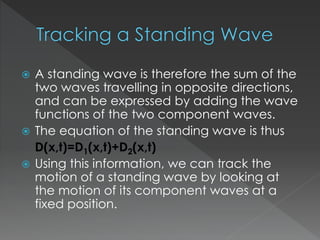
 A standing wave is therefore the sum of the
two waves travelling in opposite directions,
and can be expressed by adding the wave
functions of the two component waves.
 The equation of the standing wave is thus
D(x,t)=D1(x,t)+D2(x,t)
 Using this information, we can track the
motion of a standing wave by looking at
the motion of its component waves at a
fixed position.
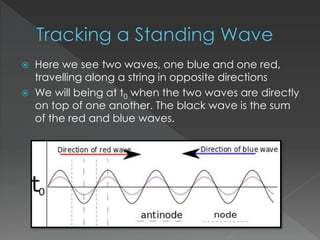
 Here we see two waves, one blue and one red,
travelling along a string in opposite directions
 We will being at t0 when the two waves are directly
on top of one another. The black wave is the sum
of the red and blue waves.
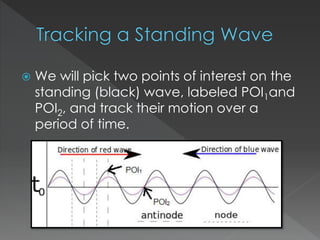
 We will pick two points of interest on the
standing (black) wave, labeled POI1and
POI2, and track their motion over a
period of time.
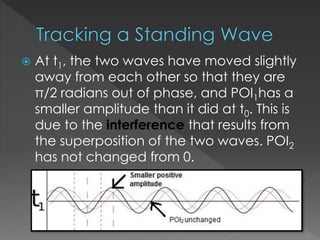
 At t1, the two waves have moved slightly
away from each other so that they are
π/2 radians out of phase, and POI1has a
smaller amplitude than it did at t0. This is
due to the interference that results from
the superposition of the two waves. POI2
has not changed from 0.
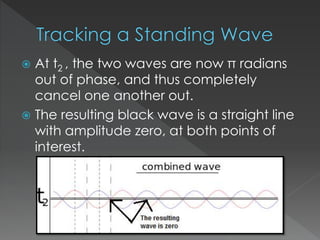
 At t2 , the two waves are now π radians
out of phase, and thus completely
cancel one another out.
 The resulting black wave is a straight line
with amplitude zero, at both points of
interest.
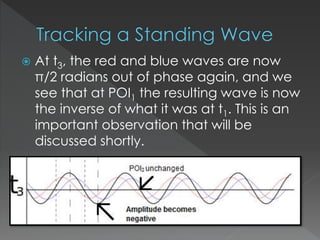
 At t3, the red and blue waves are now
π/2 radians out of phase again, and we
see that at POI1 the resulting wave is now
the inverse of what it was at t1. This is an
important observation that will be
discussed shortly.
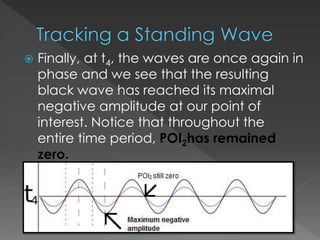
 Finally, at t4, the waves are once again in
phase and we see that the resulting
black wave has reached its maximal
negative amplitude at our point of
interest. Notice that throughout the
entire time period, POI2has remained
zero.
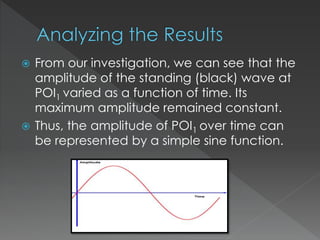
 From our investigation, we can see that the
amplitude of the standing (black) wave at
POI1 varied as a function of time. Its
maximum amplitude remained constant.
 Thus, the amplitude of POI1 over time can
be represented by a simple sine function.
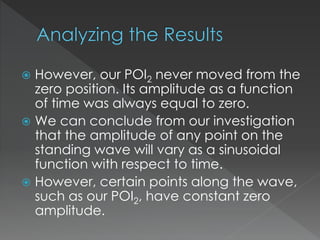
 However, our POI2 never moved from the
zero position. Its amplitude as a function
of time was always equal to zero.
 We can conclude from our investigation
that the amplitude of any point on the
standing wave will vary as a sinusoidal
function with respect to time.
 However, certain points along the wave,
such as our POI2, have constant zero
amplitude.
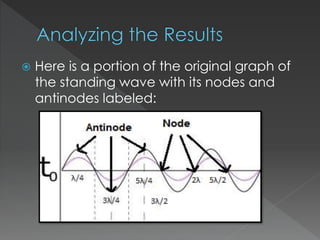
 We call those points “nodes” and they
occur at every location x=mλ/2, where
m is any integer value.
 Our other point, POI1, is an example of
what is called an “antinode”, which is
any point where the standing wave
reaches a maximum amplitude. They
occur at every location x=(m+1/2)(λ/2),
where m is any integer value.
 Here is a portion of the original graph of
the standing wave with its nodes and
antinodes labeled:
 Just like our two points of interest, every
point on the standing wave (over the
course of one wavelength) has its own
unique maximum amplitude, and it
oscillates from its positive to its negative
maximum amplitude
 This is different from travelling waves, in
which every point on the wave oscillates
with the same amplitude
 Question 1:
A sinusoidal standing wave has a
wavelength equal to π/2. Where are its
first 4 nodes located?
 Answer:
A standing wave has nodes at every point
x=mλ/2. The first node will have the lowest
possible value of m, which is zero. Therefore,
the first node occurs at x=0. Each
consecutive node will have a value of m
one greater than the last. That gives us the
second node at x=(0+1)(π/2)(1/2)= π/4, the
third node at x=(1+1)(π/2)(1/2)= π/2 and
the fourth node at x=(2+1)(π/2)(1/2)= 3π/4
 Question 2:
Find the locations of the first 4 antinodes
of the standing wave in the previous
problem.
 Answer:
The antinodes of a standing wave are
located at every point x=(m+1/2)(λ/2).
Therefore, as previously, the first antinode is
found at the lowest value of m:
x=(0+1/2)(π/2)(1/2)= π/8. The second
antinode will be at
(0+1+1/2)(π/2)(1/2)=3π/8. The third
antinode is found at (1+1+1/2)(π/2)(1/2)=
5π/8 and the fourth antinode at
(2+1+1/2)(π/2)(1/2)= 7π/8
 Pictures from:
 http://www.minelab.com/__files/i/5894/S
ineWave.gif
 http://en.wikipedia.org/wiki/Standing_w
ave#mediaviewer/File:Standingwaves.sv
g

Learning Object: Analyzing a Standing Wave

  • 2.
     In thisLearning Object we will look at how the amplitudes of two fixed positions on a standing wave change with time.
  • 3.
     In thisLearning Object we will look at how the amplitudes of two fixed positions on a standing wave change with time.  But what are standing waves?
  • 4.
     In thisLearning Object we will look at how the amplitudes of two fixed positions on a standing wave change with time.  But what are standing waves?  A standing wave results when two waves that have the same frequency and amplitude travel in opposite directions along the same medium.
  • 5.
     A standingwave is therefore the sum of the two waves travelling in opposite directions, and can be expressed by adding the wave functions of the two component waves.  The equation of the standing wave is thus D(x,t)=D1(x,t)+D2(x,t)  Using this information, we can track the motion of a standing wave by looking at the motion of its component waves at a fixed position.
  • 6.
     Here wesee two waves, one blue and one red, travelling along a string in opposite directions  We will being at t0 when the two waves are directly on top of one another. The black wave is the sum of the red and blue waves.
  • 7.
     We willpick two points of interest on the standing (black) wave, labeled POI1and POI2, and track their motion over a period of time.
  • 8.
     At t1,the two waves have moved slightly away from each other so that they are π/2 radians out of phase, and POI1has a smaller amplitude than it did at t0. This is due to the interference that results from the superposition of the two waves. POI2 has not changed from 0.
  • 9.
     At t2, the two waves are now π radians out of phase, and thus completely cancel one another out.  The resulting black wave is a straight line with amplitude zero, at both points of interest.
  • 10.
     At t3,the red and blue waves are now π/2 radians out of phase again, and we see that at POI1 the resulting wave is now the inverse of what it was at t1. This is an important observation that will be discussed shortly.
  • 11.
     Finally, att4, the waves are once again in phase and we see that the resulting black wave has reached its maximal negative amplitude at our point of interest. Notice that throughout the entire time period, POI2has remained zero.
  • 12.
     From ourinvestigation, we can see that the amplitude of the standing (black) wave at POI1 varied as a function of time. Its maximum amplitude remained constant.  Thus, the amplitude of POI1 over time can be represented by a simple sine function.
  • 13.
     However, ourPOI2 never moved from the zero position. Its amplitude as a function of time was always equal to zero.  We can conclude from our investigation that the amplitude of any point on the standing wave will vary as a sinusoidal function with respect to time.  However, certain points along the wave, such as our POI2, have constant zero amplitude.
  • 14.
     We callthose points “nodes” and they occur at every location x=mλ/2, where m is any integer value.  Our other point, POI1, is an example of what is called an “antinode”, which is any point where the standing wave reaches a maximum amplitude. They occur at every location x=(m+1/2)(λ/2), where m is any integer value.
  • 15.
     Here isa portion of the original graph of the standing wave with its nodes and antinodes labeled:
  • 16.
     Just likeour two points of interest, every point on the standing wave (over the course of one wavelength) has its own unique maximum amplitude, and it oscillates from its positive to its negative maximum amplitude  This is different from travelling waves, in which every point on the wave oscillates with the same amplitude
  • 17.
     Question 1: Asinusoidal standing wave has a wavelength equal to π/2. Where are its first 4 nodes located?
  • 18.
     Answer: A standingwave has nodes at every point x=mλ/2. The first node will have the lowest possible value of m, which is zero. Therefore, the first node occurs at x=0. Each consecutive node will have a value of m one greater than the last. That gives us the second node at x=(0+1)(π/2)(1/2)= π/4, the third node at x=(1+1)(π/2)(1/2)= π/2 and the fourth node at x=(2+1)(π/2)(1/2)= 3π/4
  • 19.
     Question 2: Findthe locations of the first 4 antinodes of the standing wave in the previous problem.
  • 20.
     Answer: The antinodesof a standing wave are located at every point x=(m+1/2)(λ/2). Therefore, as previously, the first antinode is found at the lowest value of m: x=(0+1/2)(π/2)(1/2)= π/8. The second antinode will be at (0+1+1/2)(π/2)(1/2)=3π/8. The third antinode is found at (1+1+1/2)(π/2)(1/2)= 5π/8 and the fourth antinode at (2+1+1/2)(π/2)(1/2)= 7π/8
  • 21.
     Pictures from: http://www.minelab.com/__files/i/5894/S ineWave.gif  http://en.wikipedia.org/wiki/Standing_w ave#mediaviewer/File:Standingwaves.sv g