Formation of stationary
waves with explanation
By: Tshiring lundup lama
Introductions
• Wave
• A wave is a disturbance that travels through a medium,
caused by changes in pressure or density.
For energy to be transmitted through a medium, the medium
must have three properties for mechanical wave :
a. Elasticity
B. Inertia
Explanation: Wave motion occurs due to the repeated periodic
motion of particles about their mean positions. The disturbance
is transferred from one particle to the next, carrying energy
Background study of stationary wave
A wave pattern that is created when two progressive waves of the same frequency and amplitude
travel in opposite directions and overlap
• Michael Faraday (1831) first observed standing waves on liquid surfaces, now called Faraday waves.
•
• Franz Melde (1860) demonstrated standing waves on a string and coined the term “standing wave”
through his famous experiment.
• Ernst Chladni visualized standing waves on vibrating plates, showing nodal patterns, which helped
understand wave behavior in solids.
•
• Stationary waves occur in strings, air columns, and other elastic media where reflection and
interference take place.
Objective
To understand the concept of stationary waves
To study necessary conditions for formation
• To explain formation mechanism .
Properties of waves
• Node (N): Points on a stationary wave with zero (minimum) amplitude and
no movement.
• Antinode (A): Points with maximum amplitude, located halfway between
nodes.
• Amplitude Variation: Unlike traveling waves, amplitude in stationary
waves changes with position, from zero at nodes to maximum at
antinodes.
• Wavelength in Stationary Waves: The distance between consecutive nodes
or antinodes is half a wavelength (1/2). The distance between a node and
an antinode is A/4.
Condition
1. Two Identical Waves: The waves must have the same frequency, same amplitude, and same
wavelength.
•
• 2. Opposite Directions: The two waves must travel in exactly opposite directions.
•
• 3. Superposition: They should overlap and interfere due to the principle of superposition.
•
• 4. Reflection at a Boundary: One wave is usually formed due to reflection from a fixed or open
boundary.
•
• 5. Same Medium: Both waves must travel in the same medium so that their speed remains constant.
• 6. Phase Relationship: The phase difference between them must remain constant throughout
Formation of stationary wave
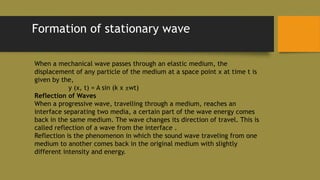
When a mechanical wave passes through an elastic medium, the
displacement of any particle of the medium at a space point x at time t is
given by the,
y (x, t) = A sin (k x ±wt)
Reflection of Waves
When a progressive wave, travelling through a medium, reaches an
interface separating two media, a certain part of the wave energy comes
back in the same medium. The wave changes its direction of travel. This is
called reflection of a wave from the interface .
Reflection is the phenomenon in which the sound wave traveling from one
medium to another comes back in the original medium with slightly
different intensity and energy.
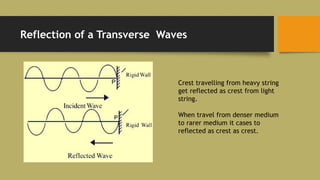
Crest travelling from heavy string
get reflected as crest from light
string.
When travel from denser medium
to rarer medium it cases to
reflected as crest as crest.
Reflection of a Transverse Waves
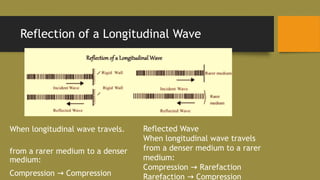
Reflection of a Longitudinal Wave
When longitudinal wave travels.
from a rarer medium to a denser
medium:
Compression Compression
→
Reflected Wave
When longitudinal wave travels
from a denser medium to a rarer
medium:
Compression Rarefaction
→
Rarefaction Compression
→
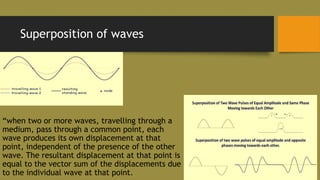
Superposition of waves
“when two or more waves, travelling through a
medium, pass through a common point, each
wave produces its own displacement at that
point, independent of the presence of the other
wave. The resultant displacement at that point is
equal to the vector sum of the displacements due
to the individual wave at that point.
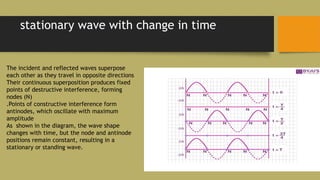
stationary wave with change in time
The incident and reflected waves superpose
each other as they travel in opposite directions
Their continuous superposition produces fixed
points of destructive interference, forming
nodes (N)
.Points of constructive interference form
antinodes, which oscillate with maximum
amplitude
As shown in the diagram, the wave shape
changes with time, but the node and antinode
positions remain constant, resulting in a
stationary or standing wave.
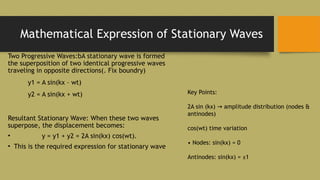
Mathematical Expression of Stationary Waves
Two Progressive Waves:bA stationary wave is formed
the superposition of two identical progressive waves
traveling in opposite directions(. Fix boundry)
y1 = A sin(kx – wt)
y2 = A sin(kx + wt)
Resultant Stationary Wave: When these two waves
superpose, the displacement becomes:
• y = y1 + y2 = 2A sin(kx) cos(wt).
• This is the required expression for stationary wave
Key Points:
2A sin (kx) amplitude distribution (nodes &
→
antinodes)
cos(wt) time variation
• Nodes: sin(kx) = 0
Antinodes: sin(kx) = ±1
Application
Musical instruments: Strings and air columns use stationary waves to produce
sound (e.g., guitar, flute).
Microwave & radio devices: Standing waves are used in resonators and
waveguides.
Optical instruments: Formation of stationary light waves in lasers and
interferometers.
Engineering & structural analysis: Used to detect vibration patterns in
buildings, bridges, and plates.
• Physics experiments: Demonstrates nodes and antinodes, helps study wave
properties.
Conclusion
• Stationary waves are formed when two waves of the same
frequency and amplitude travel in opposite directions, usually due
to reflection at boundaries. Their superposition creates a fixed
pattern of nodes (points of zero displacement) and antinodes
(points of maximum displacement). Unlike progressive waves,
stationary waves store energy in place rather than transferring it
forward. They are commonly observed in vibrating strings, musical
instruments, and air columns, helping us understand wave
behavior, resonance, and energy distribution in physical systems.
Reference
Principles of Physics, Grade XII,
Vedantu. “Stationary Waves.”
https://www.vedantu.com/jee-main/physics-stationary
-waves
BYJU’S. “Standing Wave on a String.”
https://byjus.com/jee/standing-wave-on-a-string/
Presentation (13.pptxkdkdisiisisisiis887t

Presentation (13.pptxkdkdisiisisisiis887t

  • 1.
    Formation of stationary waveswith explanation By: Tshiring lundup lama
  • 2.
    Introductions • Wave • Awave is a disturbance that travels through a medium, caused by changes in pressure or density. For energy to be transmitted through a medium, the medium must have three properties for mechanical wave : a. Elasticity B. Inertia Explanation: Wave motion occurs due to the repeated periodic motion of particles about their mean positions. The disturbance is transferred from one particle to the next, carrying energy
  • 3.
    Background study ofstationary wave A wave pattern that is created when two progressive waves of the same frequency and amplitude travel in opposite directions and overlap • Michael Faraday (1831) first observed standing waves on liquid surfaces, now called Faraday waves. • • Franz Melde (1860) demonstrated standing waves on a string and coined the term “standing wave” through his famous experiment. • Ernst Chladni visualized standing waves on vibrating plates, showing nodal patterns, which helped understand wave behavior in solids. • • Stationary waves occur in strings, air columns, and other elastic media where reflection and interference take place.
  • 4.
    Objective To understand theconcept of stationary waves To study necessary conditions for formation • To explain formation mechanism .
  • 5.
    Properties of waves •Node (N): Points on a stationary wave with zero (minimum) amplitude and no movement. • Antinode (A): Points with maximum amplitude, located halfway between nodes. • Amplitude Variation: Unlike traveling waves, amplitude in stationary waves changes with position, from zero at nodes to maximum at antinodes. • Wavelength in Stationary Waves: The distance between consecutive nodes or antinodes is half a wavelength (1/2). The distance between a node and an antinode is A/4.
  • 6.
    Condition 1. Two IdenticalWaves: The waves must have the same frequency, same amplitude, and same wavelength. • • 2. Opposite Directions: The two waves must travel in exactly opposite directions. • • 3. Superposition: They should overlap and interfere due to the principle of superposition. • • 4. Reflection at a Boundary: One wave is usually formed due to reflection from a fixed or open boundary. • • 5. Same Medium: Both waves must travel in the same medium so that their speed remains constant. • 6. Phase Relationship: The phase difference between them must remain constant throughout
  • 7.
    Formation of stationarywave When a mechanical wave passes through an elastic medium, the displacement of any particle of the medium at a space point x at time t is given by the, y (x, t) = A sin (k x ±wt) Reflection of Waves When a progressive wave, travelling through a medium, reaches an interface separating two media, a certain part of the wave energy comes back in the same medium. The wave changes its direction of travel. This is called reflection of a wave from the interface . Reflection is the phenomenon in which the sound wave traveling from one medium to another comes back in the original medium with slightly different intensity and energy.
  • 8.
    Crest travelling fromheavy string get reflected as crest from light string. When travel from denser medium to rarer medium it cases to reflected as crest as crest. Reflection of a Transverse Waves
  • 9.
    Reflection of aLongitudinal Wave When longitudinal wave travels. from a rarer medium to a denser medium: Compression Compression → Reflected Wave When longitudinal wave travels from a denser medium to a rarer medium: Compression Rarefaction → Rarefaction Compression →
  • 10.
    Superposition of waves “whentwo or more waves, travelling through a medium, pass through a common point, each wave produces its own displacement at that point, independent of the presence of the other wave. The resultant displacement at that point is equal to the vector sum of the displacements due to the individual wave at that point.
  • 11.
    stationary wave withchange in time The incident and reflected waves superpose each other as they travel in opposite directions Their continuous superposition produces fixed points of destructive interference, forming nodes (N) .Points of constructive interference form antinodes, which oscillate with maximum amplitude As shown in the diagram, the wave shape changes with time, but the node and antinode positions remain constant, resulting in a stationary or standing wave.
  • 12.
    Mathematical Expression ofStationary Waves Two Progressive Waves:bA stationary wave is formed the superposition of two identical progressive waves traveling in opposite directions(. Fix boundry) y1 = A sin(kx – wt) y2 = A sin(kx + wt) Resultant Stationary Wave: When these two waves superpose, the displacement becomes: • y = y1 + y2 = 2A sin(kx) cos(wt). • This is the required expression for stationary wave Key Points: 2A sin (kx) amplitude distribution (nodes & → antinodes) cos(wt) time variation • Nodes: sin(kx) = 0 Antinodes: sin(kx) = ±1
  • 13.
    Application Musical instruments: Stringsand air columns use stationary waves to produce sound (e.g., guitar, flute). Microwave & radio devices: Standing waves are used in resonators and waveguides. Optical instruments: Formation of stationary light waves in lasers and interferometers. Engineering & structural analysis: Used to detect vibration patterns in buildings, bridges, and plates. • Physics experiments: Demonstrates nodes and antinodes, helps study wave properties.
  • 14.
    Conclusion • Stationary wavesare formed when two waves of the same frequency and amplitude travel in opposite directions, usually due to reflection at boundaries. Their superposition creates a fixed pattern of nodes (points of zero displacement) and antinodes (points of maximum displacement). Unlike progressive waves, stationary waves store energy in place rather than transferring it forward. They are commonly observed in vibrating strings, musical instruments, and air columns, helping us understand wave behavior, resonance, and energy distribution in physical systems.
  • 15.
    Reference Principles of Physics,Grade XII, Vedantu. “Stationary Waves.” https://www.vedantu.com/jee-main/physics-stationary -waves BYJU’S. “Standing Wave on a String.” https://byjus.com/jee/standing-wave-on-a-string/