Standing Waves
By Brigette Wee
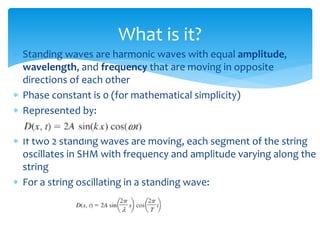
 Standing waves are harmonic waves with equal amplitude,
wavelength, and frequency that are moving in opposite
directions of each other
 Phase constant is 0 (for mathematical simplicity)
 Represented by:
 If two 2 standing waves are moving, each segment of the string
oscillates in SHM with frequency and amplitude varying along the
string
 For a string oscillating in a standing wave:
What is it?
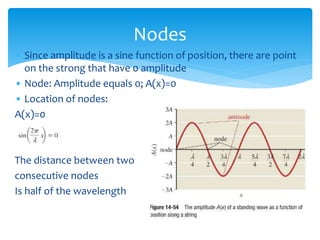
• Since amplitude is a sine function of position, there are point
on the strong that have 0 amplitude
• Node: Amplitude equals 0; A(x)=0
• Location of nodes:
A(x)=0
The distance between two
consecutive nodes
Is half of the wavelength
Nodes
Antinodes
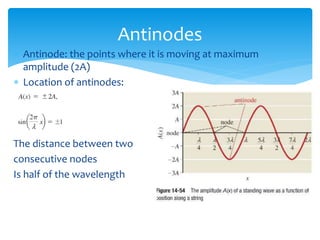
 Antinode: the points where it is moving at maximum
amplitude (2A)
 Location of antinodes:
The distance between two
consecutive nodes
Is half of the wavelength
Lets try a problem…
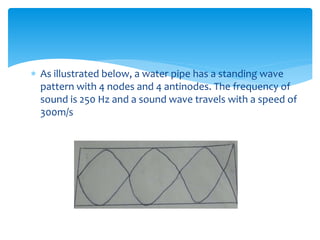
 As illustrated below, a water pipe has a standing wave
pattern with 4 nodes and 4 antinodes. The frequency of
sound is 250 Hz and a sound wave travels with a speed of
300m/s
 What is the length of the water tube?
Question 1
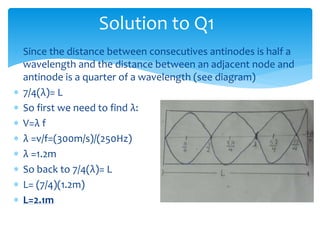
 Since the distance between consecutives antinodes is half a
wavelength and the distance between an adjacent node and
antinode is a quarter of a wavelength (see diagram)
 7/4(λ)= L
 So first we need to find λ:
 V=λ f
 λ =v/f=(300m/s)/(250Hz)
 λ =1.2m
 So back to 7/4(λ)= L
 L= (7/4)(1.2m)
 L=2.1m
Solution to Q1
Thank you for watching
 Physics for Scientist and Engineers An Interactive
Approach by Hawkes, Iqbal, Mansour Milner-Bolotin,
Williams
Work cited

Standing waves

  • 1.
  • 2.
     Standing wavesare harmonic waves with equal amplitude, wavelength, and frequency that are moving in opposite directions of each other  Phase constant is 0 (for mathematical simplicity)  Represented by:  If two 2 standing waves are moving, each segment of the string oscillates in SHM with frequency and amplitude varying along the string  For a string oscillating in a standing wave: What is it?
  • 3.
    • Since amplitudeis a sine function of position, there are point on the strong that have 0 amplitude • Node: Amplitude equals 0; A(x)=0 • Location of nodes: A(x)=0 The distance between two consecutive nodes Is half of the wavelength Nodes
  • 4.
    Antinodes  Antinode: thepoints where it is moving at maximum amplitude (2A)  Location of antinodes: The distance between two consecutive nodes Is half of the wavelength
  • 5.
    Lets try aproblem…
  • 6.
     As illustratedbelow, a water pipe has a standing wave pattern with 4 nodes and 4 antinodes. The frequency of sound is 250 Hz and a sound wave travels with a speed of 300m/s
  • 7.
     What isthe length of the water tube? Question 1
  • 8.
     Since thedistance between consecutives antinodes is half a wavelength and the distance between an adjacent node and antinode is a quarter of a wavelength (see diagram)  7/4(λ)= L  So first we need to find λ:  V=λ f  λ =v/f=(300m/s)/(250Hz)  λ =1.2m  So back to 7/4(λ)= L  L= (7/4)(1.2m)  L=2.1m Solution to Q1
  • 9.
    Thank you forwatching
  • 10.
     Physics forScientist and Engineers An Interactive Approach by Hawkes, Iqbal, Mansour Milner-Bolotin, Williams Work cited