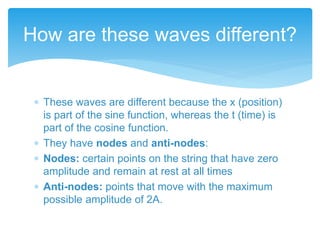
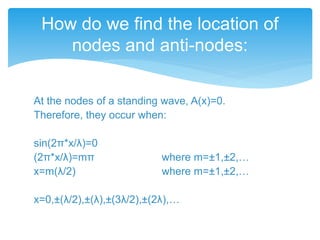
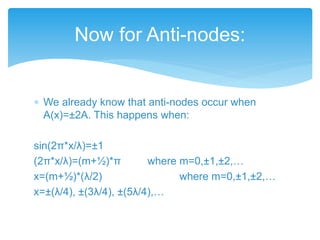
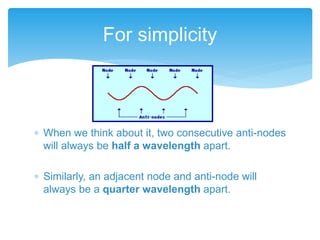
Standing waves occur when two waves of equal amplitude, wavelength, and frequency travel in opposite directions and superimpose. The result is a wave with a position-dependent amplitude described by A(x)=2Asin(kx), where k is the wavenumber. Nodes occur at integer multiples of half wavelengths, where the amplitude is zero. Anti-nodes occur at odd integer multiples of quarter wavelengths, where the amplitude is maximum (2A). The full equation for a standing wave is D(x,t)=2Asin(kx)cos(ωt), relating amplitude to position and time using sines and cosines respectively.


![ They are two harmonic waves of equal amplitude, wavelength, and
frequency moving in the opposite direction of one another
Mathematically, we see these two waves as:
D1(x,t)=Asin(kx-ωt)
and:
D2(x,t)=Asin(kx+ωt)
where:
D(x,t)=D1(x,t)+D2(x,t)
=A[sin(kx-ωt)+sin(kx+ωt)]
The sum of these two waves gives rise to a simple trigonometric identity
similar to: sin(a-b)+sin(a+b)=2sin(a)cos(b)
In this case: D(x,t)=2Asin(kx)cos(ωt)
What are standing waves?](https://image.slidesharecdn.com/standingwaves-150309012041-conversion-gate01/85/Standing-waves-Explanation-in-Depth-3-320.jpg)