Learning Object 6
Standing Waves By David Park
Standing Waves
❖ A Standing wave is two harmonic waves with equal
amplitude, wavelength and frequency that are moving
in the opposite direction of each other.
❖ For mathematical simplicity, we assume that phase
constant for both waves are zero.
❖ However, the general case is that the phase constant for
the two waves may be unequal.
Standing Waves
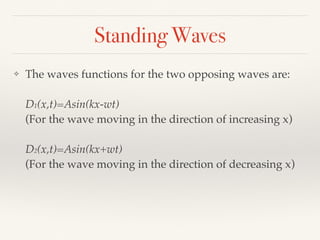
❖ The waves functions for the two opposing waves are:


D1(x,t)=Asin(kx-wt)

(For the wave moving in the direction of increasing x)


D2(x,t)=Asin(kx+wt)

(For the wave moving in the direction of decreasing x)
❖ When you apply the principal of superposition* the
result is a wave function:

D(x,t)=D1(x,t)+D2(x,t)

=A sin(kx-wt)+A sin(kx+wt)

=A[sin(kx-wt)+sin(kx+wt)]
❖ Using the trigonometric identity

sin(a-b)+sin(a+b)=2sin(a)*cos(b), where a=kx and b=wt

D(x,t)=2Asin(kx)*cos(wt)


*(Superposition) When more than one wave is present in a medium at the same time,
the resultant wave at any point in the medium is equal to the algebraic sum of the
waves at that point
Travelling wave vs. Standing Wave
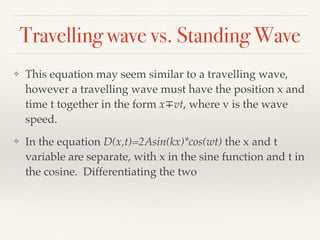
❖ This equation may seem similar to a travelling wave,
however a travelling wave must have the position x and
time t together in the form x∓vt, where v is the wave
speed.
❖ In the equation D(x,t)=2Asin(kx)*cos(wt) the x and t
variable are separate, with x in the sine function and t in
the cosine. Differentiating the two
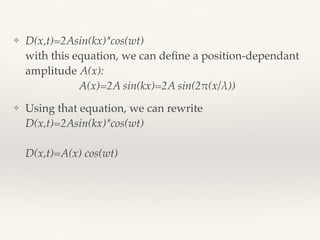
❖ D(x,t)=2Asin(kx)*cos(wt) 

with this equation, we can define a position-dependant
amplitude A(x):

A(x)=2A sin(kx)=2A sin(2!(x/λ))
❖ Using that equation, we can rewrite
D(x,t)=2Asin(kx)*cos(wt) 


D(x,t)=A(x) cos(wt)
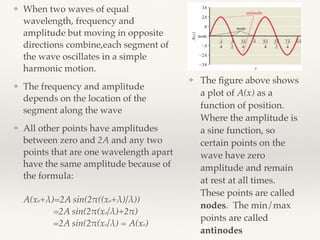
❖ When two waves of equal
wavelength, frequency and
amplitude but moving in opposite
directions combine,each segment of
the wave oscillates in a simple
harmonic motion.
❖ The frequency and amplitude
depends on the location of the
segment along the wave
❖ All other points have amplitudes
between zero and 2A and any two
points that are one wavelength apart
have the same amplitude because of
the formula:


A(xo+λ)=2A sin(2!((xo+λ)/λ))

=2A sin(2!(xo/λ)+2!)

=2A sin(2!(xo/λ) = A(xo)
❖ The figure above shows
a plot of A(x) as a
function of position.
Where the amplitude is
a sine function, so
certain points on the
wave have zero
amplitude and remain
at rest at all times.
These points are called
nodes. The min/max
points are called
antinodes
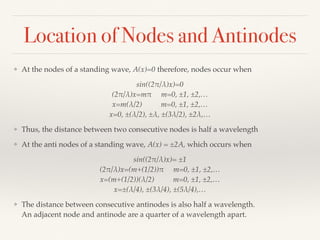
Location of Nodes and Antinodes
❖ At the nodes of a standing wave, A(x)=0 therefore, nodes occur when
sin((2!/λ)x)=0

(2!/λ)x=m! m=0, ±1, ±2,…

x=m(λ/2) m=0, ±1, ±2,…

x=0, ±(λ/2), ±λ, ±(3λ/2), ±2λ,…
❖ Thus, the distance between two consecutive nodes is half a wavelength
❖ At the anti nodes of a standing wave, A(x) = ±2A, which occurs when
sin((2!/λ)x)= ±1

(2!/λ)x=(m+(1/2))! m=0, ±1, ±2,…

x=(m+(1/2))(λ/2) m=0, ±1, ±2,…

x=±(λ/4), ±(3λ/4), ±(5λ/4),…
❖ The distance between consecutive antinodes is also half a wavelength.

An adjacent node and antinode are a quarter of a wavelength apart.

❖ To see how a wave oscillates in standing wave pattern we use the wave function
in terms of the time period:
D(x,t)=2A sin((2!/λ)x)*cos((2!/T)t)
❖ All points between two consecutive nodes oscillate in phase with each other. The
antinode has the greatest mean speed as it has to cover the longest distance (8A)
in one period. The speed decreases the further away from the antinode and is
zero at the nodes.
❖ Note: the motion of the sections between the next two nodes is ! rad out of phase
with the first section
❖ The sine term in the wave function accounts for this property:
A(xo+(λ/2))=2A sin((2!/λ)*(xo+(λ/2)))

=2A sin((2!/λ)xo)+!

=-2A sin((2!(λ/xo))

=-A(xo)
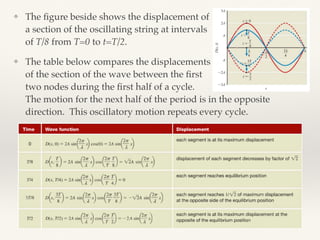
❖ The figure beside shows the displacement of

a section of the oscillating string at intervals

of T/8 from T=0 to t=T/2.
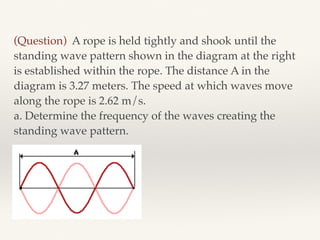
❖ The table below compares the displacements

of the section of the wave between the first

two nodes during the first half of a cycle.

The motion for the next half of the period is in the opposite
direction. This oscillatory motion repeats every cycle.
EXAMPLE
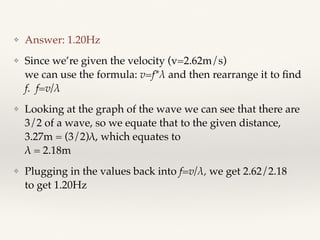
(Question) A rope is held tightly and shook until the
standing wave pattern shown in the diagram at the right
is established within the rope. The distance A in the
diagram is 3.27 meters. The speed at which waves move
along the rope is 2.62 m/s.
a. Determine the frequency of the waves creating the
standing wave pattern.
❖ Answer: 1.20Hz
❖ Since we’re given the velocity (v=2.62m/s)

we can use the formula: v=f*λ and then rearrange it to find
f. f=v/λ
❖ Looking at the graph of the wave we can see that there are
3/2 of a wave, so we equate that to the given distance,
3.27m = (3/2)λ, which equates to 

λ = 2.18m
❖ Plugging in the values back into f=v/λ, we get 2.62/2.18

to get 1.20Hz

❖ Diagrams and tables all taken from Physics for Scientists
and Engineers textbook.
❖ Example taken off of 

http://www.physicsclassroom.com/calcpad/waves/
prob18.cfm

Physics LO 6 -Standing waves

  • 1.
    Learning Object 6 StandingWaves By David Park
  • 2.
    Standing Waves ❖ AStanding wave is two harmonic waves with equal amplitude, wavelength and frequency that are moving in the opposite direction of each other. ❖ For mathematical simplicity, we assume that phase constant for both waves are zero. ❖ However, the general case is that the phase constant for the two waves may be unequal.
  • 3.
    Standing Waves ❖ Thewaves functions for the two opposing waves are:
 
 D1(x,t)=Asin(kx-wt)
 (For the wave moving in the direction of increasing x)
 
 D2(x,t)=Asin(kx+wt)
 (For the wave moving in the direction of decreasing x)
  • 4.
    ❖ When youapply the principal of superposition* the result is a wave function:
 D(x,t)=D1(x,t)+D2(x,t)
 =A sin(kx-wt)+A sin(kx+wt)
 =A[sin(kx-wt)+sin(kx+wt)] ❖ Using the trigonometric identity
 sin(a-b)+sin(a+b)=2sin(a)*cos(b), where a=kx and b=wt
 D(x,t)=2Asin(kx)*cos(wt)
 
 *(Superposition) When more than one wave is present in a medium at the same time, the resultant wave at any point in the medium is equal to the algebraic sum of the waves at that point
  • 5.
    Travelling wave vs.Standing Wave ❖ This equation may seem similar to a travelling wave, however a travelling wave must have the position x and time t together in the form x∓vt, where v is the wave speed. ❖ In the equation D(x,t)=2Asin(kx)*cos(wt) the x and t variable are separate, with x in the sine function and t in the cosine. Differentiating the two
  • 6.
    ❖ D(x,t)=2Asin(kx)*cos(wt) 
 withthis equation, we can define a position-dependant amplitude A(x):
 A(x)=2A sin(kx)=2A sin(2!(x/λ)) ❖ Using that equation, we can rewrite D(x,t)=2Asin(kx)*cos(wt) 
 
 D(x,t)=A(x) cos(wt)
  • 7.
    ❖ When twowaves of equal wavelength, frequency and amplitude but moving in opposite directions combine,each segment of the wave oscillates in a simple harmonic motion. ❖ The frequency and amplitude depends on the location of the segment along the wave ❖ All other points have amplitudes between zero and 2A and any two points that are one wavelength apart have the same amplitude because of the formula:
 
 A(xo+λ)=2A sin(2!((xo+λ)/λ))
 =2A sin(2!(xo/λ)+2!)
 =2A sin(2!(xo/λ) = A(xo) ❖ The figure above shows a plot of A(x) as a function of position. Where the amplitude is a sine function, so certain points on the wave have zero amplitude and remain at rest at all times. These points are called nodes. The min/max points are called antinodes
  • 8.
    Location of Nodesand Antinodes ❖ At the nodes of a standing wave, A(x)=0 therefore, nodes occur when sin((2!/λ)x)=0
 (2!/λ)x=m! m=0, ±1, ±2,…
 x=m(λ/2) m=0, ±1, ±2,…
 x=0, ±(λ/2), ±λ, ±(3λ/2), ±2λ,… ❖ Thus, the distance between two consecutive nodes is half a wavelength ❖ At the anti nodes of a standing wave, A(x) = ±2A, which occurs when sin((2!/λ)x)= ±1
 (2!/λ)x=(m+(1/2))! m=0, ±1, ±2,…
 x=(m+(1/2))(λ/2) m=0, ±1, ±2,…
 x=±(λ/4), ±(3λ/4), ±(5λ/4),… ❖ The distance between consecutive antinodes is also half a wavelength.
 An adjacent node and antinode are a quarter of a wavelength apart.

  • 9.
    ❖ To seehow a wave oscillates in standing wave pattern we use the wave function in terms of the time period: D(x,t)=2A sin((2!/λ)x)*cos((2!/T)t) ❖ All points between two consecutive nodes oscillate in phase with each other. The antinode has the greatest mean speed as it has to cover the longest distance (8A) in one period. The speed decreases the further away from the antinode and is zero at the nodes. ❖ Note: the motion of the sections between the next two nodes is ! rad out of phase with the first section ❖ The sine term in the wave function accounts for this property: A(xo+(λ/2))=2A sin((2!/λ)*(xo+(λ/2)))
 =2A sin((2!/λ)xo)+!
 =-2A sin((2!(λ/xo))
 =-A(xo)
  • 10.
    ❖ The figurebeside shows the displacement of
 a section of the oscillating string at intervals
 of T/8 from T=0 to t=T/2. ❖ The table below compares the displacements
 of the section of the wave between the first
 two nodes during the first half of a cycle.
 The motion for the next half of the period is in the opposite direction. This oscillatory motion repeats every cycle.
  • 11.
  • 12.
    (Question) A ropeis held tightly and shook until the standing wave pattern shown in the diagram at the right is established within the rope. The distance A in the diagram is 3.27 meters. The speed at which waves move along the rope is 2.62 m/s. a. Determine the frequency of the waves creating the standing wave pattern.
  • 13.
    ❖ Answer: 1.20Hz ❖Since we’re given the velocity (v=2.62m/s)
 we can use the formula: v=f*λ and then rearrange it to find f. f=v/λ ❖ Looking at the graph of the wave we can see that there are 3/2 of a wave, so we equate that to the given distance, 3.27m = (3/2)λ, which equates to 
 λ = 2.18m ❖ Plugging in the values back into f=v/λ, we get 2.62/2.18
 to get 1.20Hz

  • 14.
    ❖ Diagrams andtables all taken from Physics for Scientists and Engineers textbook. ❖ Example taken off of 
 http://www.physicsclassroom.com/calcpad/waves/ prob18.cfm