2
SUPERPOSITION OF WAVES
1. Choose the correct option:
i) When an air column in a pipe closed at one end vibrates such that three nodes are formed in it,
the frequency of its vibrations is _____ times the fundamental frequency.
(A) 2 (B) 3 (C) 4 (D) 5
Ans: (D) 5
ii) If two open organ pipes of length 50 cm and 51 cm sounded together produce 7 beats per
second, the speed of sound is _____.
(A) 307 m/s (B) 327 m/s (C) 350 m/s (D) 357 m/s
Ans: (D) 357 m/s
iii) The tension in a piano wire is increased by 25%. Its frequency becomes ______ times the
original frequency.
(A) 0.8 (B) 1.12 (C) 1.25 (D) 1.56
Ans: (B) 1.12
iv) Which of the following equations represents a wave travelling along Y-axis?
(A) x = A sin (ky - ωt) (B) y = A sin (kx - ωt)
(C) y = A sin (ky) cos (ωt) (D) y = A cos (ky) sin (ωt)
Ans: (A) x = A sin (ky - ωt)
v) A standing wave is produced on a string clamped at one end and free at the other. The length of
the string
(A) must be an odd integral multiple of
𝜆
4
. (B) must be an odd integral multiple of
𝜆
2
.
(C) must be an even integral multiple of λ. (D) must be an odd integral multiple of λ.
Ans: (A) must be an odd integral multiple of
𝜆
4
2. Answer in brief:
i) A wave is represented by an equation y = A sin (Bx + Ct). Given that the constants A, B and C are
positive, can you tell in which direction the wave is moving?
Ans: Equation of the wave is y = A sin (Bx + Ct).
When the variable of the equation is (Bx + Ct)
then the wave must be moving in the negative x direction.
ii) A string is fixed at the two ends and is vibrating in its fundamental mode. It is known that the
two ends will be at rest. Apart from these, is there any position on the string which can be
touched so as not to disturb the motion of the string? What will be the answer to this question
if the string is vibrating in its first and second overtones?
Ans: No. We know that in case of the fundamental mode, all points except the ends are vibrating with
different amplitudes.
Now, touching any point other than the ends will disturb the motion.
When the string will vibrate in the first overtone there is a node also at the midpoint which is
stationary.
This midpoint can be touched without disturbing the motion.
Thus, we can say that there is no point in the string that can satisfy the given condition.
3
iii) What are harmonics and overtones?
Ans: Harmonic frequencies are whole number multiples of the fundamental frequency or the lowest
frequency of vibration.
Consider a vibrating string. The modes of vibration are all multiples of the fundamental and are
related to the string length and wave velocity. Higher frequencies are found via the
relationship 𝑓
𝑛= n𝑓1, wavelength =2
𝐿
𝑛
where L is the string length.
An overtone is a name given to any resonant frequency above the fundamental frequency or
fundamental tone. The list of successive overtones for an object is called the overtone series. The
first overtone as well as all subsequent overtones in the series may or may not be an integer
multiple of the fundamental. Sometimes the relationship is that simple, and other times it is more
complex, depending on the properties and geometry of the vibrating object.
iv) For a stationary wave set up in a string having both ends fixed, what is the ratio of the
fundamental frequency to the second harmonic?
Ans: The fundamental frequency is the first harmonic. Therefore, the ratio of the fundamental
frequency (n) to the second harmonic (𝑛1) is 1:2.
v) The amplitude of a wave is represented by y = 0.2 sin 4π [
𝒕
𝟎.𝟎𝟖
−
𝒙
𝟎.𝟖
] in SI units.
Find (a) wavelength,
(b) frequency, and
(c) amplitude of the wave.
Ans: y = 0.2 sin 4π [
𝑡
0.08
−
𝑥
0.8
]
y = 0.2 sin 2π [
2𝑡
0.08
−
2𝑥
0.8
]
y = 0.2 sin 2π [
𝑡
0.04
−
𝑥
0.4
]
Let us compare above equation with the equation of a simple harmonic progressive wave:
y = A sin 2π [
𝑡
𝑇
−
𝑥
𝜆
] = 0.2 sin 2π [
𝑡
0.04
−
𝑥
0.4
]
Comparing the quantities on both sides, we get, A = 0.2 m, T = 0.04 s, λ = 0.4 m
∴ (a) Wavelength (λ) = 0.4 m
(b) Frequency (n) =
1
𝑇
=
1
0.04
= 25 Hz
(c) Amplitude (A)= 0.2 m
3. State the characteristics of progressive waves.
Ans: Progressive wave: A progressive wave is defined as the onward transmission of the vibratory
motion of a body in an elastic medium from one particle to the successive particle.
Characteristics of a progressive wave
 Energy is transmitted from particle to particle without the physical transfer of matter.
 The particles of the medium vibrate periodically about their equilibrium positions.
 In the absence of dissipative forces, every particle vibrates with the same amplitude and
frequency but differs in phase from its adjacent particles. Every particle lags behind in its
state of motion compared to the one before it.
 Wave motion is doubly periodic, i.e., it is periodic in time and periodic in space.
 The velocity of propagation through a medium depends upon the properties of the
medium.
 A transverse wave can propagate only through solids, but not through liquids and gases
while a longitudinal wave can propagate through any material medium.
 Progressive waves are of two types: transverse and longitudinal. In a transverse
mechanical wave, the individual particles of the medium vibrate perpendicular to the
4
direction of propagation of the wave. The progressively changing phase of the successive
particles results in the formation of alternate crests and troughs that are periodic in space
and time. In an em wave, the electric and magnetic fields oscillate in mutually
perpendicular directions, perpendicular to the direction of propagation. In a longitudinal
mechanical wave, the individual particles of the medium vibrate along the line of
propagation of the wave. The progressively changing phase of the successive particles
results in the formation of typical alternate regions of compressions and rarefactions that
are periodic in space and time. Periodic compressions and rarefactions result in periodic
pressure and density variations in the medium. There is no longitudinal em wave.
4. State the characteristics of stationary waves.
Ans: Stationary wave: When two, identical, progressive waves of equal amplitudes and equal
wavelengths and traveling in a similar medium, along the similar straight line, but in opposite
directions, interfere, and then the wave formed is called a standing wave or a stationary wave.
Characteristics of stationary waves:
1. Stationary waves are produced by the interference of two identical progressive waves
travelling in opposite directions, under certain conditions.
2. The overall appearance of a standing wave is of alternate intensity maximum
(displacement antinode) and minimum (displacement node).
3. The distance between adjacent nodes (or antinodes) is λ/2.
4. The distance between successive node and antinode is λ/4.
5. There is no progressive change of phase from particle to particle. All the particles in one
loop, between two adjacent nodes, vibrate in the same phase, while the particles in
adjacent loops are in opposite phase.
6. A stationary wave does not propagate in any direction and hence does not transport
energy through the medium.
5. Derive an expression for the equation of stationary wave on a stretched string.
Ans: When two progressive waves having the same amplitude, wavelength and speed propagate in
opposite directions through the same region of a medium, their superposition under certain
conditions creates a stationary interference pattern called a stationary wave.
Consider two simple harmonic progressive waves, of the same amplitude A, wavelength λ, and
frequency n = ω/2π, traveling on a string stretched along the x-axis in opposite directions. They
may be represented by
𝑦1 = A sin (ωt - kx) (along the + x-axis) ..........(1)
𝑦2 = A sin (ωt + kx) (along the − x-axis) ..........(2)
where k = 2π/λ is the propagation constant.
By the superposition principle, the resultant displacement of the particle of the medium at the
point at which the two waves arrive simultaneously is the algebraic sum
Y = Y1 +Y2 = A [sin (ωt - kx) + sin (ωt + kx)]
Using the trigonometrical identity, sin 𝐶 + sin 𝐷 = 2 sin (
𝐶+𝐷
2
) cos (
𝐶−𝐷
2
).
y = 2A sin ωt cos (- kx)
= 2A sin ωt cos kx ........... [∴ cos (- kx) = cos (kx)]
= 2A cos kx sin ωt, ......(3)
∴ y = R sin ωt, ................(4)
where R = 2A cos kx ..............(5)
Equation (4) is the equation of a stationary wave.
6. Find the amplitude of the resultant wave produced due to interference of two waves given as
𝒚𝟏 = 𝑨𝟏 𝐬𝐢𝐧 𝝎𝒕, 𝒚𝟐 = 𝑨𝟐 𝐬𝐢𝐧(𝝎𝒕 + 𝝋)
5
Ans: The amplitude of the resultant wave produced due to the interference of the two waves is,
𝐴 = √𝐴1
2
+ 2𝐴1𝐴2 cos 𝜙 + 𝐴2
2
7. State the laws of vibrating strings and explain how vibrating strings can be verified using a
sonometer.
Ans: Laws of vibrating strings
The fundamental frequency of vibration of a stretched string or wire of uniform cross-section is
n =
1
2𝐿
√
𝑇
𝑚
where L is the vibrating length, m the mass per unit length (linear density) of the string, and T the
tension in the string. From the above expression, we can state the following three laws of
vibrating strings.
a) Law of length: The fundamental frequency of vibrations of a stretched string is inversely
proportional to its vibrating length if the tension and mass per unit length are kept
constant. If T and m are constant, n α 1/L or nL = constant.
b) Law of tension: The fundamental frequency of vibrations of a stretched string is directly
proportional to the square root of the applied tension if the length and mass per unit
length are kept constant. If L and m are constant, n α √𝑇 or 𝑛2
/T = constant.
c) Law of mass or (the law of linear density): The fundamental frequency of vibrations of a
stretched string is inversely proportional to the square root of its mass per unit length if
the length and tension are kept constant. If L and T are constant, n α
1
√𝑚
or 𝑛2
m = constant
Vibrating strings can be verified using a sonometer
i. Verification of law of length: According to this law, n α 1/T if T and m are constant. To
verify this law, the sonometer wire of given linear density m is kept under constant tension
T. The length of the wire is adjusted for the wire to vibrate in unison with tuning forks of
different frequencies 𝑛1, 𝑛2, 𝑛3, .... be the corresponding resonating lengths of the wire. It
is found that, within experimental errors, 𝑛1𝐿1 = 𝑛2𝐿2 = 𝑛3𝐿3 =.... This implies that the
product, nL =constant, which verifies the law of length.
ii. Verification of law of tension: According to this law, n α √𝑇, if L and m are constant. To
verify this law, the vibrating length L of the sonometer wire of given linear density m is
kept constant.
A set of tuning forks of different frequencies is used. The tension in the wire is adjusted for
the wire to vibrate in unison with tuning forks of different frequencies 𝑛1, 𝑛2, 𝑛3, .... 𝑇1, 𝑇2,
𝑇3,, ... be the corresponding tensions. It is found that, within experimental errors,
𝑛1
√𝑇1
=
𝑛2
√𝑇2
=
𝑛3
√𝑇3
= ⋯ ..
This implies
𝑛1
√𝑇
= constant which verifies the law of tension.
iii. Verification of linear density: According to this law, n α
1
√𝑚
, if T and L are constant. To
verify this law, two wires having different linear densities 𝑚1 and 𝑚2 are kept under
constant tension T. A tuning fork of frequency n is used. The lengths of the wires are
adjusted for the wires to vibrate in unison with the tuning fork. Let 𝐿1and 𝐿2 be the
corresponding resonating lengths of the wires. It is found that, within experimental errors,
𝐿1√𝑚1 = 𝐿2√𝑚2 . This implies 𝐿√𝑚= constant. According to the law of length of a
vibrating string, n α
1
√𝐿
∴ n α
1
√𝑚
which verifies the law of linear density.
8. Show that only odd harmonics are present in an air column vibrating in a pipe closed at one
end.
6
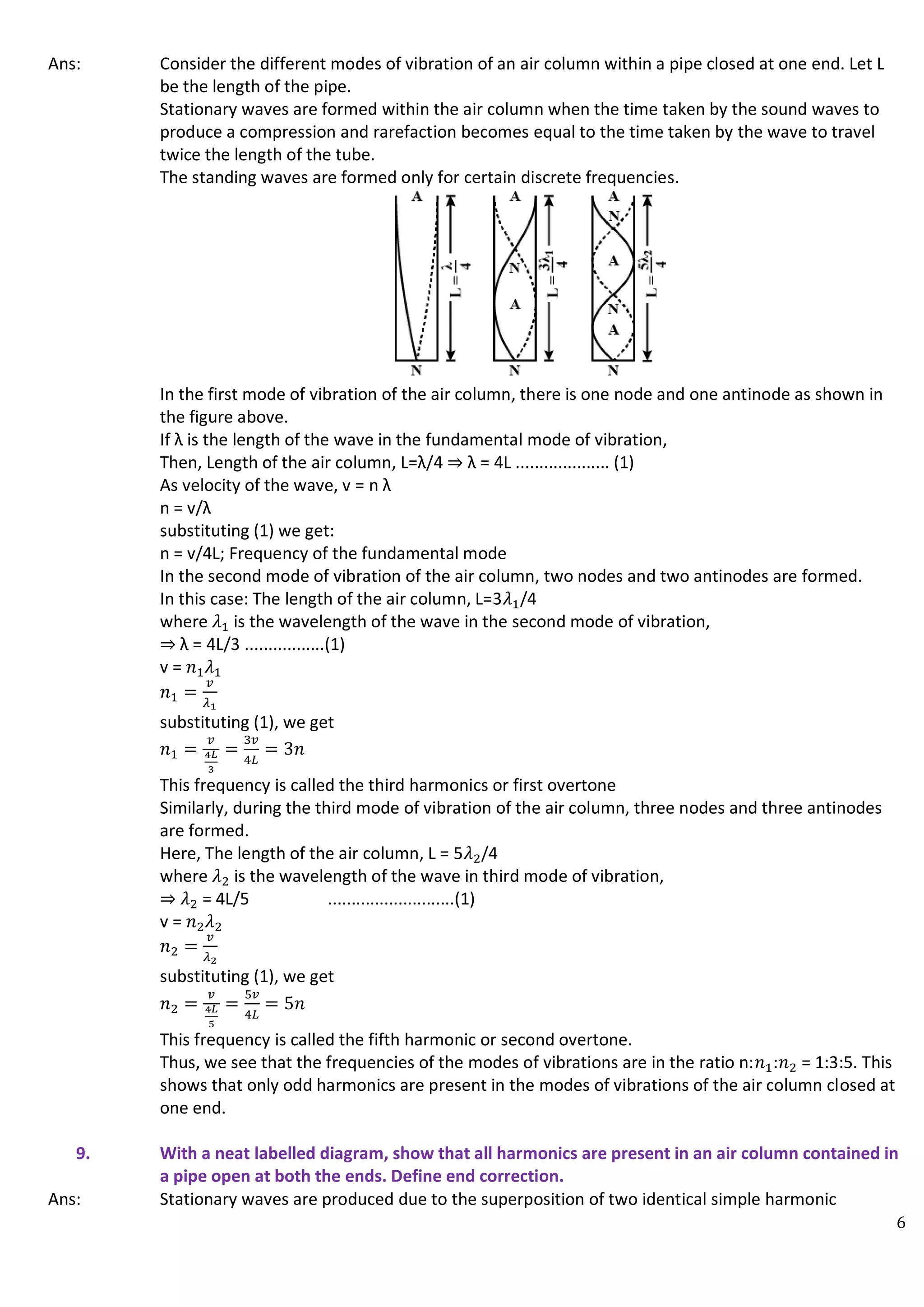
Ans: Consider the different modes of vibration of an air column within a pipe closed at one end. Let L
be the length of the pipe.
Stationary waves are formed within the air column when the time taken by the sound waves to
produce a compression and rarefaction becomes equal to the time taken by the wave to travel
twice the length of the tube.
The standing waves are formed only for certain discrete frequencies.
In the first mode of vibration of the air column, there is one node and one antinode as shown in
the figure above.
If λ is the length of the wave in the fundamental mode of vibration,
Then, Length of the air column, L=λ/4 ⇒ λ = 4L .................... (1)
As velocity of the wave, v = n λ
n = v/λ
substituting (1) we get:
n = v/4L; Frequency of the fundamental mode
In the second mode of vibration of the air column, two nodes and two antinodes are formed.
In this case: The length of the air column, L=3𝜆1/4
where 𝜆1 is the wavelength of the wave in the second mode of vibration,
⇒ λ = 4L/3 .................(1)
v = 𝑛1𝜆1
𝑛1 =
𝑣
𝜆1
substituting (1), we get
𝑛1 =
𝑣
4𝐿
3
=
3𝑣
4𝐿
= 3𝑛
This frequency is called the third harmonics or first overtone
Similarly, during the third mode of vibration of the air column, three nodes and three antinodes
are formed.
Here, The length of the air column, L = 5𝜆2/4
where 𝜆2 is the wavelength of the wave in third mode of vibration,
⇒ 𝜆2 = 4L/5 ...........................(1)
v = 𝑛2𝜆2
𝑛2 =
𝑣
𝜆2
substituting (1), we get
𝑛2 =
𝑣
4𝐿
5
=
5𝑣
4𝐿
= 5𝑛
This frequency is called the fifth harmonic or second overtone.
Thus, we see that the frequencies of the modes of vibrations are in the ratio n:𝑛1:𝑛2 = 1:3:5. This
shows that only odd harmonics are present in the modes of vibrations of the air column closed at
one end.
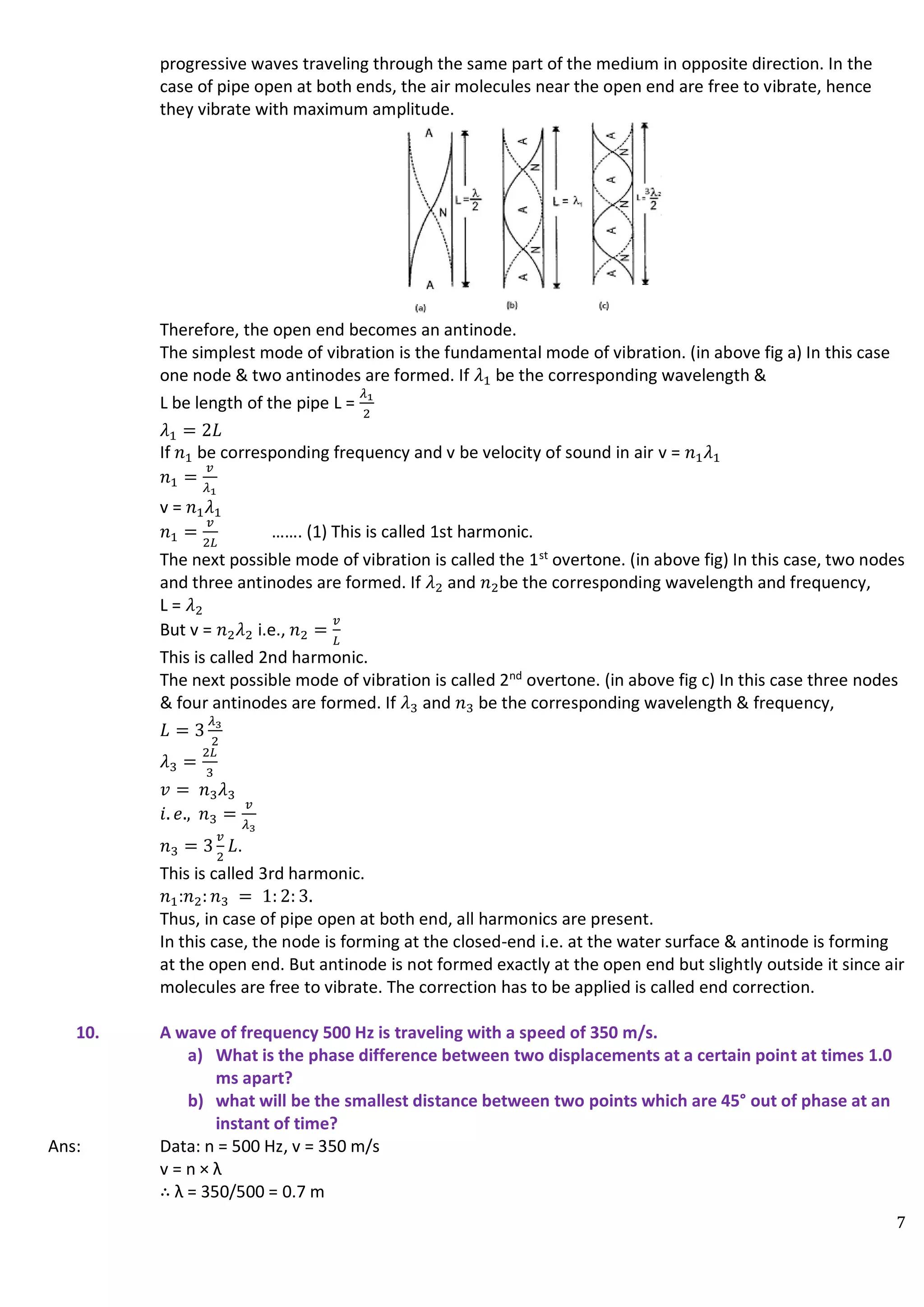
9. With a neat labelled diagram, show that all harmonics are present in an air column contained in
a pipe open at both the ends. Define end correction.
Ans: Stationary waves are produced due to the superposition of two identical simple harmonic
7
progressive waves traveling through the same part of the medium in opposite direction. In the
case of pipe open at both ends, the air molecules near the open end are free to vibrate, hence
they vibrate with maximum amplitude.
Therefore, the open end becomes an antinode.
The simplest mode of vibration is the fundamental mode of vibration. (in above fig a) In this case
one node & two antinodes are formed. If 𝜆1 be the corresponding wavelength &
L be length of the pipe L =
𝜆1
2
𝜆1 = 2𝐿
If 𝑛1 be corresponding frequency and v be velocity of sound in air v = 𝑛1𝜆1
𝑛1 =
𝑣
𝜆1
v = 𝑛1𝜆1
𝑛1 =
𝑣
2𝐿
……. (1) This is called 1st harmonic.
The next possible mode of vibration is called the 1st
overtone. (in above fig) In this case, two nodes
and three antinodes are formed. If 𝜆2 and 𝑛2be the corresponding wavelength and frequency,
L = 𝜆2
But v = 𝑛2𝜆2 i.e., 𝑛2 =
𝑣
𝐿
This is called 2nd harmonic.
The next possible mode of vibration is called 2nd
overtone. (in above fig c) In this case three nodes
& four antinodes are formed. If 𝜆3 and 𝑛3 be the corresponding wavelength & frequency,
𝐿 = 3
𝜆3
2
𝜆3 =
2𝐿
3
𝑣 = 𝑛3𝜆3
𝑖. 𝑒., 𝑛3 =
𝑣
𝜆3
𝑛3 = 3
𝑣
2
𝐿.
This is called 3rd harmonic.
𝑛1:𝑛2: 𝑛3 = 1: 2: 3.
Thus, in case of pipe open at both end, all harmonics are present.
In this case, the node is forming at the closed-end i.e. at the water surface & antinode is forming
at the open end. But antinode is not formed exactly at the open end but slightly outside it since air
molecules are free to vibrate. The correction has to be applied is called end correction.
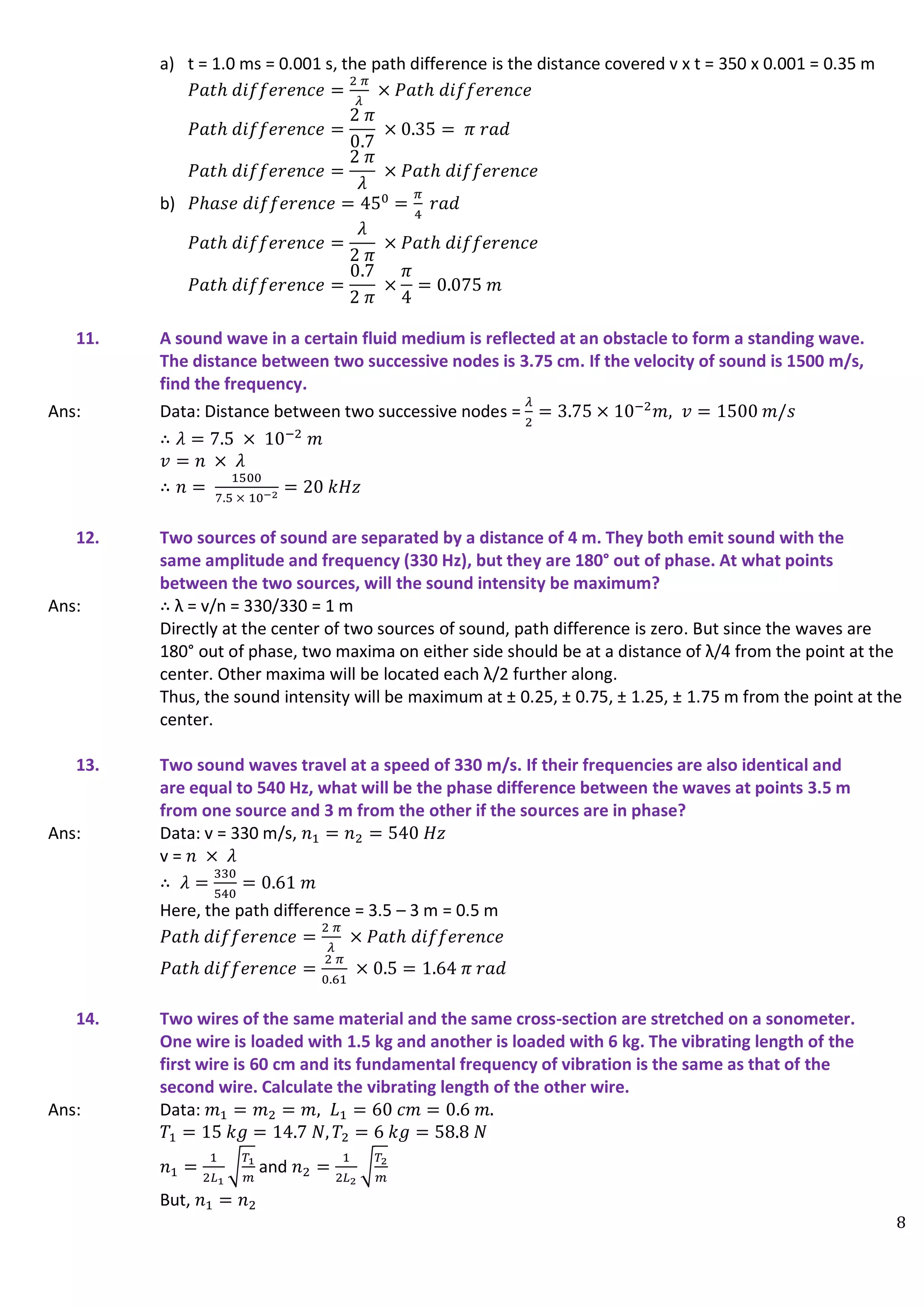
10. A wave of frequency 500 Hz is traveling with a speed of 350 m/s.
a) What is the phase difference between two displacements at a certain point at times 1.0
ms apart?
b) what will be the smallest distance between two points which are 45° out of phase at an
instant of time?
Ans: Data: n = 500 Hz, v = 350 m/s
v = n × λ
∴ λ = 350/500 = 0.7 m
8
a) t = 1.0 ms = 0.001 s, the path difference is the distance covered v x t = 350 x 0.001 = 0.35 m
𝑃𝑎𝑡ℎ 𝑑𝑖𝑓𝑓𝑒𝑟𝑒𝑛𝑐𝑒 =
2 𝜋
𝜆
× 𝑃𝑎𝑡ℎ 𝑑𝑖𝑓𝑓𝑒𝑟𝑒𝑛𝑐𝑒
𝑃𝑎𝑡ℎ 𝑑𝑖𝑓𝑓𝑒𝑟𝑒𝑛𝑐𝑒 =
2 𝜋
0.7
× 0.35 = 𝜋 𝑟𝑎𝑑
𝑃𝑎𝑡ℎ 𝑑𝑖𝑓𝑓𝑒𝑟𝑒𝑛𝑐𝑒 =
2 𝜋
𝜆
× 𝑃𝑎𝑡ℎ 𝑑𝑖𝑓𝑓𝑒𝑟𝑒𝑛𝑐𝑒
b) 𝑃ℎ𝑎𝑠𝑒 𝑑𝑖𝑓𝑓𝑒𝑟𝑒𝑛𝑐𝑒 = 450
=
𝜋
4
𝑟𝑎𝑑
𝑃𝑎𝑡ℎ 𝑑𝑖𝑓𝑓𝑒𝑟𝑒𝑛𝑐𝑒 =
𝜆
2 𝜋
× 𝑃𝑎𝑡ℎ 𝑑𝑖𝑓𝑓𝑒𝑟𝑒𝑛𝑐𝑒
𝑃𝑎𝑡ℎ 𝑑𝑖𝑓𝑓𝑒𝑟𝑒𝑛𝑐𝑒 =
0.7
2 𝜋
×
𝜋
4
= 0.075 𝑚
11. A sound wave in a certain fluid medium is reflected at an obstacle to form a standing wave.
The distance between two successive nodes is 3.75 cm. If the velocity of sound is 1500 m/s,
find the frequency.
Ans: Data: Distance between two successive nodes =
𝜆
2
= 3.75 × 10⁻²
𝑚, 𝑣 = 1500 𝑚/𝑠
∴ 𝜆 = 7.5 × 10⁻²
𝑚
𝑣 = 𝑛 × 𝜆
∴ 𝑛 =
1500
7.5 × 10−2 = 20 𝑘𝐻𝑧
12. Two sources of sound are separated by a distance of 4 m. They both emit sound with the
same amplitude and frequency (330 Hz), but they are 180° out of phase. At what points
between the two sources, will the sound intensity be maximum?
Ans: ∴ λ = v/n = 330/330 = 1 m
Directly at the center of two sources of sound, path difference is zero. But since the waves are
180° out of phase, two maxima on either side should be at a distance of λ/4 from the point at the
center. Other maxima will be located each λ/2 further along.
Thus, the sound intensity will be maximum at ± 0.25, ± 0.75, ± 1.25, ± 1.75 m from the point at the
center.
13. Two sound waves travel at a speed of 330 m/s. If their frequencies are also identical and
are equal to 540 Hz, what will be the phase difference between the waves at points 3.5 m
from one source and 3 m from the other if the sources are in phase?
Ans: Data: v = 330 m/s, 𝑛1 = 𝑛2 = 540 𝐻𝑧
v = 𝑛 × 𝜆
∴ 𝜆 =
330
540
= 0.61 𝑚
Here, the path difference = 3.5 – 3 m = 0.5 m
𝑃𝑎𝑡ℎ 𝑑𝑖𝑓𝑓𝑒𝑟𝑒𝑛𝑐𝑒 =
2 𝜋
𝜆
× 𝑃𝑎𝑡ℎ 𝑑𝑖𝑓𝑓𝑒𝑟𝑒𝑛𝑐𝑒
𝑃𝑎𝑡ℎ 𝑑𝑖𝑓𝑓𝑒𝑟𝑒𝑛𝑐𝑒 =
2 𝜋
0.61
× 0.5 = 1.64 𝜋 𝑟𝑎𝑑
14. Two wires of the same material and the same cross-section are stretched on a sonometer.
One wire is loaded with 1.5 kg and another is loaded with 6 kg. The vibrating length of the
first wire is 60 cm and its fundamental frequency of vibration is the same as that of the
second wire. Calculate the vibrating length of the other wire.
Ans: Data: 𝑚1 = 𝑚2 = 𝑚, 𝐿1 = 60 𝑐𝑚 = 0.6 𝑚.
𝑇1 = 15 𝑘𝑔 = 14.7 𝑁, 𝑇2 = 6 𝑘𝑔 = 58.8 𝑁
𝑛1 =
1
2𝐿1
√
𝑇1
𝑚
and 𝑛2 =
1
2𝐿2
√
𝑇2
𝑚
But, 𝑛1 = 𝑛2
9
∴
1
2𝐿1
√
𝑇1
𝑚
=
1
2𝐿2
√
𝑇2
𝑚
𝐿2 = √
𝑇2
𝑇1
× 𝐿1
𝐿2 = √
58.8
14.7
× 0.6 = √4 × 0.6 = 1.2 𝑚
The vibrating length of the second wire is 1.2 m.
15. A pipe closed at one end can produce overtones at frequencies 640 Hz, 896 Hz, and 1152 Hz.
Calculate the fundamental frequency.
Ans: The difference between the given frequencies of the overtones is 256 Hz. This implies that they
are consecutive overtones.
Let 𝑛𝑐 be the fundamental frequency of the closed pipe and 𝑛𝑞 , 𝑛𝑞−1 = the frequencies of the qth
,
(q+1)th
and (q+2)th
consecutive overtones, where q is an integer.
Data: 𝑛𝑞 = 640 𝐻𝑧, 𝑛𝑞−1 = 896 𝐻𝑧, 𝑛𝑞+2 = 1152 𝐻𝑧
Since only odd harmonics are present as overtones, 𝑛𝑞 = (2𝑞 + 1)𝑛𝑐
and 𝑛𝑞+1 = [2(𝑞 + 1) + 1]𝑛𝑐 = (2𝑞 + 3)𝑛𝑐
∴ (
𝑛𝑞+1
𝑛𝑞
) =
2𝑞+3
2𝑞+1
=
896
640
=
7
5
∴ 14 𝑞 + 7 = 10 𝑞 + 15
∴ 4 𝑞 = 8
∴ 𝑞 = 2
Therefore, the three given frequencies correspond to the second, third and fourth overtones, i.e.,
the fifth, seventh and ninth harmonics, respectively.
∴ 5𝑛𝑐 = 640
∴ 𝑛𝑐 = 128 𝐻𝑧
16. A standing wave is produced in a tube open at both ends. The fundamental frequency is 300 Hz.
What is the length of the tube? (Speed of the sound = 340 m s-1).
Ans: Data: For the tube open at both the ends, n = 300 Hz and
v = 340 m/s Ignoring end correction, the fundamental frequency of the tube is n = v/2L
∴ L = V/2n = 340/(2 X 300) = 0.566 m
The length of the tube open at both the ends is 0.5667 m.
17. Find the fundamental, first overtone, and second overtone frequencies of a pipe, open at
both the ends, of length 25 cm if the speed of sound in air is 330 m/s.
Ans: Data: Open pipe, L = 25 cm = 0.25 m, v = 330 m/s
The fundamental frequency of an open pipe ignoring end correction,
𝑛𝑜 =
𝑣
𝜆
=
𝑣
2𝐿
∴ 𝑛𝑜 =
330
2 ×0.25
= 660 𝐻𝑧
Since all harmonics are present as overtones, the first overtone is,
𝑛1 = 2𝑛𝑜 = 2 × 660 = 1320𝐻𝑧
The second overtone is 𝑛2 = 3n = 3 × 660 = 1980 Hz
18. A pipe open at both the ends has a fundamental frequency of 600 Hz. The first overtone of a
pipe closed at one end has the same frequency as the first overtone of the open pipe. How
long are the two pipes?
Ans: Data: Open pipe, 𝑛𝑂 = 600 Hz, 𝑛𝑐,1 = 𝑛𝑂,1 (first overtones)
For an open pipe, the fundamental frequency, 𝑛𝑂 =
𝑣
2𝐿𝑂
∴ The length of the open pipe is
10
𝐿𝑂 =
𝑣
2𝑛𝑂
=
330
2 𝑋 600
= 0.275 𝑚
For the open pipe, the frequency of the first overtone is 2𝑛𝑂 = 2 x 600 = 1200 Hz
For the pipe closed at one end, the frequency of the first overtone is
3𝑣
𝐿𝑂
.
By the data, 3v/4L = 1200
∴ 𝐿𝑐 =
3 𝑋 330
4 𝑋 1200
= 0.206 m
The length of the pipe open at both ends is 27.5 cm and the length of the pipe closed at one end is
20.6 cm.
19. A string 1m long is fixed at one end. The other end is moved up and down with frequency of
15 Hz. Due to this, a stationary wave with four complete loops gets produced on the string.
Find the speed of the progressive wave which produces the stationary wave.
[Hint: Remember that the moving end is an antinode.]
Ans: Data: L = 1 m, n = 15 Hz.
The string is fixed only at one end. Hence, an antinode will be formed at the free end. Thus, with
four and a half loops on the string, the length of the string is, L =
𝜆
4
+ 4 (
𝜆
2
) =
9
4
𝜆
∴ 𝜆 =
4𝐿
9
=
4
9
× 1 =
4
9
𝑚
v = n λ
∴ Speed of the progressive wave, v = 15 ×
4
9
=
60
9
= 6.667 𝑚/𝑠
20. A violin string vibrates with fundamental frequency of 440Hz. What are the frequencies of
the first and second overtones?
Ans: Data: n = 440 Hz
The first overtone, 𝑛1 = 2n = 2 x 400 = 880 Hz
The second overtone, 𝑛2 = 3n = 3 x 400 = 1320 Hz
21. A set of 8 tuning forks is arranged in a series of increasing order of frequencies. Each fork gives
4 beats per second with the next one and the frequency of last fork is twice that of the first.
Calculate the frequencies of the first and the last fork.
Ans: Data: 𝑛8= 2𝑛1, beat frequency = 4Hz
The set of a tuning fork is arranged in the increasing order of their frequencies.
∴ 𝑛2= 𝑛1+ 4
𝑛3= 𝑛7+ 4 = 𝑛1+ 2 × 4
𝑛4= 𝑛3+ 4 = 𝑛1+ 3 × 4
∴ 𝑛8= 𝑛7+ 4 = 𝑛1+ 7 × 4 = 𝑛1+ 28
Since 𝑛8= 2 𝑛1, 2 𝑛1= 𝑛1+ 28
∴ The frequency of the first fork, 𝑛1= 28 Hz
∴ The frequency of the last fork, 𝑛8= 𝑛1+ 28 = 28 + 28 = 56 Hz
22. A sonometer wire is stretched by the tension of 40 N. It vibrates in unison with a tuning fork
of frequency 384 Hz. How many numbers of beats get produced in two seconds if the tension
in the wire is decreased by 1.24 N?
Ans: Data: 𝑇1=40 N, 𝑛1= 384 Hz, 𝑇2= 40 − 1.24 = 38.76 N
𝑛1 =
1
2𝑙
√
𝑇1
𝑚
and 𝑛2 =
1
2𝑙
√
𝑇2
𝑚
∴
𝑛2
𝑛1
= √
𝑇2
𝑇1
∴
𝑛2
384
= √
38.76
40
=√0.969 = 0.9844
11
∴ 𝑛2 = 384 × 0.944 = 378.0 𝐻𝑧
∴ 𝑛1= 384 × 0.9844 = 378.0 Hz
∴ 𝑛1− 𝑛2= 384 − 378 = 6 Hz
∴ The number of beats produced in two seconds = 2 × 6 = 12
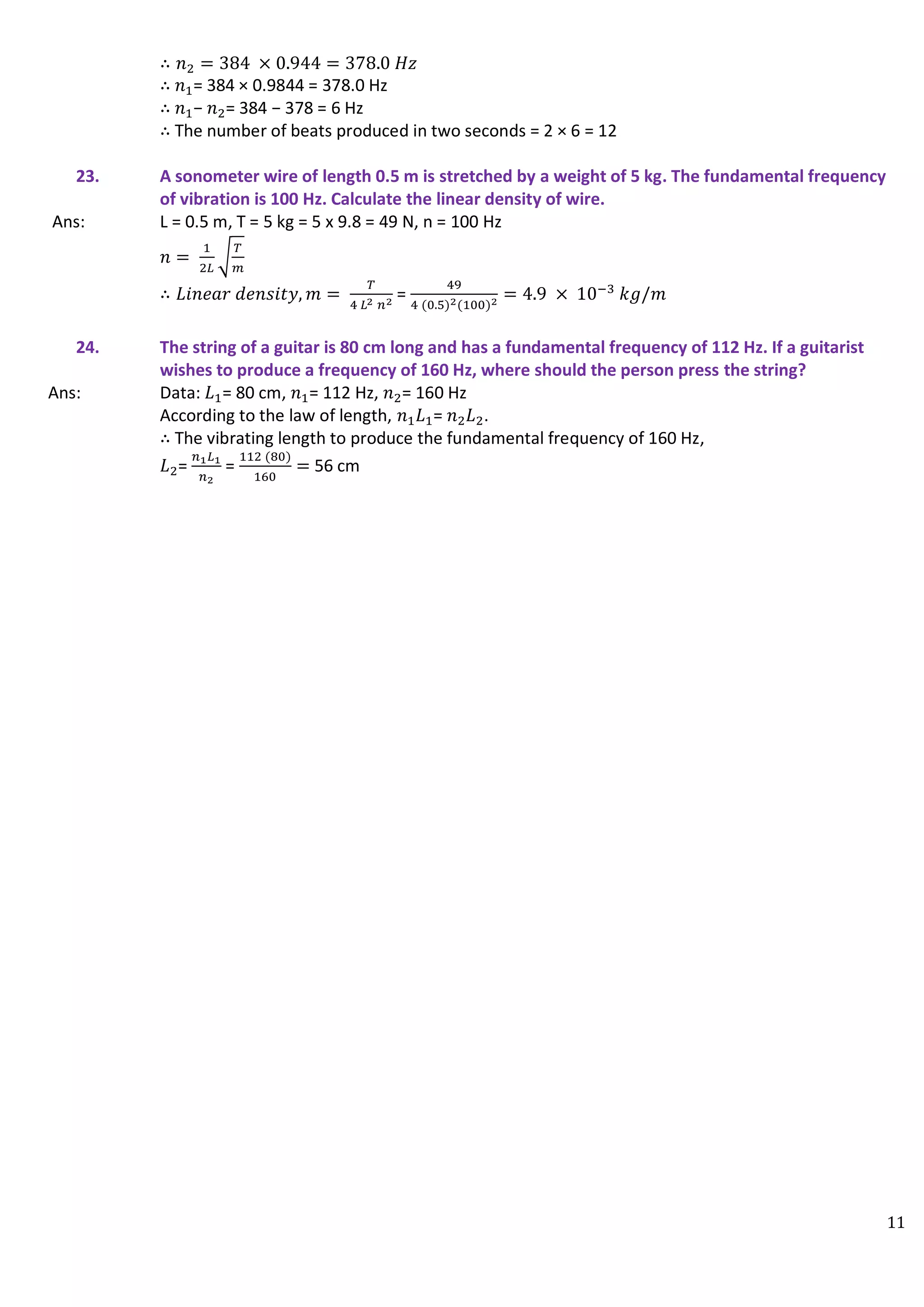
23. A sonometer wire of length 0.5 m is stretched by a weight of 5 kg. The fundamental frequency
of vibration is 100 Hz. Calculate the linear density of wire.
Ans: L = 0.5 m, T = 5 kg = 5 x 9.8 = 49 N, n = 100 Hz
𝑛 =
1
2𝐿
√
𝑇
𝑚
∴ 𝐿𝑖𝑛𝑒𝑎𝑟 𝑑𝑒𝑛𝑠𝑖𝑡𝑦, 𝑚 =
𝑇
4 𝐿2 𝑛2 =
49
4 (0.5)2(100)2 = 4.9 × 10⁻³
𝑘𝑔/𝑚
24. The string of a guitar is 80 cm long and has a fundamental frequency of 112 Hz. If a guitarist
wishes to produce a frequency of 160 Hz, where should the person press the string?
Ans: Data: 𝐿1= 80 cm, 𝑛1= 112 Hz, 𝑛2= 160 Hz
According to the law of length, 𝑛1𝐿1= 𝑛2𝐿2.
∴ The vibrating length to produce the fundamental frequency of 160 Hz,
𝐿2=
𝑛1𝐿1
𝑛2
=
112 (80)
160
= 56 cm

PHYSICS MAHARASHTRA STATE BOARD CHAPTER 6 - SUPERPOSITION OF WAVES EXERCISE SOLUTION

  • 1.
    2 SUPERPOSITION OF WAVES 1.Choose the correct option: i) When an air column in a pipe closed at one end vibrates such that three nodes are formed in it, the frequency of its vibrations is _____ times the fundamental frequency. (A) 2 (B) 3 (C) 4 (D) 5 Ans: (D) 5 ii) If two open organ pipes of length 50 cm and 51 cm sounded together produce 7 beats per second, the speed of sound is _____. (A) 307 m/s (B) 327 m/s (C) 350 m/s (D) 357 m/s Ans: (D) 357 m/s iii) The tension in a piano wire is increased by 25%. Its frequency becomes ______ times the original frequency. (A) 0.8 (B) 1.12 (C) 1.25 (D) 1.56 Ans: (B) 1.12 iv) Which of the following equations represents a wave travelling along Y-axis? (A) x = A sin (ky - ωt) (B) y = A sin (kx - ωt) (C) y = A sin (ky) cos (ωt) (D) y = A cos (ky) sin (ωt) Ans: (A) x = A sin (ky - ωt) v) A standing wave is produced on a string clamped at one end and free at the other. The length of the string (A) must be an odd integral multiple of 𝜆 4 . (B) must be an odd integral multiple of 𝜆 2 . (C) must be an even integral multiple of λ. (D) must be an odd integral multiple of λ. Ans: (A) must be an odd integral multiple of 𝜆 4 2. Answer in brief: i) A wave is represented by an equation y = A sin (Bx + Ct). Given that the constants A, B and C are positive, can you tell in which direction the wave is moving? Ans: Equation of the wave is y = A sin (Bx + Ct). When the variable of the equation is (Bx + Ct) then the wave must be moving in the negative x direction. ii) A string is fixed at the two ends and is vibrating in its fundamental mode. It is known that the two ends will be at rest. Apart from these, is there any position on the string which can be touched so as not to disturb the motion of the string? What will be the answer to this question if the string is vibrating in its first and second overtones? Ans: No. We know that in case of the fundamental mode, all points except the ends are vibrating with different amplitudes. Now, touching any point other than the ends will disturb the motion. When the string will vibrate in the first overtone there is a node also at the midpoint which is stationary. This midpoint can be touched without disturbing the motion. Thus, we can say that there is no point in the string that can satisfy the given condition.
  • 2.
    3 iii) What areharmonics and overtones? Ans: Harmonic frequencies are whole number multiples of the fundamental frequency or the lowest frequency of vibration. Consider a vibrating string. The modes of vibration are all multiples of the fundamental and are related to the string length and wave velocity. Higher frequencies are found via the relationship 𝑓 𝑛= n𝑓1, wavelength =2 𝐿 𝑛 where L is the string length. An overtone is a name given to any resonant frequency above the fundamental frequency or fundamental tone. The list of successive overtones for an object is called the overtone series. The first overtone as well as all subsequent overtones in the series may or may not be an integer multiple of the fundamental. Sometimes the relationship is that simple, and other times it is more complex, depending on the properties and geometry of the vibrating object. iv) For a stationary wave set up in a string having both ends fixed, what is the ratio of the fundamental frequency to the second harmonic? Ans: The fundamental frequency is the first harmonic. Therefore, the ratio of the fundamental frequency (n) to the second harmonic (𝑛1) is 1:2. v) The amplitude of a wave is represented by y = 0.2 sin 4π [ 𝒕 𝟎.𝟎𝟖 − 𝒙 𝟎.𝟖 ] in SI units. Find (a) wavelength, (b) frequency, and (c) amplitude of the wave. Ans: y = 0.2 sin 4π [ 𝑡 0.08 − 𝑥 0.8 ] y = 0.2 sin 2π [ 2𝑡 0.08 − 2𝑥 0.8 ] y = 0.2 sin 2π [ 𝑡 0.04 − 𝑥 0.4 ] Let us compare above equation with the equation of a simple harmonic progressive wave: y = A sin 2π [ 𝑡 𝑇 − 𝑥 𝜆 ] = 0.2 sin 2π [ 𝑡 0.04 − 𝑥 0.4 ] Comparing the quantities on both sides, we get, A = 0.2 m, T = 0.04 s, λ = 0.4 m ∴ (a) Wavelength (λ) = 0.4 m (b) Frequency (n) = 1 𝑇 = 1 0.04 = 25 Hz (c) Amplitude (A)= 0.2 m 3. State the characteristics of progressive waves. Ans: Progressive wave: A progressive wave is defined as the onward transmission of the vibratory motion of a body in an elastic medium from one particle to the successive particle. Characteristics of a progressive wave  Energy is transmitted from particle to particle without the physical transfer of matter.  The particles of the medium vibrate periodically about their equilibrium positions.  In the absence of dissipative forces, every particle vibrates with the same amplitude and frequency but differs in phase from its adjacent particles. Every particle lags behind in its state of motion compared to the one before it.  Wave motion is doubly periodic, i.e., it is periodic in time and periodic in space.  The velocity of propagation through a medium depends upon the properties of the medium.  A transverse wave can propagate only through solids, but not through liquids and gases while a longitudinal wave can propagate through any material medium.  Progressive waves are of two types: transverse and longitudinal. In a transverse mechanical wave, the individual particles of the medium vibrate perpendicular to the
  • 3.
    4 direction of propagationof the wave. The progressively changing phase of the successive particles results in the formation of alternate crests and troughs that are periodic in space and time. In an em wave, the electric and magnetic fields oscillate in mutually perpendicular directions, perpendicular to the direction of propagation. In a longitudinal mechanical wave, the individual particles of the medium vibrate along the line of propagation of the wave. The progressively changing phase of the successive particles results in the formation of typical alternate regions of compressions and rarefactions that are periodic in space and time. Periodic compressions and rarefactions result in periodic pressure and density variations in the medium. There is no longitudinal em wave. 4. State the characteristics of stationary waves. Ans: Stationary wave: When two, identical, progressive waves of equal amplitudes and equal wavelengths and traveling in a similar medium, along the similar straight line, but in opposite directions, interfere, and then the wave formed is called a standing wave or a stationary wave. Characteristics of stationary waves: 1. Stationary waves are produced by the interference of two identical progressive waves travelling in opposite directions, under certain conditions. 2. The overall appearance of a standing wave is of alternate intensity maximum (displacement antinode) and minimum (displacement node). 3. The distance between adjacent nodes (or antinodes) is λ/2. 4. The distance between successive node and antinode is λ/4. 5. There is no progressive change of phase from particle to particle. All the particles in one loop, between two adjacent nodes, vibrate in the same phase, while the particles in adjacent loops are in opposite phase. 6. A stationary wave does not propagate in any direction and hence does not transport energy through the medium. 5. Derive an expression for the equation of stationary wave on a stretched string. Ans: When two progressive waves having the same amplitude, wavelength and speed propagate in opposite directions through the same region of a medium, their superposition under certain conditions creates a stationary interference pattern called a stationary wave. Consider two simple harmonic progressive waves, of the same amplitude A, wavelength λ, and frequency n = ω/2π, traveling on a string stretched along the x-axis in opposite directions. They may be represented by 𝑦1 = A sin (ωt - kx) (along the + x-axis) ..........(1) 𝑦2 = A sin (ωt + kx) (along the − x-axis) ..........(2) where k = 2π/λ is the propagation constant. By the superposition principle, the resultant displacement of the particle of the medium at the point at which the two waves arrive simultaneously is the algebraic sum Y = Y1 +Y2 = A [sin (ωt - kx) + sin (ωt + kx)] Using the trigonometrical identity, sin 𝐶 + sin 𝐷 = 2 sin ( 𝐶+𝐷 2 ) cos ( 𝐶−𝐷 2 ). y = 2A sin ωt cos (- kx) = 2A sin ωt cos kx ........... [∴ cos (- kx) = cos (kx)] = 2A cos kx sin ωt, ......(3) ∴ y = R sin ωt, ................(4) where R = 2A cos kx ..............(5) Equation (4) is the equation of a stationary wave. 6. Find the amplitude of the resultant wave produced due to interference of two waves given as 𝒚𝟏 = 𝑨𝟏 𝐬𝐢𝐧 𝝎𝒕, 𝒚𝟐 = 𝑨𝟐 𝐬𝐢𝐧(𝝎𝒕 + 𝝋)
  • 4.
    5 Ans: The amplitudeof the resultant wave produced due to the interference of the two waves is, 𝐴 = √𝐴1 2 + 2𝐴1𝐴2 cos 𝜙 + 𝐴2 2 7. State the laws of vibrating strings and explain how vibrating strings can be verified using a sonometer. Ans: Laws of vibrating strings The fundamental frequency of vibration of a stretched string or wire of uniform cross-section is n = 1 2𝐿 √ 𝑇 𝑚 where L is the vibrating length, m the mass per unit length (linear density) of the string, and T the tension in the string. From the above expression, we can state the following three laws of vibrating strings. a) Law of length: The fundamental frequency of vibrations of a stretched string is inversely proportional to its vibrating length if the tension and mass per unit length are kept constant. If T and m are constant, n α 1/L or nL = constant. b) Law of tension: The fundamental frequency of vibrations of a stretched string is directly proportional to the square root of the applied tension if the length and mass per unit length are kept constant. If L and m are constant, n α √𝑇 or 𝑛2 /T = constant. c) Law of mass or (the law of linear density): The fundamental frequency of vibrations of a stretched string is inversely proportional to the square root of its mass per unit length if the length and tension are kept constant. If L and T are constant, n α 1 √𝑚 or 𝑛2 m = constant Vibrating strings can be verified using a sonometer i. Verification of law of length: According to this law, n α 1/T if T and m are constant. To verify this law, the sonometer wire of given linear density m is kept under constant tension T. The length of the wire is adjusted for the wire to vibrate in unison with tuning forks of different frequencies 𝑛1, 𝑛2, 𝑛3, .... be the corresponding resonating lengths of the wire. It is found that, within experimental errors, 𝑛1𝐿1 = 𝑛2𝐿2 = 𝑛3𝐿3 =.... This implies that the product, nL =constant, which verifies the law of length. ii. Verification of law of tension: According to this law, n α √𝑇, if L and m are constant. To verify this law, the vibrating length L of the sonometer wire of given linear density m is kept constant. A set of tuning forks of different frequencies is used. The tension in the wire is adjusted for the wire to vibrate in unison with tuning forks of different frequencies 𝑛1, 𝑛2, 𝑛3, .... 𝑇1, 𝑇2, 𝑇3,, ... be the corresponding tensions. It is found that, within experimental errors, 𝑛1 √𝑇1 = 𝑛2 √𝑇2 = 𝑛3 √𝑇3 = ⋯ .. This implies 𝑛1 √𝑇 = constant which verifies the law of tension. iii. Verification of linear density: According to this law, n α 1 √𝑚 , if T and L are constant. To verify this law, two wires having different linear densities 𝑚1 and 𝑚2 are kept under constant tension T. A tuning fork of frequency n is used. The lengths of the wires are adjusted for the wires to vibrate in unison with the tuning fork. Let 𝐿1and 𝐿2 be the corresponding resonating lengths of the wires. It is found that, within experimental errors, 𝐿1√𝑚1 = 𝐿2√𝑚2 . This implies 𝐿√𝑚= constant. According to the law of length of a vibrating string, n α 1 √𝐿 ∴ n α 1 √𝑚 which verifies the law of linear density. 8. Show that only odd harmonics are present in an air column vibrating in a pipe closed at one end.
  • 5.
    6 Ans: Consider thedifferent modes of vibration of an air column within a pipe closed at one end. Let L be the length of the pipe. Stationary waves are formed within the air column when the time taken by the sound waves to produce a compression and rarefaction becomes equal to the time taken by the wave to travel twice the length of the tube. The standing waves are formed only for certain discrete frequencies. In the first mode of vibration of the air column, there is one node and one antinode as shown in the figure above. If λ is the length of the wave in the fundamental mode of vibration, Then, Length of the air column, L=λ/4 ⇒ λ = 4L .................... (1) As velocity of the wave, v = n λ n = v/λ substituting (1) we get: n = v/4L; Frequency of the fundamental mode In the second mode of vibration of the air column, two nodes and two antinodes are formed. In this case: The length of the air column, L=3𝜆1/4 where 𝜆1 is the wavelength of the wave in the second mode of vibration, ⇒ λ = 4L/3 .................(1) v = 𝑛1𝜆1 𝑛1 = 𝑣 𝜆1 substituting (1), we get 𝑛1 = 𝑣 4𝐿 3 = 3𝑣 4𝐿 = 3𝑛 This frequency is called the third harmonics or first overtone Similarly, during the third mode of vibration of the air column, three nodes and three antinodes are formed. Here, The length of the air column, L = 5𝜆2/4 where 𝜆2 is the wavelength of the wave in third mode of vibration, ⇒ 𝜆2 = 4L/5 ...........................(1) v = 𝑛2𝜆2 𝑛2 = 𝑣 𝜆2 substituting (1), we get 𝑛2 = 𝑣 4𝐿 5 = 5𝑣 4𝐿 = 5𝑛 This frequency is called the fifth harmonic or second overtone. Thus, we see that the frequencies of the modes of vibrations are in the ratio n:𝑛1:𝑛2 = 1:3:5. This shows that only odd harmonics are present in the modes of vibrations of the air column closed at one end. 9. With a neat labelled diagram, show that all harmonics are present in an air column contained in a pipe open at both the ends. Define end correction. Ans: Stationary waves are produced due to the superposition of two identical simple harmonic
  • 6.
    7 progressive waves travelingthrough the same part of the medium in opposite direction. In the case of pipe open at both ends, the air molecules near the open end are free to vibrate, hence they vibrate with maximum amplitude. Therefore, the open end becomes an antinode. The simplest mode of vibration is the fundamental mode of vibration. (in above fig a) In this case one node & two antinodes are formed. If 𝜆1 be the corresponding wavelength & L be length of the pipe L = 𝜆1 2 𝜆1 = 2𝐿 If 𝑛1 be corresponding frequency and v be velocity of sound in air v = 𝑛1𝜆1 𝑛1 = 𝑣 𝜆1 v = 𝑛1𝜆1 𝑛1 = 𝑣 2𝐿 ……. (1) This is called 1st harmonic. The next possible mode of vibration is called the 1st overtone. (in above fig) In this case, two nodes and three antinodes are formed. If 𝜆2 and 𝑛2be the corresponding wavelength and frequency, L = 𝜆2 But v = 𝑛2𝜆2 i.e., 𝑛2 = 𝑣 𝐿 This is called 2nd harmonic. The next possible mode of vibration is called 2nd overtone. (in above fig c) In this case three nodes & four antinodes are formed. If 𝜆3 and 𝑛3 be the corresponding wavelength & frequency, 𝐿 = 3 𝜆3 2 𝜆3 = 2𝐿 3 𝑣 = 𝑛3𝜆3 𝑖. 𝑒., 𝑛3 = 𝑣 𝜆3 𝑛3 = 3 𝑣 2 𝐿. This is called 3rd harmonic. 𝑛1:𝑛2: 𝑛3 = 1: 2: 3. Thus, in case of pipe open at both end, all harmonics are present. In this case, the node is forming at the closed-end i.e. at the water surface & antinode is forming at the open end. But antinode is not formed exactly at the open end but slightly outside it since air molecules are free to vibrate. The correction has to be applied is called end correction. 10. A wave of frequency 500 Hz is traveling with a speed of 350 m/s. a) What is the phase difference between two displacements at a certain point at times 1.0 ms apart? b) what will be the smallest distance between two points which are 45° out of phase at an instant of time? Ans: Data: n = 500 Hz, v = 350 m/s v = n × λ ∴ λ = 350/500 = 0.7 m
  • 7.
    8 a) t =1.0 ms = 0.001 s, the path difference is the distance covered v x t = 350 x 0.001 = 0.35 m 𝑃𝑎𝑡ℎ 𝑑𝑖𝑓𝑓𝑒𝑟𝑒𝑛𝑐𝑒 = 2 𝜋 𝜆 × 𝑃𝑎𝑡ℎ 𝑑𝑖𝑓𝑓𝑒𝑟𝑒𝑛𝑐𝑒 𝑃𝑎𝑡ℎ 𝑑𝑖𝑓𝑓𝑒𝑟𝑒𝑛𝑐𝑒 = 2 𝜋 0.7 × 0.35 = 𝜋 𝑟𝑎𝑑 𝑃𝑎𝑡ℎ 𝑑𝑖𝑓𝑓𝑒𝑟𝑒𝑛𝑐𝑒 = 2 𝜋 𝜆 × 𝑃𝑎𝑡ℎ 𝑑𝑖𝑓𝑓𝑒𝑟𝑒𝑛𝑐𝑒 b) 𝑃ℎ𝑎𝑠𝑒 𝑑𝑖𝑓𝑓𝑒𝑟𝑒𝑛𝑐𝑒 = 450 = 𝜋 4 𝑟𝑎𝑑 𝑃𝑎𝑡ℎ 𝑑𝑖𝑓𝑓𝑒𝑟𝑒𝑛𝑐𝑒 = 𝜆 2 𝜋 × 𝑃𝑎𝑡ℎ 𝑑𝑖𝑓𝑓𝑒𝑟𝑒𝑛𝑐𝑒 𝑃𝑎𝑡ℎ 𝑑𝑖𝑓𝑓𝑒𝑟𝑒𝑛𝑐𝑒 = 0.7 2 𝜋 × 𝜋 4 = 0.075 𝑚 11. A sound wave in a certain fluid medium is reflected at an obstacle to form a standing wave. The distance between two successive nodes is 3.75 cm. If the velocity of sound is 1500 m/s, find the frequency. Ans: Data: Distance between two successive nodes = 𝜆 2 = 3.75 × 10⁻² 𝑚, 𝑣 = 1500 𝑚/𝑠 ∴ 𝜆 = 7.5 × 10⁻² 𝑚 𝑣 = 𝑛 × 𝜆 ∴ 𝑛 = 1500 7.5 × 10−2 = 20 𝑘𝐻𝑧 12. Two sources of sound are separated by a distance of 4 m. They both emit sound with the same amplitude and frequency (330 Hz), but they are 180° out of phase. At what points between the two sources, will the sound intensity be maximum? Ans: ∴ λ = v/n = 330/330 = 1 m Directly at the center of two sources of sound, path difference is zero. But since the waves are 180° out of phase, two maxima on either side should be at a distance of λ/4 from the point at the center. Other maxima will be located each λ/2 further along. Thus, the sound intensity will be maximum at ± 0.25, ± 0.75, ± 1.25, ± 1.75 m from the point at the center. 13. Two sound waves travel at a speed of 330 m/s. If their frequencies are also identical and are equal to 540 Hz, what will be the phase difference between the waves at points 3.5 m from one source and 3 m from the other if the sources are in phase? Ans: Data: v = 330 m/s, 𝑛1 = 𝑛2 = 540 𝐻𝑧 v = 𝑛 × 𝜆 ∴ 𝜆 = 330 540 = 0.61 𝑚 Here, the path difference = 3.5 – 3 m = 0.5 m 𝑃𝑎𝑡ℎ 𝑑𝑖𝑓𝑓𝑒𝑟𝑒𝑛𝑐𝑒 = 2 𝜋 𝜆 × 𝑃𝑎𝑡ℎ 𝑑𝑖𝑓𝑓𝑒𝑟𝑒𝑛𝑐𝑒 𝑃𝑎𝑡ℎ 𝑑𝑖𝑓𝑓𝑒𝑟𝑒𝑛𝑐𝑒 = 2 𝜋 0.61 × 0.5 = 1.64 𝜋 𝑟𝑎𝑑 14. Two wires of the same material and the same cross-section are stretched on a sonometer. One wire is loaded with 1.5 kg and another is loaded with 6 kg. The vibrating length of the first wire is 60 cm and its fundamental frequency of vibration is the same as that of the second wire. Calculate the vibrating length of the other wire. Ans: Data: 𝑚1 = 𝑚2 = 𝑚, 𝐿1 = 60 𝑐𝑚 = 0.6 𝑚. 𝑇1 = 15 𝑘𝑔 = 14.7 𝑁, 𝑇2 = 6 𝑘𝑔 = 58.8 𝑁 𝑛1 = 1 2𝐿1 √ 𝑇1 𝑚 and 𝑛2 = 1 2𝐿2 √ 𝑇2 𝑚 But, 𝑛1 = 𝑛2
  • 8.
    9 ∴ 1 2𝐿1 √ 𝑇1 𝑚 = 1 2𝐿2 √ 𝑇2 𝑚 𝐿2 = √ 𝑇2 𝑇1 ×𝐿1 𝐿2 = √ 58.8 14.7 × 0.6 = √4 × 0.6 = 1.2 𝑚 The vibrating length of the second wire is 1.2 m. 15. A pipe closed at one end can produce overtones at frequencies 640 Hz, 896 Hz, and 1152 Hz. Calculate the fundamental frequency. Ans: The difference between the given frequencies of the overtones is 256 Hz. This implies that they are consecutive overtones. Let 𝑛𝑐 be the fundamental frequency of the closed pipe and 𝑛𝑞 , 𝑛𝑞−1 = the frequencies of the qth , (q+1)th and (q+2)th consecutive overtones, where q is an integer. Data: 𝑛𝑞 = 640 𝐻𝑧, 𝑛𝑞−1 = 896 𝐻𝑧, 𝑛𝑞+2 = 1152 𝐻𝑧 Since only odd harmonics are present as overtones, 𝑛𝑞 = (2𝑞 + 1)𝑛𝑐 and 𝑛𝑞+1 = [2(𝑞 + 1) + 1]𝑛𝑐 = (2𝑞 + 3)𝑛𝑐 ∴ ( 𝑛𝑞+1 𝑛𝑞 ) = 2𝑞+3 2𝑞+1 = 896 640 = 7 5 ∴ 14 𝑞 + 7 = 10 𝑞 + 15 ∴ 4 𝑞 = 8 ∴ 𝑞 = 2 Therefore, the three given frequencies correspond to the second, third and fourth overtones, i.e., the fifth, seventh and ninth harmonics, respectively. ∴ 5𝑛𝑐 = 640 ∴ 𝑛𝑐 = 128 𝐻𝑧 16. A standing wave is produced in a tube open at both ends. The fundamental frequency is 300 Hz. What is the length of the tube? (Speed of the sound = 340 m s-1). Ans: Data: For the tube open at both the ends, n = 300 Hz and v = 340 m/s Ignoring end correction, the fundamental frequency of the tube is n = v/2L ∴ L = V/2n = 340/(2 X 300) = 0.566 m The length of the tube open at both the ends is 0.5667 m. 17. Find the fundamental, first overtone, and second overtone frequencies of a pipe, open at both the ends, of length 25 cm if the speed of sound in air is 330 m/s. Ans: Data: Open pipe, L = 25 cm = 0.25 m, v = 330 m/s The fundamental frequency of an open pipe ignoring end correction, 𝑛𝑜 = 𝑣 𝜆 = 𝑣 2𝐿 ∴ 𝑛𝑜 = 330 2 ×0.25 = 660 𝐻𝑧 Since all harmonics are present as overtones, the first overtone is, 𝑛1 = 2𝑛𝑜 = 2 × 660 = 1320𝐻𝑧 The second overtone is 𝑛2 = 3n = 3 × 660 = 1980 Hz 18. A pipe open at both the ends has a fundamental frequency of 600 Hz. The first overtone of a pipe closed at one end has the same frequency as the first overtone of the open pipe. How long are the two pipes? Ans: Data: Open pipe, 𝑛𝑂 = 600 Hz, 𝑛𝑐,1 = 𝑛𝑂,1 (first overtones) For an open pipe, the fundamental frequency, 𝑛𝑂 = 𝑣 2𝐿𝑂 ∴ The length of the open pipe is
  • 9.
    10 𝐿𝑂 = 𝑣 2𝑛𝑂 = 330 2 𝑋600 = 0.275 𝑚 For the open pipe, the frequency of the first overtone is 2𝑛𝑂 = 2 x 600 = 1200 Hz For the pipe closed at one end, the frequency of the first overtone is 3𝑣 𝐿𝑂 . By the data, 3v/4L = 1200 ∴ 𝐿𝑐 = 3 𝑋 330 4 𝑋 1200 = 0.206 m The length of the pipe open at both ends is 27.5 cm and the length of the pipe closed at one end is 20.6 cm. 19. A string 1m long is fixed at one end. The other end is moved up and down with frequency of 15 Hz. Due to this, a stationary wave with four complete loops gets produced on the string. Find the speed of the progressive wave which produces the stationary wave. [Hint: Remember that the moving end is an antinode.] Ans: Data: L = 1 m, n = 15 Hz. The string is fixed only at one end. Hence, an antinode will be formed at the free end. Thus, with four and a half loops on the string, the length of the string is, L = 𝜆 4 + 4 ( 𝜆 2 ) = 9 4 𝜆 ∴ 𝜆 = 4𝐿 9 = 4 9 × 1 = 4 9 𝑚 v = n λ ∴ Speed of the progressive wave, v = 15 × 4 9 = 60 9 = 6.667 𝑚/𝑠 20. A violin string vibrates with fundamental frequency of 440Hz. What are the frequencies of the first and second overtones? Ans: Data: n = 440 Hz The first overtone, 𝑛1 = 2n = 2 x 400 = 880 Hz The second overtone, 𝑛2 = 3n = 3 x 400 = 1320 Hz 21. A set of 8 tuning forks is arranged in a series of increasing order of frequencies. Each fork gives 4 beats per second with the next one and the frequency of last fork is twice that of the first. Calculate the frequencies of the first and the last fork. Ans: Data: 𝑛8= 2𝑛1, beat frequency = 4Hz The set of a tuning fork is arranged in the increasing order of their frequencies. ∴ 𝑛2= 𝑛1+ 4 𝑛3= 𝑛7+ 4 = 𝑛1+ 2 × 4 𝑛4= 𝑛3+ 4 = 𝑛1+ 3 × 4 ∴ 𝑛8= 𝑛7+ 4 = 𝑛1+ 7 × 4 = 𝑛1+ 28 Since 𝑛8= 2 𝑛1, 2 𝑛1= 𝑛1+ 28 ∴ The frequency of the first fork, 𝑛1= 28 Hz ∴ The frequency of the last fork, 𝑛8= 𝑛1+ 28 = 28 + 28 = 56 Hz 22. A sonometer wire is stretched by the tension of 40 N. It vibrates in unison with a tuning fork of frequency 384 Hz. How many numbers of beats get produced in two seconds if the tension in the wire is decreased by 1.24 N? Ans: Data: 𝑇1=40 N, 𝑛1= 384 Hz, 𝑇2= 40 − 1.24 = 38.76 N 𝑛1 = 1 2𝑙 √ 𝑇1 𝑚 and 𝑛2 = 1 2𝑙 √ 𝑇2 𝑚 ∴ 𝑛2 𝑛1 = √ 𝑇2 𝑇1 ∴ 𝑛2 384 = √ 38.76 40 =√0.969 = 0.9844
  • 10.
    11 ∴ 𝑛2 =384 × 0.944 = 378.0 𝐻𝑧 ∴ 𝑛1= 384 × 0.9844 = 378.0 Hz ∴ 𝑛1− 𝑛2= 384 − 378 = 6 Hz ∴ The number of beats produced in two seconds = 2 × 6 = 12 23. A sonometer wire of length 0.5 m is stretched by a weight of 5 kg. The fundamental frequency of vibration is 100 Hz. Calculate the linear density of wire. Ans: L = 0.5 m, T = 5 kg = 5 x 9.8 = 49 N, n = 100 Hz 𝑛 = 1 2𝐿 √ 𝑇 𝑚 ∴ 𝐿𝑖𝑛𝑒𝑎𝑟 𝑑𝑒𝑛𝑠𝑖𝑡𝑦, 𝑚 = 𝑇 4 𝐿2 𝑛2 = 49 4 (0.5)2(100)2 = 4.9 × 10⁻³ 𝑘𝑔/𝑚 24. The string of a guitar is 80 cm long and has a fundamental frequency of 112 Hz. If a guitarist wishes to produce a frequency of 160 Hz, where should the person press the string? Ans: Data: 𝐿1= 80 cm, 𝑛1= 112 Hz, 𝑛2= 160 Hz According to the law of length, 𝑛1𝐿1= 𝑛2𝐿2. ∴ The vibrating length to produce the fundamental frequency of 160 Hz, 𝐿2= 𝑛1𝐿1 𝑛2 = 112 (80) 160 = 56 cm