EPC Project Rule Of Credit
and
Progress measurement
Our Belief
Now Everyone Can Be Trained
Corporate Profile
Ignite Resources is a Corporate Training and Consulting company since 2012. We shape the way organizations
implement strategy through training, development and consulting . Our approach covers the processes, people
and tools essential to tactical planning and implementation.
We specialize in Training, Consultation and Human Capital Development, for both management and technical
skills. We work together with companies as smart partnership in providing hands-on solution to solve day to day
business challenges by developing their human capital and providing custom made solutions.
Our expertise comes from years of experience working with industries and public training. Ignite resources is
committed to provide cutting-edge training that align with our vision. To deliver on our aspiration of becoming a
leading low-cost training provider. We have put in an ambitious plan that will bring us closer towards our goal ...
Development for all.
Seth Godin wrote once that “Every company, indeed, every organization, is a tribe, or if it’s large enough, a
network of tribes—groups of twenty to 150 people in which everyone knows everyone else, or at least knows of
everyone else. Tribes are more powerful than teams, companies, or even CEOs, and yet their key leverage points
have not been mapped—until now.”
Ignite is here to start with a spark to create a flame that everyone member in the tribes will be developed.
Outline
2. Rule of Credit - Engineering
3. Rule of Credit - Procurement
4. Rule of Credit – Fabrication and Construction
5. Managing Rule of Credit in Primavera P6
1. Progress Calculation
Progress Calculation
01
+ Rule of Credit / Weighted Steps method
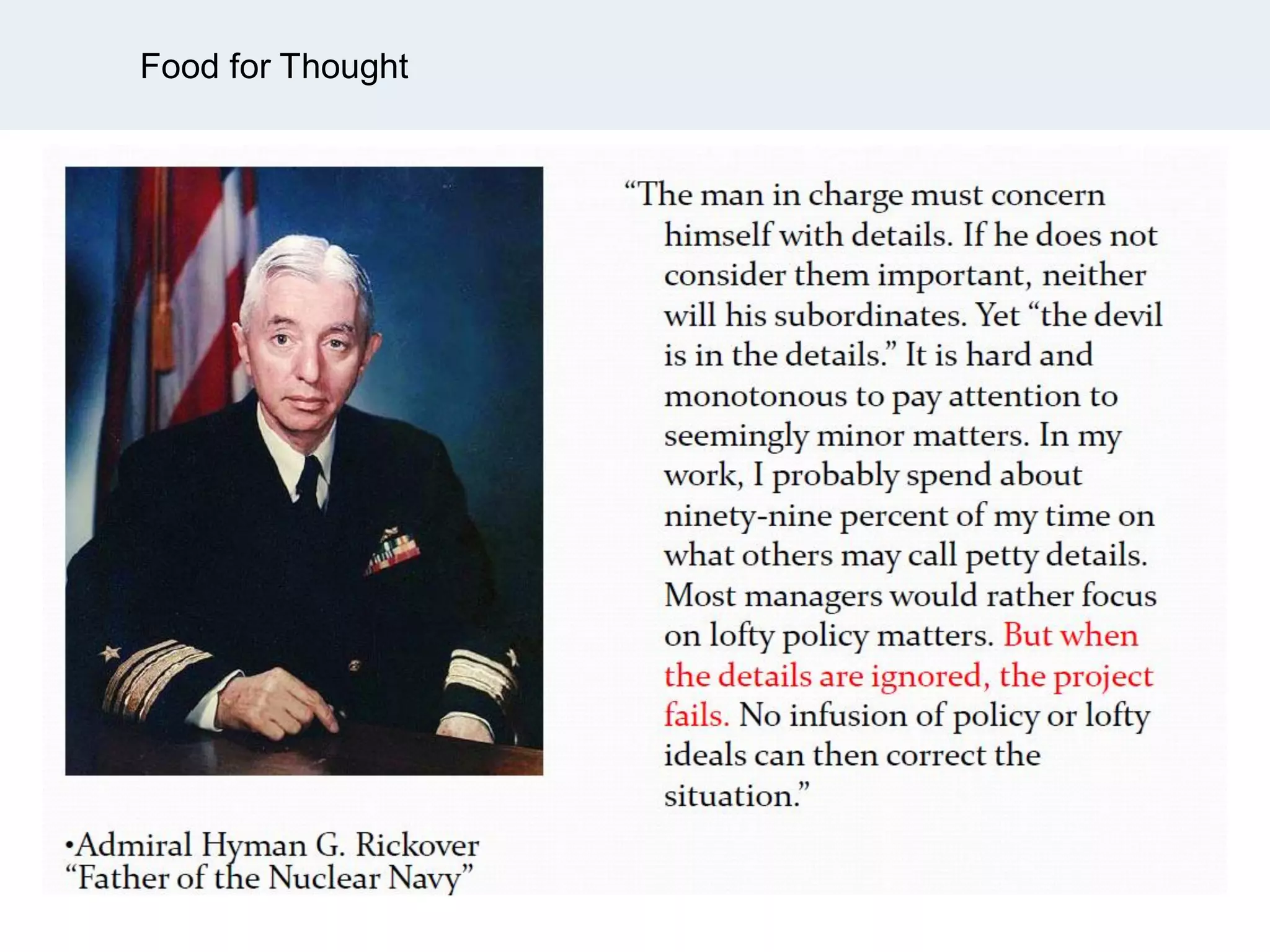
Food for Thought
Progress Measurement
Project progress monitoring and control is one of the most
important tasks of construction project management. Every
team member needs to know, in a timely and accurate
manner, how is the project progressing, where they are
currently in comparison to the initially set plans, whether
deadlines are met, budgets are safely measured and followed.
Executing a successful project depends on many factors, but
ultimately the most important question that need to be
answered before any measures can be taken is
“What’s been accomplished so far?”
Progress measurement addresses this question and serves as
a fundamental building block for effective project controls.
Progress measurement system plays an important part
of project control. It includes the detail progress tracking
sheet of its WBS elements, work categories and work steps
for each deliverable.
It is developed either when the additional requirements
are occurred for a particular project or when progress
measurement system is not in placed.
The work scope to be measure includes fabricate and
installation of pipeline including tie-in work, insulation work,
painting work, fabricate and installation of new pipe racks,
fabricate and installation of equipment access platforms,
installation of process equipment.
Progress measurement system would be different depending
on organizational and/or project preference.
Prior implementing a system for progress evaluation an
estimate must be developed for both man-hours and
quantities of drawings for each engineering discipline.
When working with progress calculation, you should know the
level of reporting. In a typical project, engineering progress is
measured as level 2 (phase wise) and level 3 (engineering
discipline wise) and level 4 (document wise).
Progress Measurement
Progress measurement system plays an important part
of project control. It includes the detail progress tracking
sheet of its WBS elements, work categories and work steps
for each deliverable.
It is developed either when the additional requirements
are occurred for a particular project or when progress
measurement system is not in placed.
The work scope to be measure includes fabricate and installation
of pipeline including tie-in work, insulation work, painting work,
fabricate and installation of new pipe racks, fabricate and
installation of equipment access platforms, installation of
process equipment.
Progress measurement system would be different depending
on organizational and/or project preference.
Prior implementing a system for progress evaluation an estimate
must be developed for both manhours and quantities of drawings
for each engineering discipline.
When working with progress calculation, you should know the
level of reporting. In a typical project, engineering progress is
measured as level 2 (phase wise) and level 3 (engineering
discipline wise) and level 4 (document wise).
Physical progress for the engineering phase of a project consists of
three levels of indenture as follows:
•Progress by Drawing, Datasheet, Document and Request for
•Quotation (RFQ)
•Progress by Discipline
•Total Engineering Progress
Weighted Step
One of the most important choices that a control project
controller or project manager makes in establishing
an progress control or EVM plan is to select an appropriate
measure of earned value for each work package.
This choice of the measure of interim progress, or
completion, for each work package will do more than any
other discretionary choice in making the EVM results
meaningful.
The execution process for a successful project depends on
mange factors, but one fundamental question that need to
be answered is before proactive or prescriptive measures
can be implemented is: What’s been accomplished so far?
Progress measurement addresses this question and serves
as a fundamental building block for effective project
controls.
Steps make it possible to describe and report progress for
activity work at a granular level by breaking an activity into
its component parts. Steps can have a step weight that
quantifies the portion of an activity's total work that each
step represents. On a project per project basis, you can use
step weights to calculate Activity Percent Complete.
Weighted steps enable you to track the progress of an
activity based on the number of steps completed.
According to the 5th edition of the
PMBOK Guide,
“ Weighted milestone method. An earned
value method that divides a work package
into measurable segments, each ending
with an observable milestone, and then
assigns a weighted value to the
achievement of each milestone. ”
Weighted Step
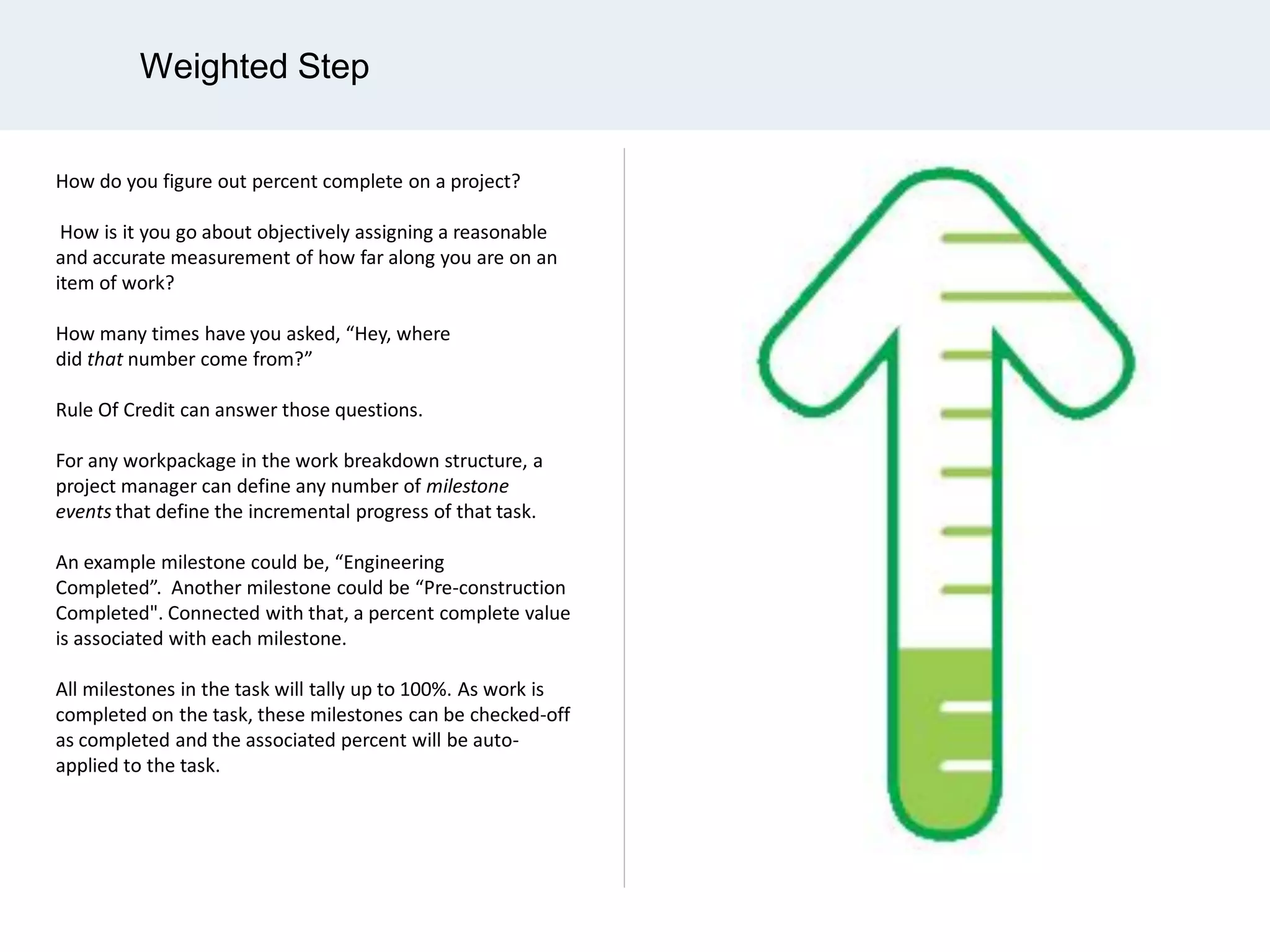
How do you figure out percent complete on a project?
How is it you go about objectively assigning a reasonable
and accurate measurement of how far along you are on an
item of work?
How many times have you asked, “Hey, where
did that number come from?”
Rule Of Credit can answer those questions.
For any workpackage in the work breakdown structure, a
project manager can define any number of milestone
events that define the incremental progress of that task.
An example milestone could be, “Engineering
Completed”. Another milestone could be “Pre-construction
Completed". Connected with that, a percent complete value
is associated with each milestone.
All milestones in the task will tally up to 100%. As work is
completed on the task, these milestones can be checked-off
as completed and the associated percent will be auto-
applied to the task.
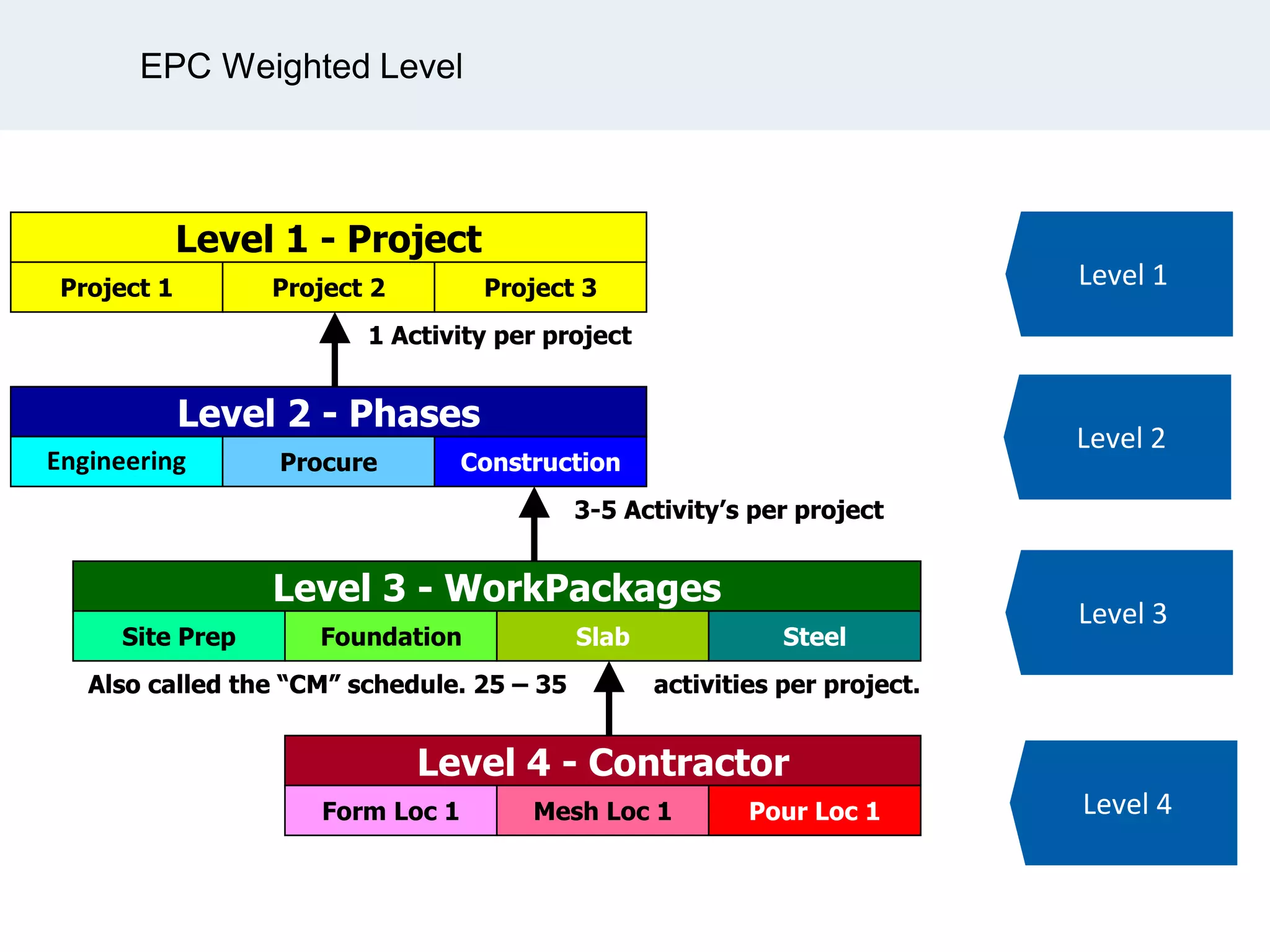
EPC Weighted Level
Level 1 - Project
Project 1 Project 2 Project 3
Level 2 - Phases
Design Procure Construction
Level 3 - WorkPackages
Site Prep Foundation Slab Steel
Level 4 - Contractor
Form Loc 1 Mesh Loc 1 Pour Loc 1
1 Activity per project
3-5 Activity’s per project
As much detail as needed to communicate W4
Also called the “CM” schedule. 25 – 35 activities per project.
Level 1 - Project
Project 1 Project 2 Project 3
Level 2 - Phases
Design Procure Construction
Level 3 - WorkPackages
Site Prep Foundation Slab Steel
Level 4 - Contractor
Form Loc 1 Mesh Loc 1 Pour Loc 1
1 Activity per project
3-5 Activity’s per project
As much detail as needed to communicate W4
Also called the “CM” schedule. 25 – 35 activities per project.
Level 1
Level 2
Level 3
Level 4
Engineering
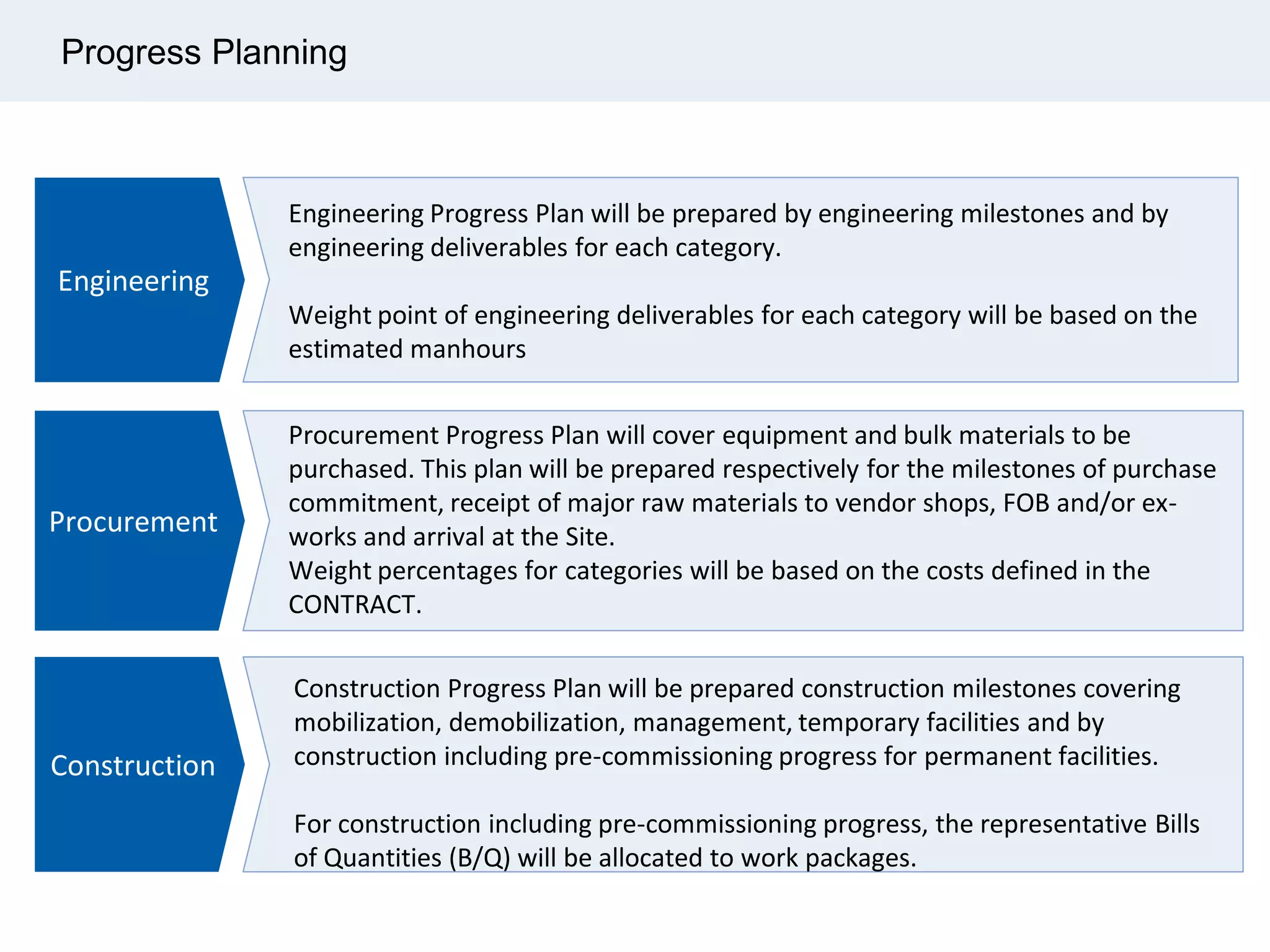
Progress Planning
Engineering
Procurement
Construction
Engineering Progress Plan will be prepared by engineering milestones and by
engineering deliverables for each category.
Weight point of engineering deliverables for each category will be based on the
estimated manhours
Procurement Progress Plan will cover equipment and bulk materials to be
purchased. This plan will be prepared respectively for the milestones of purchase
commitment, receipt of major raw materials to vendor shops, FOB and/or ex-
works and arrival at the Site.
Weight percentages for categories will be based on the costs defined in the
CONTRACT.
Construction Progress Plan will be prepared construction milestones covering
mobilization, demobilization, management, temporary facilities and by
construction including pre-commissioning progress for permanent facilities.
For construction including pre-commissioning progress, the representative Bills
of Quantities (B/Q) will be allocated to work packages.
Progress Calculation
-Engineering Weightage
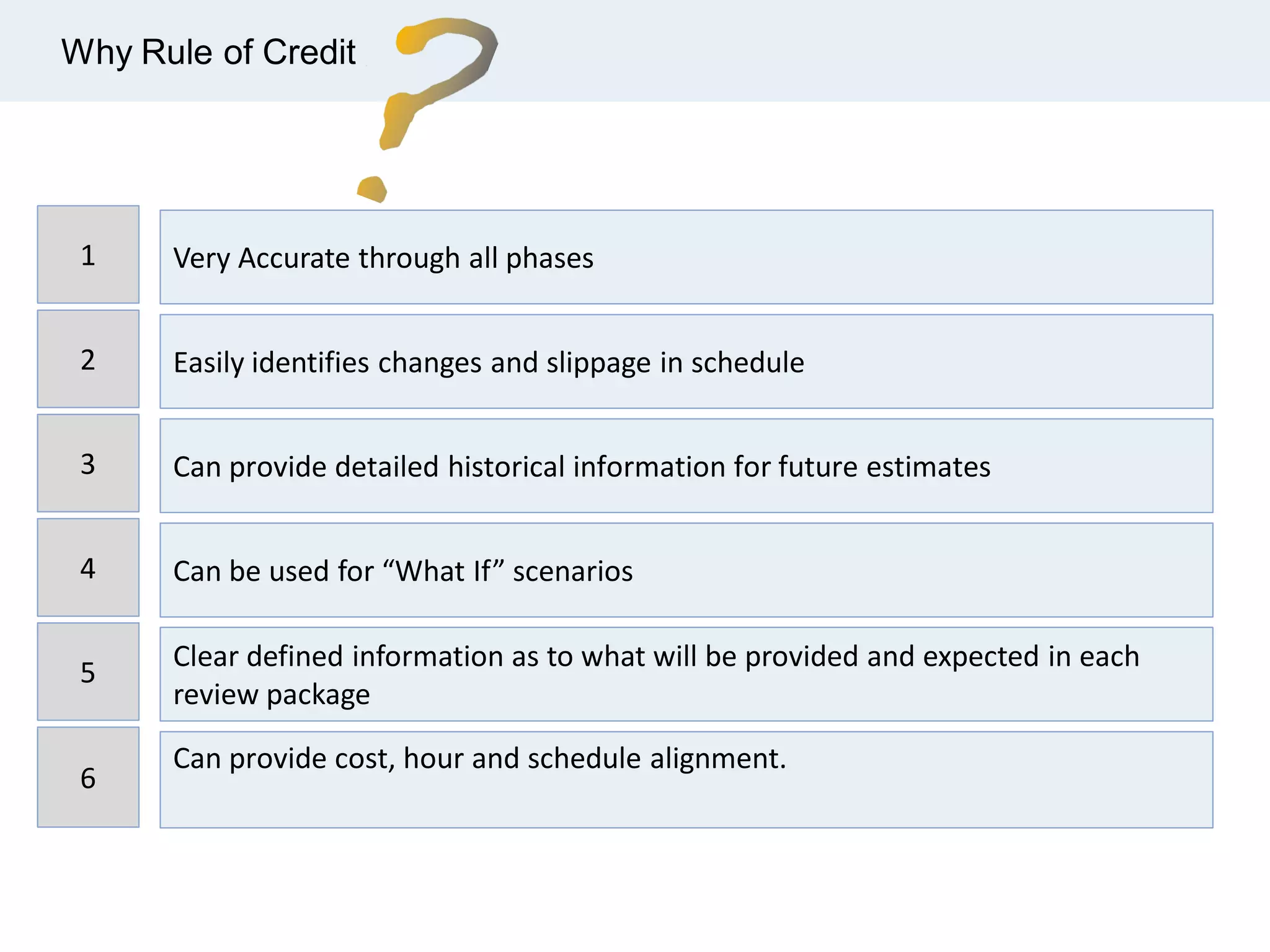
Why Rule of Credit
Very Accurate through all phases
Easily identifies changes and slippage in schedule
Can provide detailed historical information for future estimates
Can be used for “What If” scenarios
Clear defined information as to what will be provided and expected in each
review package
Can provide cost, hour and schedule alignment.
1
2
3
4
5
6
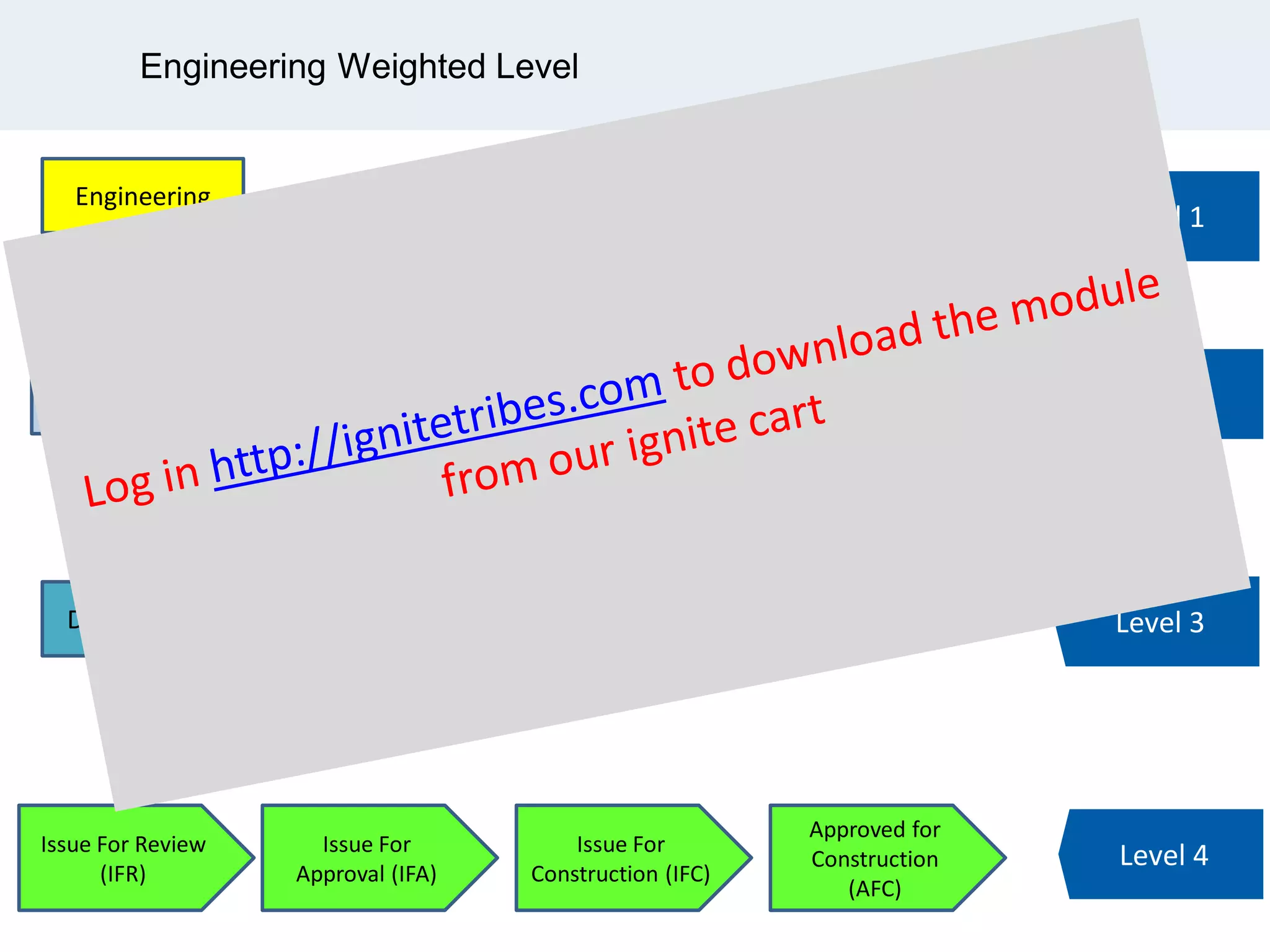
Engineering Weighted Level
Engineering
Process
Civil and
Structure
Mechanical Electrical Instrumentation Piping
Issue For Review
(IFR)
Issue For
Approval (IFA)
Issue For
Construction (IFC)
Approved for
Construction
(AFC)
Level 1
Level 2
Drawing Document Datasheet RFQ Level 3
Level 4
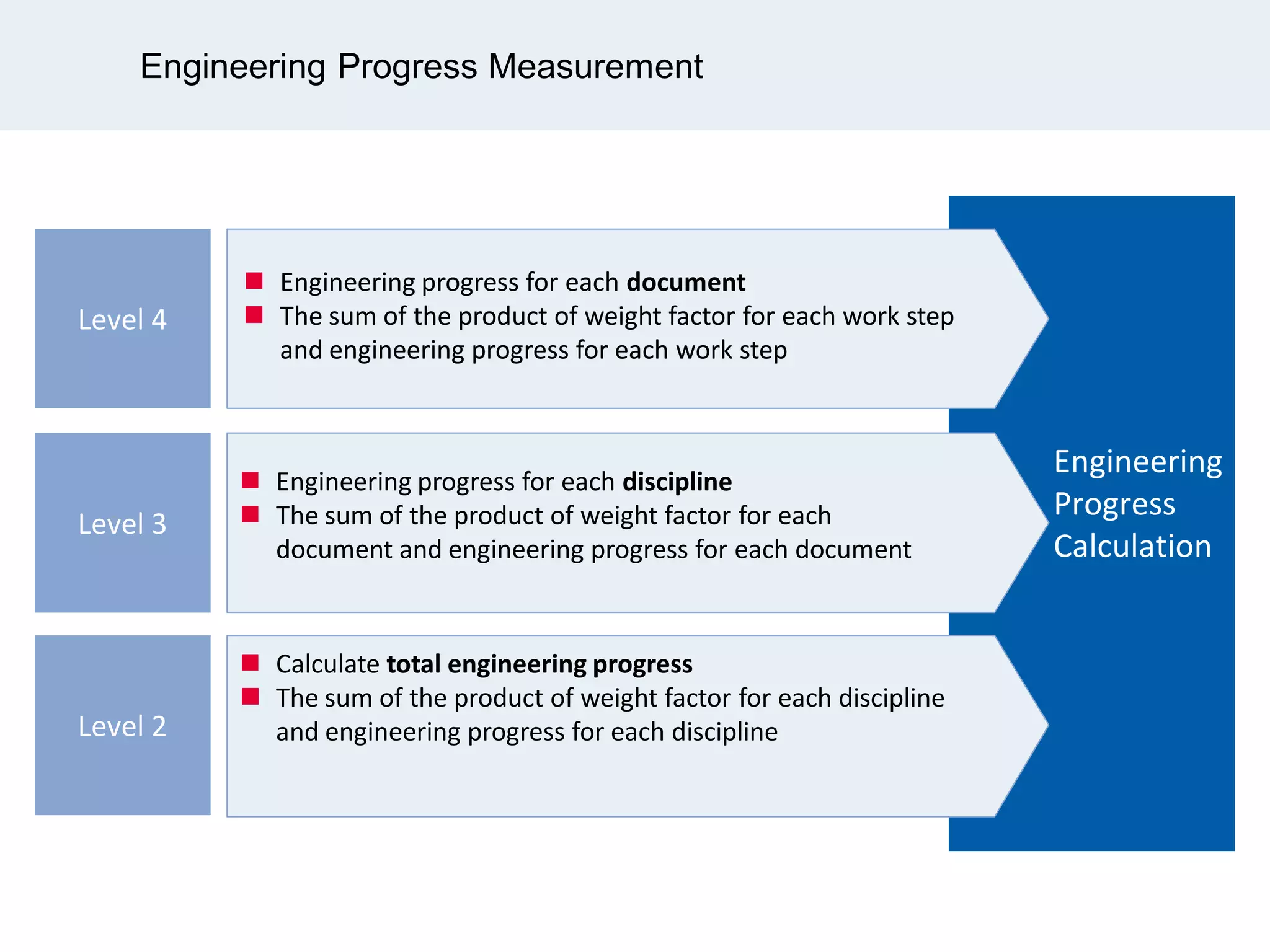
Engineering Progress Measurement
Engineering
Progress
Calculation
Level 4
Level 3
Level 2
 Engineering progress for each document
 The sum of the product of weight factor for each work step
and engineering progress for each work step
 Engineering progress for each discipline
 The sum of the product of weight factor for each
document and engineering progress for each document
 Calculate total engineering progress
 The sum of the product of weight factor for each discipline
and engineering progress for each discipline
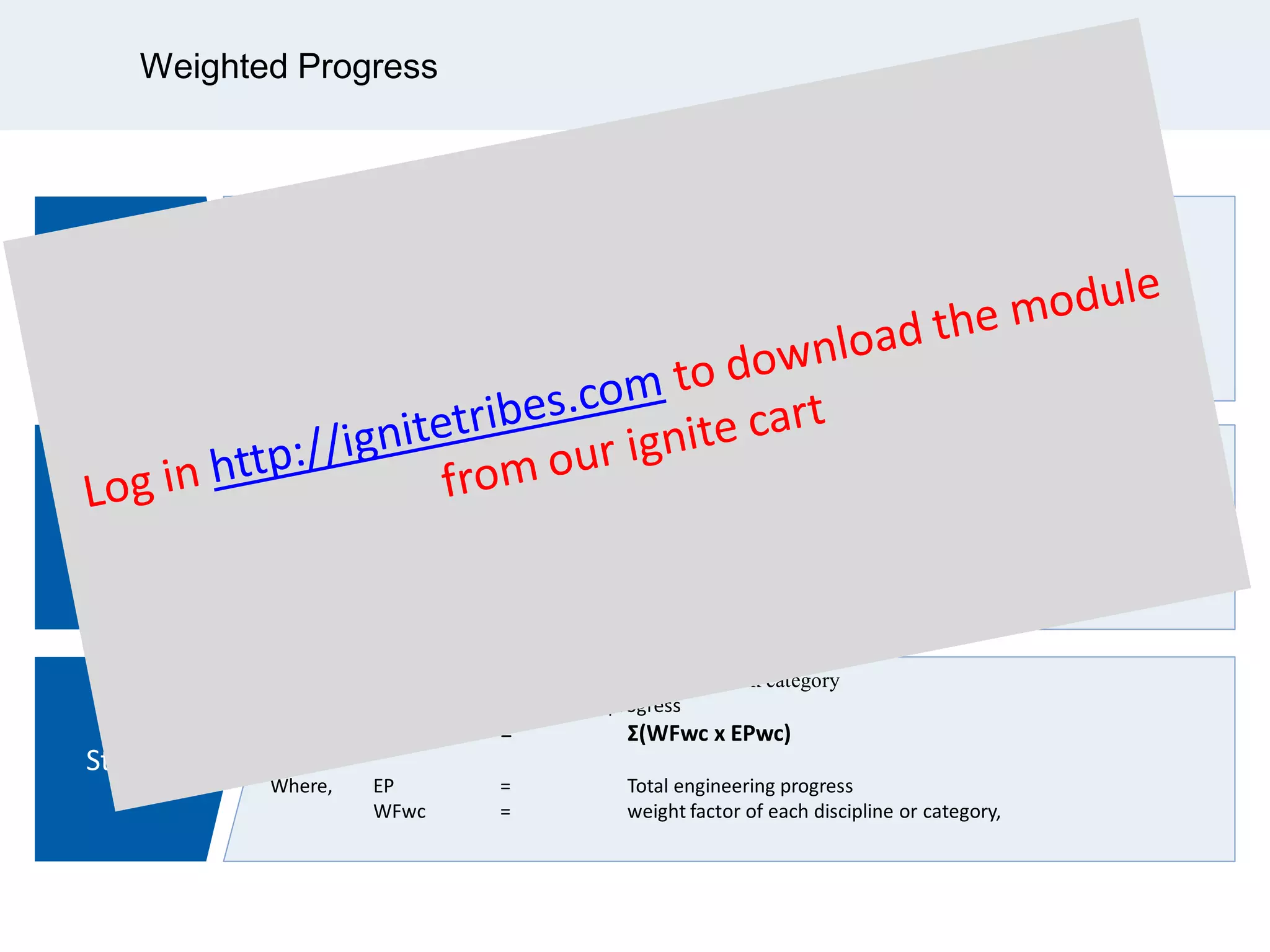
Weighted Progress
Step 1
Step 2
Step 3
Calculate the progress for each document or item
EPd = Σ (WFws x EPws)
Where, EPd = Engineering progress of each document or item
WFws = Weight factor of each work steps
EPws = Percent completion of each work step
Calculate engineering progress for each discipline or work category
EPwc = Σ(WFdd x EPdd)
Where, EPwc = Engineering progress of each discipline or category
WFdd = Weight factor of each document or item
Calculate engineering progress for each discipline or work category
Calculate total engineering progress
EP = Σ(WFwc x EPwc)
Where, EP = Total engineering progress
WFwc = weight factor of each discipline or category,
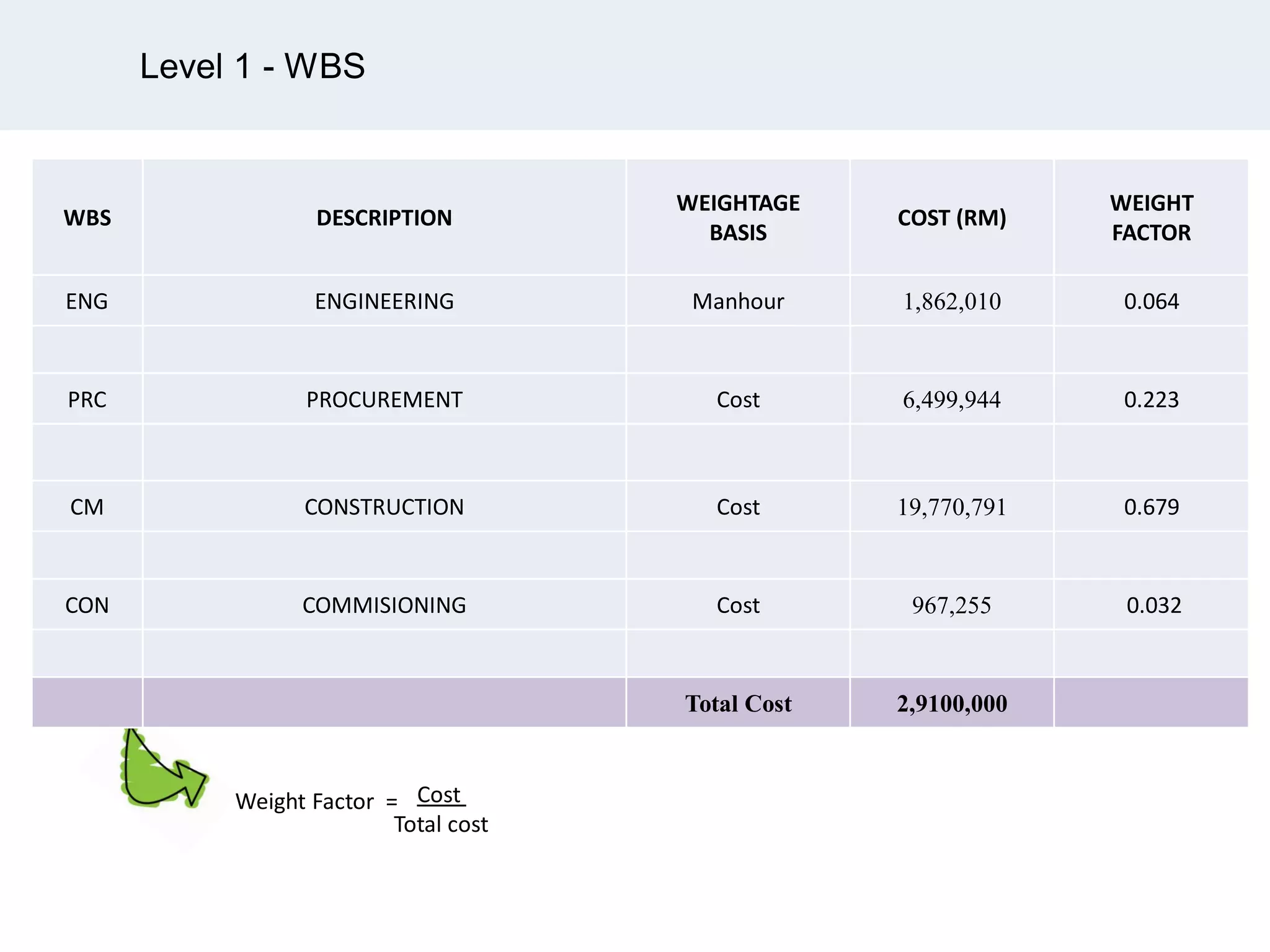
Level 1 - WBS
WBS DESCRIPTION
WEIGHTAGE
BASIS
COST (RM)
WEIGHT
FACTOR
ENG ENGINEERING Manhour 1,862,010 0.064
PRC PROCUREMENT Cost 6,499,944 0.223
CM CONSTRUCTION Cost 19,770,791 0.679
CON COMMISIONING Cost 967,255 0.032
Total Cost 2,9100,000
Weight Factor = Cost
Total cost
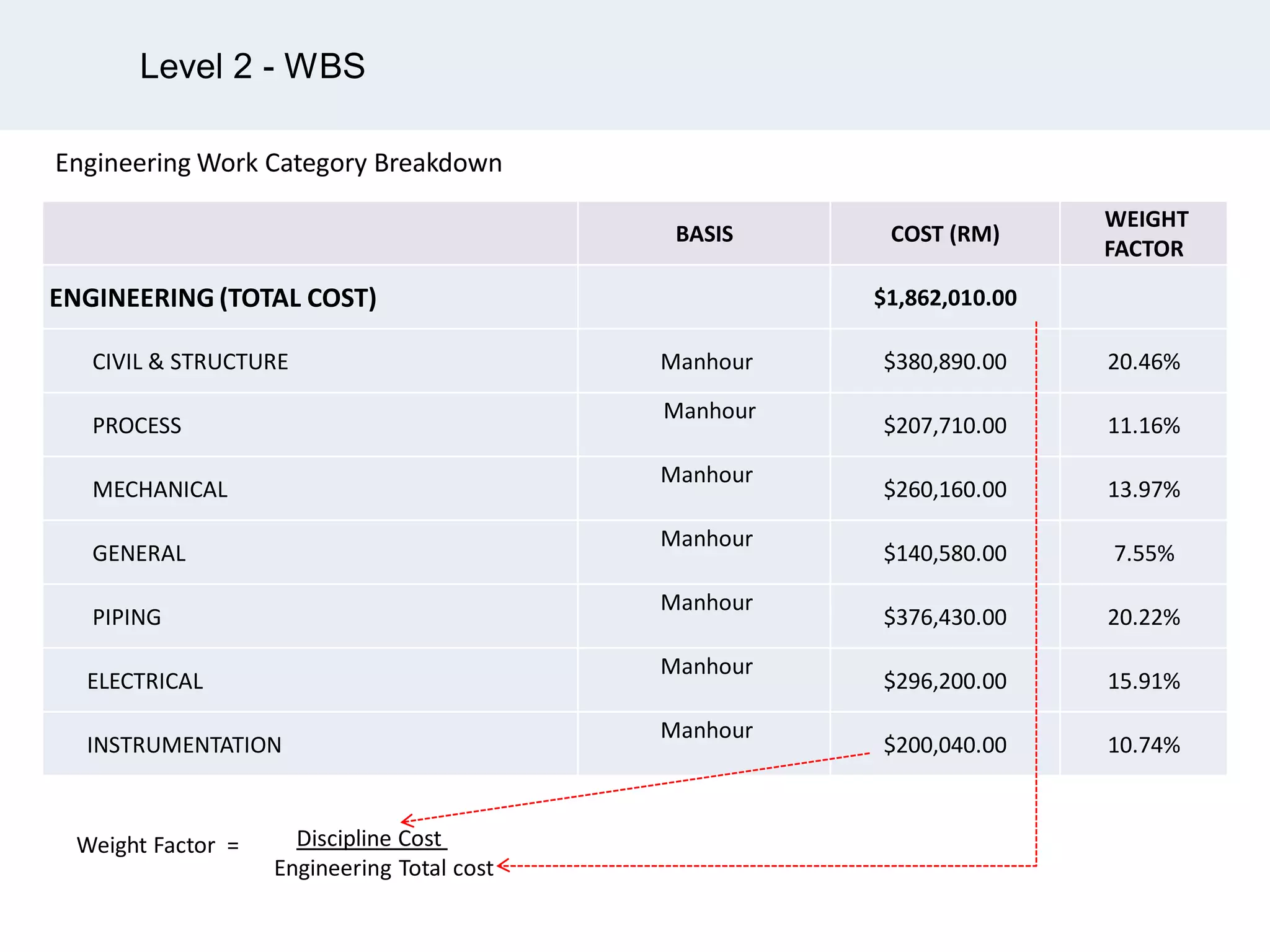
Level 2 - WBS
BASIS COST (RM)
WEIGHT
FACTOR
ENGINEERING (TOTAL COST) $1,862,010.00
CIVIL & STRUCTURE Manhour $380,890.00 20.46%
PROCESS
Manhour
$207,710.00 11.16%
MECHANICAL
Manhour
$260,160.00 13.97%
GENERAL
Manhour
$140,580.00 7.55%
PIPING
Manhour
$376,430.00 20.22%
ELECTRICAL
Manhour
$296,200.00 15.91%
INSTRUMENTATION
Manhour
$200,040.00 10.74%
Weight Factor = Discipline Cost
Engineering Total cost
Engineering Work Category Breakdown
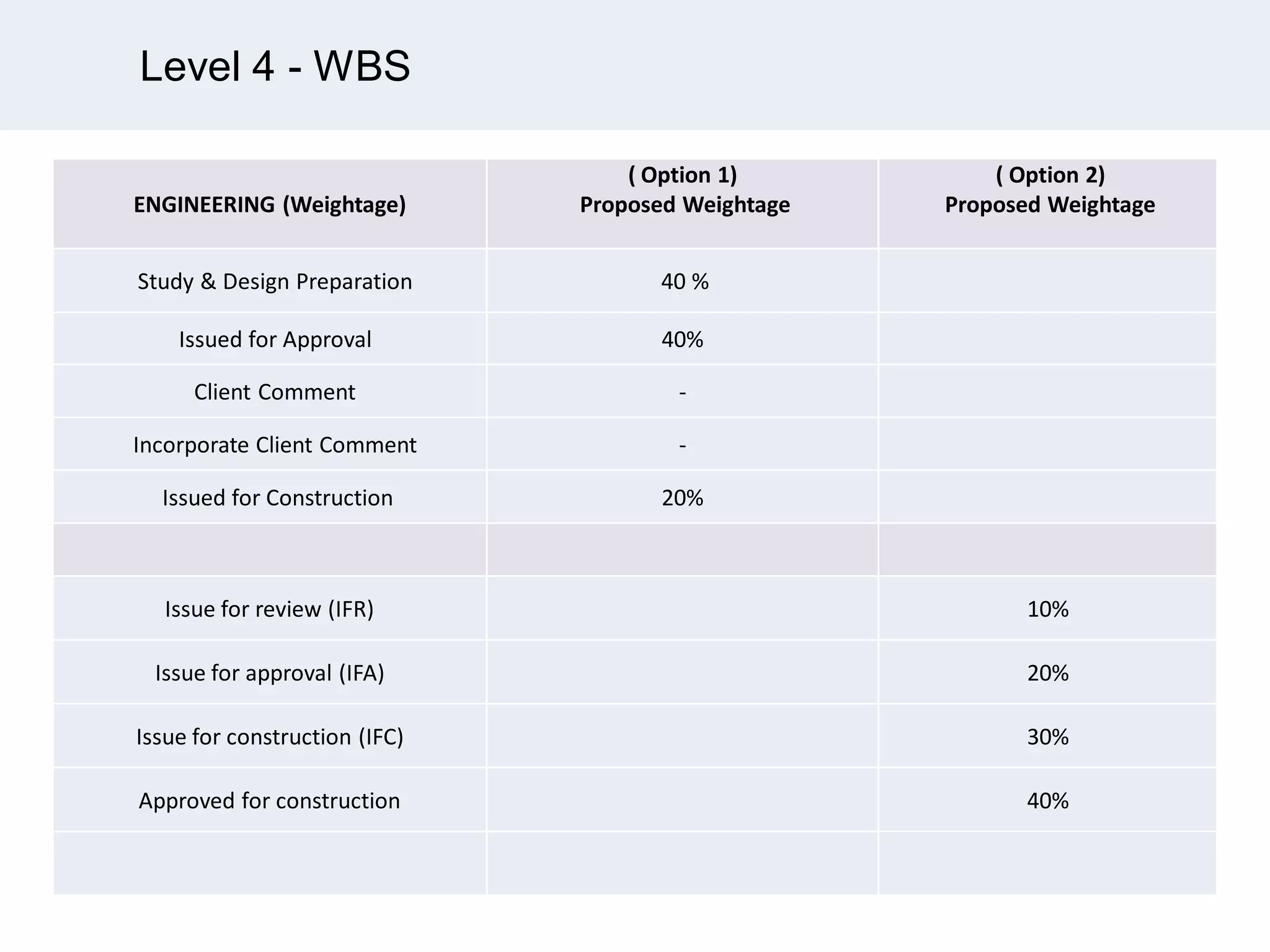
Level 4 - WBS
ENGINEERING (Weightage)
( Option 1)
Proposed Weightage
( Option 2)
Proposed Weightage
Study & Design Preparation 40 %
Issued for Approval 40%
Client Comment -
Incorporate Client Comment -
Issued for Construction 20%
Issue for review (IFR) 10%
Issue for approval (IFA) 20%
Issue for construction (IFC) 30%
Approved for construction 40%
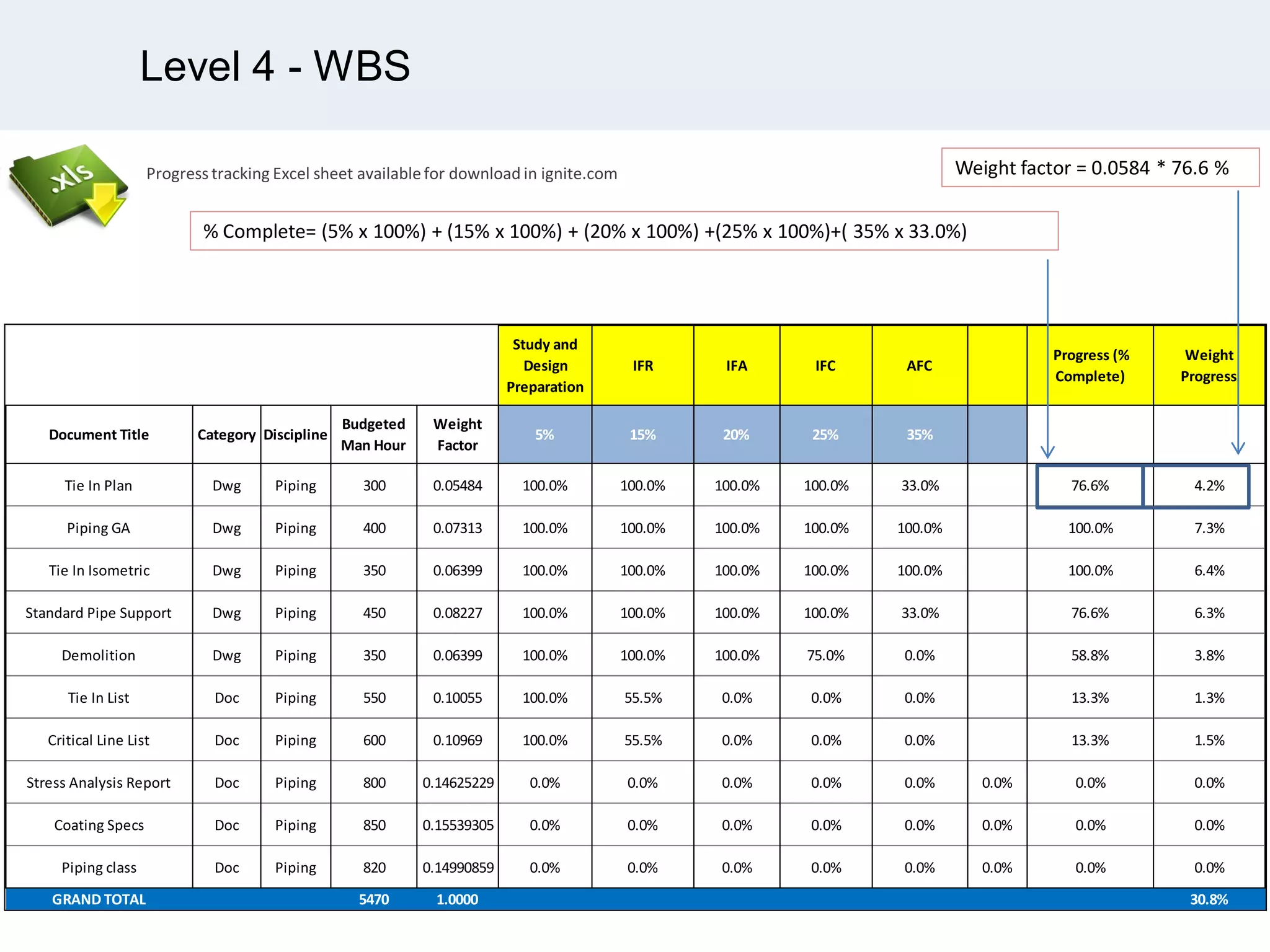
Level 4 - WBS
Study and
Design
Preparation
IFR IFA IFC AFC
Progress (%
Complete)
Weight
Progress
Document Title Category Discipline
Budgeted
Man Hour
Weight
Factor
5% 15% 20% 25% 35%
Tie In Plan Dwg Piping 300 0.05484 100.0% 100.0% 100.0% 100.0% 33.0% 76.6% 4.2%
Piping GA Dwg Piping 400 0.07313 100.0% 100.0% 100.0% 100.0% 100.0% 100.0% 7.3%
Tie In Isometric Dwg Piping 350 0.06399 100.0% 100.0% 100.0% 100.0% 100.0% 100.0% 6.4%
Standard Pipe Support Dwg Piping 450 0.08227 100.0% 100.0% 100.0% 100.0% 33.0% 76.6% 6.3%
Demolition Dwg Piping 350 0.06399 100.0% 100.0% 100.0% 75.0% 0.0% 58.8% 3.8%
Tie In List Doc Piping 550 0.10055 100.0% 55.5% 0.0% 0.0% 0.0% 13.3% 1.3%
Critical Line List Doc Piping 600 0.10969 100.0% 55.5% 0.0% 0.0% 0.0% 13.3% 1.5%
Stress Analysis Report Doc Piping 800 0.14625229 0.0% 0.0% 0.0% 0.0% 0.0% 0.0% 0.0% 0.0%
Coating Specs Doc Piping 850 0.15539305 0.0% 0.0% 0.0% 0.0% 0.0% 0.0% 0.0% 0.0%
Piping class Doc Piping 820 0.14990859 0.0% 0.0% 0.0% 0.0% 0.0% 0.0% 0.0% 0.0%
GRAND TOTAL 5470 1.0000 30.8%
% Complete= (5% x 100%) + (15% x 100%) + (20% x 100%) +(25% x 100%)+( 35% x 33.0%)
Weight factor = 0.0584 * 76.6 %Progress tracking Excel sheet availablefor download in ignite.com
Rule of Credit
02
+ Engineering
Engineering Rule Of Credit
For Engineering, the weighting is according to the estimated man hours (units) assigned to each discipline. The
Master Deliverable List (MDL) is the document for contractual required Engineering deliverables, containing all
submittal (delivery) drawings and documents required to complete a specific project.
The Engineering Master Deliverable List will be the basis of progress measurement of engineering work.
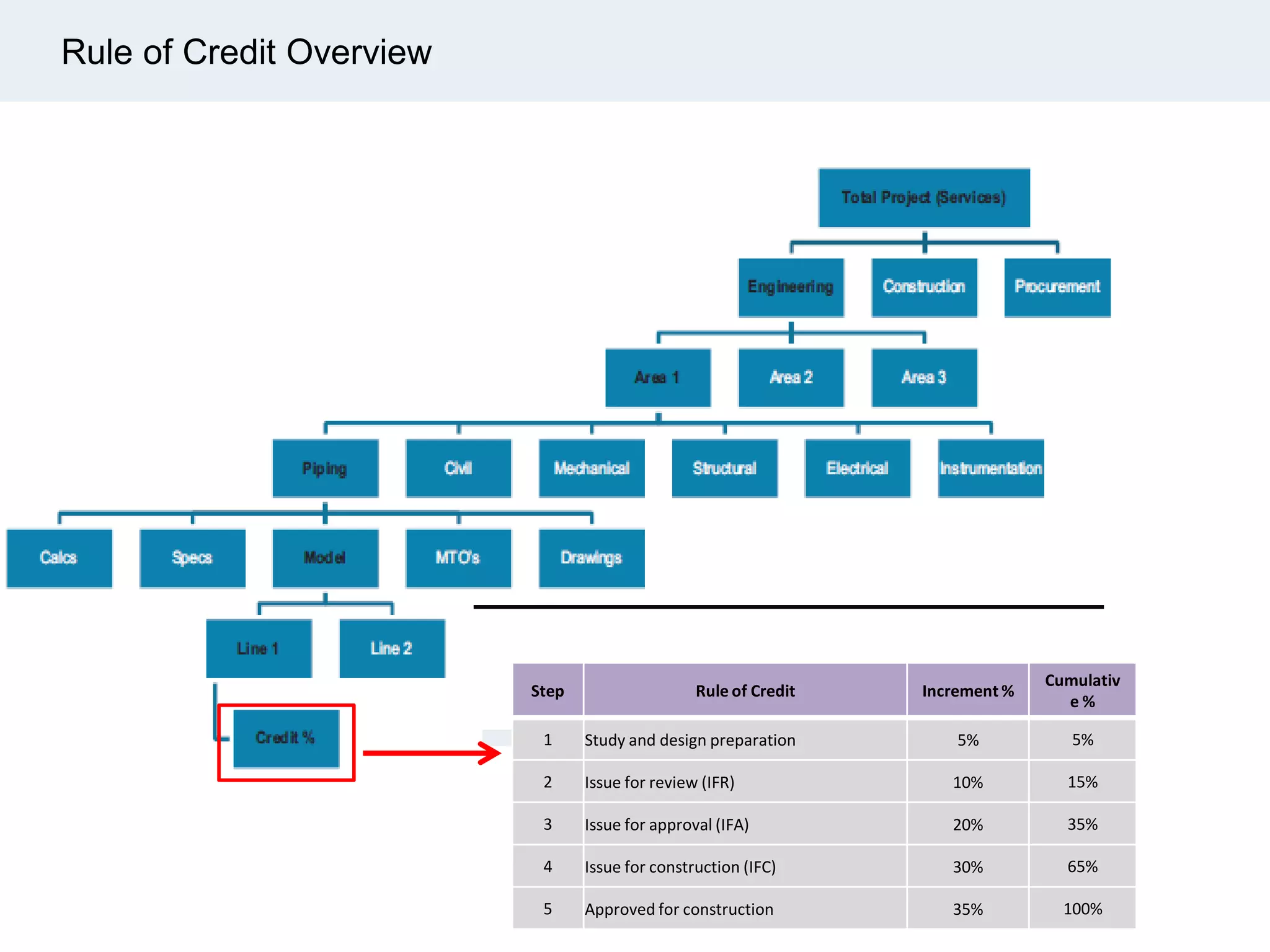
Rule of Credit Overview
Step Rule of Credit Increment %
Cumulativ
e %
1 Study and design preparation 5% 5%
2 Issue for review (IFR) 10% 15%
3 Issue for approval (IFA) 20% 35%
4 Issue for construction (IFC) 30% 65%
5 Approved for construction 35% 100%
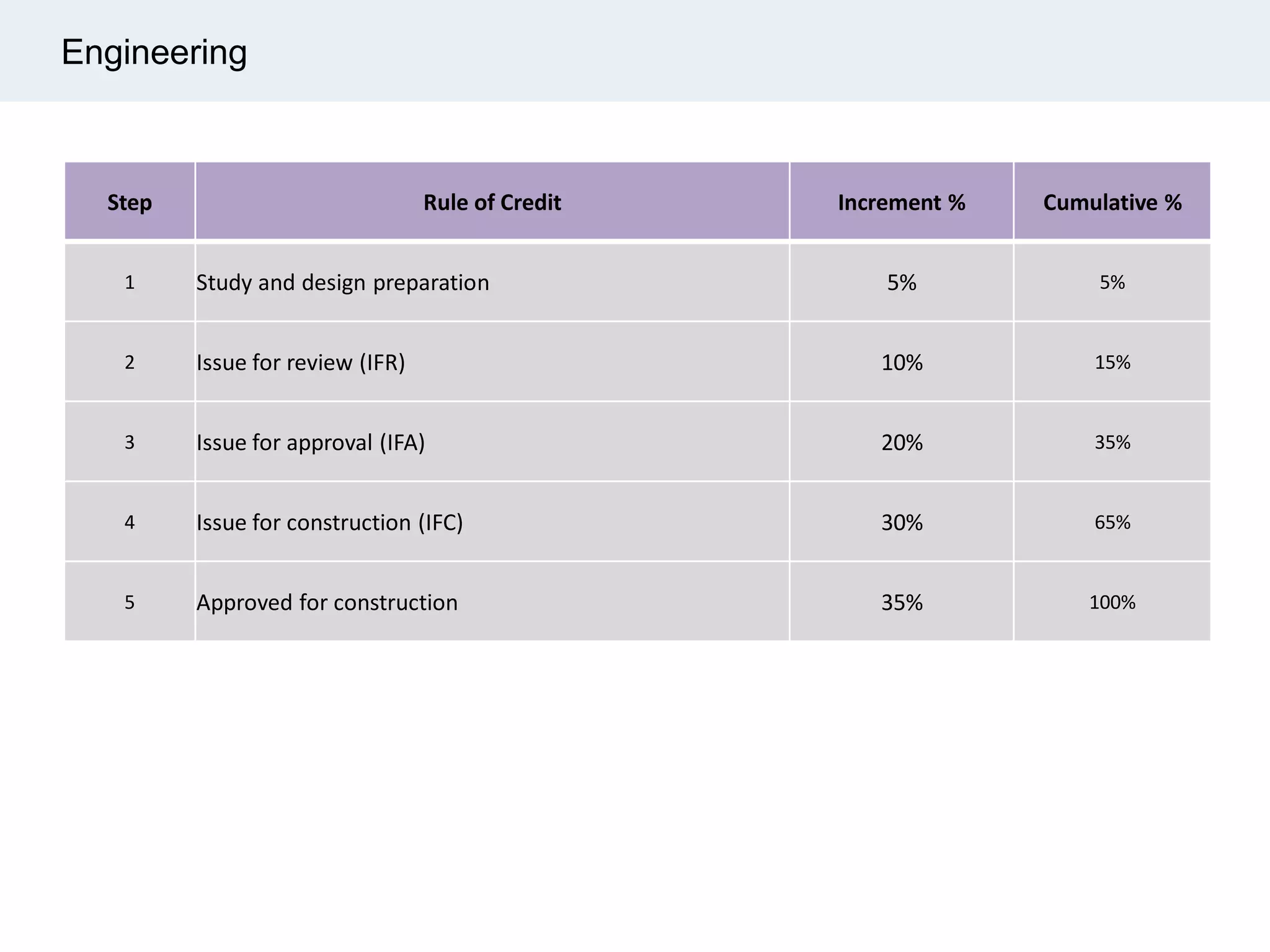
Engineering
Step Rule of Credit Increment % Cumulative %
1 Study and design preparation 5% 5%
2 Issue for review (IFR) 10% 15%
3 Issue for approval (IFA) 20% 35%
4 Issue for construction (IFC) 30% 65%
5 Approved for construction 35% 100%
Engineering
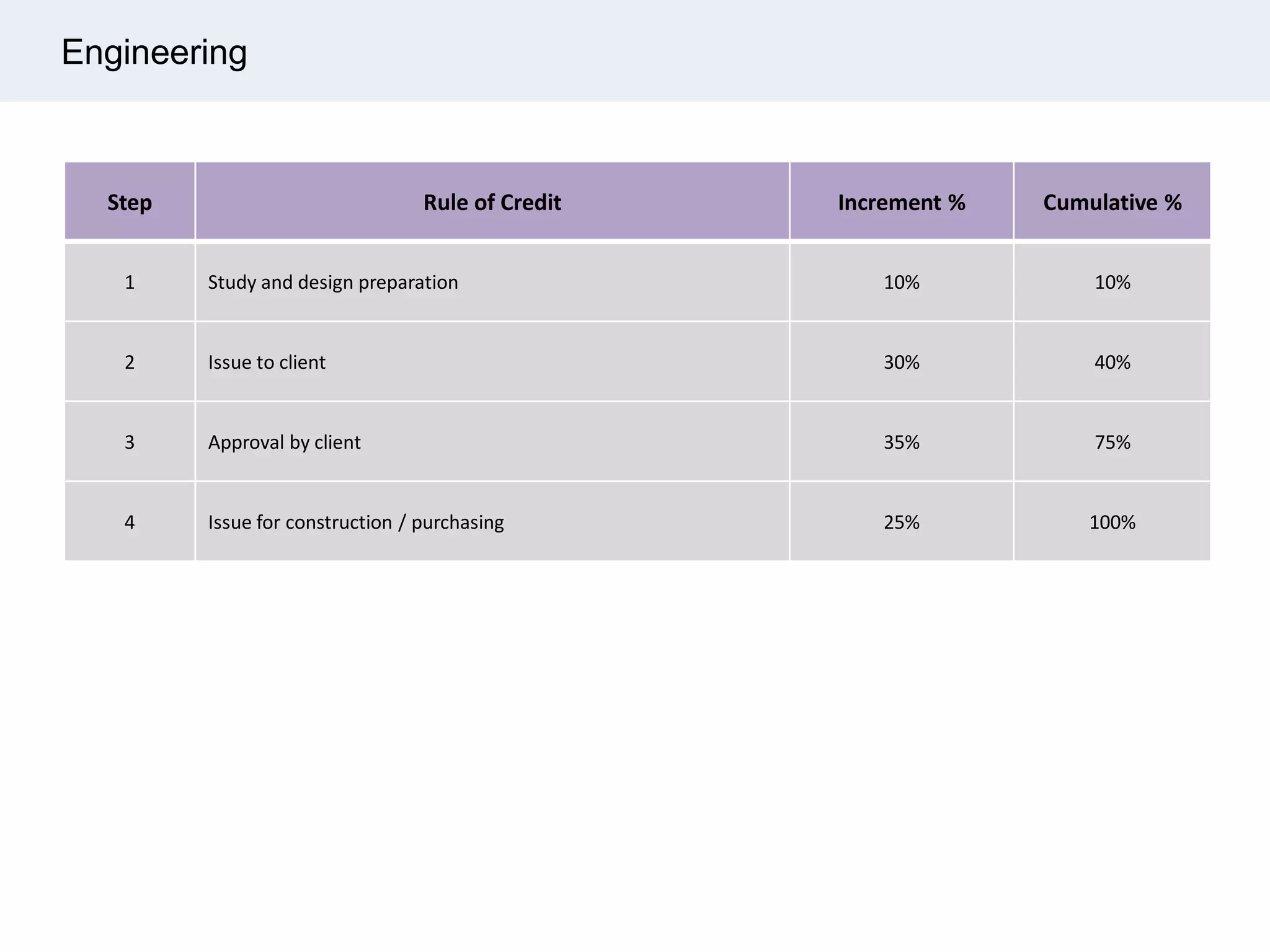
Step Rule of Credit Increment % Cumulative %
1 Study and design preparation 10% 10%
2 Issue to client 30% 40%
3 Approval by client 35% 75%
4 Issue for construction / purchasing 25% 100%
Engineering
Step Rule of Credit Increment % Cumulative %
1 Study/ design preparation 10% 10%
2 Issue for internal review 5% 15%
3 Issue to client 15% 30%
4 Approval by client 35% 65%
5 Issue to construction 35% 100%
Engineering
Step Rule of Credit Increment % Cumulative %
1 Study 10% 10%
2 Issue for internal review 5% 15%
3 Issue to client 15% 30%
4 Approval by client 35% 65%
5 Issue to construction 35% 100%
Engineering
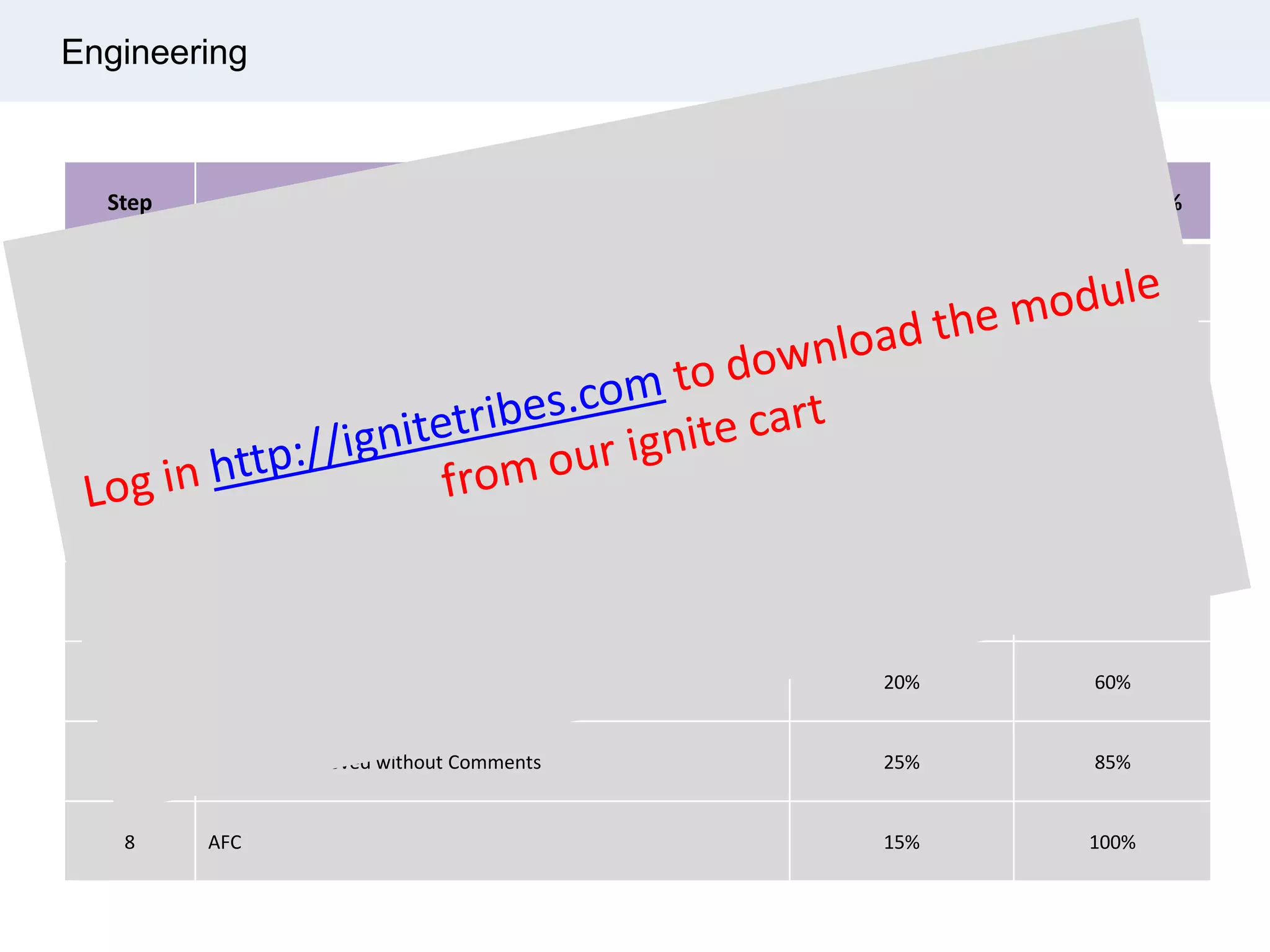
Step Rule of Credit Increment % Cumulative %
1 Document Started, Format Accepted, TOC Complete 10% 10%
2 Write-up Complete 10% 20%
3 Issue IDC 5% 25%
4 IDC approved 15% 40%
5 Code 3 – Rejected, Revise & Re-Submit - 40%
6
Code 2 – Approved with Comments, Revise & Re-Submit &
Proceed with Construction
20% 60%
7 Code 1 – Approved without Comments 25% 85%
8 AFC 15% 100%
Engineering
Step Rule of Credit Increment % Cumulative %
1 Study & design preparation 10% 10%
2 Issue for approval 25% 35%
3 Client comment - 33%
4 Incorporate client comment 35% 70%
5 Issue for construction 30% 100%
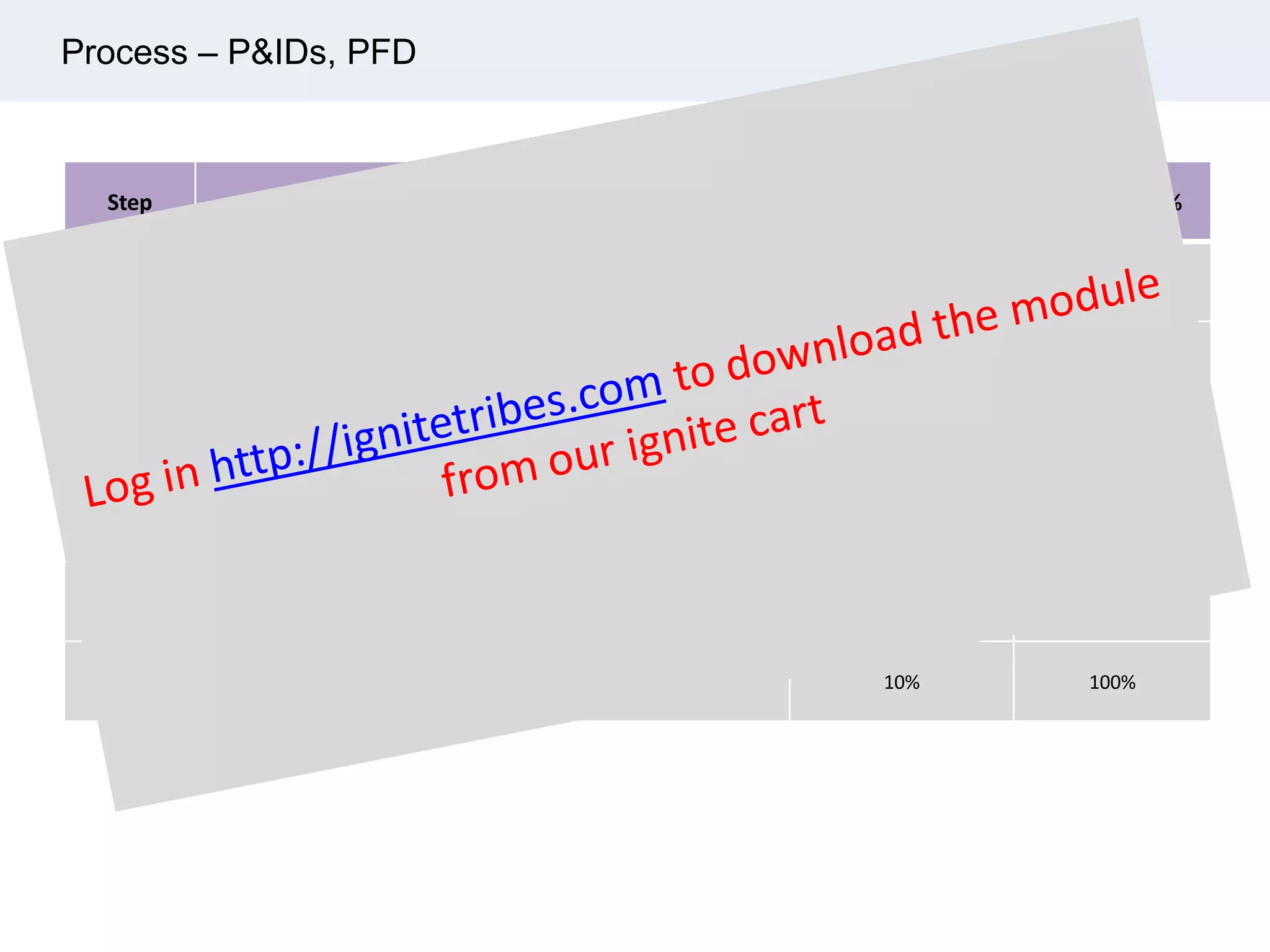
Process – P&IDs, PFD
Step Rule of Credit Increment % Cumulative %
1 Document Started, Format Accepted, TOC Complete 25% 25%
2
Write-up Complete, Dept Sign-off, Issue for Review / Issue for
Client Approval
25% 50%
3 Code 3 – Rejected, Revise & Re-Submit 10% 60%
4
Code 2 – Approved with Comments, Revise & Re-Submit &
Proceed with Construction
20% 80%
5 Code 1 – Approved without Comments 10% 90%
6 Final Issue / Upload in SAP / Issue for Construction (IFC) 10% 100%
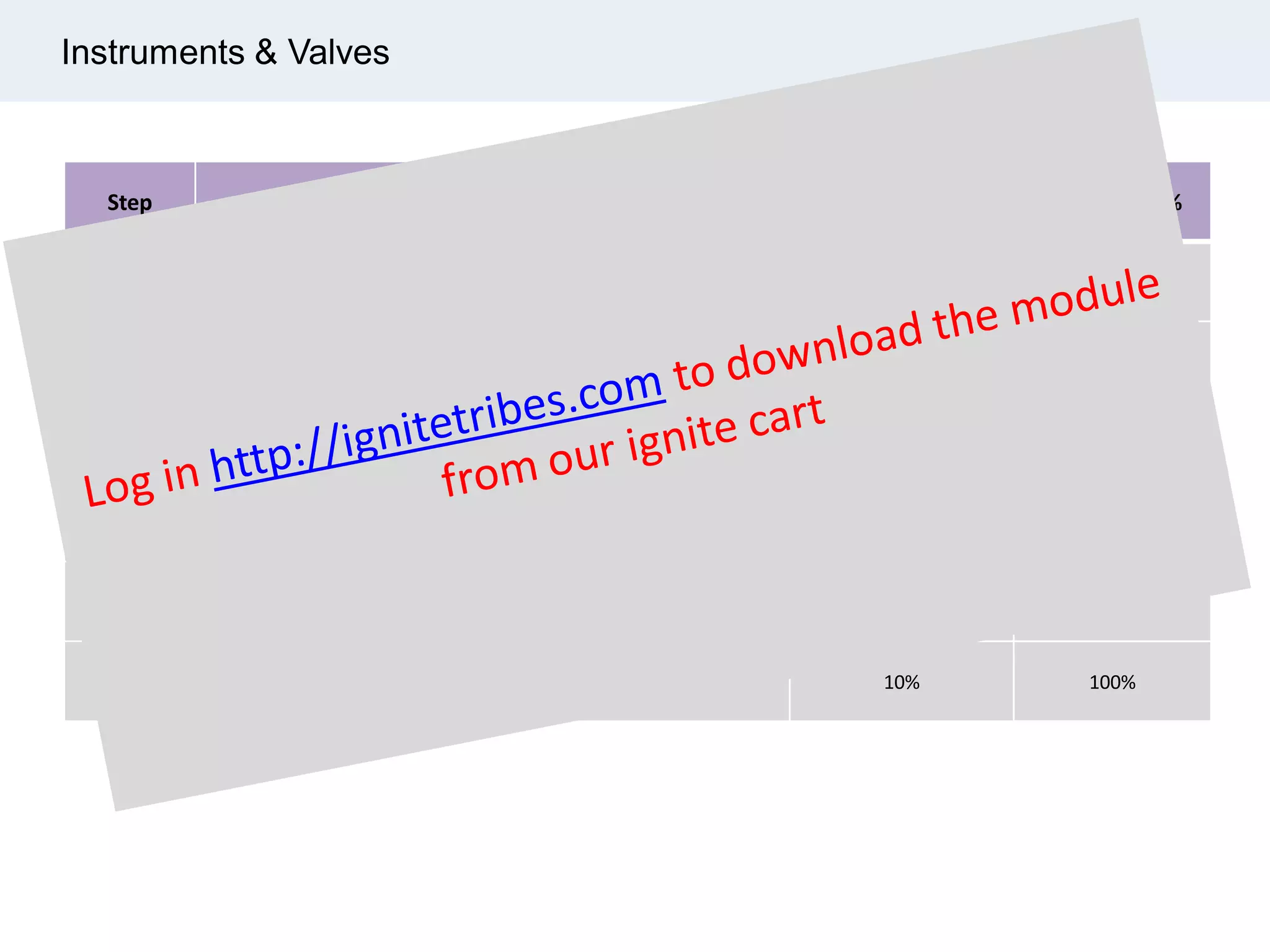
Instruments & Valves
Step Rule of Credit Increment % Cumulative %
1 Document Started, Format Accepted, TOC Complete 25% 25%
2
Write-up Complete, Dept Sign-off, Issue for Review / Issue for
Client Approval
25% 50%
3 Code 3 – Rejected, Revise & Re-Submit 10% 60%
4
Code 2 – Approved with Comments, Revise & Re-Submit &
Proceed with Construction
20% 80%
5 Code 1 – Approved without Comments 10% 90%
6 Final Issue / Upload in SAP / Issue for Construction (IFC) 10% 100%
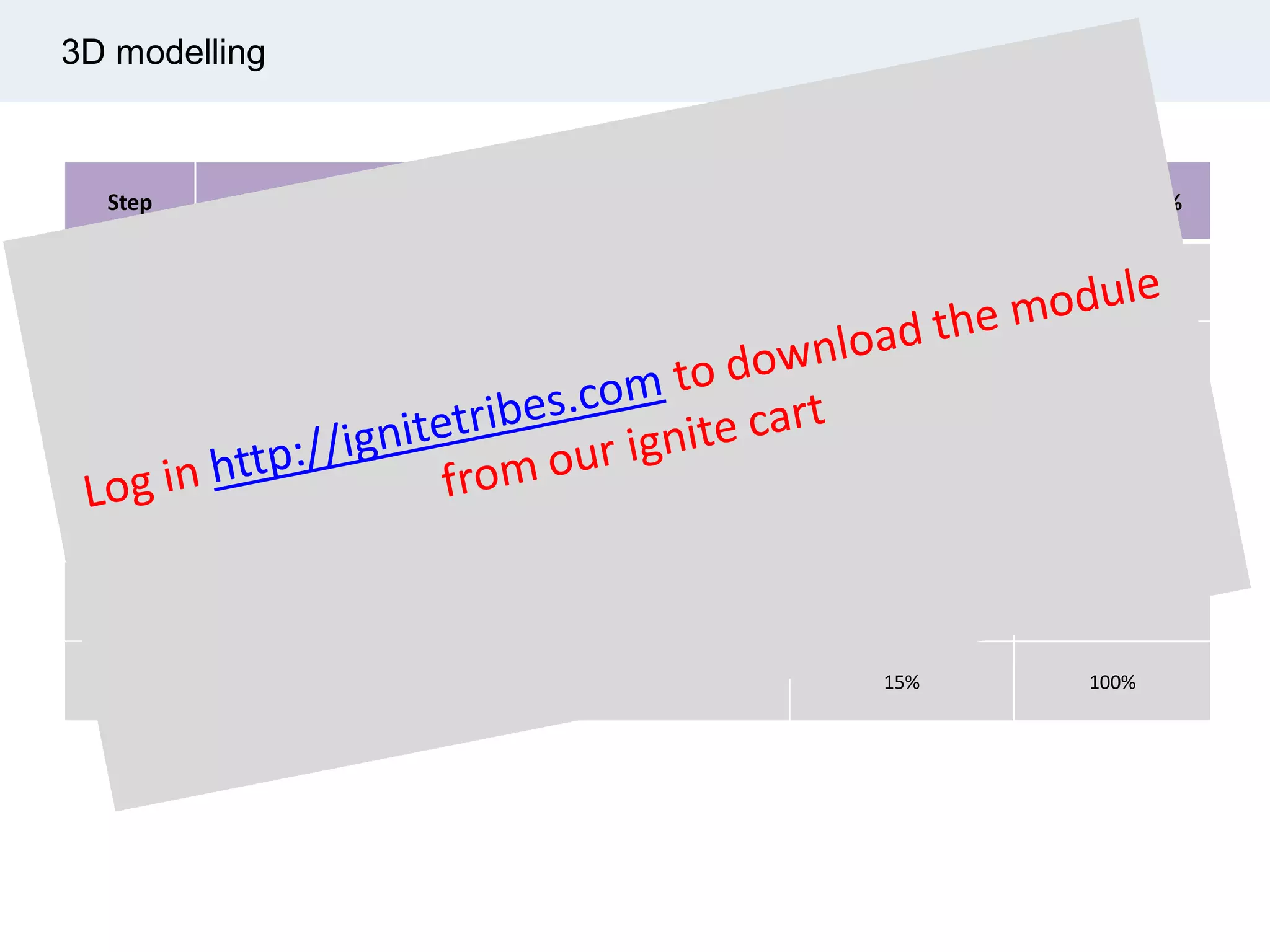
3D modelling
Step Rule of Credit Increment % Cumulative %
1 Completion to 30% Status 20% 20%
2 Completion to 60% Status 25% 45%
3 Completion to 90% Status 30% 75%
4 Code 3 – Rejected, Revise & Re-Submit 0% 75%
5
Code 2 – Approved with Comments, Revise & Re-Submit &
Proceed with Construction
10% 85%
6
Code 1 – Approved without Comments, Final Issue / Release into
SAP
15% 100%
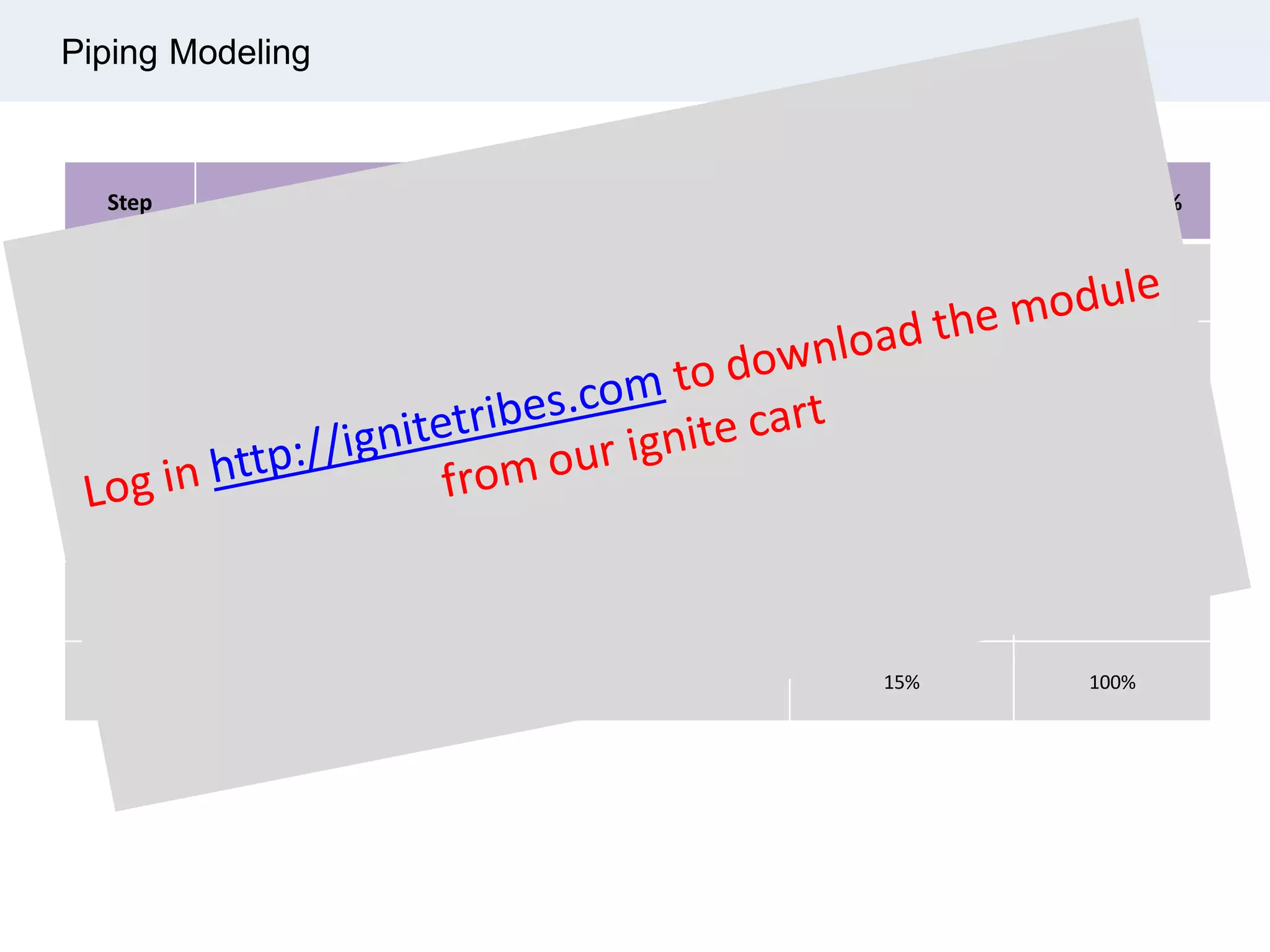
Piping Modeling
Step Rule of Credit Increment % Cumulative %
1
Preliminary : modeled point to point, branch fittings modeled,
pipe support location shown, critical line issued for stressing
20% 20%
2
Detailed : line modeled with valves, fittings and instruments, ISO
generating free of errors
25% 45%
3
Checking : Clash free, physical supports modeled, conforms to
stress analysis,, extracted for checking
30% 75%
4 Code 3 – Rejected, Revise & Re-Submit 0% 75%
5
Code 2 – Approved with Comments, Revise & Re-Submit &
Proceed with Construction
10% 85%
6
Code 1 – Approved without Comments, Final Issue / Release into
SAP
15% 100%
Piping Calculation
Step Rule of Credit Increment % Cumulative %
1 Initiate Pipe Stress Calcs/Issue Deliverables to Mech Eng 20% 20%
2 Prepare / Issue for Client Approval 55% 75%
3 Release / Approved for Construction 25% 100%
Piping Drawing
Step Rule of Credit Increment % Cumulative %
1 Document Started, Format Accepted, TOC Complete 25% 25%
2 Issue for Review / Issue for Client Approval 25% 50%
3 Code 3 – Rejected, Revise & Re-Submit 10% 60%
4
Code 2 – Approved with Comments, Revise & Re-Submit &
Proceed with Construction
20% 80%
5 Code 1 – Approved without Comments 10% 90%
6 Final Issue / Upload in SAP 10% 100%
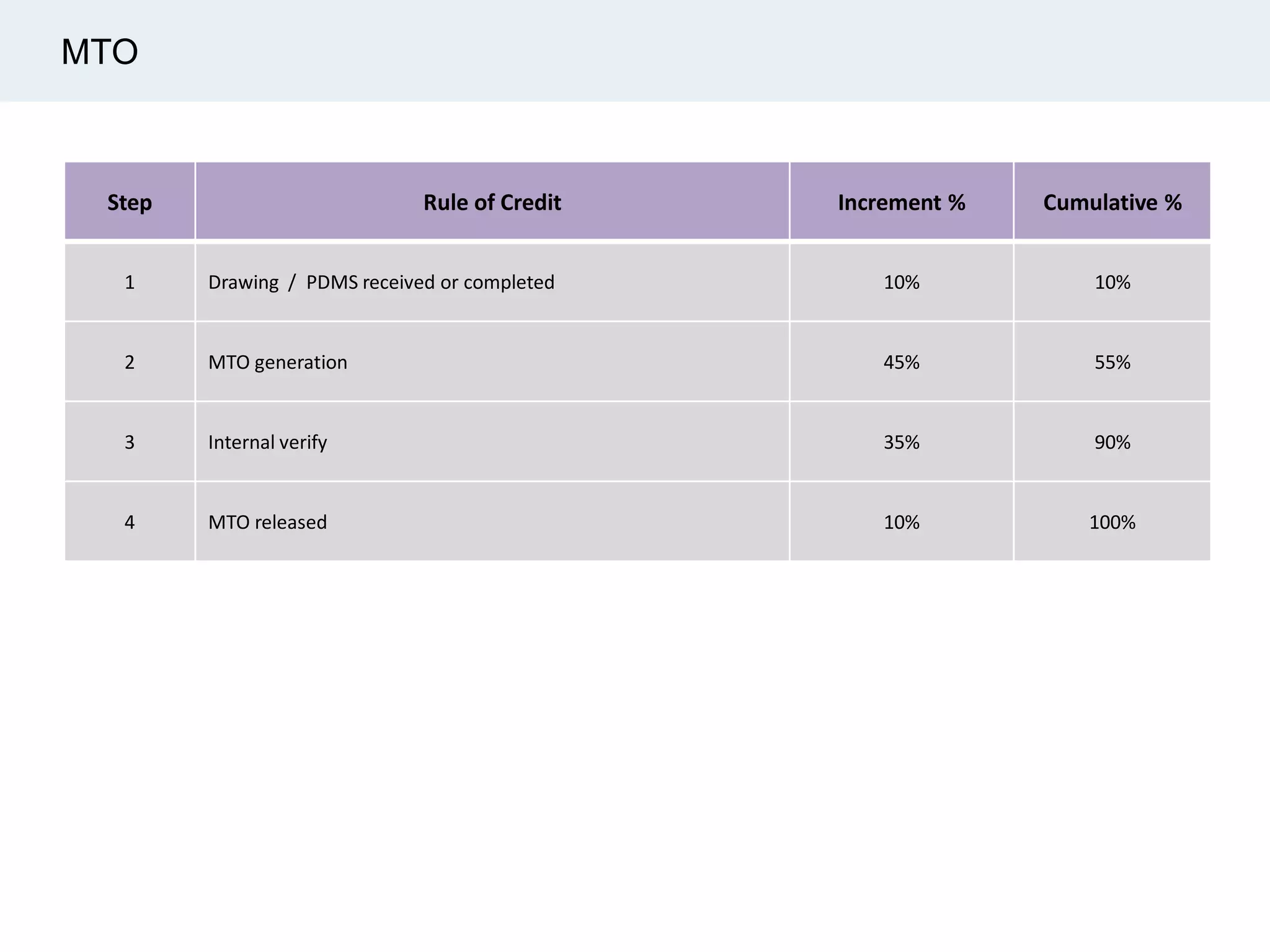
MTO
Step Rule of Credit Increment % Cumulative %
1 Drawing / PDMS received or completed 10% 10%
2 MTO generation 45% 55%
3 Internal verify 35% 90%
4 MTO released 10% 100%
Rule of Credit
03
+ Procurement
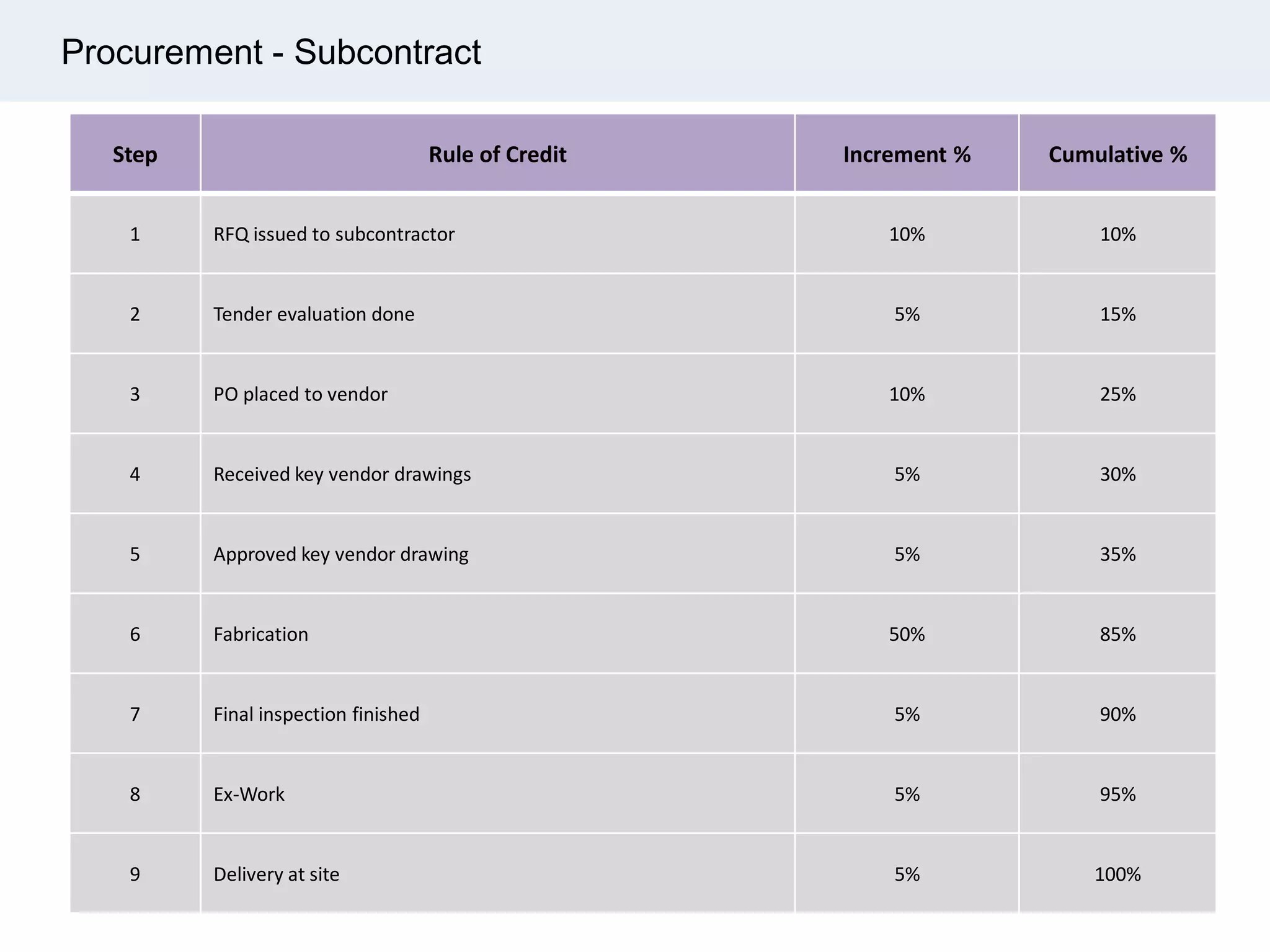
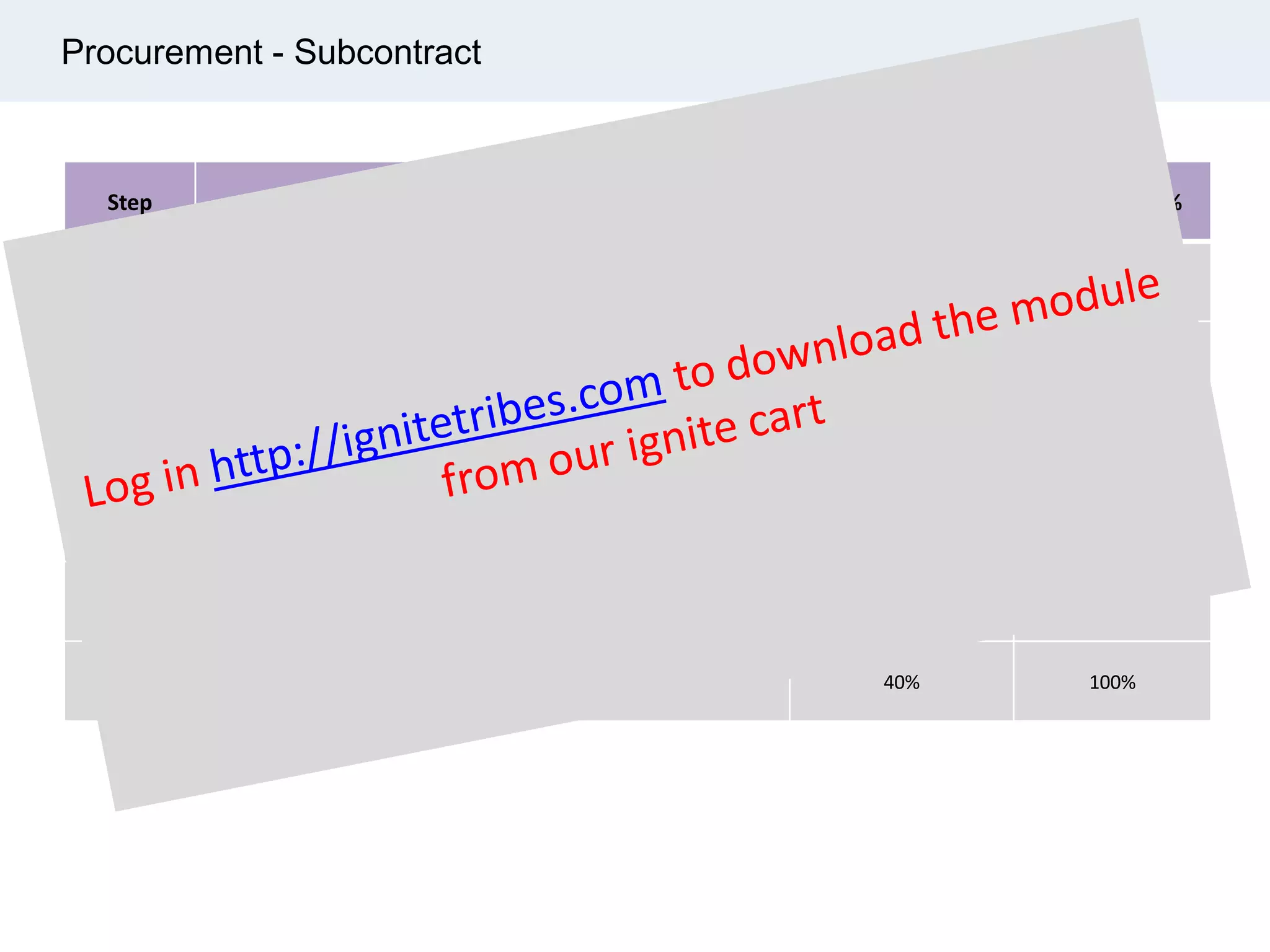
Procurement - Subcontract
Step Rule of Credit Increment % Cumulative %
1 RFQ issued to subcontractor 10% 10%
2 Technical Bid Evaluation (TBE) 5% 15%
3 Cost Bid Evaluation (CBE) 5% 20%
4 Purchasing Request (PR) 10% 30%
5 PO issued 30% 60%
6 Site mobilization 40% 100%
Procurement - Subcontract
Step Rule of Credit Increment % Cumulative %
1 RFQ issued to subcontractor 10% 10%
2 Tender evaluation done 5% 15%
3 PO placed to vendor 10% 25%
4 Received key vendor drawings 5% 30%
5 Approved key vendor drawing 5% 35%
6 Fabrication 50% 85%
7 Final inspection finished 5% 90%
8 Ex-Work 5% 95%
9 Delivery at site 5% 100%
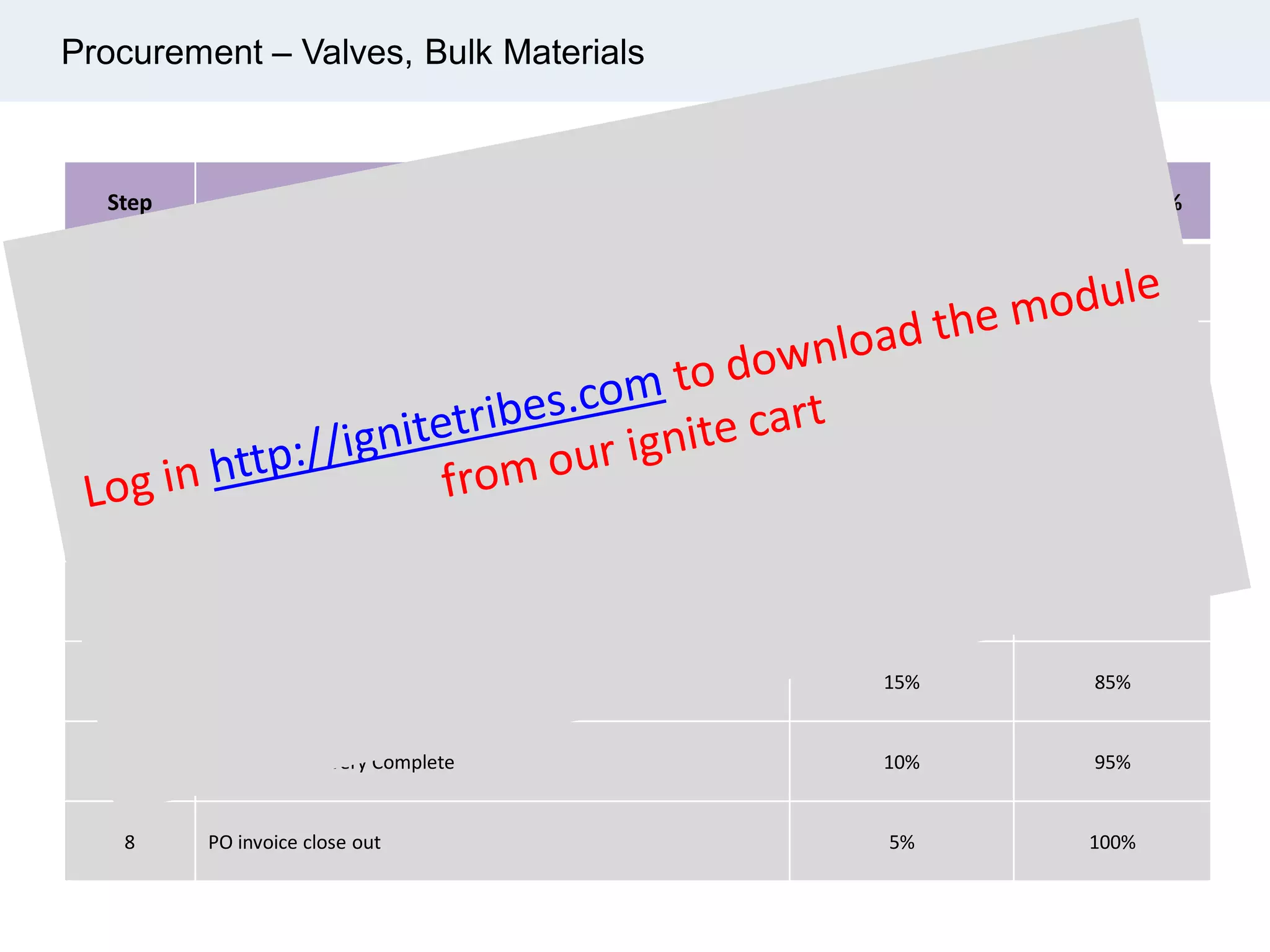
Procurement – Valves, Bulk Materials
Step Rule of Credit Increment % Cumulative %
1 Issued RFQ 10% 10%
2 Technical Bid Evaluation 10% 20%
3 P.O. Issued 15% 35%
4 Receipt of Major Materials 10% 45%
5 Function Testing 25% 70%
6 Final Inspection 15% 85%
7 Inco Term Delivery Complete 10% 95%
8 PO invoice close out 5% 100%
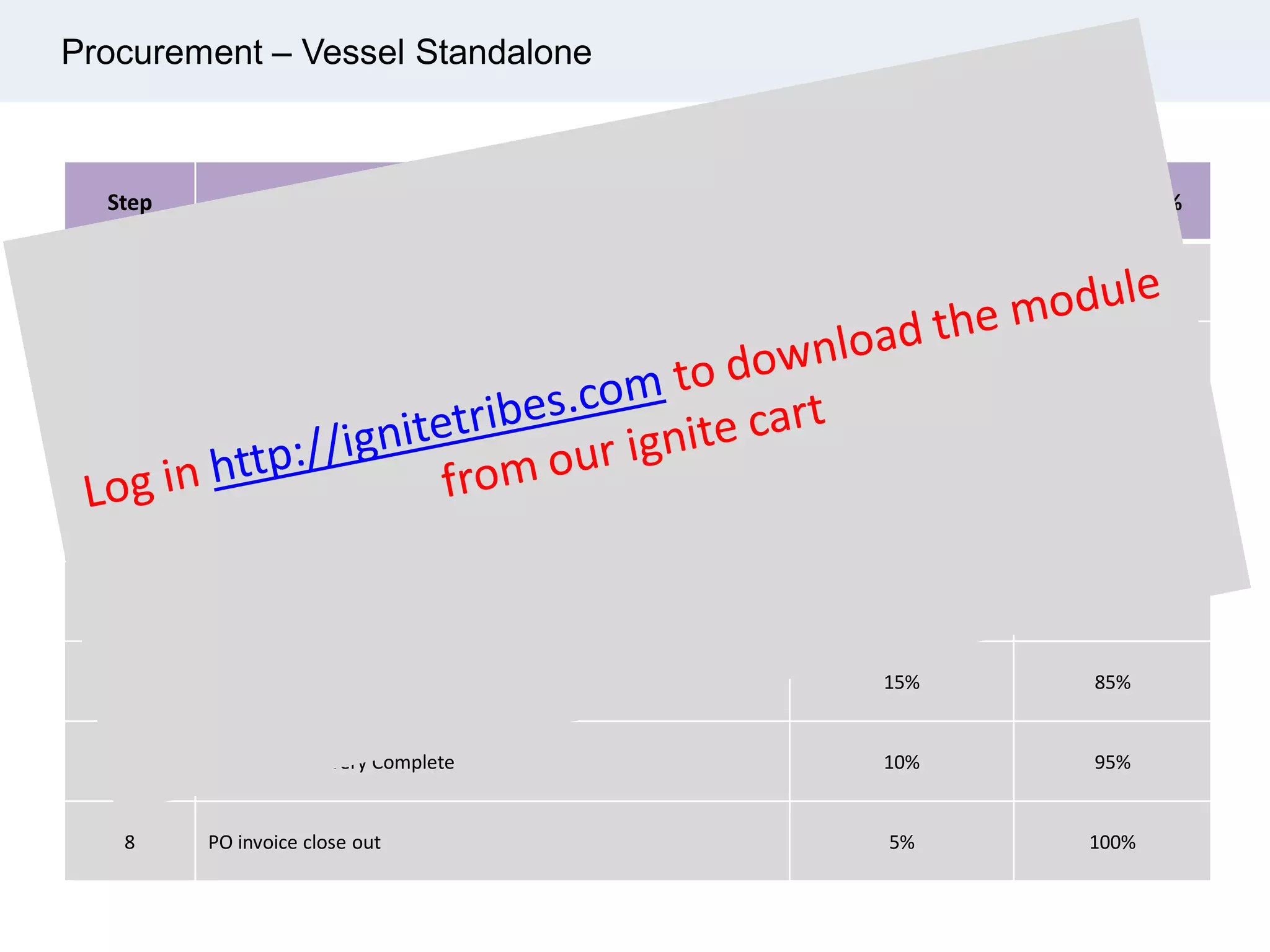
Procurement – Vessel Standalone
Step Rule of Credit Increment % Cumulative %
1 Issued RFQ 10% 10%
2 Technical Bid Evaluation 10% 20%
3 P.O. Issued 15% 35%
4 Commencement of Fabrication 10% 45%
5 Hydro Static testing 25% 70%
6 Final Inspection 15% 85%
7 Inco Term Delivery Complete 10% 95%
8 PO invoice close out 5% 100%
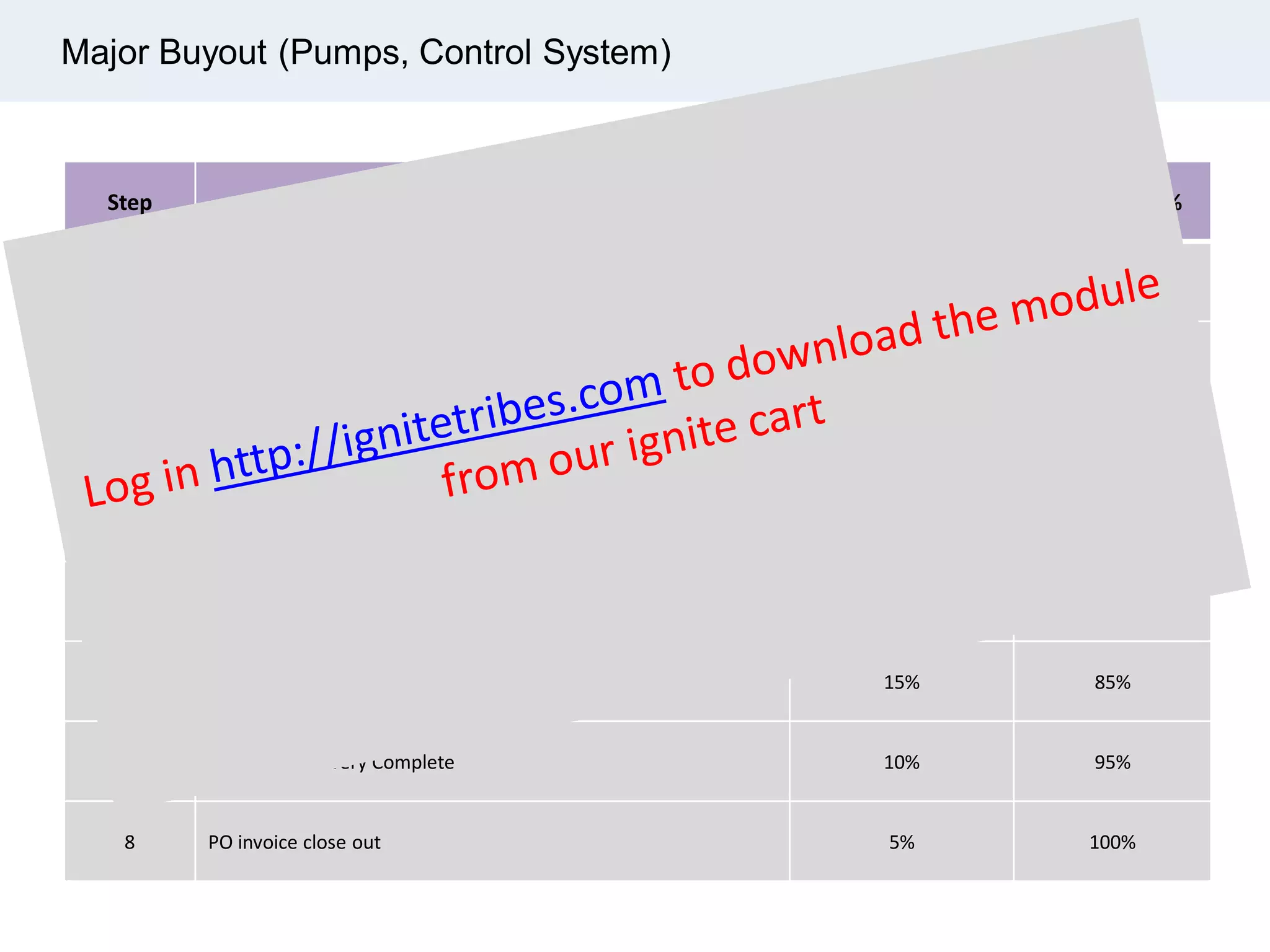
Major Buyout (Pumps, Control System)
Step Rule of Credit Increment % Cumulative %
1 Issued RFQ 10% 10%
2 Technical Bid Evaluation 10% 20%
3 P.O. Issued 15% 35%
4 Commencement of Fabrication 10% 45%
5 Hydro Static testing 25% 70%
6 Final Inspection 15% 85%
7 Inco Term Delivery Complete 10% 95%
8 PO invoice close out 5% 100%
Rule of Credit
04
+ Fabrication / Construction
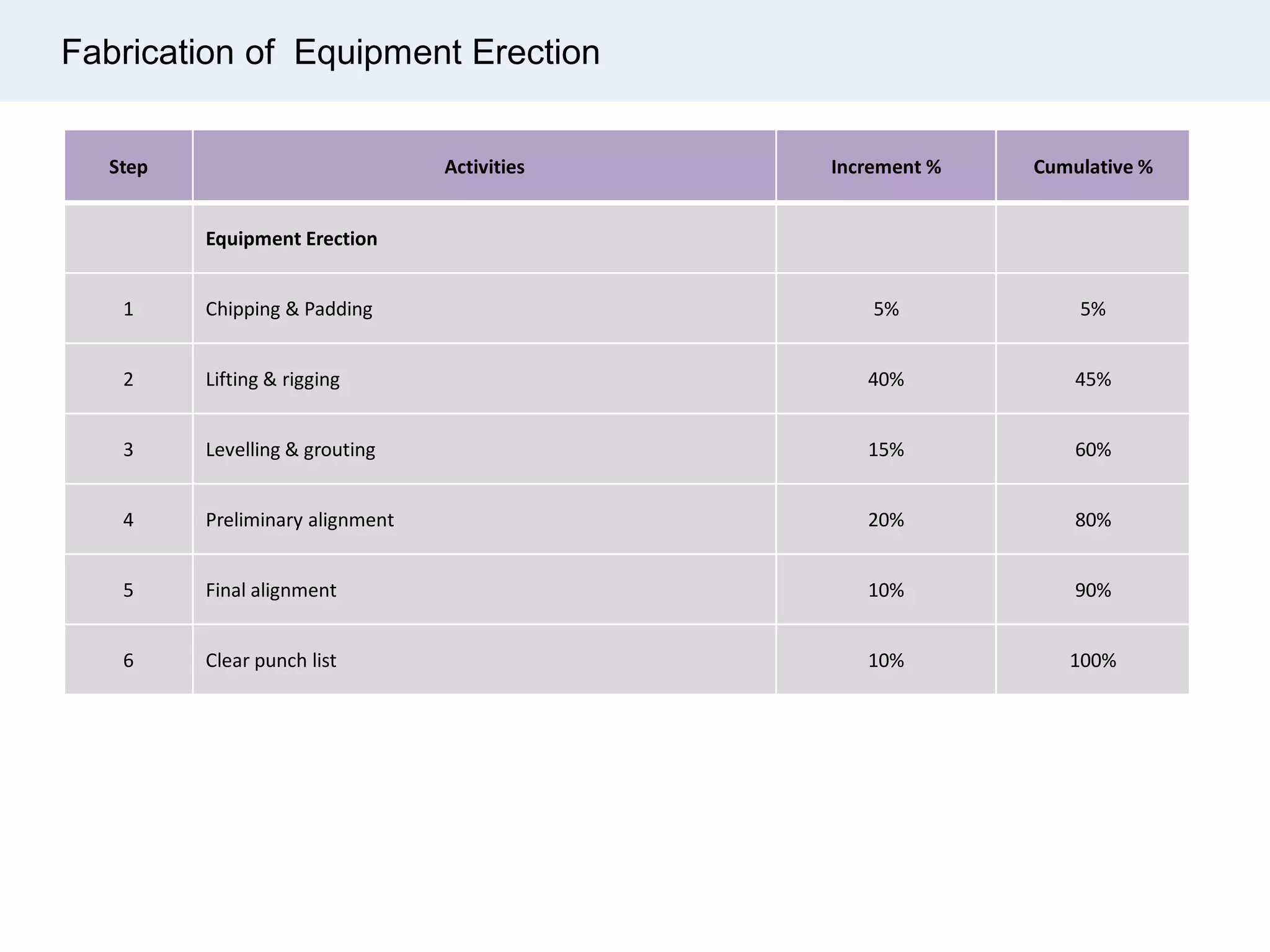
Fabrication of Equipment Erection
Step Activities Increment % Cumulative %
Equipment Erection
1 Chipping & Padding 5% 5%
2 Lifting & rigging 40% 45%
3 Levelling & grouting 15% 60%
4 Preliminary alignment 20% 80%
5 Final alignment 10% 90%
6 Clear punch list 10% 100%
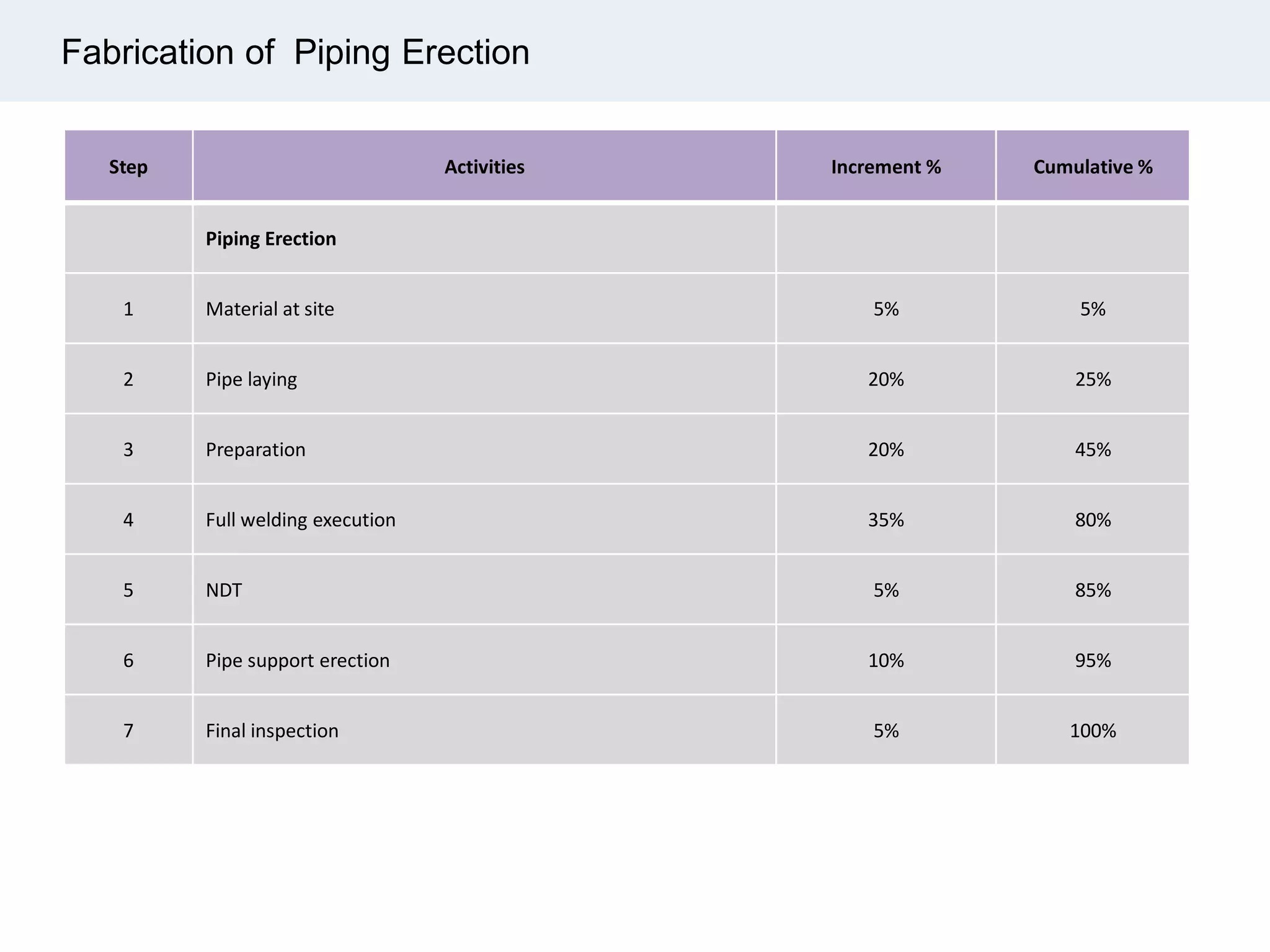
Fabrication of Piping Erection
Step Activities Increment % Cumulative %
Piping Erection
1 Material at site 5% 5%
2 Pipe laying 20% 25%
3 Preparation 20% 45%
4 Full welding execution 35% 80%
5 NDT 5% 85%
6 Pipe support erection 10% 95%
7 Final inspection 5% 100%
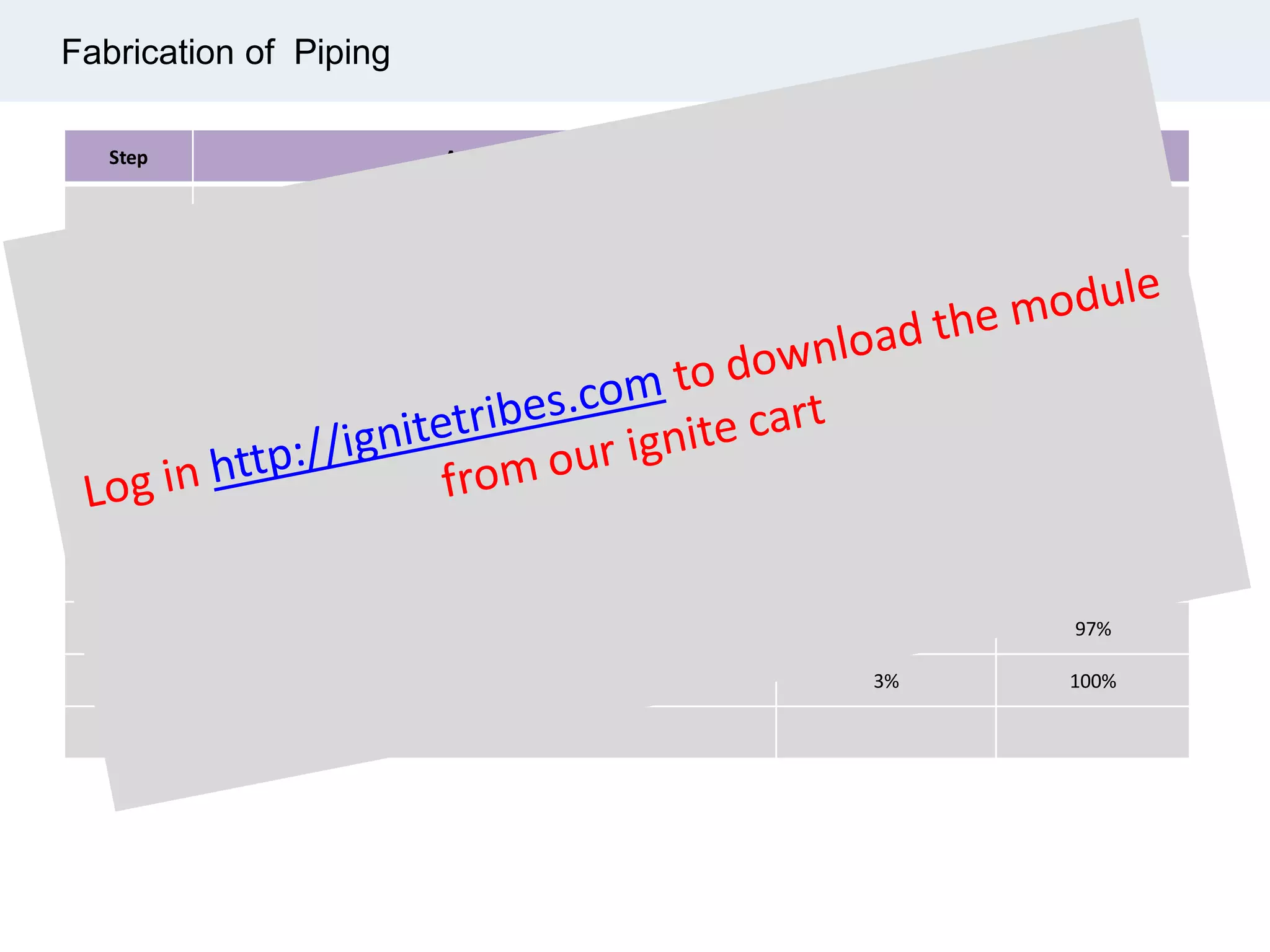
Fabrication of Piping
Step Activities Increment % Cumulative %
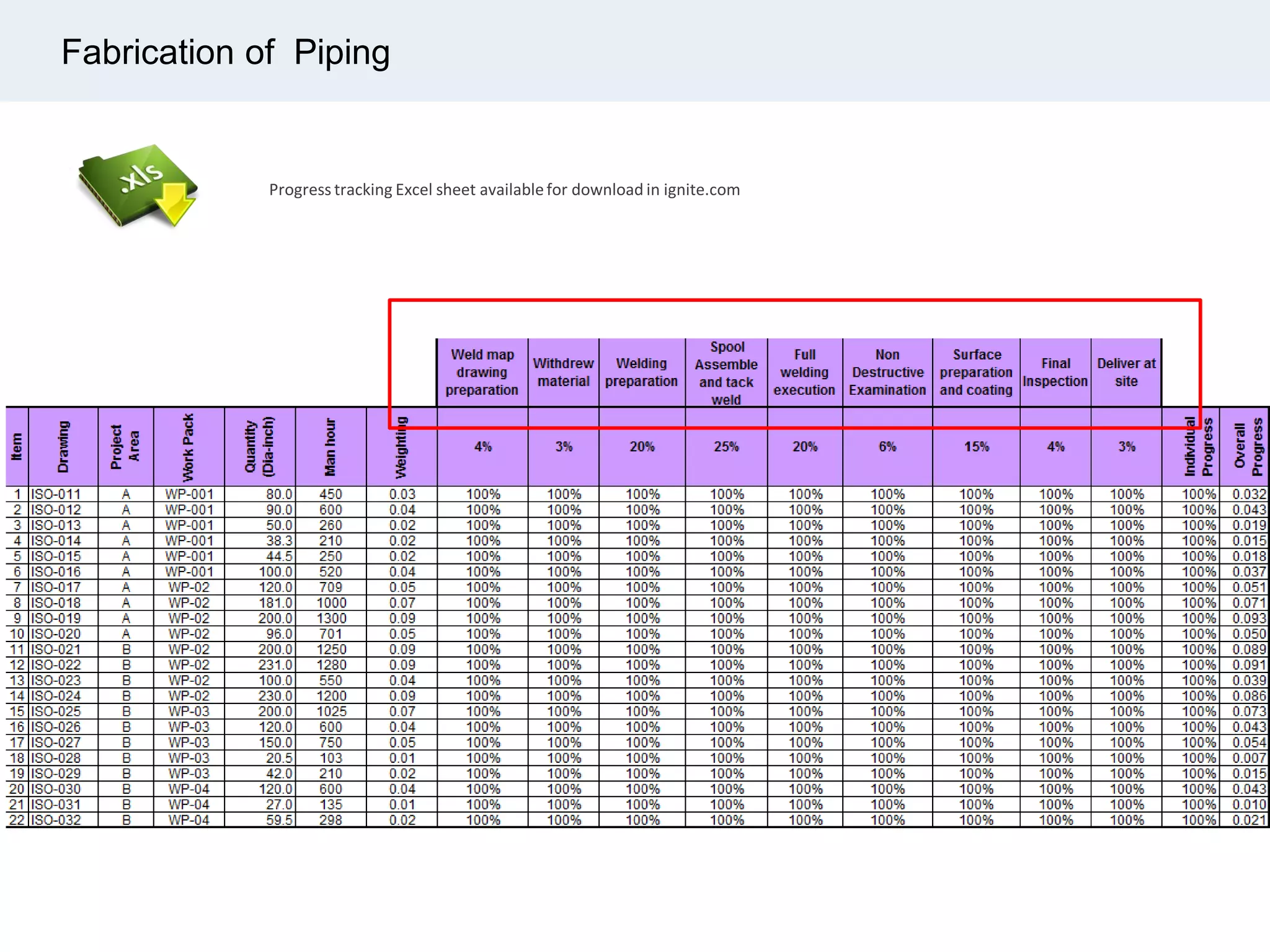
Piping Fabrication
1 Weld map drawing preparation 4% 4%
2 Withdrew material 3% 7%
3 Welding preparation 20% 27%
4 Spool assemble and tack weld 25% 52%
5 Full welding execution 20% 72%
6 Non Destructive Test (NDT) 6% 78%
7 Surface preparation and coating 15% 93%
8 Final Inspection 4% 97%
9 Deliver at Site 3% 100%
Tie-In work
Step Activities Increment % Cumulative %
Tie-in Work
1 Preparation done 10% 10%
2 Tagging done 10% 20%
3 Tie-in work 70% 90%
4 Final inspection 10% 100%
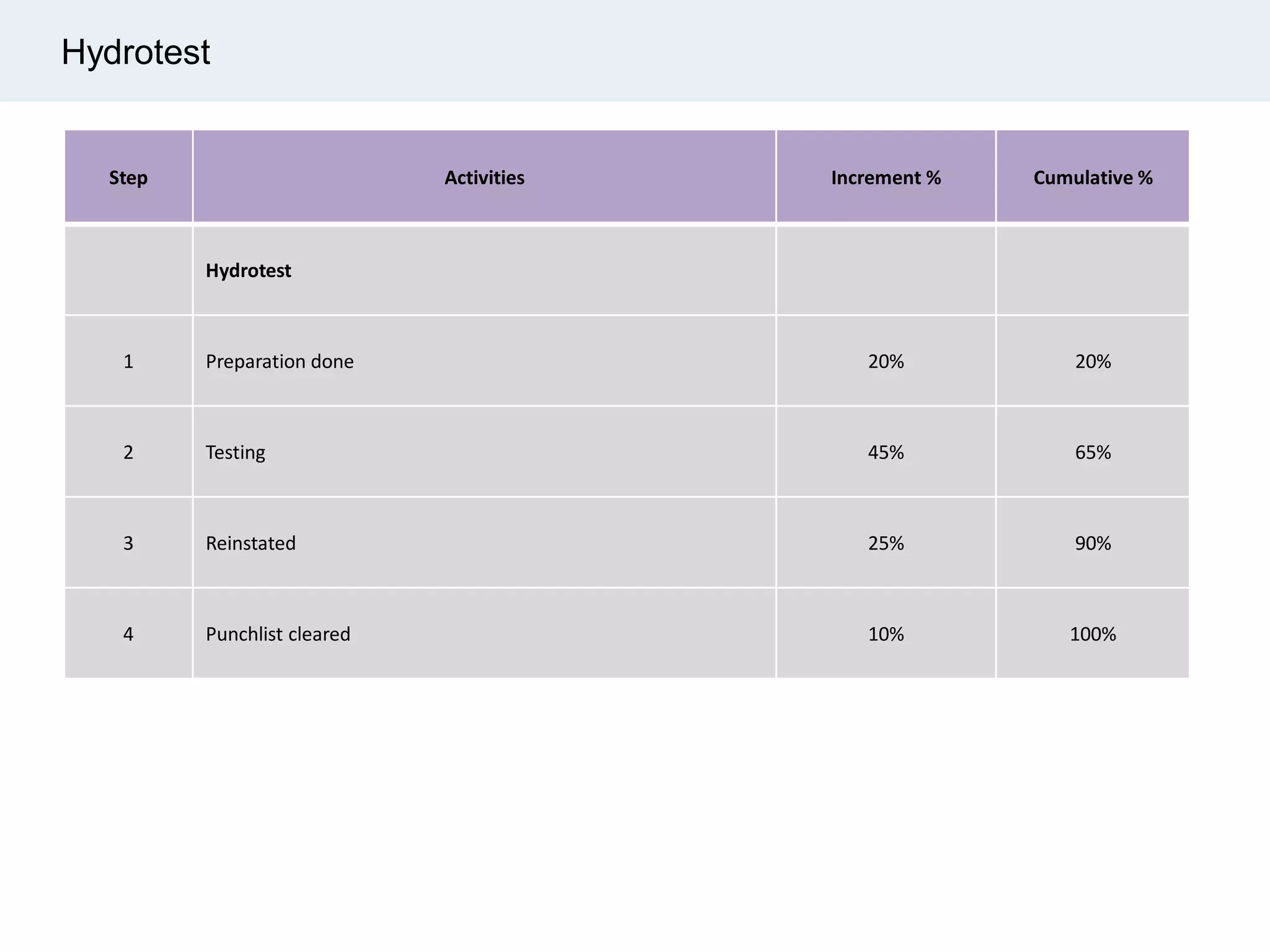
Hydrotest
Step Activities Increment % Cumulative %
Hydrotest
1 Preparation done 20% 20%
2 Testing 45% 65%
3 Reinstated 25% 90%
4 Punchlist cleared 10% 100%
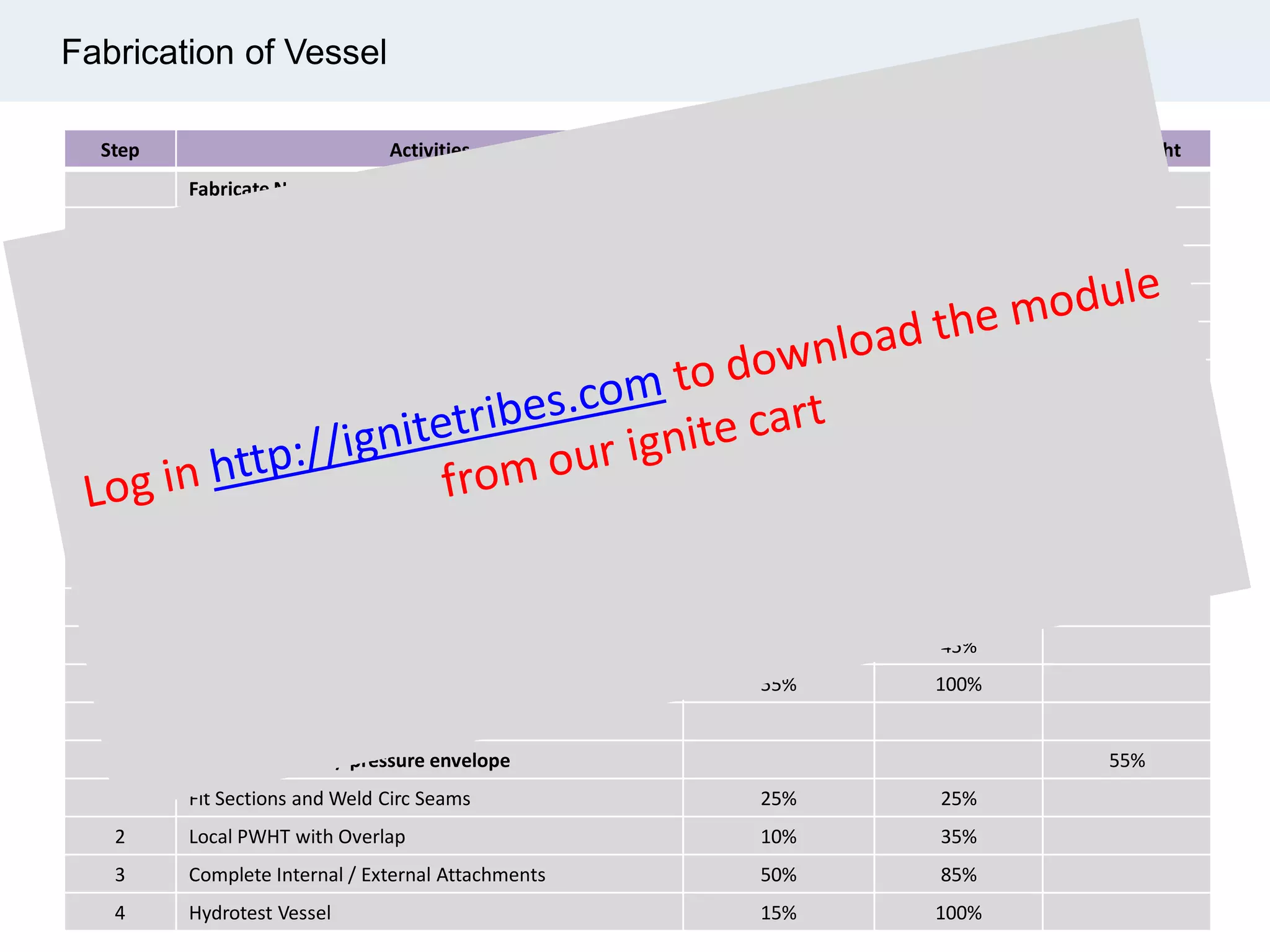
Fabrication of Vessel
Step Activities Increment % Cumulative % WBS Weight
Fabricate Nozzles 5%
1 Weld/Fabricate nozzles 50% 50%
2 Completed NDE 50% 100%
Fabricate section number head 5%
1 Layout, cut holes prep 30% 30%
2 Fit/Weld nozzles/compensation pads 70% 100%
Fabricate Section Number 20%
1 Bevel, square, roll vessel 10% 10%
2 Weld long seams / re-roll 15% 25%
3 Layout, cut holes prep 10% 35%
4 Fit/weld nozzles/compensation pads 10% 45%
5 Build/install internal pads and external (trial fit) 55% 100%
Complete vessel / pressure envelope 55%
1 Fit Sections and Weld Circ Seams 25% 25%
2 Local PWHT with Overlap 10% 35%
3 Complete Internal / External Attachments 50% 85%
4 Hydrotest Vessel 15% 100%
Fabrication of Vessel
Step Activities Increment % Cumulative % WBS Weight
Paint 15%
1 Blasting 20%
2 Painting 40%
3 Lining & Acceptable Holiday (Spark) Testing 25%
4 Release 15%
Mechanical Work – Rotating Equipment
Step Activities Increment % Cumulative %
Rotating Equipment
1 Receive material 15% 15%
2 Rough, set. And prelim alignment 20% 35%
3 Level & grout 10% 45%
4 Final alignment 15% 60%
5 Run in 20% 80%
6 Clear punch list 20% 100%
Civil Work – Foundation & Concrete Paving
Step Activities Increment % Cumulative %
Foundation
1 Excavation 10%
2 Rebar 30%
3 Formwork 10%
4 Pouring concrete 15%
5 Strip & finishing 10%
6 Backfilling & compaction 15%
7 Clear punch list 10%
Civil Work – Cable Trench
Step Activities Increment % Cumulative %
Cable Trench
1 Excavation 35% 35%
2 Pre-cast concrete 25% 70%
3 Installation of concrete 25% 95%
4 Clear punch list 5% 100%
Civil Work – RCC Structure
Step Activities Increment % Cumulative %
Cable Trench
1 Excavation/PCC 10% 10%
2 Raft concrete 15% 25%
3 Super structure wall 40% 65%
4 Slab and backfilling 35% 100%
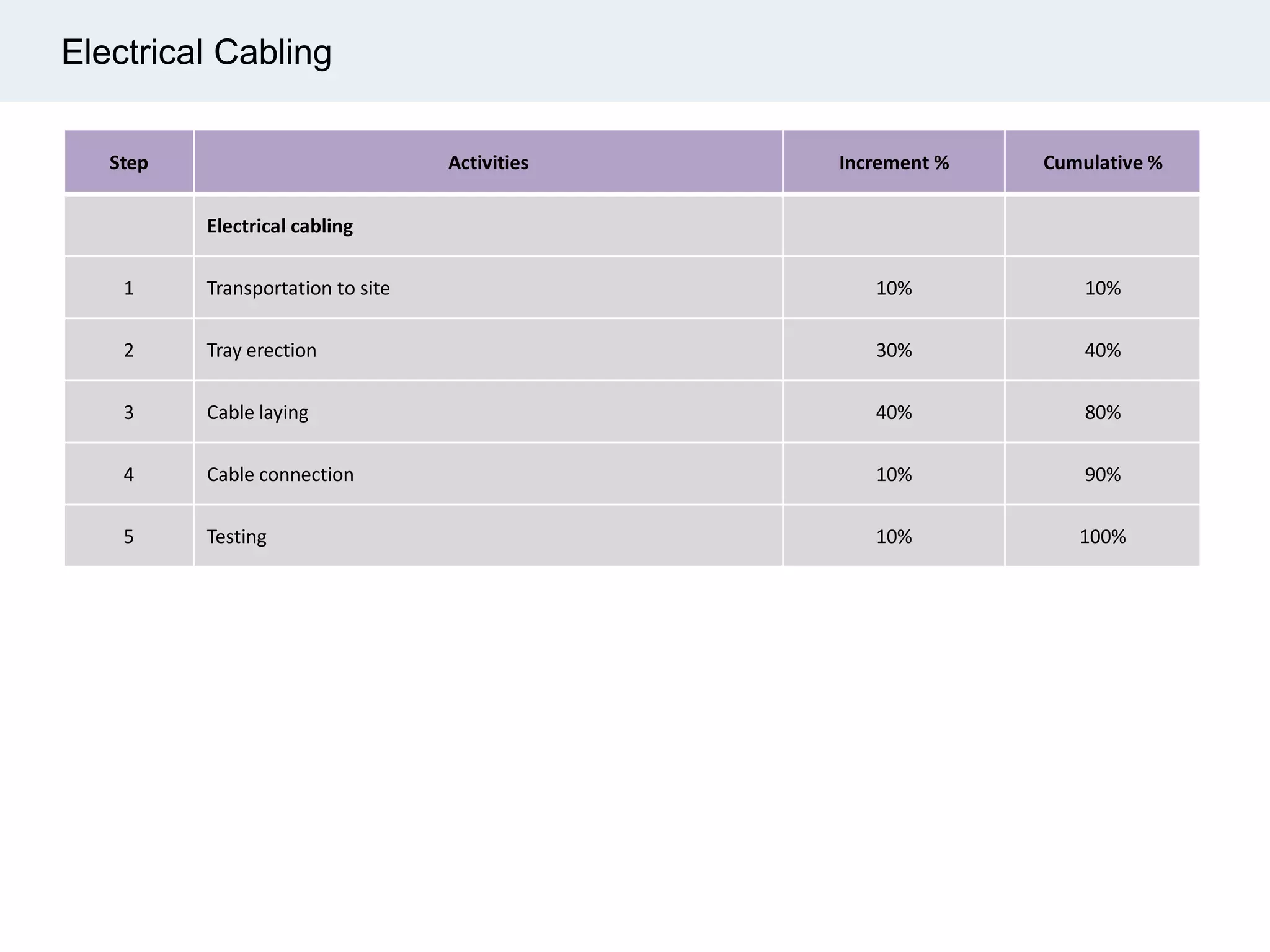
Electrical Cabling
Step Activities Increment % Cumulative %
Electrical cabling
1 Transportation to site 10% 10%
2 Tray erection 30% 40%
3 Cable laying 40% 80%
4 Cable connection 10% 90%
5 Testing 10% 100%
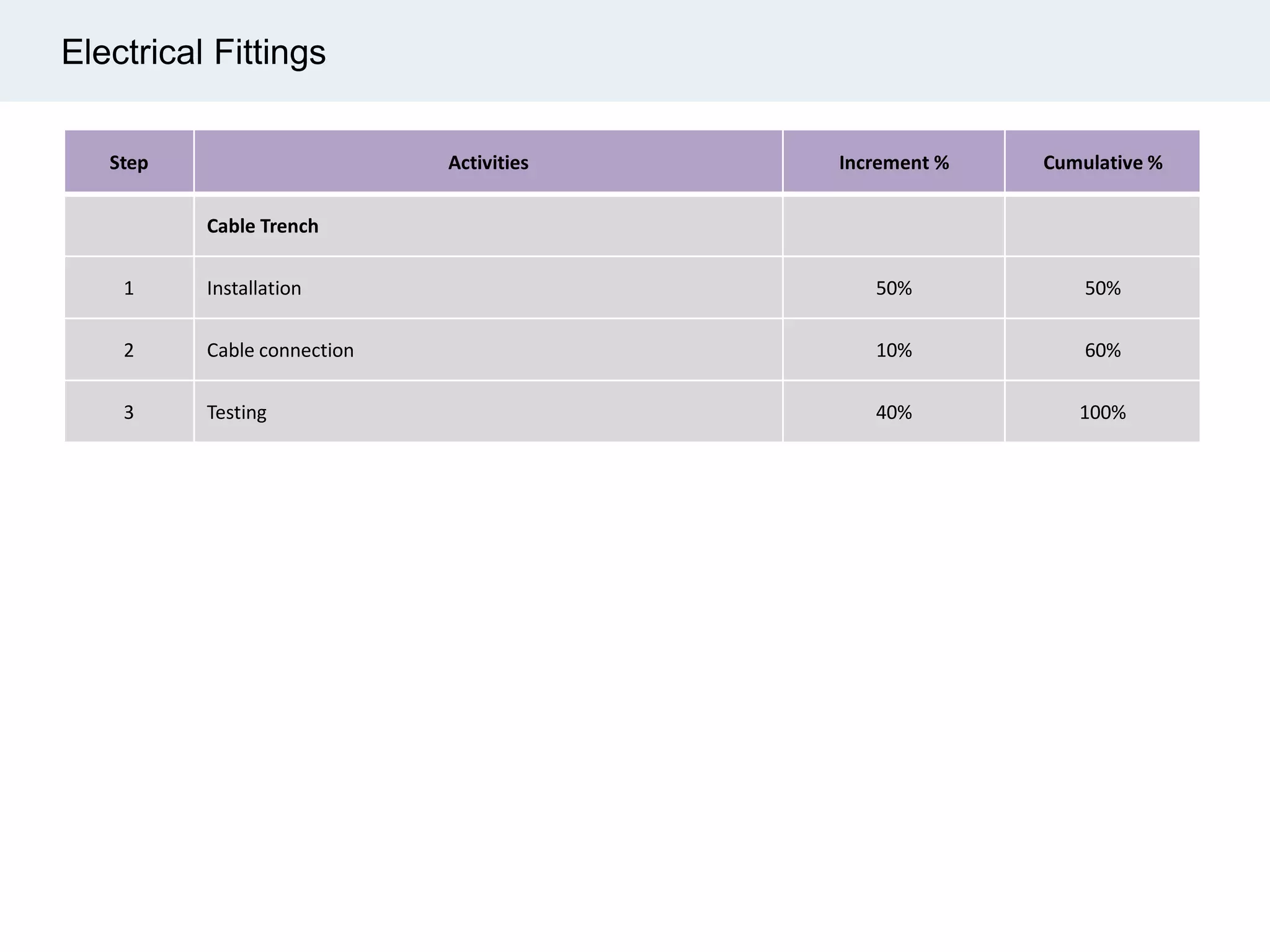
Electrical Fittings
Step Activities Increment % Cumulative %
Cable Trench
1 Installation 50% 50%
2 Cable connection 10% 60%
3 Testing 40% 100%
Fabrication of Piping
Progress tracking Excel sheet availablefor download in ignite.com
Rule of Credit in P6
05
+ “Step” function in Primavera P6
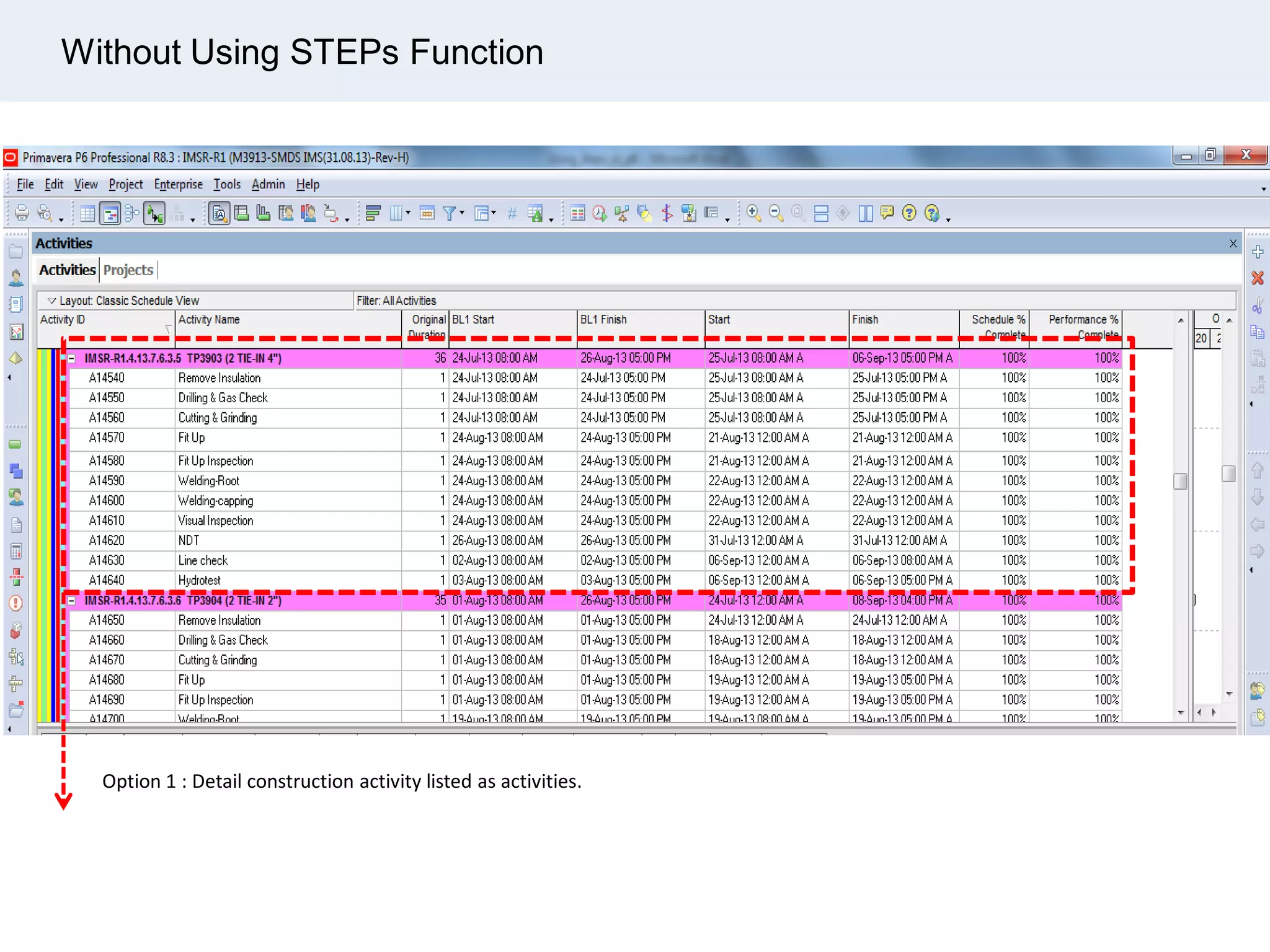
Option 1 : Detail construction activity listed as activities.
Without Using STEPs Function
“Steps” is a function in Primavera P6 that allow user to divide activities into smaller increments and track the completion.
• Activity percent complete is calculated based on the relative weights of the completed steps versus incomplete steps.
• This method suit of large activities that contents few activities steps.
Steps make it possible to describe and report progress for activity work at a granular level by breaking an activity into its component
parts.
With STEPs Function
“Steps” features in Primavera P6 in an interesting features to be used rather than creating a list of activities short-durations and no
priorities.
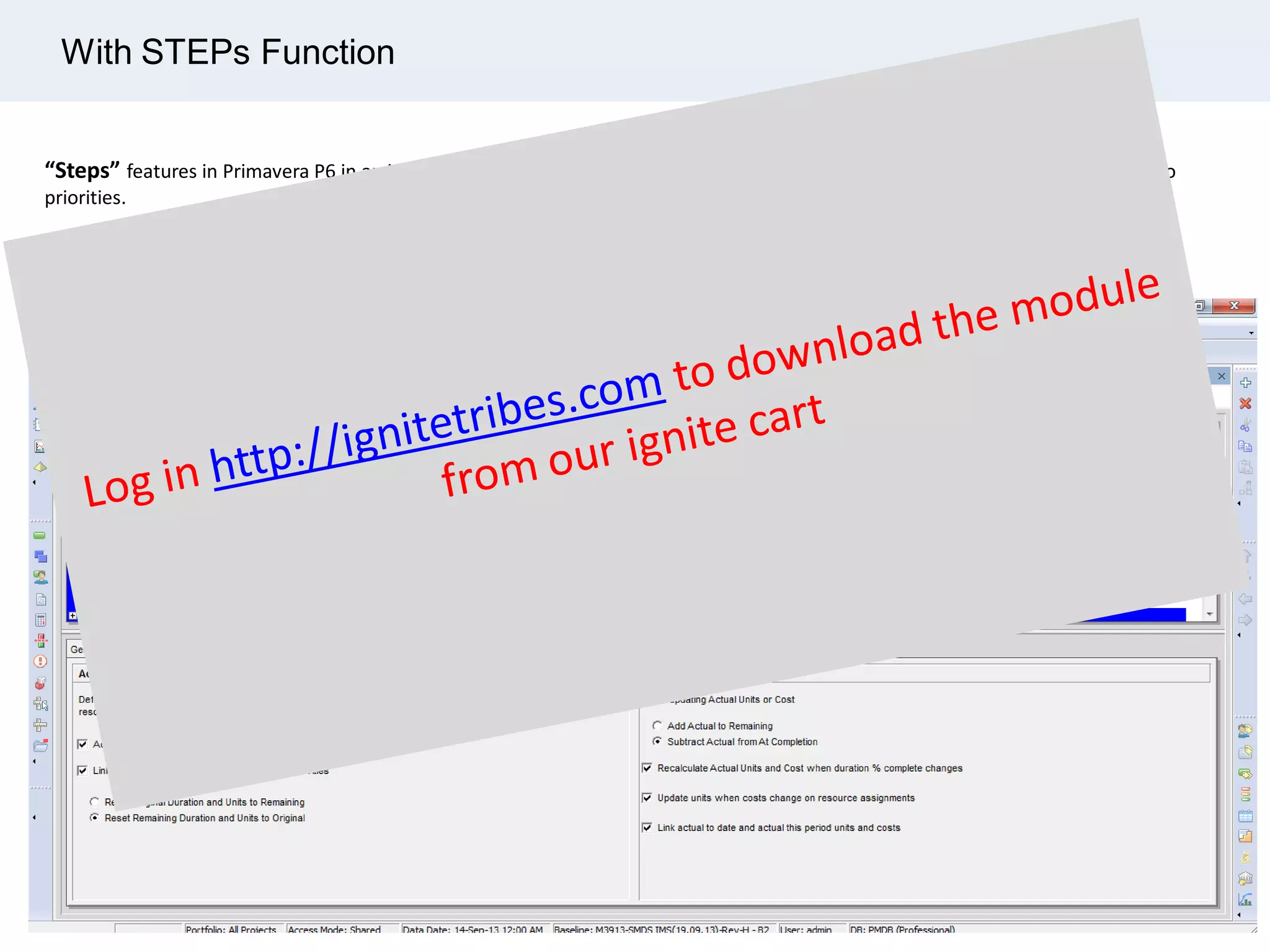
If you’re going to use the Steps feature in Primavera™ P6 to progress % Complete you need to check the “ Activity Percent Complete
Bases on Actual Steps” box in Project Calculations tab.
With STEPs Function
As you tick this box you will get a message explaining that the Physical Percent Complete values will be recalculated from the steps.
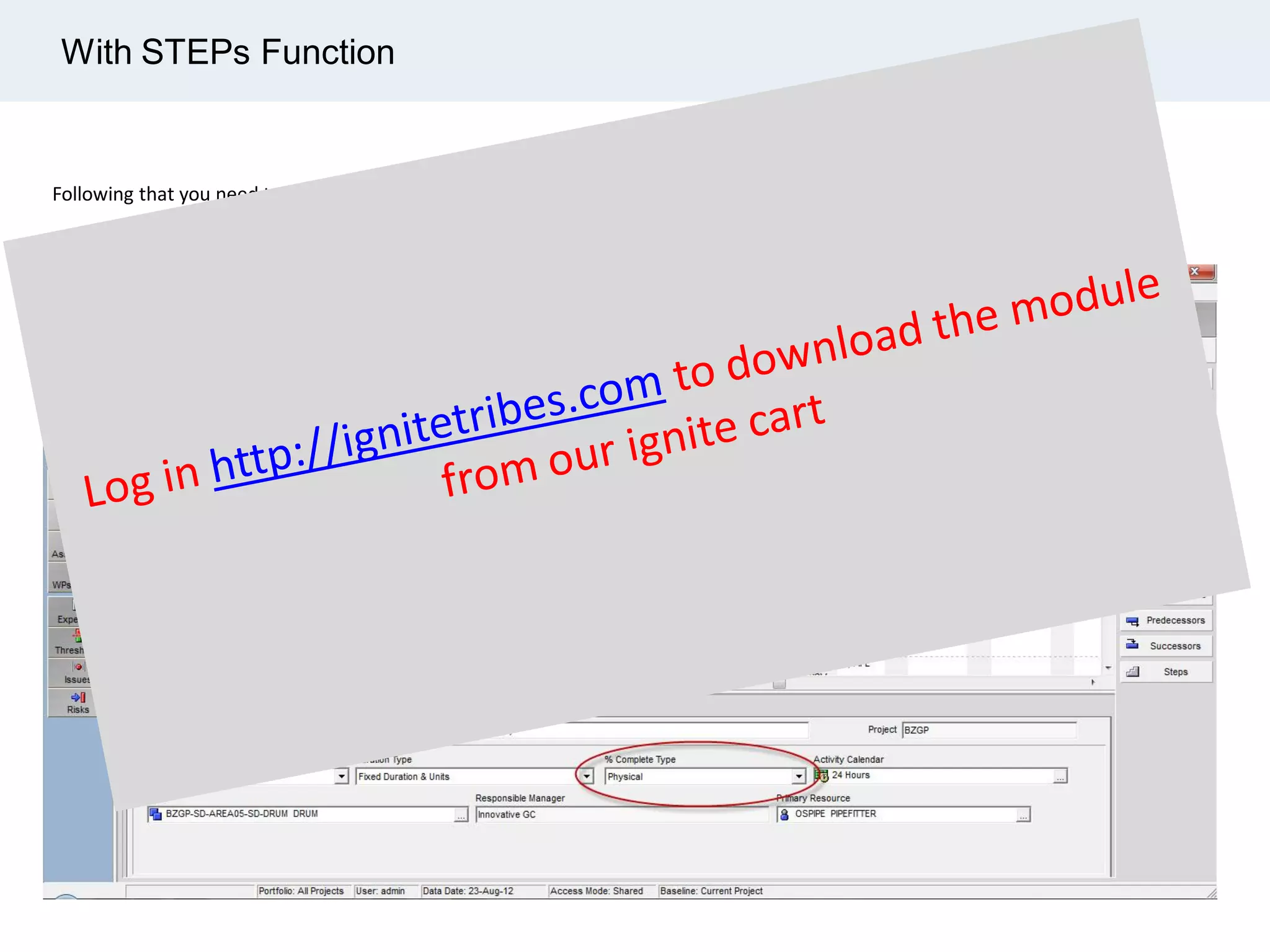
Note: if an activity is set to Percent Complete Type “Physical” but does not have Steps, then the values will NOT be recalculated. It will
only recalculate values that have steps assigned AND are Percent Complete Type “Physical”
With STEPs Function
Following that you need to use “ Physical % Complete “on the Activity that contains the steps
With STEPs Function
Steps Function
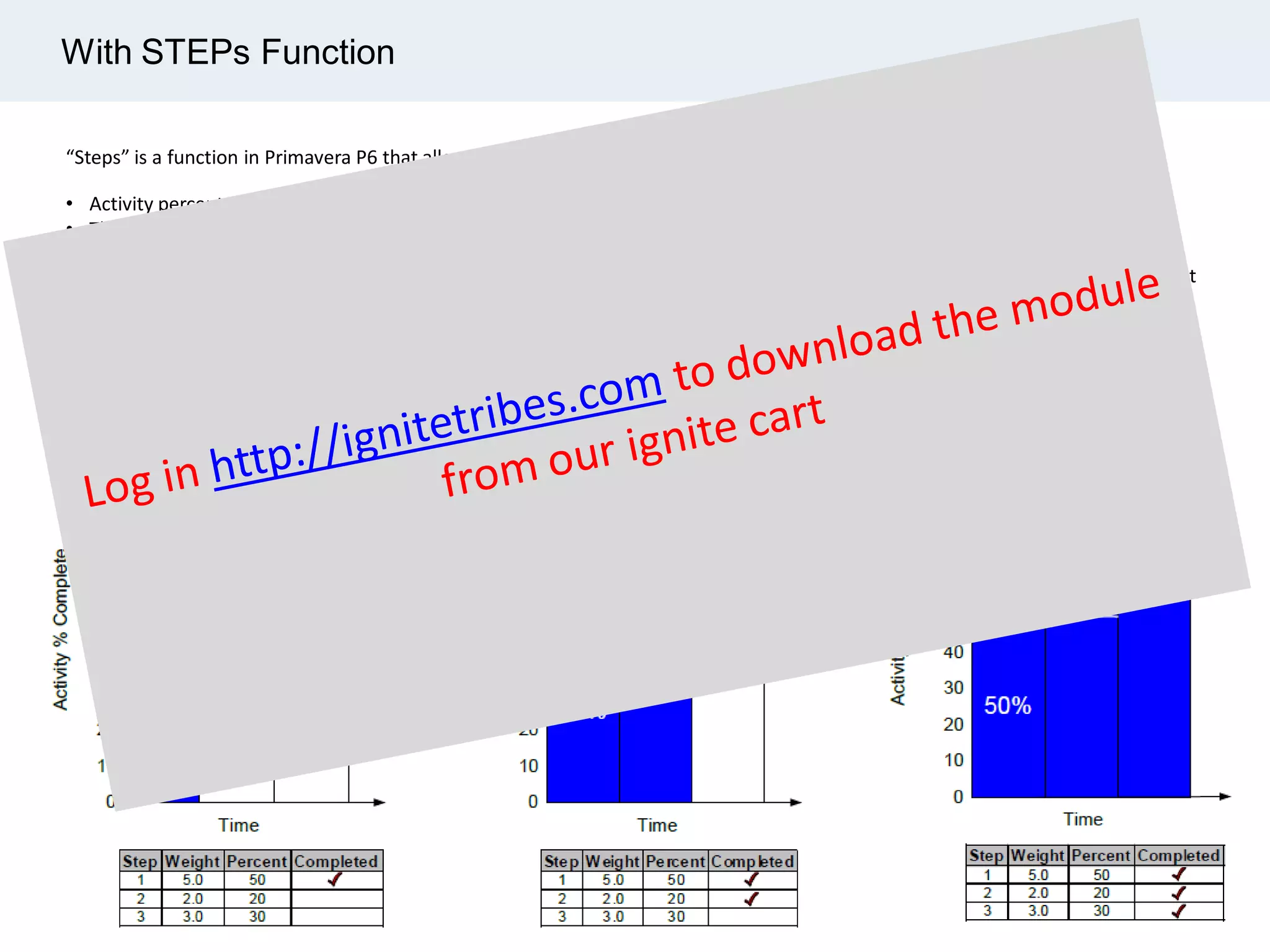
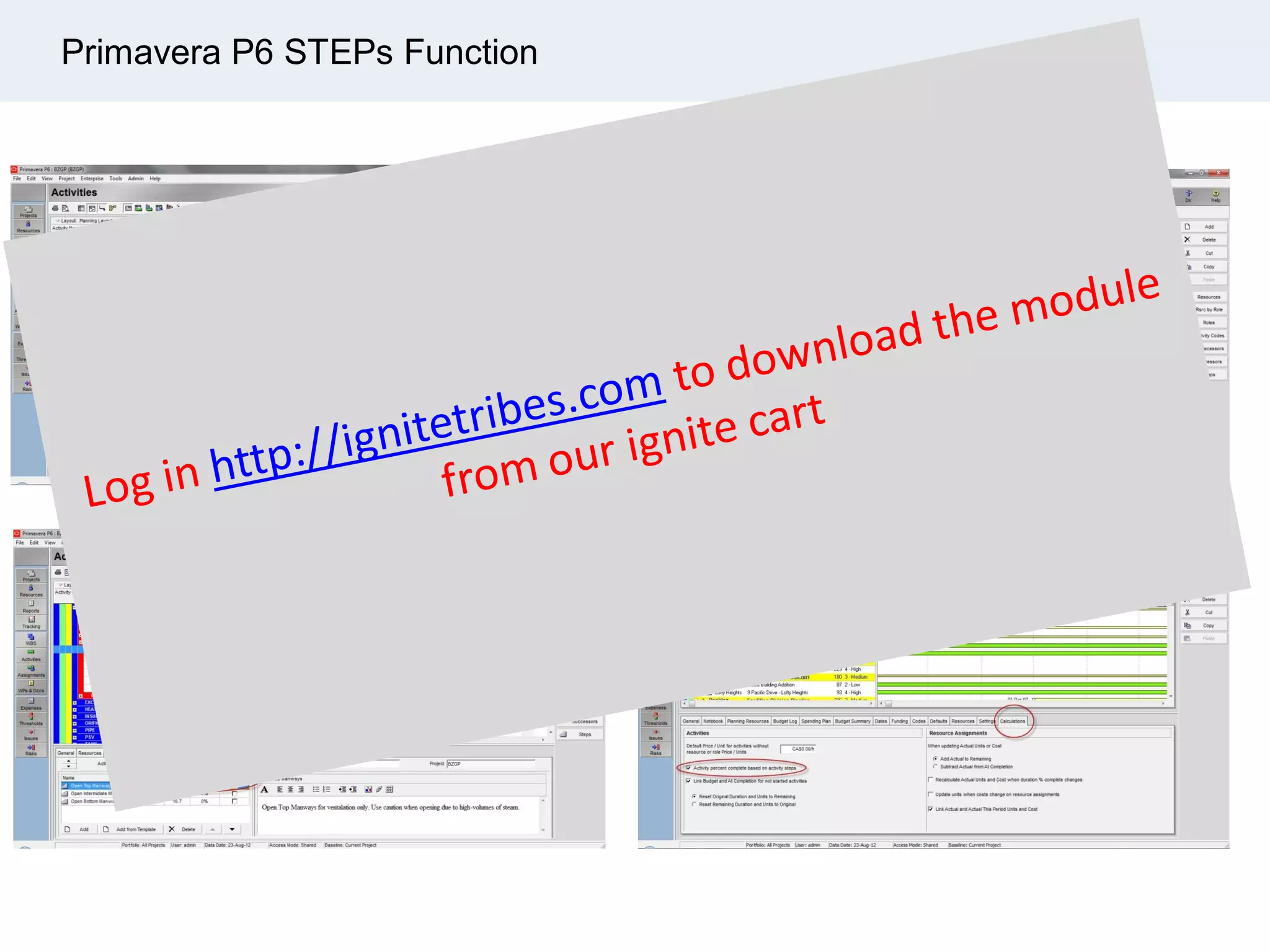
To indicate the portion of activity work that a single step represents, you can assign it a numerical value, or weight.
Once work for a step is underway, Primavera can use the step weight and the reported progress of step work (Step Percent Complete) to
calculate the percentage of total work that has been completed for the activity (Activity Percent Complete).
In the diagram above , each step is assigned a Step Weight and the Step Weight Percent is calculated.
When you add a step to an activity that already has steps defined, the default weight for the new step is 1, providing no steps have been
marked Completed, and no steps have a Step % Complete of 100%.
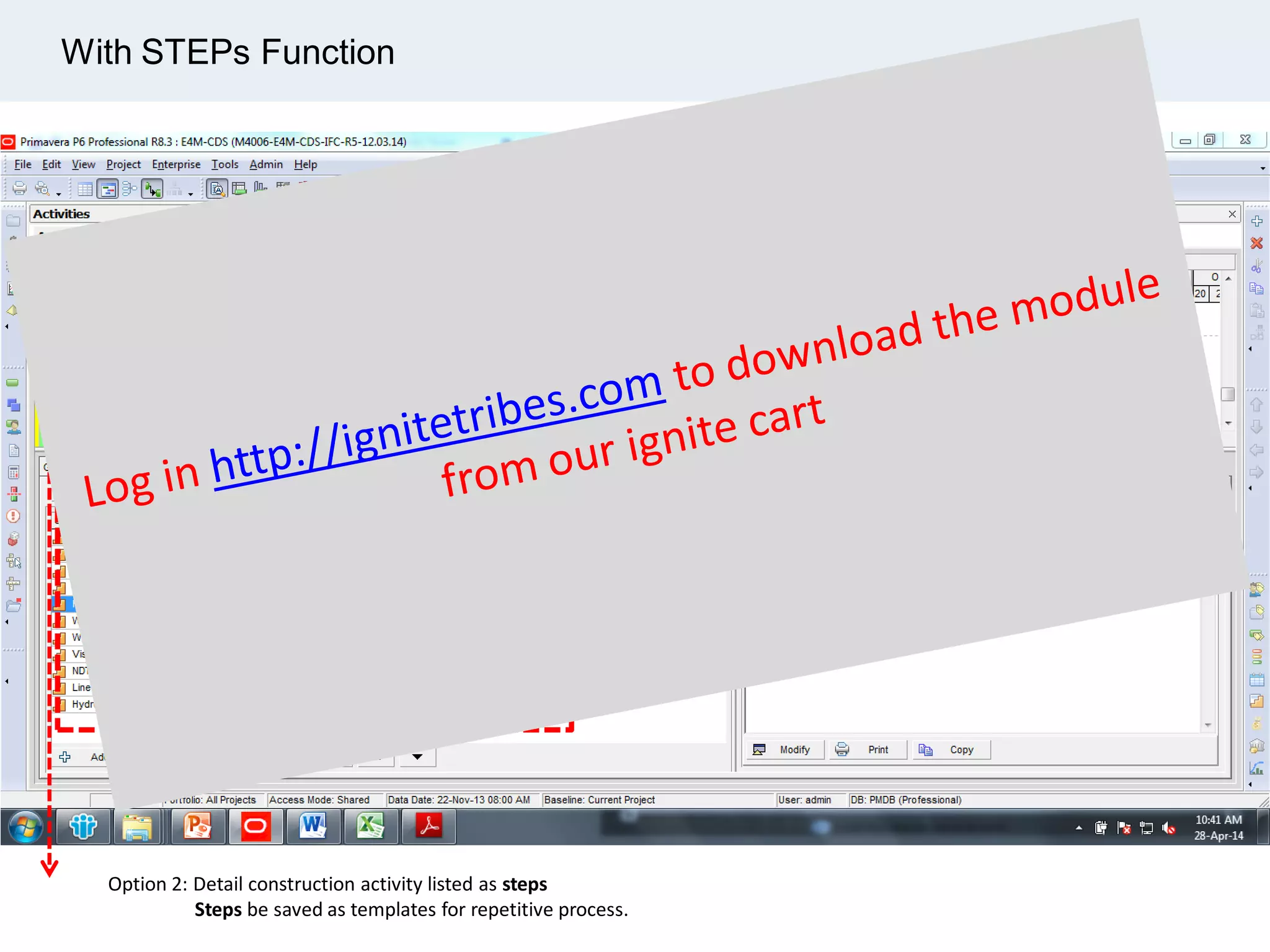
Option 2: Detail construction activity listed as steps
Steps be saved as templates for repetitive process.
With STEPs Function
Primavera P6 STEPs Function
Thank You …

Promo_Epc project rule of credit and progress measurement

  • 1.
    EPC Project RuleOf Credit and Progress measurement
  • 2.
  • 3.
    Corporate Profile Ignite Resourcesis a Corporate Training and Consulting company since 2012. We shape the way organizations implement strategy through training, development and consulting . Our approach covers the processes, people and tools essential to tactical planning and implementation. We specialize in Training, Consultation and Human Capital Development, for both management and technical skills. We work together with companies as smart partnership in providing hands-on solution to solve day to day business challenges by developing their human capital and providing custom made solutions. Our expertise comes from years of experience working with industries and public training. Ignite resources is committed to provide cutting-edge training that align with our vision. To deliver on our aspiration of becoming a leading low-cost training provider. We have put in an ambitious plan that will bring us closer towards our goal ... Development for all. Seth Godin wrote once that “Every company, indeed, every organization, is a tribe, or if it’s large enough, a network of tribes—groups of twenty to 150 people in which everyone knows everyone else, or at least knows of everyone else. Tribes are more powerful than teams, companies, or even CEOs, and yet their key leverage points have not been mapped—until now.” Ignite is here to start with a spark to create a flame that everyone member in the tribes will be developed.
  • 4.
    Outline 2. Rule ofCredit - Engineering 3. Rule of Credit - Procurement 4. Rule of Credit – Fabrication and Construction 5. Managing Rule of Credit in Primavera P6 1. Progress Calculation
  • 5.
    Progress Calculation 01 + Ruleof Credit / Weighted Steps method
  • 6.
  • 7.
    Progress Measurement Project progressmonitoring and control is one of the most important tasks of construction project management. Every team member needs to know, in a timely and accurate manner, how is the project progressing, where they are currently in comparison to the initially set plans, whether deadlines are met, budgets are safely measured and followed. Executing a successful project depends on many factors, but ultimately the most important question that need to be answered before any measures can be taken is “What’s been accomplished so far?” Progress measurement addresses this question and serves as a fundamental building block for effective project controls. Progress measurement system plays an important part of project control. It includes the detail progress tracking sheet of its WBS elements, work categories and work steps for each deliverable. It is developed either when the additional requirements are occurred for a particular project or when progress measurement system is not in placed. The work scope to be measure includes fabricate and installation of pipeline including tie-in work, insulation work, painting work, fabricate and installation of new pipe racks, fabricate and installation of equipment access platforms, installation of process equipment. Progress measurement system would be different depending on organizational and/or project preference. Prior implementing a system for progress evaluation an estimate must be developed for both man-hours and quantities of drawings for each engineering discipline. When working with progress calculation, you should know the level of reporting. In a typical project, engineering progress is measured as level 2 (phase wise) and level 3 (engineering discipline wise) and level 4 (document wise).
  • 8.
    Progress Measurement Progress measurementsystem plays an important part of project control. It includes the detail progress tracking sheet of its WBS elements, work categories and work steps for each deliverable. It is developed either when the additional requirements are occurred for a particular project or when progress measurement system is not in placed. The work scope to be measure includes fabricate and installation of pipeline including tie-in work, insulation work, painting work, fabricate and installation of new pipe racks, fabricate and installation of equipment access platforms, installation of process equipment. Progress measurement system would be different depending on organizational and/or project preference. Prior implementing a system for progress evaluation an estimate must be developed for both manhours and quantities of drawings for each engineering discipline. When working with progress calculation, you should know the level of reporting. In a typical project, engineering progress is measured as level 2 (phase wise) and level 3 (engineering discipline wise) and level 4 (document wise). Physical progress for the engineering phase of a project consists of three levels of indenture as follows: •Progress by Drawing, Datasheet, Document and Request for •Quotation (RFQ) •Progress by Discipline •Total Engineering Progress
  • 9.
    Weighted Step One ofthe most important choices that a control project controller or project manager makes in establishing an progress control or EVM plan is to select an appropriate measure of earned value for each work package. This choice of the measure of interim progress, or completion, for each work package will do more than any other discretionary choice in making the EVM results meaningful. The execution process for a successful project depends on mange factors, but one fundamental question that need to be answered is before proactive or prescriptive measures can be implemented is: What’s been accomplished so far? Progress measurement addresses this question and serves as a fundamental building block for effective project controls. Steps make it possible to describe and report progress for activity work at a granular level by breaking an activity into its component parts. Steps can have a step weight that quantifies the portion of an activity's total work that each step represents. On a project per project basis, you can use step weights to calculate Activity Percent Complete. Weighted steps enable you to track the progress of an activity based on the number of steps completed. According to the 5th edition of the PMBOK Guide, “ Weighted milestone method. An earned value method that divides a work package into measurable segments, each ending with an observable milestone, and then assigns a weighted value to the achievement of each milestone. ”
  • 10.
    Weighted Step How doyou figure out percent complete on a project? How is it you go about objectively assigning a reasonable and accurate measurement of how far along you are on an item of work? How many times have you asked, “Hey, where did that number come from?” Rule Of Credit can answer those questions. For any workpackage in the work breakdown structure, a project manager can define any number of milestone events that define the incremental progress of that task. An example milestone could be, “Engineering Completed”. Another milestone could be “Pre-construction Completed". Connected with that, a percent complete value is associated with each milestone. All milestones in the task will tally up to 100%. As work is completed on the task, these milestones can be checked-off as completed and the associated percent will be auto- applied to the task.
  • 11.
    EPC Weighted Level Level1 - Project Project 1 Project 2 Project 3 Level 2 - Phases Design Procure Construction Level 3 - WorkPackages Site Prep Foundation Slab Steel Level 4 - Contractor Form Loc 1 Mesh Loc 1 Pour Loc 1 1 Activity per project 3-5 Activity’s per project As much detail as needed to communicate W4 Also called the “CM” schedule. 25 – 35 activities per project. Level 1 - Project Project 1 Project 2 Project 3 Level 2 - Phases Design Procure Construction Level 3 - WorkPackages Site Prep Foundation Slab Steel Level 4 - Contractor Form Loc 1 Mesh Loc 1 Pour Loc 1 1 Activity per project 3-5 Activity’s per project As much detail as needed to communicate W4 Also called the “CM” schedule. 25 – 35 activities per project. Level 1 Level 2 Level 3 Level 4 Engineering
  • 12.
    Progress Planning Engineering Procurement Construction Engineering ProgressPlan will be prepared by engineering milestones and by engineering deliverables for each category. Weight point of engineering deliverables for each category will be based on the estimated manhours Procurement Progress Plan will cover equipment and bulk materials to be purchased. This plan will be prepared respectively for the milestones of purchase commitment, receipt of major raw materials to vendor shops, FOB and/or ex- works and arrival at the Site. Weight percentages for categories will be based on the costs defined in the CONTRACT. Construction Progress Plan will be prepared construction milestones covering mobilization, demobilization, management, temporary facilities and by construction including pre-commissioning progress for permanent facilities. For construction including pre-commissioning progress, the representative Bills of Quantities (B/Q) will be allocated to work packages.
  • 13.
  • 14.
    Why Rule ofCredit Very Accurate through all phases Easily identifies changes and slippage in schedule Can provide detailed historical information for future estimates Can be used for “What If” scenarios Clear defined information as to what will be provided and expected in each review package Can provide cost, hour and schedule alignment. 1 2 3 4 5 6
  • 15.
    Engineering Weighted Level Engineering Process Civiland Structure Mechanical Electrical Instrumentation Piping Issue For Review (IFR) Issue For Approval (IFA) Issue For Construction (IFC) Approved for Construction (AFC) Level 1 Level 2 Drawing Document Datasheet RFQ Level 3 Level 4
  • 16.
    Engineering Progress Measurement Engineering Progress Calculation Level4 Level 3 Level 2  Engineering progress for each document  The sum of the product of weight factor for each work step and engineering progress for each work step  Engineering progress for each discipline  The sum of the product of weight factor for each document and engineering progress for each document  Calculate total engineering progress  The sum of the product of weight factor for each discipline and engineering progress for each discipline
  • 17.
    Weighted Progress Step 1 Step2 Step 3 Calculate the progress for each document or item EPd = Σ (WFws x EPws) Where, EPd = Engineering progress of each document or item WFws = Weight factor of each work steps EPws = Percent completion of each work step Calculate engineering progress for each discipline or work category EPwc = Σ(WFdd x EPdd) Where, EPwc = Engineering progress of each discipline or category WFdd = Weight factor of each document or item Calculate engineering progress for each discipline or work category Calculate total engineering progress EP = Σ(WFwc x EPwc) Where, EP = Total engineering progress WFwc = weight factor of each discipline or category,
  • 18.
    Level 1 -WBS WBS DESCRIPTION WEIGHTAGE BASIS COST (RM) WEIGHT FACTOR ENG ENGINEERING Manhour 1,862,010 0.064 PRC PROCUREMENT Cost 6,499,944 0.223 CM CONSTRUCTION Cost 19,770,791 0.679 CON COMMISIONING Cost 967,255 0.032 Total Cost 2,9100,000 Weight Factor = Cost Total cost
  • 19.
    Level 2 -WBS BASIS COST (RM) WEIGHT FACTOR ENGINEERING (TOTAL COST) $1,862,010.00 CIVIL & STRUCTURE Manhour $380,890.00 20.46% PROCESS Manhour $207,710.00 11.16% MECHANICAL Manhour $260,160.00 13.97% GENERAL Manhour $140,580.00 7.55% PIPING Manhour $376,430.00 20.22% ELECTRICAL Manhour $296,200.00 15.91% INSTRUMENTATION Manhour $200,040.00 10.74% Weight Factor = Discipline Cost Engineering Total cost Engineering Work Category Breakdown
  • 20.
    Level 4 -WBS ENGINEERING (Weightage) ( Option 1) Proposed Weightage ( Option 2) Proposed Weightage Study & Design Preparation 40 % Issued for Approval 40% Client Comment - Incorporate Client Comment - Issued for Construction 20% Issue for review (IFR) 10% Issue for approval (IFA) 20% Issue for construction (IFC) 30% Approved for construction 40%
  • 21.
    Level 4 -WBS Study and Design Preparation IFR IFA IFC AFC Progress (% Complete) Weight Progress Document Title Category Discipline Budgeted Man Hour Weight Factor 5% 15% 20% 25% 35% Tie In Plan Dwg Piping 300 0.05484 100.0% 100.0% 100.0% 100.0% 33.0% 76.6% 4.2% Piping GA Dwg Piping 400 0.07313 100.0% 100.0% 100.0% 100.0% 100.0% 100.0% 7.3% Tie In Isometric Dwg Piping 350 0.06399 100.0% 100.0% 100.0% 100.0% 100.0% 100.0% 6.4% Standard Pipe Support Dwg Piping 450 0.08227 100.0% 100.0% 100.0% 100.0% 33.0% 76.6% 6.3% Demolition Dwg Piping 350 0.06399 100.0% 100.0% 100.0% 75.0% 0.0% 58.8% 3.8% Tie In List Doc Piping 550 0.10055 100.0% 55.5% 0.0% 0.0% 0.0% 13.3% 1.3% Critical Line List Doc Piping 600 0.10969 100.0% 55.5% 0.0% 0.0% 0.0% 13.3% 1.5% Stress Analysis Report Doc Piping 800 0.14625229 0.0% 0.0% 0.0% 0.0% 0.0% 0.0% 0.0% 0.0% Coating Specs Doc Piping 850 0.15539305 0.0% 0.0% 0.0% 0.0% 0.0% 0.0% 0.0% 0.0% Piping class Doc Piping 820 0.14990859 0.0% 0.0% 0.0% 0.0% 0.0% 0.0% 0.0% 0.0% GRAND TOTAL 5470 1.0000 30.8% % Complete= (5% x 100%) + (15% x 100%) + (20% x 100%) +(25% x 100%)+( 35% x 33.0%) Weight factor = 0.0584 * 76.6 %Progress tracking Excel sheet availablefor download in ignite.com
  • 22.
  • 23.
    Engineering Rule OfCredit For Engineering, the weighting is according to the estimated man hours (units) assigned to each discipline. The Master Deliverable List (MDL) is the document for contractual required Engineering deliverables, containing all submittal (delivery) drawings and documents required to complete a specific project. The Engineering Master Deliverable List will be the basis of progress measurement of engineering work.
  • 24.
    Rule of CreditOverview Step Rule of Credit Increment % Cumulativ e % 1 Study and design preparation 5% 5% 2 Issue for review (IFR) 10% 15% 3 Issue for approval (IFA) 20% 35% 4 Issue for construction (IFC) 30% 65% 5 Approved for construction 35% 100%
  • 25.
    Engineering Step Rule ofCredit Increment % Cumulative % 1 Study and design preparation 5% 5% 2 Issue for review (IFR) 10% 15% 3 Issue for approval (IFA) 20% 35% 4 Issue for construction (IFC) 30% 65% 5 Approved for construction 35% 100%
  • 26.
    Engineering Step Rule ofCredit Increment % Cumulative % 1 Study and design preparation 10% 10% 2 Issue to client 30% 40% 3 Approval by client 35% 75% 4 Issue for construction / purchasing 25% 100%
  • 27.
    Engineering Step Rule ofCredit Increment % Cumulative % 1 Study/ design preparation 10% 10% 2 Issue for internal review 5% 15% 3 Issue to client 15% 30% 4 Approval by client 35% 65% 5 Issue to construction 35% 100%
  • 28.
    Engineering Step Rule ofCredit Increment % Cumulative % 1 Study 10% 10% 2 Issue for internal review 5% 15% 3 Issue to client 15% 30% 4 Approval by client 35% 65% 5 Issue to construction 35% 100%
  • 29.
    Engineering Step Rule ofCredit Increment % Cumulative % 1 Document Started, Format Accepted, TOC Complete 10% 10% 2 Write-up Complete 10% 20% 3 Issue IDC 5% 25% 4 IDC approved 15% 40% 5 Code 3 – Rejected, Revise & Re-Submit - 40% 6 Code 2 – Approved with Comments, Revise & Re-Submit & Proceed with Construction 20% 60% 7 Code 1 – Approved without Comments 25% 85% 8 AFC 15% 100%
  • 30.
    Engineering Step Rule ofCredit Increment % Cumulative % 1 Study & design preparation 10% 10% 2 Issue for approval 25% 35% 3 Client comment - 33% 4 Incorporate client comment 35% 70% 5 Issue for construction 30% 100%
  • 31.
    Process – P&IDs,PFD Step Rule of Credit Increment % Cumulative % 1 Document Started, Format Accepted, TOC Complete 25% 25% 2 Write-up Complete, Dept Sign-off, Issue for Review / Issue for Client Approval 25% 50% 3 Code 3 – Rejected, Revise & Re-Submit 10% 60% 4 Code 2 – Approved with Comments, Revise & Re-Submit & Proceed with Construction 20% 80% 5 Code 1 – Approved without Comments 10% 90% 6 Final Issue / Upload in SAP / Issue for Construction (IFC) 10% 100%
  • 32.
    Instruments & Valves StepRule of Credit Increment % Cumulative % 1 Document Started, Format Accepted, TOC Complete 25% 25% 2 Write-up Complete, Dept Sign-off, Issue for Review / Issue for Client Approval 25% 50% 3 Code 3 – Rejected, Revise & Re-Submit 10% 60% 4 Code 2 – Approved with Comments, Revise & Re-Submit & Proceed with Construction 20% 80% 5 Code 1 – Approved without Comments 10% 90% 6 Final Issue / Upload in SAP / Issue for Construction (IFC) 10% 100%
  • 33.
    3D modelling Step Ruleof Credit Increment % Cumulative % 1 Completion to 30% Status 20% 20% 2 Completion to 60% Status 25% 45% 3 Completion to 90% Status 30% 75% 4 Code 3 – Rejected, Revise & Re-Submit 0% 75% 5 Code 2 – Approved with Comments, Revise & Re-Submit & Proceed with Construction 10% 85% 6 Code 1 – Approved without Comments, Final Issue / Release into SAP 15% 100%
  • 34.
    Piping Modeling Step Ruleof Credit Increment % Cumulative % 1 Preliminary : modeled point to point, branch fittings modeled, pipe support location shown, critical line issued for stressing 20% 20% 2 Detailed : line modeled with valves, fittings and instruments, ISO generating free of errors 25% 45% 3 Checking : Clash free, physical supports modeled, conforms to stress analysis,, extracted for checking 30% 75% 4 Code 3 – Rejected, Revise & Re-Submit 0% 75% 5 Code 2 – Approved with Comments, Revise & Re-Submit & Proceed with Construction 10% 85% 6 Code 1 – Approved without Comments, Final Issue / Release into SAP 15% 100%
  • 35.
    Piping Calculation Step Ruleof Credit Increment % Cumulative % 1 Initiate Pipe Stress Calcs/Issue Deliverables to Mech Eng 20% 20% 2 Prepare / Issue for Client Approval 55% 75% 3 Release / Approved for Construction 25% 100%
  • 36.
    Piping Drawing Step Ruleof Credit Increment % Cumulative % 1 Document Started, Format Accepted, TOC Complete 25% 25% 2 Issue for Review / Issue for Client Approval 25% 50% 3 Code 3 – Rejected, Revise & Re-Submit 10% 60% 4 Code 2 – Approved with Comments, Revise & Re-Submit & Proceed with Construction 20% 80% 5 Code 1 – Approved without Comments 10% 90% 6 Final Issue / Upload in SAP 10% 100%
  • 37.
    MTO Step Rule ofCredit Increment % Cumulative % 1 Drawing / PDMS received or completed 10% 10% 2 MTO generation 45% 55% 3 Internal verify 35% 90% 4 MTO released 10% 100%
  • 38.
  • 39.
    Procurement - Subcontract StepRule of Credit Increment % Cumulative % 1 RFQ issued to subcontractor 10% 10% 2 Technical Bid Evaluation (TBE) 5% 15% 3 Cost Bid Evaluation (CBE) 5% 20% 4 Purchasing Request (PR) 10% 30% 5 PO issued 30% 60% 6 Site mobilization 40% 100%
  • 40.
    Procurement - Subcontract StepRule of Credit Increment % Cumulative % 1 RFQ issued to subcontractor 10% 10% 2 Tender evaluation done 5% 15% 3 PO placed to vendor 10% 25% 4 Received key vendor drawings 5% 30% 5 Approved key vendor drawing 5% 35% 6 Fabrication 50% 85% 7 Final inspection finished 5% 90% 8 Ex-Work 5% 95% 9 Delivery at site 5% 100%
  • 41.
    Procurement – Valves,Bulk Materials Step Rule of Credit Increment % Cumulative % 1 Issued RFQ 10% 10% 2 Technical Bid Evaluation 10% 20% 3 P.O. Issued 15% 35% 4 Receipt of Major Materials 10% 45% 5 Function Testing 25% 70% 6 Final Inspection 15% 85% 7 Inco Term Delivery Complete 10% 95% 8 PO invoice close out 5% 100%
  • 42.
    Procurement – VesselStandalone Step Rule of Credit Increment % Cumulative % 1 Issued RFQ 10% 10% 2 Technical Bid Evaluation 10% 20% 3 P.O. Issued 15% 35% 4 Commencement of Fabrication 10% 45% 5 Hydro Static testing 25% 70% 6 Final Inspection 15% 85% 7 Inco Term Delivery Complete 10% 95% 8 PO invoice close out 5% 100%
  • 43.
    Major Buyout (Pumps,Control System) Step Rule of Credit Increment % Cumulative % 1 Issued RFQ 10% 10% 2 Technical Bid Evaluation 10% 20% 3 P.O. Issued 15% 35% 4 Commencement of Fabrication 10% 45% 5 Hydro Static testing 25% 70% 6 Final Inspection 15% 85% 7 Inco Term Delivery Complete 10% 95% 8 PO invoice close out 5% 100%
  • 44.
    Rule of Credit 04 +Fabrication / Construction
  • 45.
    Fabrication of EquipmentErection Step Activities Increment % Cumulative % Equipment Erection 1 Chipping & Padding 5% 5% 2 Lifting & rigging 40% 45% 3 Levelling & grouting 15% 60% 4 Preliminary alignment 20% 80% 5 Final alignment 10% 90% 6 Clear punch list 10% 100%
  • 46.
    Fabrication of PipingErection Step Activities Increment % Cumulative % Piping Erection 1 Material at site 5% 5% 2 Pipe laying 20% 25% 3 Preparation 20% 45% 4 Full welding execution 35% 80% 5 NDT 5% 85% 6 Pipe support erection 10% 95% 7 Final inspection 5% 100%
  • 47.
    Fabrication of Piping StepActivities Increment % Cumulative % Piping Fabrication 1 Weld map drawing preparation 4% 4% 2 Withdrew material 3% 7% 3 Welding preparation 20% 27% 4 Spool assemble and tack weld 25% 52% 5 Full welding execution 20% 72% 6 Non Destructive Test (NDT) 6% 78% 7 Surface preparation and coating 15% 93% 8 Final Inspection 4% 97% 9 Deliver at Site 3% 100%
  • 48.
    Tie-In work Step ActivitiesIncrement % Cumulative % Tie-in Work 1 Preparation done 10% 10% 2 Tagging done 10% 20% 3 Tie-in work 70% 90% 4 Final inspection 10% 100%
  • 49.
    Hydrotest Step Activities Increment% Cumulative % Hydrotest 1 Preparation done 20% 20% 2 Testing 45% 65% 3 Reinstated 25% 90% 4 Punchlist cleared 10% 100%
  • 50.
    Fabrication of Vessel StepActivities Increment % Cumulative % WBS Weight Fabricate Nozzles 5% 1 Weld/Fabricate nozzles 50% 50% 2 Completed NDE 50% 100% Fabricate section number head 5% 1 Layout, cut holes prep 30% 30% 2 Fit/Weld nozzles/compensation pads 70% 100% Fabricate Section Number 20% 1 Bevel, square, roll vessel 10% 10% 2 Weld long seams / re-roll 15% 25% 3 Layout, cut holes prep 10% 35% 4 Fit/weld nozzles/compensation pads 10% 45% 5 Build/install internal pads and external (trial fit) 55% 100% Complete vessel / pressure envelope 55% 1 Fit Sections and Weld Circ Seams 25% 25% 2 Local PWHT with Overlap 10% 35% 3 Complete Internal / External Attachments 50% 85% 4 Hydrotest Vessel 15% 100%
  • 51.
    Fabrication of Vessel StepActivities Increment % Cumulative % WBS Weight Paint 15% 1 Blasting 20% 2 Painting 40% 3 Lining & Acceptable Holiday (Spark) Testing 25% 4 Release 15%
  • 52.
    Mechanical Work –Rotating Equipment Step Activities Increment % Cumulative % Rotating Equipment 1 Receive material 15% 15% 2 Rough, set. And prelim alignment 20% 35% 3 Level & grout 10% 45% 4 Final alignment 15% 60% 5 Run in 20% 80% 6 Clear punch list 20% 100%
  • 53.
    Civil Work –Foundation & Concrete Paving Step Activities Increment % Cumulative % Foundation 1 Excavation 10% 2 Rebar 30% 3 Formwork 10% 4 Pouring concrete 15% 5 Strip & finishing 10% 6 Backfilling & compaction 15% 7 Clear punch list 10%
  • 54.
    Civil Work –Cable Trench Step Activities Increment % Cumulative % Cable Trench 1 Excavation 35% 35% 2 Pre-cast concrete 25% 70% 3 Installation of concrete 25% 95% 4 Clear punch list 5% 100%
  • 55.
    Civil Work –RCC Structure Step Activities Increment % Cumulative % Cable Trench 1 Excavation/PCC 10% 10% 2 Raft concrete 15% 25% 3 Super structure wall 40% 65% 4 Slab and backfilling 35% 100%
  • 56.
    Electrical Cabling Step ActivitiesIncrement % Cumulative % Electrical cabling 1 Transportation to site 10% 10% 2 Tray erection 30% 40% 3 Cable laying 40% 80% 4 Cable connection 10% 90% 5 Testing 10% 100%
  • 57.
    Electrical Fittings Step ActivitiesIncrement % Cumulative % Cable Trench 1 Installation 50% 50% 2 Cable connection 10% 60% 3 Testing 40% 100%
  • 58.
    Fabrication of Piping Progresstracking Excel sheet availablefor download in ignite.com
  • 59.
    Rule of Creditin P6 05 + “Step” function in Primavera P6
  • 60.
    Option 1 :Detail construction activity listed as activities. Without Using STEPs Function
  • 61.
    “Steps” is afunction in Primavera P6 that allow user to divide activities into smaller increments and track the completion. • Activity percent complete is calculated based on the relative weights of the completed steps versus incomplete steps. • This method suit of large activities that contents few activities steps. Steps make it possible to describe and report progress for activity work at a granular level by breaking an activity into its component parts. With STEPs Function
  • 62.
    “Steps” features inPrimavera P6 in an interesting features to be used rather than creating a list of activities short-durations and no priorities. If you’re going to use the Steps feature in Primavera™ P6 to progress % Complete you need to check the “ Activity Percent Complete Bases on Actual Steps” box in Project Calculations tab. With STEPs Function
  • 63.
    As you tickthis box you will get a message explaining that the Physical Percent Complete values will be recalculated from the steps. Note: if an activity is set to Percent Complete Type “Physical” but does not have Steps, then the values will NOT be recalculated. It will only recalculate values that have steps assigned AND are Percent Complete Type “Physical” With STEPs Function
  • 64.
    Following that youneed to use “ Physical % Complete “on the Activity that contains the steps With STEPs Function
  • 65.
    Steps Function To indicatethe portion of activity work that a single step represents, you can assign it a numerical value, or weight. Once work for a step is underway, Primavera can use the step weight and the reported progress of step work (Step Percent Complete) to calculate the percentage of total work that has been completed for the activity (Activity Percent Complete). In the diagram above , each step is assigned a Step Weight and the Step Weight Percent is calculated. When you add a step to an activity that already has steps defined, the default weight for the new step is 1, providing no steps have been marked Completed, and no steps have a Step % Complete of 100%.
  • 66.
    Option 2: Detailconstruction activity listed as steps Steps be saved as templates for repetitive process. With STEPs Function
  • 67.
  • 69.