INTERVIEW QUESTIONS
FOR PLANNING
ENGINEERS
Engineer M WALEED JAN
1
WHAT IS PROJECT
• Project—
• The process by which projects are defined , planned , monitored, controlled and
delivered so that agreed benefits are realized.
Engineer M WALEED JAN
2
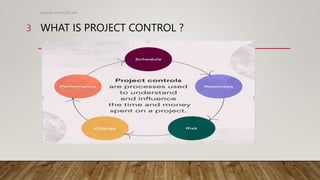
WHAT IS PROJECT CONTROL ?
Engineer M WALEED JAN
3
• 1. how much the project will cost?
• 2. how long the project will take?
• 3. what value or quality the project will deliver?
Porject Control exist to answer these three vital questions
Engineer M WALEED JAN
4
WHY PROJECT CONTROL IS IMPORTANT ?
• It is important because ,
to plan , monitor , manage and mitigate any risk that may effect the cost and
schedule of project
Engineer M WALEED JAN
5
COST CONTROL:
It is monitoring expenses and performance , monitoring budget spend, and taking
action to hit minimum costs
Engineer M WALEED JAN
6
HAVE YOU HEARD ABOUT THE KICK OF
MEETING?
Yes, I have handled a number of Kick of Meetings on different projects &
companies. the kick-off meeting is normally the first meeting of all major Stakeholders
including the Project Manager with his team and Owner’s representatives. Here, we
discuss high-level overall plans, things like how we are going to execute and once things
get clearer as project go forward then we do rolling wave planning.
These meetings can be conducted at the new phase starts during the execution of the
project also.
Engineer M WALEED JAN
7
HOW DO YOU DEFINE A CRITICAL PATH?
• The longest path & the minimum time required to complete a project. A
• combination of activities with the total float as zero are included all.
Engineer M WALEED JAN
8
PROJECT SCHEDULE
• The main purpose of project scheduling is to represent the plan to deliver the
project scope over time. A project schedule, in its simplest form, could be a chart
of work elements with associated schedule dates of when work elements and
milestones (usually the completion of a deliverable) are planned to occur. In
addition to guiding the work, the project schedule is used to communicate to all
stakeholders when certain work elements and project events are expected to be
accomplished .
• It is also mitigate the risk that cause the project delay .
Engineer M WALEED JAN
9
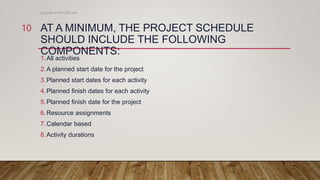
AT A MINIMUM, THE PROJECT SCHEDULE
SHOULD INCLUDE THE FOLLOWING
COMPONENTS:
1.All activities
2.A planned start date for the project
3.Planned start dates for each activity
4.Planned finish dates for each activity
5.Planned finish date for the project
6.Resource assignments
7.Calendar based
8.Activity durations
Engineer M WALEED JAN
10
CONT…
• The "flow" (sequence) of the various activities
• The relationships of activities
• An identified critical path(s)
• Total and free float
Engineer M WALEED JAN
11
ADVANTAGE: SCHEDULING IN SEGMENTS MAKES A
LARGE PROJECT MORE MANAGEABLE
• When a large project has to be finished on deadline, it can seem difficult to the
team. When you break the project into segments, it gives the team smaller goals
to focus on along the way. They don't have to focus on the final product, they
simply have to focus on the first segment. When that is finished, they can move
on to the next one.
Engineer M WALEED JAN
12
DISADVANTAGE: TIGHT DEADLINES ADD
PRESSURE
• While a deadline can add focus, it can also add pressure. If the deadline is too
tight, or if unforeseen issues arise, it can put added stress on the team. When the
team works under stress, the potential for error increases. The team will likely be
rushing to meet the deadline.
Engineer M WALEED JAN
13
HOW TO MEASURE THE PROGRESS OF A
PROJECT?
• Normally there are three ways to measure the progress 1)-Man-hours, 2)-Cost &
• 3)-Quantity
• My preferred method is through Man-hours as It is more logical but I have to
comply as per contractual obligations as most of the companies prefer through
Cost.
• By the way, sometimes we have to use all three methods on a single project to
get more intensive project updated status.
Engineer M WALEED JAN
14
WHAT YOU NORMALLY NEED TO DEVELOPA
PLAN?
• I need the Contract documents to understand the scope, the schedule drawings
• to know about areas, Bill of Quantity-BOQ including cost, scheduling software access.
• Yes, I need to meet my project team to know about a little productivity rate if I don’t
• know in case of any specific activity.
Engineer M WALEED JAN
15
HOW MUCH DURATION A MILESTONE ACTIVITY
NORMALLY HAS?
• Well, there are different types of milestones are there like start milestone, finish
• milestone, etc. but all have ZERO duration.
Engineer M WALEED JAN
16
WHAT IS THE DIFFERENCE BETWEEN FREE
FLOAT & TOTAL FLOAT?
• Free Float – the amount of time we can delay an activity without affecting the
• early start date of its successor activity. Total Float – the amount of time we can delay an
• activity from its early start date without delaying the whole project finish.
• The free float may affect the start of any activity but total float may affect the duration of
• the overall project.
Engineer M WALEED JAN
17
WHAT IS A PROJECT BASELINE? (DEFINITION)
• A project baseline is an initial plan you establish together with your stakeholders, and it includes the
project expectations, timeline, and deliverables. In other words, it is a starting point for your project plan.
• Typically, a project baseline has three components that are usually controlled, monitored, and reported to
ensure that everything in the project is on track. They include schedule, cost, and scope.
• Efficiently monitoring and tracking these three components gives you insights into how a change in one
component can affect the other. This means that when your baselines are merged, it can tell you how a
delay in your schedule can impact your costs.
• An approved project baseline also acts as a point of reference that is used to compare and measure the
progress and performance of your project over time.
Engineer M WALEED JAN
18
SO HOW CAN YOU KICKSTART YOUR PROJECT
WITHOUT MUCH HASSLE – WHILE
MEASURING/MONITER ITS PERFORMANCE?
Engineer M WALEED JAN
19
CONT……
• With a project baseline! A project baseline is a critical component of project management.
It’s the perfect tool to ensure that your projects are on track, your teams are motivated,
and your clients are happy.
Engineer M WALEED JAN
20
• A project baseline is an initial plan you establish together with your stakeholders, and it
includes the project expectations, timeline, and deliverables. In other words, it is a starting
point for your project plan.
• Typically, a project baseline has three components that are usually controlled, monitored,
and reported to ensure that everything in the project is on track. They include schedule,
cost, and scope.
• Efficiently monitoring and tracking these three Component baseline is used that how
change in one component can effect to other . This means that when your baselines are
merged, it can tell you how a delay in your schedule can impact your costs.
Engineer M WALEED JAN
21

Interview Questions for planning Engineers.pptx

  • 1.
  • 2.
    WHAT IS PROJECT •Project— • The process by which projects are defined , planned , monitored, controlled and delivered so that agreed benefits are realized. Engineer M WALEED JAN 2
  • 3.
    WHAT IS PROJECTCONTROL ? Engineer M WALEED JAN 3
  • 4.
    • 1. howmuch the project will cost? • 2. how long the project will take? • 3. what value or quality the project will deliver? Porject Control exist to answer these three vital questions Engineer M WALEED JAN 4
  • 5.
    WHY PROJECT CONTROLIS IMPORTANT ? • It is important because , to plan , monitor , manage and mitigate any risk that may effect the cost and schedule of project Engineer M WALEED JAN 5
  • 6.
    COST CONTROL: It ismonitoring expenses and performance , monitoring budget spend, and taking action to hit minimum costs Engineer M WALEED JAN 6
  • 7.
    HAVE YOU HEARDABOUT THE KICK OF MEETING? Yes, I have handled a number of Kick of Meetings on different projects & companies. the kick-off meeting is normally the first meeting of all major Stakeholders including the Project Manager with his team and Owner’s representatives. Here, we discuss high-level overall plans, things like how we are going to execute and once things get clearer as project go forward then we do rolling wave planning. These meetings can be conducted at the new phase starts during the execution of the project also. Engineer M WALEED JAN 7
  • 8.
    HOW DO YOUDEFINE A CRITICAL PATH? • The longest path & the minimum time required to complete a project. A • combination of activities with the total float as zero are included all. Engineer M WALEED JAN 8
  • 9.
    PROJECT SCHEDULE • Themain purpose of project scheduling is to represent the plan to deliver the project scope over time. A project schedule, in its simplest form, could be a chart of work elements with associated schedule dates of when work elements and milestones (usually the completion of a deliverable) are planned to occur. In addition to guiding the work, the project schedule is used to communicate to all stakeholders when certain work elements and project events are expected to be accomplished . • It is also mitigate the risk that cause the project delay . Engineer M WALEED JAN 9
  • 10.
    AT A MINIMUM,THE PROJECT SCHEDULE SHOULD INCLUDE THE FOLLOWING COMPONENTS: 1.All activities 2.A planned start date for the project 3.Planned start dates for each activity 4.Planned finish dates for each activity 5.Planned finish date for the project 6.Resource assignments 7.Calendar based 8.Activity durations Engineer M WALEED JAN 10
  • 11.
    CONT… • The "flow"(sequence) of the various activities • The relationships of activities • An identified critical path(s) • Total and free float Engineer M WALEED JAN 11
  • 12.
    ADVANTAGE: SCHEDULING INSEGMENTS MAKES A LARGE PROJECT MORE MANAGEABLE • When a large project has to be finished on deadline, it can seem difficult to the team. When you break the project into segments, it gives the team smaller goals to focus on along the way. They don't have to focus on the final product, they simply have to focus on the first segment. When that is finished, they can move on to the next one. Engineer M WALEED JAN 12
  • 13.
    DISADVANTAGE: TIGHT DEADLINESADD PRESSURE • While a deadline can add focus, it can also add pressure. If the deadline is too tight, or if unforeseen issues arise, it can put added stress on the team. When the team works under stress, the potential for error increases. The team will likely be rushing to meet the deadline. Engineer M WALEED JAN 13
  • 14.
    HOW TO MEASURETHE PROGRESS OF A PROJECT? • Normally there are three ways to measure the progress 1)-Man-hours, 2)-Cost & • 3)-Quantity • My preferred method is through Man-hours as It is more logical but I have to comply as per contractual obligations as most of the companies prefer through Cost. • By the way, sometimes we have to use all three methods on a single project to get more intensive project updated status. Engineer M WALEED JAN 14
  • 15.
    WHAT YOU NORMALLYNEED TO DEVELOPA PLAN? • I need the Contract documents to understand the scope, the schedule drawings • to know about areas, Bill of Quantity-BOQ including cost, scheduling software access. • Yes, I need to meet my project team to know about a little productivity rate if I don’t • know in case of any specific activity. Engineer M WALEED JAN 15
  • 16.
    HOW MUCH DURATIONA MILESTONE ACTIVITY NORMALLY HAS? • Well, there are different types of milestones are there like start milestone, finish • milestone, etc. but all have ZERO duration. Engineer M WALEED JAN 16
  • 17.
    WHAT IS THEDIFFERENCE BETWEEN FREE FLOAT & TOTAL FLOAT? • Free Float – the amount of time we can delay an activity without affecting the • early start date of its successor activity. Total Float – the amount of time we can delay an • activity from its early start date without delaying the whole project finish. • The free float may affect the start of any activity but total float may affect the duration of • the overall project. Engineer M WALEED JAN 17
  • 18.
    WHAT IS APROJECT BASELINE? (DEFINITION) • A project baseline is an initial plan you establish together with your stakeholders, and it includes the project expectations, timeline, and deliverables. In other words, it is a starting point for your project plan. • Typically, a project baseline has three components that are usually controlled, monitored, and reported to ensure that everything in the project is on track. They include schedule, cost, and scope. • Efficiently monitoring and tracking these three components gives you insights into how a change in one component can affect the other. This means that when your baselines are merged, it can tell you how a delay in your schedule can impact your costs. • An approved project baseline also acts as a point of reference that is used to compare and measure the progress and performance of your project over time. Engineer M WALEED JAN 18
  • 19.
    SO HOW CANYOU KICKSTART YOUR PROJECT WITHOUT MUCH HASSLE – WHILE MEASURING/MONITER ITS PERFORMANCE? Engineer M WALEED JAN 19
  • 20.
    CONT…… • With aproject baseline! A project baseline is a critical component of project management. It’s the perfect tool to ensure that your projects are on track, your teams are motivated, and your clients are happy. Engineer M WALEED JAN 20
  • 21.
    • A projectbaseline is an initial plan you establish together with your stakeholders, and it includes the project expectations, timeline, and deliverables. In other words, it is a starting point for your project plan. • Typically, a project baseline has three components that are usually controlled, monitored, and reported to ensure that everything in the project is on track. They include schedule, cost, and scope. • Efficiently monitoring and tracking these three Component baseline is used that how change in one component can effect to other . This means that when your baselines are merged, it can tell you how a delay in your schedule can impact your costs. Engineer M WALEED JAN 21