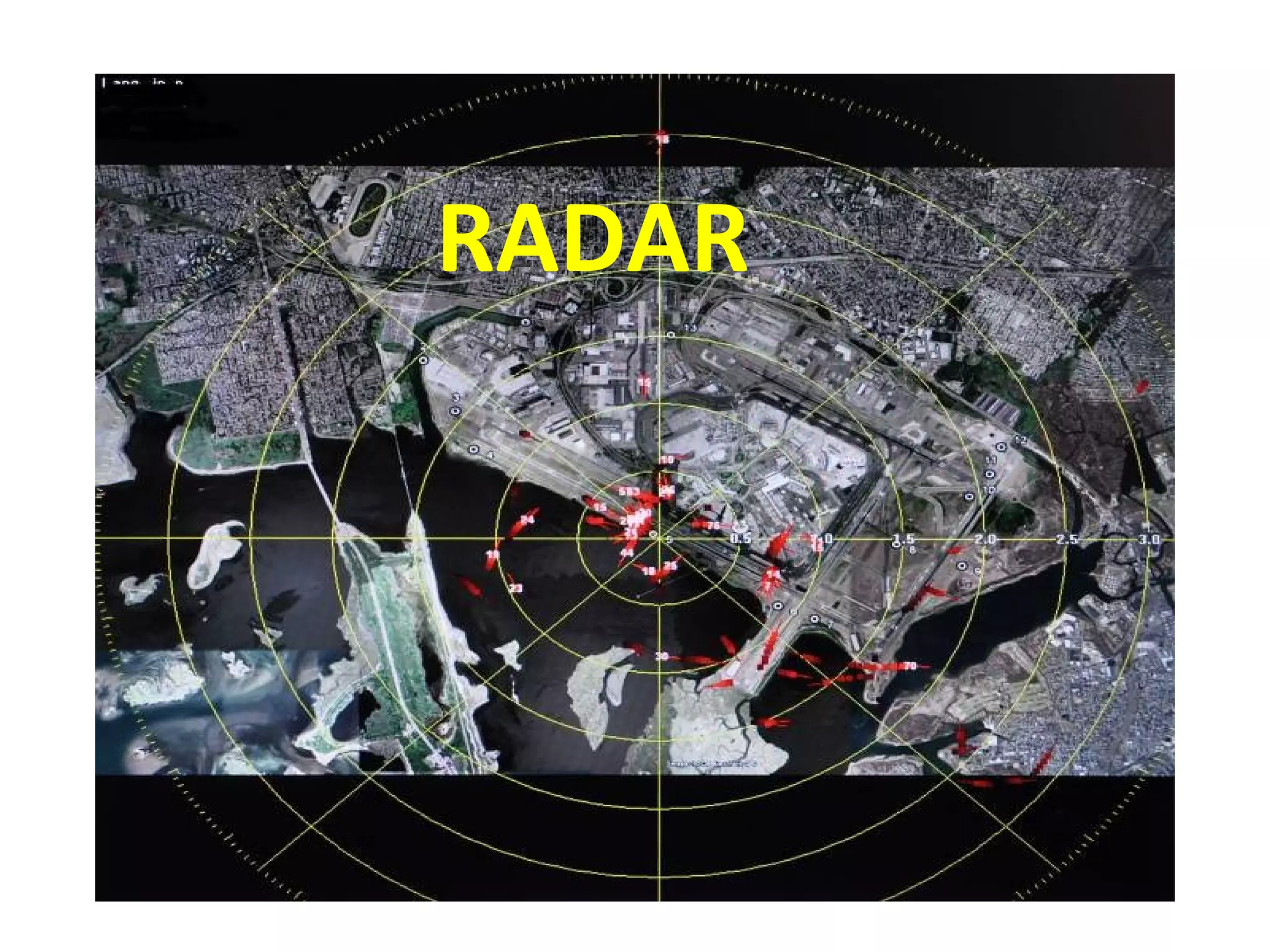

RADAR
Name : Hitesh D. Chandanshive
What is Radar?
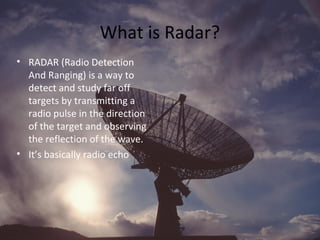
• RADAR (Radio Detection
And Ranging) is a way to
detect and study far off
targets by transmitting a
radio pulse in the direction
of the target and observing
the reflection of the wave.
• It’s basically radio echo
RADAR
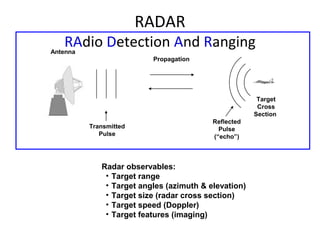
RAdio Detection And Ranging
Radar observables:
• Target range
• Target angles (azimuth & elevation)
• Target size (radar cross section)
• Target speed (Doppler)
• Target features (imaging)
Antenna
Transmitted
Pulse
Target
Cross
Section
Propagation
Reflected
Pulse
(“echo”)
Components
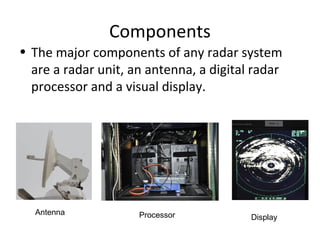
• The major components of any radar system
are a radar unit, an antenna, a digital radar
processor and a visual display.
Antenna Processor Display
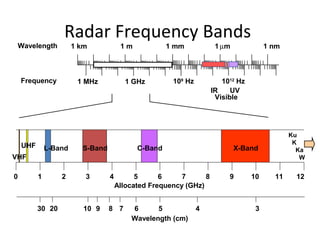
Radar Frequency Bands
Frequency
Wavelength 1 mm1 km 1 m 1 µm 1 nm
1 MHz 1 GHz
IR UV
109
Hz
0 1 2 3 4 5 6 7 8 9 10 11 12
30 20 10 8 6 5 4 39 7
Allocated Frequency (GHz)
Wavelength (cm)
X-BandC-BandS-BandL-BandUHF
VHF
Visible
1012
Hz
Ku
K
Ka
W
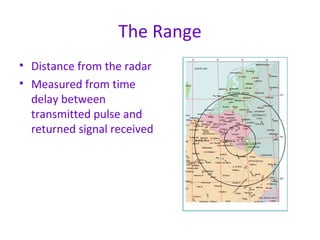
The Range
• Distance from the radar
• Measured from time
delay between
transmitted pulse and
returned signal received
The Range
• Remember, in general v=d/t and d=vt
• The range is just a distance
• Since radio waves travel at the speed of light
(v = c = 300,000 km/sec )
range = c•time/2
• Why divided by 2?
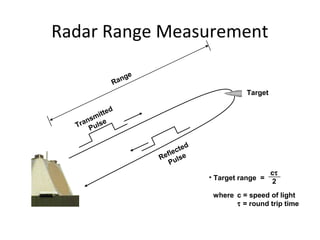
Radar Range Measurement
Transmitted
Pulse
Reflected
Pulse
Range
Target
• Target range =
cτ
2
where c = speed of light
τ = round trip time
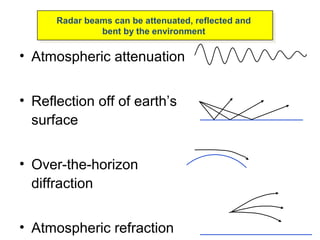
• Atmospheric attenuation
• Reflection off of earth’s
surface
• Over-the-horizon
diffraction
• Atmospheric refraction
Radar beams can be attenuated, reflected and
bent by the environment
Radar beams can be attenuated, reflected and
bent by the environment
Radar
• The range and the direction of the target
determine its location, which is what is
needed for many radar applications such as
air traffic control.
Types and Uses of Radar
• Search radars scan a large area with pulses of short radio
waves
• Targeting radars use the same principle but scan a smaller
area more often
• Navigational radars are like search radar, but use short waves
that reflect off hard surfaces. They are used on commercial
ships and long-distance commercial aircraft
Types and Uses of Radar
• Mapping radar scans a large regions for
remote sensing and geography applications
• Wearable radar which is used to help the visually
impaired
• Air traffic control uses radar to reflect echoes off of
aircraft
• Weather radar uses radar to reflect echoes off of
clouds
Types and Uses of Radar
• Weather radars use radio waves with horizontal, dual
(horizontal and vertical), or circular polarization
• Some weather radars use the Doppler effect to measure wind
speeds
Incoherent Scatter Echo
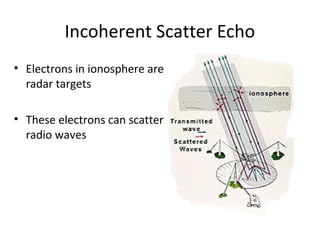
• Electrons in ionosphere are
radar targets
• These electrons can scatter
radio waves
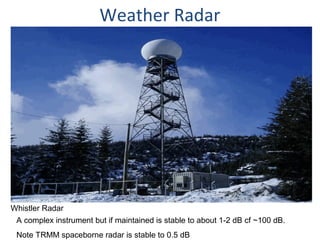
Weather Radar
A complex instrument but if maintained is stable to about 1-2 dB cf ~100 dB.
Note TRMM spaceborne radar is stable to 0.5 dB
Whistler Radar
Thank you !!!

Radar

  • 1.
  • 2.
    Name : HiteshD. Chandanshive
  • 3.
    What is Radar? •RADAR (Radio Detection And Ranging) is a way to detect and study far off targets by transmitting a radio pulse in the direction of the target and observing the reflection of the wave. • It’s basically radio echo
  • 4.
    RADAR RAdio Detection AndRanging Radar observables: • Target range • Target angles (azimuth & elevation) • Target size (radar cross section) • Target speed (Doppler) • Target features (imaging) Antenna Transmitted Pulse Target Cross Section Propagation Reflected Pulse (“echo”)
  • 5.
    Components • The majorcomponents of any radar system are a radar unit, an antenna, a digital radar processor and a visual display. Antenna Processor Display
  • 6.
    Radar Frequency Bands Frequency Wavelength1 mm1 km 1 m 1 µm 1 nm 1 MHz 1 GHz IR UV 109 Hz 0 1 2 3 4 5 6 7 8 9 10 11 12 30 20 10 8 6 5 4 39 7 Allocated Frequency (GHz) Wavelength (cm) X-BandC-BandS-BandL-BandUHF VHF Visible 1012 Hz Ku K Ka W
  • 7.
    The Range • Distancefrom the radar • Measured from time delay between transmitted pulse and returned signal received
  • 8.
    The Range • Remember,in general v=d/t and d=vt • The range is just a distance • Since radio waves travel at the speed of light (v = c = 300,000 km/sec ) range = c•time/2 • Why divided by 2?
  • 9.
    Radar Range Measurement Transmitted Pulse Reflected Pulse Range Target •Target range = cτ 2 where c = speed of light τ = round trip time
  • 10.
    • Atmospheric attenuation •Reflection off of earth’s surface • Over-the-horizon diffraction • Atmospheric refraction Radar beams can be attenuated, reflected and bent by the environment Radar beams can be attenuated, reflected and bent by the environment
  • 11.
    Radar • The rangeand the direction of the target determine its location, which is what is needed for many radar applications such as air traffic control.
  • 12.
    Types and Usesof Radar • Search radars scan a large area with pulses of short radio waves • Targeting radars use the same principle but scan a smaller area more often • Navigational radars are like search radar, but use short waves that reflect off hard surfaces. They are used on commercial ships and long-distance commercial aircraft
  • 13.
    Types and Usesof Radar • Mapping radar scans a large regions for remote sensing and geography applications • Wearable radar which is used to help the visually impaired • Air traffic control uses radar to reflect echoes off of aircraft • Weather radar uses radar to reflect echoes off of clouds
  • 14.
    Types and Usesof Radar • Weather radars use radio waves with horizontal, dual (horizontal and vertical), or circular polarization • Some weather radars use the Doppler effect to measure wind speeds
  • 15.
    Incoherent Scatter Echo •Electrons in ionosphere are radar targets • These electrons can scatter radio waves
  • 17.
    Weather Radar A complexinstrument but if maintained is stable to about 1-2 dB cf ~100 dB. Note TRMM spaceborne radar is stable to 0.5 dB Whistler Radar
  • 18.