 Term technical textile was coined in 1985, other terms
used for defining technical textiles are industrial
textiles, functional textile, performance textile,
engineering textile, invisible textile and hi-tech textile.
 Technical textiles is a knowledge based research
oriented industry.
 The global technical textile has shown an increase from
25%(1998) to 37% (2010).
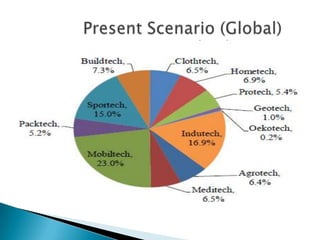
 The largest segment are mobiltex, Indutex and sportek
and they contribue to about 55-57% of the total
technical textile on global basis.
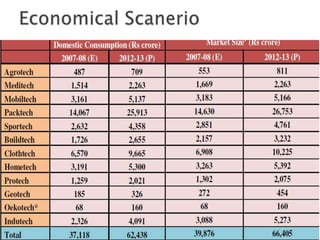
 The market size of technical textiles in India is estimated at
Rs. 63, 202 Crore during the year 2011-12 with a growth rate
of 11% per annum, & expected to increase at a growth rate of
20%.
 India Textile Ministry estimates the market size of technical
textiles in the country to reach US $28.7 billion from the
US$ 10.3 billion (2010-11)
 Total employment given by technical textile - 8.8 lakh
persons
 Total Exports - $ 12.6 billion
 Centers of Excellence (COEs): Four COEs are BTRA for Geo-
tech, SASMIRA for Agro-tech, NITRA for Pro-tech & SITRA for
Medi-tech.
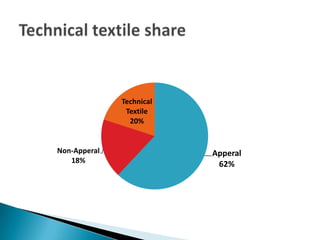
Apperal
62%
Non-Apperal
18%
Technical
Textile
20%
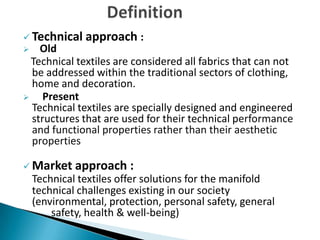
 Technical approach :
 Old
Technical textiles are considered all fabrics that can not
be addressed within the traditional sectors of clothing,
home and decoration.
 Present
Technical textiles are specially designed and engineered
structures that are used for their technical performance
and functional properties rather than their aesthetic
properties
 Market approach :
Technical textiles offer solutions for the manifold
technical challenges existing in our society
(environmental, protection, personal safety, general
safety, health & well-being)
• Very strong
• Durable / abrasion resistant
• Chemically inert
• Flame retardant
• Anti static
• Anti microbial
• Insect repellent
• Anti soiling
• Water repellent
• Waterproof….
 Natural fibres
Cotton
Jute
Silk
Coir
 Man-made fibres and filaments
Viscose
Polyester
Nylon
Acrylic/Modacrylic
Polypropylene
High performance fibers
Aramid
UHMW polyethylen
Carbon
Glass
Mechanical function
Exchange functions
Functionalities for living beings
Protective functions
Protection & barrier
Safety & strength
Structure & support
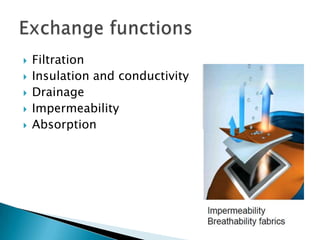
 Filtration
 Insulation and conductivity
 Drainage
 Impermeability
 Absorption
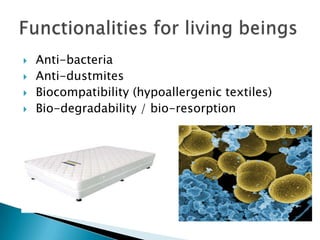
 Anti-bacteria
 Anti-dustmites
 Biocompatibility (hypoallergenic textiles)
 Bio-degradability / bio-resorption
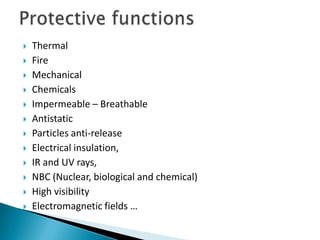
 Thermal
 Fire
 Mechanical
 Chemicals
 Impermeable – Breathable
 Antistatic
 Particles anti-release
 Electrical insulation,
 IR and UV rays,
 NBC (Nuclear, biological and chemical)
 High visibility
 Electromagnetic fields …
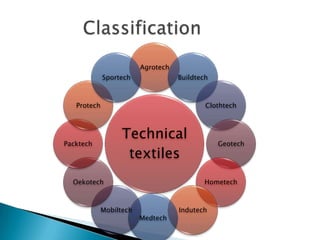
Technical
textiles
Agrotech
Buildtech
Clothtech
Geotech
Hometech
Indutech
Medtech
Mobiltech
Oekotech
Packtech
Protech
Sportech
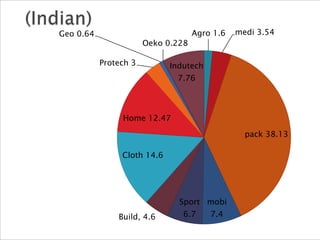
Agro 1.6 medi 3.54
pack 38.13
mobi
7.4
Sport
6.7Build, 4.6
Cloth 14.6
Home 12.47
Protech 3
Geo 0.64
Oeko 0.228
Indutech
7.76
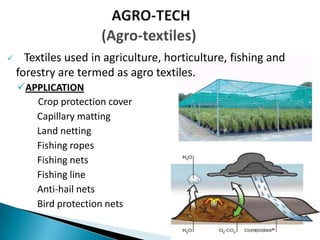
 Textiles used in agriculture, horticulture, fishing and
forestry are termed as agro textiles.
APPLICATION
Crop protection cover
Capillary matting
Land netting
Fishing ropes
Fishing nets
Fishing line
Anti-hail nets
Bird protection nets
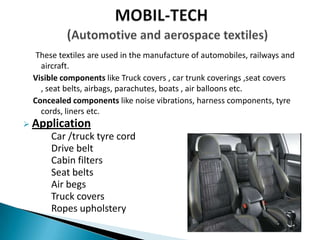
These textiles are used in the manufacture of automobiles, railways and
aircraft.
Visible components like Truck covers , car trunk coverings ,seat covers
, seat belts, airbags, parachutes, boats , air balloons etc.
Concealed components like noise vibrations, harness components, tyre
cords, liners etc.
 Application
Car /truck tyre cord
Drive belt
Cabin filters
Seat belts
Air begs
Truck covers
Ropes upholstery
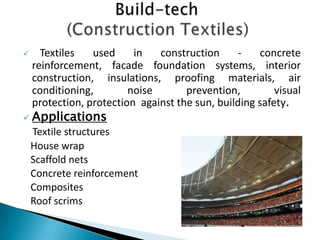
 Textiles used in construction - concrete
reinforcement, facade foundation systems, interior
construction, insulations, proofing materials, air
conditioning, noise prevention, visual
protection, protection against the sun, building safety.
 Applications
Textile structures
House wrap
Scaffold nets
Concrete reinforcement
Composites
Roof scrims
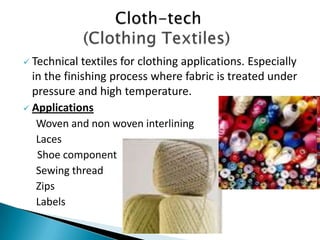
 Technical textiles for clothing applications. Especially
in the finishing process where fabric is treated under
pressure and high temperature.
 Applications
Woven and non woven interlining
Laces
Shoe component
Sewing thread
Zips
Labels
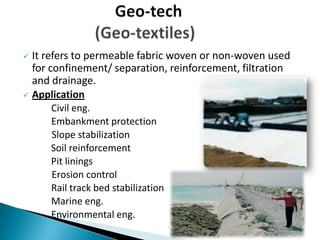
 It refers to permeable fabric woven or non-woven used
for confinement/ separation, reinforcement, filtration
and drainage.
 Application
Civil eng.
Embankment protection
Slope stabilization
Soil reinforcement
Pit linings
Erosion control
Rail track bed stabilization
Marine eng.
Environmental eng.
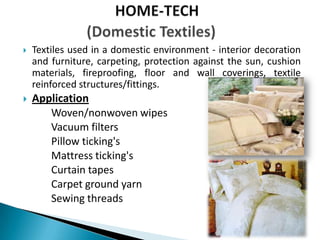
 Textiles used in a domestic environment - interior decoration
and furniture, carpeting, protection against the sun, cushion
materials, fireproofing, floor and wall coverings, textile
reinforced structures/fittings.
 Application
Woven/nonwoven wipes
Vacuum filters
Pillow ticking's
Mattress ticking's
Curtain tapes
Carpet ground yarn
Sewing threads
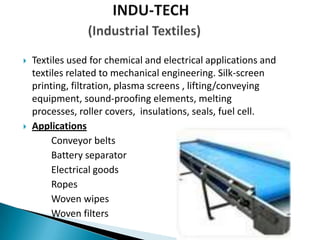
 Textiles used for chemical and electrical applications and
textiles related to mechanical engineering. Silk-screen
printing, filtration, plasma screens , lifting/conveying
equipment, sound-proofing elements, melting
processes, roller covers, insulations, seals, fuel cell.
 Applications
Conveyor belts
Battery separator
Electrical goods
Ropes
Woven wipes
Woven filters
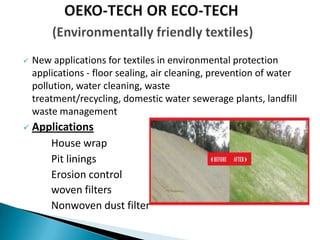
 New applications for textiles in environmental protection
applications - floor sealing, air cleaning, prevention of water
pollution, water cleaning, waste
treatment/recycling, domestic water sewerage plants, landfill
waste management
 Applications
House wrap
Pit linings
Erosion control
woven filters
Nonwoven dust filter
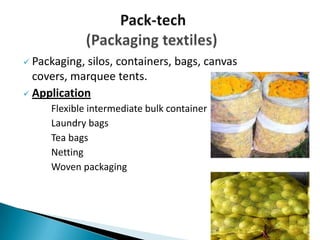
 Packaging, silos, containers, bags, canvas
covers, marquee tents.
 Application
Flexible intermediate bulk container
Laundry bags
Tea bags
Netting
Woven packaging
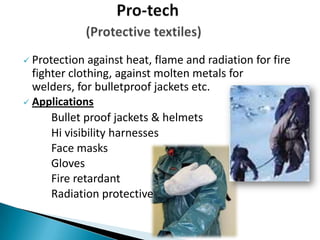
 Protection against heat, flame and radiation for fire
fighter clothing, against molten metals for
welders, for bulletproof jackets etc.
 Applications
Bullet proof jackets & helmets
Hi visibility harnesses
Face masks
Gloves
Fire retardant
Radiation protective
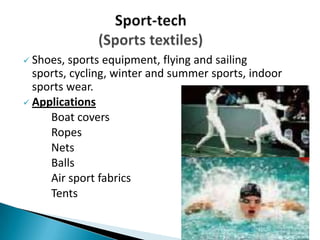
 Shoes, sports equipment, flying and sailing
sports, cycling, winter and summer sports, indoor
sports wear.
 Applications
Boat covers
Ropes
Nets
Balls
Air sport fabrics
Tents
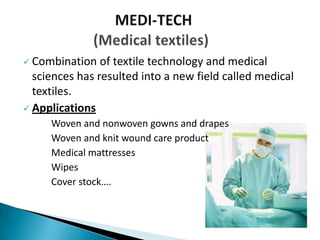
 Combination of textile technology and medical
sciences has resulted into a new field called medical
textiles.
 Applications
Woven and nonwoven gowns and drapes
Woven and knit wound care product
Medical mattresses
Wipes
Cover stock….
 Cost Efficient
 Logistic convenience
 Durability
 High Strength
 Light weight
 Versatility in application
 Customization
 User friendly
 Eco-friendly
ā—¦ Production is limited and fragmented
ā—¦ Lack of investments by the industry
ā—¦ Poor R & D facilities and lack of innovative and high end
technologies
ā—¦ Lack of skilled workforce for the sector
ā—¦ Lack of adequate legislative measures for ensuring level playing
field for domestic industry.
 Concessional rate of 5 percent customs duty on most of
the technical textile machinery
 Reduction in excise duty on man-made fibre and filament
yarns : major raw material for technical textiles.
 Coverage of technical textile machinery under TUFS.
1. Asian Textile Journal, April-June 2011.
2. The Indian Textile journal, October 1994.
3. Man-Made Textile in India, September
2000.
4. Textile Progress, vol. 40, No. 3, 2008.
5. Asian Textile journal, April-June 2009
Introduction to technical textiles2

Introduction to technical textiles2

  • 2.
     Term technicaltextile was coined in 1985, other terms used for defining technical textiles are industrial textiles, functional textile, performance textile, engineering textile, invisible textile and hi-tech textile.  Technical textiles is a knowledge based research oriented industry.  The global technical textile has shown an increase from 25%(1998) to 37% (2010).  The largest segment are mobiltex, Indutex and sportek and they contribue to about 55-57% of the total technical textile on global basis.
  • 3.
     The marketsize of technical textiles in India is estimated at Rs. 63, 202 Crore during the year 2011-12 with a growth rate of 11% per annum, & expected to increase at a growth rate of 20%.  India Textile Ministry estimates the market size of technical textiles in the country to reach US $28.7 billion from the US$ 10.3 billion (2010-11)  Total employment given by technical textile - 8.8 lakh persons  Total Exports - $ 12.6 billion  Centers of Excellence (COEs): Four COEs are BTRA for Geo- tech, SASMIRA for Agro-tech, NITRA for Pro-tech & SITRA for Medi-tech.
  • 4.
  • 5.
     Technical approach:  Old Technical textiles are considered all fabrics that can not be addressed within the traditional sectors of clothing, home and decoration.  Present Technical textiles are specially designed and engineered structures that are used for their technical performance and functional properties rather than their aesthetic properties  Market approach : Technical textiles offer solutions for the manifold technical challenges existing in our society (environmental, protection, personal safety, general safety, health & well-being)
  • 6.
    • Very strong •Durable / abrasion resistant • Chemically inert • Flame retardant • Anti static • Anti microbial • Insect repellent • Anti soiling • Water repellent • Waterproof….
  • 7.
     Natural fibres Cotton Jute Silk Coir Man-made fibres and filaments Viscose Polyester Nylon Acrylic/Modacrylic Polypropylene
  • 8.
  • 9.
    Mechanical function Exchange functions Functionalitiesfor living beings Protective functions
  • 10.
    Protection & barrier Safety& strength Structure & support
  • 11.
     Filtration  Insulationand conductivity  Drainage  Impermeability  Absorption
  • 12.
     Anti-bacteria  Anti-dustmites Biocompatibility (hypoallergenic textiles)  Bio-degradability / bio-resorption
  • 13.
     Thermal  Fire Mechanical  Chemicals  Impermeable – Breathable  Antistatic  Particles anti-release  Electrical insulation,  IR and UV rays,  NBC (Nuclear, biological and chemical)  High visibility  Electromagnetic fields …
  • 14.
  • 16.
    Agro 1.6 medi3.54 pack 38.13 mobi 7.4 Sport 6.7Build, 4.6 Cloth 14.6 Home 12.47 Protech 3 Geo 0.64 Oeko 0.228 Indutech 7.76
  • 18.
     Textiles usedin agriculture, horticulture, fishing and forestry are termed as agro textiles. APPLICATION Crop protection cover Capillary matting Land netting Fishing ropes Fishing nets Fishing line Anti-hail nets Bird protection nets
  • 19.
    These textiles areused in the manufacture of automobiles, railways and aircraft. Visible components like Truck covers , car trunk coverings ,seat covers , seat belts, airbags, parachutes, boats , air balloons etc. Concealed components like noise vibrations, harness components, tyre cords, liners etc.  Application Car /truck tyre cord Drive belt Cabin filters Seat belts Air begs Truck covers Ropes upholstery
  • 20.
     Textiles usedin construction - concrete reinforcement, facade foundation systems, interior construction, insulations, proofing materials, air conditioning, noise prevention, visual protection, protection against the sun, building safety.  Applications Textile structures House wrap Scaffold nets Concrete reinforcement Composites Roof scrims
  • 21.
     Technical textilesfor clothing applications. Especially in the finishing process where fabric is treated under pressure and high temperature.  Applications Woven and non woven interlining Laces Shoe component Sewing thread Zips Labels
  • 22.
     It refersto permeable fabric woven or non-woven used for confinement/ separation, reinforcement, filtration and drainage.  Application Civil eng. Embankment protection Slope stabilization Soil reinforcement Pit linings Erosion control Rail track bed stabilization Marine eng. Environmental eng.
  • 23.
     Textiles usedin a domestic environment - interior decoration and furniture, carpeting, protection against the sun, cushion materials, fireproofing, floor and wall coverings, textile reinforced structures/fittings.  Application Woven/nonwoven wipes Vacuum filters Pillow ticking's Mattress ticking's Curtain tapes Carpet ground yarn Sewing threads
  • 24.
     Textiles usedfor chemical and electrical applications and textiles related to mechanical engineering. Silk-screen printing, filtration, plasma screens , lifting/conveying equipment, sound-proofing elements, melting processes, roller covers, insulations, seals, fuel cell.  Applications Conveyor belts Battery separator Electrical goods Ropes Woven wipes Woven filters
  • 25.
     New applicationsfor textiles in environmental protection applications - floor sealing, air cleaning, prevention of water pollution, water cleaning, waste treatment/recycling, domestic water sewerage plants, landfill waste management  Applications House wrap Pit linings Erosion control woven filters Nonwoven dust filter
  • 26.
     Packaging, silos,containers, bags, canvas covers, marquee tents.  Application Flexible intermediate bulk container Laundry bags Tea bags Netting Woven packaging
  • 27.
     Protection againstheat, flame and radiation for fire fighter clothing, against molten metals for welders, for bulletproof jackets etc.  Applications Bullet proof jackets & helmets Hi visibility harnesses Face masks Gloves Fire retardant Radiation protective
  • 28.
     Shoes, sportsequipment, flying and sailing sports, cycling, winter and summer sports, indoor sports wear.  Applications Boat covers Ropes Nets Balls Air sport fabrics Tents
  • 29.
     Combination oftextile technology and medical sciences has resulted into a new field called medical textiles.  Applications Woven and nonwoven gowns and drapes Woven and knit wound care product Medical mattresses Wipes Cover stock….
  • 30.
     Cost Efficient Logistic convenience  Durability  High Strength  Light weight  Versatility in application  Customization  User friendly  Eco-friendly
  • 31.
    ā—¦ Production islimited and fragmented ā—¦ Lack of investments by the industry ā—¦ Poor R & D facilities and lack of innovative and high end technologies ā—¦ Lack of skilled workforce for the sector ā—¦ Lack of adequate legislative measures for ensuring level playing field for domestic industry.
  • 32.
     Concessional rateof 5 percent customs duty on most of the technical textile machinery  Reduction in excise duty on man-made fibre and filament yarns : major raw material for technical textiles.  Coverage of technical textile machinery under TUFS.
  • 33.
    1. Asian TextileJournal, April-June 2011. 2. The Indian Textile journal, October 1994. 3. Man-Made Textile in India, September 2000. 4. Textile Progress, vol. 40, No. 3, 2008. 5. Asian Textile journal, April-June 2009