Strategic Directions
                 for School Libraries
                 SCIS Consultation 4 December 2012


JUDY O’CONNELL                                       FACULTY OF EDUCATION
This is our context!
 .... our augmented environments reality
   Multi-literate, multi-device curriculum environments
   Natural user interfaces & game-based learning
   Expanding ‘services’ & collaborative spaces
   New information pathways & cloud environments
   Accessible and searchable collections
   Critical thinking and authentic problem solving
   Socially networked & collaborative Web 2.0
   Copyright, creative commons, digital citizenship

    Horizon Report K-12
    http://www.nmc.org/pdf/2012-horizon-report-K12.pdf

JUDY O’CONNELL                                            CHARLES STURT UNIVERSITY
This is our context!
 .... our library services reality

   The   spaces and places of
   libraries are physical and virtual, adopting
   and adapting Web 2.0 media tools to
   enhance and envelop school learning
   communities into a series of globally
   powered learning commons—dynamic,
   collaborative 21st century library
   environments!

JUDY O’CONNELL                                    CHARLES STURT UNIVERSITY
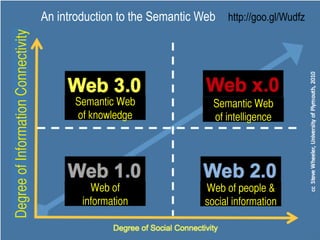
Degree of Information Connectivity	
   An introduction to the Semantic Web http://goo.gl/Wudfz


                                              Semantic Web	
               Semantic Web	
                                              of knowledge	
               of intelligence	


                                                 Web of	
                Web of people &	
                                               information	
             social information
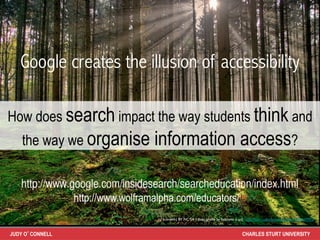
Google creates the illusion of accessibility

How does search impact the way students think and
    the way we organise            information access?

   http://www.google.com/insidesearch/searcheducation/index.html	
                 http://www.wolframalpha.com/educators/
                                    cc licensed ( BY NC SA ) flickr photo by fatboyke (Luc): http://flickr.com/photos/fatboyke/2984569992/	


JUDY O’CONNELL                                                                             CHARLES STURT UNIVERSITY
linkeddata.org                                                  schema.org


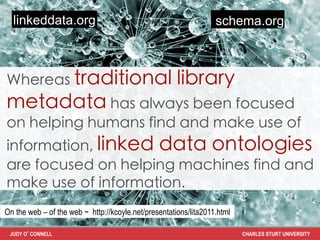
Whereas traditional                                   library
metadata has always been focused
on helping humans find and make use of
information, linked data ontologies
are focused on helping machines find and
make use of information.	
On the web – of the web ~ http://kcoyle.net/presentations/lita2011.html

 JUDY O’CONNELL                                                           CHARLES STURT UNIVERSITY
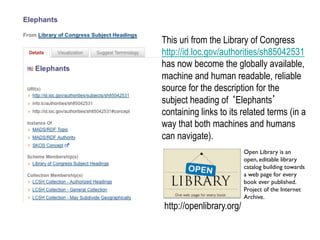
This uri from the Library of Congress
http://id.loc.gov/authorities/sh85042531
has now become the globally available,
machine and human readable, reliable
source for the description for the
subject heading of ‘Elephants’
containing links to its related terms (in a
way that both machines and humans
can navigate).
                          Open Library is an
                          open, editable library
                          catalog building towards
                          a web page for every
                          book ever published.
                          Project of the Internet
                          Archive.	

http://openlibrary.org/
This is our context!
 .... our library services reality
The catalogue has been a silo but with RDA data can move
beyond bibliographic and authority records

RDA encourages the recording of sufficient data to support
 more precise collocation
RDA emphasizes the importance of relationships
RDA adds precision to access points
RDA provides greater internationalisation
RDA builds a display of results that conveys meaningful
  information to the user

JUDY O’CONNELL                                          CHARLES STURT UNIVERSITY
This is our context!
       .... old questions, new answers

 Metadata ~ what are the rules of engagement?
 Schema ~ what about controlled vocabularies?
 Users ~ what are their access needs
 Interface ~ how many access points?
 Data ~ what are the opportunities for user engagement?
 Media ~ what are the elements of interactivity?
 Access ~ what can we learn from the semantic web?


JUDY O’CONNELL                                        CHARLES STURT UNIVERSITY
This is our context!
        .... OPAC as discovery interface
  Context aware:
   Points on the curriculum
   Points on the interest continuum
   Capacity to support learning discovery!            How do you
  Access aware:                                        stack up?
   Interfaces to support searching and discovery
  Search aware:
   Natural, predictive, responsive
  Results aware:
   Multimodal, multi-depository, relevant, filtered
JUDY O’CONNELL                                          CHARLES STURT UNIVERSITY
Strategic directions for school libraries!
   .... today’s novelty is tomorrow’s norm
       New skills
       New knowledge
       New metadata
       New open access
       New global connections
       New learning community
 Are you prepared?
JUDY O’CONNELL                          CHARLES STURT UNIVERSITY

Strategic Directions for School Libraries

  • 1.
    Strategic Directions for School Libraries SCIS Consultation 4 December 2012 JUDY O’CONNELL FACULTY OF EDUCATION
  • 2.
    This is ourcontext! .... our augmented environments reality Multi-literate, multi-device curriculum environments Natural user interfaces & game-based learning Expanding ‘services’ & collaborative spaces New information pathways & cloud environments Accessible and searchable collections Critical thinking and authentic problem solving Socially networked & collaborative Web 2.0 Copyright, creative commons, digital citizenship Horizon Report K-12 http://www.nmc.org/pdf/2012-horizon-report-K12.pdf JUDY O’CONNELL CHARLES STURT UNIVERSITY
  • 3.
    This is ourcontext! .... our library services reality The spaces and places of libraries are physical and virtual, adopting and adapting Web 2.0 media tools to enhance and envelop school learning communities into a series of globally powered learning commons—dynamic, collaborative 21st century library environments! JUDY O’CONNELL CHARLES STURT UNIVERSITY
  • 4.
    Degree of InformationConnectivity An introduction to the Semantic Web http://goo.gl/Wudfz Semantic Web Semantic Web of knowledge of intelligence Web of Web of people & information social information
  • 5.
    Google creates theillusion of accessibility How does search impact the way students think and the way we organise information access? http://www.google.com/insidesearch/searcheducation/index.html http://www.wolframalpha.com/educators/ cc licensed ( BY NC SA ) flickr photo by fatboyke (Luc): http://flickr.com/photos/fatboyke/2984569992/ JUDY O’CONNELL CHARLES STURT UNIVERSITY
  • 6.
    linkeddata.org schema.org Whereas traditional library metadata has always been focused on helping humans find and make use of information, linked data ontologies are focused on helping machines find and make use of information. On the web – of the web ~ http://kcoyle.net/presentations/lita2011.html JUDY O’CONNELL CHARLES STURT UNIVERSITY
  • 7.
    This uri fromthe Library of Congress http://id.loc.gov/authorities/sh85042531 has now become the globally available, machine and human readable, reliable source for the description for the subject heading of ‘Elephants’ containing links to its related terms (in a way that both machines and humans can navigate). Open Library is an open, editable library catalog building towards a web page for every book ever published. Project of the Internet Archive. http://openlibrary.org/
  • 8.
    This is ourcontext! .... our library services reality The catalogue has been a silo but with RDA data can move beyond bibliographic and authority records RDA encourages the recording of sufficient data to support more precise collocation RDA emphasizes the importance of relationships RDA adds precision to access points RDA provides greater internationalisation RDA builds a display of results that conveys meaningful information to the user JUDY O’CONNELL CHARLES STURT UNIVERSITY
  • 9.
    This is ourcontext! .... old questions, new answers Metadata ~ what are the rules of engagement? Schema ~ what about controlled vocabularies? Users ~ what are their access needs Interface ~ how many access points? Data ~ what are the opportunities for user engagement? Media ~ what are the elements of interactivity? Access ~ what can we learn from the semantic web? JUDY O’CONNELL CHARLES STURT UNIVERSITY
  • 10.
    This is ourcontext! .... OPAC as discovery interface Context aware: Points on the curriculum Points on the interest continuum Capacity to support learning discovery! How do you Access aware: stack up? Interfaces to support searching and discovery Search aware: Natural, predictive, responsive Results aware: Multimodal, multi-depository, relevant, filtered JUDY O’CONNELL CHARLES STURT UNIVERSITY
  • 11.
    Strategic directions forschool libraries! .... today’s novelty is tomorrow’s norm New skills New knowledge New metadata New open access New global connections New learning community Are you prepared? JUDY O’CONNELL CHARLES STURT UNIVERSITY