Content Sharing
whence & whither?

            Nikos Manouselis
Agro-Know Technologies & ARIADNE Foundation
             nikosm@ieee.org
        @ILIAS 2012, Stuttgart, 6/9/12
Metadata Sharing
 whence & whither?

            Nikos Manouselis
Agro-Know Technologies & ARIADNE Foundation
             nikosm@ieee.org
        @ILIAS 2012, Stuttgart, 6/9/12
about me
• Computer Engineer
• MSc’s on Operational Research +
  Telecommunications
• PhD from Informatics Lab of an
  Agricultural University
• working on e-learning content,
  repositories & federations for the past
  10 years
about me
• Computer Engineer
• MSc’s on Operational Research +
  Telecommunications
• PhD from Informatics Lab of an
  Agricultural University
• working on e-learning content,
  repositories & federations for the past
  10 years
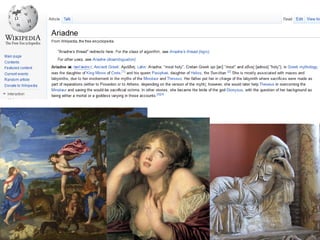
who is Ariadne?
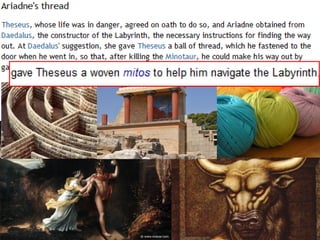
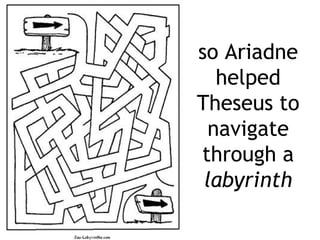
so Ariadne
   helped
Theseus to
  navigate
through a
 labyrinth
ARIADNE Foundation
• not-for-profit association aiming to foster
  Share and Reuse of Learning Resources
  • working on facilitating the reuse of digital
    resources that can be used to support learning
• created a standards-based technology
  infrastructure for metadata aggregation
  • allows publication and management of
    metadata records about digital learning
    resources in an open and scalable way
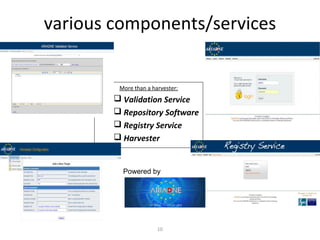
various components/services


         More than a harvester:
         Validation Service
         Repository Software
         Registry Service
         Harvester


          Powered by


                       10
simplified scenario
• backend: periodical aggregation of metadata
  from various providers
  – harvesting through OAI-PMH protocol/targets, as
    well as human-facilitated ingestion/import
  – different metadata schemas/specs combined
  – indexing metadata element values to use for faceted
    search/browse
• front-end: interfaces to search/browse through
  metadata descriptions of learning resources
                           11
alliance with
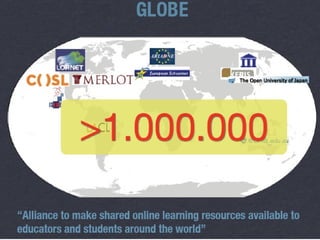
• member of Global Learning Objects
  Brokering Exchange (GLOBE) Alliance
  • contributing towards the development of a
    global learning infrastructure that can be
    accessible from all
  • one-stop-shop for learning resource broker
    organizations, each of them managing and/or
    federating one or more learning object
    repositories
                www.globe-info.org
GLOBE is powered by ARIADNE
• an instance of the metadata aggregation
  infrastructure of ARIADNE is used to support
  federated search in allied GLOBE repositories
also: Open Discovery Space
• CIP PSP funded initiative aiming to deploy a pan-
  European open eLearning content infrastructure
  [launched April’12; http://www.opendiscoveryspace.eu ]
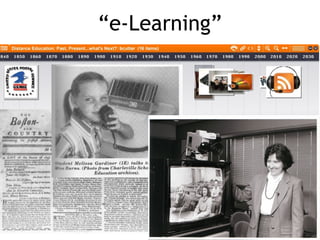
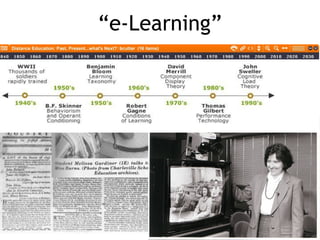
e-learning & metadata
“e-Learning”
“e-Learning”
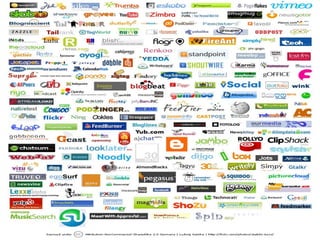
“e-Learning”
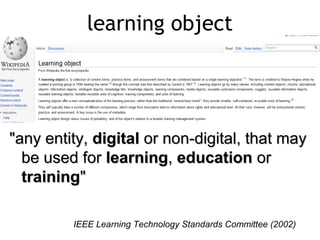
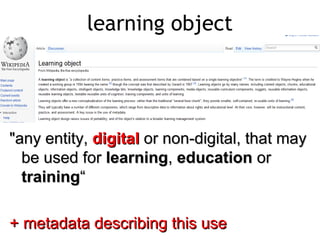
learning object


"any entity, digital or non-digital, that may
  be used for learning, education or
  training"

         ΙΕΕΕ Learning Technology Standards Committee (2002)
learning object


"any entity, digital or non-digital, that may
  be used for learning, education or
  training“

+ metadata describing this use
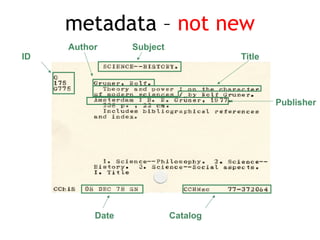
metadata – not new
     Author      Subject
ID                                   Title


                                             Publisher


          Date             Catalog
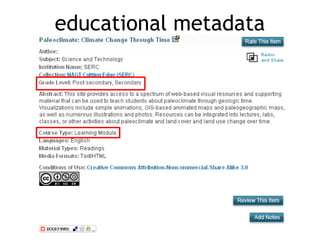
educational metadata
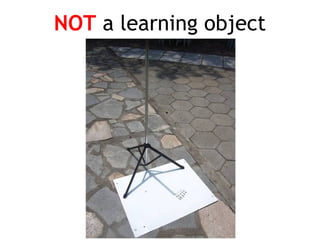
NOT a learning object
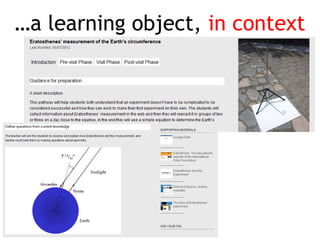
…a learning object, in context
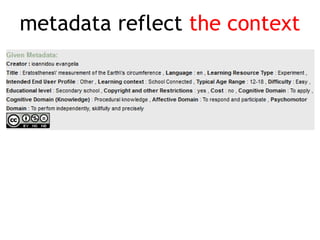
metadata reflect the context
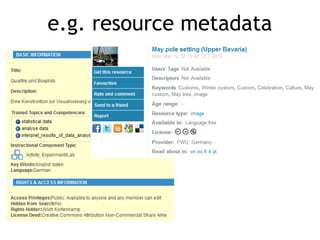
e.g. resource metadata
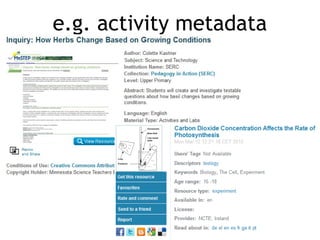
e.g. activity metadata
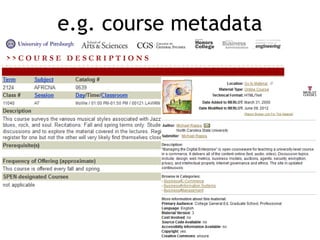
e.g. course metadata
metadata aggregation
aggregating metadata records
• concerns viewing merged collections of
  metadata records from different sources
• useful: when access to specific supersets or
  subsets of networked collections
  – records actually stored at aggregator
  – or queries distributed at virtually aggregated
    collections


                         32
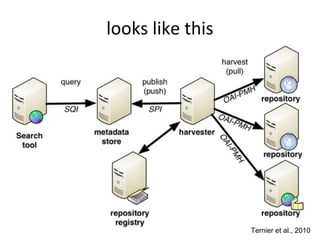
popular approach: harvesting
• based on Open Archives Initiative
  Protocol for Metadata Harvesting
  (OAI-PMH)
  – XML-driven technology
  – wrappers for legacy systems often
    developed
  – implementations for various metadata
    standards/specs (including DC, IEEE LOM,…)
                        33
looks like this


       34         Ternier et al., 2010
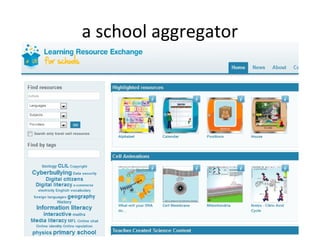
a school aggregator
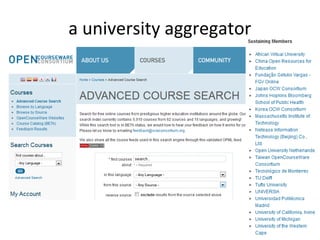
a university aggregator
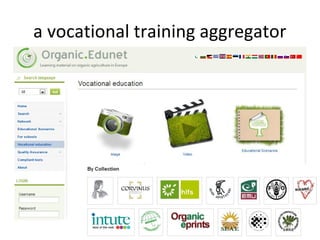
a vocational training aggregator
typical problems
a.   metadata authoring/creation
b.   metadata assurance/validation
c.   metadata values/vocabularies
d.   metadata multilinguality
e.   …lots more


                    38
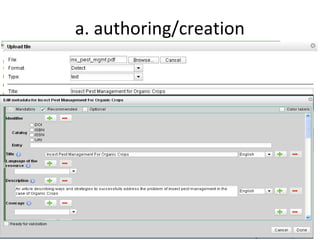
a. authoring/creation
• metadata creation is a painful and
  costly process
  – automatic generation can help
  – high quality/accuracy/relevance
    descriptions require human intervention


                     39
a. authoring/creation


          40
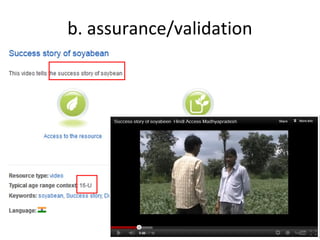
b. assurance/validation
• good online services demand high
  quality (or at least not poor quality)
  description of content
  – someone needs to take the final decision
    before something is published
  – especially relevant when content
    development has been costly/labourous
                      41
b. assurance/validation


           42
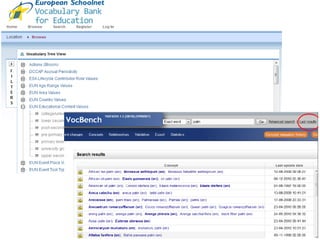
c. values/vocabularies
• mappings and crosswalks among
  values and vocabularies of different
  collections are crucial
  – usually manually defined and maintained
  – difficult to ensure that all applications
    will publish and link their vocabularies
  – vocabulary bank management tend to
    become too complex for the purpose
    that they serve   43
c. values/vocabularies


          44
d. multilinguality
• for multilingual contexts, everything
  needs to become (and be maintained)
  multilingual
  – metadata values and labels
  – interface labels for various systems
• automatic translation helps but usually
  produces rather rough/poor
  translations
                       45
d. multilinguality


        46
why should you then care?
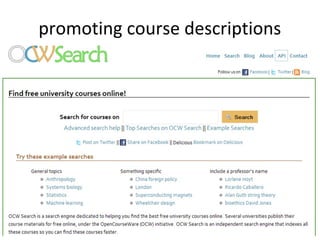
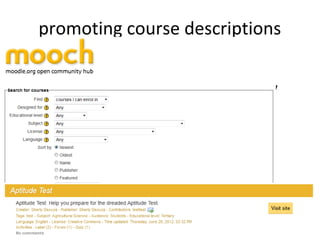
promoting course descriptions
• push course information to various
  syndication/aggregation sites to allow
  users discover them
  – OCW search engine (
    http://www.ocwsearch.com)
  – Moodle Hub concept (hub.moodle.org)


                     48
promoting course descriptions
• push course information to various
  syndication/aggregation sites to allow
  users discover them
  – OCW search engine (
    http://www.ocwsearch.com)
  – Moodle Hub concept (hub.moodle.org)


                     49
promoting course descriptions
• push course information to various
  syndication/aggregation sites to allow
  users discover them
  – OCW search engine (
    http://www.ocwsearch.com)
  – Moodle Hub concept (hub.moodle.org)


                     50
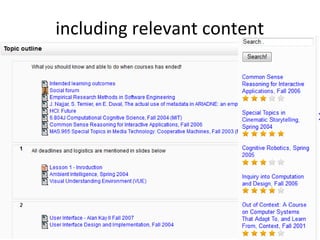
including relevant content
• allow course creator/author to find relevant
  material and resources to enrich course
  – Europeana ingestion widget (
    http://wiki.agroknow.gr/agroknow/index.php/Hack4Europe_20
    )
• suggest to learners additional courses and
  material relevant to what they access
  – Eummena’s Moodle Widget (
    http://www.eummena.org/index.php/labs)

                           51
including relevant content
• allow course creator/author to find relevant
  material and resources to enrich course
  – Europeana ingestion widget (
    http://wiki.agroknow.gr/agroknow/index.php/Hack4Europe_20
    )
• suggest to learners additional courses and
  material relevant to what they access
  – Eummena’s Moodle Widget (
    http://www.eummena.org/index.php/labs)

                           52
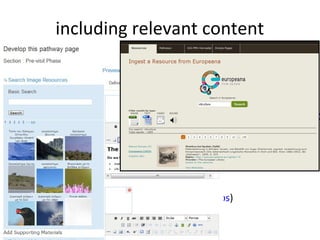
including relevant content
• allow course creator/author to find relevant
  material and resources to enrich course
  – Europeana ingestion widget (
    http://wiki.agroknow.gr/agroknow/index.php/Hack4Europe_20
    )
• suggest to learners additional courses and
  material relevant to what they access
  – Eummena’s Moodle Widget
    (http://www.eummena.org/index.php/labs)

                           53
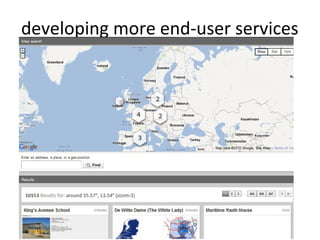
developing more end-user services
• Web portals to support user communities
  (e.g. thematic, geographical, social, cultural)
  – MACE portal (http://portal.mace-project.eu)
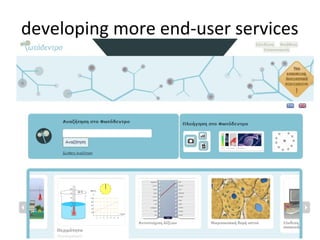
  – Photodentro Greek school collections portal
    (http://photodentro.edu.gr)
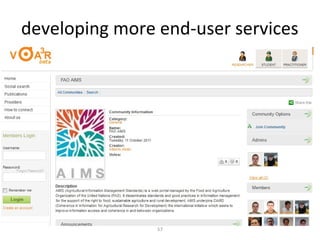
  – VOA3R social platform for researchers
    (http://voa3r.cc.uah.es)


                         54
developing more end-user services
• Web portals to support user communities
  (e.g. thematic, geographical, social, cultural)
  – MACE portal (http://portal.mace-project.eu)
  – Photodentro Greek school collections portal
    (http://photodentro.edu.gr)
  – VOA3R social platform for researchers
    (http://voa3r.cc.uah.es)


                         55
developing more end-user services
• Web portals to support user communities
  (e.g. thematic, geographical, social, cultural)
  – MACE portal (http://portal.mace-project.eu)
  – Photodentro Greek school collections portal
    (http://photodentro.edu.gr)
  – VOA3R social platform for researchers
    (http://voa3r.cc.uah.es)


                         56
developing more end-user services
• Web portals to support user communities
  (e.g. thematic, geographical, social, cultural)
  – MACE portal (http://portal.mace-project.eu)
  – Photodentro Greek school collections portal
    (http://photodentro.edu.gr)
  – VOA3R social platform for researchers
    (http://voa3r.cc.uah.es)


                         57
future scenarios
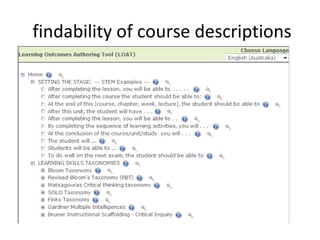
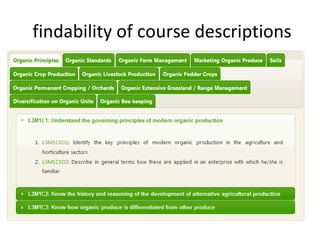
findability of course descriptions
• interoperable course metadata
  published and aggregated, accessible
  through multiple information
  portals/channels
  – curricula described in terms of learning
    outcomes
  – findable through requesting targeted
    competences
findability of course descriptions
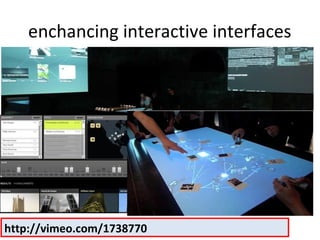
interactive access
• multi-touch, interactive installations
  enhancing the educational
  experience
  – related to both technology and content
    industries
  – deployment both at any educational
    context (formal/informal)
enchancing interactive interfaces


http://vimeo.com/1738770
social networking
• Connecting peers & visualising social
  networks, connecting people with content
  resources, recommending people/content
  – Mendeley (www.mendeley.com), ResearchGate
    (http://www.researchgate.net), Academia.edu
    (http://academia.edu), ArnetMiner
    (http://arnetminer.org), …
  – Social research components in popular CMSs
    (JomSocial, Drupal’s Buddylist, Elgg…)
  – Social research components in institutional CMSs
    (VIVO, …)
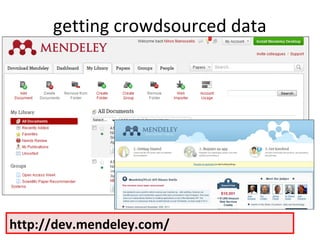
getting crowdsourced data


http://dev.mendeley.com/
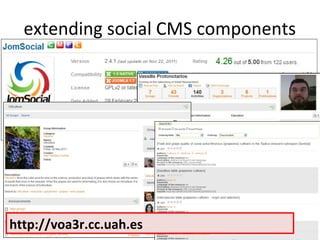
extending social CMS components


http://voa3r.cc.uah.es
wrap up
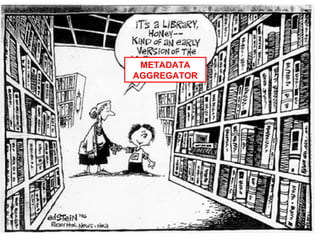
METADATA
AGGREGATOR
challenges
• semantic evolution (Linked Open
  Data)
• data/content growth rates
• usage logging & learning analytics
• …more
interested to experiment?
thank you!
    nikosm@ieee.org
  http://ariadne-eu.org
http://wiki.agroknow.gr

Content Sharing: Whence and Whither?

  • 1.
    Content Sharing whence &whither? Nikos Manouselis Agro-Know Technologies & ARIADNE Foundation nikosm@ieee.org @ILIAS 2012, Stuttgart, 6/9/12
  • 2.
    Metadata Sharing whence& whither? Nikos Manouselis Agro-Know Technologies & ARIADNE Foundation nikosm@ieee.org @ILIAS 2012, Stuttgart, 6/9/12
  • 3.
    about me • ComputerEngineer • MSc’s on Operational Research + Telecommunications • PhD from Informatics Lab of an Agricultural University • working on e-learning content, repositories & federations for the past 10 years
  • 4.
    about me • ComputerEngineer • MSc’s on Operational Research + Telecommunications • PhD from Informatics Lab of an Agricultural University • working on e-learning content, repositories & federations for the past 10 years
  • 5.
  • 8.
    so Ariadne helped Theseus to navigate through a labyrinth
  • 9.
    ARIADNE Foundation • not-for-profitassociation aiming to foster Share and Reuse of Learning Resources • working on facilitating the reuse of digital resources that can be used to support learning • created a standards-based technology infrastructure for metadata aggregation • allows publication and management of metadata records about digital learning resources in an open and scalable way
  • 10.
    various components/services More than a harvester:  Validation Service  Repository Software  Registry Service  Harvester Powered by 10
  • 11.
    simplified scenario • backend:periodical aggregation of metadata from various providers – harvesting through OAI-PMH protocol/targets, as well as human-facilitated ingestion/import – different metadata schemas/specs combined – indexing metadata element values to use for faceted search/browse • front-end: interfaces to search/browse through metadata descriptions of learning resources 11
  • 12.
    alliance with • memberof Global Learning Objects Brokering Exchange (GLOBE) Alliance • contributing towards the development of a global learning infrastructure that can be accessible from all • one-stop-shop for learning resource broker organizations, each of them managing and/or federating one or more learning object repositories www.globe-info.org
  • 14.
    GLOBE is poweredby ARIADNE • an instance of the metadata aggregation infrastructure of ARIADNE is used to support federated search in allied GLOBE repositories
  • 15.
    also: Open DiscoverySpace • CIP PSP funded initiative aiming to deploy a pan- European open eLearning content infrastructure [launched April’12; http://www.opendiscoveryspace.eu ]
  • 16.
  • 17.
  • 18.
  • 19.
  • 21.
    learning object "any entity,digital or non-digital, that may be used for learning, education or training" ΙΕΕΕ Learning Technology Standards Committee (2002)
  • 22.
    learning object "any entity,digital or non-digital, that may be used for learning, education or training“ + metadata describing this use
  • 23.
    metadata – notnew Author Subject ID Title Publisher Date Catalog
  • 24.
  • 25.
  • 26.
  • 27.
  • 28.
  • 29.
  • 30.
  • 31.
  • 32.
    aggregating metadata records •concerns viewing merged collections of metadata records from different sources • useful: when access to specific supersets or subsets of networked collections – records actually stored at aggregator – or queries distributed at virtually aggregated collections 32
  • 33.
    popular approach: harvesting •based on Open Archives Initiative Protocol for Metadata Harvesting (OAI-PMH) – XML-driven technology – wrappers for legacy systems often developed – implementations for various metadata standards/specs (including DC, IEEE LOM,…) 33
  • 34.
    looks like this 34 Ternier et al., 2010
  • 35.
  • 36.
  • 37.
  • 38.
    typical problems a. metadata authoring/creation b. metadata assurance/validation c. metadata values/vocabularies d. metadata multilinguality e. …lots more 38
  • 39.
    a. authoring/creation • metadatacreation is a painful and costly process – automatic generation can help – high quality/accuracy/relevance descriptions require human intervention 39
  • 40.
  • 41.
    b. assurance/validation • goodonline services demand high quality (or at least not poor quality) description of content – someone needs to take the final decision before something is published – especially relevant when content development has been costly/labourous 41
  • 42.
  • 43.
    c. values/vocabularies • mappingsand crosswalks among values and vocabularies of different collections are crucial – usually manually defined and maintained – difficult to ensure that all applications will publish and link their vocabularies – vocabulary bank management tend to become too complex for the purpose that they serve 43
  • 44.
  • 45.
    d. multilinguality • formultilingual contexts, everything needs to become (and be maintained) multilingual – metadata values and labels – interface labels for various systems • automatic translation helps but usually produces rather rough/poor translations 45
  • 46.
  • 47.
    why should youthen care?
  • 48.
    promoting course descriptions •push course information to various syndication/aggregation sites to allow users discover them – OCW search engine ( http://www.ocwsearch.com) – Moodle Hub concept (hub.moodle.org) 48
  • 49.
    promoting course descriptions •push course information to various syndication/aggregation sites to allow users discover them – OCW search engine ( http://www.ocwsearch.com) – Moodle Hub concept (hub.moodle.org) 49
  • 50.
    promoting course descriptions •push course information to various syndication/aggregation sites to allow users discover them – OCW search engine ( http://www.ocwsearch.com) – Moodle Hub concept (hub.moodle.org) 50
  • 51.
    including relevant content •allow course creator/author to find relevant material and resources to enrich course – Europeana ingestion widget ( http://wiki.agroknow.gr/agroknow/index.php/Hack4Europe_20 ) • suggest to learners additional courses and material relevant to what they access – Eummena’s Moodle Widget ( http://www.eummena.org/index.php/labs) 51
  • 52.
    including relevant content •allow course creator/author to find relevant material and resources to enrich course – Europeana ingestion widget ( http://wiki.agroknow.gr/agroknow/index.php/Hack4Europe_20 ) • suggest to learners additional courses and material relevant to what they access – Eummena’s Moodle Widget ( http://www.eummena.org/index.php/labs) 52
  • 53.
    including relevant content •allow course creator/author to find relevant material and resources to enrich course – Europeana ingestion widget ( http://wiki.agroknow.gr/agroknow/index.php/Hack4Europe_20 ) • suggest to learners additional courses and material relevant to what they access – Eummena’s Moodle Widget (http://www.eummena.org/index.php/labs) 53
  • 54.
    developing more end-userservices • Web portals to support user communities (e.g. thematic, geographical, social, cultural) – MACE portal (http://portal.mace-project.eu) – Photodentro Greek school collections portal (http://photodentro.edu.gr) – VOA3R social platform for researchers (http://voa3r.cc.uah.es) 54
  • 55.
    developing more end-userservices • Web portals to support user communities (e.g. thematic, geographical, social, cultural) – MACE portal (http://portal.mace-project.eu) – Photodentro Greek school collections portal (http://photodentro.edu.gr) – VOA3R social platform for researchers (http://voa3r.cc.uah.es) 55
  • 56.
    developing more end-userservices • Web portals to support user communities (e.g. thematic, geographical, social, cultural) – MACE portal (http://portal.mace-project.eu) – Photodentro Greek school collections portal (http://photodentro.edu.gr) – VOA3R social platform for researchers (http://voa3r.cc.uah.es) 56
  • 57.
    developing more end-userservices • Web portals to support user communities (e.g. thematic, geographical, social, cultural) – MACE portal (http://portal.mace-project.eu) – Photodentro Greek school collections portal (http://photodentro.edu.gr) – VOA3R social platform for researchers (http://voa3r.cc.uah.es) 57
  • 58.
  • 59.
    findability of coursedescriptions • interoperable course metadata published and aggregated, accessible through multiple information portals/channels – curricula described in terms of learning outcomes – findable through requesting targeted competences
  • 60.
  • 61.
  • 62.
    interactive access • multi-touch,interactive installations enhancing the educational experience – related to both technology and content industries – deployment both at any educational context (formal/informal)
  • 63.
  • 64.
    social networking • Connectingpeers & visualising social networks, connecting people with content resources, recommending people/content – Mendeley (www.mendeley.com), ResearchGate (http://www.researchgate.net), Academia.edu (http://academia.edu), ArnetMiner (http://arnetminer.org), … – Social research components in popular CMSs (JomSocial, Drupal’s Buddylist, Elgg…) – Social research components in institutional CMSs (VIVO, …)
  • 65.
  • 66.
    extending social CMScomponents http://voa3r.cc.uah.es
  • 67.
  • 68.
  • 69.
    challenges • semantic evolution(Linked Open Data) • data/content growth rates • usage logging & learning analytics • …more
  • 70.
  • 71.
    thank you! nikosm@ieee.org http://ariadne-eu.org http://wiki.agroknow.gr