JUDY O’CONNELL CHARLES STURT UNIVERSITY
Preparing for the impact of
EduTech National Congress !
Brisbane, 3 June 2014
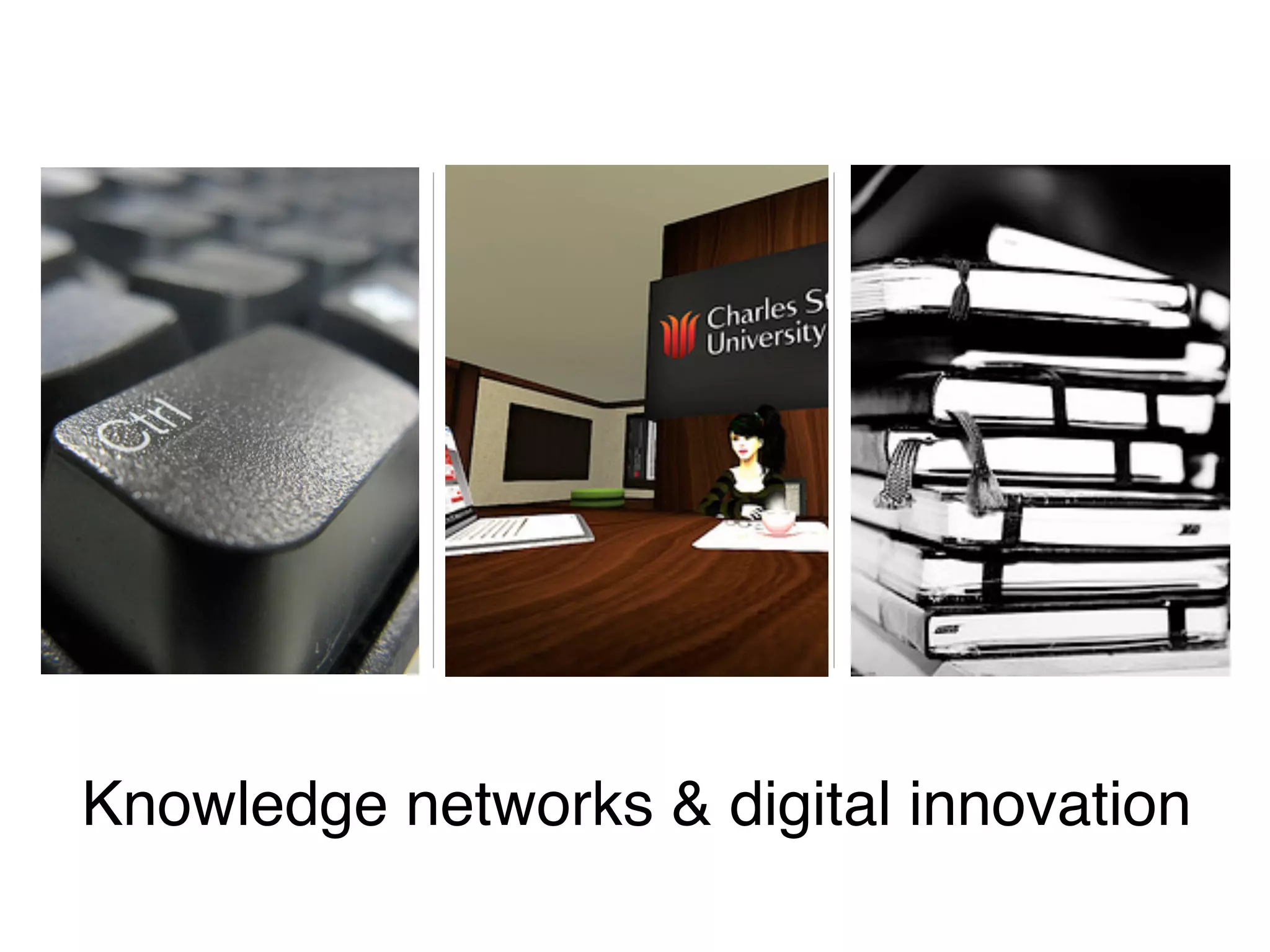
Knowledge networks & digital innovation
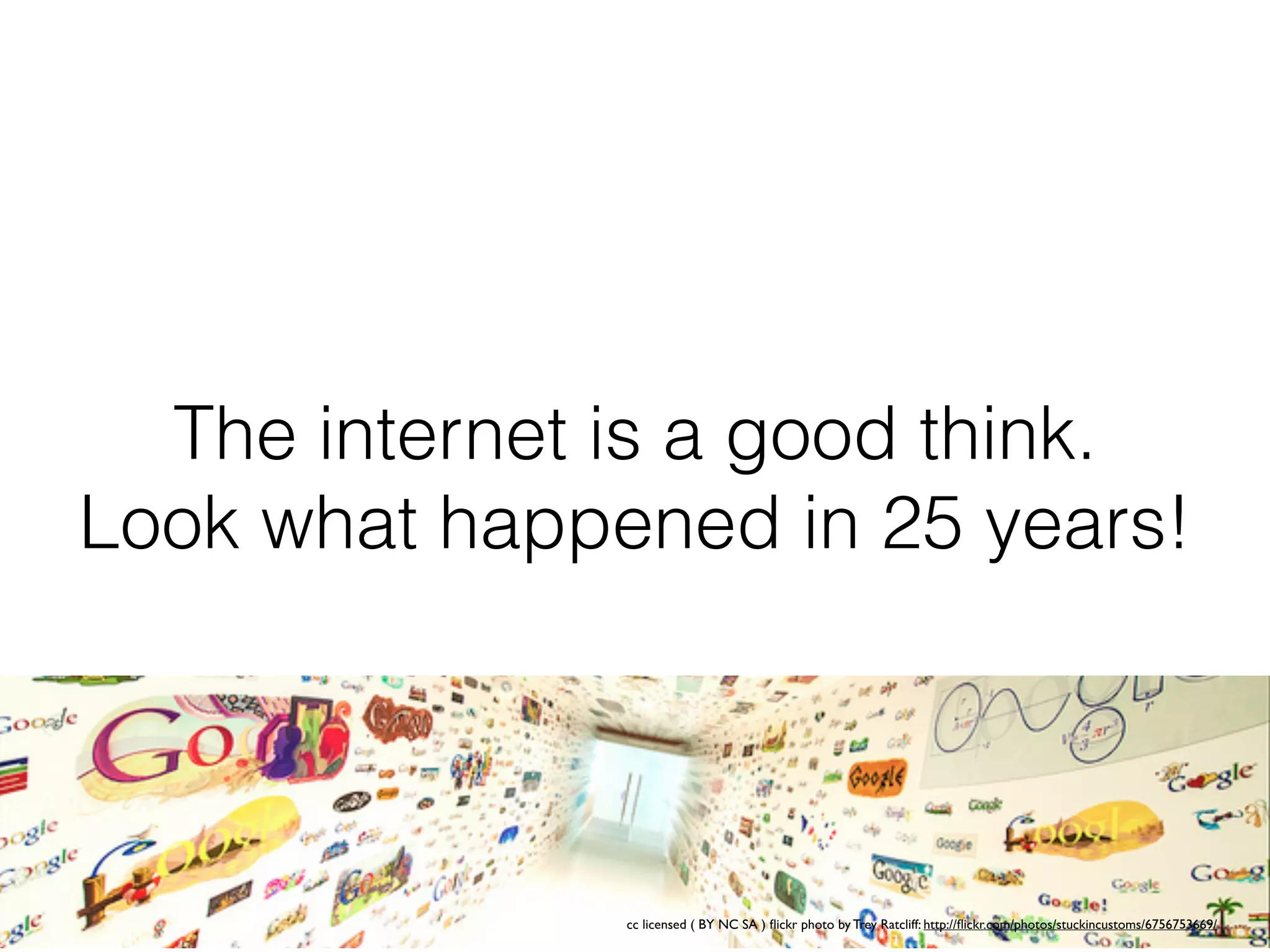
The internet is a good think.
Look what happened in 25 years!
cc licensed ( BY NC SA ) flickr photo by Trey Ratcliff: http://flickr.com/photos/stuckincustoms/6756753669/
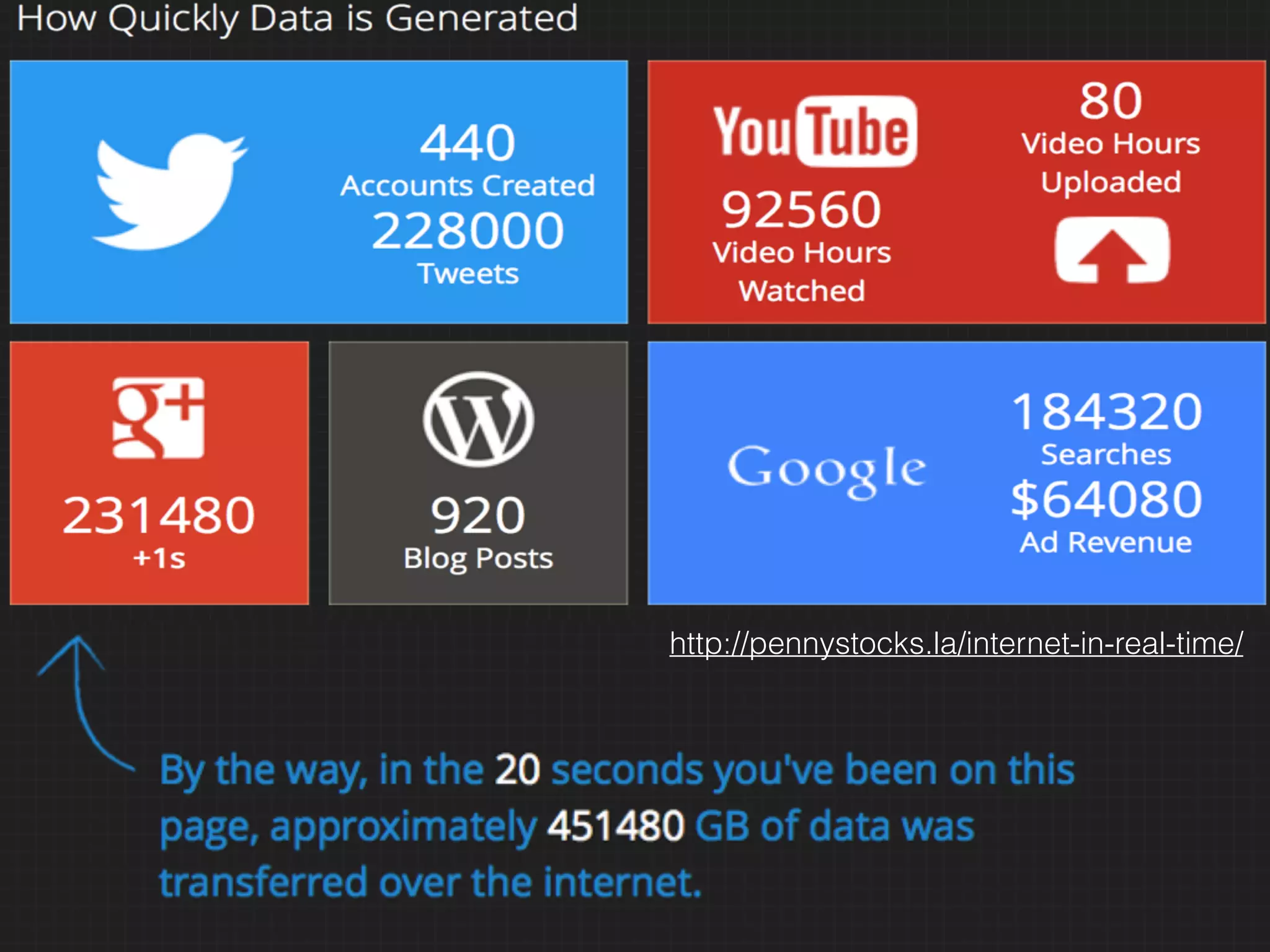
Are we purposefully chaotic?
http://pennystocks.la/internet-in-real-time/
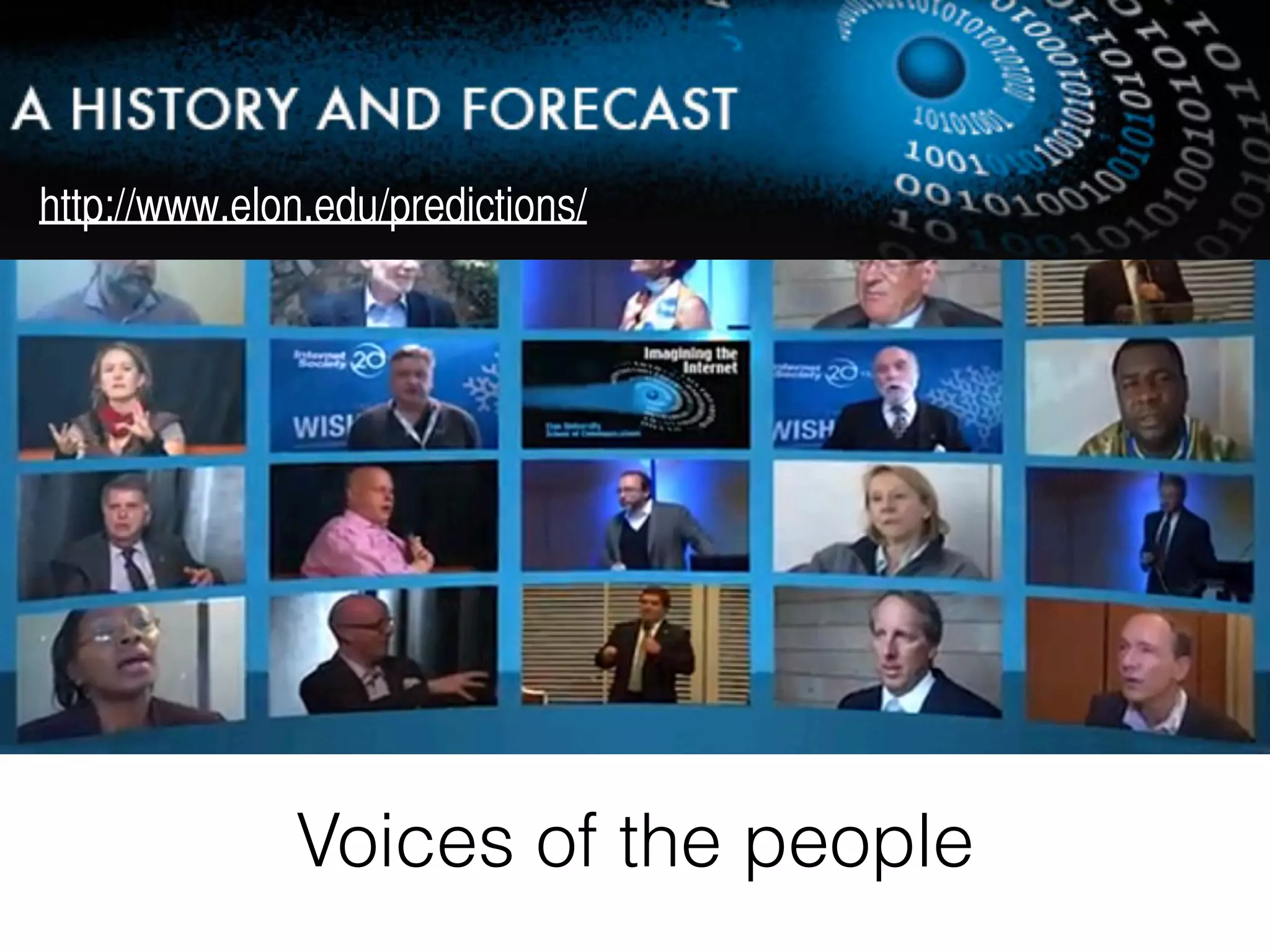
Voices of the people
http://www.elon.edu/predictions/
Imagining the Internet
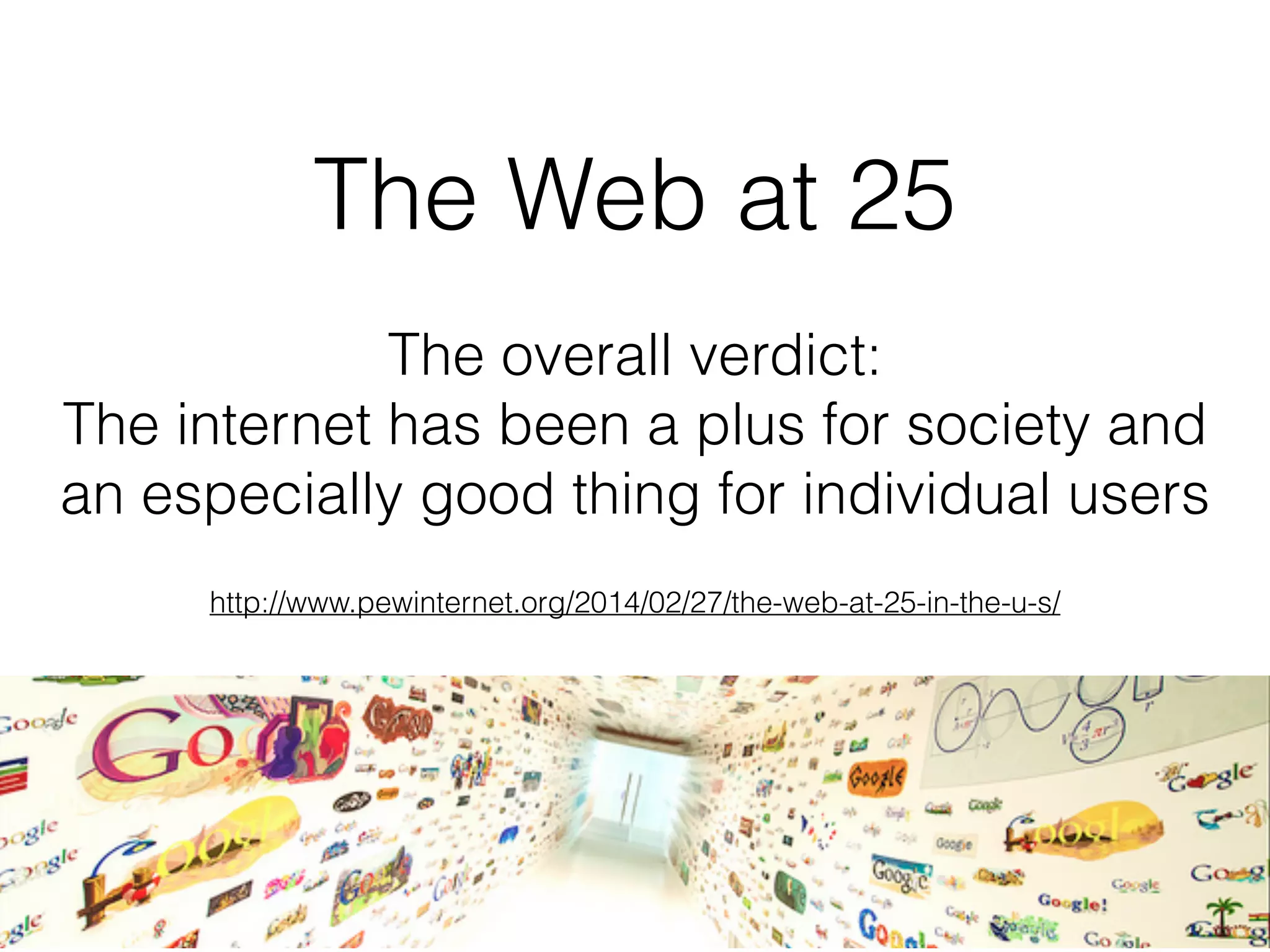
The Web at 25
The overall verdict:
The internet has been a plus for society and
an especially good thing for individual users
http://www.pewinternet.org/2014/02/27/the-web-at-25-in-the-u-s/
More content and streams of data –
these online environments require
a better understanding of what
being ‘online’ means!
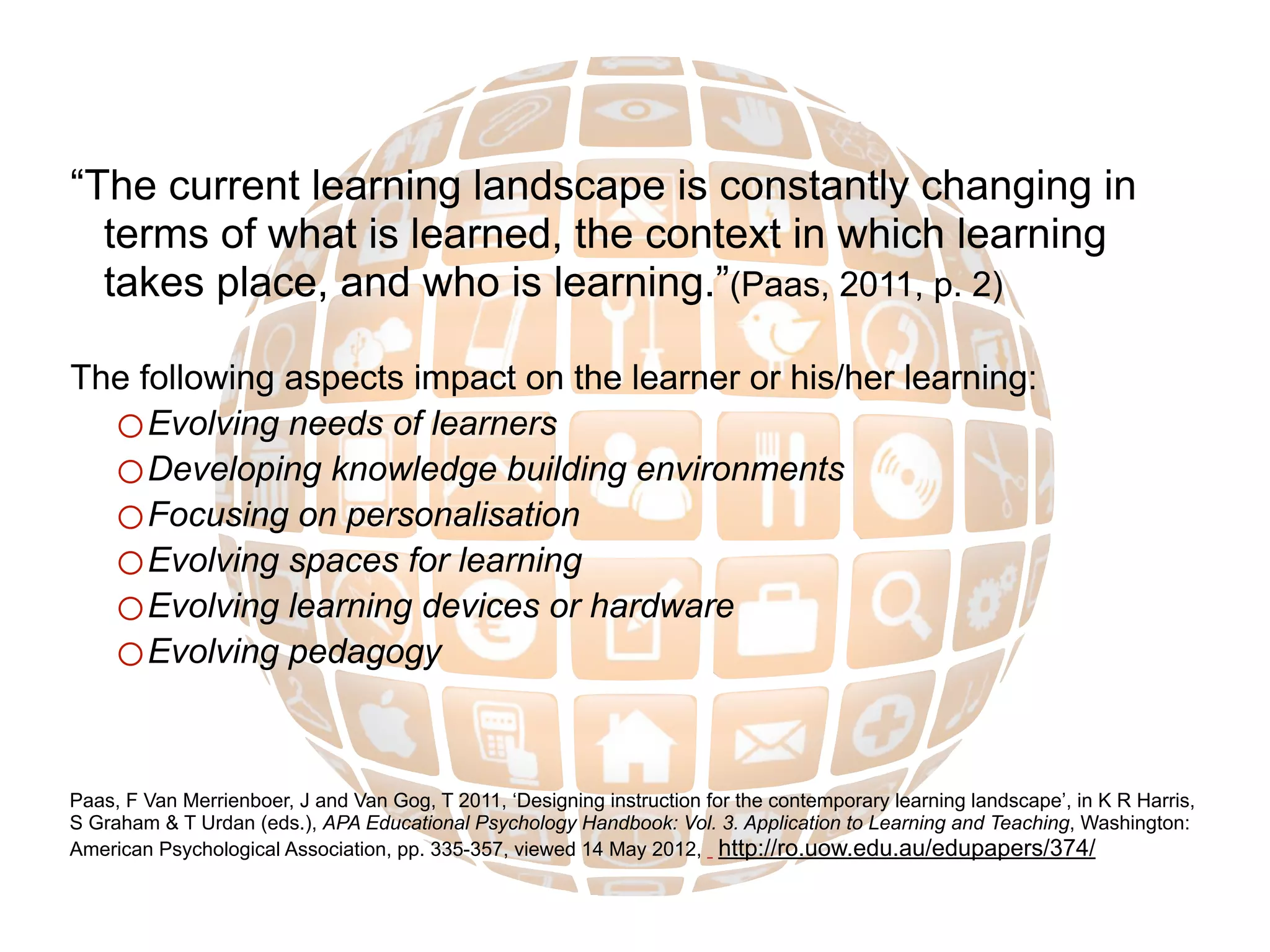
Is knowing obsolete?
oEvolving needs of learners!
oNew knowledge building environments!
oFocusing on personalisation!
oEvolving spaces for learning!
oEvolving learning device technologies!
oEvolving pedagogy
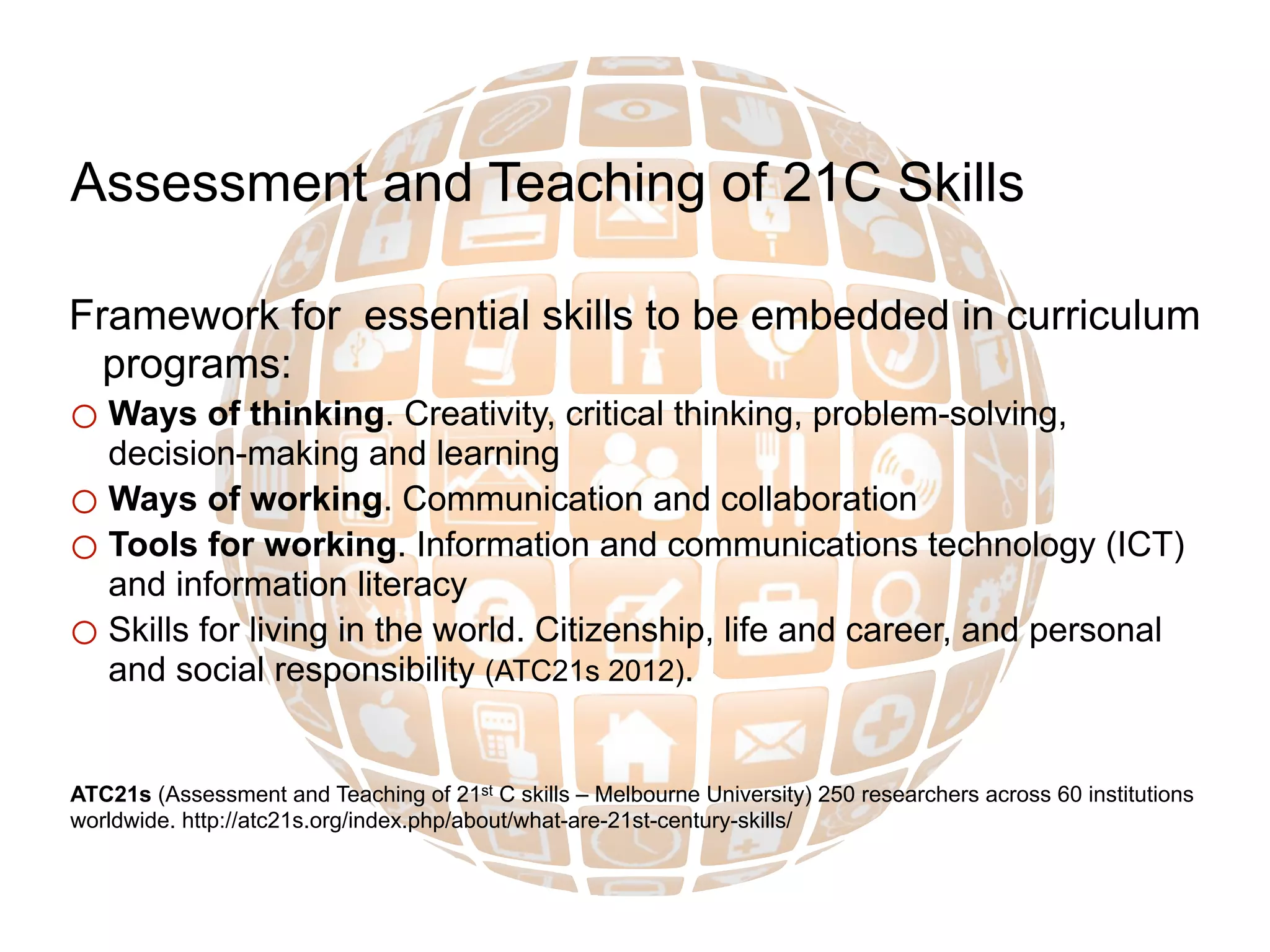
Assessment and Teaching of 21C
Skills
Framework for essential skills for curriculum programs:
!
o Ways of thinking. Creativity, critical thinking, problem-solving,
decision-making and learning
o Ways of working. Communication and collaboration
o Tools for working. Information and communications technology (ICT)
and information literacy
o Skills for living in the world. Citizenship, life and career, and personal
and social responsibility (ATC21s 2012).
ATC21s (Assessment and Teaching of 21st C skills – Melbourne University) 250 researchers across 60 institutions
worldwide. http://atc21s.org/index.php/about/what-are-21st-century-skills/
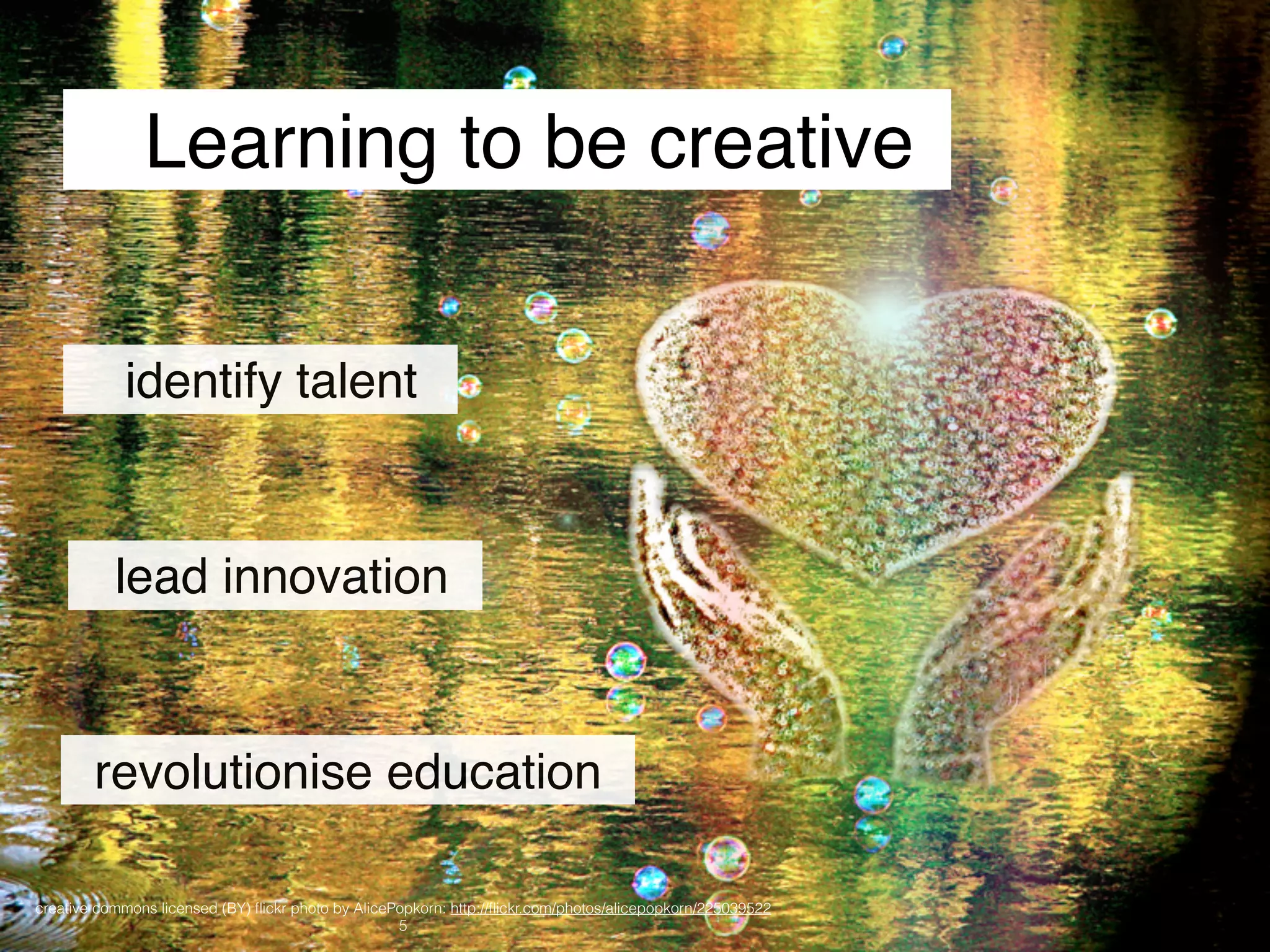
Connected, creative, learning
ecology
lead innovation
identify talent
revolutionise education
creative commons licensed (BY) flickr photo by AlicePopkorn: http://flickr.com/photos/alicepopkorn/225039522
5
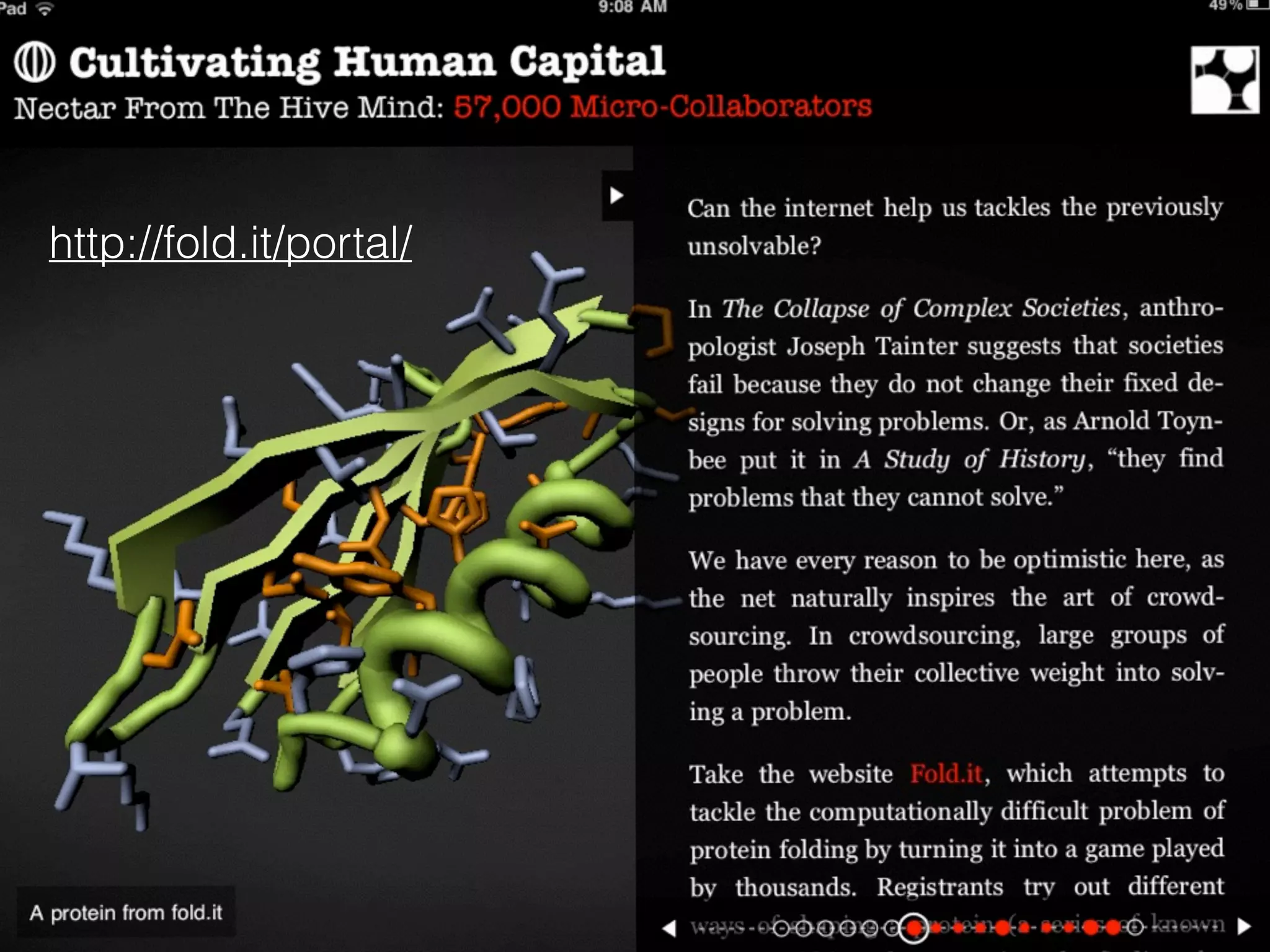
Developed by
researchers at the
University of
Washington,
Folditturns
scientific problems
into competitive
games.
Gamers Unlock Protein Mystery
.... that Baffled Researchers For Years
Khatib, F., DiMaio, F., Cooper, S., Kazmierczyk, M., Gilski, M., Krzywda, S., Zabranska, H., et
al. (2011). Crystal structure of a monomeric retroviral protease solved by protein folding game
players. Nat Struct Mol Biol, 18(10), 1175–1177. doi:10.1038/nsmb.2119!
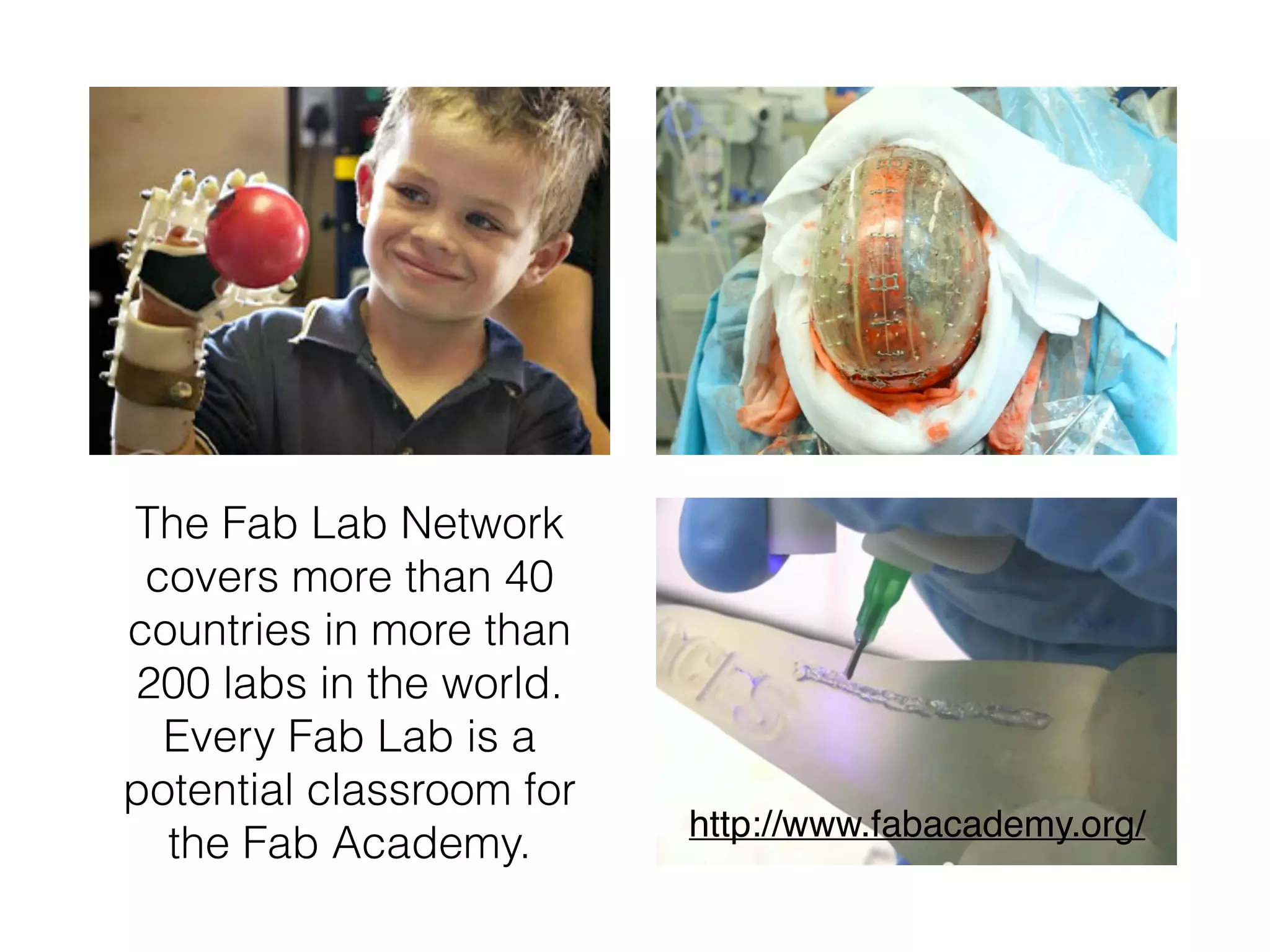
http://www.fabacademy.org/
The Fab Lab Network
covers more than 40
countries in more than
200 labs in the world.
Every Fab Lab is a
potential classroom for
the Fab Academy.
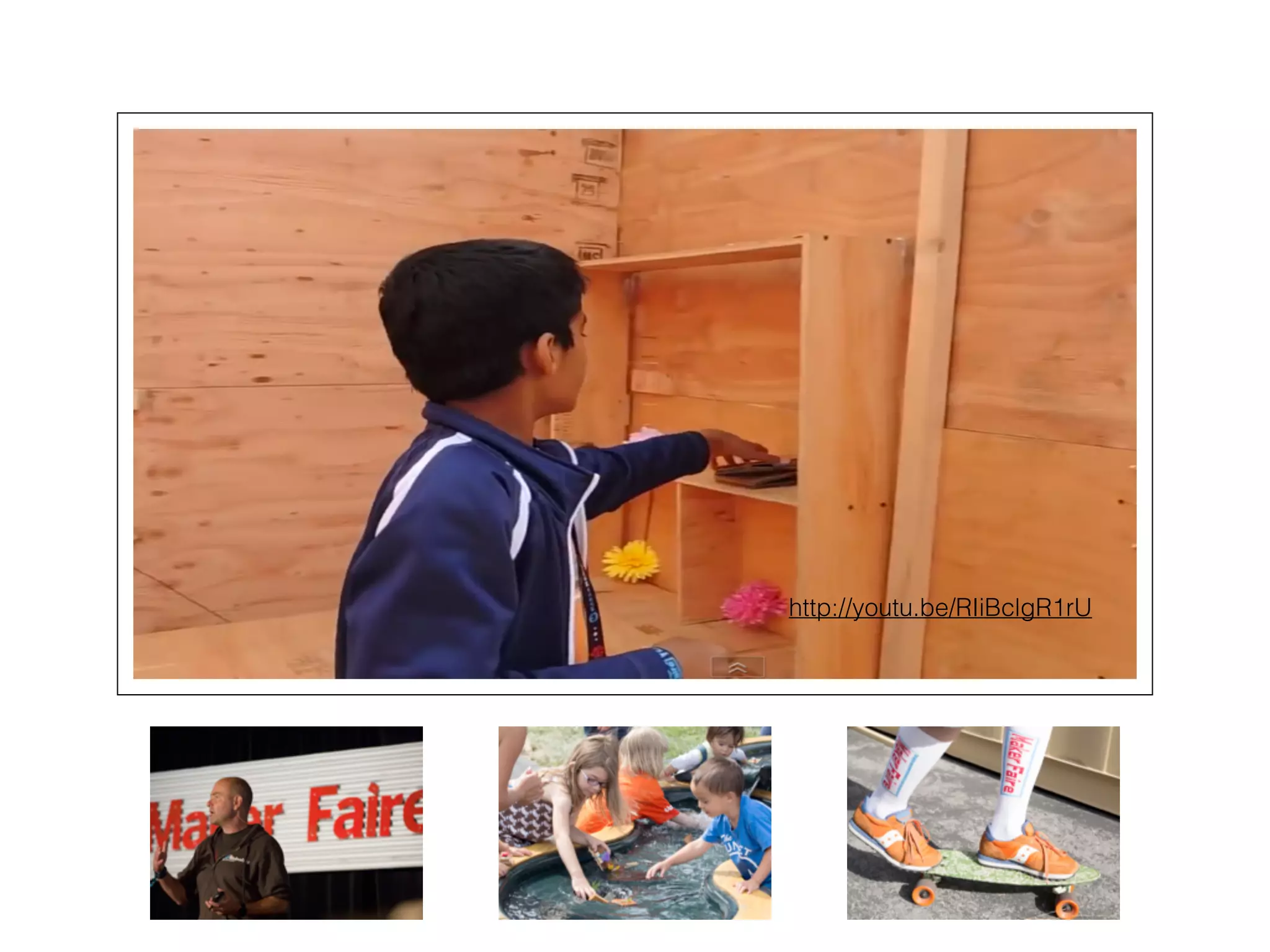
untethered,
empowered learning
http://youtu.be/RIiBclgR1rU
The Robots and Dinosaurs
Hackerspace meets right here in
Sydney and offers a communal space
where geeks and artists brainstorm
ideas, play games, work on
collaborative projects, and share the
cost of some great tools.
http://robodino.org/
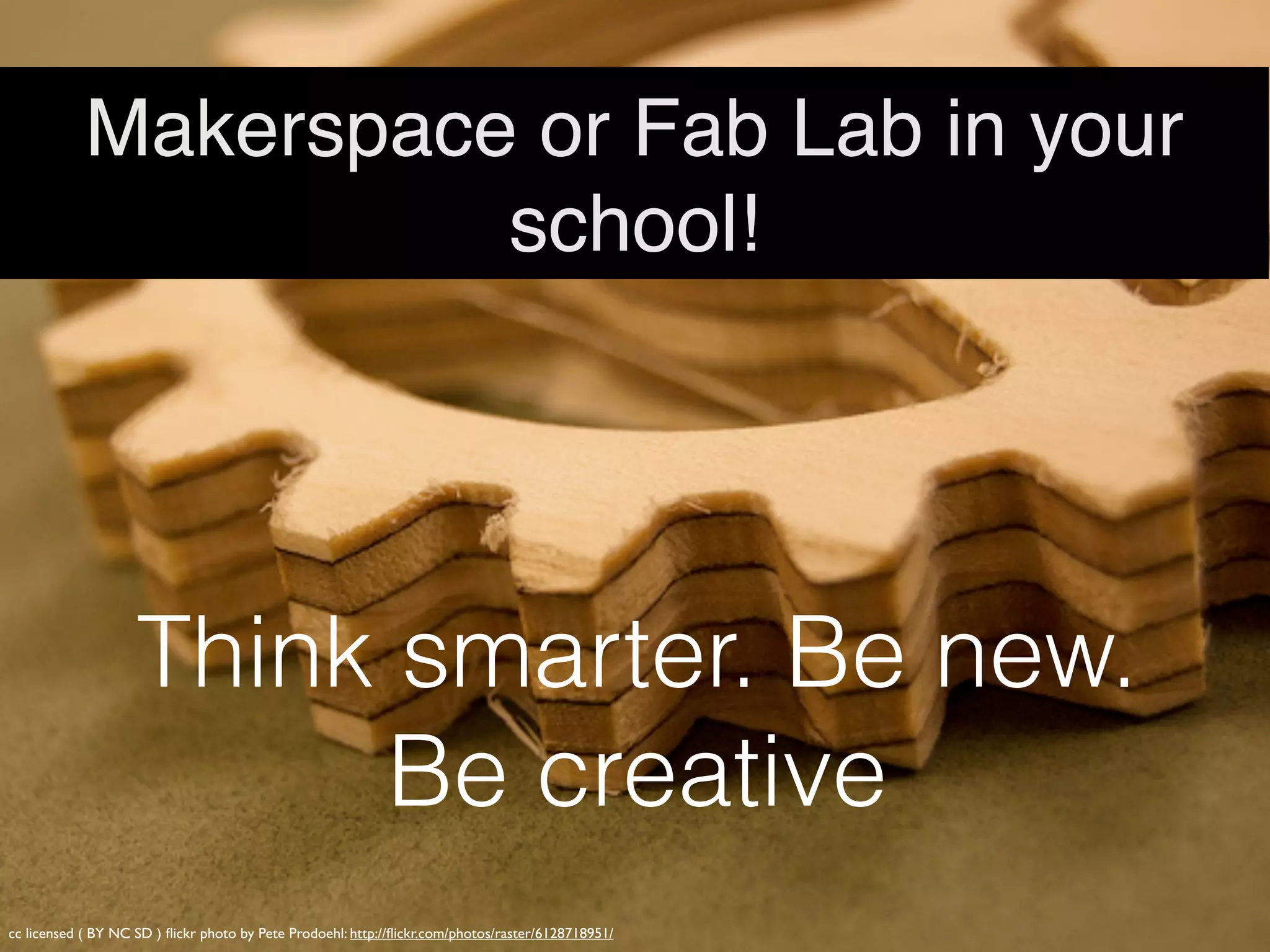
cc licensed ( BY NC SD ) flickr photo by Pete Prodoehl: http://flickr.com/photos/raster/6128718951/
Makerspace or Hackerspace in
your school!
Think smarter. Be new.
Be creative
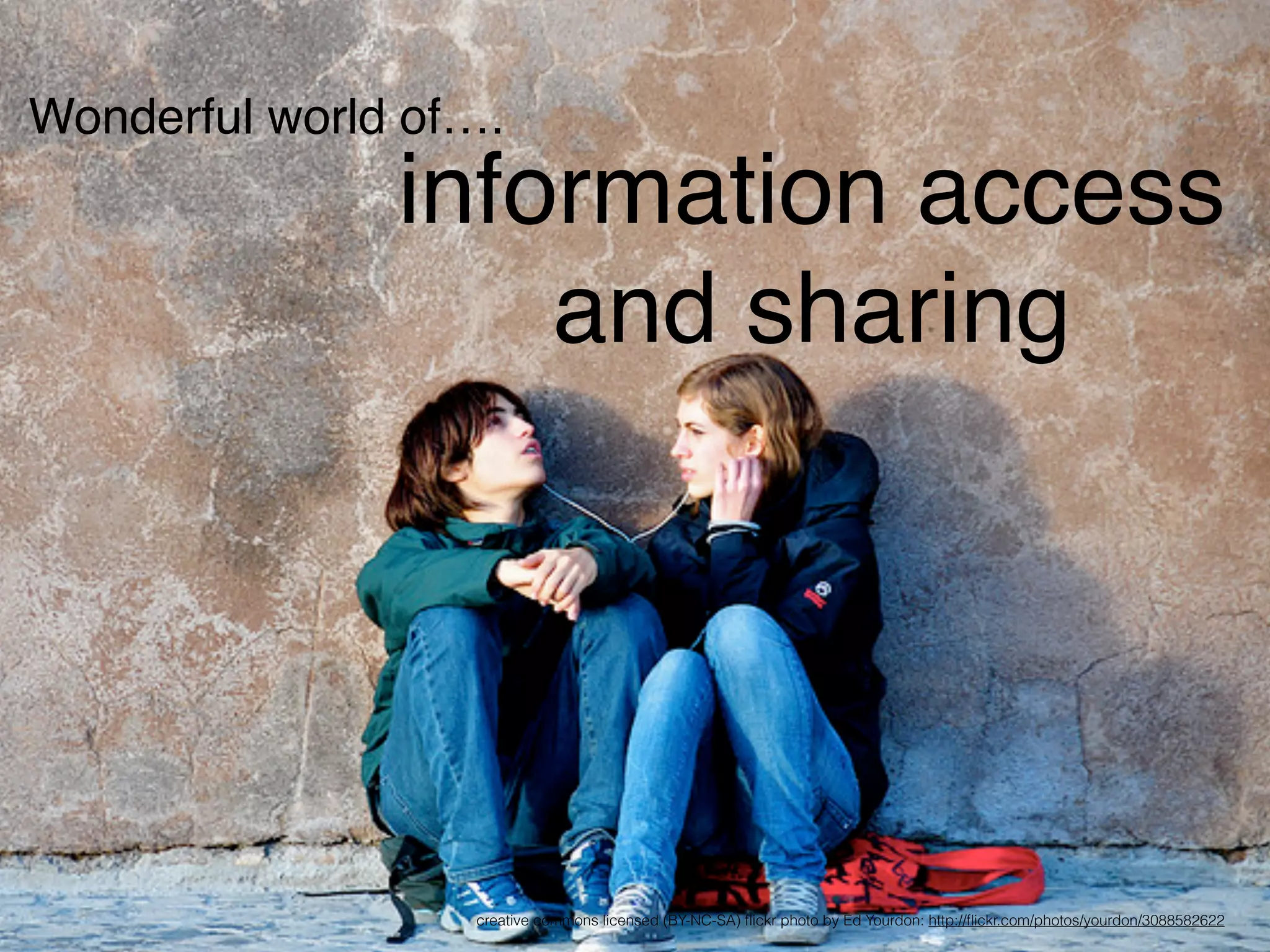
information access
and sharing
Wonderful world of….
creative commons licensed (BY-NC-SA) flickr photo by Ed Yourdon: http://flickr.com/photos/yourdon/3088582622
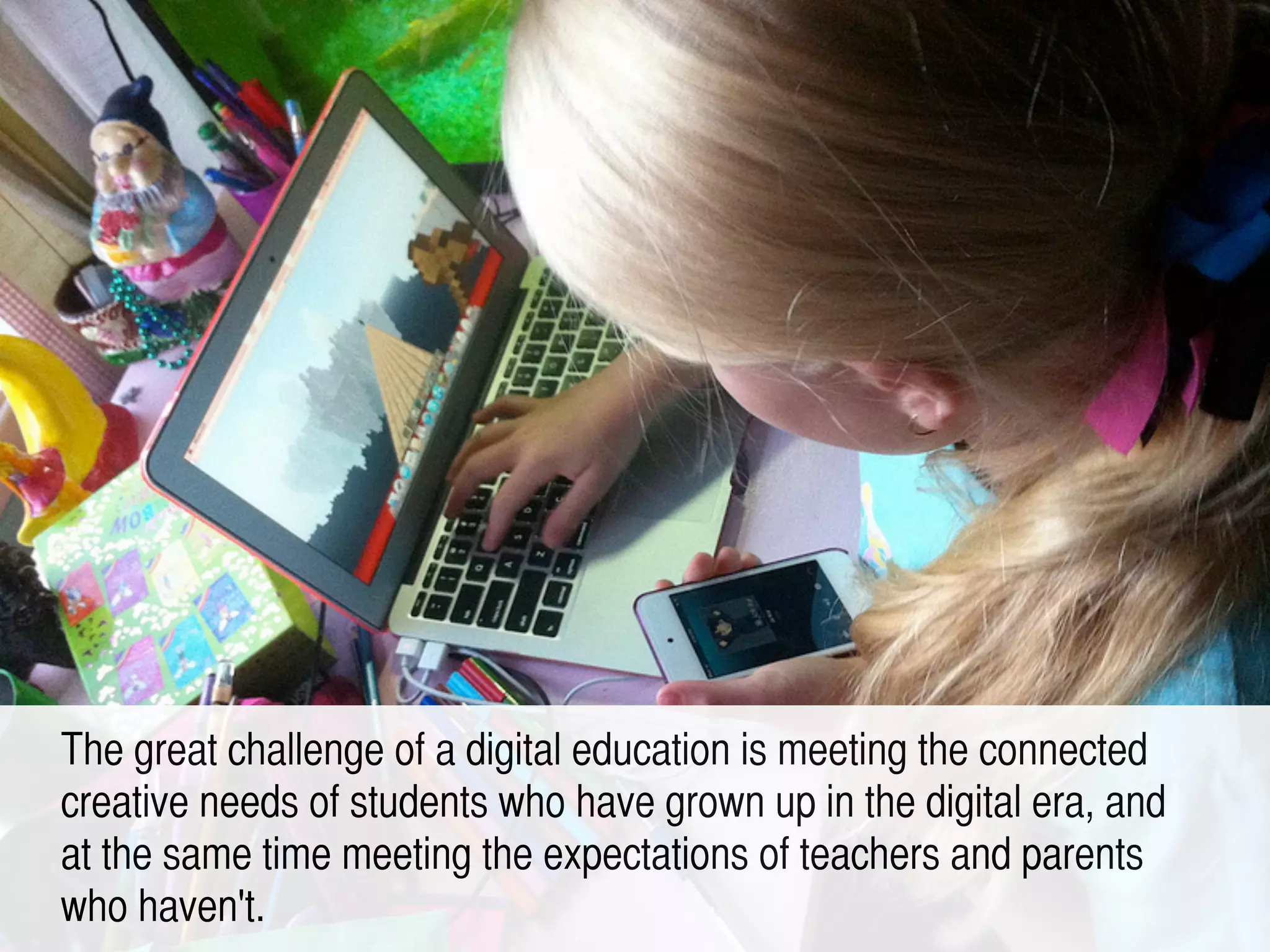
learning today requires that teachers
and school librarians understand
reading and information seeking in a
connected world....
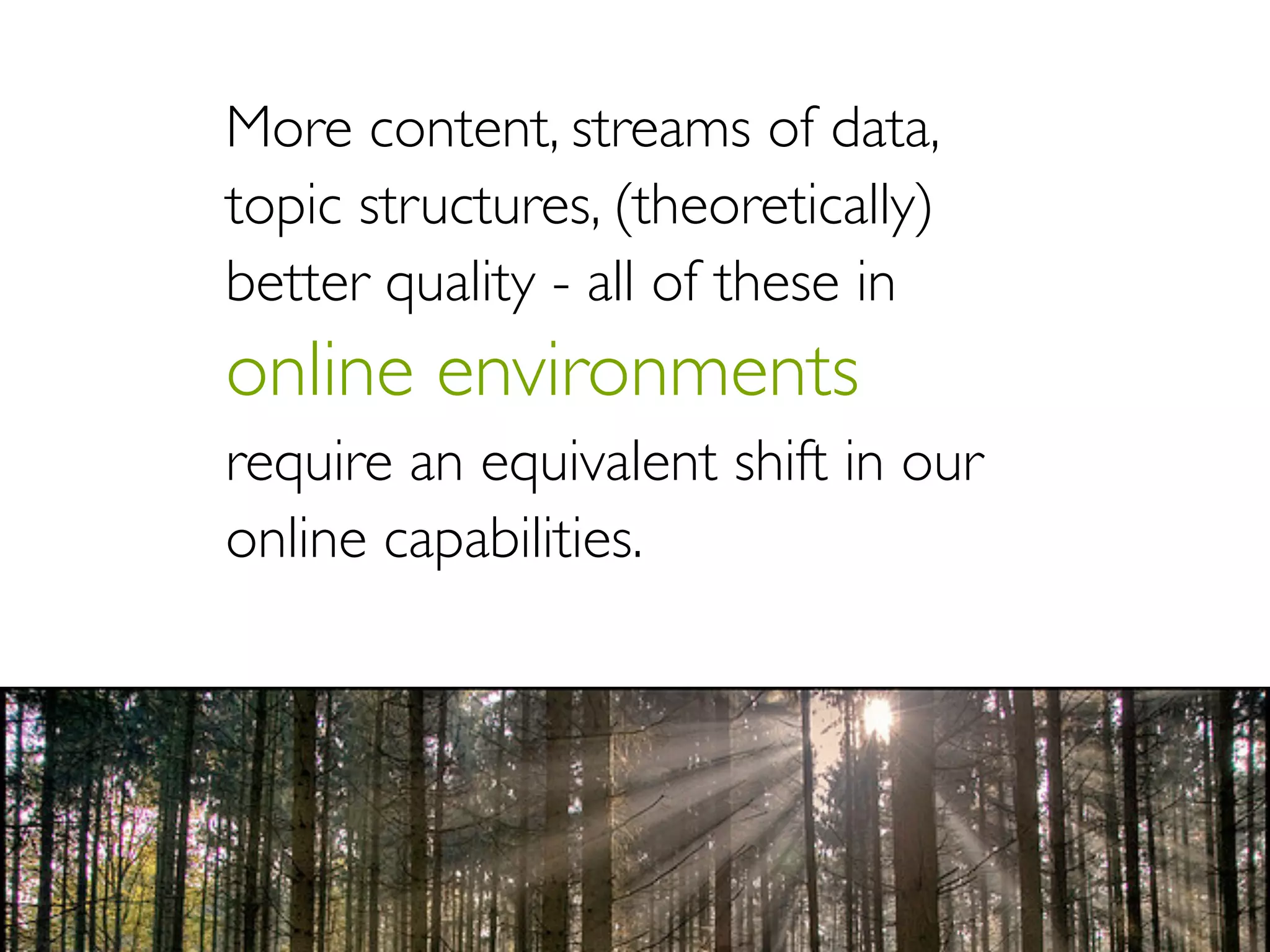
More content, streams of data,
topic structures, (theoretically)
better quality - all of these in
online environments
require an equivalent shift in our
capacity to understand
information structures.
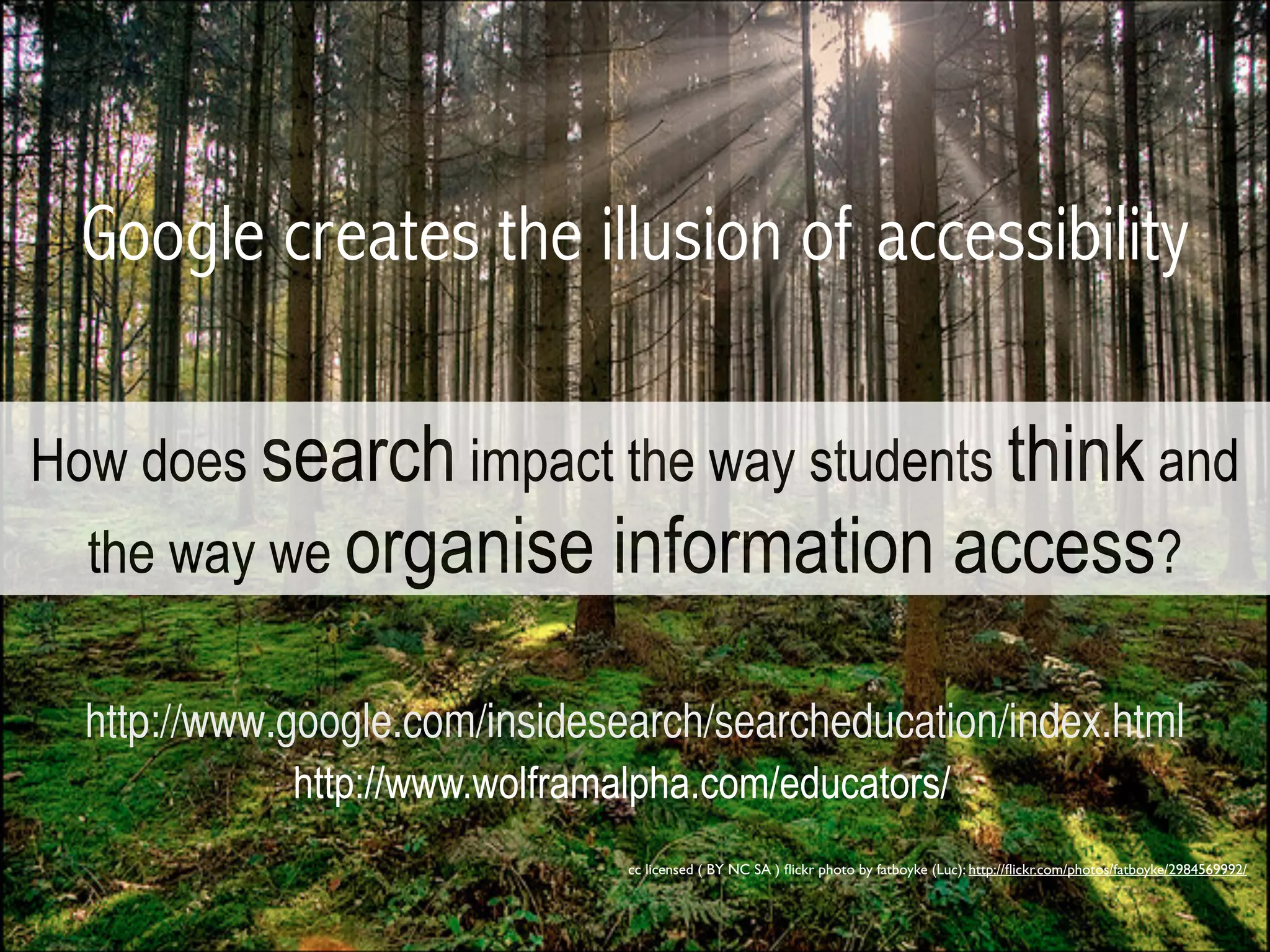
How does search impact the way
students think and the way we
organise information access?
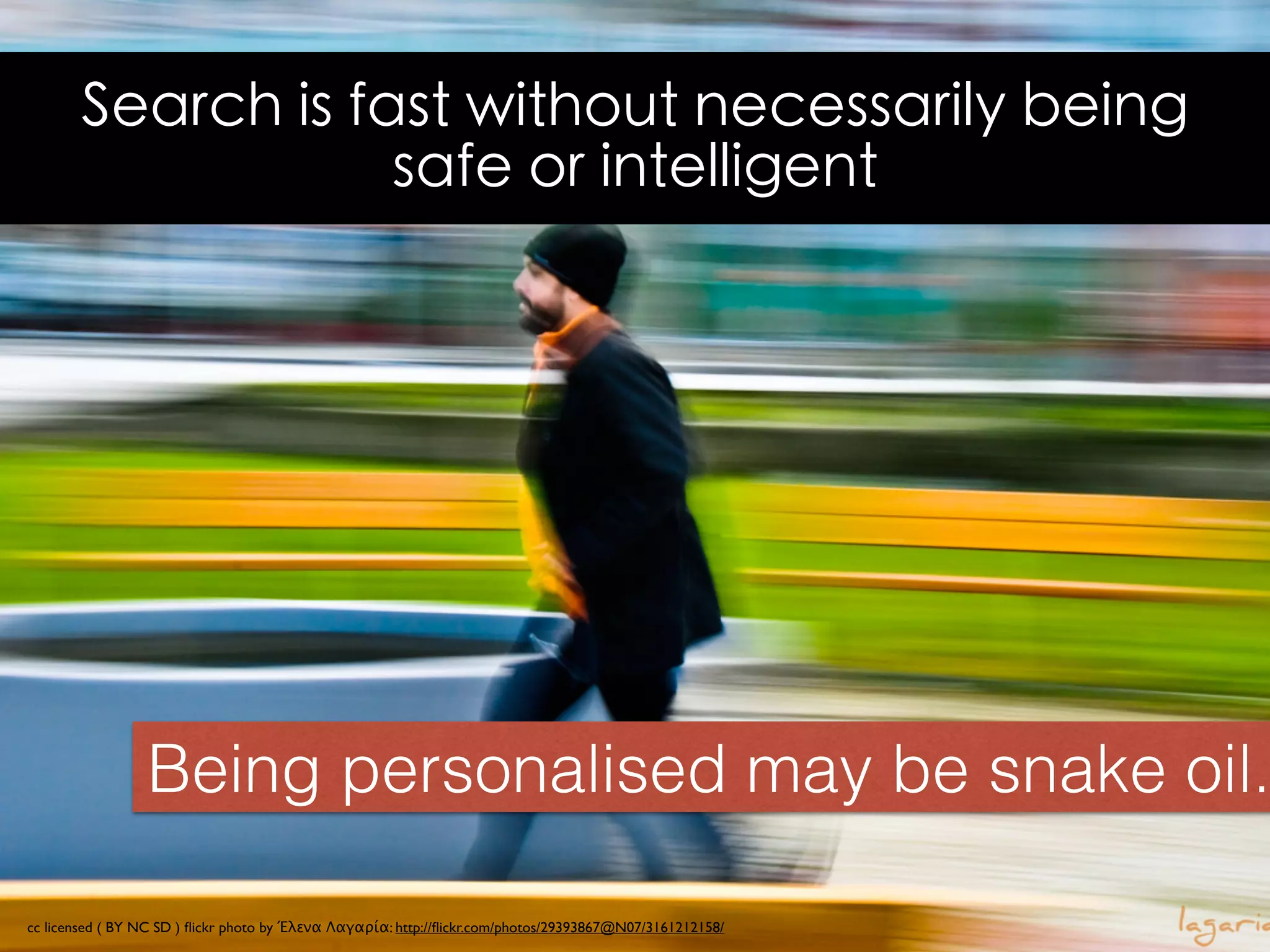
Search is fast without necessarily being
safe or intelligent
!
YET!
cc licensed ( BY NC SD ) flickr photo by Έλενα Λαγαρία: http://flickr.com/photos/29393867@N07/3161212158/
!
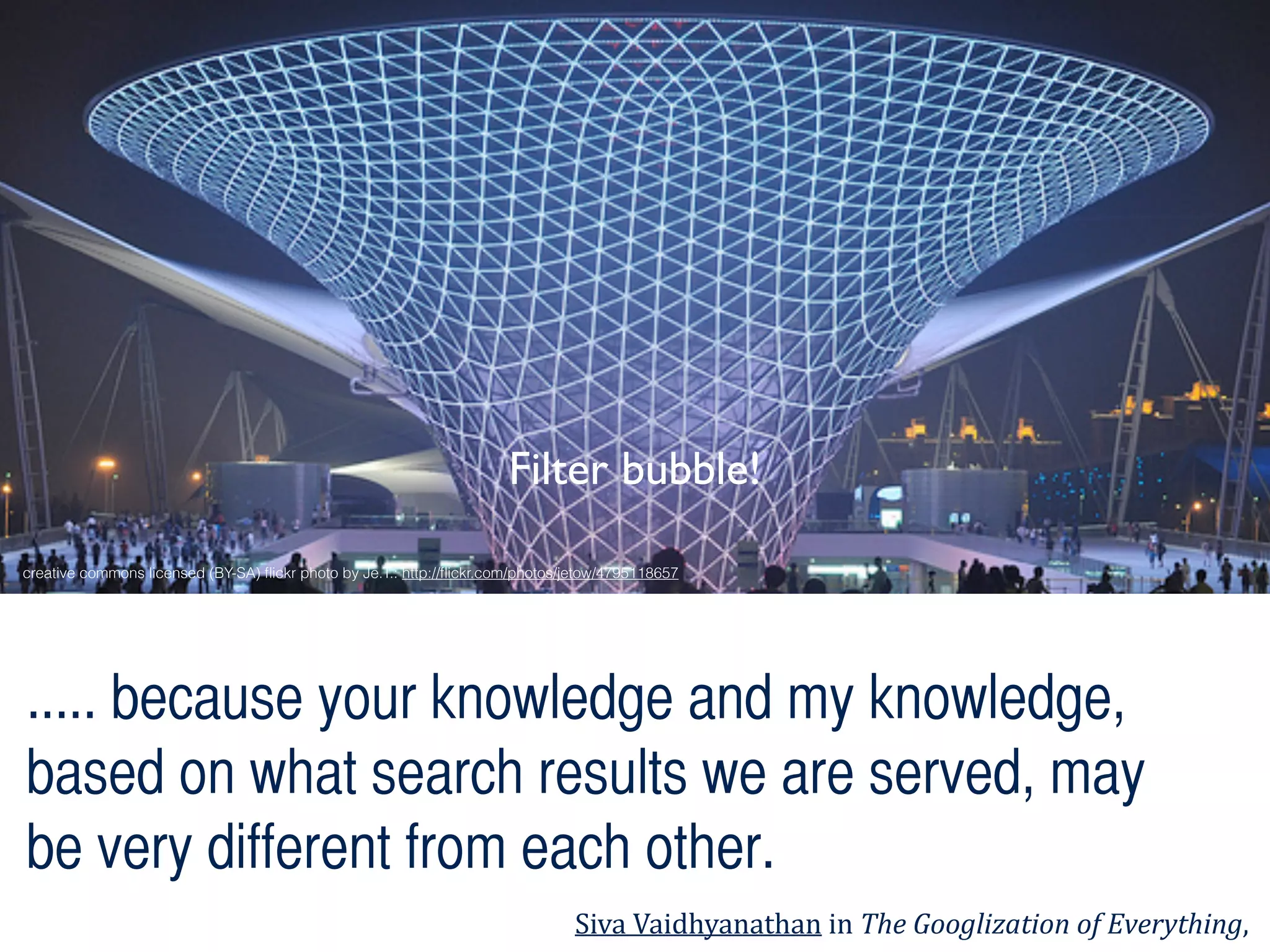
..... because your knowledge and my knowledge,
based on what search results we are served, may
be very different from each other.
Siva	
  Vaidhyanathan	
  in	
  The	
  Googlization	
  of	
  Everything,
Filter bubble!
creative commons licensed (BY-SA) flickr photo by Je.T.: http://flickr.com/photos/jetow/4795118657
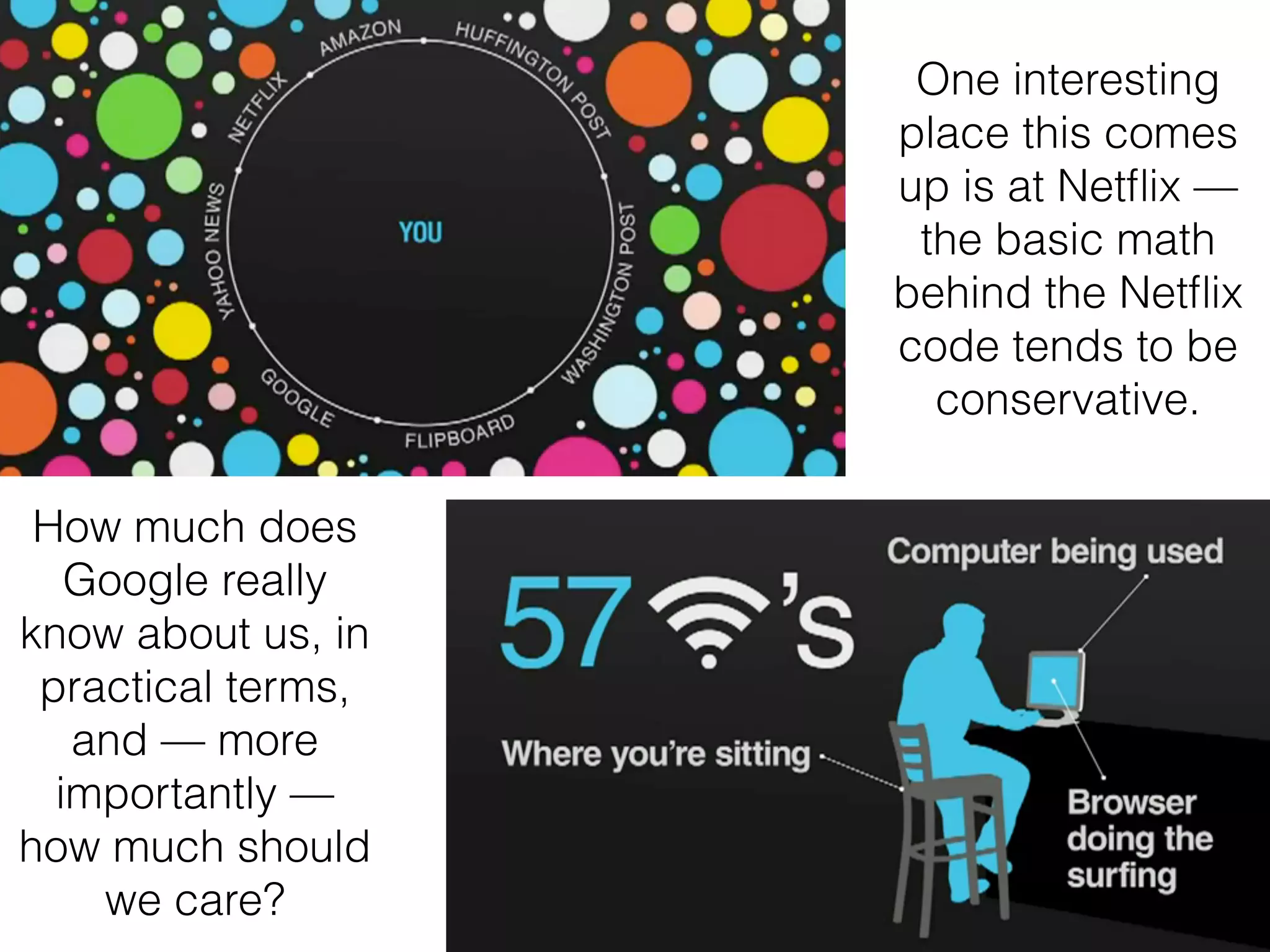
How much does
Google really
know about us, in
practical terms,
and — more
importantly —
how much should
we care?
One interesting
place this comes
up is at Netflix —
the basic math
behind the Netflix
code tends to be
conservative.
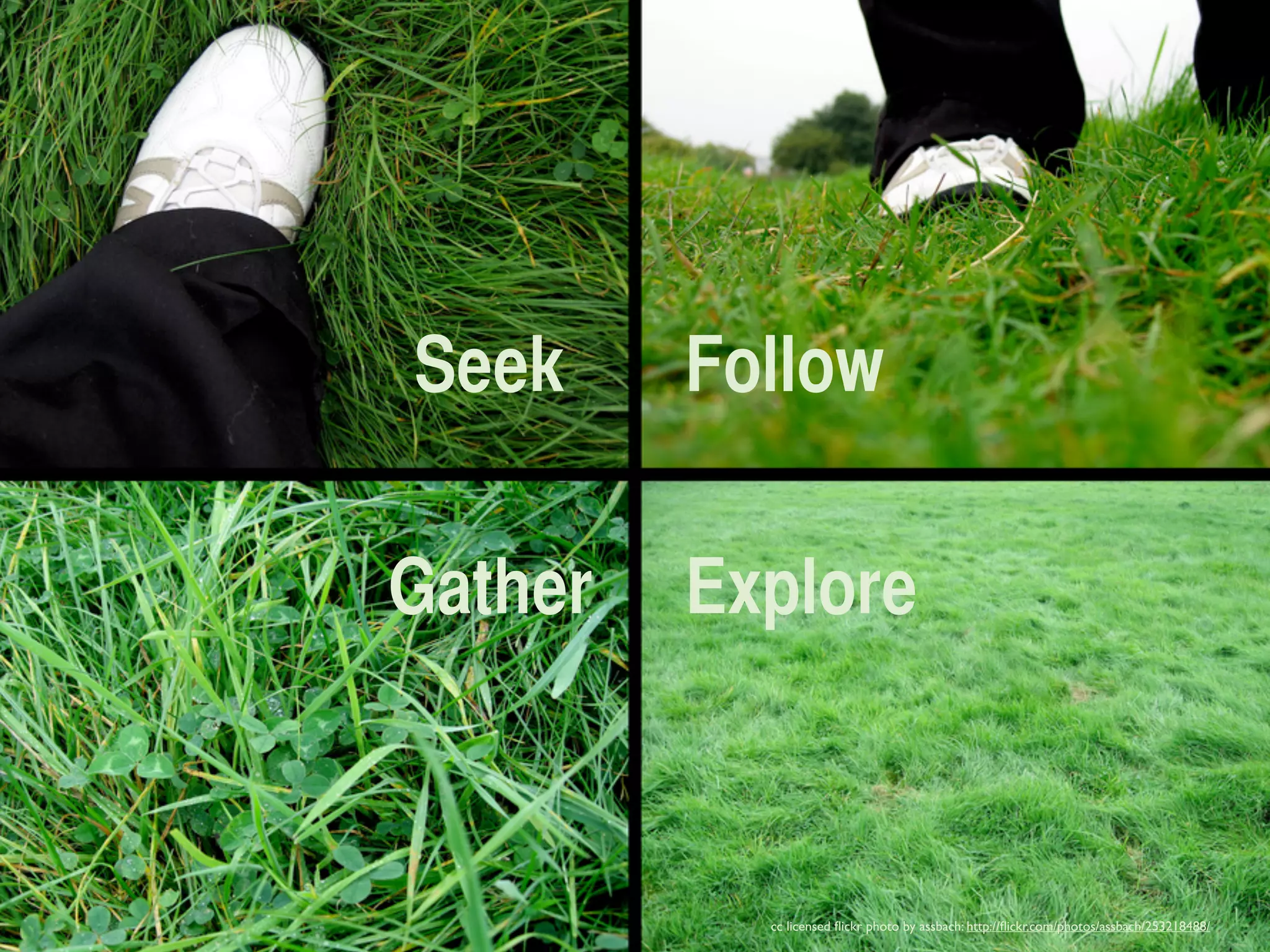
cc licensed flickr photo by assbach: http://flickr.com/photos/assbach/253218488/
Gather
Seek Follow
Explore
put video
http://youtu.be/b8CZmB4qLvY!
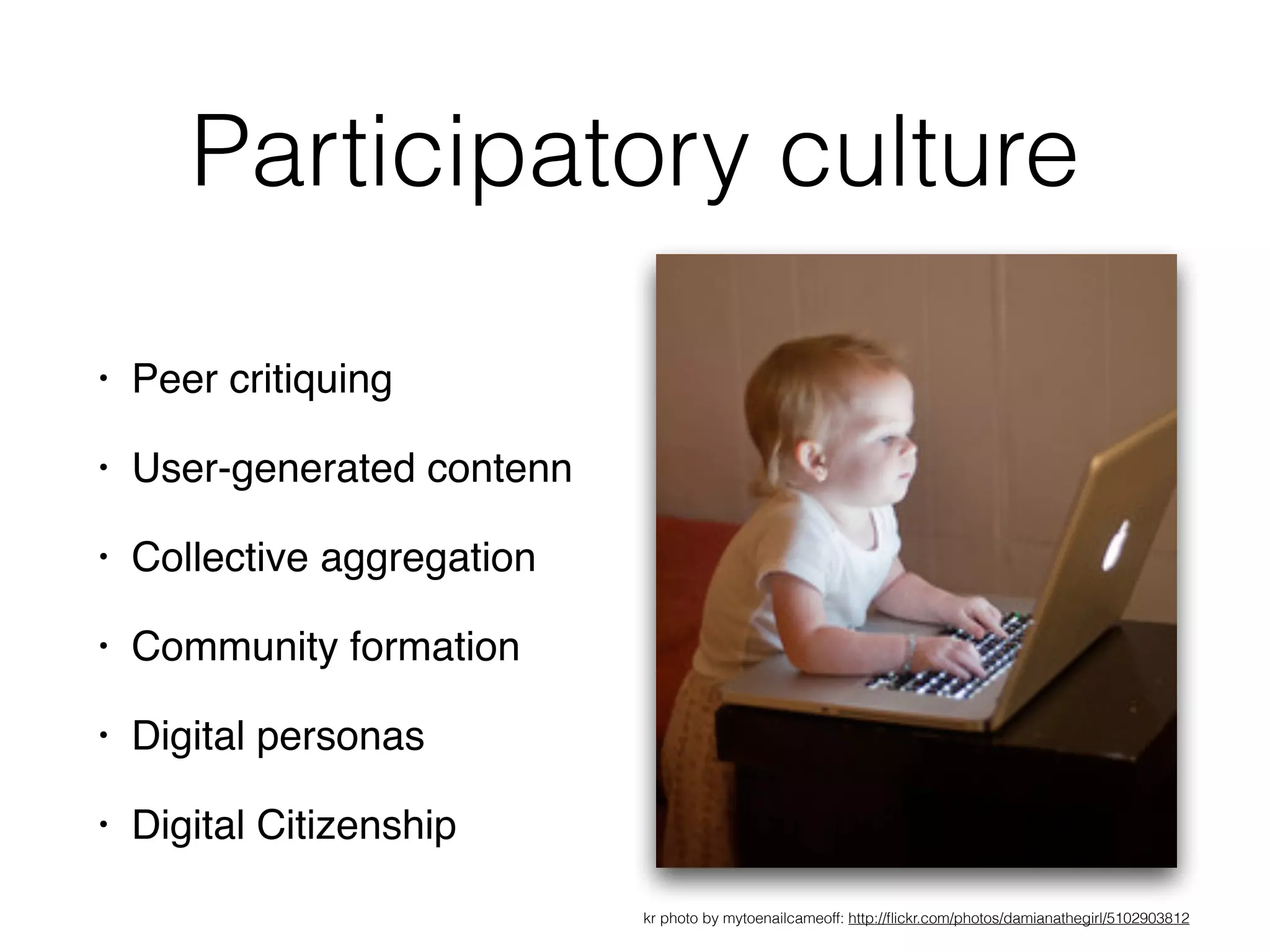
Participatory culture
• Peer critiquing
• User-generated content
• Collective aggregation
• Community formation
• Digital personas
• Digital Citizenship
kr photo by mytoenailcameoff: http://flickr.com/photos/damianathegirl/5102903812
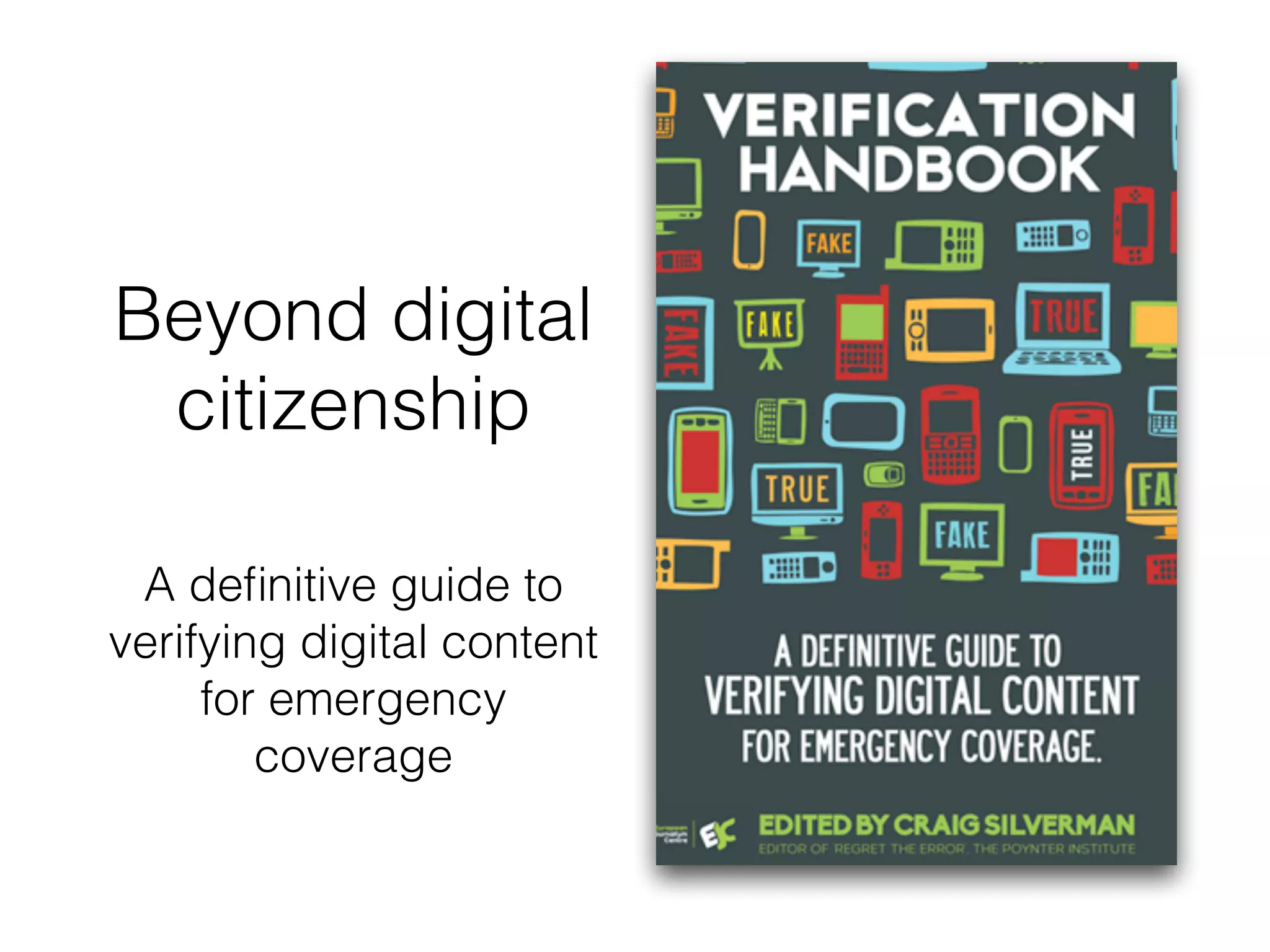
Beyond digital
citizenship
A definitive guide to
verifying digital content
for emergency
coverage
The [r]evolution
Digital not print is the future
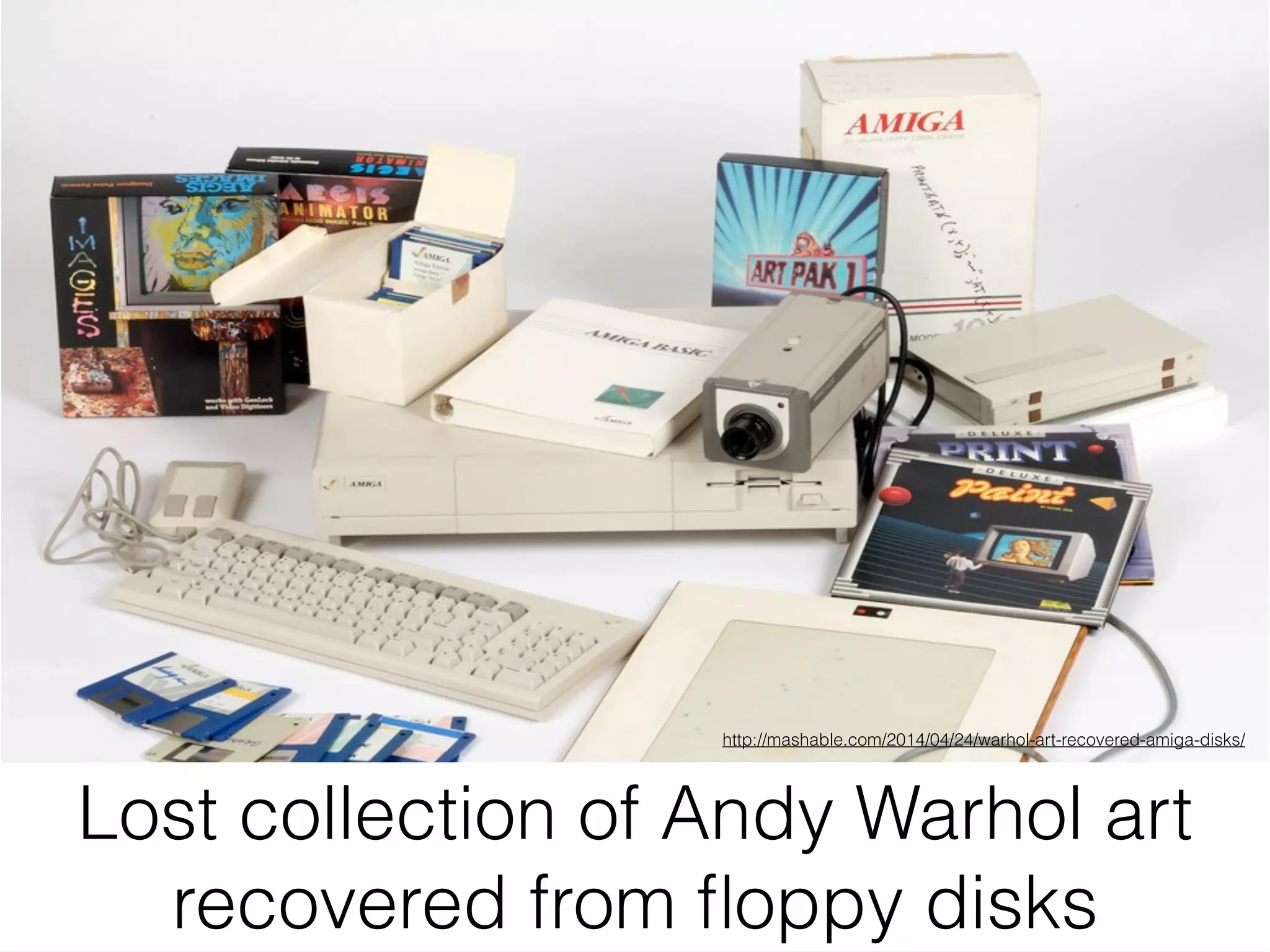
Lost collection of Andy Warhol art
recovered from floppy disks
http://mashable.com/2014/04/24/warhol-art-recovered-amiga-disks/
This is the ‘back-story’ of the digital revolution
– digitisation for information storage, retrieval,
accessibility, and usage that has changed the
face of the digital information ecology in the
current era.
creative commons licensed (BY-NC-SA) flickr photo by Tal Bright: http://flickr.com/photos/bright/17378095
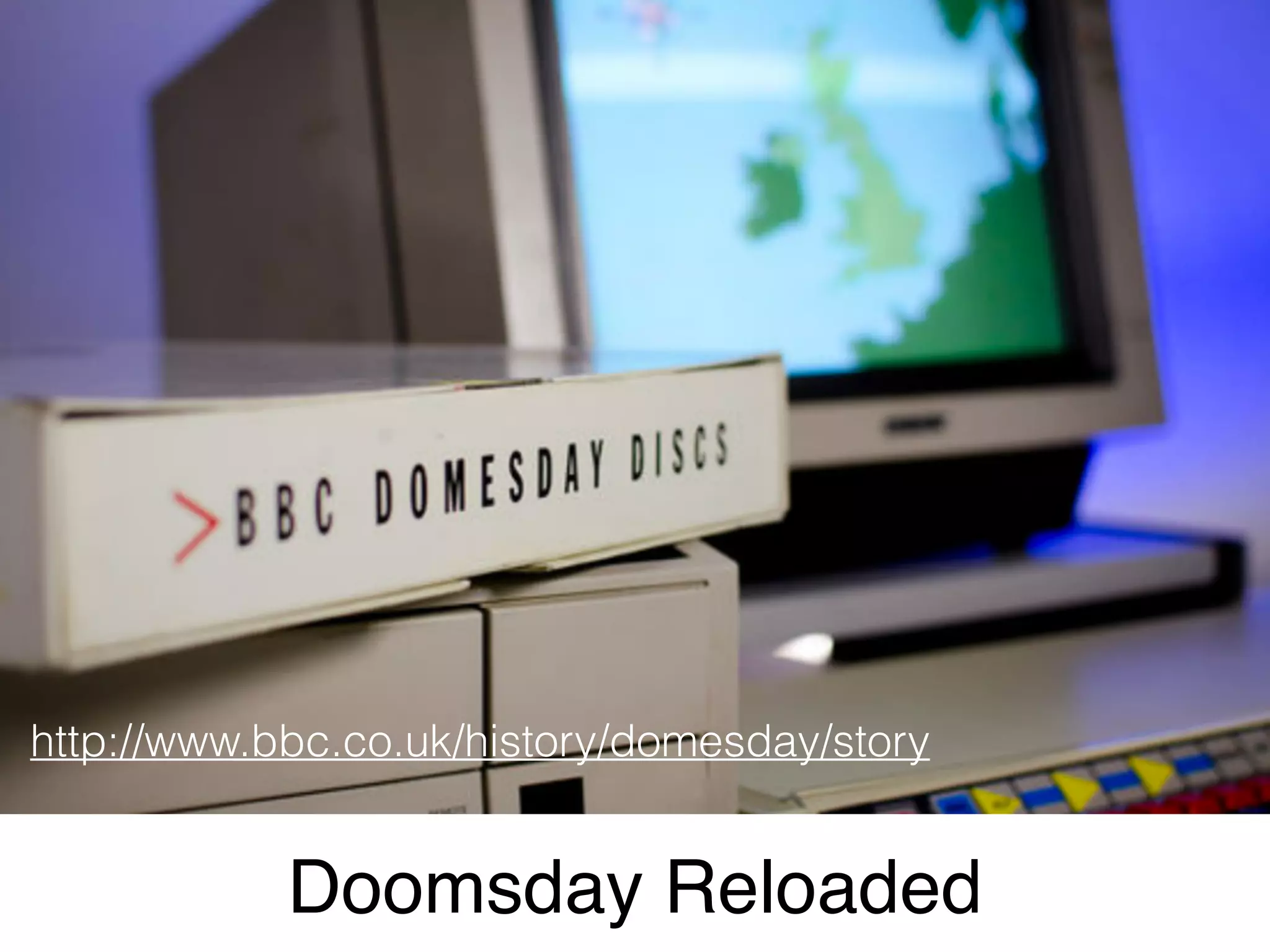
Doomsday Reloaded
http://www.bbc.co.uk/history/domesday/story
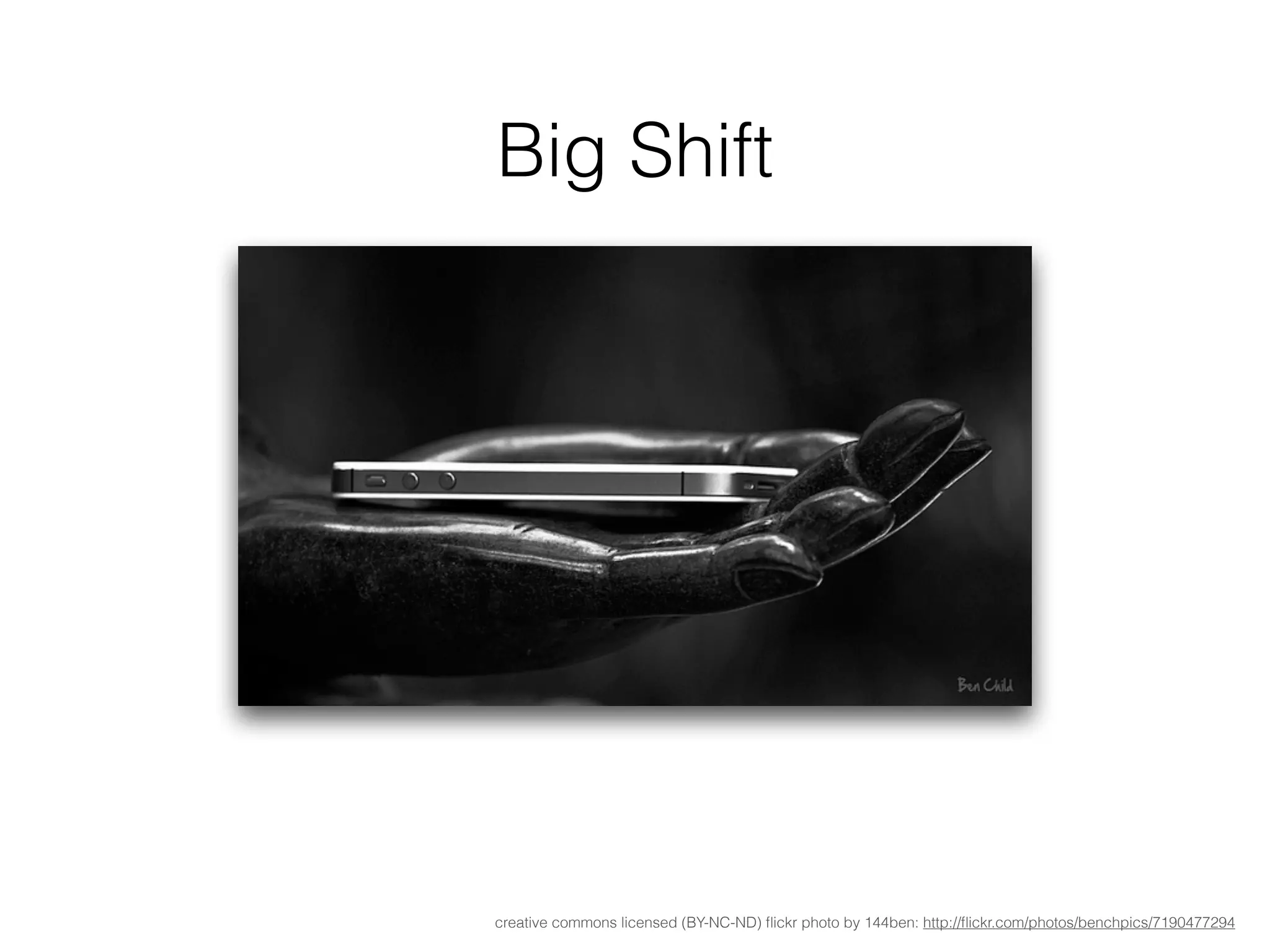
Big Shift
creative commons licensed (BY-NC-ND) flickr photo by 144ben: http://flickr.com/photos/benchpics/7190477294
Connectedness the new black!
creative commons licensed (BY-SA) flickr photo by Ian Muttoo: http://flickr.com/photos/imuttoo/2631466945!
The Web is not the Internet
számítógép
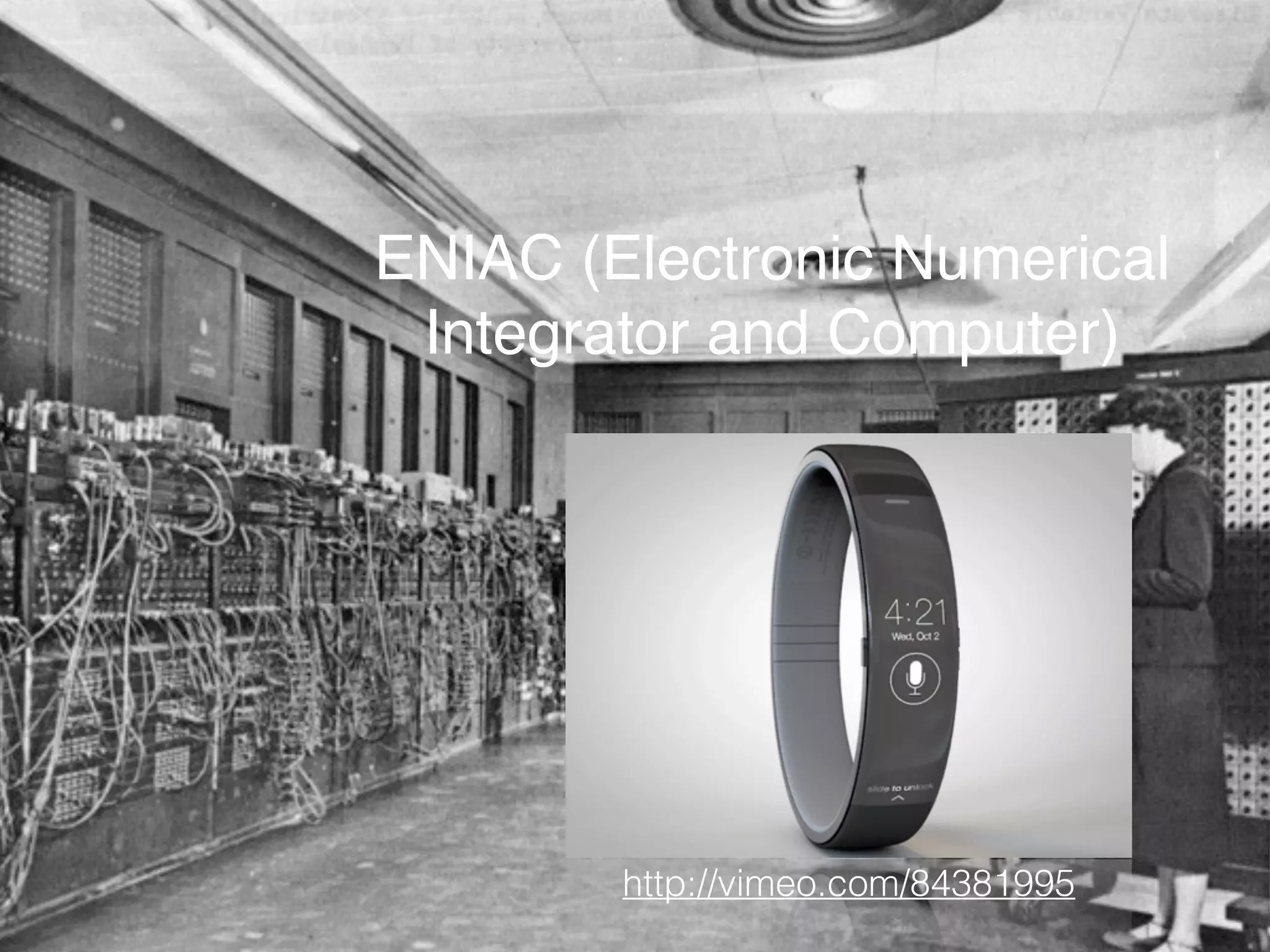
ENIAC (Electronic Numerical
Integrator and Computer)
http://vimeo.com/84381995!
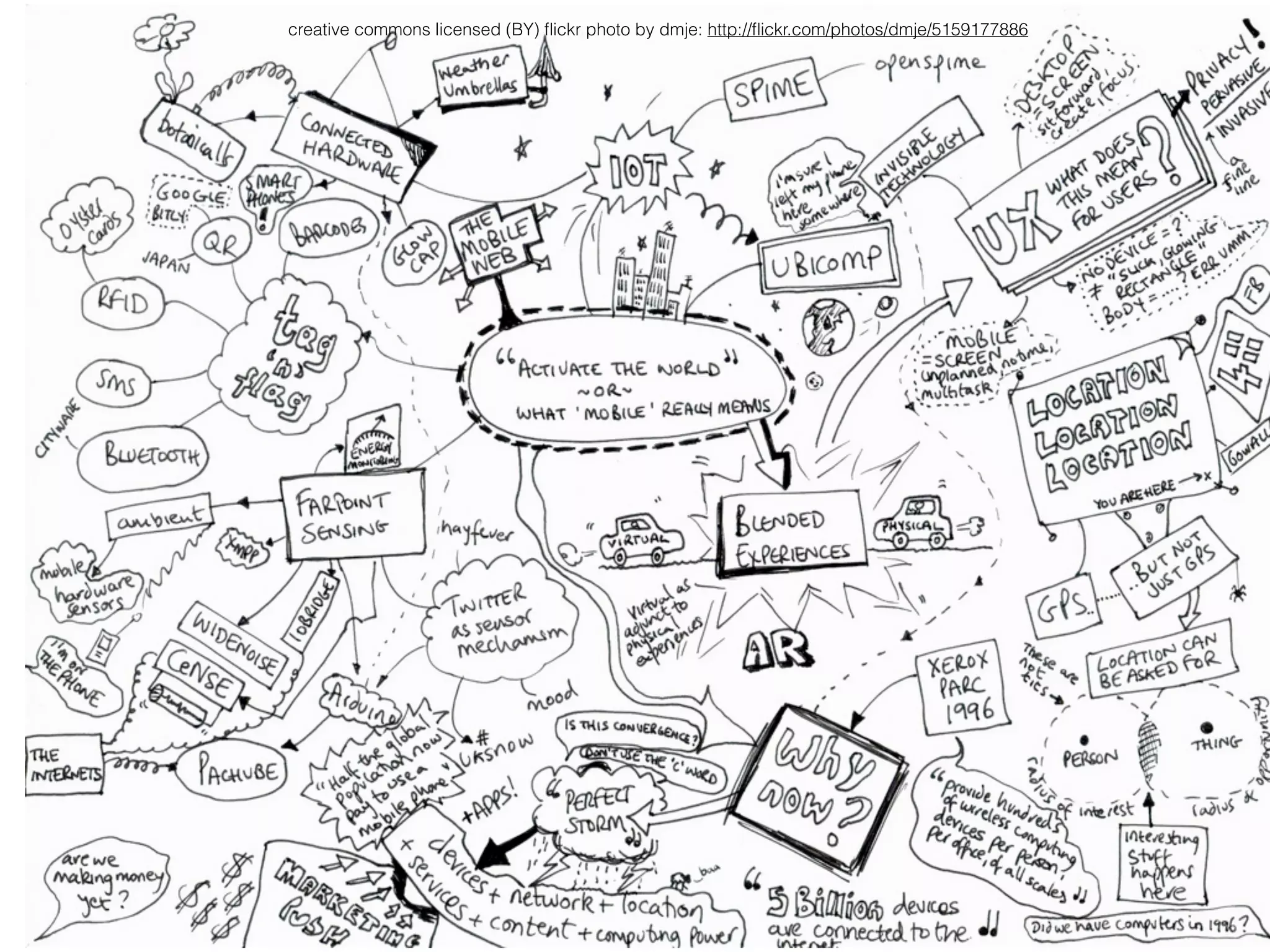
Internet of Things (IoT)
(sometimes call Web 3.)
is an integrated part of
“Future Internet”
https://flic.kr/p/iswbBn
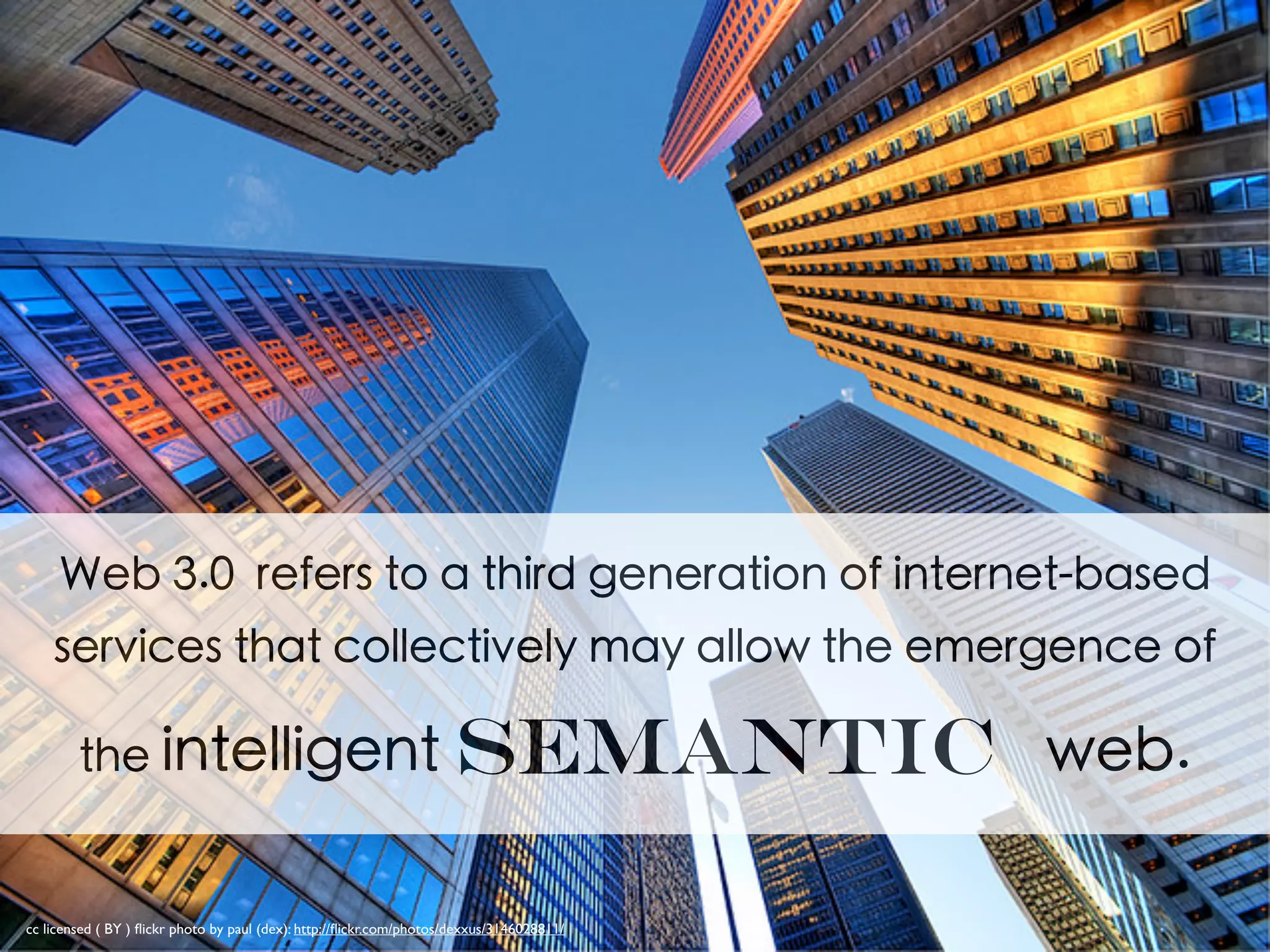
Web 3.0 refers to a third generation of internet-based
services that collectively may allow the emergence of the
intelligent semantic web.
cc licensed ( BY ) flickr photo by paul (dex): http://flickr.com/photos/dexxus/3146028811/
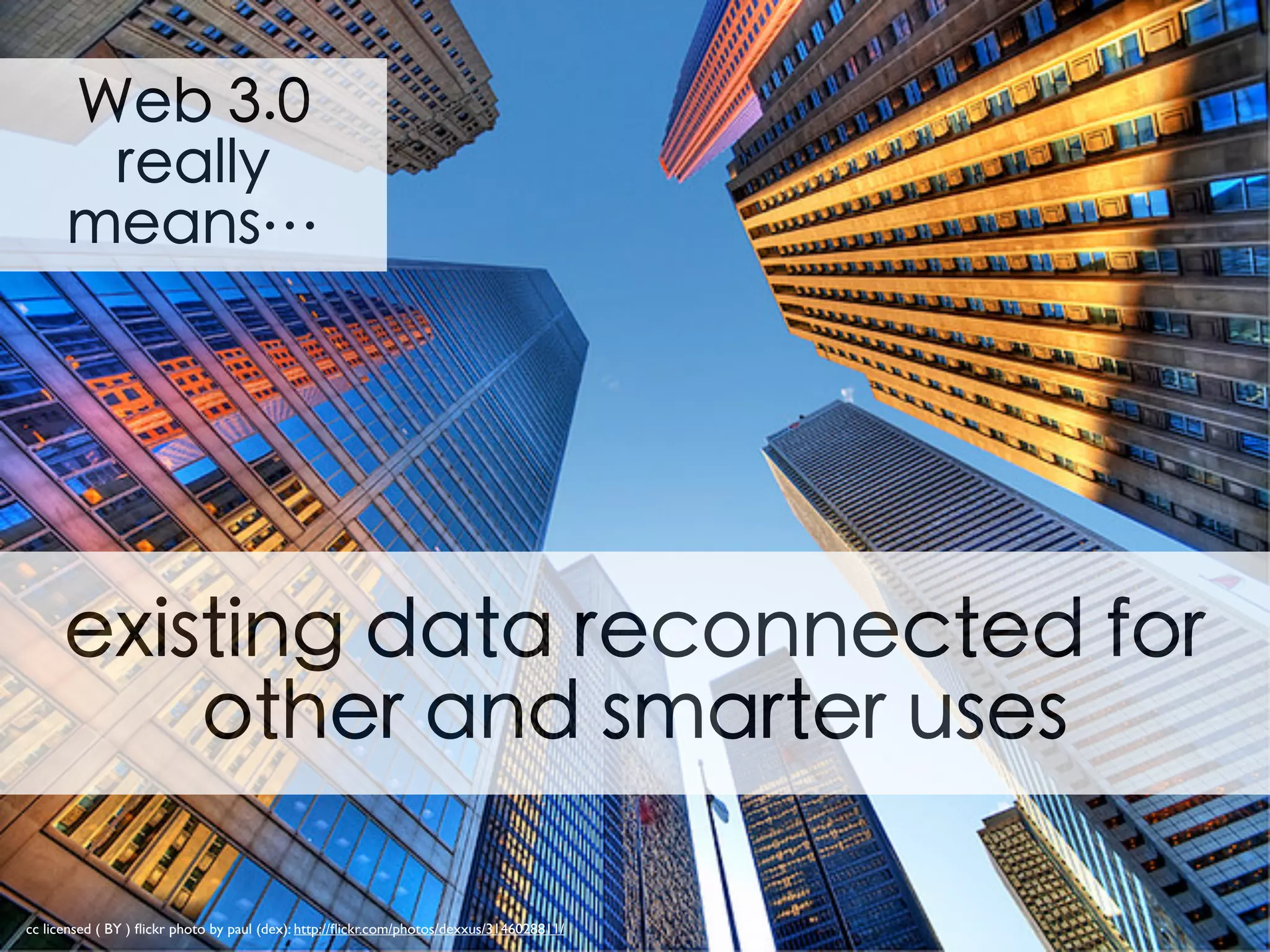
existing data reconnected for other and
smarter uses
Web 3.0
really
means…
cc licensed ( BY ) flickr photo by paul (dex): http://flickr.com/photos/dexxus/3146028811/
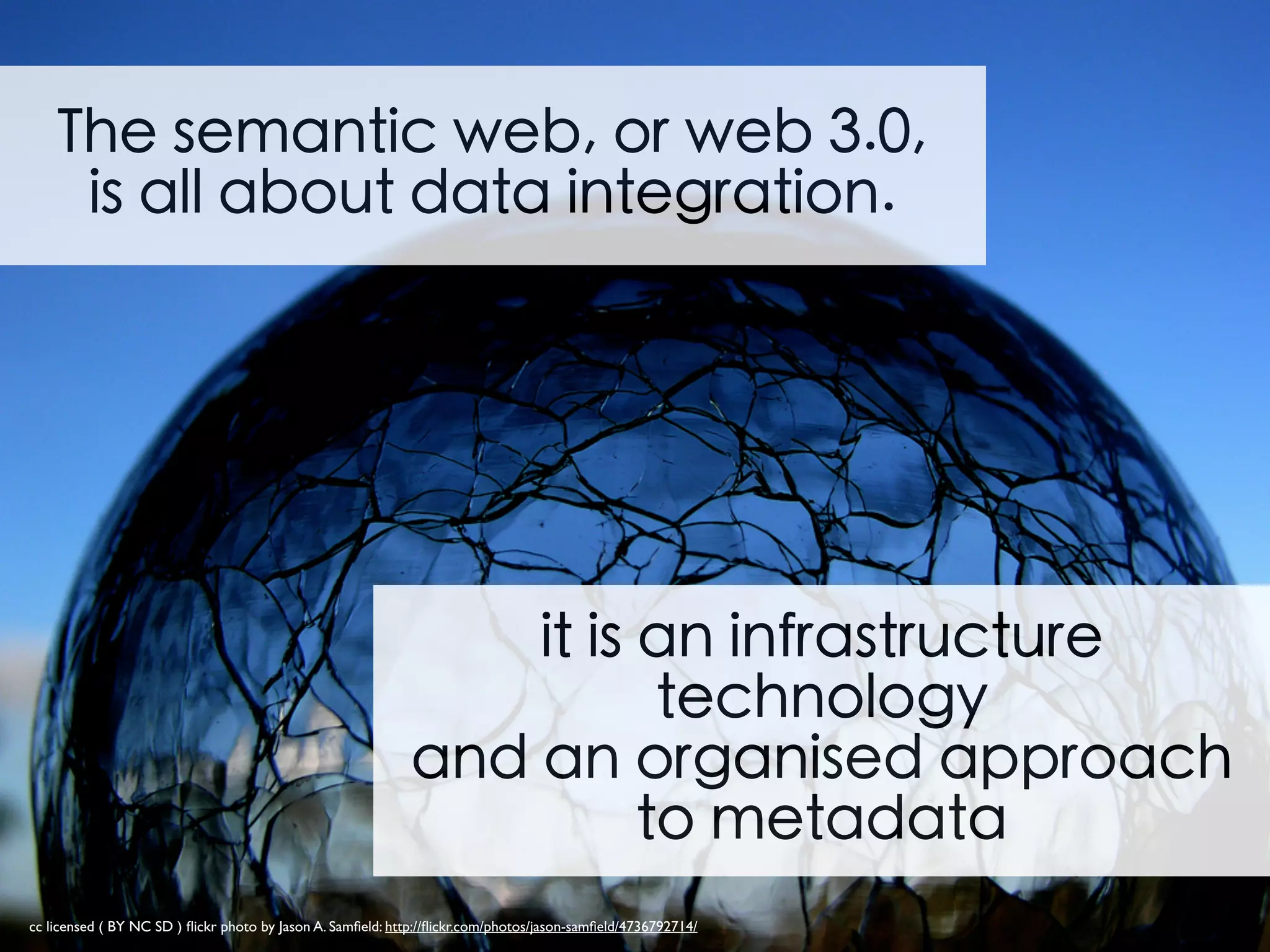
The semantic web, or web 3.0,
is all about data integration.
it is an infrastructure
technology
and an organised approach
to metadata
cc licensed ( BY NC SD ) flickr photo by Jason A. Samfield: http://flickr.com/photos/jason-samfield/4736792714/
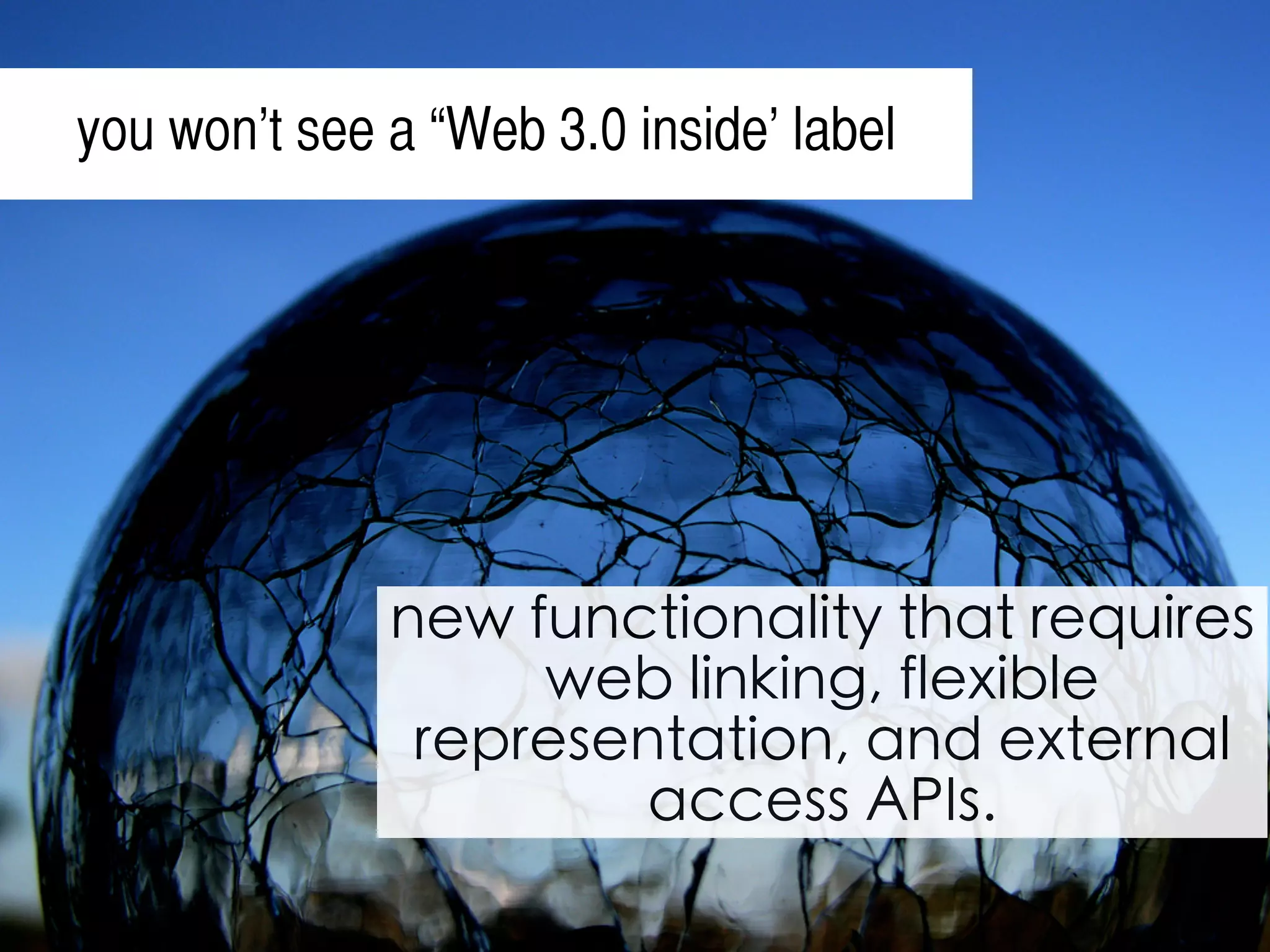
new functionality that requires
web linking, flexible
representation, and external
access APIs.
you won’t see a “Web 3.0 inside’
label
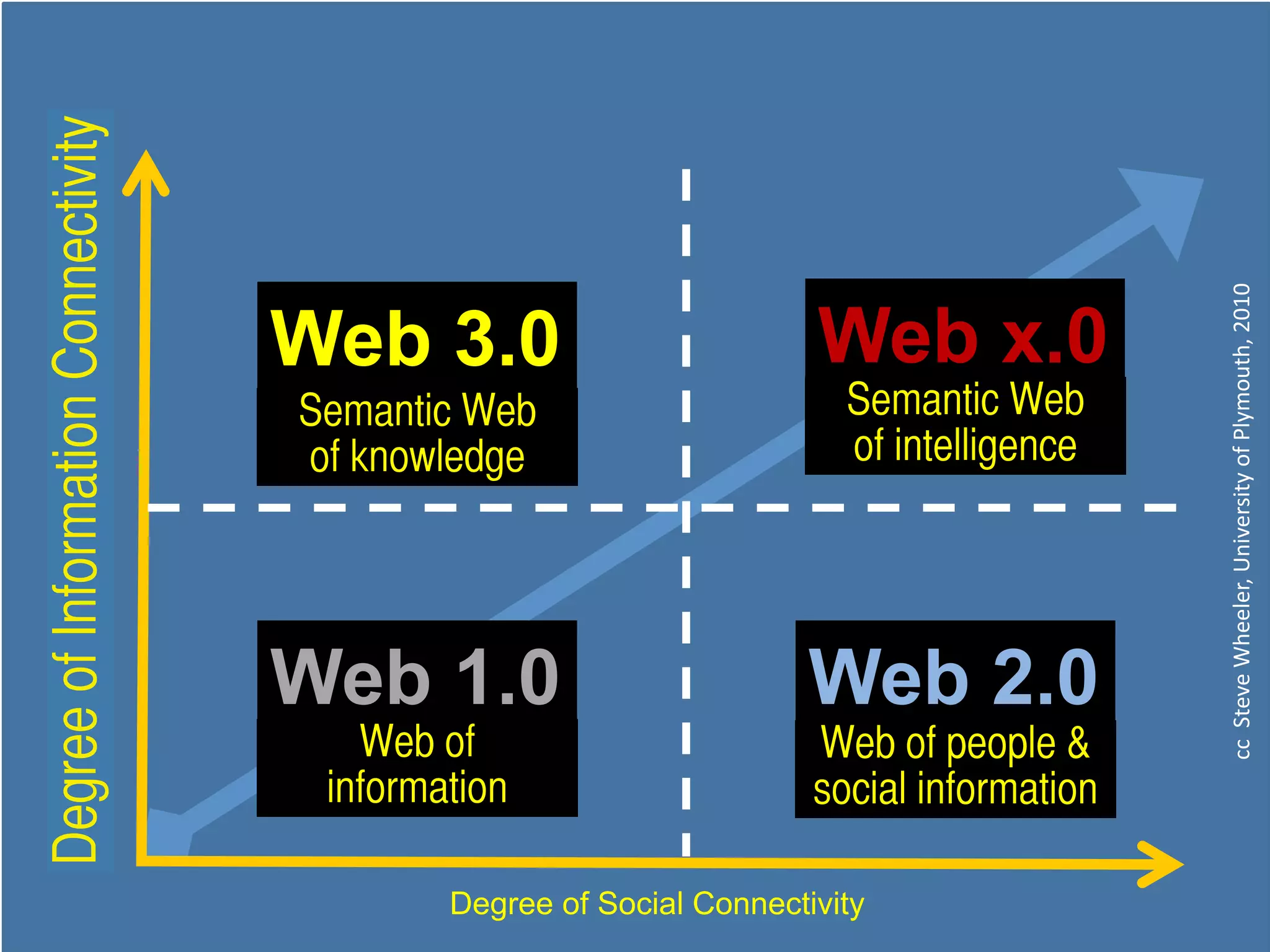
Web 3.0
Web 1.0
Web x.0
Web 2.0
Semantic Web
The Web
Meta Web
Social Web
Degree of Social Connectivity
DegreeofInformationConnectivity
cc""Steve"Wheeler,"University"of"Plymouth,"2010"
Semantic Web
of knowledge
Semantic Web
of intelligence
Web of
information
Web of people &
social information
DegreeofInformationConnectivity
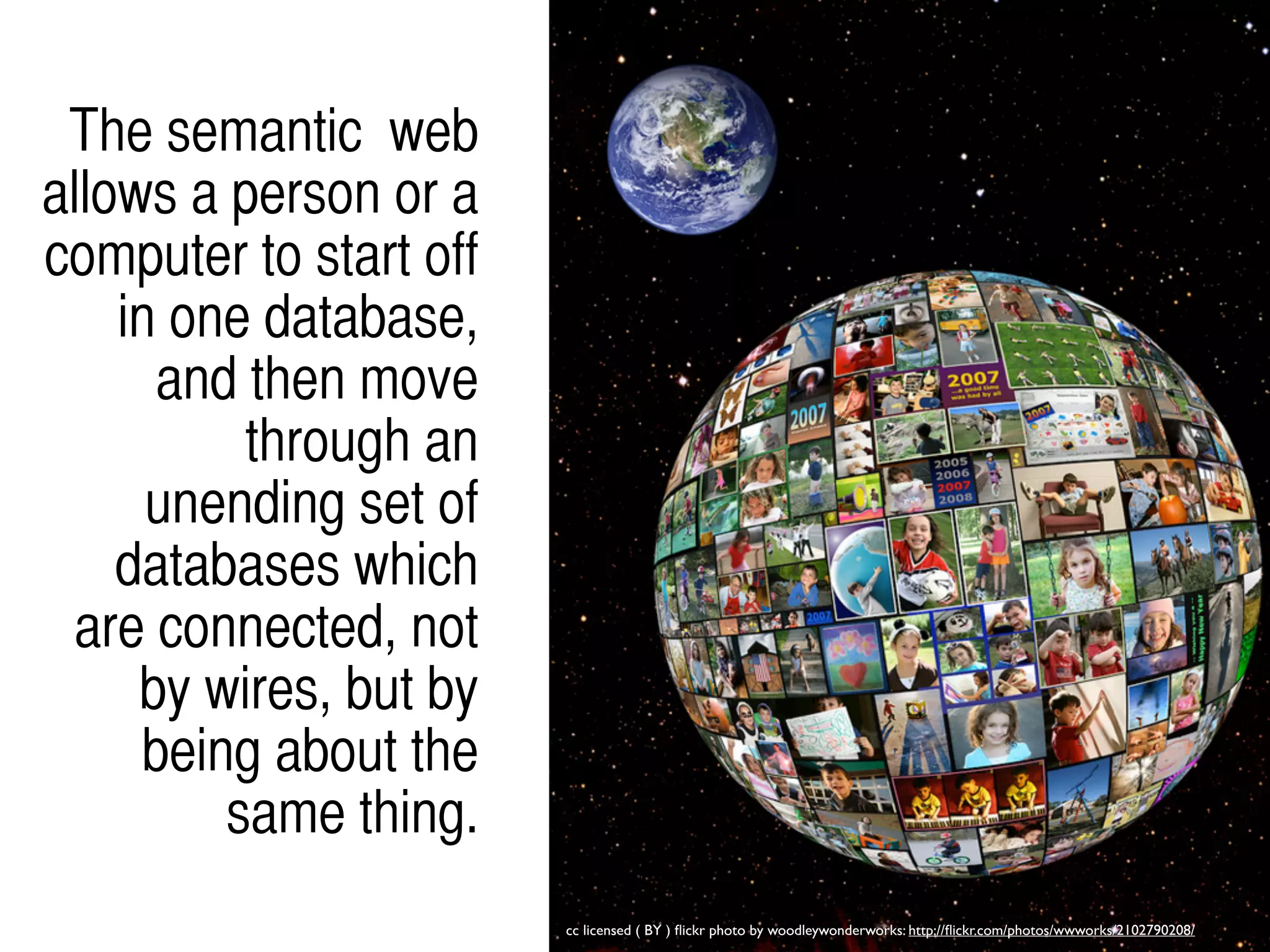
The semantic web allows a
person or a computer to start
off in one database, and then
move through an unending set
of databases which are
connected, not by wires, but by
being about the same thing.
This is where complexity theory doesn’t quite cut it!
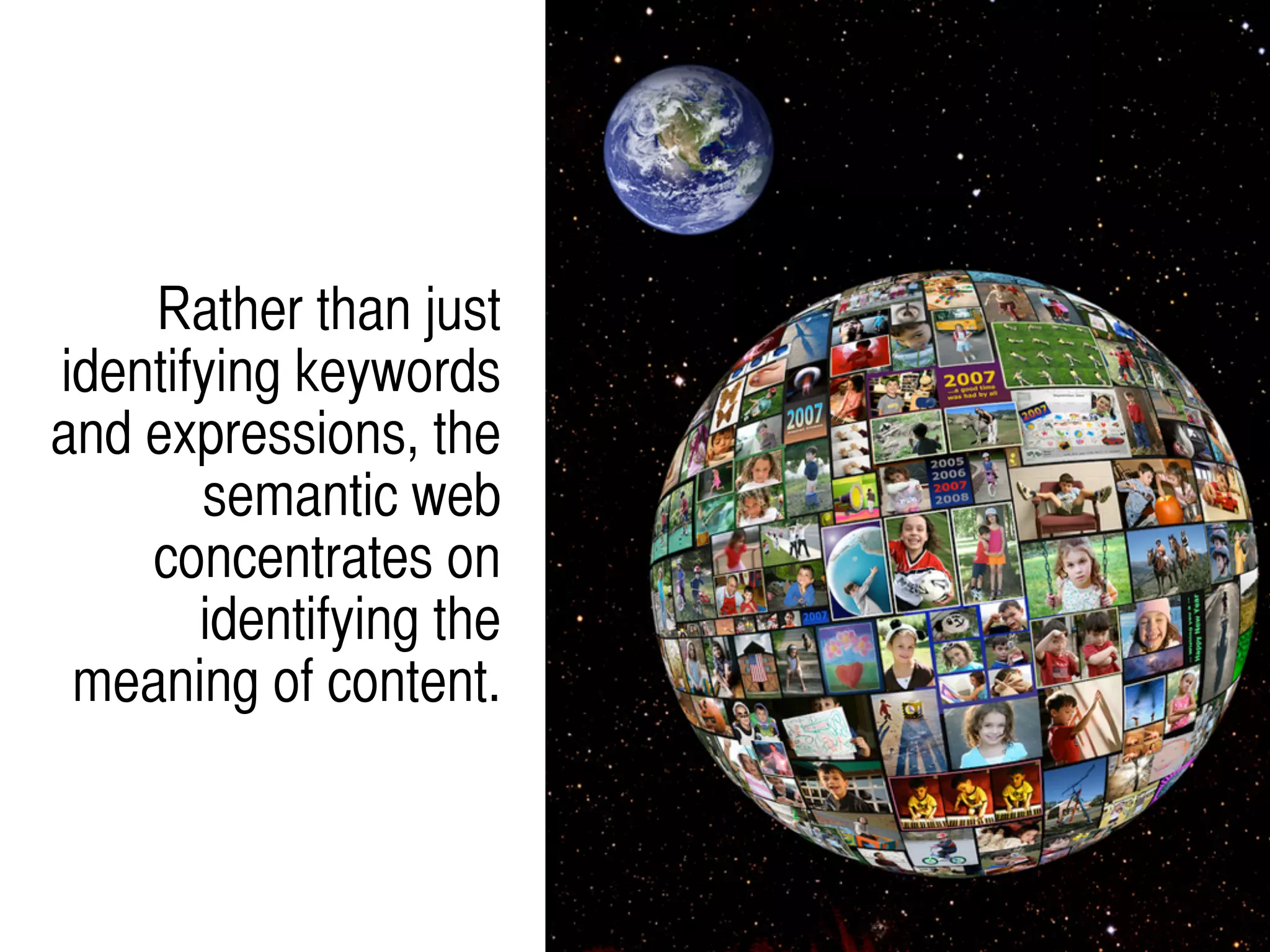
Rather than just identifying
keywords and expressions,
the semantic web
concentrates on identifying
the meaning of content.
It is about common formats and
metadata which allow for
integration and combination of
linked data drawn from
diverse sources.
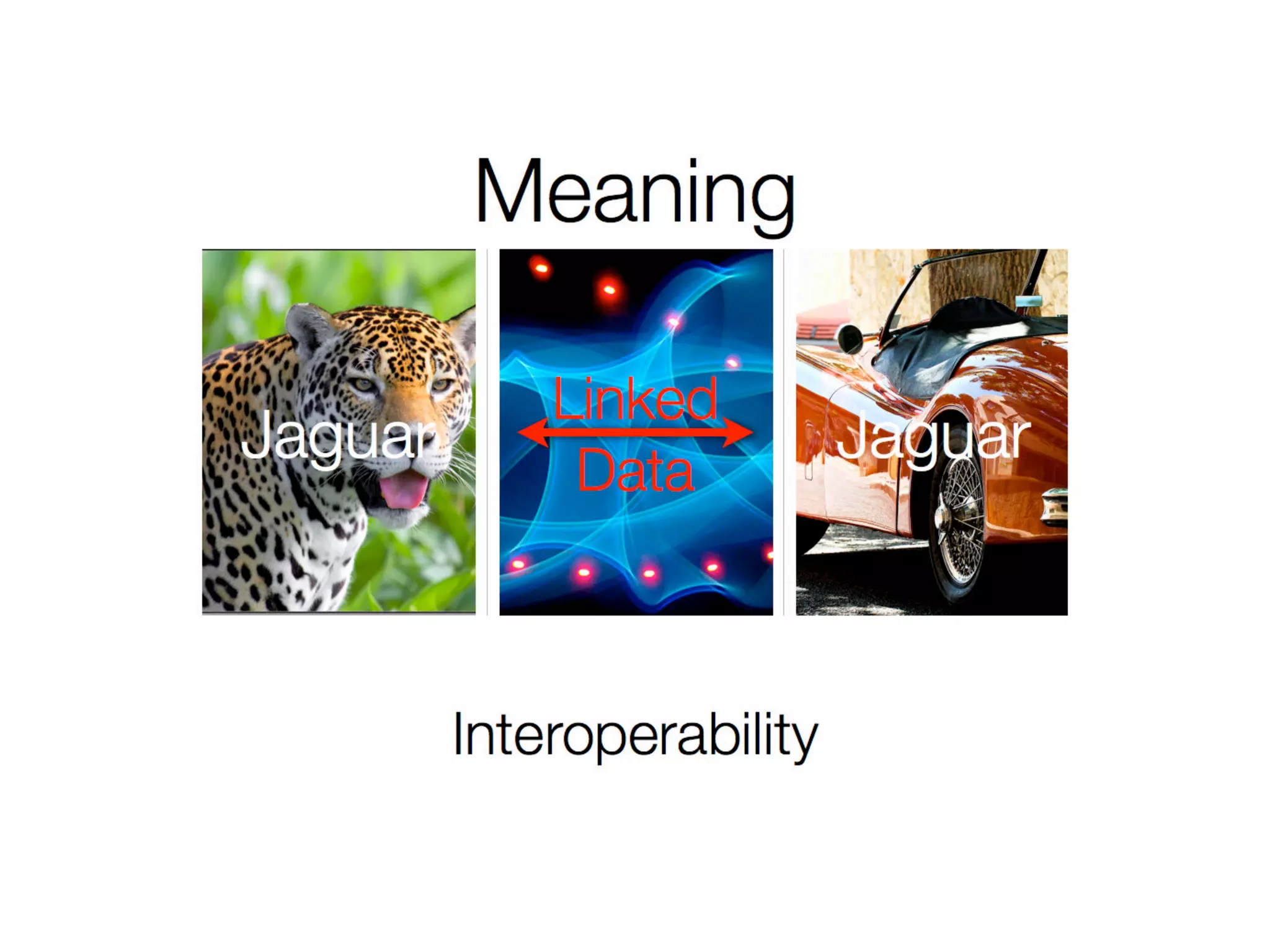
It is also about language, or
ontology, for recording how the
linked data relates to real world
objects, allowing a ‘machine’ to
‘understand’ the semantic
meaning of words.
!
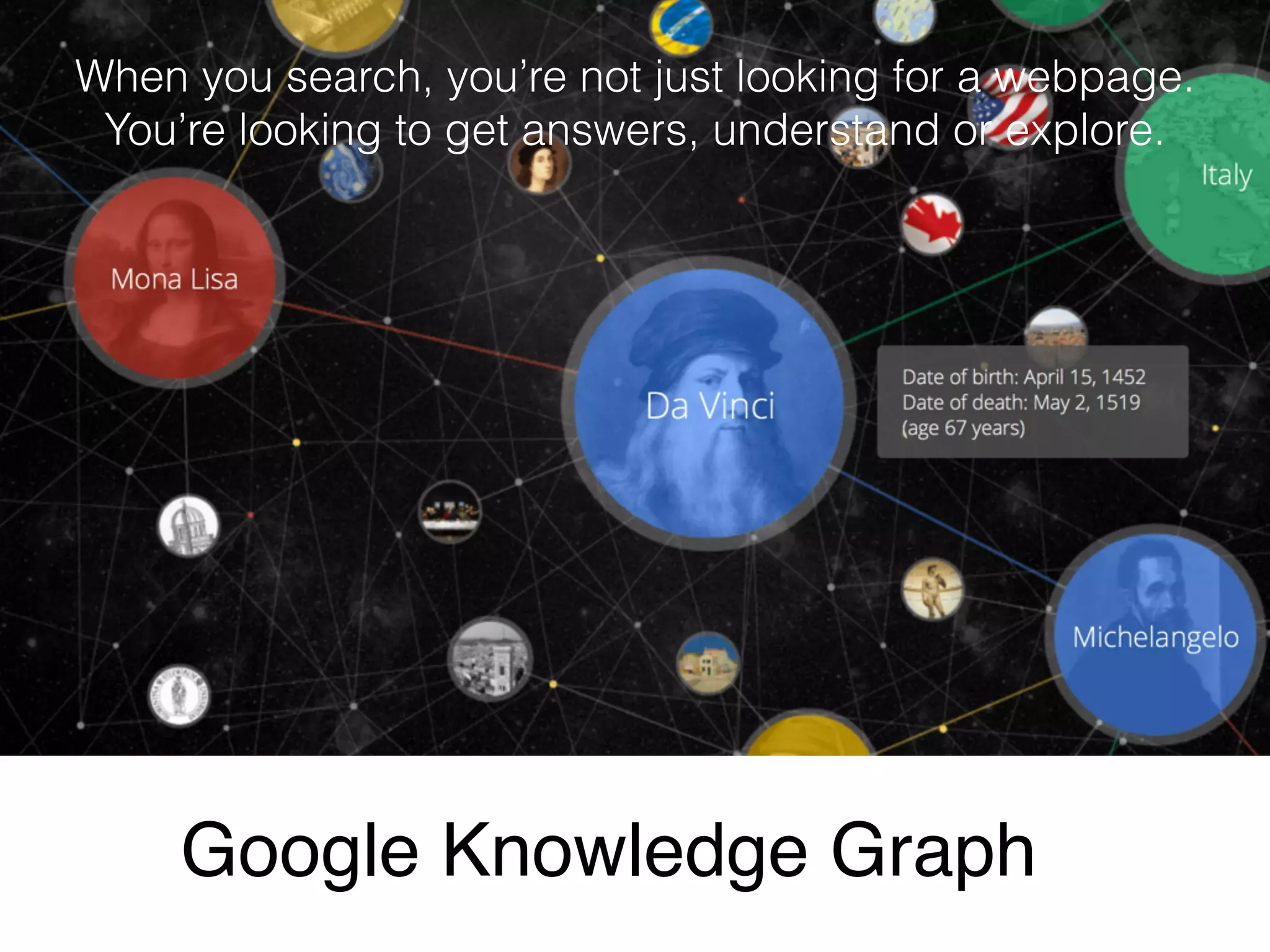
Google Knowledge Graph
When you search, you’re not just looking for a webpage.
You’re looking to get answers, understand or explore.
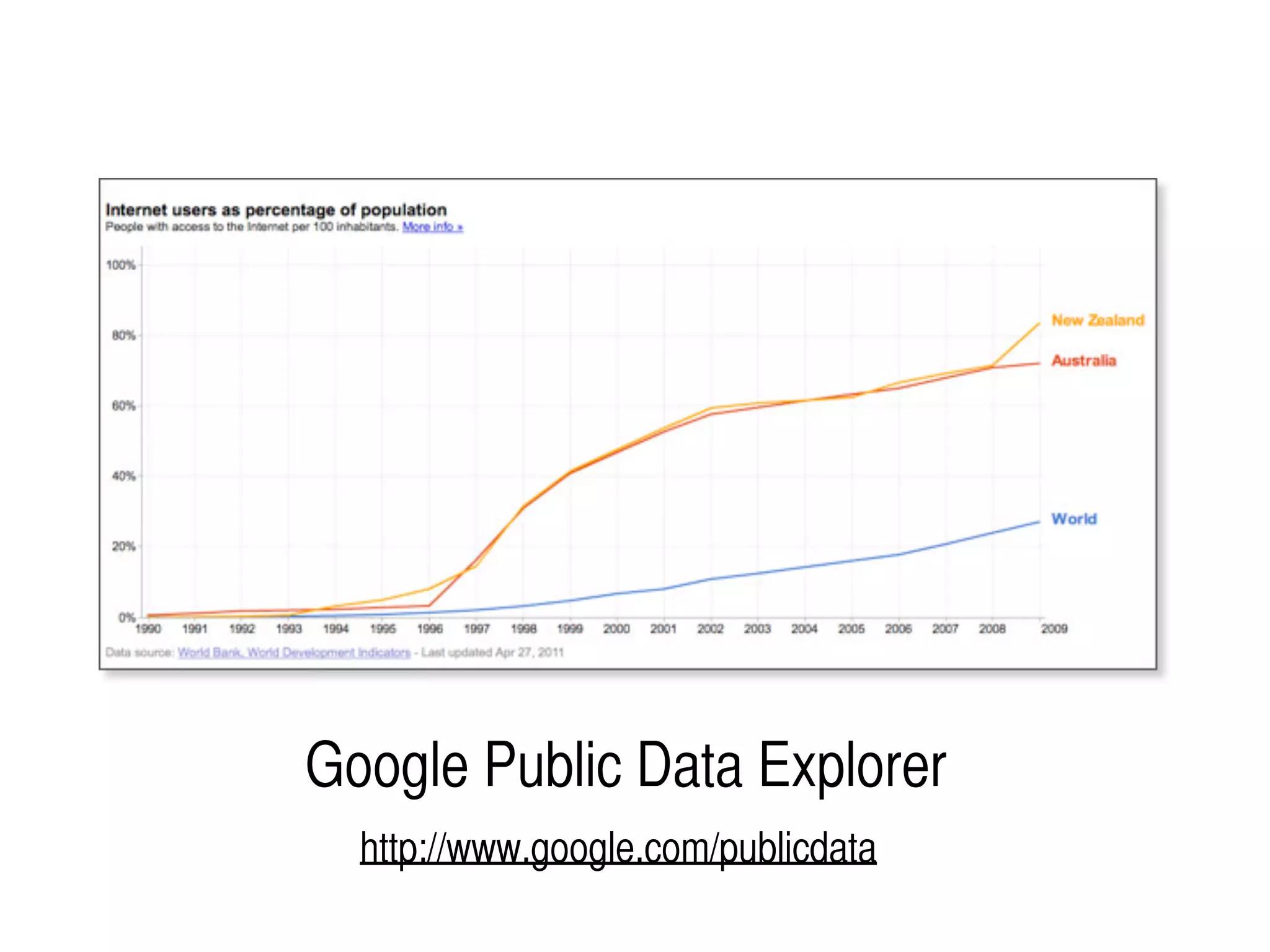
http://www.google.com/publicdata
Google Public Data Explorer
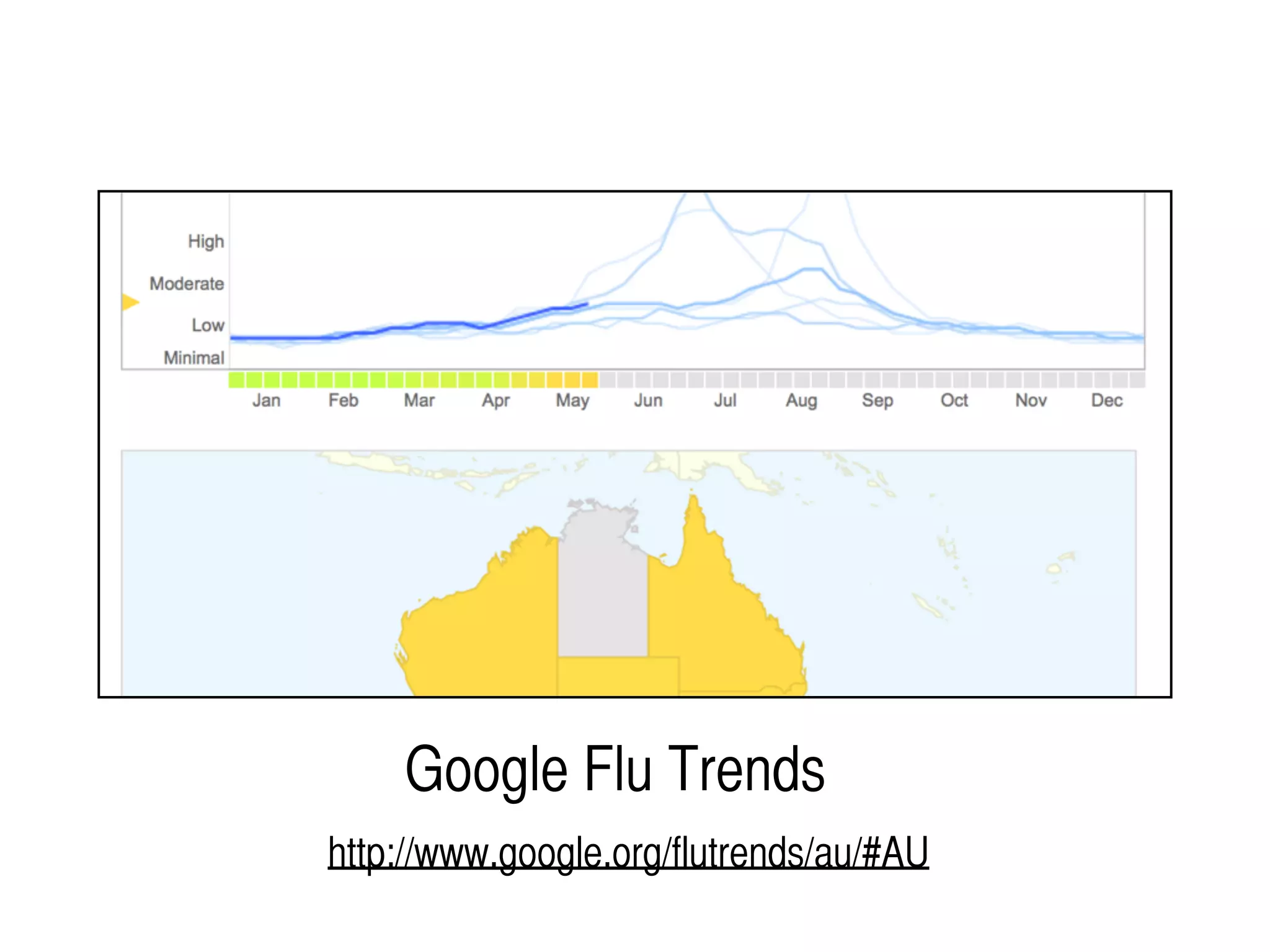
http://www.google.org/flutrends/au/#AU
Google Flu Trends
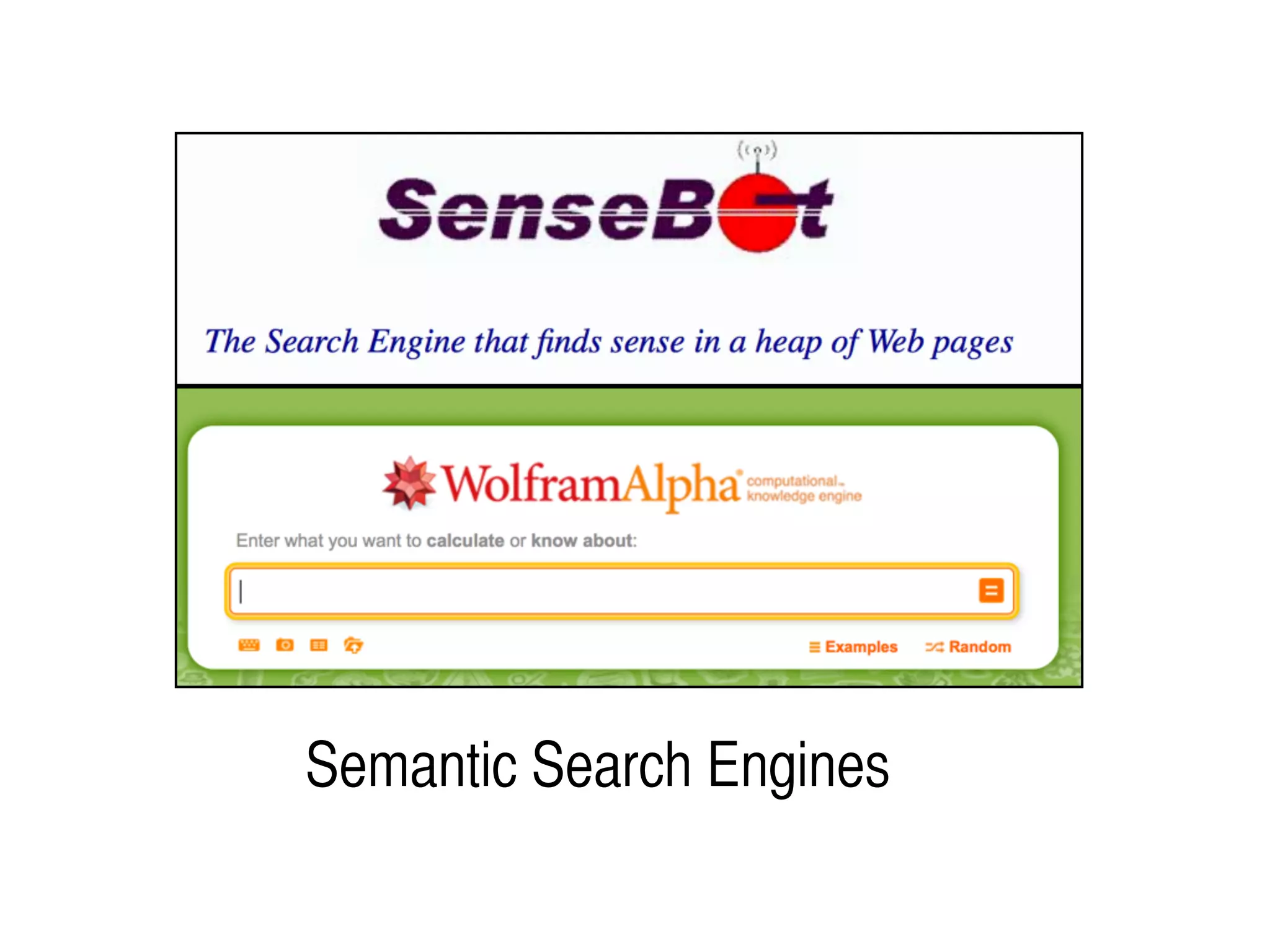
Semantic Search Engines
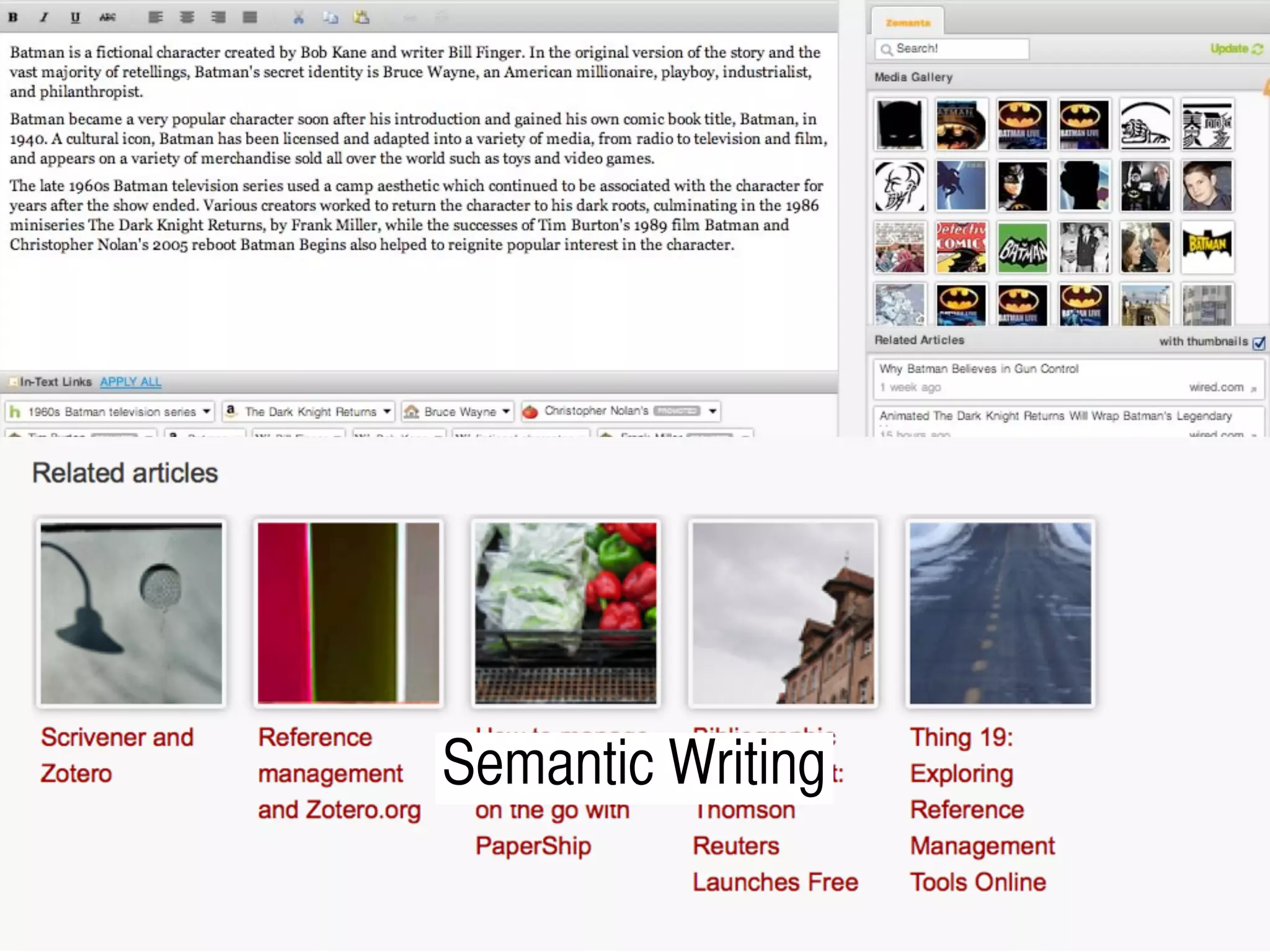
Semantic Writing
Gapminder fact-based world view
http://www.gapminder.org/for-teachers/
~ use the teacher tools in your classroom
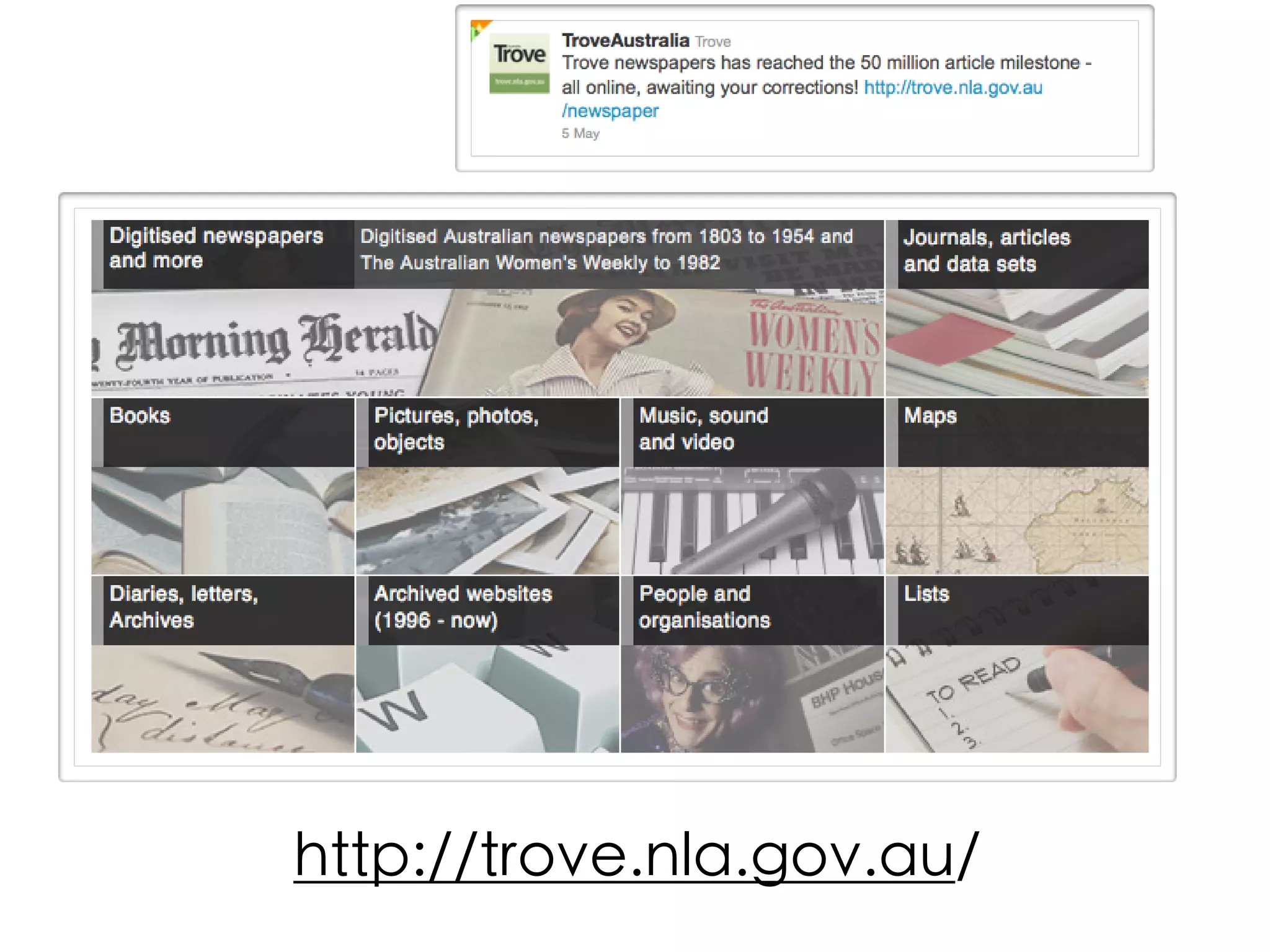
http://trove.nla.gov.au/
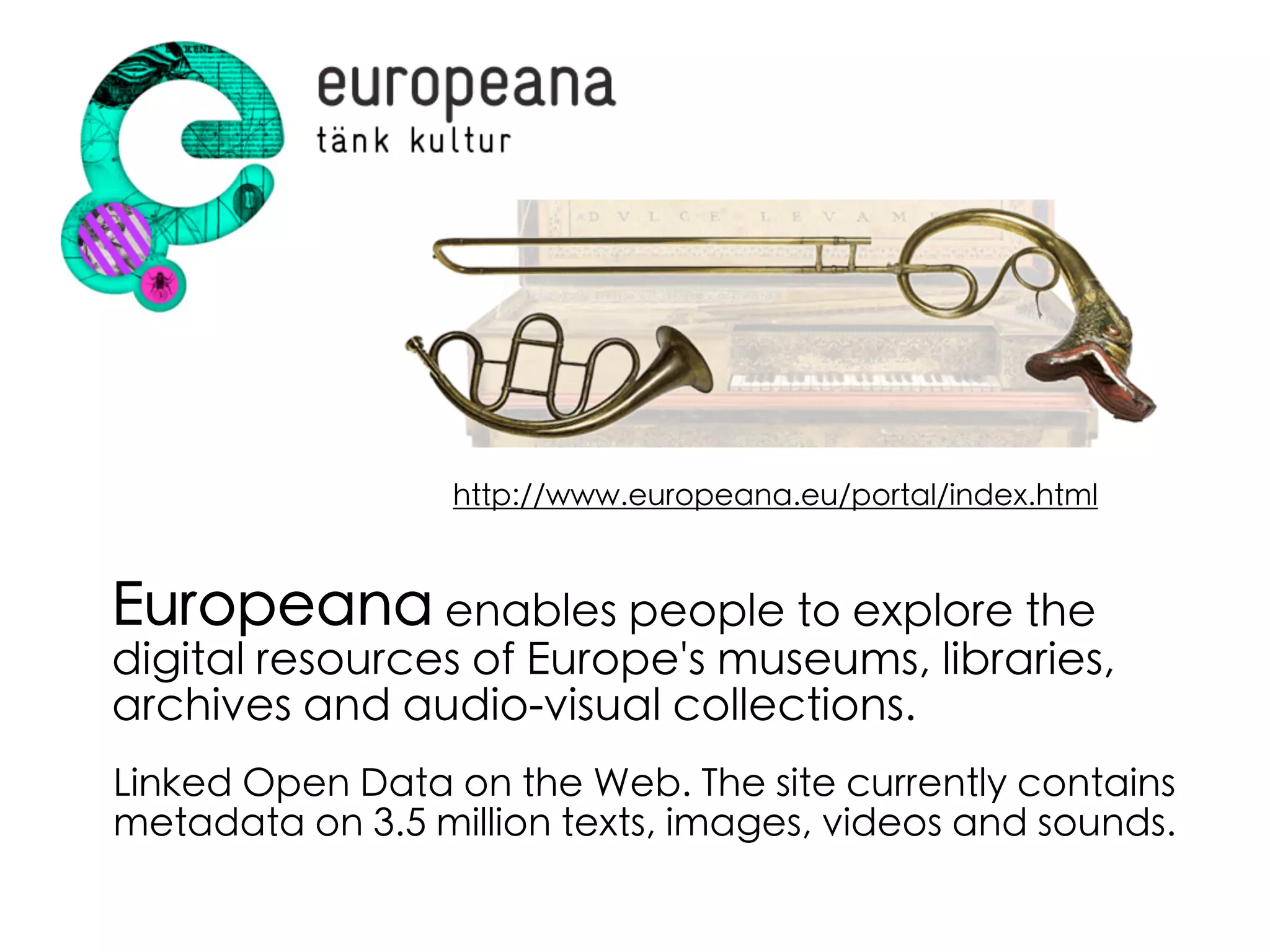
Europeana enables people to explore the
digital resources of Europe's museums, libraries,
archives and audio-visual collections.
http://www.europeana.eu/portal/index.html
Linked Open Data on the Web. The site currently contains
metadata on 3.5 million texts, images, videos and sounds.
HOW does this work?
CHARLES STURT UNIVERSITY
Whereas traditional library
metadata has always been focused
on helping humans find and make use of
information, linked data ontologies
are focused on helping machines find and
make use of information.
linkeddata.org schema.org/
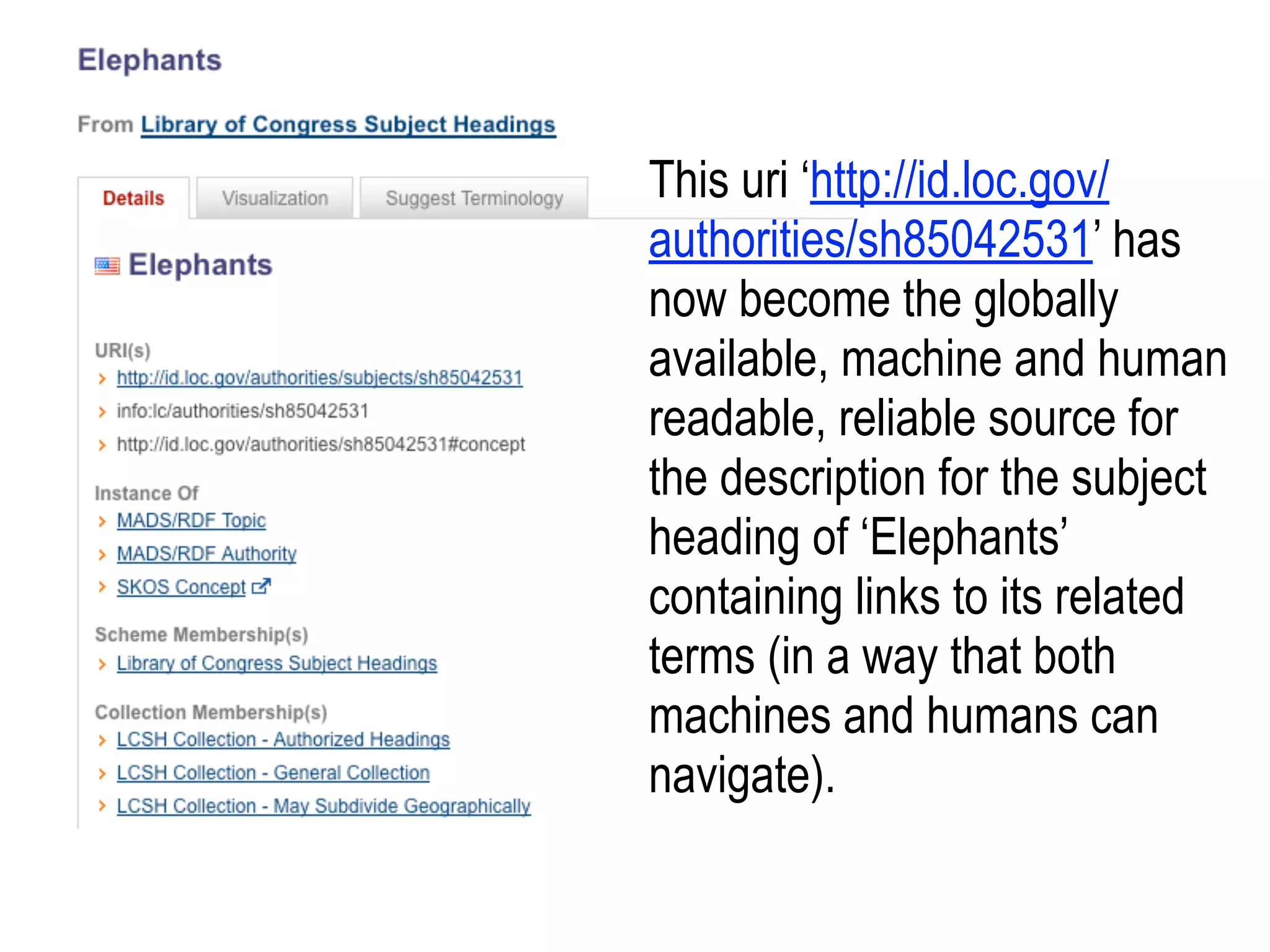
This uri ‘http://id.loc.gov/
authorities/sh85042531’
has now become the
globally available,
machine and human
readable, reliable source
for the description for the
subject heading of
‘Elephants’ containing
links to its related terms
(in a way that both
machines and humans
can navigate).
Information
Architecture
!
Making it possible to federate,

query, browse, gather and

recommend information from

disparate sources.
!
Think of the Web 3.0 environment as the portable, personal web,
focused on the individual, on a life-stream, on consolidating
content, and which is powered by widgets, drag & drop, and
mashups of user engagement.
!
This socially powered web is exploding, and is the new
baseline for all our internet and technology empowered
interactions.
!
Another feature of our
hyper-connected
systems is the
democratisation of information
organisation and access.
DATA is the NEW BLACK
This is our context!
Metadata ~ what are the rules of engagement?
Schema ~ what about controlled vocabularies?
Users ~ what are their access needs
Interface ~ how many access points?
Data ~ what are the opportunities for user engagement?
Media ~ what are the elements of interactivity?
Access ~ what can we learn from the semantic web?
.... old questions, new answers
.... what is your discovery interface
!
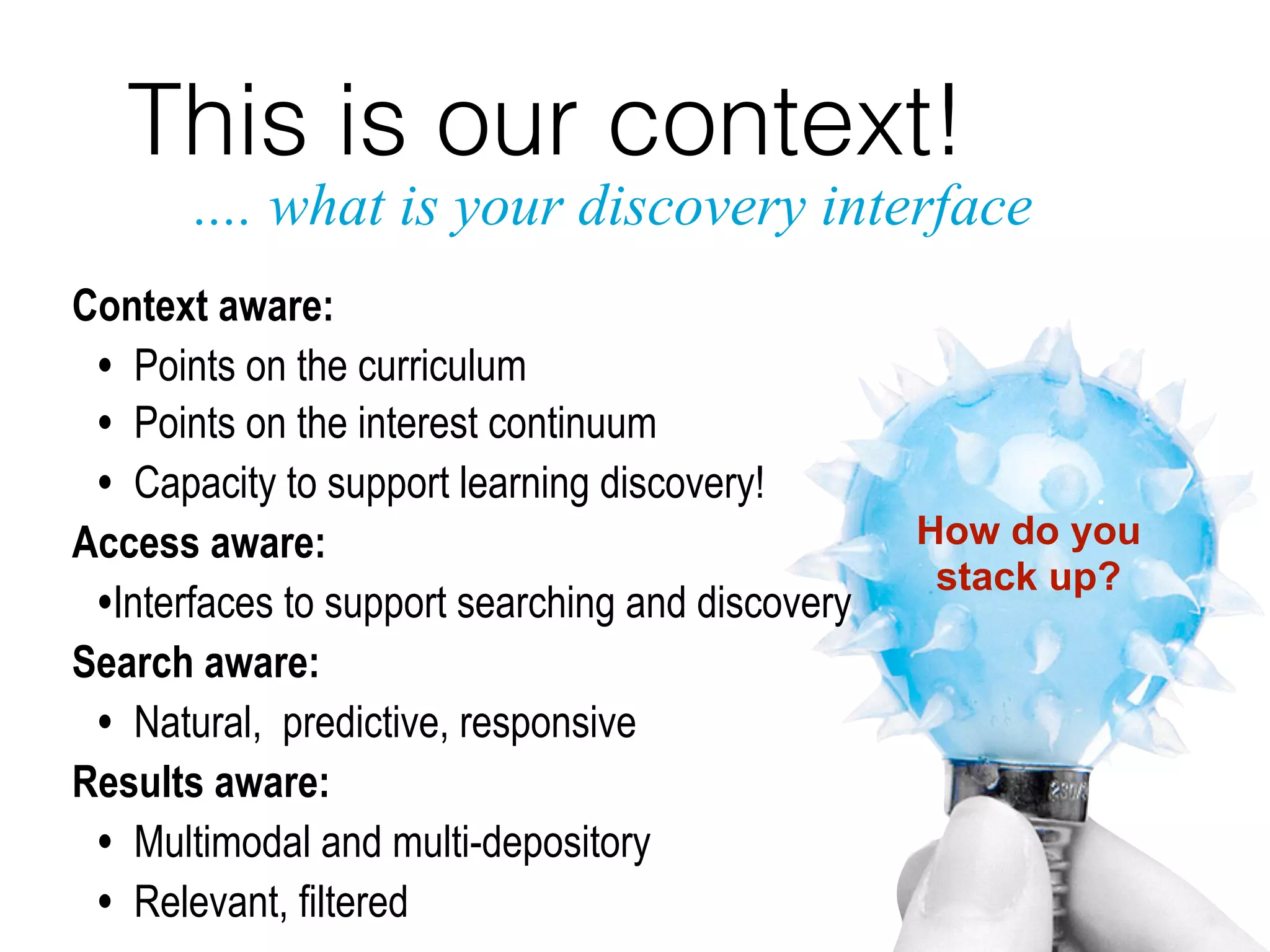
Context aware:
• Points on the curriculum
• Points on the interest continuum
• Capacity to support learning discovery!
Access aware:
•Interfaces to support searching and discovery
Search aware:
• Natural, predictive, responsive
Results aware:
• Multimodal and multi-depository
• Relevant, filtered
How do you
stack up?
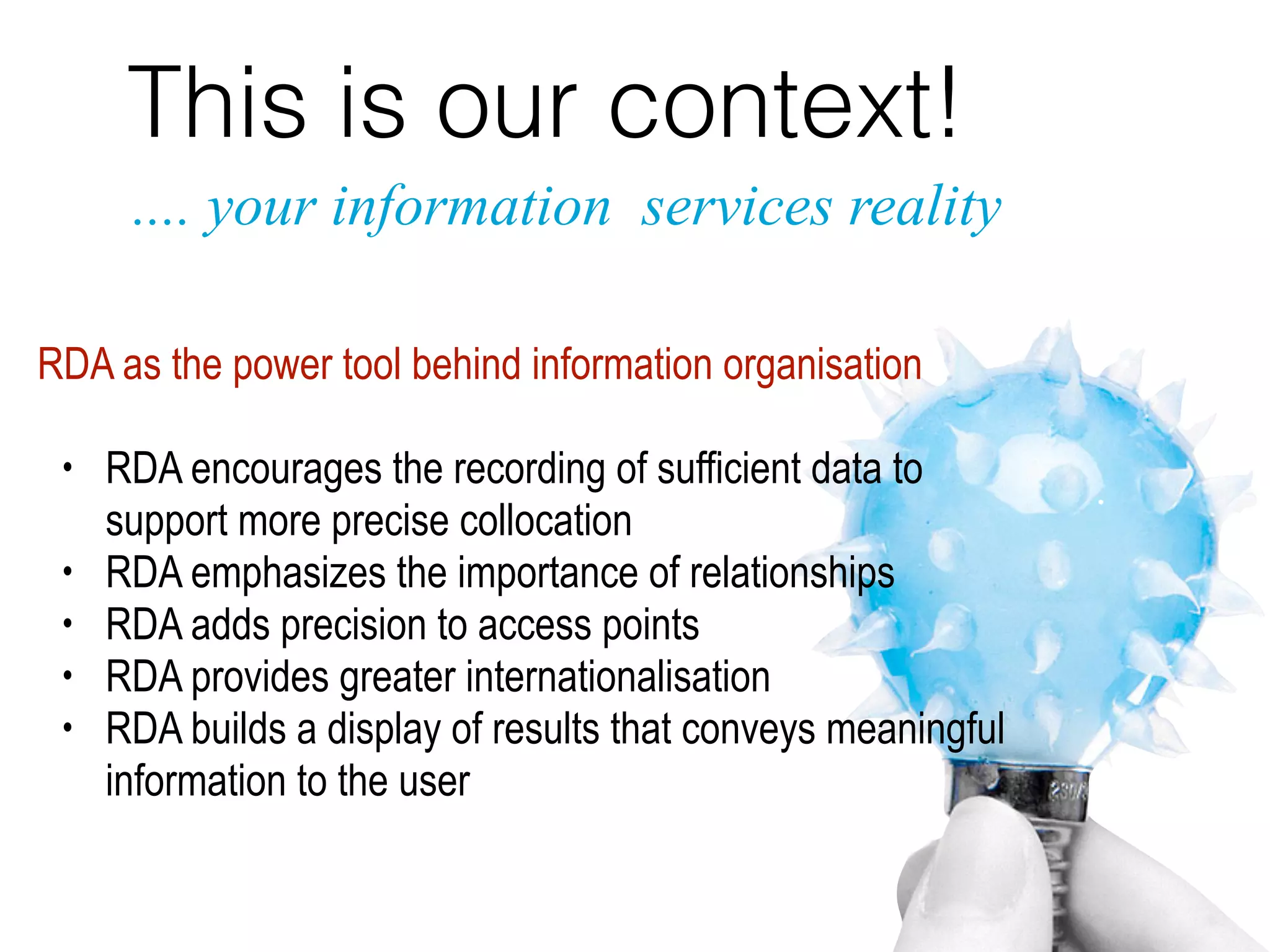
This is our context!
.... your information services reality
Resource Description and Analysis (RDA) as the
power tool behind information organisation

• RDA emphasizes the importance of
relationships
• RDA adds precision to access points
• RDA provides greater internationalisation
• RDA builds a display of results that conveys
meaningful information to the user
This is your context!
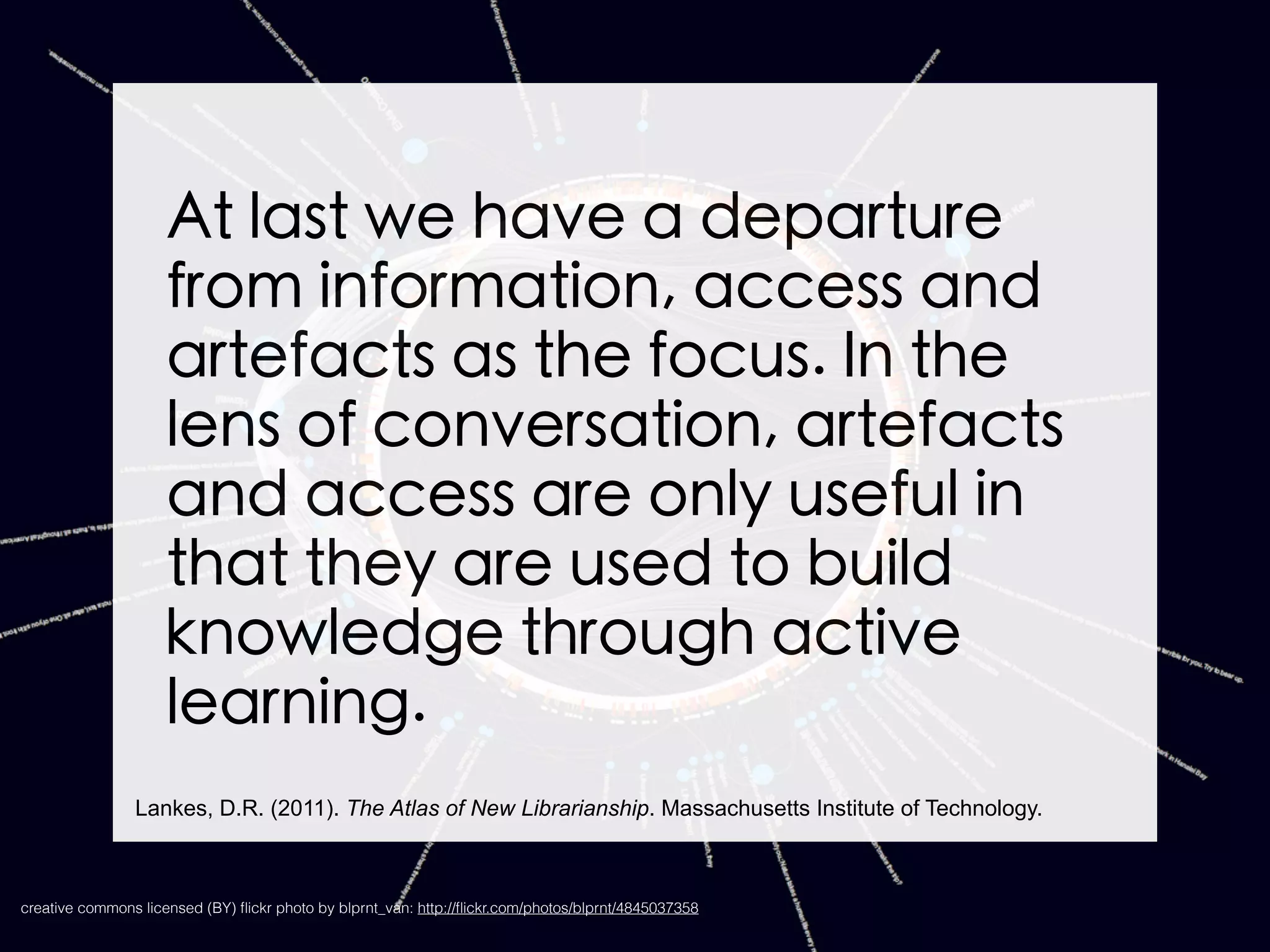
creative commons licensed (BY) flickr photo by blprnt_van: http://flickr.com/photos/blprnt/4845037358
shared information!
resource description and
access across!
connected systems and
organisations
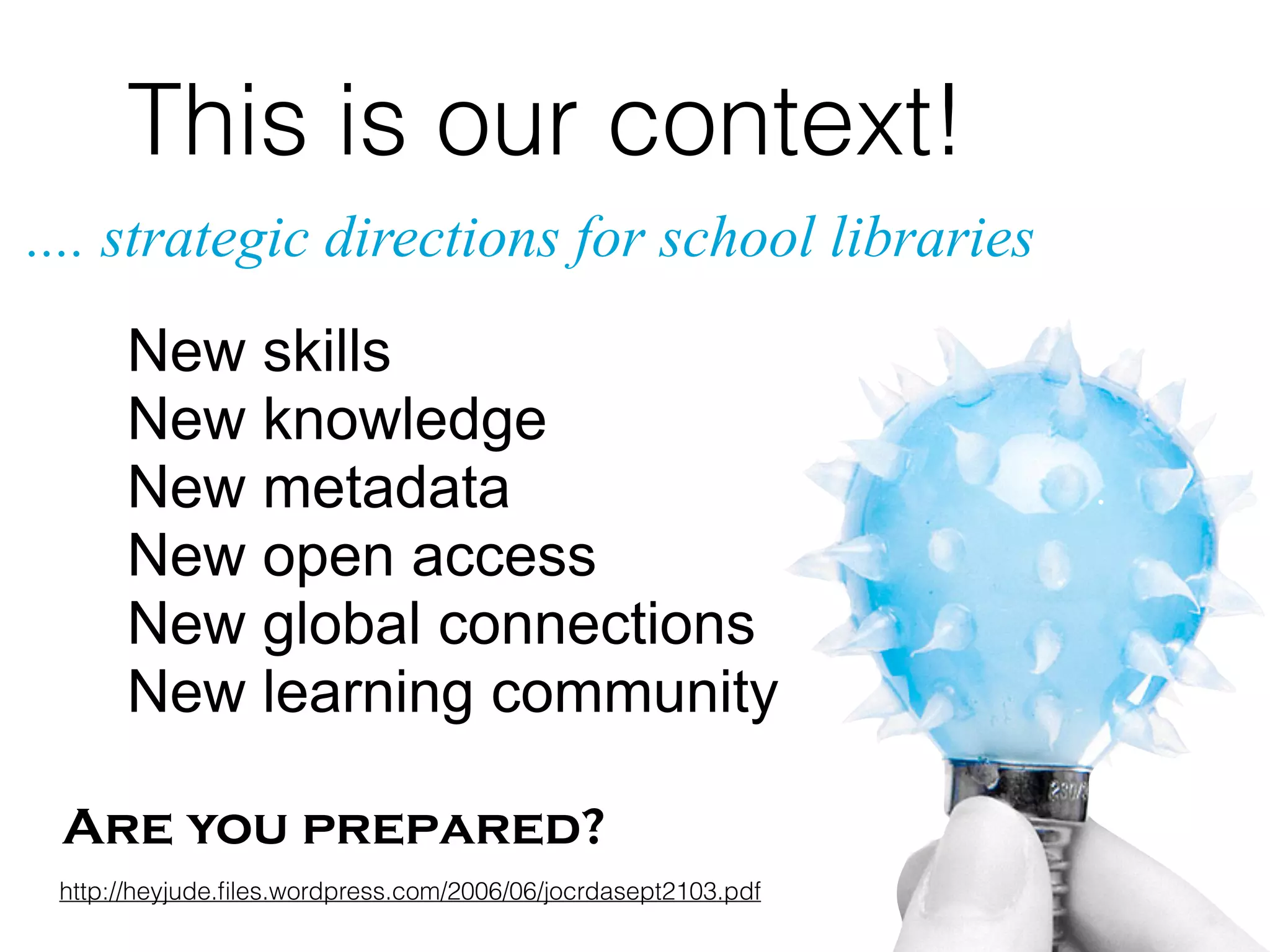
transliteracy skills
knowledge networking
metadata
open access
global connections
learning community
creative commons licensed (BY) flickr photo by blprnt_van: http://flickr.com/photos/blprnt/4845037358
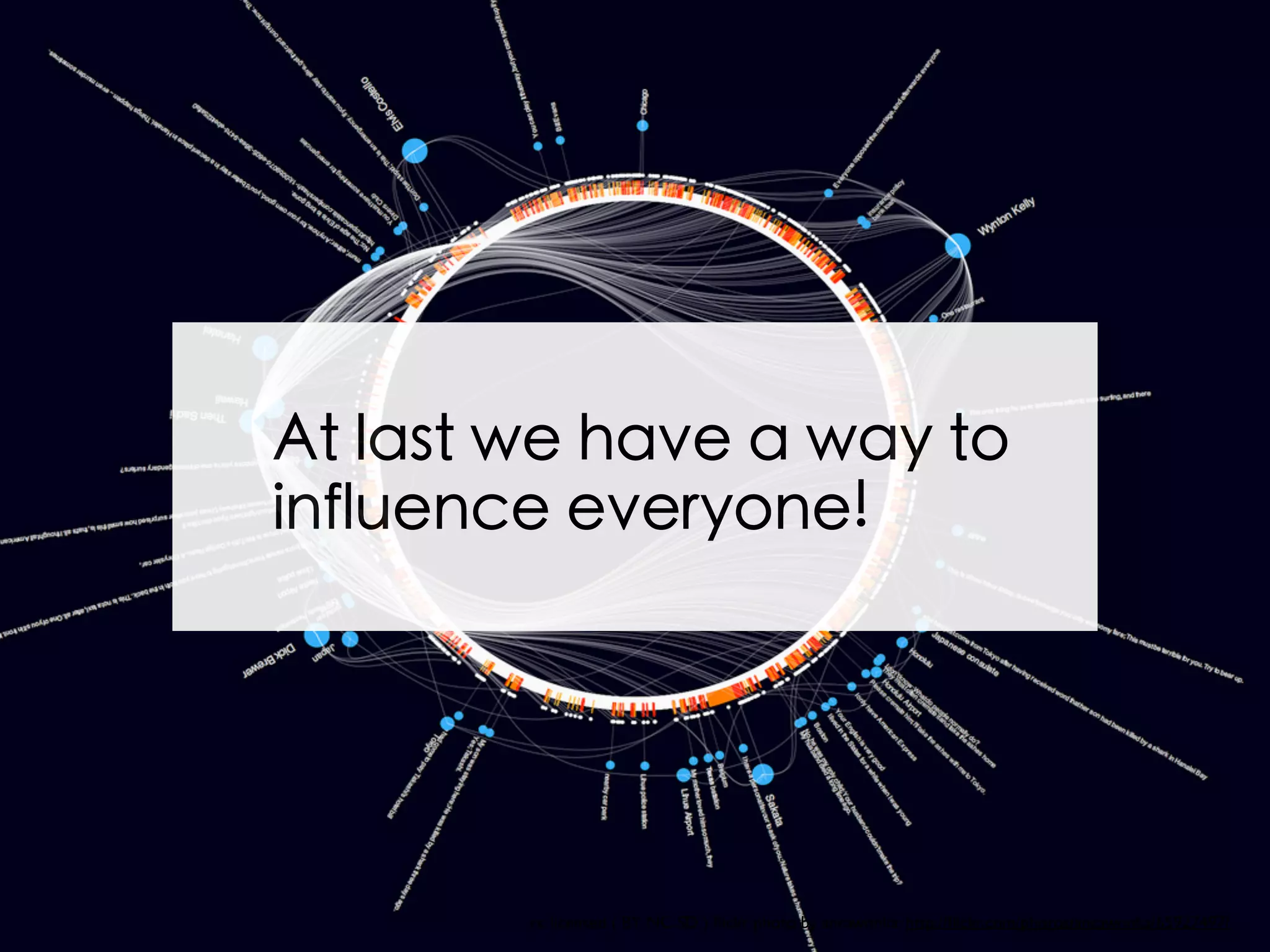
At last we have a way to

influence everyone!
cc licensed ( BY NC SD ) flickr photo by ancawonka: http://flickr.com/photos/ancawonka/65927497/
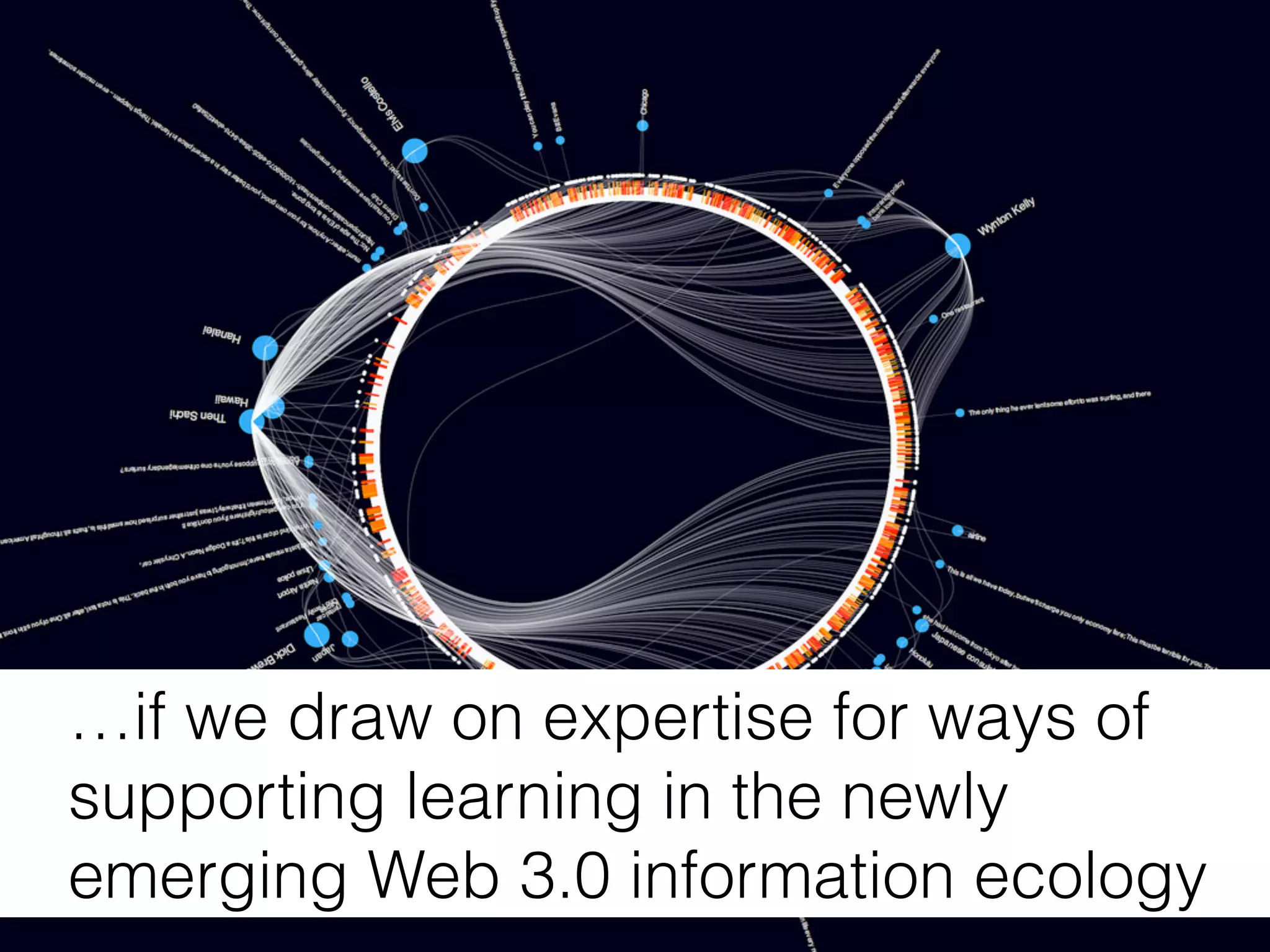
…if we draw on expertise for ways of
supporting learning in the newly
emerging Web 3.0 information ecology
Master of Education
(Knowledge Networks and Digital Innovation)
http://www.csu.edu.au/digital
“An eye opener for me to say the least, I have felt as though I
have been catching up through the entire trek”
Does metadata matter?
http://thinkspace.csu.edu.au/jerry/does-metadata-matter/
http://youtu.be/bAOWpdQeyBQ
Here’s to HUMANITY
heyjudeonline
Judy O’Connell
http://judyoconnell.com
Judy O’Connell

Preparing for the Impact of Web 3.0

  • 1.
    JUDY O’CONNELL CHARLESSTURT UNIVERSITY Preparing for the impact of EduTech National Congress ! Brisbane, 3 June 2014
  • 2.
    Knowledge networks &digital innovation
  • 3.
    The internet isa good think. Look what happened in 25 years! cc licensed ( BY NC SA ) flickr photo by Trey Ratcliff: http://flickr.com/photos/stuckincustoms/6756753669/ Are we purposefully chaotic?
  • 4.
  • 5.
    Voices of thepeople http://www.elon.edu/predictions/ Imagining the Internet
  • 6.
    The Web at25 The overall verdict: The internet has been a plus for society and an especially good thing for individual users http://www.pewinternet.org/2014/02/27/the-web-at-25-in-the-u-s/
  • 7.
    More content andstreams of data – these online environments require a better understanding of what being ‘online’ means! Is knowing obsolete?
  • 8.
    oEvolving needs oflearners! oNew knowledge building environments! oFocusing on personalisation! oEvolving spaces for learning! oEvolving learning device technologies! oEvolving pedagogy
  • 9.
    Assessment and Teachingof 21C Skills Framework for essential skills for curriculum programs: ! o Ways of thinking. Creativity, critical thinking, problem-solving, decision-making and learning o Ways of working. Communication and collaboration o Tools for working. Information and communications technology (ICT) and information literacy o Skills for living in the world. Citizenship, life and career, and personal and social responsibility (ATC21s 2012). ATC21s (Assessment and Teaching of 21st C skills – Melbourne University) 250 researchers across 60 institutions worldwide. http://atc21s.org/index.php/about/what-are-21st-century-skills/
  • 10.
    Connected, creative, learning ecology leadinnovation identify talent revolutionise education creative commons licensed (BY) flickr photo by AlicePopkorn: http://flickr.com/photos/alicepopkorn/225039522 5
  • 11.
    Developed by researchers atthe University of Washington, Folditturns scientific problems into competitive games. Gamers Unlock Protein Mystery .... that Baffled Researchers For Years Khatib, F., DiMaio, F., Cooper, S., Kazmierczyk, M., Gilski, M., Krzywda, S., Zabranska, H., et al. (2011). Crystal structure of a monomeric retroviral protease solved by protein folding game players. Nat Struct Mol Biol, 18(10), 1175–1177. doi:10.1038/nsmb.2119!
  • 12.
    http://www.fabacademy.org/ The Fab LabNetwork covers more than 40 countries in more than 200 labs in the world. Every Fab Lab is a potential classroom for the Fab Academy.
  • 13.
  • 14.
    The Robots andDinosaurs Hackerspace meets right here in Sydney and offers a communal space where geeks and artists brainstorm ideas, play games, work on collaborative projects, and share the cost of some great tools. http://robodino.org/
  • 15.
    cc licensed (BY NC SD ) flickr photo by Pete Prodoehl: http://flickr.com/photos/raster/6128718951/ Makerspace or Hackerspace in your school! Think smarter. Be new. Be creative
  • 16.
    information access and sharing Wonderfulworld of…. creative commons licensed (BY-NC-SA) flickr photo by Ed Yourdon: http://flickr.com/photos/yourdon/3088582622
  • 17.
    learning today requiresthat teachers and school librarians understand reading and information seeking in a connected world....
  • 18.
    More content, streamsof data, topic structures, (theoretically) better quality - all of these in online environments require an equivalent shift in our capacity to understand information structures.
  • 19.
    How does searchimpact the way students think and the way we organise information access?
  • 20.
    Search is fastwithout necessarily being safe or intelligent ! YET! cc licensed ( BY NC SD ) flickr photo by Έλενα Λαγαρία: http://flickr.com/photos/29393867@N07/3161212158/
  • 21.
    ! ..... because yourknowledge and my knowledge, based on what search results we are served, may be very different from each other. Siva  Vaidhyanathan  in  The  Googlization  of  Everything, Filter bubble! creative commons licensed (BY-SA) flickr photo by Je.T.: http://flickr.com/photos/jetow/4795118657
  • 22.
    How much does Googlereally know about us, in practical terms, and — more importantly — how much should we care? One interesting place this comes up is at Netflix — the basic math behind the Netflix code tends to be conservative.
  • 23.
    cc licensed flickrphoto by assbach: http://flickr.com/photos/assbach/253218488/ Gather Seek Follow Explore
  • 24.
  • 25.
    Participatory culture • Peercritiquing • User-generated content • Collective aggregation • Community formation • Digital personas • Digital Citizenship kr photo by mytoenailcameoff: http://flickr.com/photos/damianathegirl/5102903812
  • 26.
    Beyond digital citizenship A definitiveguide to verifying digital content for emergency coverage
  • 27.
    The [r]evolution Digital notprint is the future
  • 28.
    Lost collection ofAndy Warhol art recovered from floppy disks http://mashable.com/2014/04/24/warhol-art-recovered-amiga-disks/
  • 29.
    This is the‘back-story’ of the digital revolution – digitisation for information storage, retrieval, accessibility, and usage that has changed the face of the digital information ecology in the current era. creative commons licensed (BY-NC-SA) flickr photo by Tal Bright: http://flickr.com/photos/bright/17378095
  • 30.
  • 31.
    Big Shift creative commonslicensed (BY-NC-ND) flickr photo by 144ben: http://flickr.com/photos/benchpics/7190477294 Connectedness the new black!
  • 32.
    creative commons licensed(BY-SA) flickr photo by Ian Muttoo: http://flickr.com/photos/imuttoo/2631466945!
  • 33.
    creative commons licensed(BY-SA) flickr photo by Ian Muttoo: http://flickr.com/photos/imuttoo/2631466945! The Web is not the Internet
  • 34.
    számítógép ENIAC (Electronic Numerical Integratorand Computer) http://vimeo.com/84381995!
  • 35.
    Internet of Things(IoT) (sometimes call Web 3.) is an integrated part of “Future Internet” https://flic.kr/p/iswbBn
  • 36.
    Web 3.0 refersto a third generation of internet-based services that collectively may allow the emergence of the intelligent semantic web. cc licensed ( BY ) flickr photo by paul (dex): http://flickr.com/photos/dexxus/3146028811/
  • 37.
    existing data reconnectedfor other and smarter uses Web 3.0 really means… cc licensed ( BY ) flickr photo by paul (dex): http://flickr.com/photos/dexxus/3146028811/
  • 38.
    The semantic web,or web 3.0, is all about data integration. it is an infrastructure technology and an organised approach to metadata cc licensed ( BY NC SD ) flickr photo by Jason A. Samfield: http://flickr.com/photos/jason-samfield/4736792714/
  • 39.
    new functionality thatrequires web linking, flexible representation, and external access APIs. you won’t see a “Web 3.0 inside’ label
  • 40.
    Web 3.0 Web 1.0 Webx.0 Web 2.0 Semantic Web The Web Meta Web Social Web Degree of Social Connectivity DegreeofInformationConnectivity cc""Steve"Wheeler,"University"of"Plymouth,"2010" Semantic Web of knowledge Semantic Web of intelligence Web of information Web of people & social information DegreeofInformationConnectivity
  • 41.
    The semantic weballows a person or a computer to start off in one database, and then move through an unending set of databases which are connected, not by wires, but by being about the same thing. This is where complexity theory doesn’t quite cut it!
  • 42.
    Rather than justidentifying keywords and expressions, the semantic web concentrates on identifying the meaning of content.
  • 43.
    It is aboutcommon formats and metadata which allow for integration and combination of linked data drawn from diverse sources.
  • 44.
    It is alsoabout language, or ontology, for recording how the linked data relates to real world objects, allowing a ‘machine’ to ‘understand’ the semantic meaning of words.
  • 45.
  • 47.
    Google Knowledge Graph Whenyou search, you’re not just looking for a webpage. You’re looking to get answers, understand or explore.
  • 48.
  • 49.
  • 50.
  • 51.
  • 52.
    Gapminder fact-based worldview http://www.gapminder.org/for-teachers/ ~ use the teacher tools in your classroom
  • 53.
  • 54.
    Europeana enables peopleto explore the digital resources of Europe's museums, libraries, archives and audio-visual collections. http://www.europeana.eu/portal/index.html Linked Open Data on the Web. The site currently contains metadata on 3.5 million texts, images, videos and sounds.
  • 55.
  • 56.
    CHARLES STURT UNIVERSITY Whereastraditional library metadata has always been focused on helping humans find and make use of information, linked data ontologies are focused on helping machines find and make use of information. linkeddata.org schema.org/
  • 57.
    This uri ‘http://id.loc.gov/ authorities/sh85042531’ hasnow become the globally available, machine and human readable, reliable source for the description for the subject heading of ‘Elephants’ containing links to its related terms (in a way that both machines and humans can navigate).
  • 58.
  • 59.
    ! Making it possibleto federate,
 query, browse, gather and
 recommend information from
 disparate sources.
  • 60.
    ! Think of theWeb 3.0 environment as the portable, personal web, focused on the individual, on a life-stream, on consolidating content, and which is powered by widgets, drag & drop, and mashups of user engagement. ! This socially powered web is exploding, and is the new baseline for all our internet and technology empowered interactions.
  • 61.
    ! Another feature ofour hyper-connected systems is the democratisation of information organisation and access. DATA is the NEW BLACK
  • 62.
    This is ourcontext! Metadata ~ what are the rules of engagement? Schema ~ what about controlled vocabularies? Users ~ what are their access needs Interface ~ how many access points? Data ~ what are the opportunities for user engagement? Media ~ what are the elements of interactivity? Access ~ what can we learn from the semantic web? .... old questions, new answers
  • 63.
    .... what isyour discovery interface ! Context aware: • Points on the curriculum • Points on the interest continuum • Capacity to support learning discovery! Access aware: •Interfaces to support searching and discovery Search aware: • Natural, predictive, responsive Results aware: • Multimodal and multi-depository • Relevant, filtered How do you stack up? This is our context!
  • 64.
    .... your informationservices reality Resource Description and Analysis (RDA) as the power tool behind information organisation
 • RDA emphasizes the importance of relationships • RDA adds precision to access points • RDA provides greater internationalisation • RDA builds a display of results that conveys meaningful information to the user This is your context!
  • 65.
    creative commons licensed(BY) flickr photo by blprnt_van: http://flickr.com/photos/blprnt/4845037358
  • 66.
    creative commons licensed(BY) flickr photo by blprnt_van: http://flickr.com/photos/blprnt/4845037358 shared information! resource description and access across! connected systems and organisations
  • 67.
    transliteracy skills knowledge networking metadata openaccess global connections learning community creative commons licensed (BY) flickr photo by blprnt_van: http://flickr.com/photos/blprnt/4845037358
  • 68.
    At last wehave a way to
 influence everyone! cc licensed ( BY NC SD ) flickr photo by ancawonka: http://flickr.com/photos/ancawonka/65927497/
  • 69.
    …if we drawon expertise for ways of supporting learning in the newly emerging Web 3.0 information ecology
  • 70.
    Master of Education (KnowledgeNetworks and Digital Innovation) http://www.csu.edu.au/digital “An eye opener for me to say the least, I have felt as though I have been catching up through the entire trek”
  • 71.
  • 72.
  • 73.