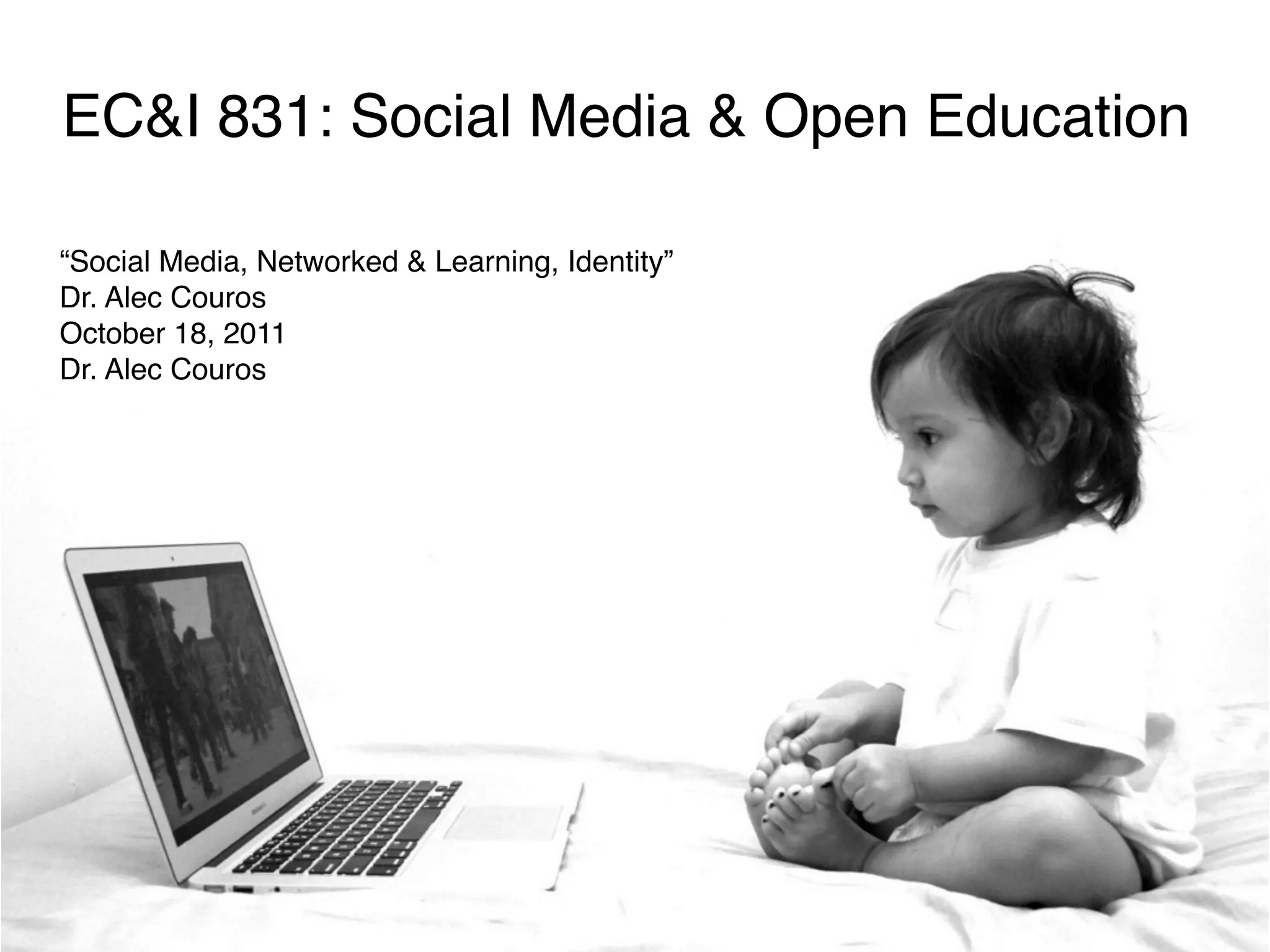

EC&I 831: Social Media & Open Education

“Social Media, Networked & Learning, Identity”
Dr. Alec Couros
October 18, 2011
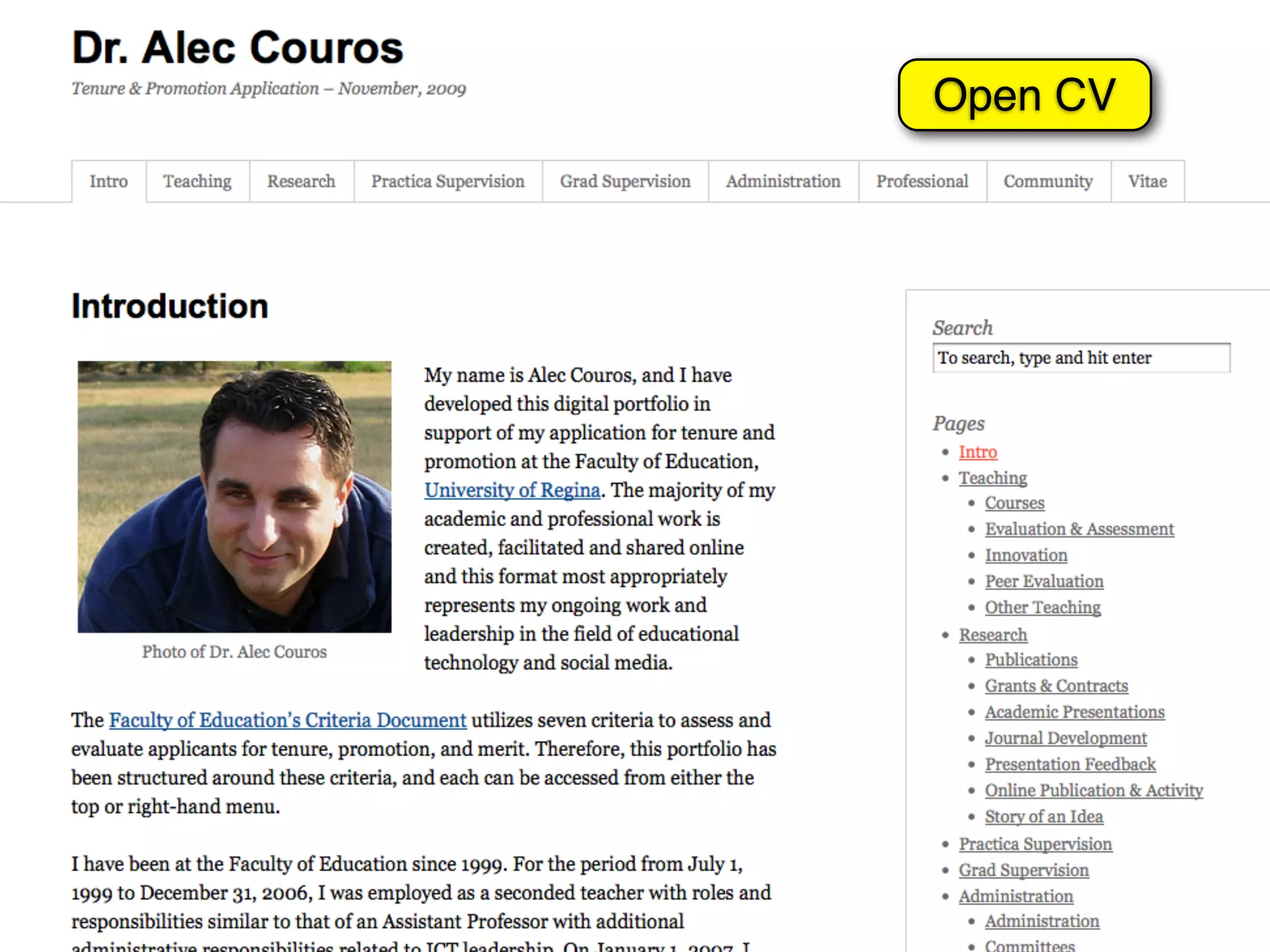
Dr. Alec Couros
me
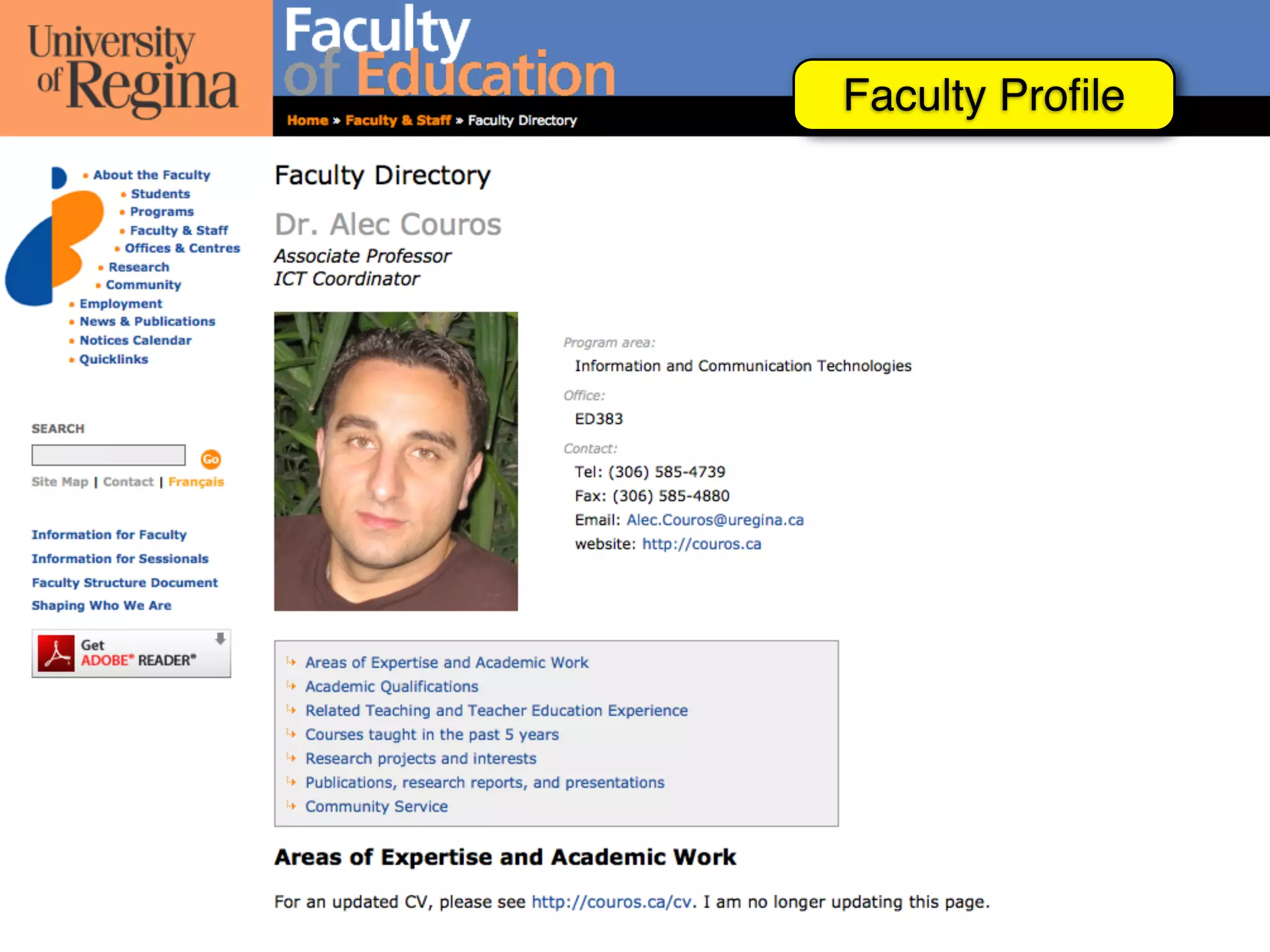
Faculty Profile
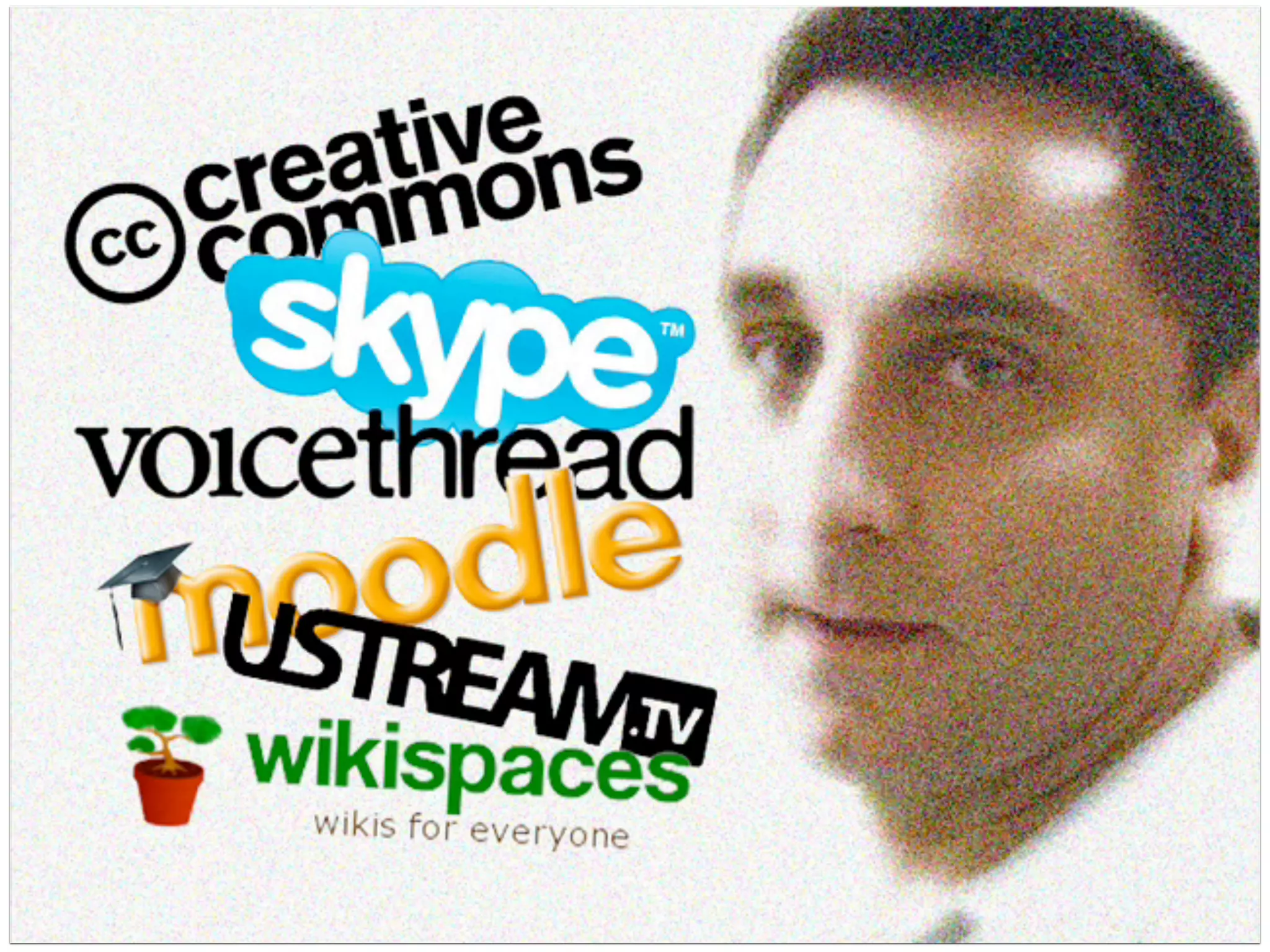
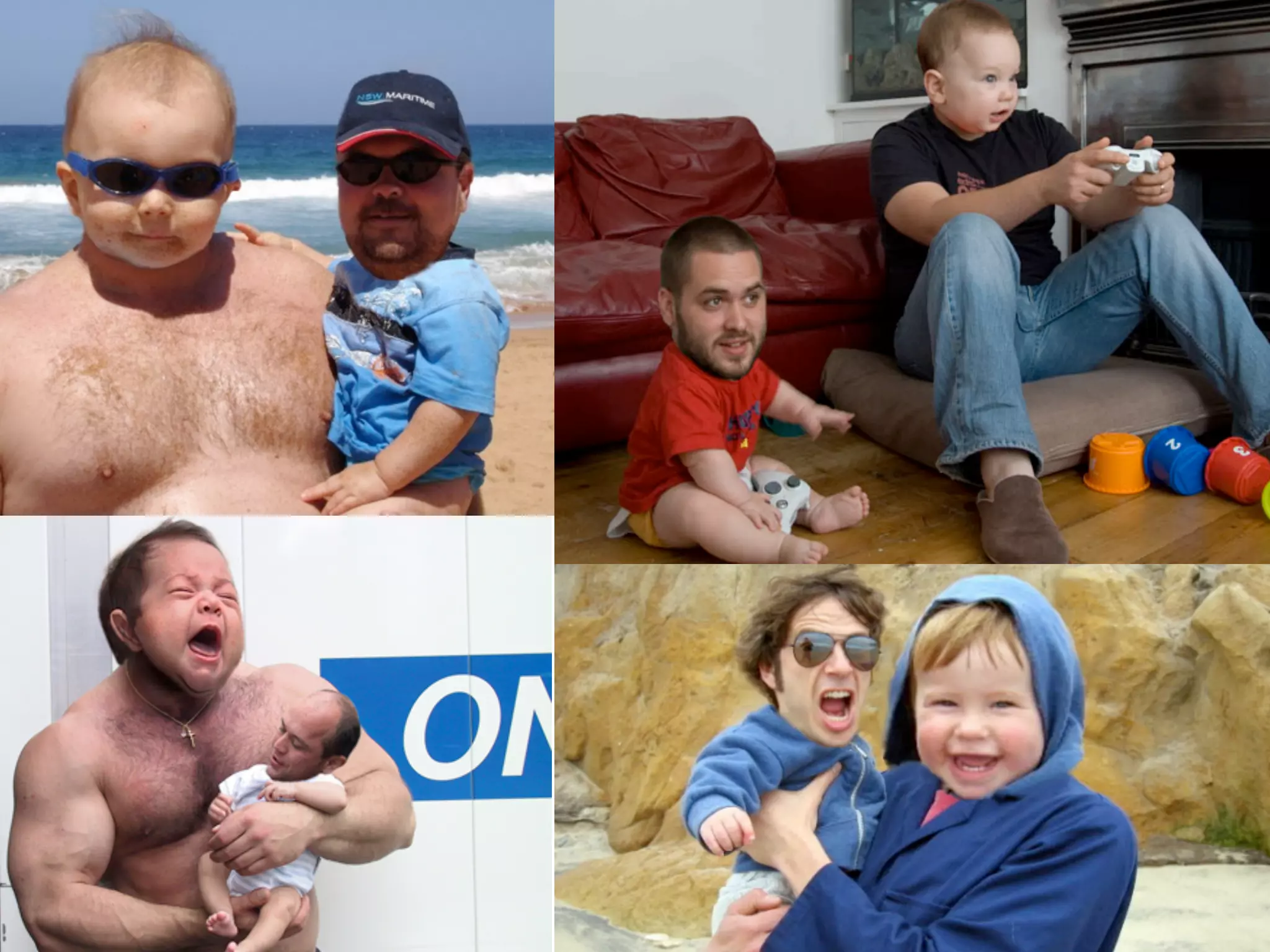
The Blur
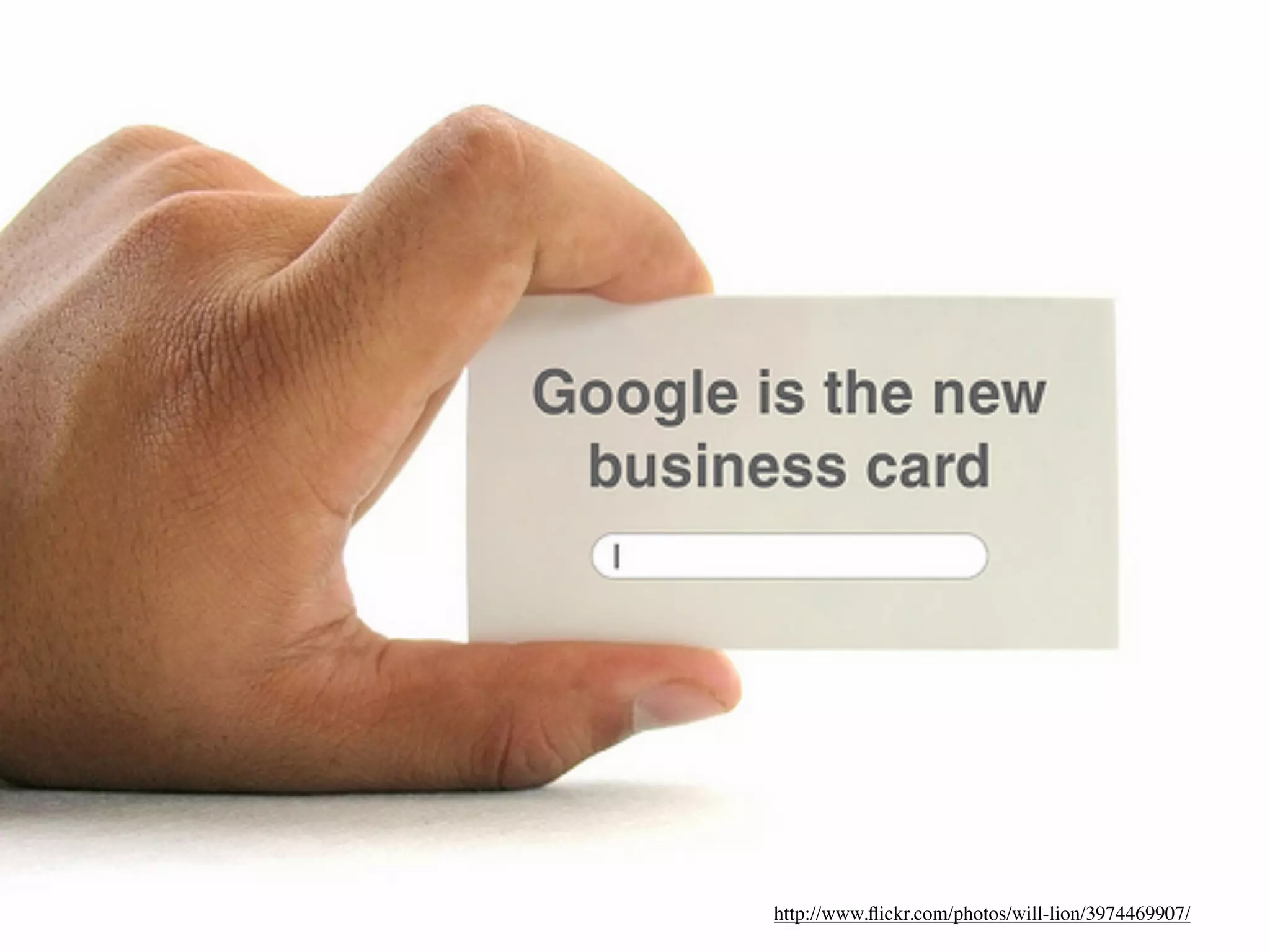
http://www.flickr.com/photos/will-lion/3974469907/
An Open Educator
Open CV
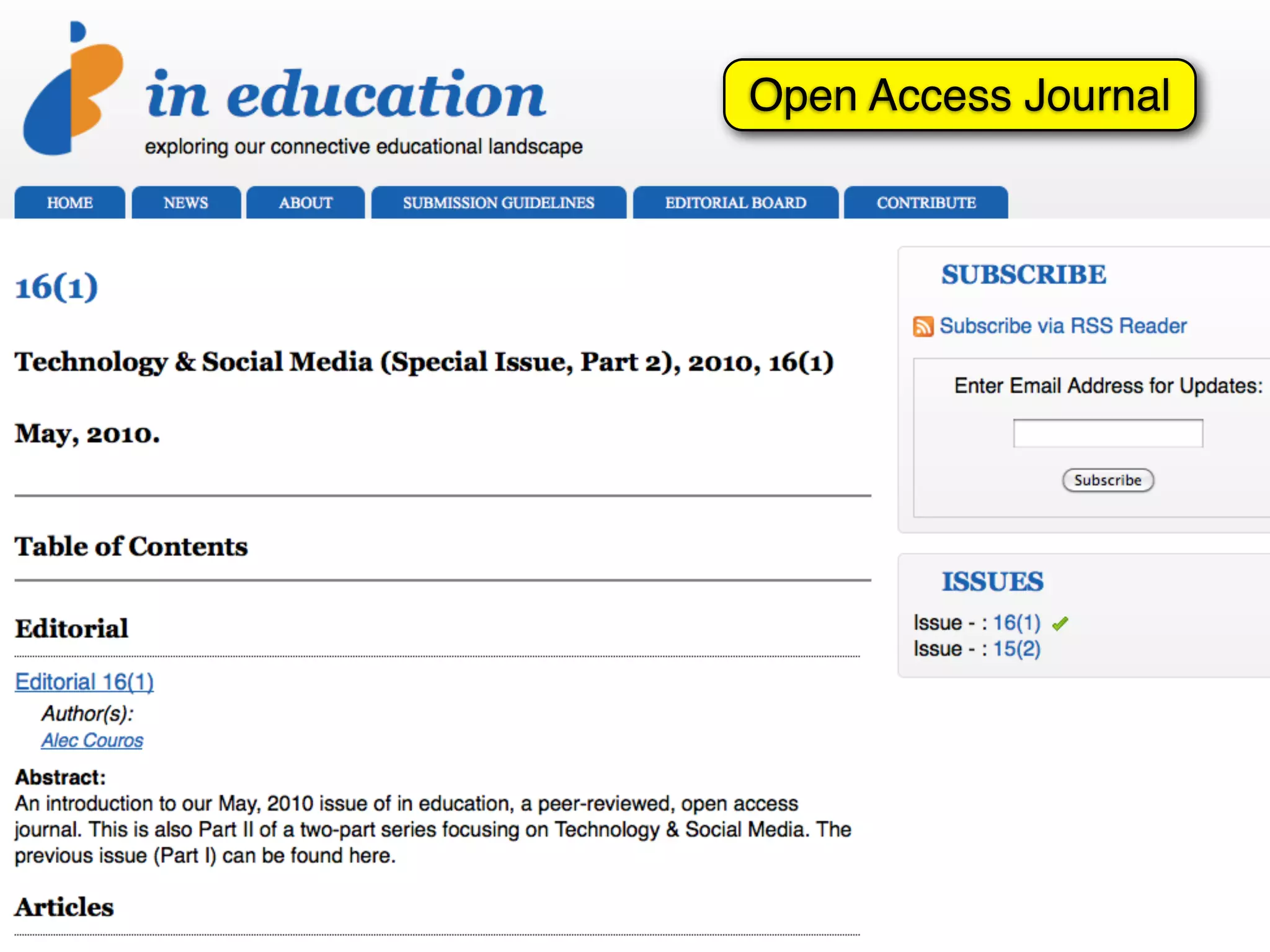
Open Access Journal
“Web 2.0 tools exist that might allow academics to reflect
and reimagine what they do as scholars. Such tools might
positively affect -- even transform - research, teaching, and
  service responsibilities - only if scholars choose to build
 serious academic lives online, presenting semi-public
 selves and becoming invested in and connected to the
            work of their peers and students.”
                   (Greenhow, Robelia, & Hughes, 2009)
journey
(quick version)
Knowledge
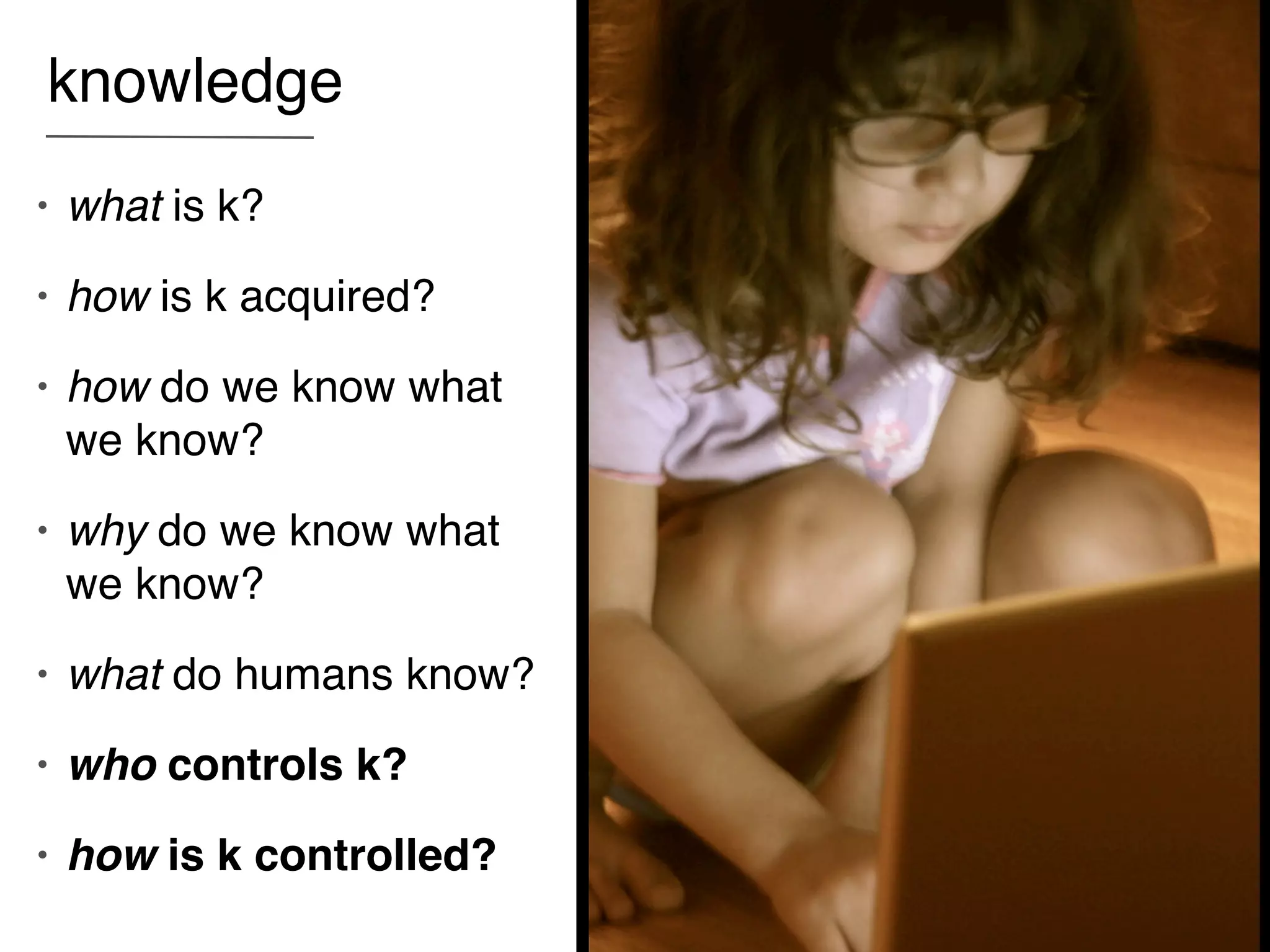
knowledge
•   what is k?
•   how is k acquired?
•   how do we know what
    we know?
•   why do we know what
    we know?
•   what do humans know?
•   who controls k?
•   how is k controlled?
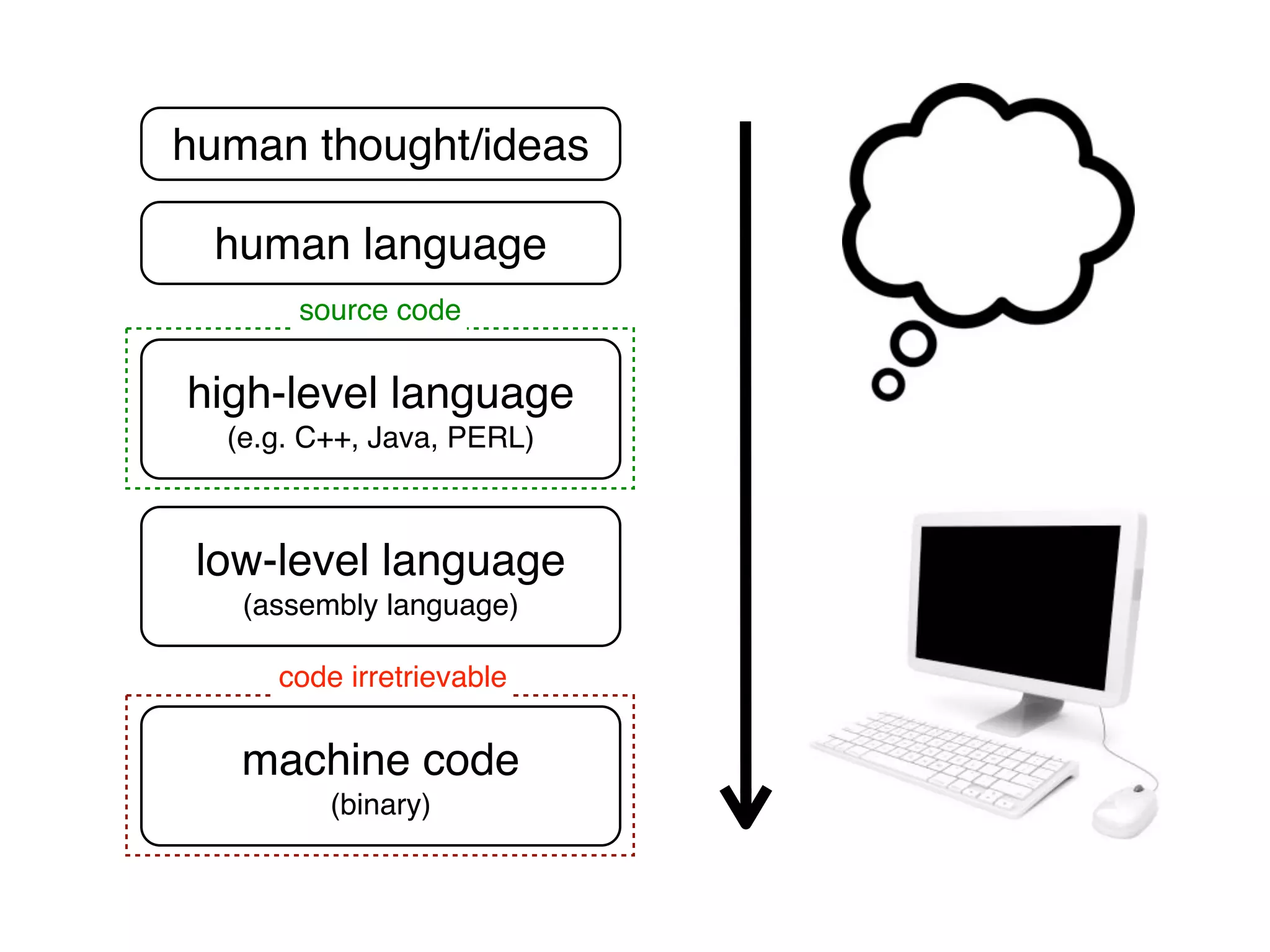
human thought/ideas

 human language
       source code

high-level language
  (e.g. C++, Java, PERL)


 low-level language
   (assembly language)

     code irretrievable

   machine code
         (binary)
@jonmott
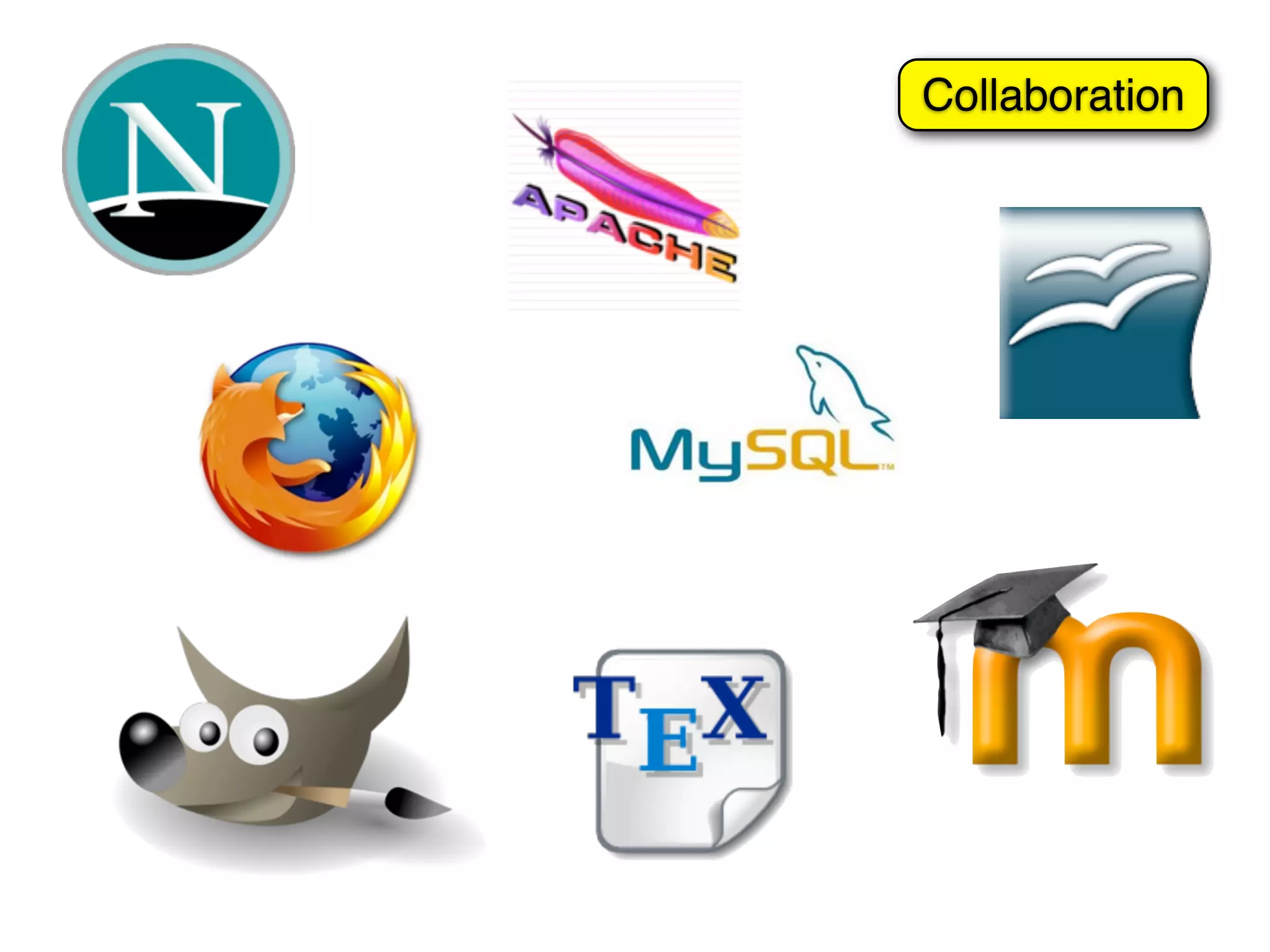
Collaboration
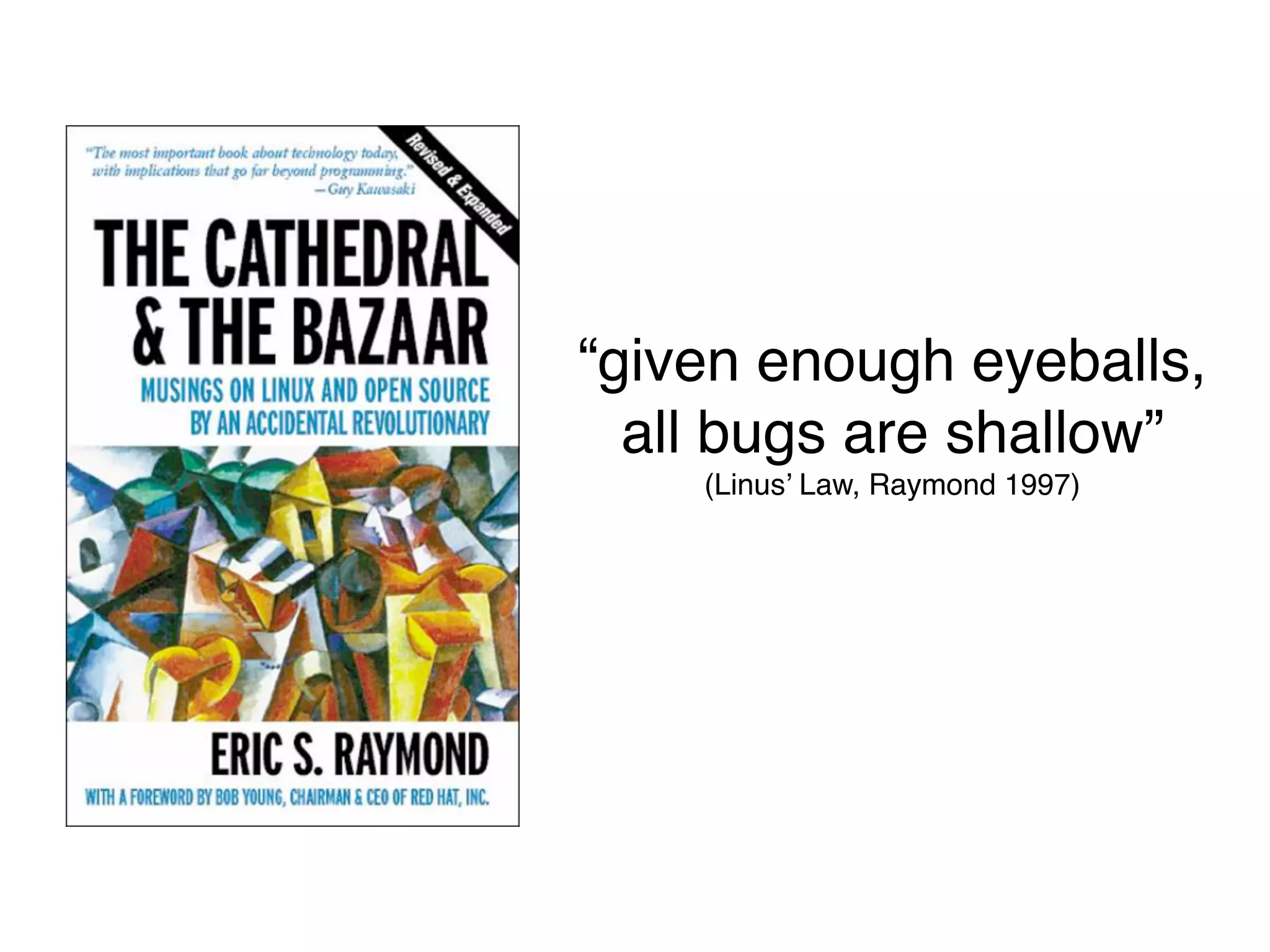
“given enough eyeballs,
  all bugs are shallow”
    (Linus’ Law, Raymond 1997)
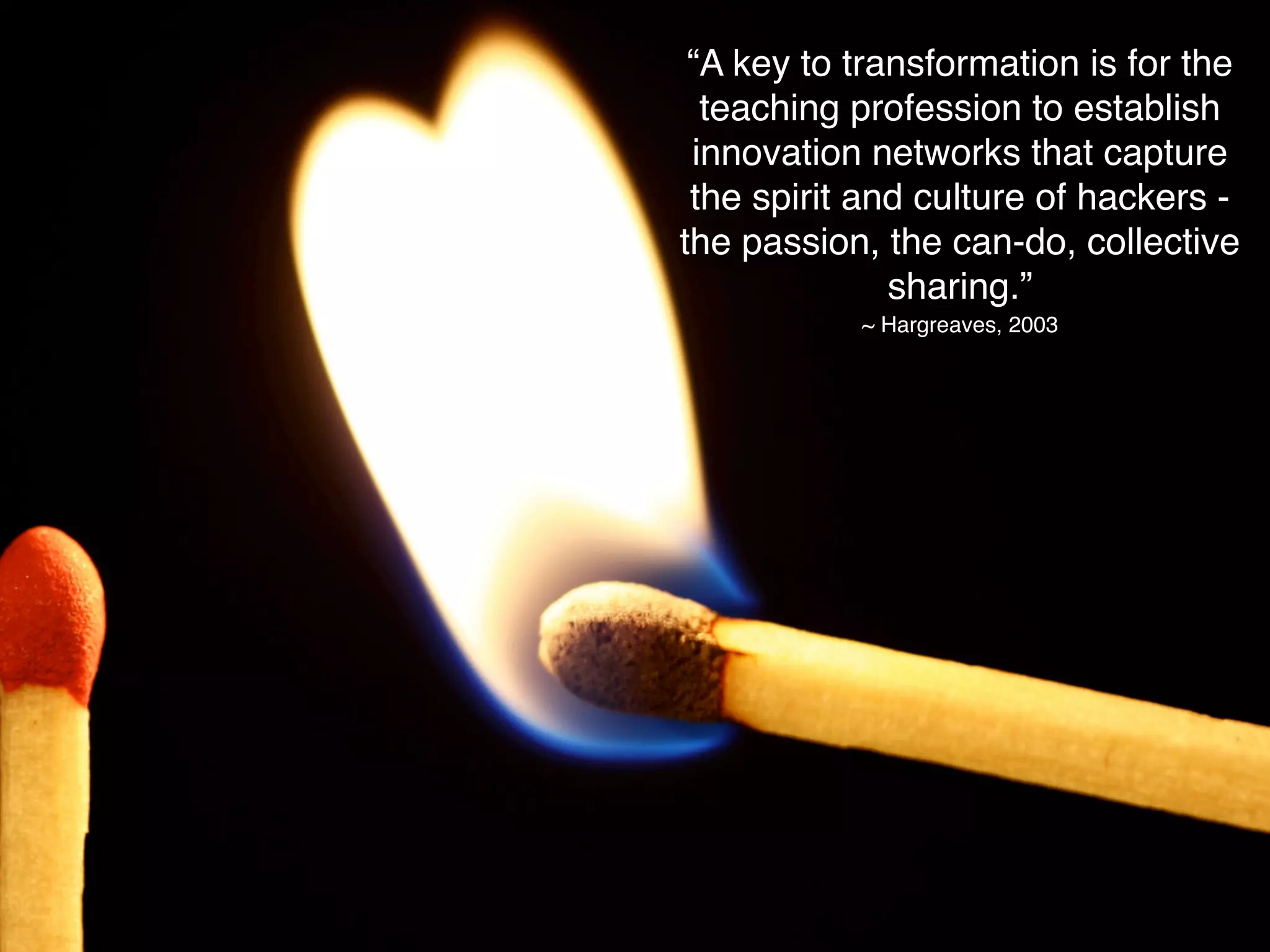
“A key to transformation is for the
  teaching profession to establish
 innovation networks that capture
 the spirit and culture of hackers -
the passion, the can-do, collective
              sharing.”
           ~ Hargreaves, 2003
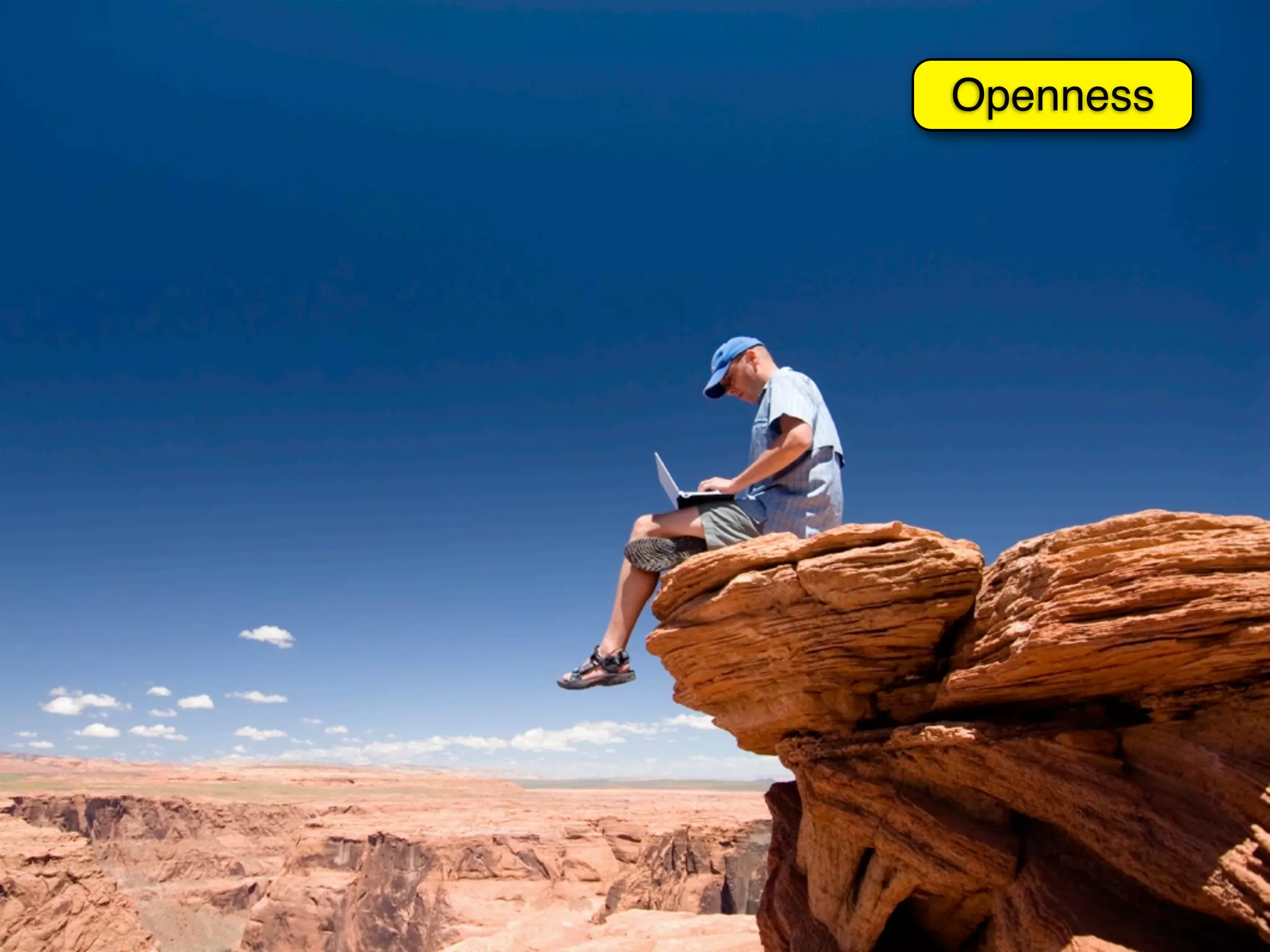
Openness
“Open Education is the simple and
powerful idea that the world’s knowledge
 is a public good and that technology in
    general and the Worldwide Web in
    particular provide an extraordinary
 opportunity for everyone to share, use,
          and reuse knowledge.”
         (William & Flora Hewlett Foundation)
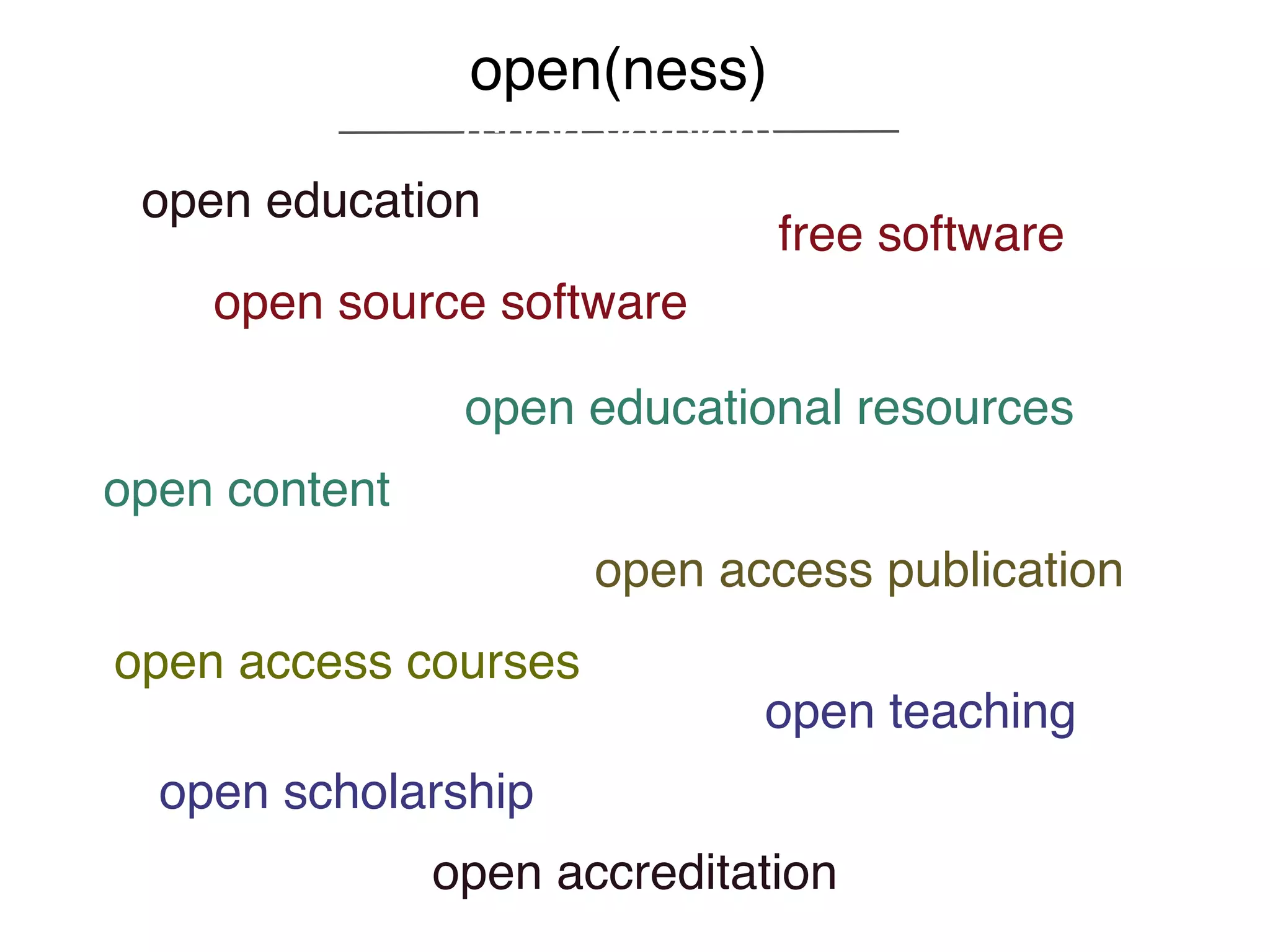
open(ness)
              (short version)
 open education
                                free software
    open source software

                open educational resources
open content
                      open access publication
open access courses
                             open teaching
  open scholarship
               open accreditation
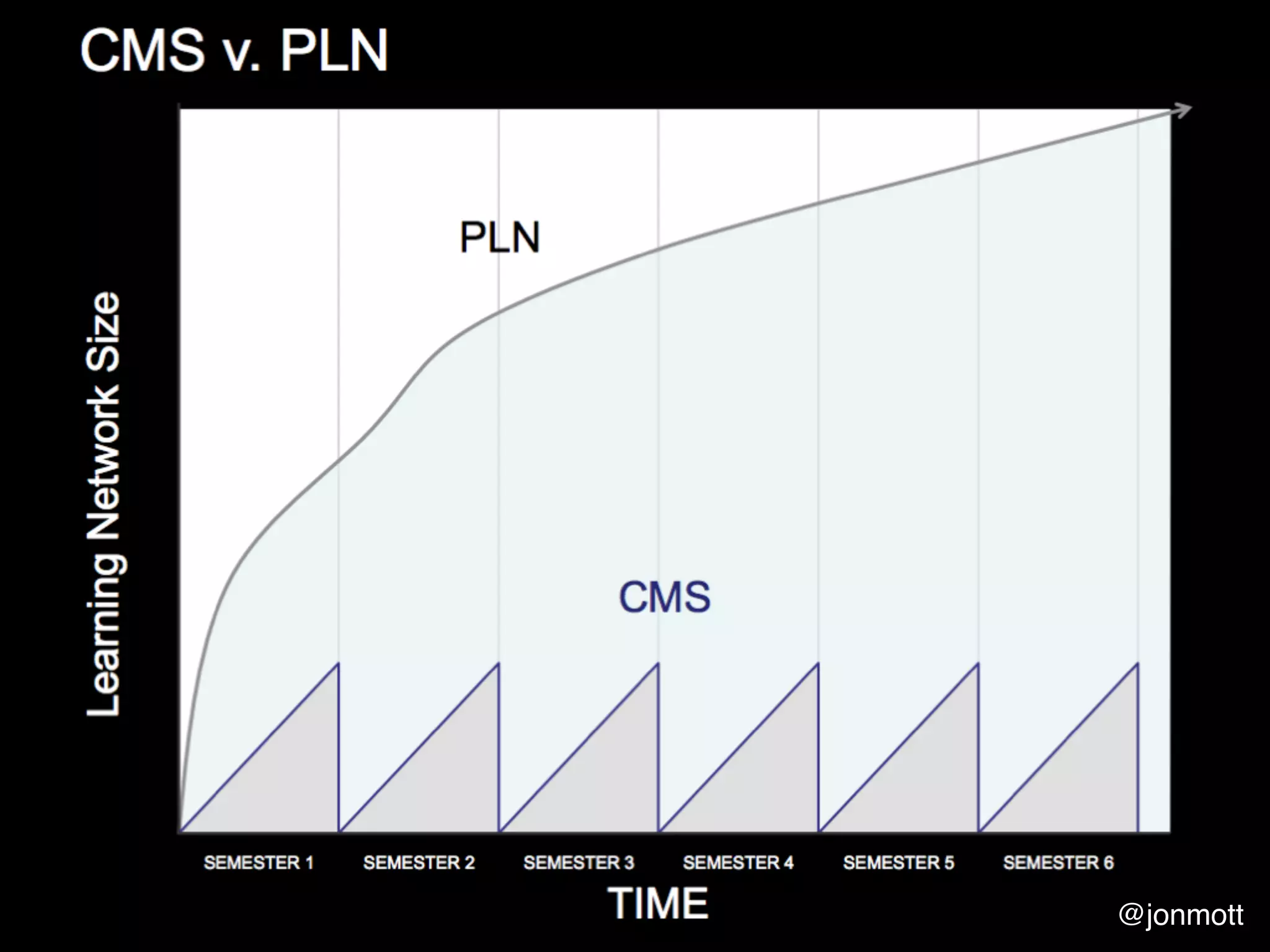
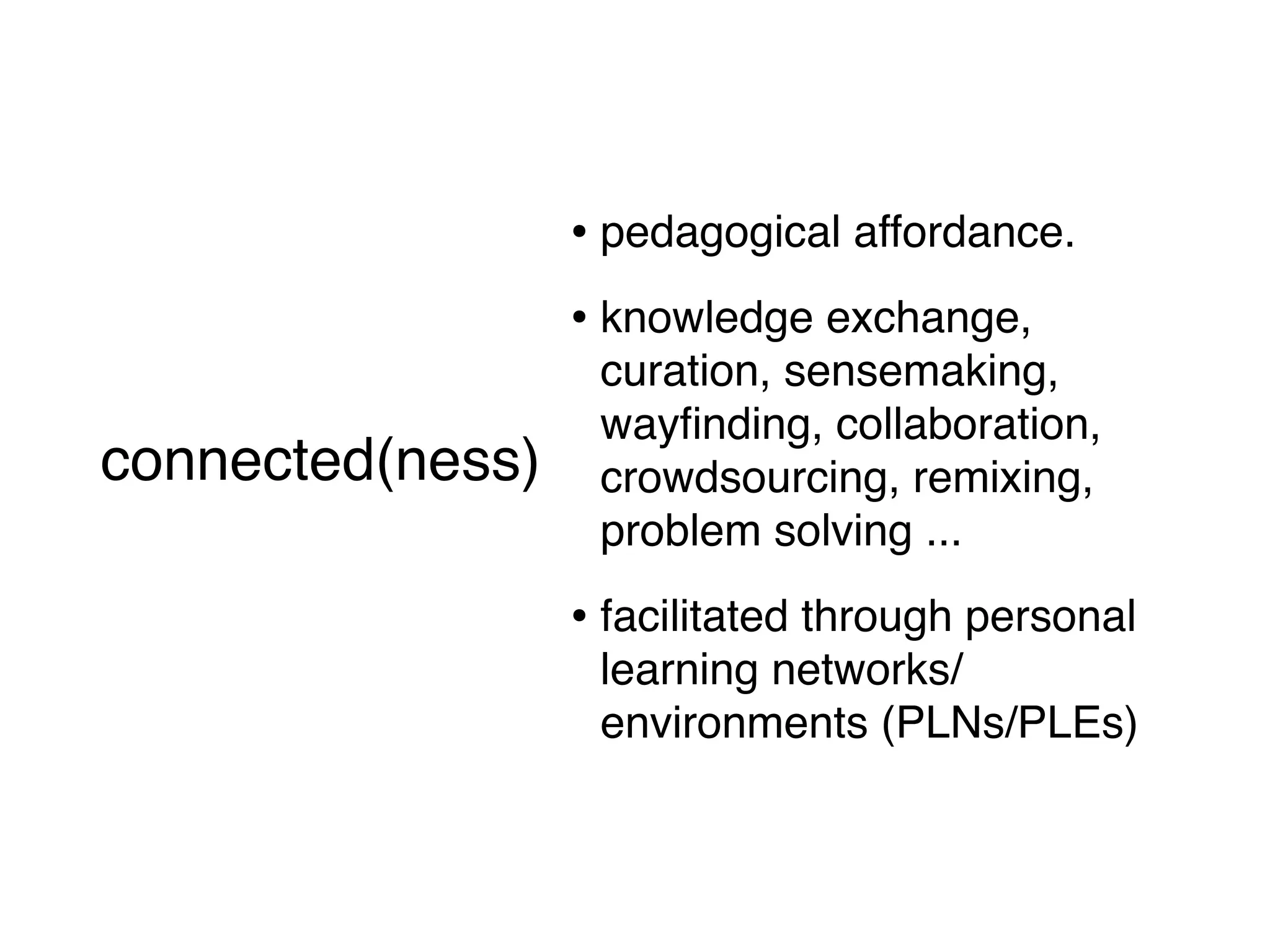
• pedagogical affordance.
                      • knowledge exchange,
                       curation, sensemaking,
                       wayfinding, collaboration,
connected(ness)        crowdsourcing, remixing,
    (short version)
                       problem solving ...

                      • facilitated through personal
                       learning networks/
                       environments (PLNs/PLEs)
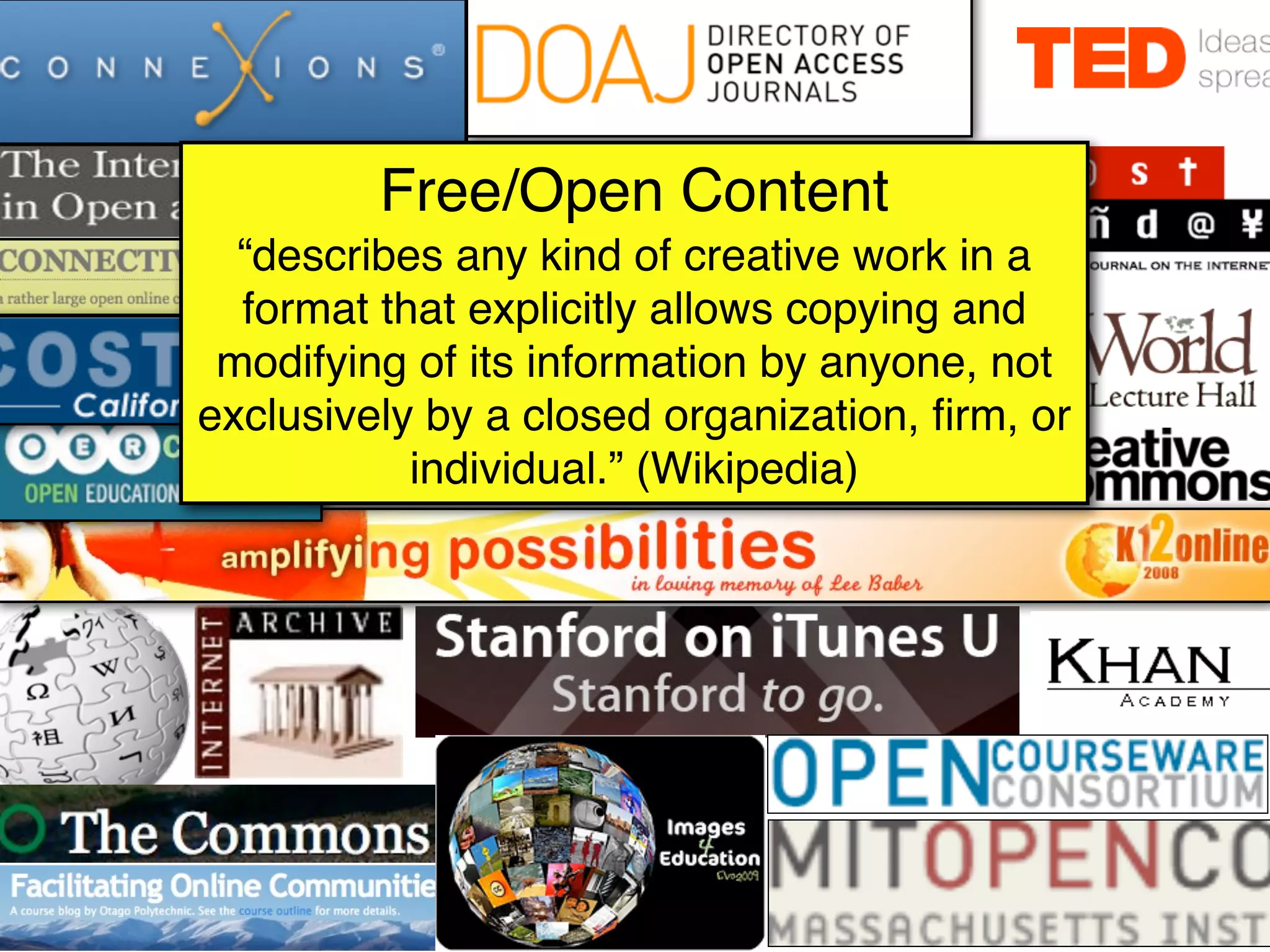
Free/Open Content
  “describes any kind of creative work in a
  format that explicitly allows copying and
 modifying of its information by anyone, not
exclusively by a closed organization, firm, or
           individual.” (Wikipedia)
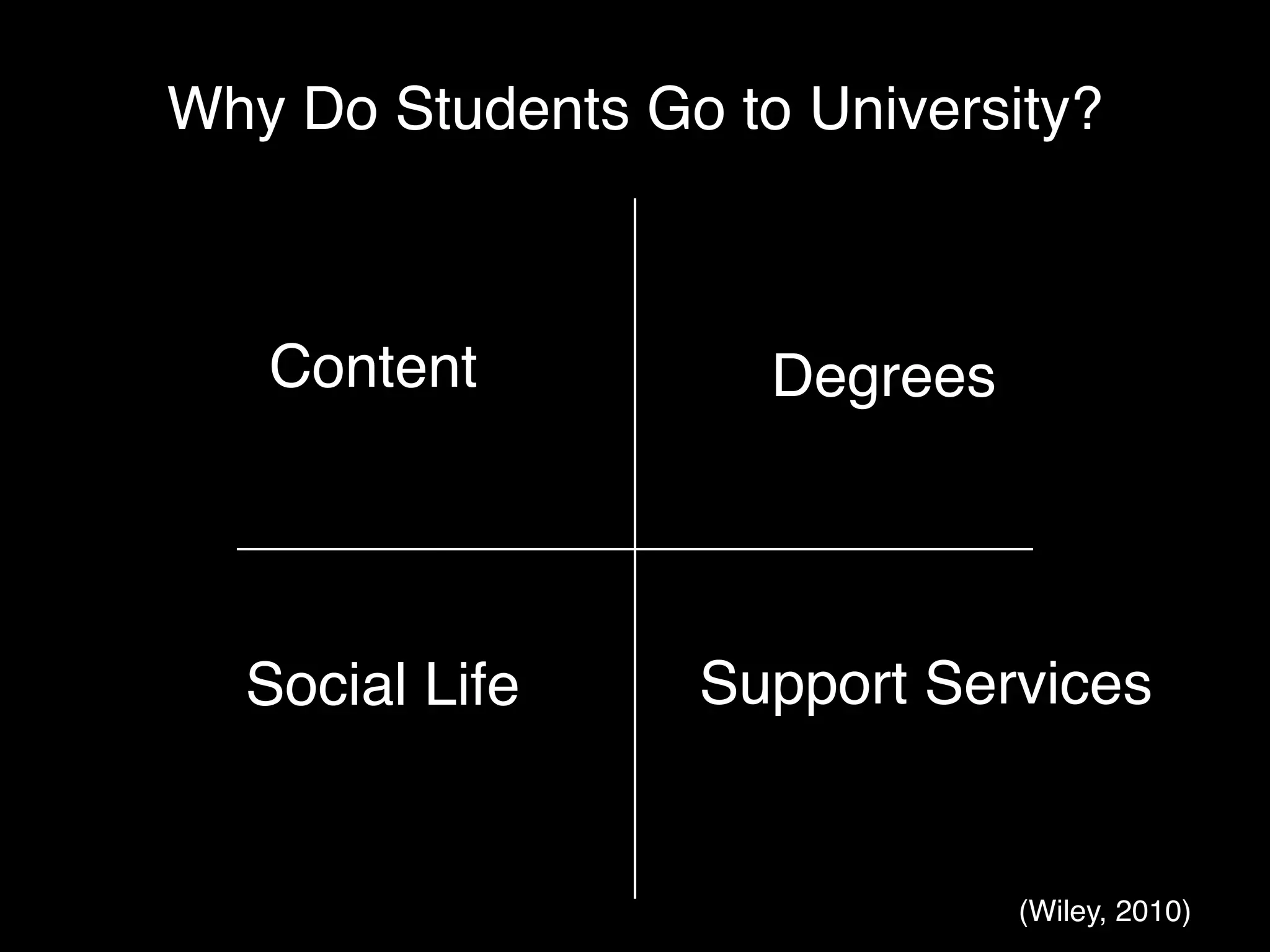
Why Do Students Go to University?


   Content           Degrees


  Social Life     Support Services


                               (Wiley, 2010)
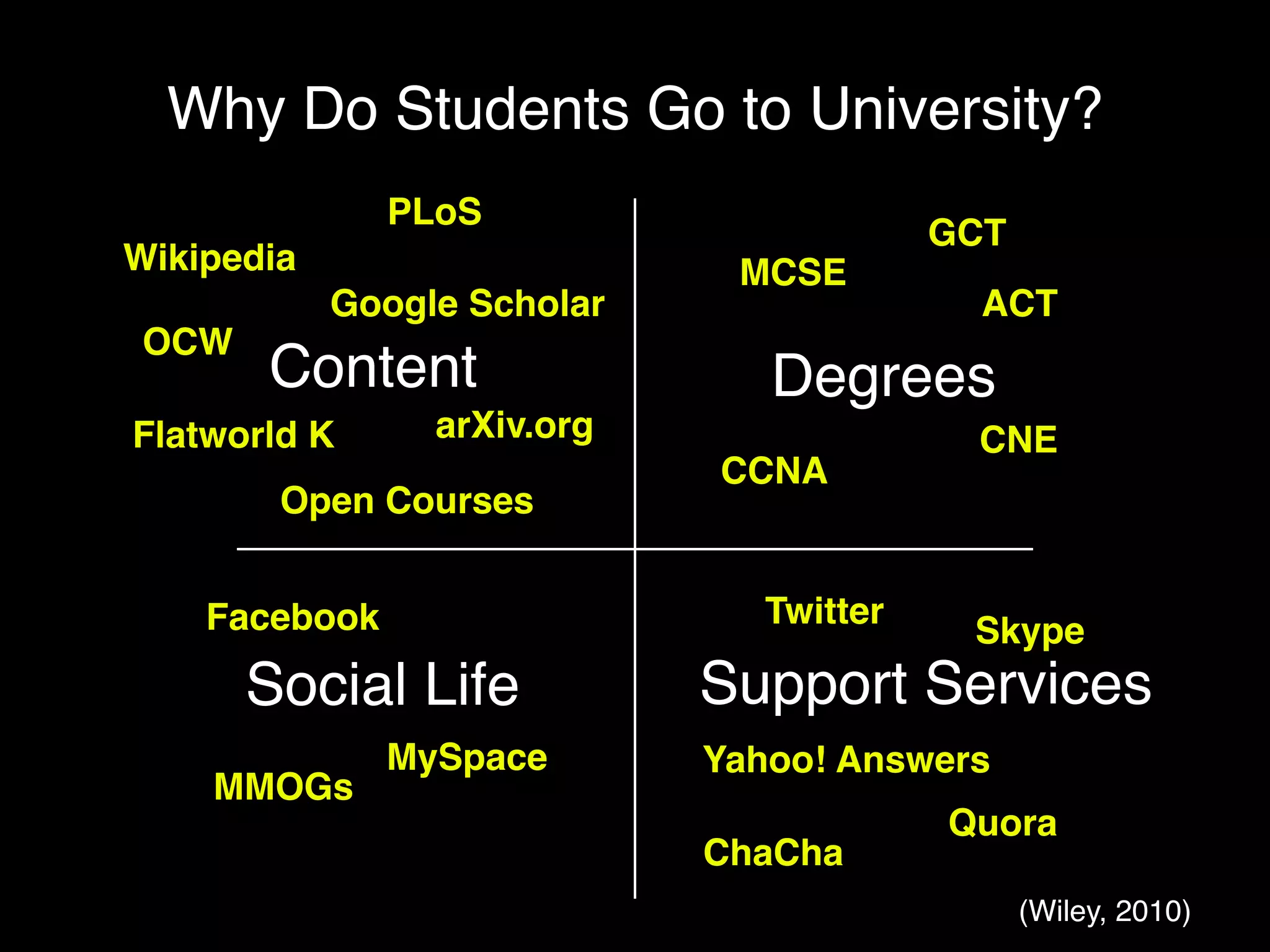
Why Do Students Go to University?
               PLoS
                                          GCT
Wikipedia                     MCSE
            Google Scholar                  ACT
 OCW
       Content                  Degrees
Flatworld K      arXiv.org                 CNE
                             CCNA
        Open Courses


    Facebook                    Twitter
                                           Skype
       Social Life           Support Services
               MySpace       Yahoo! Answers
    MMOGs
                                          Quora
                             ChaCha
                                                (Wiley, 2010)
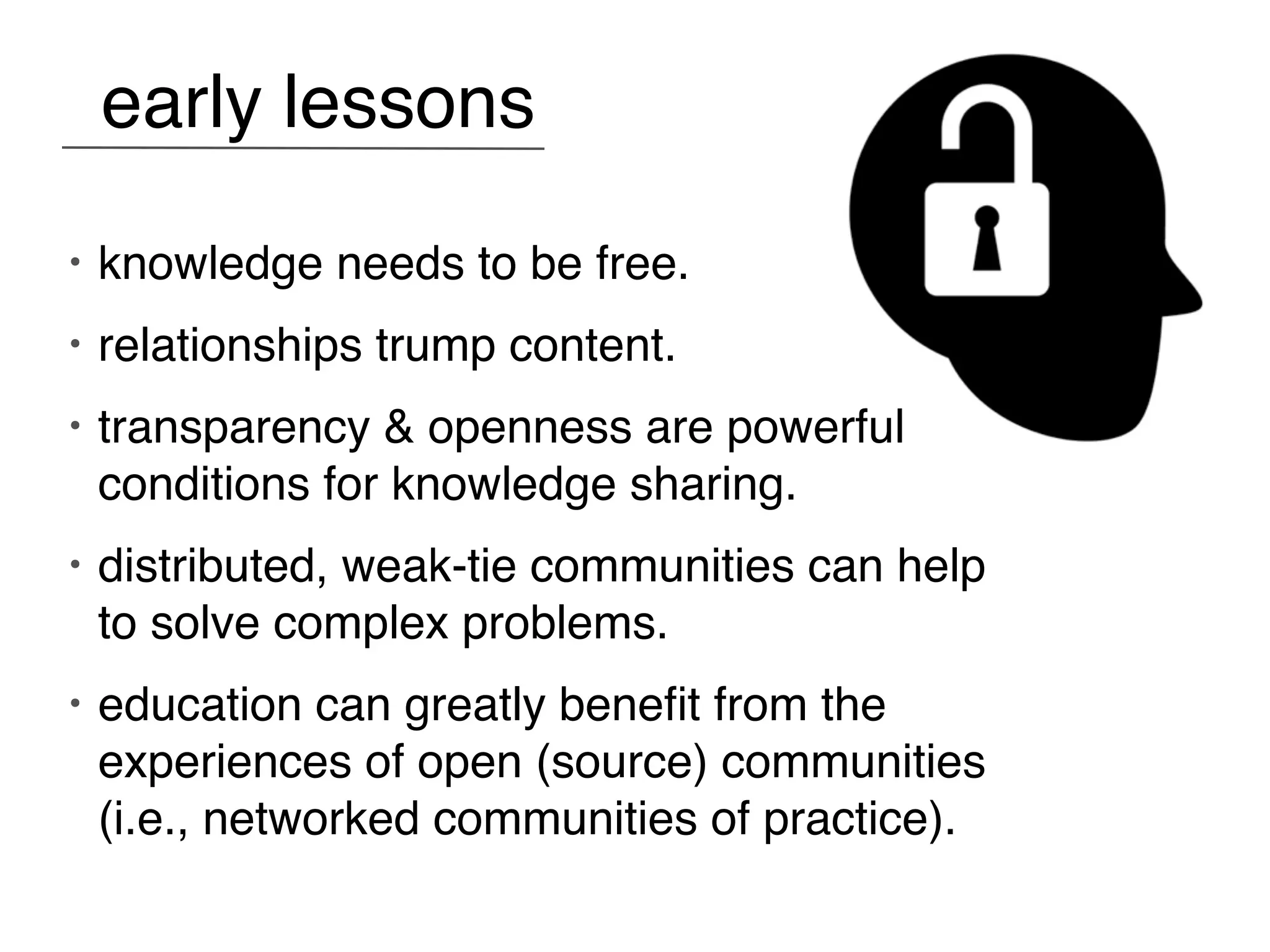
early lessons
•   knowledge needs to be free.
•   relationships trump content.
•   transparency & openness are powerful
    conditions for knowledge sharing.
•   distributed, weak-tie communities can help
    to solve complex problems.
•   education can greatly benefit from the
    experiences of open (source) communities
    (i.e., networked communities of practice).
participatory media
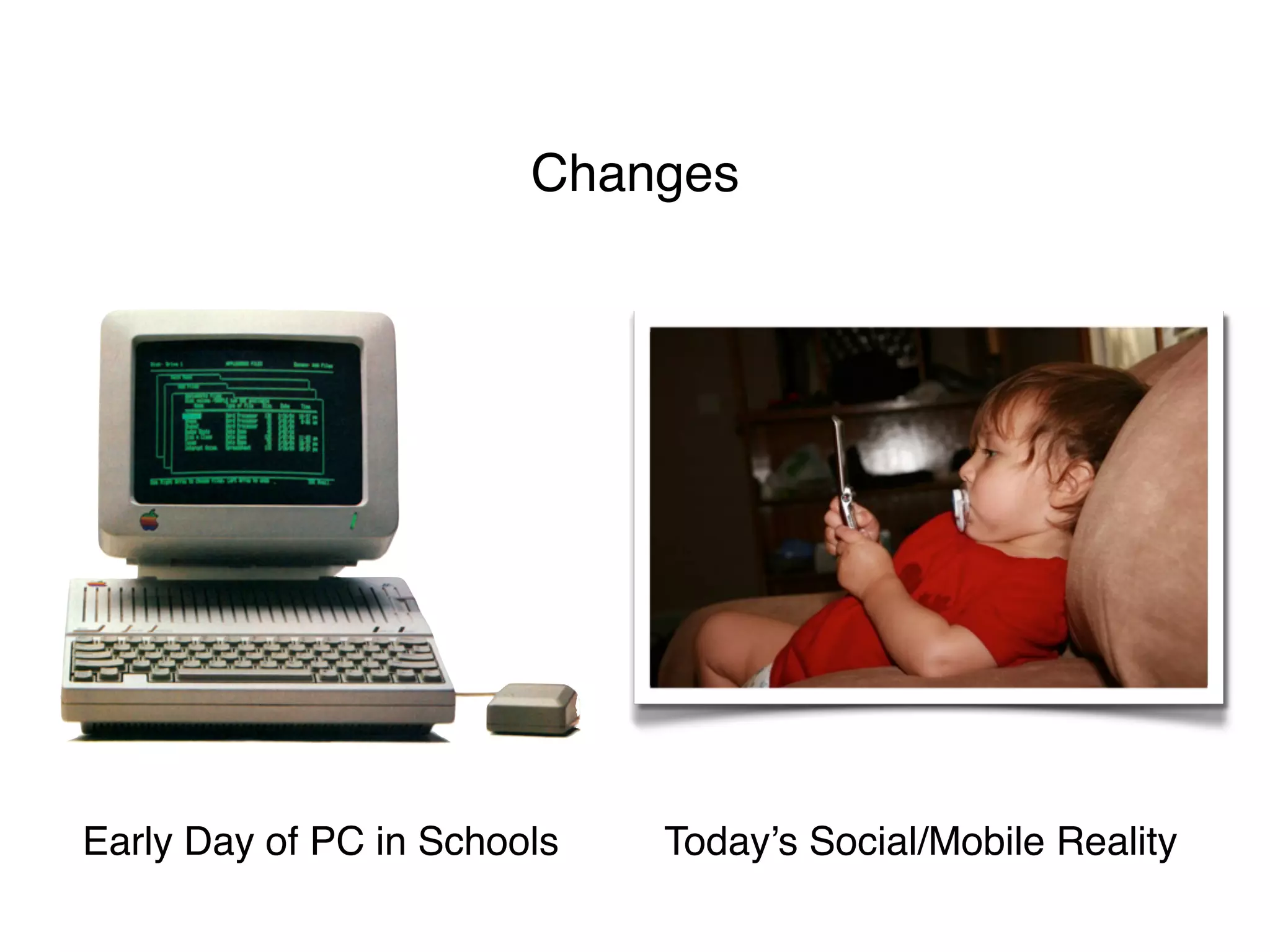
Changes


Early Day of PC in Schools   Today’s Social/Mobile Reality
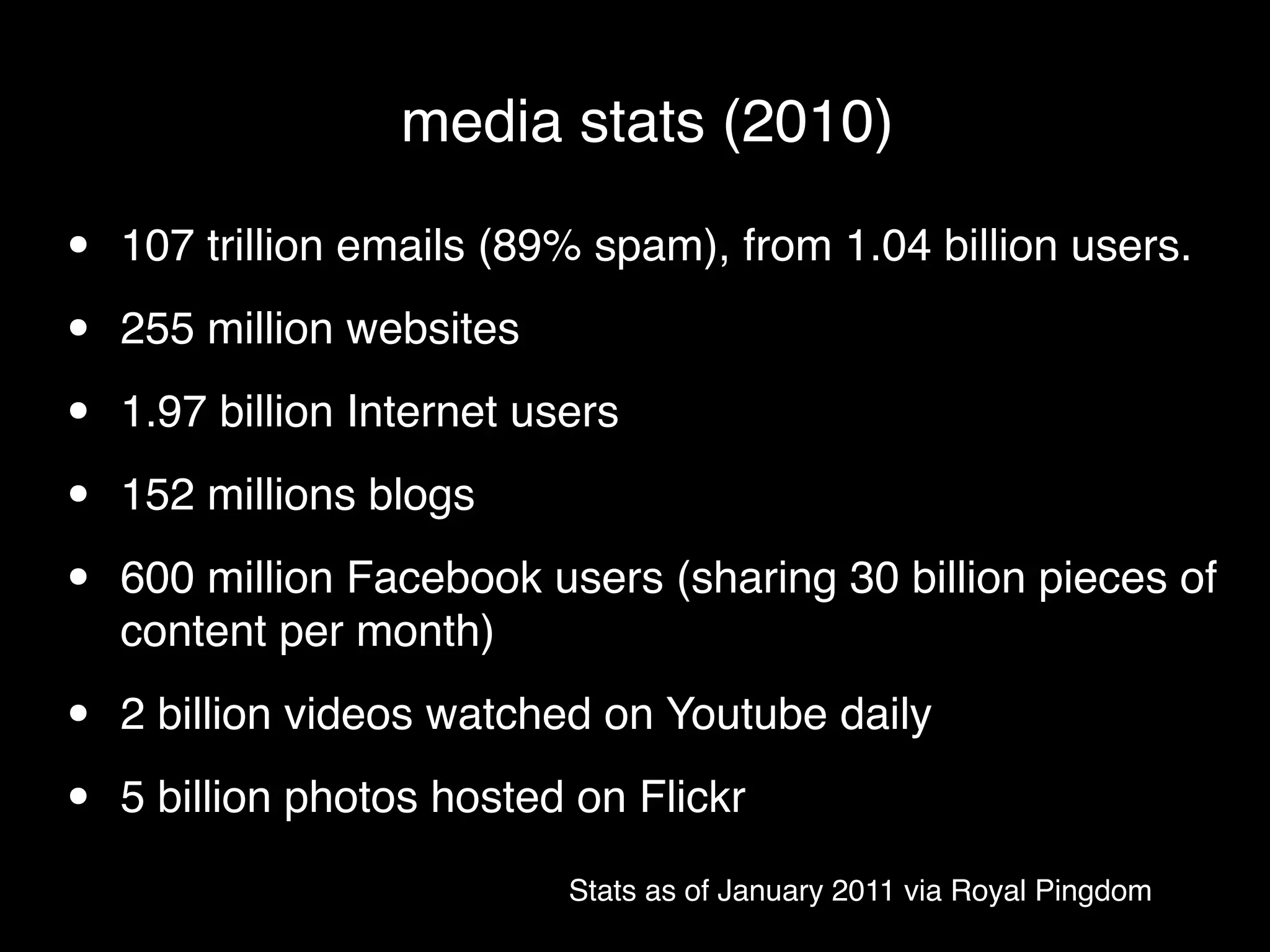
media stats (2010)

•   107 trillion emails (89% spam), from 1.04 billion users.

•   255 million websites

•   1.97 billion Internet users

•   152 millions blogs

•   600 million Facebook users (sharing 30 billion pieces of
    content per month)

•   2 billion videos watched on Youtube daily

•   5 billion photos hosted on Flickr
                            Stats as of January 2011 via Royal Pingdom
cautions
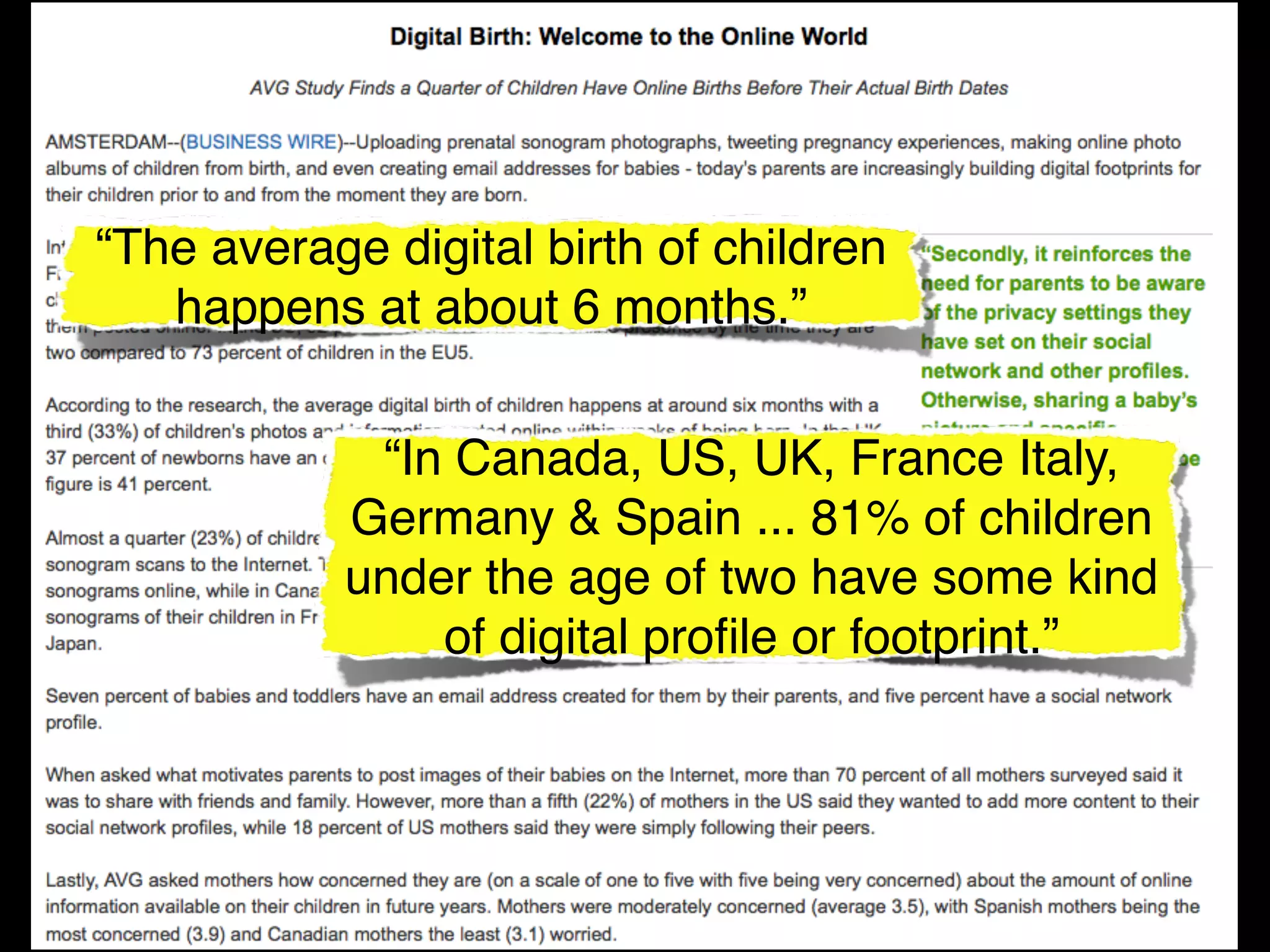
“The average digital birth of children
   happens at about 6 months.”


            “In Canada, US, UK, France Italy,
           Germany & Spain ... 81% of children
           under the age of two have some kind
               of digital profile or footprint.”
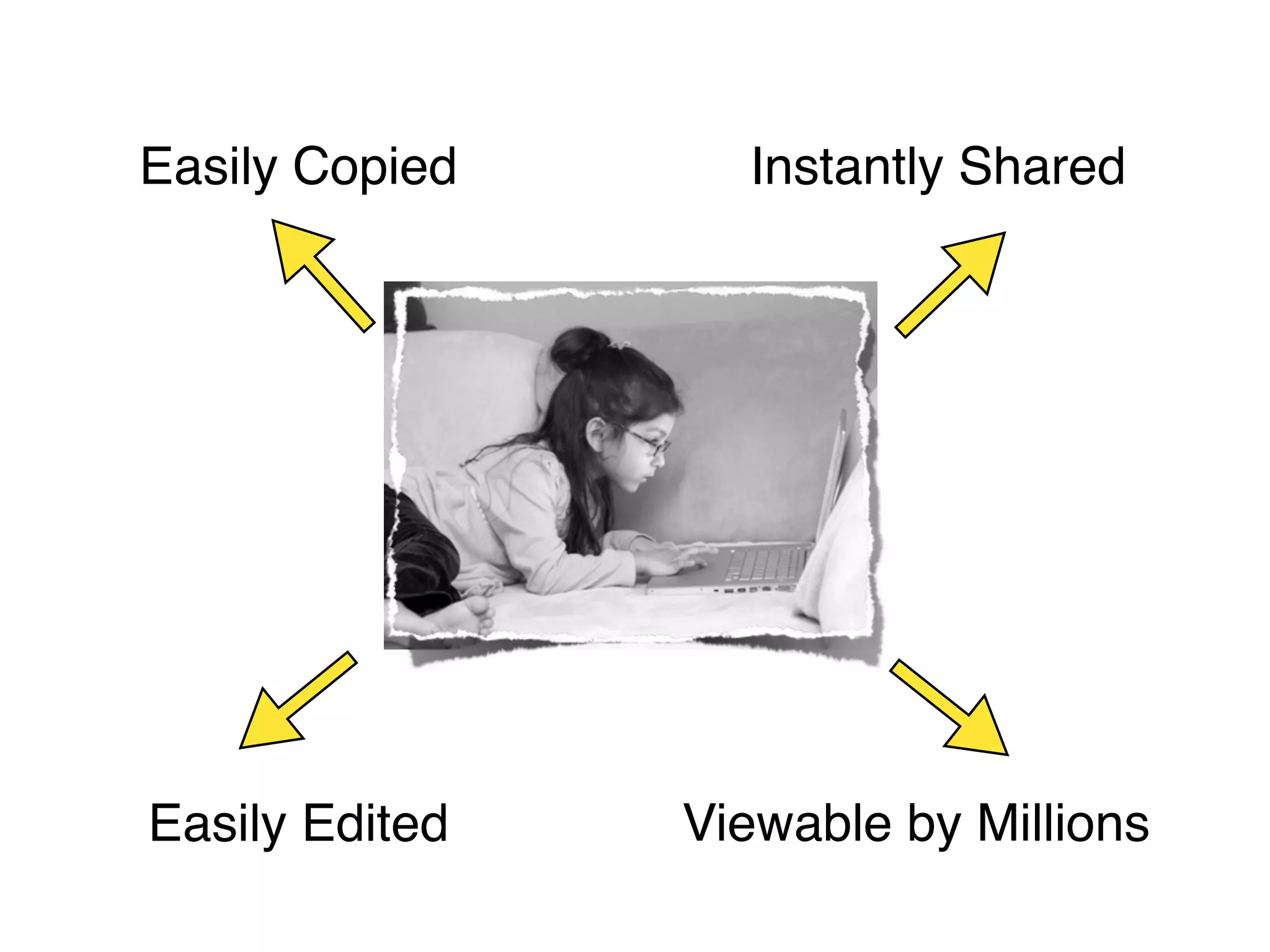
Easily Copied     Instantly Shared


Easily Edited   Viewable by Millions
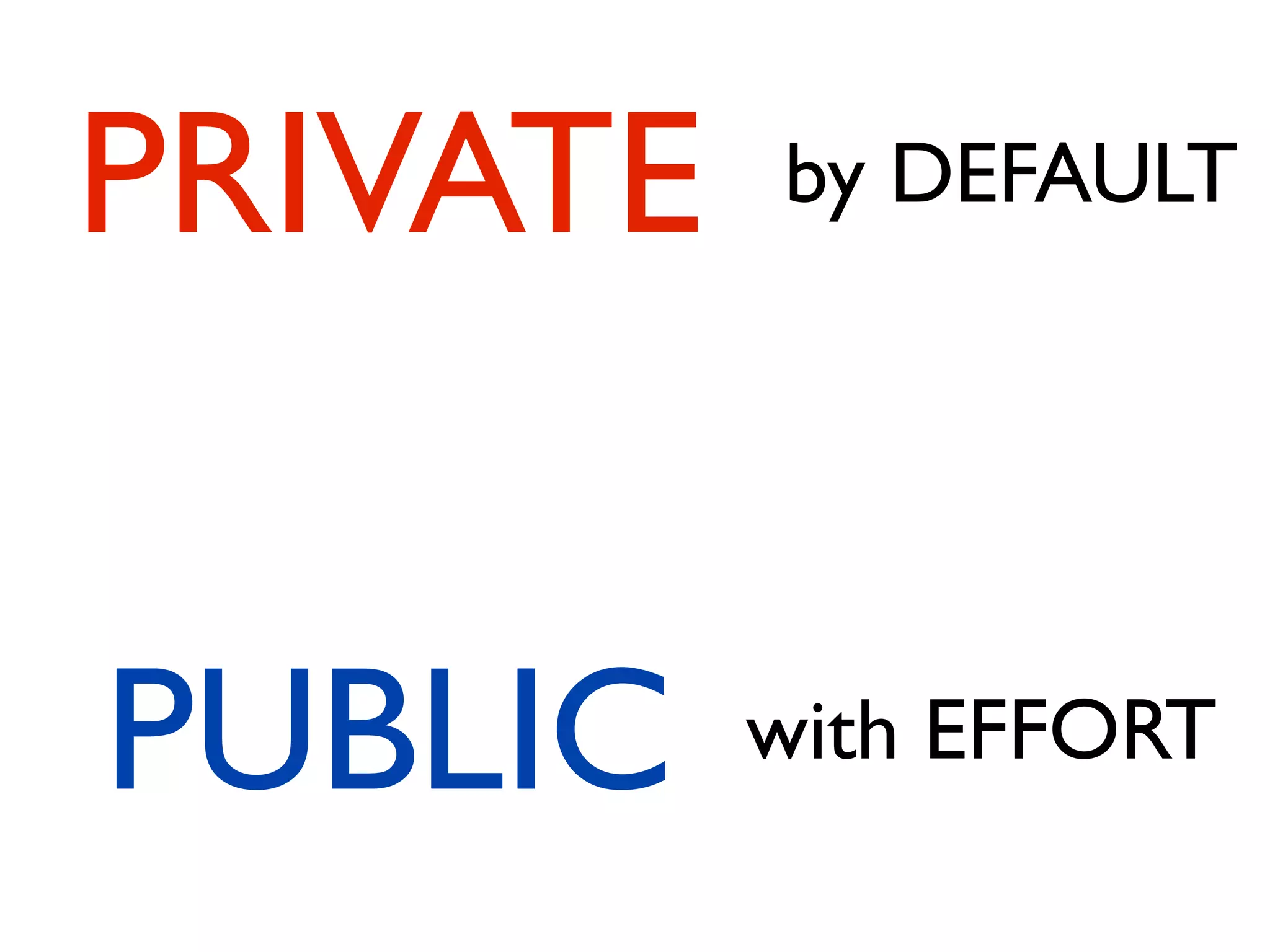
PRIVATE   by DEFAULT


PUBLIC    with EFFORT
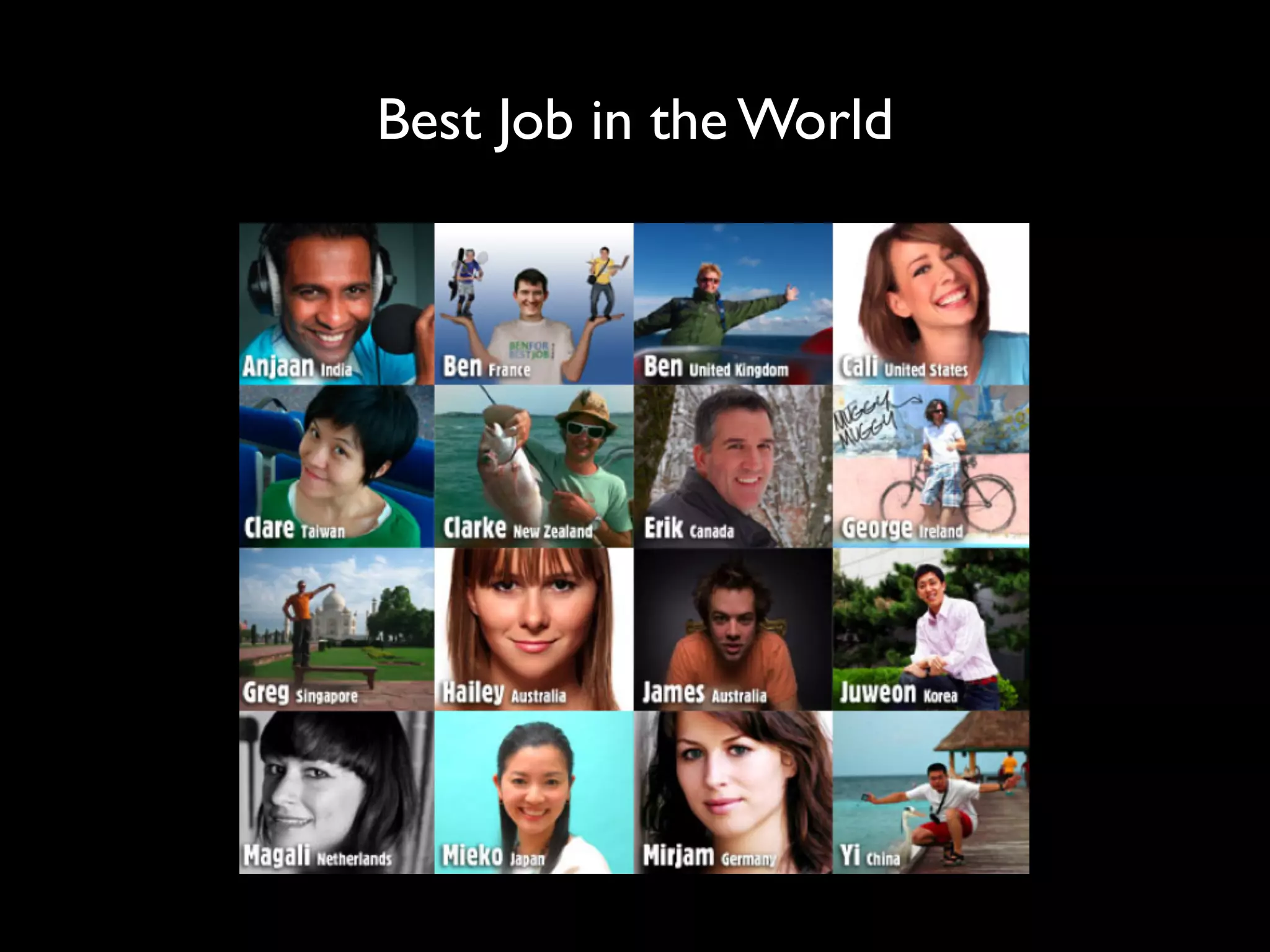
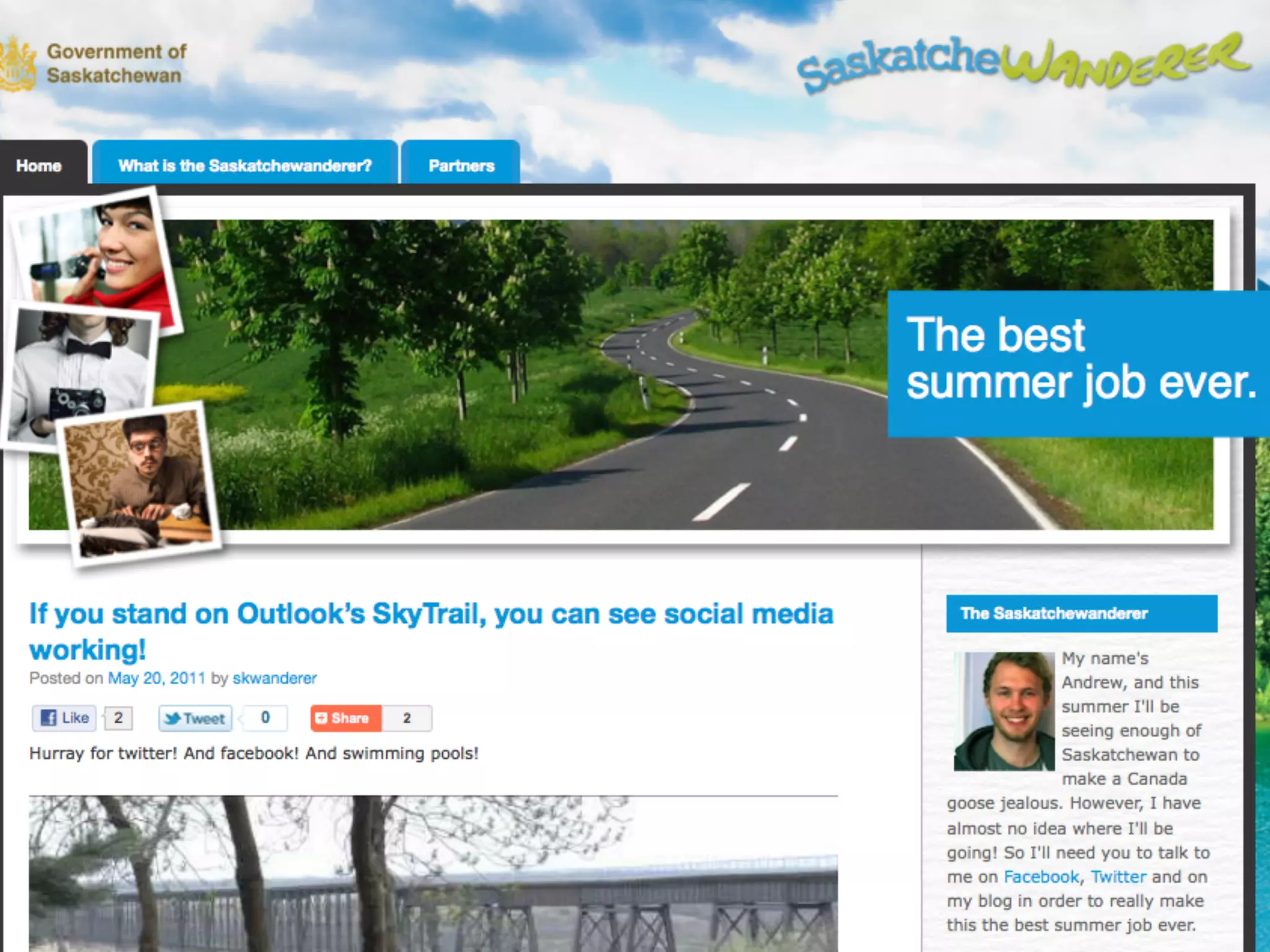
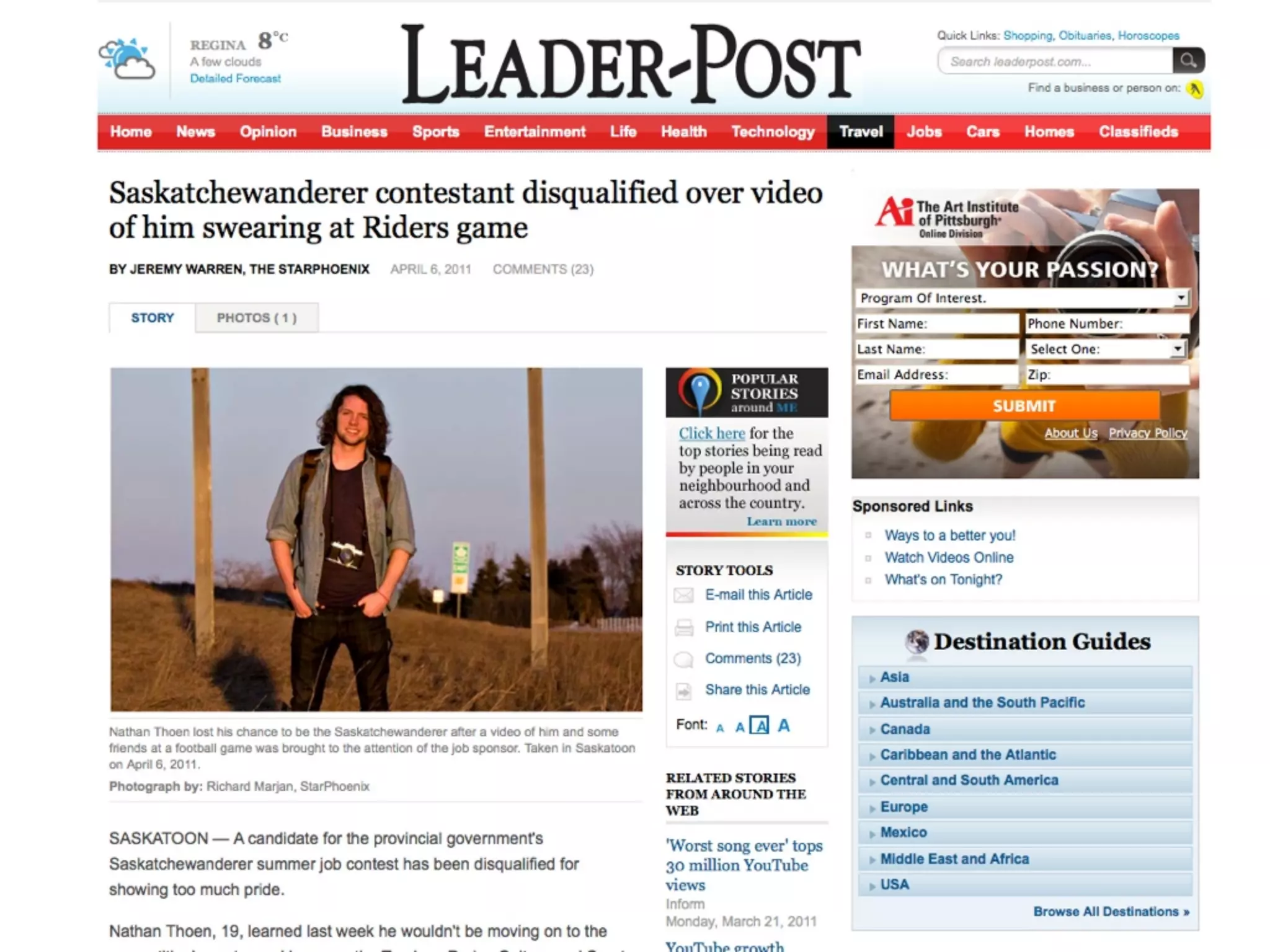
Best Job in the World
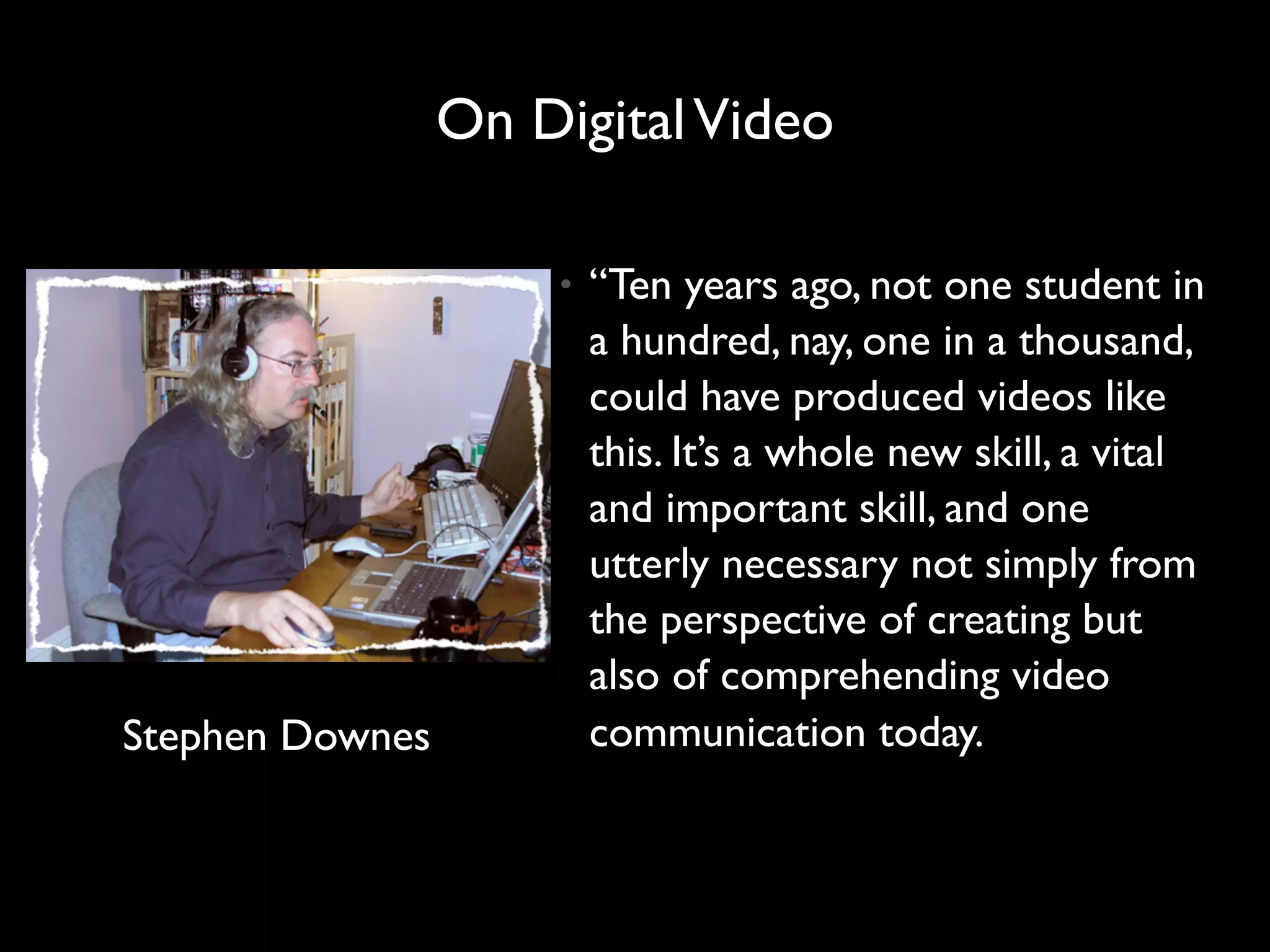
On Digital Video

                     •   “Ten years ago, not one student in
                         a hundred, nay, one in a thousand,
                         could have produced videos like
                         this. It’s a whole new skill, a vital
                         and important skill, and one
                         utterly necessary not simply from
                         the perspective of creating but
                         also of comprehending video
Stephen Downes           communication today.
affordances
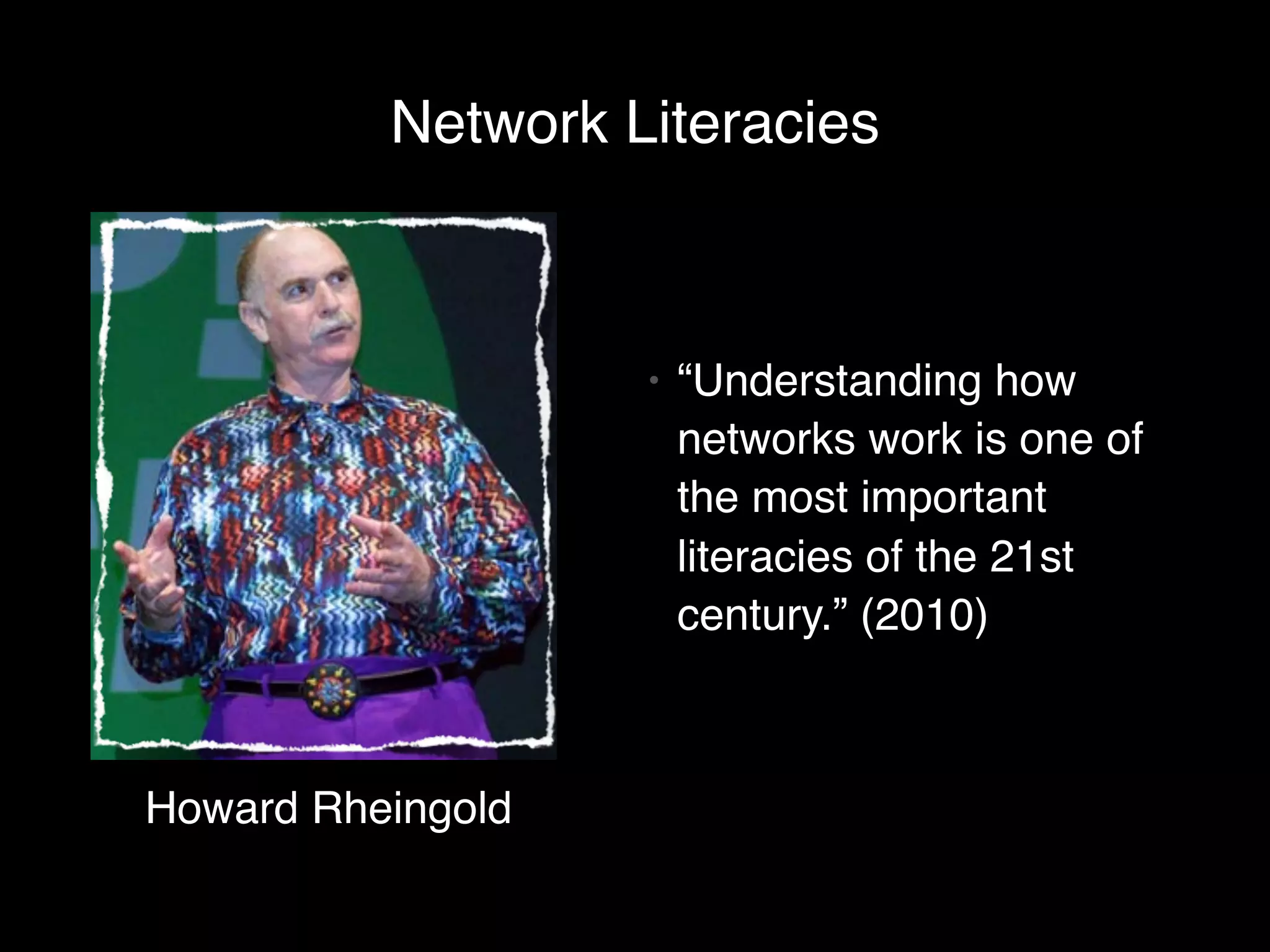
Network Literacies


                   •   “Understanding how
                       networks work is one of
                       the most important
                       literacies of the 21st
                       century.” (2010)


Howard Rheingold
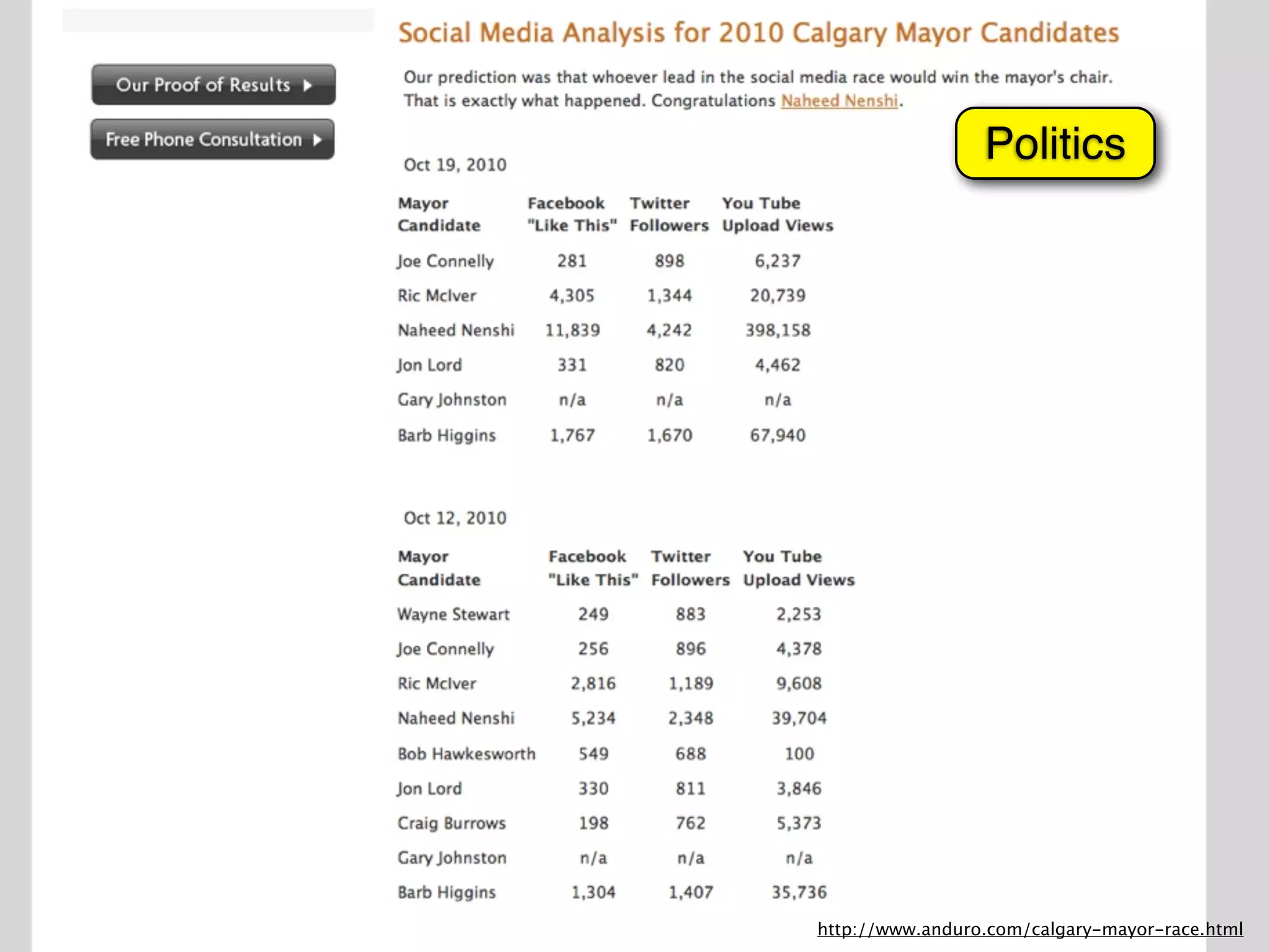
Politics


Howard Rheingold

                   http://www.anduro.com/calgary-mayor-race.html
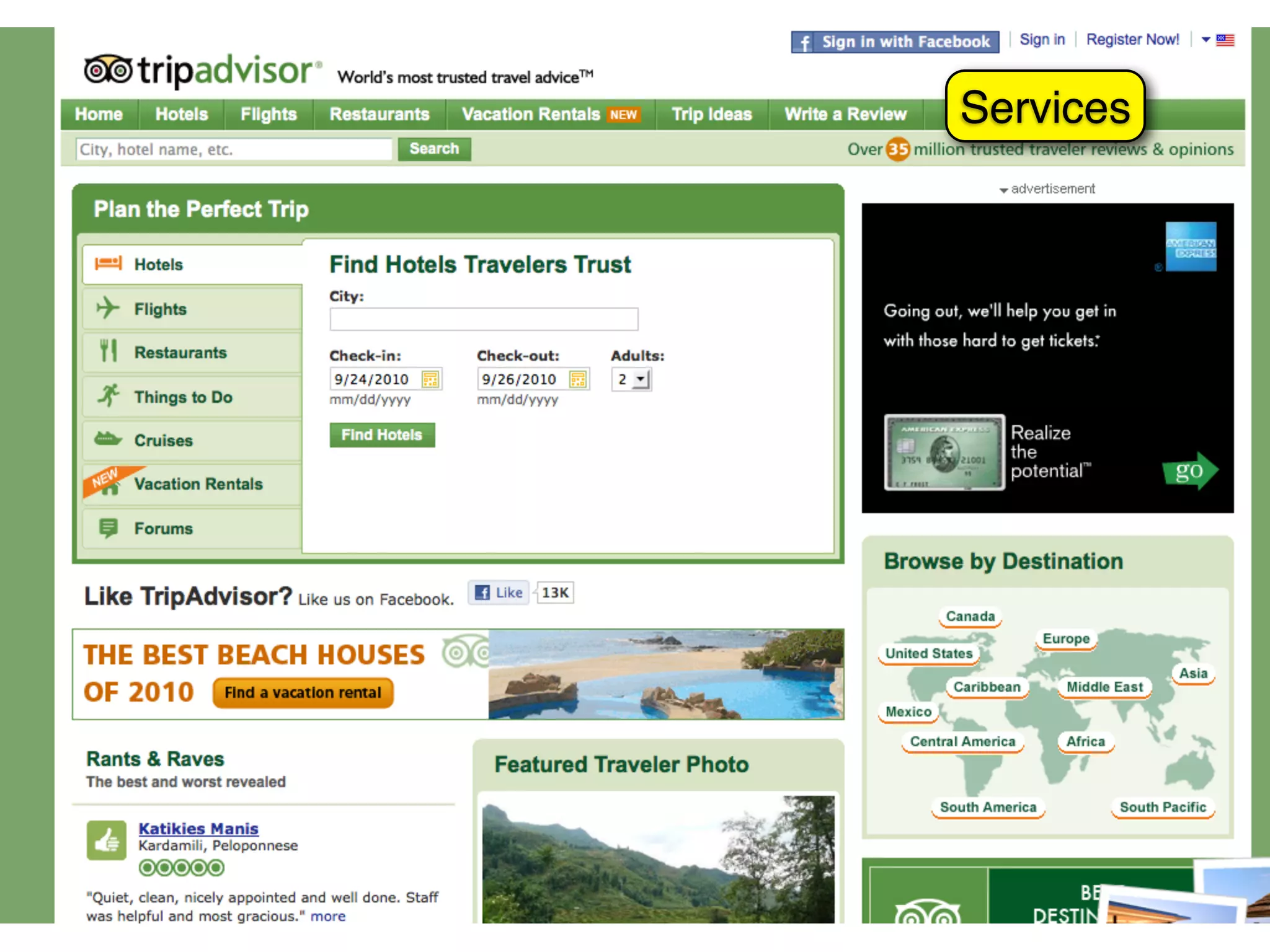
Services
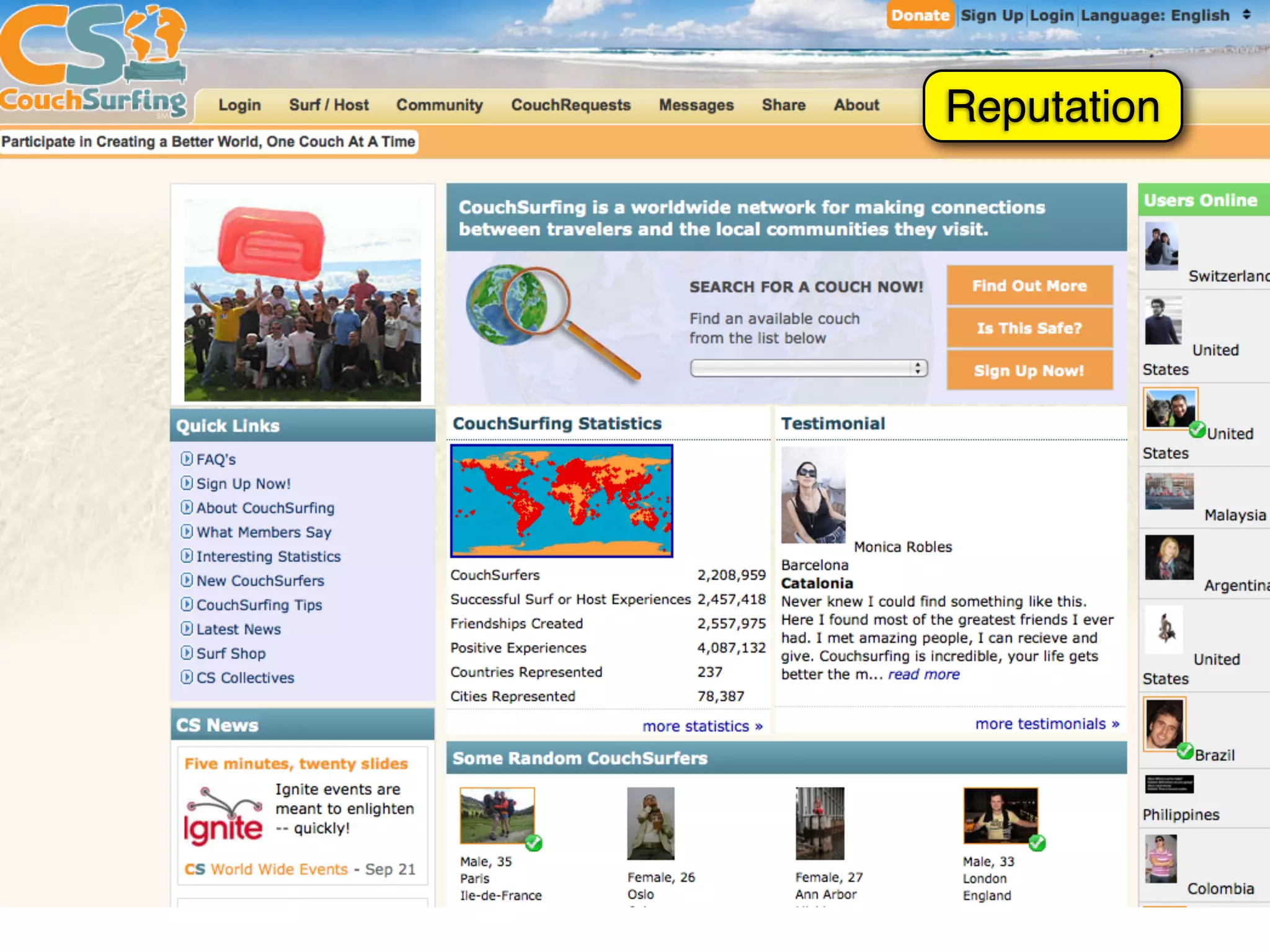
Reputation
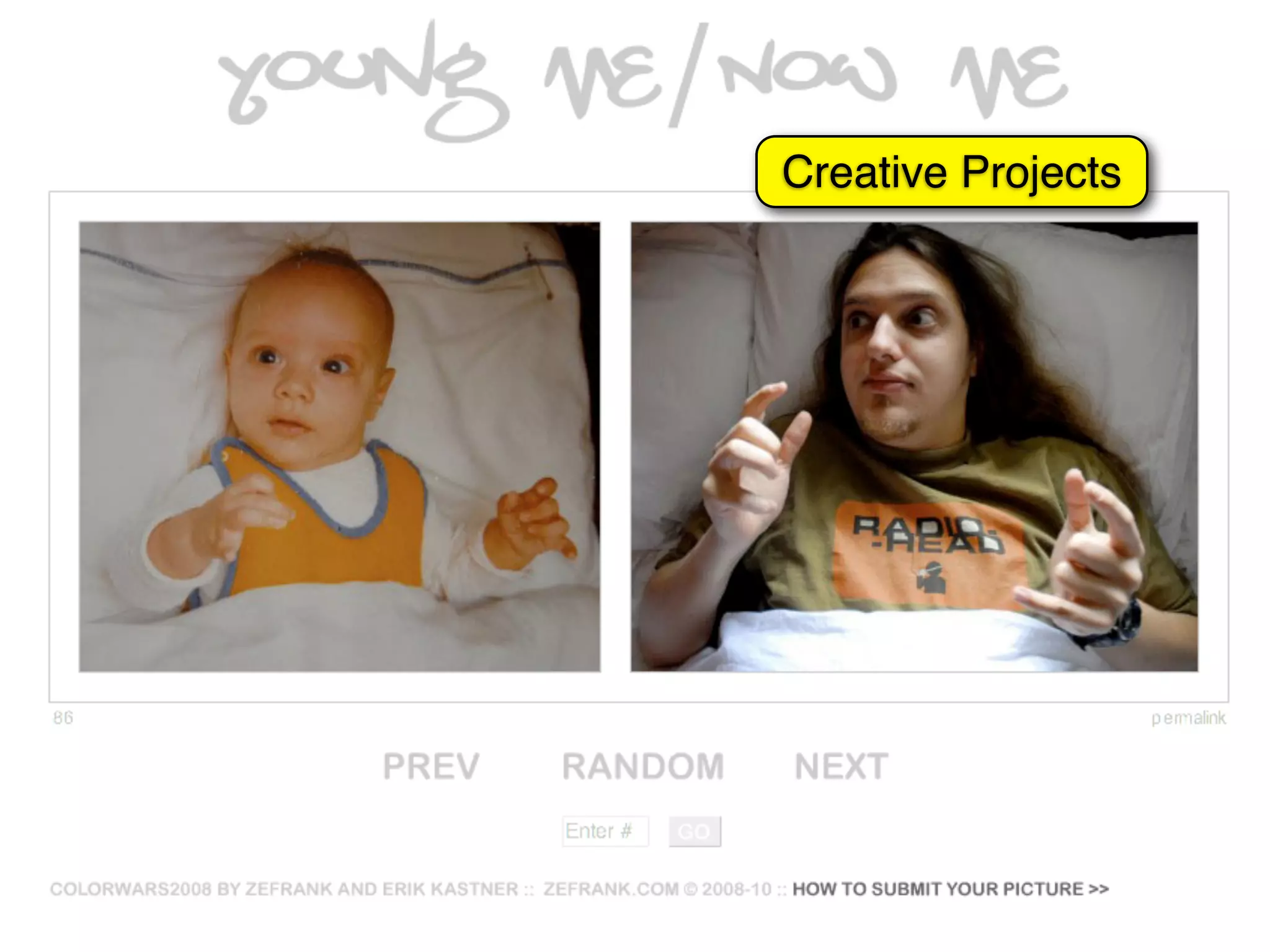
Creative Projects
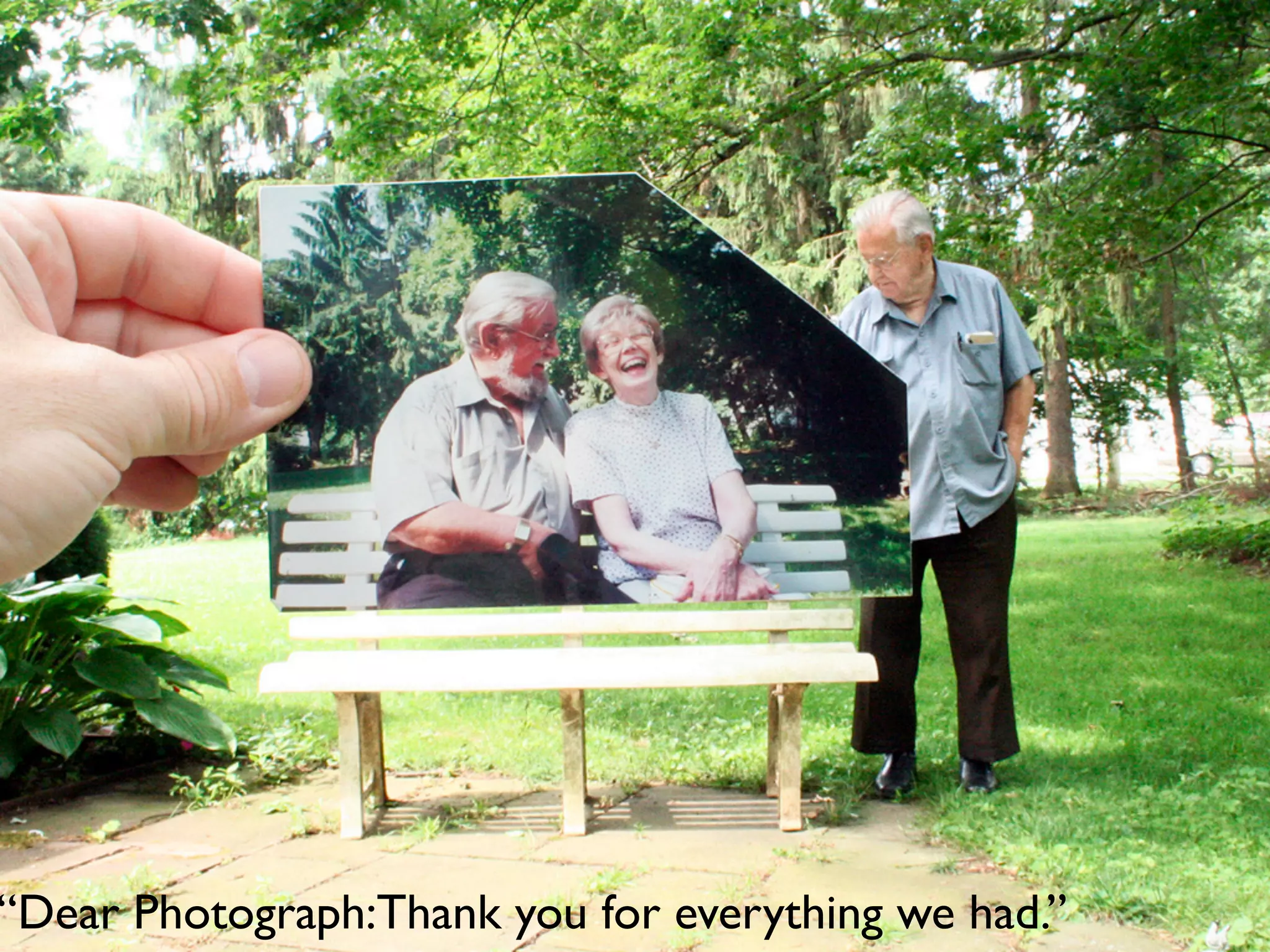
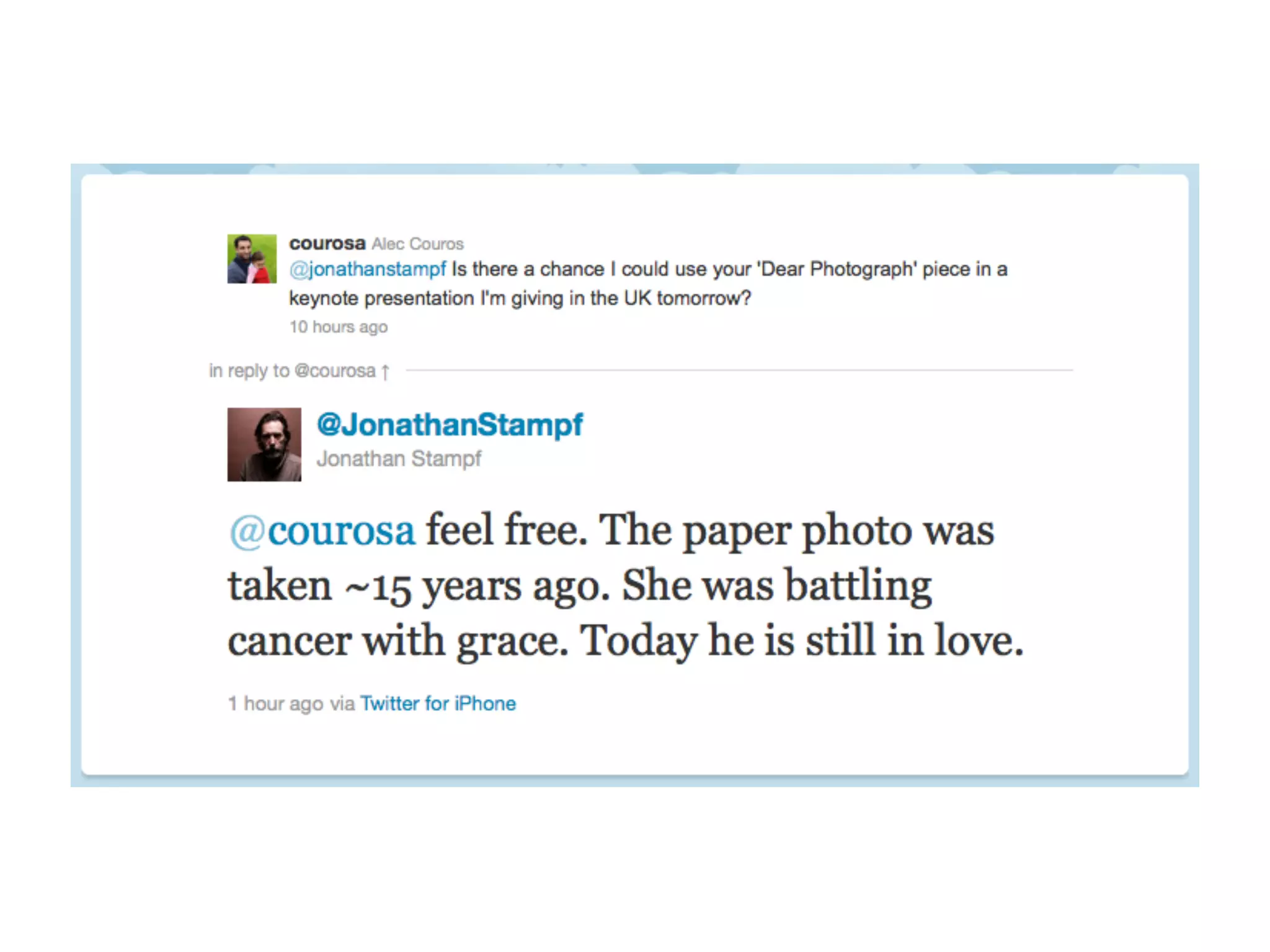
“Dear Photograph:Thank you for everything we had.”
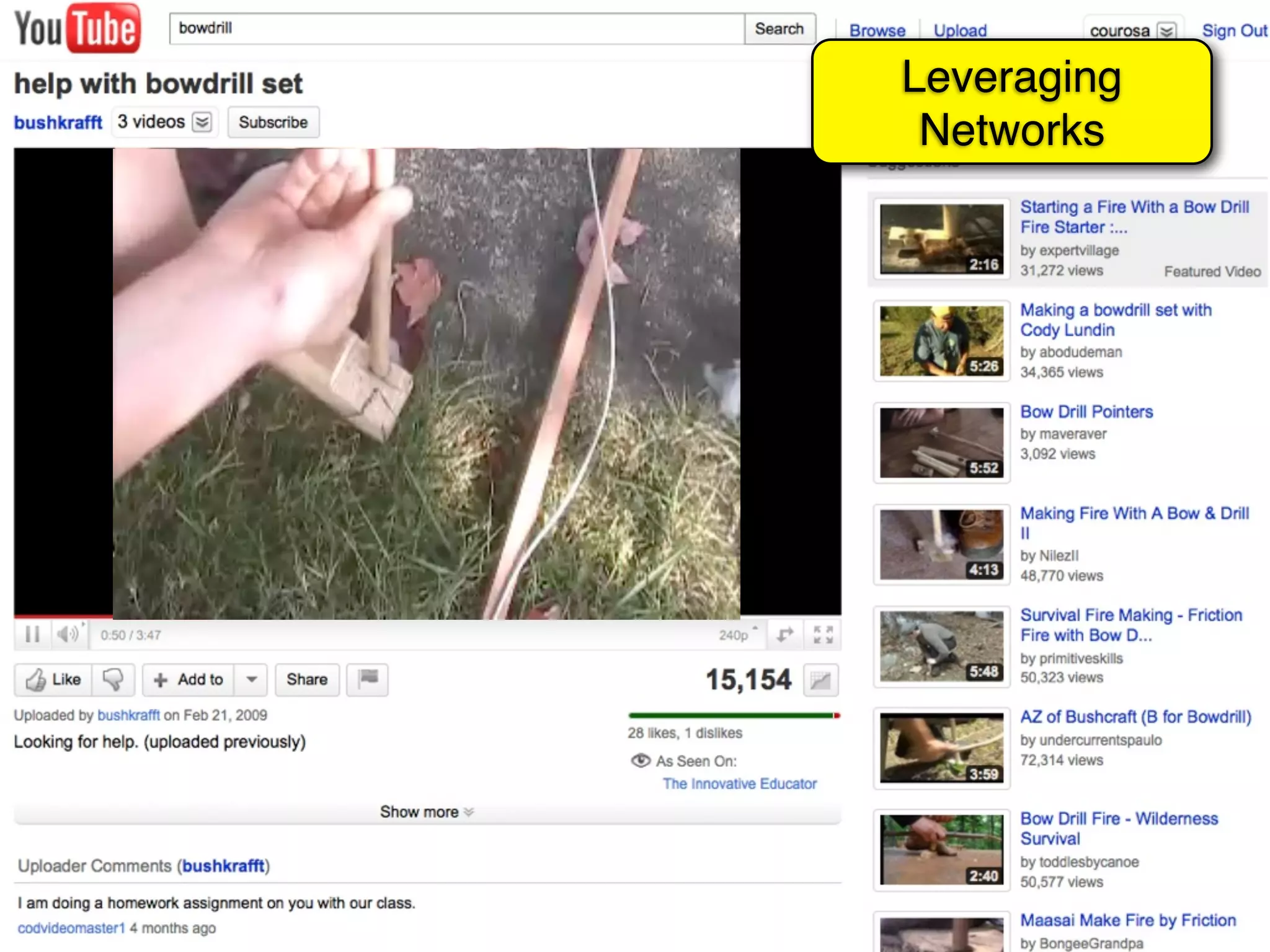
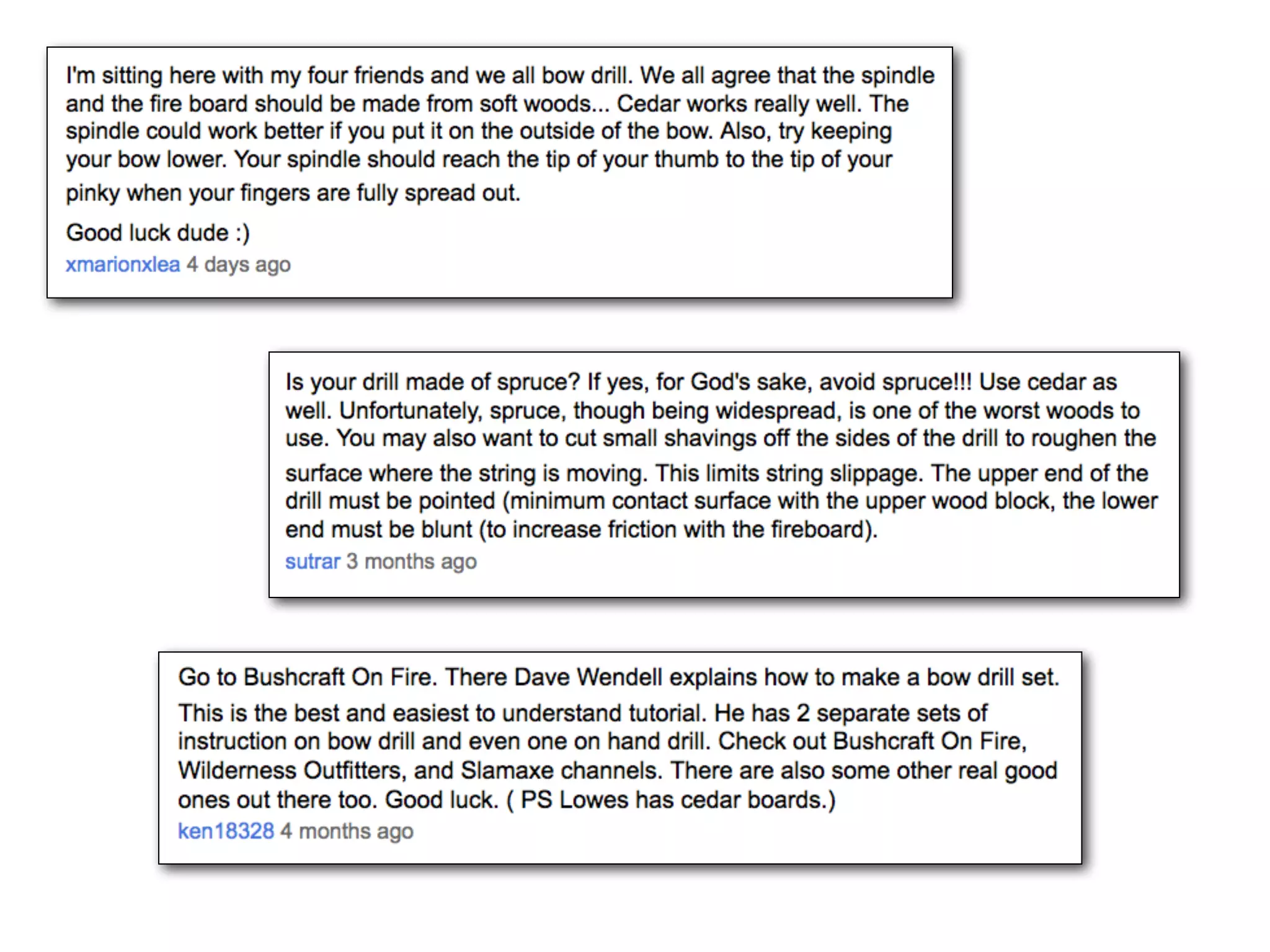
Leveraging
 Networks
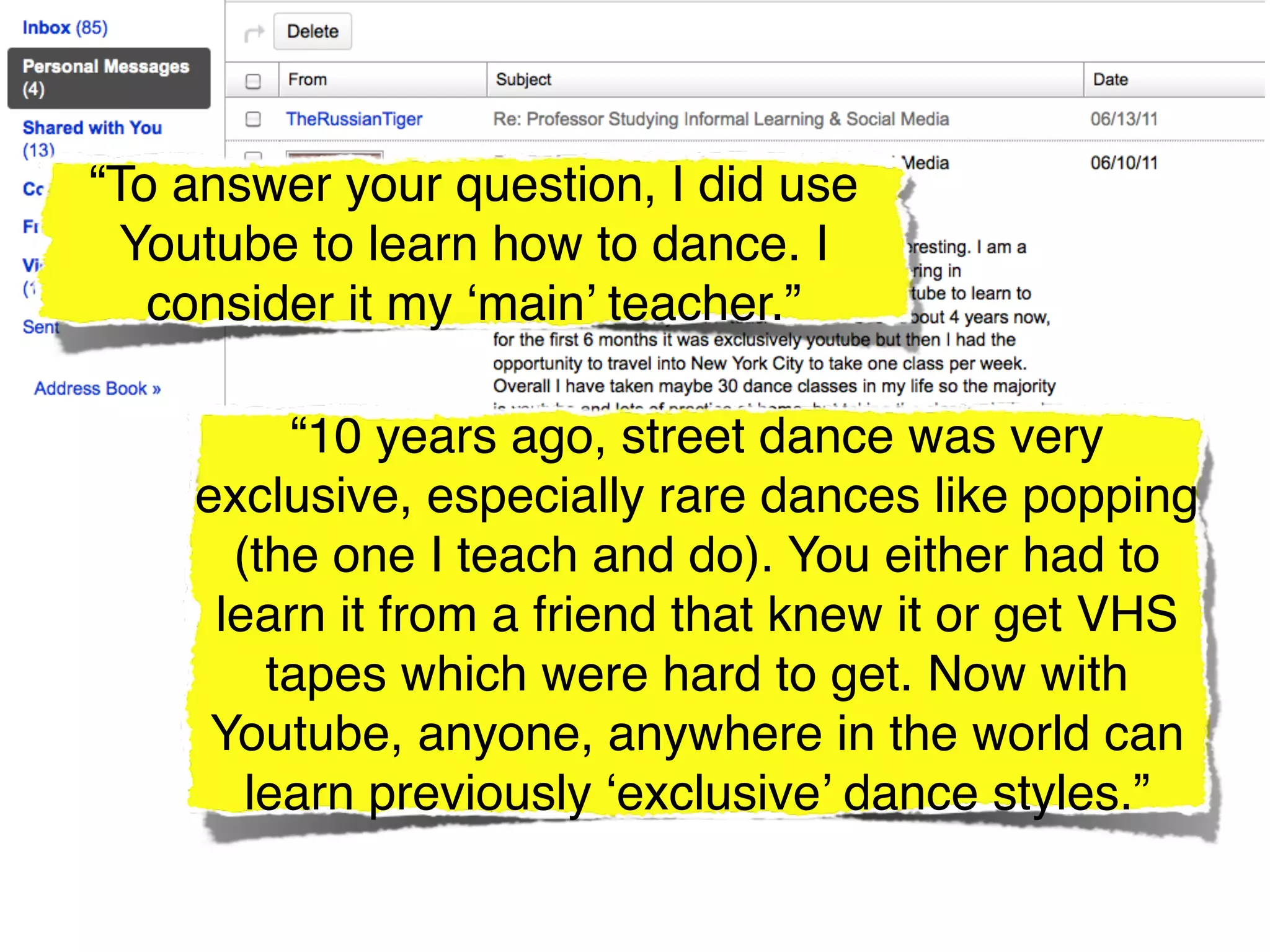
“To answer your question, I did use
  Youtube to learn how to dance. I
   consider it my ‘main’ teacher.”

         “10 years ago, street dance was very
    exclusive, especially rare dances like popping
      (the one I teach and do). You either had to
     learn it from a friend that knew it or get VHS
        tapes which were hard to get. Now with
     Youtube, anyone, anywhere in the world can
       learn previously ‘exclusive’ dance styles.”
additional lessons
•   growing modes of access and the
    ability to publish & disseminate to wide
    audiences are key affordances.
•   (digital) citizenship & (digital) identity
    are emerging content areas that
    heavily implicate emerging
    pedagogies.
•   crowdsourcing & social curation of
    content will prove transformational for
    learning environments.
critical considerations
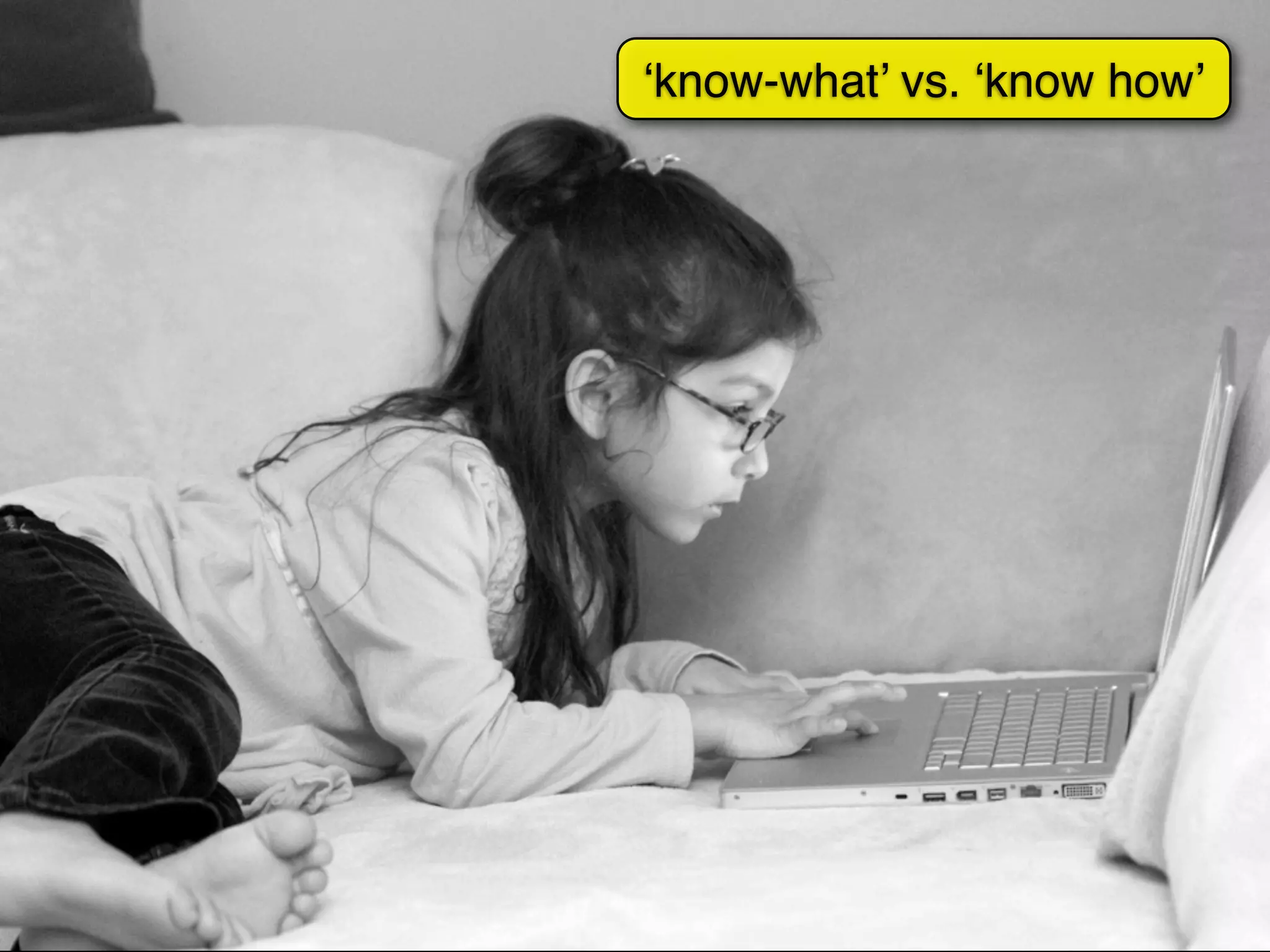
‘know-what’ vs. ‘know how’
new roles
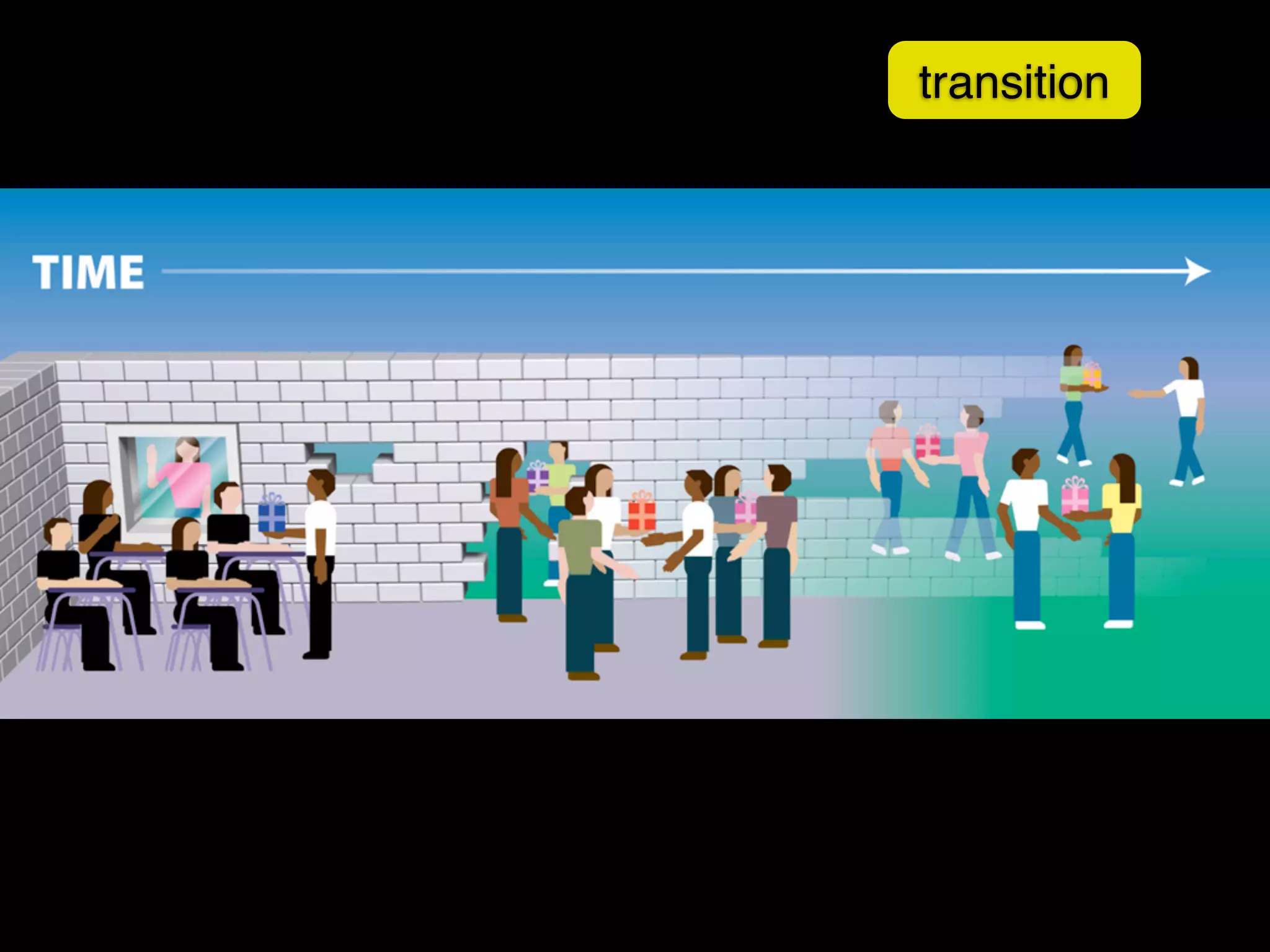
transition
inspirations
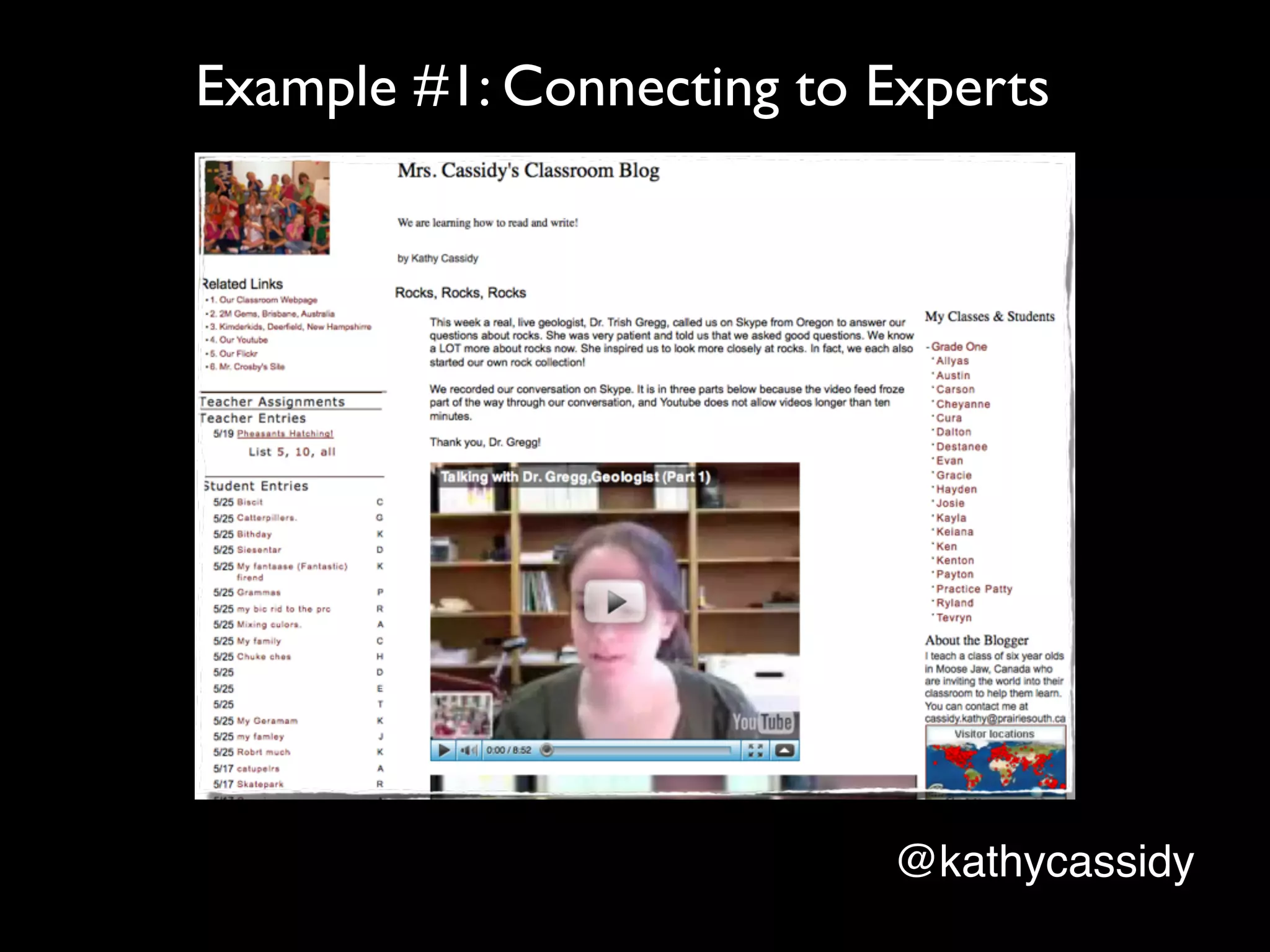
Example #1: Connecting to Experts


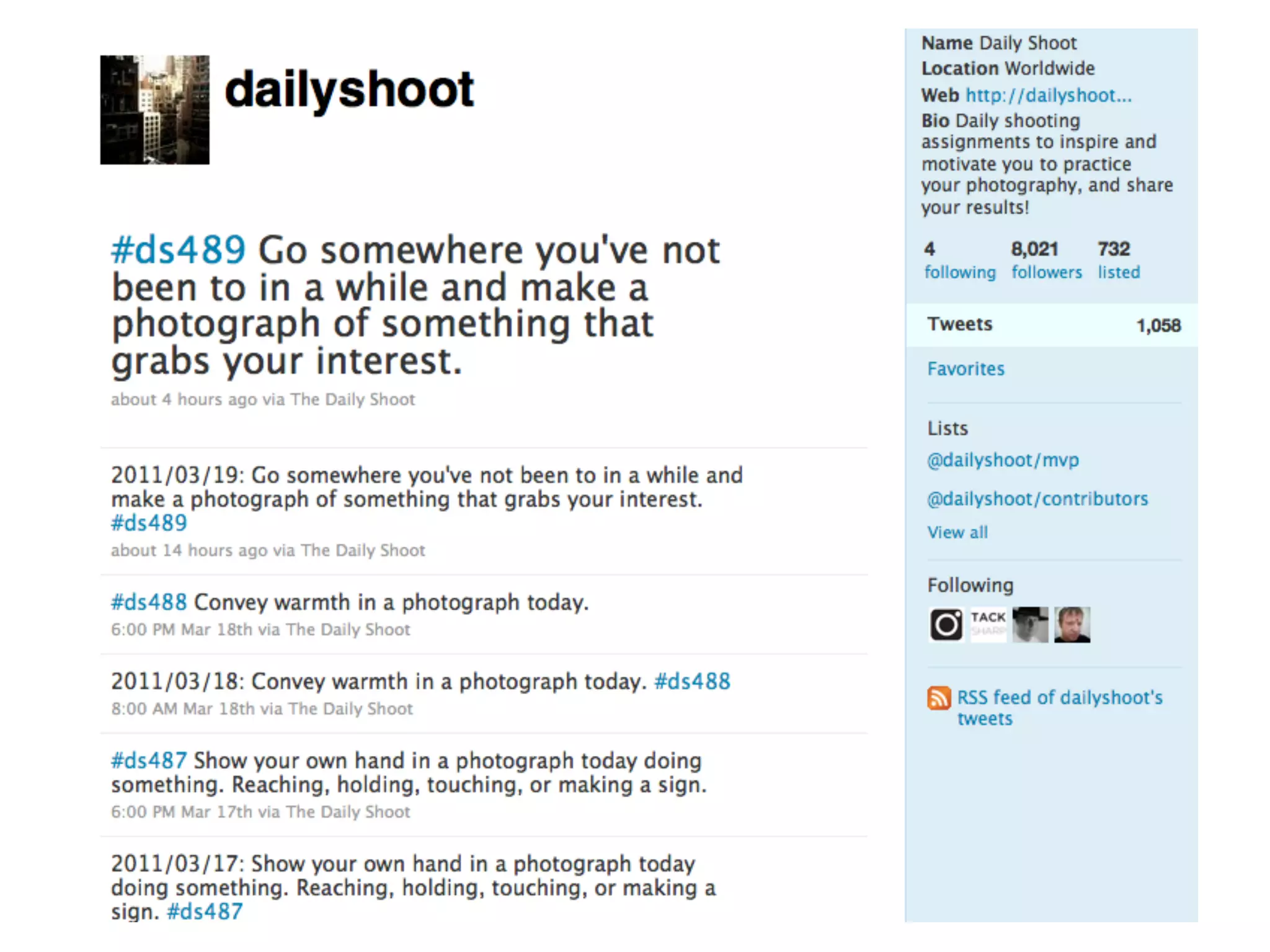
                          @kathycassidy
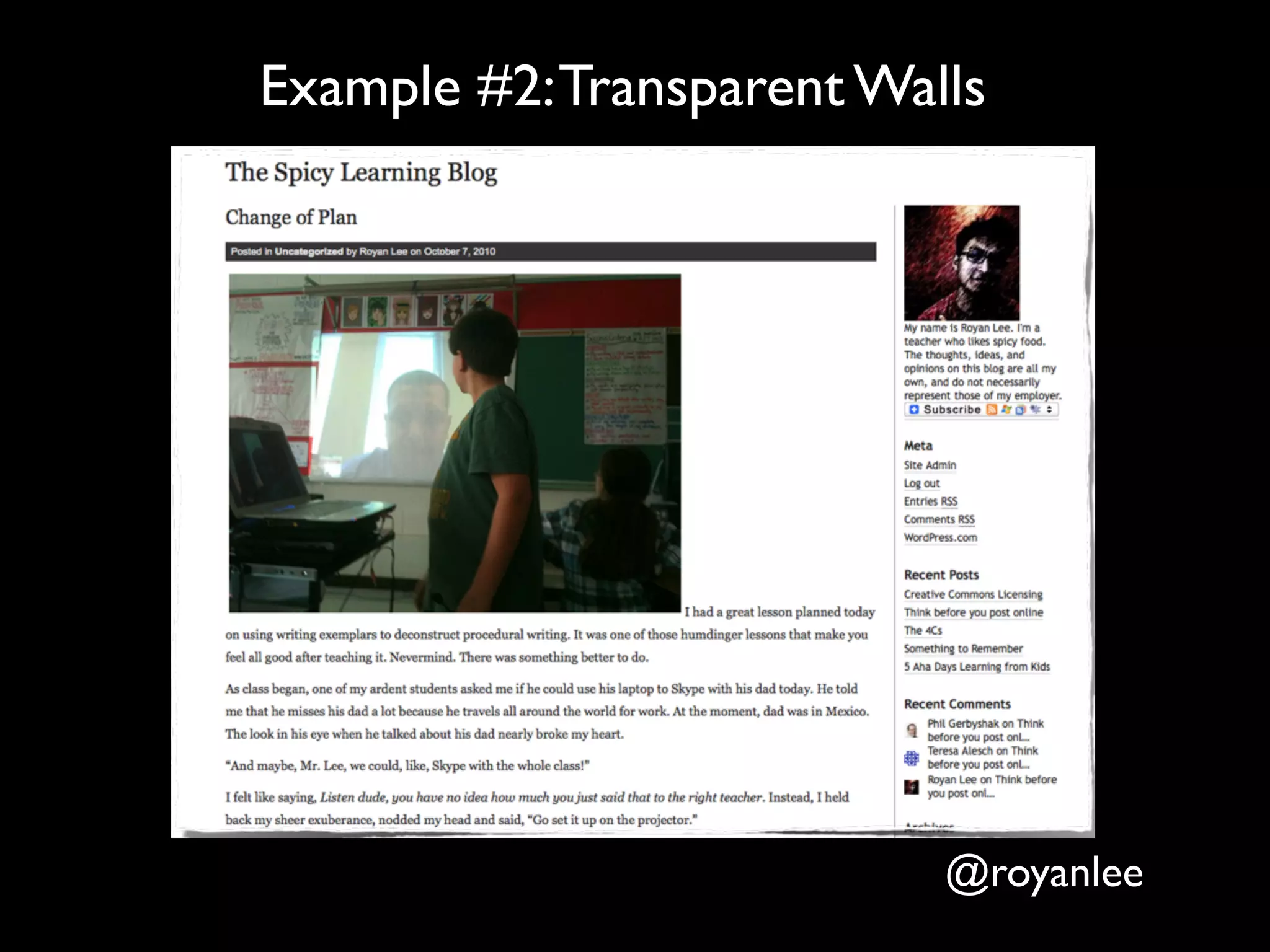
Example #2: Transparent Walls


                           @royanlee
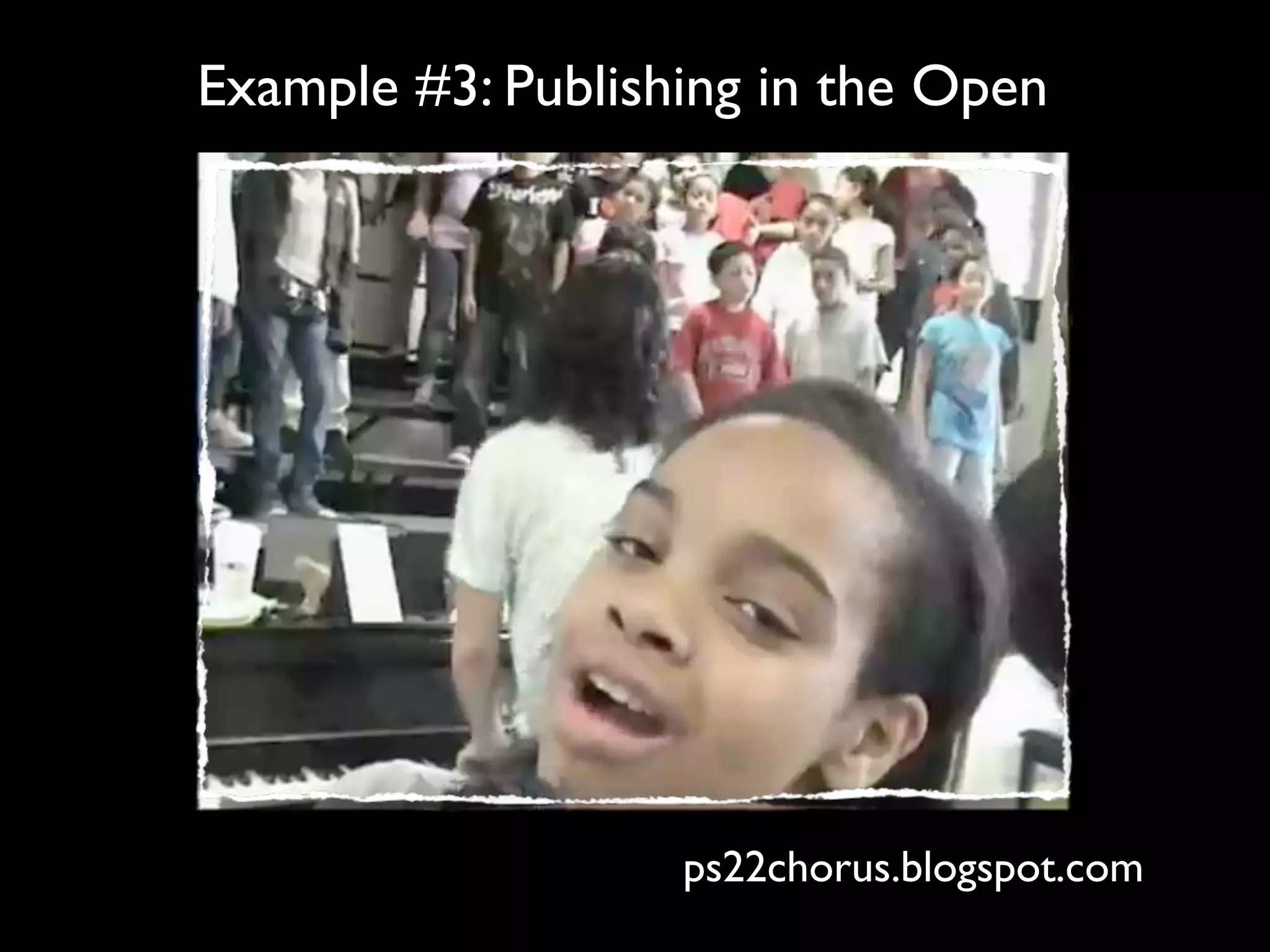
Example #3: Publishing in the Open


                   ps22chorus.blogspot.com
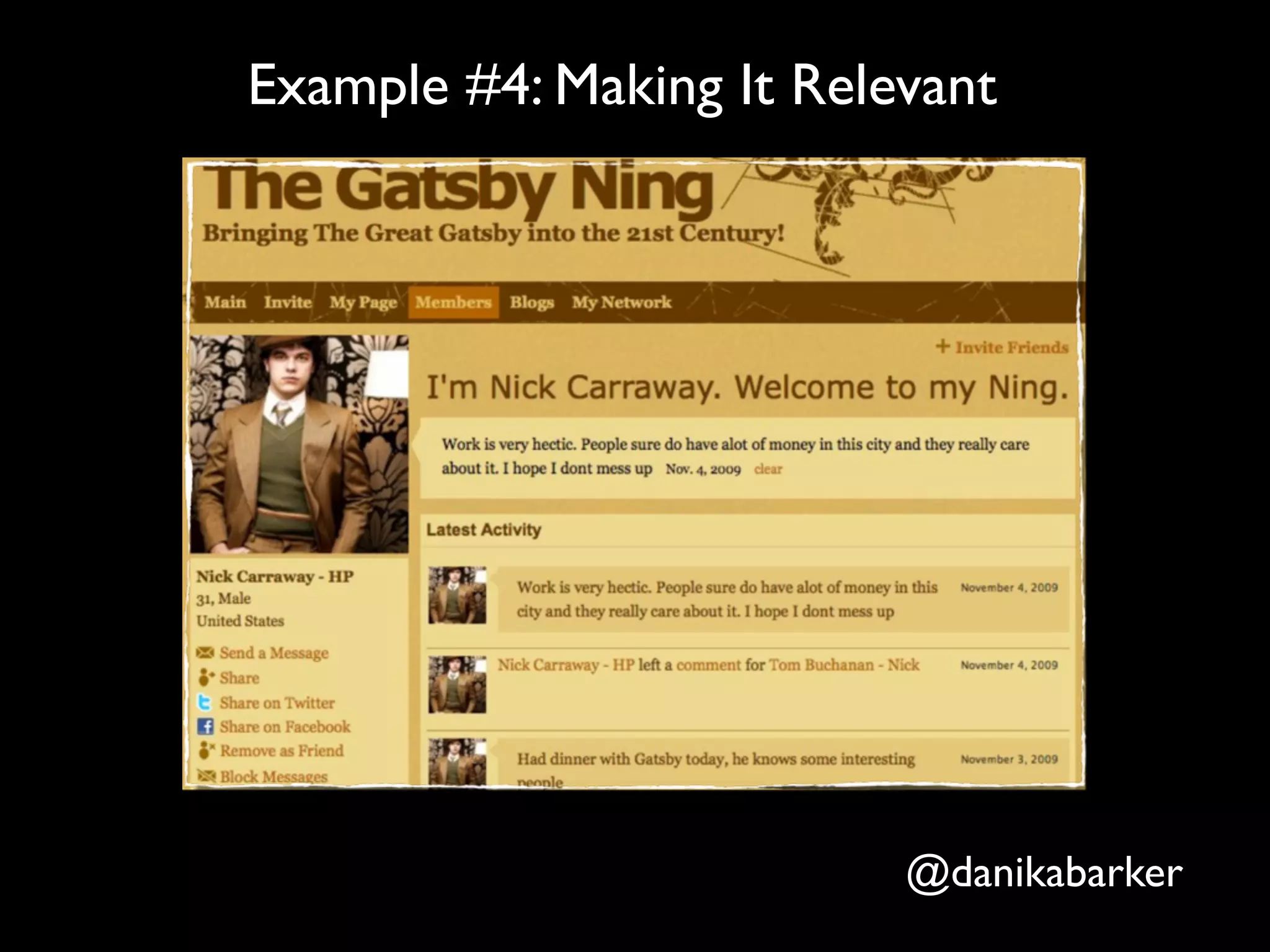
Example #4: Making It Relevant


                          @danikabarker
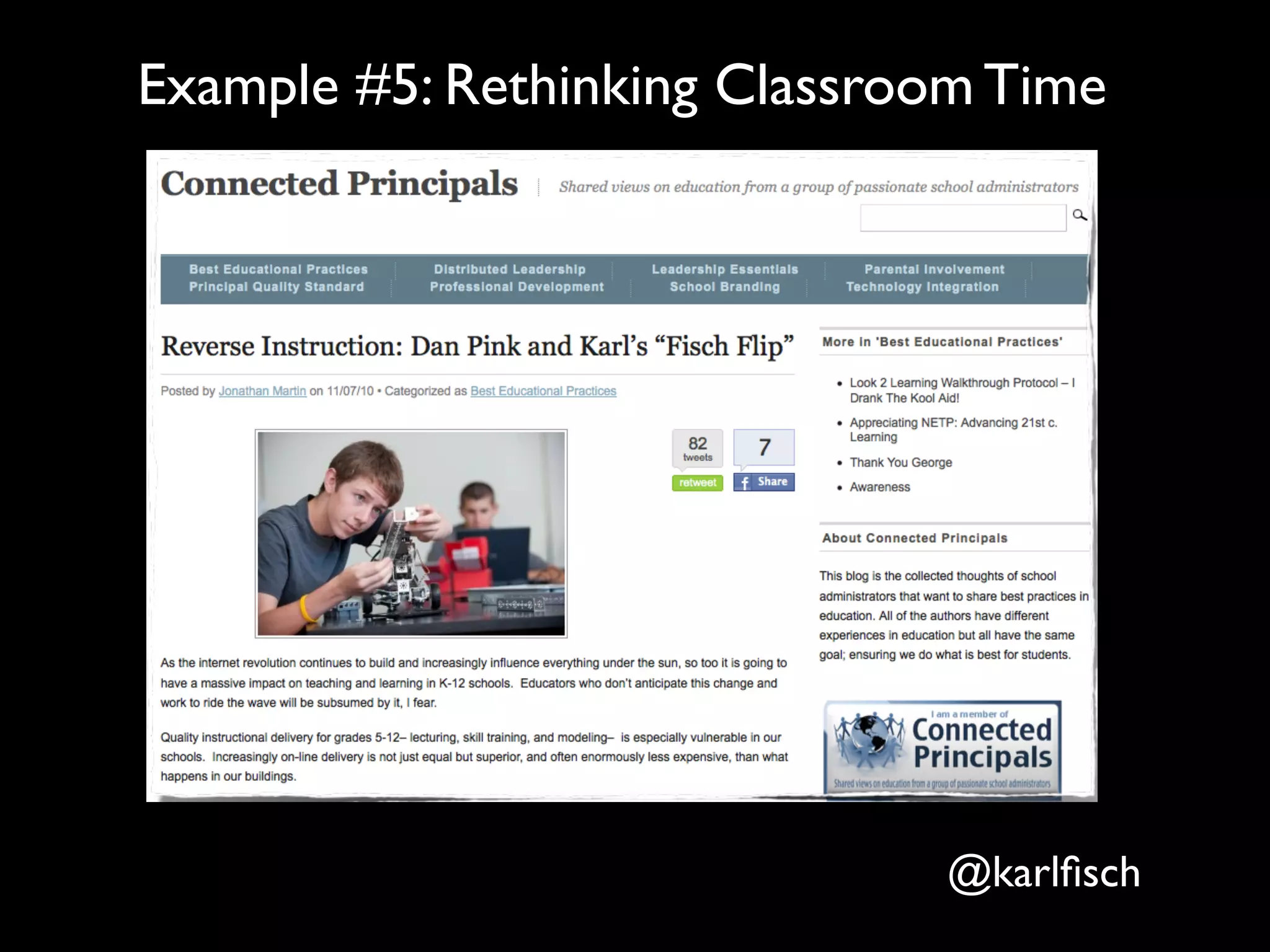
Example #5: Rethinking Classroom Time


                              @karlfisch
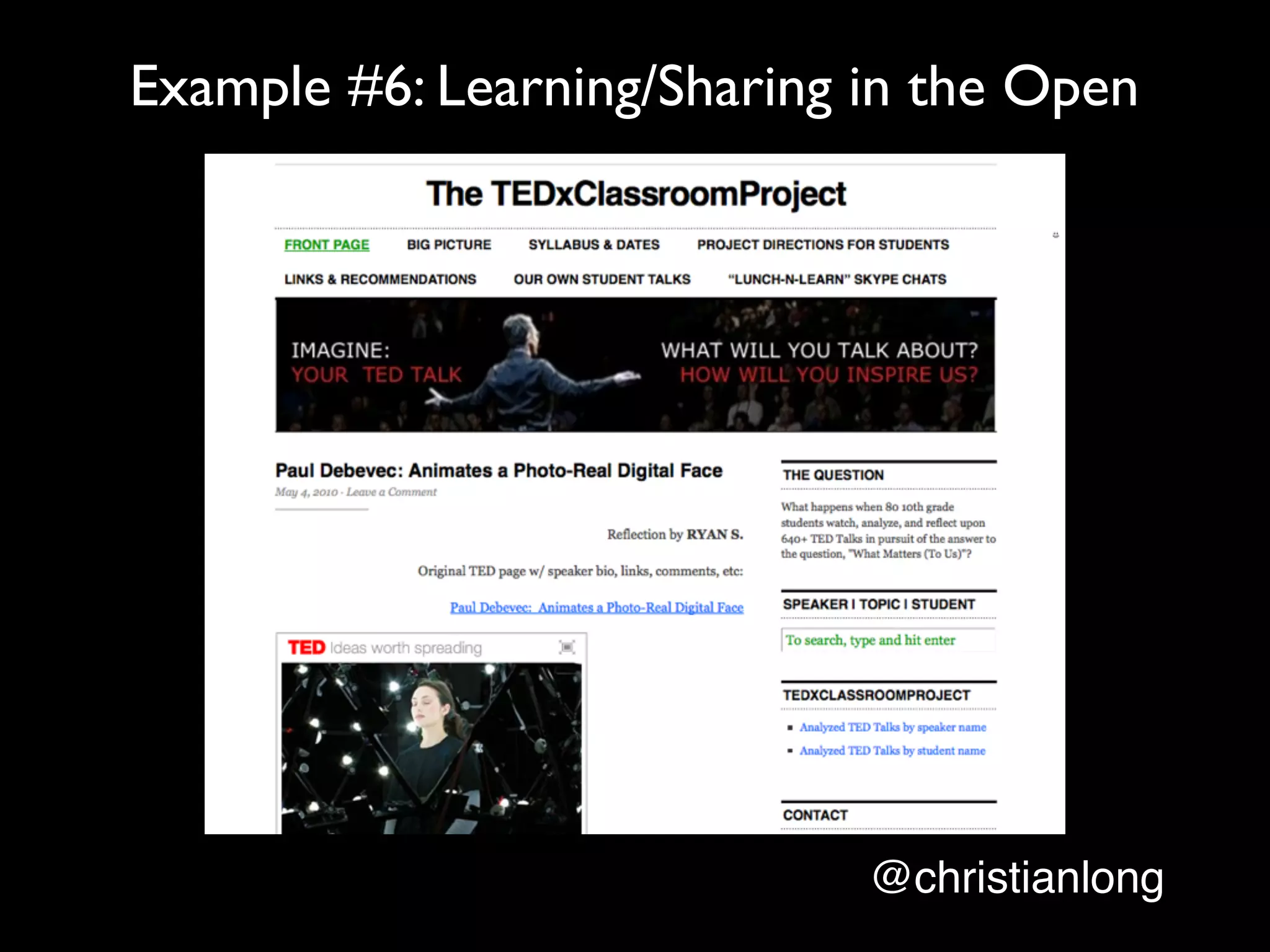
Example #6: Learning/Sharing in the Open


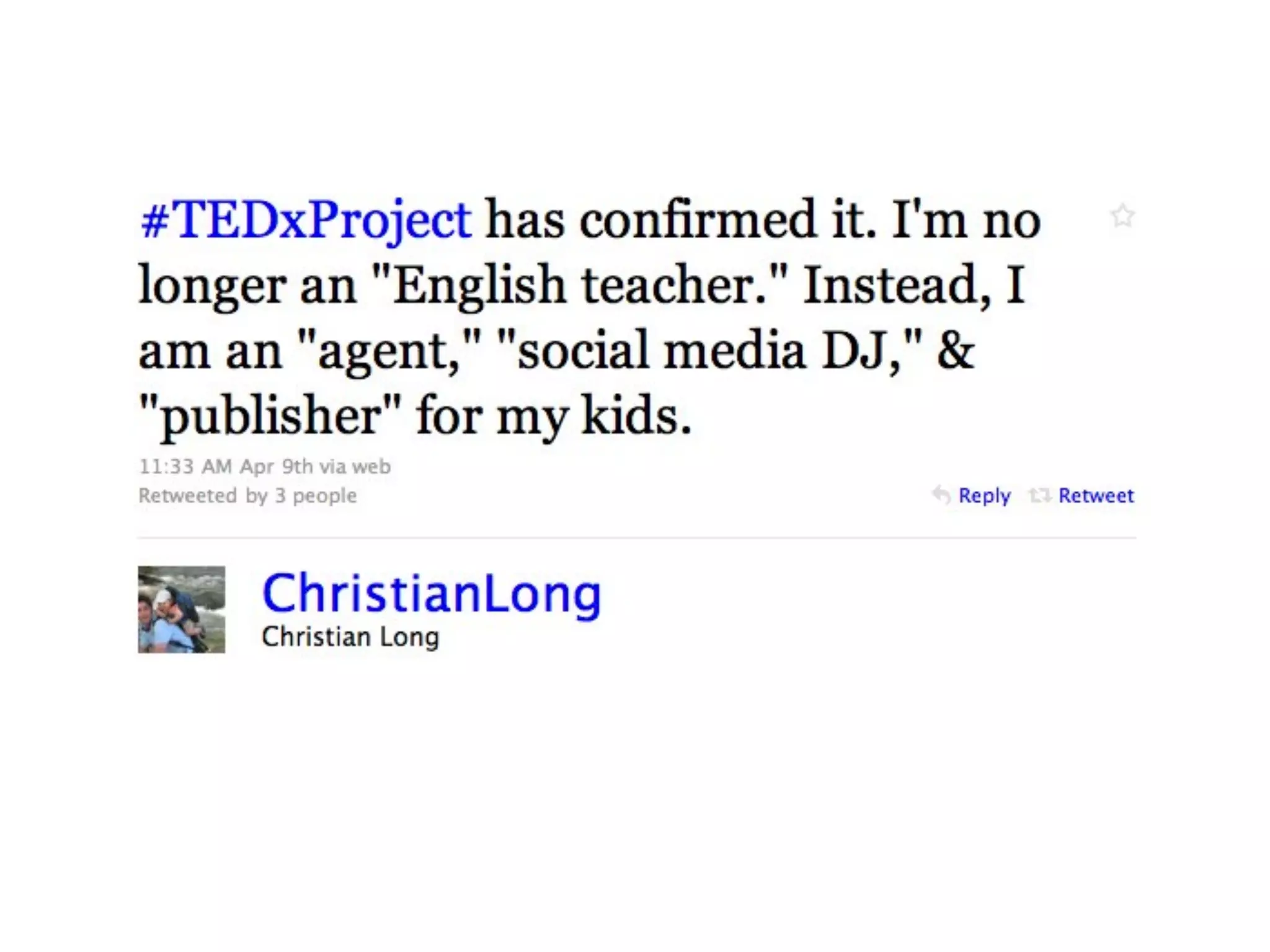
                             @christianlong
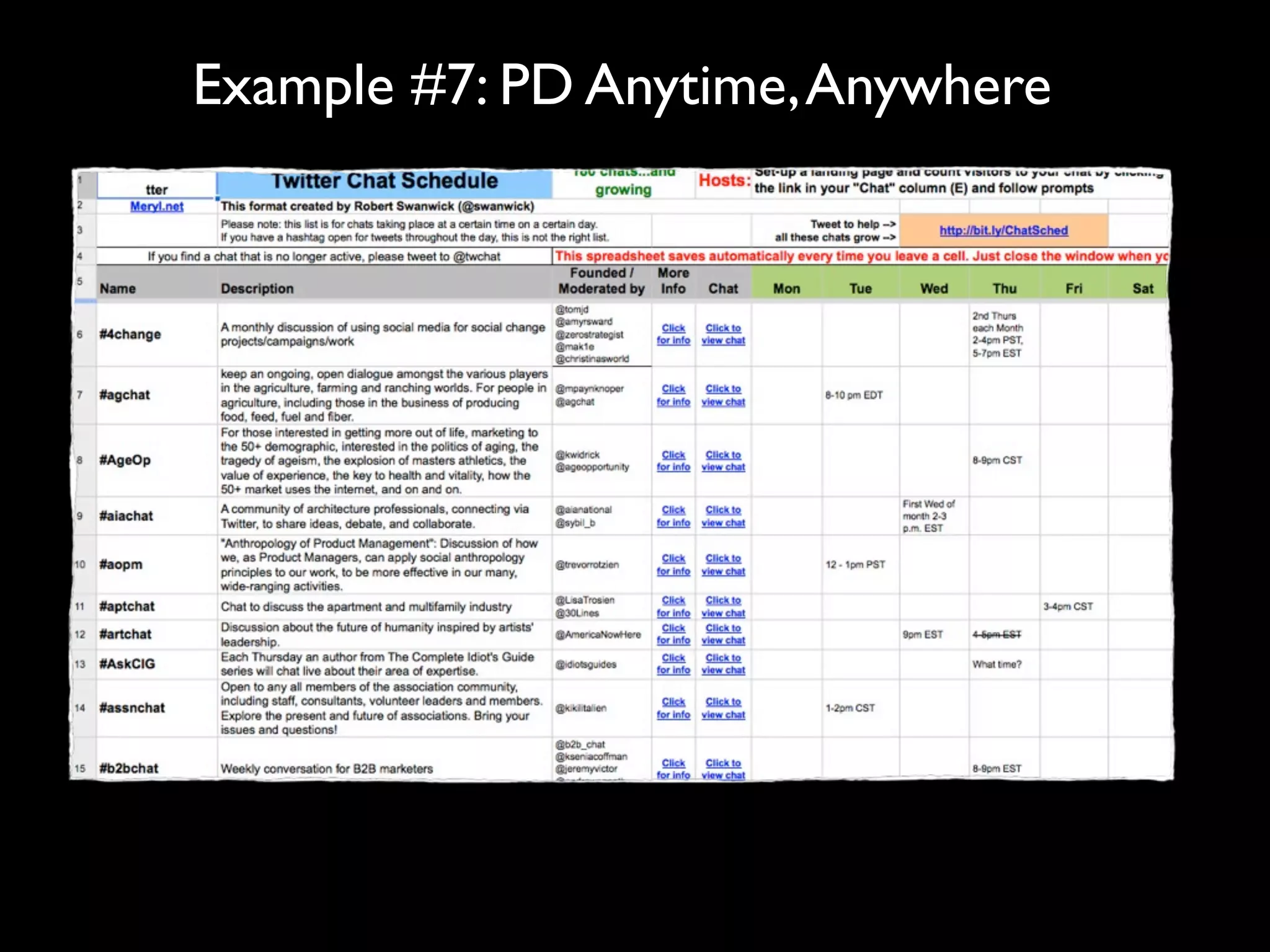
Example #7: PD Anytime, Anywhere
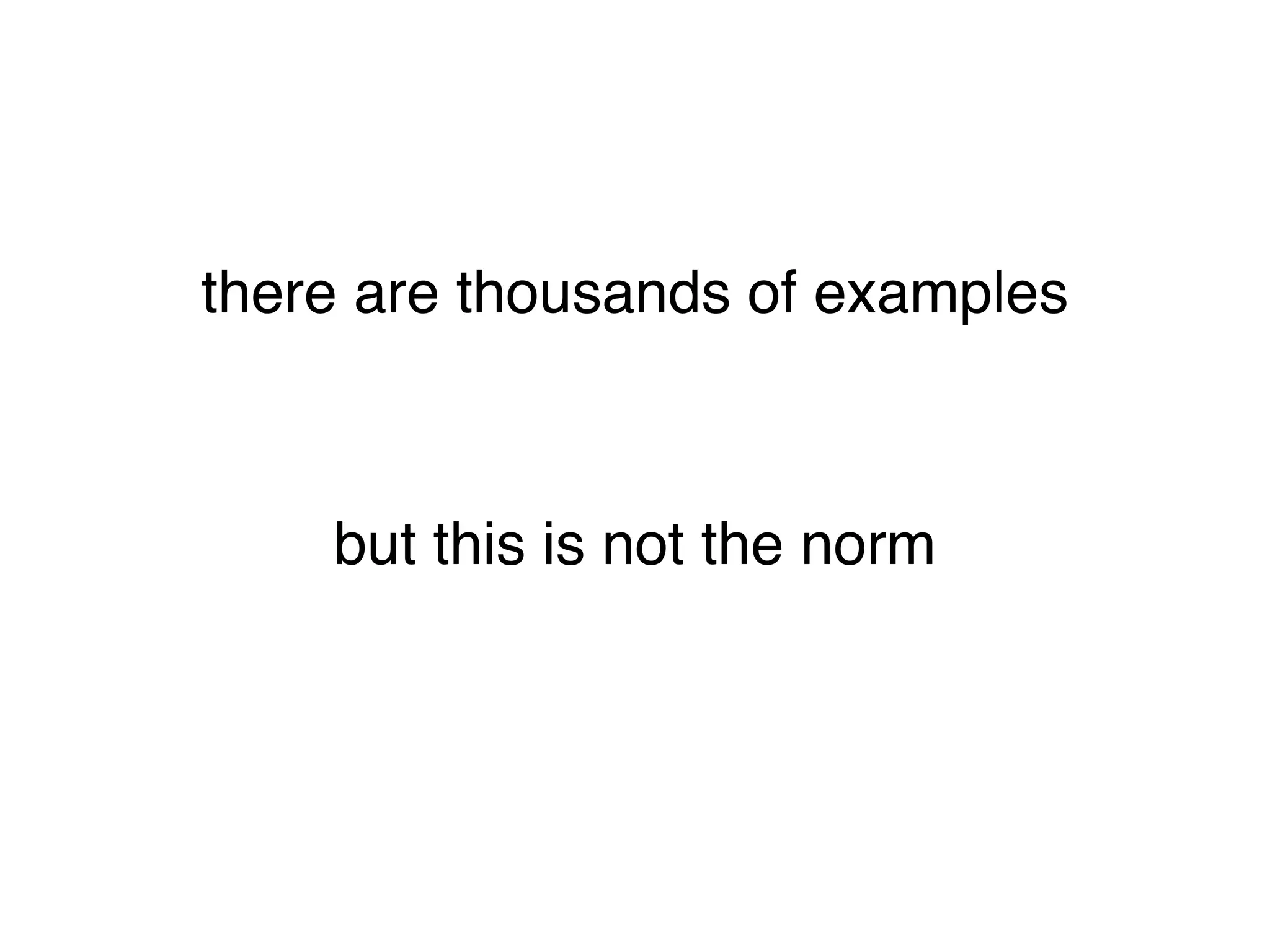
there are thousands of examples


    but this is not the norm
big ideas to consider
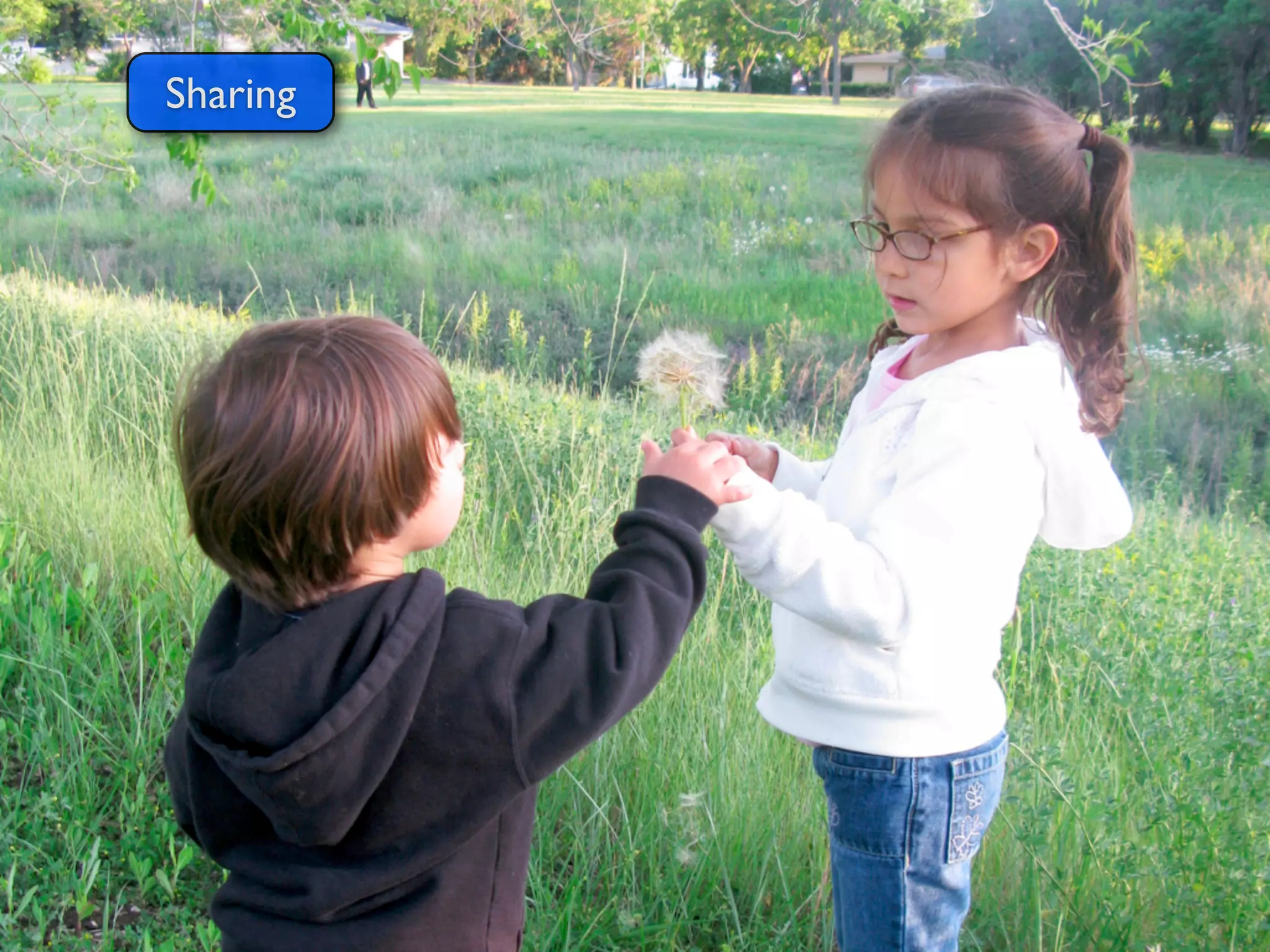
Sharing


          http://www.flickr.com/photos/dolmansaxlil/4802611949/
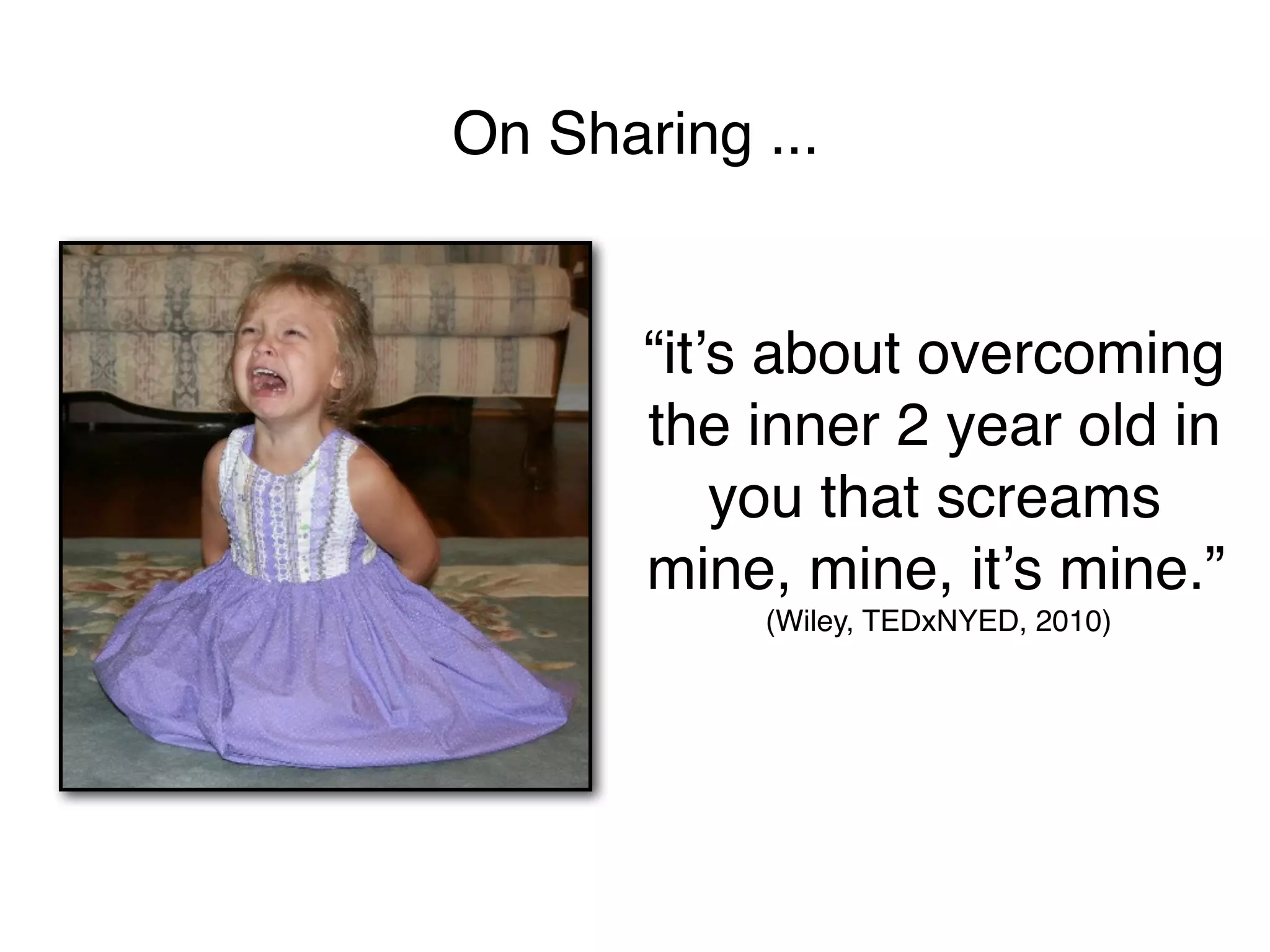
On Sharing ...


       “it’s about overcoming
       the inner 2 year old in
           you that screams
       mine, mine, it’s mine.”
           (Wiley, TEDxNYED, 2010)
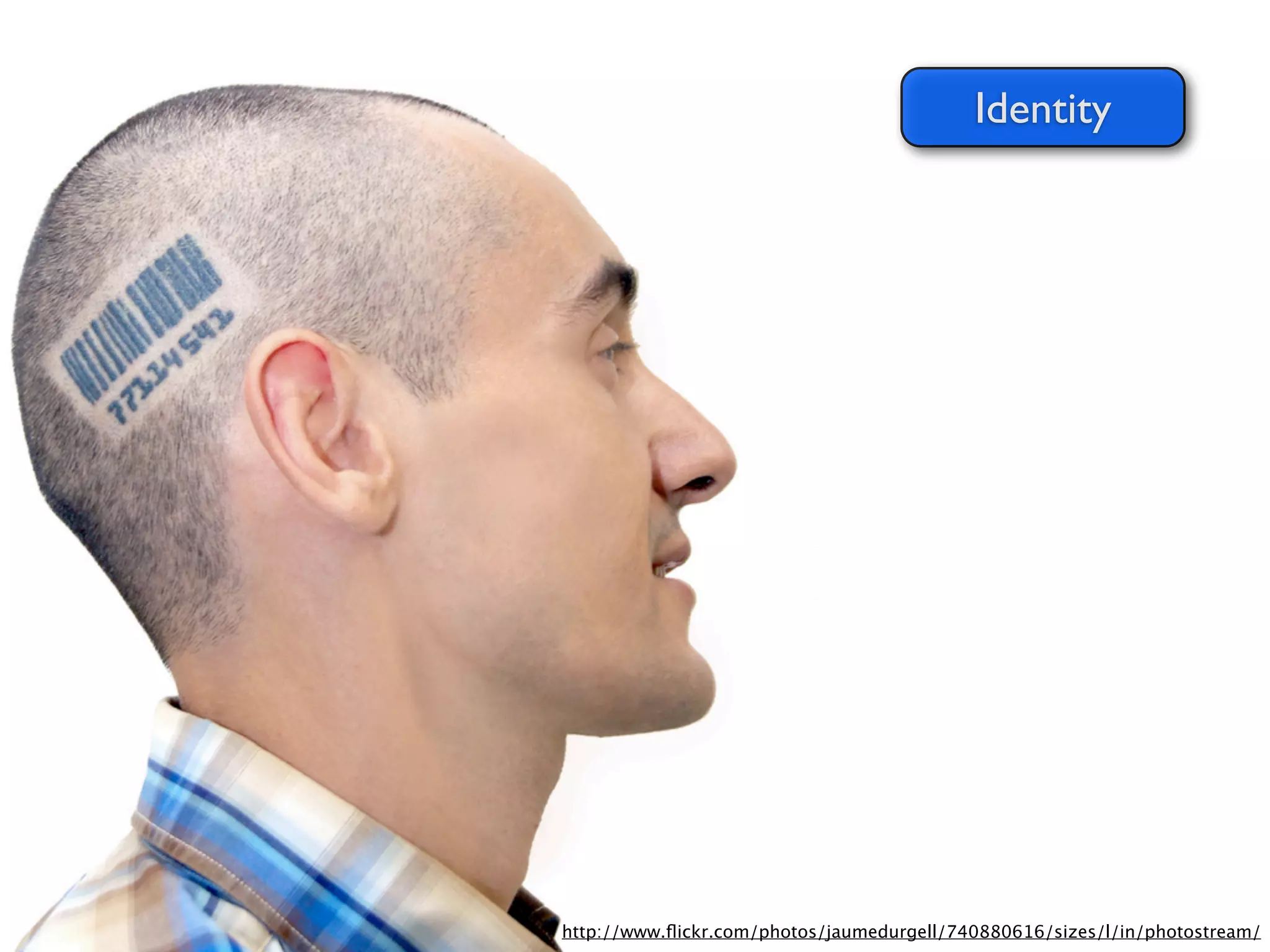
Identity


http://www.flickr.com/photos/jaumedurgell/740880616/sizes/l/in/photostream/
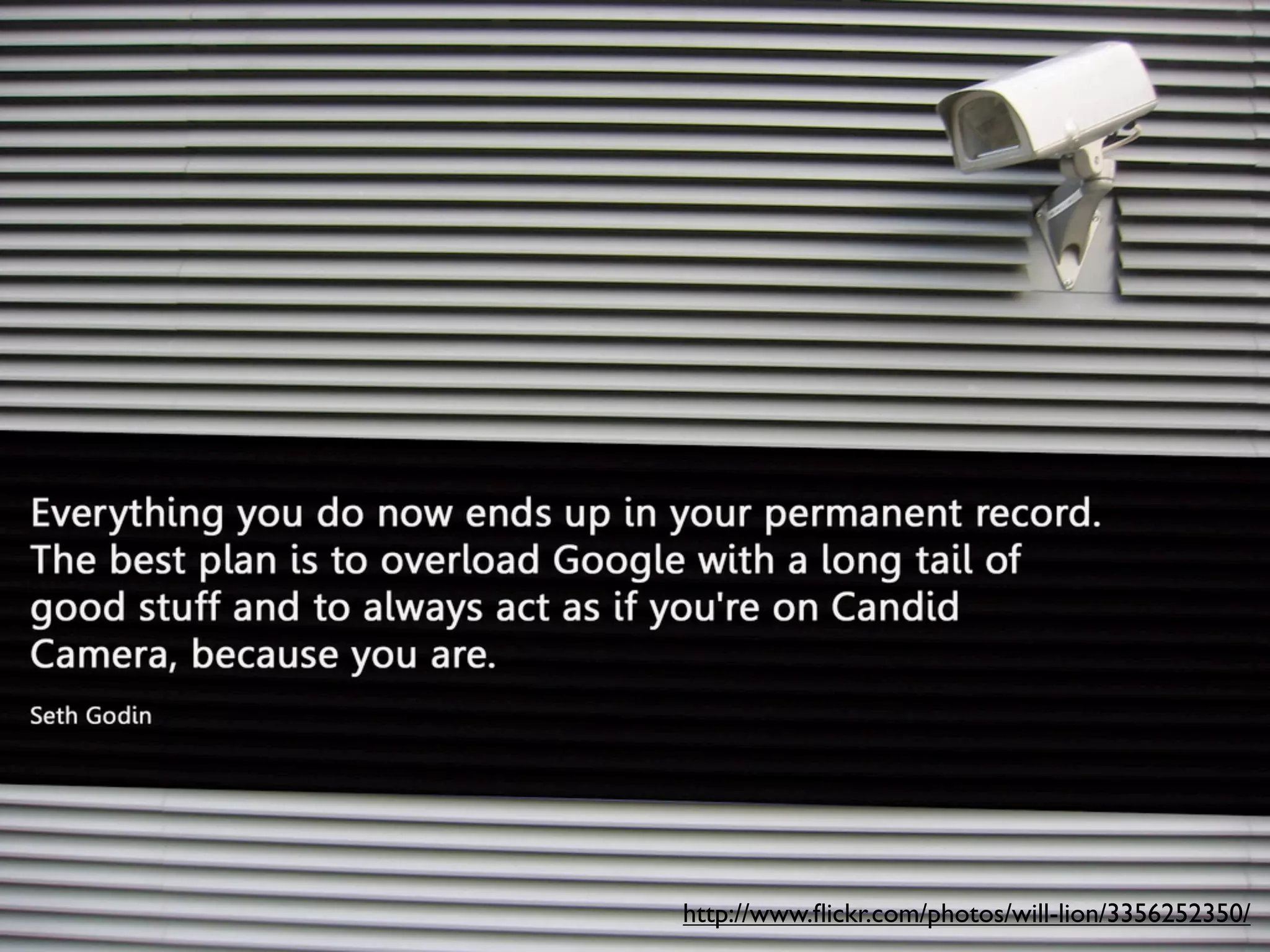
http://www.flickr.com/photos/will-lion/3356252350/
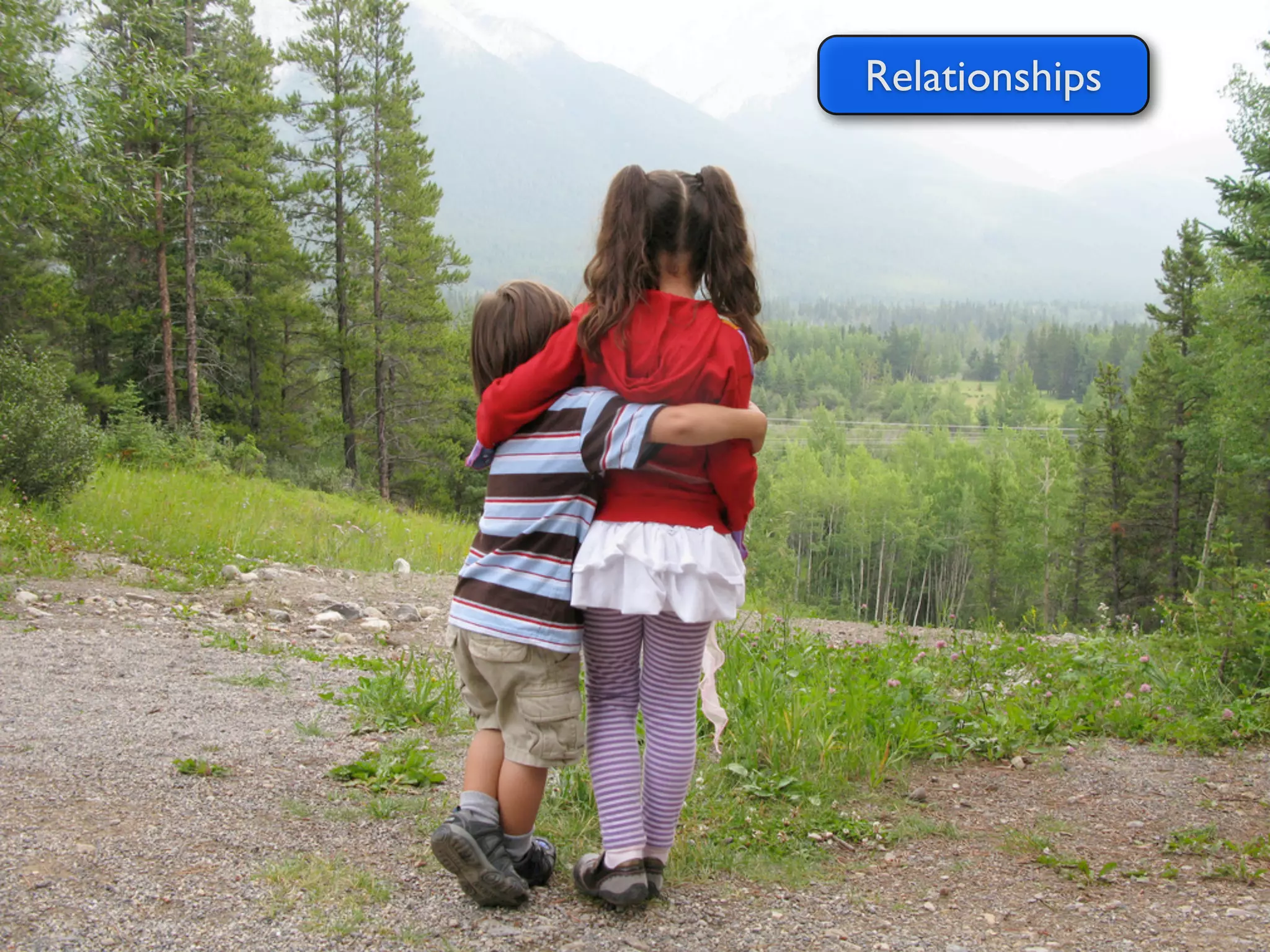
Relationships
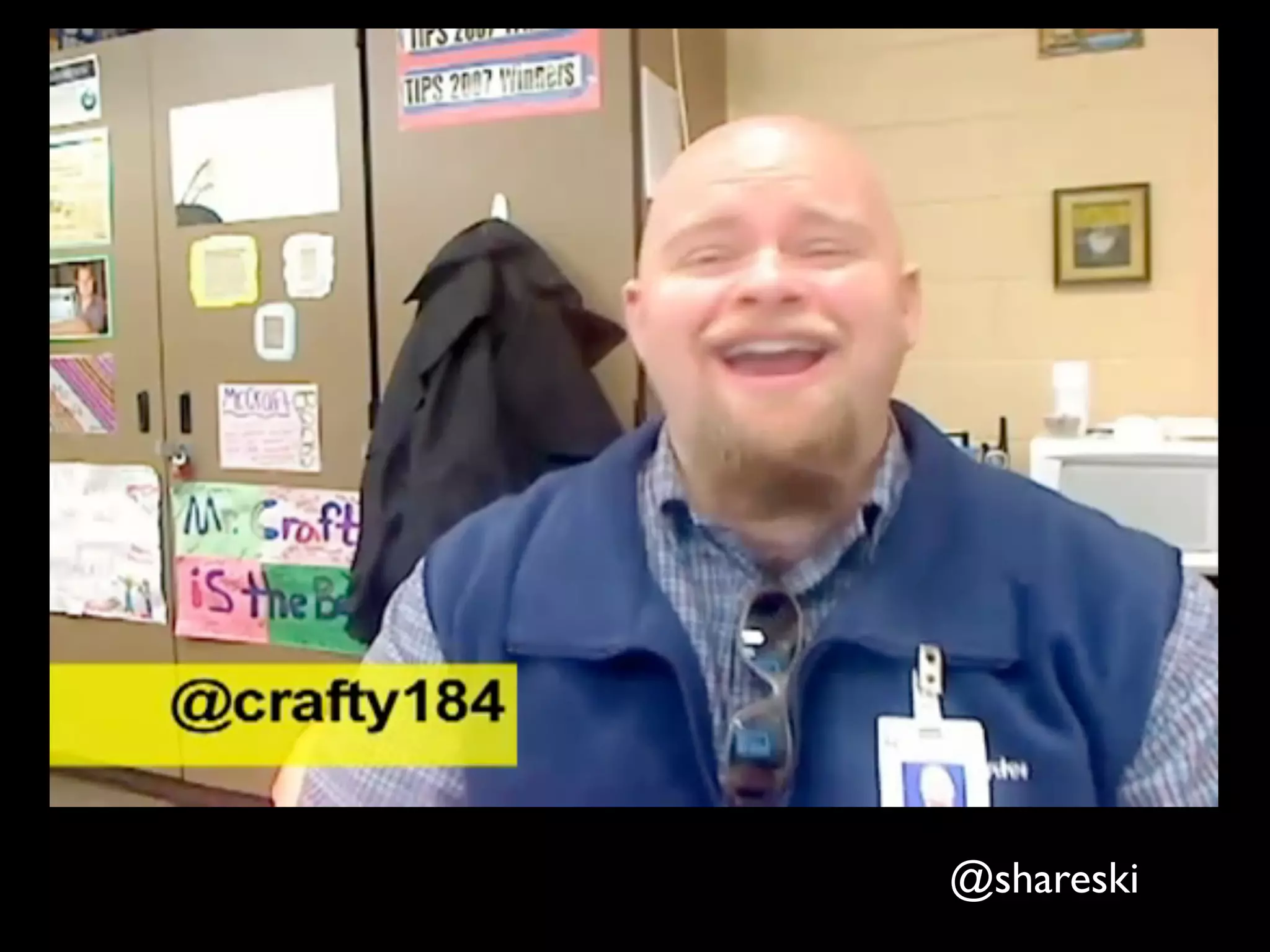
@shareski
conclusion
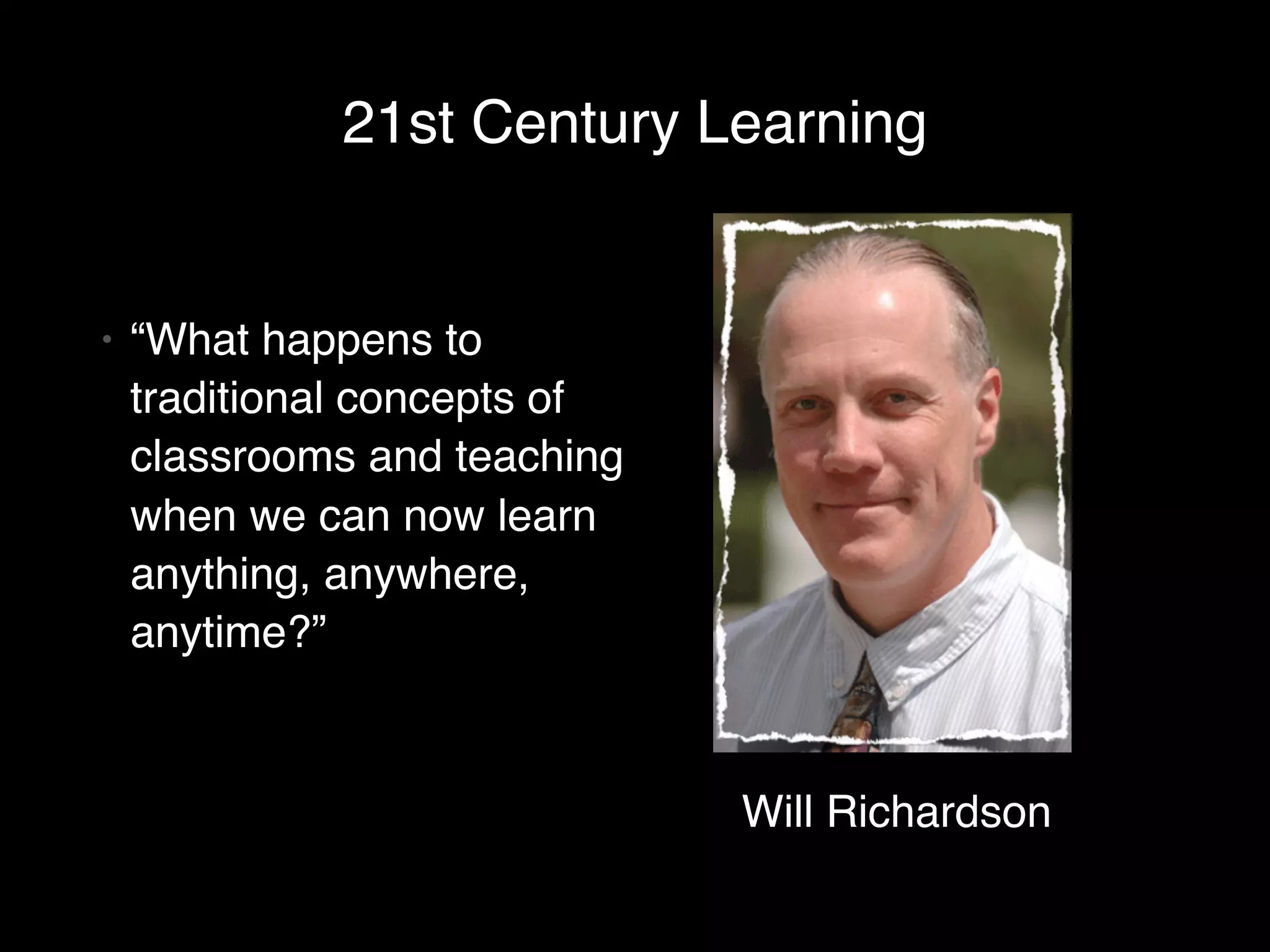
21st Century Learning


•   “What happens to
    traditional concepts of
    classrooms and teaching
    when we can now learn
    anything, anywhere,
    anytime?”


                              Will Richardson
http://www.flickr.com/photos/admitchell08/2574455073
Don’t limit a child to your
own learning, for he was born
  in another time. ~Tagore


       http://couros.ca
     couros@gmail.com
          @courosa

Social Media, Networked Learning & Identity

  • 1.
    EC&I 831: SocialMedia & Open Education “Social Media, Networked & Learning, Identity” Dr. Alec Couros October 18, 2011 Dr. Alec Couros
  • 2.
  • 3.
  • 4.
  • 5.
  • 6.
  • 9.
  • 10.
  • 12.
    “Web 2.0 toolsexist that might allow academics to reflect and reimagine what they do as scholars. Such tools might positively affect -- even transform - research, teaching, and service responsibilities - only if scholars choose to build serious academic lives online, presenting semi-public selves and becoming invested in and connected to the work of their peers and students.” (Greenhow, Robelia, & Hughes, 2009)
  • 13.
  • 14.
  • 15.
    knowledge • what is k? • how is k acquired? • how do we know what we know? • why do we know what we know? • what do humans know? • who controls k? • how is k controlled?
  • 16.
    human thought/ideas humanlanguage source code high-level language (e.g. C++, Java, PERL) low-level language (assembly language) code irretrievable machine code (binary)
  • 17.
  • 19.
  • 20.
    “given enough eyeballs, all bugs are shallow” (Linus’ Law, Raymond 1997)
  • 21.
    “A key totransformation is for the teaching profession to establish innovation networks that capture the spirit and culture of hackers - the passion, the can-do, collective sharing.” ~ Hargreaves, 2003
  • 24.
  • 25.
    “Open Education isthe simple and powerful idea that the world’s knowledge is a public good and that technology in general and the Worldwide Web in particular provide an extraordinary opportunity for everyone to share, use, and reuse knowledge.” (William & Flora Hewlett Foundation)
  • 26.
    open(ness) (short version) open education free software open source software open educational resources open content open access publication open access courses open teaching open scholarship open accreditation
  • 27.
    • pedagogical affordance. • knowledge exchange, curation, sensemaking, wayfinding, collaboration, connected(ness) crowdsourcing, remixing, (short version) problem solving ... • facilitated through personal learning networks/ environments (PLNs/PLEs)
  • 28.
    Free/Open Content “describes any kind of creative work in a format that explicitly allows copying and modifying of its information by anyone, not exclusively by a closed organization, firm, or individual.” (Wikipedia)
  • 30.
    Why Do StudentsGo to University? Content Degrees Social Life Support Services (Wiley, 2010)
  • 31.
    Why Do StudentsGo to University? PLoS GCT Wikipedia MCSE Google Scholar ACT OCW Content Degrees Flatworld K arXiv.org CNE CCNA Open Courses Facebook Twitter Skype Social Life Support Services MySpace Yahoo! Answers MMOGs Quora ChaCha (Wiley, 2010)
  • 32.
    early lessons • knowledge needs to be free. • relationships trump content. • transparency & openness are powerful conditions for knowledge sharing. • distributed, weak-tie communities can help to solve complex problems. • education can greatly benefit from the experiences of open (source) communities (i.e., networked communities of practice).
  • 33.
  • 34.
    Changes Early Day ofPC in Schools Today’s Social/Mobile Reality
  • 35.
    media stats (2010) • 107 trillion emails (89% spam), from 1.04 billion users. • 255 million websites • 1.97 billion Internet users • 152 millions blogs • 600 million Facebook users (sharing 30 billion pieces of content per month) • 2 billion videos watched on Youtube daily • 5 billion photos hosted on Flickr Stats as of January 2011 via Royal Pingdom
  • 38.
  • 39.
    “The average digitalbirth of children happens at about 6 months.” “In Canada, US, UK, France Italy, Germany & Spain ... 81% of children under the age of two have some kind of digital profile or footprint.”
  • 41.
    Easily Copied Instantly Shared Easily Edited Viewable by Millions
  • 42.
    PRIVATE by DEFAULT PUBLIC with EFFORT
  • 43.
    Best Job inthe World
  • 46.
    On Digital Video • “Ten years ago, not one student in a hundred, nay, one in a thousand, could have produced videos like this. It’s a whole new skill, a vital and important skill, and one utterly necessary not simply from the perspective of creating but also of comprehending video Stephen Downes communication today.
  • 47.
  • 48.
    Network Literacies • “Understanding how networks work is one of the most important literacies of the 21st century.” (2010) Howard Rheingold
  • 49.
    Politics Howard Rheingold http://www.anduro.com/calgary-mayor-race.html
  • 50.
  • 51.
  • 52.
  • 57.
    “Dear Photograph:Thank youfor everything we had.”
  • 59.
  • 63.
    “To answer yourquestion, I did use Youtube to learn how to dance. I consider it my ‘main’ teacher.” “10 years ago, street dance was very exclusive, especially rare dances like popping (the one I teach and do). You either had to learn it from a friend that knew it or get VHS tapes which were hard to get. Now with Youtube, anyone, anywhere in the world can learn previously ‘exclusive’ dance styles.”
  • 66.
    additional lessons • growing modes of access and the ability to publish & disseminate to wide audiences are key affordances. • (digital) citizenship & (digital) identity are emerging content areas that heavily implicate emerging pedagogies. • crowdsourcing & social curation of content will prove transformational for learning environments.
  • 67.
  • 68.
  • 69.
  • 70.
  • 71.
  • 72.
    Example #1: Connectingto Experts @kathycassidy
  • 73.
    Example #2: TransparentWalls @royanlee
  • 74.
    Example #3: Publishingin the Open ps22chorus.blogspot.com
  • 75.
    Example #4: MakingIt Relevant @danikabarker
  • 76.
    Example #5: RethinkingClassroom Time @karlfisch
  • 77.
    Example #6: Learning/Sharingin the Open @christianlong
  • 79.
    Example #7: PDAnytime, Anywhere
  • 80.
    there are thousandsof examples but this is not the norm
  • 81.
    big ideas toconsider
  • 82.
    Sharing http://www.flickr.com/photos/dolmansaxlil/4802611949/
  • 83.
    On Sharing ... “it’s about overcoming the inner 2 year old in you that screams mine, mine, it’s mine.” (Wiley, TEDxNYED, 2010)
  • 85.
  • 89.
  • 91.
  • 92.
  • 93.
  • 94.
    21st Century Learning • “What happens to traditional concepts of classrooms and teaching when we can now learn anything, anywhere, anytime?” Will Richardson
  • 95.
  • 96.
    Don’t limit achild to your own learning, for he was born in another time. ~Tagore http://couros.ca couros@gmail.com @courosa