POPULATION INTERACTIONS
 Population interactions are the effects organism in a community
have on one another.
 An organisms interaction with its environment are fundamental to
the survival of that organism and the functioning of the ecosystem
as a whole
 Populations do not exist alone in nature, The way organisms
interact is important for the survival of a species. There are two
types of interaction: intraspecific interactions and interspecific
interactions. Intraspecific interactions are those that take place
among organisms of the same species while interspecific
interactions are those which happen among individuals of different
species.
By comparing populations living alone and
together, several types of interactions can
be identified.
 COMMENSALISM (+/0)
 MUTUALISM (+/+)
 COMPETITION (-/-)
 PARASITISM (+/-)
 PREDATION (+/-)
 ALLELOPATHY(+/-)
IMPORTANT INTERACTIONS BETWEEN
TWO SPECIES
POPULATION INTERACTIONS
INFLUENCE ABUNDANCE
• When populations of different species interact, the effects
on one on the other may be positive (+), negative (-) or
neutral (0).
MUTUALISM
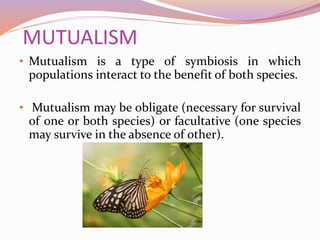
• Mutualism is a type of symbiosis in which
populations interact to the benefit of both species.
• Mutualism may be obligate (necessary for survival
of one or both species) or facultative (one species
may survive in the absence of other).
MUTUALISM
 One of the most
commonly observed
mutualism is the
pollination of flowering
plants by an insect or
humming bird.
 The pollinator benefits
from the interaction by
receiving nectar.
 The plant gets its pollen
transferred from one
plant to another.
POLLINATION PROCESS
MUTUALISM
 Although free nitrogen is about 80% of the atmosphere,
plants are unable to use it until it is “fixed” into ammonia
and converted to nitrates by bacteria.
 A common example of this mutualism between plants
and nitrogen fixing bacteria is found in the roots of
leguminous plants.
SYMBIOTIC NITROGEN FIXERS
LEGUMES/NITROGEN FIXING
BACTERIA
 Nitrogen fixing bacteria
enter the root hairs of
legumes in the seedling
stage. The bacteria causes
the plant to produce
nodules.
 The host plant in return
supplies carbohydrates,
amino acids and other
nutrients that sustain their
bacterial partners
(bacteriods).
The Rhizobium/Soybean
Connection
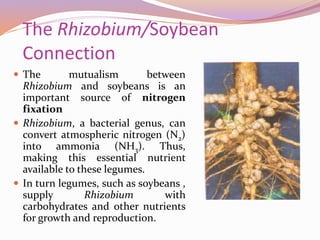
 The mutualism between
Rhizobium and soybeans is an
important source of nitrogen
fixation
 Rhizobium, a bacterial genus, can
convert atmospheric nitrogen (N2)
into ammonia (NH3). Thus,
making this essential nutrient
available to these legumes.
 In turn legumes, such as soybeans ,
supply Rhizobium with
carbohydrates and other nutrients
for growth and reproduction.
MUTUALISM
 The lichen is a mutualistic
association between a species of
algae and a species of fungus.
Algal partner is known as
phycobiont and fungal partner is
known as mycobiont
 The fungus retains water and
takes up minerals.
 The algae provides carbohydrates
and other organic nutrients as the
result of photosynthesis.
LICHEN
COMMENSALISM
•Commensalism is an association between two organisms in
which one benefits and the other derives neither benefit nor
harm
•In commensalism species involved live together without
entering into any kind of physiological exchange
COMMENSALISM
 These are vascular plants
rooted in the ground and
maintain erectness of their
stem by making use of
other objects for support
 They maintain no direct
nutritional relationship
with the trees upon which
they grow
 E.g. : Grapes
LIANAS
COMMENSALISM
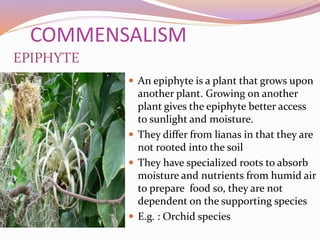
 An epiphyte is a plant that grows upon
another plant. Growing on another
plant gives the epiphyte better access
to sunlight and moisture.
 They differ from lianas in that they are
not rooted into the soil
 They have specialized roots to absorb
moisture and nutrients from humid air
to prepare food so, they are not
dependent on the supporting species
 E.g. : Orchid species
EPIPHYTE
COMMENSALISM
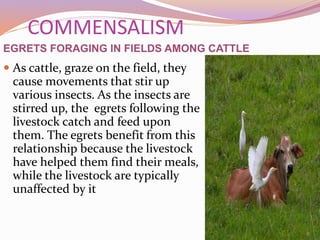
 As cattle, graze on the field, they
cause movements that stir up
various insects. As the insects are
stirred up, the egrets following the
livestock catch and feed upon
them. The egrets benefit from this
relationship because the livestock
have helped them find their meals,
while the livestock are typically
unaffected by it
EGRETS FORAGING IN FIELDS AMONG CATTLE
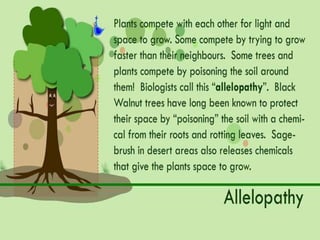
•Allelopathy is a biological phenomenon by which an
organism produces one or more biochemical's that
influence the growth, survival, and reproduction of
other organisms.
•These biochemical's are known as allelochemicals and
can have beneficial (positive allelopathy) or
detrimental (negative allelopathy) effects on the target
organisms.
•plant allelopathy is used as a means of survival in
nature, reducing competition from plants nearby.
COMPETITION
 Mutual use of a limited
resource by populations of
two or more species.
 Each individual adversely
affect another in the quest
for food (nutrients), living
space, or other common
needs.
 Individuals harm one
another is attempting to
gain a resource.
Categories of Competition
 When competition is between individuals of:
same species (intraspecific)
different species (interspecific)
• When a resource is in short supply that used by
one thus not available to the other
(exploitation).
• When an action or substance produced by one
is directly harmful to the other (interference).
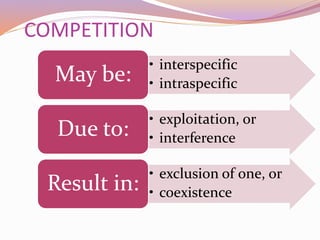
COMPETITION
• interspecific
• intraspecificMay be:
• exploitation, or
• interferenceDue to:
• exclusion of one, or
• coexistenceResult in:
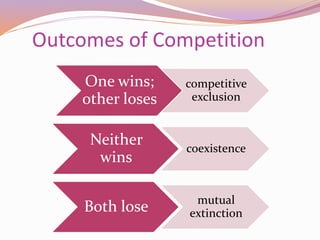
Outcomes of Competition
One wins;
other loses
competitive
exclusion
Neither
wins
coexistence
Both lose mutual
extinction
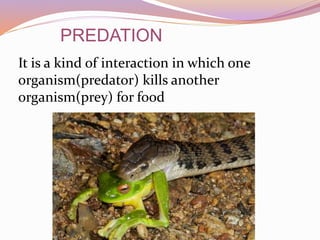
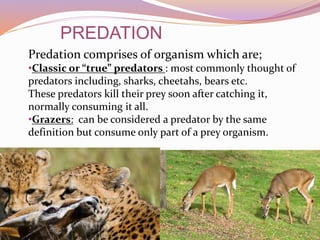
PREDATION
It is a kind of interaction in which one
organism(predator) kills another
organism(prey) for food
Predation comprises of organism which are;
•Classic or “true” predators : most commonly thought of
predators including, sharks, cheetahs, bears etc.
These predators kill their prey soon after catching it,
normally consuming it all.
•Grazers: can be considered a predator by the same
definition but consume only part of a prey organism.
PREDATION
PREDATION
•Most of the predatory organism are animals but there
are some plants, like Nephenthes,Drosera etc. which
consume insects for their food.They are also known as
Insectivorous plants
•These plants are adapted in remarkable ways to
attract,catch and digest their victims. Their foliar
appendage produce proteolytic enzymes for digestion of
insects
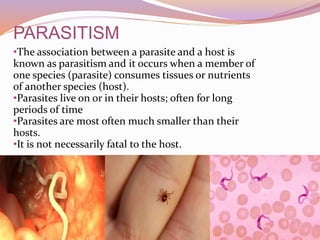
PARASITISM
•The association between a parasite and a host is
known as parasitism and it occurs when a member of
one species (parasite) consumes tissues or nutrients
of another species (host).
•Parasites live on or in their hosts; often for long
periods of time
•Parasites are most often much smaller than their
hosts.
•It is not necessarily fatal to the host.
•Parasites are divided into two
groups: endoparasites and ectoparasites.
•Endoparasites are parasites that live inside
the body of the host e.g. Trypanosoma
•Ectoparasites are parasites that live on the
outer surface of the host and generally
attach themselves during feeding e.g.
Ticks, Mites
PARASITISM
PARASITISM
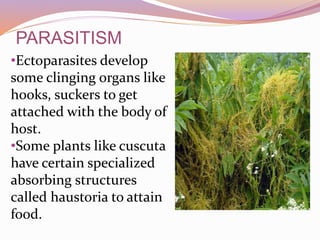
•Ectoparasites develop
some clinging organs like
hooks, suckers to get
attached with the body of
host.
•Some plants like cuscuta
have certain specialized
absorbing structures
called haustoria to attain
food.
Population interaction ppt

Population interaction ppt

  • 3.
    POPULATION INTERACTIONS  Populationinteractions are the effects organism in a community have on one another.  An organisms interaction with its environment are fundamental to the survival of that organism and the functioning of the ecosystem as a whole  Populations do not exist alone in nature, The way organisms interact is important for the survival of a species. There are two types of interaction: intraspecific interactions and interspecific interactions. Intraspecific interactions are those that take place among organisms of the same species while interspecific interactions are those which happen among individuals of different species.
  • 4.
    By comparing populationsliving alone and together, several types of interactions can be identified.  COMMENSALISM (+/0)  MUTUALISM (+/+)  COMPETITION (-/-)  PARASITISM (+/-)  PREDATION (+/-)  ALLELOPATHY(+/-) IMPORTANT INTERACTIONS BETWEEN TWO SPECIES
  • 5.
    POPULATION INTERACTIONS INFLUENCE ABUNDANCE •When populations of different species interact, the effects on one on the other may be positive (+), negative (-) or neutral (0).
  • 6.
    MUTUALISM • Mutualism isa type of symbiosis in which populations interact to the benefit of both species. • Mutualism may be obligate (necessary for survival of one or both species) or facultative (one species may survive in the absence of other).
  • 7.
    MUTUALISM  One ofthe most commonly observed mutualism is the pollination of flowering plants by an insect or humming bird.  The pollinator benefits from the interaction by receiving nectar.  The plant gets its pollen transferred from one plant to another. POLLINATION PROCESS
  • 8.
    MUTUALISM  Although freenitrogen is about 80% of the atmosphere, plants are unable to use it until it is “fixed” into ammonia and converted to nitrates by bacteria.  A common example of this mutualism between plants and nitrogen fixing bacteria is found in the roots of leguminous plants. SYMBIOTIC NITROGEN FIXERS
  • 9.
    LEGUMES/NITROGEN FIXING BACTERIA  Nitrogenfixing bacteria enter the root hairs of legumes in the seedling stage. The bacteria causes the plant to produce nodules.  The host plant in return supplies carbohydrates, amino acids and other nutrients that sustain their bacterial partners (bacteriods).
  • 10.
    The Rhizobium/Soybean Connection  Themutualism between Rhizobium and soybeans is an important source of nitrogen fixation  Rhizobium, a bacterial genus, can convert atmospheric nitrogen (N2) into ammonia (NH3). Thus, making this essential nutrient available to these legumes.  In turn legumes, such as soybeans , supply Rhizobium with carbohydrates and other nutrients for growth and reproduction.
  • 11.
    MUTUALISM  The lichenis a mutualistic association between a species of algae and a species of fungus. Algal partner is known as phycobiont and fungal partner is known as mycobiont  The fungus retains water and takes up minerals.  The algae provides carbohydrates and other organic nutrients as the result of photosynthesis. LICHEN
  • 12.
    COMMENSALISM •Commensalism is anassociation between two organisms in which one benefits and the other derives neither benefit nor harm •In commensalism species involved live together without entering into any kind of physiological exchange
  • 13.
    COMMENSALISM  These arevascular plants rooted in the ground and maintain erectness of their stem by making use of other objects for support  They maintain no direct nutritional relationship with the trees upon which they grow  E.g. : Grapes LIANAS
  • 14.
    COMMENSALISM  An epiphyteis a plant that grows upon another plant. Growing on another plant gives the epiphyte better access to sunlight and moisture.  They differ from lianas in that they are not rooted into the soil  They have specialized roots to absorb moisture and nutrients from humid air to prepare food so, they are not dependent on the supporting species  E.g. : Orchid species EPIPHYTE
  • 15.
    COMMENSALISM  As cattle,graze on the field, they cause movements that stir up various insects. As the insects are stirred up, the egrets following the livestock catch and feed upon them. The egrets benefit from this relationship because the livestock have helped them find their meals, while the livestock are typically unaffected by it EGRETS FORAGING IN FIELDS AMONG CATTLE
  • 16.
    •Allelopathy is abiological phenomenon by which an organism produces one or more biochemical's that influence the growth, survival, and reproduction of other organisms. •These biochemical's are known as allelochemicals and can have beneficial (positive allelopathy) or detrimental (negative allelopathy) effects on the target organisms. •plant allelopathy is used as a means of survival in nature, reducing competition from plants nearby.
  • 18.
    COMPETITION  Mutual useof a limited resource by populations of two or more species.  Each individual adversely affect another in the quest for food (nutrients), living space, or other common needs.  Individuals harm one another is attempting to gain a resource.
  • 19.
    Categories of Competition When competition is between individuals of: same species (intraspecific) different species (interspecific) • When a resource is in short supply that used by one thus not available to the other (exploitation). • When an action or substance produced by one is directly harmful to the other (interference).
  • 20.
    COMPETITION • interspecific • intraspecificMaybe: • exploitation, or • interferenceDue to: • exclusion of one, or • coexistenceResult in:
  • 21.
    Outcomes of Competition Onewins; other loses competitive exclusion Neither wins coexistence Both lose mutual extinction
  • 22.
    PREDATION It is akind of interaction in which one organism(predator) kills another organism(prey) for food
  • 23.
    Predation comprises oforganism which are; •Classic or “true” predators : most commonly thought of predators including, sharks, cheetahs, bears etc. These predators kill their prey soon after catching it, normally consuming it all. •Grazers: can be considered a predator by the same definition but consume only part of a prey organism. PREDATION
  • 24.
    PREDATION •Most of thepredatory organism are animals but there are some plants, like Nephenthes,Drosera etc. which consume insects for their food.They are also known as Insectivorous plants •These plants are adapted in remarkable ways to attract,catch and digest their victims. Their foliar appendage produce proteolytic enzymes for digestion of insects
  • 25.
    PARASITISM •The association betweena parasite and a host is known as parasitism and it occurs when a member of one species (parasite) consumes tissues or nutrients of another species (host). •Parasites live on or in their hosts; often for long periods of time •Parasites are most often much smaller than their hosts. •It is not necessarily fatal to the host.
  • 26.
    •Parasites are dividedinto two groups: endoparasites and ectoparasites. •Endoparasites are parasites that live inside the body of the host e.g. Trypanosoma •Ectoparasites are parasites that live on the outer surface of the host and generally attach themselves during feeding e.g. Ticks, Mites PARASITISM
  • 27.
    PARASITISM •Ectoparasites develop some clingingorgans like hooks, suckers to get attached with the body of host. •Some plants like cuscuta have certain specialized absorbing structures called haustoria to attain food.