 Ecology is the study of the interrelations of organisms and
environment
 Interrelationships or animal associations either direct or
indirect, exist among members within a species (Intra specific)
or between members of different groups (Inter specific).
1. Symbiosis
2. Commensalisms
3. Parasitism
4. Natural selection
5. Artificial selection
6. Prey – predator relationship
7. Host - parasitic relationship
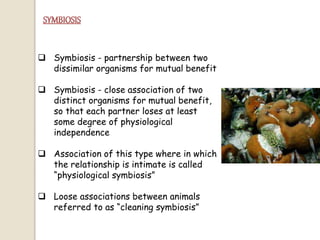
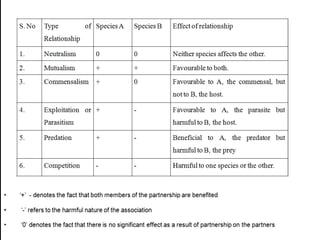
 Symbiosis - partnership between two
dissimilar organisms for mutual benefit
 Symbiosis - close association of two
distinct organisms for mutual benefit,
so that each partner loses at least
some degree of physiological
independence
 Association of this type where in which
the relationship is intimate is called
“physiological symbiosis”
 Loose associations between animals
referred to as “cleaning symbiosis”
• The association is beneficial to both organisms
• Here algae benefit by deriving protection and securing carbon
dioxide and nitrogen’s waste products from the coral-host
• The host obtains additional oxygen supply and secured the
elimination of waste substances
• Symbiosis with algae is well known in Mollusca – Tridacna sp and
Hippolpus sp.
• Tridacna is a giant mollusc inhabits in coral reefs, it grows one
and half meters and it contains millions of tiny zooxanthelle on
outer tissues
• The symbionts remove waste products i.e., CO2, nitrogen,
phosphorus and other nutrients
• Besides clam get nourishment by digesting their algae for
nourishment
A permanent type of relationship in which two symbionts are in close
contact and interdependent on each other
Also referred as mutualism with continuous contact
Examples:
1.Hermit crab and sea Anemone-
1.Hermit crab (Eupagurus sp) lives in the empty shell of a snail
2.The outer surface of the shell is inhabited by the sea anemone
(Adamsia sp)
3.The hermit crab is protected from the enemies by the nematocysts
of the sea anemones
4.The sea anemone derives food from hermit crabs and gets
transported from one place to another
•Partners or symbionts are rarely attached to each
other and if so it is only for a short duration
•It is also called as mutualism without continuous
contact
•Though both the partners are benefited from each
other but the nutritional need is primary at least for one
of the species
•Ex: crocodile (Crocodylus spp.) and crocodile-bird
(Pluvianus aegyptius), which removes leaches from
around the teeth of the crocodile which allows the bird
to enter its mouth for the search
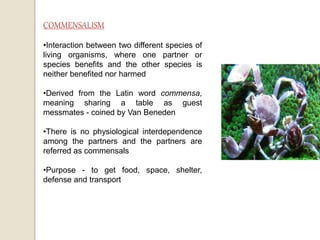
•Interaction between two different species of
living organisms, where one partner or
species benefits and the other species is
neither benefited nor harmed
•Derived from the Latin word commensa,
meaning sharing a table as guest
messmates - coined by Van Beneden
•There is no physiological interdependence
among the partners and the partners are
referred as commensals
•Purpose - to get food, space, shelter,
defense and transport
Based on the position or location of the commensal on the host species -
grouped into Endocommensals and Ectocommensals
Commensalism is of the following two types based on the level of association
between the commensals.
1. Permanent commensalism
2. Temporary commensalism
The commensals remain only in temporary contact with each other
This intermittent contact between the animals for food, shelter or for breeding
sites is seen in many marine animals. Examples - Sucker fish and shark
Temporary association or contact between two animal commensals is seen in
sucker-fish and the sharks or whales
Sucker-fish (Echeneis) is found attached by means of its dorsal sucker to the
underside of a shark or other large animal
The decapod crustacean, Polyonyx lives in the U-tube of the marine annelid,
Chaetopterus
It obtains food particles and oxygen supply from water entering the tube due to
the pumping action of the worm’s parapodia.
Portuguese man-of-war and fish
Based on the position or location of the commensal on the host species, it is
grouped into Endocommensals and Ectocommensals.
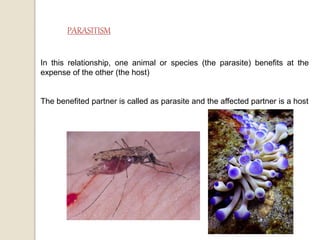
In this relationship, one animal or species (the parasite) benefits at the
expense of the other (the host)
The benefited partner is called as parasite and the affected partner is a host
A parasite is an organism which exploits another organism for the purpose
of nourishing from its tissues
It lives in or on the body of the host
A number of organisms also go through a parasitic stage at some point
during their lives and afterwards they lead a different life
Hence, based on the duration of parasitic mode of life, parasites are
classified as permanent and temporary parasites.
Those organisms which spend only a portion of their life as parasites on the
host are called temporary parasites
E.g. Lamprey (Petromyzon) and marine fish. The lamprey sucks the blood
from the large fishes with its sucker and leaves the host
This type of parasitic forms is also known as facultative parasites
The glochidium larva of freshwater mussel attaches to the host fish by its
hooks till it attains a young stage and leads a permanent benthic life
Those organisms which spend their entire life as parasites are called
permanent parasites
The permanent parasites of plants are called the phytoparasites and those of
animals as zooparasites
These are also called as obligatory parasites, which must need a host
The permanent parasites can be divided into two categories, viz. ectoparasites
and endoparasites
The former referring to external parasites, and the latter internal parasites
The endoparasites are further divided into intracellular parasites and
intercellular parasites
Parasites which live inside the host cell are called intracellular parasites (e.g.
Trypanosoma)
Those which live in between the cells of the host are intercellular parasites
(e.g. flukes, isopods, etc.)
Another marine example is that the male angler fish of very small size is
attached to the large sized female fish, Antennarius hispidus
This attachment of male fish with female is to get nourishment as well as for
reproduction. This type of parasitism is also termed as sexual parasitism.
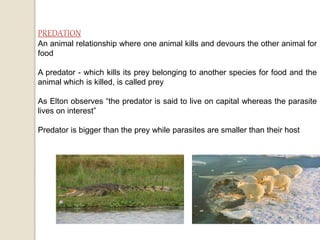
An animal relationship where one animal kills and devours the other animal for
food
A predator - which kills its prey belonging to another species for food and the
animal which is killed, is called prey
As Elton observes “the predator is said to live on capital whereas the parasite
lives on interest”
Predator is bigger than the prey while parasites are smaller than their host
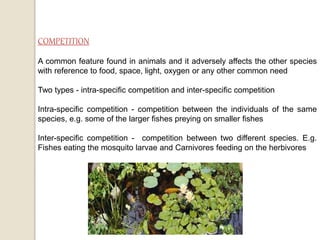
A common feature found in animals and it adversely affects the other species
with reference to food, space, light, oxygen or any other common need
Two types - intra-specific competition and inter-specific competition
Intra-specific competition - competition between the individuals of the same
species, e.g. some of the larger fishes preying on smaller fishes
Inter-specific competition - competition between two different species. E.g.
Fishes eating the mosquito larvae and Carnivores feeding on the herbivores
Association of animals

Association of animals

  • 2.
     Ecology isthe study of the interrelations of organisms and environment  Interrelationships or animal associations either direct or indirect, exist among members within a species (Intra specific) or between members of different groups (Inter specific). 1. Symbiosis 2. Commensalisms 3. Parasitism 4. Natural selection 5. Artificial selection 6. Prey – predator relationship 7. Host - parasitic relationship
  • 3.
     Symbiosis -partnership between two dissimilar organisms for mutual benefit  Symbiosis - close association of two distinct organisms for mutual benefit, so that each partner loses at least some degree of physiological independence  Association of this type where in which the relationship is intimate is called “physiological symbiosis”  Loose associations between animals referred to as “cleaning symbiosis”
  • 4.
    • The associationis beneficial to both organisms • Here algae benefit by deriving protection and securing carbon dioxide and nitrogen’s waste products from the coral-host • The host obtains additional oxygen supply and secured the elimination of waste substances • Symbiosis with algae is well known in Mollusca – Tridacna sp and Hippolpus sp. • Tridacna is a giant mollusc inhabits in coral reefs, it grows one and half meters and it contains millions of tiny zooxanthelle on outer tissues • The symbionts remove waste products i.e., CO2, nitrogen, phosphorus and other nutrients • Besides clam get nourishment by digesting their algae for nourishment
  • 6.
    A permanent typeof relationship in which two symbionts are in close contact and interdependent on each other Also referred as mutualism with continuous contact Examples: 1.Hermit crab and sea Anemone- 1.Hermit crab (Eupagurus sp) lives in the empty shell of a snail 2.The outer surface of the shell is inhabited by the sea anemone (Adamsia sp) 3.The hermit crab is protected from the enemies by the nematocysts of the sea anemones 4.The sea anemone derives food from hermit crabs and gets transported from one place to another
  • 7.
    •Partners or symbiontsare rarely attached to each other and if so it is only for a short duration •It is also called as mutualism without continuous contact •Though both the partners are benefited from each other but the nutritional need is primary at least for one of the species •Ex: crocodile (Crocodylus spp.) and crocodile-bird (Pluvianus aegyptius), which removes leaches from around the teeth of the crocodile which allows the bird to enter its mouth for the search
  • 8.
    •Interaction between twodifferent species of living organisms, where one partner or species benefits and the other species is neither benefited nor harmed •Derived from the Latin word commensa, meaning sharing a table as guest messmates - coined by Van Beneden •There is no physiological interdependence among the partners and the partners are referred as commensals •Purpose - to get food, space, shelter, defense and transport
  • 9.
    Based on theposition or location of the commensal on the host species - grouped into Endocommensals and Ectocommensals Commensalism is of the following two types based on the level of association between the commensals. 1. Permanent commensalism 2. Temporary commensalism
  • 10.
    The commensals remainonly in temporary contact with each other This intermittent contact between the animals for food, shelter or for breeding sites is seen in many marine animals. Examples - Sucker fish and shark Temporary association or contact between two animal commensals is seen in sucker-fish and the sharks or whales Sucker-fish (Echeneis) is found attached by means of its dorsal sucker to the underside of a shark or other large animal
  • 11.
    The decapod crustacean,Polyonyx lives in the U-tube of the marine annelid, Chaetopterus It obtains food particles and oxygen supply from water entering the tube due to the pumping action of the worm’s parapodia. Portuguese man-of-war and fish Based on the position or location of the commensal on the host species, it is grouped into Endocommensals and Ectocommensals.
  • 12.
    In this relationship,one animal or species (the parasite) benefits at the expense of the other (the host) The benefited partner is called as parasite and the affected partner is a host
  • 13.
    A parasite isan organism which exploits another organism for the purpose of nourishing from its tissues It lives in or on the body of the host A number of organisms also go through a parasitic stage at some point during their lives and afterwards they lead a different life Hence, based on the duration of parasitic mode of life, parasites are classified as permanent and temporary parasites.
  • 14.
    Those organisms whichspend only a portion of their life as parasites on the host are called temporary parasites E.g. Lamprey (Petromyzon) and marine fish. The lamprey sucks the blood from the large fishes with its sucker and leaves the host This type of parasitic forms is also known as facultative parasites The glochidium larva of freshwater mussel attaches to the host fish by its hooks till it attains a young stage and leads a permanent benthic life
  • 15.
    Those organisms whichspend their entire life as parasites are called permanent parasites The permanent parasites of plants are called the phytoparasites and those of animals as zooparasites These are also called as obligatory parasites, which must need a host The permanent parasites can be divided into two categories, viz. ectoparasites and endoparasites The former referring to external parasites, and the latter internal parasites The endoparasites are further divided into intracellular parasites and intercellular parasites Parasites which live inside the host cell are called intracellular parasites (e.g. Trypanosoma) Those which live in between the cells of the host are intercellular parasites (e.g. flukes, isopods, etc.) Another marine example is that the male angler fish of very small size is attached to the large sized female fish, Antennarius hispidus This attachment of male fish with female is to get nourishment as well as for reproduction. This type of parasitism is also termed as sexual parasitism.
  • 16.
    An animal relationshipwhere one animal kills and devours the other animal for food A predator - which kills its prey belonging to another species for food and the animal which is killed, is called prey As Elton observes “the predator is said to live on capital whereas the parasite lives on interest” Predator is bigger than the prey while parasites are smaller than their host
  • 17.
    A common featurefound in animals and it adversely affects the other species with reference to food, space, light, oxygen or any other common need Two types - intra-specific competition and inter-specific competition Intra-specific competition - competition between the individuals of the same species, e.g. some of the larger fishes preying on smaller fishes Inter-specific competition - competition between two different species. E.g. Fishes eating the mosquito larvae and Carnivores feeding on the herbivores