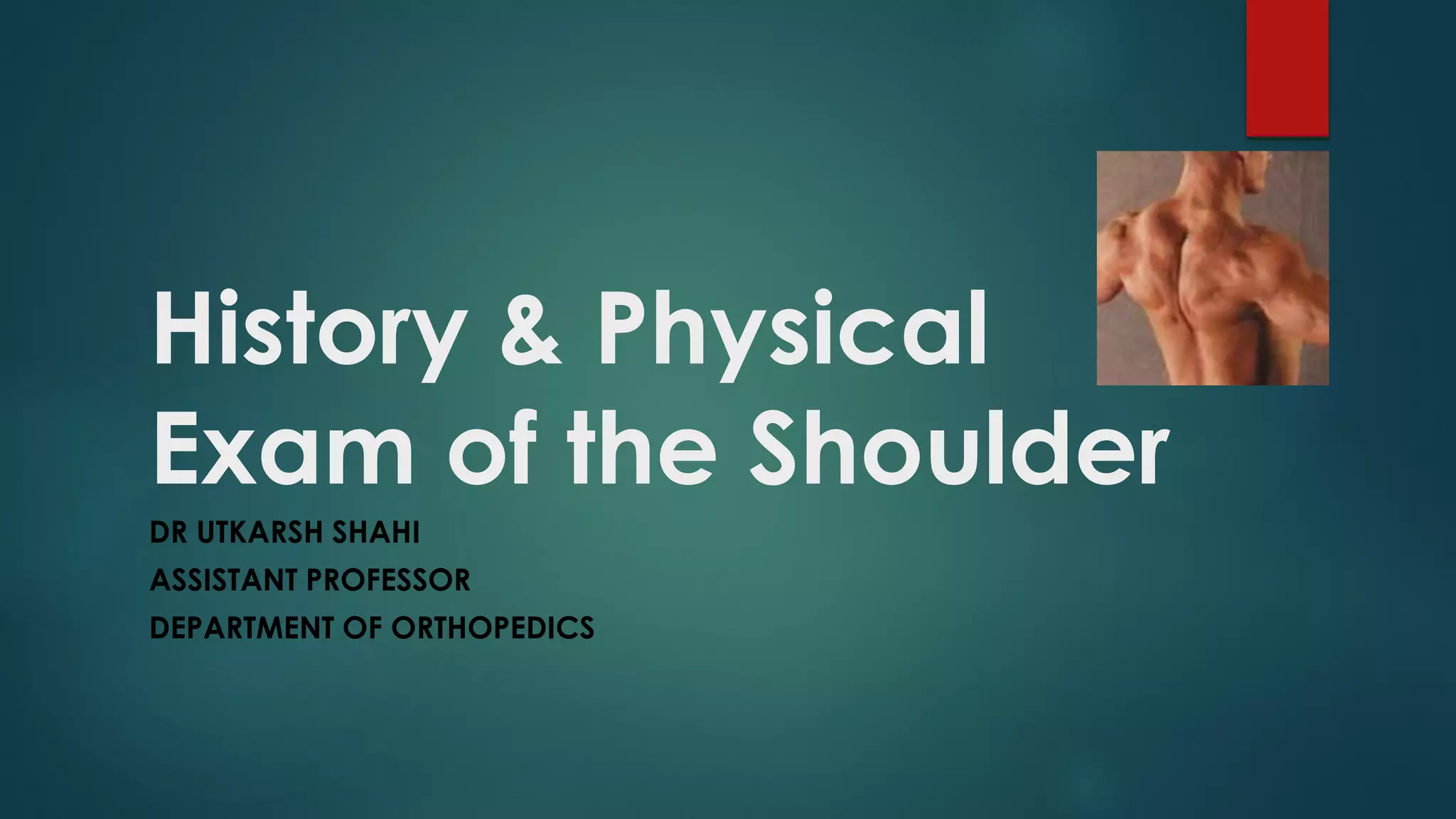
History & Physical
Exam of the Shoulder
DR UTKARSH SHAHI
ASSISTANT PROFESSOR
DEPARTMENT OF ORTHOPEDICS
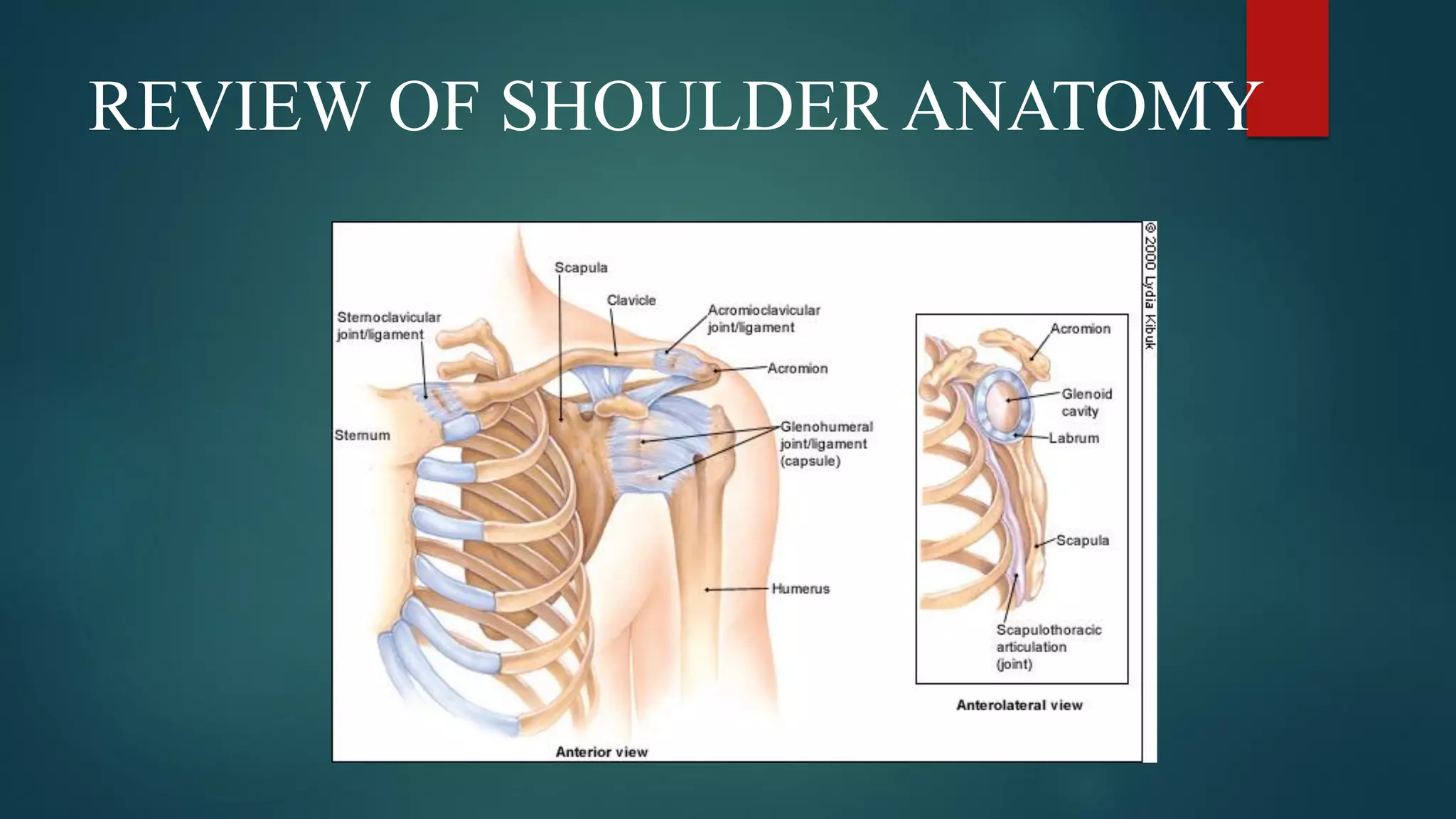
REVIEW OF SHOULDER ANATOMY
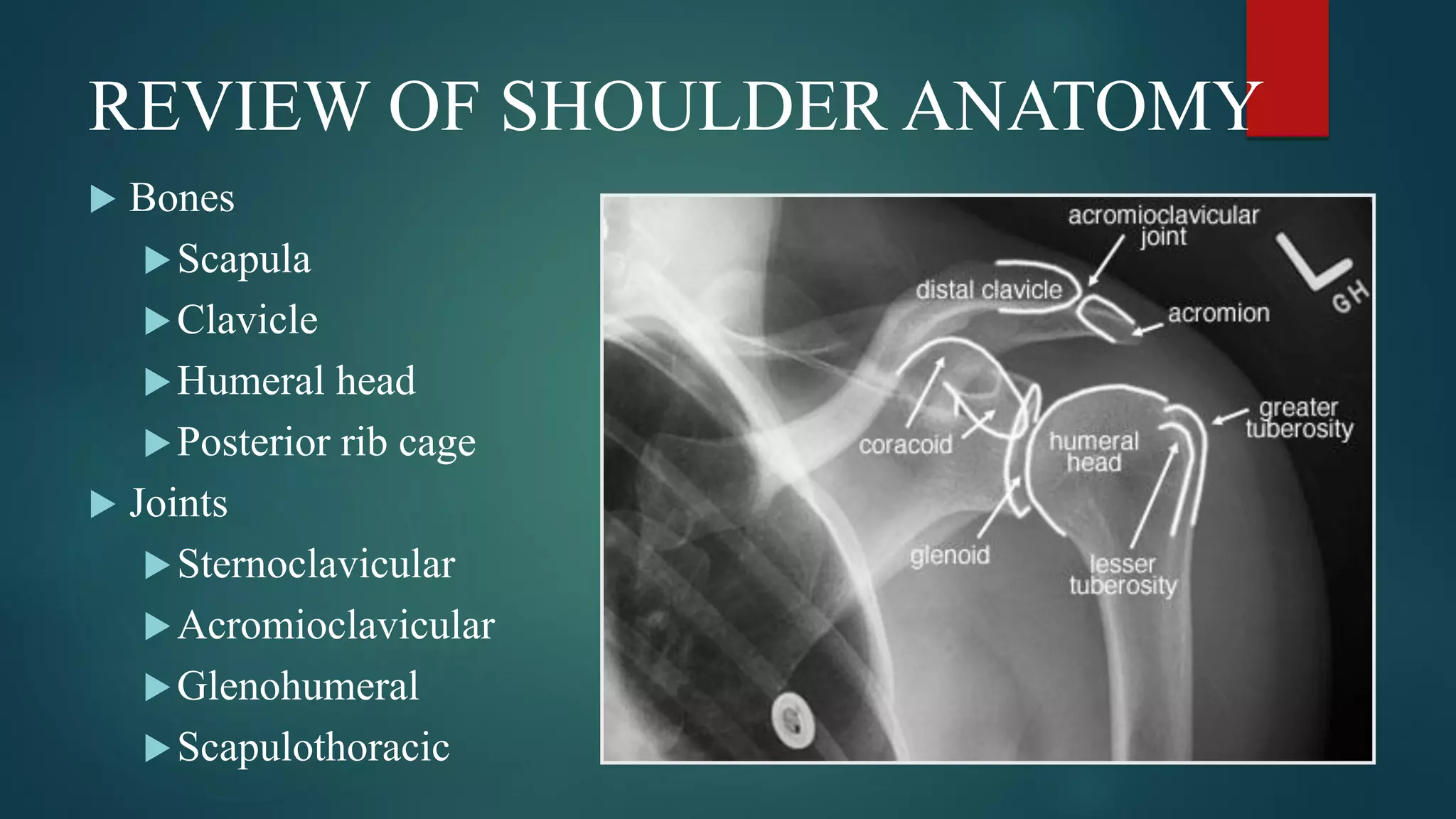
 Bones
Scapula
Clavicle
Humeral head
Posterior rib cage
 Joints
Sternoclavicular
Acromioclavicular
Glenohumeral
Scapulothoracic
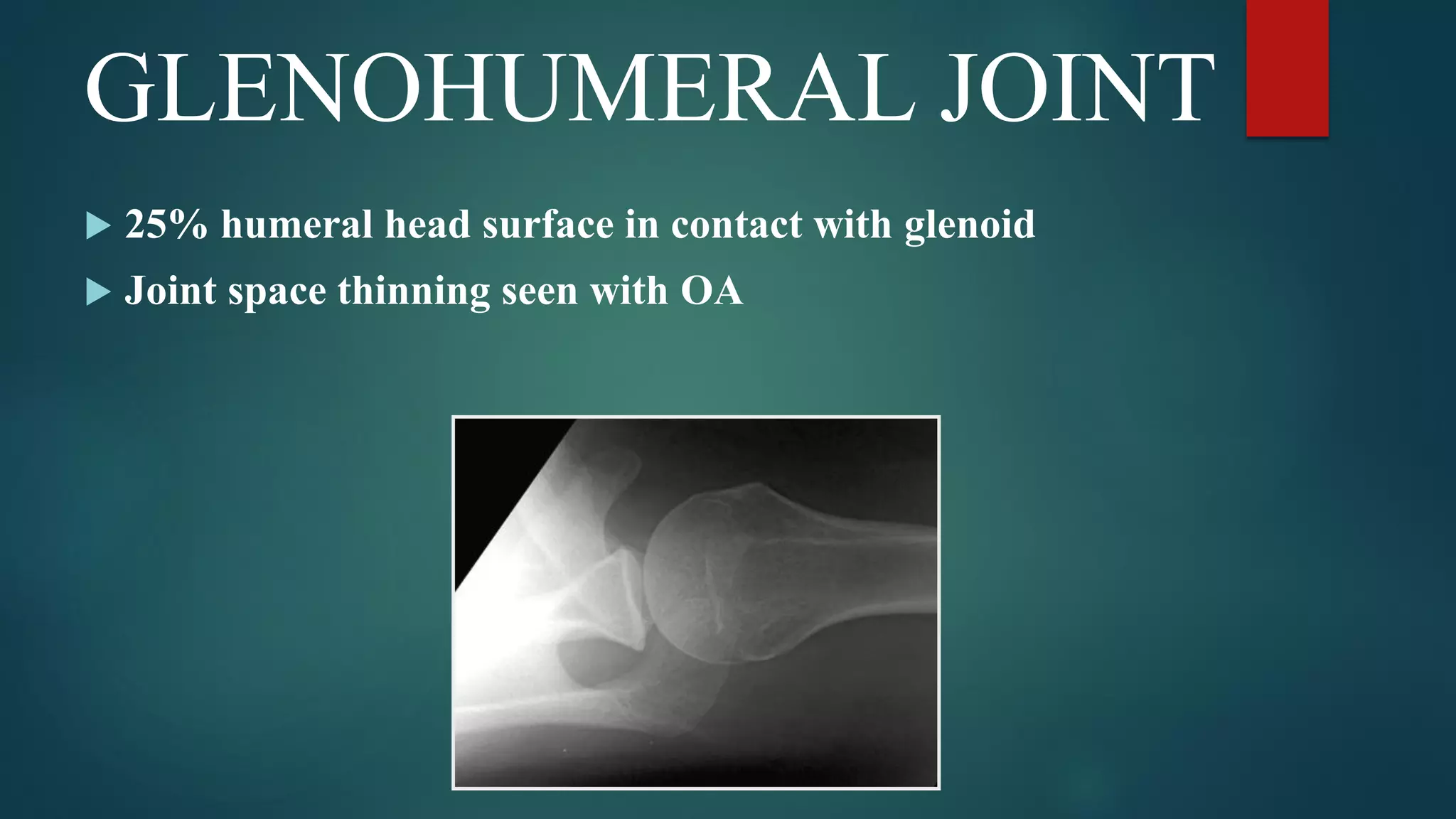
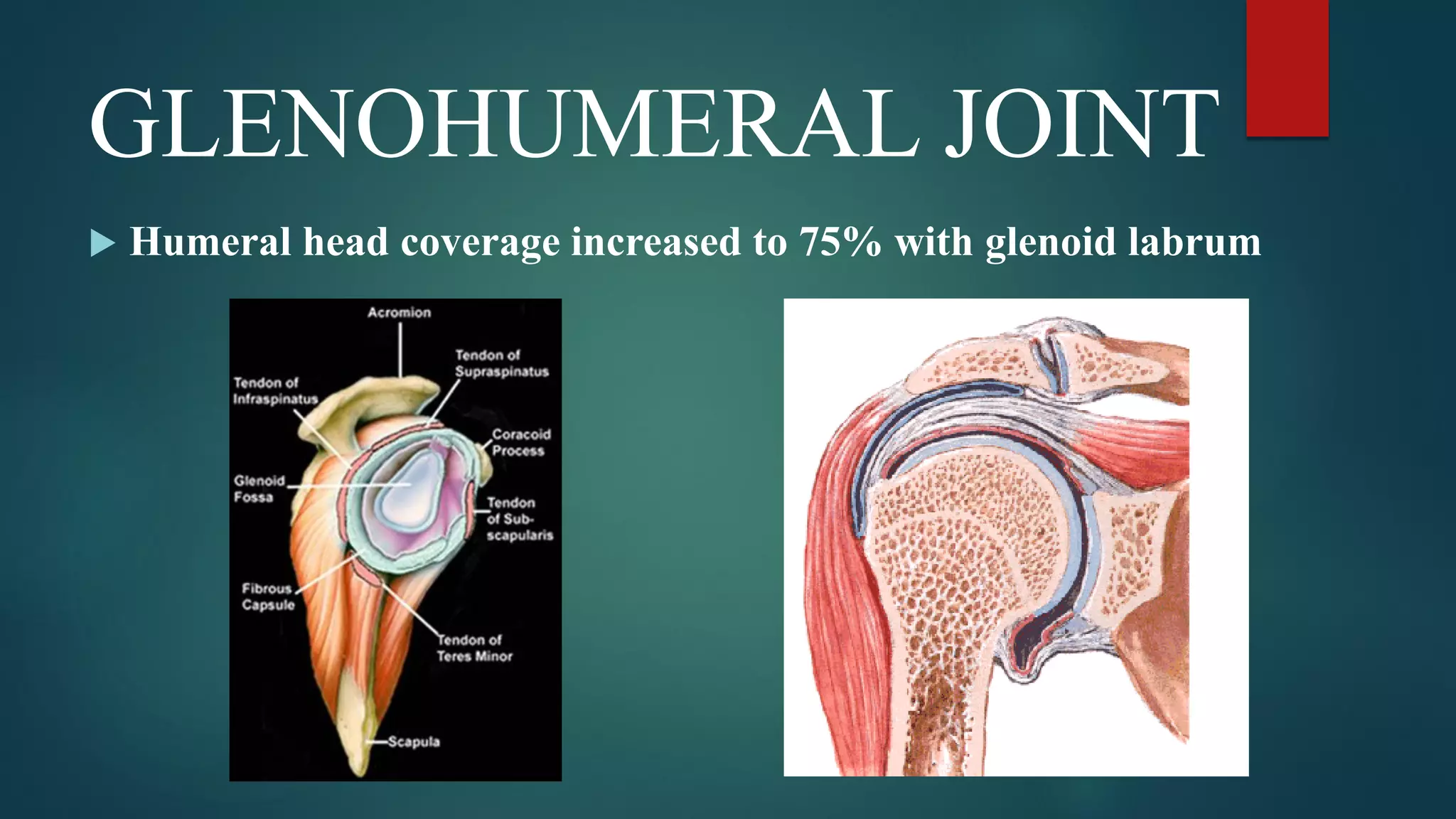
GLENOHUMERAL JOINT
 25% humeral head surface in contact with glenoid
 Joint space thinning seen with OA
GLENOHUMERAL JOINT
 Humeral head coverage increased to 75% with glenoid labrum
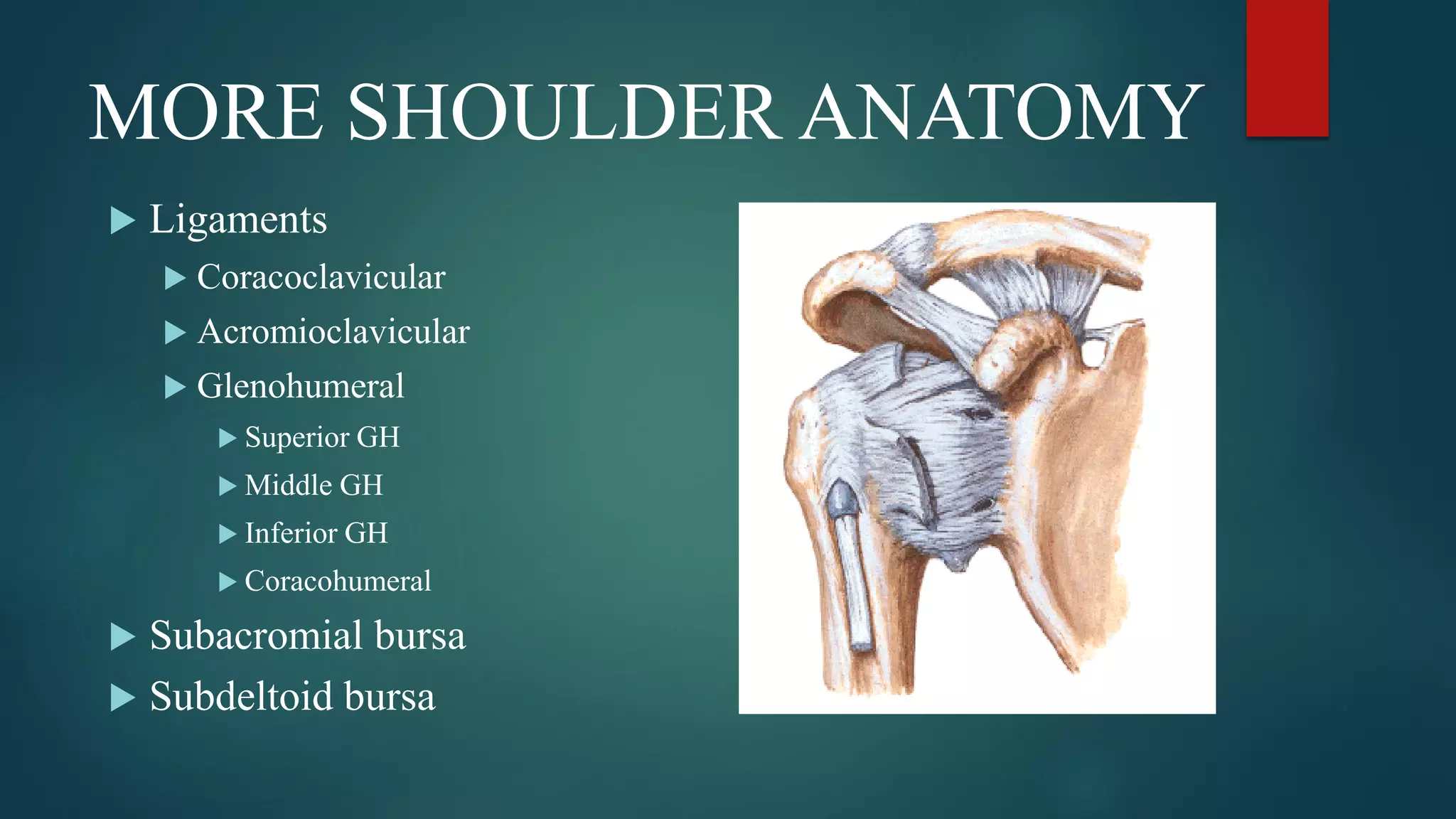
MORE SHOULDER ANATOMY
 Ligaments
 Coracoclavicular
 Acromioclavicular
 Glenohumeral
 Superior GH
 Middle GH
 Inferior GH
 Coracohumeral
 Subacromial bursa
 Subdeltoid bursa
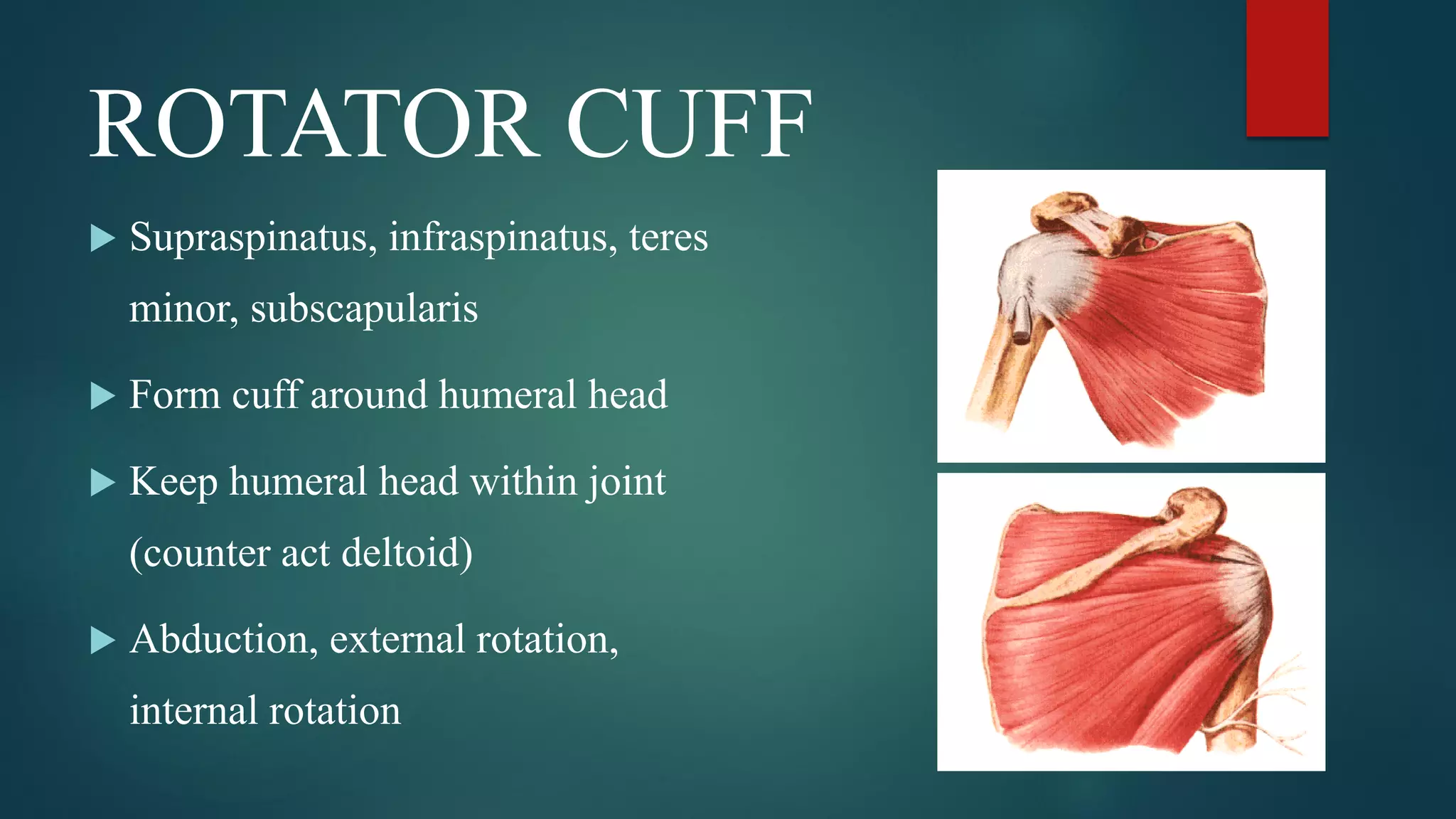
ROTATOR CUFF
 Supraspinatus, infraspinatus, teres
minor, subscapularis
 Form cuff around humeral head
 Keep humeral head within joint
(counter act deltoid)
 Abduction, external rotation,
internal rotation
MUSCLES OF THE ROTATOR CUFF
 The four major muscles of the rotator cuff rotate the humerus and properly orient the
humoral head in the glenoid fossa (socket).
 The tendons of these four muscles merge, forming a cuff around the glenohumeral joint.
 Supraspinatus: abducts the humeral head and acts as a humeral head depressor
 Infraspinatus: externally rotates and horizontally extends the humerus
 Teres minor: externally rotates and extends the humerus
 Subscapularis: internally rotates the humerus
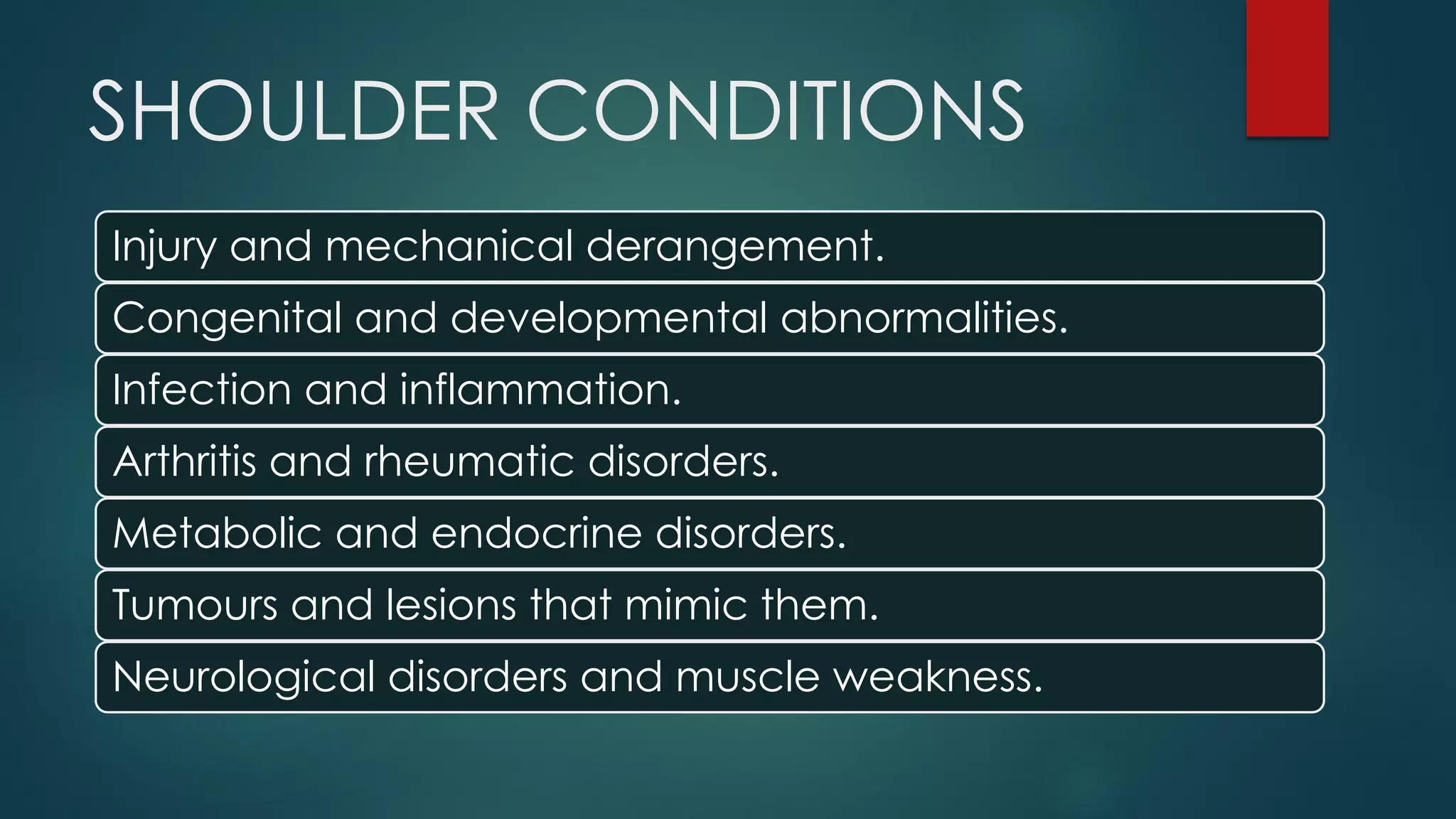
SHOULDER CONDITIONS
Injury and mechanical derangement.
Congenital and developmental abnormalities.
Infection and inflammation.
Arthritis and rheumatic disorders.
Metabolic and endocrine disorders.
Tumours and lesions that mimic them.
Neurological disorders and muscle weakness.
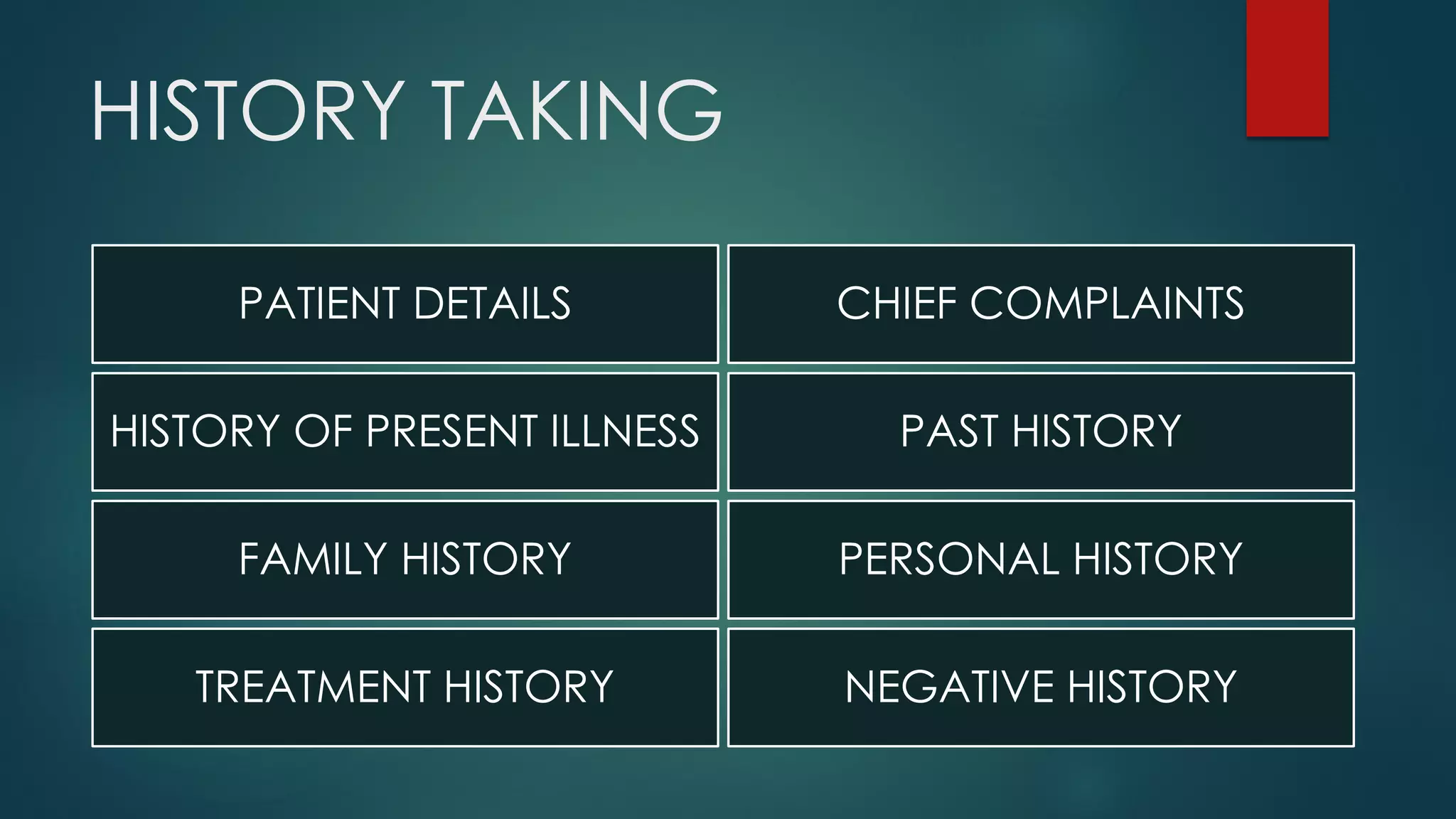
HISTORY TAKING
PATIENT DETAILS CHIEF COMPLAINTS
HISTORY OF PRESENT ILLNESS PAST HISTORY
FAMILY HISTORY PERSONAL HISTORY
TREATMENT HISTORY NEGATIVE HISTORY
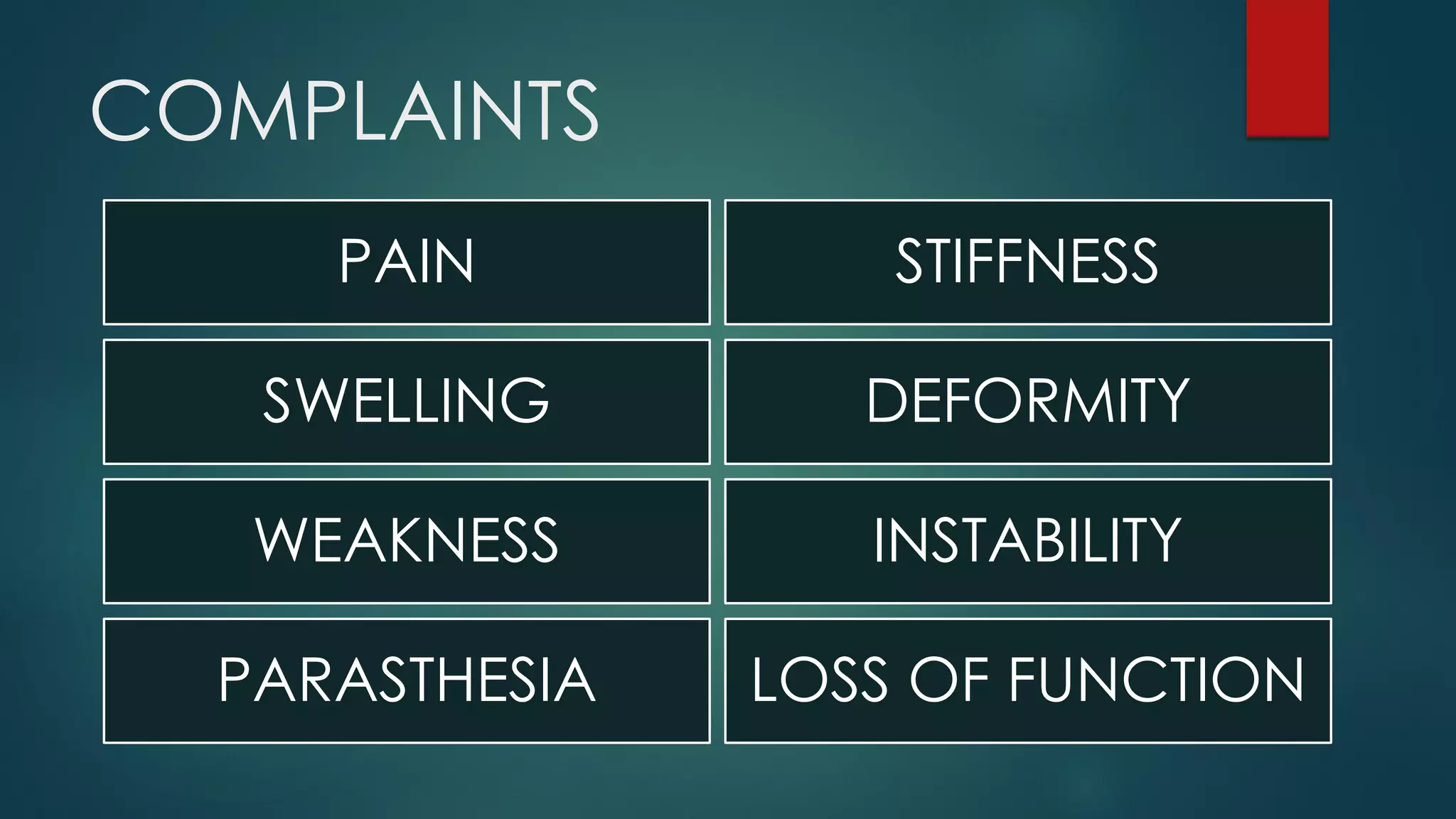
COMPLAINTS
PAIN STIFFNESS
SWELLING DEFORMITY
WEAKNESS INSTABILITY
PARASTHESIA LOSS OF FUNCTION
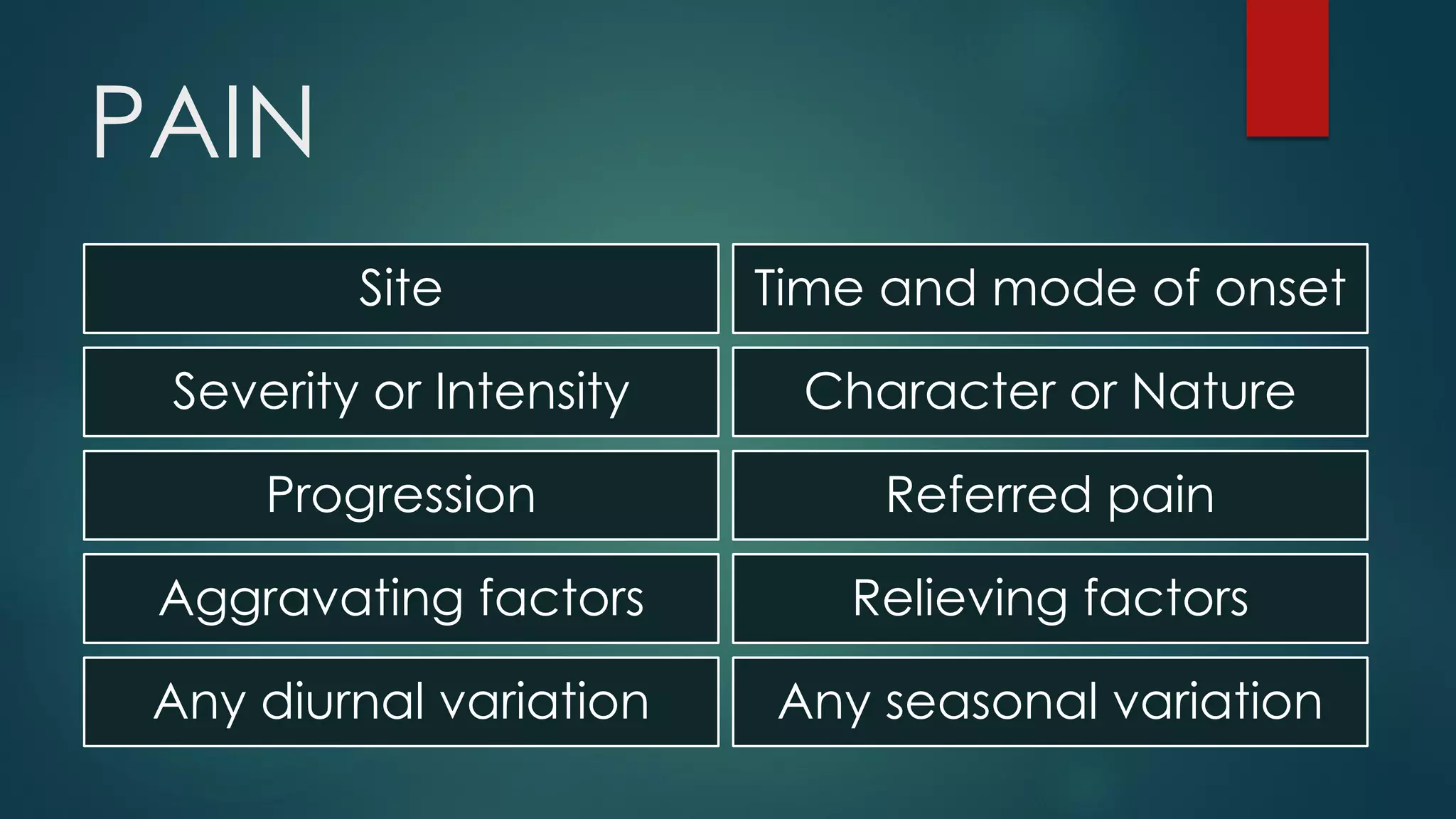
PAIN
Site Time and mode of onset
Severity or Intensity Character or Nature
Progression Referred pain
Aggravating factors Relieving factors
Any diurnal variation Any seasonal variation
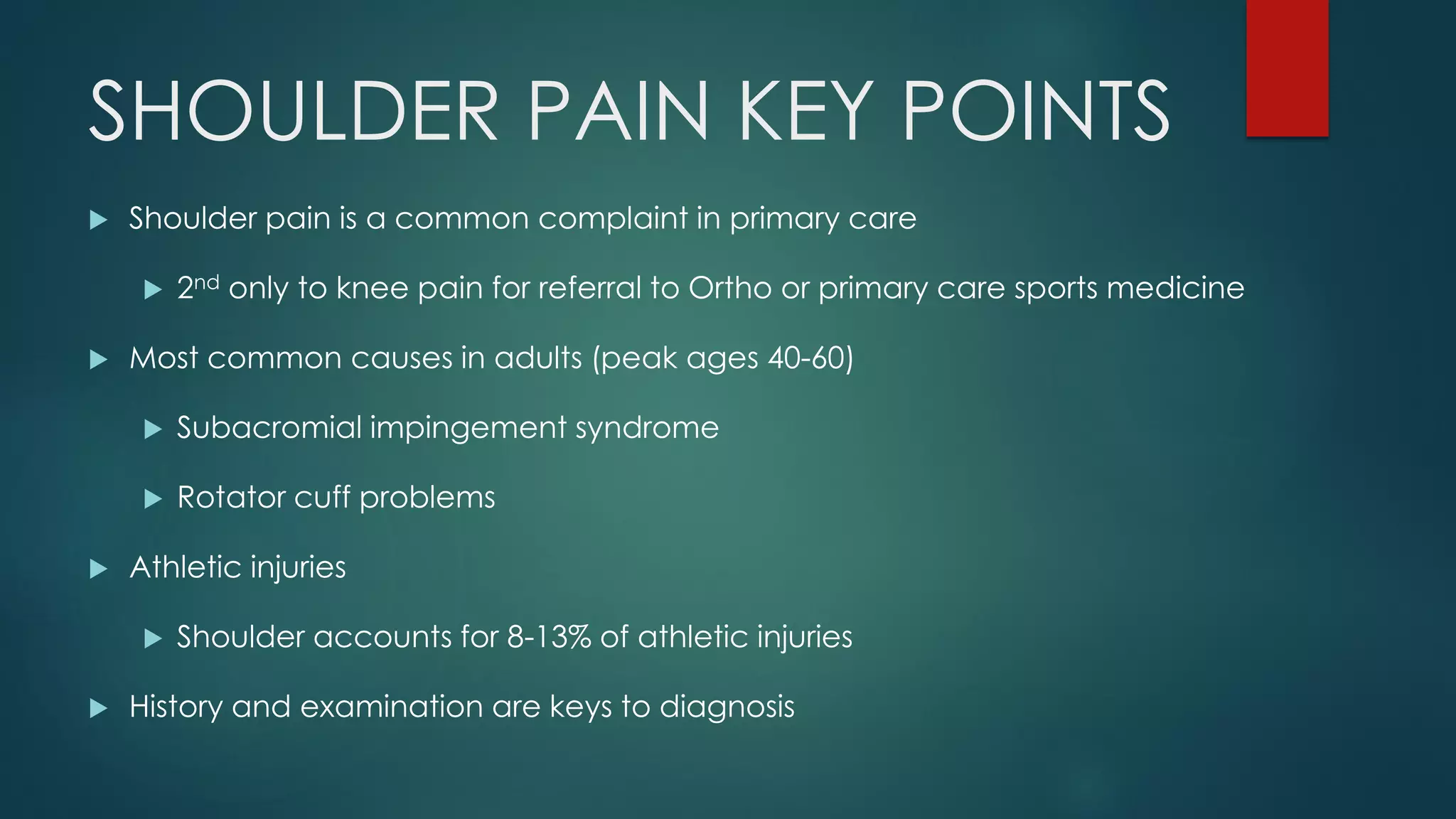
SHOULDER PAIN KEY POINTS
 Shoulder pain is a common complaint in primary care
 2nd only to knee pain for referral to Ortho or primary care sports medicine
 Most common causes in adults (peak ages 40-60)
 Subacromial impingement syndrome
 Rotator cuff problems
 Athletic injuries
 Shoulder accounts for 8-13% of athletic injuries
 History and examination are keys to diagnosis
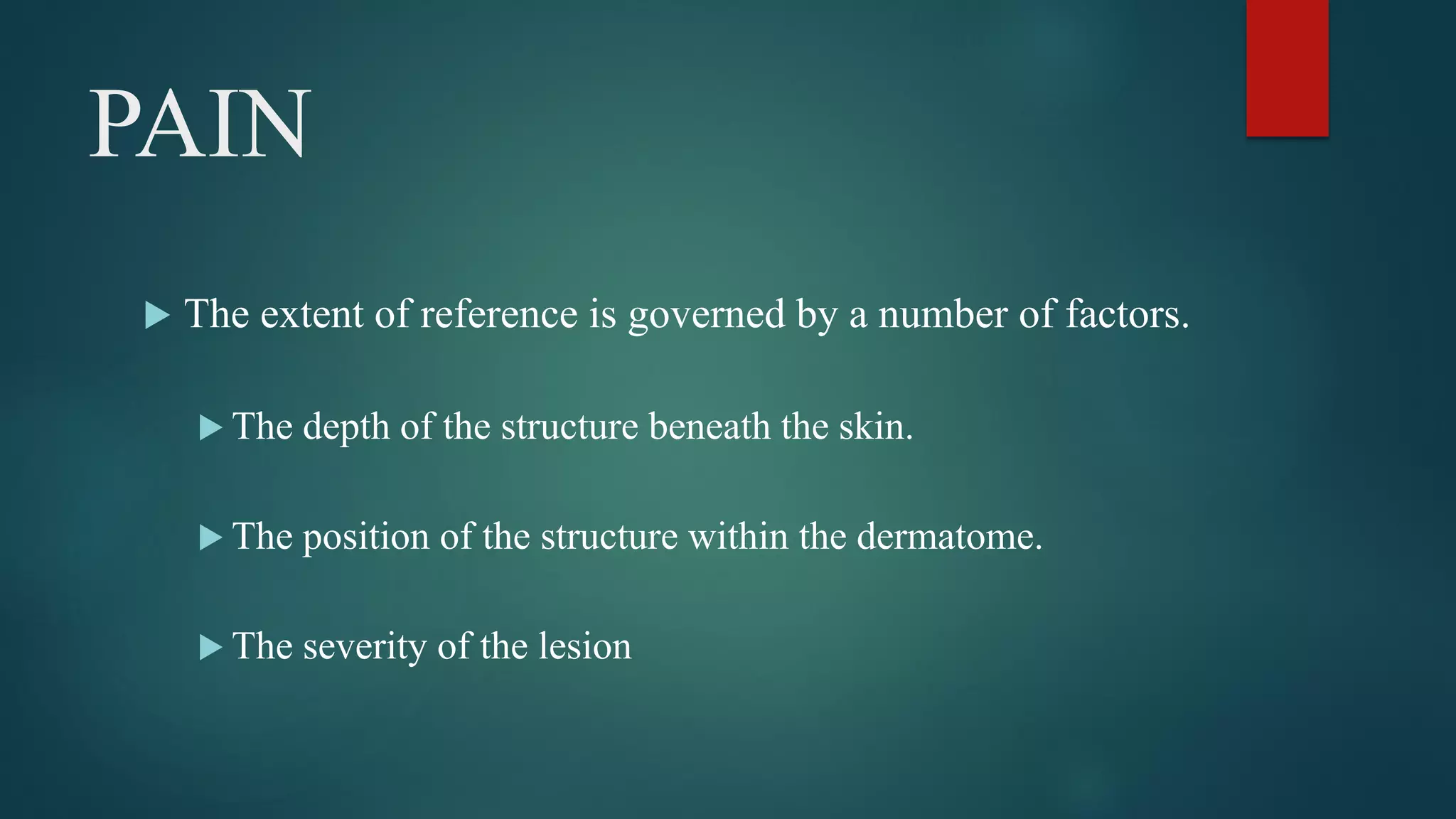
PAIN
 The extent of reference is governed by a number of factors.
 The depth of the structure beneath the skin.
 The position of the structure within the dermatome.
 The severity of the lesion
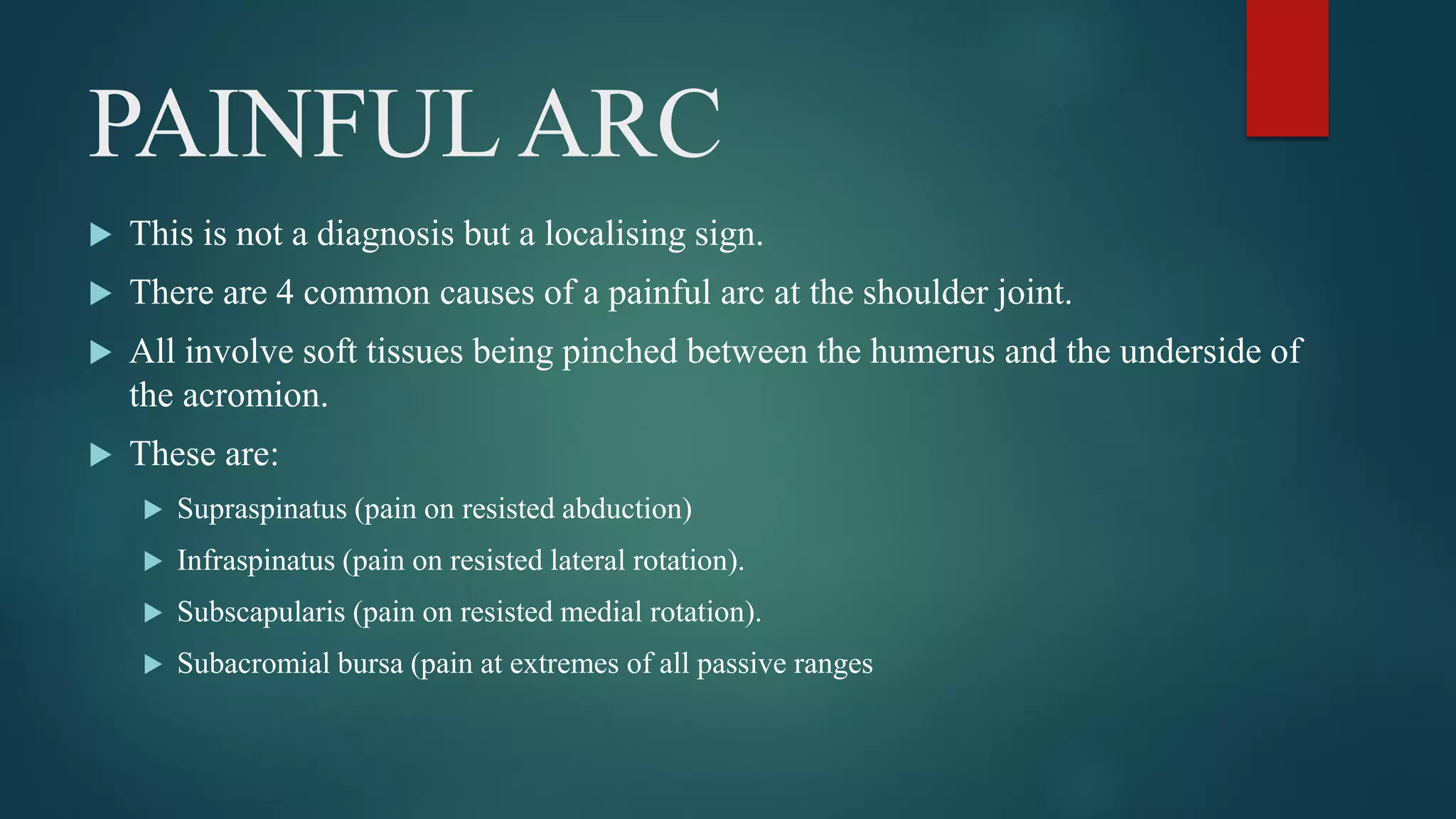
PAINFUL ARC
 This is not a diagnosis but a localising sign.
 There are 4 common causes of a painful arc at the shoulder joint.
 All involve soft tissues being pinched between the humerus and the underside of
the acromion.
 These are:
 Supraspinatus (pain on resisted abduction)
 Infraspinatus (pain on resisted lateral rotation).
 Subscapularis (pain on resisted medial rotation).
 Subacromial bursa (pain at extremes of all passive ranges
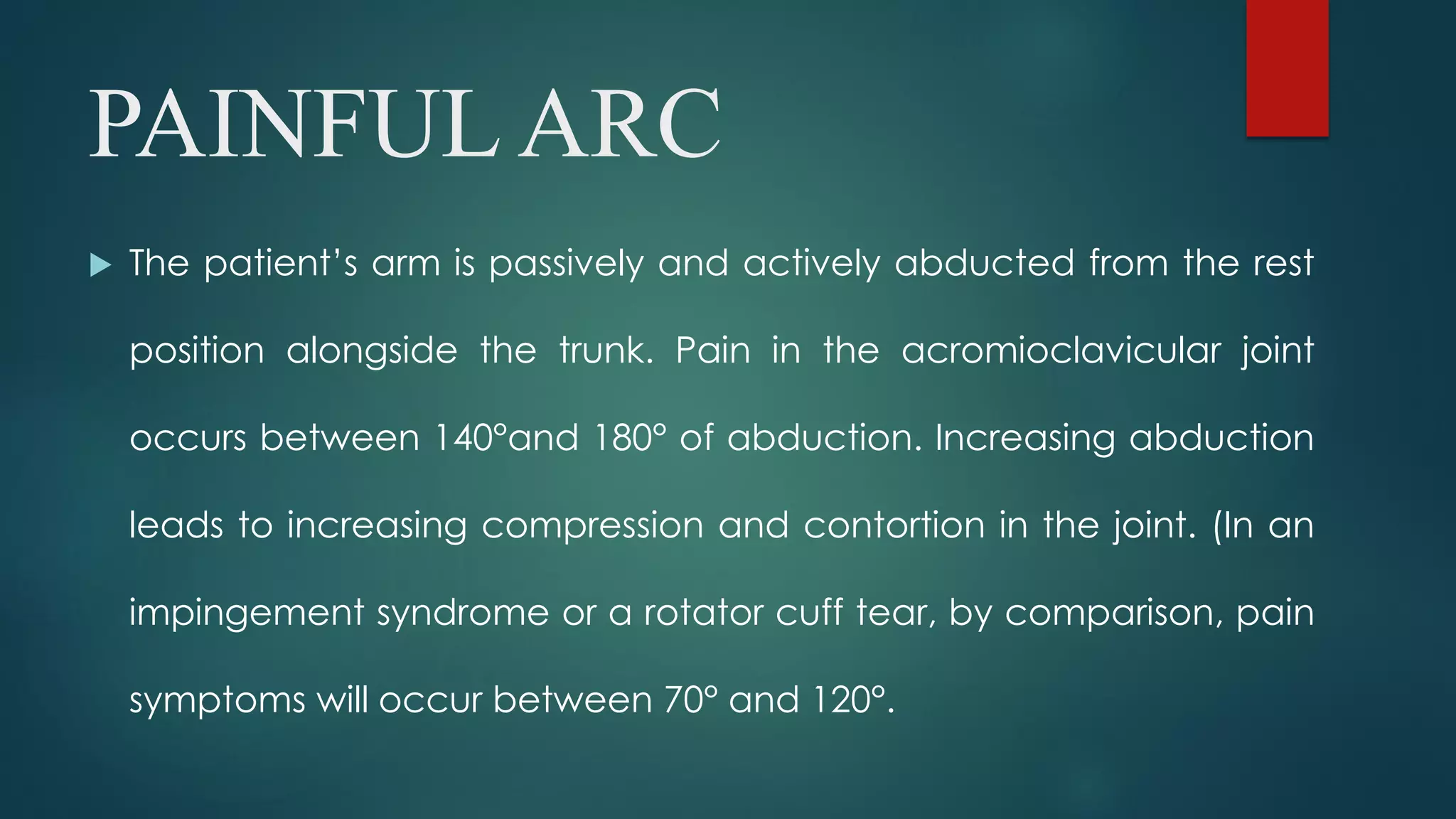
PAINFUL ARC
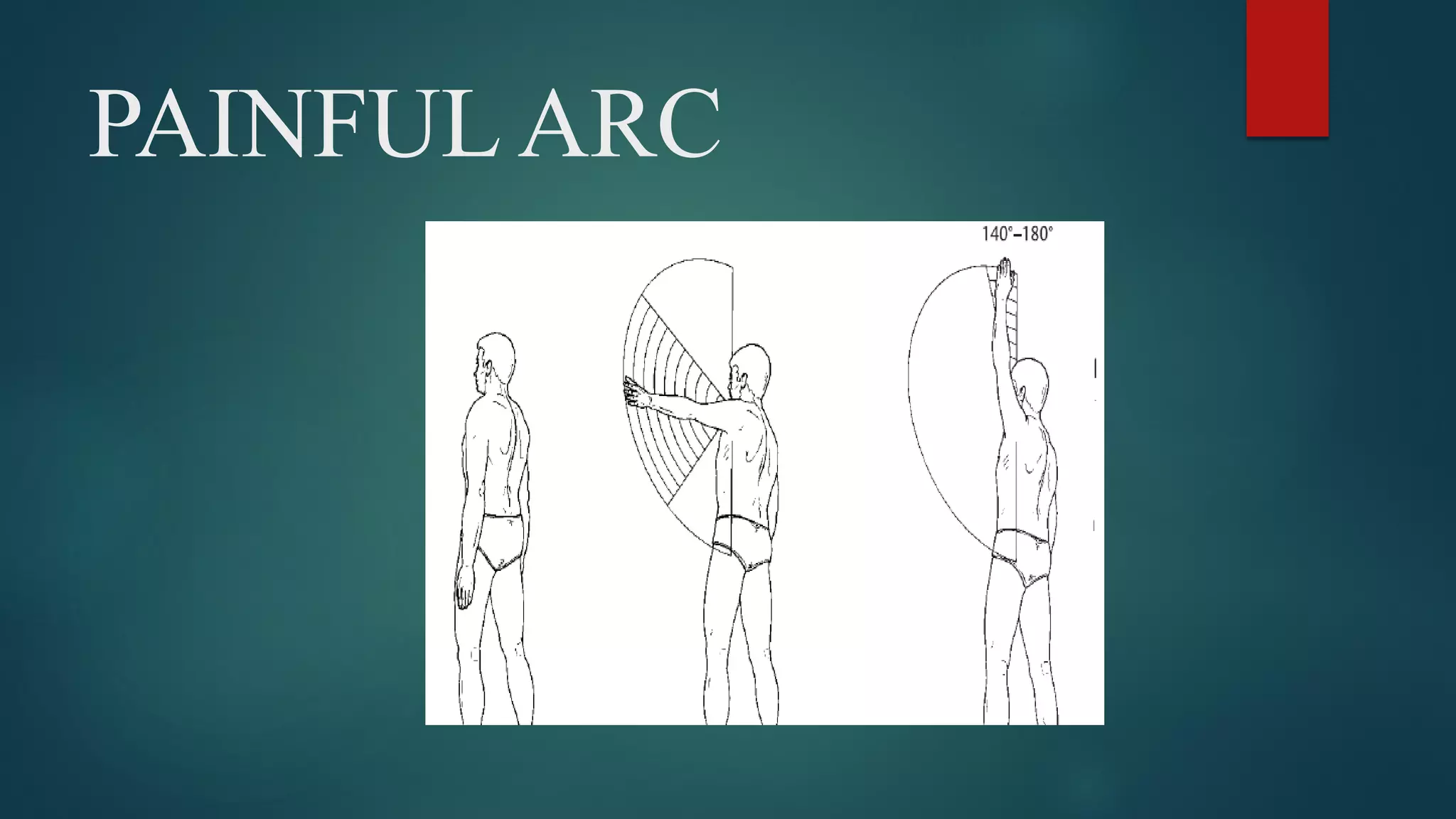
 The patient’s arm is passively and actively abducted from the rest
position alongside the trunk. Pain in the acromioclavicular joint
occurs between 140°and 180° of abduction. Increasing abduction
leads to increasing compression and contortion in the joint. (In an
impingement syndrome or a rotator cuff tear, by comparison, pain
symptoms will occur between 70° and 120°.
PAINFUL ARC
 In the evaluation of the active and passive ranges of motion, the
patient can often avoid the painful arc by externally rotating the
arm while abducting it. This increases the clearance between the
acromion and the diseased tendinous portion of the rotator cuff,
avoiding impingement in the range between 70° and 120°.
PAINFUL ARC
FOCUSED HISTORY
FOCUSED HISTORY QUESTIONS
 Mechanism of Injury
 Helps predict injured structure
 Example: Fall directly onto anterior/superior shoulder  AC joint injury
(shoulder separation)
 Example: Arm forcefully abducted and externally rotated  subluxation
or anterior dislocation
 Example: If chronic pain, note activity that triggers pain, such as the
cocking phase of throwing or the pull-through phase of swimming
Characteristics of pain
FOCUSED HISTORY QUESTIONS
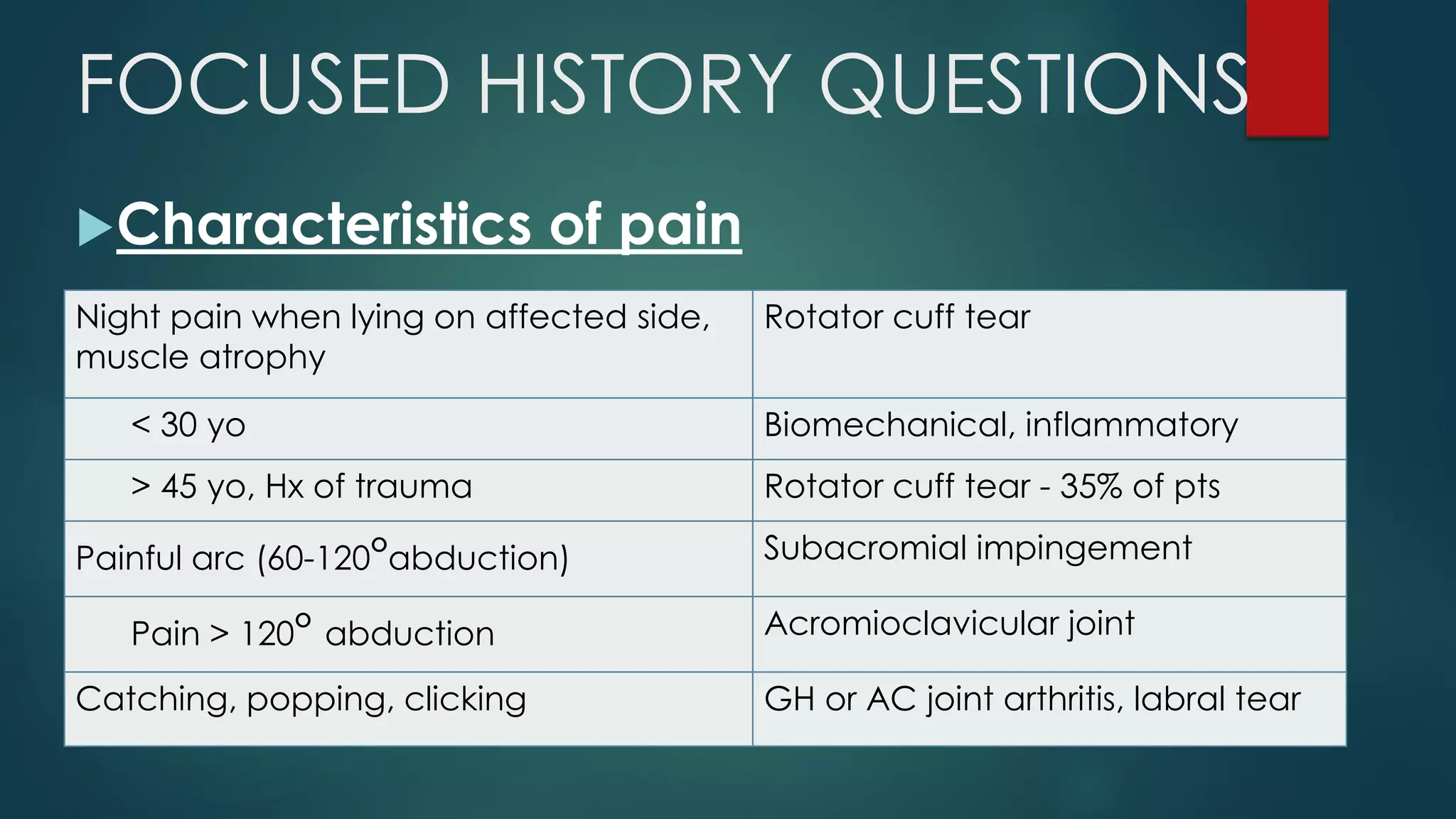
Night pain when lying on affected side,
muscle atrophy
Rotator cuff tear
< 30 yo Biomechanical, inflammatory
> 45 yo, Hx of trauma Rotator cuff tear - 35% of pts
Painful arc (60-120°abduction) Subacromial impingement
Pain > 120° abduction Acromioclavicular joint
Catching, popping, clicking GH or AC joint arthritis, labral tear
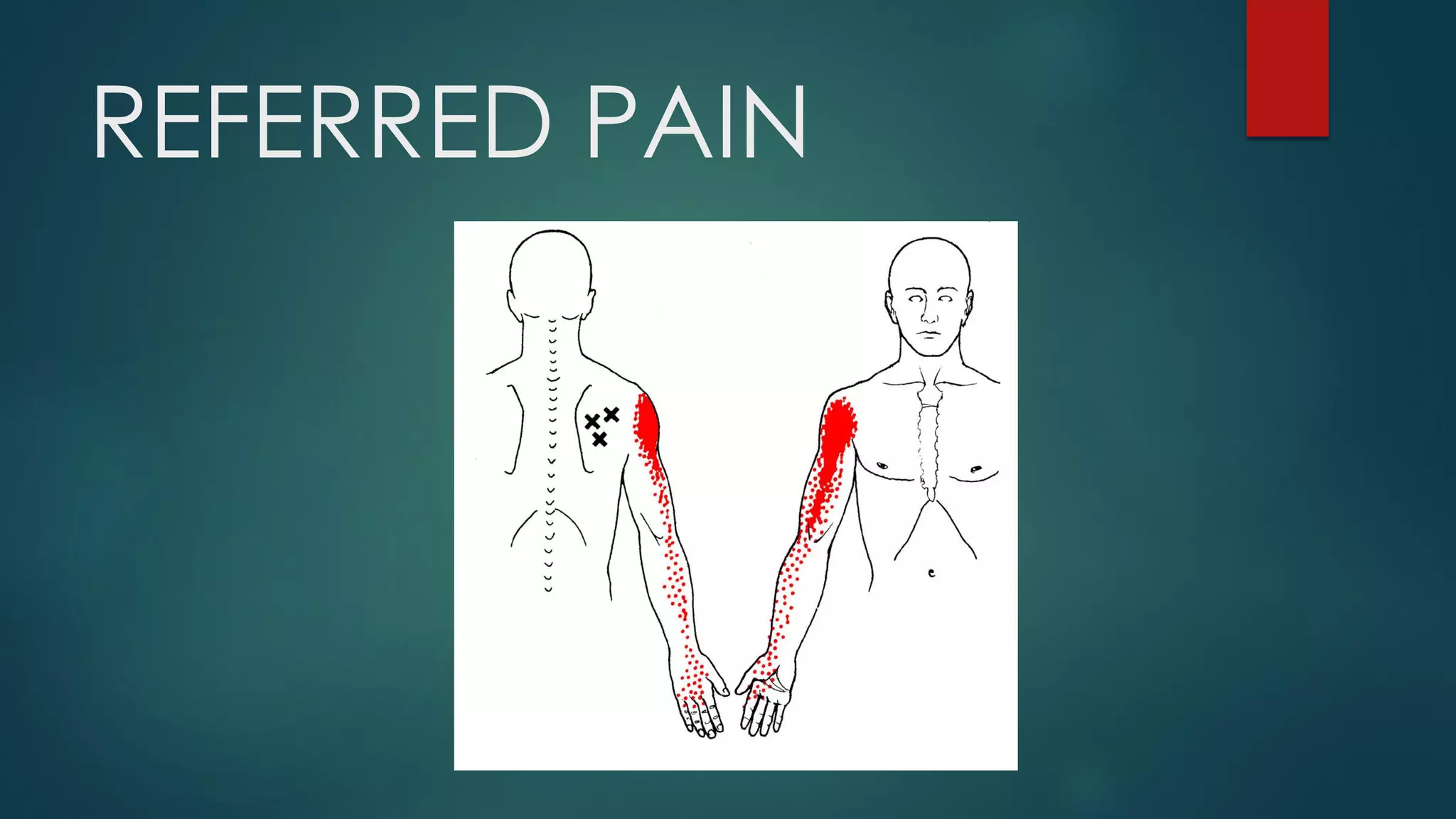
REFERRED PAIN
REFERRED PAIN
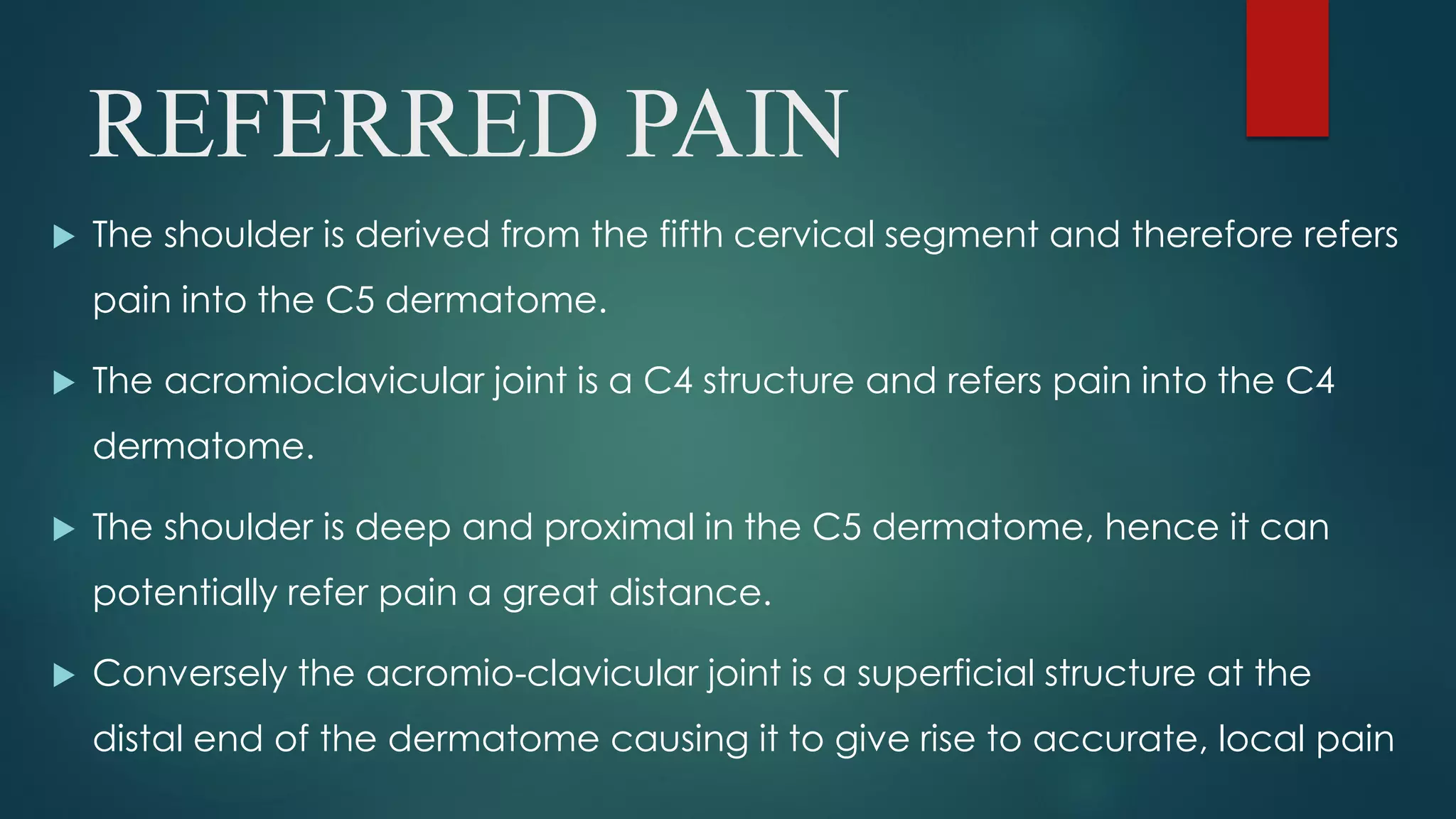
 The shoulder is derived from the fifth cervical segment and therefore refers
pain into the C5 dermatome.
 The acromioclavicular joint is a C4 structure and refers pain into the C4
dermatome.
 The shoulder is deep and proximal in the C5 dermatome, hence it can
potentially refer pain a great distance.
 Conversely the acromio-clavicular joint is a superficial structure at the
distal end of the dermatome causing it to give rise to accurate, local pain
REFERRED PAIN
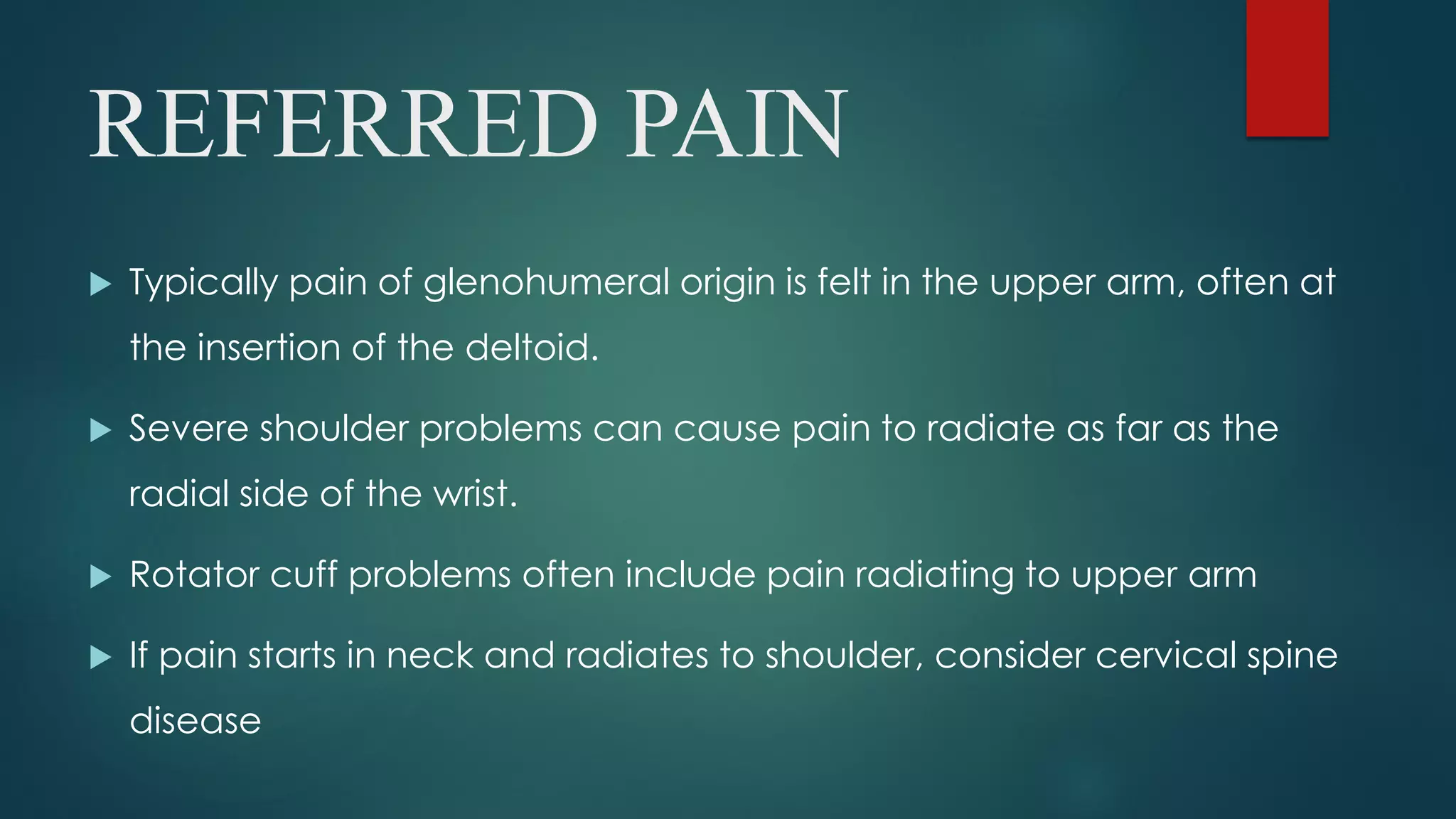
 Typically pain of glenohumeral origin is felt in the upper arm, often at
the insertion of the deltoid.
 Severe shoulder problems can cause pain to radiate as far as the
radial side of the wrist.
 Rotator cuff problems often include pain radiating to upper arm
 If pain starts in neck and radiates to shoulder, consider cervical spine
disease
25
 Consider OTHER sources of referred pain
 Cervical spine – spondylolysis, arthritis, disc disease
 Cardiac - myocardial ischemia
 Diaphragmatic irritation
 Thoracic outlet syndrome
 Gallbladder disease
 Complex regional pain syndrome (a.k.a, reflex sympathetic dystrophy)
REFERRED PAIN
INSTABILITY
Time of Onset
•Congenital
•Developmental
•Acquired
Frequency
•Single episode
•Recurrent Aggravating factors
Associated
symptoms
•Pain
•Disability
•Neurovascular
Reducibility
•Reducible
•Irreducible Associated Illness
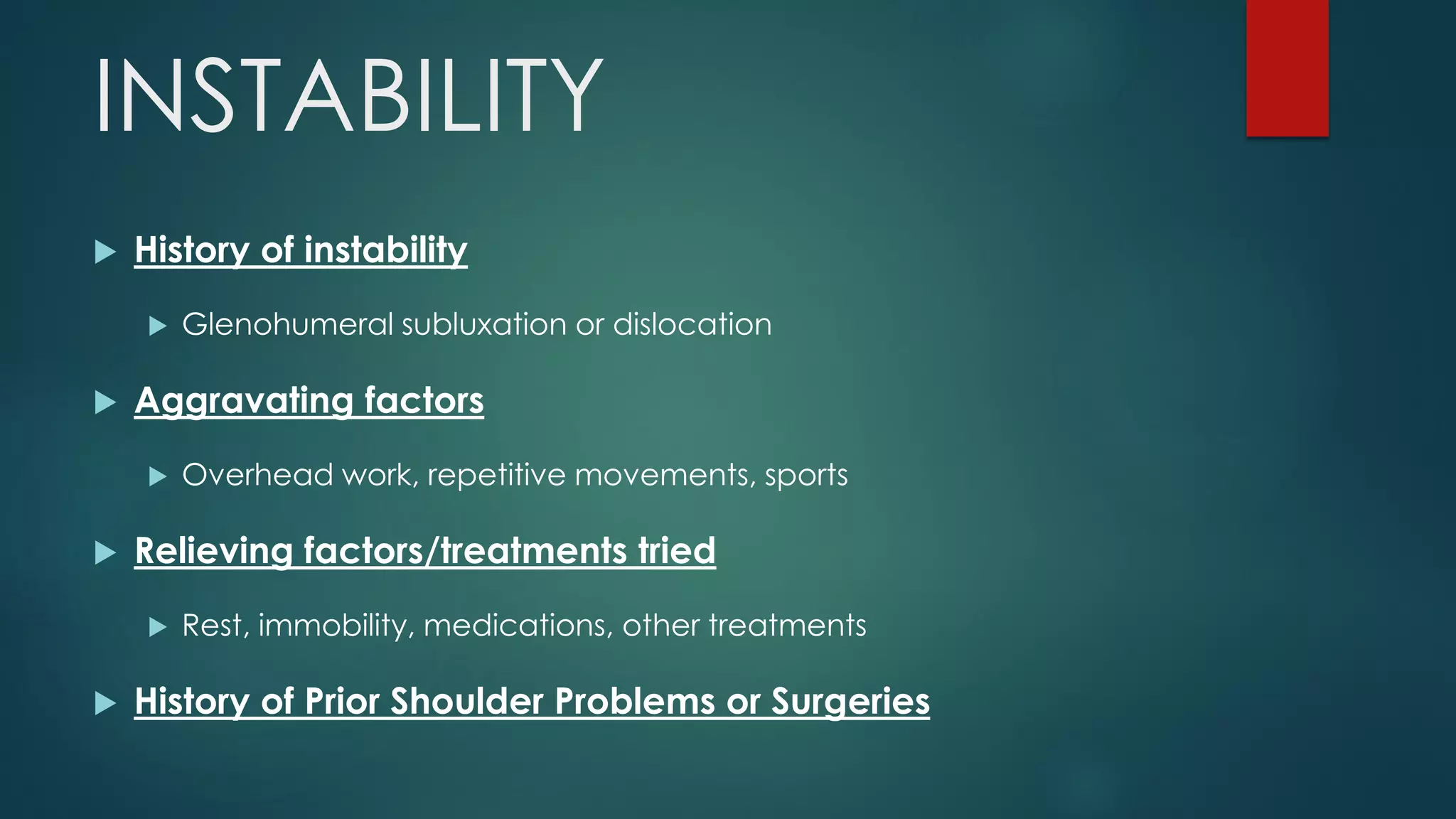
INSTABILITY
 History of instability
 Glenohumeral subluxation or dislocation
 Aggravating factors
 Overhead work, repetitive movements, sports
 Relieving factors/treatments tried
 Rest, immobility, medications, other treatments
 History of Prior Shoulder Problems or Surgeries
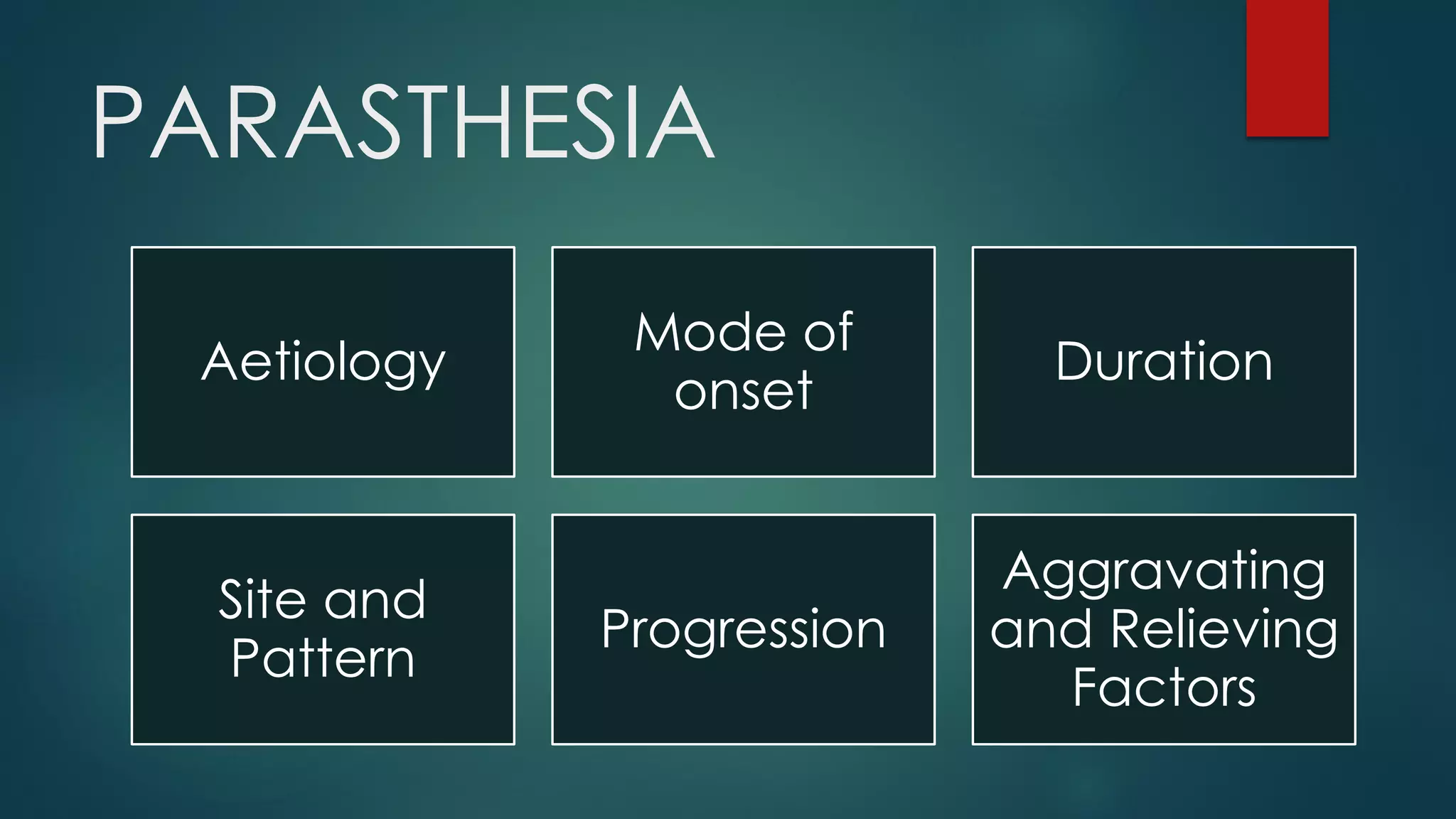
PARASTHESIA
Aetiology
Mode of
onset
Duration
Site and
Pattern
Progression
Aggravating
and Relieving
Factors
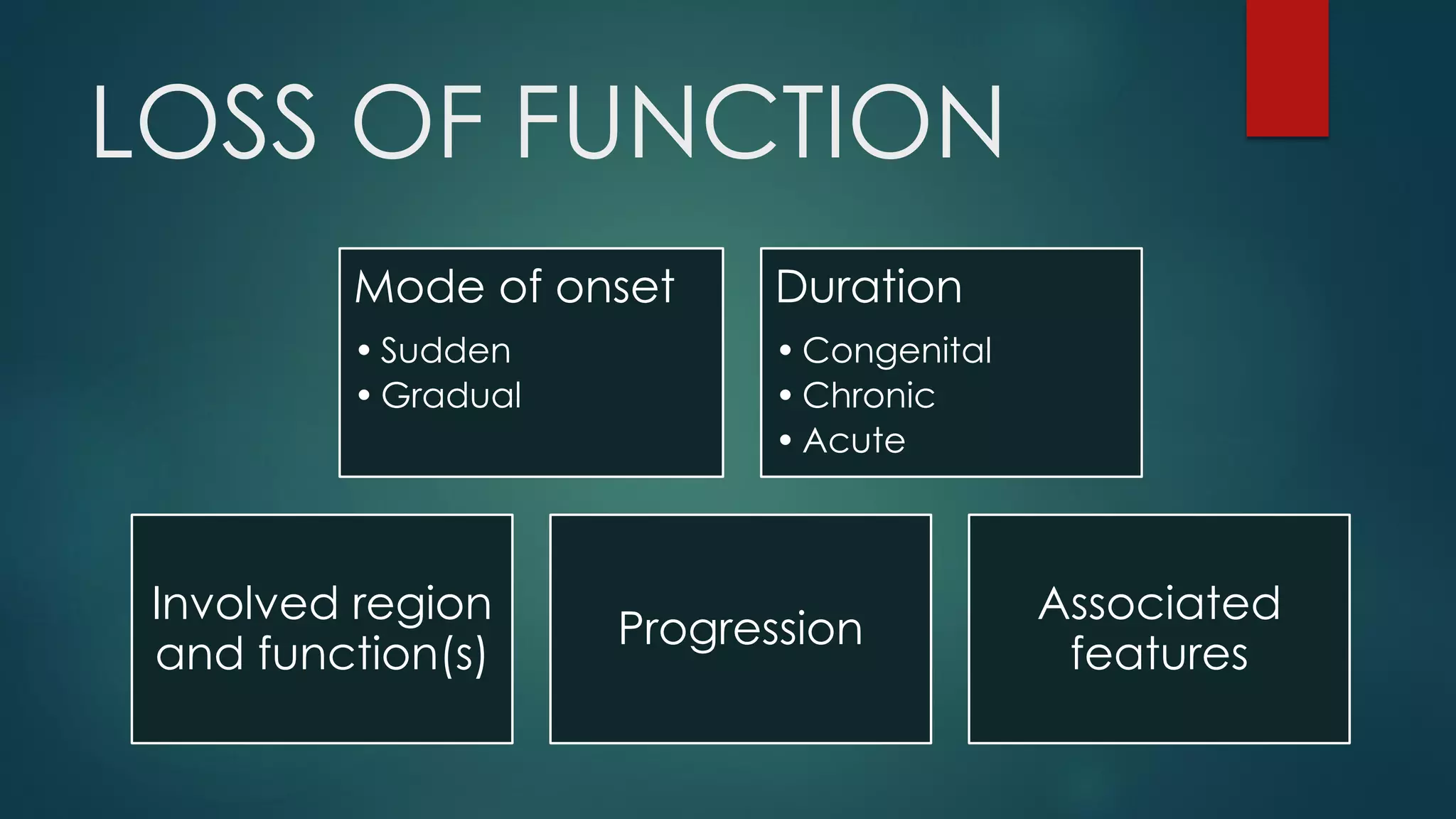
LOSS OF FUNCTION
Mode of onset
• Sudden
• Gradual
Duration
• Congenital
• Chronic
• Acute
Involved region
and function(s)
Progression
Associated
features
STIFFNESS
Generalised Localised
Locking Ankylosis
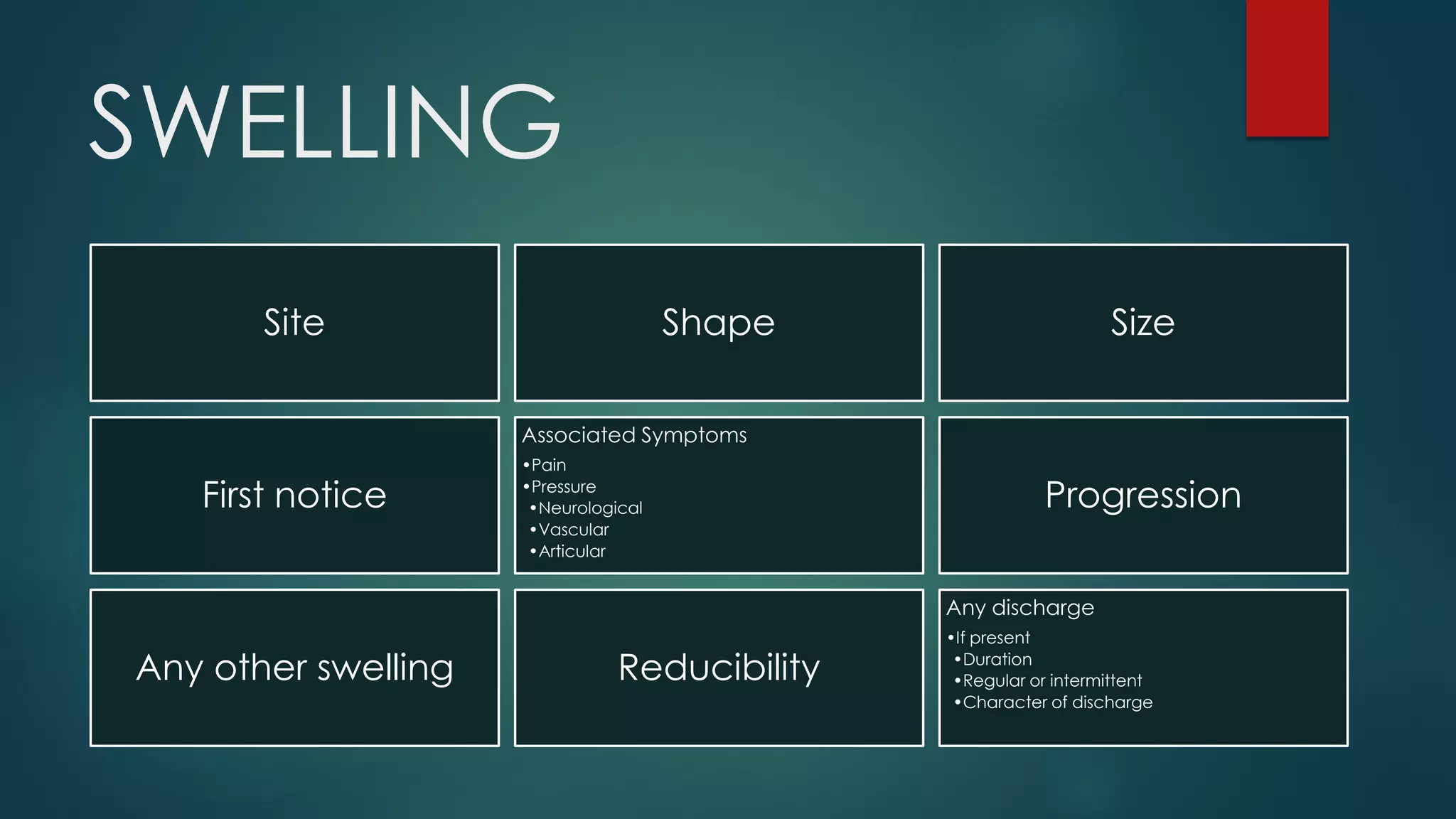
SWELLING
Site Shape Size
First notice
Associated Symptoms
•Pain
•Pressure
•Neurological
•Vascular
•Articular
Progression
Any other swelling Reducibility
Any discharge
•If present
•Duration
•Regular or intermittent
•Character of discharge
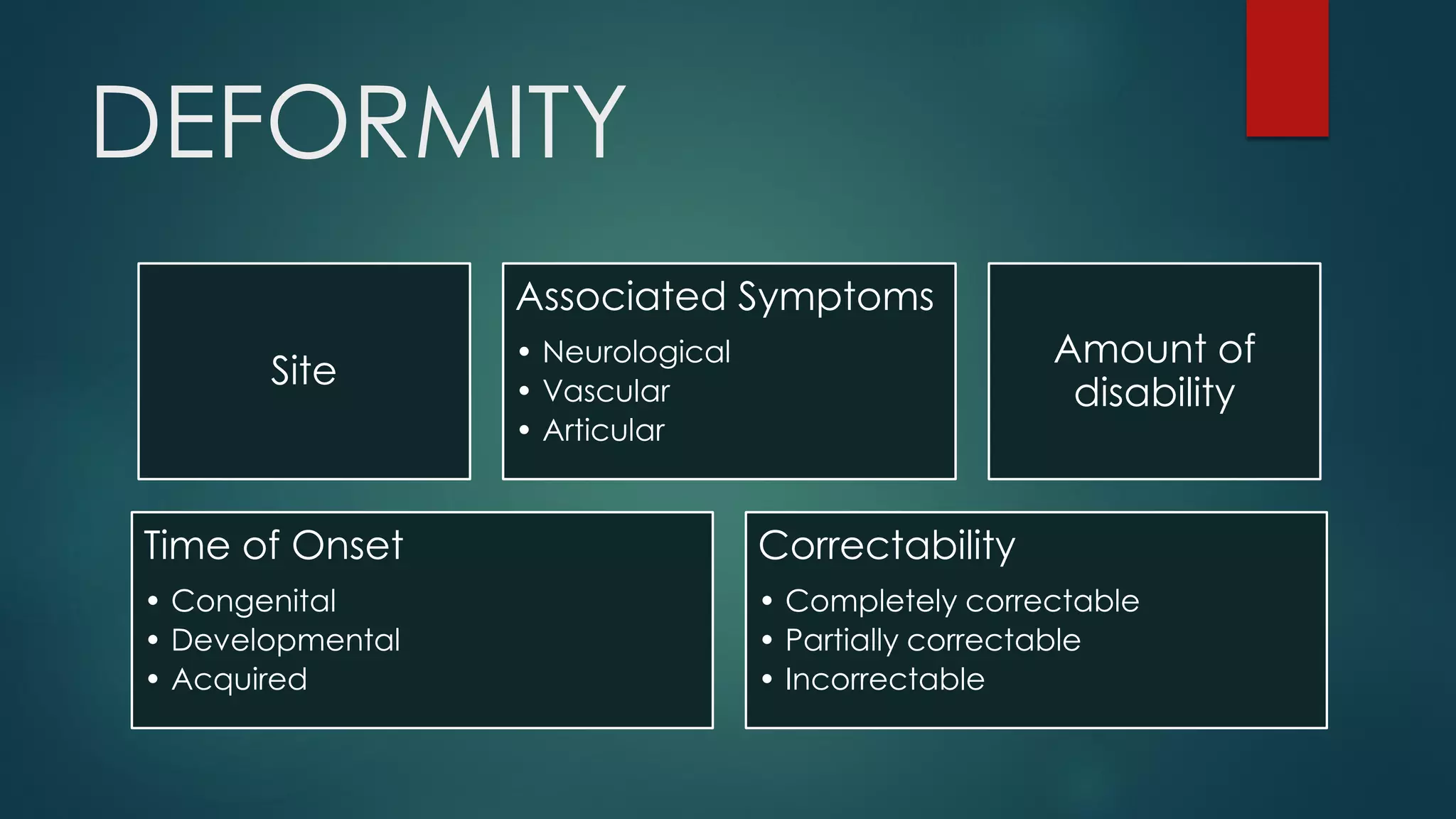
DEFORMITY
Site
Associated Symptoms
• Neurological
• Vascular
• Articular
Amount of
disability
Time of Onset
• Congenital
• Developmental
• Acquired
Correctability
• Completely correctable
• Partially correctable
• Incorrectable
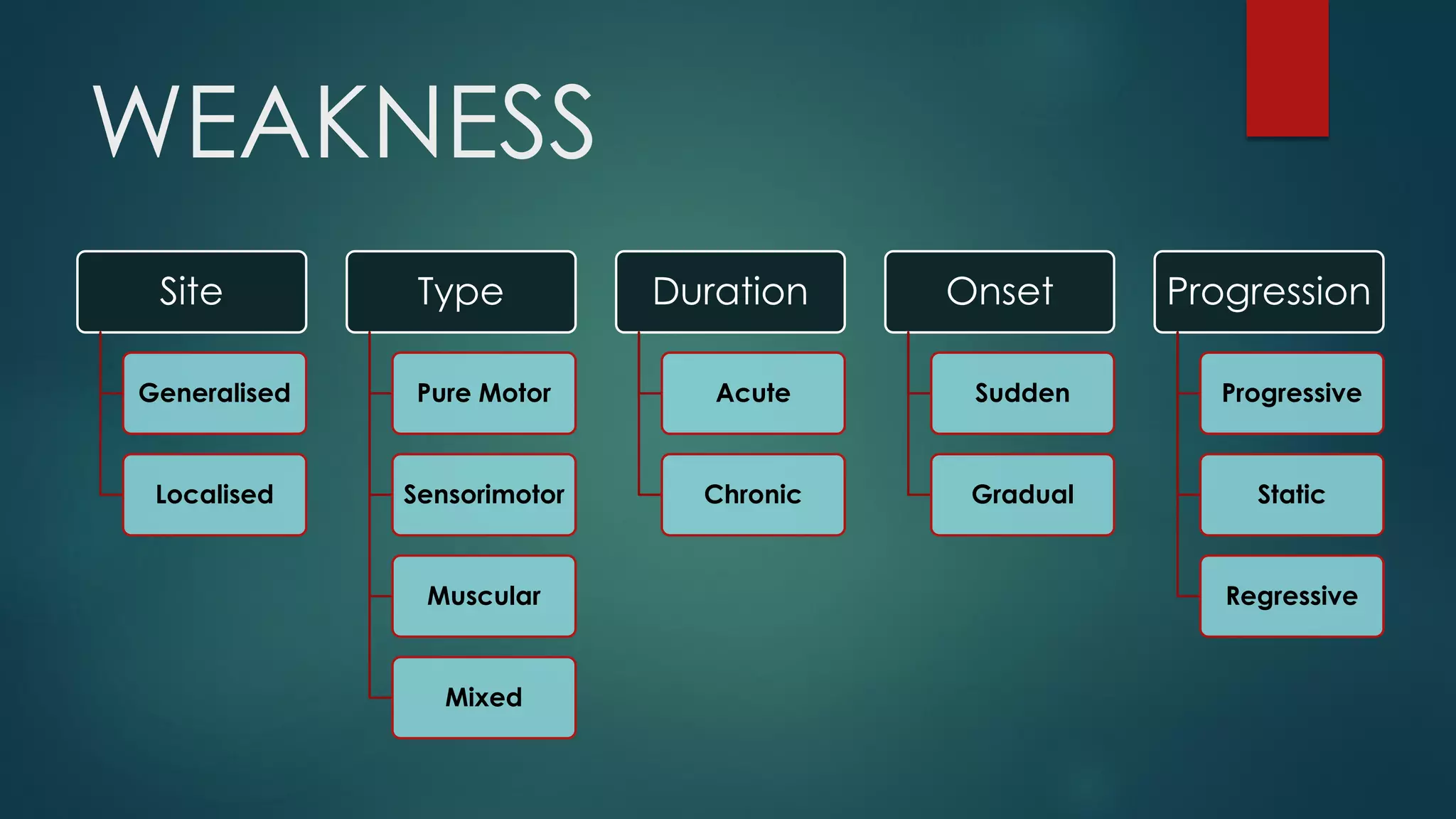
WEAKNESS
Site
Generalised
Localised
Type
Pure Motor
Sensorimotor
Muscular
Mixed
Duration
Acute
Chronic
Onset
Sudden
Gradual
Progression
Progressive
Static
Regressive
DIFFERENTIAL DIAGNOSIS
1. _ _ _ _ _ _ _ _ _ _ _ _ _ _ _ _ _ _ _ _ _ _ _ _
2. _ _ _ _ _ _ _ _ _ _ _ _ _ _ _ _ _ _ _ _ _ _ _ _
3. _ _ _ _ _ _ _ _ _ _ _ _ _ _ _ _ _ _ _ _ _ _ _ _
4. _ _ _ _ _ _ _ _ _ _ _ _ _ _ _ _ _ _ _ _ _ _ _ _
5. _ _ _ _ _ _ _ _ _ _ _ _ _ _ _ _ _ _ _ _ _ _ _ _
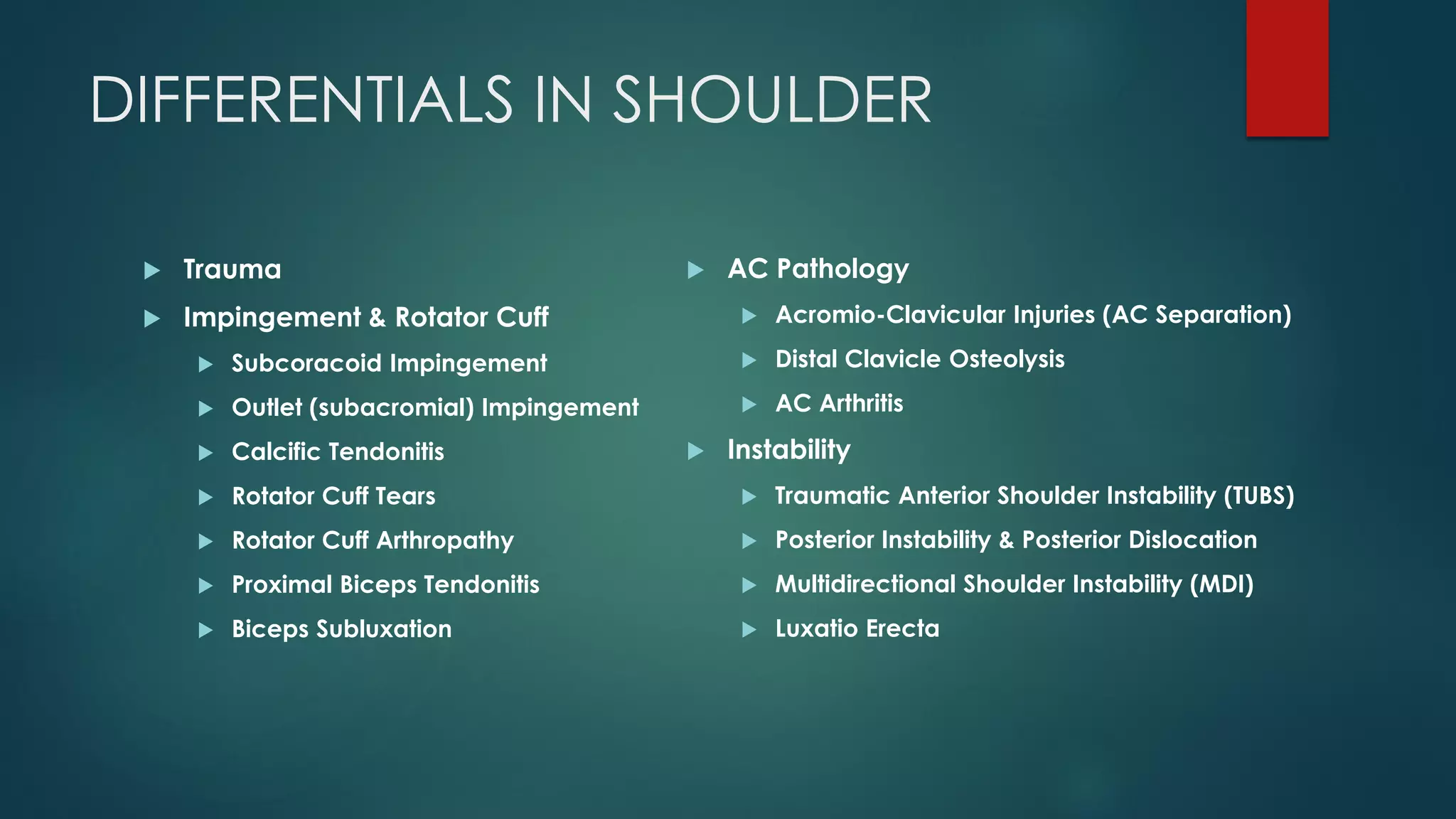
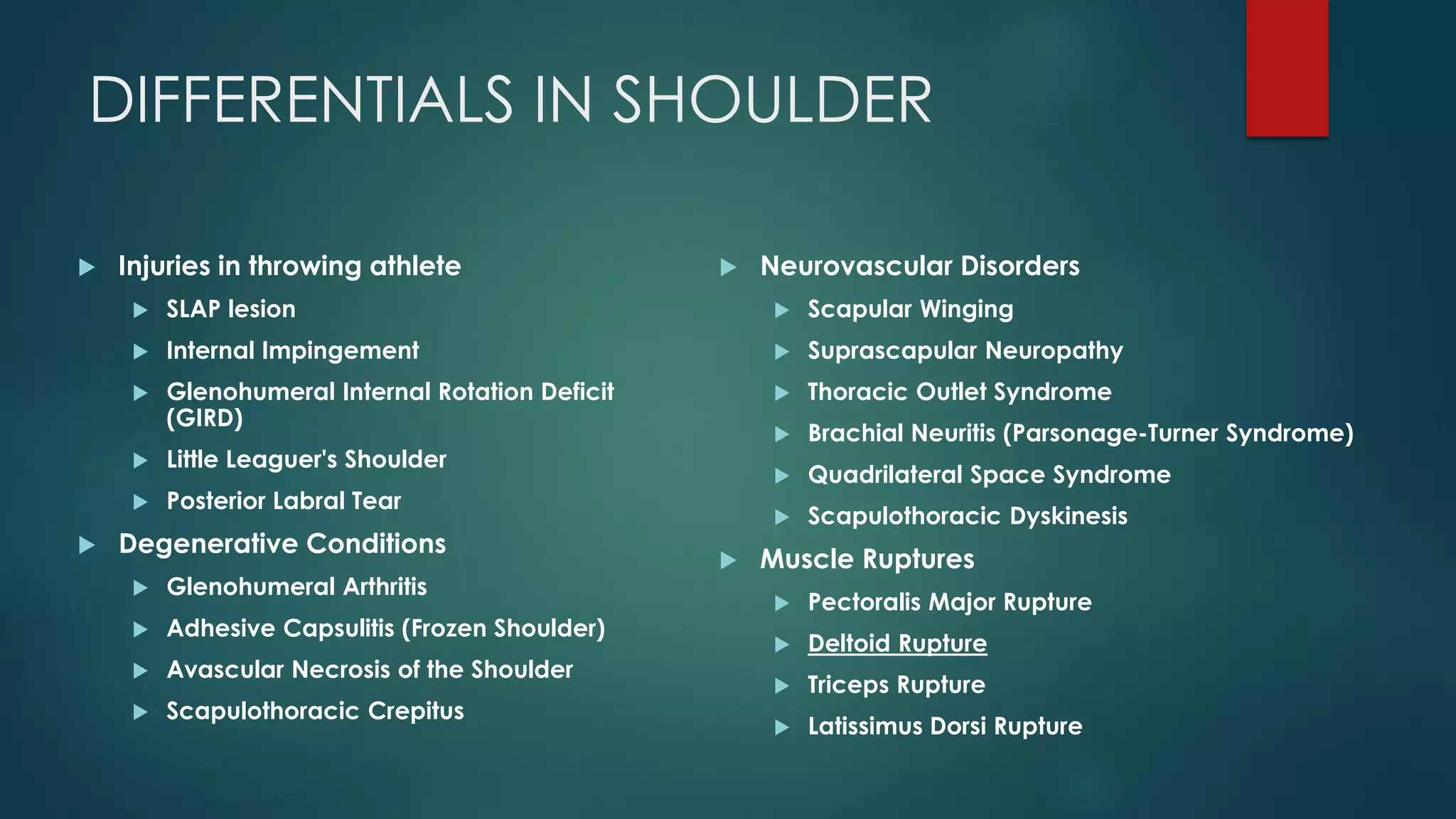
DIFFERENTIALS IN SHOULDER
 Trauma
 Impingement & Rotator Cuff
 Subcoracoid Impingement
 Outlet (subacromial) Impingement
 Calcific Tendonitis
 Rotator Cuff Tears
 Rotator Cuff Arthropathy
 Proximal Biceps Tendonitis
 Biceps Subluxation
 AC Pathology
 Acromio-Clavicular Injuries (AC Separation)
 Distal Clavicle Osteolysis
 AC Arthritis
 Instability
 Traumatic Anterior Shoulder Instability (TUBS)
 Posterior Instability & Posterior Dislocation
 Multidirectional Shoulder Instability (MDI)
 Luxatio Erecta
DIFFERENTIALS IN SHOULDER
 Injuries in throwing athlete
 SLAP lesion
 Internal Impingement
 Glenohumeral Internal Rotation Deficit
(GIRD)
 Little Leaguer's Shoulder
 Posterior Labral Tear
 Degenerative Conditions
 Glenohumeral Arthritis
 Adhesive Capsulitis (Frozen Shoulder)
 Avascular Necrosis of the Shoulder
 Scapulothoracic Crepitus
 Neurovascular Disorders
 Scapular Winging
 Suprascapular Neuropathy
 Thoracic Outlet Syndrome
 Brachial Neuritis (Parsonage-Turner Syndrome)
 Quadrilateral Space Syndrome
 Scapulothoracic Dyskinesis
 Muscle Ruptures
 Pectoralis Major Rupture
 Deltoid Rupture
 Triceps Rupture
 Latissimus Dorsi Rupture
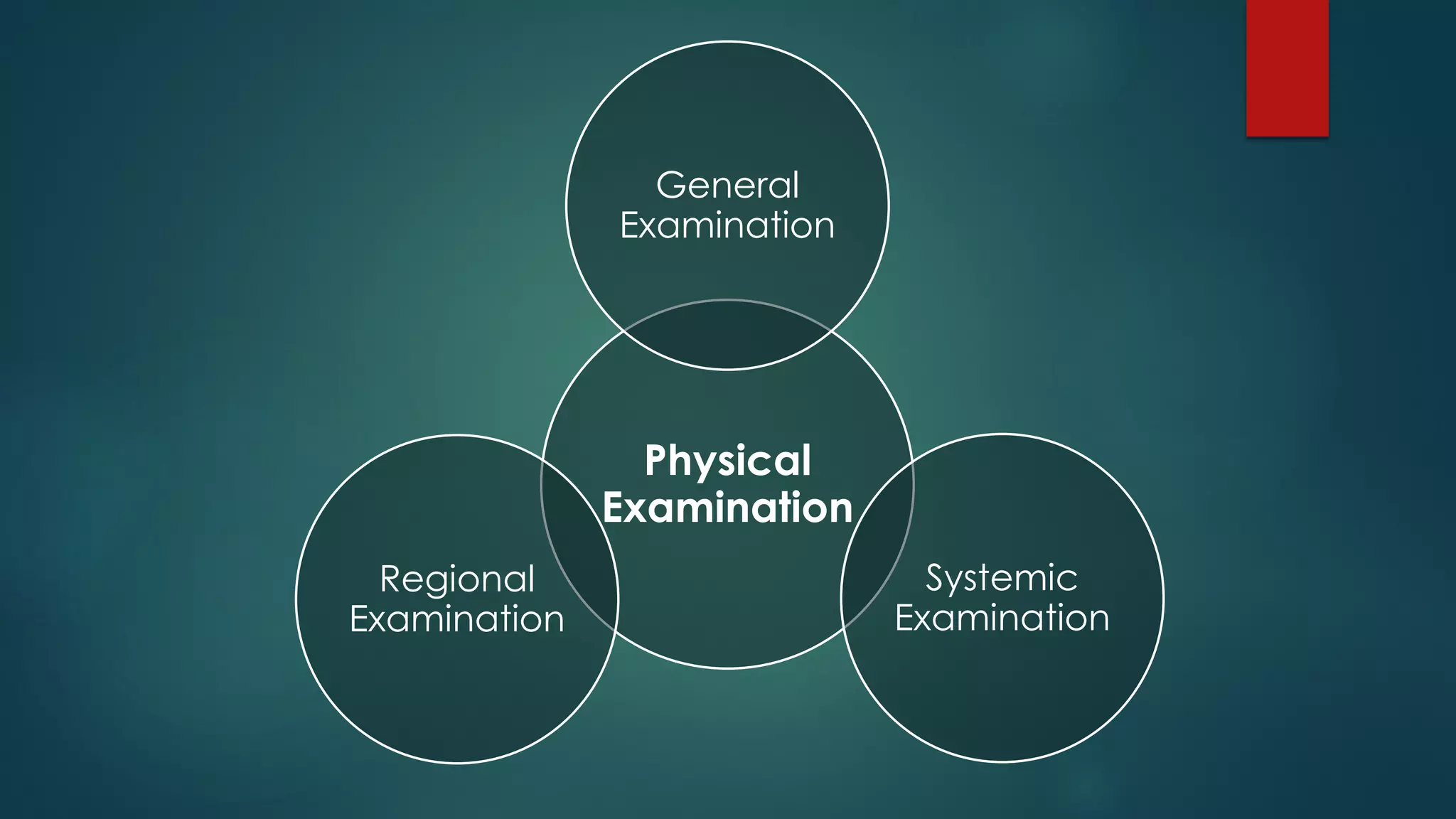
Physical
Examination
General
Examination
Systemic
Examination
Regional
Examination
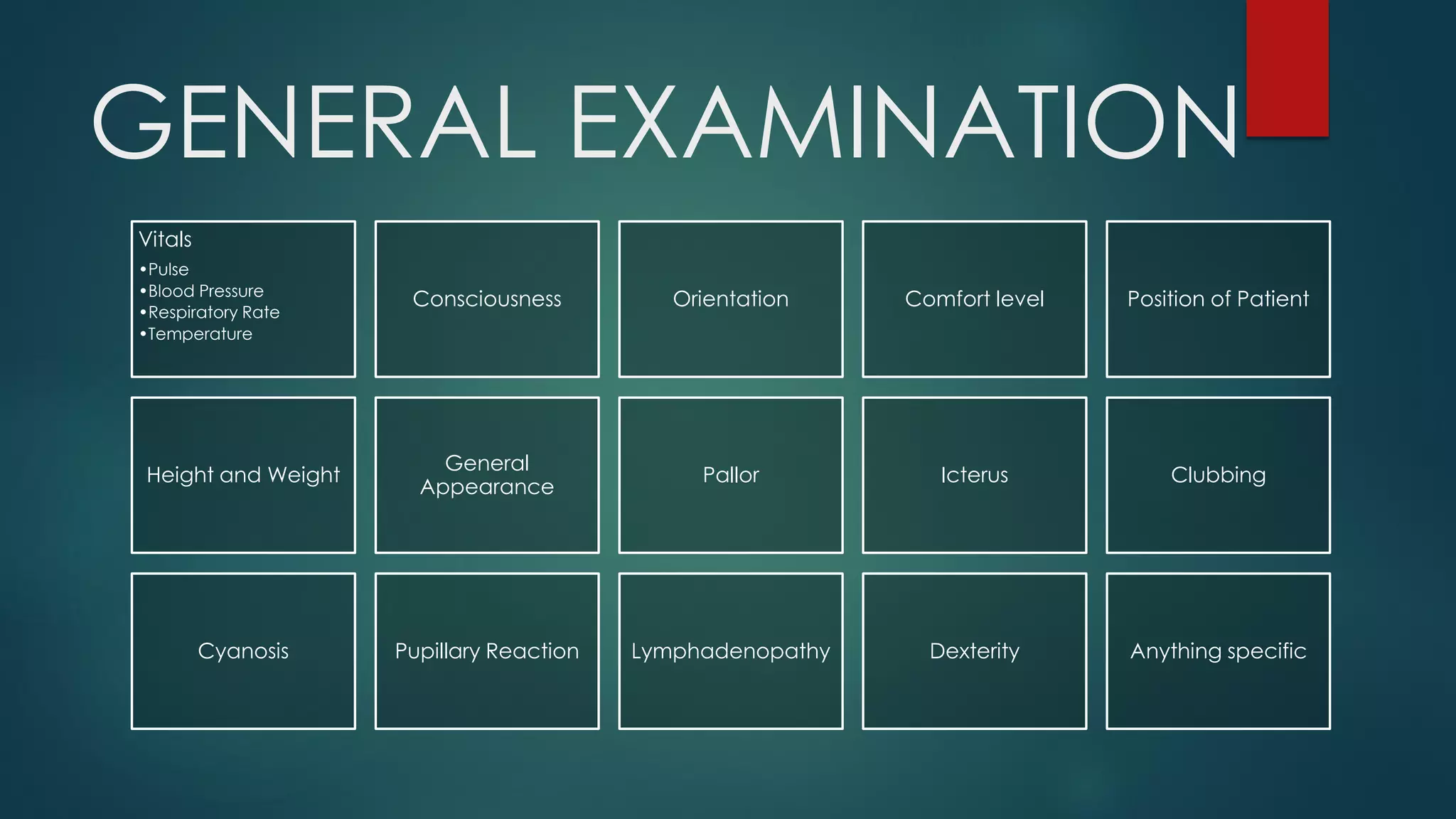
GENERAL EXAMINATION
Vitals
•Pulse
•Blood Pressure
•Respiratory Rate
•Temperature
Consciousness Orientation Comfort level Position of Patient
Height and Weight
General
Appearance
Pallor Icterus Clubbing
Cyanosis Pupillary Reaction Lymphadenopathy Dexterity Anything specific
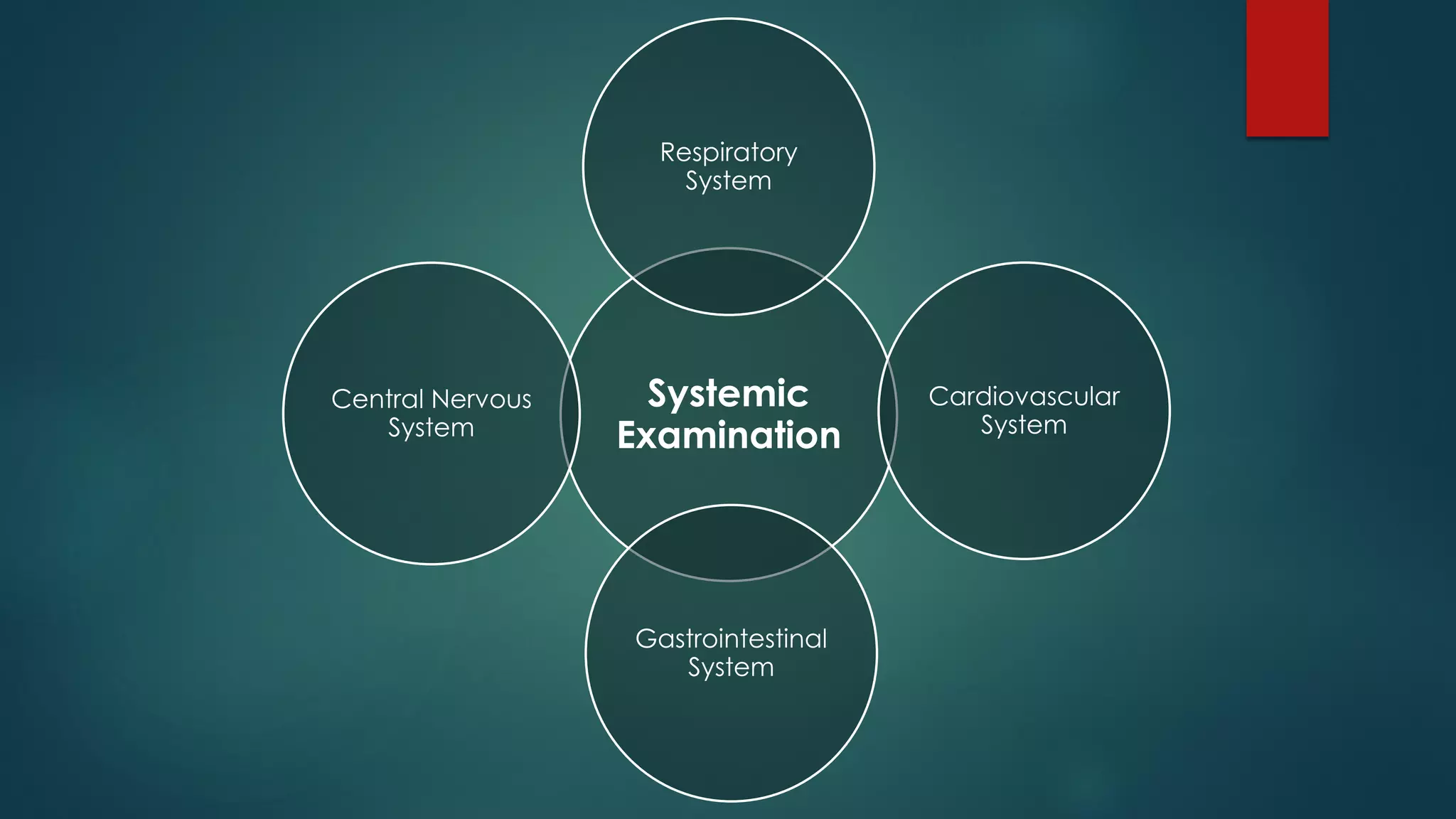
Systemic
Examination
Respiratory
System
Cardiovascular
System
Gastrointestinal
System
Central Nervous
System
REGIONAL EXAMINATION
• InspectionLOOK
• PalpationFEEL
• Strength TestingMOVE
• Shortening or Lengthening
• Range of Motion
• Regional measurements
MEASURE
• Depends upon specific region in considerationSPECIAL TESTS
PHYSICAL EXAM - GENERAL
 Develop a standard routine
 Alleviate the patient's fears
 Adequate exposure - bilateral
 Males – shirtless
 Females – tank top or sports bra
 Compare shoulders
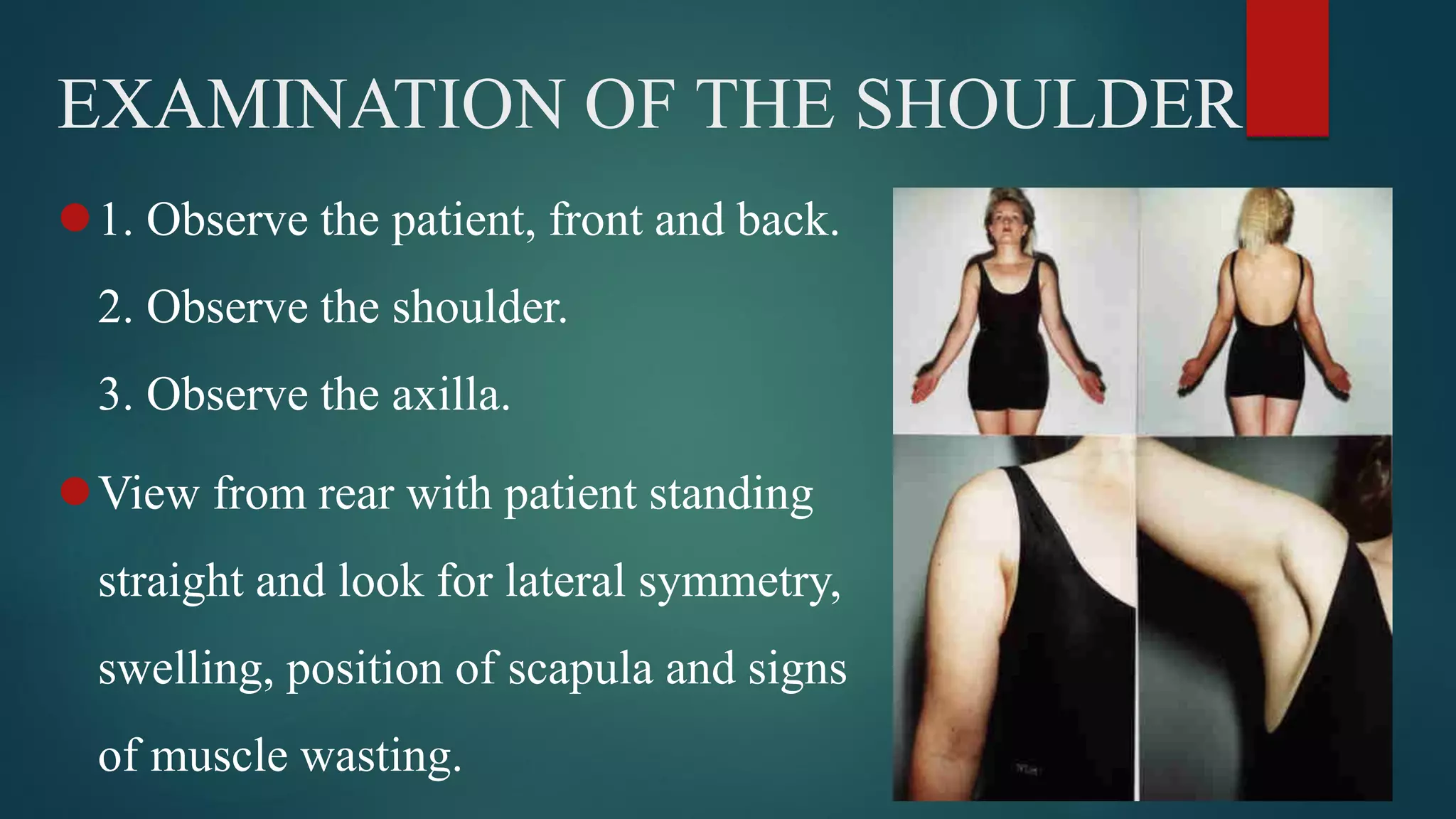
EXAMINATION OF THE SHOULDER
1. Observe the patient, front and back.
2. Observe the shoulder.
3. Observe the axilla.
View from rear with patient standing
straight and look for lateral symmetry,
swelling, position of scapula and signs
of muscle wasting.
INSPECTION
 Swelling, asymmetry, muscle atrophy, scars, ecchymosis
and any venous distention
 Note posture (e.g., shoulder protraction)
 Deformities
 Squaring of shoulder - anterior dislocation
 Scapular "winging" - shoulder instability and serratus anterior or
trapezius dysfunction
 Atrophy - supraspinatus or infraspinatus - consider rotator cuff
tear, suprascapular nerve entrapment or neuropathy
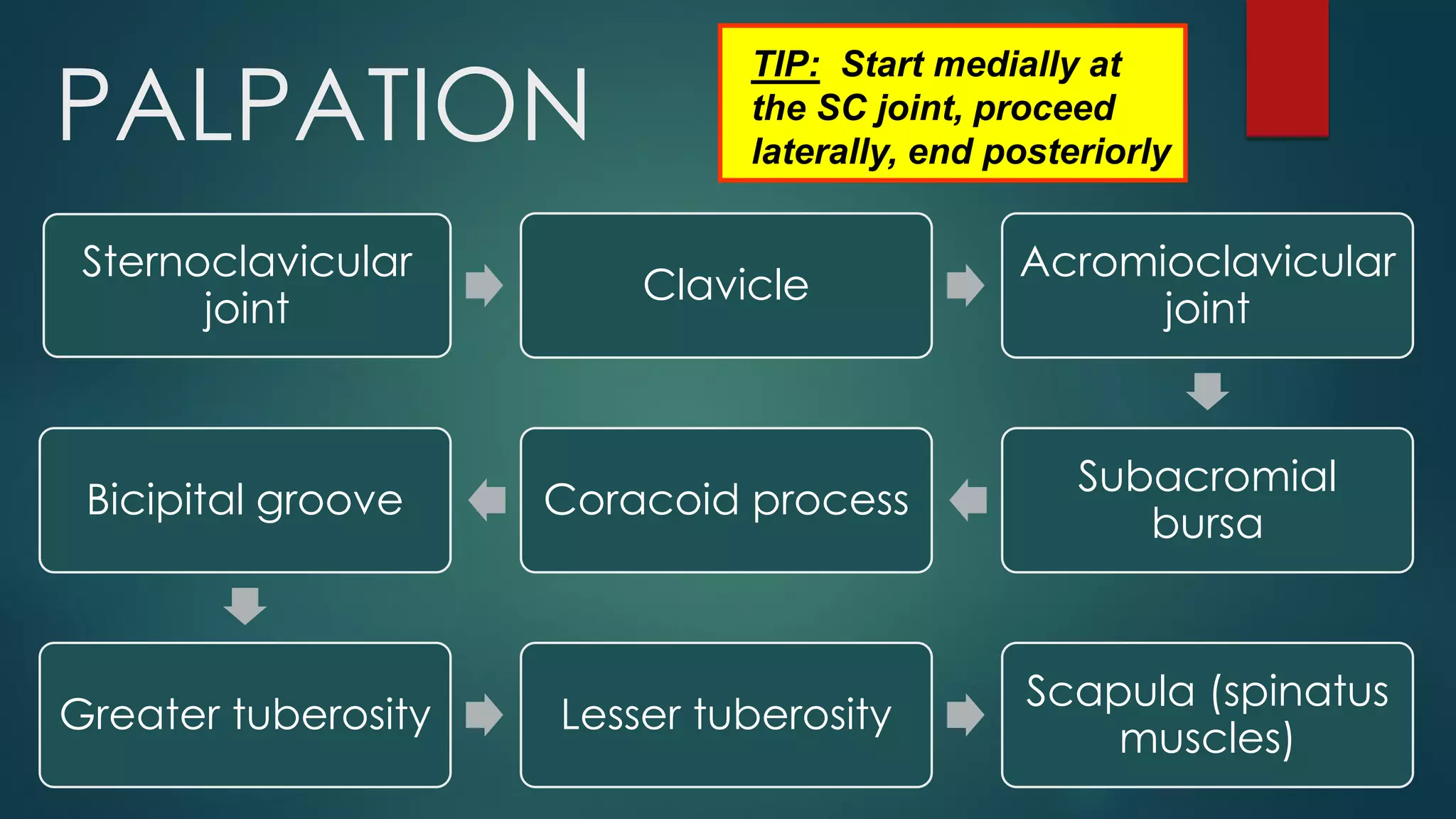
PALPATION
Sternoclavicular
joint
Clavicle
Acromioclavicular
joint
Subacromial
bursa
Coracoid processBicipital groove
Greater tuberosity Lesser tuberosity
Scapula (spinatus
muscles)
TIP: Start medially at
the SC joint, proceed
laterally, end posteriorly
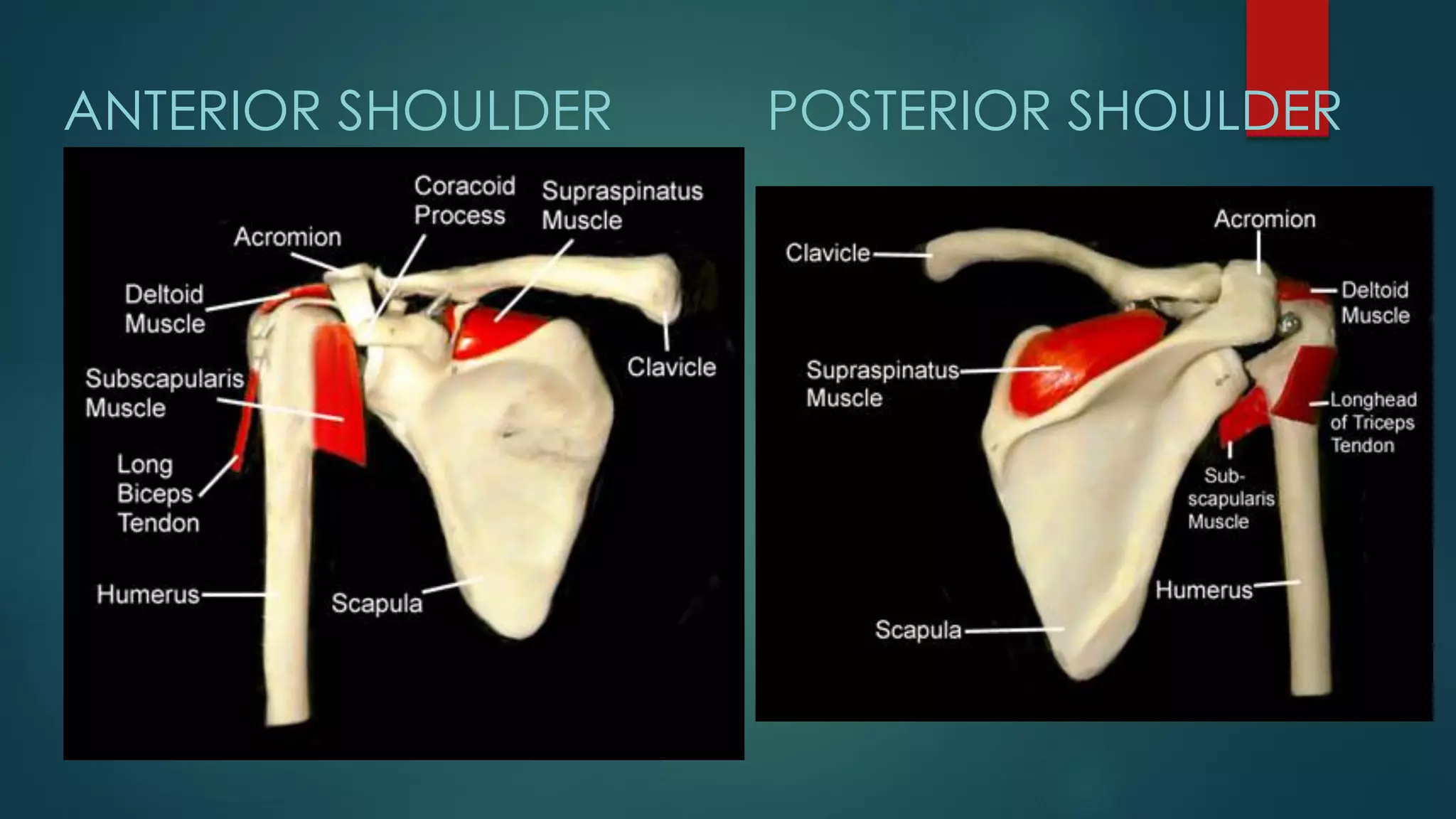
ANTERIOR SHOULDER POSTERIOR SHOULDER
46
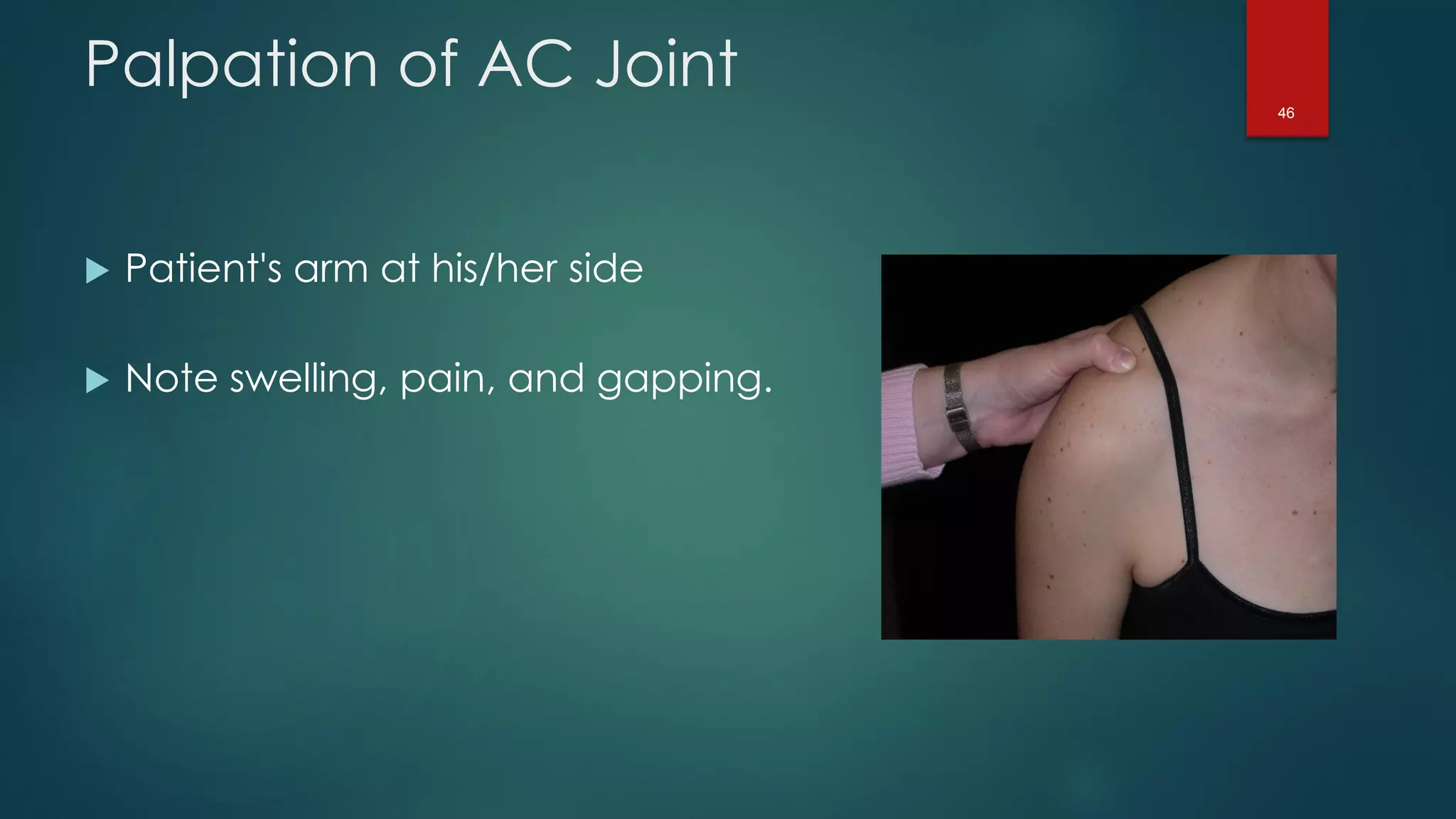
Palpation of AC Joint
 Patient's arm at his/her side
 Note swelling, pain, and gapping.
47
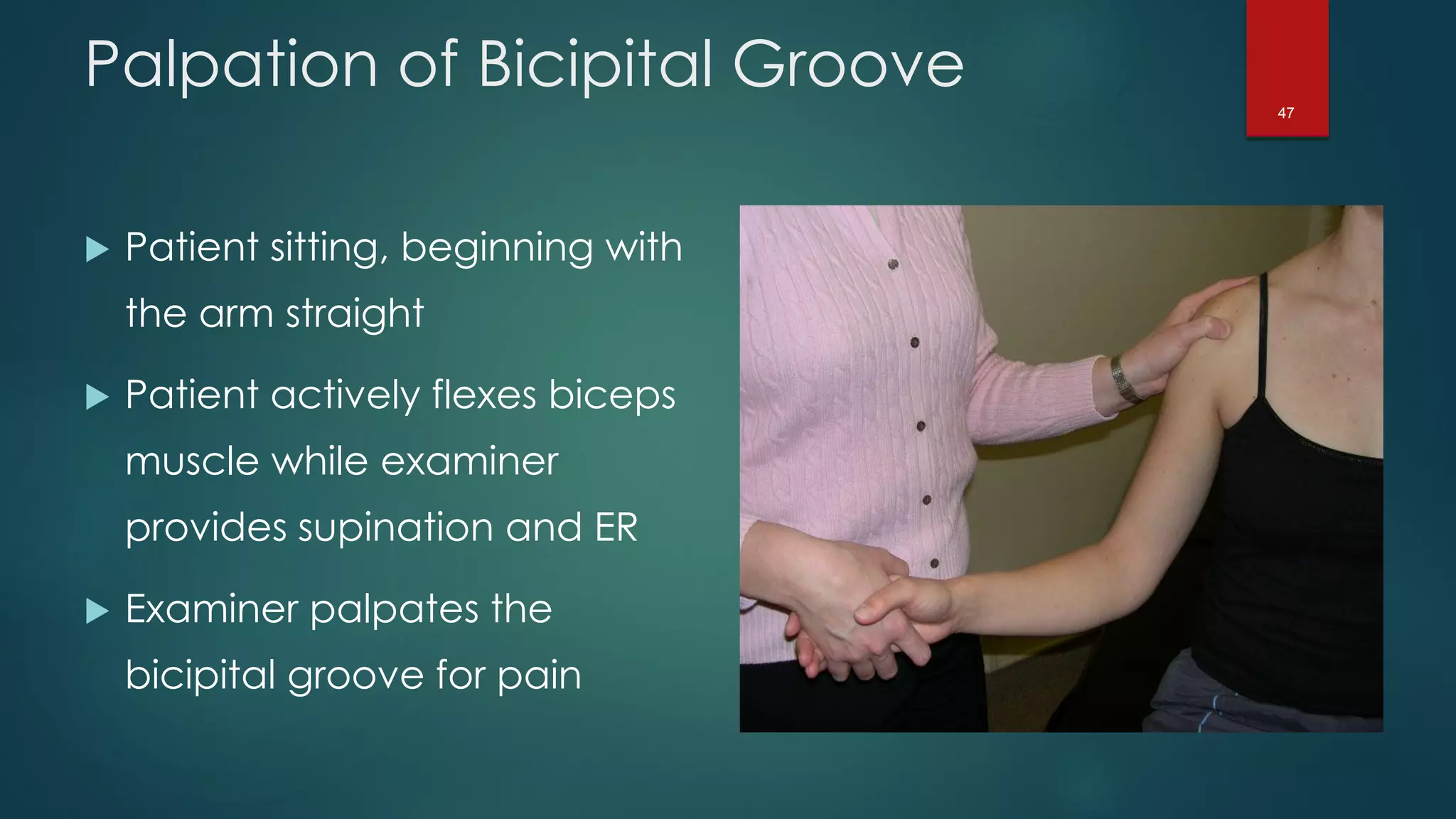
Palpation of Bicipital Groove
 Patient sitting, beginning with
the arm straight
 Patient actively flexes biceps
muscle while examiner
provides supination and ER
 Examiner palpates the
bicipital groove for pain
RANGE OF MOTION (ROM)
 Evaluate active ROM
 If movement limited by pain, weakness, or tightness, assist
passively
 Lack of full ROM with active and passive exam is found in
adhesive capsulitis and arthropathy
 Evaluate bilaterally for comparison
49
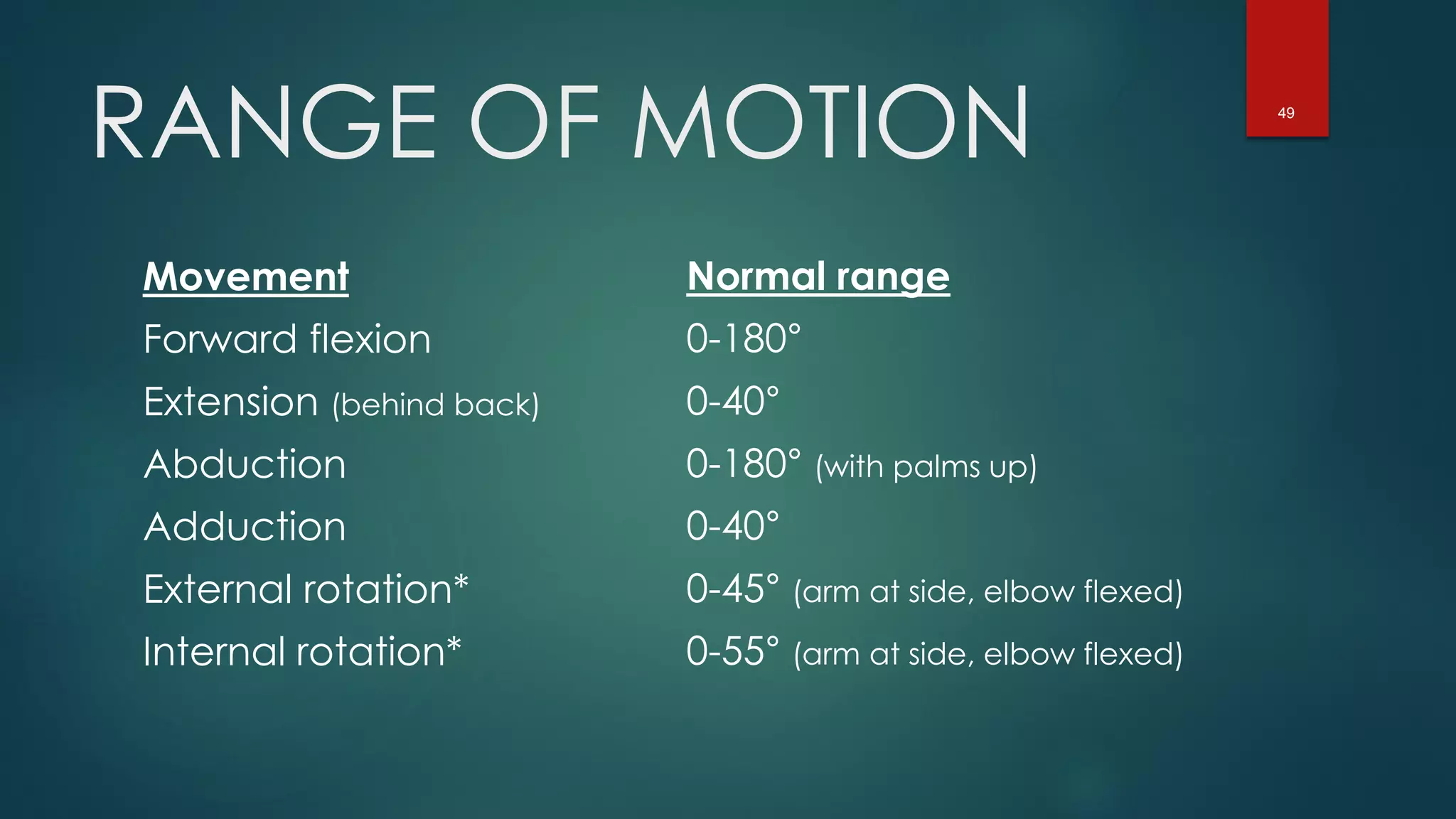
RANGE OF MOTION
Movement
Forward flexion
Extension (behind back)
Abduction
Adduction
External rotation*
Internal rotation*
Normal range
0-180°
0-40°
0-180° (with palms up)
0-40°
0-45° (arm at side, elbow flexed)
0-55° (arm at side, elbow flexed)
50FORWARD FLEXION
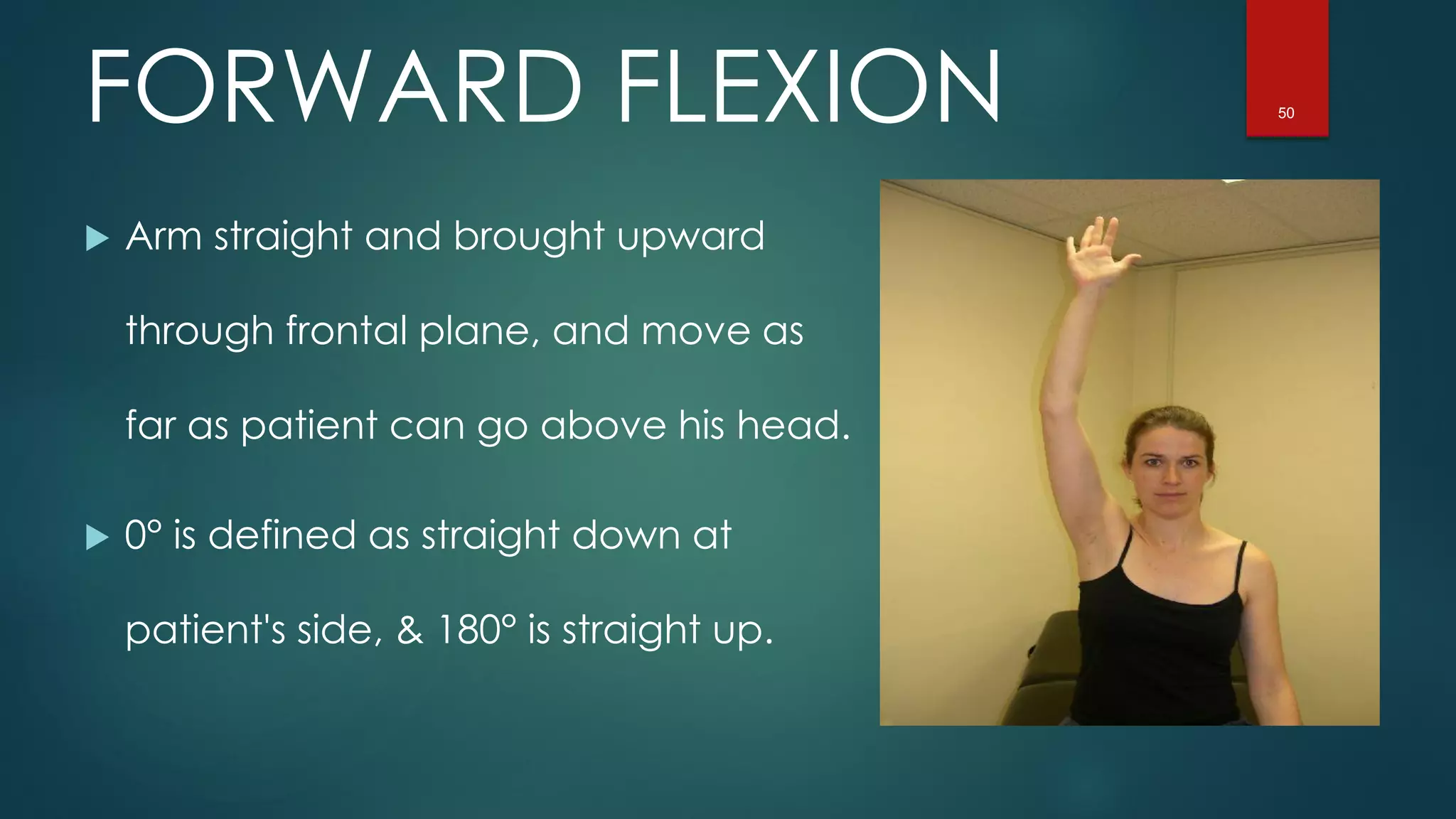
 Arm straight and brought upward
through frontal plane, and move as
far as patient can go above his head.
 0° is defined as straight down at
patient's side, & 180° is straight up.
51ABDUCTION
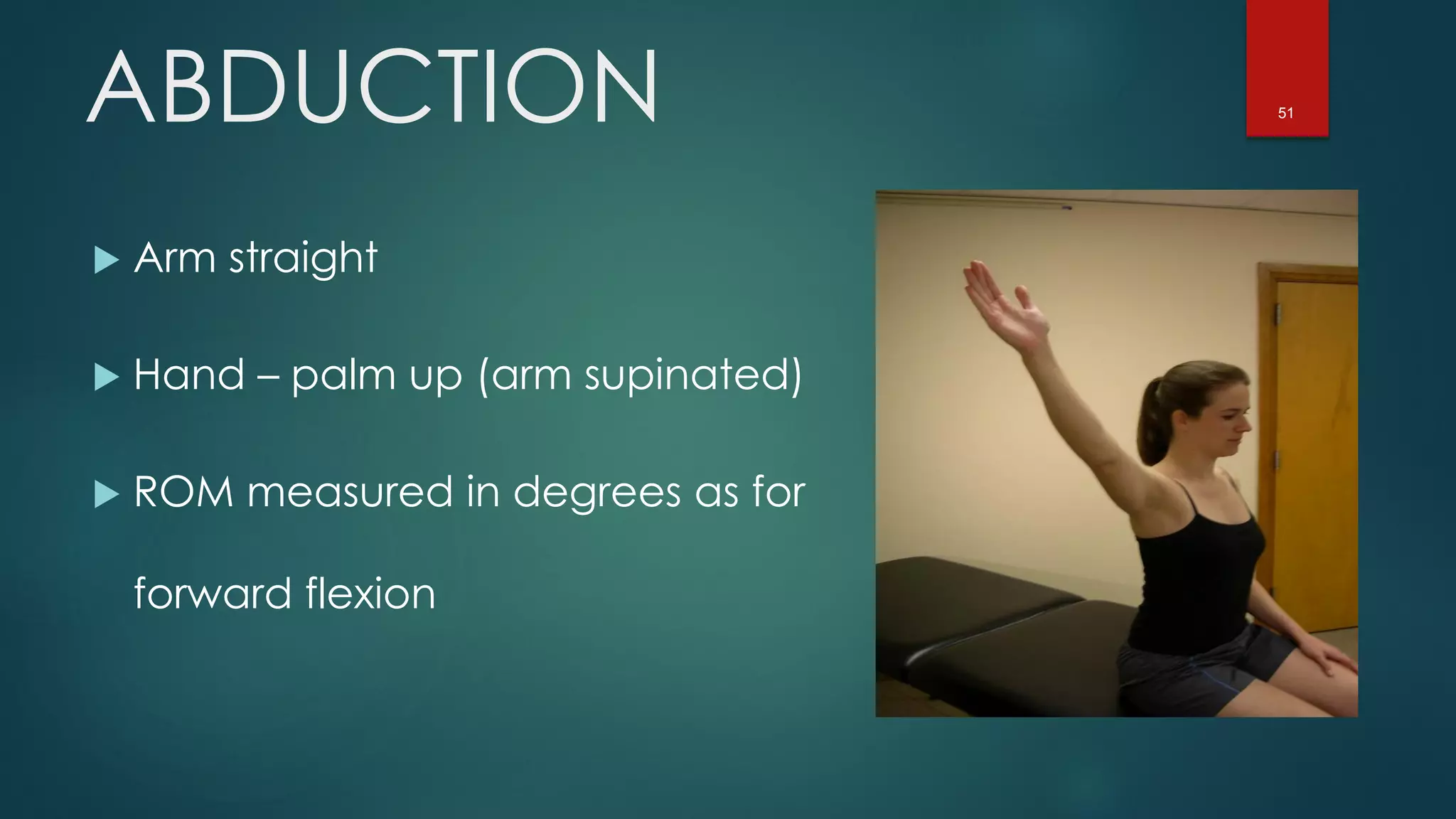
 Arm straight
 Hand – palm up (arm supinated)
 ROM measured in degrees as for
forward flexion
52
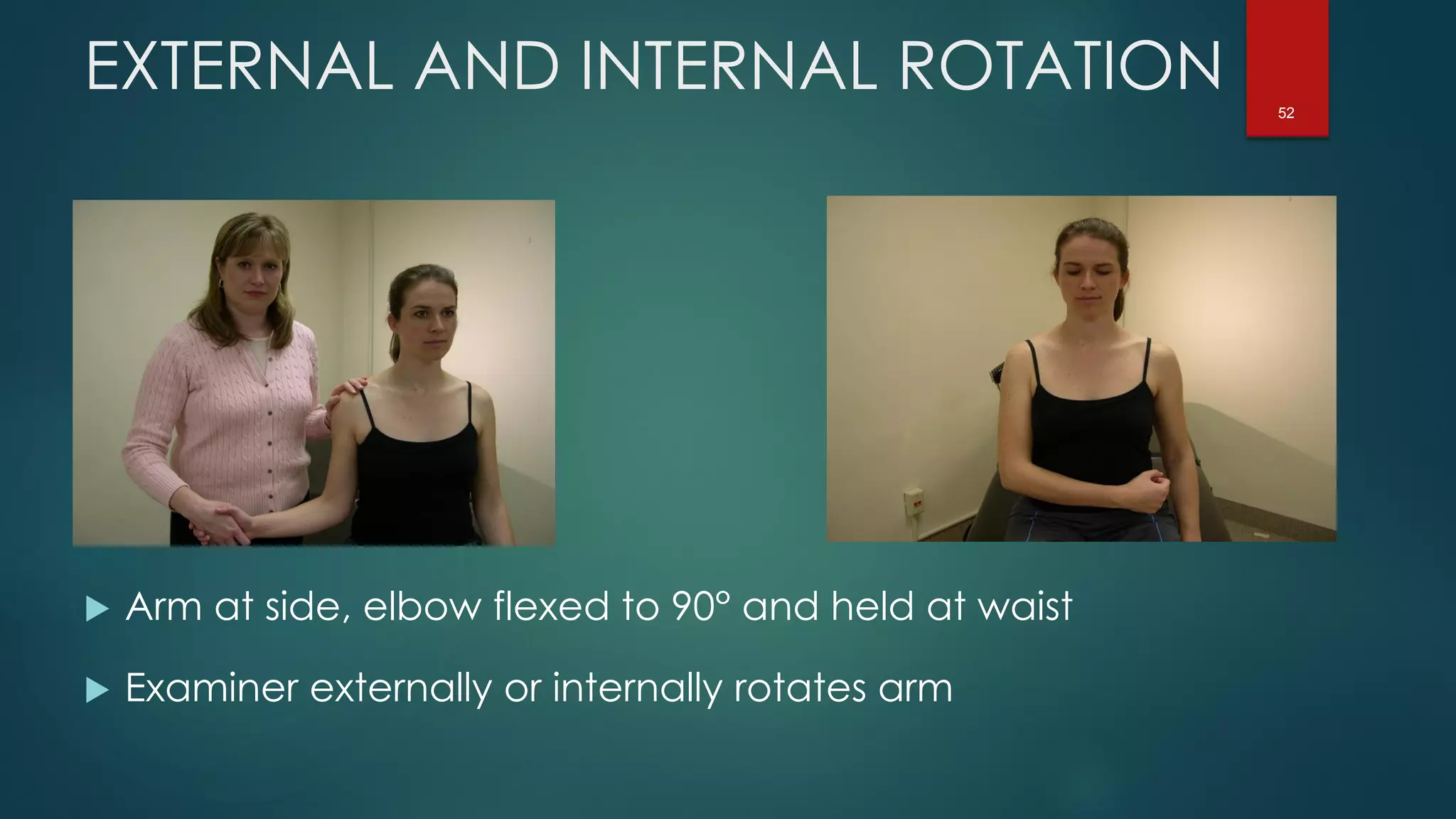
EXTERNAL AND INTERNAL ROTATION
 Arm at side, elbow flexed to 90° and held at waist
 Examiner externally or internally rotates arm
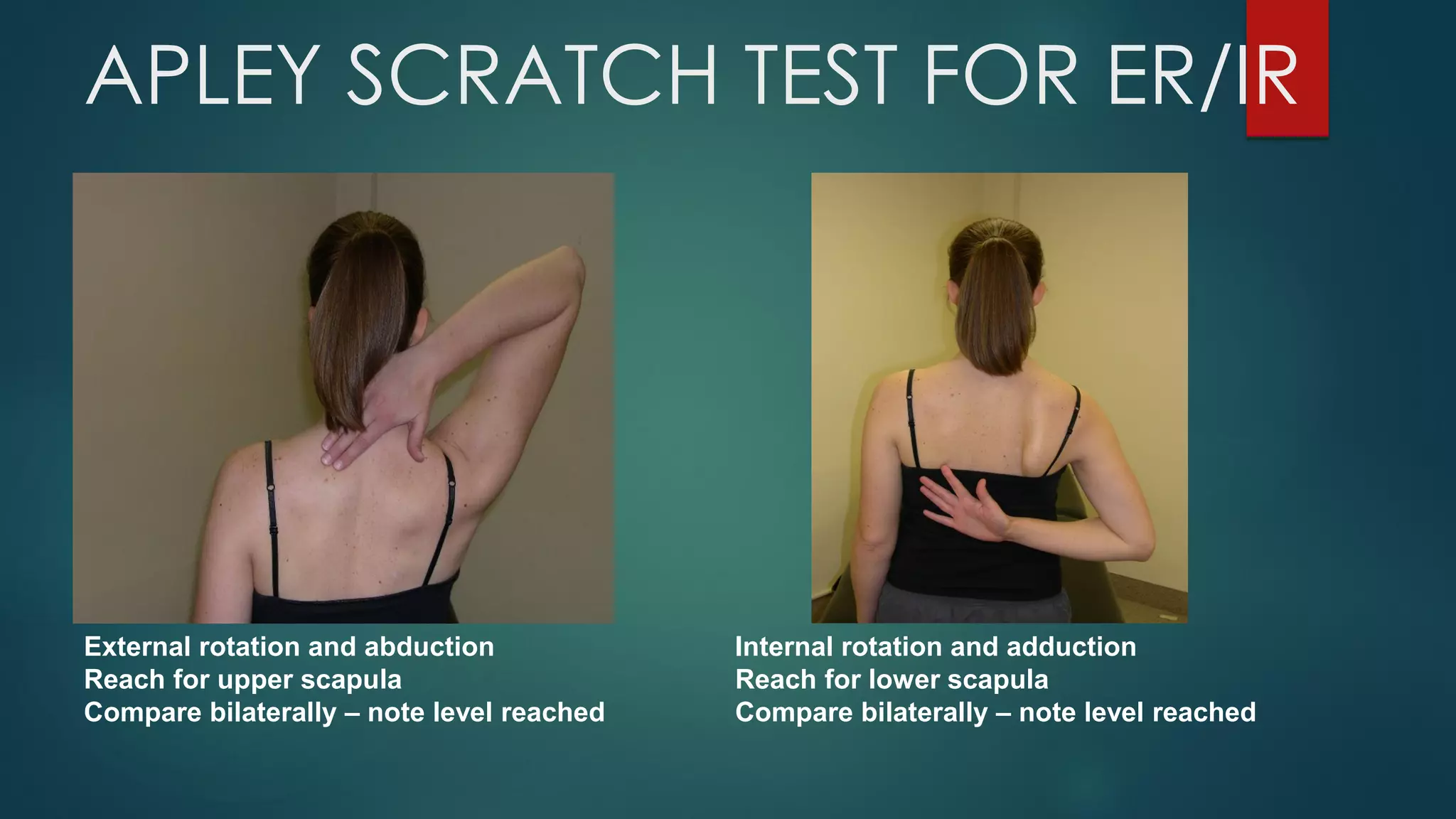
APLEY SCRATCH TEST FOR ER/IR
Internal rotation and adduction
Reach for lower scapula
Compare bilaterally – note level reached
External rotation and abduction
Reach for upper scapula
Compare bilaterally – note level reached
OTHER MOVEMENTS
 Extension-with arm by the patient’s side, lift the arm back wards
as far as possible.
 Adduction-draw the arm across the anterior chest wall as far as
possible.
 Circumduction
 Shrugging of shoulders
PAINFUL ARC
 In the evaluation of the active and passive ranges of motion, the
patient can often avoid the painful arc by externally rotating the
arm while abducting it. This increases the clearance between the
acromion and the diseased tendinous portion of the rotator cuff,
avoiding impingement in the range between 70° and 120°.
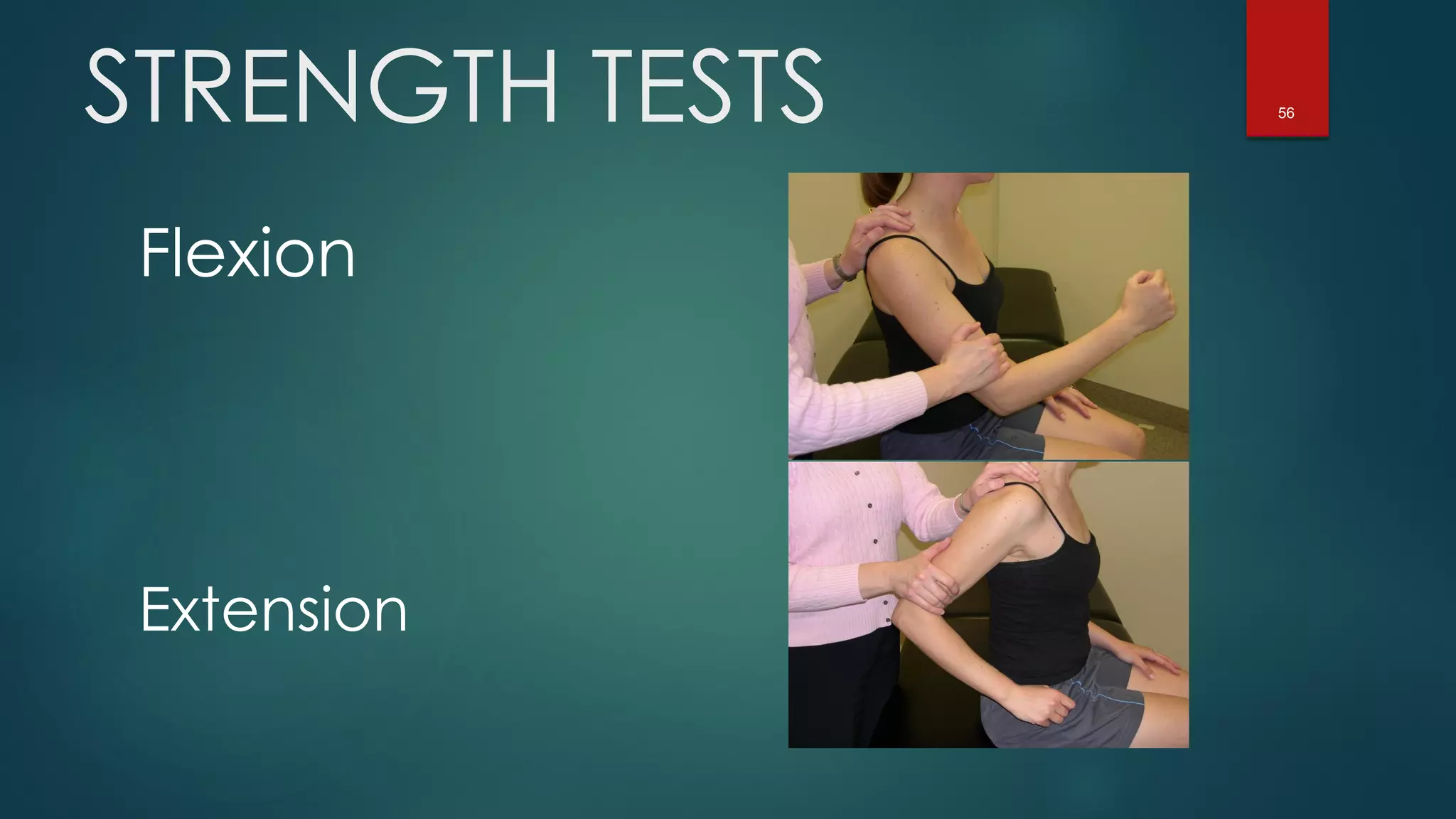
56STRENGTH TESTS
Flexion
Extension
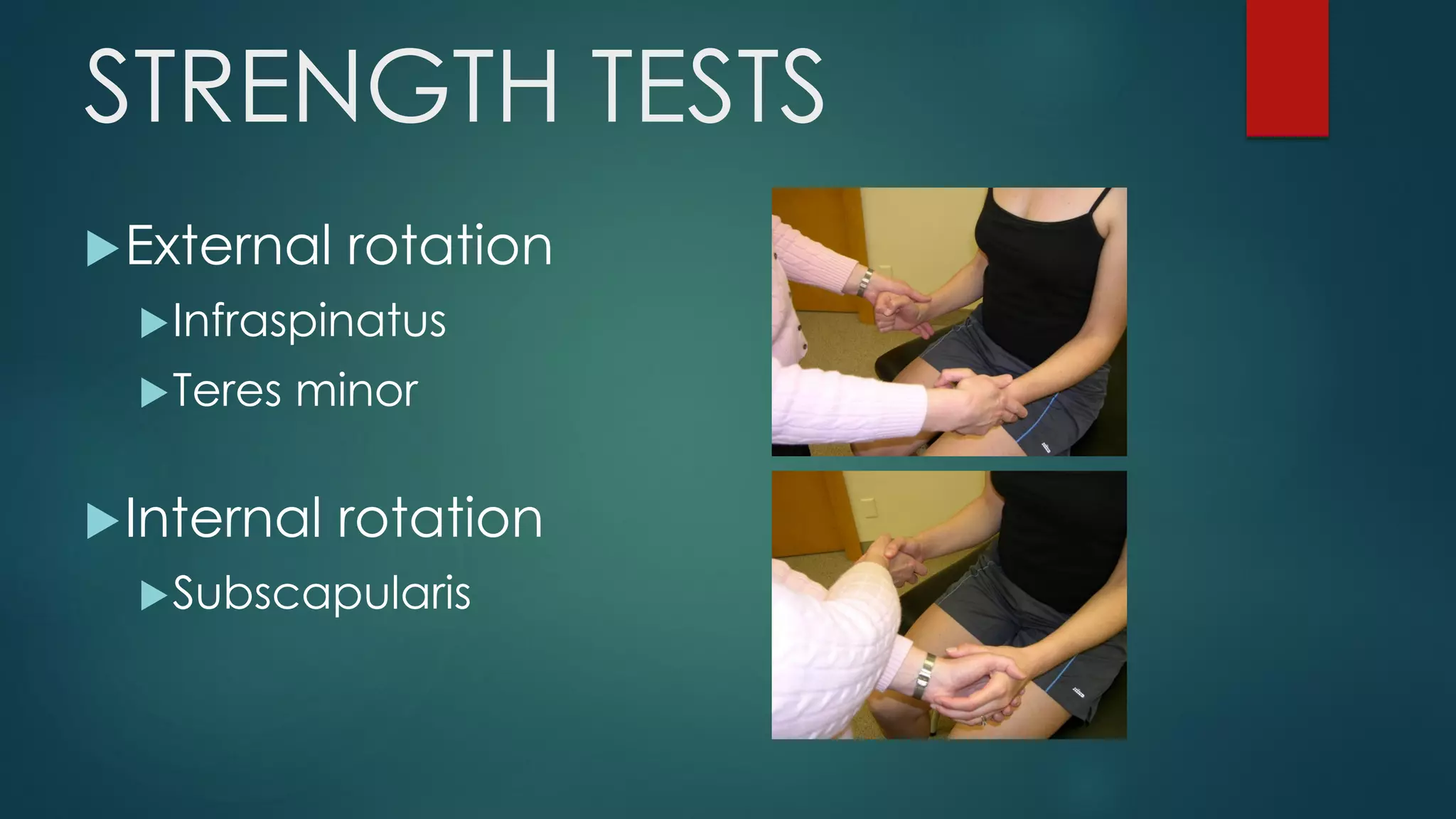
STRENGTH TESTS
External rotation
Infraspinatus
Teres minor
Internal rotation
Subscapularis
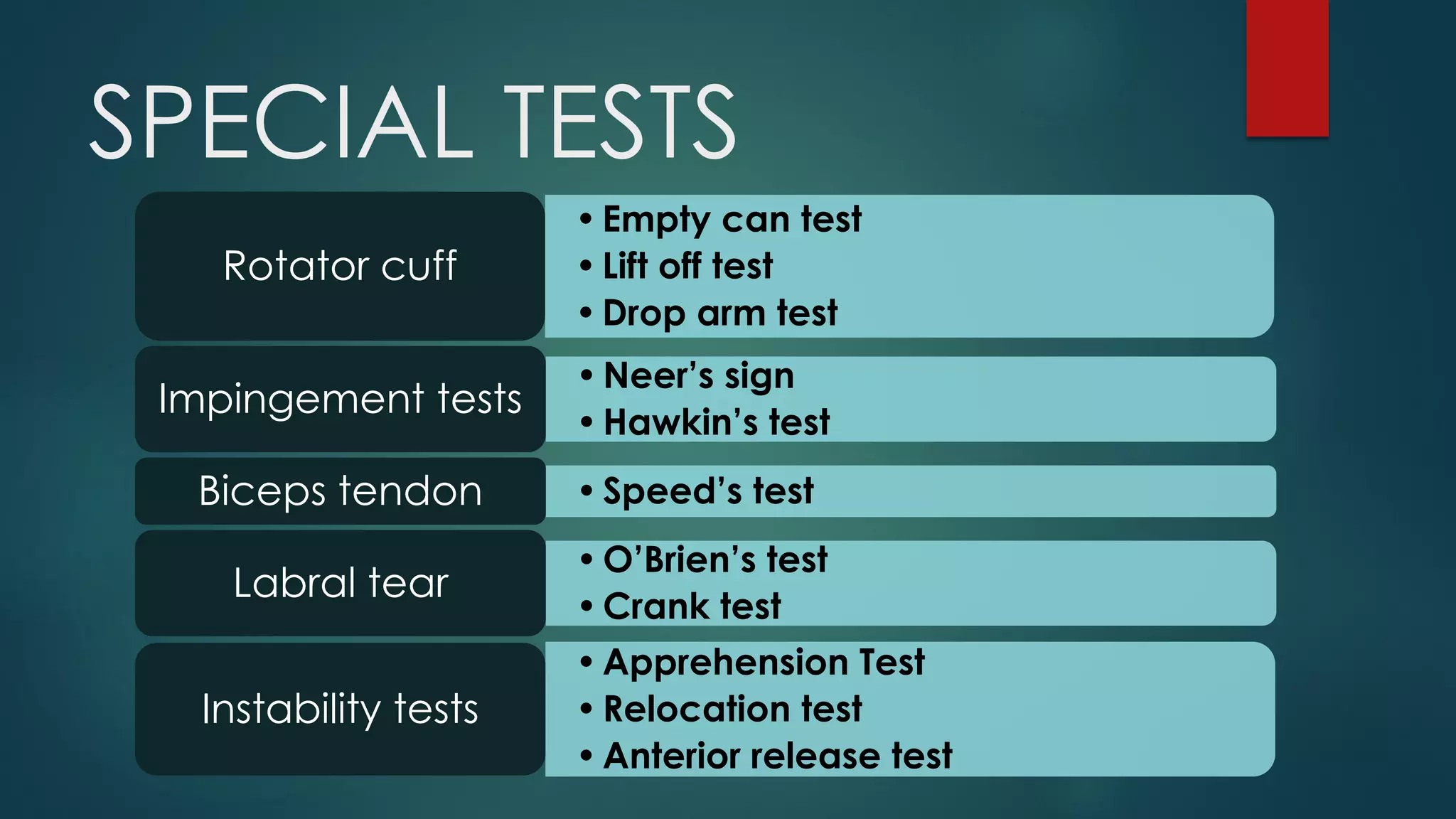
SPECIAL TESTS
•Empty can test
•Lift off test
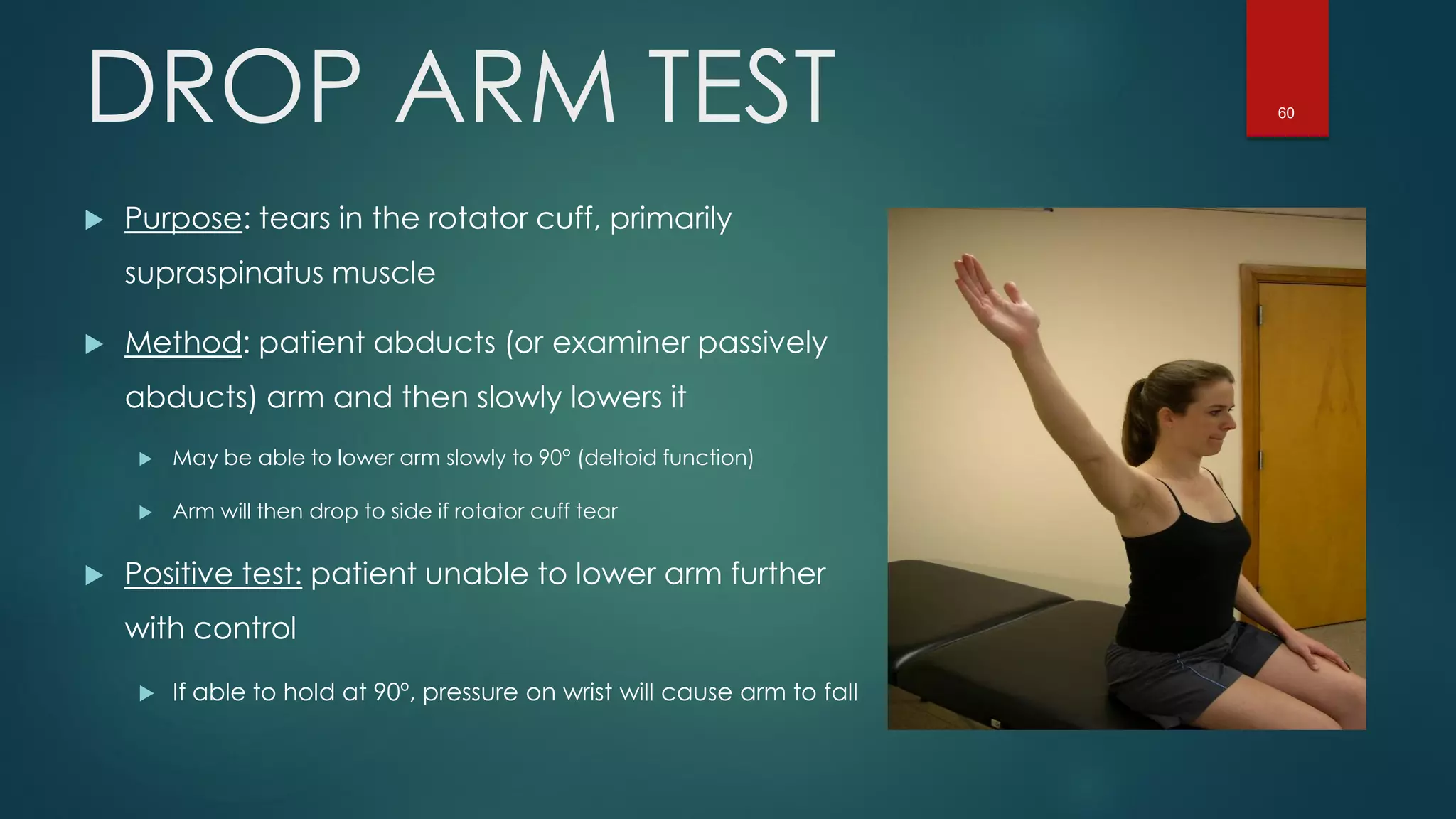
•Drop arm test
Rotator cuff
•Neer’s sign
•Hawkin’s test
Impingement tests
•Speed’s testBiceps tendon
•O’Brien’s test
•Crank test
Labral tear
•Apprehension Test
•Relocation test
•Anterior release test
Instability tests
59
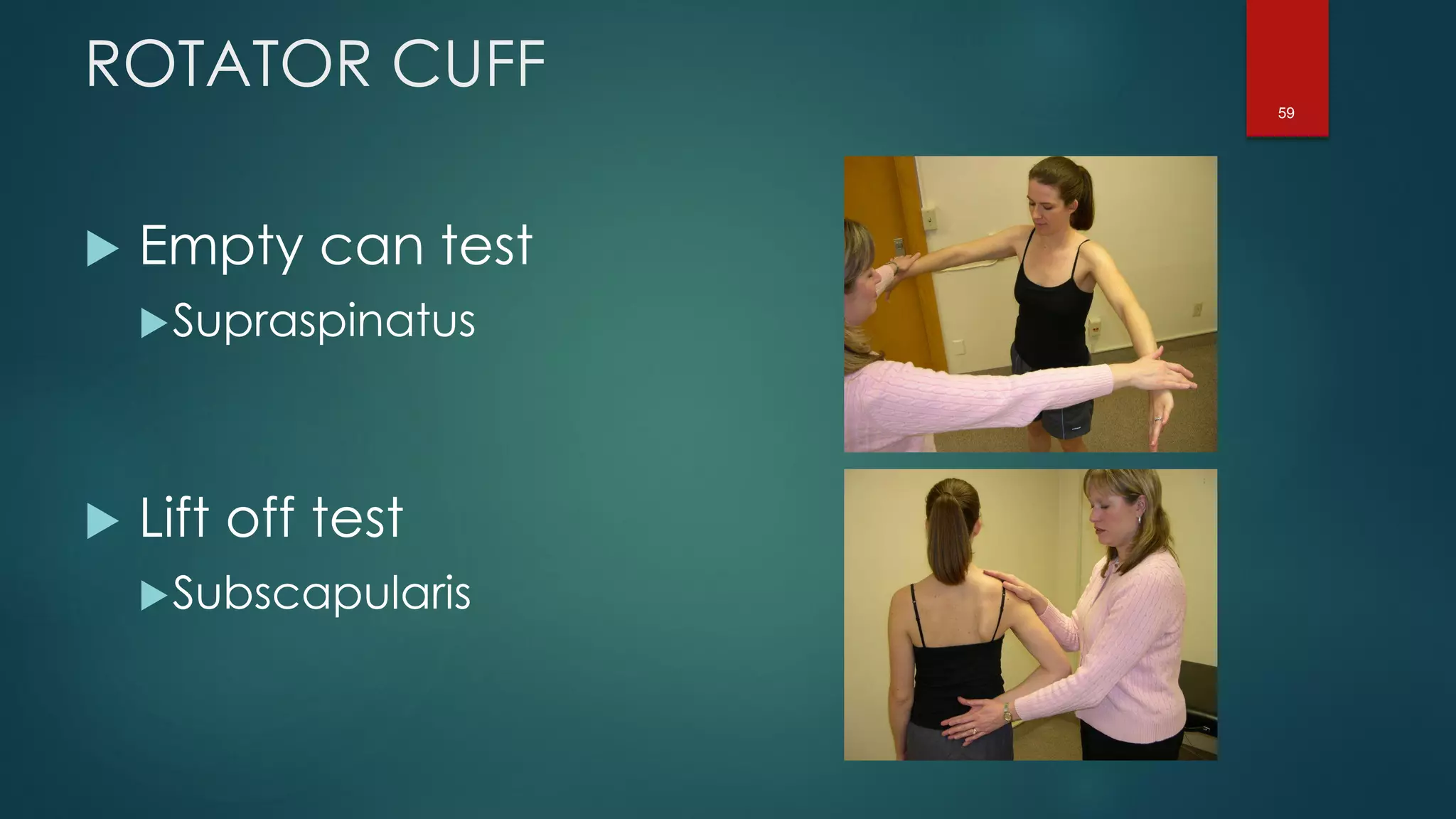
ROTATOR CUFF
 Empty can test
Supraspinatus
 Lift off test
Subscapularis
60DROP ARM TEST
 Purpose: tears in the rotator cuff, primarily
supraspinatus muscle
 Method: patient abducts (or examiner passively
abducts) arm and then slowly lowers it
 May be able to lower arm slowly to 90° (deltoid function)
 Arm will then drop to side if rotator cuff tear
 Positive test: patient unable to lower arm further
with control
 If able to hold at 90º, pressure on wrist will cause arm to fall
GLENOHUMERAL JOINT STABILITY
Anterior Glenohumeral Instability
Apprehension test
Relocation test
Anterior release test
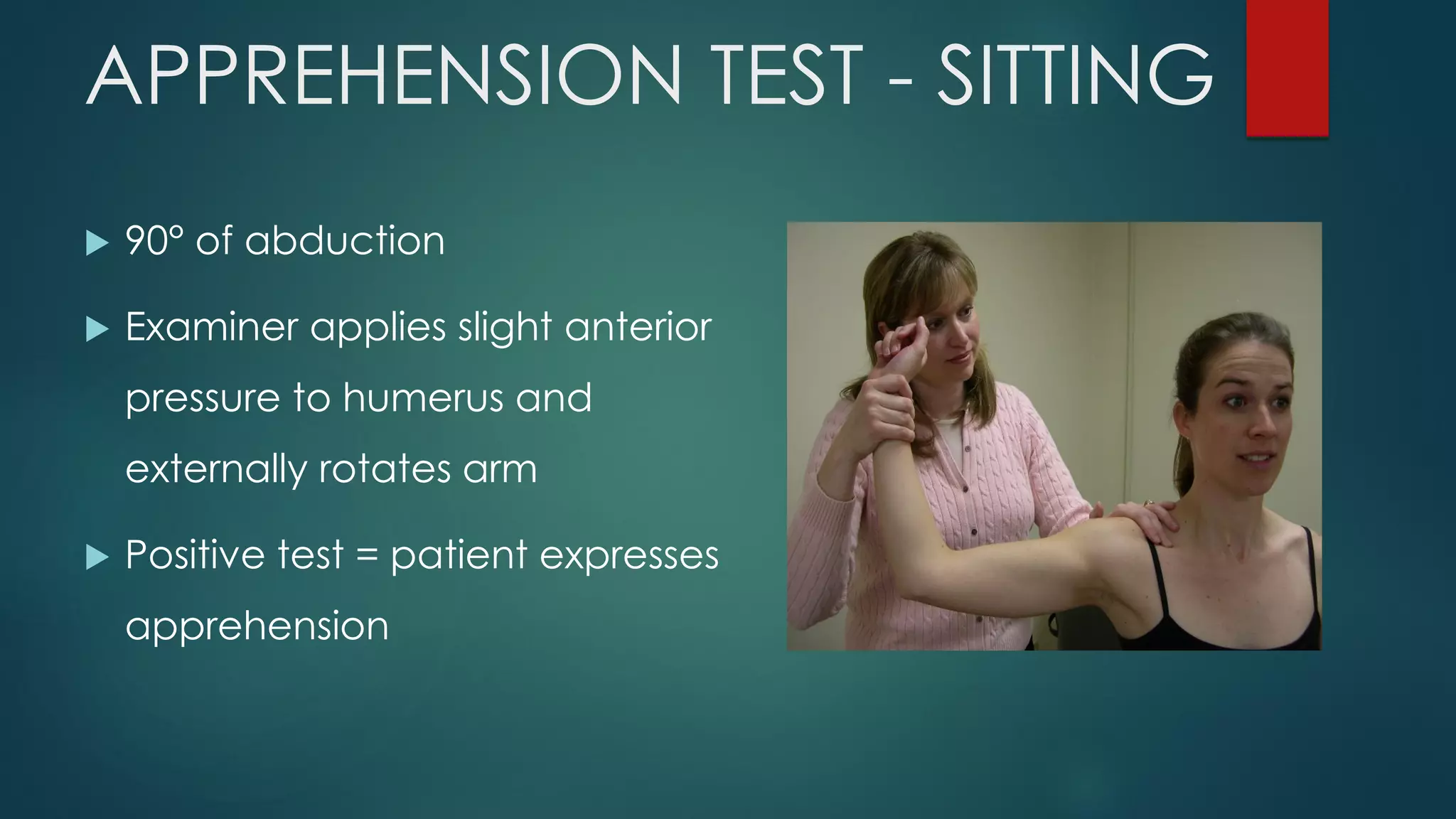
APPREHENSION TEST - SITTING
 90° of abduction
 Examiner applies slight anterior
pressure to humerus and
externally rotates arm
 Positive test = patient expresses
apprehension
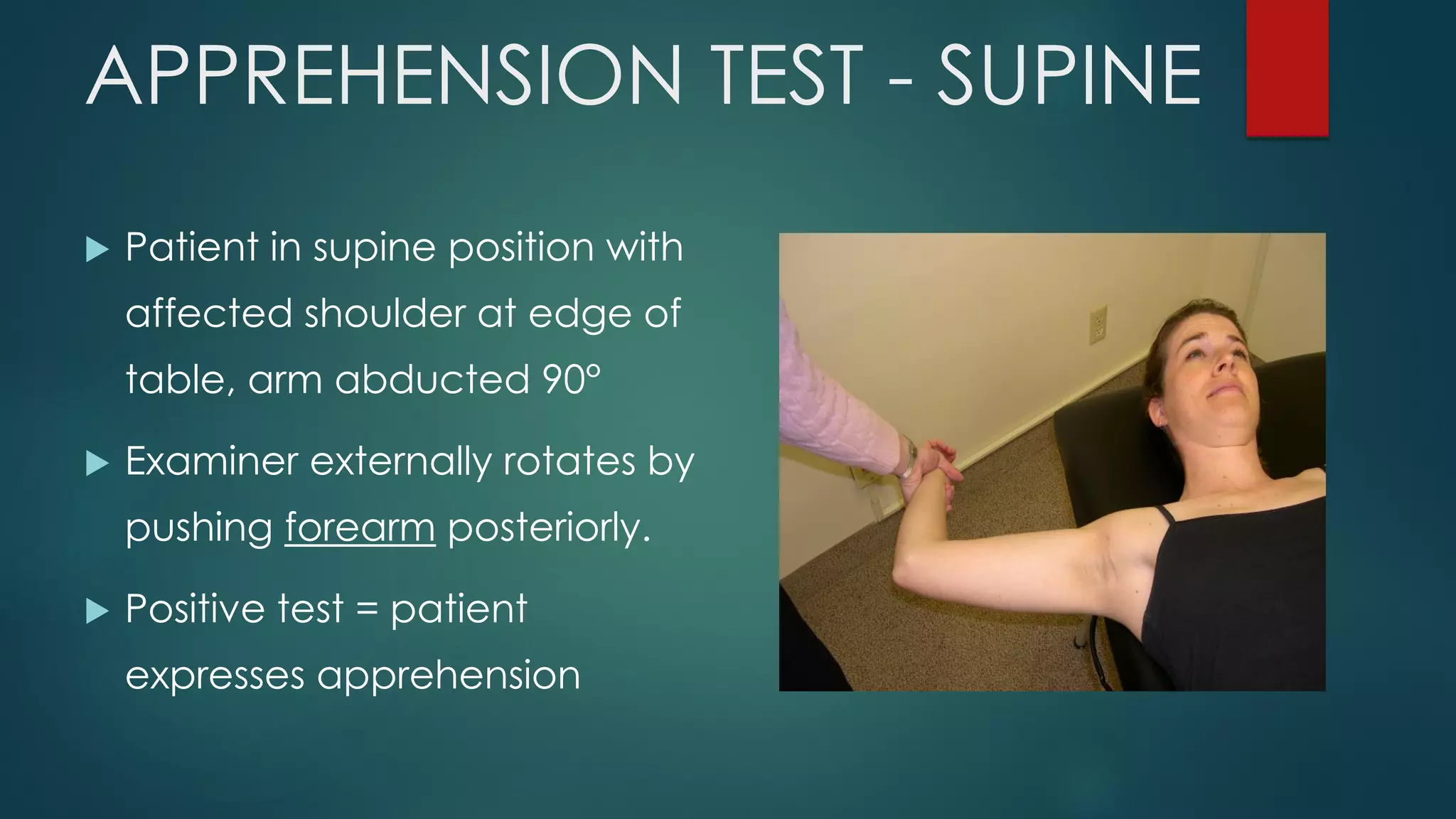
APPREHENSION TEST - SUPINE
 Patient in supine position with
affected shoulder at edge of
table, arm abducted 90°
 Examiner externally rotates by
pushing forearm posteriorly.
 Positive test = patient
expresses apprehension
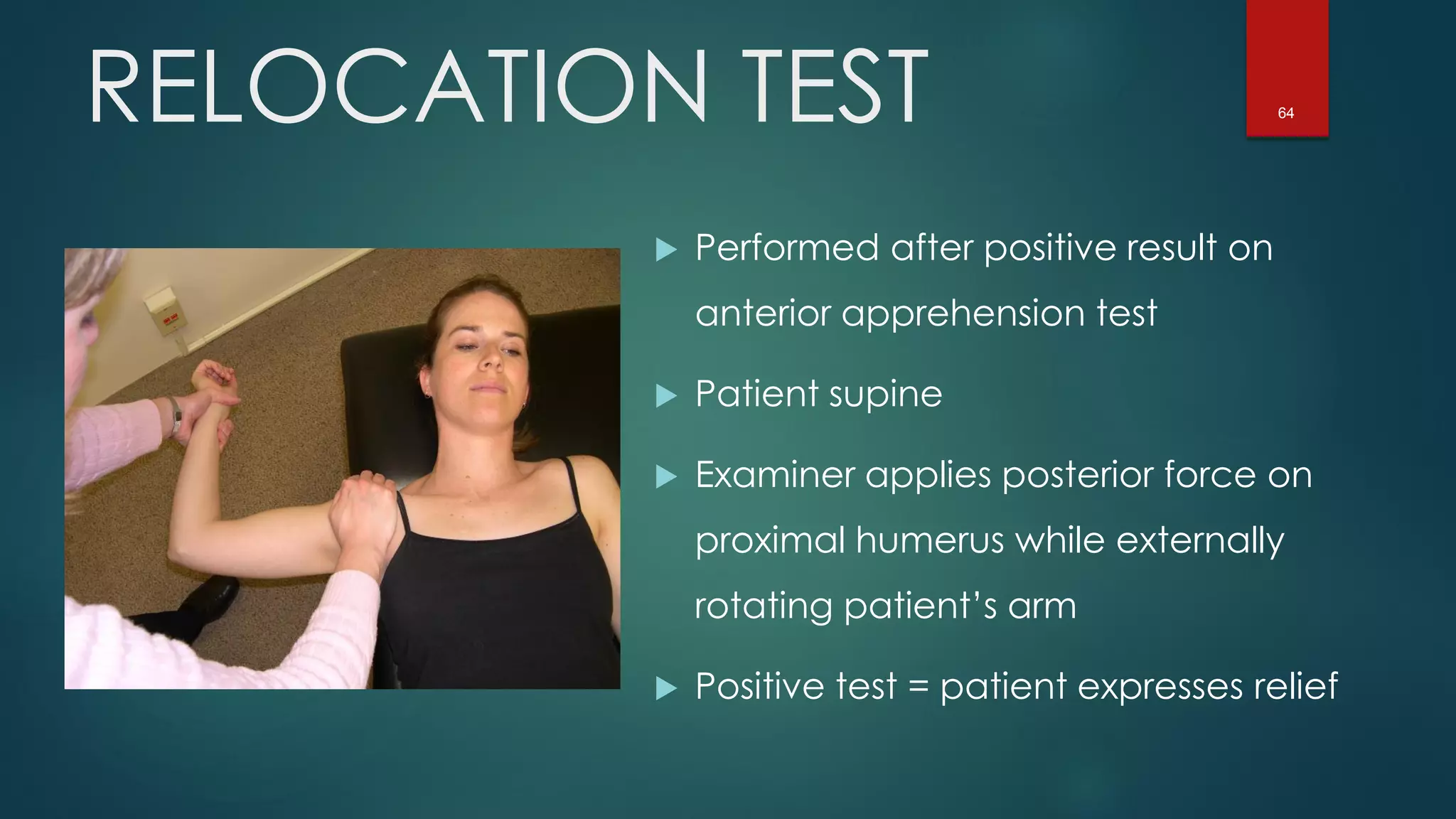
64RELOCATION TEST
 Performed after positive result on
anterior apprehension test
 Patient supine
 Examiner applies posterior force on
proximal humerus while externally
rotating patient’s arm
 Positive test = patient expresses relief
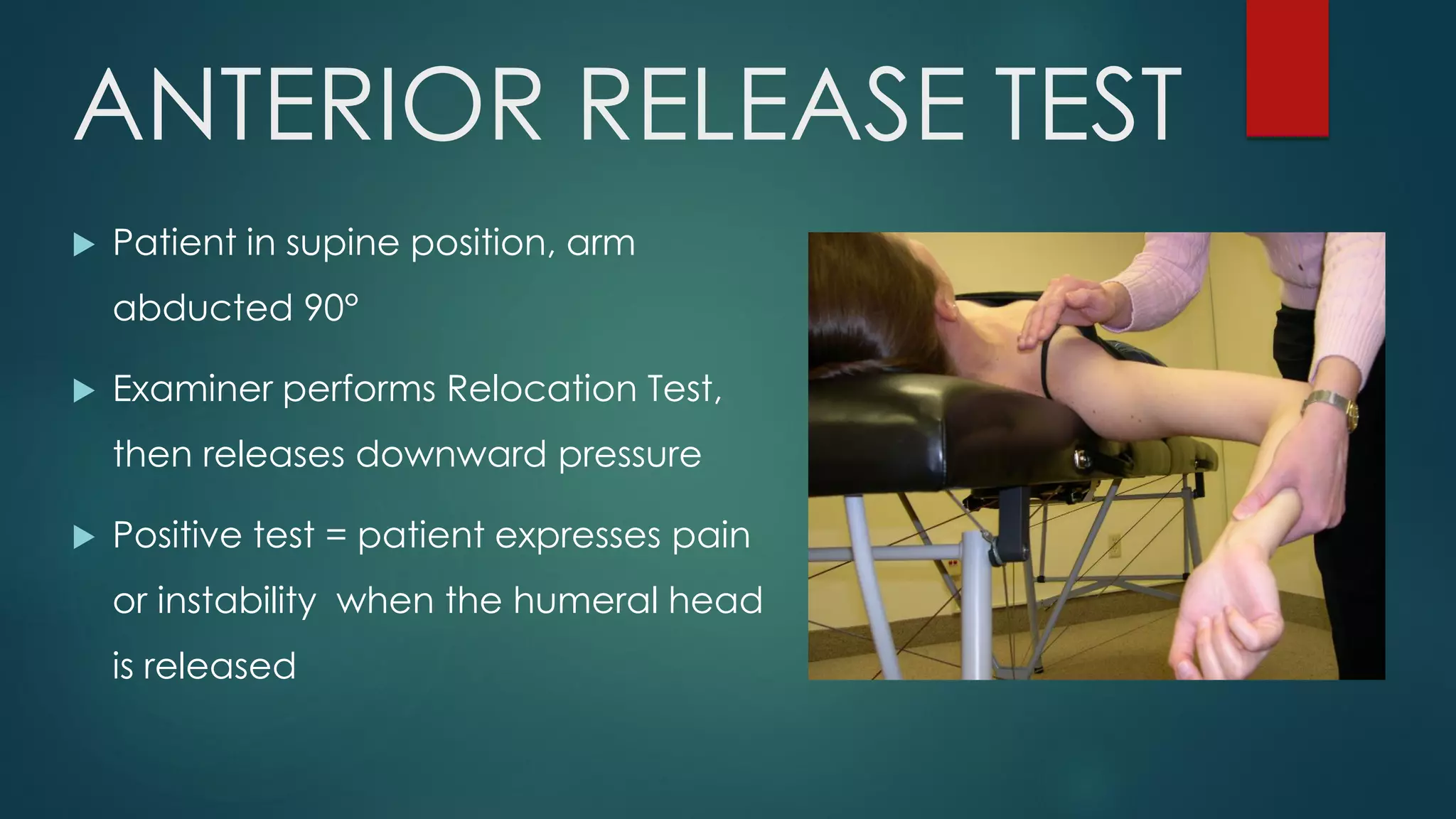
ANTERIOR RELEASE TEST
 Patient in supine position, arm
abducted 90°
 Examiner performs Relocation Test,
then releases downward pressure
 Positive test = patient expresses pain
or instability when the humeral head
is released
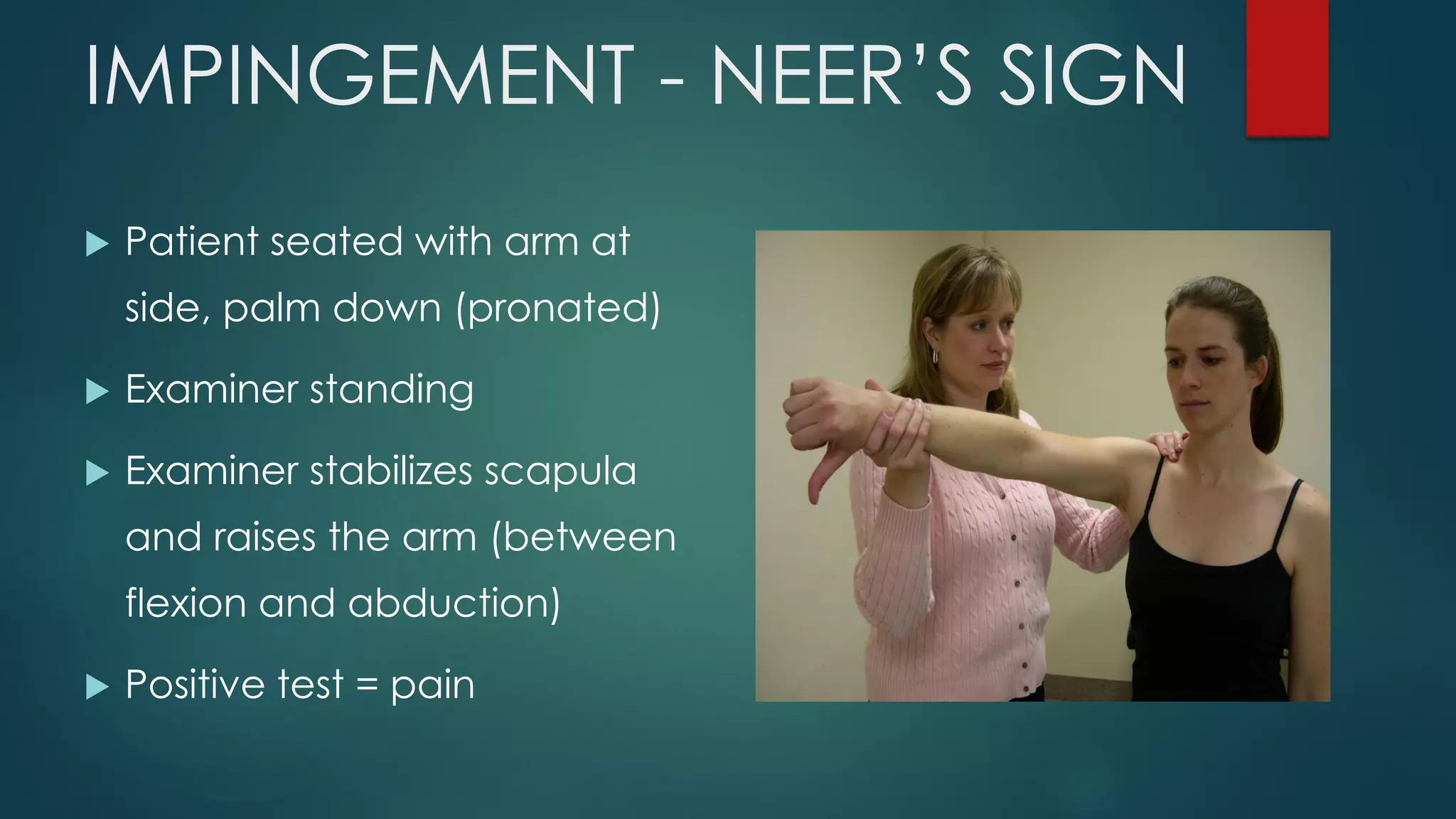
IMPINGEMENT - NEER’S SIGN
 Patient seated with arm at
side, palm down (pronated)
 Examiner standing
 Examiner stabilizes scapula
and raises the arm (between
flexion and abduction)
 Positive test = pain
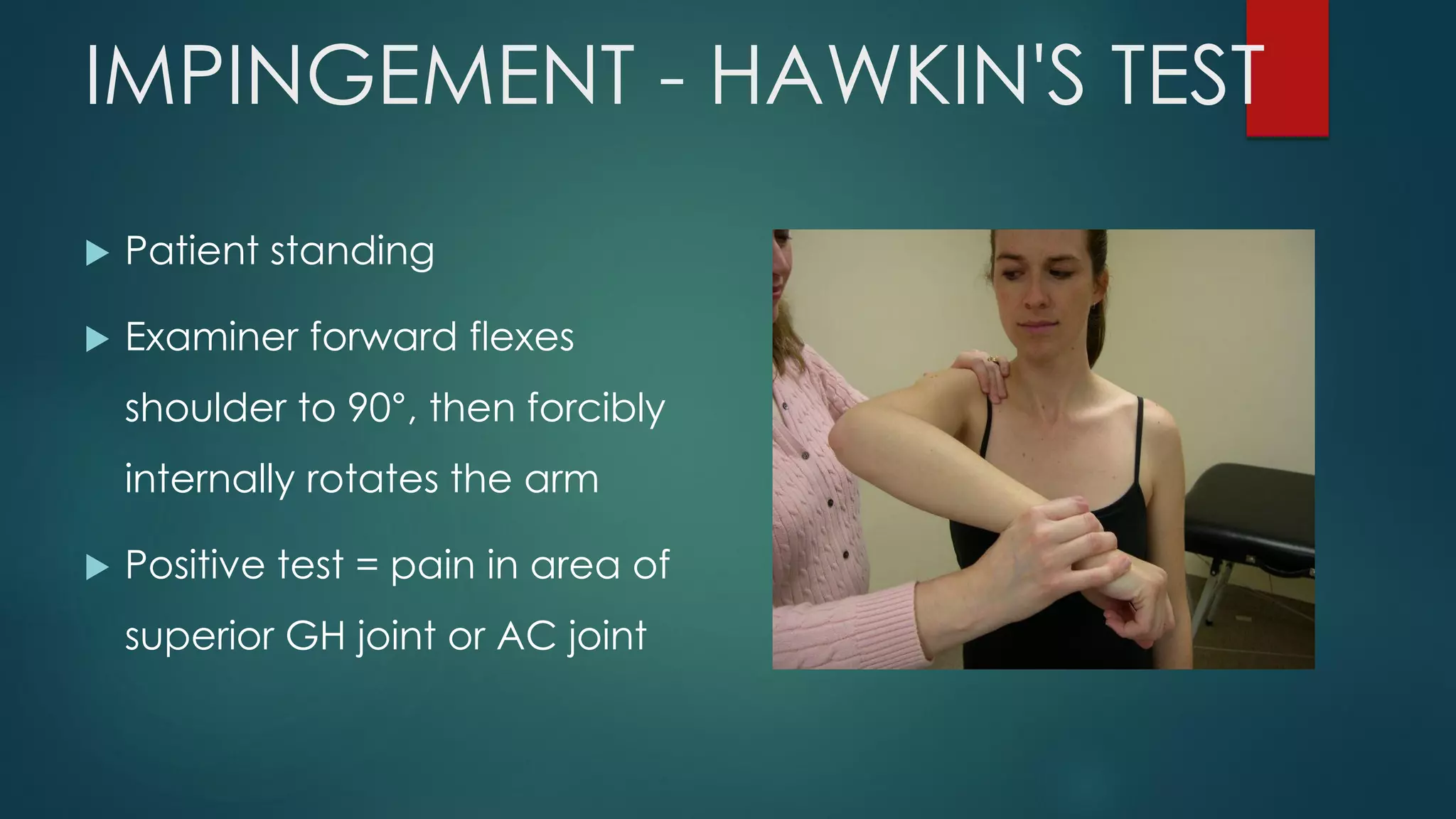
IMPINGEMENT - HAWKIN'S TEST
 Patient standing
 Examiner forward flexes
shoulder to 90°, then forcibly
internally rotates the arm
 Positive test = pain in area of
superior GH joint or AC joint
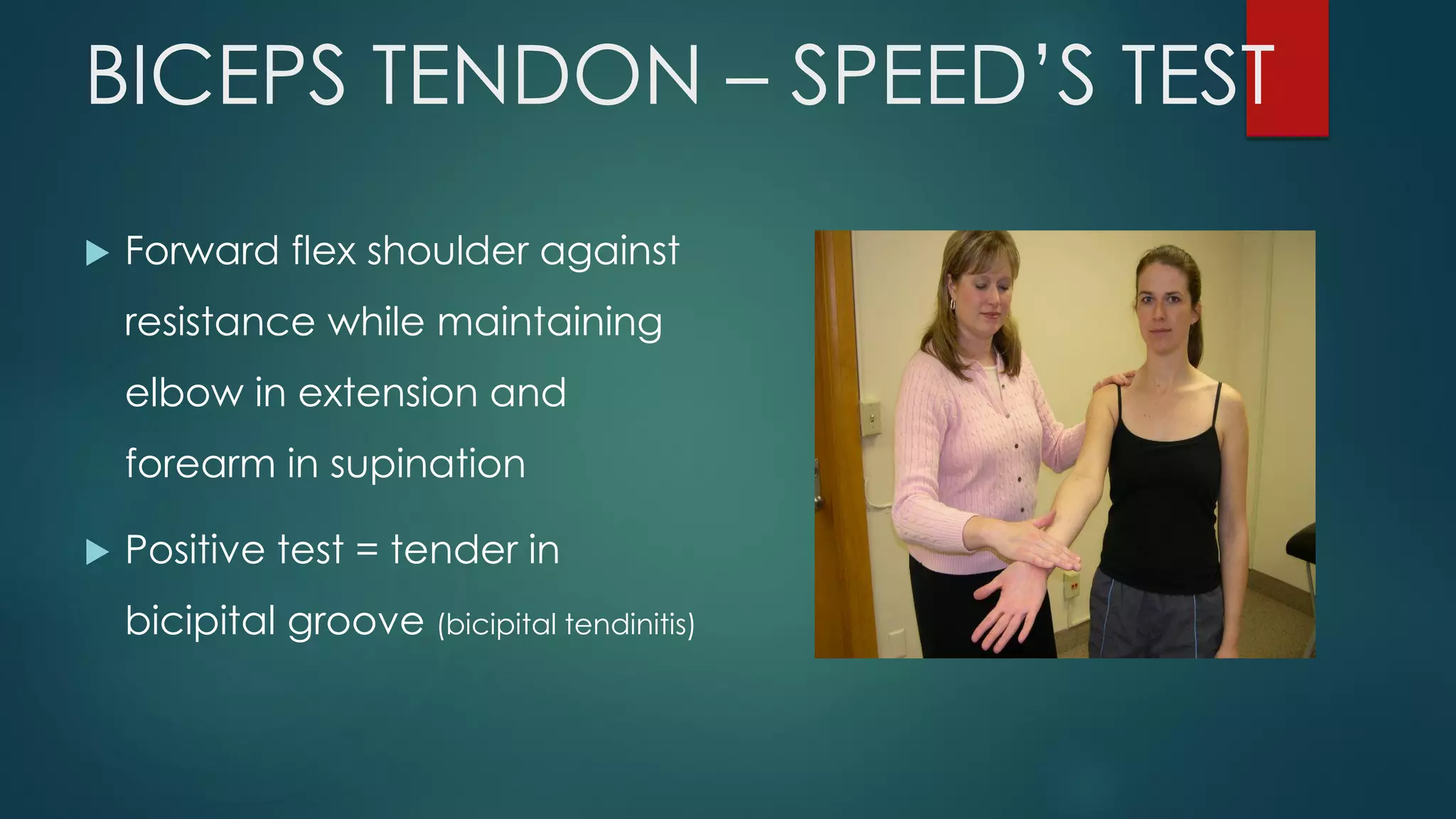
BICEPS TENDON – SPEED’S TEST
 Forward flex shoulder against
resistance while maintaining
elbow in extension and
forearm in supination
 Positive test = tender in
bicipital groove (bicipital tendinitis)
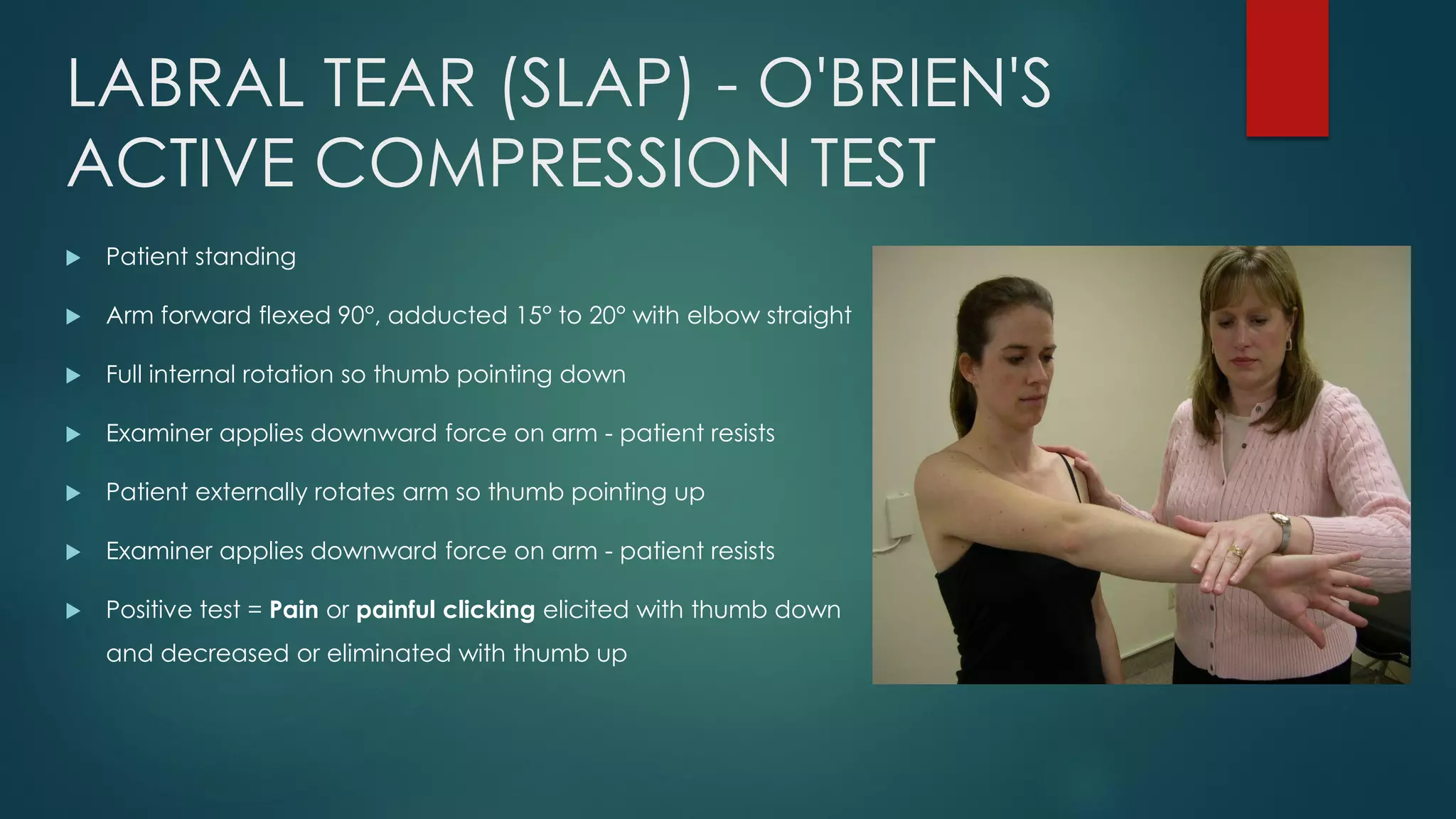
LABRAL TEAR (SLAP) - O'BRIEN'S
ACTIVE COMPRESSION TEST
 Patient standing
 Arm forward flexed 90°, adducted 15° to 20° with elbow straight
 Full internal rotation so thumb pointing down
 Examiner applies downward force on arm - patient resists
 Patient externally rotates arm so thumb pointing up
 Examiner applies downward force on arm - patient resists
 Positive test = Pain or painful clicking elicited with thumb down
and decreased or eliminated with thumb up
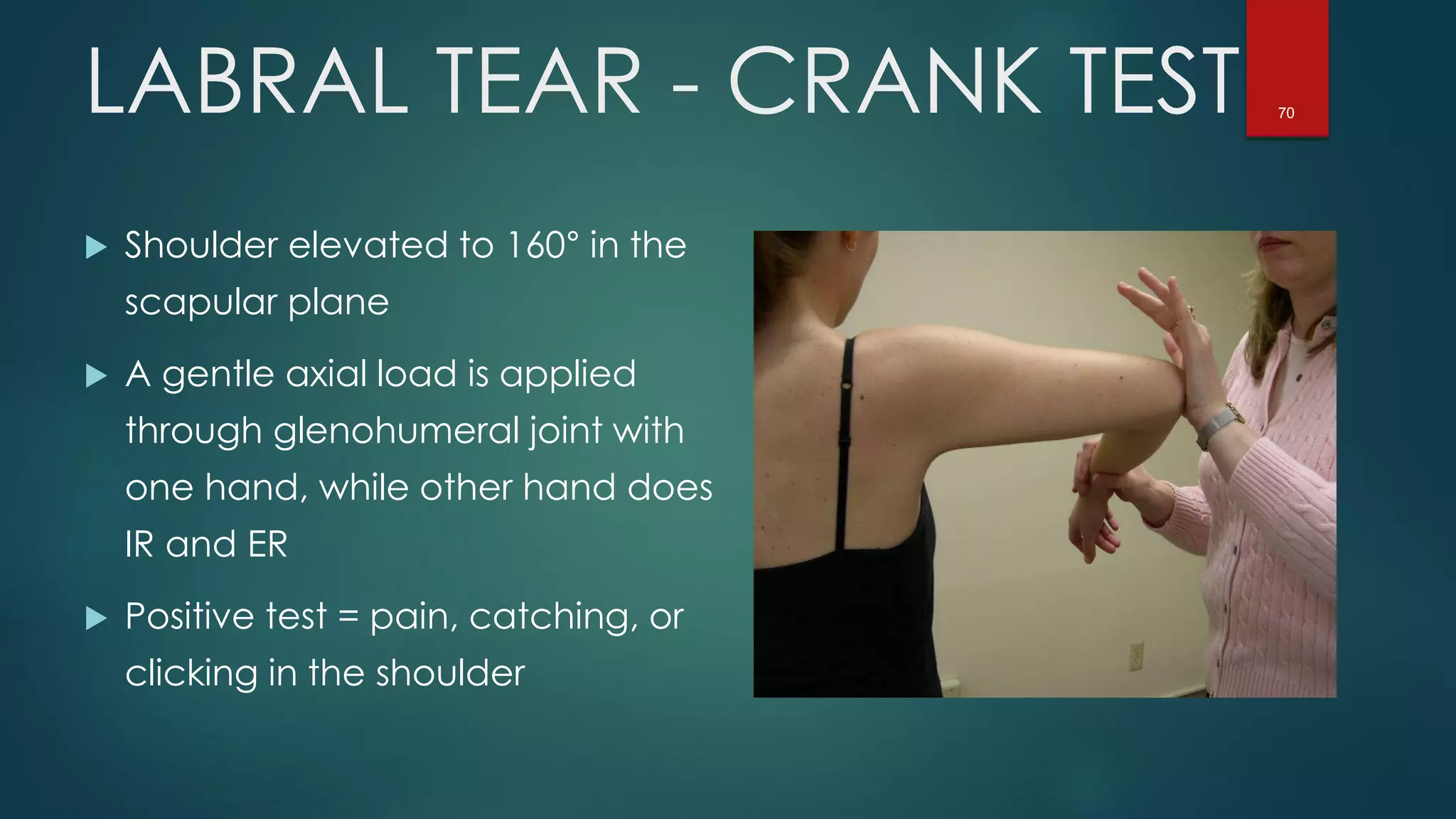
70LABRAL TEAR - CRANK TEST
 Shoulder elevated to 160° in the
scapular plane
 A gentle axial load is applied
through glenohumeral joint with
one hand, while other hand does
IR and ER
 Positive test = pain, catching, or
clicking in the shoulder
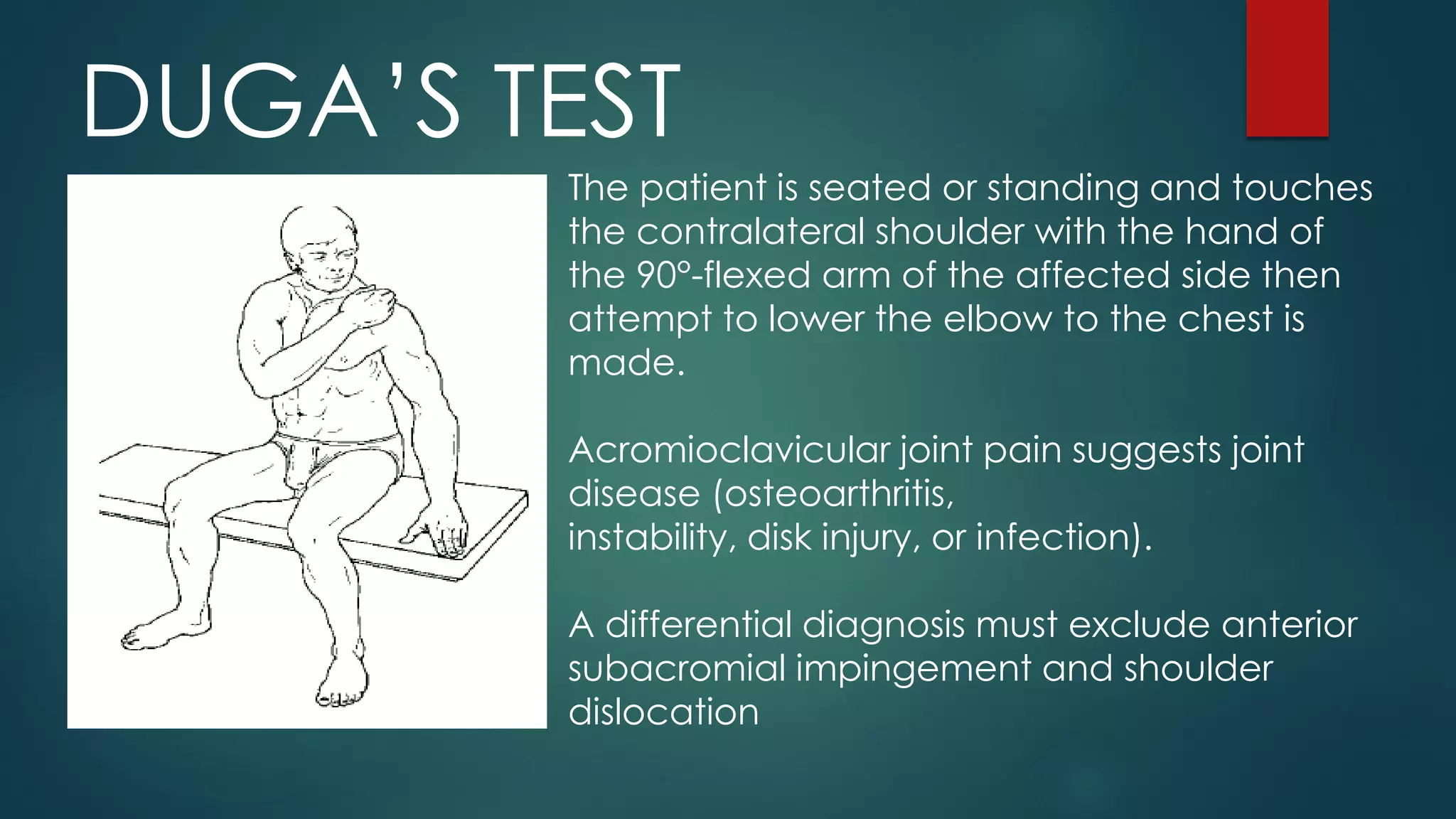
DUGA’S TEST
The patient is seated or standing and touches
the contralateral shoulder with the hand of
the 90°-flexed arm of the affected side then
attempt to lower the elbow to the chest is
made.
Acromioclavicular joint pain suggests joint
disease (osteoarthritis,
instability, disk injury, or infection).
A differential diagnosis must exclude anterior
subacromial impingement and shoulder
dislocation
PROVISIONAL DIAGNOSIS
1. _ _ _ _ _ _ _ _ _ _ _ _ _ _ _ _ _ _ _ _ _ _ _ _
2. _ _ _ _ _ _ _ _ _ _ _ _ _ _ _ _ _ _ _ _ _ _ _ _
3. _ _ _ _ _ _ _ _ _ _ _ _ _ _ _ _ _ _ _ _ _ _ _ _
4. _ _ _ _ _ _ _ _ _ _ _ _ _ _ _ _ _ _ _ _ _ _ _ _
5. _ _ _ _ _ _ _ _ _ _ _ _ _ _ _ _ _ _ _ _ _ _ _ _
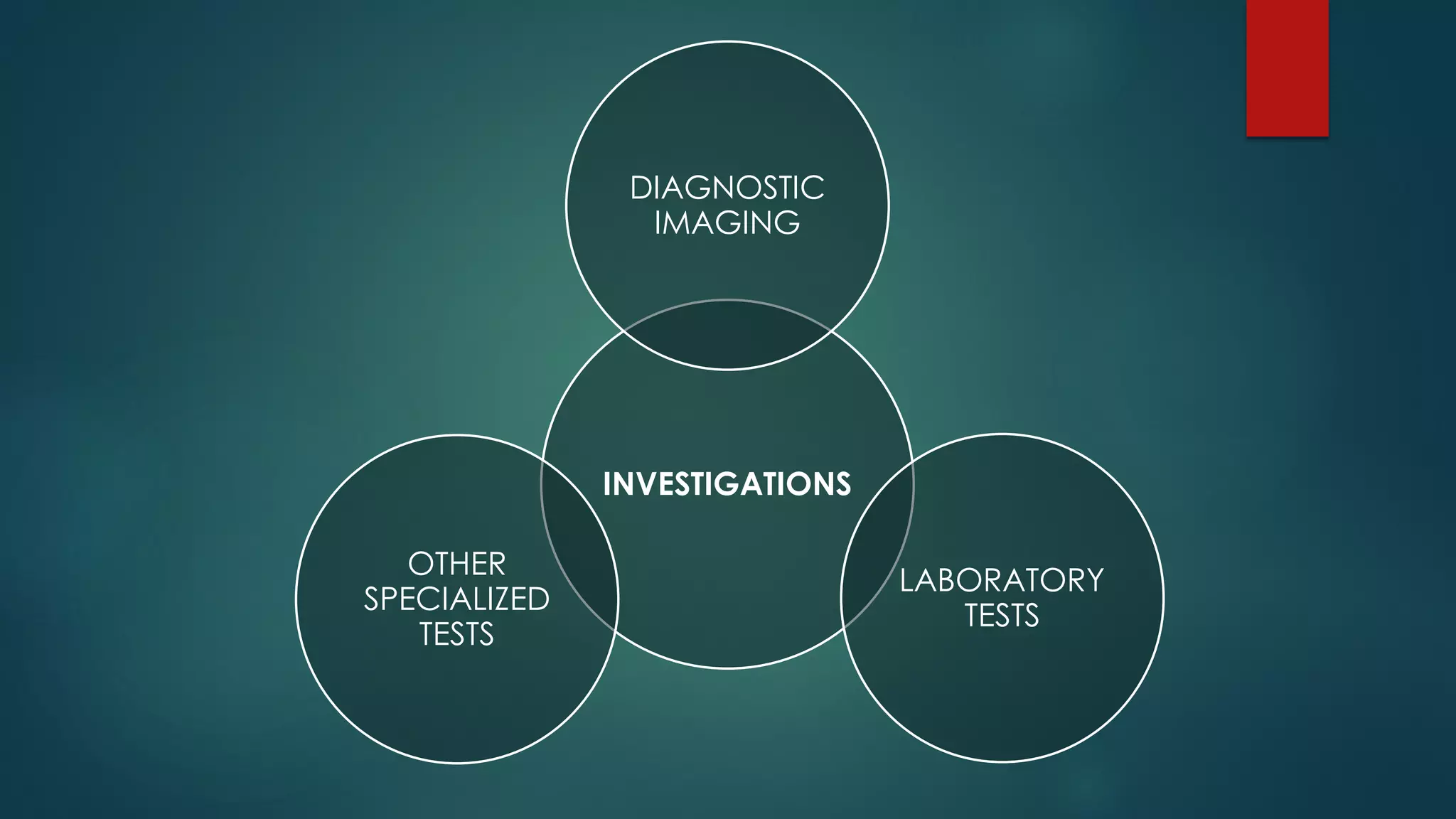
INVESTIGATIONS
DIAGNOSTIC
IMAGING
LABORATORY
TESTS
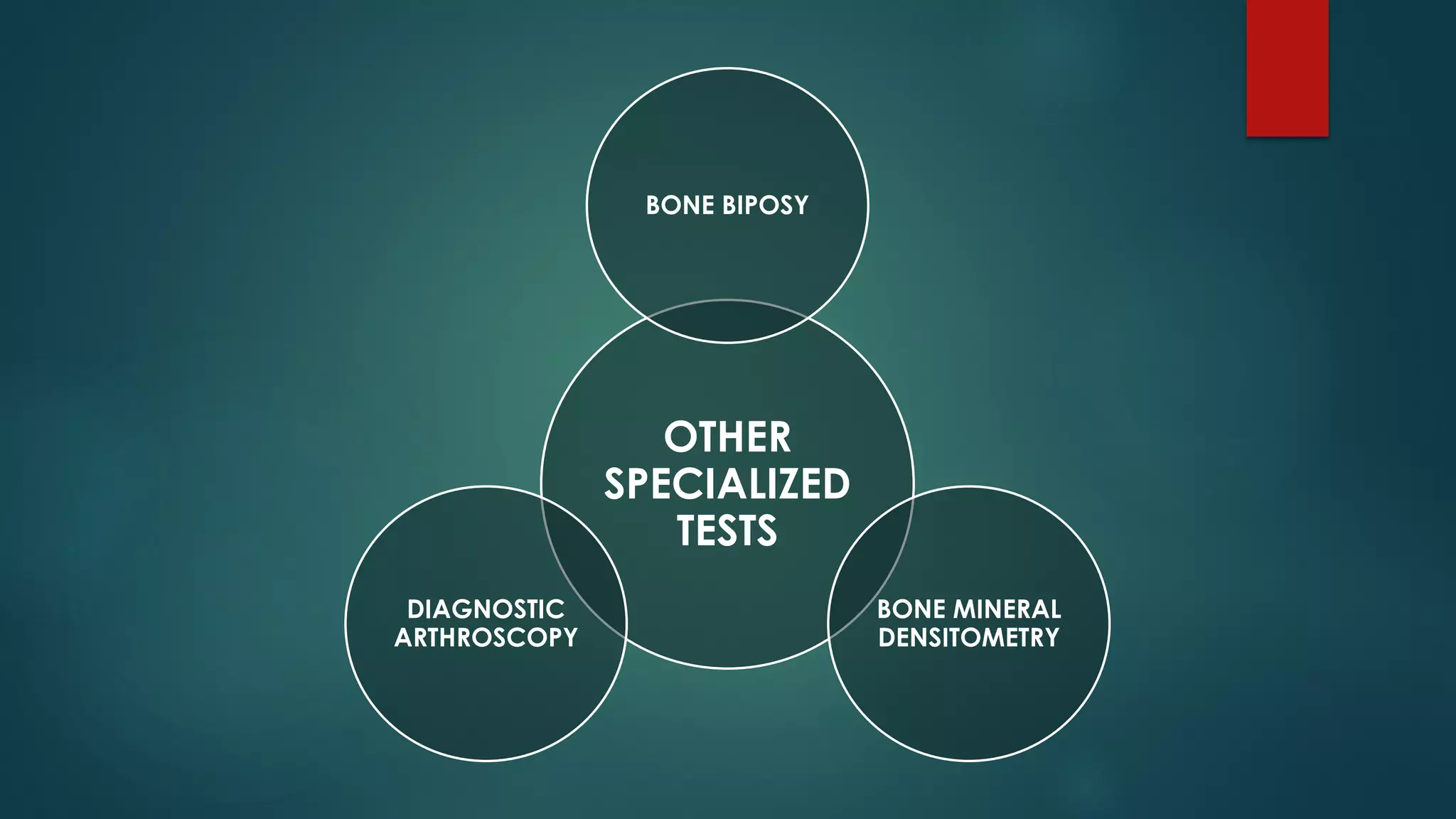
OTHER
SPECIALIZED
TESTS
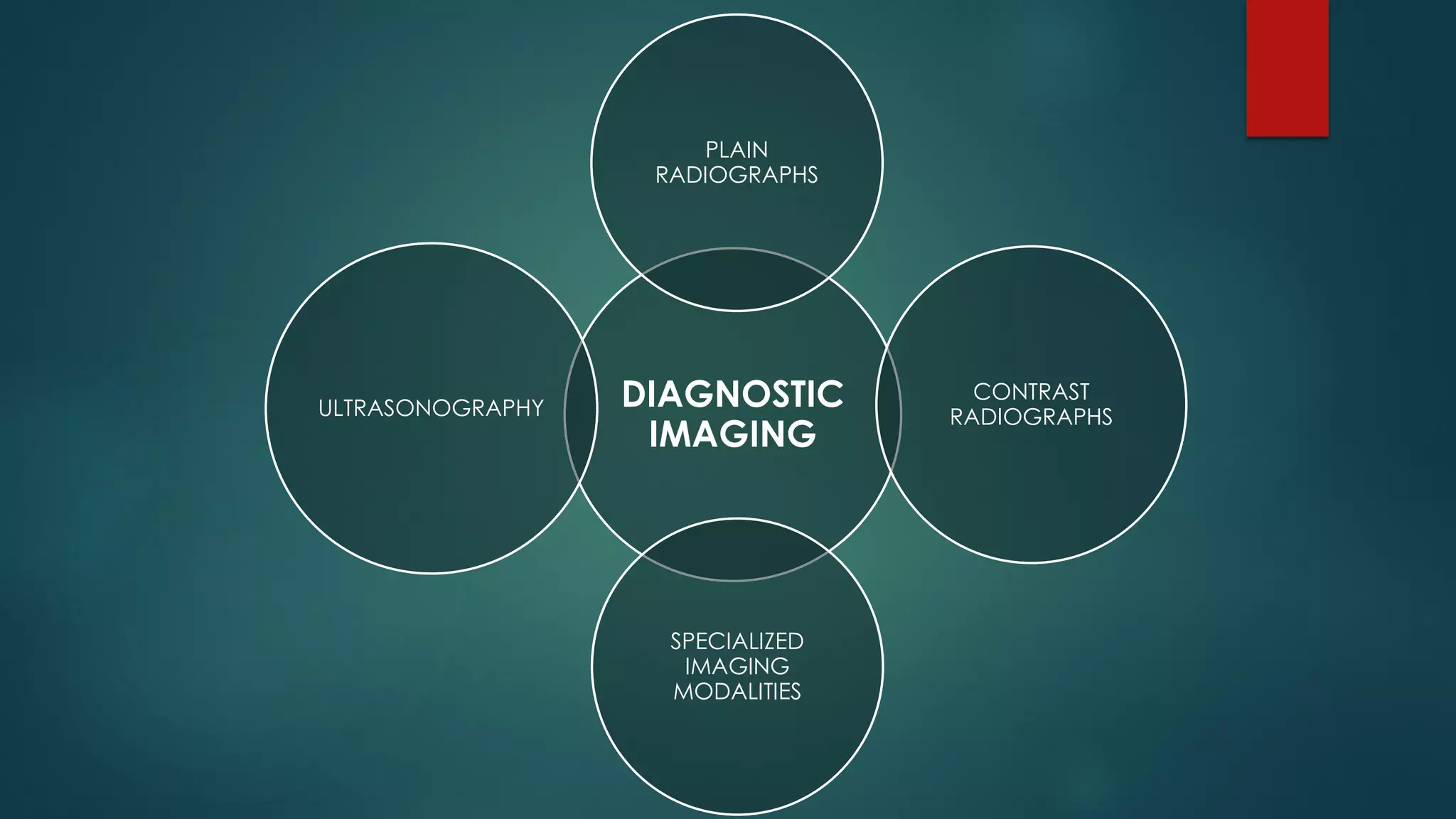
DIAGNOSTIC
IMAGING
PLAIN
RADIOGRAPHS
CONTRAST
RADIOGRAPHS
SPECIALIZED
IMAGING
MODALITIES
ULTRASONOGRAPHY
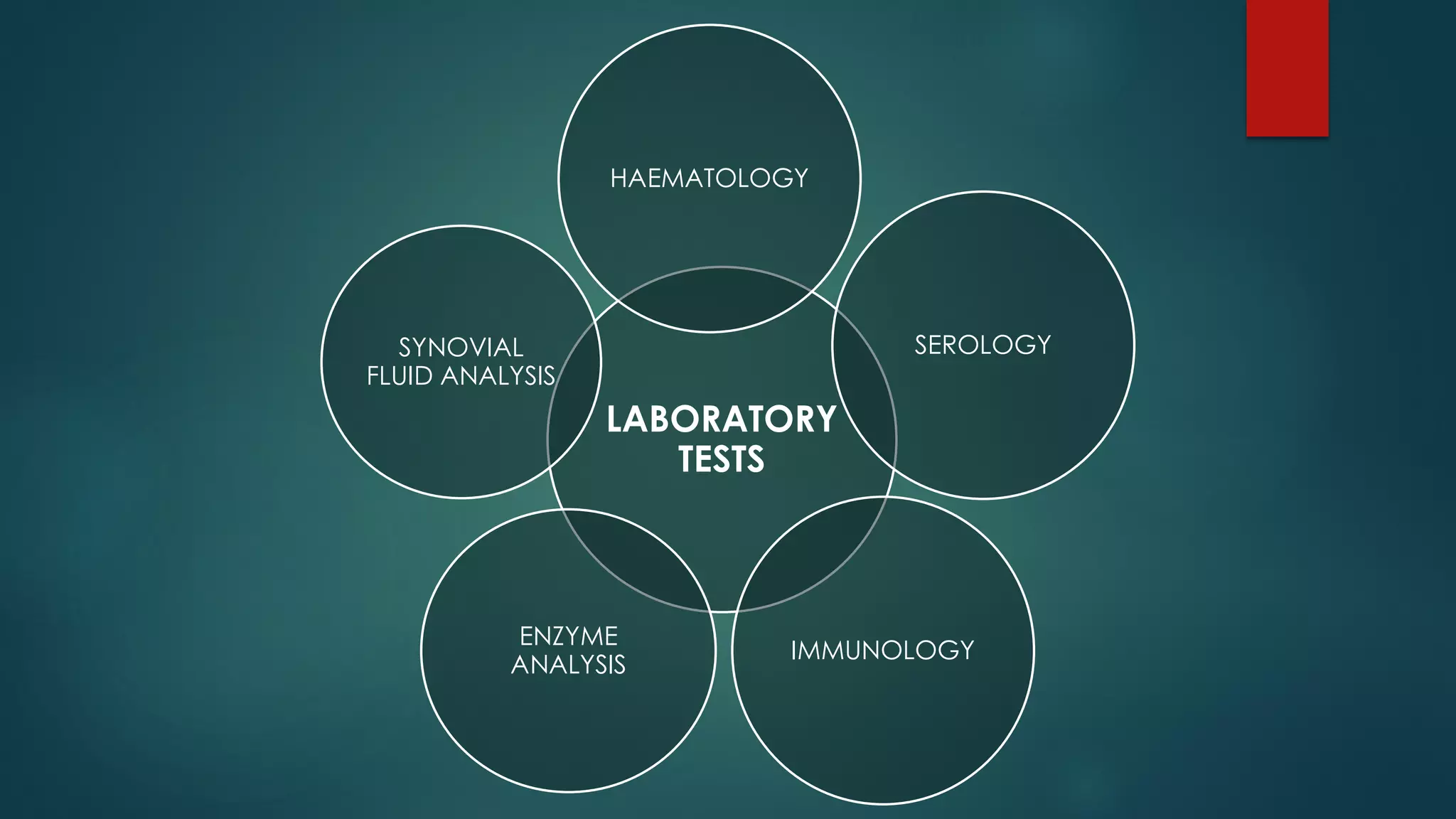
LABORATORY
TESTS
HAEMATOLOGY
SEROLOGY
IMMUNOLOGY
ENZYME
ANALYSIS
SYNOVIAL
FLUID ANALYSIS
OTHER
SPECIALIZED
TESTS
BONE BIPOSY
BONE MINERAL
DENSITOMETRY
DIAGNOSTIC
ARTHROSCOPY
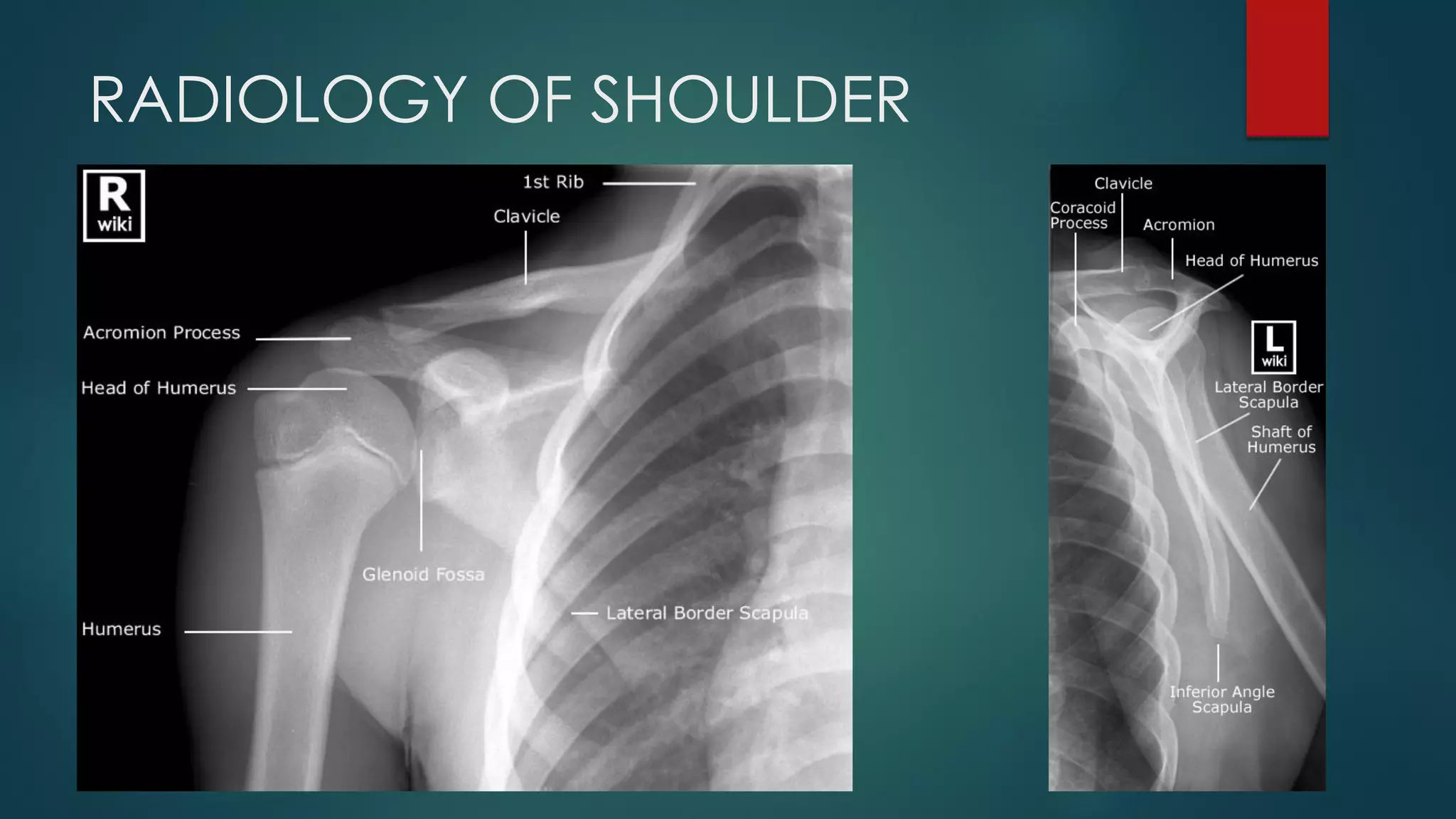
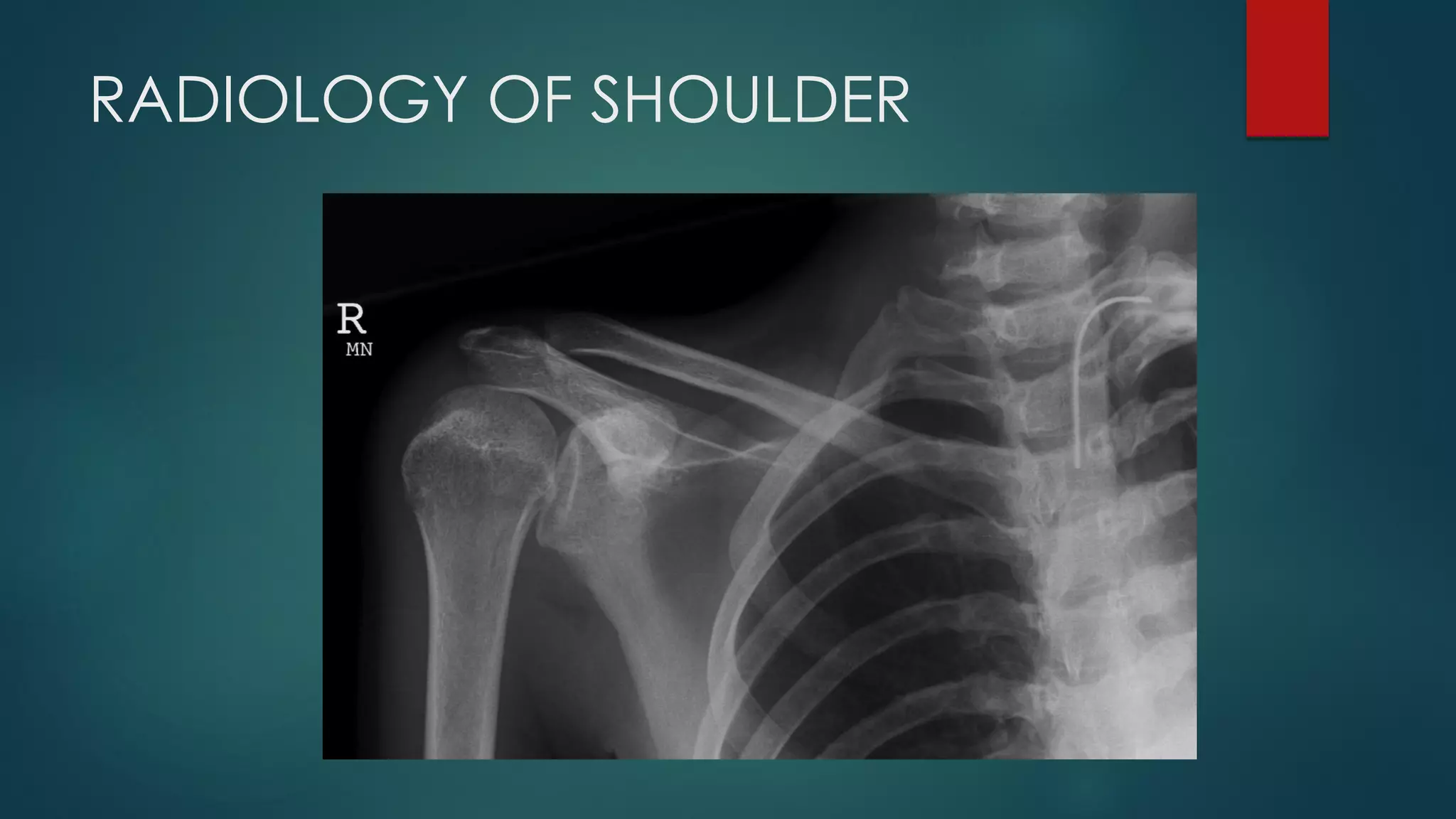
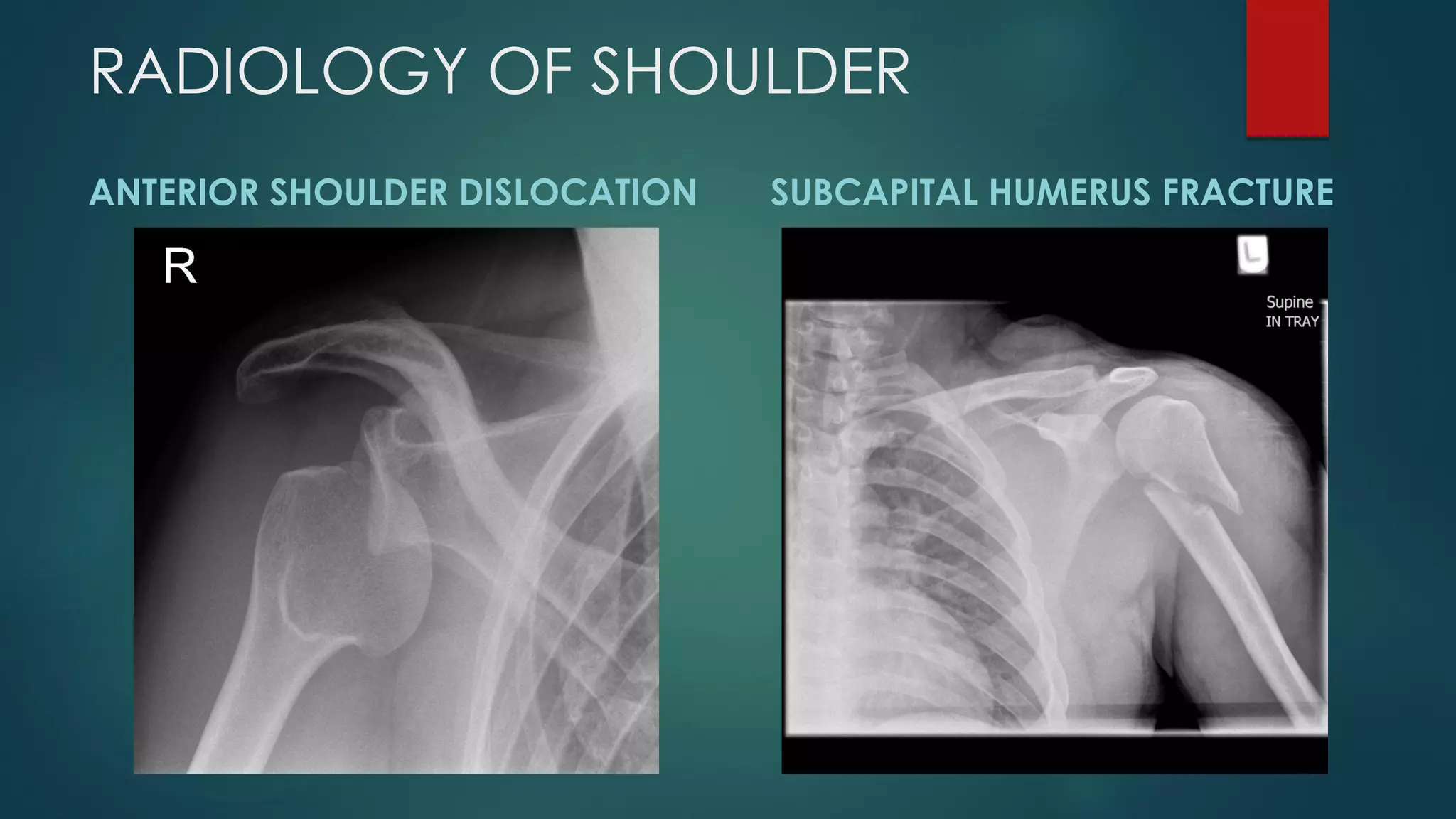
RADIOLOGY OF SHOULDER
ANTERIOR SHOULDER DISLOCATION SUBCAPITAL HUMERUS FRACTURE
DEFINITIVE DIAGNOSIS
1. _ _ _ _ _ _ _ _ _ _ _ _ _ _ _ _ _ _ _ _ _ _ _ _
2. _ _ _ _ _ _ _ _ _ _ _ _ _ _ _ _ _ _ _ _ _ _ _ _
3. _ _ _ _ _ _ _ _ _ _ _ _ _ _ _ _ _ _ _ _ _ _ _ _
4. _ _ _ _ _ _ _ _ _ _ _ _ _ _ _ _ _ _ _ _ _ _ _ _
5. _ _ _ _ _ _ _ _ _ _ _ _ _ _ _ _ _ _ _ _ _ _ _ _
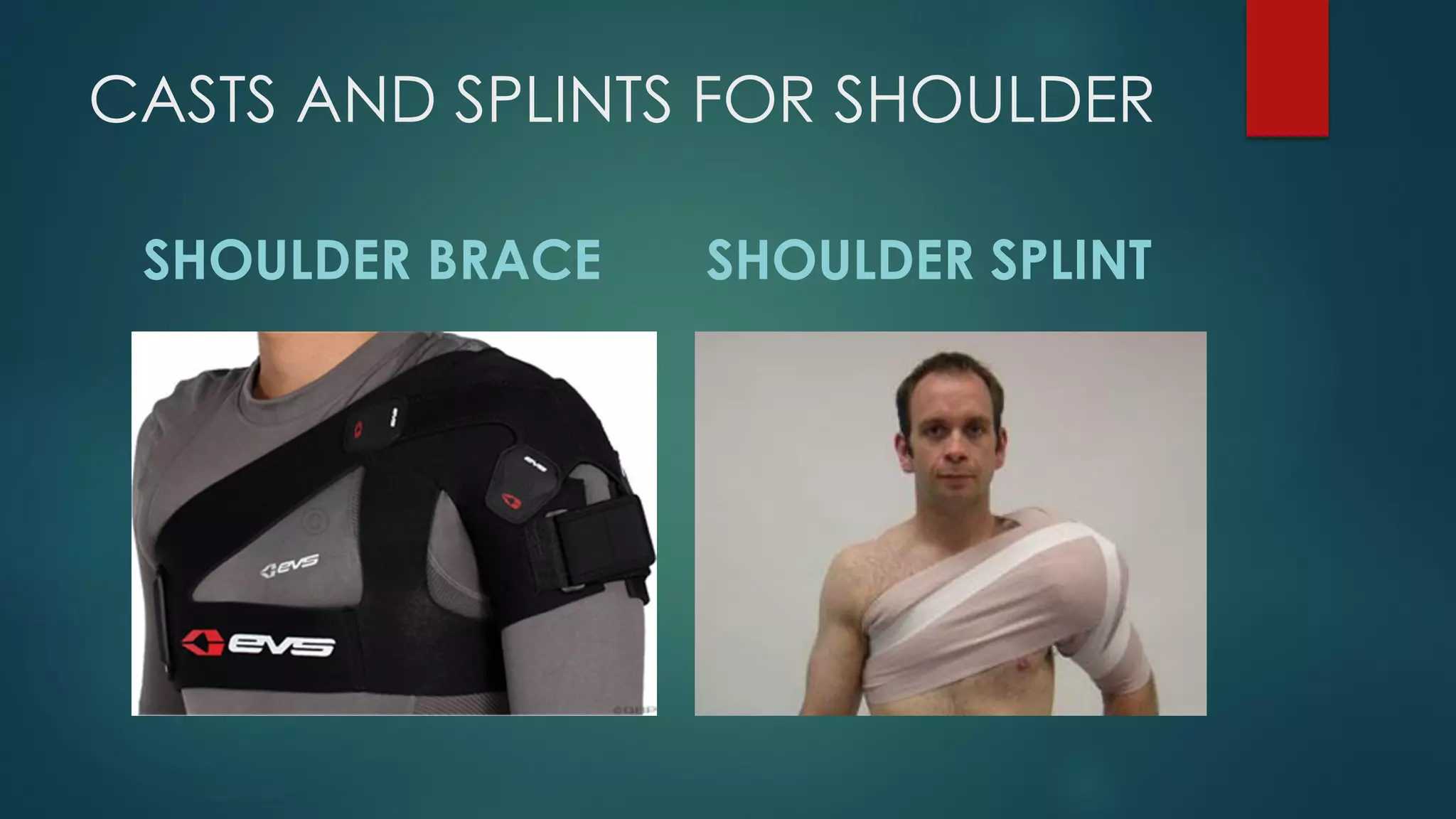
CASTS AND SPLINTS FOR SHOULDER
SHOULDER BRACE SHOULDER SPLINT
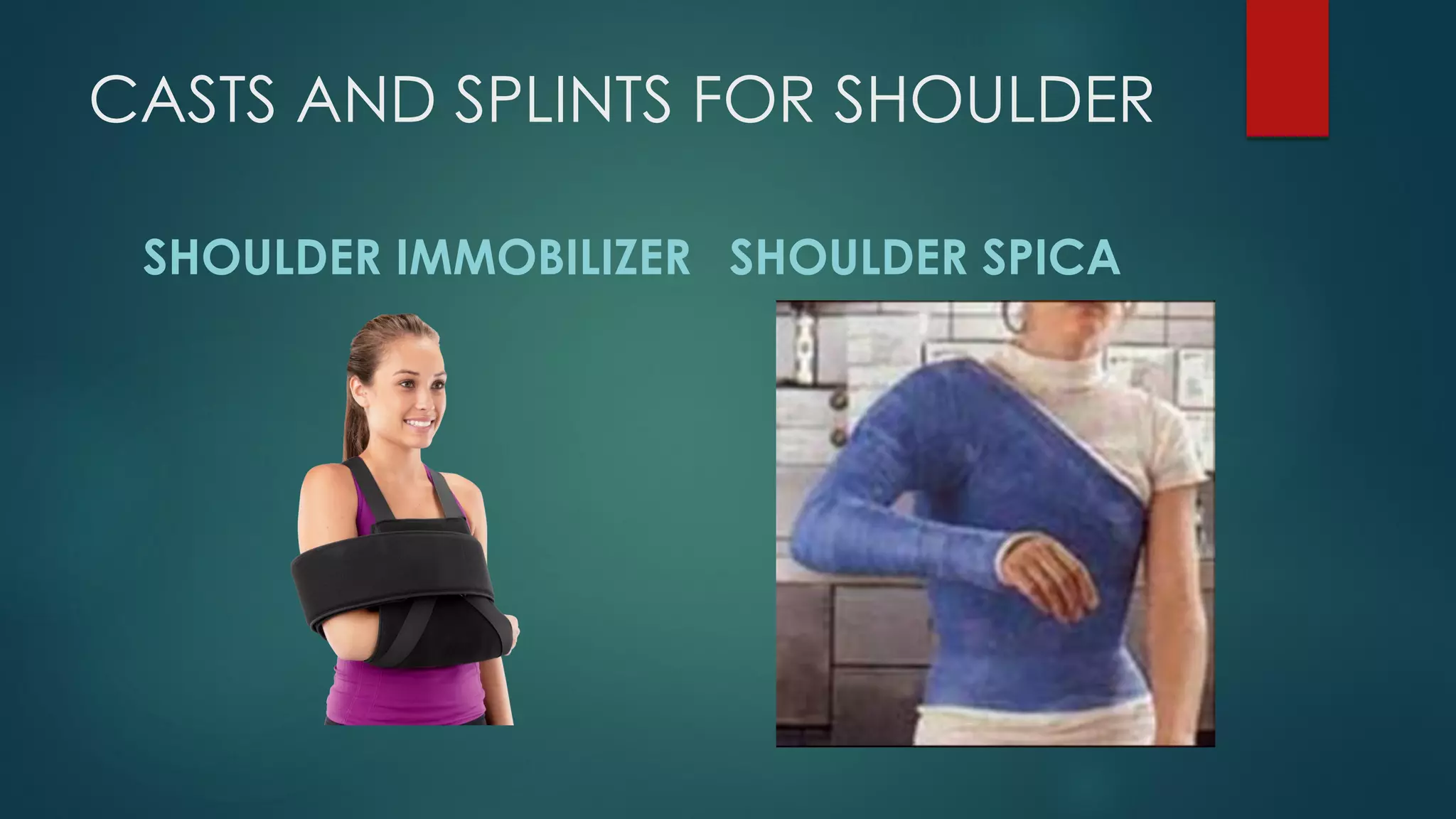
CASTS AND SPLINTS FOR SHOULDER
SHOULDER IMMOBILIZER SHOULDER SPICA
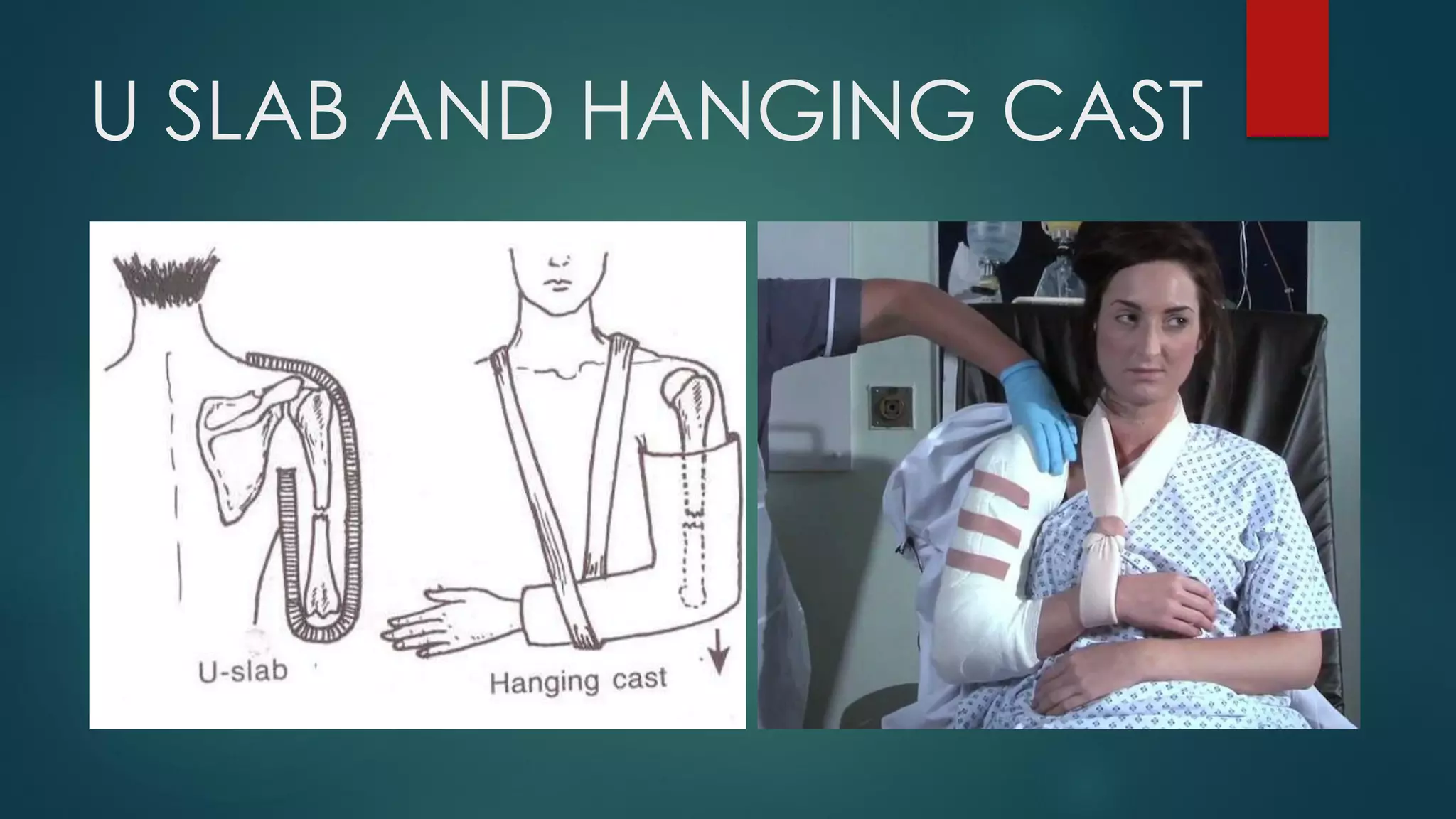
U SLAB AND HANGING CAST
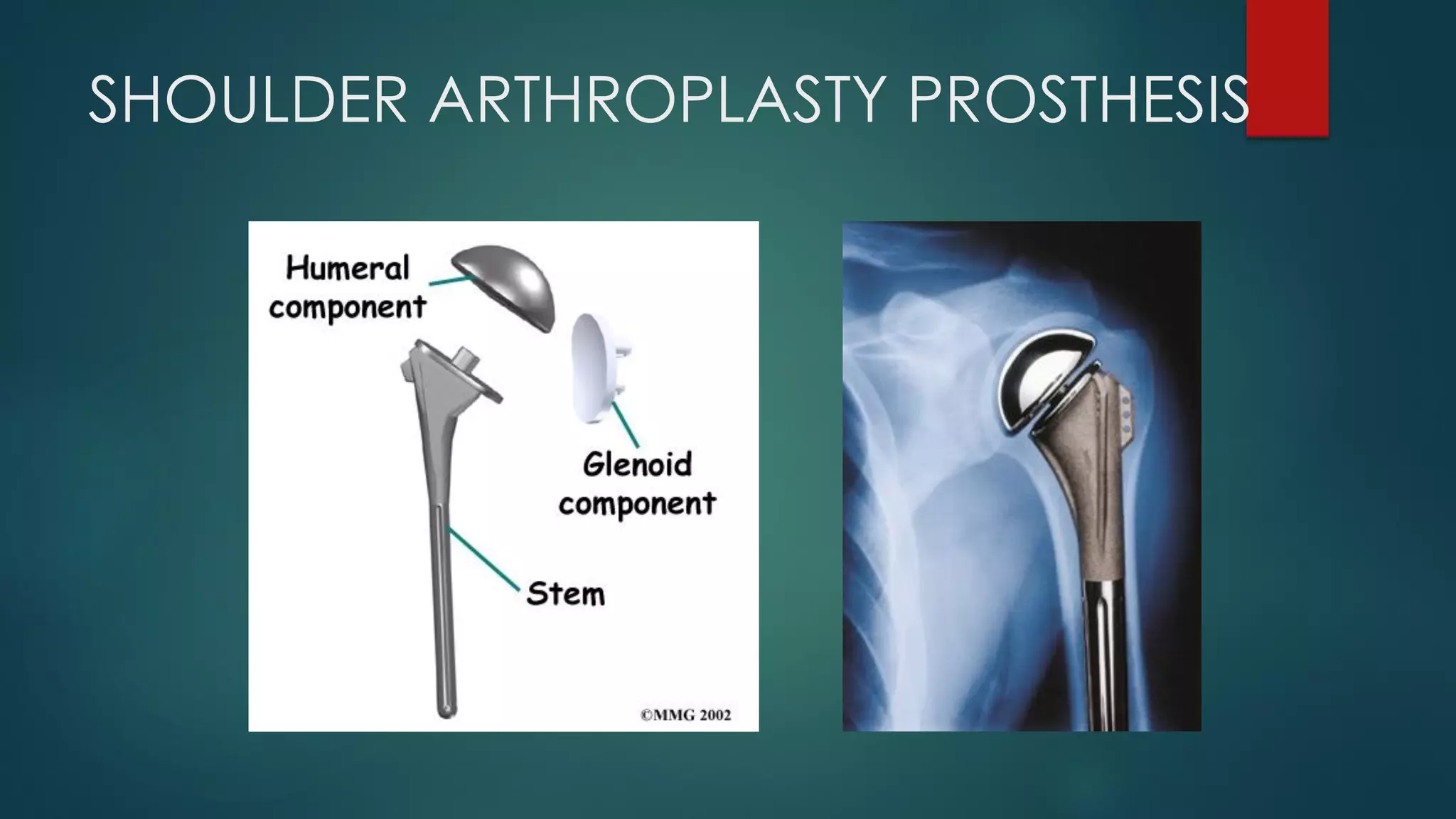
SHOULDER ARTHROPLASTY PROSTHESIS
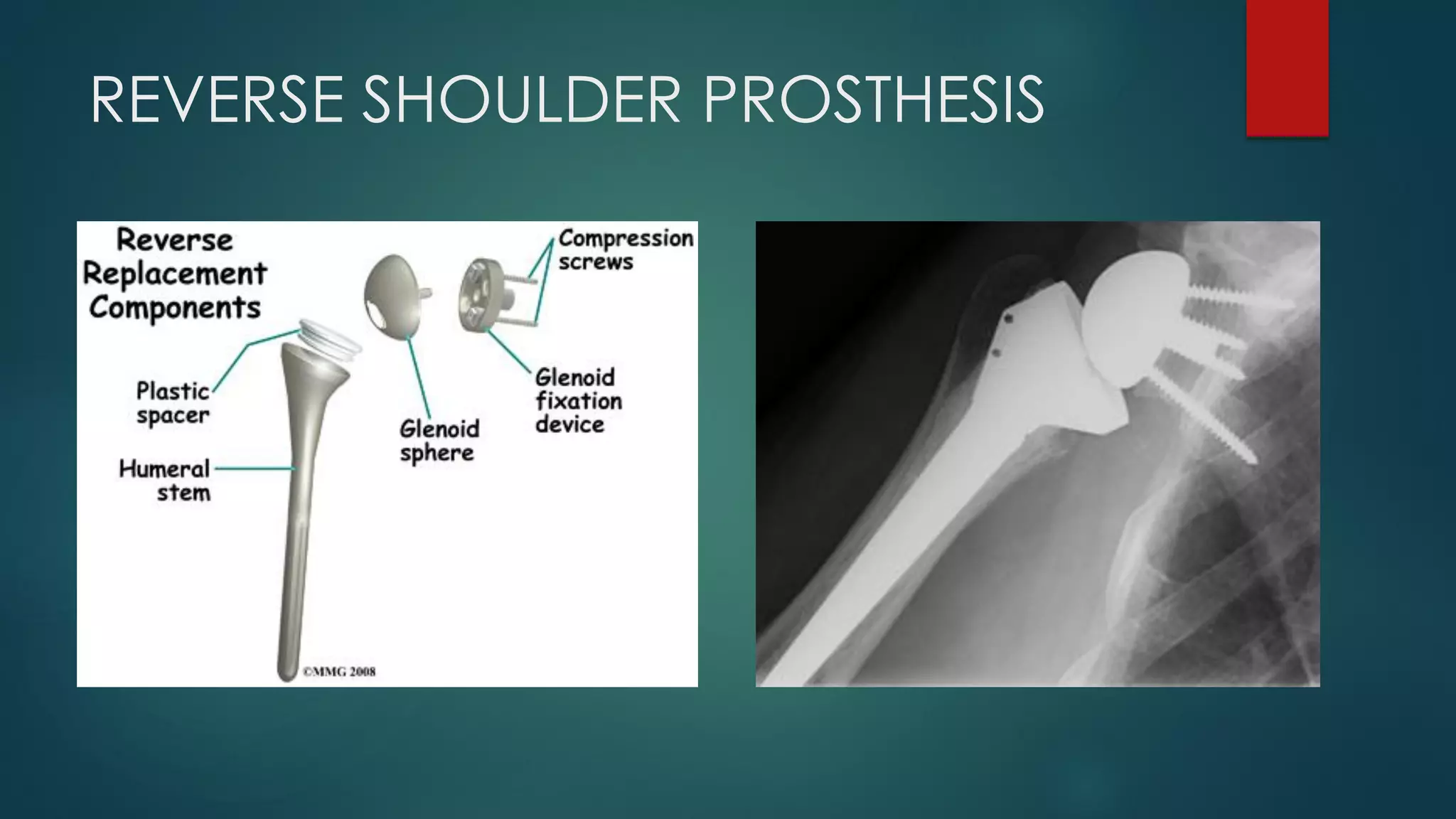
REVERSE SHOULDER PROSTHESIS
THE END
THANK YOU

PS SESSION : EXAMINATION OF SHOULDER

  • 1.
    History & Physical Examof the Shoulder DR UTKARSH SHAHI ASSISTANT PROFESSOR DEPARTMENT OF ORTHOPEDICS
  • 2.
  • 3.
    REVIEW OF SHOULDERANATOMY  Bones Scapula Clavicle Humeral head Posterior rib cage  Joints Sternoclavicular Acromioclavicular Glenohumeral Scapulothoracic
  • 4.
    GLENOHUMERAL JOINT  25%humeral head surface in contact with glenoid  Joint space thinning seen with OA
  • 5.
    GLENOHUMERAL JOINT  Humeralhead coverage increased to 75% with glenoid labrum
  • 6.
    MORE SHOULDER ANATOMY Ligaments  Coracoclavicular  Acromioclavicular  Glenohumeral  Superior GH  Middle GH  Inferior GH  Coracohumeral  Subacromial bursa  Subdeltoid bursa
  • 7.
    ROTATOR CUFF  Supraspinatus,infraspinatus, teres minor, subscapularis  Form cuff around humeral head  Keep humeral head within joint (counter act deltoid)  Abduction, external rotation, internal rotation
  • 8.
    MUSCLES OF THEROTATOR CUFF  The four major muscles of the rotator cuff rotate the humerus and properly orient the humoral head in the glenoid fossa (socket).  The tendons of these four muscles merge, forming a cuff around the glenohumeral joint.  Supraspinatus: abducts the humeral head and acts as a humeral head depressor  Infraspinatus: externally rotates and horizontally extends the humerus  Teres minor: externally rotates and extends the humerus  Subscapularis: internally rotates the humerus
  • 9.
    SHOULDER CONDITIONS Injury andmechanical derangement. Congenital and developmental abnormalities. Infection and inflammation. Arthritis and rheumatic disorders. Metabolic and endocrine disorders. Tumours and lesions that mimic them. Neurological disorders and muscle weakness.
  • 10.
    HISTORY TAKING PATIENT DETAILSCHIEF COMPLAINTS HISTORY OF PRESENT ILLNESS PAST HISTORY FAMILY HISTORY PERSONAL HISTORY TREATMENT HISTORY NEGATIVE HISTORY
  • 11.
    COMPLAINTS PAIN STIFFNESS SWELLING DEFORMITY WEAKNESSINSTABILITY PARASTHESIA LOSS OF FUNCTION
  • 12.
    PAIN Site Time andmode of onset Severity or Intensity Character or Nature Progression Referred pain Aggravating factors Relieving factors Any diurnal variation Any seasonal variation
  • 13.
    SHOULDER PAIN KEYPOINTS  Shoulder pain is a common complaint in primary care  2nd only to knee pain for referral to Ortho or primary care sports medicine  Most common causes in adults (peak ages 40-60)  Subacromial impingement syndrome  Rotator cuff problems  Athletic injuries  Shoulder accounts for 8-13% of athletic injuries  History and examination are keys to diagnosis
  • 14.
    PAIN  The extentof reference is governed by a number of factors.  The depth of the structure beneath the skin.  The position of the structure within the dermatome.  The severity of the lesion
  • 15.
    PAINFUL ARC  Thisis not a diagnosis but a localising sign.  There are 4 common causes of a painful arc at the shoulder joint.  All involve soft tissues being pinched between the humerus and the underside of the acromion.  These are:  Supraspinatus (pain on resisted abduction)  Infraspinatus (pain on resisted lateral rotation).  Subscapularis (pain on resisted medial rotation).  Subacromial bursa (pain at extremes of all passive ranges
  • 16.
    PAINFUL ARC  Thepatient’s arm is passively and actively abducted from the rest position alongside the trunk. Pain in the acromioclavicular joint occurs between 140°and 180° of abduction. Increasing abduction leads to increasing compression and contortion in the joint. (In an impingement syndrome or a rotator cuff tear, by comparison, pain symptoms will occur between 70° and 120°.
  • 17.
    PAINFUL ARC  Inthe evaluation of the active and passive ranges of motion, the patient can often avoid the painful arc by externally rotating the arm while abducting it. This increases the clearance between the acromion and the diseased tendinous portion of the rotator cuff, avoiding impingement in the range between 70° and 120°.
  • 18.
  • 19.
  • 20.
    FOCUSED HISTORY QUESTIONS Mechanism of Injury  Helps predict injured structure  Example: Fall directly onto anterior/superior shoulder  AC joint injury (shoulder separation)  Example: Arm forcefully abducted and externally rotated  subluxation or anterior dislocation  Example: If chronic pain, note activity that triggers pain, such as the cocking phase of throwing or the pull-through phase of swimming
  • 21.
    Characteristics of pain FOCUSEDHISTORY QUESTIONS Night pain when lying on affected side, muscle atrophy Rotator cuff tear < 30 yo Biomechanical, inflammatory > 45 yo, Hx of trauma Rotator cuff tear - 35% of pts Painful arc (60-120°abduction) Subacromial impingement Pain > 120° abduction Acromioclavicular joint Catching, popping, clicking GH or AC joint arthritis, labral tear
  • 22.
  • 23.
    REFERRED PAIN  Theshoulder is derived from the fifth cervical segment and therefore refers pain into the C5 dermatome.  The acromioclavicular joint is a C4 structure and refers pain into the C4 dermatome.  The shoulder is deep and proximal in the C5 dermatome, hence it can potentially refer pain a great distance.  Conversely the acromio-clavicular joint is a superficial structure at the distal end of the dermatome causing it to give rise to accurate, local pain
  • 24.
    REFERRED PAIN  Typicallypain of glenohumeral origin is felt in the upper arm, often at the insertion of the deltoid.  Severe shoulder problems can cause pain to radiate as far as the radial side of the wrist.  Rotator cuff problems often include pain radiating to upper arm  If pain starts in neck and radiates to shoulder, consider cervical spine disease
  • 25.
    25  Consider OTHERsources of referred pain  Cervical spine – spondylolysis, arthritis, disc disease  Cardiac - myocardial ischemia  Diaphragmatic irritation  Thoracic outlet syndrome  Gallbladder disease  Complex regional pain syndrome (a.k.a, reflex sympathetic dystrophy) REFERRED PAIN
  • 26.
    INSTABILITY Time of Onset •Congenital •Developmental •Acquired Frequency •Singleepisode •Recurrent Aggravating factors Associated symptoms •Pain •Disability •Neurovascular Reducibility •Reducible •Irreducible Associated Illness
  • 27.
    INSTABILITY  History ofinstability  Glenohumeral subluxation or dislocation  Aggravating factors  Overhead work, repetitive movements, sports  Relieving factors/treatments tried  Rest, immobility, medications, other treatments  History of Prior Shoulder Problems or Surgeries
  • 28.
  • 29.
    LOSS OF FUNCTION Modeof onset • Sudden • Gradual Duration • Congenital • Chronic • Acute Involved region and function(s) Progression Associated features
  • 30.
  • 31.
    SWELLING Site Shape Size Firstnotice Associated Symptoms •Pain •Pressure •Neurological •Vascular •Articular Progression Any other swelling Reducibility Any discharge •If present •Duration •Regular or intermittent •Character of discharge
  • 32.
    DEFORMITY Site Associated Symptoms • Neurological •Vascular • Articular Amount of disability Time of Onset • Congenital • Developmental • Acquired Correctability • Completely correctable • Partially correctable • Incorrectable
  • 33.
  • 34.
    DIFFERENTIAL DIAGNOSIS 1. __ _ _ _ _ _ _ _ _ _ _ _ _ _ _ _ _ _ _ _ _ _ _ 2. _ _ _ _ _ _ _ _ _ _ _ _ _ _ _ _ _ _ _ _ _ _ _ _ 3. _ _ _ _ _ _ _ _ _ _ _ _ _ _ _ _ _ _ _ _ _ _ _ _ 4. _ _ _ _ _ _ _ _ _ _ _ _ _ _ _ _ _ _ _ _ _ _ _ _ 5. _ _ _ _ _ _ _ _ _ _ _ _ _ _ _ _ _ _ _ _ _ _ _ _
  • 35.
    DIFFERENTIALS IN SHOULDER Trauma  Impingement & Rotator Cuff  Subcoracoid Impingement  Outlet (subacromial) Impingement  Calcific Tendonitis  Rotator Cuff Tears  Rotator Cuff Arthropathy  Proximal Biceps Tendonitis  Biceps Subluxation  AC Pathology  Acromio-Clavicular Injuries (AC Separation)  Distal Clavicle Osteolysis  AC Arthritis  Instability  Traumatic Anterior Shoulder Instability (TUBS)  Posterior Instability & Posterior Dislocation  Multidirectional Shoulder Instability (MDI)  Luxatio Erecta
  • 36.
    DIFFERENTIALS IN SHOULDER Injuries in throwing athlete  SLAP lesion  Internal Impingement  Glenohumeral Internal Rotation Deficit (GIRD)  Little Leaguer's Shoulder  Posterior Labral Tear  Degenerative Conditions  Glenohumeral Arthritis  Adhesive Capsulitis (Frozen Shoulder)  Avascular Necrosis of the Shoulder  Scapulothoracic Crepitus  Neurovascular Disorders  Scapular Winging  Suprascapular Neuropathy  Thoracic Outlet Syndrome  Brachial Neuritis (Parsonage-Turner Syndrome)  Quadrilateral Space Syndrome  Scapulothoracic Dyskinesis  Muscle Ruptures  Pectoralis Major Rupture  Deltoid Rupture  Triceps Rupture  Latissimus Dorsi Rupture
  • 37.
  • 38.
    GENERAL EXAMINATION Vitals •Pulse •Blood Pressure •RespiratoryRate •Temperature Consciousness Orientation Comfort level Position of Patient Height and Weight General Appearance Pallor Icterus Clubbing Cyanosis Pupillary Reaction Lymphadenopathy Dexterity Anything specific
  • 39.
  • 40.
    REGIONAL EXAMINATION • InspectionLOOK •PalpationFEEL • Strength TestingMOVE • Shortening or Lengthening • Range of Motion • Regional measurements MEASURE • Depends upon specific region in considerationSPECIAL TESTS
  • 41.
    PHYSICAL EXAM -GENERAL  Develop a standard routine  Alleviate the patient's fears  Adequate exposure - bilateral  Males – shirtless  Females – tank top or sports bra  Compare shoulders
  • 42.
    EXAMINATION OF THESHOULDER 1. Observe the patient, front and back. 2. Observe the shoulder. 3. Observe the axilla. View from rear with patient standing straight and look for lateral symmetry, swelling, position of scapula and signs of muscle wasting.
  • 43.
    INSPECTION  Swelling, asymmetry,muscle atrophy, scars, ecchymosis and any venous distention  Note posture (e.g., shoulder protraction)  Deformities  Squaring of shoulder - anterior dislocation  Scapular "winging" - shoulder instability and serratus anterior or trapezius dysfunction  Atrophy - supraspinatus or infraspinatus - consider rotator cuff tear, suprascapular nerve entrapment or neuropathy
  • 44.
    PALPATION Sternoclavicular joint Clavicle Acromioclavicular joint Subacromial bursa Coracoid processBicipital groove Greatertuberosity Lesser tuberosity Scapula (spinatus muscles) TIP: Start medially at the SC joint, proceed laterally, end posteriorly
  • 45.
  • 46.
    46 Palpation of ACJoint  Patient's arm at his/her side  Note swelling, pain, and gapping.
  • 47.
    47 Palpation of BicipitalGroove  Patient sitting, beginning with the arm straight  Patient actively flexes biceps muscle while examiner provides supination and ER  Examiner palpates the bicipital groove for pain
  • 48.
    RANGE OF MOTION(ROM)  Evaluate active ROM  If movement limited by pain, weakness, or tightness, assist passively  Lack of full ROM with active and passive exam is found in adhesive capsulitis and arthropathy  Evaluate bilaterally for comparison
  • 49.
    49 RANGE OF MOTION Movement Forwardflexion Extension (behind back) Abduction Adduction External rotation* Internal rotation* Normal range 0-180° 0-40° 0-180° (with palms up) 0-40° 0-45° (arm at side, elbow flexed) 0-55° (arm at side, elbow flexed)
  • 50.
    50FORWARD FLEXION  Armstraight and brought upward through frontal plane, and move as far as patient can go above his head.  0° is defined as straight down at patient's side, & 180° is straight up.
  • 51.
    51ABDUCTION  Arm straight Hand – palm up (arm supinated)  ROM measured in degrees as for forward flexion
  • 52.
    52 EXTERNAL AND INTERNALROTATION  Arm at side, elbow flexed to 90° and held at waist  Examiner externally or internally rotates arm
  • 53.
    APLEY SCRATCH TESTFOR ER/IR Internal rotation and adduction Reach for lower scapula Compare bilaterally – note level reached External rotation and abduction Reach for upper scapula Compare bilaterally – note level reached
  • 54.
    OTHER MOVEMENTS  Extension-witharm by the patient’s side, lift the arm back wards as far as possible.  Adduction-draw the arm across the anterior chest wall as far as possible.  Circumduction  Shrugging of shoulders
  • 55.
    PAINFUL ARC  Inthe evaluation of the active and passive ranges of motion, the patient can often avoid the painful arc by externally rotating the arm while abducting it. This increases the clearance between the acromion and the diseased tendinous portion of the rotator cuff, avoiding impingement in the range between 70° and 120°.
  • 56.
  • 57.
    STRENGTH TESTS External rotation Infraspinatus Teresminor Internal rotation Subscapularis
  • 58.
    SPECIAL TESTS •Empty cantest •Lift off test •Drop arm test Rotator cuff •Neer’s sign •Hawkin’s test Impingement tests •Speed’s testBiceps tendon •O’Brien’s test •Crank test Labral tear •Apprehension Test •Relocation test •Anterior release test Instability tests
  • 59.
    59 ROTATOR CUFF  Emptycan test Supraspinatus  Lift off test Subscapularis
  • 60.
    60DROP ARM TEST Purpose: tears in the rotator cuff, primarily supraspinatus muscle  Method: patient abducts (or examiner passively abducts) arm and then slowly lowers it  May be able to lower arm slowly to 90° (deltoid function)  Arm will then drop to side if rotator cuff tear  Positive test: patient unable to lower arm further with control  If able to hold at 90º, pressure on wrist will cause arm to fall
  • 61.
    GLENOHUMERAL JOINT STABILITY AnteriorGlenohumeral Instability Apprehension test Relocation test Anterior release test
  • 62.
    APPREHENSION TEST -SITTING  90° of abduction  Examiner applies slight anterior pressure to humerus and externally rotates arm  Positive test = patient expresses apprehension
  • 63.
    APPREHENSION TEST -SUPINE  Patient in supine position with affected shoulder at edge of table, arm abducted 90°  Examiner externally rotates by pushing forearm posteriorly.  Positive test = patient expresses apprehension
  • 64.
    64RELOCATION TEST  Performedafter positive result on anterior apprehension test  Patient supine  Examiner applies posterior force on proximal humerus while externally rotating patient’s arm  Positive test = patient expresses relief
  • 65.
    ANTERIOR RELEASE TEST Patient in supine position, arm abducted 90°  Examiner performs Relocation Test, then releases downward pressure  Positive test = patient expresses pain or instability when the humeral head is released
  • 66.
    IMPINGEMENT - NEER’SSIGN  Patient seated with arm at side, palm down (pronated)  Examiner standing  Examiner stabilizes scapula and raises the arm (between flexion and abduction)  Positive test = pain
  • 67.
    IMPINGEMENT - HAWKIN'STEST  Patient standing  Examiner forward flexes shoulder to 90°, then forcibly internally rotates the arm  Positive test = pain in area of superior GH joint or AC joint
  • 68.
    BICEPS TENDON –SPEED’S TEST  Forward flex shoulder against resistance while maintaining elbow in extension and forearm in supination  Positive test = tender in bicipital groove (bicipital tendinitis)
  • 69.
    LABRAL TEAR (SLAP)- O'BRIEN'S ACTIVE COMPRESSION TEST  Patient standing  Arm forward flexed 90°, adducted 15° to 20° with elbow straight  Full internal rotation so thumb pointing down  Examiner applies downward force on arm - patient resists  Patient externally rotates arm so thumb pointing up  Examiner applies downward force on arm - patient resists  Positive test = Pain or painful clicking elicited with thumb down and decreased or eliminated with thumb up
  • 70.
    70LABRAL TEAR -CRANK TEST  Shoulder elevated to 160° in the scapular plane  A gentle axial load is applied through glenohumeral joint with one hand, while other hand does IR and ER  Positive test = pain, catching, or clicking in the shoulder
  • 71.
    DUGA’S TEST The patientis seated or standing and touches the contralateral shoulder with the hand of the 90°-flexed arm of the affected side then attempt to lower the elbow to the chest is made. Acromioclavicular joint pain suggests joint disease (osteoarthritis, instability, disk injury, or infection). A differential diagnosis must exclude anterior subacromial impingement and shoulder dislocation
  • 72.
    PROVISIONAL DIAGNOSIS 1. __ _ _ _ _ _ _ _ _ _ _ _ _ _ _ _ _ _ _ _ _ _ _ 2. _ _ _ _ _ _ _ _ _ _ _ _ _ _ _ _ _ _ _ _ _ _ _ _ 3. _ _ _ _ _ _ _ _ _ _ _ _ _ _ _ _ _ _ _ _ _ _ _ _ 4. _ _ _ _ _ _ _ _ _ _ _ _ _ _ _ _ _ _ _ _ _ _ _ _ 5. _ _ _ _ _ _ _ _ _ _ _ _ _ _ _ _ _ _ _ _ _ _ _ _
  • 73.
  • 74.
  • 75.
  • 76.
  • 77.
  • 78.
  • 79.
    RADIOLOGY OF SHOULDER ANTERIORSHOULDER DISLOCATION SUBCAPITAL HUMERUS FRACTURE
  • 80.
    DEFINITIVE DIAGNOSIS 1. __ _ _ _ _ _ _ _ _ _ _ _ _ _ _ _ _ _ _ _ _ _ _ 2. _ _ _ _ _ _ _ _ _ _ _ _ _ _ _ _ _ _ _ _ _ _ _ _ 3. _ _ _ _ _ _ _ _ _ _ _ _ _ _ _ _ _ _ _ _ _ _ _ _ 4. _ _ _ _ _ _ _ _ _ _ _ _ _ _ _ _ _ _ _ _ _ _ _ _ 5. _ _ _ _ _ _ _ _ _ _ _ _ _ _ _ _ _ _ _ _ _ _ _ _
  • 81.
    CASTS AND SPLINTSFOR SHOULDER SHOULDER BRACE SHOULDER SPLINT
  • 82.
    CASTS AND SPLINTSFOR SHOULDER SHOULDER IMMOBILIZER SHOULDER SPICA
  • 83.
    U SLAB ANDHANGING CAST
  • 84.
  • 85.
  • 86.