Shoulder Pain
Donna Guthery
AOMA Graduate School of Integrative
Medicine 2014
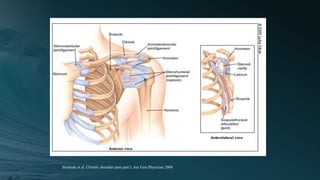
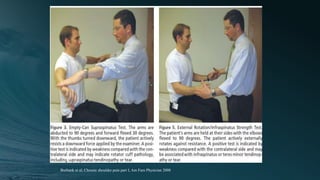
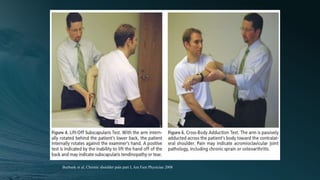
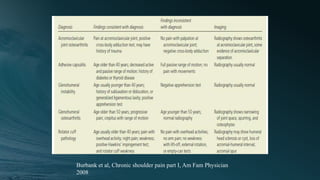
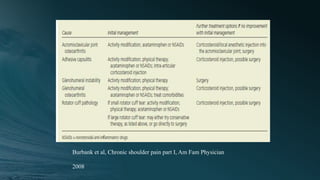
Burbank et al, Chronic shoulder pain part I, Am Fam Physician 2008
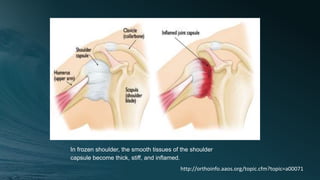
In frozen shoulder, the smooth tissues of the shoulder
capsule become thick, stiff, and inflamed.
http://orthoinfo.aaos.org/topic.cfm?topic=a00071
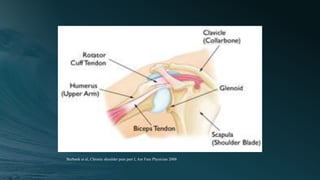
Burbank et al, Chronic shoulder pain part I, Am Fam Physician 2008
See Hand out
Left Shoulder Pain
HPI
• 48 Yom accountant, former swimmer, Shoulder pain x 2 months
• No pain at rest, pain with abducting Left arm
• Achy, non radiating 6-7/10 with movement only, no numbness or
tingling
• Pain over anterior and medial deltoid muscles
• Wakes him at night if arm is too adducted
• Ibuprofen 800 mig bid, not much relief, PT exercises
• Also h/o upper back pain x years, achy non radiating, comes
and goes
Exam
• 110/68, p: 66 rr: 18, AA, O x 3
• L shoulder ROM decreased, abduct to 30-40 º pain is 6/10 with
movement, able to internally externally rotate at lesser degree,
uses accessory muscles when attempting abduction
• Can place L arm behind back but unable to raise it to scapula
• Unable to assess resisted ROM d/t pain
• Shrugs shoulders without pain
neck
• Rom 75º ish bil, flexion/ extension ok, some tension with flexion
chin to chest
• Lateral flexion shoulder to ear no pain
• Few myofascial knots bil splenius capitus C 2-5, levator scapula
tension, large myofascial knot R medial trapezius
• Motor strength: 5/5 bil hand grasp, RUE 5/5 C 5-8, LUE C 5/6
difficult to assess d/t pain
Treatment
• Initially St 38 L and passive ROM with traction able to abduct L
arm 10º more
• Added SI 4, SJ 5 , Lu 6, 7, LI 4 on Left with local trigger points
• GB 20 bil./e SI 13 bil/e, SI 10, 11,12 L, JJ C3 bil, C 5 bil, C 6 bil,
T 1 bil, T 2 bil, T 3 bil,Jianqian L x 30 minutes using micro
current
• Followed by cupping massage
• End of treatment: able abduct L arm to 80 degrees
• Rec: twice a week for two weeks, if responding well, once a
week and re-eval prior/after to each tx for follow up
Freezing
In the "freezing" stage, slowly have more and more pain.
As the pain worsens, shoulder loses range of motion.
Freezing typically lasts from 6 weeks to 9 months.
Frozen
Painful symptoms may actually improve during this stage,
but the stiffness remains. During the 4 to 6 months of the
"frozen" stage, daily activities may be very difficult.
Thawing
Shoulder motion slowly improves during the "thawing"
stage. Complete return to normal or close to normal
strength and motion typically takes from 6 months to 2
years.
http://orthoinfo.aaos.org/topic.cfm?topic=a00071
Examination
• Pain scale 0 – 10/10
• May find tenderness at bicipital groove
• May also have pain in upper back and neck d/t overuse of
shoulder girdle muscles
• At rest may brace affected extremity against body
• Assess alignment of bones and soft tissues
• Assess postural alignment of cervical, thoracic, lumbar and
humeral/scapular position (may find head forward, protracted scapula
and thoracic kyphosis)
Brigham and Women’s Hospital Inc. Dept. of Rehabilitation
Services 2010
Differential Diagnoses
 Biceps Rupture
 Biceps Tendinopathy
 Brachial Neuritis
 Cervical Disc Disease
 Cervical Myofascial Pain
 Cervical Spondyliosis
 Cervical Sprain and Strain
 Complex Regional Pain Syndromes
 Heterotopic Ossification
 Myelomeningocele
 Neoplastic Brachial Plexopathy
 Parkinson Disease
 Psoriatic Arthritis
 Rheumatoid Arthritis
 Rotator Cuff Disease
 Shoulder and Hemiplegia
 Thoracic Outlet Syndrome
 Traumatic Brachial Plexopathy
http://orthoinfo.aaos.org/topic.cfm?topic=a00071
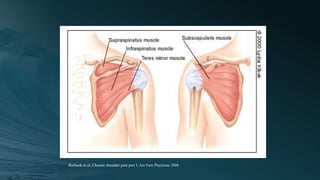
Muscle Origin on scapula Attachment on humerus Function Innervation
Supraspinatus
muscle
supraspinous fossa
superior and middle
facet of the greater
tuberosity
abducts the arm
Suprascapular nerve
(C5)
Infraspinatus
muscle
infraspinous fossa
posterior facet of
the greater tuberosity
externally rotates the
arm
Suprascapular nerve
(C5-C6)
Teres minor muscle
middle half of lateral
border
inferior facet of
the greater tuberosity
externally rotates the
arm
Axillary nerve (C5)
Subscapularis
muscle
subscapular fossa
lesser
tuberosity (60%)
or humeral neck(40%)
internally rotates the
humerus
Upper and Lower
subscapular nerve
(C5-C6)
http://orthoinfo.aaos.org/topic.cfm?topic=a00071
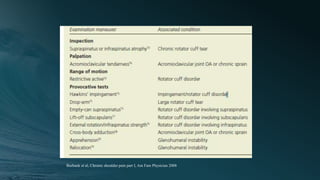
Burbank et al, Chronic shoulder pain part I, Am Fam Physician 2008
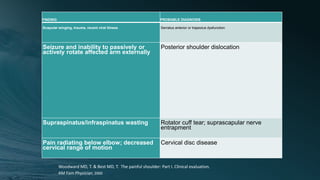
FINDING PROBABLE DIAGNOSIS
Scapular winging, trauma, recent viral illness Serratus anterior or trapezius dysfunction
Seizure and inability to passively or
actively rotate affected arm externally
Posterior shoulder dislocation
Supraspinatus/infraspinatus wasting Rotator cuff tear; suprascapular nerve
entrapment
Pain radiating below elbow; decreased
cervical range of motion
Cervical disc disease
Woodward MD, T. & Best MD, T. The painful shoulder: Part I. Clinical evaluation.
AM Fam Physician, 2000
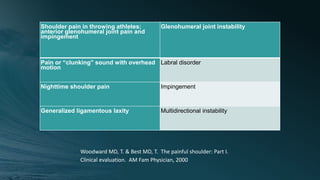
Shoulder pain in throwing athletes;
anterior glenohumeral joint pain and
impingement
Glenohumeral joint instability
Pain or “clunking” sound with overhead
motion
Labral disorder
Nighttime shoulder pain Impingement
Generalized ligamentous laxity Multidirectional instability
Woodward MD, T. & Best MD, T. The painful shoulder: Part I.
Clinical evaluation. AM Fam Physician, 2000
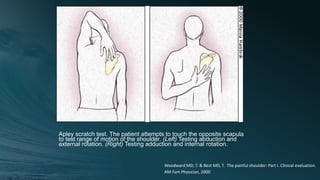
Apley scratch test. The patient attempts to touch the opposite scapula
to test range of motion of the shoulder. (Left) Testing abduction and
external rotation. (Right) Testing adduction and internal rotation.
Woodward MD, T. & Best MD, T. The painful shoulder: Part I. Clinical evaluation.
AM Fam Physician, 2000
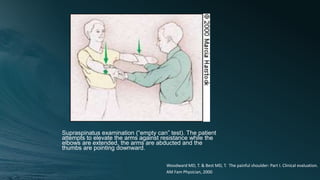
Woodward MD, T. & Best MD, T. The painful shoulder: Part I. Clinical evaluation.
AM Fam Physician, 2000
Supraspinatus examination (“empty can” test). The patient
attempts to elevate the arms against resistance while the
elbows are extended, the arms are abducted and the
thumbs are pointing downward.
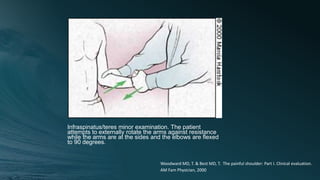
Infraspinatus/teres minor examination. The patient
attempts to externally rotate the arms against resistance
while the arms are at the sides and the elbows are flexed
to 90 degrees.
Woodward MD, T. & Best MD, T. The painful shoulder: Part I. Clinical evaluation.
AM Fam Physician, 2000
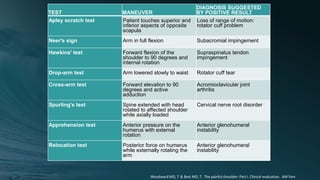
TEST MANEUVER
DIAGNOSIS SUGGESTED
BY POSITIVE RESULT
Apley scratch test Patient touches superior and
inferior aspects of opposite
scapula
Loss of range of motion:
rotator cuff problem
Neer's sign Arm in full flexion Subacromial impingement
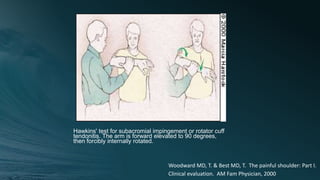
Hawkins' test Forward flexion of the
shoulder to 90 degrees and
internal rotation
Supraspinatus tendon
impingement
Drop-arm test Arm lowered slowly to waist Rotator cuff tear
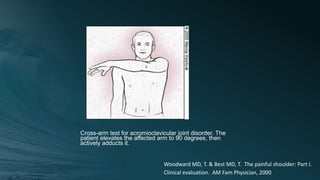
Cross-arm test Forward elevation to 90
degrees and active
adduction
Acromioclavicular joint
arthritis
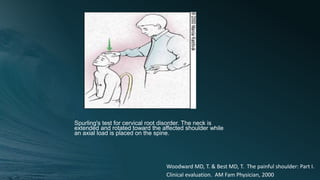
Spurling's test Spine extended with head
rotated to affected shoulder
while axially loaded
Cervical nerve root disorder
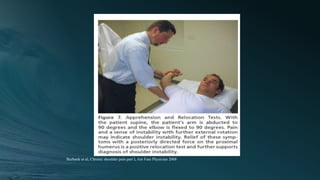
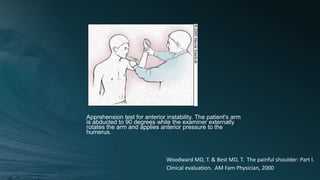
Apprehension test Anterior pressure on the
humerus with external
rotation
Anterior glenohumeral
instability
Relocation test Posterior force on humerus
while externally rotating the
arm
Anterior glenohumeral
instability
Woodward MD, T. & Best MD, T. The painful shoulder: Part I. Clinical evaluation. AM Fam
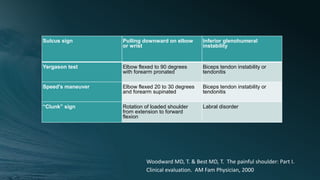
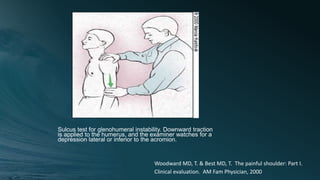
Sulcus sign Pulling downward on elbow
or wrist
Inferior glenohumeral
instability
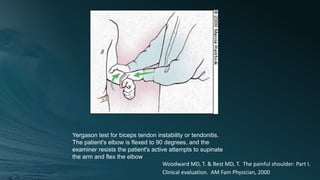
Yergason test Elbow flexed to 90 degrees
with forearm pronated
Biceps tendon instability or
tendonitis
Speed's maneuver Elbow flexed 20 to 30 degrees
and forearm supinated
Biceps tendon instability or
tendonitis
“Clunk” sign Rotation of loaded shoulder
from extension to forward
flexion
Labral disorder
Woodward MD, T. & Best MD, T. The painful shoulder: Part I.
Clinical evaluation. AM Fam Physician, 2000
08
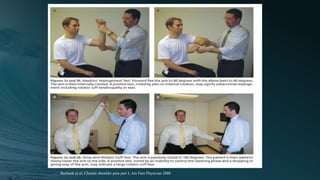
Burbank et al, Chronic shoulder pain part I, Am Fam Physician 2008
Burbank et al, Chronic shoulder pain part I, Am Fam Physician
2008
Hawkins' test for subacromial impingement or rotator cuff
tendonitis. The arm is forward elevated to 90 degrees,
then forcibly internally rotated.
Woodward MD, T. & Best MD, T. The painful shoulder: Part I.
Clinical evaluation. AM Fam Physician, 2000
Cross-arm test for acromioclavicular joint disorder. The
patient elevates the affected arm to 90 degrees, then
actively adducts it.
Woodward MD, T. & Best MD, T. The painful shoulder: Part I.
Clinical evaluation. AM Fam Physician, 2000
Apprehension test for anterior instability. The patient's arm
is abducted to 90 degrees while the examiner externally
rotates the arm and applies anterior pressure to the
humerus.
Woodward MD, T. & Best MD, T. The painful shoulder: Part I.
Clinical evaluation. AM Fam Physician, 2000
Yergason test for biceps tendon instability or tendonitis.
The patient's elbow is flexed to 90 degrees, and the
examiner resists the patient's active attempts to supinate
the arm and flex the elbow
Woodward MD, T. & Best MD, T. The painful shoulder: Part I.
Clinical evaluation. AM Fam Physician, 2000
Sulcus test for glenohumeral instability. Downward traction
is applied to the humerus, and the examiner watches for a
depression lateral or inferior to the acromion.
Woodward MD, T. & Best MD, T. The painful shoulder: Part I.
Clinical evaluation. AM Fam Physician, 2000
Spurling's test for cervical root disorder. The neck is
extended and rotated toward the affected shoulder while
an axial load is placed on the spine.
Woodward MD, T. & Best MD, T. The painful shoulder: Part I.
Clinical evaluation. AM Fam Physician, 2000
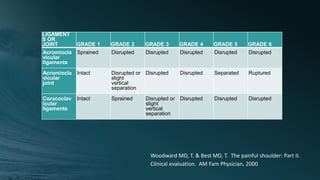
LIGAMENT
S OR
JOINT GRADE 1 GRADE 2 GRADE 3 GRADE 4 GRADE 5 GRADE 6
Acromiocla
vicular
ligaments
Sprained Disrupted Disrupted Disrupted Disrupted Disrupted
Acromiocla
vicular
joint
Intact Disrupted or
slight
vertical
separation
Disrupted Disrupted Separated Ruptured
Coracoclav
icular
ligaments
Intact Sprained Disrupted or
slight
vertical
separation
Disrupted Disrupted Disrupted
Woodward MD, T. & Best MD, T. The painful shoulder: Part II.
Clinical evaluation. AM Fam Physician, 2000
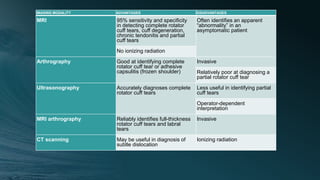
IMAGING MODALITY ADVANTAGES DISADVANTAGES
MRI 95% sensitivity and specificity
in detecting complete rotator
cuff tears, cuff degeneration,
chronic tendonitis and partial
cuff tears
Often identifies an apparent
“abnormality” in an
asymptomatic patient
No ionizing radiation
Arthrography Good at identifying complete
rotator cuff tear or adhesive
capsulitis (frozen shoulder)
Invasive
Relatively poor at diagnosing a
partial rotator cuff tear
Ultrasonography Accurately diagnoses complete
rotator cuff tears
Less useful in identifying partial
cuff tears
Operator-dependent
interpretation
MRI arthrography Reliably identifies full-thickness
rotator cuff tears and labral
tears
Invasive
CT scanning May be useful in diagnosis of
subtle dislocation
Ionizing radiation
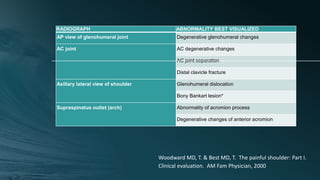
RADIOGRAPH ABNORMALITY BEST VISUALIZED
AP view of glenohumeral joint Degenerative glenohumeral changes
AC joint AC degenerative changes
AC joint separation
Distal clavicle fracture
Axillary lateral view of shoulder Glenohumeral dislocation
Bony Bankart lesion*
Supraspinatus outlet (arch) Abnormality of acromion process
Degenerative changes of anterior acromion
Woodward MD, T. & Best MD, T. The painful shoulder: Part I.
Clinical evaluation. AM Fam Physician, 2000
Burbank et al, Chronic shoulder pain part I, Am Fam Physician
2008
References
Burbank MD, K., Stevenson MD, J, Czarnecki DO, G. &
Dorfman, DO, J. Chronic shoulder pain: Part I. evaluation and
diagnosis. Am Fam Physician. 2008 Feb 15:77(4):453-460.
Burbank MD, K., Stevenson MD, J, Czarnecki DO, G. &
Dorfman, DO, J. Chronic shoulder pain: Part II. Treatment.
Am Fam Physician. 2008 Feb 15:77(4):493-497.
Cheng, I. 2013 Thawing frozen shoulder-A case study and
clinical recommendations for the use of acupuncture in
treatment of adhesive capsulitis. The American Acupuncturist
V62, 25-29.
Deily DC, S. 2013 Class Notes
Hammer, D. 2012. Chinese scalp acupuncture relieves
pain and restores function in complex regional pain syndrome.
Military Medicine, vol. 177, Oct 2012.
He, D., Hostmark, A., Viersted, K., & Medbo, J. 2005.
Acupuncture in Medicine. 23(2):52-61.
Ma, T., Kao, M., Liu, I., Chiu, Y., Chien, C., Ho, T., Chu,
B. and Chang, Y. 2006. A study on the clinical effects of
physical therapy and acupuncture to treat spontaneous frozen
shoulder. The American Journal of Chinese Medicine, Vol. 34,
NO 5, 759-775.
Peilin, S. 2011. The Treatment of Pain with Chinese
Herbs and Acupuncture, Churchill Livingstone, Edinburgh.

Shoulder pain may 2014 ppt

  • 1.
    Shoulder Pain Donna Guthery AOMAGraduate School of Integrative Medicine 2014
  • 2.
    Burbank et al,Chronic shoulder pain part I, Am Fam Physician 2008
  • 3.
    Burbank et al,Chronic shoulder pain part I, Am Fam Physician 2008
  • 4.
    In frozen shoulder,the smooth tissues of the shoulder capsule become thick, stiff, and inflamed. http://orthoinfo.aaos.org/topic.cfm?topic=a00071
  • 5.
    Burbank et al,Chronic shoulder pain part I, Am Fam Physician 2008
  • 6.
    See Hand out LeftShoulder Pain
  • 7.
    HPI • 48 Yomaccountant, former swimmer, Shoulder pain x 2 months • No pain at rest, pain with abducting Left arm • Achy, non radiating 6-7/10 with movement only, no numbness or tingling • Pain over anterior and medial deltoid muscles • Wakes him at night if arm is too adducted • Ibuprofen 800 mig bid, not much relief, PT exercises • Also h/o upper back pain x years, achy non radiating, comes and goes
  • 8.
    Exam • 110/68, p:66 rr: 18, AA, O x 3 • L shoulder ROM decreased, abduct to 30-40 º pain is 6/10 with movement, able to internally externally rotate at lesser degree, uses accessory muscles when attempting abduction • Can place L arm behind back but unable to raise it to scapula • Unable to assess resisted ROM d/t pain • Shrugs shoulders without pain
  • 9.
    neck • Rom 75ºish bil, flexion/ extension ok, some tension with flexion chin to chest • Lateral flexion shoulder to ear no pain • Few myofascial knots bil splenius capitus C 2-5, levator scapula tension, large myofascial knot R medial trapezius • Motor strength: 5/5 bil hand grasp, RUE 5/5 C 5-8, LUE C 5/6 difficult to assess d/t pain
  • 10.
    Treatment • Initially St38 L and passive ROM with traction able to abduct L arm 10º more • Added SI 4, SJ 5 , Lu 6, 7, LI 4 on Left with local trigger points • GB 20 bil./e SI 13 bil/e, SI 10, 11,12 L, JJ C3 bil, C 5 bil, C 6 bil, T 1 bil, T 2 bil, T 3 bil,Jianqian L x 30 minutes using micro current • Followed by cupping massage • End of treatment: able abduct L arm to 80 degrees • Rec: twice a week for two weeks, if responding well, once a week and re-eval prior/after to each tx for follow up
  • 11.
    Freezing In the "freezing"stage, slowly have more and more pain. As the pain worsens, shoulder loses range of motion. Freezing typically lasts from 6 weeks to 9 months. Frozen Painful symptoms may actually improve during this stage, but the stiffness remains. During the 4 to 6 months of the "frozen" stage, daily activities may be very difficult. Thawing Shoulder motion slowly improves during the "thawing" stage. Complete return to normal or close to normal strength and motion typically takes from 6 months to 2 years. http://orthoinfo.aaos.org/topic.cfm?topic=a00071
  • 12.
    Examination • Pain scale0 – 10/10 • May find tenderness at bicipital groove • May also have pain in upper back and neck d/t overuse of shoulder girdle muscles • At rest may brace affected extremity against body • Assess alignment of bones and soft tissues • Assess postural alignment of cervical, thoracic, lumbar and humeral/scapular position (may find head forward, protracted scapula and thoracic kyphosis) Brigham and Women’s Hospital Inc. Dept. of Rehabilitation Services 2010
  • 13.
    Differential Diagnoses  BicepsRupture  Biceps Tendinopathy  Brachial Neuritis  Cervical Disc Disease  Cervical Myofascial Pain  Cervical Spondyliosis  Cervical Sprain and Strain  Complex Regional Pain Syndromes  Heterotopic Ossification  Myelomeningocele  Neoplastic Brachial Plexopathy  Parkinson Disease  Psoriatic Arthritis  Rheumatoid Arthritis  Rotator Cuff Disease  Shoulder and Hemiplegia  Thoracic Outlet Syndrome  Traumatic Brachial Plexopathy http://orthoinfo.aaos.org/topic.cfm?topic=a00071
  • 14.
    Muscle Origin onscapula Attachment on humerus Function Innervation Supraspinatus muscle supraspinous fossa superior and middle facet of the greater tuberosity abducts the arm Suprascapular nerve (C5) Infraspinatus muscle infraspinous fossa posterior facet of the greater tuberosity externally rotates the arm Suprascapular nerve (C5-C6) Teres minor muscle middle half of lateral border inferior facet of the greater tuberosity externally rotates the arm Axillary nerve (C5) Subscapularis muscle subscapular fossa lesser tuberosity (60%) or humeral neck(40%) internally rotates the humerus Upper and Lower subscapular nerve (C5-C6) http://orthoinfo.aaos.org/topic.cfm?topic=a00071
  • 15.
    Burbank et al,Chronic shoulder pain part I, Am Fam Physician 2008
  • 16.
    Burbank et al,Chronic shoulder pain part I, Am Fam Physician 2008
  • 17.
    FINDING PROBABLE DIAGNOSIS Scapularwinging, trauma, recent viral illness Serratus anterior or trapezius dysfunction Seizure and inability to passively or actively rotate affected arm externally Posterior shoulder dislocation Supraspinatus/infraspinatus wasting Rotator cuff tear; suprascapular nerve entrapment Pain radiating below elbow; decreased cervical range of motion Cervical disc disease Woodward MD, T. & Best MD, T. The painful shoulder: Part I. Clinical evaluation. AM Fam Physician, 2000
  • 18.
    Shoulder pain inthrowing athletes; anterior glenohumeral joint pain and impingement Glenohumeral joint instability Pain or “clunking” sound with overhead motion Labral disorder Nighttime shoulder pain Impingement Generalized ligamentous laxity Multidirectional instability Woodward MD, T. & Best MD, T. The painful shoulder: Part I. Clinical evaluation. AM Fam Physician, 2000
  • 19.
    Apley scratch test.The patient attempts to touch the opposite scapula to test range of motion of the shoulder. (Left) Testing abduction and external rotation. (Right) Testing adduction and internal rotation. Woodward MD, T. & Best MD, T. The painful shoulder: Part I. Clinical evaluation. AM Fam Physician, 2000
  • 20.
    Woodward MD, T.& Best MD, T. The painful shoulder: Part I. Clinical evaluation. AM Fam Physician, 2000 Supraspinatus examination (“empty can” test). The patient attempts to elevate the arms against resistance while the elbows are extended, the arms are abducted and the thumbs are pointing downward.
  • 21.
    Infraspinatus/teres minor examination.The patient attempts to externally rotate the arms against resistance while the arms are at the sides and the elbows are flexed to 90 degrees. Woodward MD, T. & Best MD, T. The painful shoulder: Part I. Clinical evaluation. AM Fam Physician, 2000
  • 22.
    TEST MANEUVER DIAGNOSIS SUGGESTED BYPOSITIVE RESULT Apley scratch test Patient touches superior and inferior aspects of opposite scapula Loss of range of motion: rotator cuff problem Neer's sign Arm in full flexion Subacromial impingement Hawkins' test Forward flexion of the shoulder to 90 degrees and internal rotation Supraspinatus tendon impingement Drop-arm test Arm lowered slowly to waist Rotator cuff tear Cross-arm test Forward elevation to 90 degrees and active adduction Acromioclavicular joint arthritis Spurling's test Spine extended with head rotated to affected shoulder while axially loaded Cervical nerve root disorder Apprehension test Anterior pressure on the humerus with external rotation Anterior glenohumeral instability Relocation test Posterior force on humerus while externally rotating the arm Anterior glenohumeral instability Woodward MD, T. & Best MD, T. The painful shoulder: Part I. Clinical evaluation. AM Fam
  • 23.
    Sulcus sign Pullingdownward on elbow or wrist Inferior glenohumeral instability Yergason test Elbow flexed to 90 degrees with forearm pronated Biceps tendon instability or tendonitis Speed's maneuver Elbow flexed 20 to 30 degrees and forearm supinated Biceps tendon instability or tendonitis “Clunk” sign Rotation of loaded shoulder from extension to forward flexion Labral disorder Woodward MD, T. & Best MD, T. The painful shoulder: Part I. Clinical evaluation. AM Fam Physician, 2000
  • 24.
    08 Burbank et al,Chronic shoulder pain part I, Am Fam Physician 2008
  • 25.
    Burbank et al,Chronic shoulder pain part I, Am Fam Physician 2008
  • 26.
    Burbank et al,Chronic shoulder pain part I, Am Fam Physician 2008
  • 27.
    Burbank et al,Chronic shoulder pain part I, Am Fam Physician 2008
  • 28.
    Hawkins' test forsubacromial impingement or rotator cuff tendonitis. The arm is forward elevated to 90 degrees, then forcibly internally rotated. Woodward MD, T. & Best MD, T. The painful shoulder: Part I. Clinical evaluation. AM Fam Physician, 2000
  • 29.
    Cross-arm test foracromioclavicular joint disorder. The patient elevates the affected arm to 90 degrees, then actively adducts it. Woodward MD, T. & Best MD, T. The painful shoulder: Part I. Clinical evaluation. AM Fam Physician, 2000
  • 30.
    Apprehension test foranterior instability. The patient's arm is abducted to 90 degrees while the examiner externally rotates the arm and applies anterior pressure to the humerus. Woodward MD, T. & Best MD, T. The painful shoulder: Part I. Clinical evaluation. AM Fam Physician, 2000
  • 31.
    Yergason test forbiceps tendon instability or tendonitis. The patient's elbow is flexed to 90 degrees, and the examiner resists the patient's active attempts to supinate the arm and flex the elbow Woodward MD, T. & Best MD, T. The painful shoulder: Part I. Clinical evaluation. AM Fam Physician, 2000
  • 32.
    Sulcus test forglenohumeral instability. Downward traction is applied to the humerus, and the examiner watches for a depression lateral or inferior to the acromion. Woodward MD, T. & Best MD, T. The painful shoulder: Part I. Clinical evaluation. AM Fam Physician, 2000
  • 33.
    Spurling's test forcervical root disorder. The neck is extended and rotated toward the affected shoulder while an axial load is placed on the spine. Woodward MD, T. & Best MD, T. The painful shoulder: Part I. Clinical evaluation. AM Fam Physician, 2000
  • 34.
    LIGAMENT S OR JOINT GRADE1 GRADE 2 GRADE 3 GRADE 4 GRADE 5 GRADE 6 Acromiocla vicular ligaments Sprained Disrupted Disrupted Disrupted Disrupted Disrupted Acromiocla vicular joint Intact Disrupted or slight vertical separation Disrupted Disrupted Separated Ruptured Coracoclav icular ligaments Intact Sprained Disrupted or slight vertical separation Disrupted Disrupted Disrupted Woodward MD, T. & Best MD, T. The painful shoulder: Part II. Clinical evaluation. AM Fam Physician, 2000
  • 35.
    IMAGING MODALITY ADVANTAGESDISADVANTAGES MRI 95% sensitivity and specificity in detecting complete rotator cuff tears, cuff degeneration, chronic tendonitis and partial cuff tears Often identifies an apparent “abnormality” in an asymptomatic patient No ionizing radiation Arthrography Good at identifying complete rotator cuff tear or adhesive capsulitis (frozen shoulder) Invasive Relatively poor at diagnosing a partial rotator cuff tear Ultrasonography Accurately diagnoses complete rotator cuff tears Less useful in identifying partial cuff tears Operator-dependent interpretation MRI arthrography Reliably identifies full-thickness rotator cuff tears and labral tears Invasive CT scanning May be useful in diagnosis of subtle dislocation Ionizing radiation
  • 36.
    RADIOGRAPH ABNORMALITY BESTVISUALIZED AP view of glenohumeral joint Degenerative glenohumeral changes AC joint AC degenerative changes AC joint separation Distal clavicle fracture Axillary lateral view of shoulder Glenohumeral dislocation Bony Bankart lesion* Supraspinatus outlet (arch) Abnormality of acromion process Degenerative changes of anterior acromion Woodward MD, T. & Best MD, T. The painful shoulder: Part I. Clinical evaluation. AM Fam Physician, 2000
  • 37.
    Burbank et al,Chronic shoulder pain part I, Am Fam Physician 2008
  • 38.
    References Burbank MD, K.,Stevenson MD, J, Czarnecki DO, G. & Dorfman, DO, J. Chronic shoulder pain: Part I. evaluation and diagnosis. Am Fam Physician. 2008 Feb 15:77(4):453-460. Burbank MD, K., Stevenson MD, J, Czarnecki DO, G. & Dorfman, DO, J. Chronic shoulder pain: Part II. Treatment. Am Fam Physician. 2008 Feb 15:77(4):493-497. Cheng, I. 2013 Thawing frozen shoulder-A case study and clinical recommendations for the use of acupuncture in treatment of adhesive capsulitis. The American Acupuncturist V62, 25-29.
  • 39.
    Deily DC, S.2013 Class Notes Hammer, D. 2012. Chinese scalp acupuncture relieves pain and restores function in complex regional pain syndrome. Military Medicine, vol. 177, Oct 2012. He, D., Hostmark, A., Viersted, K., & Medbo, J. 2005. Acupuncture in Medicine. 23(2):52-61. Ma, T., Kao, M., Liu, I., Chiu, Y., Chien, C., Ho, T., Chu, B. and Chang, Y. 2006. A study on the clinical effects of physical therapy and acupuncture to treat spontaneous frozen shoulder. The American Journal of Chinese Medicine, Vol. 34, NO 5, 759-775. Peilin, S. 2011. The Treatment of Pain with Chinese Herbs and Acupuncture, Churchill Livingstone, Edinburgh.