Unit 1 Lesson 1 What Is Science?
Copyright © Houghton Mifflin Harcourt Publishing Company
Unit 1 Lesson 1 What Is Science?
What All Scientists Do
Copyright © Houghton Mifflin Harcourt Publishing Company
• Science is the study of the natural world through
careful observation and investigation. There are
many branches of science.
• Scientists use investigations to try to explain how
and why things in the natural world happen.
• Investigations are procedures carried out to
observe, study, or test something.
Unit 1 Lesson 1 What Is Science?
What All Scientists Do
Copyright © Houghton Mifflin Harcourt Publishing Company
• All scientists observe by using their five senses to
collect information.
• All scientists compare by finding ways objects
and events are similar and different.
• Scientists must think critically about the results of
their investigations to learn more about the
natural world.
Unit 1 Lesson 1 What Is Science?
Prove It!
Copyright © Houghton Mifflin Harcourt Publishing Company
• Scientists collect evidence, or information, to
explain observations during a scientific
investigation.
• Evidence can be direct. A fossil of a dinosaur skull
is direct evidence that dinosaurs once lived.
• Evidence can be indirect. A fossil of a dinosaur
footprint is indirect evidence of dinosaurs.
Unit 1 Lesson 1 What Is Science?
Prove It!
Copyright © Houghton Mifflin Harcourt Publishing Company
• Here is an example of a scientist collecting
evidence:
• In the 1660s, a scientist named Dr. Francesco
Redi designed an experiment on maggots.
• At that time, most people thought maggots grew
out of rotting meat.
Unit 1 Lesson 1 What Is Science?
Prove It!
Copyright © Houghton Mifflin Harcourt Publishing Company
• Redi put fresh meat in two jars. He covered one
jar with cloth and left the other jar uncovered.
Unit 1 Lesson 1 What Is Science?
Prove It!
Copyright © Houghton Mifflin Harcourt Publishing Company
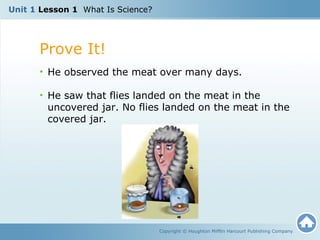
• He observed the meat over many days.
• He saw that flies landed on the meat in the
uncovered jar. No flies landed on the meat in the
covered jar.
Unit 1 Lesson 1 What Is Science?
Prove It!
Copyright © Houghton Mifflin Harcourt Publishing Company
• Soon, there were maggots on the meat in the
uncovered jar. There were no maggots on the
meat in the covered jar.
Unit 1 Lesson 1 What Is Science?
Prove It!
Copyright © Houghton Mifflin Harcourt Publishing Company
• Redi repeated the experiment many times.
• Each time, he observed the same thing: Maggots
grew on meat that flies landed on, but no maggots
appeared on meat with no flies.
• He concluded that maggots come from eggs that
flies lay.
Unit 1 Lesson 1 What Is Science?
Prove It!
Copyright © Houghton Mifflin Harcourt Publishing Company
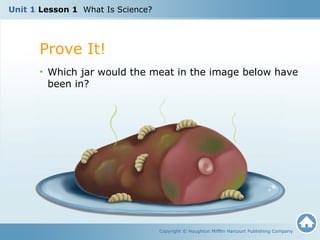
• Which jar would the meat in the image below have
been in?
A Sticky Trap
Copyright © Houghton Mifflin Harcourt Publishing Company
How to Draw Conclusions
• Scientists repeat investigations over and over to
draw conclusions. The conclusions are always
based on evidence.
• A scientist uses inferences to draw conclusions
based on evidence.
• Scientists do not use feelings or opinions to draw
conclusions.
Unit 1 Lesson 1 What Is Science?
Opinion or Evidence?
• Opinions are beliefs or judgments. Scientists do
not use opinions to draw conclusions.
• Personal feelings and opinions should not affect
how you do investigations or your conclusions.
• You should not ignore evidence, even if you do not
like what it means.
Copyright © Houghton Mifflin Harcourt Publishing Company
Unit 1 Lesson 1 What Is Science?
Knowledge Grows
Copyright © Houghton Mifflin Harcourt Publishing Company
• Scientists communicate, or share, the results of
investigations.
• Other scientists can repeat the investigations and
compare the results.
• Scientific knowledge grows as scientists expand on
one another’s ideas.
Unit 1 Lesson 1 What Is Science?
Meet Scientists
Copyright © Houghton Mifflin Harcourt Publishing Company
• Many people work as many different types of
scientists.
• Astronomers: study how the universe works, using
time and space relationships to investigate it
• Botanists: investigate questions about plants, such as
how environmental conditions impact the plant cycle
• Taxonomists: identify and classify living things into
categories based on specific characteristics
Unit 1 Lesson 1 What Is Science?
Meet Scientists
Copyright © Houghton Mifflin Harcourt Publishing Company
• Scientists may need to place objects or events in
order. They may also need to classify objects or
events based on specific characteristics.
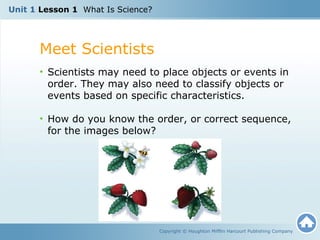
• How do you know the order, or correct sequence,
for the images below?

Unit 1 lesson 1 What is Science

  • 1.
    Unit 1 Lesson1 What Is Science? Copyright © Houghton Mifflin Harcourt Publishing Company
  • 2.
    Unit 1 Lesson1 What Is Science? What All Scientists Do Copyright © Houghton Mifflin Harcourt Publishing Company • Science is the study of the natural world through careful observation and investigation. There are many branches of science. • Scientists use investigations to try to explain how and why things in the natural world happen. • Investigations are procedures carried out to observe, study, or test something.
  • 3.
    Unit 1 Lesson1 What Is Science? What All Scientists Do Copyright © Houghton Mifflin Harcourt Publishing Company • All scientists observe by using their five senses to collect information. • All scientists compare by finding ways objects and events are similar and different. • Scientists must think critically about the results of their investigations to learn more about the natural world.
  • 4.
    Unit 1 Lesson1 What Is Science? Prove It! Copyright © Houghton Mifflin Harcourt Publishing Company • Scientists collect evidence, or information, to explain observations during a scientific investigation. • Evidence can be direct. A fossil of a dinosaur skull is direct evidence that dinosaurs once lived. • Evidence can be indirect. A fossil of a dinosaur footprint is indirect evidence of dinosaurs.
  • 5.
    Unit 1 Lesson1 What Is Science? Prove It! Copyright © Houghton Mifflin Harcourt Publishing Company • Here is an example of a scientist collecting evidence: • In the 1660s, a scientist named Dr. Francesco Redi designed an experiment on maggots. • At that time, most people thought maggots grew out of rotting meat.
  • 6.
    Unit 1 Lesson1 What Is Science? Prove It! Copyright © Houghton Mifflin Harcourt Publishing Company • Redi put fresh meat in two jars. He covered one jar with cloth and left the other jar uncovered.
  • 7.
    Unit 1 Lesson1 What Is Science? Prove It! Copyright © Houghton Mifflin Harcourt Publishing Company • He observed the meat over many days. • He saw that flies landed on the meat in the uncovered jar. No flies landed on the meat in the covered jar.
  • 8.
    Unit 1 Lesson1 What Is Science? Prove It! Copyright © Houghton Mifflin Harcourt Publishing Company • Soon, there were maggots on the meat in the uncovered jar. There were no maggots on the meat in the covered jar.
  • 9.
    Unit 1 Lesson1 What Is Science? Prove It! Copyright © Houghton Mifflin Harcourt Publishing Company • Redi repeated the experiment many times. • Each time, he observed the same thing: Maggots grew on meat that flies landed on, but no maggots appeared on meat with no flies. • He concluded that maggots come from eggs that flies lay.
  • 10.
    Unit 1 Lesson1 What Is Science? Prove It! Copyright © Houghton Mifflin Harcourt Publishing Company • Which jar would the meat in the image below have been in?
  • 11.
    A Sticky Trap Copyright© Houghton Mifflin Harcourt Publishing Company How to Draw Conclusions • Scientists repeat investigations over and over to draw conclusions. The conclusions are always based on evidence. • A scientist uses inferences to draw conclusions based on evidence. • Scientists do not use feelings or opinions to draw conclusions. Unit 1 Lesson 1 What Is Science?
  • 12.
    Opinion or Evidence? •Opinions are beliefs or judgments. Scientists do not use opinions to draw conclusions. • Personal feelings and opinions should not affect how you do investigations or your conclusions. • You should not ignore evidence, even if you do not like what it means. Copyright © Houghton Mifflin Harcourt Publishing Company Unit 1 Lesson 1 What Is Science?
  • 13.
    Unit 1 Lesson1 What Is Science? Knowledge Grows Copyright © Houghton Mifflin Harcourt Publishing Company • Scientists communicate, or share, the results of investigations. • Other scientists can repeat the investigations and compare the results. • Scientific knowledge grows as scientists expand on one another’s ideas.
  • 14.
    Unit 1 Lesson1 What Is Science? Meet Scientists Copyright © Houghton Mifflin Harcourt Publishing Company • Many people work as many different types of scientists. • Astronomers: study how the universe works, using time and space relationships to investigate it • Botanists: investigate questions about plants, such as how environmental conditions impact the plant cycle • Taxonomists: identify and classify living things into categories based on specific characteristics
  • 15.
    Unit 1 Lesson1 What Is Science? Meet Scientists Copyright © Houghton Mifflin Harcourt Publishing Company • Scientists may need to place objects or events in order. They may also need to classify objects or events based on specific characteristics. • How do you know the order, or correct sequence, for the images below?