SCIENCE
Definition of Science A way of exploring and explaining the natural world Using a  process  designed to reduce the chance of being misled
Scientific disciplines Branches of scientific knowledge that are limited in size and scope to make them more manageable. In reality, all branches of scientific knowledge are inter-related and dependent on each other Can you name some scientific disciplines?
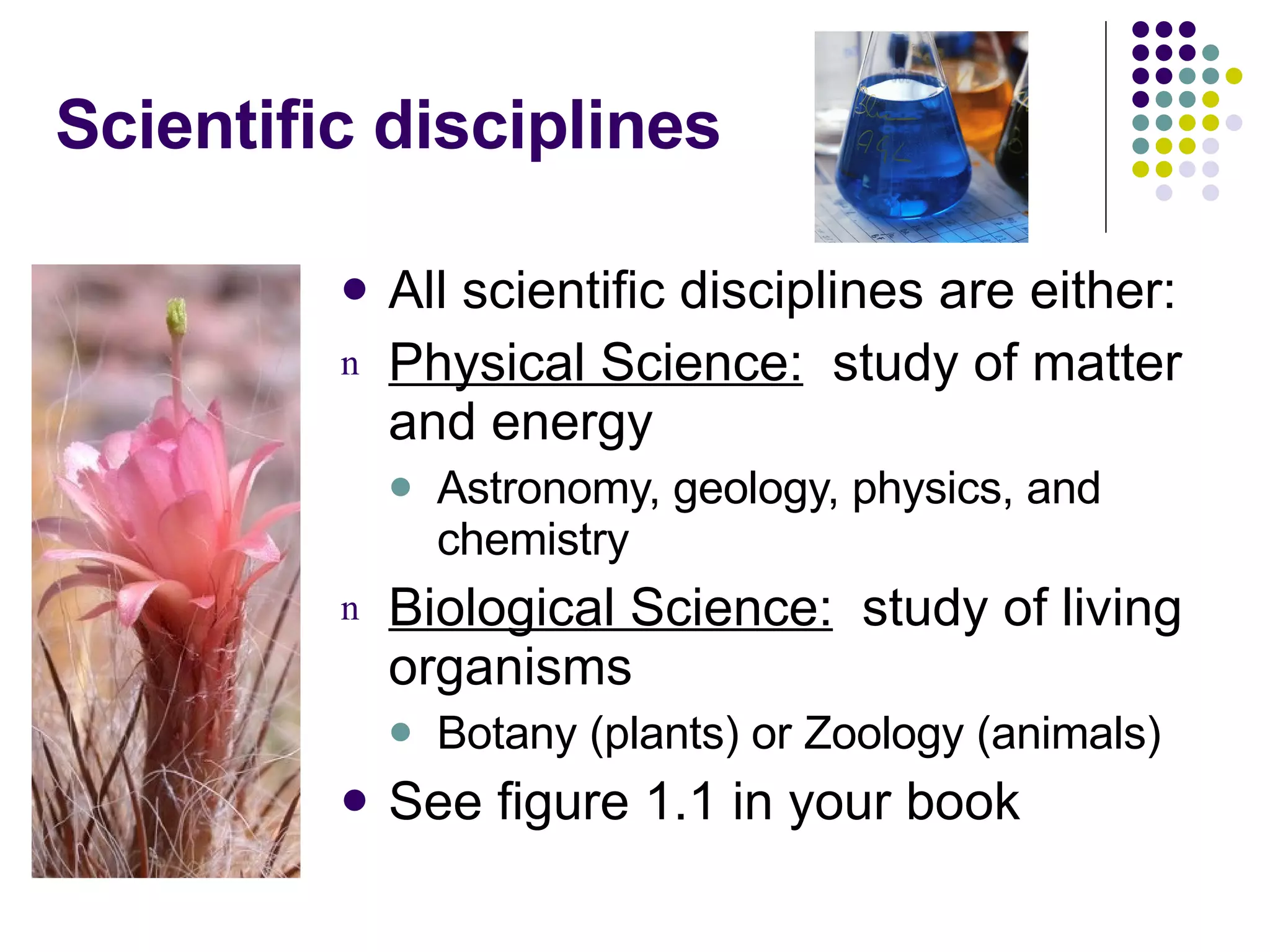
Scientific disciplines All scientific disciplines are either: Physical Science:   study of matter and energy Astronomy, geology, physics, and chemistry Biological Science:   study of living organisms Botany (plants) or Zoology (animals) See figure 1.1 in your book
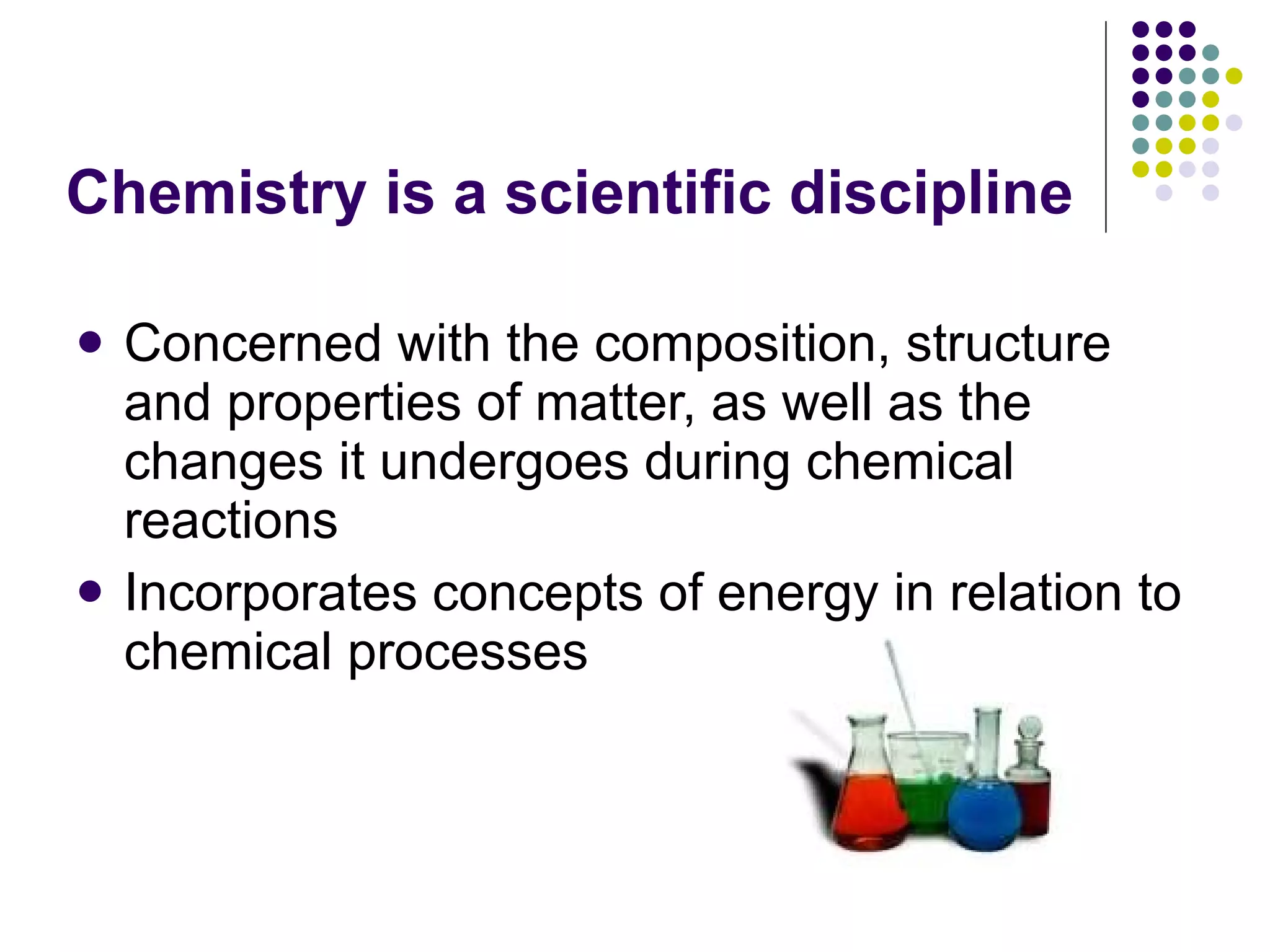
Chemistry is a scientific discipline Concerned with the composition, structure and properties of matter, as well as the changes it undergoes during chemical reactions Incorporates concepts of energy in relation to chemical processes
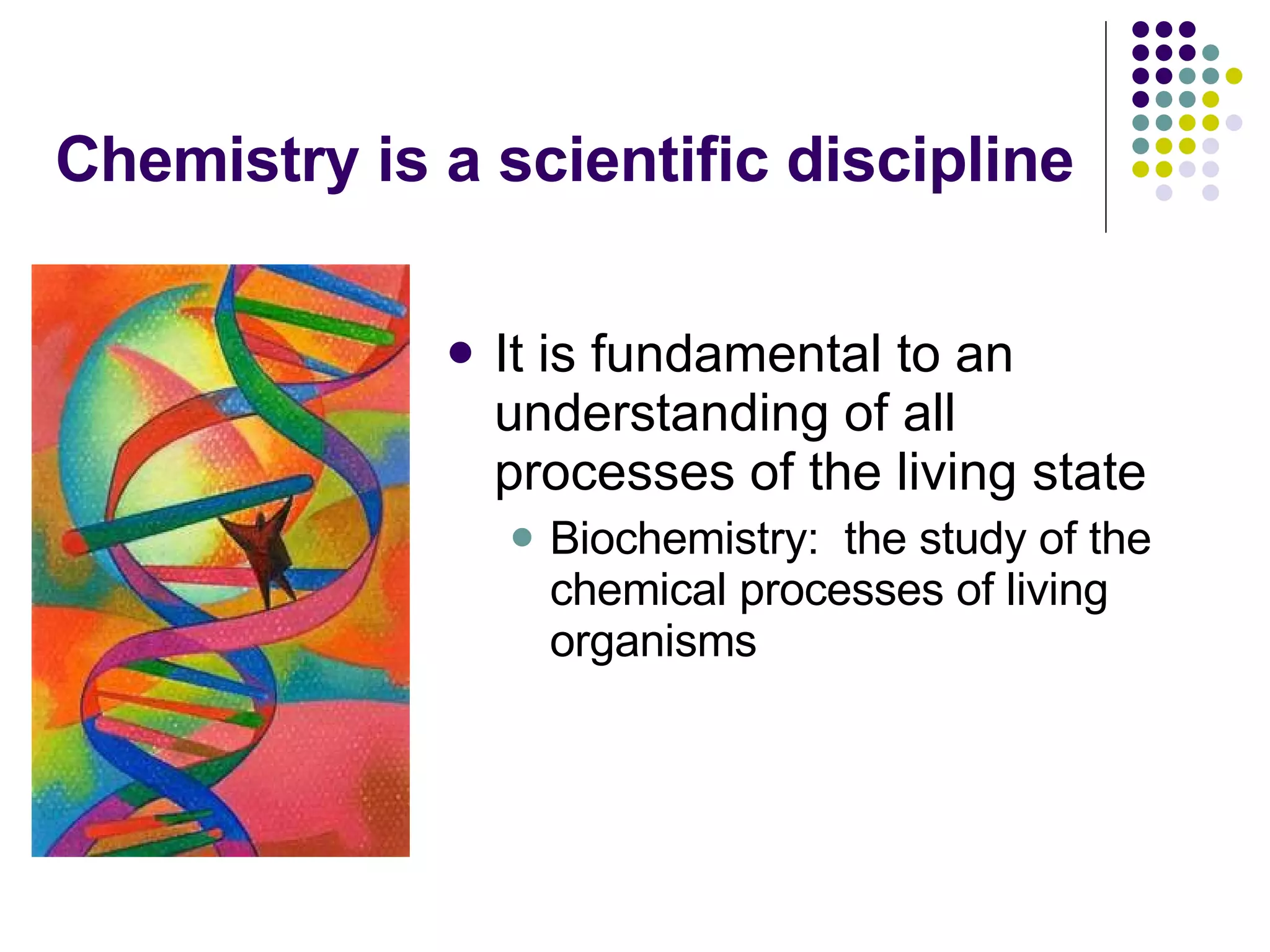
Chemistry is a scientific discipline It is fundamental to an understanding of all processes of the living state Biochemistry:  the study of the chemical processes of living organisms
Chemistry is a scientific discipline Chemical processes produce the products needed for our clothes, housing, transportation, medications and recreational pursuits
Scientific disciplines The knowledge in separate scientific disciplines combined create the whole of scientific knowledge currently known. For example, knowledge of how the human body works requires knowledge in the areas of biology, chemistry, and physics. Can you think of some examples?
SCIENTIFIC METHOD: PART I : The process of science!!
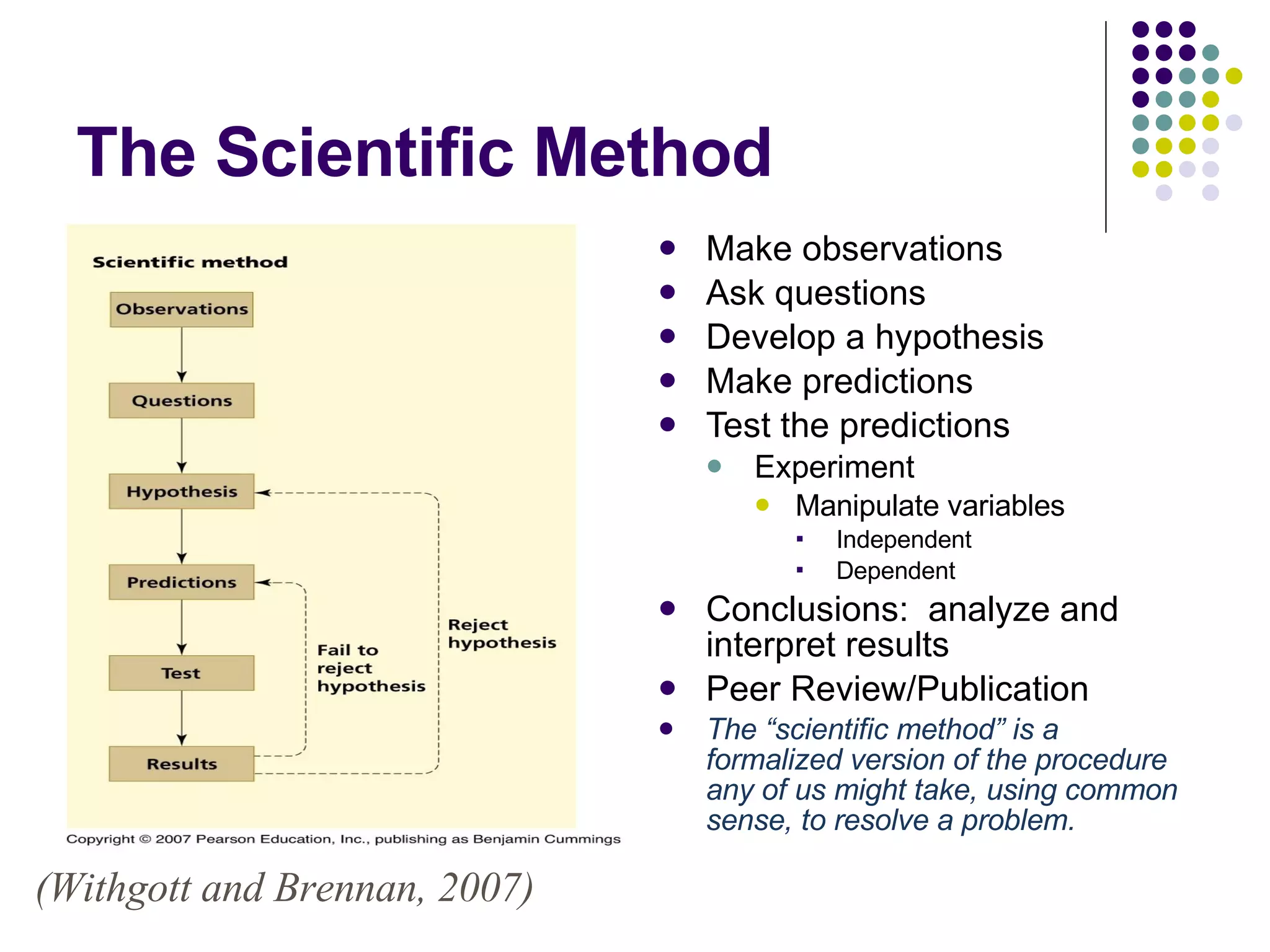
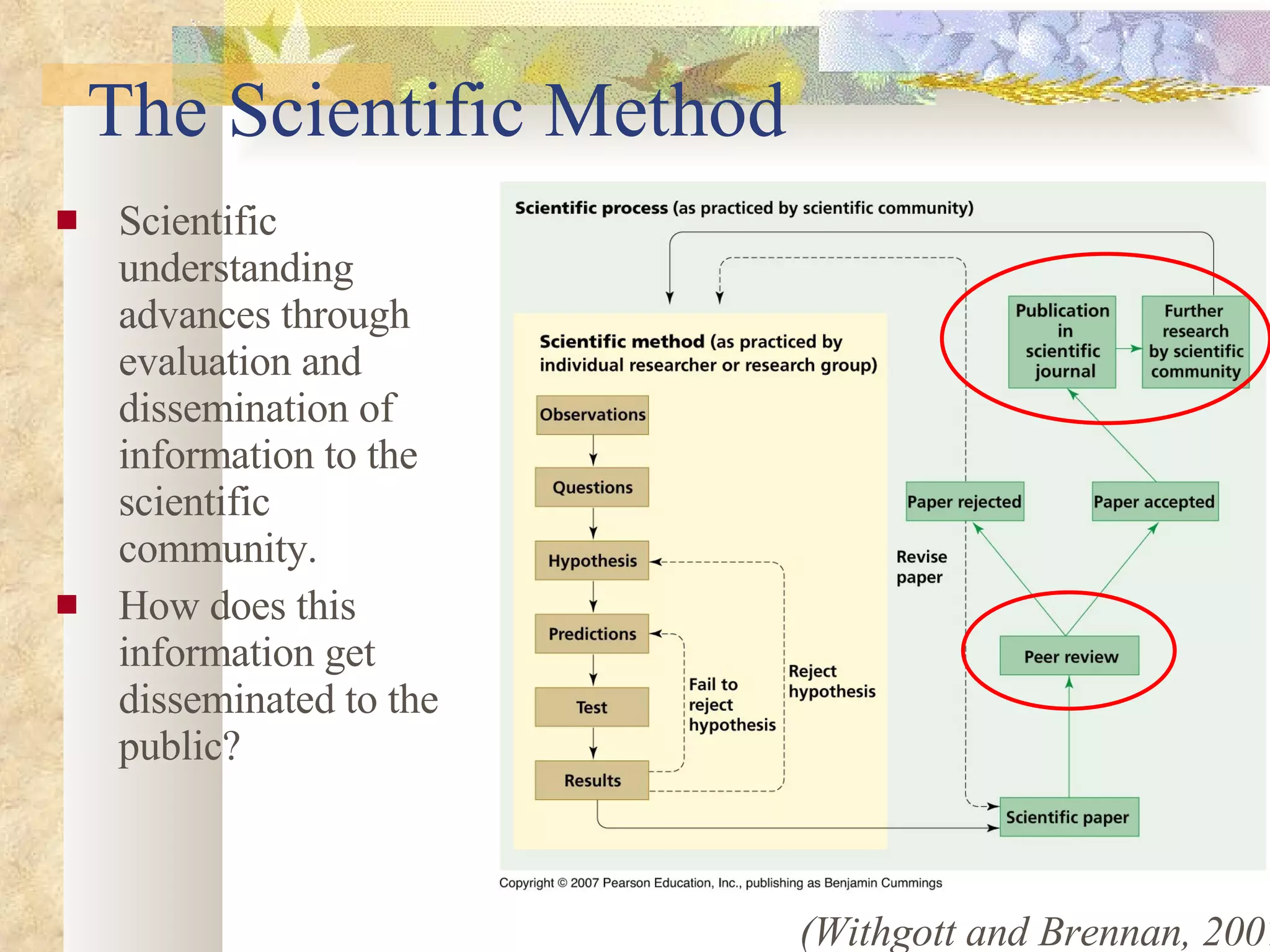
The Scientific Method Make observations Ask questions Develop a hypothesis Make predictions Test the predictions Experiment Manipulate variables Independent Dependent Conclusions:  analyze and interpret results Peer Review/Publication The “scientific method” is a formalized version of the procedure any of us might take, using common sense, to resolve a problem. (Withgott and Brennan, 2007)
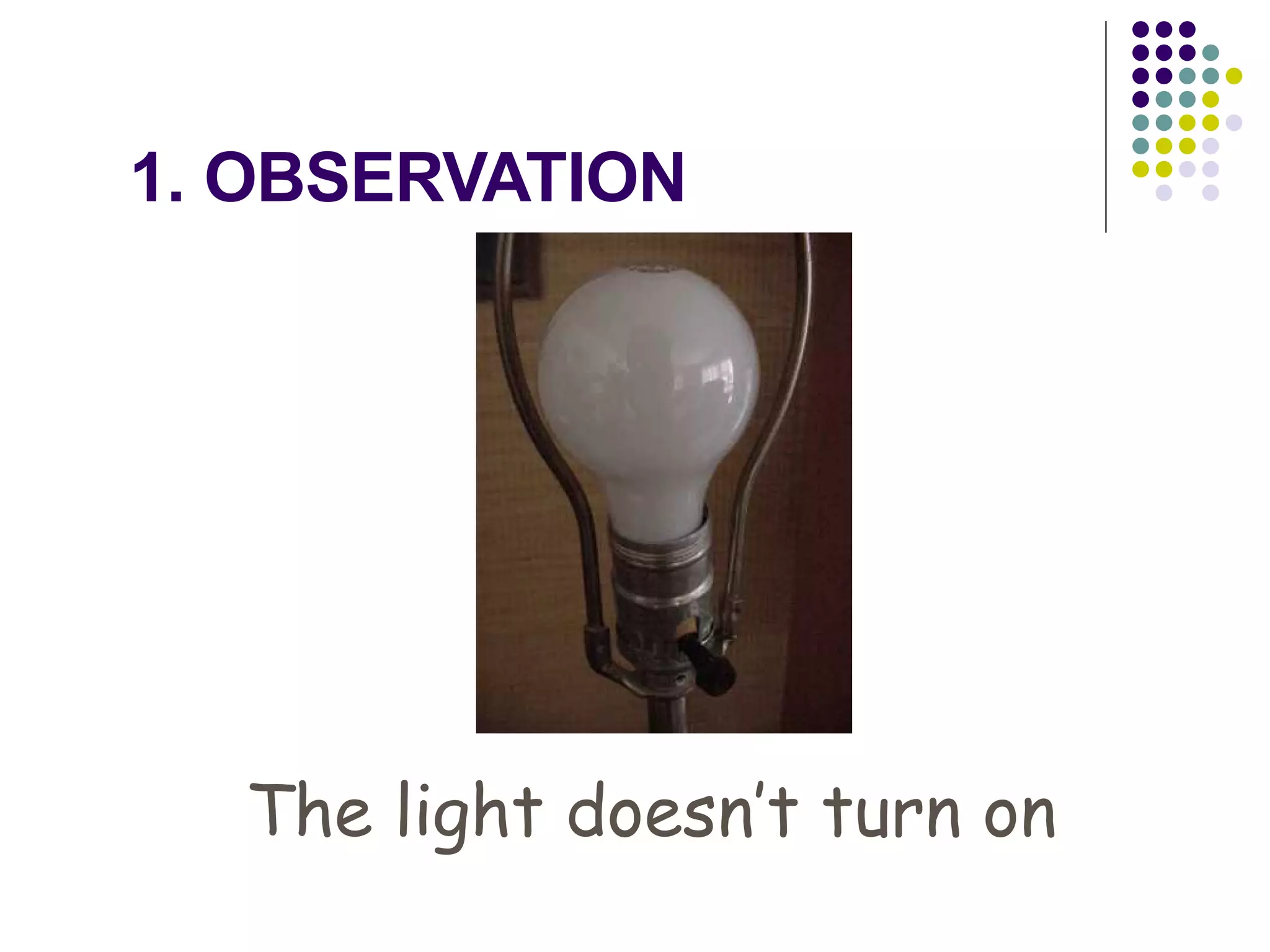
1. OBSERVATION The light doesn’t turn on
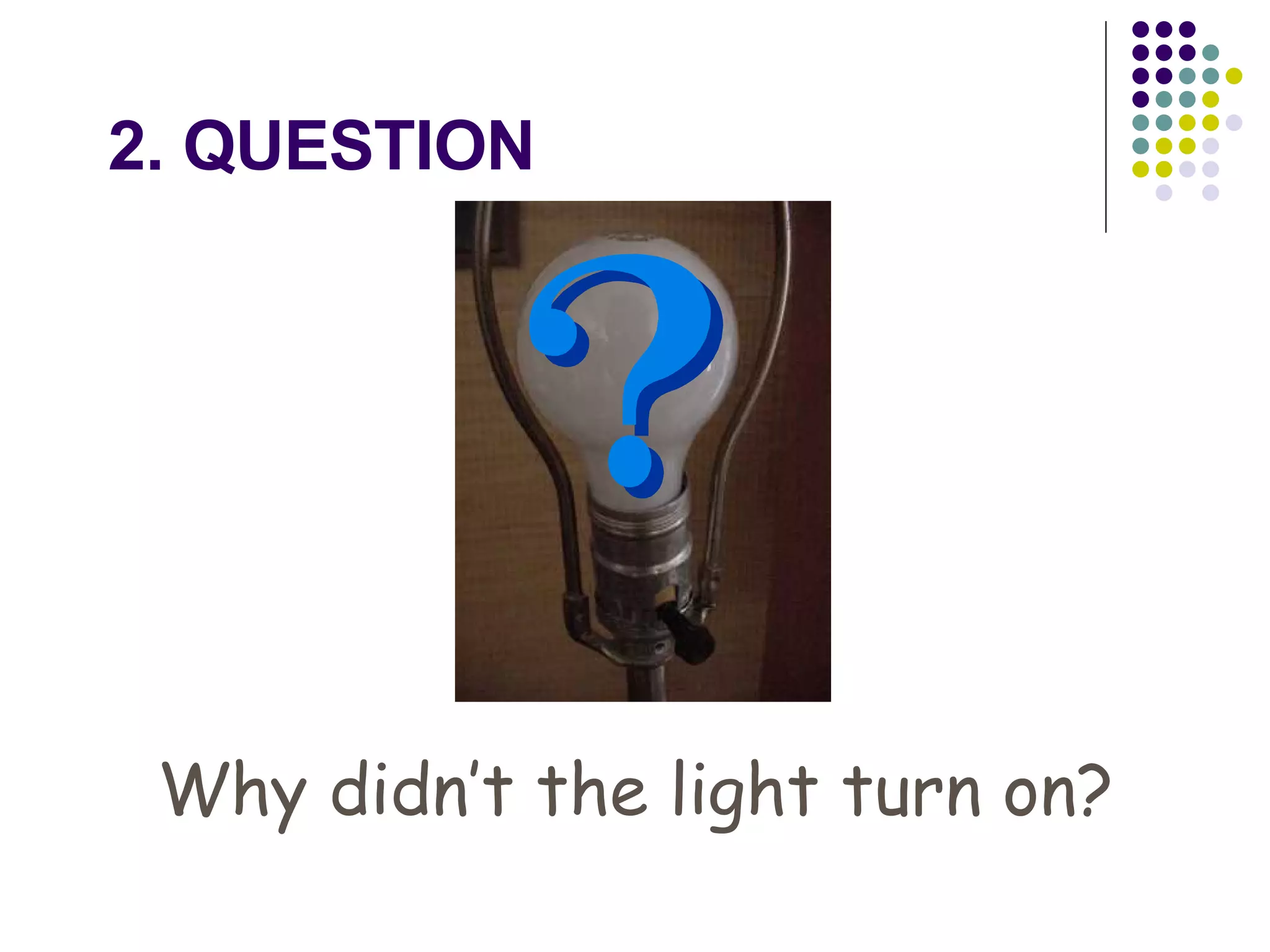
2. QUESTION Why didn’t the light turn on?
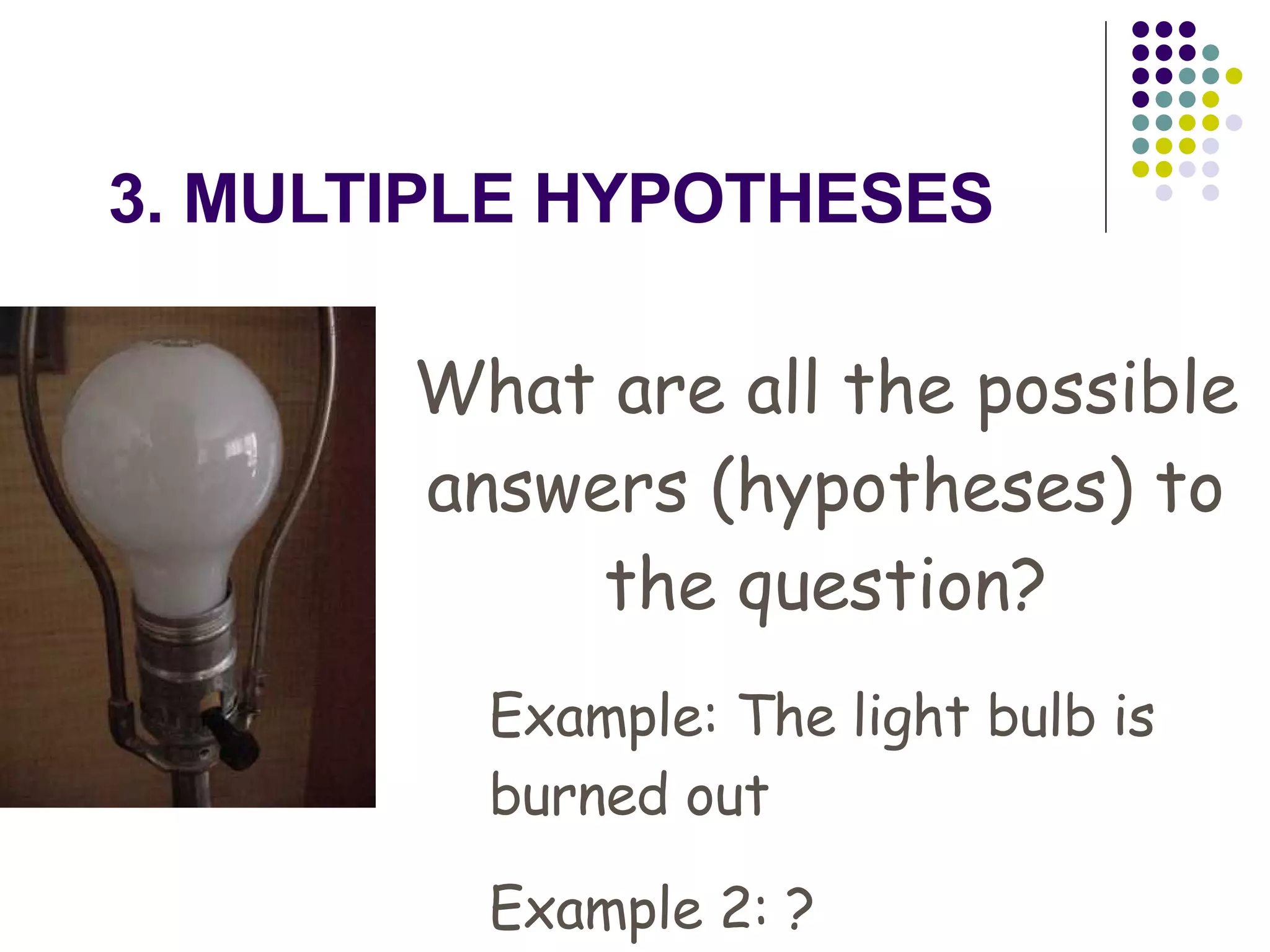
3. MULTIPLE HYPOTHESES What are all the possible answers (hypotheses) to the question? Example: The light bulb is burned out Example 2: ?
4. PREDICTIONS What data would support a particular hypothesis (= expected data) and/or what data would refute the hypothesis? Example: The light bulb will rattle when shaken
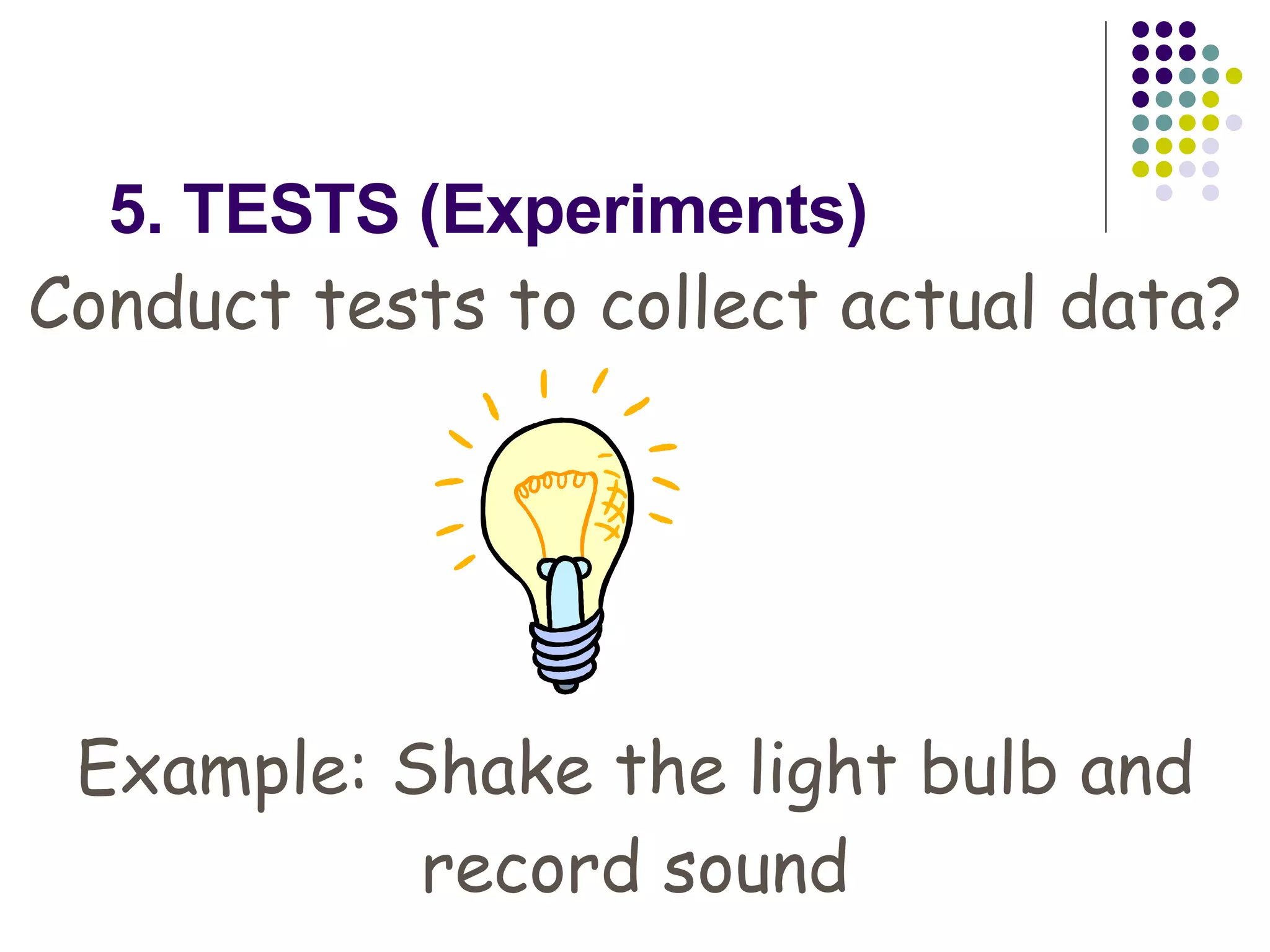
5. TESTS (Experiments) Conduct tests to collect actual data? Example: Shake the light bulb and record sound
6. TENTATIVE CONCLUSIONS Which hypotheses were supported (not refuted) by the actual data? Write up report (introduction, methods, results, discussion) for publication
7. PEER REVIEW & PUBLICATION Submit your report to a scientific journal that is peer-reviewed, meaning that your methods, data, tentative conclusions will be scrutinized by scientists whose reputation is at stake if they allow your report to be published. Publication leads to creation of scientific information
The Scientific Method Scientific understanding advances through evaluation and dissemination of information to the scientific community. How does this information get disseminated to the public? (Withgott and Brennan, 2007)
THE NATURE OF SCIENTIFIC PROOF & KNOWLEDGE PART II:
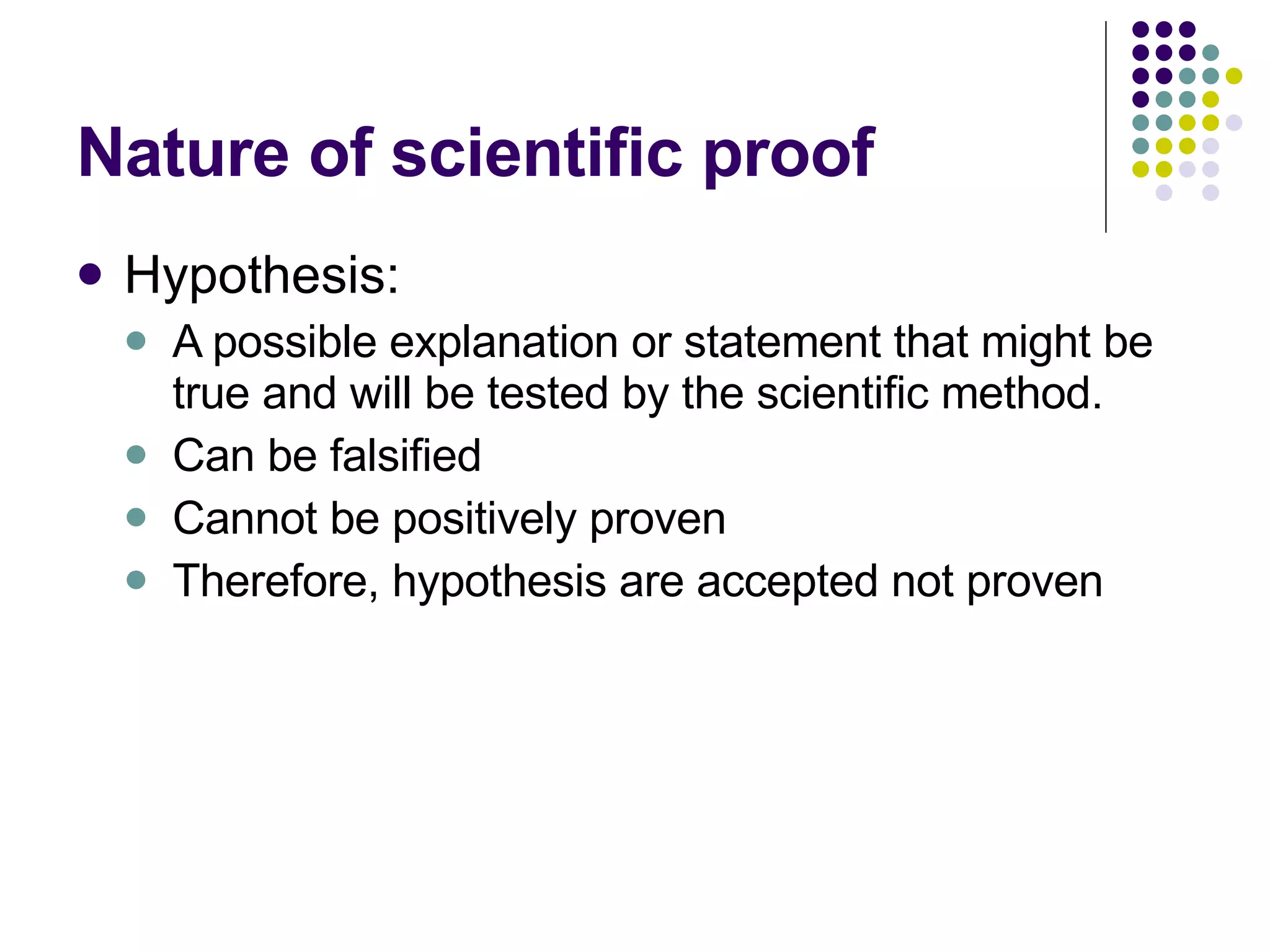
Nature of scientific proof Hypothesis: A possible explanation or statement that might be true and will be tested by the scientific method. Can be falsified Cannot be positively proven Therefore, hypothesis are accepted not proven
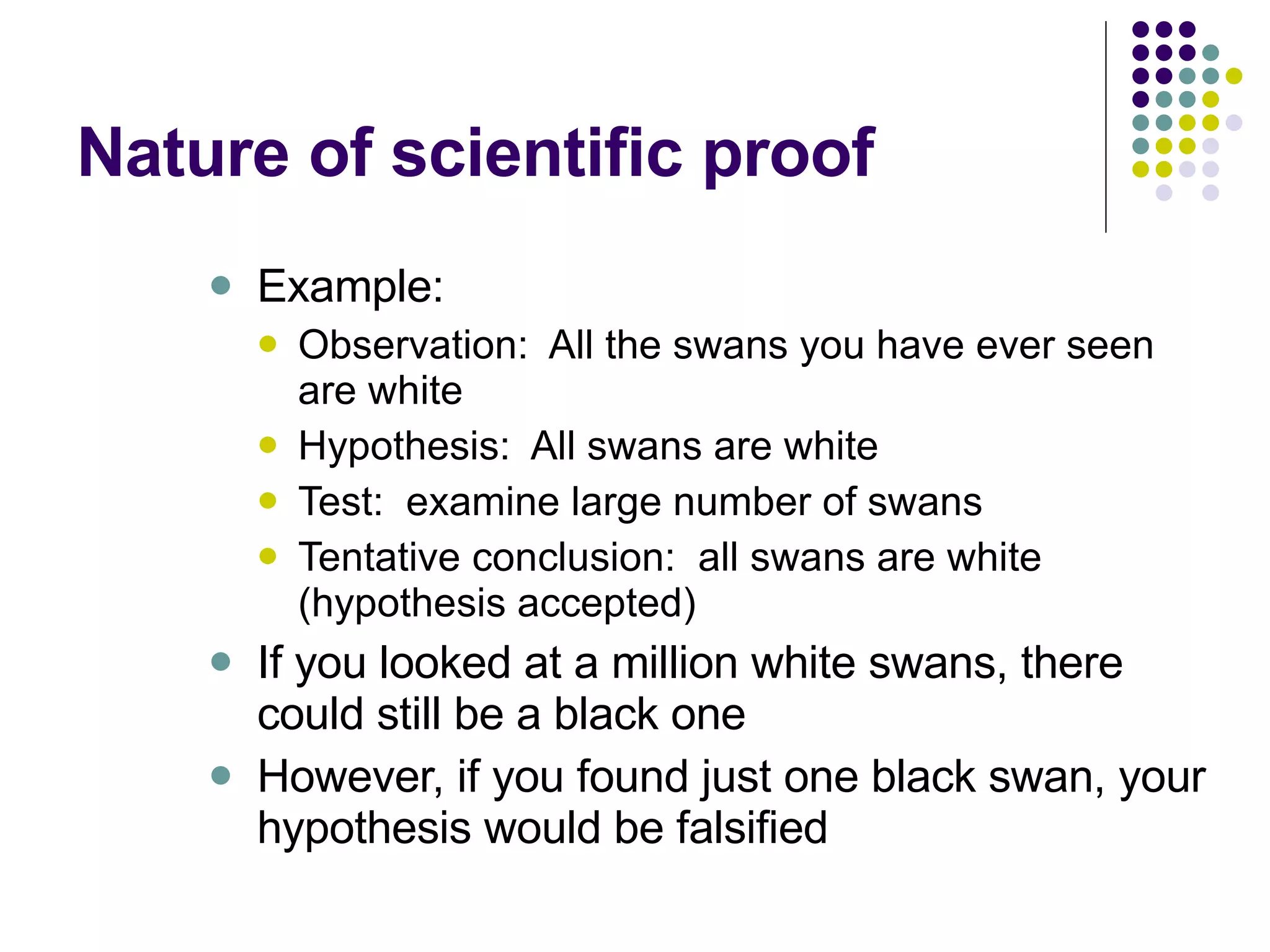
Nature of scientific proof Example: Observation:  All the swans you have ever seen are white Hypothesis:  All swans are white Test:  examine large number of swans Tentative conclusion:  all swans are white (hypothesis accepted) If you looked at a million white swans, there could still be a black one However, if you found just one black swan, your hypothesis would be falsified
Nature of scientific proof When a hypothesis withstands RIGOROUS testing, especially over time, it becomes a theory Theory: A hypothesis that has been rigorously tested and over time has become generally accepted by the scientific community as correct
Nature of Scientific Proof Some examples of theories are: Theory of relativity Theory of plate tectonics Theory of evolution Eventually theories become laws Law of gravity
Nature of Scientific Knowledge The main body of science is very stable and grows by being corrected slowly So, although scientists accept that scientific knowledge is always open to improvement, the main body of knowledge is well-accepted and stable
Nature of Scientific Knowledge Scientific fact A valid observation about some natural phenomenon obtained by carrying out experiments Scientific theory: A hypothesis that has been tested and validated over a long period of time Theory of evolution
Nature of Scientific Knowledge Scientific law:  generalization that summarizes facts about natural phenomena Law of gravity Scientific law vs scientific theory: Law addresses how it behaves Theory addresses why it behaves that way
Scientific Worldview There are several beliefs underlying the work of scientists: By working together over time, people can figure out how the world works Knowledge is both stable and changing Scientists become excited by new ideas, but are skeptics that judge ideas by the strength of the evidence that supports them.
Scientific Worldview The universe is a unified system functions in accordance with fixed natural laws that do not change from time to time or from place to place Knowledge gained from studying one part of it can often be applied to other parts of it All events arise from some cause or causes and, in turn, cause other events. We can use our senses and reasoning abilities to detect and describe natural laws that underlie the cause and effect relationships we observe in nature.
Are the terms  Science  and  Technology synonymous?    
Science    Technology    Technology = the application of scientific knowledge for practical purposes.
EXPERIMENTAL DESIGN PART III:
Experiments--definition A well-defined, controlled procedure for obtaining information about a system under study A way to test an hypothesis
Experiments—some rules Adequate Sample Size.  Ex. Larger sample size better Representative Sample.  Ex. Random sample
Manipulative or controlled study Uses a model system to control and manipulate variables An experiment in which variables are taken into account Based on comparing a control group with an experimental group Both groups are treated identically except for one variable or factor This factor is changed for the experimental group but not the control group If an effect is seen in the experimental group but not the control group that indicates that the factor changed is the cause of the effect
Examples of Controlled Studies Studying the effect of nutrients on plant growth—add or change the kinds & amounts of nutrients in natural or artificial setting Studying the effect of grazing on plant communities—exclude grazing on study plots & allow grazing on others Challenge:  hard to do over large scales of space & time
Controlled study Variables :  factors that affect observations or experiments Dependent variable—response that is measured Independent variable—varied or manipulated by researcher (cause)
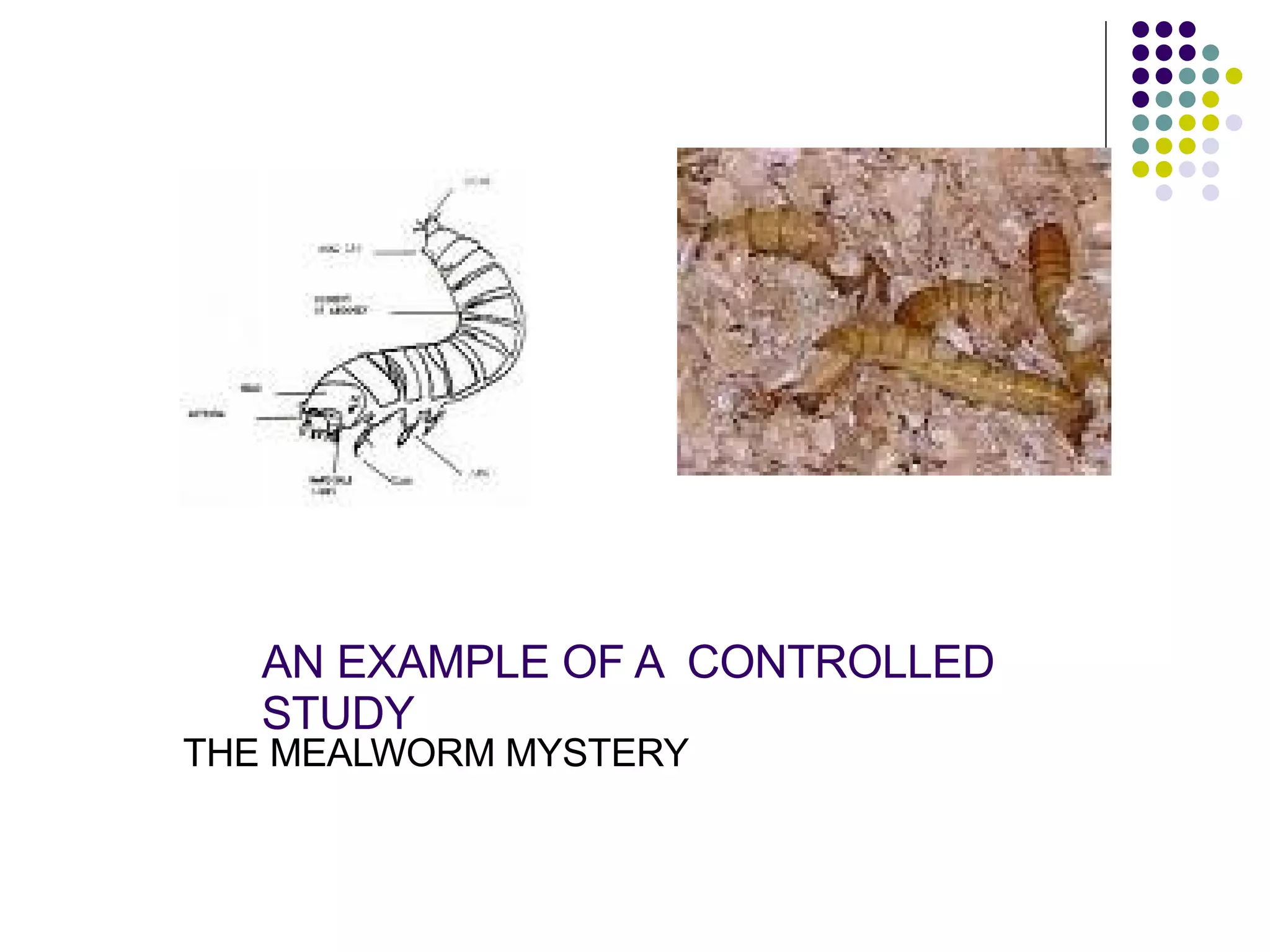
AN EXAMPLE OF A  CONTROLLED STUDY THE MEALWORM MYSTERY
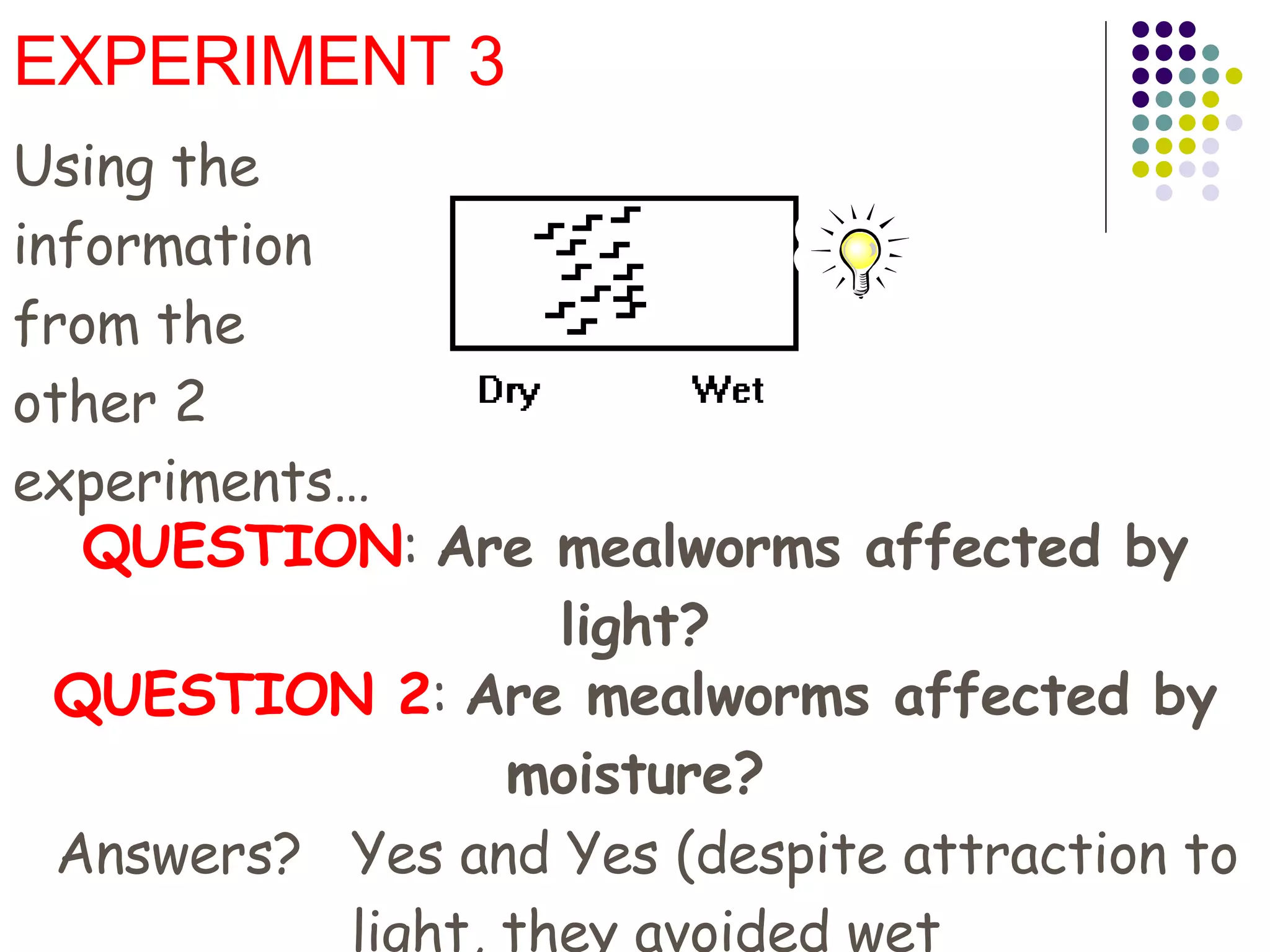
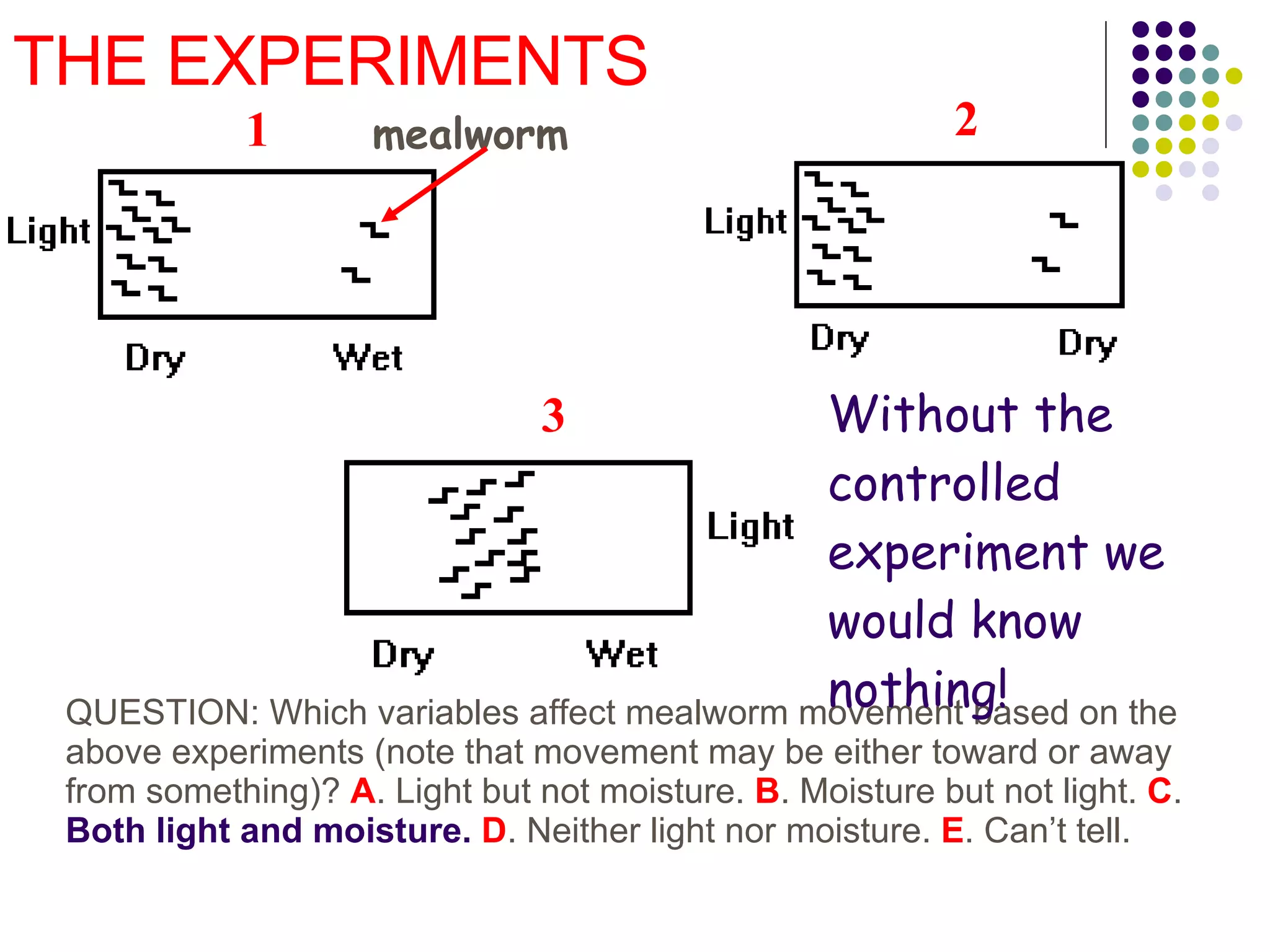
MEALWORM MYSTERY A student conducted 4 experiments to determine how mealworms respond to light and moisture. All  variables except light and moisture were held constant from experiment to experiment. For each experiment, 12 mealworms were placed in the center of a box and then their positions were recorded 24 hours later .
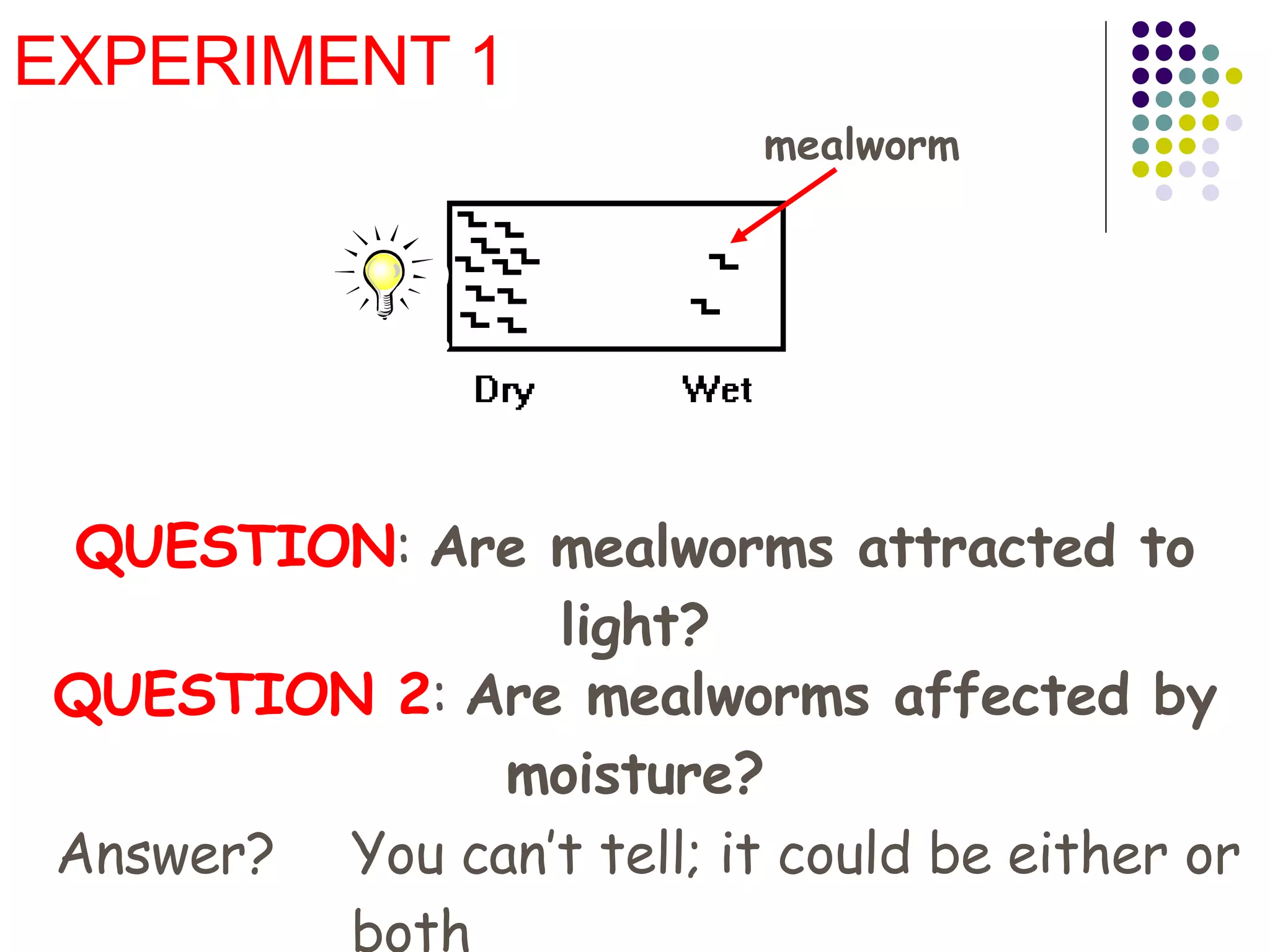
EXPERIMENT 1 QUESTION :  Are mealworms attracted to light? mealworm QUESTION 2 :  Are mealworms affected by moisture? Answer? You can’t tell; it could be either or both
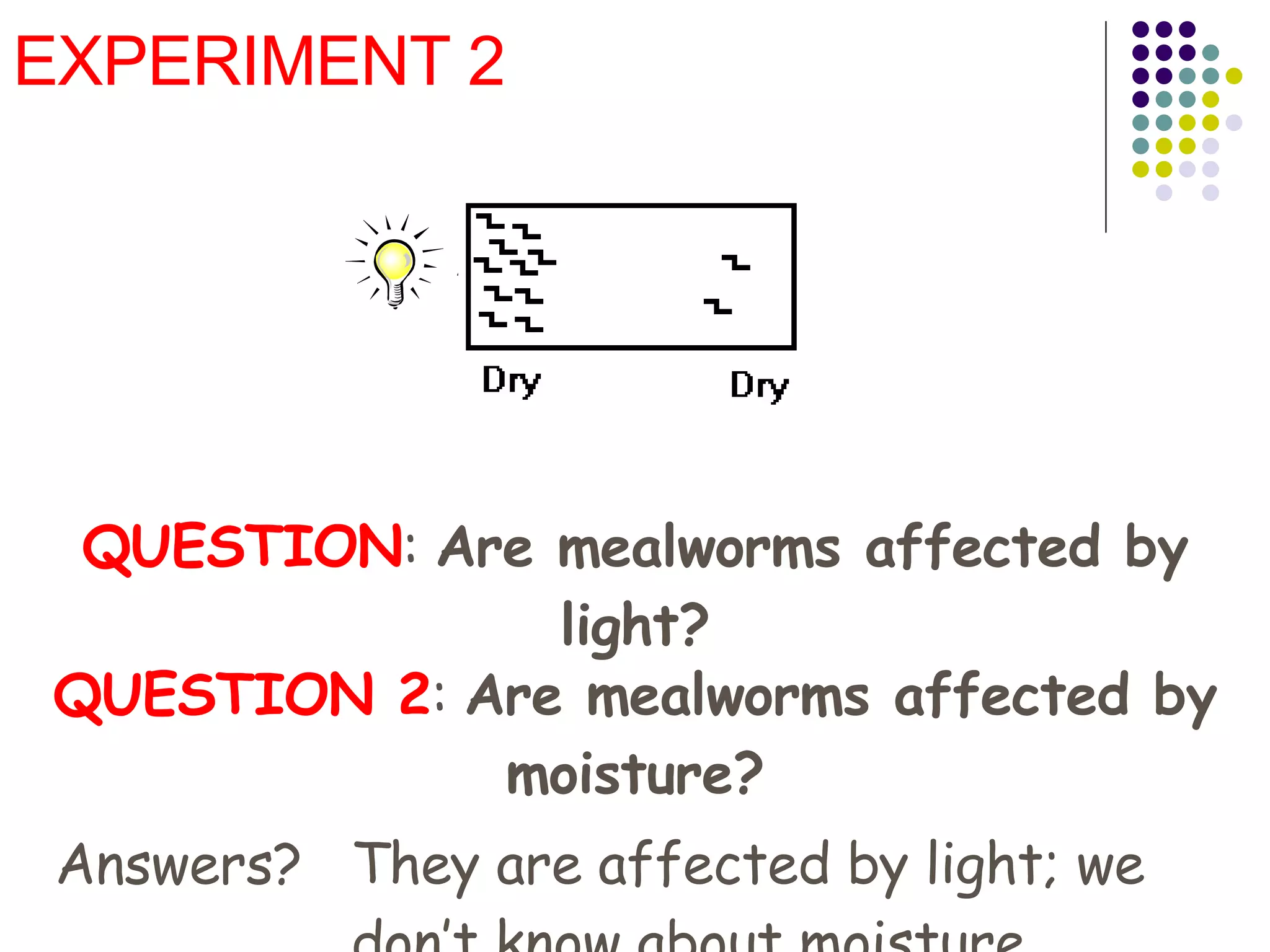
EXPERIMENT 2 QUESTION :  Are mealworms affected by light? QUESTION 2 :  Are mealworms affected by moisture? Answers? They are affected by light; we don’t know about moisture
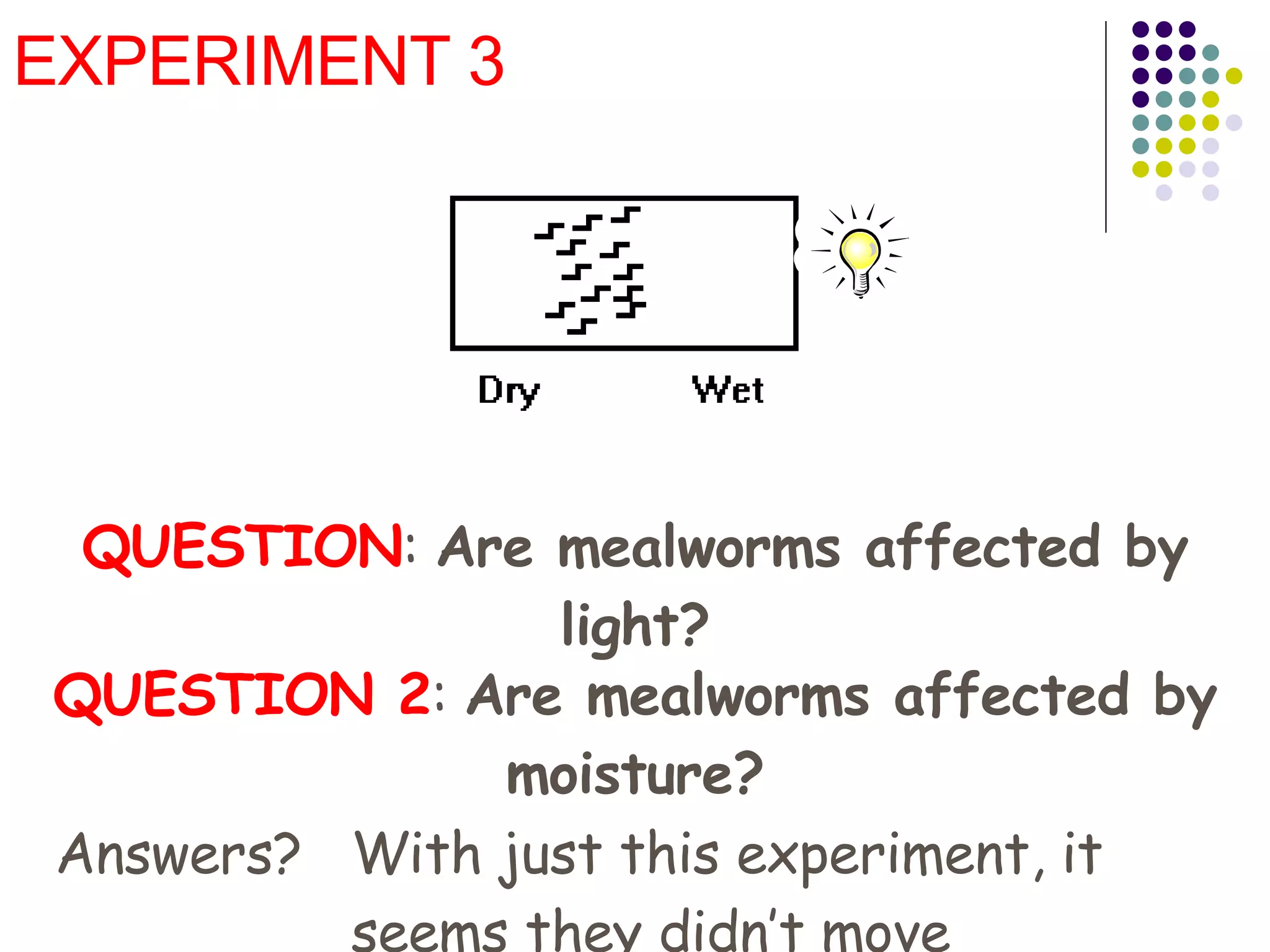
EXPERIMENT 3 QUESTION :  Are mealworms affected by light? QUESTION 2 :  Are mealworms affected by moisture? Answers? With just this experiment, it seems they didn’t move
EXPERIMENT 3 QUESTION :  Are mealworms affected by light? QUESTION 2 :  Are mealworms affected by moisture? Using the information from the other 2 experiments… Answers? Yes and Yes (despite attraction to light, they avoided wet
THE EXPERIMENTS 1 2 3 QUESTION:  Which variables affect mealworm movement based on the above experiments (note that movement may be either toward or away from something)?  A . Light but not moisture.  B . Moisture but not light.  C .  Both light and moisture.   D . Neither light nor moisture.  E . Can’t tell. mealworm Without the controlled experiment we would know nothing!

Introduction to Science and Chemistry

  • 1.
  • 2.
    Definition of ScienceA way of exploring and explaining the natural world Using a process designed to reduce the chance of being misled
  • 3.
    Scientific disciplines Branchesof scientific knowledge that are limited in size and scope to make them more manageable. In reality, all branches of scientific knowledge are inter-related and dependent on each other Can you name some scientific disciplines?
  • 4.
    Scientific disciplines Allscientific disciplines are either: Physical Science: study of matter and energy Astronomy, geology, physics, and chemistry Biological Science: study of living organisms Botany (plants) or Zoology (animals) See figure 1.1 in your book
  • 5.
    Chemistry is ascientific discipline Concerned with the composition, structure and properties of matter, as well as the changes it undergoes during chemical reactions Incorporates concepts of energy in relation to chemical processes
  • 6.
    Chemistry is ascientific discipline It is fundamental to an understanding of all processes of the living state Biochemistry: the study of the chemical processes of living organisms
  • 7.
    Chemistry is ascientific discipline Chemical processes produce the products needed for our clothes, housing, transportation, medications and recreational pursuits
  • 8.
    Scientific disciplines Theknowledge in separate scientific disciplines combined create the whole of scientific knowledge currently known. For example, knowledge of how the human body works requires knowledge in the areas of biology, chemistry, and physics. Can you think of some examples?
  • 9.
    SCIENTIFIC METHOD: PARTI : The process of science!!
  • 10.
    The Scientific MethodMake observations Ask questions Develop a hypothesis Make predictions Test the predictions Experiment Manipulate variables Independent Dependent Conclusions: analyze and interpret results Peer Review/Publication The “scientific method” is a formalized version of the procedure any of us might take, using common sense, to resolve a problem. (Withgott and Brennan, 2007)
  • 11.
    1. OBSERVATION Thelight doesn’t turn on
  • 12.
    2. QUESTION Whydidn’t the light turn on?
  • 13.
    3. MULTIPLE HYPOTHESESWhat are all the possible answers (hypotheses) to the question? Example: The light bulb is burned out Example 2: ?
  • 14.
    4. PREDICTIONS Whatdata would support a particular hypothesis (= expected data) and/or what data would refute the hypothesis? Example: The light bulb will rattle when shaken
  • 15.
    5. TESTS (Experiments)Conduct tests to collect actual data? Example: Shake the light bulb and record sound
  • 16.
    6. TENTATIVE CONCLUSIONSWhich hypotheses were supported (not refuted) by the actual data? Write up report (introduction, methods, results, discussion) for publication
  • 17.
    7. PEER REVIEW& PUBLICATION Submit your report to a scientific journal that is peer-reviewed, meaning that your methods, data, tentative conclusions will be scrutinized by scientists whose reputation is at stake if they allow your report to be published. Publication leads to creation of scientific information
  • 18.
    The Scientific MethodScientific understanding advances through evaluation and dissemination of information to the scientific community. How does this information get disseminated to the public? (Withgott and Brennan, 2007)
  • 19.
    THE NATURE OFSCIENTIFIC PROOF & KNOWLEDGE PART II:
  • 20.
    Nature of scientificproof Hypothesis: A possible explanation or statement that might be true and will be tested by the scientific method. Can be falsified Cannot be positively proven Therefore, hypothesis are accepted not proven
  • 21.
    Nature of scientificproof Example: Observation: All the swans you have ever seen are white Hypothesis: All swans are white Test: examine large number of swans Tentative conclusion: all swans are white (hypothesis accepted) If you looked at a million white swans, there could still be a black one However, if you found just one black swan, your hypothesis would be falsified
  • 22.
    Nature of scientificproof When a hypothesis withstands RIGOROUS testing, especially over time, it becomes a theory Theory: A hypothesis that has been rigorously tested and over time has become generally accepted by the scientific community as correct
  • 23.
    Nature of ScientificProof Some examples of theories are: Theory of relativity Theory of plate tectonics Theory of evolution Eventually theories become laws Law of gravity
  • 24.
    Nature of ScientificKnowledge The main body of science is very stable and grows by being corrected slowly So, although scientists accept that scientific knowledge is always open to improvement, the main body of knowledge is well-accepted and stable
  • 25.
    Nature of ScientificKnowledge Scientific fact A valid observation about some natural phenomenon obtained by carrying out experiments Scientific theory: A hypothesis that has been tested and validated over a long period of time Theory of evolution
  • 26.
    Nature of ScientificKnowledge Scientific law: generalization that summarizes facts about natural phenomena Law of gravity Scientific law vs scientific theory: Law addresses how it behaves Theory addresses why it behaves that way
  • 27.
    Scientific Worldview Thereare several beliefs underlying the work of scientists: By working together over time, people can figure out how the world works Knowledge is both stable and changing Scientists become excited by new ideas, but are skeptics that judge ideas by the strength of the evidence that supports them.
  • 28.
    Scientific Worldview Theuniverse is a unified system functions in accordance with fixed natural laws that do not change from time to time or from place to place Knowledge gained from studying one part of it can often be applied to other parts of it All events arise from some cause or causes and, in turn, cause other events. We can use our senses and reasoning abilities to detect and describe natural laws that underlie the cause and effect relationships we observe in nature.
  • 29.
    Are the terms Science and Technology synonymous?  
  • 30.
    Science  Technology   Technology = the application of scientific knowledge for practical purposes.
  • 31.
  • 32.
    Experiments--definition A well-defined,controlled procedure for obtaining information about a system under study A way to test an hypothesis
  • 33.
    Experiments—some rules AdequateSample Size. Ex. Larger sample size better Representative Sample. Ex. Random sample
  • 34.
    Manipulative or controlledstudy Uses a model system to control and manipulate variables An experiment in which variables are taken into account Based on comparing a control group with an experimental group Both groups are treated identically except for one variable or factor This factor is changed for the experimental group but not the control group If an effect is seen in the experimental group but not the control group that indicates that the factor changed is the cause of the effect
  • 35.
    Examples of ControlledStudies Studying the effect of nutrients on plant growth—add or change the kinds & amounts of nutrients in natural or artificial setting Studying the effect of grazing on plant communities—exclude grazing on study plots & allow grazing on others Challenge: hard to do over large scales of space & time
  • 36.
    Controlled study Variables: factors that affect observations or experiments Dependent variable—response that is measured Independent variable—varied or manipulated by researcher (cause)
  • 37.
    AN EXAMPLE OFA CONTROLLED STUDY THE MEALWORM MYSTERY
  • 38.
    MEALWORM MYSTERY Astudent conducted 4 experiments to determine how mealworms respond to light and moisture. All variables except light and moisture were held constant from experiment to experiment. For each experiment, 12 mealworms were placed in the center of a box and then their positions were recorded 24 hours later .
  • 39.
    EXPERIMENT 1 QUESTION: Are mealworms attracted to light? mealworm QUESTION 2 : Are mealworms affected by moisture? Answer? You can’t tell; it could be either or both
  • 40.
    EXPERIMENT 2 QUESTION: Are mealworms affected by light? QUESTION 2 : Are mealworms affected by moisture? Answers? They are affected by light; we don’t know about moisture
  • 41.
    EXPERIMENT 3 QUESTION: Are mealworms affected by light? QUESTION 2 : Are mealworms affected by moisture? Answers? With just this experiment, it seems they didn’t move
  • 42.
    EXPERIMENT 3 QUESTION: Are mealworms affected by light? QUESTION 2 : Are mealworms affected by moisture? Using the information from the other 2 experiments… Answers? Yes and Yes (despite attraction to light, they avoided wet
  • 43.
    THE EXPERIMENTS 12 3 QUESTION: Which variables affect mealworm movement based on the above experiments (note that movement may be either toward or away from something)? A . Light but not moisture. B . Moisture but not light. C . Both light and moisture. D . Neither light nor moisture. E . Can’t tell. mealworm Without the controlled experiment we would know nothing!