Cell Biology  HCR 118 •  Tami Port…Who’s she? •   Student information sheet with “Super Secret Code Name” •   Syllabus
Courtesy Be Respectful  Pay Attention If you can’t pay attention, at least keep it to yourself…don’t disrupt others. Cell Phones  off/silenced No Computers YAWN!
ATTENDANCE:   Students are expected to attend all lectures and BE ON TIME!  If you are perpetually late to this class it may result in the loss of points.  If you have a problem with your schedule that interferes with your being on time to this class, you need to see me.  Attend fewer than 60% = failing grade. This is not a telecourse.
Resources to Help You Excel in This Class Class Website:  Virtual Cell Biology Classroom (VCBC) GENERAL: - Grades Posted - How to Improve Your Grades & Study Skills LECTURE: - Power Point Lectures - Online Quizzes -  Review Worksheets - Lecture Study Guide Learning Center
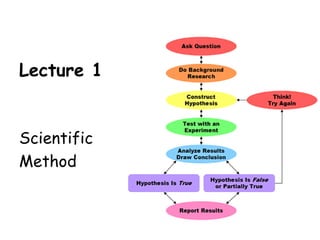
Lecture 1 Scientific  Method
What is science ? Science is a  ______   for answering questions.
What is Science?   or  Here are a few statements  to test your current understanding of science! ( You are thinking  … Wow! This instructor is HARSH! A test the first time we meet.) True False
Science actually attempts to  disprove  ideas (hypotheses). Science is limited strictly to solving problems about the physical and natural world.  Explanations based on supernatural forces, values or ethics can never be disproved and thus do not fall under the realm of science. Science can prove anything, solve any problem or answer any question. True  or  False ? False
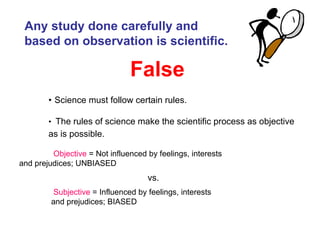
Any study done carefully and based on observation is scientific.   •   Science must follow certain rules. •  The rules of science make the scientific process as objective as is possible.     Objective  = Not influenced by feelings, interests  and prejudices; UNBIASED  vs.   Subjective  = Influenced by feelings, interests    and prejudices; BIASED  False
Science can be done poorly.  True
Different scientists may get different solutions to the same problem.  Yes No True
The Controversy Over Spontaneous Generation   John Needham  & Lazzaro Spallanzani   Problem: What causes tiny living things to appear in decaying broth?  Spallazani’s Hypothesis:  Microbes come from the air. Boiling will kill them. Needham’s Hypothesis : Spontaneous generation.  1700’s Needham Spallazani Needham > Spallazani >
____________  is the key to good science. To be objective, experiments must be designed and conducted in a way that does not introduce bias into the study. Scientists use the  __________ _________   Soooo…what is  good  science?
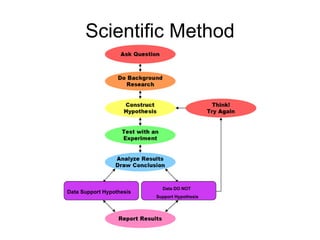
Scientific Method Data Support Hypothesis Data DO NOT  Support Hypothesis
The Beginnings of Immunology Edward   Jenner and the first vaccine Credited with introducing use of scabs from cowpox lesions to prevent smallpox. Was aware of farm workers' belief that if you had cowpox in past, you wouldn’t get smallpox.  _____________:  Infectious disease that caused mild discomfort, aching, a few pustules, some swelling…symptoms that disappeared in a few days. No biggie. _____________:  Infectious disease that caused massive disfigurement, sometimes blindness, and often death.  1800’s – English physician
The Beginnings of Immunology Edward   Jenner and the first vaccine Question:  Does having cowpox make a person immune to smallpox? Hypothesis :  If I infect someone with cowpox, they will then be immune to smallpox. Experiments:  Jenner made small incisions or punctures with cowpox material in arms of human subjects in order to prevent smallpox.  Analysis & Conclusion:  He saw that people that he infected with cow pox, when later exposed to smallpox, would get a little bit sick, but never come down with a full-blown case of smallpox. Present Results / Peer Evaluation:  At first his peers doubted the safety and efficacy of his treatment, but  eventually the value of the cowpox inoculum was recognized. 1800’s – English physician
__________ _________  = Two or more scientists from different institutions investigate the same question separately and get similar results. _____-_______ ____________  = A journal that publishes articles only after they have been checked for quality by   several expert, objective scientists from different institutions.   Verification is another quality control measure to eliminate bias.  Results are verified by  independent duplication  and publication in a  peer-reviewed journal .
So that’s Science… Now, what’s the difference between: 1. Science 2. Non-science 3. Pseudoscience ?
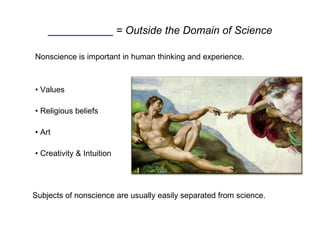
___________  = Outside the Domain of Science •  Values •  Religious beliefs •  Art •  Creativity & Intuition Subjects of nonscience are usually easily separated from science. Nonscience is important in human thinking and experience.
_______________ When Nonscience Claims to Be Science •  Claims that can be tested scientifically, but are not. •  Try to pose as science. Religious “science”: constantly upholds hypotheses instead of trying to falsify them. Unidentified flying objects: none of the UFO “sightings” stand to careful scrutiny Hauntings: none of the ghost “sightings” stand to careful scrutiny
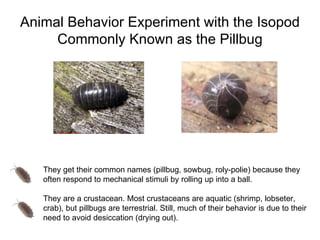
Animal Behavior Experiment with the Isopod Commonly Known as the Pillbug They get their common names (pillbug, sowbug, roly-polie) because they often respond to mechanical stimuli by rolling up into a ball. They are a crustacean. Most crustaceans are aquatic (shrimp, lobseter, crab), but pillbugs are terrestrial. Still, much of their behavior is due to their need to avoid desiccation (drying out).
Pillbug Experiment You will be designing an experiment to help you to better understand the scientific method. Break up into groups (of at least 5 members) and design an experiment to investigate the pillbugs’ response to light, pH, food hiding place or background color. Choose only one variable to manipulate.  You will must work through all of the steps of the scientific method:  ask a question  develop a hypothesis state the objectives of your experiment design your experiment  (list materials that you will use, and outline your procedure in detail, determine what data you will collect) analyze your data draw a conclusion  ( was your hypothesis supported or not?) I will need to approve your experiment before you begin.

1 Scientific Method Power Point

  • 1.
    Cell Biology HCR 118 • Tami Port…Who’s she? • Student information sheet with “Super Secret Code Name” • Syllabus
  • 2.
    Courtesy Be Respectful Pay Attention If you can’t pay attention, at least keep it to yourself…don’t disrupt others. Cell Phones off/silenced No Computers YAWN!
  • 3.
    ATTENDANCE: Students are expected to attend all lectures and BE ON TIME! If you are perpetually late to this class it may result in the loss of points. If you have a problem with your schedule that interferes with your being on time to this class, you need to see me. Attend fewer than 60% = failing grade. This is not a telecourse.
  • 4.
    Resources to HelpYou Excel in This Class Class Website: Virtual Cell Biology Classroom (VCBC) GENERAL: - Grades Posted - How to Improve Your Grades & Study Skills LECTURE: - Power Point Lectures - Online Quizzes - Review Worksheets - Lecture Study Guide Learning Center
  • 5.
  • 6.
    What is science? Science is a ______ for answering questions.
  • 7.
    What is Science?  or Here are a few statements to test your current understanding of science! ( You are thinking … Wow! This instructor is HARSH! A test the first time we meet.) True False
  • 8.
    Science actually attemptsto disprove ideas (hypotheses). Science is limited strictly to solving problems about the physical and natural world. Explanations based on supernatural forces, values or ethics can never be disproved and thus do not fall under the realm of science. Science can prove anything, solve any problem or answer any question. True or False ? False
  • 9.
    Any study donecarefully and based on observation is scientific. • Science must follow certain rules. • The rules of science make the scientific process as objective as is possible. Objective = Not influenced by feelings, interests and prejudices; UNBIASED vs. Subjective = Influenced by feelings, interests and prejudices; BIASED False
  • 10.
    Science can bedone poorly. True
  • 11.
    Different scientists mayget different solutions to the same problem. Yes No True
  • 12.
    The Controversy OverSpontaneous Generation John Needham & Lazzaro Spallanzani Problem: What causes tiny living things to appear in decaying broth? Spallazani’s Hypothesis: Microbes come from the air. Boiling will kill them. Needham’s Hypothesis : Spontaneous generation. 1700’s Needham Spallazani Needham > Spallazani >
  • 13.
    ____________ isthe key to good science. To be objective, experiments must be designed and conducted in a way that does not introduce bias into the study. Scientists use the __________ _________ Soooo…what is good science?
  • 14.
    Scientific Method DataSupport Hypothesis Data DO NOT Support Hypothesis
  • 15.
    The Beginnings ofImmunology Edward Jenner and the first vaccine Credited with introducing use of scabs from cowpox lesions to prevent smallpox. Was aware of farm workers' belief that if you had cowpox in past, you wouldn’t get smallpox. _____________: Infectious disease that caused mild discomfort, aching, a few pustules, some swelling…symptoms that disappeared in a few days. No biggie. _____________: Infectious disease that caused massive disfigurement, sometimes blindness, and often death. 1800’s – English physician
  • 16.
    The Beginnings ofImmunology Edward Jenner and the first vaccine Question: Does having cowpox make a person immune to smallpox? Hypothesis : If I infect someone with cowpox, they will then be immune to smallpox. Experiments: Jenner made small incisions or punctures with cowpox material in arms of human subjects in order to prevent smallpox. Analysis & Conclusion: He saw that people that he infected with cow pox, when later exposed to smallpox, would get a little bit sick, but never come down with a full-blown case of smallpox. Present Results / Peer Evaluation: At first his peers doubted the safety and efficacy of his treatment, but eventually the value of the cowpox inoculum was recognized. 1800’s – English physician
  • 17.
    __________ _________ = Two or more scientists from different institutions investigate the same question separately and get similar results. _____-_______ ____________ = A journal that publishes articles only after they have been checked for quality by several expert, objective scientists from different institutions. Verification is another quality control measure to eliminate bias. Results are verified by independent duplication and publication in a peer-reviewed journal .
  • 18.
    So that’s Science…Now, what’s the difference between: 1. Science 2. Non-science 3. Pseudoscience ?
  • 19.
    ___________ =Outside the Domain of Science • Values • Religious beliefs • Art • Creativity & Intuition Subjects of nonscience are usually easily separated from science. Nonscience is important in human thinking and experience.
  • 20.
    _______________ When NonscienceClaims to Be Science • Claims that can be tested scientifically, but are not. • Try to pose as science. Religious “science”: constantly upholds hypotheses instead of trying to falsify them. Unidentified flying objects: none of the UFO “sightings” stand to careful scrutiny Hauntings: none of the ghost “sightings” stand to careful scrutiny
  • 21.
    Animal Behavior Experimentwith the Isopod Commonly Known as the Pillbug They get their common names (pillbug, sowbug, roly-polie) because they often respond to mechanical stimuli by rolling up into a ball. They are a crustacean. Most crustaceans are aquatic (shrimp, lobseter, crab), but pillbugs are terrestrial. Still, much of their behavior is due to their need to avoid desiccation (drying out).
  • 22.
    Pillbug Experiment Youwill be designing an experiment to help you to better understand the scientific method. Break up into groups (of at least 5 members) and design an experiment to investigate the pillbugs’ response to light, pH, food hiding place or background color. Choose only one variable to manipulate. You will must work through all of the steps of the scientific method: ask a question develop a hypothesis state the objectives of your experiment design your experiment (list materials that you will use, and outline your procedure in detail, determine what data you will collect) analyze your data draw a conclusion ( was your hypothesis supported or not?) I will need to approve your experiment before you begin.