Spacial Topics in Human Genetics
       Subject: Epigenetics
                 by:
Mohammad Hossein Bakhshi Aliabad
     Peyman Ghoraishizadeh
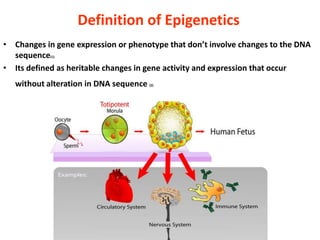
Definition of Epigenetics
• Changes in gene expression or phenotype that don’t involve changes to the DNA
  sequence(1)
• Its defined as heritable changes in gene activity and expression that occur
   without alteration in DNA sequence (2)
Mechanism of Epigenetics
•      Mechanisms
               Chromatin Remodelling & Histone Modification
               DNA Methylation
               Non-coding RNA mediated pathway
               Prion


    Epigenetic code:

Consist of Both DNA methylation and histone modifications
Defining code in every eukaryotic cells


Genetic code in each cell is the same
Epigenetic code is tissue and cell specific (3)
Chromatin structure
• Chromatin= DNA+ Protein
•   Basic unit of chromatin is nucleosome
•   Chromatin structure is dynamic
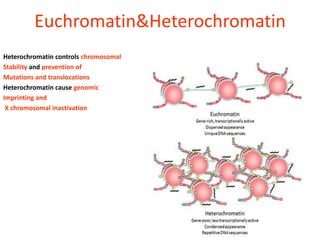
Euchromatin&Heterochromatin
Heterochromatin controls chromosomal
Stability and prevention of
Mutations and translocations
Heterochromatin cause genomic
Imprinting and
 X chromosomal inactivation
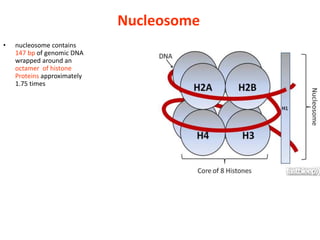
Nucleosome
•   nucleosome contains
    147 bp of genomic DNA
    wrapped around an
    octamer of histone
    Proteins approximately
    1.75 times
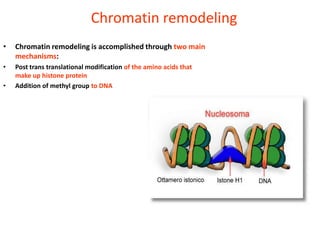
Chromatin remodeling
•   Chromatin remodeling is accomplished through two main
    mechanisms:
•   Post trans translational modification of the amino acids that
    make up histone protein
•   Addition of methyl group to DNA
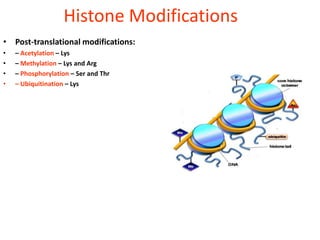
Histone Modifications
• Post-translational modifications:
•   – Acetylation – Lys
•   – Methylation – Lys and Arg
•   – Phosphorylation – Ser and Thr
•   – Ubiquitination – Lys
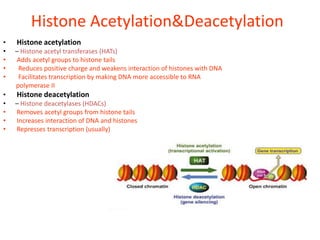
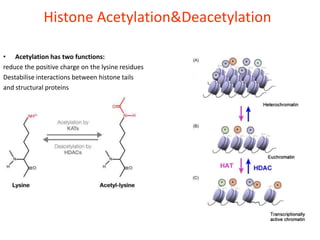
Histone Acetylation&Deacetylation
•   Histone acetylation
•   – Histone acetyl transferases (HATs)
•   Adds acetyl groups to histone tails
•    Reduces positive charge and weakens interaction of histones with DNA
•    Facilitates transcription by making DNA more accessible to RNA
    polymerase II
•   Histone deacetylation
•   – Histone deacetylases (HDACs)
•   Removes acetyl groups from histone tails
•   Increases interaction of DNA and histones
•   Represses transcription (usually)
Histone Acetylation&Deacetylation

• Acetylation has two functions:
reduce the positive charge on the lysine residues
Destabilise interactions between histone tails
and structural proteins
Histone Methylation
•      Histone methylation
      • Histone methyl transferases (HMTs)
     – Histone lysine methyl transferases(HKMTs)
     .Methylate lys (k) residues

.     Protein argenin methyl transferase (PRMTs)
     .Methylate arge(R) residues


Methylation can result in activation or repression
Of expression

trimethylation of histone H3 at lysine 4 (H3K4) is an active mark for transcription

    dimethylation of histone H3 at lysine 9 (H3K9), a signal for transcriptional silencing   (4)
• Small Ubiquitin-like Modifier (or SUMO) proteins

• Ubiquitin


•   ADP-ribosylation
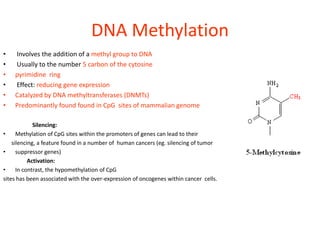
DNA Methylation
•   Involves the addition of a methyl group to DNA
•   Usually to the number 5 carbon of the cytosine
•   pyrimidine ring
•   Effect: reducing gene expression
•   Catalyzed by DNA methyltransferases (DNMTs)
•   Predominantly found found in CpG sites of mammalian genome

             Silencing:
•     Methylation of CpG sites within the promoters of genes can lead to their
    silencing, a feature found in a number of human cancers (eg. silencing of tumor
•     suppressor genes)
           Activation:
•     In contrast, the hypomethylation of CpG
sites has been associated with the over-expression of oncogenes within cancer cells.
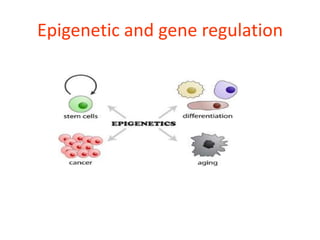
Epigenetic and gene regulation
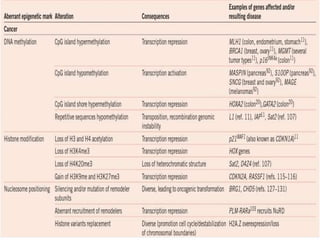
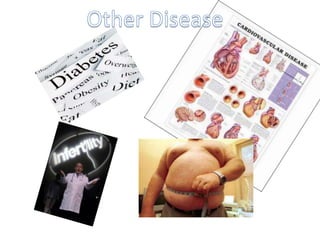
 Cancer epigenetics is the study of epigenetic modifications to the genome
of cancer cells that do not involve a change in the nucleotide sequence. Epigenetic
alterations are as important as genetic mutations in a cell’s transformation to
cancer.
Mechanisms of epigenetic silencing of tumor suppressor genes and activation
of oncogenes include: alteration in CpG island methylation
patterns, histone modifications.
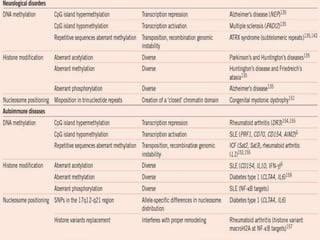
 Epigenetic modifications in Neurodevelopmental disorders
Genetic mutations in epigenetic genes cause dysfunctions that lead to certain
neurodevelopmental disorders, The majority of the evidence centers on DNA
methylation and histone modification.

 Epigenetic modifications in autoimmune diseases

Autoimmune diseases are characterized by the breakdown of immune
tolerance to specific self-antigens.
• So if you do something during your life that gives
  you a specific Epigenome will it be passed down?


      Yes ?                            No ?
Sometimes yes and some times no …
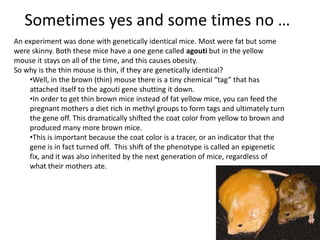
An experiment was done with genetically identical mice. Most were fat but some
were skinny. Both these mice have a one gene called agouti but in the yellow
mouse it stays on all of the time, and this causes obesity.
So why is the thin mouse is thin, if they are genetically identical?
    •Well, in the brown (thin) mouse there is a tiny chemical “tag” that has
    attached itself to the agouti gene shutting it down.
    •In order to get thin brown mice instead of fat yellow mice, you can feed the
    pregnant mothers a diet rich in methyl groups to form tags and ultimately turn
    the gene off. This dramatically shifted the coat color from yellow to brown and
    produced many more brown mice.
    •This is important because the coat color is a tracer, or an indicator that the
    gene is in fact turned off. This shift of the phenotype is called an epigenetic
    fix, and it was also inherited by the next generation of mice, regardless of
    what their mothers ate.
Enviromental and Dietary factors have an important role in abnormal
epygnetics pathway.

For example:


Smoking : causes Demethylation of metastatic genes in lung cancer cells.

Cadmium: is a heavy metal that causes deformity in DNA methylation.

Pesticide: changes the DNA methylation.

folate and methionine : they supply methyl group for DNA methylation.
DRUGS
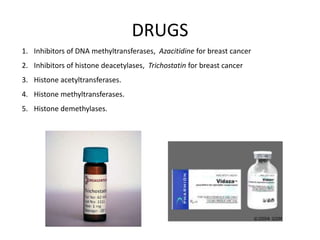
1. Inhibitors of DNA methyltransferases, Azacitidine for breast cancer
2. Inhibitors of histone deacetylases, Trichostatin for breast cancer
3. Histone acetyltransferases.
4. Histone methyltransferases.
5. Histone demethylases.
The epigenome shows far greater plasticity than the genome and contributes
significantly to development and differentiation by responding to environmental
stimuli. Errors in epigenetic programming caused by genetic defects and/or
environmental factors have been directly implicated with human disease.
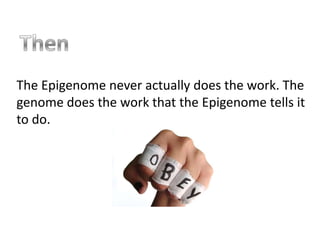
The Epigenome never actually does the work. The
genome does the work that the Epigenome tells it
to do.
Conclusion
• the epigenetic mechanisms are a window to
  understanding the possible mechanisms involved
  in the pathogenesis of complex diseases.

• For example: Unmethylated CpG sites can be
  detected by Toll-Like Receptor 9 (TLR 9) on
  plasmacytoid dendritic cells and B cells in humans
  and it can be used to detect intracellular viral,
  fungal, and bacterial pathogen DNA.
References
•   1.http://en.wikipedia.org/wiki/Epigenetics
•   2.Bird A.Nature ,447 ,396-98[2007]
•   3. Turner B (2007). "Defining an epigenetic code". Nat Cell Biol 9 (1): 2–6.
•   4.Gupta, Swati; Se Y. Kim, Sonja Artis, David L. Molfese, Armin Schumacher, J. David Sweatt, Richard E. Paylor, and Farah D. Lubin (10 March 2010). "Histone Methylation Regulates Memory Formation". The


    Journal of Neuroscience 30 (10): 3589–3599
Epigenetics

Epigenetics

  • 1.
    Spacial Topics inHuman Genetics Subject: Epigenetics by: Mohammad Hossein Bakhshi Aliabad Peyman Ghoraishizadeh
  • 2.
    Definition of Epigenetics •Changes in gene expression or phenotype that don’t involve changes to the DNA sequence(1) • Its defined as heritable changes in gene activity and expression that occur without alteration in DNA sequence (2)
  • 3.
    Mechanism of Epigenetics • Mechanisms Chromatin Remodelling & Histone Modification DNA Methylation Non-coding RNA mediated pathway Prion Epigenetic code: Consist of Both DNA methylation and histone modifications Defining code in every eukaryotic cells Genetic code in each cell is the same Epigenetic code is tissue and cell specific (3)
  • 4.
    Chromatin structure • Chromatin=DNA+ Protein • Basic unit of chromatin is nucleosome • Chromatin structure is dynamic
  • 5.
    Euchromatin&Heterochromatin Heterochromatin controls chromosomal Stabilityand prevention of Mutations and translocations Heterochromatin cause genomic Imprinting and X chromosomal inactivation
  • 6.
    Nucleosome • nucleosome contains 147 bp of genomic DNA wrapped around an octamer of histone Proteins approximately 1.75 times
  • 7.
    Chromatin remodeling • Chromatin remodeling is accomplished through two main mechanisms: • Post trans translational modification of the amino acids that make up histone protein • Addition of methyl group to DNA
  • 8.
    Histone Modifications • Post-translationalmodifications: • – Acetylation – Lys • – Methylation – Lys and Arg • – Phosphorylation – Ser and Thr • – Ubiquitination – Lys
  • 9.
    Histone Acetylation&Deacetylation • Histone acetylation • – Histone acetyl transferases (HATs) • Adds acetyl groups to histone tails • Reduces positive charge and weakens interaction of histones with DNA • Facilitates transcription by making DNA more accessible to RNA polymerase II • Histone deacetylation • – Histone deacetylases (HDACs) • Removes acetyl groups from histone tails • Increases interaction of DNA and histones • Represses transcription (usually)
  • 10.
    Histone Acetylation&Deacetylation • Acetylationhas two functions: reduce the positive charge on the lysine residues Destabilise interactions between histone tails and structural proteins
  • 11.
    Histone Methylation • Histone methylation • Histone methyl transferases (HMTs) – Histone lysine methyl transferases(HKMTs) .Methylate lys (k) residues . Protein argenin methyl transferase (PRMTs) .Methylate arge(R) residues Methylation can result in activation or repression Of expression trimethylation of histone H3 at lysine 4 (H3K4) is an active mark for transcription dimethylation of histone H3 at lysine 9 (H3K9), a signal for transcriptional silencing (4)
  • 12.
    • Small Ubiquitin-likeModifier (or SUMO) proteins • Ubiquitin • ADP-ribosylation
  • 13.
    DNA Methylation • Involves the addition of a methyl group to DNA • Usually to the number 5 carbon of the cytosine • pyrimidine ring • Effect: reducing gene expression • Catalyzed by DNA methyltransferases (DNMTs) • Predominantly found found in CpG sites of mammalian genome Silencing: • Methylation of CpG sites within the promoters of genes can lead to their silencing, a feature found in a number of human cancers (eg. silencing of tumor • suppressor genes) Activation: • In contrast, the hypomethylation of CpG sites has been associated with the over-expression of oncogenes within cancer cells.
  • 14.
  • 15.
     Cancer epigeneticsis the study of epigenetic modifications to the genome of cancer cells that do not involve a change in the nucleotide sequence. Epigenetic alterations are as important as genetic mutations in a cell’s transformation to cancer. Mechanisms of epigenetic silencing of tumor suppressor genes and activation of oncogenes include: alteration in CpG island methylation patterns, histone modifications.  Epigenetic modifications in Neurodevelopmental disorders Genetic mutations in epigenetic genes cause dysfunctions that lead to certain neurodevelopmental disorders, The majority of the evidence centers on DNA methylation and histone modification.  Epigenetic modifications in autoimmune diseases Autoimmune diseases are characterized by the breakdown of immune tolerance to specific self-antigens.
  • 20.
    • So ifyou do something during your life that gives you a specific Epigenome will it be passed down? Yes ? No ?
  • 21.
    Sometimes yes andsome times no … An experiment was done with genetically identical mice. Most were fat but some were skinny. Both these mice have a one gene called agouti but in the yellow mouse it stays on all of the time, and this causes obesity. So why is the thin mouse is thin, if they are genetically identical? •Well, in the brown (thin) mouse there is a tiny chemical “tag” that has attached itself to the agouti gene shutting it down. •In order to get thin brown mice instead of fat yellow mice, you can feed the pregnant mothers a diet rich in methyl groups to form tags and ultimately turn the gene off. This dramatically shifted the coat color from yellow to brown and produced many more brown mice. •This is important because the coat color is a tracer, or an indicator that the gene is in fact turned off. This shift of the phenotype is called an epigenetic fix, and it was also inherited by the next generation of mice, regardless of what their mothers ate.
  • 22.
    Enviromental and Dietaryfactors have an important role in abnormal epygnetics pathway. For example: Smoking : causes Demethylation of metastatic genes in lung cancer cells. Cadmium: is a heavy metal that causes deformity in DNA methylation. Pesticide: changes the DNA methylation. folate and methionine : they supply methyl group for DNA methylation.
  • 23.
    DRUGS 1. Inhibitors ofDNA methyltransferases, Azacitidine for breast cancer 2. Inhibitors of histone deacetylases, Trichostatin for breast cancer 3. Histone acetyltransferases. 4. Histone methyltransferases. 5. Histone demethylases.
  • 24.
    The epigenome showsfar greater plasticity than the genome and contributes significantly to development and differentiation by responding to environmental stimuli. Errors in epigenetic programming caused by genetic defects and/or environmental factors have been directly implicated with human disease.
  • 25.
    The Epigenome neveractually does the work. The genome does the work that the Epigenome tells it to do.
  • 26.
    Conclusion • the epigeneticmechanisms are a window to understanding the possible mechanisms involved in the pathogenesis of complex diseases. • For example: Unmethylated CpG sites can be detected by Toll-Like Receptor 9 (TLR 9) on plasmacytoid dendritic cells and B cells in humans and it can be used to detect intracellular viral, fungal, and bacterial pathogen DNA.
  • 27.
    References • 1.http://en.wikipedia.org/wiki/Epigenetics • 2.Bird A.Nature ,447 ,396-98[2007] • 3. Turner B (2007). "Defining an epigenetic code". Nat Cell Biol 9 (1): 2–6. • 4.Gupta, Swati; Se Y. Kim, Sonja Artis, David L. Molfese, Armin Schumacher, J. David Sweatt, Richard E. Paylor, and Farah D. Lubin (10 March 2010). "Histone Methylation Regulates Memory Formation". The Journal of Neuroscience 30 (10): 3589–3599