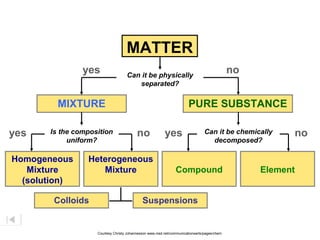
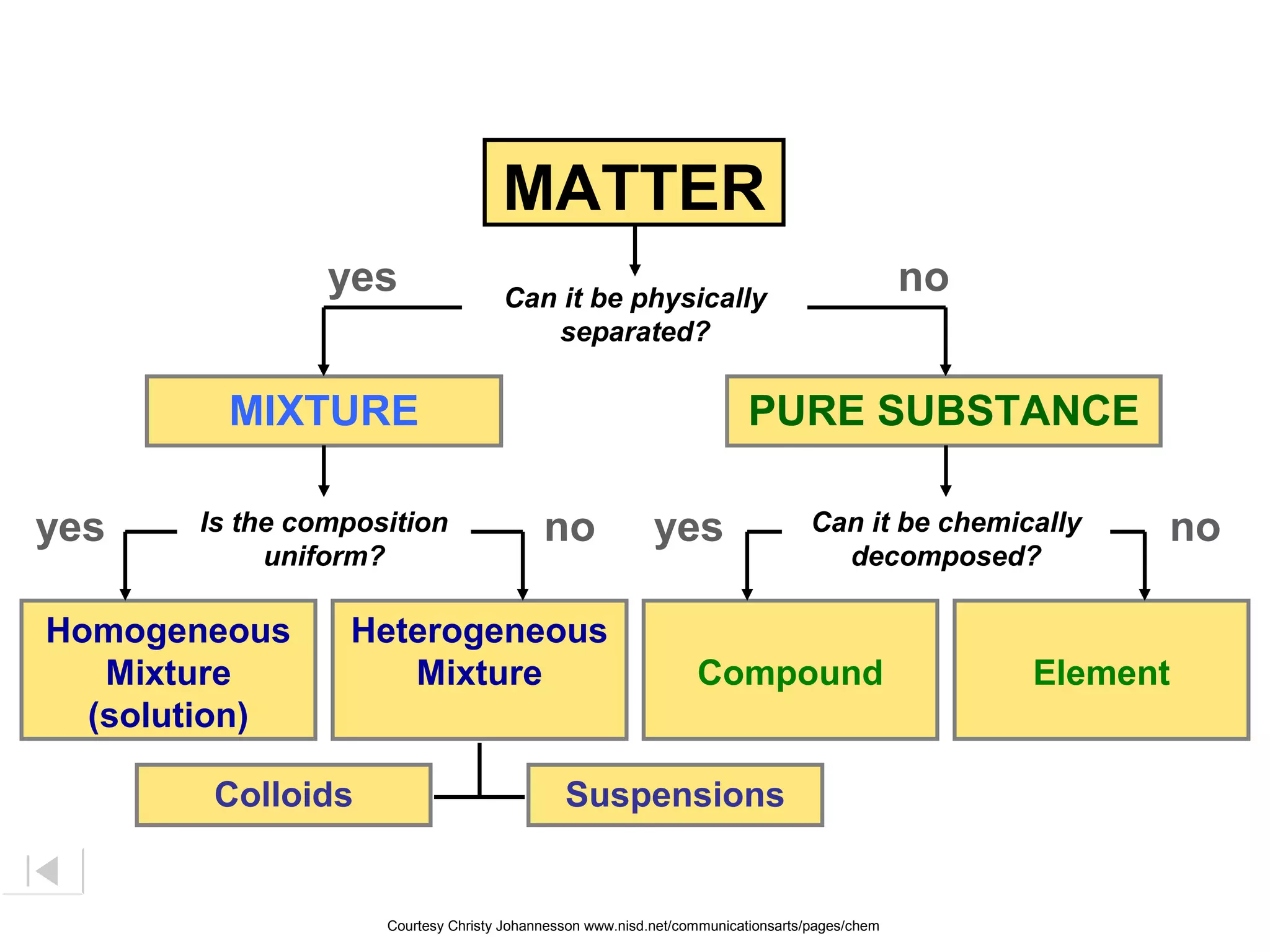
MATTER
Can it be physically
separated?
Homogeneous
Mixture
(solution)
Heterogeneous
Mixture Compound Element
MIXTURE PURE SUBSTANCE
yes no
Can it be chemically
decomposed?
noyesIs the composition
uniform?
noyes
Colloids Suspensions
Courtesy Christy Johannesson www.nisd.net/communicationsarts/pages/chem
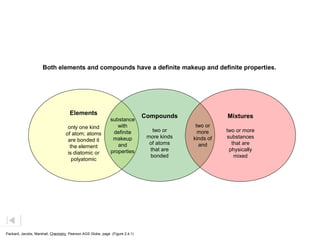
Elements
only one kind
of atom; atoms
are bonded it
the element
is diatomic or
polyatomic
Compounds
two or
more kinds
of atoms
that are
bonded
substance
with
definite
makeup
and
properties
Mixtures
two or more
substances
that are
physically
mixed
two or
more
kinds of
and
Both elements and compounds have a definite makeup and definite properties.
Packard, Jacobs, Marshall, Chemistry Pearson AGS Globe, page (Figure 2.4.1)
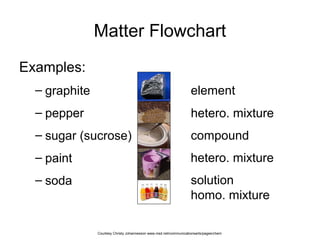
Matter Flowchart
Examples:
– graphite
– pepper
– sugar (sucrose)
– paint
– soda
Courtesy Christy Johannesson www.nisd.net/communicationsarts/pages/chem
element
hetero. mixture
compound
solution
homo. mixture
hetero. mixture
Pure Substances
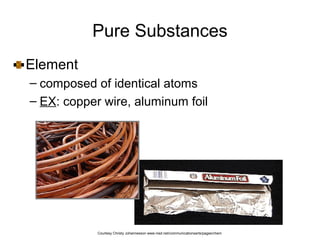
Element
– composed of identical atoms
– EX: copper wire, aluminum foil
Courtesy Christy Johannesson www.nisd.net/communicationsarts/pages/chem
Pure Substances
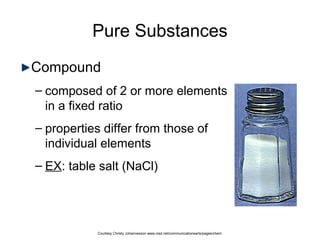
Compound
– composed of 2 or more elements
in a fixed ratio
– properties differ from those of
individual elements
– EX: table salt (NaCl)
Courtesy Christy Johannesson www.nisd.net/communicationsarts/pages/chem
Pure Substances
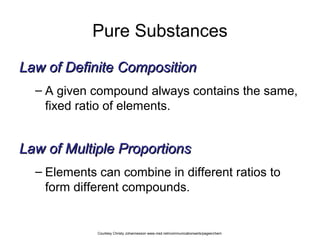
Law of Definite CompositionLaw of Definite Composition
– A given compound always contains the same,
fixed ratio of elements.
Law of Multiple ProportionsLaw of Multiple Proportions
– Elements can combine in different ratios to
form different compounds.
Courtesy Christy Johannesson www.nisd.net/communicationsarts/pages/chem
Pure Substances
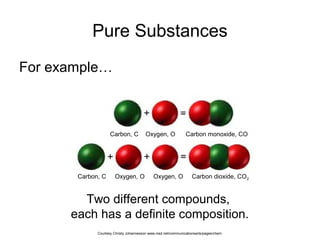
For example…
Two different compounds,
each has a definite composition.
Carbon, C Oxygen, O Carbon monoxide, CO
Carbon, C Oxygen, O Oxygen, O Carbon dioxide, CO2
Courtesy Christy Johannesson www.nisd.net/communicationsarts/pages/chem
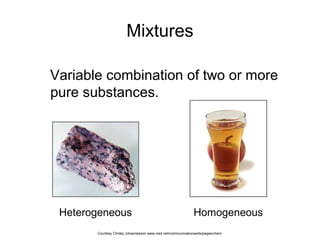
Mixtures
Variable combination of two or more
pure substances.
Heterogeneous Homogeneous
Courtesy Christy Johannesson www.nisd.net/communicationsarts/pages/chem
Mixtures
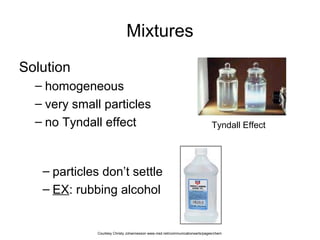
Solution
– homogeneous
– very small particles
– no Tyndall effect Tyndall Effect
– particles don’t settle
– EX: rubbing alcohol
Courtesy Christy Johannesson www.nisd.net/communicationsarts/pages/chem
Mixtures
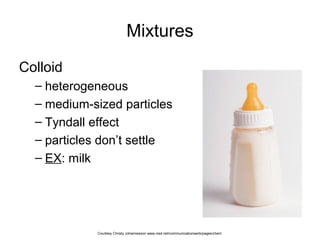
Colloid
– heterogeneous
– medium-sized particles
– Tyndall effect
– particles don’t settle
– EX: milk
Courtesy Christy Johannesson www.nisd.net/communicationsarts/pages/chem
Mixtures
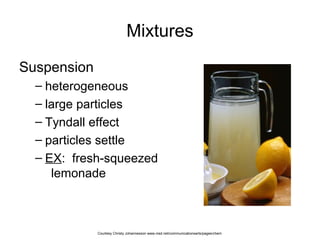
Suspension
– heterogeneous
– large particles
– Tyndall effect
– particles settle
– EX: fresh-squeezed
lemonade
Courtesy Christy Johannesson www.nisd.net/communicationsarts/pages/chem
Mixtures
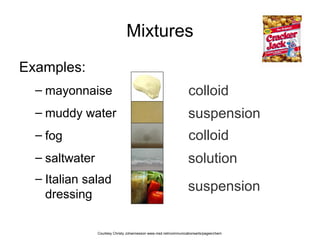
Examples:
– mayonnaise
– muddy water
– fog
– saltwater
– Italian salad
dressing
Courtesy Christy Johannesson www.nisd.net/communicationsarts/pages/chem
colloid
suspension
colloid
solution
suspension
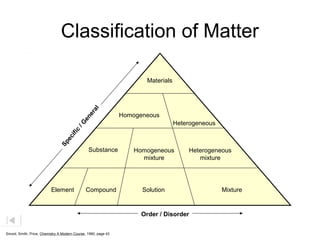
Classification of Matter
Materials
Homogeneous
Heterogeneous
Heterogeneous
mixture
Homogeneous
mixture
Substance
Element Compound Solution Mixture
Specific
/G
eneral
Order / Disorder
Smoot, Smith, Price, Chemistry A Modern Course, 1990, page 43
Classification of Matter
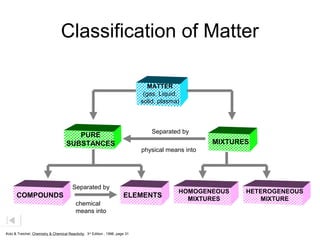
MATTER
(gas. Liquid,
solid, plasma)
PURE
SUBSTANCES MIXTURES
HETEROGENEOUS
MIXTURE
HOMOGENEOUS
MIXTURES
ELEMENTSCOMPOUNDS
Separated by
physical means into
Separated by
chemical
means into
Kotz & Treichel, Chemistry & Chemical Reactivity, 3rd
Edition , 1996, page 31
Classification of Matter
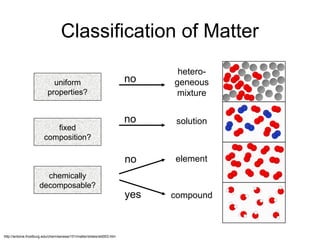
uniform
properties?
fixed
composition?
chemically
decomposable?
no
no
no
yes
hetero-
geneous
mixture
solution
element
compound
http://antoine.frostburg.edu/chem/senese/101/matter/slides/sld003.htm
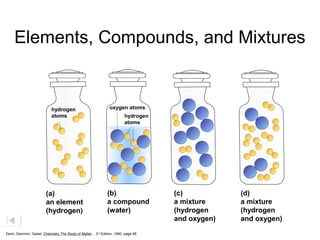
Elements, Compounds, and Mixtures
(a)
an element
(hydrogen)
(b)
a compound
(water)
(c)
a mixture
(hydrogen
and oxygen)
(d)
a mixture
(hydrogen
and oxygen)
Dorin, Demmin, Gabel, Chemistry The Study of Matter , 3rd
Edition, 1990, page 68
hydrogen
atoms hydrogen
atoms
oxygen atoms
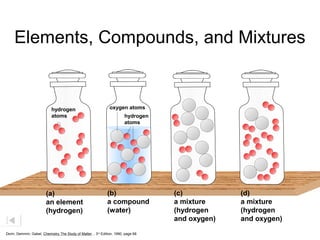
Elements, Compounds, and Mixtures
(a)
an element
(hydrogen)
(b)
a compound
(water)
(c)
a mixture
(hydrogen
and oxygen)
(d)
a mixture
(hydrogen
and oxygen)
Dorin, Demmin, Gabel, Chemistry The Study of Matter , 3rd
Edition, 1990, page 68
hydrogen
atoms hydrogen
atoms
oxygen atoms
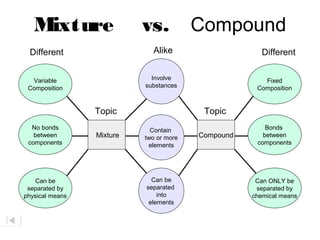
Mixture vs. Compound
Mixture
Fixed
Composition
Bonds
between
components
Can ONLY be
separated by
chemical means
Variable
Composition
No bonds
between
components
Can be
separated by
physical means
Alike Different
Contain
two or more
elements
Can be
separated
into
elements
Involve
substances
Compound
Different
Topic Topic
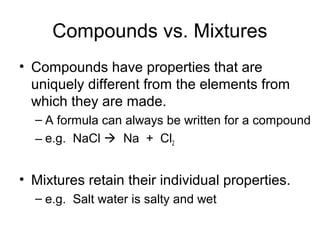
Compounds vs. Mixtures
• Compounds have properties that are
uniquely different from the elements from
which they are made.
– A formula can always be written for a compound
– e.g. NaCl  Na + Cl2
• Mixtures retain their individual properties.
– e.g. Salt water is salty and wet
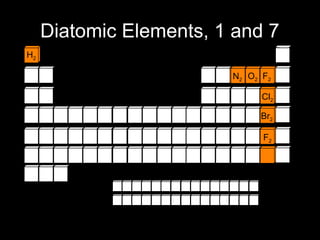
Diatomic Elements, 1 and 7
H2
N2 O2 F2
Cl2
Br2
F2
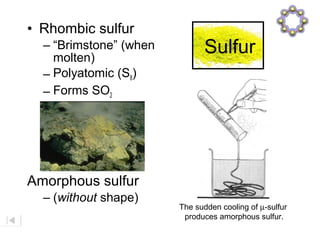
• Rhombic sulfur
– “Brimstone” (when
molten)
– Polyatomic (S8)
– Forms SO2
Amorphous sulfur
– (without shape)
Sulfur
The sudden cooling of µ-sulfur
produces amorphous sulfur.
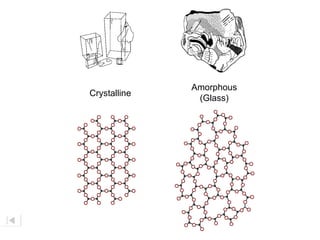
Amorphous
(Glass)
Crystalline
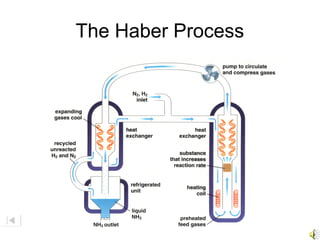
The Haber Process
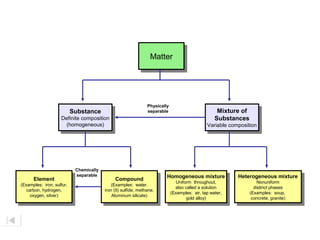
MatterMatter
Substance
Definite composition
(homogeneous)
Substance
Definite composition
(homogeneous)
Element
(Examples: iron, sulfur,
carbon, hydrogen,
oxygen, silver)
Element
(Examples: iron, sulfur,
carbon, hydrogen,
oxygen, silver)
Mixture of
Substances
Variable composition
Mixture of
Substances
Variable composition
Compound
(Examples: water.
iron (II) sulfide, methane,
Aluminum silicate)
Compound
(Examples: water.
iron (II) sulfide, methane,
Aluminum silicate)
Homogeneous mixture
Uniform throughout,
also called a solution
(Examples: air, tap water,
gold alloy)
Homogeneous mixture
Uniform throughout,
also called a solution
(Examples: air, tap water,
gold alloy)
Heterogeneous mixture
Nonuniform
distinct phases
(Examples: soup,
concrete, granite)
Heterogeneous mixture
Nonuniform
distinct phases
(Examples: soup,
concrete, granite)
Chemically
separable
Physically
separable
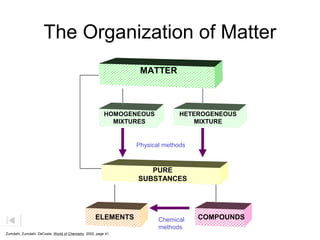
The Organization of Matter
MATTER
PURE
SUBSTANCES
HETEROGENEOUS
MIXTURE
HOMOGENEOUS
MIXTURES
ELEMENTS COMPOUNDS
Physical methods
Chemical
methods
Zumdahl, Zumdahl, DeCoste, World of Chemistry 2002, page 41
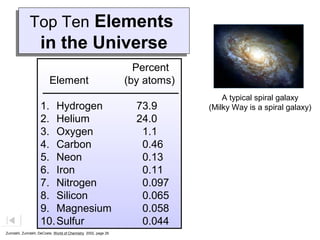
Top Ten Elements
in the Universe
Top Ten Elements
in the Universe
Percent
Element (by atoms)
1. Hydrogen 73.9
2. Helium 24.0
3. Oxygen 1.1
4. Carbon 0.46
5. Neon 0.13
6. Iron 0.11
7. Nitrogen 0.097
8. Silicon 0.065
9. Magnesium 0.058
10.Sulfur 0.044
A typical spiral galaxy
(Milky Way is a spiral galaxy)
Zumdahl, Zumdahl, DeCoste, World of Chemistry 2002, page 26
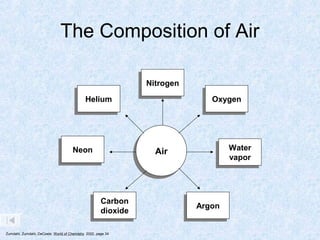
The Composition of Air
AirAir
NitrogenNitrogen
OxygenOxygenHeliumHelium
Water
vapor
Water
vapor
NeonNeon
Carbon
dioxide
Carbon
dioxide ArgonArgon
Zumdahl, Zumdahl, DeCoste, World of Chemistry 2002, page 34
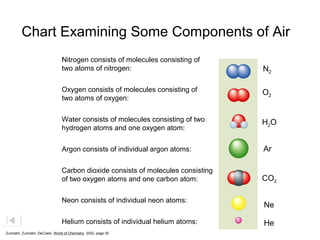
Chart Examining Some Components of Air
Nitrogen consists of molecules consisting of
two atoms of nitrogen:
Oxygen consists of molecules consisting of
two atoms of oxygen:
Water consists of molecules consisting of two
hydrogen atoms and one oxygen atom:
Argon consists of individual argon atoms:
Carbon dioxide consists of molecules consisting
of two oxygen atoms and one carbon atom:
Neon consists of individual neon atoms:
Helium consists of individual helium atoms:
N2
O2
H2O
Ar
CO2
Ne
He
Zumdahl, Zumdahl, DeCoste, World of Chemistry 2002, page 35
Reviewing ConceptsReviewing Concepts
Classifying Matter
• Why does every sample of a given substance
have the same properties?
• Explain why the composition of an element is
fixed.
• Describe the composition of a compound.
• Why can the properties of a mixture vary?
• On what basis can mixtures be classified as
solutions, suspensions, or colloids?

Ch. 2 classification of matter ppt

  • 1.
    MATTER Can it bephysically separated? Homogeneous Mixture (solution) Heterogeneous Mixture Compound Element MIXTURE PURE SUBSTANCE yes no Can it be chemically decomposed? noyesIs the composition uniform? noyes Colloids Suspensions Courtesy Christy Johannesson www.nisd.net/communicationsarts/pages/chem
  • 2.
    Elements only one kind ofatom; atoms are bonded it the element is diatomic or polyatomic Compounds two or more kinds of atoms that are bonded substance with definite makeup and properties Mixtures two or more substances that are physically mixed two or more kinds of and Both elements and compounds have a definite makeup and definite properties. Packard, Jacobs, Marshall, Chemistry Pearson AGS Globe, page (Figure 2.4.1)
  • 3.
    Matter Flowchart Examples: – graphite –pepper – sugar (sucrose) – paint – soda Courtesy Christy Johannesson www.nisd.net/communicationsarts/pages/chem element hetero. mixture compound solution homo. mixture hetero. mixture
  • 4.
    Pure Substances Element – composedof identical atoms – EX: copper wire, aluminum foil Courtesy Christy Johannesson www.nisd.net/communicationsarts/pages/chem
  • 5.
    Pure Substances Compound – composedof 2 or more elements in a fixed ratio – properties differ from those of individual elements – EX: table salt (NaCl) Courtesy Christy Johannesson www.nisd.net/communicationsarts/pages/chem
  • 6.
    Pure Substances Law ofDefinite CompositionLaw of Definite Composition – A given compound always contains the same, fixed ratio of elements. Law of Multiple ProportionsLaw of Multiple Proportions – Elements can combine in different ratios to form different compounds. Courtesy Christy Johannesson www.nisd.net/communicationsarts/pages/chem
  • 7.
    Pure Substances For example… Twodifferent compounds, each has a definite composition. Carbon, C Oxygen, O Carbon monoxide, CO Carbon, C Oxygen, O Oxygen, O Carbon dioxide, CO2 Courtesy Christy Johannesson www.nisd.net/communicationsarts/pages/chem
  • 8.
    Mixtures Variable combination oftwo or more pure substances. Heterogeneous Homogeneous Courtesy Christy Johannesson www.nisd.net/communicationsarts/pages/chem
  • 9.
    Mixtures Solution – homogeneous – verysmall particles – no Tyndall effect Tyndall Effect – particles don’t settle – EX: rubbing alcohol Courtesy Christy Johannesson www.nisd.net/communicationsarts/pages/chem
  • 10.
    Mixtures Colloid – heterogeneous – medium-sizedparticles – Tyndall effect – particles don’t settle – EX: milk Courtesy Christy Johannesson www.nisd.net/communicationsarts/pages/chem
  • 11.
    Mixtures Suspension – heterogeneous – largeparticles – Tyndall effect – particles settle – EX: fresh-squeezed lemonade Courtesy Christy Johannesson www.nisd.net/communicationsarts/pages/chem
  • 12.
    Mixtures Examples: – mayonnaise – muddywater – fog – saltwater – Italian salad dressing Courtesy Christy Johannesson www.nisd.net/communicationsarts/pages/chem colloid suspension colloid solution suspension
  • 13.
    Classification of Matter Materials Homogeneous Heterogeneous Heterogeneous mixture Homogeneous mixture Substance ElementCompound Solution Mixture Specific /G eneral Order / Disorder Smoot, Smith, Price, Chemistry A Modern Course, 1990, page 43
  • 14.
    Classification of Matter MATTER (gas.Liquid, solid, plasma) PURE SUBSTANCES MIXTURES HETEROGENEOUS MIXTURE HOMOGENEOUS MIXTURES ELEMENTSCOMPOUNDS Separated by physical means into Separated by chemical means into Kotz & Treichel, Chemistry & Chemical Reactivity, 3rd Edition , 1996, page 31
  • 15.
  • 16.
    Elements, Compounds, andMixtures (a) an element (hydrogen) (b) a compound (water) (c) a mixture (hydrogen and oxygen) (d) a mixture (hydrogen and oxygen) Dorin, Demmin, Gabel, Chemistry The Study of Matter , 3rd Edition, 1990, page 68 hydrogen atoms hydrogen atoms oxygen atoms
  • 17.
    Elements, Compounds, andMixtures (a) an element (hydrogen) (b) a compound (water) (c) a mixture (hydrogen and oxygen) (d) a mixture (hydrogen and oxygen) Dorin, Demmin, Gabel, Chemistry The Study of Matter , 3rd Edition, 1990, page 68 hydrogen atoms hydrogen atoms oxygen atoms
  • 18.
    Mixture vs. Compound Mixture Fixed Composition Bonds between components CanONLY be separated by chemical means Variable Composition No bonds between components Can be separated by physical means Alike Different Contain two or more elements Can be separated into elements Involve substances Compound Different Topic Topic
  • 19.
    Compounds vs. Mixtures •Compounds have properties that are uniquely different from the elements from which they are made. – A formula can always be written for a compound – e.g. NaCl  Na + Cl2 • Mixtures retain their individual properties. – e.g. Salt water is salty and wet
  • 20.
    Diatomic Elements, 1and 7 H2 N2 O2 F2 Cl2 Br2 F2
  • 21.
    • Rhombic sulfur –“Brimstone” (when molten) – Polyatomic (S8) – Forms SO2 Amorphous sulfur – (without shape) Sulfur The sudden cooling of µ-sulfur produces amorphous sulfur.
  • 22.
  • 23.
  • 24.
    MatterMatter Substance Definite composition (homogeneous) Substance Definite composition (homogeneous) Element (Examples:iron, sulfur, carbon, hydrogen, oxygen, silver) Element (Examples: iron, sulfur, carbon, hydrogen, oxygen, silver) Mixture of Substances Variable composition Mixture of Substances Variable composition Compound (Examples: water. iron (II) sulfide, methane, Aluminum silicate) Compound (Examples: water. iron (II) sulfide, methane, Aluminum silicate) Homogeneous mixture Uniform throughout, also called a solution (Examples: air, tap water, gold alloy) Homogeneous mixture Uniform throughout, also called a solution (Examples: air, tap water, gold alloy) Heterogeneous mixture Nonuniform distinct phases (Examples: soup, concrete, granite) Heterogeneous mixture Nonuniform distinct phases (Examples: soup, concrete, granite) Chemically separable Physically separable
  • 25.
    The Organization ofMatter MATTER PURE SUBSTANCES HETEROGENEOUS MIXTURE HOMOGENEOUS MIXTURES ELEMENTS COMPOUNDS Physical methods Chemical methods Zumdahl, Zumdahl, DeCoste, World of Chemistry 2002, page 41
  • 26.
    Top Ten Elements inthe Universe Top Ten Elements in the Universe Percent Element (by atoms) 1. Hydrogen 73.9 2. Helium 24.0 3. Oxygen 1.1 4. Carbon 0.46 5. Neon 0.13 6. Iron 0.11 7. Nitrogen 0.097 8. Silicon 0.065 9. Magnesium 0.058 10.Sulfur 0.044 A typical spiral galaxy (Milky Way is a spiral galaxy) Zumdahl, Zumdahl, DeCoste, World of Chemistry 2002, page 26
  • 27.
    The Composition ofAir AirAir NitrogenNitrogen OxygenOxygenHeliumHelium Water vapor Water vapor NeonNeon Carbon dioxide Carbon dioxide ArgonArgon Zumdahl, Zumdahl, DeCoste, World of Chemistry 2002, page 34
  • 28.
    Chart Examining SomeComponents of Air Nitrogen consists of molecules consisting of two atoms of nitrogen: Oxygen consists of molecules consisting of two atoms of oxygen: Water consists of molecules consisting of two hydrogen atoms and one oxygen atom: Argon consists of individual argon atoms: Carbon dioxide consists of molecules consisting of two oxygen atoms and one carbon atom: Neon consists of individual neon atoms: Helium consists of individual helium atoms: N2 O2 H2O Ar CO2 Ne He Zumdahl, Zumdahl, DeCoste, World of Chemistry 2002, page 35
  • 29.
    Reviewing ConceptsReviewing Concepts ClassifyingMatter • Why does every sample of a given substance have the same properties? • Explain why the composition of an element is fixed. • Describe the composition of a compound. • Why can the properties of a mixture vary? • On what basis can mixtures be classified as solutions, suspensions, or colloids?

Editor's Notes

  • #2 http://www.chem1.com/acad/webtext/pre/chemsci.html
  • #5 Graphite image: geology.about.com/.../bl/images/blgraphite.htm
  • #6 http://www.friedlandindustries.com/images/new/NonferrousMetalsCopper.jpg
  • #17 http://antoine.frostburg.edu/chem/senese/101/matter/slides/sld003.htm
  • #18 “Elements, Compounds, and Mixtures”   Description: This slide shows the molecular composition of an element, a compound, and two mixtures.   Basic Concepts All samples of a substance have the same molecular composition and intensive properties and are homogeneous. Elements and compounds are substances; mixtures are not. The elements making up a compound combine in fixed ratios. Mixtures can be separated by physical methods. Mixtures that have a uniform composition throughout are homogeneous; those that have parts with different compositions are heterogeneous.   Teaching Suggestions Use this transparency to help students visualize the molecular composition of elements, compounds, and mixtures and to review the definitions of these terms. Make sure students understand the difference between the terms matter and substance. Remind students that elements and compounds are always homogeneous, while mixtures can be either homogeneous or heterogeneous.   Questions: Which of the bottles pictured above contain(s) matter? Which contain(s) a single substance? Explain your answers. How many elements are present in each molecule of water shown in bottle (b)? What is the relative number of atoms of each element in a water molecule? As you know, ice is frozen water. In other words, ice and water are the same substance, in different phases. What would you expect the ratio of hydrogen atoms to oxygen atoms to be in a molecule of ice? Explain your reasoning. Bottle (c) and bottle (d) both contain mixtures. How are these mixtures similar? How are they different? Suppose you find an unlabeled bottle containing a clear liquid. Can you tell by looking at it whether the material is a compound or a mixture? Explain your answer. How can you prove that a sample of sea water is a mixture? Classify the following items as elements, compounds or mixtures; rice pudding, copper, carbon dioxide, air, milk, magnesium chloride, granite, mercury, and maple syrup. A chocolate-chip cookie with more chips in one part of the cookie than another can be used to demonstrate a heterogeneous mixture. Name two other materials that can be classified as heterogeneous mixtures. Explain your reasoning.  
  • #19 “Elements, Compounds, and Mixtures”   Description: This slide shows the molecular composition of an element, a compound, and two mixtures.   Basic Concepts All samples of a substance have the same molecular composition and intensive properties and are homogeneous. Elements and compounds are substances; mixtures are not. The elements making up a compound combine in fixed ratios. Mixtures can be separated by physical methods. Mixtures that have a uniform composition throughout are homogeneous; those that have parts with different compositions are heterogeneous.   Teaching Suggestions Use this transparency to help students visualize the molecular composition of elements, compounds, and mixtures and to review the definitions of these terms. Make sure students understand the difference between the terms matter and substance. Remind students that elements and compounds are always homogeneous, while mixtures can be either homogeneous or heterogeneous.   Questions: Which of the bottles pictured above contain(s) matter? Which contain(s) a single substance? Explain your answers. How many elements are present in each molecule of water shown in bottle (b)? What is the relative number of atoms of each element in a water molecule? As you know, ice is frozen water. In other words, ice and water are the same substance, in different phases. What would you expect the ratio of hydrogen atoms to oxygen atoms to be in a molecule of ice? Explain your reasoning. Bottle (c) and bottle (d) both contain mixtures. How are these mixtures similar? How are they different? Suppose you find an unlabeled bottle containing a clear liquid. Can you tell by looking at it whether the material is a compound or a mixture? Explain your answer. How can you prove that a sample of sea water is a mixture? Classify the following items as elements, compounds or mixtures; rice pudding, copper, carbon dioxide, air, milk, magnesium chloride, granite, mercury, and maple syrup. A chocolate-chip cookie with more chips in one part of the cookie than another can be used to demonstrate a heterogeneous mixture. Name two other materials that can be classified as heterogeneous mixtures. Explain your reasoning.  
  • #20 Compounds have different properties than the elements they are made from. In a mixture, the mixture retains the properties of the materials it is made from. A chemical formula can always be written for a compound.
  • #23 Shoot photograph of solid piece of rhombic sulfur and ‘rubbery” amorphous sulfur. Point out that both forms of sulfur are the exact same material. They do have different physical properties because of their structure. ‘Structure leads to function’ (an important concept in biochemistry) Look for link to rubber manufacture: vulcanization.
  • #24 Crystalline - a pattern to the manner in which the atoms are bonded together. crystalline lattice structure Amorphous - 'without shape'; no regular pattern exists as to how the atoms are bonded together
  • #25 HELPING THE WAR EFFORT “Fritz Haber (1868-1934), a German chemist, succeeded in manufacturing ammonia from nitrogen and hydrogen gases using a catalyst of osmium. Saltpeter was used to prepare nitric acid, needed for the manufacture of explosives. During World War I Germany’s supplies of saltpeter from Chile were cut off. However, ammonia could be oxidized to nitric acid, so the new Haber process ensured the continuing supplies of explosives. Haber used Le Chatelier’s principle to work out the best conditions of temperature and pressure. Only 10-20 percent of the nitrogen and hydrogen combine, so the gases are recycled.” Eyewitness Science “Chemistry” , Dr. Ann Newmark, DK Publishing, Inc., 1993, pg 39
  • #26 Basis for separation: different components, different properties. Strategy: devise a process that discriminates between components with different properties. high density / low density reactive / inert volatile / nonvolatile soluble / insoluble polar / nonpolar magnetic . nonmagnetic
  • #31 Prentice Hall Physical Science Concepts in Action (Wysession, Frank, Yancopoulos) 2004 pg 44 Every sample of a given substance has the same properties because a substance has a fixed, uniform composition. An element has a fixed composition because it contains only one type of atom. A compound always contains two or more elements joined in a fixed proportion. The properties of a mixture can vary because the composition of a mixture is not fixed. Based on the size of its largest particles, a mixture can be classified as a solution, a suspension, or a colloid. http://upload.wikimedia.org/wikipedia/commons/thumb/7/73/Syndiotactic_polypropene.png/300px-Syndiotactic_polypropene.png