SPECIALIZED CONNECTED
TISSUE:
BONE
Clara Corpuz
Emsi Cipriano
Jacob Dela Cruz
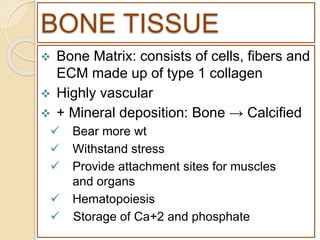
BONE TISSUE
 Bone Matrix: consists of cells, fibers and
ECM made up of type 1 collagen
 Highly vascular
 + Mineral deposition: Bone → Calcified
 Bear more wt
 Withstand stress
 Provide attachment sites for muscles
and organs
 Hematopoiesis
 Storage of Ca+2 and phosphate
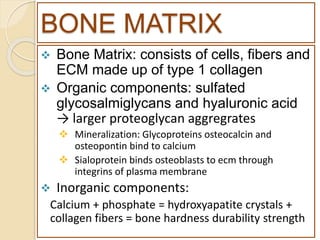
BONE MATRIX
 Bone Matrix: consists of cells, fibers and
ECM made up of type 1 collagen
 Organic components: sulfated
glycosalmiglycans and hyaluronic acid
→ larger proteoglycan aggregrates
 Mineralization: Glycoproteins osteocalcin and
osteopontin bind to calcium
 Sialoprotein binds osteoblasts to ecm through
integrins of plasma membrane
 Inorganic components:
Calcium + phosphate = hydroxyapatite crystals +
collagen fibers = bone hardness durability strength
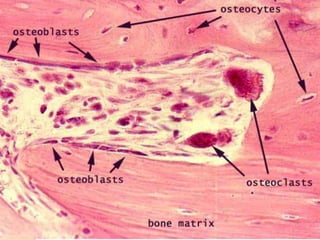
BONE CELLS
 Osteoprogenitor cells:
undifferentiated, pleuropotential stem
cells
 Osteoblasts: @ surface of the bone
that synthesize, secrete bony matrix;
active
 Osteocytes: mature form of
osteoblasts; maintain the structural
integrity of the matrix
 Osteoclasts: resorb bone during
PROCESS OF BONE
FORMATION
 Endochondrial Ossification
 Intramembranous Ossification
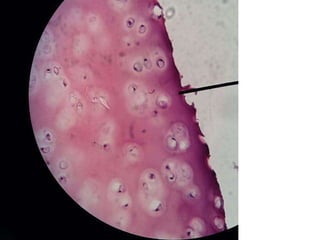
Endochondral Ossification
 Hyaline Cartilage → Interstital and Appositional
Growth → Chondrocytes divide and enlarge →
Cartilage Calcify → diffusion of nutrients ↓
chondrocytes die fragmented → calcified matrix
→ Periosteum → osteoprogenitor cells (arise
from endosteum) and bv invades → Osteoblasts
 Mesenchyme + Osteoblasts + Bv = Ossification
center
 Long bones: primary ossification center in
diaphysis → secondary in epiphysis → Osteoid
Matrix → bone (x epiphyseal plate region)
INTRAMEMBRANOUS
OSSIFICATION
 No cartilage
 forms the mandible, clavicles, and flat
bones of the body
 Mesenchyme → Osteoblasts → osteoid
→ calcified → osteocytes w/ lacunae
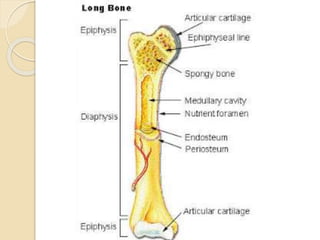
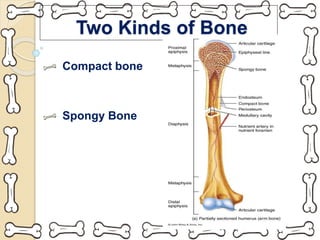
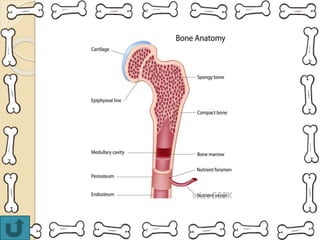
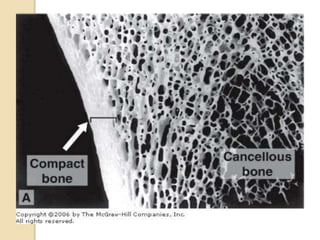
Two Kinds of Bone
Compact bone
Spongy Bone
Spongy Bone
 Also called cancellous or trabecular
bone
 No formal osteons
 Trabeculae
 Forms most of the structure of short,
flat, and irregular bones, and the
epiphyses of long bones.
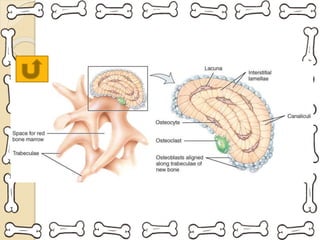
Spongy bone (Trabeculae)
 Latticework of thin plates of bone
oriented along lines of stress
 Contains red bone marrow
(hemopoiesis)
 Found in ends of long bones and
inside flat bones such as the
hipbones, sternum, sides of skull, and
ribs.
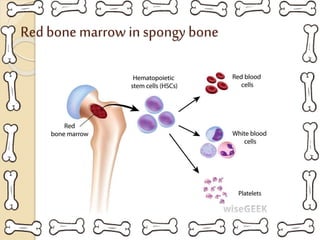
Red bone marrow in spongy bone
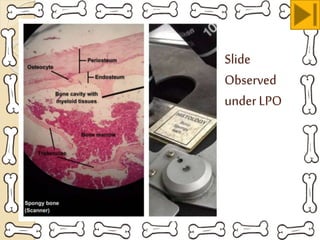
Slide
Observed
under LPO
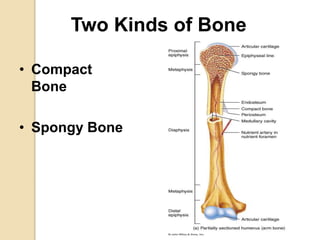
Two Kinds of Bone
• Compact
Bone
• Spongy Bone
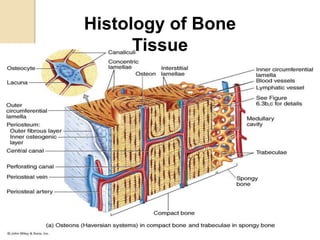
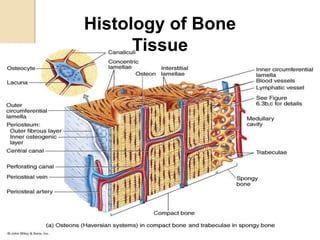
Histology of Bone
Tissue
Compact Bone
• The structural unit of compact bone is the
osteon or Haversian system.
• Each osteon is an elongated cylinder
running parallel to the long axis of the
bone.
• It actually contains canals and
passageways that provide access for
nerves, blood vessels, and lymphatic
ducts.
• Each columns is made up of concentric
rings or lamellae along the calcified matrix.
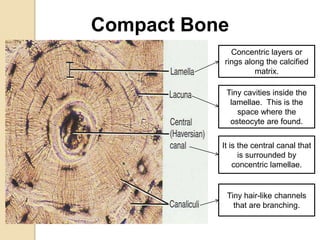
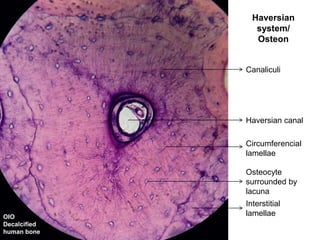
Concentric layers or
rings along the calcified
matrix.
Tiny cavities inside the
lamellae. This is the
space where the
osteocyte are found.
It is the central canal that
is surrounded by
concentric lamellae.
Tiny hair-like channels
that are branching.
Compact Bone
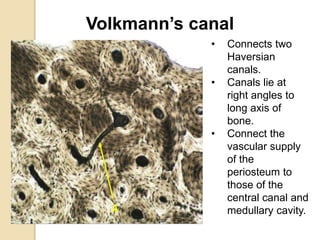
• Connects two
Haversian
canals.
• Canals lie at
right angles to
long axis of
bone.
• Connect the
vascular supply
of the
periosteum to
those of the
central canal and
medullary cavity.
Volkmann’s canal
Histology of Bone
Tissue
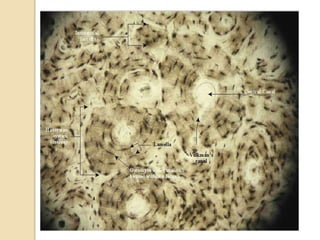
Canaliculi
Haversian canal
Circumferencial
lamellae
Osteocyte
surrounded by
lacuna
Interstitial
lamellae
Haversian
system/
Osteon
OIO
Decalcified
human bone
REFERENCES
 Difiores’ Atlas of Histology 11th Ed.
 http://www.freezingblue.com/iphone/fla
shcards/printPreview.cgi?cardsetID=2
66224
 http://www.wisegeekhealth.com/what-
is-spongy-bone.htm
 http://www.gla.ac.uk/t4/~fbls/files/fab/t
utorial/generic/bone2.html

Histology - Specialized Connective Tissues (BONE)

  • 1.
  • 2.
    BONE TISSUE  BoneMatrix: consists of cells, fibers and ECM made up of type 1 collagen  Highly vascular  + Mineral deposition: Bone → Calcified  Bear more wt  Withstand stress  Provide attachment sites for muscles and organs  Hematopoiesis  Storage of Ca+2 and phosphate
  • 3.
    BONE MATRIX  BoneMatrix: consists of cells, fibers and ECM made up of type 1 collagen  Organic components: sulfated glycosalmiglycans and hyaluronic acid → larger proteoglycan aggregrates  Mineralization: Glycoproteins osteocalcin and osteopontin bind to calcium  Sialoprotein binds osteoblasts to ecm through integrins of plasma membrane  Inorganic components: Calcium + phosphate = hydroxyapatite crystals + collagen fibers = bone hardness durability strength
  • 4.
    BONE CELLS  Osteoprogenitorcells: undifferentiated, pleuropotential stem cells  Osteoblasts: @ surface of the bone that synthesize, secrete bony matrix; active  Osteocytes: mature form of osteoblasts; maintain the structural integrity of the matrix  Osteoclasts: resorb bone during
  • 6.
    PROCESS OF BONE FORMATION Endochondrial Ossification  Intramembranous Ossification
  • 7.
    Endochondral Ossification  HyalineCartilage → Interstital and Appositional Growth → Chondrocytes divide and enlarge → Cartilage Calcify → diffusion of nutrients ↓ chondrocytes die fragmented → calcified matrix → Periosteum → osteoprogenitor cells (arise from endosteum) and bv invades → Osteoblasts  Mesenchyme + Osteoblasts + Bv = Ossification center  Long bones: primary ossification center in diaphysis → secondary in epiphysis → Osteoid Matrix → bone (x epiphyseal plate region)
  • 9.
    INTRAMEMBRANOUS OSSIFICATION  No cartilage forms the mandible, clavicles, and flat bones of the body  Mesenchyme → Osteoblasts → osteoid → calcified → osteocytes w/ lacunae
  • 10.
    Two Kinds ofBone Compact bone Spongy Bone
  • 11.
    Spongy Bone  Alsocalled cancellous or trabecular bone  No formal osteons  Trabeculae  Forms most of the structure of short, flat, and irregular bones, and the epiphyses of long bones.
  • 12.
    Spongy bone (Trabeculae) Latticework of thin plates of bone oriented along lines of stress  Contains red bone marrow (hemopoiesis)  Found in ends of long bones and inside flat bones such as the hipbones, sternum, sides of skull, and ribs.
  • 14.
    Red bone marrowin spongy bone
  • 15.
  • 18.
    Two Kinds ofBone • Compact Bone • Spongy Bone
  • 19.
  • 21.
    Compact Bone • Thestructural unit of compact bone is the osteon or Haversian system. • Each osteon is an elongated cylinder running parallel to the long axis of the bone. • It actually contains canals and passageways that provide access for nerves, blood vessels, and lymphatic ducts. • Each columns is made up of concentric rings or lamellae along the calcified matrix.
  • 22.
    Concentric layers or ringsalong the calcified matrix. Tiny cavities inside the lamellae. This is the space where the osteocyte are found. It is the central canal that is surrounded by concentric lamellae. Tiny hair-like channels that are branching. Compact Bone
  • 24.
    • Connects two Haversian canals. •Canals lie at right angles to long axis of bone. • Connect the vascular supply of the periosteum to those of the central canal and medullary cavity. Volkmann’s canal
  • 25.
  • 26.
  • 27.
    REFERENCES  Difiores’ Atlasof Histology 11th Ed.  http://www.freezingblue.com/iphone/fla shcards/printPreview.cgi?cardsetID=2 66224  http://www.wisegeekhealth.com/what- is-spongy-bone.htm  http://www.gla.ac.uk/t4/~fbls/files/fab/t utorial/generic/bone2.html

Editor's Notes

  • #3 Main constituent of skeleton Bone matrix: contains organic and inorganic components where organic enable bones to resist tension and the mineral components enable bones to resist compression
  • #4 Calcium + phosphate = hydroxyapatite crystals + collagen fibers = bone hardness durability strenght
  • #5 Osteoprogenitor cells: located on the inner layer of periosteum and in the single layer of endosteum that lines the marrow cavities, harvesian system, and perforating canals. Perio and endo fxn: nutrition of bone and provide continous supply of new osteoblasts for growth remodeling and repair of bones During bone dev’t osp cells proliferate by mitosis and differentiate into osteoblasts than secretes the bony matrix Osteocytes: smaller than osteoblasts; trapped by the surrounding bone matrix produced by osteoblasts; one osteocyte in each lacuna; principal cells of the bone Osteoclasts: large multinucleated cells where removal and remodeling and repair of bone take place; located on howship’s lacunae
  • #8 Calcified Matrix- serves as structural framework for deposition of bony material Endosteum- lines internal cavities n bone; single layer of osteoprogenitor cells Osteoid Matrix- produced by osteoblasts mineralized into bone Epiphyseal Plate Region- growth continues and responsible for lenghtening bone until bone growth stops. Excepet in the free ends of long bones where a layer of permanent hyaline cartilage covers bone called articular cartilage
  • #10 forms the mandible, clavicles, and flat bones of the body bone development not preceded by a hyaline cartilage model, instead bone develops from condensation of CT mesenchyme to form an ossification center mesenchyme cells differentiate directly into osteoblasts that produce the bone matrix, called osteoid the bone matrix becomes calcified, osteoblasts become osteocytes within lacunae, and the process repeats resulting in production of layers of bone