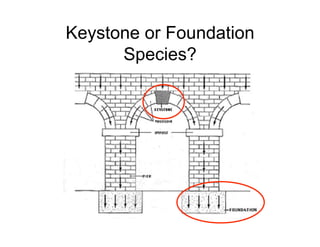
Keystone or Foundation
      Species?
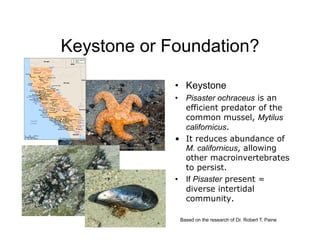
Keystone or Foundation?

             •  Keystone
             •  Pisaster ochraceus is an
                efficient predator of the
                common mussel, Mytilus
                californicus.
             •  It reduces abundance of
                M. californicus, allowing
                other macroinvertebrates
                to persist.
             •  If Pisaster present =
                diverse intertidal
                community.

              Based on the research of Dr. Robert T. Paine
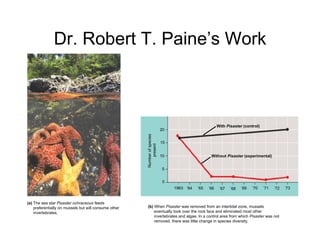
Dr. Robert T. Paine’s Work


                                                                                                       With Pisaster (control)
                                                                           20


                                                       Number of species
                                                                           15

                                                           present         10                     Without Pisaster (experimental)


                                                                            5


                                                                            0
                                                                                1963 ´64   ´65   ´66    ´67   ´68   ´69   ´70    ´71   ´72   ´73


(a) The sea star Pisaster ochraceous feeds
    preferentially on mussels but will consume other    (b) When Pisaster was removed from an intertidal zone, mussels
    invertebrates.                                          eventually took over the rock face and eliminated most other
                                                            invertebrates and algae. In a control area from which Pisaster was not
                                                            removed, there was little change in species diversity.
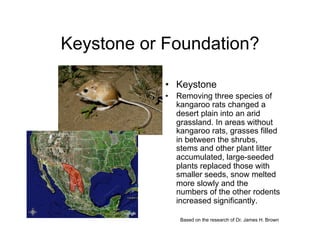
Keystone or Foundation?

            •  Keystone
            •  Removing three species of
               kangaroo rats changed a
               desert plain into an arid
               grassland. In areas without
               kangaroo rats, grasses filled
               in between the shrubs,
               stems and other plant litter
               accumulated, large-seeded
               plants replaced those with
               smaller seeds, snow melted
               more slowly and the
               numbers of the other rodents
               increased significantly.

                Based on the research of Dr. James H. Brown
Keystone or Foundation?
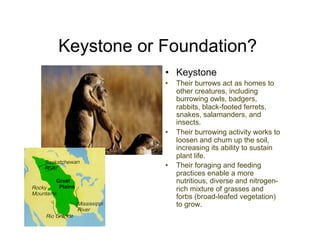
            •  Keystone
            •    Their burrows act as homes to
                 other creatures, including
                 burrowing owls, badgers,
                 rabbits, black-footed ferrets,
                 snakes, salamanders, and
                 insects.
            •    Their burrowing activity works to
                 loosen and churn up the soil,
                 increasing its ability to sustain
                 plant life.
            •    Their foraging and feeding
                 practices enable a more
                 nutritious, diverse and nitrogen-
                 rich mixture of grasses and
                 forbs (broad-leafed vegetation)
                 to grow.
Keystone or Foundation?

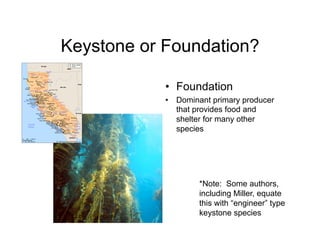
            •  Foundation
            •  Dominant primary producer
               that provides food and
               shelter for many other
               species


                    *Note: Some authors,
                    including Miller, equate
                    this with “engineer” type
                    keystone species
Effects of losing the
           “keystone” predator…
                               •  A trophic cascade-
                                  in a food web, the
                                  cascading effect that a
                                  change in the size of one
                                  population (usually an
                                  apex predator) in the
                                  web has on the
                                  populations below it


Example: Gray Wolf in Yellowstone National Park
(Wolf -> Elk -> Cottonwood/Aspen/Willow -> Bird Populations)
Don’t forget…


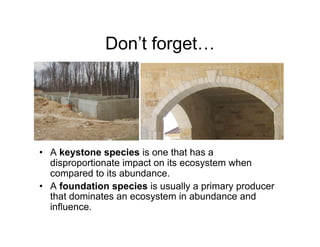
•  A keystone species is one that has a
   disproportionate impact on its ecosystem when
   compared to its abundance.
•  A foundation species is usually a primary producer
   that dominates an ecosystem in abundance and
   influence.
Sources
•  http://www.washington.edu/research/
   pathbreakers/1969g.html (starfish)
•  http://query.nytimes.com/gst/fullpage.html?
   res=9C0CE1DB1530F936A15751C1A966958
   260 (kangaroo rats)
•  http://www.prairiedogs.org/keystone.html
   (praire dogs)
•  http://www.eoearth.org/article/
   Global_marine_biodiversity_trends (kelp)

Keystone and Foundation Species

  • 1.
  • 2.
    Keystone or Foundation? •  Keystone •  Pisaster ochraceus is an efficient predator of the common mussel, Mytilus californicus. •  It reduces abundance of M. californicus, allowing other macroinvertebrates to persist. •  If Pisaster present = diverse intertidal community. Based on the research of Dr. Robert T. Paine
  • 3.
    Dr. Robert T.Paine’s Work With Pisaster (control) 20 Number of species 15 present 10 Without Pisaster (experimental) 5 0 1963 ´64 ´65 ´66 ´67 ´68 ´69 ´70 ´71 ´72 ´73 (a) The sea star Pisaster ochraceous feeds preferentially on mussels but will consume other (b) When Pisaster was removed from an intertidal zone, mussels invertebrates. eventually took over the rock face and eliminated most other invertebrates and algae. In a control area from which Pisaster was not removed, there was little change in species diversity.
  • 4.
    Keystone or Foundation? •  Keystone •  Removing three species of kangaroo rats changed a desert plain into an arid grassland. In areas without kangaroo rats, grasses filled in between the shrubs, stems and other plant litter accumulated, large-seeded plants replaced those with smaller seeds, snow melted more slowly and the numbers of the other rodents increased significantly. Based on the research of Dr. James H. Brown
  • 5.
    Keystone or Foundation? •  Keystone •  Their burrows act as homes to other creatures, including burrowing owls, badgers, rabbits, black-footed ferrets, snakes, salamanders, and insects. •  Their burrowing activity works to loosen and churn up the soil, increasing its ability to sustain plant life. •  Their foraging and feeding practices enable a more nutritious, diverse and nitrogen- rich mixture of grasses and forbs (broad-leafed vegetation) to grow.
  • 6.
    Keystone or Foundation? •  Foundation •  Dominant primary producer that provides food and shelter for many other species *Note: Some authors, including Miller, equate this with “engineer” type keystone species
  • 7.
    Effects of losingthe “keystone” predator… •  A trophic cascade- in a food web, the cascading effect that a change in the size of one population (usually an apex predator) in the web has on the populations below it Example: Gray Wolf in Yellowstone National Park (Wolf -> Elk -> Cottonwood/Aspen/Willow -> Bird Populations)
  • 8.
    Don’t forget… •  Akeystone species is one that has a disproportionate impact on its ecosystem when compared to its abundance. •  A foundation species is usually a primary producer that dominates an ecosystem in abundance and influence.
  • 9.
    Sources •  http://www.washington.edu/research/ pathbreakers/1969g.html (starfish) •  http://query.nytimes.com/gst/fullpage.html? res=9C0CE1DB1530F936A15751C1A966958 260 (kangaroo rats) •  http://www.prairiedogs.org/keystone.html (praire dogs) •  http://www.eoearth.org/article/ Global_marine_biodiversity_trends (kelp)