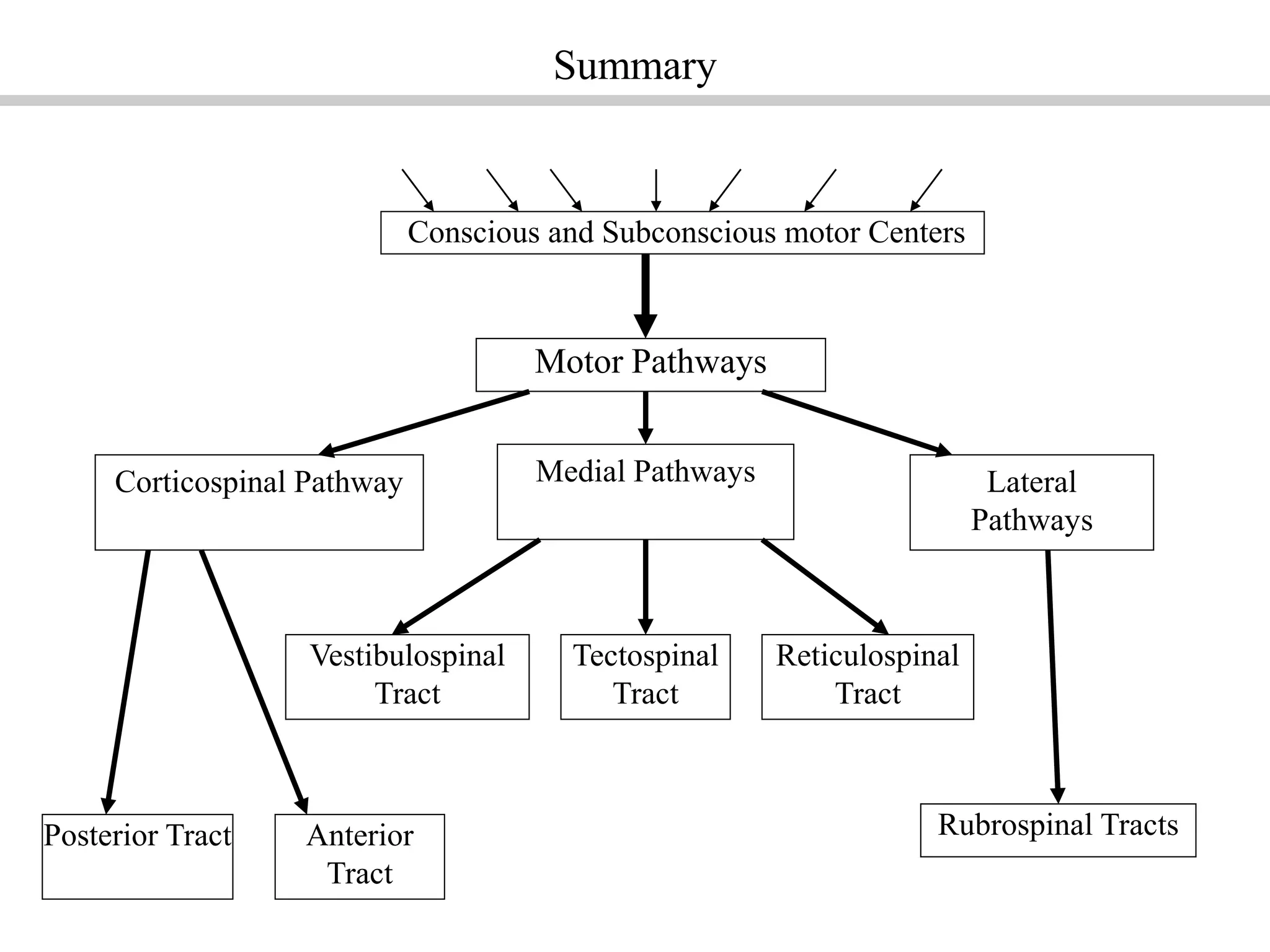
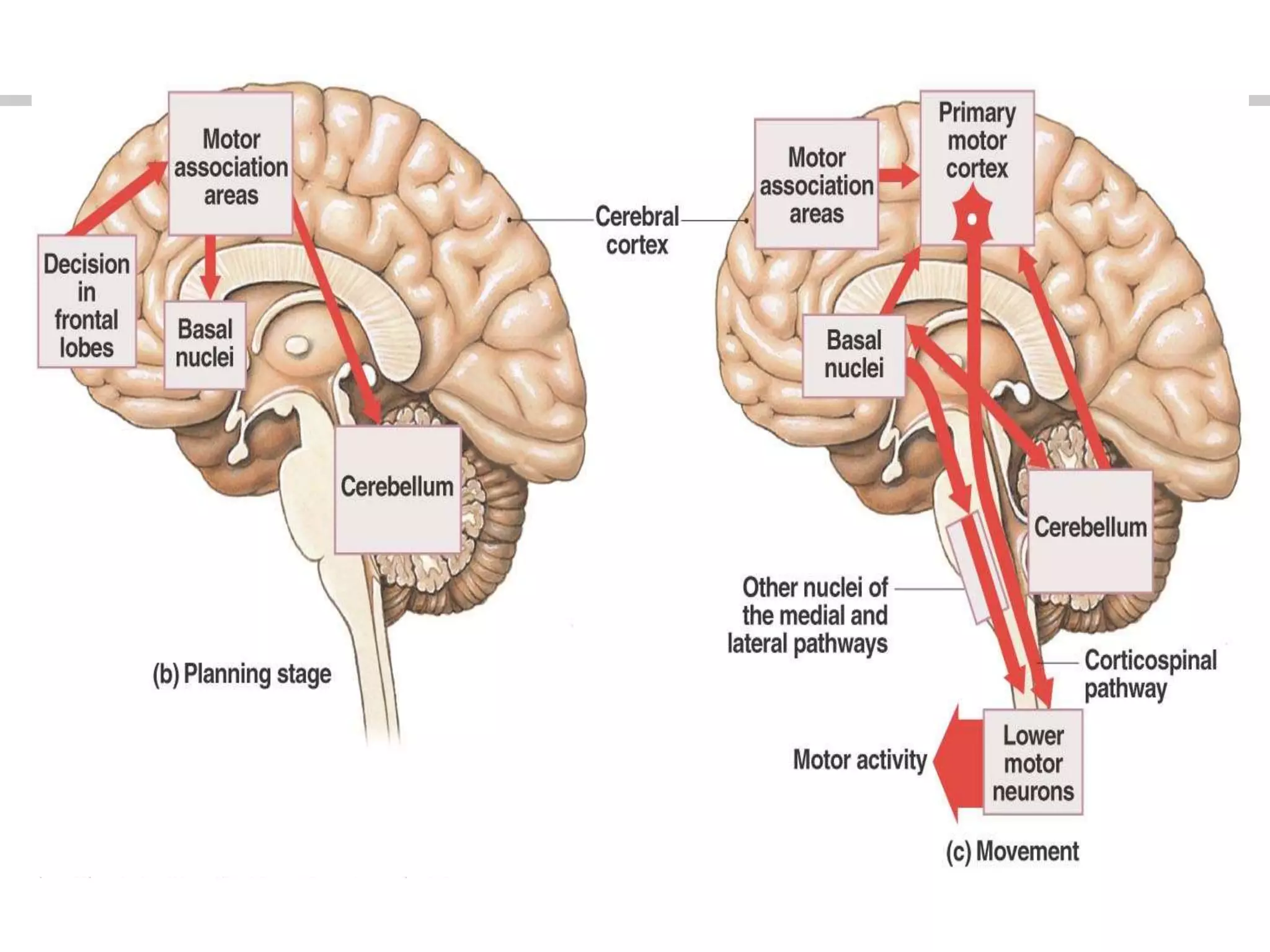
1) The motor cortex and corticospinal tract provide conscious control of voluntary skeletal muscle movements. The corticospinal tract contains fibers that cross to the opposite side of the body and fibers that remain on the same side.
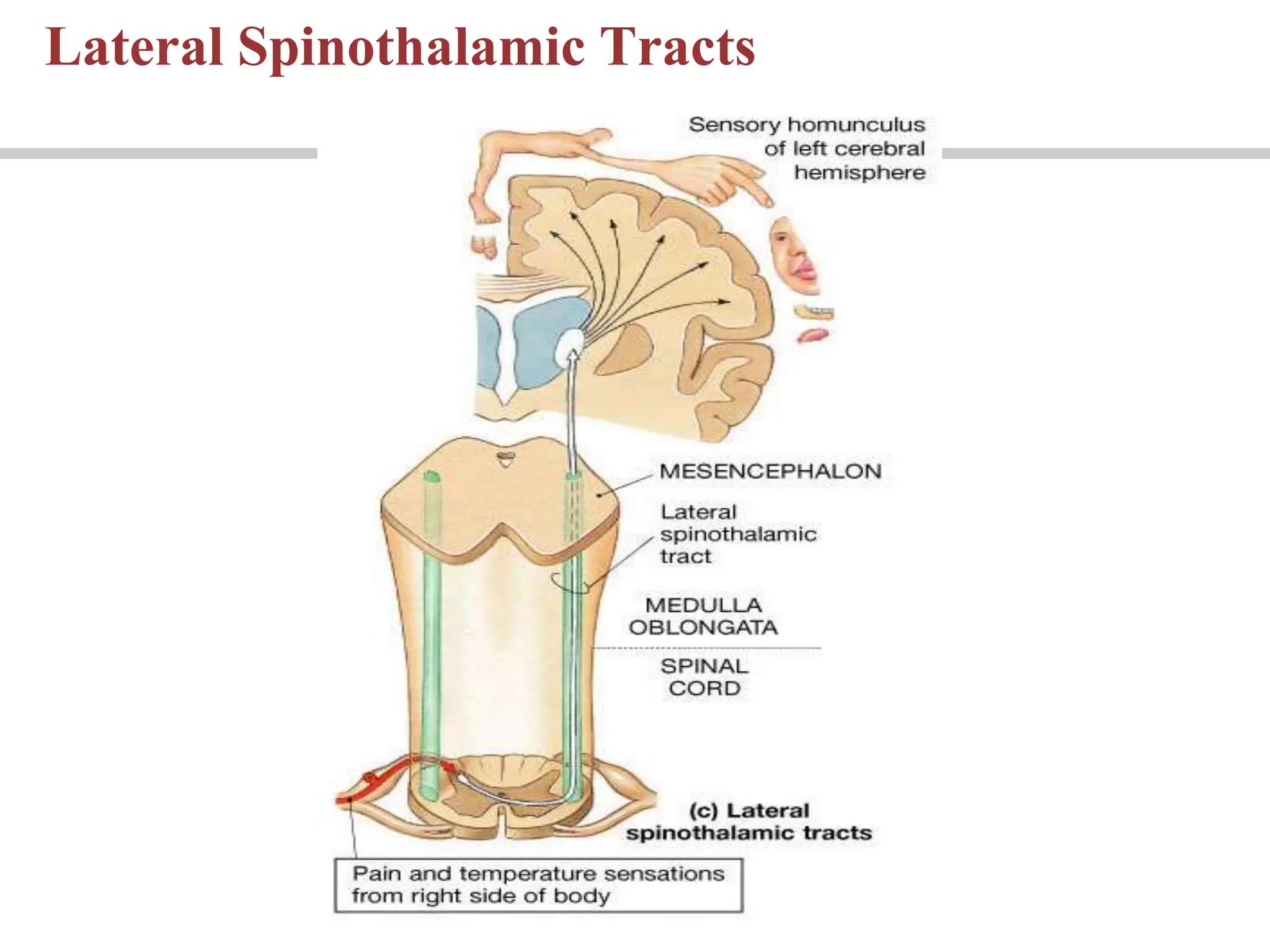
2) Sensory information travels through ascending tracts in the spinal cord including the posterior, lateral, and spinocerebellar tracts to the brain.
3) The medial and lateral motor pathways issue subconscious motor commands through tracts like the rubrospinal and reticulospinal tracts to control gross movements and posture.
An Overview ofSensory Pathways and the Somatic Nervous System
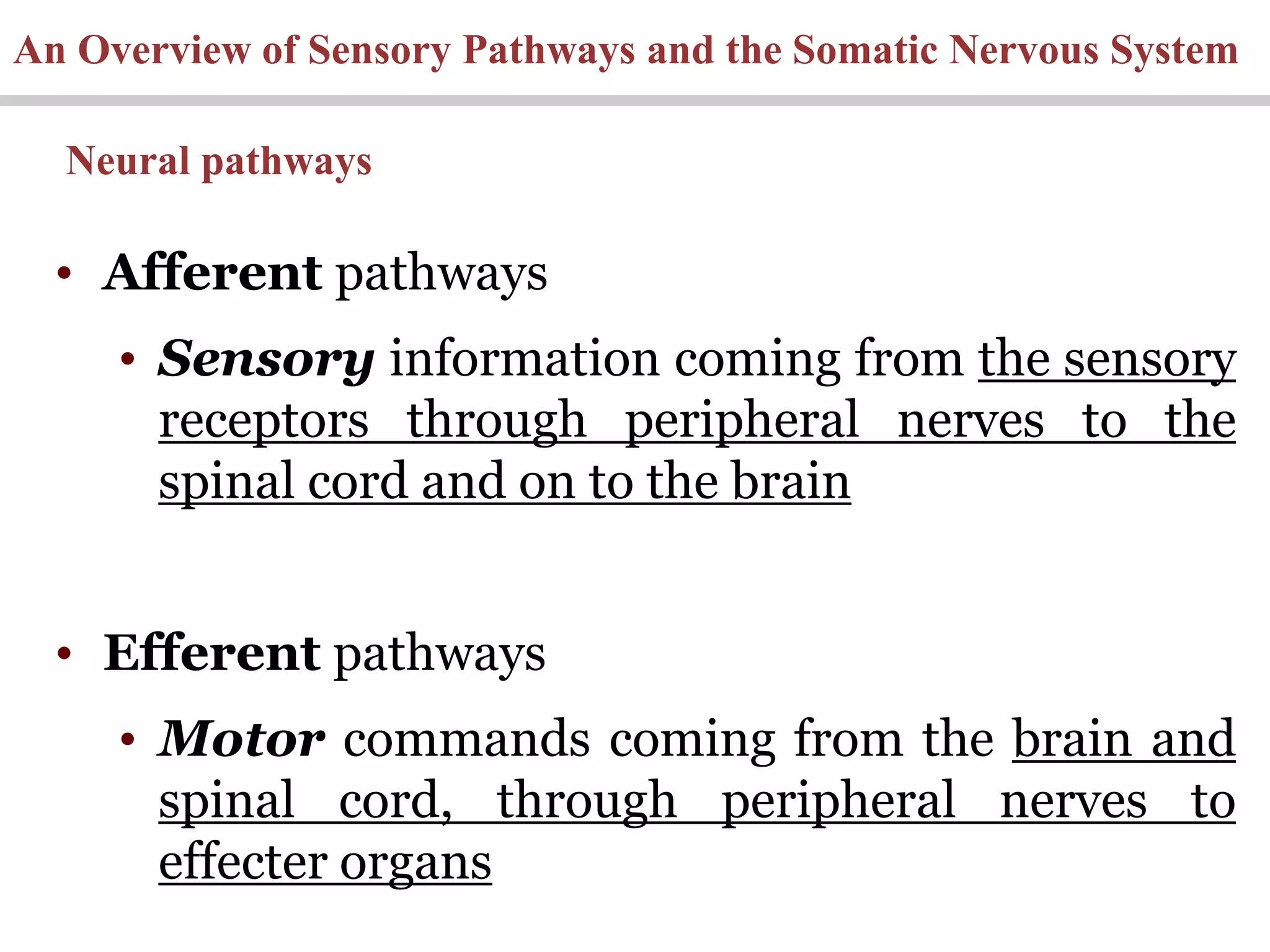
• Afferent pathways
• Sensory information coming from the sensory
receptors through peripheral nerves to the
spinal cord and on to the brain
• Efferent pathways
• Motor commands coming from the brain and
spinal cord, through peripheral nerves to
effecter organs
Neural pathways
• Specialized cellor cell process that
monitors specific conditions
• Arriving information is a sensation
• Awareness of a sensation is a
perception
Sensory Receptors
Sensory receptor
• First orderneurons
• Sensory neurons that deliver sensory information to
the CNS
• Second order neurons
• First order neurons synapse on these in the brain or
spinal cord
• Third order neurons
• Found in the thalamus
• Second order neurons synapse on these
The Organization of Sensory Pathways
First, second, and third order neurons
7.
Tracts (pathways) inthe spinal cord carries
information
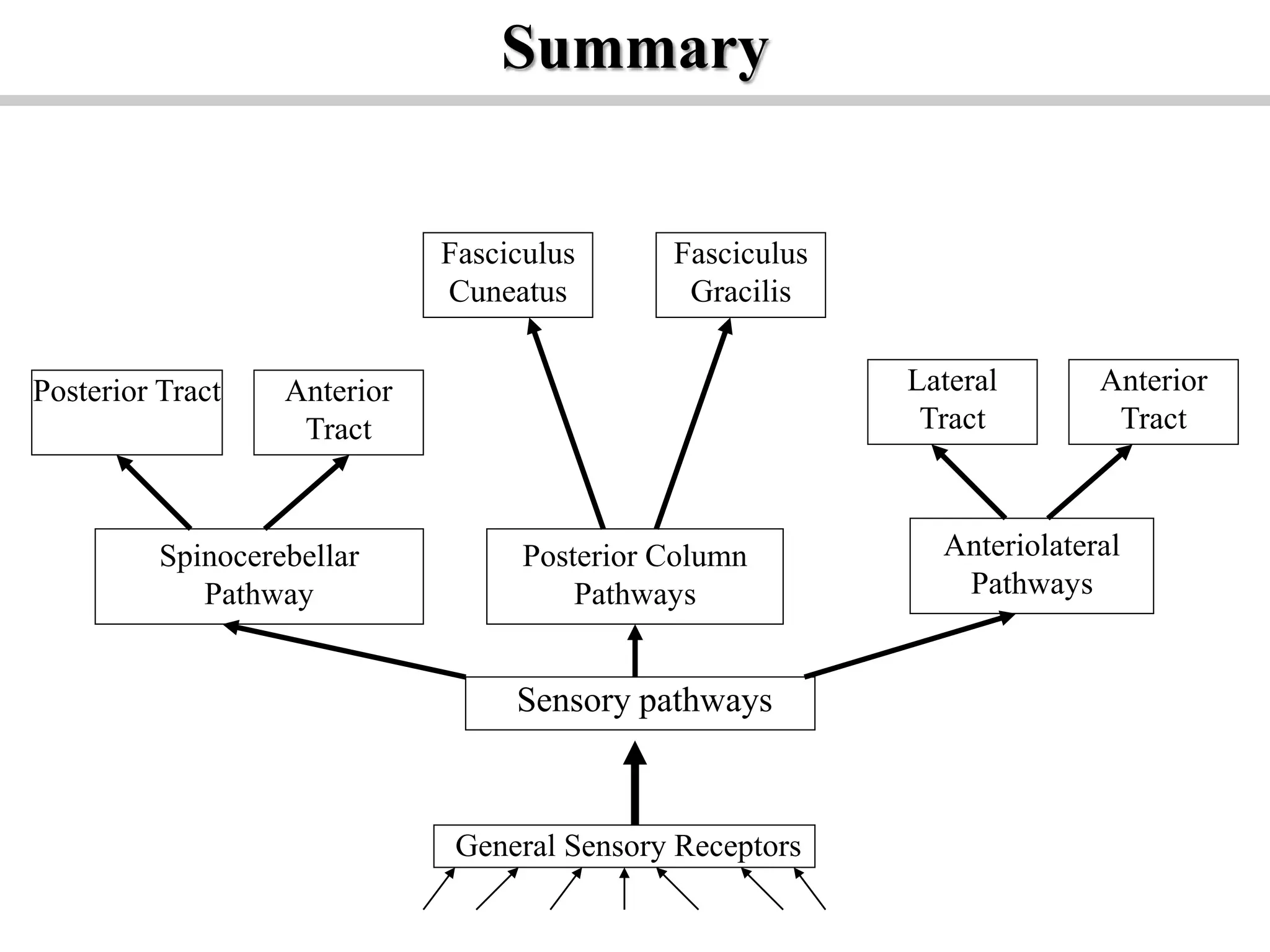
• Three major pathways carry sensory information
• Posterior column pathway
• Anterolateral pathway
• Spinocerebellar pathway
• Sensations that originate in different areas of the
body can be distinguished because sensory neurons
from each body region synapse in a specific brain
region.
Somatic sensory pathways
• Spinocerebellar pathwayIncludes the
• Posterior Spinocerebellar tract –
relays information from
propioceptors to the CNS
• Anterior Spinocerebellar tract.
• Carries sensation to the cerebellum
concerning position of muscles,
tendons and joints
Spinocerebellar pathway
Levels of motorcontrol
• I) Highest level – Motor cortex which includes,
• Primary motor cortex (4),
• Premotor cortex (6, 8, 44, 45),
• Supplementary motor cortex.
• The motor cortex also shows plasticity which
means it learns by doing and performance
improves with repetition.
• 2) Middle level- Subcortical centers - basal ganglia,
cerebellum, Brainstem.
• 3) Lowest level- Spinal cord.
18.
• Anterior tothe central cortical
sulcus, occupying approximately
the posterior one third of the
frontal lobes, is the motor cortex.
• Posterior to the central sulcus
is the somatosensory cortex
which feeds the motor cortex many
of the signals that initiate motor
activities.
• The motor cortex itself is
divided into three sub areas,
each of which has its own
topographical representation
of muscle groups and specific
motor functions:
• (1) the primary motor cortex,
• (2) the premotor area, and
• (3) the supplementary motor area.
19.
Primary motor cortex
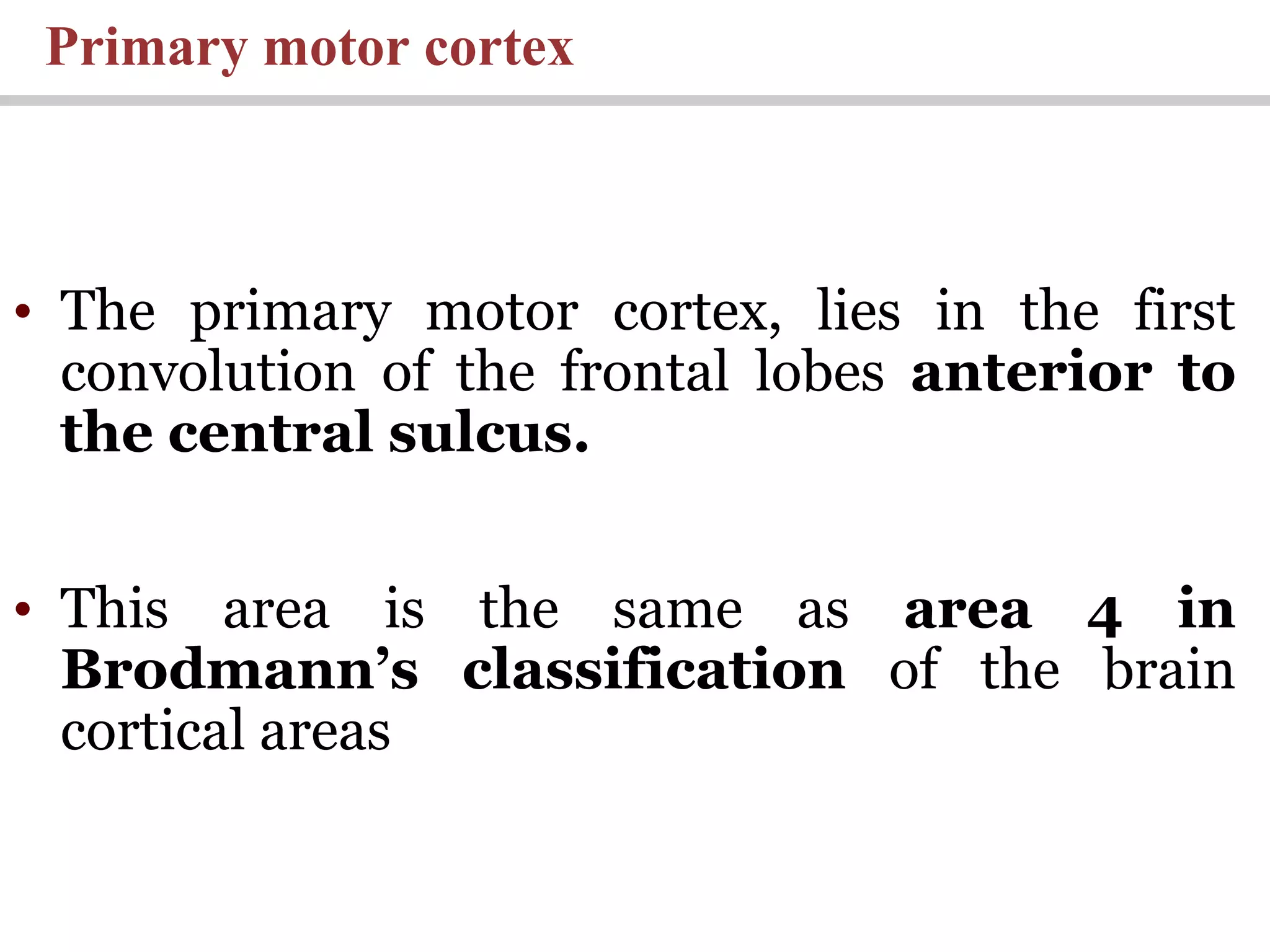
•The primary motor cortex, lies in the first
convolution of the frontal lobes anterior to
the central sulcus.
• This area is the same as area 4 in
Brodmann’s classification of the brain
cortical areas
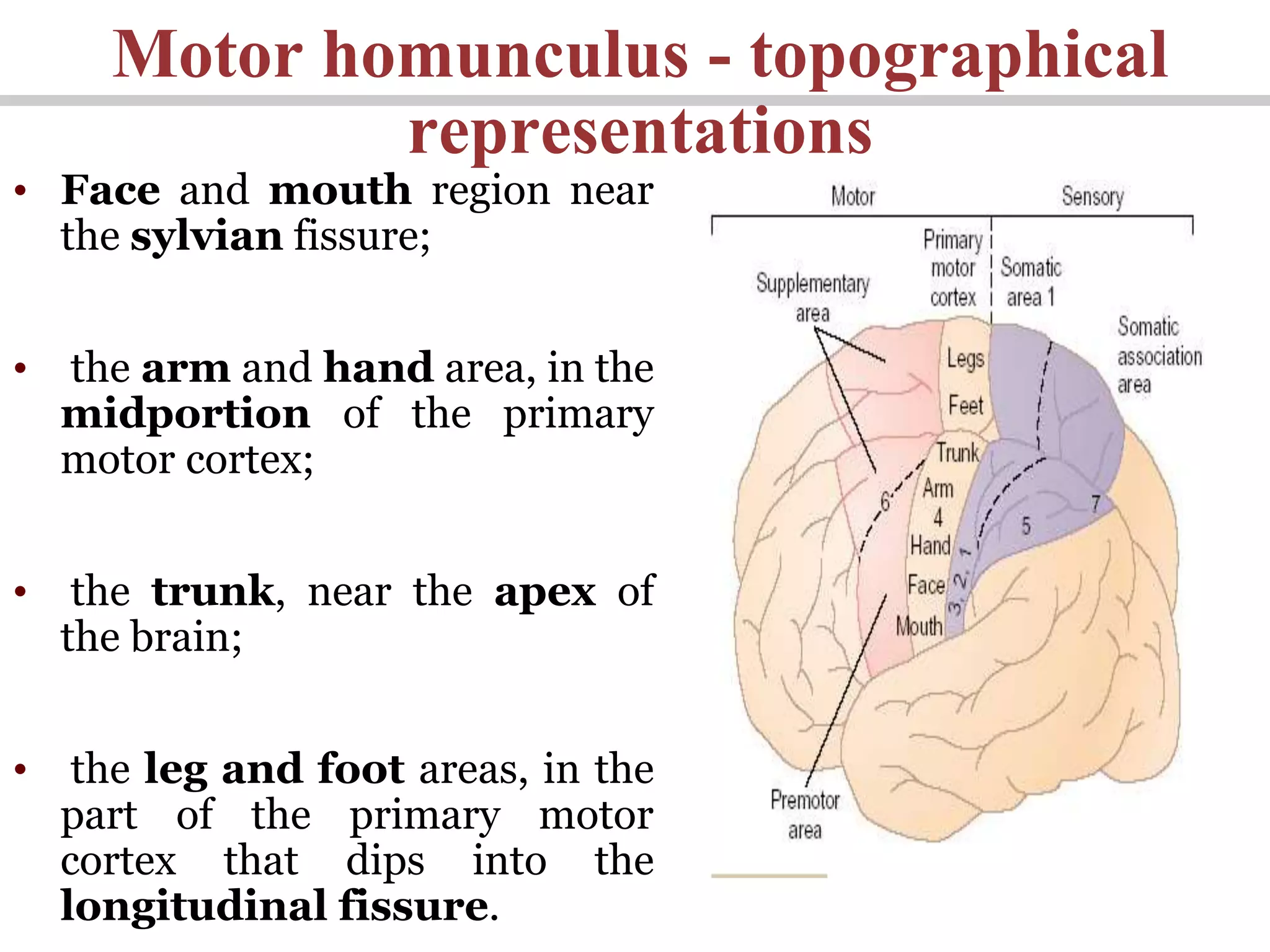
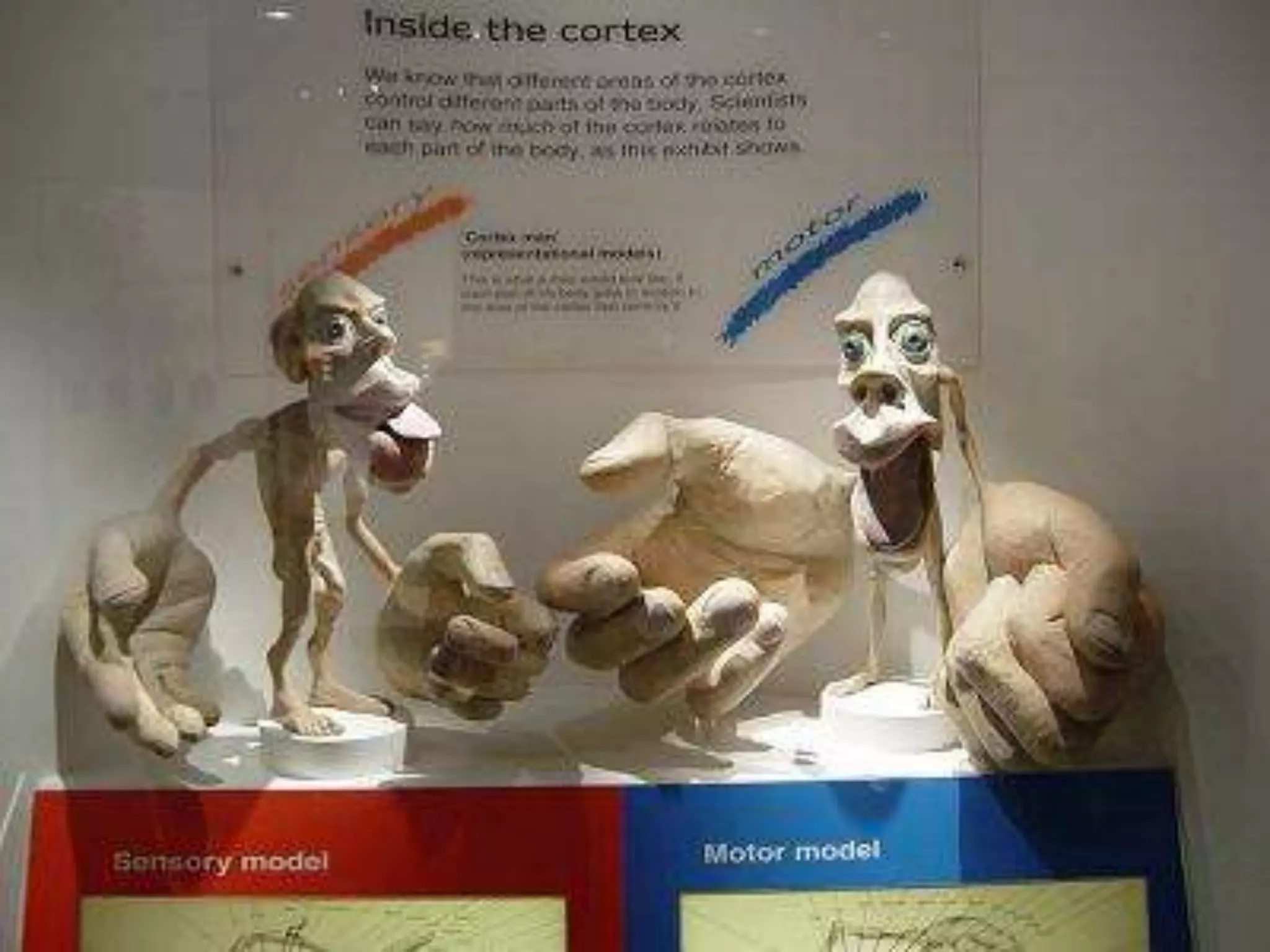
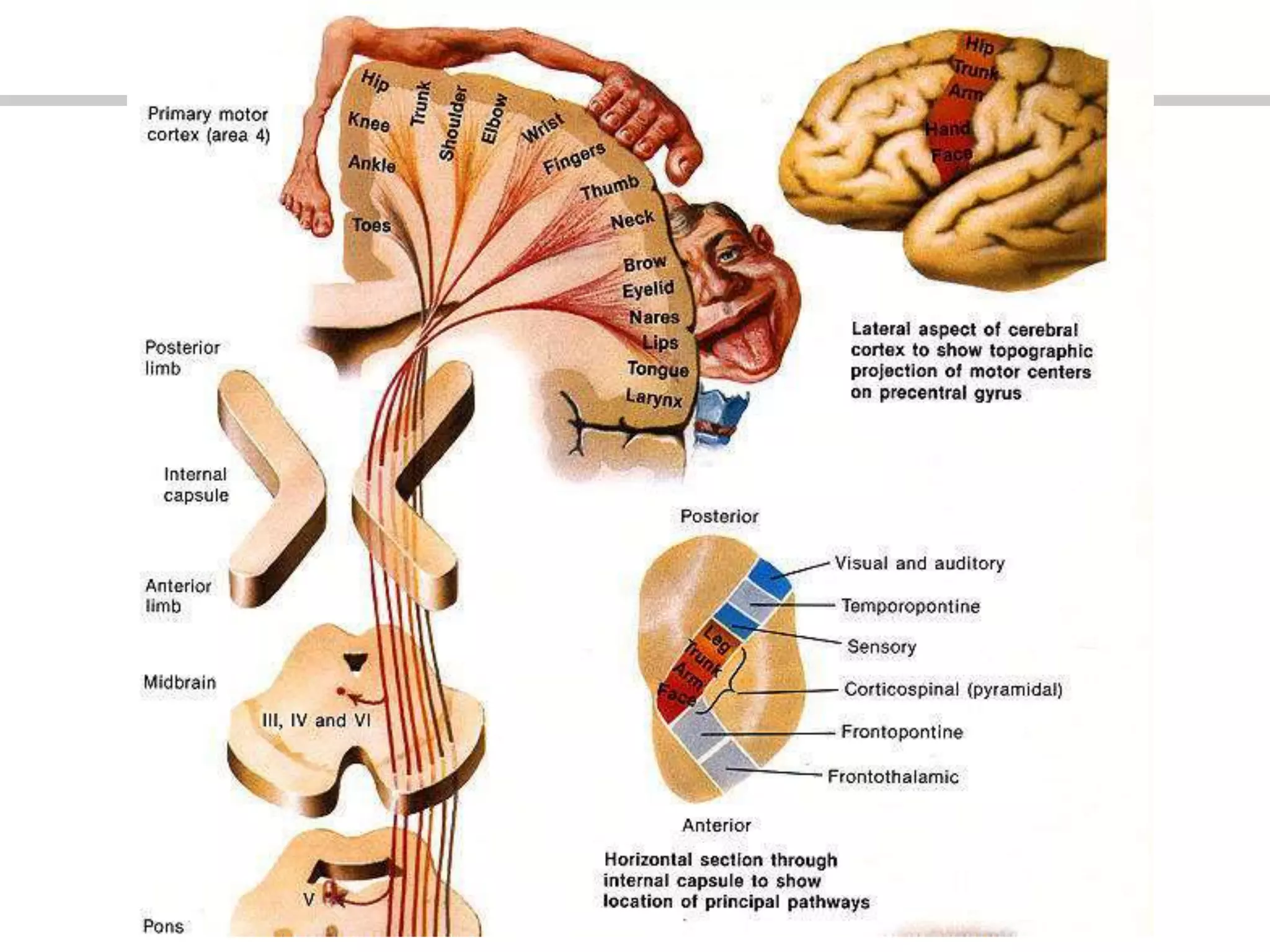
Motor homunculus -topographical
representations
• Face and mouth region near
the sylvian fissure;
• the arm and hand area, in the
midportion of the primary
motor cortex;
• the trunk, near the apex of
the brain;
• the leg and foot areas, in the
part of the primary motor
cortex that dips into the
longitudinal fissure.
25.
Complex patterns ofmuscle activity
• posterior part of the premotor cortex sends its
signals either directly to the primary motor cortex to
excite specific muscles or,
• by way of the basal ganglia and thalamus back
to the primary motor cortex.
• Thus, the premotor cortex, basal ganglia,
thalamus, and primary motor cortex constitute
a complex overall system for the control of complex
patterns of coordinated muscle activity.
26.
Supplementary area functionsalong
with premotor area to provide
• fixation movements of the different
segments of the body,
• positional movements of the head and
eyes,
• as background for the finer motor
control of the arms and hands by the
premotor area and primary motor cortex.
27.
Specialized areas ofbrain
• Broca’s
area
• Voluntary
eye
movement
• Head
rotation
area
• Area for
hand skills
28.
Functions of specializedarea
• 1) Broca’s area – helps in speech and word formation, and
damage here causes motor aphasia.
• 2) Voluntary eye movement area - helps in movement of
eyes to look at different objects.
• Damage here causes involuntary locking of eyes on objects.
This area also controls eyelid movements like blinking
• 3) Head rotation area - This area is closely associated with
the eye movement field; it directs the head toward different
objects.
• 4) Hand skill area - important for “hand skills.”
• when tumors or other lesions cause destruction in this area,
hand movements become uncoordinated and
nonpurposeful, a condition called motor apraxia.
29.
Descending tracts -motor pathways
• I) A) Pyramidal tracts - Corticospinal tracts and
Corticobular tracts.
• B) Extrapyramidal tracts-
• 1) Rubrospinal tracts
• 2) Tectospinal tracts
• 3) Reticulospinal tracts
• 4) Vestibulospinal tracts
• 5) Medial longitudinal fasciculus
• 6) Olivospinal tract
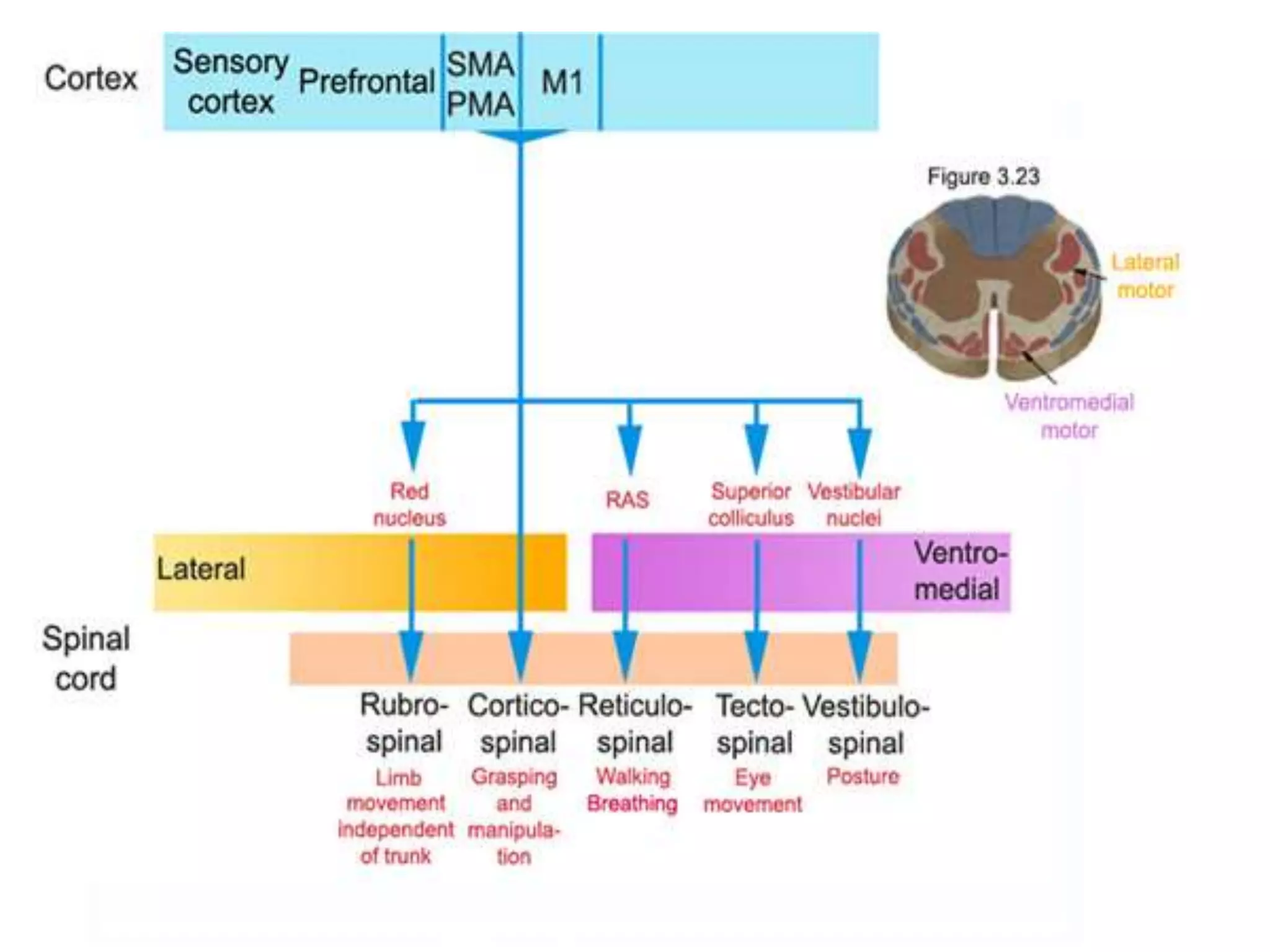
• II) A) Lateral motor system
B) Medial motor system
30.
Lateral and medialmotor systems
• Depending upon location or
termination
• the motor pathways are divided in
these two ways.
• Lateral system is new and
medial is old.
31.
• Lateral motorsystem involves
• Lateral corticospinal tract,
• Rubrospinal tract,
• a part of corticobulbar tract which
controls movements of tongue and
lower part of face.
32.
• Medial motorsystem includes
• ventral corticospinal tract,
• part of corticobulbar tract
• vestibulospinal tracts,
• reticulospinal tracts and
• tectospinal tracts.
33.
Concept of Lateraland Medial motor system
Lateral Motor System Medial Motor System
Corticospinal and Rubrospinal
tract
Except cortico and rubrospinal
tract
Fibres mainly originates from
cortex
Primarily originates in the
brainstem
Distributed to motor neurons
which supply distal muscle
groups
Distributed to motor neurons
which supply proximal muscle
group
Main function of this system is
to control fractionate
movements of the extremities
Main function of this system is
to control posture equilibrium
and progression
33
34.
Pyramidal tract -why this name?
• 1)They form two pyramidal
structures in medulla on either side of
the midline,
• 2) Origin is from pyramidal cells.
• 3) There are a large no of fibers and a
large amount of amplification and
divergence is also seen hence the name.
35.
Pyramidal tract -Corticospinal tract -
most imp output from motor cortex
• The corticospinal tract originates about
• 30 per cent from the primary motor cortex,
• 30 per cent from the premotor and
supplementary motor areas, and
• 40 per cent from the somatosensory areas
posterior to the central sulcus.
36.
Cortex - internalcapsule - pyramids
• After leaving the cortex, it passes through the
posterior limb of the internal capsule
(between the caudate nucleus and the putamen of
the basal ganglia).
• The internal capsule is a band of white fibers -
“V” shaped with the point of V looking medially.
• Pyramidal fibers lie in the bend (genu) and in
anterior 2/3 rd of posterior limb.
39.
Travel through midbrain,pons,
medulla
• It then passes through crus cerebri (cerebral
peduncles) of midbrain then
• through basilar part of pons where the tract
gets broken into small bundles by intervening
pontine nuclei
• after coming out of pons the fibers are reunited
again and enter the medulla forming the
pyramids of the medulla
40.
Lateral corticospinal tract- and its
terminations
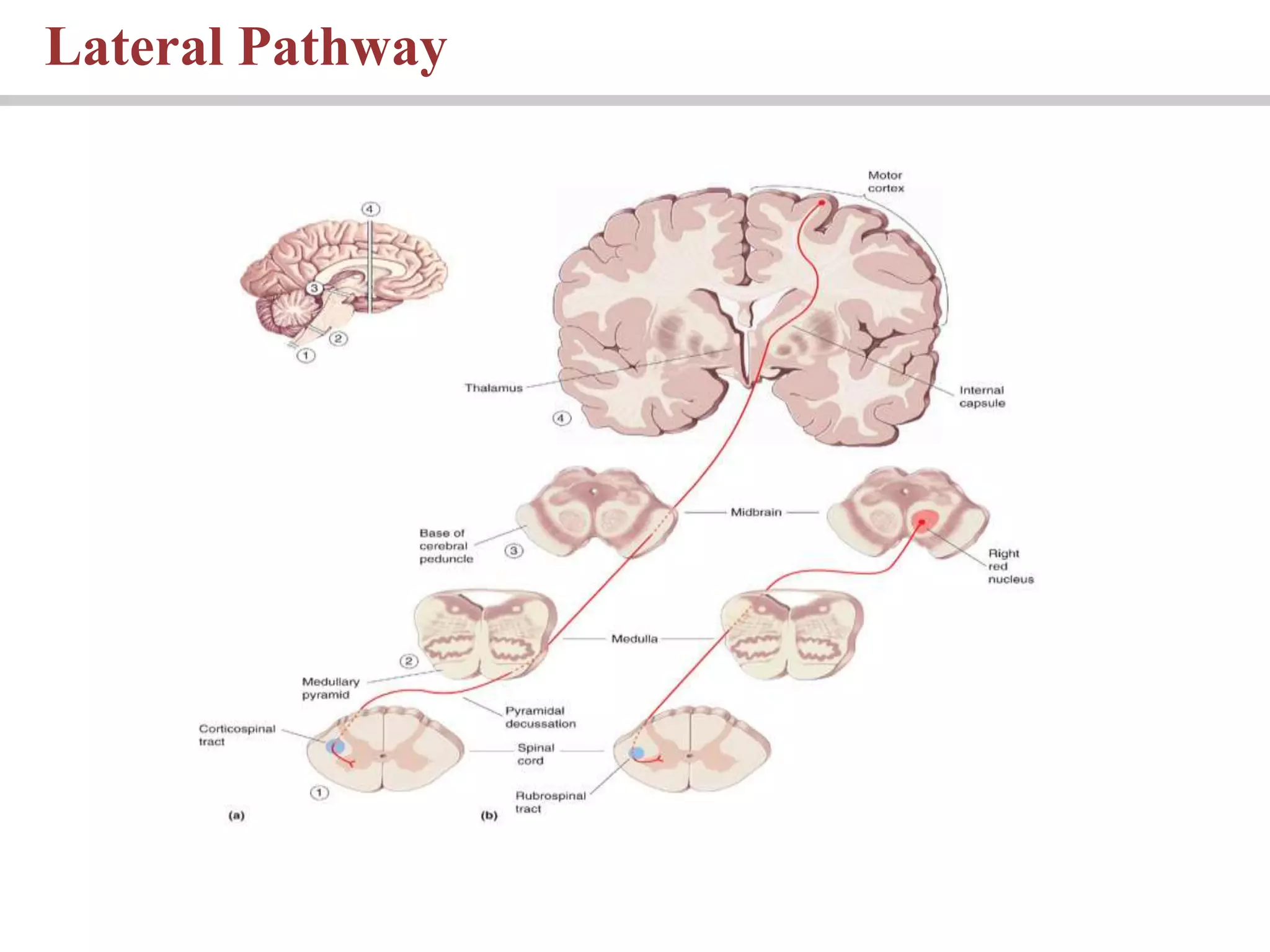
• The majority of the pyramidal fibers then cross
in the lower medulla to the opposite side and descend
into the lateral corticospinal tracts of the cord,
finally terminating
• 1) Principally on interneurons in the
intermediate regions of the cord gray matter;
• 2) a few terminate on sensory relay neurons in
the dorsal horn, and
• 3) a very few terminate directly on the anterior
motor neurons that cause muscle contraction.
41.
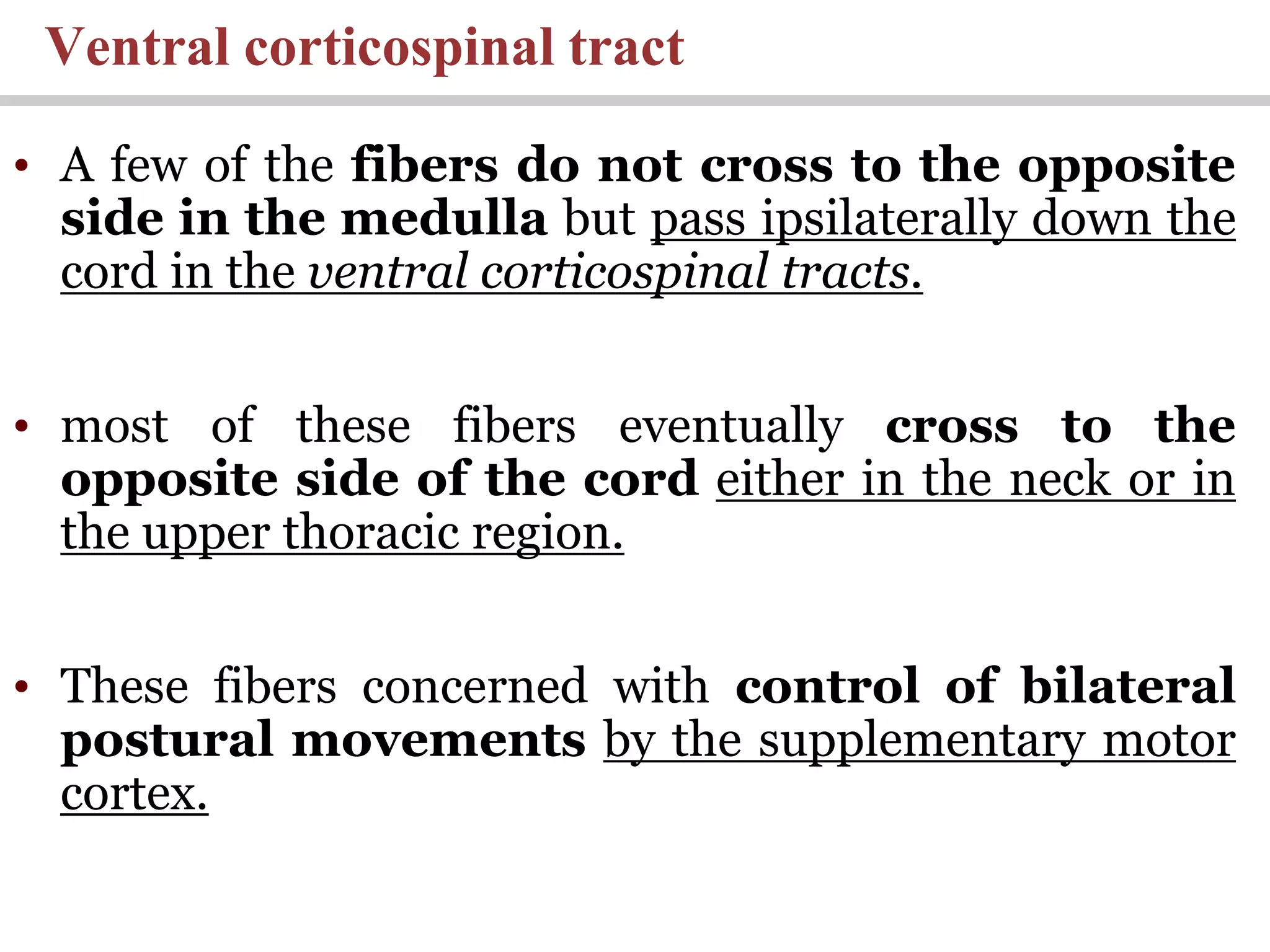
Ventral corticospinal tract
•A few of the fibers do not cross to the opposite
side in the medulla but pass ipsilaterally down the
cord in the ventral corticospinal tracts.
• most of these fibers eventually cross to the
opposite side of the cord either in the neck or in
the upper thoracic region.
• These fibers concerned with control of bilateral
postural movements by the supplementary motor
cortex.
44.
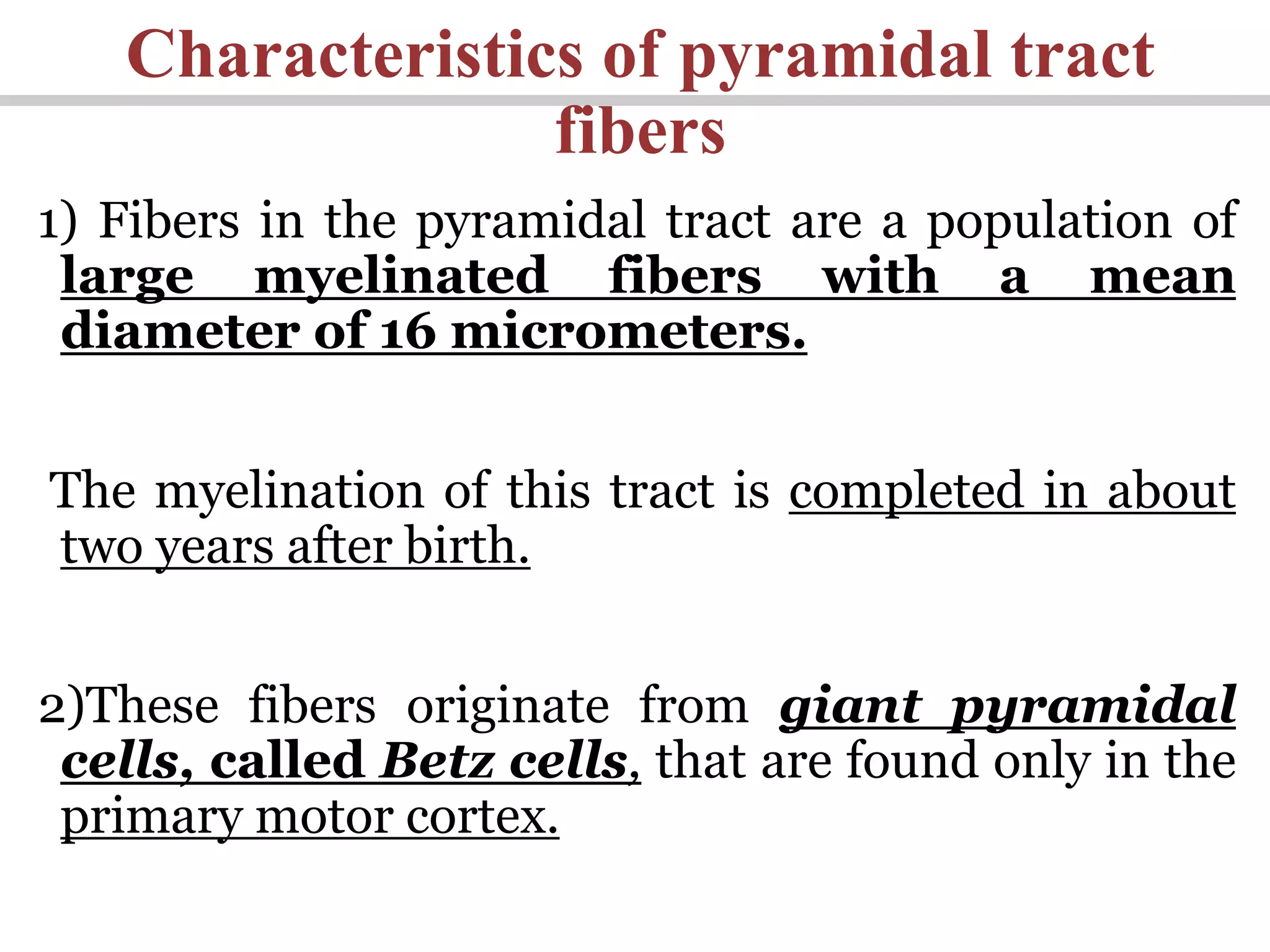
Characteristics of pyramidaltract
fibers
1) Fibers in the pyramidal tract are a population of
large myelinated fibers with a mean
diameter of 16 micrometers.
The myelination of this tract is completed in about
two years after birth.
2)These fibers originate from giant pyramidal
cells, called Betz cells, that are found only in the
primary motor cortex.
45.
• 3)The Betzcells are about 60 micrometers in
diameter,
• and their fibers transmit nerve impulses to
the spinal cord at a velocity of about 70
m/sec,
• the most rapid rate of transmission of any
signals from the brain to the cord.
• 4)There are about 34,000 of these large Betz
cell fibers in each corticospinal tract.
46.
• 5)The totalnumber of fibers in each
corticospinal tract is more than 1
million, so these large fibers represent only
3 per cent of the total.
• 6)The other 97 per cent are mainly fibers
smaller than 4 micrometers in diameter
that conduct background tonic signals to the
motor areas of the cord.
47.
• The largefibers of pyramidal tract
have a tendency to disappear
with old age.
• These tracts are concerned with
control of voluntary movements
so disappearing of fibers leads to
automatic shivering in old age.
48.
Functions of pyramidaltracts
• 1) Lateral corticospinal tract - helps in controlling skillful,
fine and voluntary and discreet movements especially of
distal limb muscles - fine movements of fingers, hands.
• 2) Ventral corticospinal tract - control muscles of trunk
and proximal portions of limbs - bilateral postural movements
• 3) They are involved in some reflexes such as cremasteric
reflex, abdominal and plantar reflex.
• (Babinski's sign seen in lesion of this tract where plantar
reflex is extensor instead of flexor)
• 4) They influence stretch reflex via their influence on alpha
and gamma motor neurons.
49.
Corticobulbar tract -from cerebral
cortex to bulb - brainstem
• Where all motor cranial nuclei are located.
• Hence this tract is concerned with voluntary control
of muscles of larynx, pharynx, palate, upper and
lower face, jaw, eye, etc.
• In short these control voluntary movements of
muscles of head and neck and corticospinal serve
this function for the muscles of rest of the body.
• Pseudobulbar palsy - weakness or paralysis of
muscles controlling swallowing, talking, tongue and lip
movements.
50.
Important points
• 1)Of all pyramidal fibers
• 55% end in cervical,
• 20% end in thoracic and
• 25% in the lumbosacral region.
• 2) Most common site of lesion to pyramidal
tract is in the internal capsule due to
thrombosis or hemorrhage of
lenticulostriate artery, a branch of middle
cerebral artery.
51.
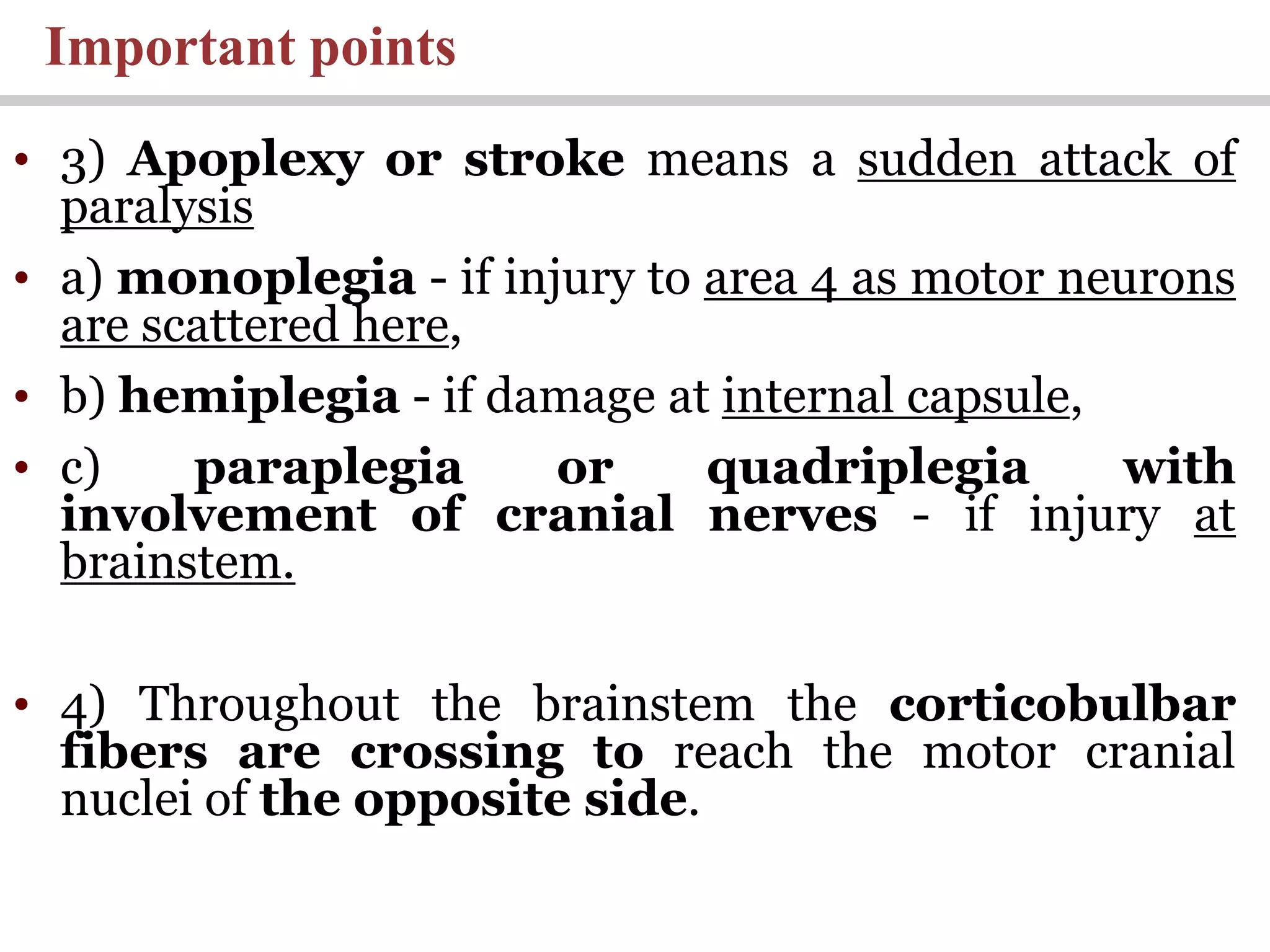
Important points
• 3)Apoplexy or stroke means a sudden attack of
paralysis
• a) monoplegia - if injury to area 4 as motor neurons
are scattered here,
• b) hemiplegia - if damage at internal capsule,
• c) paraplegia or quadriplegia with
involvement of cranial nerves - if injury at
brainstem.
• 4) Throughout the brainstem the corticobulbar
fibers are crossing to reach the motor cranial
nuclei of the opposite side.
52.
Pyramidal tract- UMNLesion
• 1) Loss of voluntary movements
• 2) Muscle tone increased, spasticity is
seen, there is spastic paralysis due to
failure of inhibitory impulses to reach from
cortex to spinal cord.
• 3) Superficial reflexes lost and deep are
exaggerated.
• Abnormal plantar reflex - Babinski’s sign
present. Clonus will be present.
53.
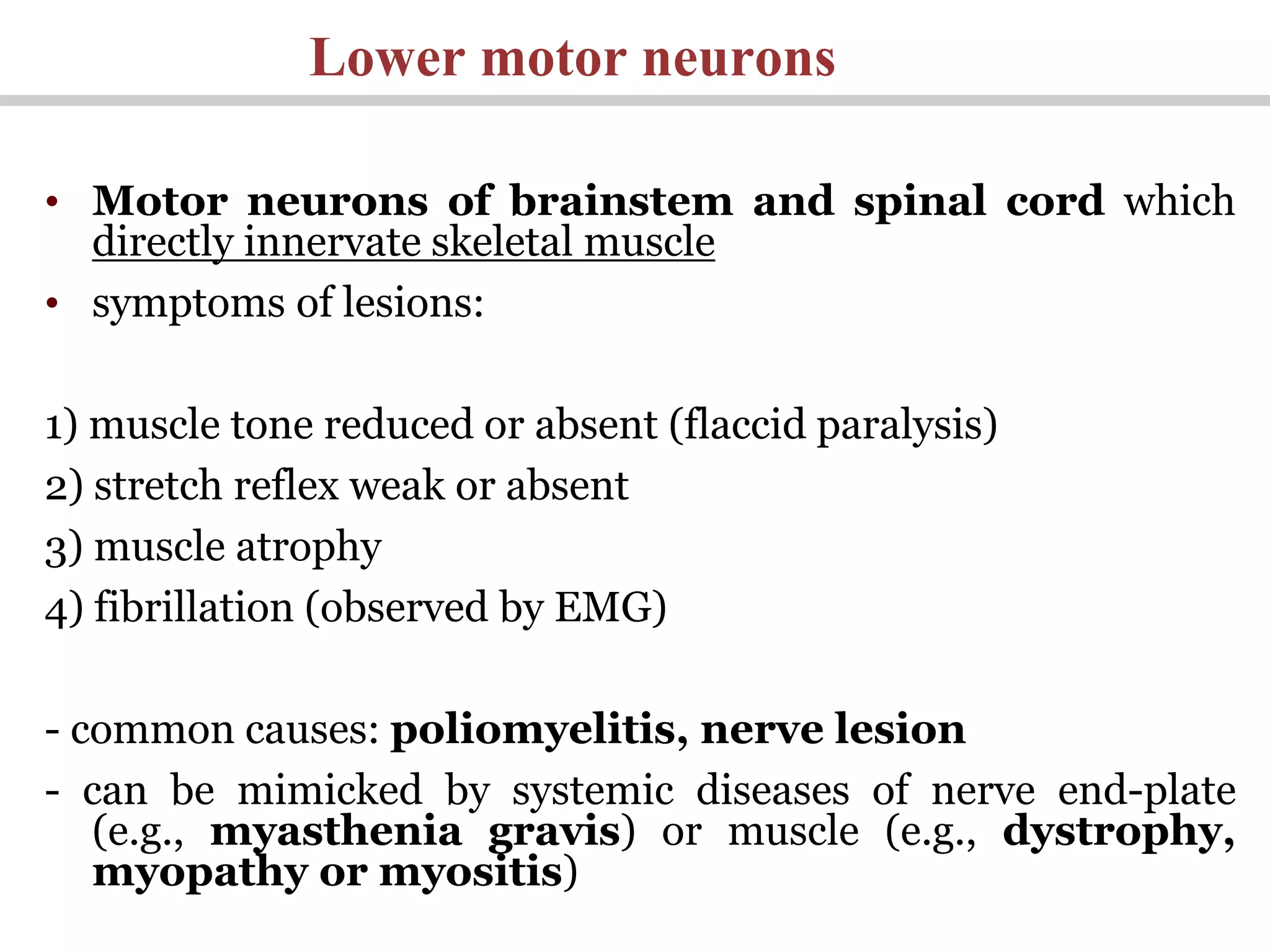
Lower motor neurons
•Motor neurons of brainstem and spinal cord which
directly innervate skeletal muscle
• symptoms of lesions:
1) muscle tone reduced or absent (flaccid paralysis)
2) stretch reflex weak or absent
3) muscle atrophy
4) fibrillation (observed by EMG)
- common causes: poliomyelitis, nerve lesion
- can be mimicked by systemic diseases of nerve end-plate
(e.g., myasthenia gravis) or muscle (e.g., dystrophy,
myopathy or myositis)
54.
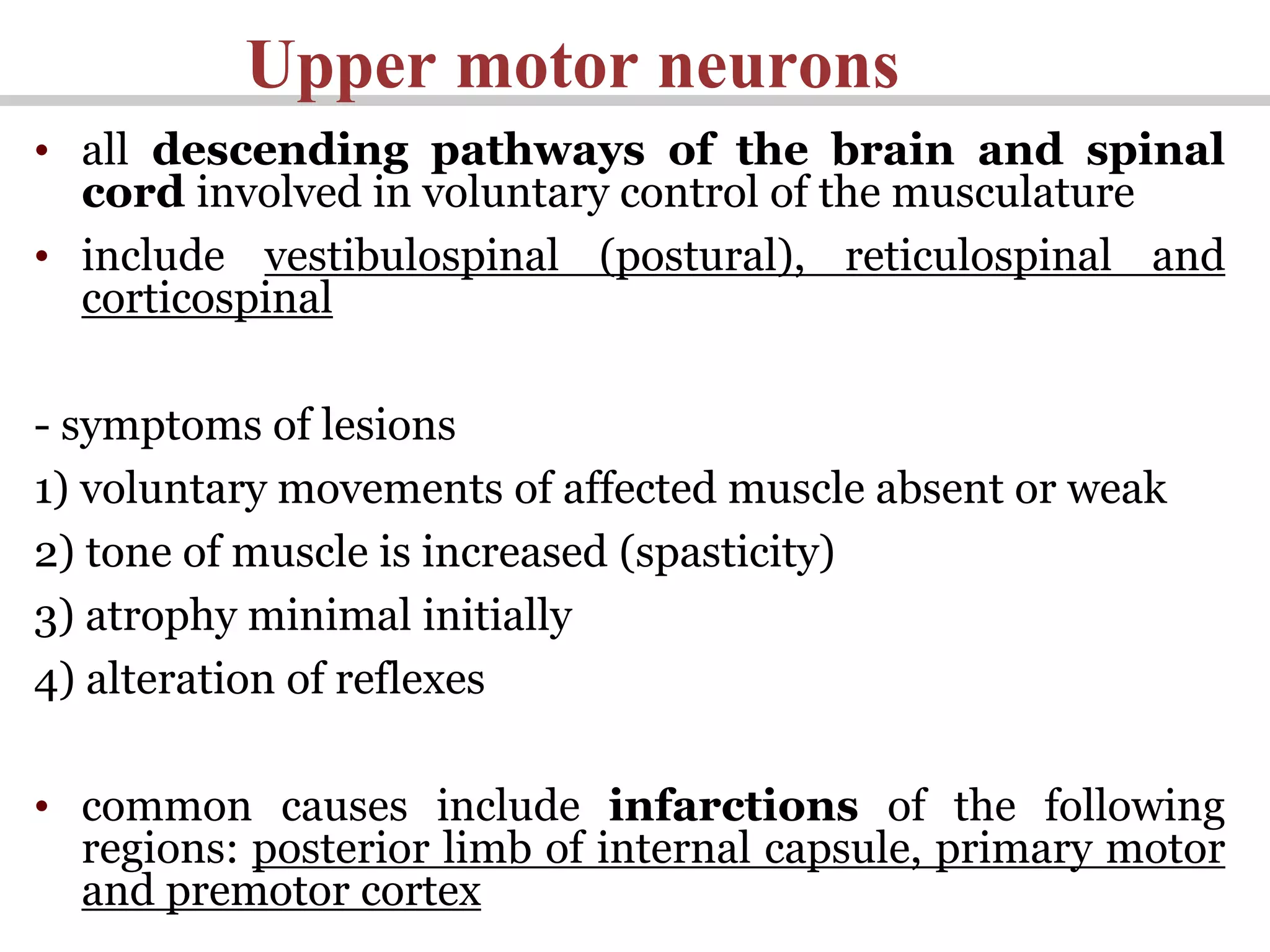
Upper motor neurons
•all descending pathways of the brain and spinal
cord involved in voluntary control of the musculature
• include vestibulospinal (postural), reticulospinal and
corticospinal
- symptoms of lesions
1) voluntary movements of affected muscle absent or weak
2) tone of muscle is increased (spasticity)
3) atrophy minimal initially
4) alteration of reflexes
• common causes include infarctions of the following
regions: posterior limb of internal capsule, primary motor
and premotor cortex
• Incoming informationis processed by CNS and
distributed by the:
1. The Somatic Nervous System (SNS)
2. Autonomic Nervous System (ANS)
• SNS also called Somatic motor system
controls contraction of skeletal muscle
• Motor commands control skeletal muscle
travel by:
• Corticospinal pathway
• Medial Pathway
• Lateral Pathway
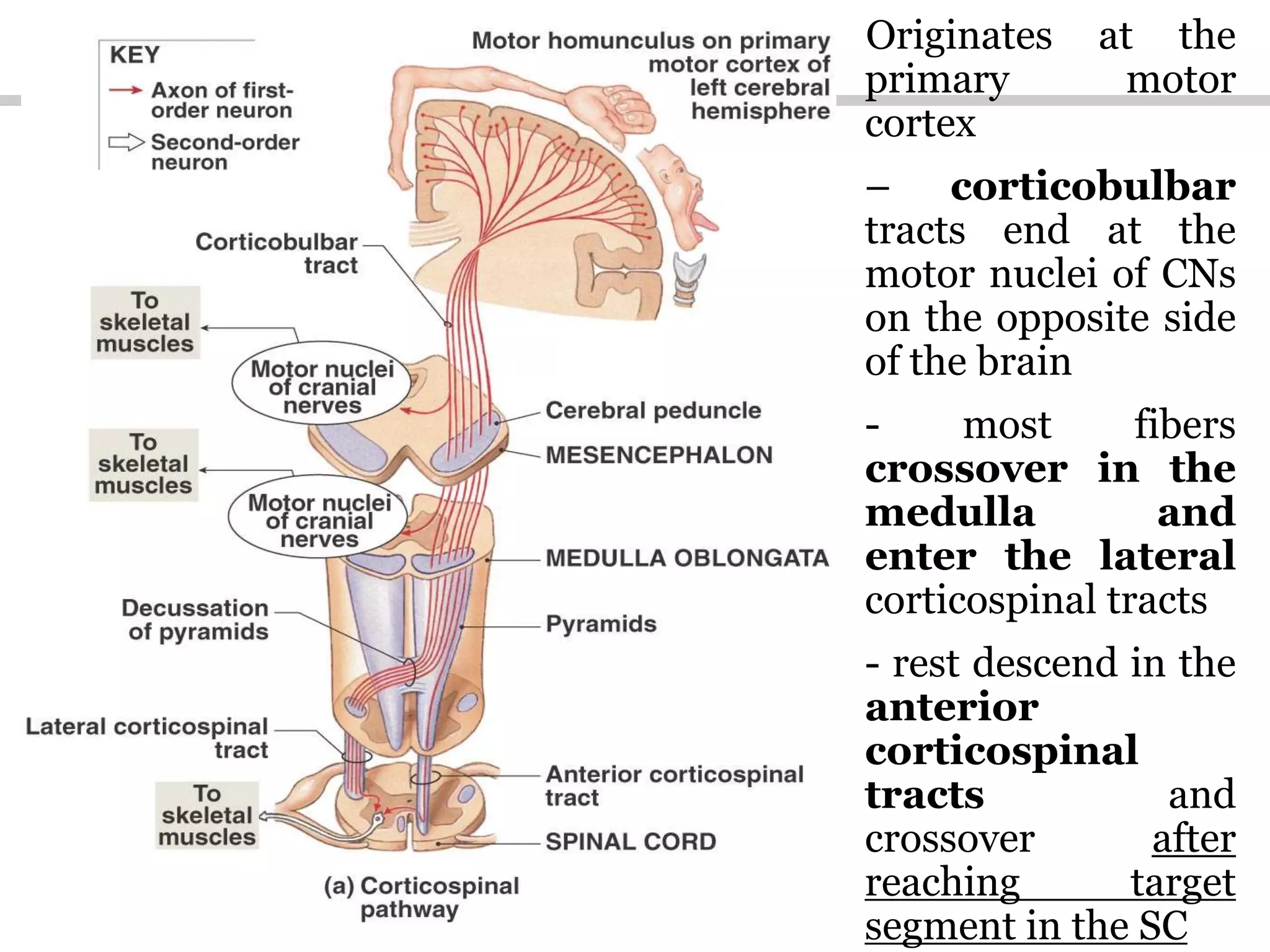
Motor Pathway
Originates at the
primarymotor
cortex
– corticobulbar
tracts end at the
motor nuclei of CNs
on the opposite side
of the brain
- most fibers
crossover in the
medulla and
enter the lateral
corticospinal tracts
- rest descend in the
anterior
corticospinal
tracts and
crossover after
reaching target
segment in the SC
65.
• Corticospinal pathwaycontain 3 pairs of
descending tracts:
1. Corticobular – provide conscious control over
skeletal muscle of eye, jaw, face, neck and
pharynx
2. Lateral corticospinal - regulate voluntary
control of skeletal muscle on the opposite side
3. Anterior corticospinal – regulate voluntary
control of skeletal muscle on the same side
The corticospinal pathway
66.
• The medialand lateral pathways
• Issue motor commands as a result of subconscious
processing
• Medial pathway
• Primarily controls gross movements of the trunk
and proximal limbs
• Medial Pathway Includes the:
1. Vestibulospinal tracts – regulates involuntary control of
posture and muscle tone
2. Tectospinal tracts - controls involuntary regulation of eye,
head, neck and position in response to visual and auditory
stimuli
3. Reticulospinal tracts – controls involuntary regulation of
reflex activity and autonomic function
medial and lateral pathways
67.
• Lateral pathway
•Controls muscle tone and
movements of the distal
muscles of the upper limbs
lateral pathways
Extrapyramidal System
• Thesemotor pathways are complex and
multisynaptic and regulate:
• Axial muscles that maintain balance and
posture
• Muscles controlling coarse movements
of the proximal portions of limbs
• Head, neck, and eye movement
72.
Extrapyramidal (Multineuronal) Pathways
•Reticulospinal tracts – maintain
balance
• Rubrospinal tracts – control flexor
muscles
• Superior colliculi and tectospinal
tracts mediate head movements
Functions: Red nucleus
•Red nucleus functions in close
association with corticospinal tract and
together from lateral motor system of
the cord
• Along with corticospinal tract it is
responsible for controlling muscles that
make precise movements.
• The corticospinaland Rubrospinal tracts together
are called the lateral motor system of the
cord
• in contradistinction to a vestibuloreticulospinal
system, which lies mainly medially in the cord
and is called the medial motor system of the
cord
77.
From these areastwo
reticulospinal tracts arise
• Pontine reticulospinal
tract
• Medullary reticulospinal
tract
78.
Functions of Reticulospinaltract:
• Concern with control of movements and
maintenance of muscle tone.
• The reticulospinal tracts, probably also
convey autonomic information form
higher centres to the intermediate region of
spinal grey matter
• and regulate respiration, circulation
and sweating.
79.
• Pontine nucleifacilitate while medullary nuclei
inhibit the control of voluntary and reflex
movements and control of muscle tone through
gamma motor neurons.
Medullary reticular formation
favors….
• Inspiration
• vasodilatation
Pontine reticular formation
favors……
• expiration
• cause vasoconstriction
80.
Functions: Vestibulospinal tract
•Vestibular nucleus receives afferents from
vestibular apparatus mainly from utricles
• This pathway is principally concerned with
adjustment of postural muscles to linear
acceleratory displacement of the body.
• Mainly facilitates activity of extensor muscles
• Inhibits the activity of flexor muscles in
association with the maintenance of the balance
81.
Functions - medialvestibulospinal tract
• Functionally medial vestibulospinal
tract is the down connection of medial
longitudinal bundle (MLB).
• The tract provides a reflex pathway for
movements of head, neck, and
eyes in response to visual and auditory
stimuli.
82.
Function - tectospinal
•This tract forms the motor limb of the reflex
pathway for turning the head and moving the
arms in response to visual, hearing or other
exteroceptive stimuli.
• tract mediates visually guided head movements.
83.
Functions - Olivospinal
•Inferior olivery nucleus receives afferent fibres
from cerebral cortex, corpus striatum, red nucleus
and spinal cord.
• It influences muscle activity.
• Probably it is involved in reflex movements
arising from the propioceptors.
85.
Decerebrate Rigidity
• CSSherrington did this operation
on experiment on cat in 1890.
• Transaction made in between
superior and inferior colliculi
so animal develops decerebrate
rigidity.
86.
Features
• Hyper extendedall limbs, become
rigid like pillars
• Hypertonia of both muscles (flexors
and extensors)
• Tail and neck hyper extended
90.
Explanation
• The intercollicularsection causes total
loss of the communication
between cerebral cortex and
brainstem
• (so named decerebration - removal of
cerebrum) so receiving no signals from
cortex
91.
• Medullary inhibitoryarea having no
intrinsic activity of its own, now become
greatly non functioning. This centre however
receives signals from the cerebellum
• Brainstem facilitatory area having
intrinsic activity of its own, continue to
discharge the facilitatory impulses and now
this impulses are unopposed.
92.
• Vestibular nucleusnormally sends
facilitatory impulses to the spinal centre.
• In a decerebrate preparation, such
facilitatory impulses are exaggerated.
93.
• So, inSherrington type of decerebrate rigidity, there
is a great predominance of facilitatory
influences reaching the spinal cord from above.
• Experiments show that these facilitatory influence
cause stimulation of γ efferent and thus
increase muscle tone
• decerebrate rigidity is due to the release of
brainstem centres from the influence of cortex
and basal ganglia - release phenomenon.
94.
• The DecerebrateAnimal Develops Spastic Rigidity
• When the brain stem of an animal is sectioned below the
midlevel of the mesencephalon, but the pontine and medullary
reticular systems as well as the vestibular system are left intact, the
animal develops a condition called decerebrate rigidity.
• This rigidity does not occur in all muscles of the body but does
occur in the antigravity muscles—the muscles of the neck and
trunk and the extensors of the legs. The cause of decerebrate rigidity
is blockage of normally strong input to the medullary
reticular nuclei from the cerebral cortex, the red nuclei, and the
basal ganglia.
• Lacking this input, the medullary reticular inhibitor system
becomes nonfunctional;
• full over activity of the pontine excitatory system occurs, and
rigidity develops.