Downloaded 53 times
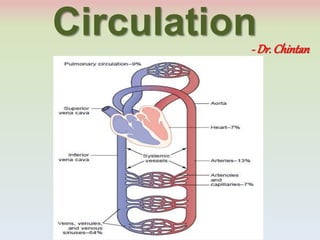







The circulatory system precisely controls blood flow to tissues according to need. Cardiac output is controlled by the sum of all local tissue flows. Arterial pressure is generally controlled independently of local blood flows or cardiac output. Blood flow through vessels is determined by the pressure difference between the vessel ends and vascular resistance from blood friction. Ohm's law states that flow equals the change in pressure divided by resistance. Turbulent blood flow can occur with high velocities, obstructions, turns, or rough surfaces. Reynolds number measures turbulence tendency. Resistance depends on vessel length and diameter, with conductance inversely proportional to resistance. Vessel distensibility and the reservoir function of veins help accommodate pulsatile blood flow and volume changes.


