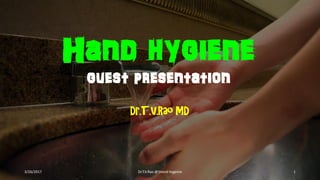
Hand hygiene
guest presentation
Dr.T.V.Rao MD
3/26/2017 Dr.T.V.Rao @!Hand Hygeine 1
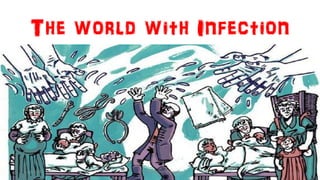
The world with Infection
3/26/2017 Dr.T.V.Rao @!Hand Hygeine 2
A tribute to a Great soul
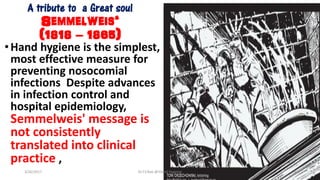
Semmelweis‘
(1818 – 1865)
•Hand hygiene is the simplest,
most effective measure for
preventing nosocomial
infections Despite advances
in infection control and
hospital epidemiology,
Semmelweis' message is
not consistently
translated into clinical
practice ,
3/26/2017 Dr.T.V.Rao @!Hand Hygeine 3
HCAI: The worldwide burden
•Estimates are hampered by limited availability
of reliable data
•The burden of disease both outside and inside
health-care facilities is unknown in many countries
•No health-care facility, no country, no health-
care
system in the world can claim to
have solved the problem3/26/2017 Dr.T.V.Rao @!Hand Hygeine 4
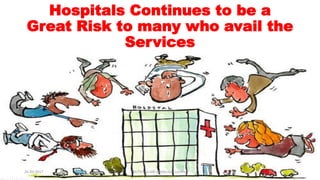
Hospitals Continues to be a
Great Risk to many who avail the
Services
26-03-2017 Dr.T.V.Rao MD @Infection control 5
3/26/2017 Dr.T.V.Rao @!Hand Hygeine 6
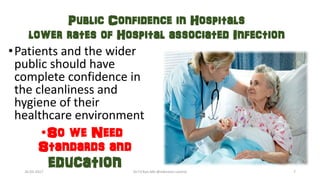
Public Confidence in Hospitals
lower rates of Hospital associated Infection
•Patients and the wider
public should have
complete confidence in
the cleanliness and
hygiene of their
healthcare environment
•So we Need
Standards and
education26-03-2017 Dr.T.V.Rao MD @Infection control 7
Soap water and common sense are best
antiseptics
WILLIAM OSLER
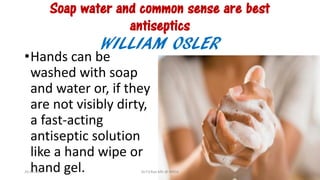
•Hands can be
washed with soap
and water or, if they
are not visibly dirty,
a fast-acting
antiseptic solution
like a hand wipe or
hand gel.26-03-2017 Dr.T.V.Rao MD @ MRSA
What we Know
 we know:WELL
Bugs are on our hands
Bugs can be washed off
Washing bugs off our hands saves lives
HCWs don’t wash their hands!!!
 So what is the problem???
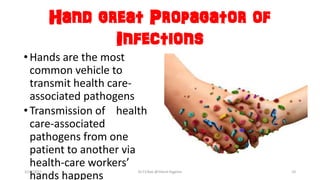
Hand great Propagator of
Infections
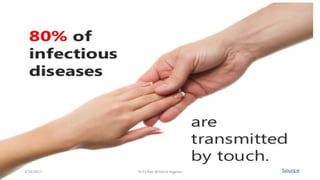
•Hands are the most
common vehicle to
transmit health care-
associated pathogens
•Transmission of health
care-associated
pathogens from one
patient to another via
health-care workers’
hands happens
3/26/2017 Dr.T.V.Rao @!Hand Hygeine 10
When should I wash my hands?
• Different situations where people can pick up "germs" include:
• When hands are visibly soiled.
• After using the washroom (includes changing diapers).
• After blowing your nose or after sneezing in your hands.
• Before and after eating, handling food, drinking or smoking.
• After touching raw meat, poultry, or fish.
• After handling garbage.
• Visiting or caring for sick people.
• Handling pets, animals or animal waste.
3/26/2017 Dr.T.V.Rao @!Hand Hygeine 11
Strategies for compliance
• Monitoring of hand
hygiene is a key
component in improving
processes and compliance.
rely on different measures
to gauge compliance.
Monitoring should be
conducted on a routine
basis and documented
•Do we Have ?
3/26/2017 Dr.T.V.Rao @!Hand Hygeine 12
Hand washing agents
• Plain (non-antimicrobial) soap
•Alcohols
• Most alcohol-based hand antiseptics contain either ethanol,
isopropanol or n-propanol, or a combination of two of these
products.
• Chlorhexidine
• CHG, a cationic bisbiguanide, was developed in the United Kingdom in
the early 1950s and introduced into the USA in the 1970s.
Chlorhexidine base is barely soluble in water, but the digluconate
form is water-soluble
3/26/2017 Dr.T.V.Rao @!Hand Hygeine 13
Hand washing agents
• Chloroxylenol
• Chloroxylenol, also known as para-chloro-meta-xylenol (PCMX), is a
halogen-substituted phenolic compound that has been used widely as a
preservative in cosmetics and other products and as an active agent in
antimicrobial soaps
• Hexachlorophene
• Hexachlorophene is a bisphenol composed of two phenolic groups and
three chlorine moieties. In the 1950s and early 1960s, emulsions
containing 3% hexachlorophene were widely used for hygienic
handwashing as surgical scrubs and for routine bathing of infants in
hospital nurseries
3/26/2017 Dr.T.V.Rao @!Hand Hygeine 14
Hand washing agents
• Iodine and iodophors
• Iodine has been recognized as an effective antiseptic since the 1800s,
though iodophors have largely replaced iodine as the active ingredient in
antiseptics because iodine often causes irritation and discolouring of skin.
• Quaternary ammonium compounds
• Quaternary ammonium compounds (QACs) are composed of a nitrogen
atom linked directly to four alkyl groups Among this large group of
compounds, alkyl benzalkonium chlorides are the most widely used as
antiseptics
• Triclosan
• Triclosan (chemical name 2,4,4’–trichloro-2’-hydroxydiphenyl ether) is
known commercially as Irgasan DP-300
3/26/2017 Dr.T.V.Rao @!Hand Hygeine 15
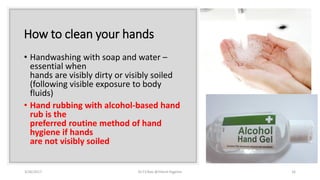
How to clean your hands
• Handwashing with soap and water –
essential when
hands are visibly dirty or visibly soiled
(following visible exposure to body
fluids)
• Hand rubbing with alcohol-based hand
rub is the
preferred routine method of hand
hygiene if hands
are not visibly soiled
3/26/2017 Dr.T.V.Rao @!Hand Hygeine 16
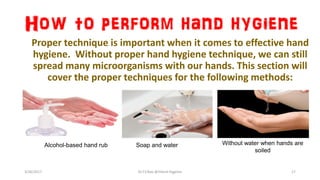
How to perform hand hygiene
Proper technique is important when it comes to effective hand
hygiene. Without proper hand hygiene technique, we can still
spread many microorganisms with our hands. This section will
cover the proper techniques for the following methods:
Alcohol-based hand rub Soap and water Without water when hands are
soiled
3/26/2017 Dr.T.V.Rao @!Hand Hygeine 17
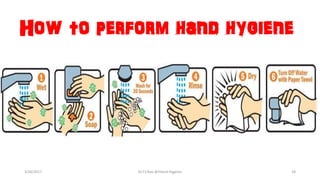
How to perform hand hygiene
3/26/2017 Dr.T.V.Rao @!Hand Hygeine 18
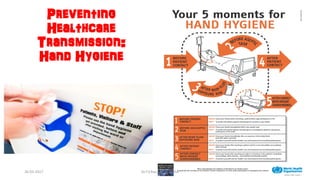
Preventing
Healthcare
Transmission:
Hand Hygiene
26-03-2017 Dr.T.V.Rao MD @ MRSA
What about
antibacterial soaps and
waterless hand scrubs?
• While it is true that regular
soap and water does not
actually kill microorganisms
(they create a slippery
surface that allows the
organisms to "slide off"),
antibacterial soaps are
typically considered to be
"overkill" for most purposes.
3/26/2017 Dr.T.V.Rao @!Hand Hygeine 20
Use of Antiseptic Soaps
• The exception may be in a
hospital where special
situations are present
(e.g., before invasive
procedures, when caring
for severely immuno-
compromised patients,
critical care areas, intensive
care nurseries, etc..
3/26/2017 Dr.T.V.Rao @!Hand Hygeine 21
WHEN ESSENTIAL TO USE
SOAP AND WATER
•If exposure to spore
forming organisms e.g.
Clostridium difficile is
strongly suspected or
proven, including during
outbreaks – clean hands
using soap and water
3/26/2017 Dr.T.V.Rao @!Hand Hygeine 22
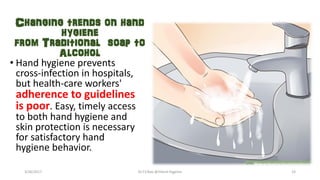
Changing trends on hand
hygiene
from Traditional soap to
Alcohol
• Hand hygiene prevents
cross-infection in hospitals,
but health-care workers'
adherence to guidelines
is poor. Easy, timely access
to both hand hygiene and
skin protection is necessary
for satisfactory hand
hygiene behavior.
3/26/2017 Dr.T.V.Rao @!Hand Hygeine 23
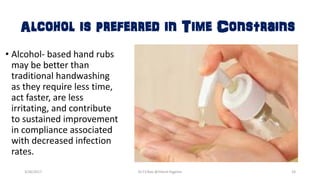
Alcohol is preferred in Time Constrains
• Alcohol- based hand rubs
may be better than
traditional handwashing
as they require less time,
act faster, are less
irritating, and contribute
to sustained improvement
in compliance associated
with decreased infection
rates.
3/26/2017 Dr.T.V.Rao @!Hand Hygeine 24
Alcohol association with C.difficile
Infections
• The widespread use of alcohol-based hand rubs was repeatedly given
the major blame for the increase of C. difficile-associated
disease rates because alcohol preserves spores and is used in the
laboratory to select C. difficile spores from stools.
• Although alcohol-based hand rubs may not be effective against.
difficile, it has not been shown that they trigger the rise of
C.difficile-associated disease.
• However rates began to rise in the USA long before the wide use of
alcohol-based hand rubs.
3/26/2017 Dr.T.V.Rao @!Hand Hygeine 25
How to observe Hand Hygiene
• Direct observation is the most accurate method
• Observer must conduct the observation without interfering
with ongoing work
• Observer should be familiar with “The 5 Moments for
Hand Hygiene” and the data collection tool that is being
utilized
• Identify opportunities for hand hygiene and then record if
the worker being observed performed hand hygiene at that
time
3/26/2017 Dr.T.V.Rao @!Hand Hygeine 26
FDA Standards in Hand Hygiene
ASTM standards
•ASTM E-1174202 Currently, hand wash or hand
rub agents are evaluated using this method in
North America. The efficacy criteria of the FDA’s
Tentative Final Monograph (TFM) are a 2-log10
reduction of the indicator organism on each hand
within 5 minutes after the first use, and a 3-log10
reduction of the indicator organism on each hand
within 5 minutes after the tenth use.
3/26/2017 Dr.T.V.Rao @!Hand Hygeine 27
3/26/2017 Dr.T.V.Rao @!Hand Hygeine 28
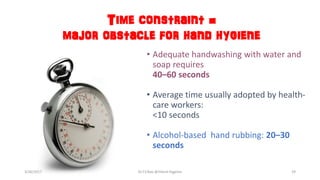
• Adequate handwashing with water and
soap requires
40–60 seconds
• Average time usually adopted by health-
care workers:
<10 seconds
• Alcohol-based hand rubbing: 20–30
seconds
Time constraint =
major obstacle for hand hygiene
3/26/2017 Dr.T.V.Rao @!Hand Hygeine 29
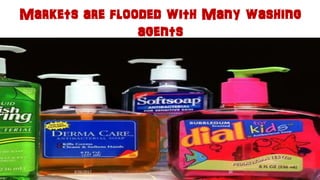
Markets are flooded with Many washing
agents
3/26/2017 Dr.T.V.Rao @!Hand Hygeine 30
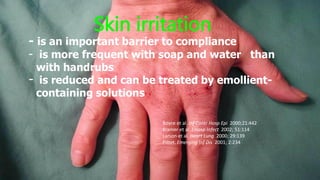
- is an important barrier to compliance
- is more frequent with soap and water than
with handrubs
- is reduced and can be treated by emollient-
containing solutions
Skin irritation
Boyce et al. Inf Contr Hosp Epi 2000;21:442
Kramer et al. J Hosp Infect 2002; 51:114
Larson et al. Heart Lung 2000; 29:139
Pittet. Emerging Inf Dis 2001; 2:234
What can we do to help change
Provide easy access to hand hygiene materials
Handrub solution
Conveniently located:
at the patients bedside
at the patient’s room entrance
in convenient / appropriate locations
in high traffic public areas
Working appropriately
Resources for success
•WHO has hundreds of resources including scientific
evidence to support their recommendations for hand
hygiene, as well as easy-to-use implementation guides
and training materials that can be adapted for use in
any healthcare setting..
Additionally, The CDC has several key resources and
a dedicated web course on hand hygiene for
healthcare providers. This resource can be access by
visiting the CDC website at www.cdc.gov.
3/26/2017 Dr.T.V.Rao @!Hand Hygeine 33
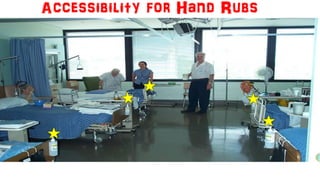
Accessibility for Hand Rubs
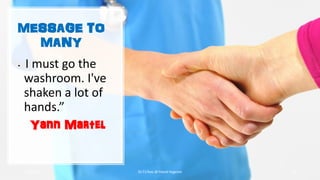
MESSAGE TO
MANY
• I must go the
washroom. I've
shaken a lot of
hands.”
Yann Martel
3/26/2017 Dr.T.V.Rao @!Hand Hygeine 35
BEST PRAYER IN THE HOSPITAL IS
SUPPORTING THE HYGIENE
3/26/2017 Dr.T.V.Rao @!Hand Hygeine 36
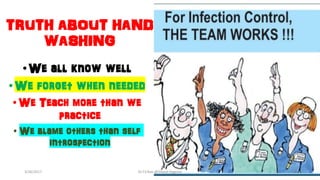
TRUTH ABOUT HAND
WASHING
•We all know well
•We forget when needed
• We Teach more than we
practice
• We blame others than self
introspection
3/26/2017 Dr.T.V.Rao @!Hand Hygeine 37
YOU CAN VISIT ME AT
3/26/2017 Dr.T.V.Rao @!Hand Hygeine 38
References
• WHO Guidelines on Hand Hygiene in Health CareFirst Global Patient
Safety Challenge Clean Care is Safer Care © World Health
Organization 2009
• CDC Guidelines on Hand Disinfection
3/26/2017 Dr.T.V.Rao @!Hand Hygeine 39
THANK YOU ALL
3/26/2017 Dr.T.V.Rao @!Hand Hygeine 40

Hand hygiene

  • 1.
    Hand hygiene guest presentation Dr.T.V.RaoMD 3/26/2017 Dr.T.V.Rao @!Hand Hygeine 1
  • 2.
    The world withInfection 3/26/2017 Dr.T.V.Rao @!Hand Hygeine 2
  • 3.
    A tribute toa Great soul Semmelweis‘ (1818 – 1865) •Hand hygiene is the simplest, most effective measure for preventing nosocomial infections Despite advances in infection control and hospital epidemiology, Semmelweis' message is not consistently translated into clinical practice , 3/26/2017 Dr.T.V.Rao @!Hand Hygeine 3
  • 4.
    HCAI: The worldwideburden •Estimates are hampered by limited availability of reliable data •The burden of disease both outside and inside health-care facilities is unknown in many countries •No health-care facility, no country, no health- care system in the world can claim to have solved the problem3/26/2017 Dr.T.V.Rao @!Hand Hygeine 4
  • 5.
    Hospitals Continues tobe a Great Risk to many who avail the Services 26-03-2017 Dr.T.V.Rao MD @Infection control 5
  • 6.
  • 7.
    Public Confidence inHospitals lower rates of Hospital associated Infection •Patients and the wider public should have complete confidence in the cleanliness and hygiene of their healthcare environment •So we Need Standards and education26-03-2017 Dr.T.V.Rao MD @Infection control 7
  • 8.
    Soap water andcommon sense are best antiseptics WILLIAM OSLER •Hands can be washed with soap and water or, if they are not visibly dirty, a fast-acting antiseptic solution like a hand wipe or hand gel.26-03-2017 Dr.T.V.Rao MD @ MRSA
  • 9.
    What we Know we know:WELL Bugs are on our hands Bugs can be washed off Washing bugs off our hands saves lives HCWs don’t wash their hands!!!  So what is the problem???
  • 10.
    Hand great Propagatorof Infections •Hands are the most common vehicle to transmit health care- associated pathogens •Transmission of health care-associated pathogens from one patient to another via health-care workers’ hands happens 3/26/2017 Dr.T.V.Rao @!Hand Hygeine 10
  • 11.
    When should Iwash my hands? • Different situations where people can pick up "germs" include: • When hands are visibly soiled. • After using the washroom (includes changing diapers). • After blowing your nose or after sneezing in your hands. • Before and after eating, handling food, drinking or smoking. • After touching raw meat, poultry, or fish. • After handling garbage. • Visiting or caring for sick people. • Handling pets, animals or animal waste. 3/26/2017 Dr.T.V.Rao @!Hand Hygeine 11
  • 12.
    Strategies for compliance •Monitoring of hand hygiene is a key component in improving processes and compliance. rely on different measures to gauge compliance. Monitoring should be conducted on a routine basis and documented •Do we Have ? 3/26/2017 Dr.T.V.Rao @!Hand Hygeine 12
  • 13.
    Hand washing agents •Plain (non-antimicrobial) soap •Alcohols • Most alcohol-based hand antiseptics contain either ethanol, isopropanol or n-propanol, or a combination of two of these products. • Chlorhexidine • CHG, a cationic bisbiguanide, was developed in the United Kingdom in the early 1950s and introduced into the USA in the 1970s. Chlorhexidine base is barely soluble in water, but the digluconate form is water-soluble 3/26/2017 Dr.T.V.Rao @!Hand Hygeine 13
  • 14.
    Hand washing agents •Chloroxylenol • Chloroxylenol, also known as para-chloro-meta-xylenol (PCMX), is a halogen-substituted phenolic compound that has been used widely as a preservative in cosmetics and other products and as an active agent in antimicrobial soaps • Hexachlorophene • Hexachlorophene is a bisphenol composed of two phenolic groups and three chlorine moieties. In the 1950s and early 1960s, emulsions containing 3% hexachlorophene were widely used for hygienic handwashing as surgical scrubs and for routine bathing of infants in hospital nurseries 3/26/2017 Dr.T.V.Rao @!Hand Hygeine 14
  • 15.
    Hand washing agents •Iodine and iodophors • Iodine has been recognized as an effective antiseptic since the 1800s, though iodophors have largely replaced iodine as the active ingredient in antiseptics because iodine often causes irritation and discolouring of skin. • Quaternary ammonium compounds • Quaternary ammonium compounds (QACs) are composed of a nitrogen atom linked directly to four alkyl groups Among this large group of compounds, alkyl benzalkonium chlorides are the most widely used as antiseptics • Triclosan • Triclosan (chemical name 2,4,4’–trichloro-2’-hydroxydiphenyl ether) is known commercially as Irgasan DP-300 3/26/2017 Dr.T.V.Rao @!Hand Hygeine 15
  • 16.
    How to cleanyour hands • Handwashing with soap and water – essential when hands are visibly dirty or visibly soiled (following visible exposure to body fluids) • Hand rubbing with alcohol-based hand rub is the preferred routine method of hand hygiene if hands are not visibly soiled 3/26/2017 Dr.T.V.Rao @!Hand Hygeine 16
  • 17.
    How to performhand hygiene Proper technique is important when it comes to effective hand hygiene. Without proper hand hygiene technique, we can still spread many microorganisms with our hands. This section will cover the proper techniques for the following methods: Alcohol-based hand rub Soap and water Without water when hands are soiled 3/26/2017 Dr.T.V.Rao @!Hand Hygeine 17
  • 18.
    How to performhand hygiene 3/26/2017 Dr.T.V.Rao @!Hand Hygeine 18
  • 19.
  • 20.
    What about antibacterial soapsand waterless hand scrubs? • While it is true that regular soap and water does not actually kill microorganisms (they create a slippery surface that allows the organisms to "slide off"), antibacterial soaps are typically considered to be "overkill" for most purposes. 3/26/2017 Dr.T.V.Rao @!Hand Hygeine 20
  • 21.
    Use of AntisepticSoaps • The exception may be in a hospital where special situations are present (e.g., before invasive procedures, when caring for severely immuno- compromised patients, critical care areas, intensive care nurseries, etc.. 3/26/2017 Dr.T.V.Rao @!Hand Hygeine 21
  • 22.
    WHEN ESSENTIAL TOUSE SOAP AND WATER •If exposure to spore forming organisms e.g. Clostridium difficile is strongly suspected or proven, including during outbreaks – clean hands using soap and water 3/26/2017 Dr.T.V.Rao @!Hand Hygeine 22
  • 23.
    Changing trends onhand hygiene from Traditional soap to Alcohol • Hand hygiene prevents cross-infection in hospitals, but health-care workers' adherence to guidelines is poor. Easy, timely access to both hand hygiene and skin protection is necessary for satisfactory hand hygiene behavior. 3/26/2017 Dr.T.V.Rao @!Hand Hygeine 23
  • 24.
    Alcohol is preferredin Time Constrains • Alcohol- based hand rubs may be better than traditional handwashing as they require less time, act faster, are less irritating, and contribute to sustained improvement in compliance associated with decreased infection rates. 3/26/2017 Dr.T.V.Rao @!Hand Hygeine 24
  • 25.
    Alcohol association withC.difficile Infections • The widespread use of alcohol-based hand rubs was repeatedly given the major blame for the increase of C. difficile-associated disease rates because alcohol preserves spores and is used in the laboratory to select C. difficile spores from stools. • Although alcohol-based hand rubs may not be effective against. difficile, it has not been shown that they trigger the rise of C.difficile-associated disease. • However rates began to rise in the USA long before the wide use of alcohol-based hand rubs. 3/26/2017 Dr.T.V.Rao @!Hand Hygeine 25
  • 26.
    How to observeHand Hygiene • Direct observation is the most accurate method • Observer must conduct the observation without interfering with ongoing work • Observer should be familiar with “The 5 Moments for Hand Hygiene” and the data collection tool that is being utilized • Identify opportunities for hand hygiene and then record if the worker being observed performed hand hygiene at that time 3/26/2017 Dr.T.V.Rao @!Hand Hygeine 26
  • 27.
    FDA Standards inHand Hygiene ASTM standards •ASTM E-1174202 Currently, hand wash or hand rub agents are evaluated using this method in North America. The efficacy criteria of the FDA’s Tentative Final Monograph (TFM) are a 2-log10 reduction of the indicator organism on each hand within 5 minutes after the first use, and a 3-log10 reduction of the indicator organism on each hand within 5 minutes after the tenth use. 3/26/2017 Dr.T.V.Rao @!Hand Hygeine 27
  • 28.
  • 29.
    • Adequate handwashingwith water and soap requires 40–60 seconds • Average time usually adopted by health- care workers: <10 seconds • Alcohol-based hand rubbing: 20–30 seconds Time constraint = major obstacle for hand hygiene 3/26/2017 Dr.T.V.Rao @!Hand Hygeine 29
  • 30.
    Markets are floodedwith Many washing agents 3/26/2017 Dr.T.V.Rao @!Hand Hygeine 30
  • 31.
    - is animportant barrier to compliance - is more frequent with soap and water than with handrubs - is reduced and can be treated by emollient- containing solutions Skin irritation Boyce et al. Inf Contr Hosp Epi 2000;21:442 Kramer et al. J Hosp Infect 2002; 51:114 Larson et al. Heart Lung 2000; 29:139 Pittet. Emerging Inf Dis 2001; 2:234
  • 32.
    What can wedo to help change Provide easy access to hand hygiene materials Handrub solution Conveniently located: at the patients bedside at the patient’s room entrance in convenient / appropriate locations in high traffic public areas Working appropriately
  • 33.
    Resources for success •WHOhas hundreds of resources including scientific evidence to support their recommendations for hand hygiene, as well as easy-to-use implementation guides and training materials that can be adapted for use in any healthcare setting.. Additionally, The CDC has several key resources and a dedicated web course on hand hygiene for healthcare providers. This resource can be access by visiting the CDC website at www.cdc.gov. 3/26/2017 Dr.T.V.Rao @!Hand Hygeine 33
  • 34.
  • 35.
    MESSAGE TO MANY • Imust go the washroom. I've shaken a lot of hands.” Yann Martel 3/26/2017 Dr.T.V.Rao @!Hand Hygeine 35
  • 36.
    BEST PRAYER INTHE HOSPITAL IS SUPPORTING THE HYGIENE 3/26/2017 Dr.T.V.Rao @!Hand Hygeine 36
  • 37.
    TRUTH ABOUT HAND WASHING •Weall know well •We forget when needed • We Teach more than we practice • We blame others than self introspection 3/26/2017 Dr.T.V.Rao @!Hand Hygeine 37
  • 38.
    YOU CAN VISITME AT 3/26/2017 Dr.T.V.Rao @!Hand Hygeine 38
  • 39.
    References • WHO Guidelineson Hand Hygiene in Health CareFirst Global Patient Safety Challenge Clean Care is Safer Care © World Health Organization 2009 • CDC Guidelines on Hand Disinfection 3/26/2017 Dr.T.V.Rao @!Hand Hygeine 39
  • 40.
    THANK YOU ALL 3/26/2017Dr.T.V.Rao @!Hand Hygeine 40