HAND WASH
Hand Hygiene and Handwashing
Handwashing is the act of cleaning one’s hands with the use of any liquid with or without soap for the
purpose of removing dirt or microorganisms. It is the most effective measure in reducing the risk of
transmitting infectious diseases.
It cannot be said too often that hand washing is the most important and most basic technique in preventing
and controlling infections. It is the single most effective infection control measure.
Handwashing is under the umbrella of hand hygiene. Hand hygiene is defined by the World Health
Organization as a general term that applies to handwashing, antiseptic handwash, antiseptic hand rub or
surgical hand antisepsis.
Terms
To understand this study guide better, familiarize yourself with the terms used:
•Hand Hygiene. It is a general term that applies to handwashing, antiseptic handwash, antiseptic hand rub,
or surgical hand antisepsis
•Hand Washing. It is defined as the washing of hands with plain (i.e., non-antimicrobial) soap and water.
•Antiseptic Handwash. A term that applies to handwashing with an antimicrobial soap and water.
•Surgical Hand Antisepsis. Commonly called as a surgical hand scrub. This is to remove as many
microorganisms from the hands as possible before the sterile procedure.
Concepts
Principles and concepts surrounding hand hygiene:
•You must use running water in a sink that drains out instead of using a basin.
•You may use soap – antibacterial soap if necessary.
•You must rub your hands against each other for at least 30 seconds to facilitate removal of microorganisms.
•Long nails and jewelry trap germs. It is best to keep fingernails short. If you wear a ring, it is better not to
remove the ring before hand washing so that it can be washed too.
•It is always better to use disposable paper towels than to use cloth towel when drying hands to ensure that
you can only use those once.
•The faucet is always considered dirty and it is recommended to turn it off using a paper towel in the
absence of the ideal sensor or foot pedal.
•Dispensers of soap should be used until completely empty. Once emptied, it should be washed before
refilled.
Purposes
The purposes of hand hygiene are:
•Hand washing can prevent infection
•Avoid pathogenic microorganisms and to avoid transmitting them
Types of Hand Hygiene
The following are the types of hand hygiene:
•Routine handwash. Use of water and non-antimicrobial soap for the purpose of removing soil and transient
microorganisms.
•Antiseptic handwash. Use of water and antimicrobial soap (e.g., chlorhexidine, iodine and iodophors,
chloroxylenol [PCMX], triclosan) for the purpose of removing or destroying transient microorganisms and
reduce resident flora.
•Antiseptic handrub. Use of alcohol-based handrub.
•Surgical antisepsis. Use of water and antimicrobial soap (e.g., chlorhexidine, iodine and iodophors,
chloroxylenol [PCMX], triclosan) for the purpose of removing or destroying transient microorganisms and
reduce resident flora. Recommended duration is 2-6 minutes.
Indicators of Hand Hygiene
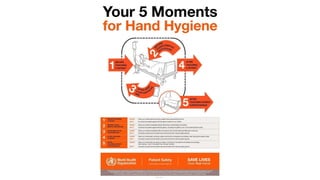
According to the World Health Organization (WHO), there are Five Moments for Hand Hygiene:
1.Before Patient Contact.
2.Before and Antiseptic Task.
3.After Body Fluid Exposure Risk.
4.After Patient Contact.
5.After Contact with Patient Surroundings.
Supplies Needed
The following materials or equipment are needed to perform hand washing:
•Soap or detergent
•Warm running water
•Paper towels
•Alcohol
•Optional: Antiseptic cleaner, fingernail brush, plastic cuticle stick
Procedures
Below are the step-by-step guide for different hand hygiene methods:
Antiseptic Handrub
The use of alcohol-based handrub.
1. Ensure jewellery has been removed
2. Apply quantity of alcohol-based hand hygiene product as per manufacturer’s recommendations into cupped
hand.Rub hands palm to palm
4. Right palm over left dorsum with interlaced fingers and vice versa.
5. Palm to palm with fingers interlaced
6. Backs of fingers to opposing palms with fingers interlaced
7. Rotational rubbing of left thumb clasped in right palm and vice versa
8. Rotational rubbing, backwards and forwards with clasped fingers of right hand in left
palm and vice versa
9. Rubbing hands together until hands are dry before continuing with patient care, do not rub off excess product.
Antiseptic Handwash
Also known as clean technique, includes procedures used to reduce the number of organisms on hands.
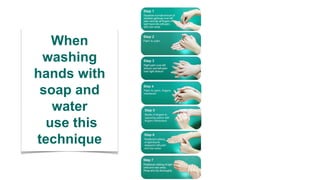
1. Gather the necessary supplies. Stand in front of the sink.
2. Wet the hands and wrist area. Keep hands lower than elbows to allow water to flow towards the
fingertips.
3. Cover all areas of hands with soap.
4. With firm rubbing and circular motions, wash the palms and backs of the hands, each finger, the
knuckles, wrists, and forearms. Continue this friction motion for 30 seconds.
5. Rinse thoroughly with water flowing towards the fingertips.
6. Pat hands dry, beginning with the fingers and moving upward towards forearms, with a paper towel and
discard immediately
7. In the absence of sensors or foot pedal, use another clean paper towel to turn off the faucet.
Surgical Antisepsis
Also known as sterile technique, prevents contamination of an open wound, serves to isolate the operative area
from the unsterile environment, and maintains a sterile field for surgery.
1. Remove all pieces of jewelry.
2. Wet hands using sterile water with water closest to your body temperature.
3. Wash hands using antimicrobial soap and/or povidone-iodine.
4. Clean subungual areas with a nail file.
5. Scrub each side of each finger, between the fingers, and the backs and fronts of the hands for at least 4
minutes.
6. Proceed to scrub the hands, keeping the hand higher than the arm at all times to prevent bacteria-laden soap
and water from contaminating the hands.
7. Rinse hands and arms by passing them through the flowing water in one direction only, from fingertips to
elbow.
8. Proceed to the operating room holding hands above elbows.
9. Dry hands and arms using sterile towel observing aseptic technique.
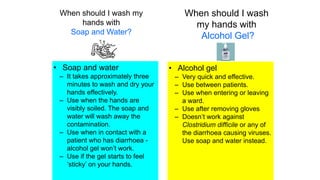
When should I wash my
hands with
Soap and Water?
• Soap and water
– It takes approximately three
minutes to wash and dry your
hands effectively.
– Use when the hands are
visibly soiled. The soap and
water will wash away the
contamination.
– Use when in contact with a
patient who has diarrhoea -
alcohol gel won’t work.
– Use if the gel starts to feel
‘sticky’ on your hands.
• Alcohol gel
– Very quick and effective.
– Use between patients.
– Use when entering or leaving
a ward.
– Use after removing gloves
– Doesn’t work against
Clostridium difficile or any of
the diarrhoea causing viruses.
Use soap and water instead.
When should I wash
my hands with
Alcohol Gel?
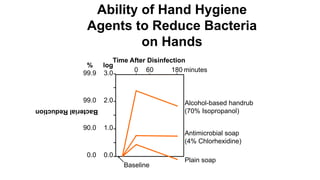
Ability of Hand Hygiene
Agents to Reduce Bacteria
on Hands
0.0
1.0
2.0
3.0 0 60 180 minutes
0.0
90.0
99.0
99.9
log
%
Bacterial
Reduction
Alcohol-based handrub
(70% Isopropanol)
Antimicrobial soap
(4% Chlorhexidine)
Plain soap
Time After Disinfection
Baseline
When
washing
hands with
soap and
water
use this
technique
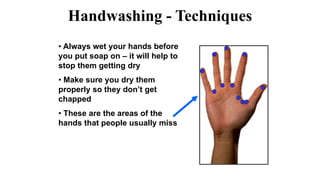
Handwashing - Techniques
• Always wet your hands before
you put soap on – it will help to
stop them getting dry
• Make sure you dry them
properly so they don’t get
chapped
• These are the areas of the
hands that people usually miss
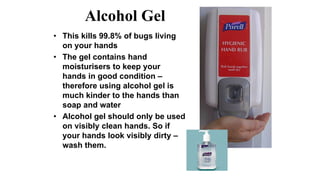
Alcohol Gel
• This kills 99.8% of bugs living
on your hands
• The gel contains hand
moisturisers to keep your
hands in good condition –
therefore using alcohol gel is
much kinder to the hands than
soap and water
• Alcohol gel should only be used
on visibly clean hands. So if
your hands look visibly dirty –
wash them.
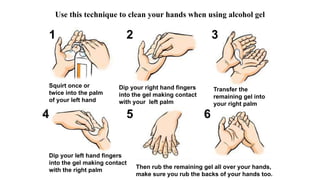
Use this technique to clean your hands when using alcohol gel
Squirt once or
twice into the palm
of your left hand
Dip your right hand fingers
into the gel making contact
with your left palm
Transfer the
remaining gel into
your right palm
Dip your left hand fingers
into the gel making contact
with the right palm
Then rub the remaining gel all over your hands,
make sure you rub the backs of your hands too.
1 2 3
4 5 6
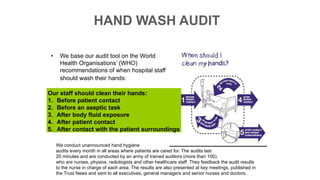
• We base our audit tool on the World
Health Organisations’ (WHO)
recommendations of when hospital staff
should wash their hands:
Our staff should clean their hands:
1. Before patient contact
2. Before an aseptic task
3. After body fluid exposure
4. After patient contact
5. After contact with the patient surroundings
We conduct unannounced hand hygiene
audits every month in all areas where patients are cared for. The audits last
20 minutes and are conducted by an army of trained auditors (more than 100).
who are nurses, physios, radiologists and other healthcare staff. They feedback the audit results
to the nurse in charge of each area. The results are also presented at key meetings, published in
the Trust News and sent to all executives, general managers and senior nurses and doctors.
HAND WASH AUDIT

Hand wash.ppt

  • 1.
  • 2.
    Hand Hygiene andHandwashing Handwashing is the act of cleaning one’s hands with the use of any liquid with or without soap for the purpose of removing dirt or microorganisms. It is the most effective measure in reducing the risk of transmitting infectious diseases. It cannot be said too often that hand washing is the most important and most basic technique in preventing and controlling infections. It is the single most effective infection control measure. Handwashing is under the umbrella of hand hygiene. Hand hygiene is defined by the World Health Organization as a general term that applies to handwashing, antiseptic handwash, antiseptic hand rub or surgical hand antisepsis. Terms To understand this study guide better, familiarize yourself with the terms used: •Hand Hygiene. It is a general term that applies to handwashing, antiseptic handwash, antiseptic hand rub, or surgical hand antisepsis •Hand Washing. It is defined as the washing of hands with plain (i.e., non-antimicrobial) soap and water. •Antiseptic Handwash. A term that applies to handwashing with an antimicrobial soap and water. •Surgical Hand Antisepsis. Commonly called as a surgical hand scrub. This is to remove as many microorganisms from the hands as possible before the sterile procedure.
  • 3.
    Concepts Principles and conceptssurrounding hand hygiene: •You must use running water in a sink that drains out instead of using a basin. •You may use soap – antibacterial soap if necessary. •You must rub your hands against each other for at least 30 seconds to facilitate removal of microorganisms. •Long nails and jewelry trap germs. It is best to keep fingernails short. If you wear a ring, it is better not to remove the ring before hand washing so that it can be washed too. •It is always better to use disposable paper towels than to use cloth towel when drying hands to ensure that you can only use those once. •The faucet is always considered dirty and it is recommended to turn it off using a paper towel in the absence of the ideal sensor or foot pedal. •Dispensers of soap should be used until completely empty. Once emptied, it should be washed before refilled. Purposes The purposes of hand hygiene are: •Hand washing can prevent infection •Avoid pathogenic microorganisms and to avoid transmitting them
  • 4.
    Types of HandHygiene The following are the types of hand hygiene: •Routine handwash. Use of water and non-antimicrobial soap for the purpose of removing soil and transient microorganisms. •Antiseptic handwash. Use of water and antimicrobial soap (e.g., chlorhexidine, iodine and iodophors, chloroxylenol [PCMX], triclosan) for the purpose of removing or destroying transient microorganisms and reduce resident flora. •Antiseptic handrub. Use of alcohol-based handrub. •Surgical antisepsis. Use of water and antimicrobial soap (e.g., chlorhexidine, iodine and iodophors, chloroxylenol [PCMX], triclosan) for the purpose of removing or destroying transient microorganisms and reduce resident flora. Recommended duration is 2-6 minutes. Indicators of Hand Hygiene According to the World Health Organization (WHO), there are Five Moments for Hand Hygiene: 1.Before Patient Contact. 2.Before and Antiseptic Task. 3.After Body Fluid Exposure Risk. 4.After Patient Contact. 5.After Contact with Patient Surroundings.
  • 6.
    Supplies Needed The followingmaterials or equipment are needed to perform hand washing: •Soap or detergent •Warm running water •Paper towels •Alcohol •Optional: Antiseptic cleaner, fingernail brush, plastic cuticle stick
  • 7.
    Procedures Below are thestep-by-step guide for different hand hygiene methods: Antiseptic Handrub The use of alcohol-based handrub. 1. Ensure jewellery has been removed 2. Apply quantity of alcohol-based hand hygiene product as per manufacturer’s recommendations into cupped hand.Rub hands palm to palm 4. Right palm over left dorsum with interlaced fingers and vice versa. 5. Palm to palm with fingers interlaced 6. Backs of fingers to opposing palms with fingers interlaced 7. Rotational rubbing of left thumb clasped in right palm and vice versa 8. Rotational rubbing, backwards and forwards with clasped fingers of right hand in left palm and vice versa 9. Rubbing hands together until hands are dry before continuing with patient care, do not rub off excess product.
  • 8.
    Antiseptic Handwash Also knownas clean technique, includes procedures used to reduce the number of organisms on hands. 1. Gather the necessary supplies. Stand in front of the sink. 2. Wet the hands and wrist area. Keep hands lower than elbows to allow water to flow towards the fingertips. 3. Cover all areas of hands with soap. 4. With firm rubbing and circular motions, wash the palms and backs of the hands, each finger, the knuckles, wrists, and forearms. Continue this friction motion for 30 seconds. 5. Rinse thoroughly with water flowing towards the fingertips. 6. Pat hands dry, beginning with the fingers and moving upward towards forearms, with a paper towel and discard immediately 7. In the absence of sensors or foot pedal, use another clean paper towel to turn off the faucet.
  • 9.
    Surgical Antisepsis Also knownas sterile technique, prevents contamination of an open wound, serves to isolate the operative area from the unsterile environment, and maintains a sterile field for surgery. 1. Remove all pieces of jewelry. 2. Wet hands using sterile water with water closest to your body temperature. 3. Wash hands using antimicrobial soap and/or povidone-iodine. 4. Clean subungual areas with a nail file. 5. Scrub each side of each finger, between the fingers, and the backs and fronts of the hands for at least 4 minutes. 6. Proceed to scrub the hands, keeping the hand higher than the arm at all times to prevent bacteria-laden soap and water from contaminating the hands. 7. Rinse hands and arms by passing them through the flowing water in one direction only, from fingertips to elbow. 8. Proceed to the operating room holding hands above elbows. 9. Dry hands and arms using sterile towel observing aseptic technique.
  • 10.
    When should Iwash my hands with Soap and Water? • Soap and water – It takes approximately three minutes to wash and dry your hands effectively. – Use when the hands are visibly soiled. The soap and water will wash away the contamination. – Use when in contact with a patient who has diarrhoea - alcohol gel won’t work. – Use if the gel starts to feel ‘sticky’ on your hands. • Alcohol gel – Very quick and effective. – Use between patients. – Use when entering or leaving a ward. – Use after removing gloves – Doesn’t work against Clostridium difficile or any of the diarrhoea causing viruses. Use soap and water instead. When should I wash my hands with Alcohol Gel?
  • 11.
    Ability of HandHygiene Agents to Reduce Bacteria on Hands 0.0 1.0 2.0 3.0 0 60 180 minutes 0.0 90.0 99.0 99.9 log % Bacterial Reduction Alcohol-based handrub (70% Isopropanol) Antimicrobial soap (4% Chlorhexidine) Plain soap Time After Disinfection Baseline
  • 12.
  • 14.
    Handwashing - Techniques •Always wet your hands before you put soap on – it will help to stop them getting dry • Make sure you dry them properly so they don’t get chapped • These are the areas of the hands that people usually miss
  • 15.
    Alcohol Gel • Thiskills 99.8% of bugs living on your hands • The gel contains hand moisturisers to keep your hands in good condition – therefore using alcohol gel is much kinder to the hands than soap and water • Alcohol gel should only be used on visibly clean hands. So if your hands look visibly dirty – wash them.
  • 16.
    Use this techniqueto clean your hands when using alcohol gel Squirt once or twice into the palm of your left hand Dip your right hand fingers into the gel making contact with your left palm Transfer the remaining gel into your right palm Dip your left hand fingers into the gel making contact with the right palm Then rub the remaining gel all over your hands, make sure you rub the backs of your hands too. 1 2 3 4 5 6
  • 18.
    • We baseour audit tool on the World Health Organisations’ (WHO) recommendations of when hospital staff should wash their hands: Our staff should clean their hands: 1. Before patient contact 2. Before an aseptic task 3. After body fluid exposure 4. After patient contact 5. After contact with the patient surroundings We conduct unannounced hand hygiene audits every month in all areas where patients are cared for. The audits last 20 minutes and are conducted by an army of trained auditors (more than 100). who are nurses, physios, radiologists and other healthcare staff. They feedback the audit results to the nurse in charge of each area. The results are also presented at key meetings, published in the Trust News and sent to all executives, general managers and senior nurses and doctors. HAND WASH AUDIT

Editor's Notes

  • #15 Hand Washing Washing your hands properly has been shown to be the most important way of reducing the spread of infection. The skin is your hands' first defence against infection from pathogenic organisms. While it's intact, it's impermeable to the likes of human immunodeficiency virus (HIV) and hepatitis, so its care and hygiene are crucial. Simply keeping your hands clean is the single most important measure you can take. Handwashing Technique Handwashing is so routine and basic that it's often taken for granted. You will see hand washing technique posters above all sinks in the hospital to remind you of the right technique. Using soap when washing your hands is essential as the bugs will not come off with water alone. You can also use alcohol gel. Rings, watches, bracelets and long sleeves MUST not be worn on the wards as they interfere with hand washing and provide good places for bugs to go. The only rings that are safe to wear are plain bands (wedding rings). If you wear these, make sure you wash under them. False nails have caused outbreaks of infections in hospitals. You should not wear false nails if you work with patients.
  • #16 You do not need to rinse this off. Rub it all over your hands and wrists. 1-2 squirts is enough to clean your hands properly