

z
Dr. Rajesh Pande
Dr. Devawrat Buche
HAND HYGIENE PRACTICES
BASIC QUESTIONS ???
• WHO started it ?? – A Brief history.
• WHY TO PRACTICE ?
• WHEN TO PRACTICE ?
• WHAT TO PRACTICE WITH ?
• HOW TO PRACTICE ?
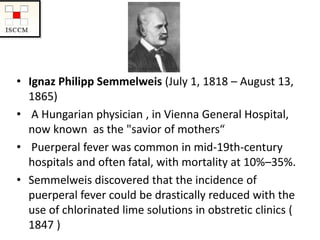
• Ignaz Philipp Semmelweis (July 1, 1818 – August 13,
1865)
• A Hungarian physician , in Vienna General Hospital,
now known as the "savior of mothers“
• Puerperal fever was common in mid-19th-century
hospitals and often fatal, with mortality at 10%–35%.
• Semmelweis discovered that the incidence of
puerperal fever could be drastically reduced with the
use of chlorinated lime solutions in obstretic clinics (
1847 )
Milestones in Hand Hygiene
• 1980: First hand hygiene guidelines published in
English literature
• 1995-96: CDC recommended use of antimicrobial
soap or a waterless antiseptic agent for cleaning
hands upon leaving patient rooms.
• 2002: Healthcare Infection Control Practices
Advisory Committee Guidelines defined alcohol-
based handrub as the standard of care for hand
hygiene in healthcare settings.
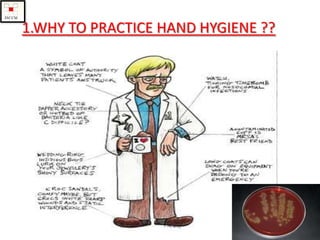
1.WHY TO PRACTICE HAND HYGIENE ??
WHY TO PRACTICE HAND HYGIENE
• The burden of HCAI is greatly increased in the ICU
• Prevalence rates of infection
– In Europe: 9.7% to 31.8%
– US: 9% to 37%
– Crude mortality rates: 12-80%
• The use of invasive devices (e.g., CVC, MV or urinary catheters) is one of
the most important risk factors for acquiring HCAIs.
• Not only the morbidity and mortality is high, but multidrug-resistant
pathogens are commonly involved in such infections and render effective
treatment challenging
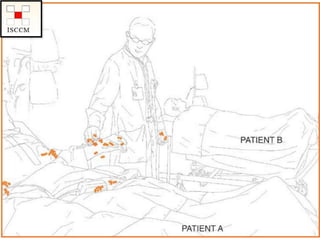
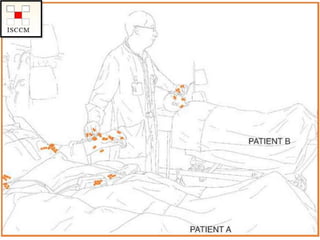
• Hands of HCWs may become persistently colonized by
pathogenic flora
– S. aureus, Gram-negative bacilli, or yeast
– The bacterial density of transient and resident flora, usually
between 3.9 x 10⁴ colony-forming units (CFU)/cm2 and 4.6 x
106 CFU/cm2 and is relatively constant for any given individual.
• Hands can be contaminated with GNB, S. aureus,
enterococci, or C. difficile by performing “clean
procedures,” such as lifting a patient or taking the patient’s
pulse, blood pressure, or temperature, or by touching
intact areas of a hospitalized patient’s skin
• Both Enterococcus faecalis and E. faecium
survived for at least 60 mins on fingertips.
• Pseudomonas aeruginosa and Burkholderia
cepacia were transmissible by handshake for up
to 30 mins when the organisms were suspended
in saline and for up to 180 mins when they were
suspended in sputum.
• People suffering from dermatitis commonly
remain colonized for prolonged time periods
• "Proper handwashing with soap and
water is an important barrier to
many infectious diseases and
promotes better health and well-
being…handwashing is one of the
most practical and effective ways of
preventing the spread of disease."
World Health Organization (WHO)
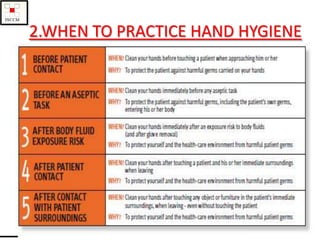
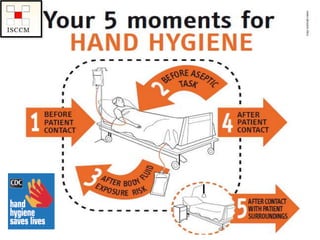
2.WHEN TO PRACTICE HAND HYGIENE
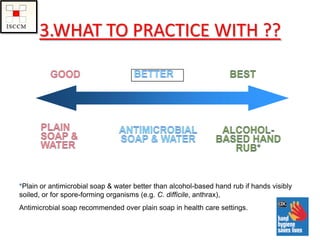
3.WHAT TO PRACTICE WITH ??
*Plain or antimicrobial soap & water better than alcohol-based hand rub if hands visibly
soiled, or for spore-forming organisms (e.g. C. difficile, anthrax),
Antimicrobial soap recommended over plain soap in health care settings.
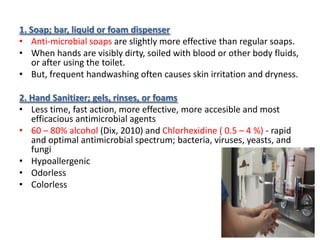
1. Soap; bar, liquid or foam dispenser
• Anti-microbial soaps are slightly more effective than regular soaps.
• When hands are visibly dirty, soiled with blood or other body fluids,
or after using the toilet.
• But, frequent handwashing often causes skin irritation and dryness.
2. Hand Sanitizer; gels, rinses, or foams
• Less time, fast action, more effective, more accesible and most
efficacious antimicrobial agents
• 60 – 80% alcohol (Dix, 2010) and Chlorhexidine ( 0.5 – 4 %) - rapid
and optimal antimicrobial spectrum; bacteria, viruses, yeasts, and
fungi
• Hypoallergenic
• Odorless
• Colorless
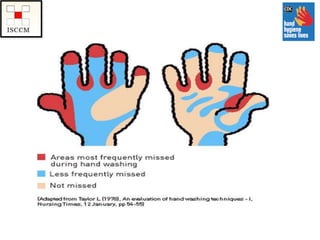
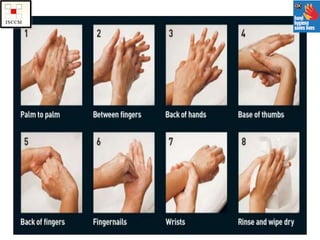
4. HOW TO PRACTICE HAND HYGIENE?
• Hands must be washed
for atleast 20-25 seconds.
• Even intact skin of
patients and healthcare
workers can be colonised
with disease causing
bacteria!
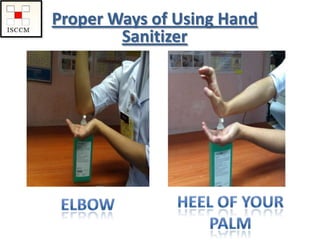
Proper Ways of Using Hand
Sanitizer
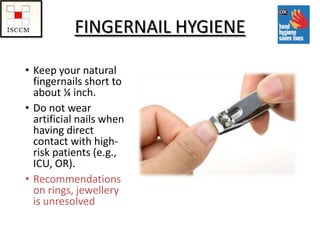
• Keep your natural
fingernails short to
about ÂĽ inch.
• Do not wear
artificial nails when
having direct
contact with high-
risk patients (e.g.,
ICU, OR).
• Recommendations
on rings, jewellery
is unresolved
FINGERNAIL HYGIENE
• Handwashing with soap and water. Available at:
http://www.youtube.com/watch?v=WYj2kkSIsOc&feat
ure=related
• Handwashing with Hand rub. Available at:
http://www.youtube.com/watch?v=JHoPQTTfCv0
• Recommendations from the CDC Guideline for Hand
Hygiene in Healthcare Settings. Available at:
http://solutions.3m.com/3MContentRetrievalAPI/Blob
Servlet?locale=en_US&lmd=1145337135000&assetId=
1114284208573&assetType=MMM_Image&blobAttrib
ute=ImageFile
Protect patients…protect healthcare personnel…
promote quality healthcare!
THANK YOU !!!!