BY
SANDEEP SIR
KAPOL COLLEGE OF HOTEL
MANAGEMENT, KANDIVALI(W.)
AN OVERVIEW:
•

•

•

India is the second largest producer of tea
(camelia sinensis), the largest consumer and
the fourth largest exporter (after Sri Lanka,
Kenya and China) in the world production .
Indian tea exports hit a new bottom in 2007
with only 155.6 m kgs of tea shipped overseas
and total earnings of Rs 15 billion.
The major tea growing areas of India are:
North Bengal, Assam, Tamil Nadu and Kerala.
HISTORY OF TEA
 The

second emperor of China, Shen Nung,
discovers tea when tea leaves blow into his cup
of hot water .
 In 1824 the first tea plant was brought to Ceylon
& planted in the Royal Botanical Gardens,
Peradeniya.
 The pioneer of Ceylon Tea industry James
Taylor planted the first 19 acres of tea in
“Loolecondra” Estate near to the Kandy.
 Tea Sector plays most vital role in Indian
economy.
“ Camellia Sinensis”
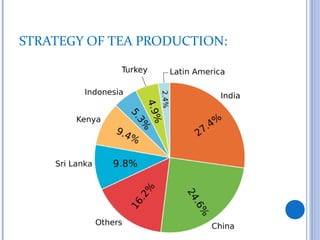
STRATEGY OF TEA PRODUCTION:
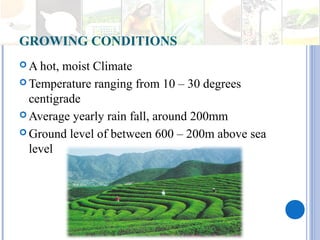
GROWING CONDITIONS
 A hot,

moist Climate
 Temperature ranging from 10 – 30 degrees
centigrade
 Average yearly rain fall, around 200mm
 Ground level of between 600 – 200m above sea
level
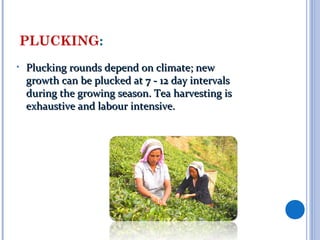
PLUCKING:
•

Plucking rounds depend on climate; new
growth can be plucked at 7 - 12 day intervals
during the growing season. Tea harvesting is
exhaustive and labour intensive.
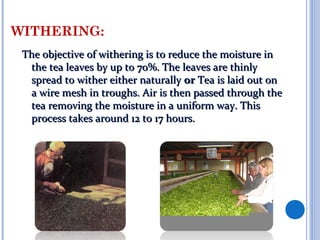
WITHERING:
The objective of withering is to reduce the moisture in
the tea leaves by up to 70%. The leaves are thinly
spread to wither either naturally or Tea is laid out on
a wire mesh in troughs. Air is then passed through the
tea removing the moisture in a uniform way. This
process takes around 12 to 17 hours.
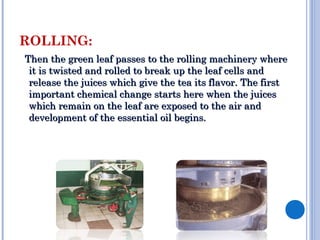
ROLLING:
Then the green leaf passes to the rolling machinery where
it is twisted and rolled to break up the leaf cells and
release the juices which give the tea its flavor. The first
important chemical change starts here when the juices
which remain on the leaf are exposed to the air and
development of the essential oil begins. 
FERMENTATION:
•
•

•

Rolled leaf is put on fermentation racks specially made
of tiles, cement or aluminium.
Fermentation rooms are kept clean and cold .
Fermentation period varies from 2 to 3 hrs depending
on the type of leaf, degree of wither, temperature,
availability of oxygen and fermenting ability of the tea
flush.
Fermentation is a very sensitive process. Even 5 minutes
time delay in adjusting the correct fermentation period
is likely to deteriorate flavour appreciably. During
fermentation the leaf changes colour.
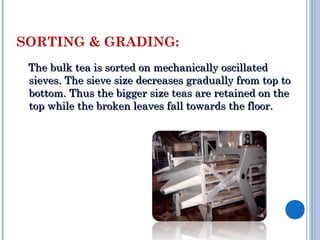
SORTING & GRADING:
The bulk tea is sorted on mechanically oscillated
sieves. The sieve size decreases gradually from top to
bottom. Thus the bigger size teas are retained on the
top while the broken leaves fall towards the floor.
TEA PROCESSING CYCLE
TYPES:
•

White tea: Unwilted and unoxidized

•

Yellow tea: Unwilted and unoxidized but allowed to
yellow

•

Green tea: Wilted and unoxidized

•

Oolong tea: Wilted, crushed, and partially oxidized

•

Black tea: Wilted, crushed, and fully oxidized
HEALTH & BENEFITS OF TEA
 Higher

antioxidant capacity than fruits &
vegetables.
 Help to relax on human
 Assist in natural immune
 Response to infection
 Reduce risk of heart diseases, cancers,
cholesterol level, higher blood pressure.
 Reduce eye fatigue.
BLACK , GREEN, WHITE TEA…….
OU
KY
AN
TH

Tea Making Process

  • 1.
    BY SANDEEP SIR KAPOL COLLEGEOF HOTEL MANAGEMENT, KANDIVALI(W.)
  • 2.
    AN OVERVIEW: • • • India isthe second largest producer of tea (camelia sinensis), the largest consumer and the fourth largest exporter (after Sri Lanka, Kenya and China) in the world production . Indian tea exports hit a new bottom in 2007 with only 155.6 m kgs of tea shipped overseas and total earnings of Rs 15 billion. The major tea growing areas of India are: North Bengal, Assam, Tamil Nadu and Kerala.
  • 3.
    HISTORY OF TEA The second emperor of China, Shen Nung, discovers tea when tea leaves blow into his cup of hot water .  In 1824 the first tea plant was brought to Ceylon & planted in the Royal Botanical Gardens, Peradeniya.  The pioneer of Ceylon Tea industry James Taylor planted the first 19 acres of tea in “Loolecondra” Estate near to the Kandy.  Tea Sector plays most vital role in Indian economy. “ Camellia Sinensis”
  • 4.
    STRATEGY OF TEAPRODUCTION:
  • 5.
    GROWING CONDITIONS  Ahot, moist Climate  Temperature ranging from 10 – 30 degrees centigrade  Average yearly rain fall, around 200mm  Ground level of between 600 – 200m above sea level
  • 7.
    PLUCKING: • Plucking rounds dependon climate; new growth can be plucked at 7 - 12 day intervals during the growing season. Tea harvesting is exhaustive and labour intensive.
  • 8.
    WITHERING: The objective ofwithering is to reduce the moisture in the tea leaves by up to 70%. The leaves are thinly spread to wither either naturally or Tea is laid out on a wire mesh in troughs. Air is then passed through the tea removing the moisture in a uniform way. This process takes around 12 to 17 hours.
  • 9.
    ROLLING: Then the greenleaf passes to the rolling machinery where it is twisted and rolled to break up the leaf cells and release the juices which give the tea its flavor. The first important chemical change starts here when the juices which remain on the leaf are exposed to the air and development of the essential oil begins. 
  • 10.
    FERMENTATION: • • • Rolled leaf isput on fermentation racks specially made of tiles, cement or aluminium. Fermentation rooms are kept clean and cold . Fermentation period varies from 2 to 3 hrs depending on the type of leaf, degree of wither, temperature, availability of oxygen and fermenting ability of the tea flush. Fermentation is a very sensitive process. Even 5 minutes time delay in adjusting the correct fermentation period is likely to deteriorate flavour appreciably. During fermentation the leaf changes colour.
  • 11.
    SORTING & GRADING: Thebulk tea is sorted on mechanically oscillated sieves. The sieve size decreases gradually from top to bottom. Thus the bigger size teas are retained on the top while the broken leaves fall towards the floor.
  • 12.
  • 13.
    TYPES: • White tea: Unwiltedand unoxidized • Yellow tea: Unwilted and unoxidized but allowed to yellow • Green tea: Wilted and unoxidized • Oolong tea: Wilted, crushed, and partially oxidized • Black tea: Wilted, crushed, and fully oxidized
  • 14.
    HEALTH & BENEFITSOF TEA  Higher antioxidant capacity than fruits & vegetables.  Help to relax on human  Assist in natural immune  Response to infection  Reduce risk of heart diseases, cancers, cholesterol level, higher blood pressure.  Reduce eye fatigue.
  • 15.
    BLACK , GREEN,WHITE TEA…….
  • 17.