
COFFEE PROCESSING
(BEAN TO CUP)
BY
T.SENTHAMIZH SELVAN
HISTORY OF
COFFEE
CHIKMAGALUR, -GENESIS OF THE INDIAN COFFEE INDUSTRY.400 YEARS AGO IN BABA BUDAN
HILLS.
IN 1670 BABA BUDAN SMUGGLED SEVEN COFFEE BEANS FROM YEMEN TO MYSORE AND
PLANTED IN CHIKMAGALUR
• Dutch began to grow coffee in the Malabar region.
• British led to set up Arabica coffee plantations
across the hilly regions in South India.
• India is home to 16 unique varieties of coffees that
are sourced from 13 distinct coffee growing regions
• Coffee growing regions in India are divided into three
categories :
• 1.Traditional -Karnataka, Kerala and Tamil Nadu
2.Non-traditional -Andhra Pradesh and Orissa
• 3.Northeastern region -Assam, Manipur, Meghalaya,
Mizoram, Tripura, Nagaland and Arunachal Pradesh
COFFEE MARKET AN
OVERVIEW
MAJOR COFFEE PRODUCING COUNTRIES
1 .Brazil
2.Vietnam
3.Colombia
4 .Indonesia
5 .Ethiopia
6. India
7. Honduras
8. Uganda
9. Mexico
10. Guatemala
MAJOR COFFEE EXPORTING COUNTRIES
1.BRAZIL
2.COLOMBIA
3.VIETNAM
4.GERMANY
5.SWITZERLAND
6.ITALY
7.INDONESIA
8.BELGIUM
9.HONDURAS
10.ETHIOPIA
MAJOR COFFEE IMPORTING COUNTRIES
1.US
2.GERMANY
3.FRANCE
4.ITALY
5.JAPAN
6.CANADA
7.BELGIUM
8.SPAIN
9.UK
10.NETHERLANDS
MAJOR COFFEE CONSUMING COUNTRIES
1 .Finland
2. Norway
3. Netherlands
4. Slovenia
5. Austria
6. Serbia
7. Denmark
8. Germany
9. Belgium
10. Brazil
MAJOR COFFEE EXPORTERS IN THE WORLD
• Barbera Coffee Company (Italy)
• Coffee Cabana Brazil (Brazil)
• Maxwell House (United States)
• Miko Coffee (Belgium)
• Nestlé (Switzerland)
• Neumann Gruppe AG (Germany)
• O’Coffee – Brazilian Estates (Brazil)
• Ospina Coffee Company (Colombia)
• Simexco Daklak Ltd (Vietnam)
• Starbucks Corporation (United States)
MAJOR GREEN COFFEE EXPORTERS IN INDIA
• 1. NKG JAYANTI COFFEE PVT. LTD.
• 2. ALLANASONS LIMITED
• 3. I.T.C.LIMITED
• 4. AMALGAMATED BEAN COFFEE TRADING CO.LTD.,
• 5.NED COMMODITIES INDIA PVT. LTD.,
• 6. TATA COFFEE LTD
PRE HARVEST
PROCESSING OF COFFEE
Species, Growing
Family - Rubiaceae
Genus - Coffea
Species - arabica and canephora
The principal coffee species grown today in the most
important are two:
• Arabica and Robusta.
• http://www.coffeeresearch.org/agriculture/beandev
el.htm
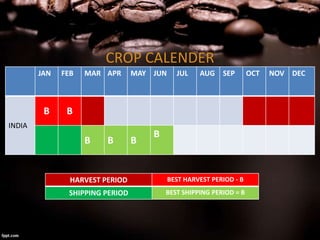
JAN FEB MAR APR MAY JUN JUL AUG SEP OCT NOV DEC
INDIA
B B
B B B
B
CROP CALENDER
HARVEST PERIOD BEST HARVEST PERIOD - B
SHIPPING PERIOD BEST SHIPPING PERIOD = B
ARABICA VS ROBUSTA
ARABICA ROBUSTA
Date species first
identified
1753 1895
Growing area 1000m to 2500m Upto 600metres
Plan type tree Shrubs
Time from flower
to ripe cherry
9 months 10 - 11 months
Flowering after rain irregular
Ripe Cherries fall stay
Root System deep shallow
Pollination self pollinating cross pollination
Plant Height 2.5 – 4.5 meters 4.5 – 6 meter
ARABICA ROBUSTA
ARABICA ROBUSTA
Optimum Temperature
(yearly average)
15-24°C 24-30°C
Optimal Rainfall 1500-2000mm 2000-3000mm
Growth Optimum 1000-2000m 0-700m
Coffee Berry Disease susceptible resistant
Caffeine content of
beans
0.8-1.4% 1.7-4.0%
Shape of Bean flat oval
Typical Brew
Characteristics acidity bitterness, ful
HARVESTING
HARVESTING
• The berries are mature when they are red and soft.
• The coffee berries are ready 8 to 9 months after the plant
flowers.
• Harvest starts during November and harvesting extends up to
February.
HARVESTING METHODS
1.MANUAL
 selective harvesting
 Stripping
2.MECHANICAL
• Large mechanical harvesters on wheels
• light hand-held harvesters.
SELECTIVE HARVESTING STRIPPING
M
A
N
U
A
L
H
A
R
V
E
S
T
I
N
G
LARGE HARVESTERS ON WHEELSSingle rod hand-held harvester
MECHANICAL HARVESTING
METHODS
POST HARVESTING
METHODS
After harvesting, three different
systems are used for processing:
1.DRY-PROCESSED
2.WET-PROCESSED
3.SEMI-DRYPROCESSED
DRY PROCESSING OF COFFEE
WINNOWING SIFTING DRYING
WET PROCESSING OF COFFEE
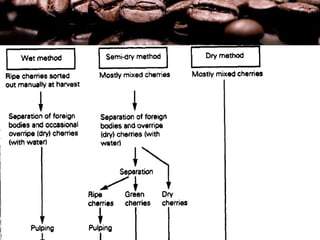
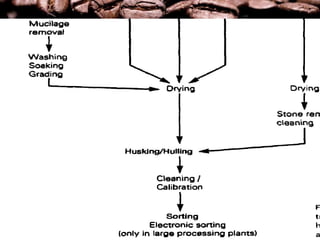
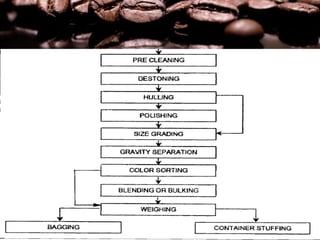
PROCESS FLOW CHART
GRADES OF COFFEE
VARIETIES WASHED
(WET PROCESSED)
UNWASHED
(DRY PROCESSED)
ARABICA PLANTATION CHERRY
ROBUSTA PARCHMENT CHERRY
Major Types And Grades Of Coffee
1.ARABICA COFFEE
I. WASHED ARABICA -
'PLANTATION'
1.Plantation PB
2. Plantation A
3. Plantation B
4. Plantation C
5. Plantation Blacks
6. Plantation Bits
7. Plantation Bulk
II. UNWASHED ARABICA -
'ARABICA CHERRY'
1. Arabica Cherry PB
2. Arabica Cherry AB
3. Arabica Cherry C
4. Arabica Cherry
Blacks/Browns
5. Arabica Cherry Bits
6. Arabica Cherry Bulk
2. Robusta Coffee
I. Washed Robusta 'Robusta
Parchment'
1. Robusta Plantation PB
2. Robusta Plantation AB
3. Robusta Plantation C
4. Robusta Plantation
Blacks/Browns
5. Robusta Plantation Bits
6. Robusta Plantation Bulk
II. Unwashed Robusta
'Robusta Cherry'
1. Robusta Cherry PB
2. Robusta Cherry AB
3. Robusta Cherry C
4. Robusta Cherry
Blacks/Browns
5. Robusta Cherry Bits
6. Robusta Cherry Bulk
3. MONSOONED COFFEES
A. Arabica Monsooned Coffee
1. Monsooned Malabar AA
2. Monsooned Basanally
3. Monsooned Arabica Triage
B. Robusta Monsooned Coffee
1. Monsooned Robusta 'AA'
2. Monsooned Robusta Triage
4. INSTANT COFFEE
5. GROUND COFFEE
6. ROASTED SEEDS
7.SPECIALTY COFFEE
1. MONSOONED COFFEE
2. MYSORE NUGGETS EB (EXTRA BOLD)
3. ROBUSTA KAAPI ROYALE
MOISTURE STANDARDS FOR THE DIFFERENT
TYPES OF COFFEE
A tolerance of +0.5% in moisture
continent permitted.
Type of coffee Moisture (%)
Plantation 10.0*
Arabica cherry 10.5*
Robusta parchment 10*
Robusta cherry 11*
Mysore Nuggets EB 09.0-10.5
Robusta kappi royale 09.0-10.5
Monsooned coffee 13.0-14.5
APERTURE SIZE OF TEST SIEVS USED IN COFFEE
AND OTHER CORRESPONDING
Aperture size
(Diameter of round holes in mm)
screen no
7.50 19
7.25 BETWEEN 19&18
7.10 18
6.70/ 6.65 17
6.50 BETWEEN 17& 16
6.30 16
6.00 15
5.60/5.50 14
5.00 13
BEAN TO CUP
1.Coffee seeds to seedlings in
the nursery
2.Coffee seeds to seedlings
in the nursery
3. Cultivating the adult
coffee tree
4.
4.Harvesting the ripe coffee
cherry
5. Pulping the coffee beans
from the coffee cherry
6.Removing the excess via
fermenting & washing
7.Drying to make parchment coffee
8. Milling the green bean
coffee
9.Storing and exporting
the green coffee bean
TASTING COFFEE
REFERENCES
• Coffee: Growing, Processing,Sustainable Production
by by Jean Nicolas Wintgens.
• COFFEE Recent Developments by R.J. Clarke and O.G.
Vitzthum.
• http://www.indiacoffee.org/
• http://www.coffeeresearch.org/agriculture/processing.
htm
• http://equalexchange.coop/products/coffee/steps
Coffee Processing Technology

Coffee Processing Technology

  • 1.
    COFFEE PROCESSING (BEAN TOCUP) BY T.SENTHAMIZH SELVAN
  • 2.
  • 4.
    CHIKMAGALUR, -GENESIS OFTHE INDIAN COFFEE INDUSTRY.400 YEARS AGO IN BABA BUDAN HILLS. IN 1670 BABA BUDAN SMUGGLED SEVEN COFFEE BEANS FROM YEMEN TO MYSORE AND PLANTED IN CHIKMAGALUR
  • 6.
    • Dutch beganto grow coffee in the Malabar region. • British led to set up Arabica coffee plantations across the hilly regions in South India. • India is home to 16 unique varieties of coffees that are sourced from 13 distinct coffee growing regions • Coffee growing regions in India are divided into three categories : • 1.Traditional -Karnataka, Kerala and Tamil Nadu 2.Non-traditional -Andhra Pradesh and Orissa • 3.Northeastern region -Assam, Manipur, Meghalaya, Mizoram, Tripura, Nagaland and Arunachal Pradesh
  • 7.
  • 8.
    MAJOR COFFEE PRODUCINGCOUNTRIES 1 .Brazil 2.Vietnam 3.Colombia 4 .Indonesia 5 .Ethiopia 6. India 7. Honduras 8. Uganda 9. Mexico 10. Guatemala
  • 9.
    MAJOR COFFEE EXPORTINGCOUNTRIES 1.BRAZIL 2.COLOMBIA 3.VIETNAM 4.GERMANY 5.SWITZERLAND 6.ITALY 7.INDONESIA 8.BELGIUM 9.HONDURAS 10.ETHIOPIA
  • 10.
    MAJOR COFFEE IMPORTINGCOUNTRIES 1.US 2.GERMANY 3.FRANCE 4.ITALY 5.JAPAN 6.CANADA 7.BELGIUM 8.SPAIN 9.UK 10.NETHERLANDS
  • 11.
    MAJOR COFFEE CONSUMINGCOUNTRIES 1 .Finland 2. Norway 3. Netherlands 4. Slovenia 5. Austria 6. Serbia 7. Denmark 8. Germany 9. Belgium 10. Brazil
  • 12.
    MAJOR COFFEE EXPORTERSIN THE WORLD • Barbera Coffee Company (Italy) • Coffee Cabana Brazil (Brazil) • Maxwell House (United States) • Miko Coffee (Belgium) • Nestlé (Switzerland) • Neumann Gruppe AG (Germany) • O’Coffee – Brazilian Estates (Brazil) • Ospina Coffee Company (Colombia) • Simexco Daklak Ltd (Vietnam) • Starbucks Corporation (United States)
  • 13.
    MAJOR GREEN COFFEEEXPORTERS IN INDIA • 1. NKG JAYANTI COFFEE PVT. LTD. • 2. ALLANASONS LIMITED • 3. I.T.C.LIMITED • 4. AMALGAMATED BEAN COFFEE TRADING CO.LTD., • 5.NED COMMODITIES INDIA PVT. LTD., • 6. TATA COFFEE LTD
  • 14.
  • 15.
    Species, Growing Family -Rubiaceae Genus - Coffea Species - arabica and canephora The principal coffee species grown today in the most important are two: • Arabica and Robusta. • http://www.coffeeresearch.org/agriculture/beandev el.htm
  • 16.
    JAN FEB MARAPR MAY JUN JUL AUG SEP OCT NOV DEC INDIA B B B B B B CROP CALENDER HARVEST PERIOD BEST HARVEST PERIOD - B SHIPPING PERIOD BEST SHIPPING PERIOD = B
  • 17.
  • 20.
    ARABICA ROBUSTA Date speciesfirst identified 1753 1895 Growing area 1000m to 2500m Upto 600metres Plan type tree Shrubs Time from flower to ripe cherry 9 months 10 - 11 months Flowering after rain irregular Ripe Cherries fall stay Root System deep shallow Pollination self pollinating cross pollination Plant Height 2.5 – 4.5 meters 4.5 – 6 meter
  • 21.
  • 22.
    ARABICA ROBUSTA Optimum Temperature (yearlyaverage) 15-24°C 24-30°C Optimal Rainfall 1500-2000mm 2000-3000mm Growth Optimum 1000-2000m 0-700m Coffee Berry Disease susceptible resistant Caffeine content of beans 0.8-1.4% 1.7-4.0% Shape of Bean flat oval Typical Brew Characteristics acidity bitterness, ful
  • 24.
  • 25.
    HARVESTING • The berriesare mature when they are red and soft. • The coffee berries are ready 8 to 9 months after the plant flowers. • Harvest starts during November and harvesting extends up to February. HARVESTING METHODS 1.MANUAL  selective harvesting  Stripping 2.MECHANICAL • Large mechanical harvesters on wheels • light hand-held harvesters.
  • 26.
  • 27.
    LARGE HARVESTERS ONWHEELSSingle rod hand-held harvester MECHANICAL HARVESTING METHODS
  • 28.
  • 29.
    After harvesting, threedifferent systems are used for processing: 1.DRY-PROCESSED 2.WET-PROCESSED 3.SEMI-DRYPROCESSED
  • 32.
  • 33.
  • 34.
  • 35.
  • 37.
  • 38.
    VARIETIES WASHED (WET PROCESSED) UNWASHED (DRYPROCESSED) ARABICA PLANTATION CHERRY ROBUSTA PARCHMENT CHERRY
  • 39.
    Major Types AndGrades Of Coffee 1.ARABICA COFFEE I. WASHED ARABICA - 'PLANTATION' 1.Plantation PB 2. Plantation A 3. Plantation B 4. Plantation C 5. Plantation Blacks 6. Plantation Bits 7. Plantation Bulk II. UNWASHED ARABICA - 'ARABICA CHERRY' 1. Arabica Cherry PB 2. Arabica Cherry AB 3. Arabica Cherry C 4. Arabica Cherry Blacks/Browns 5. Arabica Cherry Bits 6. Arabica Cherry Bulk
  • 40.
    2. Robusta Coffee I.Washed Robusta 'Robusta Parchment' 1. Robusta Plantation PB 2. Robusta Plantation AB 3. Robusta Plantation C 4. Robusta Plantation Blacks/Browns 5. Robusta Plantation Bits 6. Robusta Plantation Bulk II. Unwashed Robusta 'Robusta Cherry' 1. Robusta Cherry PB 2. Robusta Cherry AB 3. Robusta Cherry C 4. Robusta Cherry Blacks/Browns 5. Robusta Cherry Bits 6. Robusta Cherry Bulk
  • 41.
    3. MONSOONED COFFEES A.Arabica Monsooned Coffee 1. Monsooned Malabar AA 2. Monsooned Basanally 3. Monsooned Arabica Triage B. Robusta Monsooned Coffee 1. Monsooned Robusta 'AA' 2. Monsooned Robusta Triage
  • 42.
    4. INSTANT COFFEE 5.GROUND COFFEE 6. ROASTED SEEDS 7.SPECIALTY COFFEE 1. MONSOONED COFFEE 2. MYSORE NUGGETS EB (EXTRA BOLD) 3. ROBUSTA KAAPI ROYALE
  • 43.
    MOISTURE STANDARDS FORTHE DIFFERENT TYPES OF COFFEE A tolerance of +0.5% in moisture continent permitted. Type of coffee Moisture (%) Plantation 10.0* Arabica cherry 10.5* Robusta parchment 10* Robusta cherry 11* Mysore Nuggets EB 09.0-10.5 Robusta kappi royale 09.0-10.5 Monsooned coffee 13.0-14.5
  • 44.
    APERTURE SIZE OFTEST SIEVS USED IN COFFEE AND OTHER CORRESPONDING Aperture size (Diameter of round holes in mm) screen no 7.50 19 7.25 BETWEEN 19&18 7.10 18 6.70/ 6.65 17 6.50 BETWEEN 17& 16 6.30 16 6.00 15 5.60/5.50 14 5.00 13
  • 45.
  • 46.
    1.Coffee seeds toseedlings in the nursery 2.Coffee seeds to seedlings in the nursery 3. Cultivating the adult coffee tree 4. 4.Harvesting the ripe coffee cherry 5. Pulping the coffee beans from the coffee cherry 6.Removing the excess via fermenting & washing
  • 47.
    7.Drying to makeparchment coffee 8. Milling the green bean coffee 9.Storing and exporting the green coffee bean TASTING COFFEE
  • 48.
    REFERENCES • Coffee: Growing,Processing,Sustainable Production by by Jean Nicolas Wintgens. • COFFEE Recent Developments by R.J. Clarke and O.G. Vitzthum. • http://www.indiacoffee.org/ • http://www.coffeeresearch.org/agriculture/processing. htm • http://equalexchange.coop/products/coffee/steps