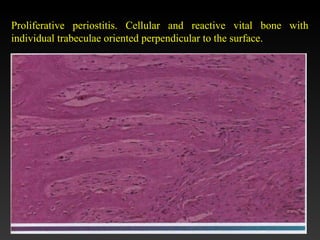
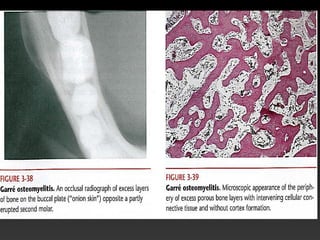
Proliferative periostitis. Cellular and reactive vital bone with
individual trabeculae oriented perpendicular to the surface.
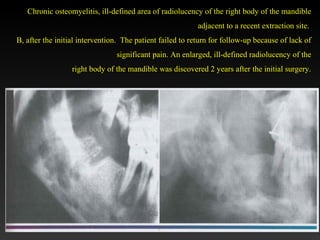
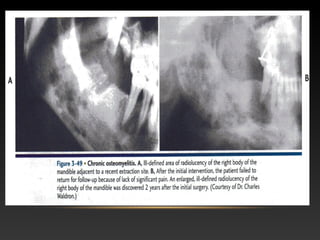
Chronic osteomyelitis, ill-defined area of radiolucency of the right body of the mandible
adjacent to a recent extraction site.
B, after the initial intervention. The patient failed to return for follow-up because of lack of
significant pain. An enlarged, ill-defined radiolucency of the
right body of the mandible was discovered 2 years after the initial surgery.
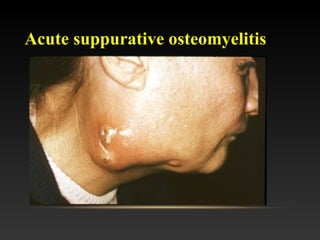
Acute suppurative osteomyelitis
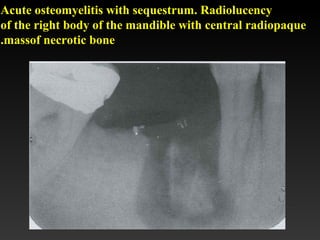
Acute osteomyelitis with sequestrum. Radiolucency
of the right body of the mandible with central radiopaque
massof necrotic bone.
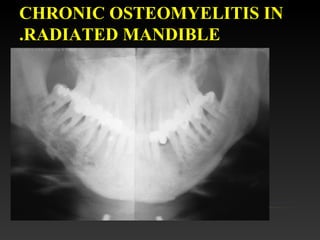
CHRONIC OSTEOMYELITIS IN
RADIATED MANDIBLE.
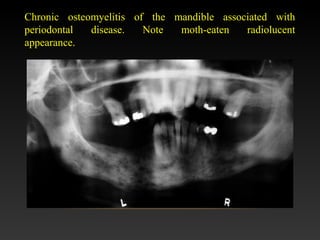
Chronic osteomyelitis of the mandible associated with
periodontal disease. Note moth-eaten radiolucent
appearance.
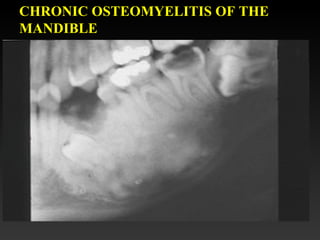
CHRONIC OSTEOMYELITIS OF THE
MANDIBLE
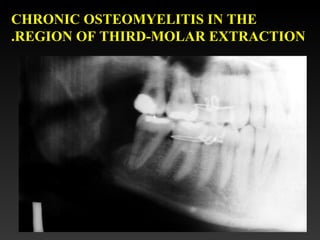
CHRONIC OSTEOMYELITIS IN THE
REGION OF THIRD-MOLAR EXTRACTION.
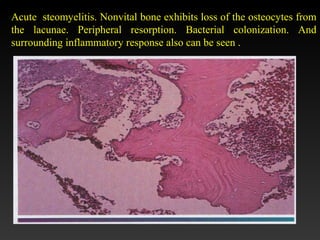
Acute steomyelitis. Nonvital bone exhibits loss of the osteocytes from
the lacunae. Peripheral resorption. Bacterial colonization. And
surrounding inflammatory response also can be seen .
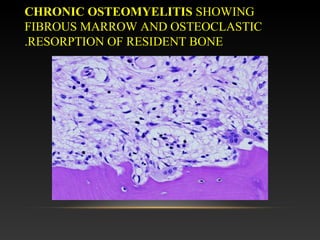
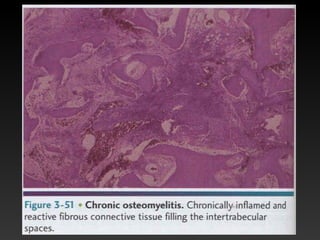
CHRONIC OSTEOMYELITIS SHOWING
FIBROUS MARROW AND OSTEOCLASTIC
RESORPTION OF RESIDENT BONE.
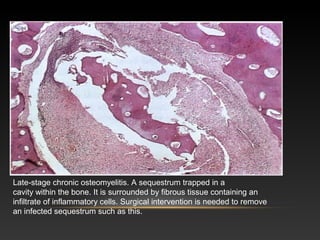
Late-stage chronic osteomyelitis. A sequestrum trapped in a
cavity within the bone. It is surrounded by fibrous tissue containing an
infiltrate of inflammatory cells. Surgical intervention is needed to remove
an infected sequestrum such as this.
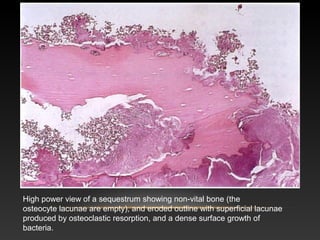
High power view of a sequestrum showing non-vital bone (the
osteocyte lacunae are empty), and eroded outline with superficial lacunae
produced by osteoclastic resorption, and a dense surface growth of
bacteria.
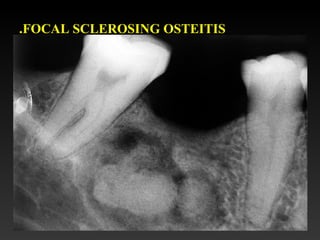
FOCAL SCLEROSING OSTEITIS.
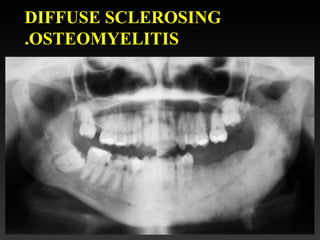
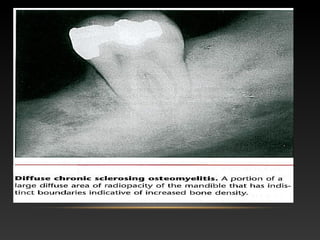
DIFFUSE SCLEROSING
OSTEOMYELITIS.
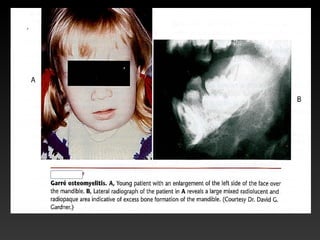
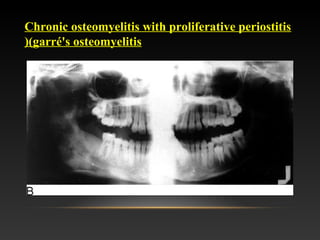
Chronic osteomyelitis with proliferative periostitis
(garré's osteomyelitis(
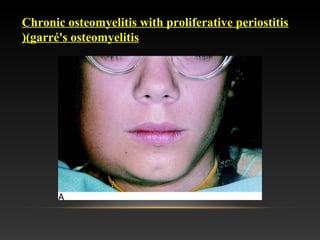
Chronic osteomyelitis with proliferative periostitis
(garré's osteomyelitis(
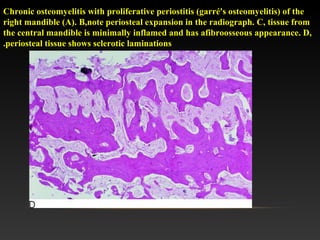
Chronic osteomyelitis with proliferative periostitis (garré's osteomyelitis( of the
right mandible (A(. B,note periosteal expansion in the radiograph. C, tissue from
the central mandible is minimally inflamed and has afibroosseous appearance. D,
periosteal tissue shows sclerotic laminations.
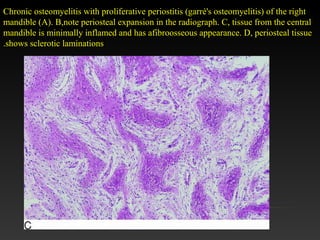
Chronic osteomyelitis with proliferative periostitis (garré's osteomyelitis) of the right
mandible (A). B,note periosteal expansion in the radiograph. C, tissue from the central
mandible is minimally inflamed and has afibroosseous appearance. D, periosteal tissue
shows sclerotic laminations.
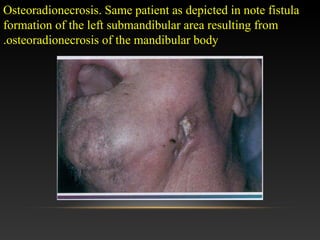
Osteoradionecrosis. Same patient as depicted in note fistula
formation of the left submandibular area resulting from
osteoradionecrosis of the mandibular body.
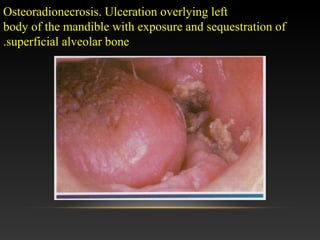
Osteoradionecrosis. Ulceration overlying left
body of the mandible with exposure and sequestration of
superficial alveolar bone.
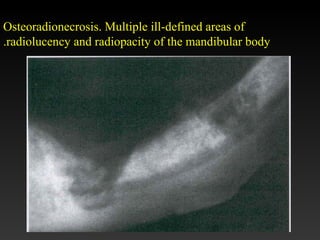
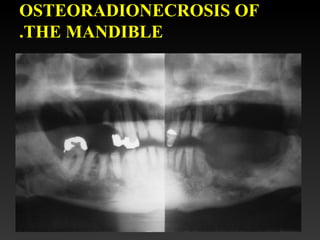
Osteoradionecrosis. Multiple ill-defined areas of
radiolucency and radiopacity of the mandibular body.
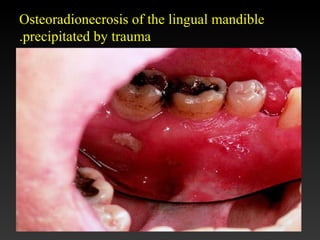
Osteoradionecrosis of the lingual mandible
precipitated by trauma.
OSTEORADIONECROSIS OF
THE MANDIBLE.
Dry socket. Typical appearances
of chronic alveolar osteitis; the
socket is empty and the bony
lamina dura is visible.
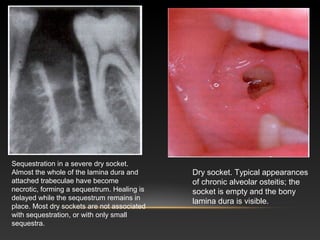
Sequestration in a severe dry socket.
Almost the whole of the lamina dura and
attached trabeculae have become
necrotic, forming a sequestrum. Healing is
delayed while the sequestrum remains in
place. Most dry sockets are not associated
with sequestration, or with only small
sequestra.

Bone infection dina patho