Dr. Dharati Patel
Department of Pedodontics and Preventive Dentistry
BEHAVIOURAL SCIENCES AND ITS
APPLICATION TO PEDODONTICS
CONTENT
• Introduction
• Definitions
• Classification of child behaviour in dental clinic
• Behaviour rating scales
• Factors affecting child’s behaviour in dental clinic
• Conclusion
• References
INTRODUCTION
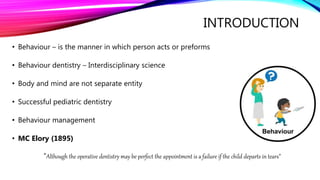
• Behaviour – is the manner in which person acts or preforms
• Behaviour dentistry – Interdisciplinary science
• Body and mind are not separate entity
• Successful pediatric dentistry
• Behaviour management
• MC Elory (1895)
“Although the operative dentistry may be perfect the appointment is a failure if the child departs in tears”
DEFINITIONS
• Behaviour
• Any activity that can be observed, recorded and measured.
• Any change observed in functioning of an organism.
• Behaviour is the sum total of response to stimuli, internal and external
[Healy, Bronner and Bowers, 1965]
• Behaviour is defined as the response by the child and the reaction of the
dentist as the consequence. The consequence can be answered with a
reinforcer, which strengthens behaviour in a patient, or with a punisher, which
weakens behaviour [Rosenberg, 1974]
• Behavioral science
• Is the science which deals with the observation of Behavioral habits of man
and lower animals in various physical and social environments; including
behavior pedodontics, psychology, sociology and social anthropology.
• Behavioral Pedodontics
• Study of science which helps to understand development of fear, anxiety and
anger as it is applied to child in dental situations.
CLASSIFICATION OF CHILD’S
BEHAVIOUR IN DENTAL OFFICE
THE REASONS FOR BEHAVIOUR
CLASSIFICATION
• Provides a systematic means for recording patient’s behaviour.
• Assists in evaluating the validity of current research
• Helps in behaviour management
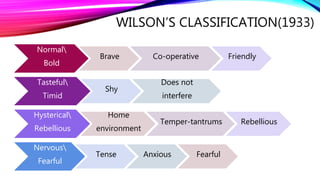
WILSON’S CLASSIFICATION(1933)
Normal
Bold
Brave Co-operative Friendly
Tasteful
Timid
Shy
Does not
interfere
Hysterical
Rebellious
Home
environment
Temper-tantrums Rebellious
Nervous
Fearful
Tense Anxious Fearful
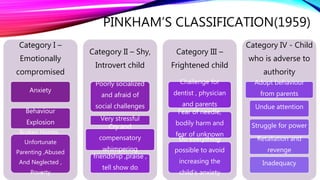
PINKHAM’S CLASSIFICATION(1959)
Category I –
Emotionally
compromised
Anxiety
Behaviour
Explosion
Broken Homes ,
Unfortunate
Parenting ,Abused
And Neglected ,
Poverty
Category II – Shy,
Introvert child
Poorly socialized
and afraid of
social challenges
Very stressful
Cry and
compensatory
whimpering
friendship ,praise ,
tell show do
Category III –
Frightened child
Challenge for
dentist , physician
and parents
Fear of needle,
bodily harm and
fear of unknown
Do everything
possible to avoid
increasing the
child’s anxiety
Category IV - Child
who is adverse to
authority
Adopt behaviour
from parents
Undue attention
Struggle for power
Retaliation and
revenge
Inadequacy
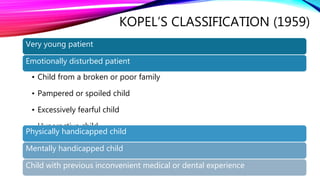
KOPEL’S CLASSIFICATION (1959)
Very young patient
Emotionally disturbed patient
• Child from a broken or poor family
• Pampered or spoiled child
• Excessively fearful child
• Hyperactive child
Physically handicapped child
Mentally handicapped child
Child with previous inconvenient medical or dental experience
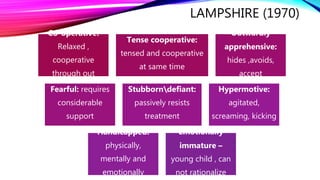
LAMPSHIRE (1970)
Co-operative:
Relaxed ,
cooperative
through out
Tense cooperative:
tensed and cooperative
at same time
Outwardly
apprehensive:
hides ,avoids,
accept
Fearful: requires
considerable
support
Stubborndefiant:
passively resists
treatment
Hypermotive:
agitated,
screaming, kicking
Handicapped:
physically,
mentally and
emotionally
Emotionally
immature –
young child , can
not rationalize
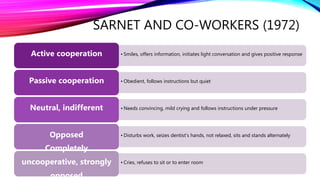
SARNET AND CO-WORKERS (1972)
• Smiles, offers information, initiates light conversation and gives positive response
Active cooperation
• Obedient, follows instructions but quiet
Passive cooperation
• Needs convincing, mild crying and follows instructions under pressure
Neutral, indifferent
• Disturbs work, seizes dentist’s hands, not relaxed, sits and stands alternately
Opposed
• Cries, refuses to sit or to enter room
Completely
uncooperative, strongly
opposed
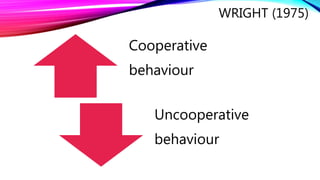
WRIGHT (1975)
Cooperative
behaviour
Uncooperative
behaviour
COOPERATIVE BEHAVIOUR
• Cooperative behaviour
• Relaxed
• Minimal apprehension
• Treated by a straight forward behaviour shaping approach
• Develop good rapport with the dentist
• Interested in the dental procedure
• Laugh and enjoy the situation
• Allow the dentist to function effectively and efficiently
• Lacking cooperative behaviour
• Includes very young (0-3 years), disabled and handicapped child
• Can pose major behavioural problems
• Potentially cooperative
• Has potential to cooperate
• Inherent fear (subjective and objective) – does not cooperate
UNCOOPERATIVE BEHAVIOUR
• Uncontrolledhystericalincorrigible: Preschooler , 1st visit , temper- tantrums ,loud cry
• Defiantobstinate behaviour: Any age , spoilt, stubborn , challenge authority
• Tense cooperative: Borderline between + and - , does not resist, tensed at mind
• Timid behaviour: Shy, overprotective but cooperative , initial visit
• Whining type: Complaining behaviour but allows treatment , whines
• Stoic behaviour: Physically abused but passively accept treatment
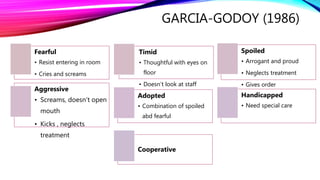
GARCIA-GODOY (1986)
Fearful
• Resist entering in room
• Cries and screams
Timid
• Thoughtful with eyes on
floor
• Doesn’t look at staff
Spoiled
• Arrogant and proud
• Neglects treatment
• Gives order
Aggressive
• Screams, doesn’t open
mouth
• Kicks , neglects
treatment
Adopted
• Combination of spoiled
abd fearful
Handicapped
• Need special care
Cooperative
BEHAVIOR RATING SCALE
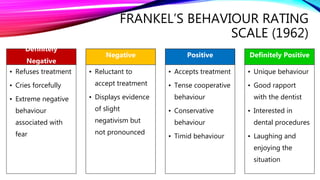
FRANKEL’S BEHAVIOUR RATING
SCALE (1962)
Definitely
Negative
• Refuses treatment
• Cries forcefully
• Extreme negative
behaviour
associated with
fear
Negative
• Reluctant to
accept treatment
• Displays evidence
of slight
negativism but
not pronounced
Positive
• Accepts treatment
• Tense cooperative
behaviour
• Conservative
behaviour
• Timid behaviour
Definitely Positive
• Unique behaviour
• Good rapport
with the dentist
• Interested in
dental procedures
• Laughing and
enjoying the
situation
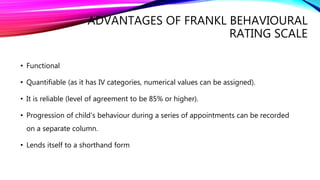
ADVANTAGES OF FRANKL BEHAVIOURAL
RATING SCALE
• Functional
• Quantifiable (as it has IV categories, numerical values can be assigned).
• It is reliable (level of agreement to be 85% or higher).
• Progression of child's behaviour during a series of appointments can be recorded
on a separate column.
• Lends itself to a shorthand form
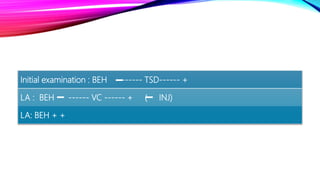
Initial examination : BEH ------ TSD------ +
LA : BEH ------ VC ------ + ( INJ)
LA: BEH + +
SHORTCOMING
• Scale does not give us sufficient clinical information for uncooperative children.
WRIGHT’S MODIFICATIONS TO
FRANKL’S RATING SCALE (1975)
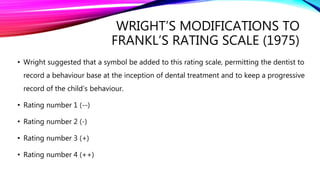
• Wright suggested that a symbol be added to this rating scale, permitting the dentist to
record a behaviour base at the inception of dental treatment and to keep a progressive
record of the child’s behaviour.
• Rating number 1 (--)
• Rating number 2 (-)
• Rating number 3 (+)
• Rating number 4 (++)
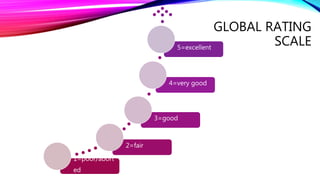
GLOBAL RATING
SCALE
1=poor/abort
ed
2=fair
3=good
4=very good
5=excellent
Dharati Patel
Department of Pedodontics and Preventive Dentistry
BEHAVIOURAL SCIENCES AND ITS
APPLICATION TO PEDODONTICS
CONTENT
• Factors affecting child’s behaviour in dental clinic
• Maternal influence
• Behaviour management
• Classification
• Objectives
• principle
• Fundamentals
• Conclusion
• References
FACTORS AFFECT CHILD’S
BEHAVIOUR IN DENTAL OFFICE
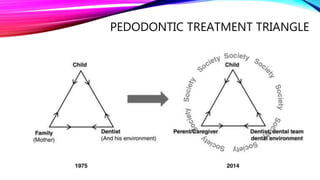
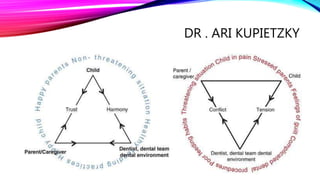
PEDODONTIC TREATMENT TRIANGLE
DR . ARI KUPIETZKY
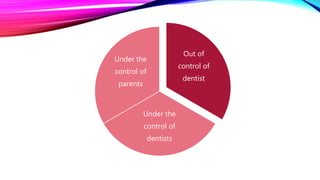
Out of
control of
dentist
Under the
control of
dentists
Under the
control of
parents
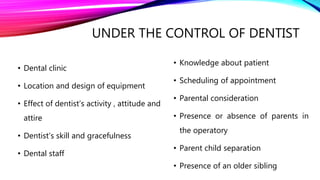
UNDER THE CONTROL OF DENTIST
• Dental clinic
• Location and design of equipment
• Effect of dentist’s activity , attitude and
attire
• Dentist’s skill and gracefulness
• Dental staff
• Knowledge about patient
• Scheduling of appointment
• Parental consideration
• Presence or absence of parents in
the operatory
• Parent child separation
• Presence of an older sibling
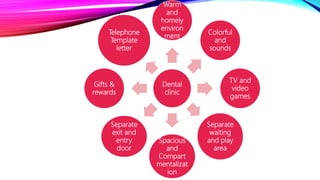
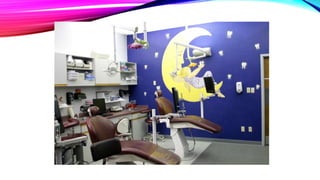
Dental
clinic
Warm
and
homely
environ
ment
Colorful
and
sounds
TV and
video
games
Separate
waiting
and play
area
Spacious
and
Compart
mentalizat
ion
Separate
exit and
entry
door
Gifts &
rewards
Telephone
Template
letter
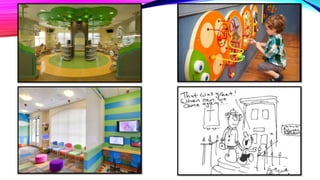
• Swallow and co-worker in 1962 evaluated the effect on children’s anxiety of
the environment in which dental interview and treatment were performed.
Swallow JN, Jones JM, Morgan MF. The effect of environment on a child’s reaction to dentistry. J Dent Child 1962;
29:150-63.
LOCATION AND DESIGN OF THE
EQUIPMENT
• Instruments - fear provoking – kept in inconspicuous positions
• Dentist and assistant should sit closer to the working field - work more
efficiently.
• Handpieces, burs, rubber dam must all be of sufficient range in sizes to
facilitate easy access to working sites in smaller mouths.
• Avoid child to see adults in pain or sight of blood on others
EFFECT OF DENTIST’S ACTIVITY AND
ATTITUDES
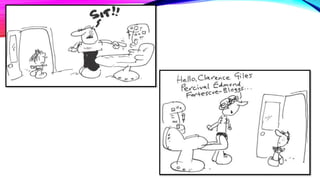
• Firmness with kindness and a soft, clear voice are helpful
• Should be polite and speak to the child as one individual to another
• Verbal guidelines should be presented in the form of statements rather than
questions.
• Truthfulness is mandatory
• Avoid jerky and quick movement
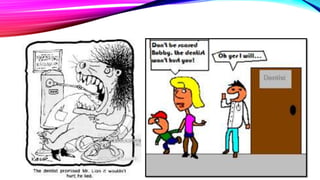
• The dentist’s attire and general appearance create a significant impression on the child
– white coat
DENTIST’S SKILL AND GRACEFULNESS
• In talking to the child the dentist must get down to the patient’s own level in
position and in conversation , in both ideas and words.
• It flatters child if adults judge them older than they really are.
• Talk to them at their own or slightly older age level .
• Children are more observant then adults.
• If dentist lacks confidence - will be reflected in child’s behaviour
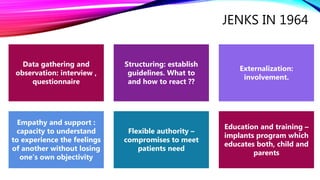
JENKS IN 1964
Data gathering and
observation: interview ,
questionnaire
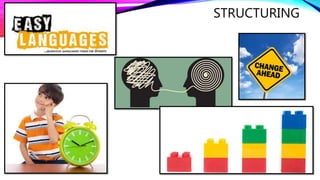
Structuring: establish
guidelines. What to
and how to react ??
Externalization:
involvement.
Empathy and support :
capacity to understand
to experience the feelings
of another without losing
one’s own objectivity
Flexible authority –
compromises to meet
patients need
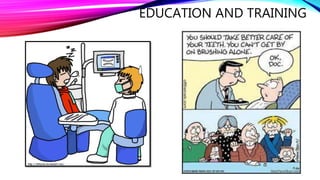
Education and training –
implants program which
educates both, child and
parents
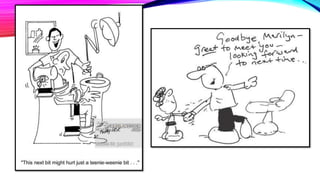
STRUCTURING
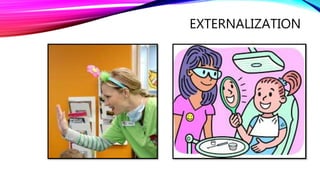
EXTERNALIZATION
EDUCATION AND TRAINING
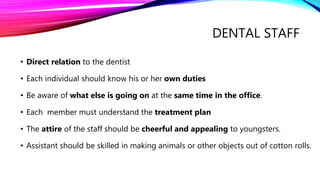
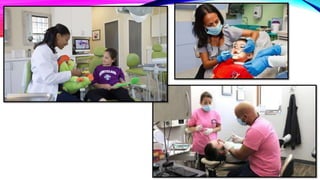
DENTAL STAFF
• Direct relation to the dentist
• Each individual should know his or her own duties
• Be aware of what else is going on at the same time in the office.
• Each member must understand the treatment plan
• The attire of the staff should be cheerful and appealing to youngsters.
• Assistant should be skilled in making animals or other objects out of cotton rolls.
KNOWLEDGE ABOUT THE PATIENT
• Every child is unique and different
• It is wise to know the child patient before he is seated in the dental chair.
• Useful to know which behaviour techniques would be needed for that child
SCHEDULING APPOINTMENT
• Naps and meals – this time should be avoided - irritability will results
• Preschoolers – best seen in early morning
• The length of the visit - determined by the work to be accomplished and the
attention span of the child.
• Appointments for children should be short - the short attention span
• Minimize the number of visits & limit the frequency of local anaesthesia
• Accomplish quadrant dentistry wherever possible
• The most pleasantly accomplished procedures must be attempted first
PARENTAL CONSIDERATIONS
• Visual environment of dental office – effect either positively or negatively
• Appearance and attire of the dentist and dental staff
• Cleanliness and decor of the office , Olfactory and auditory stimuli - contribute
to the overall impression
• Treatment will be accomplished only if accepted by the parents
• Flexible approach – preferable
• The dentist must be allowed to establish communication with the child
independently
PRESENCE OR ABSENCE OF PARENTS
IN THE OPERATORY
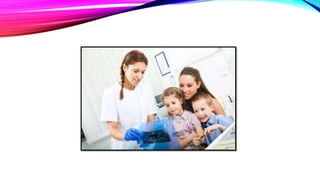
• Mother – essential for preschooler , handicapped
• Older child – not require mother (emotional independency)
• Dentist – relaxed and comfortable - parents are in reception room
• If a child should exhibit uncooperative behaviour, the presence of the
parent will sometimes lend support to this type of behaviour and it can also
limit the range of behaviour control techniques of the dentist.
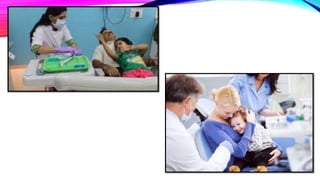
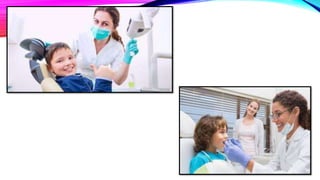
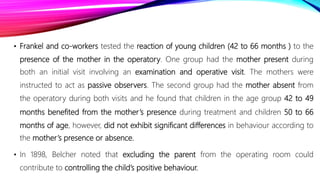
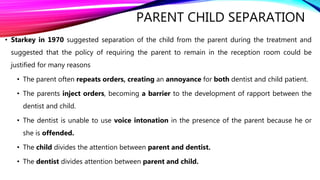
• Frankel and co-workers tested the reaction of young children (42 to 66 months ) to the
presence of the mother in the operatory. One group had the mother present during
both an initial visit involving an examination and operative visit. The mothers were
instructed to act as passive observers. The second group had the mother absent from
the operatory during both visits and he found that children in the age group 42 to 49
months benefited from the mother’s presence during treatment and children 50 to 66
months of age, however, did not exhibit significant differences in behaviour according to
the mother’s presence or absence.
• In 1898, Belcher noted that excluding the parent from the operating room could
contribute to controlling the child’s positive behaviour.
PARENT CHILD SEPARATION
• Starkey in 1970 suggested separation of the child from the parent during the treatment and
suggested that the policy of requiring the parent to remain in the reception room could be
justified for many reasons
• The parent often repeats orders, creating an annoyance for both dentist and child patient.
• The parents inject orders, becoming a barrier to the development of rapport between the
dentist and child.
• The dentist is unable to use voice intonation in the presence of the parent because he or
she is offended.
• The child divides the attention between parent and dentist.
• The dentist divides attention between parent and child.
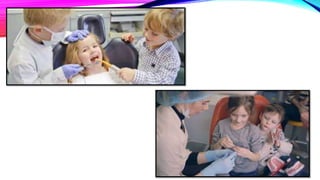
PRESENCE OF AN OLDER SIBLING
• Serves as role model
• Depend on age
• Little effect – 3 year old patient
• Most noticeable effect on – 4 -5 year old patient
OUT OF CONTROL OF THE DENTIST
• Growth and development
• Nutritional factors
• Past medical and dental experiences
• Influence of parents, siblings and peers
• School environment
• Socioeconomic status
GROWTH AND DEVELOPMENT
• Deficiency of physical growth or congenital deformities – leads to
psychological trauma due to rejection by society
• Mental retardation , epilepsy , cerebral palsy – make the child mentally
handicapped
• There is failure of cognitive development and therefore variations in
behaviour
• Very young child reacts very differently – transformed to positive behaviour
as grows older
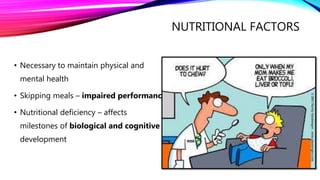
NUTRITIONAL FACTORS
• Necessary to maintain physical and
mental health
• Skipping meals – impaired performance
• Nutritional deficiency – affects
milestones of biological and cognitive
development
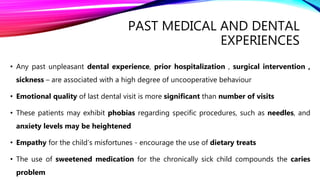
PAST MEDICAL AND DENTAL
EXPERIENCES
• Any past unpleasant dental experience, prior hospitalization , surgical intervention ,
sickness – are associated with a high degree of uncooperative behaviour
• Emotional quality of last dental visit is more significant than number of visits
• These patients may exhibit phobias regarding specific procedures, such as needles, and
anxiety levels may be heightened
• Empathy for the child’s misfortunes - encourage the use of dietary treats
• The use of sweetened medication for the chronically sick child compounds the caries
problem
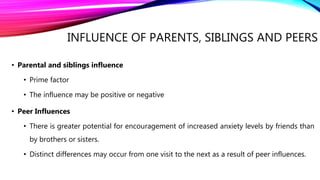
INFLUENCE OF PARENTS, SIBLINGS AND PEERS
• Parental and siblings influence
• Prime factor
• The influence may be positive or negative
• Peer Influences
• There is greater potential for encouragement of increased anxiety levels by friends than
by brothers or sisters.
• Distinct differences may occur from one visit to the next as a result of peer influences.
SCHOOL ENVIRONMENT
• 50% children’s development is influenced by school environment
• Teachers and peers helps to influence the behaviour of younger children
• Seniors become role models
SOCIOECONOMIC STATUS
• High socioeconomic status child
• Develop normally and may become spoilt
• Low socioeconomic status child
• Tensed (little attention and neglected)
UNDER THE CONTROL OF THE
PARENTS
• Home environment
• Family development and peer influences
• Maternal influence
HOME ENVIRONMENT
• Home is first school – learns to behave
• All individual influence – child’s behaviour
• Broken home – child feel insecure , inferior , depressed
FAMILY DEVELOPMENT AND PEER
INFLUENCES
• Position and status of child – can influence child’s behaviour
• Overindulgence by parents – spoilt behaviour – show sudden outburst of
temper tantrums
• Interfamily conflicts – emotionally frustrated child
MATERNAL BEHAVIOUR
• Maternal influence - children’s mental, physical and emotional development
- even before birth
• Fetus influenced by changes in the mother’s neurohormonal system, which is
transmitted through the placenta
• Somatic development of fetus – Nutritional status of mother
• Post natal behaviour of child = Prenatal emotional status mother
• Agents – Alcohol , smoking and keratogenic drugs
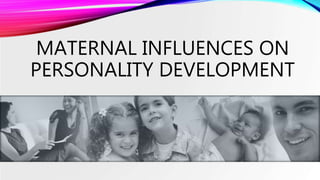
MATERNAL INFLUENCES ON
PERSONALITY DEVELOPMENT
• Bell has termed this relationship “ONE-TAILED”- parental characteristics have an
unilateral influence on developing child
• Child’s personality ,behaviour, and reaction to stressful reactions – direct product
product of maternal characteristics
• Baldwin (1969) used subjects 3-7 years of age to show significant relationship
between maternal anxiety and children’s behaviour at first dental visit. They
found that highly anxious mothers had a negative influence on their children
Johnson R, Baldwin D. Maternal anxiety and child behaviour. J Dent Child 1969; 36:13-8.
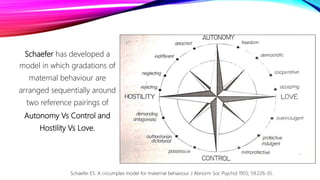
Schaefer has developed a
model in which gradations of
maternal behaviour are
arranged sequentially around
two reference pairings of
Autonomy Vs Control and
Hostility Vs Love.
Schaefer ES. A circumplex model for maternal behaviour. J Abnorm Soc Psychol 1955; 59:226-35.
• The behaviour of mothers who participated in the Berkeley Growth study in 1967 , was
rated according to the attitudes depicted in the Schaefer model.
• Suggested that loving mothers tended to have calm and happy sons while hostile
mothers had sons who were excitable and unhappy.
• Mothers who allowed autonomy had sons who were friendly cooperative and
attentive.
• Conversely punitive mothers who ignore their children did not have positive
behaviour
Bayley N, Schaefer ES. Maternal behaviour and personality development: Data from Berkley Growth Study. In Meddinus GR. Readings in the Psychology of
Parent- Child Relationships. NewYork: John Wiley and Sons Inc. 1967; 157-69.
PARENTAL ATTITUDE
• Overprotective
• Overindulgent
• Overanxious
• Under affectionate
• Rejecting
• Authoritarian / dominant
OVERPROTECTIVE
• Child’s behaviour : shy , submissive, anxious and fearful
• Exaggeration of attitude – overprotection – harmful to normal development
• Factors :
• Previous miscarriage and long delay in conceive the child
• Another sibling had died
• Mother is aware that she can not have more children
• Medical illness or handicapped child
• Paternal absence
• Not allow the child to take ordinary risks
• Shows excessive concern regarding – dental and medical problems
OVERINDULGENT
• Child behaviour : aggressive , spoiled , demanding , display tempers
• Associated with overprotection and dominant maternal trait
• Emotional development impeded – keeping him infantile & depended state
• Give the child whatever they wants
• Get their own way – dental office
• Shows burst of temper – when can not control dental situations
• They learn to manipulate their parents into satisfying all of their wants and tend to act
superior, bossy, and demanding
OVERANXIOUS
• Child behaviour : shy, timid and fearful
• Undue concern for the child - some previous family tragedy - accident or illness.
• It is usually associated with over affection, overprotection and overindulgence.
• Child - not permitted to work or play alone.
• Minor illness is greatly exaggerated and frequently the child is bedridden unnecessarily
• Lack the ability to make decisions for them
• They are generally good dental patients - with encouragement and assurance
UNDER AFFECTIONATE
• Child behaviour: well behaved and outwardly appear to be well adjusted.
• Under affection - vary from mild detachment, to indifference, to neglect
• Mother - become less emotionally supportive of her child due to her outside
interests or employment or simply because the child is unwanted.
• Tendency to be unsure of their decision - making capacities.
• Cry easily and shy .
REJECTING
• Child’s behaviour : aggressive , overreacting, disobedient
• Maternal rejection – unwanted
• Unstable , unhappy marriage
• Birth was not anticipated
• Child interfere with career
• Immature or emotionally unstable
• Mother’s behaviour : neglect the child, sever punishments , nagging , resistance to spending a
time or money
• Child usually lacks feeling of belonging & self esteem
• Feeling of helplessness - leads to deep anxiety
• No home securities - becomes suspicious, aggressive, revengeful, disobedient,
restless and overactive
• In the dental office - this child may be difficult to control.
• Behaviour management - not rejection but with friendliness and understanding.
• Children are generally demanding - demands should be respected as much as
possible, need of attention and kindness
AUTHORITARIAN / DOMINANT
• This attitude demands – children’s excessive responsibility
• Which is incompatible - their chronological age
• Force the child & train him - being critical, strict and often rejecting.
• Constant nagging and criticizing - develops in the child submission and restlessness
• Negativism may be common
• Fearful, resisting openly and obey commands slowly .
• With kindness and consideration they generally develop into good dental patients
BEHAVIOUR MANAGEMENT
• Behaviour management (wright 1975)
• Defined as means by which the dental health team effectively and efficiently
performs dental treatment and thereby instills a positive dental attitude
• Behaviour modification(Eysenck – 1964)
• Defined as attempt to alter human behaviour and emotion in a beneficial way
and in accordance with the laws of learning
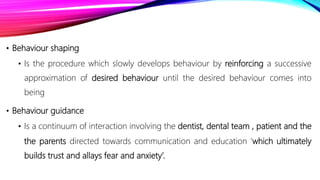
• Behaviour shaping
• Is the procedure which slowly develops behaviour by reinforcing a successive
approximation of desired behaviour until the desired behaviour comes into
being
• Behaviour guidance
• Is a continuum of interaction involving the dentist, dental team , patient and the
the parents directed towards communication and education ‘which ultimately
builds trust and allays fear and anxiety’.
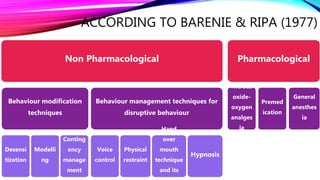
ACCORDING TO BARENIE & RIPA (1977)
Non Pharmacological
Behaviour modification
techniques
Desensi
tization
Modelli
ng
Conting
ency
manage
ment
Behaviour management techniques for
disruptive behaviour
Voice
control
Physical
restraint
Hand
over
mouth
technique
and its
Hypnosis
Pharmacological
Nitrous
oxide-
oxygen
analges
ia
Premed
ication
General
anesthes
ia
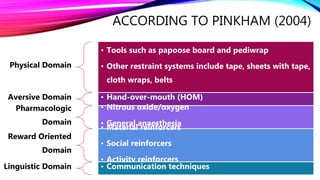
ACCORDING TO PINKHAM (2004)
Physical Domain
• Hand restraint
• Tools such as papoose board and pediwrap
• Other restraint systems include tape, sheets with tape,
cloth wraps, belts
• Mouth props
Aversive Domain • Hand-over-mouth (HOM)
Pharmacologic
Domain
• Nitrous oxide/oxygen
• General anaesthesia
Reward Oriented
Domain
• Material reinforcers
• Social reinforcers
• Activity reinforcers
Linguistic Domain • Communication techniques
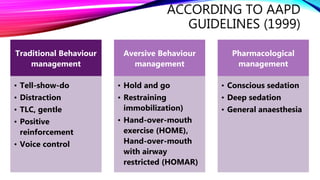
ACCORDING TO AAPD
GUIDELINES (1999)
Traditional Behaviour
management
• Tell-show-do
• Distraction
• TLC, gentle
• Positive
reinforcement
• Voice control
Aversive Behaviour
management
• Hold and go
• Restraining
immobilization)
• Hand-over-mouth
exercise (HOME),
Hand-over-mouth
with airway
restricted (HOMAR)
Pharmacological
management
• Conscious sedation
• Deep sedation
• General anaesthesia
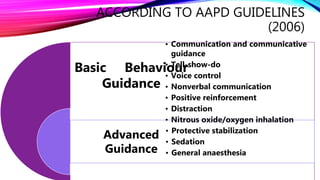
ACCORDING TO AAPD GUIDELINES
(2006)
Basic Behaviour
Guidance
Advanced
Guidance
• Communication and communicative
guidance
• Tell-show-do
• Voice control
• Nonverbal communication
• Positive reinforcement
• Distraction
• Nitrous oxide/oxygen inhalation
• Protective stabilization
• Sedation
• General anaesthesia
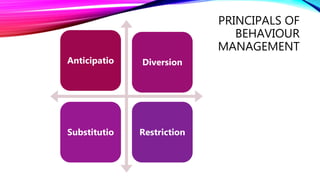
PRINCIPALS OF
BEHAVIOUR
MANAGEMENT
Anticipatio Diversion
Substitutio Restriction
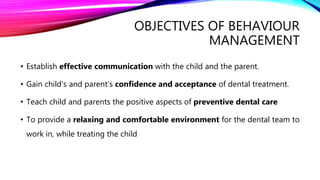
OBJECTIVES OF BEHAVIOUR
MANAGEMENT
• Establish effective communication with the child and the parent.
• Gain child’s and parent’s confidence and acceptance of dental treatment.
• Teach child and parents the positive aspects of preventive dental care
• To provide a relaxing and comfortable environment for the dental team to
work in, while treating the child
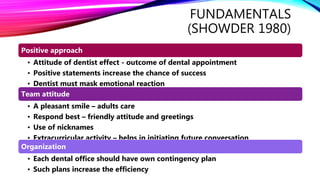
FUNDAMENTALS
(SHOWDER 1980)
Positive approach
• Attitude of dentist effect - outcome of dental appointment
• Positive statements increase the chance of success
• Dentist must mask emotional reaction
Team attitude
• A pleasant smile – adults care
• Respond best – friendly attitude and greetings
• Use of nicknames
• Extracurricular activity – helps in initiating future conversation
Organization
• Each dental office should have own contingency plan
• Such plans increase the efficiency
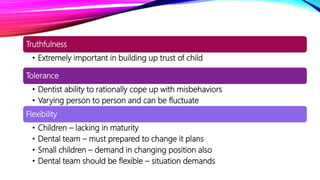
Truthfulness
• Extremely important in building up trust of child
Tolerance
• Dentist ability to rationally cope up with misbehaviors
• Varying person to person and can be fluctuate
Flexibility
• Children – lacking in maturity
• Dental team – must prepared to change it plans
• Small children – demand in changing position also
• Dental team should be flexible – situation demands
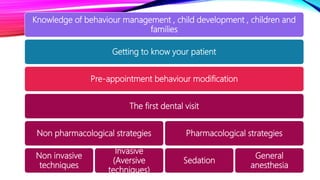
Knowledge of behaviour management , child development , children and
families
Getting to know your patient
Pre-appointment behaviour modification
The first dental visit
Non pharmacological strategies
Non invasive
techniques
Invasive
(Aversive
techniques)
Pharmacological strategies
Sedation
General
anesthesia
PSYCHOLOGICAL APPROACH
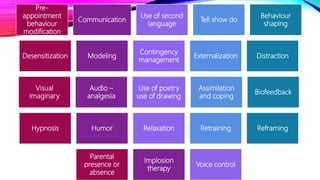
Pre-
appointment
behaviour
modification
Communication
Use of second
language
Tell show do
Behaviour
shaping
Desensitization Modeling
Contingency
management
Externalization Distraction
Visual
imaginary
Audio –
analgesia
Use of poetry
use of drawing
Assimilation
and coping
Biofeedback
Hypnosis Humor Relaxation Retraining Reframing
Parental
presence or
absence
Implosion
therapy
Voice control
PHYSICAL
OR FLOODING TECHNIQUES
Hand over
mouth
Protective
stabilization
PRE APPOINTMENT BEHAVIOUR
MODIFICATION
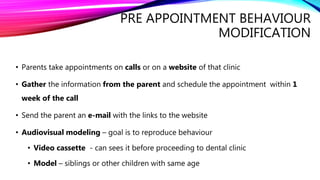
• Parents take appointments on calls or on a website of that clinic
• Gather the information from the parent and schedule the appointment within 1
week of the call
• Send the parent an e-mail with the links to the website
• Audiovisual modeling – goal is to reproduce behaviour
• Video cassette - can sees it before proceeding to dental clinic
• Model – siblings or other children with same age
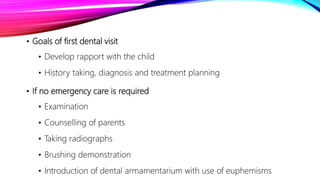
FIRST DENTAL VISIT OF A CHILD
• Goals of first dental visit
• Develop rapport with the child
• History taking, diagnosis and treatment planning
• If no emergency care is required
• Examination
• Counselling of parents
• Taking radiographs
• Brushing demonstration
• Introduction of dental armamentarium with use of euphemisms
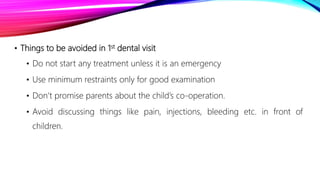
• Things to be avoided in 1st dental visit
• Do not start any treatment unless it is an emergency
• Use minimum restraints only for good examination
• Don’t promise parents about the child’s co-operation.
• Avoid discussing things like pain, injections, bleeding etc. in front of
children.
ATTENTION TO THE PATIENT
• Every child should have dentist’s undivided attention
• Always treat the child as if he was the only patient seen that day.
• Never leave a very young child alone in the chair
• If possible do all the work necessary on the child in the same room
COMMUNICATION
• First objective – successful management
• Consider the cognitive development of the patient
• As well as the presence of other communication deficits (e.g. Hearing
disorder)
• Conversation – learns about patient – relax youngsters
• The fear – nature innate curiosity – demand – explanations
VERBAL COMMUNICATION
• The language choice should consist of words that express pleasantness,
friendship and concern
• Initial remarks should include statements about the child’s appearance or
dress.
• 2-7 year child – based on – Piagetian concept - Animism
• Honesty of approach to a child is very important
• Moss (1972) described three essential elements of effective communication-
source, medium and destination or receiver- as they relate to dentistry. In
the dental office the dentist is the source or transmitter, the dental office is
the medium, and the patient is the receiver.
Smith ME. An investigation of the development of the sentence and the extent of vocabulary in young children. Univ. Iowa
stud. Child Welfare 1926; 3(5).
• Through appropriate contact, posture, facial expression, body language, pat
on the back, the smile and the warmth
• Facial expression - conveys to the child that the practitioner is in control
• Nonverbal communication of friendliness should be expressed.
NON VERBAL
USE OF SECOND LANGUAGE
• Address the child at his or her level of understanding
• Does not suggest – baby talk
• Tone of voice – kind and firm
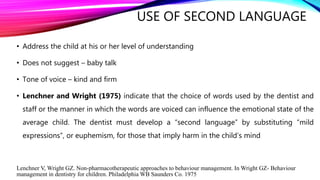
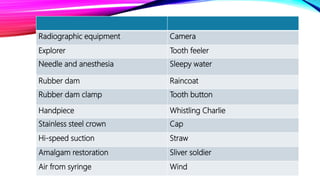
• Lenchner and Wright (1975) indicate that the choice of words used by the dentist and
staff or the manner in which the words are voiced can influence the emotional state of the
average child. The dentist must develop a “second language” by substituting “mild
expressions”, or euphemism, for those that imply harm in the child’s mind
Lenchner V, Wright GZ. Non-pharmacotherapeutic approaches to behaviour management. In Wright GZ- Behaviour
management in dentistry for children. Philadelphia WB Saunders Co. 1975
Radiographic equipment Camera
Explorer Tooth feeler
Needle and anesthesia Sleepy water
Rubber dam Raincoat
Rubber dam clamp Tooth button
Handpiece Whistling Charlie
Stainless steel crown Cap
Hi-speed suction Straw
Amalgam restoration Sliver soldier
Air from syringe Wind
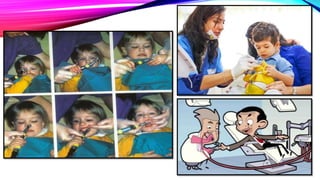
TELL – SHOW –DO(TSD)
• Corner stone
• Addleston – 1959
• Objectives
• To teach the patient important aspects of the dental visit and familiarize
the patient with the dental setting.
• To shape the patient’s response to various procedures
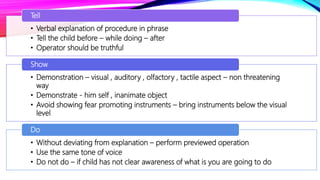
• Verbal explanation of procedure in phrase
• Tell the child before – while doing – after
• Operator should be truthful
Tell
• Demonstration – visual , auditory , olfactory , tactile aspect – non threatening
way
• Demonstrate - him self , inanimate object
• Avoid showing fear promoting instruments – bring instruments below the visual
level
Show
• Without deviating from explanation – perform previewed operation
• Use the same tone of voice
• Do not do – if child has not clear awareness of what is you are going to do
Do
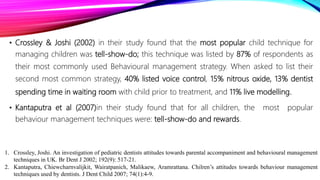
• Crossley & Joshi (2002) in their study found that the most popular child technique for
managing children was tell-show-do; this technique was listed by 87% of respondents as
their most commonly used Behavioural management strategy. When asked to list their
second most common strategy, 40% listed voice control, 15% nitrous oxide, 13% dentist
spending time in waiting room with child prior to treatment, and 11% live modelling.
• Kantaputra et al (2007)in their study found that for all children, the most popular
behaviour management techniques were: tell-show-do and rewards.
1. Crossley, Joshi. An investigation of pediatric dentists attitudes towards parental accompaniment and behavioural management
techniques in UK. Br Dent J 2002; 192(9): 517-21.
2. Kantaputra, Chiewcharnvalijkit, Wairatpanich, Malikaew, Aramrattana. Chilren’s attitudes towards behaviour management
techniques used by dentists. J Dent Child 2007; 74(1):4-9.
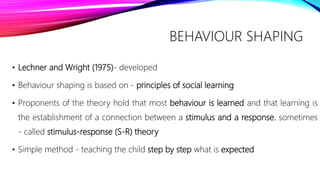
BEHAVIOUR SHAPING
• Lechner and Wright (1975)- developed
• Behaviour shaping is based on - principles of social learning
• Proponents of the theory hold that most behaviour is learned and that learning is
the establishment of a connection between a stimulus and a response. sometimes
- called stimulus-response (S-R) theory
• Simple method - teaching the child step by step what is expected
OUTLINES FOR BEHAVIOUR
SHAPING MODEL
• State the general goal or task to the child at the outset
• Explain the necessity for the procedure
• Divide the explanation for the procedure
• Give all explanations at a child’s level of understanding.
• Use successive estimation – like time
• Reinforce appropriate behaviour
• Disregard minor inappropriate behaviour
DESENSITIZATION
• Demonstrated by –Jones -1924
• Reducing children’s fears in which she demonstrated
• The power of a pleasurable experience will overcome a fearful one
• Popularized by –Wolpe - 1947
• Desensitizing is a therapeutic technique that pairs an anxiety – evoking stimulus
with a response-inhibitory to anxiety . In such situations the perceived link
between the stimulus and the anxiety response is weakened.
• A fear producing object is gradually brought closer and closer until it loses its
anxiety producing ability
• Introducing progressively more threatening stimuli as the patient becomes
“desensitized” to the anxiety producing features of a procedure
• Technique - found to be effective in managing a broad spectrum of phobias
including fears of rejection, physical injury, injections and authority figures.
• Clinicians frequently make use of this approach by starting with the easiest and least
threatening procedures and saving the more difficult or painful ones for the later.
• Wolpe (1952) has suggested that desensitization is effective because the
patients learn to substitute an appropriate, adaptive, emotional response-
relaxation for an inappropriate or maladaptive response-anxiety
• Howitt and Stricker addressed the hierarchy of anxiety evolving stimuli in the
dental experience in children as : injection > exposure to dental environment >
dental drill > rubber dam > hand instruments > prophylaxis.
Wolpe J. Experimental neuroses as a learned behaviour. Br. J Psychol 1952; 43:243.
MODELING
• Based on - Bandura’s social learning theory – states that one’s learning or
behaviour acquisition occurs through observation of suitable model performing a
specific behaviour.
• He states - learning occurs only as a result of a “direct experience which can be
vicarious-witnessing the behaviour and the outcome of that behaviour for
other people”
• Synonymous terms : imitation, observational learning, identification, internalization ,
introjection , social facilitation , contagion and role taking
Bandura A. Principles of behavioural modification. NewYork: Holt, Rinehart and Winston 1969
OBJECTIVES
• Stimulates acquisition of new behaviour
• Facilitating the behaviour already in the patient in a more appropriate
manner
• Elimination of avoidance behaviour
• Extinction of fear
• Ghose et al in 1969 examined whether modelling works equally well with all
types of children. Studies indicate that while certain differences such as
previous experience and age are important and need to be addressed in
specific modelling application, the benefits of modelling are robust and can
be used with most children. Modelling has been shown to reduce fear
behaviour among male and female children, and across a wide age range
from 3 to 13 years.
Ghose LJ, Gidden DB, Shiere FR. Evaluation of sibling support. J Dent Child 1969; 36:35-40,49.
FOUR REQUIREMENTS OF THE
MODELLING TECHNIQUE
• Concentrated attention must be expended toward the witnessing of the model.
Brief exposure to the modelling procedure is not productive
• There must be sufficient retention of desirable behaviour in the absence of a
model.
• One must be able to reproduce effectively the behaviour modelled.
• The newly acquired behaviour must be appropriately rewarded to retain it.
Bandura A. Principles of behavioural modification. NewYork: Holt, Rinehart and Winston 1969
• Stokes and Kennedy clearly demonstrated modeling’s clinically significant
benefits among children with fear levels high enough to make dental treatment
problematic. All of the children’s uncooperative behaviour was reduced to a
considered to be acceptable to the dental practitioner.
Stokes TF, Kennedy SH. Reducing child uncooperative behaviour during dental treatment through modeling and
reinforcement. J Appl Behav Anal 1980; 13:41-9.
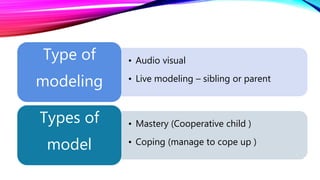
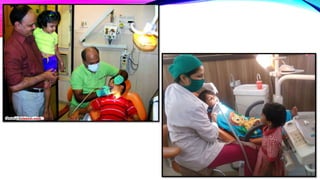
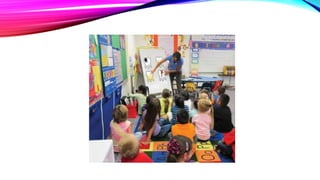
• Audio visual
• Live modeling – sibling or parent
Type of
modeling
• Mastery (Cooperative child )
• Coping (manage to cope up )
Types of
model
• Adelson and goldfried stated that a child is able to learn complex behaviour
patterns by observing a model. Learning through modelling is particularly
• When the observer is in a state of arousal
• When the model has relatively more status and prestige
• When there are positive consequences associated with the model’s behaviour
Adelson R, Goldfried MR. Modeling and the fearful child patient. J Dent Child 1970; 37:476-78,488-89
• Johnson and Machen (1973) have found that children who viewed a 12-
minute video-tape presentation of a child undergoing an examination,
radiographs, local anaesthetic administration, and restorative treatment
exhibited more positive behaviour than did a control group with no
modelling experience.
Johnson R, Machen JB. Behaviour modification techniques and maternal anxiety. J Dent Child 1973; 40:20-4.
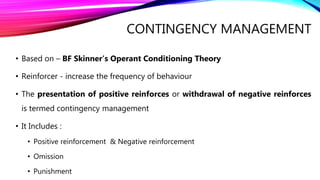
CONTINGENCY MANAGEMENT
• Based on – BF Skinner’s Operant Conditioning Theory
• Reinforcer - increase the frequency of behaviour
• The presentation of positive reinforces or withdrawal of negative reinforces
is termed contingency management
• It Includes :
• Positive reinforcement & Negative reinforcement
• Omission
• Punishment
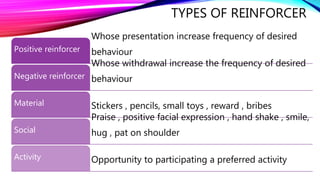
TYPES OF REINFORCER
Whose presentation increase frequency of desired
behaviour
Positive reinforcer
Whose withdrawal increase the frequency of desired
behaviour
Negative reinforcer
Stickers , pencils, small toys , reward , bribes
Material
Praise , positive facial expression , hand shake , smile,
hug , pat on shoulder
Social
Opportunity to participating a preferred activity
Activity
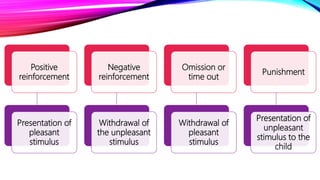
Positive
reinforcement
Presentation of
pleasant
stimulus
Negative
reinforcement
Withdrawal of
the unpleasant
stimulus
Omission or
time out
Withdrawal of
pleasant
stimulus
Punishment
Presentation of
unpleasant
stimulus to the
child
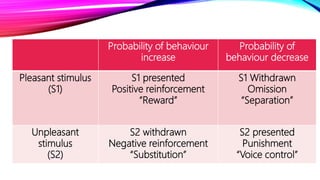
Probability of behaviour
increase
Probability of
behaviour decrease
Pleasant stimulus
(S1)
S1 presented
Positive reinforcement
“Reward”
S1 Withdrawn
Omission
“Separation”
Unpleasant
stimulus
(S2)
S2 withdrawn
Negative reinforcement
“Substitution”
S2 presented
Punishment
“Voice control”
• Some clinicians consider contingency management a form – Bribery
• Bribery - payoffs for irresponsible, undesirable or morally offensive behaviour
• Contingency reinforcement - salary, bonuses, commission, praise or awards for
desirable behaviours.
• Kohlenberg et al in 1972 have used various fruit juices and trading cards of athletes as
material reinforcers in a study involving mentally retarded patients. They report significant
improvements in patient behaviour and the reduced need for physical restraint.
• Shapiro in 1967 has suggested the possibility that a preoperative gift may be more
meaningful and helpful to a child than a postoperative toy given as a reward, and he has
reported the highly favourable response of children to a preoperative gift.
• Kohlenberg R, Greenberg D, Reymore L. Behaviour modification and management of mentally retarded dental
patients. J Dent Child 1972; 34:61-7.
• Shapiro DN. Reactions of children to oral surgery experience. J Dent Child 1967; 34:97-107.
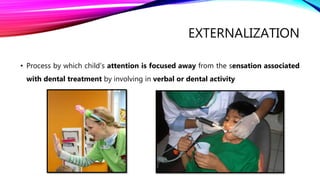
EXTERNALIZATION
• Process by which child’s attention is focused away from the sensation associated
with dental treatment by involving in verbal or dental activity
DISTRACTION
• Distraction - diverting the patient’s attention from what may be perceived as an
unpleasant procedure
• Giving the patient a short break during a stressful procedure
• Use stories and fairy tales
• Use slow music
• Choice of distraction – chosen by patient – help the child to gain control over
unpleasant stimulus
• May be perceived - as a clue that another stressful procedure lies ahead
OBJECTIVES
• Decrease the perception of unpleasantness
• Avert negative or avoidance behaviour
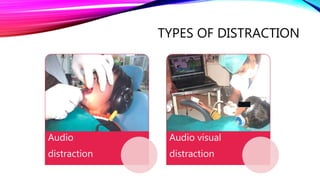
TYPES OF DISTRACTION
Audio
distraction
Audio visual
distraction
• Ingersoll et al in 1982 effectively combined distraction with a omission
procedure. When story tapes were interrupted following uncooperative
behaviour and resumed when the child cooperated. Behaviour fear was
lower and cooperation was higher than in distraction (continuous use of
tapes).
Ingersoll BD. Behavioural aspects in Dentistry. East Norwalk, Conn; Appleton-Century-Crofts 1982.
VISUAL IMAGINARY
• Controlled day dreaming
• Subject
• To imagine being in his favorite place
• Performing his favorites activity
• This can act as a fantasy during dental treatment
AUDIO – ANALGESIA
• Gardiner and Licklider - 1959
• White noise
• An effective method of patient distraction
• The technique consists of providing a sound stimulus of such intensity that
the patient finds it difficult to attend to anything else
• The effect seems to result from stimulus distraction, displacement of
attention and a positive feeling
• Gardener et al have reported that audio analgesia was completely effective
in 65% of 1000 patients who previously required nitrous oxide or local
anaesthetics to accomplish comparable procedures.
• Burt or Korn have reported that 60% of obstetrical patients experienced
good to excellent results when audio analgesia was administered.
1. Gardner WJ Licklider JC, Weisz AZ. Suppression of pain by sound. Science 1960; 132:32-3.
2. Burt RK, Korn GW. Audio-analgesia in obstetrics. Am J Obstet Gynec 1964; 88: 361-5.
USE OF POETRY
• Above - 7 year of age
• The dentist contributing one line and the child next
• Teeth are white – when they are bright
• Teeth are happy – when they are healthy
• Teeth stay long – when they are strong
USE OF DRAWINGS
• Useful in children – 3 to 5 years
• Child is given – paper , pencil and crayons
• Asked to draw some picture
• Slowly asked to draw teeth
• And showed how teeth can be made to look like his pets
• Like his pets – teeth also have to be looked after and kept cleaned
ADVANTAGES
• Allows repetition without monotony
• Rhyme and rhythm can be used – to guide the child towards the
information to be implied
• Gives the sense – of achievement and increases self – esteem
• Destroy the preconception – the child has formed about dentistry
ASSIMILATION AND COPING
• Coping – cognitive and behavioral efforts made by individual to master,
tolerate or reduce stressful situation (Lazaue 1980)
• Coping includes individual’s internal mental and emotional processes and
his external behavioral responses which are stimulated by either external
events or internal conflicts
• Children respond to stressful situation by coping
• Behavioral coping – efforts includes physical or verbal activities in which child
engages to deal with stress
• Cognitive coping – efforts which involve manipulation of emotions
• Child may be silent and thinking to keep calm - self – talk
• Strategies can enable the children to :
• Maintain realistic perspective
• Perceive situation less threatening
• Calms and reassure themselves – all is well
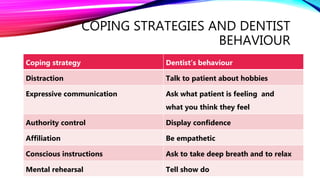
COPING STRATEGIES AND DENTIST
BEHAVIOUR
Coping strategy Dentist’s behaviour
Distraction Talk to patient about hobbies
Expressive communication Ask what patient is feeling and
what you think they feel
Authority control Display confidence
Affiliation Be empathetic
Conscious instructions Ask to take deep breath and to relax
Mental rehearsal Tell show do
BIOFEEDBACK(BUONOMONO 1979)
• A technical procedure involving the use of instrumentation to instruct direct
control over certain physiologic processes
• In phobia - aims of biofeedback are to eliminate the physiologic symptoms of
anxiety
• If the blood pressure is high – instrument reading give stimulation – subject
asked to control signals(anxiety or stress)
• Without the instrumented feedback - difficult for patient or practitioner to
know with certainty how relaxed the patient is
• Externalization also achieved
• Barber et al in 1988 have summarized the basic elements involved in
biofeedback training: the physiologic function to be controlled must be
monitored continuously, and the monitoring device must be sufficiently
sensitive to detect momentary changes. This is achieved by means of a visual
or auditory signal. Biofeedback is useful in anxiety and stress related disorders
HYPNOSIS
• Suggested by – Franz A Mesmer – 1773 – Physician
• Defined as a state of mental relaxation and restricted awareness in which
subjects are usually engrossed in their inner experiences such as
imaginary, less analytical and logical in their thinking and have enhanced
capacity to respond to suggestions in an automatic and dissociated
manner
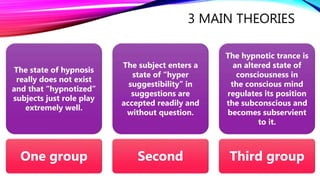
3 MAIN THEORIES
One group
The state of hypnosis
really does not exist
and that “hypnotized”
subjects just role play
extremely well.
Second
The subject enters a
state of “hyper
suggestibility” in
suggestions are
accepted readily and
without question.
Third group
The hypnotic trance is
an altered state of
consciousness in
the conscious mind
regulates its position
the subconscious and
becomes subservient
to it.
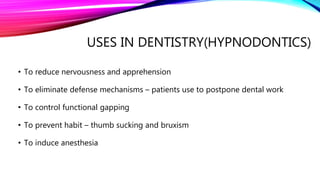
USES IN DENTISTRY(HYPNODONTICS)
• To reduce nervousness and apprehension
• To eliminate defense mechanisms – patients use to postpone dental work
• To control functional gapping
• To prevent habit – thumb sucking and bruxism
• To induce anesthesia
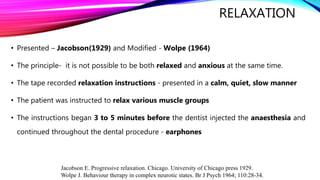
RELAXATION
• Presented – Jacobson(1929) and Modified - Wolpe (1964)
• The principle- it is not possible to be both relaxed and anxious at the same time.
• The tape recorded relaxation instructions - presented in a calm, quiet, slow manner
• The patient was instructed to relax various muscle groups
• The instructions began 3 to 5 minutes before the dentist injected the anaesthesia and
continued throughout the dental procedure - earphones
Jacobson E. Progressive relaxation. Chicago. University of Chicago press 1929.
Wolpe J. Behaviour therapy in complex neurotic states. Br J Psych 1964; 110:28-34.
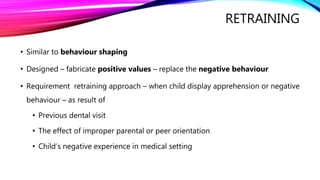
RETRAINING
• Similar to behaviour shaping
• Designed – fabricate positive values – replace the negative behaviour
• Requirement retraining approach – when child display apprehension or negative
behaviour – as result of
• Previous dental visit
• The effect of improper parental or peer orientation
• Child’s negative experience in medical setting
• Try to build a new relation – child is able to forget this previous thought
process
• Responsibility of dental team – to make his experience “Different”
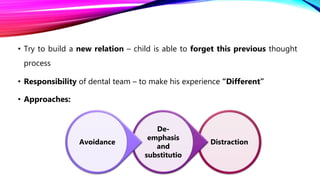
• Approaches:
Distraction
De-
emphasis
and
substitutio
Avoidance
IMPLOSION THERAPY
• A group working at the institute for Psychiatry in London in the 1960s
developed “implosion therapy”
• The patients were asked to imagine very strong phobic scenes, and to
experience every bit of anxiety that arose.
• The parts of the scene that caused the most anxiety were intensified in the
next sessions
• Which continued until the patient’s anxiety disappeared
VOICE CONTROL
• Given by Pinkham – 1985
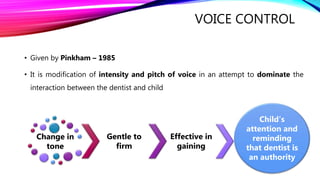
• It is modification of intensity and pitch of voice in an attempt to dominate the
interaction between the dentist and child
Change in
tone
Gentle to
firm
Effective in
gaining
Child’s
attention and
reminding
that dentist is
an authority
• Indication
• Uncooperative and inattentive patients
• Contraindication
• Younger age , disability , mental or emotionally immaturity – unable to understand
• Objectives
• Gain the patient’s attention and compliance
• Avert negative or avoidance behaviour
• Establish appropriate authority
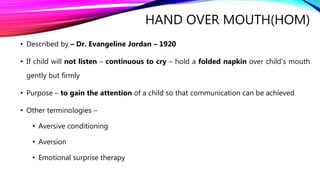
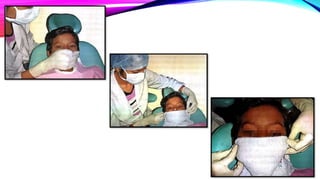
HAND OVER MOUTH(HOM)
• Described by – Dr. Evangeline Jordan – 1920
• If child will not listen – continuous to cry – hold a folded napkin over child’s mouth
gently but firmly
• Purpose – to gain the attention of a child so that communication can be achieved
• Other terminologies –
• Aversive conditioning
• Aversion
• Emotional surprise therapy
OBJECTIVES
• To gain child’s attention enabling communication with dentist so that appropriate
behavioral expectation can be explained
• To eliminate inappropriate avoidance behaviour to dental treatment and
established appropriate learned response
• To increase child’s confidence in coping with anxiety provoking dental stimuli
Indications
• A healthy child – able to understand
but who exhibits defiant – hysterical
behaviour
• A child – who can understand verbal
command but display uncontrollable
behaviour
Contraindications
• Immature child
• Frightened child
• Handicapped child
• Emotional
• Physical
• Mental
• Child with breathing problems
VARIATIONS OF HOM
• Hand-over-mouth Exercise - Airway Unrestricted (HOME)
• Hand Over Both Nose And Mouth - Airway Restricted (HOMAR)
• Towel Held Over Mouth Only
• Dry Towel Held Over Nose And Mouth
• Wet Towel Held Over Nose And Mouth
FACTORS TO BE CONSIDERED
• Technique should not be used as a routine procedure
• Inform the parents before procedure
• Consent of parent is very important
• Pediatric dentist should be aware of changing laws that govern informed consent
• HOME – will not subject to dentist liability – when it is used properly with parents
consent
• HOMAR – is more objectionable legally – may result in liability of dentist
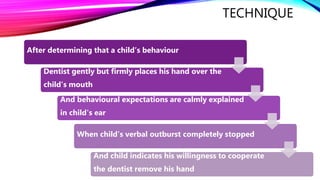
TECHNIQUE
After determining that a child’s behaviour
Dentist gently but firmly places his hand over the
child’s mouth
And behavioural expectations are calmly explained
in child's ear
When child’s verbal outburst completely stopped
And child indicates his willingness to cooperate
the dentist remove his hand
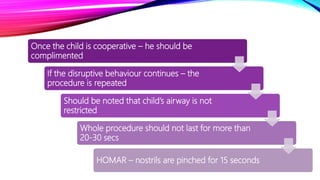
Once the child is cooperative – he should be
complimented
If the disruptive behaviour continues – the
procedure is repeated
Should be noted that child’s airway is not
restricted
Whole procedure should not last for more than
20-30 secs
HOMAR – nostrils are pinched for 15 seconds
• Scott and Garda-Godoy (1988) stated that HOM was unacceptable to 63% of the
informed parents and 81% of the uninformed parents.
• Kantaputra et al (2007) found that for children, HOM was the least popular
behaviour management technique. Majority of the parents reported that they did
not consider the use of HOM justified.
• Adair et al (2004) observed that 79% of clinician did not use HOME
• Belanger (1993) believed that airway restriction was the critical element and it
should be avoided
PROTECTIVE
STABILIZATION/PHYSICAL RESTRAIN
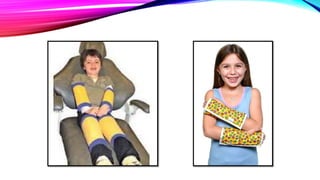
• Last resort of handling uncooperative , handicapped and spastic child
• Restrain are usually needed – Hypermotive , stubborn and defiant child
• Active :
• Stabilization performed by dentist , staff or parent without aid or devices
• Passive:
• With aid or restraining devices
INDICATIONS
• Can not cooperate because of lack of maturity
• Can not cooperate because of mental or physical disabilities
• Does not cooperative after other behaviour management technique have
failed
CONTRAINDICATION
• A cooperative patient
• A person can not be safely immobilized because of underlying medical or
systemic conditions
• As punishment
• It should not be used solely for the convenience of the staff
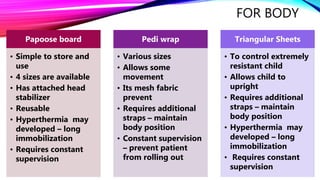
TYPES OF RESTRAIN
FOR BODY
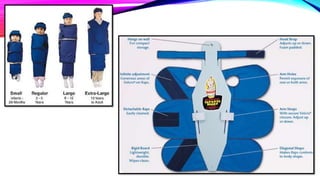
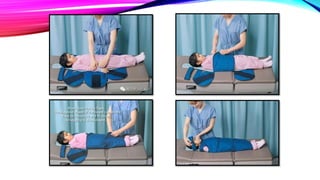
Papoose board
• Simple to store and
use
• 4 sizes are available
• Has attached head
stabilizer
• Reusable
• Hyperthermia may
developed – long
immobilization
• Requires constant
supervision
Pedi wrap
• Various sizes
• Allows some
movement
• Its mesh fabric
prevent
• Requires additional
straps – maintain
body position
• Constant supervision
– prevent patient
from rolling out
Triangular Sheets
• To control extremely
resistant child
• Allows child to
upright
• Requires additional
straps – maintain
body position
• Hyperthermia may
developed – long
immobilization
• Requires constant
supervision
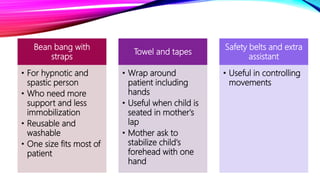
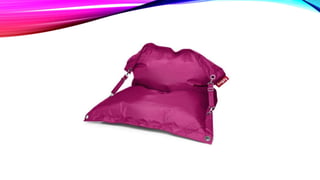
Bean bang with
straps
• For hypnotic and
spastic person
• Who need more
support and less
immobilization
• Reusable and
washable
• One size fits most of
patient
Towel and tapes
• Wrap around
patient including
hands
• Useful when child is
seated in mother's
lap
• Mother ask to
stabilize child's
forehead with one
hand
Safety belts and extra
assistant
• Useful in controlling
movements
FOR EXTREMITIES
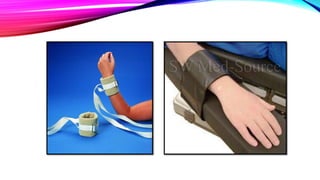
• Posey straps
• Velcro straps
• Towel and tapes
• Extra assistant
• Fasten to the arms of dental chair – allow limited movement
• Helpful – Athetoid- spastic cerebral palsy patient who tries desperately but
cant control body movement
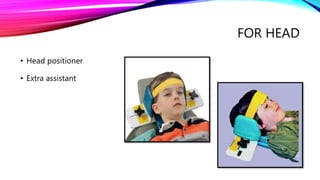
FOR HEAD
• Head positioner
• Extra assistant
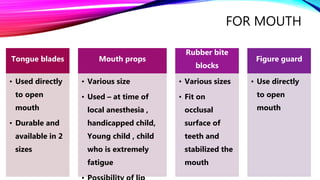
FOR MOUTH
Tongue blades
• Used directly
to open
mouth
• Durable and
available in 2
sizes
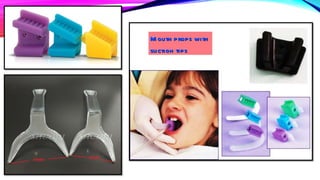
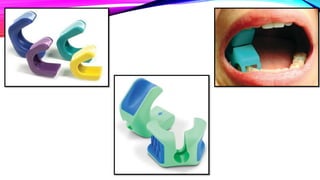
Mouth props
• Various size
• Used – at time of
local anesthesia ,
handicapped child,
Young child , child
who is extremely
fatigue
Rubber bite
blocks
• Various sizes
• Fit on
occlusal
surface of
teeth and
stabilized the
mouth
Figure guard
• Use directly
to open
mouth
CONCLUSION
• Behaviour management completely depends on knowledge regarding
behaviour
• The preschool child clearly requires the most energy and talent for effective
management
• No single method will be applicable in all situations - appropriate
management techniques should be chosen based on the individual child’s
requirements.
CHILDREN ARE NOT BORN WITH AN UNDERSTANDING OF
THE RULES OF ACCEPTABLE BEHAVIOUR - THEY HAVE TO
LEARN THEM AND NEED ADULTS HELP TO DO THIS
REFERENCES
• McDonald RE, Avery DR, Dean JA. Dentistry for child and adolescent. 8th edition. Mosby – an imprint of
Elsevier; Missouri 2004; 33-49.
• Ray ES, Kenneth CT, Thomas KB, Stethen HY. Pediatric dentistry - Scientific foundations and clinical practice.
Mosby Co; 1982
• Wright GZ. Behaviour management in dentistry for children. Philadelphia, WB Saunders, 1975.
• Pinkham, Cassamissimo, Fieldes, McTigue, Nowak. Pediatric Dentistry, Infancy Through Adolescence. 4th
edition. Elsevier publications 2004.
• Guidelines of behaviour guidance for the Pediatric dental patient. AAPD Reference manual 2012-2013; 29(7).
• Ripa LW, Barenie JT. Management of dental behaviour in children. PSG publishing, Massachusetts.
• Tandon S. Textbook of Pedodontics. 2nd edition. Paras Publishing; 2007: 134-42.
• Finn SB. Clinical Pedodontics 4th edition. WB Saunder’s Company; 1999: 15-32.
• Arathi Rao. Principles and practice of pedodontics. 3rd edition. Jaypee Brothers medical publishers 2012; 109-
10
• Frankl SN, Shiere FR, Fogels HR. Should the parent remain in the operatory? J Dent Child 1962;
29:150-63.
• Swallow JN, Jones JM, Morgan MF. The effect of environment on a child’s reaction to dentistry. J
Dent Child 1962; 29:150-63.
• Jenks L. How the dentist’s behaviour can influence the child’s behaviour. J Dent Child
1964; 31:358-66.
• Illingworth RS. The development of the infant and young child. Normal and Abnormal. 5th edition
Baltimore: The Williams and Wilkins Co. 1972; 24-6.
• Bayley N, Schaefer ES. Maternal behaviour and personality development: Data from Berkley Growth
Study. In Meddinus GR. Readings in the Psychology of Parent- Child Relationships. NewYork: John
Wiley and Sons Inc. 1967; 157-69.
• Belcher DR. Exclusion of parents from operating room. Br J Dent Sci 1898; 41:1117.
• Kantaputra, Chiewcharnvalijkit, Wairatpanich, Malikaew, Aramrattana. Chilren’s attitudes towards
behaviour management techniques used by dentists. J Dent Child 2007; 74(1):4-9.
• Hull CL. Hypnosis and suggestibility: an experimental approach; New York 1968, Appleton Century
Crofts.
• Barber TX. Hypnosis, a scientific approach. NewYork 1969, Van Nostrand- Reinhold Co.
• Barber TX, Coopre BJ. Effects of pain experimentally induced and spontaneous distraction. Psychol.
Rep. 1972; 31:647.
• Sarbin TR. Contributions to role taking theory. I. Hypnotic behaviour. Psychol. Rev. 1950; 57:255.
• Sarbin TR, Coe WC. Hypnosis: a social psychological analysis of influence communication. NewYork
1972, Holt, Rinehart and Winston.
• Erickson MH, Rossi EL, Rossi JI. Hypnotic realities. New York, 1976, Irvington Publishers, Inc.
• Erickson MH. Advanced techniques of hypnosis and therapy: selected papers (Jay Hailey, editor).
NewYork 1967, Grune and Stratton, Inc.
• Scott, Garcia-Godoy. Attitudes of Hispanic parents towards behaviour management techniques. J Dent
Child 1998; 65:128-31.
THANK YOU

Behavioural sciences and its application to pedodontics

  • 1.
    Dr. Dharati Patel Departmentof Pedodontics and Preventive Dentistry BEHAVIOURAL SCIENCES AND ITS APPLICATION TO PEDODONTICS
  • 2.
    CONTENT • Introduction • Definitions •Classification of child behaviour in dental clinic • Behaviour rating scales • Factors affecting child’s behaviour in dental clinic • Conclusion • References
  • 3.
    INTRODUCTION • Behaviour –is the manner in which person acts or preforms • Behaviour dentistry – Interdisciplinary science • Body and mind are not separate entity • Successful pediatric dentistry • Behaviour management • MC Elory (1895) “Although the operative dentistry may be perfect the appointment is a failure if the child departs in tears”
  • 4.
    DEFINITIONS • Behaviour • Anyactivity that can be observed, recorded and measured. • Any change observed in functioning of an organism. • Behaviour is the sum total of response to stimuli, internal and external [Healy, Bronner and Bowers, 1965] • Behaviour is defined as the response by the child and the reaction of the dentist as the consequence. The consequence can be answered with a reinforcer, which strengthens behaviour in a patient, or with a punisher, which weakens behaviour [Rosenberg, 1974]
  • 5.
    • Behavioral science •Is the science which deals with the observation of Behavioral habits of man and lower animals in various physical and social environments; including behavior pedodontics, psychology, sociology and social anthropology. • Behavioral Pedodontics • Study of science which helps to understand development of fear, anxiety and anger as it is applied to child in dental situations.
  • 6.
  • 7.
    THE REASONS FORBEHAVIOUR CLASSIFICATION • Provides a systematic means for recording patient’s behaviour. • Assists in evaluating the validity of current research • Helps in behaviour management
  • 8.
    WILSON’S CLASSIFICATION(1933) Normal Bold Brave Co-operativeFriendly Tasteful Timid Shy Does not interfere Hysterical Rebellious Home environment Temper-tantrums Rebellious Nervous Fearful Tense Anxious Fearful
  • 9.
    PINKHAM’S CLASSIFICATION(1959) Category I– Emotionally compromised Anxiety Behaviour Explosion Broken Homes , Unfortunate Parenting ,Abused And Neglected , Poverty Category II – Shy, Introvert child Poorly socialized and afraid of social challenges Very stressful Cry and compensatory whimpering friendship ,praise , tell show do Category III – Frightened child Challenge for dentist , physician and parents Fear of needle, bodily harm and fear of unknown Do everything possible to avoid increasing the child’s anxiety Category IV - Child who is adverse to authority Adopt behaviour from parents Undue attention Struggle for power Retaliation and revenge Inadequacy
  • 10.
    KOPEL’S CLASSIFICATION (1959) Veryyoung patient Emotionally disturbed patient • Child from a broken or poor family • Pampered or spoiled child • Excessively fearful child • Hyperactive child Physically handicapped child Mentally handicapped child Child with previous inconvenient medical or dental experience
  • 11.
    LAMPSHIRE (1970) Co-operative: Relaxed , cooperative throughout Tense cooperative: tensed and cooperative at same time Outwardly apprehensive: hides ,avoids, accept Fearful: requires considerable support Stubborndefiant: passively resists treatment Hypermotive: agitated, screaming, kicking Handicapped: physically, mentally and emotionally Emotionally immature – young child , can not rationalize
  • 12.
    SARNET AND CO-WORKERS(1972) • Smiles, offers information, initiates light conversation and gives positive response Active cooperation • Obedient, follows instructions but quiet Passive cooperation • Needs convincing, mild crying and follows instructions under pressure Neutral, indifferent • Disturbs work, seizes dentist’s hands, not relaxed, sits and stands alternately Opposed • Cries, refuses to sit or to enter room Completely uncooperative, strongly opposed
  • 13.
  • 14.
    COOPERATIVE BEHAVIOUR • Cooperativebehaviour • Relaxed • Minimal apprehension • Treated by a straight forward behaviour shaping approach • Develop good rapport with the dentist • Interested in the dental procedure • Laugh and enjoy the situation • Allow the dentist to function effectively and efficiently
  • 15.
    • Lacking cooperativebehaviour • Includes very young (0-3 years), disabled and handicapped child • Can pose major behavioural problems • Potentially cooperative • Has potential to cooperate • Inherent fear (subjective and objective) – does not cooperate
  • 16.
    UNCOOPERATIVE BEHAVIOUR • Uncontrolledhystericalincorrigible:Preschooler , 1st visit , temper- tantrums ,loud cry • Defiantobstinate behaviour: Any age , spoilt, stubborn , challenge authority • Tense cooperative: Borderline between + and - , does not resist, tensed at mind • Timid behaviour: Shy, overprotective but cooperative , initial visit • Whining type: Complaining behaviour but allows treatment , whines • Stoic behaviour: Physically abused but passively accept treatment
  • 17.
    GARCIA-GODOY (1986) Fearful • Resistentering in room • Cries and screams Timid • Thoughtful with eyes on floor • Doesn’t look at staff Spoiled • Arrogant and proud • Neglects treatment • Gives order Aggressive • Screams, doesn’t open mouth • Kicks , neglects treatment Adopted • Combination of spoiled abd fearful Handicapped • Need special care Cooperative
  • 18.
  • 19.
    FRANKEL’S BEHAVIOUR RATING SCALE(1962) Definitely Negative • Refuses treatment • Cries forcefully • Extreme negative behaviour associated with fear Negative • Reluctant to accept treatment • Displays evidence of slight negativism but not pronounced Positive • Accepts treatment • Tense cooperative behaviour • Conservative behaviour • Timid behaviour Definitely Positive • Unique behaviour • Good rapport with the dentist • Interested in dental procedures • Laughing and enjoying the situation
  • 20.
    ADVANTAGES OF FRANKLBEHAVIOURAL RATING SCALE • Functional • Quantifiable (as it has IV categories, numerical values can be assigned). • It is reliable (level of agreement to be 85% or higher). • Progression of child's behaviour during a series of appointments can be recorded on a separate column. • Lends itself to a shorthand form
  • 21.
    Initial examination :BEH ------ TSD------ + LA : BEH ------ VC ------ + ( INJ) LA: BEH + +
  • 22.
    SHORTCOMING • Scale doesnot give us sufficient clinical information for uncooperative children.
  • 23.
    WRIGHT’S MODIFICATIONS TO FRANKL’SRATING SCALE (1975) • Wright suggested that a symbol be added to this rating scale, permitting the dentist to record a behaviour base at the inception of dental treatment and to keep a progressive record of the child’s behaviour. • Rating number 1 (--) • Rating number 2 (-) • Rating number 3 (+) • Rating number 4 (++)
  • 24.
  • 25.
    Dharati Patel Department ofPedodontics and Preventive Dentistry BEHAVIOURAL SCIENCES AND ITS APPLICATION TO PEDODONTICS
  • 26.
    CONTENT • Factors affectingchild’s behaviour in dental clinic • Maternal influence • Behaviour management • Classification • Objectives • principle • Fundamentals • Conclusion • References
  • 27.
  • 28.
  • 29.
    DR . ARIKUPIETZKY
  • 30.
    Out of control of dentist Underthe control of dentists Under the control of parents
  • 31.
    UNDER THE CONTROLOF DENTIST • Dental clinic • Location and design of equipment • Effect of dentist’s activity , attitude and attire • Dentist’s skill and gracefulness • Dental staff • Knowledge about patient • Scheduling of appointment • Parental consideration • Presence or absence of parents in the operatory • Parent child separation • Presence of an older sibling
  • 33.
  • 35.
    • Swallow andco-worker in 1962 evaluated the effect on children’s anxiety of the environment in which dental interview and treatment were performed. Swallow JN, Jones JM, Morgan MF. The effect of environment on a child’s reaction to dentistry. J Dent Child 1962; 29:150-63.
  • 36.
    LOCATION AND DESIGNOF THE EQUIPMENT • Instruments - fear provoking – kept in inconspicuous positions • Dentist and assistant should sit closer to the working field - work more efficiently. • Handpieces, burs, rubber dam must all be of sufficient range in sizes to facilitate easy access to working sites in smaller mouths. • Avoid child to see adults in pain or sight of blood on others
  • 38.
    EFFECT OF DENTIST’SACTIVITY AND ATTITUDES • Firmness with kindness and a soft, clear voice are helpful • Should be polite and speak to the child as one individual to another • Verbal guidelines should be presented in the form of statements rather than questions. • Truthfulness is mandatory • Avoid jerky and quick movement • The dentist’s attire and general appearance create a significant impression on the child – white coat
  • 42.
    DENTIST’S SKILL ANDGRACEFULNESS • In talking to the child the dentist must get down to the patient’s own level in position and in conversation , in both ideas and words. • It flatters child if adults judge them older than they really are. • Talk to them at their own or slightly older age level . • Children are more observant then adults. • If dentist lacks confidence - will be reflected in child’s behaviour
  • 43.
    JENKS IN 1964 Datagathering and observation: interview , questionnaire Structuring: establish guidelines. What to and how to react ?? Externalization: involvement. Empathy and support : capacity to understand to experience the feelings of another without losing one’s own objectivity Flexible authority – compromises to meet patients need Education and training – implants program which educates both, child and parents
  • 45.
  • 47.
  • 49.
  • 50.
    DENTAL STAFF • Directrelation to the dentist • Each individual should know his or her own duties • Be aware of what else is going on at the same time in the office. • Each member must understand the treatment plan • The attire of the staff should be cheerful and appealing to youngsters. • Assistant should be skilled in making animals or other objects out of cotton rolls.
  • 52.
    KNOWLEDGE ABOUT THEPATIENT • Every child is unique and different • It is wise to know the child patient before he is seated in the dental chair. • Useful to know which behaviour techniques would be needed for that child
  • 54.
    SCHEDULING APPOINTMENT • Napsand meals – this time should be avoided - irritability will results • Preschoolers – best seen in early morning • The length of the visit - determined by the work to be accomplished and the attention span of the child. • Appointments for children should be short - the short attention span • Minimize the number of visits & limit the frequency of local anaesthesia • Accomplish quadrant dentistry wherever possible • The most pleasantly accomplished procedures must be attempted first
  • 55.
    PARENTAL CONSIDERATIONS • Visualenvironment of dental office – effect either positively or negatively • Appearance and attire of the dentist and dental staff • Cleanliness and decor of the office , Olfactory and auditory stimuli - contribute to the overall impression • Treatment will be accomplished only if accepted by the parents • Flexible approach – preferable • The dentist must be allowed to establish communication with the child independently
  • 57.
    PRESENCE OR ABSENCEOF PARENTS IN THE OPERATORY • Mother – essential for preschooler , handicapped • Older child – not require mother (emotional independency) • Dentist – relaxed and comfortable - parents are in reception room • If a child should exhibit uncooperative behaviour, the presence of the parent will sometimes lend support to this type of behaviour and it can also limit the range of behaviour control techniques of the dentist.
  • 60.
    • Frankel andco-workers tested the reaction of young children (42 to 66 months ) to the presence of the mother in the operatory. One group had the mother present during both an initial visit involving an examination and operative visit. The mothers were instructed to act as passive observers. The second group had the mother absent from the operatory during both visits and he found that children in the age group 42 to 49 months benefited from the mother’s presence during treatment and children 50 to 66 months of age, however, did not exhibit significant differences in behaviour according to the mother’s presence or absence. • In 1898, Belcher noted that excluding the parent from the operating room could contribute to controlling the child’s positive behaviour.
  • 61.
    PARENT CHILD SEPARATION •Starkey in 1970 suggested separation of the child from the parent during the treatment and suggested that the policy of requiring the parent to remain in the reception room could be justified for many reasons • The parent often repeats orders, creating an annoyance for both dentist and child patient. • The parents inject orders, becoming a barrier to the development of rapport between the dentist and child. • The dentist is unable to use voice intonation in the presence of the parent because he or she is offended. • The child divides the attention between parent and dentist. • The dentist divides attention between parent and child.
  • 62.
    PRESENCE OF ANOLDER SIBLING • Serves as role model • Depend on age • Little effect – 3 year old patient • Most noticeable effect on – 4 -5 year old patient
  • 64.
    OUT OF CONTROLOF THE DENTIST • Growth and development • Nutritional factors • Past medical and dental experiences • Influence of parents, siblings and peers • School environment • Socioeconomic status
  • 65.
    GROWTH AND DEVELOPMENT •Deficiency of physical growth or congenital deformities – leads to psychological trauma due to rejection by society • Mental retardation , epilepsy , cerebral palsy – make the child mentally handicapped • There is failure of cognitive development and therefore variations in behaviour • Very young child reacts very differently – transformed to positive behaviour as grows older
  • 66.
    NUTRITIONAL FACTORS • Necessaryto maintain physical and mental health • Skipping meals – impaired performance • Nutritional deficiency – affects milestones of biological and cognitive development
  • 67.
    PAST MEDICAL ANDDENTAL EXPERIENCES • Any past unpleasant dental experience, prior hospitalization , surgical intervention , sickness – are associated with a high degree of uncooperative behaviour • Emotional quality of last dental visit is more significant than number of visits • These patients may exhibit phobias regarding specific procedures, such as needles, and anxiety levels may be heightened • Empathy for the child’s misfortunes - encourage the use of dietary treats • The use of sweetened medication for the chronically sick child compounds the caries problem
  • 69.
    INFLUENCE OF PARENTS,SIBLINGS AND PEERS • Parental and siblings influence • Prime factor • The influence may be positive or negative • Peer Influences • There is greater potential for encouragement of increased anxiety levels by friends than by brothers or sisters. • Distinct differences may occur from one visit to the next as a result of peer influences.
  • 70.
    SCHOOL ENVIRONMENT • 50%children’s development is influenced by school environment • Teachers and peers helps to influence the behaviour of younger children • Seniors become role models
  • 71.
    SOCIOECONOMIC STATUS • Highsocioeconomic status child • Develop normally and may become spoilt • Low socioeconomic status child • Tensed (little attention and neglected)
  • 72.
    UNDER THE CONTROLOF THE PARENTS • Home environment • Family development and peer influences • Maternal influence
  • 73.
    HOME ENVIRONMENT • Homeis first school – learns to behave • All individual influence – child’s behaviour • Broken home – child feel insecure , inferior , depressed
  • 74.
    FAMILY DEVELOPMENT ANDPEER INFLUENCES • Position and status of child – can influence child’s behaviour • Overindulgence by parents – spoilt behaviour – show sudden outburst of temper tantrums • Interfamily conflicts – emotionally frustrated child
  • 75.
    MATERNAL BEHAVIOUR • Maternalinfluence - children’s mental, physical and emotional development - even before birth • Fetus influenced by changes in the mother’s neurohormonal system, which is transmitted through the placenta • Somatic development of fetus – Nutritional status of mother • Post natal behaviour of child = Prenatal emotional status mother • Agents – Alcohol , smoking and keratogenic drugs
  • 76.
  • 77.
    • Bell hastermed this relationship “ONE-TAILED”- parental characteristics have an unilateral influence on developing child • Child’s personality ,behaviour, and reaction to stressful reactions – direct product product of maternal characteristics • Baldwin (1969) used subjects 3-7 years of age to show significant relationship between maternal anxiety and children’s behaviour at first dental visit. They found that highly anxious mothers had a negative influence on their children Johnson R, Baldwin D. Maternal anxiety and child behaviour. J Dent Child 1969; 36:13-8.
  • 78.
    Schaefer has developeda model in which gradations of maternal behaviour are arranged sequentially around two reference pairings of Autonomy Vs Control and Hostility Vs Love. Schaefer ES. A circumplex model for maternal behaviour. J Abnorm Soc Psychol 1955; 59:226-35.
  • 79.
    • The behaviourof mothers who participated in the Berkeley Growth study in 1967 , was rated according to the attitudes depicted in the Schaefer model. • Suggested that loving mothers tended to have calm and happy sons while hostile mothers had sons who were excitable and unhappy. • Mothers who allowed autonomy had sons who were friendly cooperative and attentive. • Conversely punitive mothers who ignore their children did not have positive behaviour Bayley N, Schaefer ES. Maternal behaviour and personality development: Data from Berkley Growth Study. In Meddinus GR. Readings in the Psychology of Parent- Child Relationships. NewYork: John Wiley and Sons Inc. 1967; 157-69.
  • 80.
    PARENTAL ATTITUDE • Overprotective •Overindulgent • Overanxious • Under affectionate • Rejecting • Authoritarian / dominant
  • 81.
    OVERPROTECTIVE • Child’s behaviour: shy , submissive, anxious and fearful • Exaggeration of attitude – overprotection – harmful to normal development • Factors : • Previous miscarriage and long delay in conceive the child • Another sibling had died • Mother is aware that she can not have more children • Medical illness or handicapped child • Paternal absence • Not allow the child to take ordinary risks • Shows excessive concern regarding – dental and medical problems
  • 82.
    OVERINDULGENT • Child behaviour: aggressive , spoiled , demanding , display tempers • Associated with overprotection and dominant maternal trait • Emotional development impeded – keeping him infantile & depended state • Give the child whatever they wants • Get their own way – dental office • Shows burst of temper – when can not control dental situations • They learn to manipulate their parents into satisfying all of their wants and tend to act superior, bossy, and demanding
  • 83.
    OVERANXIOUS • Child behaviour: shy, timid and fearful • Undue concern for the child - some previous family tragedy - accident or illness. • It is usually associated with over affection, overprotection and overindulgence. • Child - not permitted to work or play alone. • Minor illness is greatly exaggerated and frequently the child is bedridden unnecessarily • Lack the ability to make decisions for them • They are generally good dental patients - with encouragement and assurance
  • 84.
    UNDER AFFECTIONATE • Childbehaviour: well behaved and outwardly appear to be well adjusted. • Under affection - vary from mild detachment, to indifference, to neglect • Mother - become less emotionally supportive of her child due to her outside interests or employment or simply because the child is unwanted. • Tendency to be unsure of their decision - making capacities. • Cry easily and shy .
  • 85.
    REJECTING • Child’s behaviour: aggressive , overreacting, disobedient • Maternal rejection – unwanted • Unstable , unhappy marriage • Birth was not anticipated • Child interfere with career • Immature or emotionally unstable • Mother’s behaviour : neglect the child, sever punishments , nagging , resistance to spending a time or money • Child usually lacks feeling of belonging & self esteem • Feeling of helplessness - leads to deep anxiety
  • 86.
    • No homesecurities - becomes suspicious, aggressive, revengeful, disobedient, restless and overactive • In the dental office - this child may be difficult to control. • Behaviour management - not rejection but with friendliness and understanding. • Children are generally demanding - demands should be respected as much as possible, need of attention and kindness
  • 87.
    AUTHORITARIAN / DOMINANT •This attitude demands – children’s excessive responsibility • Which is incompatible - their chronological age • Force the child & train him - being critical, strict and often rejecting. • Constant nagging and criticizing - develops in the child submission and restlessness • Negativism may be common • Fearful, resisting openly and obey commands slowly . • With kindness and consideration they generally develop into good dental patients
  • 88.
  • 89.
    • Behaviour management(wright 1975) • Defined as means by which the dental health team effectively and efficiently performs dental treatment and thereby instills a positive dental attitude • Behaviour modification(Eysenck – 1964) • Defined as attempt to alter human behaviour and emotion in a beneficial way and in accordance with the laws of learning
  • 90.
    • Behaviour shaping •Is the procedure which slowly develops behaviour by reinforcing a successive approximation of desired behaviour until the desired behaviour comes into being • Behaviour guidance • Is a continuum of interaction involving the dentist, dental team , patient and the the parents directed towards communication and education ‘which ultimately builds trust and allays fear and anxiety’.
  • 91.
    ACCORDING TO BARENIE& RIPA (1977) Non Pharmacological Behaviour modification techniques Desensi tization Modelli ng Conting ency manage ment Behaviour management techniques for disruptive behaviour Voice control Physical restraint Hand over mouth technique and its Hypnosis Pharmacological Nitrous oxide- oxygen analges ia Premed ication General anesthes ia
  • 92.
    ACCORDING TO PINKHAM(2004) Physical Domain • Hand restraint • Tools such as papoose board and pediwrap • Other restraint systems include tape, sheets with tape, cloth wraps, belts • Mouth props Aversive Domain • Hand-over-mouth (HOM) Pharmacologic Domain • Nitrous oxide/oxygen • General anaesthesia Reward Oriented Domain • Material reinforcers • Social reinforcers • Activity reinforcers Linguistic Domain • Communication techniques
  • 93.
    ACCORDING TO AAPD GUIDELINES(1999) Traditional Behaviour management • Tell-show-do • Distraction • TLC, gentle • Positive reinforcement • Voice control Aversive Behaviour management • Hold and go • Restraining immobilization) • Hand-over-mouth exercise (HOME), Hand-over-mouth with airway restricted (HOMAR) Pharmacological management • Conscious sedation • Deep sedation • General anaesthesia
  • 94.
    ACCORDING TO AAPDGUIDELINES (2006) Basic Behaviour Guidance Advanced Guidance • Communication and communicative guidance • Tell-show-do • Voice control • Nonverbal communication • Positive reinforcement • Distraction • Nitrous oxide/oxygen inhalation • Protective stabilization • Sedation • General anaesthesia
  • 95.
  • 96.
    OBJECTIVES OF BEHAVIOUR MANAGEMENT •Establish effective communication with the child and the parent. • Gain child’s and parent’s confidence and acceptance of dental treatment. • Teach child and parents the positive aspects of preventive dental care • To provide a relaxing and comfortable environment for the dental team to work in, while treating the child
  • 97.
    FUNDAMENTALS (SHOWDER 1980) Positive approach •Attitude of dentist effect - outcome of dental appointment • Positive statements increase the chance of success • Dentist must mask emotional reaction Team attitude • A pleasant smile – adults care • Respond best – friendly attitude and greetings • Use of nicknames • Extracurricular activity – helps in initiating future conversation Organization • Each dental office should have own contingency plan • Such plans increase the efficiency
  • 98.
    Truthfulness • Extremely importantin building up trust of child Tolerance • Dentist ability to rationally cope up with misbehaviors • Varying person to person and can be fluctuate Flexibility • Children – lacking in maturity • Dental team – must prepared to change it plans • Small children – demand in changing position also • Dental team should be flexible – situation demands
  • 99.
    Knowledge of behaviourmanagement , child development , children and families Getting to know your patient Pre-appointment behaviour modification The first dental visit Non pharmacological strategies Non invasive techniques Invasive (Aversive techniques) Pharmacological strategies Sedation General anesthesia
  • 100.
  • 101.
    Pre- appointment behaviour modification Communication Use of second language Tellshow do Behaviour shaping Desensitization Modeling Contingency management Externalization Distraction Visual imaginary Audio – analgesia Use of poetry use of drawing Assimilation and coping Biofeedback Hypnosis Humor Relaxation Retraining Reframing Parental presence or absence Implosion therapy Voice control
  • 102.
    PHYSICAL OR FLOODING TECHNIQUES Handover mouth Protective stabilization
  • 103.
    PRE APPOINTMENT BEHAVIOUR MODIFICATION •Parents take appointments on calls or on a website of that clinic • Gather the information from the parent and schedule the appointment within 1 week of the call • Send the parent an e-mail with the links to the website • Audiovisual modeling – goal is to reproduce behaviour • Video cassette - can sees it before proceeding to dental clinic • Model – siblings or other children with same age
  • 104.
  • 105.
    • Goals offirst dental visit • Develop rapport with the child • History taking, diagnosis and treatment planning • If no emergency care is required • Examination • Counselling of parents • Taking radiographs • Brushing demonstration • Introduction of dental armamentarium with use of euphemisms
  • 106.
    • Things tobe avoided in 1st dental visit • Do not start any treatment unless it is an emergency • Use minimum restraints only for good examination • Don’t promise parents about the child’s co-operation. • Avoid discussing things like pain, injections, bleeding etc. in front of children.
  • 107.
    ATTENTION TO THEPATIENT • Every child should have dentist’s undivided attention • Always treat the child as if he was the only patient seen that day. • Never leave a very young child alone in the chair • If possible do all the work necessary on the child in the same room
  • 108.
    COMMUNICATION • First objective– successful management • Consider the cognitive development of the patient • As well as the presence of other communication deficits (e.g. Hearing disorder) • Conversation – learns about patient – relax youngsters • The fear – nature innate curiosity – demand – explanations
  • 109.
    VERBAL COMMUNICATION • Thelanguage choice should consist of words that express pleasantness, friendship and concern • Initial remarks should include statements about the child’s appearance or dress. • 2-7 year child – based on – Piagetian concept - Animism • Honesty of approach to a child is very important
  • 110.
    • Moss (1972)described three essential elements of effective communication- source, medium and destination or receiver- as they relate to dentistry. In the dental office the dentist is the source or transmitter, the dental office is the medium, and the patient is the receiver. Smith ME. An investigation of the development of the sentence and the extent of vocabulary in young children. Univ. Iowa stud. Child Welfare 1926; 3(5).
  • 111.
    • Through appropriatecontact, posture, facial expression, body language, pat on the back, the smile and the warmth • Facial expression - conveys to the child that the practitioner is in control • Nonverbal communication of friendliness should be expressed. NON VERBAL
  • 112.
    USE OF SECONDLANGUAGE • Address the child at his or her level of understanding • Does not suggest – baby talk • Tone of voice – kind and firm • Lenchner and Wright (1975) indicate that the choice of words used by the dentist and staff or the manner in which the words are voiced can influence the emotional state of the average child. The dentist must develop a “second language” by substituting “mild expressions”, or euphemism, for those that imply harm in the child’s mind Lenchner V, Wright GZ. Non-pharmacotherapeutic approaches to behaviour management. In Wright GZ- Behaviour management in dentistry for children. Philadelphia WB Saunders Co. 1975
  • 113.
    Radiographic equipment Camera ExplorerTooth feeler Needle and anesthesia Sleepy water Rubber dam Raincoat Rubber dam clamp Tooth button Handpiece Whistling Charlie Stainless steel crown Cap Hi-speed suction Straw Amalgam restoration Sliver soldier Air from syringe Wind
  • 114.
    TELL – SHOW–DO(TSD) • Corner stone • Addleston – 1959 • Objectives • To teach the patient important aspects of the dental visit and familiarize the patient with the dental setting. • To shape the patient’s response to various procedures
  • 115.
    • Verbal explanationof procedure in phrase • Tell the child before – while doing – after • Operator should be truthful Tell • Demonstration – visual , auditory , olfactory , tactile aspect – non threatening way • Demonstrate - him self , inanimate object • Avoid showing fear promoting instruments – bring instruments below the visual level Show • Without deviating from explanation – perform previewed operation • Use the same tone of voice • Do not do – if child has not clear awareness of what is you are going to do Do
  • 116.
    • Crossley &Joshi (2002) in their study found that the most popular child technique for managing children was tell-show-do; this technique was listed by 87% of respondents as their most commonly used Behavioural management strategy. When asked to list their second most common strategy, 40% listed voice control, 15% nitrous oxide, 13% dentist spending time in waiting room with child prior to treatment, and 11% live modelling. • Kantaputra et al (2007)in their study found that for all children, the most popular behaviour management techniques were: tell-show-do and rewards. 1. Crossley, Joshi. An investigation of pediatric dentists attitudes towards parental accompaniment and behavioural management techniques in UK. Br Dent J 2002; 192(9): 517-21. 2. Kantaputra, Chiewcharnvalijkit, Wairatpanich, Malikaew, Aramrattana. Chilren’s attitudes towards behaviour management techniques used by dentists. J Dent Child 2007; 74(1):4-9.
  • 118.
    BEHAVIOUR SHAPING • Lechnerand Wright (1975)- developed • Behaviour shaping is based on - principles of social learning • Proponents of the theory hold that most behaviour is learned and that learning is the establishment of a connection between a stimulus and a response. sometimes - called stimulus-response (S-R) theory • Simple method - teaching the child step by step what is expected
  • 119.
    OUTLINES FOR BEHAVIOUR SHAPINGMODEL • State the general goal or task to the child at the outset • Explain the necessity for the procedure • Divide the explanation for the procedure • Give all explanations at a child’s level of understanding. • Use successive estimation – like time • Reinforce appropriate behaviour • Disregard minor inappropriate behaviour
  • 120.
    DESENSITIZATION • Demonstrated by–Jones -1924 • Reducing children’s fears in which she demonstrated • The power of a pleasurable experience will overcome a fearful one • Popularized by –Wolpe - 1947 • Desensitizing is a therapeutic technique that pairs an anxiety – evoking stimulus with a response-inhibitory to anxiety . In such situations the perceived link between the stimulus and the anxiety response is weakened.
  • 121.
    • A fearproducing object is gradually brought closer and closer until it loses its anxiety producing ability • Introducing progressively more threatening stimuli as the patient becomes “desensitized” to the anxiety producing features of a procedure • Technique - found to be effective in managing a broad spectrum of phobias including fears of rejection, physical injury, injections and authority figures. • Clinicians frequently make use of this approach by starting with the easiest and least threatening procedures and saving the more difficult or painful ones for the later.
  • 122.
    • Wolpe (1952)has suggested that desensitization is effective because the patients learn to substitute an appropriate, adaptive, emotional response- relaxation for an inappropriate or maladaptive response-anxiety • Howitt and Stricker addressed the hierarchy of anxiety evolving stimuli in the dental experience in children as : injection > exposure to dental environment > dental drill > rubber dam > hand instruments > prophylaxis. Wolpe J. Experimental neuroses as a learned behaviour. Br. J Psychol 1952; 43:243.
  • 123.
    MODELING • Based on- Bandura’s social learning theory – states that one’s learning or behaviour acquisition occurs through observation of suitable model performing a specific behaviour. • He states - learning occurs only as a result of a “direct experience which can be vicarious-witnessing the behaviour and the outcome of that behaviour for other people” • Synonymous terms : imitation, observational learning, identification, internalization , introjection , social facilitation , contagion and role taking Bandura A. Principles of behavioural modification. NewYork: Holt, Rinehart and Winston 1969
  • 124.
    OBJECTIVES • Stimulates acquisitionof new behaviour • Facilitating the behaviour already in the patient in a more appropriate manner • Elimination of avoidance behaviour • Extinction of fear
  • 125.
    • Ghose etal in 1969 examined whether modelling works equally well with all types of children. Studies indicate that while certain differences such as previous experience and age are important and need to be addressed in specific modelling application, the benefits of modelling are robust and can be used with most children. Modelling has been shown to reduce fear behaviour among male and female children, and across a wide age range from 3 to 13 years. Ghose LJ, Gidden DB, Shiere FR. Evaluation of sibling support. J Dent Child 1969; 36:35-40,49.
  • 126.
    FOUR REQUIREMENTS OFTHE MODELLING TECHNIQUE • Concentrated attention must be expended toward the witnessing of the model. Brief exposure to the modelling procedure is not productive • There must be sufficient retention of desirable behaviour in the absence of a model. • One must be able to reproduce effectively the behaviour modelled. • The newly acquired behaviour must be appropriately rewarded to retain it. Bandura A. Principles of behavioural modification. NewYork: Holt, Rinehart and Winston 1969
  • 127.
    • Stokes andKennedy clearly demonstrated modeling’s clinically significant benefits among children with fear levels high enough to make dental treatment problematic. All of the children’s uncooperative behaviour was reduced to a considered to be acceptable to the dental practitioner. Stokes TF, Kennedy SH. Reducing child uncooperative behaviour during dental treatment through modeling and reinforcement. J Appl Behav Anal 1980; 13:41-9.
  • 128.
    • Audio visual •Live modeling – sibling or parent Type of modeling • Mastery (Cooperative child ) • Coping (manage to cope up ) Types of model
  • 131.
    • Adelson andgoldfried stated that a child is able to learn complex behaviour patterns by observing a model. Learning through modelling is particularly • When the observer is in a state of arousal • When the model has relatively more status and prestige • When there are positive consequences associated with the model’s behaviour Adelson R, Goldfried MR. Modeling and the fearful child patient. J Dent Child 1970; 37:476-78,488-89
  • 132.
    • Johnson andMachen (1973) have found that children who viewed a 12- minute video-tape presentation of a child undergoing an examination, radiographs, local anaesthetic administration, and restorative treatment exhibited more positive behaviour than did a control group with no modelling experience. Johnson R, Machen JB. Behaviour modification techniques and maternal anxiety. J Dent Child 1973; 40:20-4.
  • 133.
    CONTINGENCY MANAGEMENT • Basedon – BF Skinner’s Operant Conditioning Theory • Reinforcer - increase the frequency of behaviour • The presentation of positive reinforces or withdrawal of negative reinforces is termed contingency management • It Includes : • Positive reinforcement & Negative reinforcement • Omission • Punishment
  • 134.
    TYPES OF REINFORCER Whosepresentation increase frequency of desired behaviour Positive reinforcer Whose withdrawal increase the frequency of desired behaviour Negative reinforcer Stickers , pencils, small toys , reward , bribes Material Praise , positive facial expression , hand shake , smile, hug , pat on shoulder Social Opportunity to participating a preferred activity Activity
  • 135.
    Positive reinforcement Presentation of pleasant stimulus Negative reinforcement Withdrawal of theunpleasant stimulus Omission or time out Withdrawal of pleasant stimulus Punishment Presentation of unpleasant stimulus to the child
  • 136.
    Probability of behaviour increase Probabilityof behaviour decrease Pleasant stimulus (S1) S1 presented Positive reinforcement “Reward” S1 Withdrawn Omission “Separation” Unpleasant stimulus (S2) S2 withdrawn Negative reinforcement “Substitution” S2 presented Punishment “Voice control”
  • 138.
    • Some cliniciansconsider contingency management a form – Bribery • Bribery - payoffs for irresponsible, undesirable or morally offensive behaviour • Contingency reinforcement - salary, bonuses, commission, praise or awards for desirable behaviours.
  • 139.
    • Kohlenberg etal in 1972 have used various fruit juices and trading cards of athletes as material reinforcers in a study involving mentally retarded patients. They report significant improvements in patient behaviour and the reduced need for physical restraint. • Shapiro in 1967 has suggested the possibility that a preoperative gift may be more meaningful and helpful to a child than a postoperative toy given as a reward, and he has reported the highly favourable response of children to a preoperative gift. • Kohlenberg R, Greenberg D, Reymore L. Behaviour modification and management of mentally retarded dental patients. J Dent Child 1972; 34:61-7. • Shapiro DN. Reactions of children to oral surgery experience. J Dent Child 1967; 34:97-107.
  • 140.
    EXTERNALIZATION • Process bywhich child’s attention is focused away from the sensation associated with dental treatment by involving in verbal or dental activity
  • 141.
    DISTRACTION • Distraction -diverting the patient’s attention from what may be perceived as an unpleasant procedure • Giving the patient a short break during a stressful procedure • Use stories and fairy tales • Use slow music • Choice of distraction – chosen by patient – help the child to gain control over unpleasant stimulus • May be perceived - as a clue that another stressful procedure lies ahead
  • 142.
    OBJECTIVES • Decrease theperception of unpleasantness • Avert negative or avoidance behaviour
  • 143.
  • 144.
    • Ingersoll etal in 1982 effectively combined distraction with a omission procedure. When story tapes were interrupted following uncooperative behaviour and resumed when the child cooperated. Behaviour fear was lower and cooperation was higher than in distraction (continuous use of tapes). Ingersoll BD. Behavioural aspects in Dentistry. East Norwalk, Conn; Appleton-Century-Crofts 1982.
  • 145.
    VISUAL IMAGINARY • Controlledday dreaming • Subject • To imagine being in his favorite place • Performing his favorites activity • This can act as a fantasy during dental treatment
  • 146.
    AUDIO – ANALGESIA •Gardiner and Licklider - 1959 • White noise • An effective method of patient distraction • The technique consists of providing a sound stimulus of such intensity that the patient finds it difficult to attend to anything else • The effect seems to result from stimulus distraction, displacement of attention and a positive feeling
  • 147.
    • Gardener etal have reported that audio analgesia was completely effective in 65% of 1000 patients who previously required nitrous oxide or local anaesthetics to accomplish comparable procedures. • Burt or Korn have reported that 60% of obstetrical patients experienced good to excellent results when audio analgesia was administered. 1. Gardner WJ Licklider JC, Weisz AZ. Suppression of pain by sound. Science 1960; 132:32-3. 2. Burt RK, Korn GW. Audio-analgesia in obstetrics. Am J Obstet Gynec 1964; 88: 361-5.
  • 148.
    USE OF POETRY •Above - 7 year of age • The dentist contributing one line and the child next • Teeth are white – when they are bright • Teeth are happy – when they are healthy • Teeth stay long – when they are strong
  • 149.
    USE OF DRAWINGS •Useful in children – 3 to 5 years • Child is given – paper , pencil and crayons • Asked to draw some picture • Slowly asked to draw teeth • And showed how teeth can be made to look like his pets • Like his pets – teeth also have to be looked after and kept cleaned
  • 150.
    ADVANTAGES • Allows repetitionwithout monotony • Rhyme and rhythm can be used – to guide the child towards the information to be implied • Gives the sense – of achievement and increases self – esteem • Destroy the preconception – the child has formed about dentistry
  • 151.
    ASSIMILATION AND COPING •Coping – cognitive and behavioral efforts made by individual to master, tolerate or reduce stressful situation (Lazaue 1980) • Coping includes individual’s internal mental and emotional processes and his external behavioral responses which are stimulated by either external events or internal conflicts • Children respond to stressful situation by coping
  • 152.
    • Behavioral coping– efforts includes physical or verbal activities in which child engages to deal with stress • Cognitive coping – efforts which involve manipulation of emotions • Child may be silent and thinking to keep calm - self – talk • Strategies can enable the children to : • Maintain realistic perspective • Perceive situation less threatening • Calms and reassure themselves – all is well
  • 153.
    COPING STRATEGIES ANDDENTIST BEHAVIOUR Coping strategy Dentist’s behaviour Distraction Talk to patient about hobbies Expressive communication Ask what patient is feeling and what you think they feel Authority control Display confidence Affiliation Be empathetic Conscious instructions Ask to take deep breath and to relax Mental rehearsal Tell show do
  • 154.
    BIOFEEDBACK(BUONOMONO 1979) • Atechnical procedure involving the use of instrumentation to instruct direct control over certain physiologic processes • In phobia - aims of biofeedback are to eliminate the physiologic symptoms of anxiety • If the blood pressure is high – instrument reading give stimulation – subject asked to control signals(anxiety or stress) • Without the instrumented feedback - difficult for patient or practitioner to know with certainty how relaxed the patient is
  • 155.
    • Externalization alsoachieved • Barber et al in 1988 have summarized the basic elements involved in biofeedback training: the physiologic function to be controlled must be monitored continuously, and the monitoring device must be sufficiently sensitive to detect momentary changes. This is achieved by means of a visual or auditory signal. Biofeedback is useful in anxiety and stress related disorders
  • 156.
    HYPNOSIS • Suggested by– Franz A Mesmer – 1773 – Physician • Defined as a state of mental relaxation and restricted awareness in which subjects are usually engrossed in their inner experiences such as imaginary, less analytical and logical in their thinking and have enhanced capacity to respond to suggestions in an automatic and dissociated manner
  • 157.
    3 MAIN THEORIES Onegroup The state of hypnosis really does not exist and that “hypnotized” subjects just role play extremely well. Second The subject enters a state of “hyper suggestibility” in suggestions are accepted readily and without question. Third group The hypnotic trance is an altered state of consciousness in the conscious mind regulates its position the subconscious and becomes subservient to it.
  • 158.
    USES IN DENTISTRY(HYPNODONTICS) •To reduce nervousness and apprehension • To eliminate defense mechanisms – patients use to postpone dental work • To control functional gapping • To prevent habit – thumb sucking and bruxism • To induce anesthesia
  • 159.
    RELAXATION • Presented –Jacobson(1929) and Modified - Wolpe (1964) • The principle- it is not possible to be both relaxed and anxious at the same time. • The tape recorded relaxation instructions - presented in a calm, quiet, slow manner • The patient was instructed to relax various muscle groups • The instructions began 3 to 5 minutes before the dentist injected the anaesthesia and continued throughout the dental procedure - earphones Jacobson E. Progressive relaxation. Chicago. University of Chicago press 1929. Wolpe J. Behaviour therapy in complex neurotic states. Br J Psych 1964; 110:28-34.
  • 160.
    RETRAINING • Similar tobehaviour shaping • Designed – fabricate positive values – replace the negative behaviour • Requirement retraining approach – when child display apprehension or negative behaviour – as result of • Previous dental visit • The effect of improper parental or peer orientation • Child’s negative experience in medical setting
  • 161.
    • Try tobuild a new relation – child is able to forget this previous thought process • Responsibility of dental team – to make his experience “Different” • Approaches: Distraction De- emphasis and substitutio Avoidance
  • 162.
    IMPLOSION THERAPY • Agroup working at the institute for Psychiatry in London in the 1960s developed “implosion therapy” • The patients were asked to imagine very strong phobic scenes, and to experience every bit of anxiety that arose. • The parts of the scene that caused the most anxiety were intensified in the next sessions • Which continued until the patient’s anxiety disappeared
  • 163.
    VOICE CONTROL • Givenby Pinkham – 1985 • It is modification of intensity and pitch of voice in an attempt to dominate the interaction between the dentist and child Change in tone Gentle to firm Effective in gaining Child’s attention and reminding that dentist is an authority
  • 164.
    • Indication • Uncooperativeand inattentive patients • Contraindication • Younger age , disability , mental or emotionally immaturity – unable to understand • Objectives • Gain the patient’s attention and compliance • Avert negative or avoidance behaviour • Establish appropriate authority
  • 165.
    HAND OVER MOUTH(HOM) •Described by – Dr. Evangeline Jordan – 1920 • If child will not listen – continuous to cry – hold a folded napkin over child’s mouth gently but firmly • Purpose – to gain the attention of a child so that communication can be achieved • Other terminologies – • Aversive conditioning • Aversion • Emotional surprise therapy
  • 167.
    OBJECTIVES • To gainchild’s attention enabling communication with dentist so that appropriate behavioral expectation can be explained • To eliminate inappropriate avoidance behaviour to dental treatment and established appropriate learned response • To increase child’s confidence in coping with anxiety provoking dental stimuli
  • 168.
    Indications • A healthychild – able to understand but who exhibits defiant – hysterical behaviour • A child – who can understand verbal command but display uncontrollable behaviour Contraindications • Immature child • Frightened child • Handicapped child • Emotional • Physical • Mental • Child with breathing problems
  • 169.
    VARIATIONS OF HOM •Hand-over-mouth Exercise - Airway Unrestricted (HOME) • Hand Over Both Nose And Mouth - Airway Restricted (HOMAR) • Towel Held Over Mouth Only • Dry Towel Held Over Nose And Mouth • Wet Towel Held Over Nose And Mouth
  • 171.
    FACTORS TO BECONSIDERED • Technique should not be used as a routine procedure • Inform the parents before procedure • Consent of parent is very important • Pediatric dentist should be aware of changing laws that govern informed consent • HOME – will not subject to dentist liability – when it is used properly with parents consent • HOMAR – is more objectionable legally – may result in liability of dentist
  • 172.
    TECHNIQUE After determining thata child’s behaviour Dentist gently but firmly places his hand over the child’s mouth And behavioural expectations are calmly explained in child's ear When child’s verbal outburst completely stopped And child indicates his willingness to cooperate the dentist remove his hand
  • 173.
    Once the childis cooperative – he should be complimented If the disruptive behaviour continues – the procedure is repeated Should be noted that child’s airway is not restricted Whole procedure should not last for more than 20-30 secs HOMAR – nostrils are pinched for 15 seconds
  • 174.
    • Scott andGarda-Godoy (1988) stated that HOM was unacceptable to 63% of the informed parents and 81% of the uninformed parents. • Kantaputra et al (2007) found that for children, HOM was the least popular behaviour management technique. Majority of the parents reported that they did not consider the use of HOM justified. • Adair et al (2004) observed that 79% of clinician did not use HOME • Belanger (1993) believed that airway restriction was the critical element and it should be avoided
  • 175.
    PROTECTIVE STABILIZATION/PHYSICAL RESTRAIN • Lastresort of handling uncooperative , handicapped and spastic child • Restrain are usually needed – Hypermotive , stubborn and defiant child • Active : • Stabilization performed by dentist , staff or parent without aid or devices • Passive: • With aid or restraining devices
  • 176.
    INDICATIONS • Can notcooperate because of lack of maturity • Can not cooperate because of mental or physical disabilities • Does not cooperative after other behaviour management technique have failed
  • 177.
    CONTRAINDICATION • A cooperativepatient • A person can not be safely immobilized because of underlying medical or systemic conditions • As punishment • It should not be used solely for the convenience of the staff
  • 178.
  • 179.
    FOR BODY Papoose board •Simple to store and use • 4 sizes are available • Has attached head stabilizer • Reusable • Hyperthermia may developed – long immobilization • Requires constant supervision Pedi wrap • Various sizes • Allows some movement • Its mesh fabric prevent • Requires additional straps – maintain body position • Constant supervision – prevent patient from rolling out Triangular Sheets • To control extremely resistant child • Allows child to upright • Requires additional straps – maintain body position • Hyperthermia may developed – long immobilization • Requires constant supervision
  • 183.
    Bean bang with straps •For hypnotic and spastic person • Who need more support and less immobilization • Reusable and washable • One size fits most of patient Towel and tapes • Wrap around patient including hands • Useful when child is seated in mother's lap • Mother ask to stabilize child's forehead with one hand Safety belts and extra assistant • Useful in controlling movements
  • 185.
    FOR EXTREMITIES • Poseystraps • Velcro straps • Towel and tapes • Extra assistant • Fasten to the arms of dental chair – allow limited movement • Helpful – Athetoid- spastic cerebral palsy patient who tries desperately but cant control body movement
  • 187.
    FOR HEAD • Headpositioner • Extra assistant
  • 188.
    FOR MOUTH Tongue blades •Used directly to open mouth • Durable and available in 2 sizes Mouth props • Various size • Used – at time of local anesthesia , handicapped child, Young child , child who is extremely fatigue Rubber bite blocks • Various sizes • Fit on occlusal surface of teeth and stabilized the mouth Figure guard • Use directly to open mouth
  • 191.
    CONCLUSION • Behaviour managementcompletely depends on knowledge regarding behaviour • The preschool child clearly requires the most energy and talent for effective management • No single method will be applicable in all situations - appropriate management techniques should be chosen based on the individual child’s requirements.
  • 192.
    CHILDREN ARE NOTBORN WITH AN UNDERSTANDING OF THE RULES OF ACCEPTABLE BEHAVIOUR - THEY HAVE TO LEARN THEM AND NEED ADULTS HELP TO DO THIS
  • 193.
    REFERENCES • McDonald RE,Avery DR, Dean JA. Dentistry for child and adolescent. 8th edition. Mosby – an imprint of Elsevier; Missouri 2004; 33-49. • Ray ES, Kenneth CT, Thomas KB, Stethen HY. Pediatric dentistry - Scientific foundations and clinical practice. Mosby Co; 1982 • Wright GZ. Behaviour management in dentistry for children. Philadelphia, WB Saunders, 1975. • Pinkham, Cassamissimo, Fieldes, McTigue, Nowak. Pediatric Dentistry, Infancy Through Adolescence. 4th edition. Elsevier publications 2004. • Guidelines of behaviour guidance for the Pediatric dental patient. AAPD Reference manual 2012-2013; 29(7). • Ripa LW, Barenie JT. Management of dental behaviour in children. PSG publishing, Massachusetts. • Tandon S. Textbook of Pedodontics. 2nd edition. Paras Publishing; 2007: 134-42. • Finn SB. Clinical Pedodontics 4th edition. WB Saunder’s Company; 1999: 15-32. • Arathi Rao. Principles and practice of pedodontics. 3rd edition. Jaypee Brothers medical publishers 2012; 109- 10
  • 194.
    • Frankl SN,Shiere FR, Fogels HR. Should the parent remain in the operatory? J Dent Child 1962; 29:150-63. • Swallow JN, Jones JM, Morgan MF. The effect of environment on a child’s reaction to dentistry. J Dent Child 1962; 29:150-63. • Jenks L. How the dentist’s behaviour can influence the child’s behaviour. J Dent Child 1964; 31:358-66. • Illingworth RS. The development of the infant and young child. Normal and Abnormal. 5th edition Baltimore: The Williams and Wilkins Co. 1972; 24-6. • Bayley N, Schaefer ES. Maternal behaviour and personality development: Data from Berkley Growth Study. In Meddinus GR. Readings in the Psychology of Parent- Child Relationships. NewYork: John Wiley and Sons Inc. 1967; 157-69. • Belcher DR. Exclusion of parents from operating room. Br J Dent Sci 1898; 41:1117. • Kantaputra, Chiewcharnvalijkit, Wairatpanich, Malikaew, Aramrattana. Chilren’s attitudes towards behaviour management techniques used by dentists. J Dent Child 2007; 74(1):4-9.
  • 195.
    • Hull CL.Hypnosis and suggestibility: an experimental approach; New York 1968, Appleton Century Crofts. • Barber TX. Hypnosis, a scientific approach. NewYork 1969, Van Nostrand- Reinhold Co. • Barber TX, Coopre BJ. Effects of pain experimentally induced and spontaneous distraction. Psychol. Rep. 1972; 31:647. • Sarbin TR. Contributions to role taking theory. I. Hypnotic behaviour. Psychol. Rev. 1950; 57:255. • Sarbin TR, Coe WC. Hypnosis: a social psychological analysis of influence communication. NewYork 1972, Holt, Rinehart and Winston. • Erickson MH, Rossi EL, Rossi JI. Hypnotic realities. New York, 1976, Irvington Publishers, Inc. • Erickson MH. Advanced techniques of hypnosis and therapy: selected papers (Jay Hailey, editor). NewYork 1967, Grune and Stratton, Inc. • Scott, Garcia-Godoy. Attitudes of Hispanic parents towards behaviour management techniques. J Dent Child 1998; 65:128-31.
  • 196.

Editor's Notes

  • #4 Learned , practice and reinforced Social , emotional psychological dental experience Ability to Aquire and maintain – child’s cooperation , 1st dental visit
  • #7 helps in attaining greater sensitivity to the underlying factors which contribute to children’s reaction in dental office
  • #8 As generation changes behaviour also changes
  • #9 Taste ful – sensitive Timid – showing lack of courage or confidence , frightened Hysterical – shows wildly uncontrolled emotions
  • #10 Pshycological or emotional problem Break the shell of shyness with Adverse – unfavourable , retaliation – counter attack / pay back
  • #12 Stubborn – techniques useful in other situayons Agiated –nervous , feeling troubled
  • #13 Indifferent – unconcerned , casual , uncaring
  • #17 Incorrigible – not be able to change , defiant – resistant , argumantive Child’s anxiety prevent him from listening attentively to dentist Instruction should be given – slowly , quietly and repeated when necessary
  • #29 1975- gz wright Modified by mcdonalds et al in 2004
  • #30 Happy child – happy parents – non threatening situation Child in pain – parents are stressed – feeling of guilty – complicated dental procedure – treating situation
  • #31 Wright summarized this factors
  • #33 Enters with fear
  • #34 Toys for all age groups , story books and comics , Portrait of smiling and carefree child The operatory room - appealing to the child by having few pictures
  • #37 inconspicuous – hidden , unnoticeable , not clearly visible
  • #39 Courteous- Polite , well mannered , respectful Surgical gown , white coat ,shirt and tie
  • #43 An inefficient operator will soon be spotted and will lose the confidence of the patient
  • #44 Jenks gave six categories of activity by which the dentist can enhance cooperation in child
  • #45 The answer to above question should enable the dentist to modify the dentist-child relationship Observation – continuous process
  • #48 Distraction and envlovment
  • #55 the length of a typical appointment has been extended in order to perform quadrant or complete treatment in a single visit
  • #61 1962
  • #66 Cleft lip or palate Can not react to the requirement of mother nd expectation of society
  • #68 To display affection to attempting to compensate for the illness
  • #70 Positive – encouraged to response favorably with eagerness Negative – discourage positive attitude towards dental environment
  • #77 Emotional stress at pregnancy – lead to an excessively active and irritable child
  • #79 Parent – independent variable Child- dependent variable
  • #82 Adversely affect child’s behaving personality Inappropriate bheviour In dental situation
  • #89 Submissive – obedient Evasion – avoidance
  • #90 Pinkham has stated that a dentist must be a skilled “observer and analyser” of a child’s behaviour to succeed in managing it.
  • #92 To allay – reduce , decrease
  • #94 Linguistic – related to language
  • #97 1. Explaining the child regarding dental procedure – TSD , good communication 3.Substititing unwanted behaviour by accepted behaviour – Contigency man , modeling
  • #99 They are more effective than thoughtless question or remarks This can be convey immediately to the pediatric patient – casual greeting
  • #100 Upseeting exepierence at home can affect clinician’s work in dental office Morning – afternoon
  • #105 Advantages – stimulating new behaviour , extinction of fear and anxiety Disadvantages – expensive and time consuming
  • #108 (esp. children under 5 years of age)
  • #110 when choosing specific communicative management techniques Explanations be given for each and every step of dental treatment
  • #111 Animism – giving life to inanimate objects – giving life like names to dental instruments Dentist should be honest with his words – will bring out cooperative behaviour
  • #114 It is not what u say but how you say Word substitutions are mostly effective- pre-school Comprehension –ability to understand something
  • #115 The child should be told in language appropriate for his age and level of understanding It allow him to associate the dental sensations that he will experience with ones that he already knows.
  • #117 What will happened ? How and with what instrument ? Multisensory approach – child can see , touch , smell and hear
  • #120 From him in dental operatory
  • #121 Children cannot always grasp the overall procedure with a single explanation. Use euphemisms appropriately. Approximation – estimation Ignored minor misbehaviour tends to extinguish itself when it is not reinforced [1].
  • #122 This method relies on the theory that the individual cannot be relaxed and anxious at the same time
  • #123 Clinicians frequently make use of this approach by starting with the easiest and least threatening procedures and saving the more difficult or painful ones for the later.
  • #127 The first empirical study on modelling in dentistry was conducted in
  • #128 Effective observational learning, according to Bandura (1969) [94]
  • #129 there are iatrogenic effects, that is, does the dentist’s use of modelling actually increase patient fear of treatment?
  • #133 Arousal – excitement
  • #136 Cartoon show or visiting park
  • #140 is more accurately compared to concepts such as
  • #145 Audio visual distraction provides multisensory distraction
  • #151 Teeth could be altered to look like animal , bird or insect
  • #159 Subservient – submissive , obey other
  • #161 These instructions were presented to the patient through earphones
  • #164 Instead of having the patients gradually approach their feared situation in their imagination using relaxation to minimize anxiety,
  • #166 Voice control has sometimes been considered as a punishment technique Loud voice is considered aversive stimuli for children