Theories relating to learning
movement skills
Connectionist and
associationist theories
• Depend on linking a stimulus to a
response
• This S-R bond is stored in the Long
Term Memory (LTM)
• The connection is strengthened by
reinforcement. Positive-verbal praise or
tangible reward or Negative
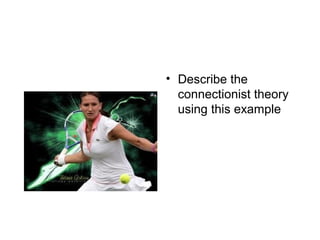
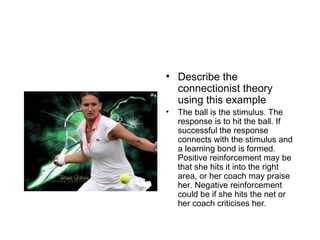
• Describe the
connectionist theory
using this example
• Describe the
connectionist theory
using this example
• The ball is the stimulus. The
response is to hit the ball. If
successful the response
connects with the stimulus and
a learning bond is formed.
Positive reinforcement may be
that she hits it into the right
area, or her coach may praise
her. Negative reinforcement
could be if she hits the net or
her coach criticises her.
Thorndike’s laws
• Thorndike put forward three laws relating to
the application of reinforcement.
• Law of effect. Positive reinforcement is the
most effective way to strengthen the learning
bond
• Law of exercise. The S-R bond is
strengthened by practice.
• Law of readiness. The learner must be
physically and mentally capable of performing
the skill to strengthen the S-R bond
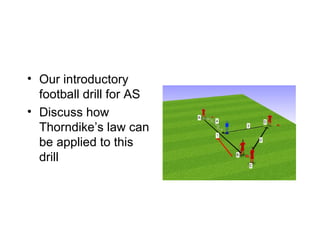
• Our introductory
football drill for AS
• Discuss how
Thorndike’s law can
be applied to this
drill
Operant Conditioning
• This is based on work by Skinner
• This is a connectionist or associationist
theory. The learner forms and
strengthens a S-R bond.
• The teacher will present a stimulus to
the performer that replicates the
relevant sports situation
Operant Conditioning
• Key points to apply to a sports coaching
situation
• Manipulating a situation to bring about the
desired response
• Learning through trial and error
• Reinforcing the response
• Changing the response- behaviour shaping
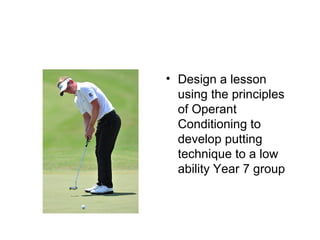
• Design a lesson
using the principles
of Operant
Conditioning to
develop putting
technique to a low
ability Year 7 group
Cognitive Learning Theory
(not to be confused with the cognitive stage of
learning)
• This concerns the individuals thought
process rather than the influence of
stimulus response
• GESTALT means whole patterning,
seeing the skill as a whole
• It is a thinking process
• Learning may be slower to start with
Cognitive Learning Theory
(not to be confused with the cognitive stage of
learning)
• Perception. Interpretation or understanding the
whole task
• Previous experience. Related experiences can
help with a new task
• Current knowledge. The learner needs an insight
as to what is required
• Motivation. The learner needs to want to solve
the problem
• Self-esteem. The learner must have positive self
esteem.
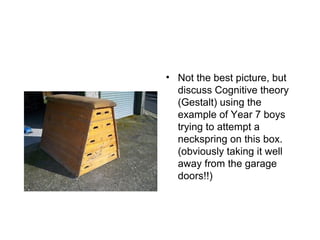
• Not the best picture, but
discuss Cognitive theory
(Gestalt) using the
example of Year 7 boys
trying to attempt a
neckspring on this box.
(obviously taking it well
away from the garage
doors!!)
Bandura. Observational
learning
• We have done this, and this forms part
of this chapter. Remember the four
elements. Attention, Retention, Motor
Reproduction and Motivation.
• Examples were juggling, Beckham’s
free kicks.
Reinforcement
• This is defined as a process that causes a response or
behaviour to reoccur by forming and strengthening the S-R
bond
• Positive. Show of approval eg ‘well done’. A ‘satisfier’-House
point, certificate
• Negative. Show of disapproval. Weakens incorrect learning
bond. Eg pain when you do a bad dive into the pool.
Negative reinforcement is not punishment
• Try and think of examples of punishment or an unpleasant
stimulus (a noxious stimulus)

Learning skills theories

  • 1.
    Theories relating tolearning movement skills
  • 2.
    Connectionist and associationist theories •Depend on linking a stimulus to a response • This S-R bond is stored in the Long Term Memory (LTM) • The connection is strengthened by reinforcement. Positive-verbal praise or tangible reward or Negative
  • 3.
    • Describe the connectionisttheory using this example
  • 4.
    • Describe the connectionisttheory using this example • The ball is the stimulus. The response is to hit the ball. If successful the response connects with the stimulus and a learning bond is formed. Positive reinforcement may be that she hits it into the right area, or her coach may praise her. Negative reinforcement could be if she hits the net or her coach criticises her.
  • 5.
    Thorndike’s laws • Thorndikeput forward three laws relating to the application of reinforcement. • Law of effect. Positive reinforcement is the most effective way to strengthen the learning bond • Law of exercise. The S-R bond is strengthened by practice. • Law of readiness. The learner must be physically and mentally capable of performing the skill to strengthen the S-R bond
  • 6.
    • Our introductory footballdrill for AS • Discuss how Thorndike’s law can be applied to this drill
  • 7.
    Operant Conditioning • Thisis based on work by Skinner • This is a connectionist or associationist theory. The learner forms and strengthens a S-R bond. • The teacher will present a stimulus to the performer that replicates the relevant sports situation
  • 8.
    Operant Conditioning • Keypoints to apply to a sports coaching situation • Manipulating a situation to bring about the desired response • Learning through trial and error • Reinforcing the response • Changing the response- behaviour shaping
  • 9.
    • Design alesson using the principles of Operant Conditioning to develop putting technique to a low ability Year 7 group
  • 10.
    Cognitive Learning Theory (notto be confused with the cognitive stage of learning) • This concerns the individuals thought process rather than the influence of stimulus response • GESTALT means whole patterning, seeing the skill as a whole • It is a thinking process • Learning may be slower to start with
  • 11.
    Cognitive Learning Theory (notto be confused with the cognitive stage of learning) • Perception. Interpretation or understanding the whole task • Previous experience. Related experiences can help with a new task • Current knowledge. The learner needs an insight as to what is required • Motivation. The learner needs to want to solve the problem • Self-esteem. The learner must have positive self esteem.
  • 12.
    • Not thebest picture, but discuss Cognitive theory (Gestalt) using the example of Year 7 boys trying to attempt a neckspring on this box. (obviously taking it well away from the garage doors!!)
  • 13.
    Bandura. Observational learning • Wehave done this, and this forms part of this chapter. Remember the four elements. Attention, Retention, Motor Reproduction and Motivation. • Examples were juggling, Beckham’s free kicks.
  • 14.
    Reinforcement • This isdefined as a process that causes a response or behaviour to reoccur by forming and strengthening the S-R bond • Positive. Show of approval eg ‘well done’. A ‘satisfier’-House point, certificate • Negative. Show of disapproval. Weakens incorrect learning bond. Eg pain when you do a bad dive into the pool. Negative reinforcement is not punishment • Try and think of examples of punishment or an unpleasant stimulus (a noxious stimulus)