AS Level Sport and Physical Education
Reaction / Response Times
01/26/16 .1
Contents
3 - REACTION TIME
MOVEMENT / RESPONSE TIME
4 - REACTION TIME
SIMPLE / CHOICE REACTION TIME / HICK’S
LAW
5 - PSYCHOLOGICAL REFRACTORY PERIOD
6 - FACTORS AFFECTING REACTION TIME
AGE / GENDER / AROUSAL / ANTICIPATION
7 - THE ROLE OF ANTICIPATION
8 - IMPROVING RESPONSE TIMES
CUES / DECISION MAKING / ATTENTIONAL
FOCUS
01/26/16 .2
REACTION TIME
01/26/16 .3
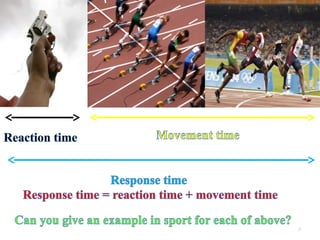
Reaction time is the speed at which we are
able
to process information and make decisions.
Being
able to respond quickly is very important in
many
sports and often determines if we are
successful.
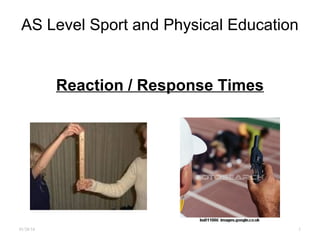
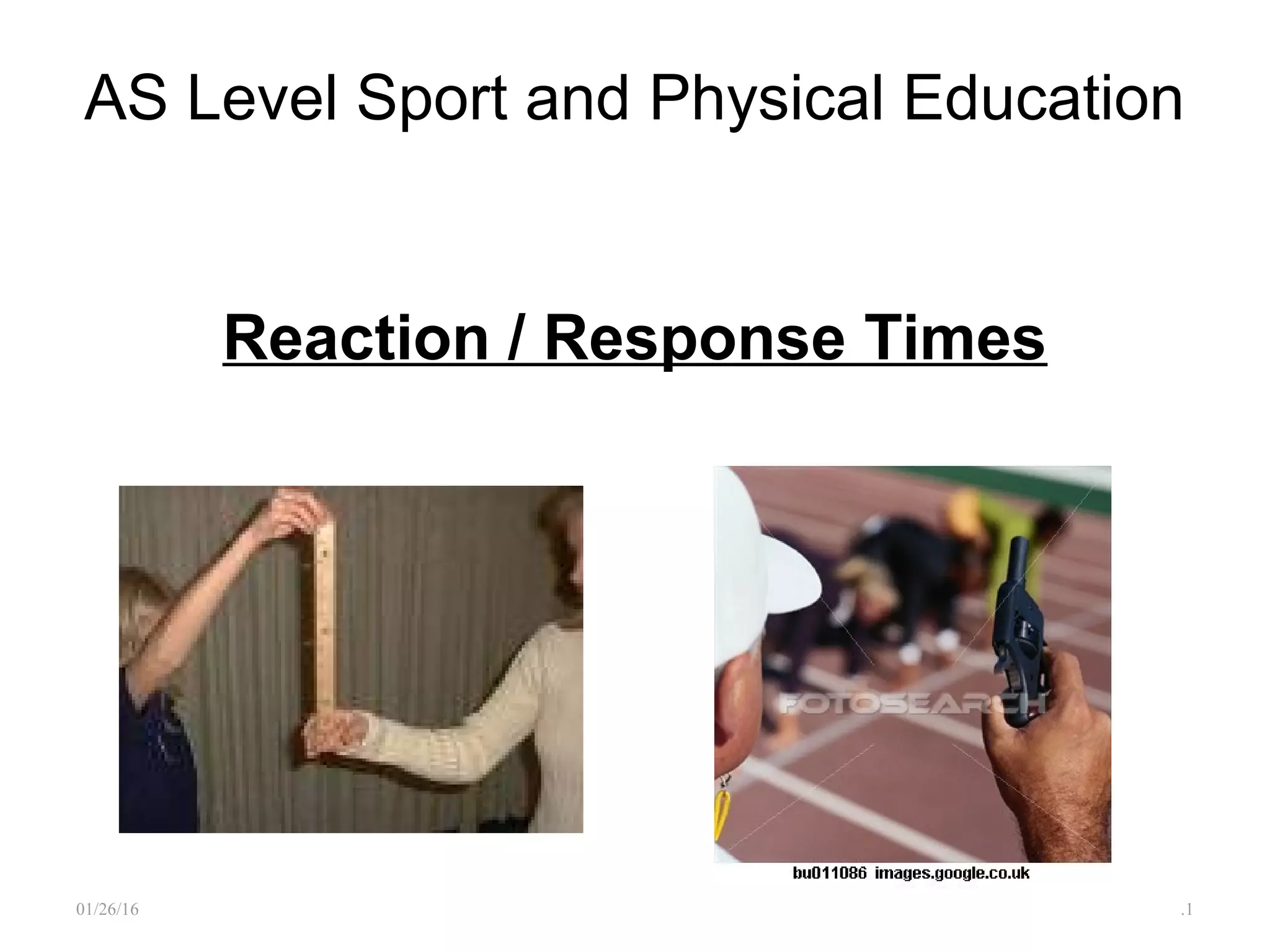
Reaction time is defined as the time between the onset
of
the stimulus and the start of the movement response to
it.
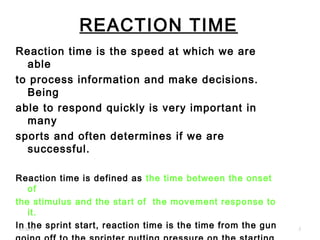
In the sprint start, reaction time is the time from the gun
REACTION TIME
01/26/16 .4
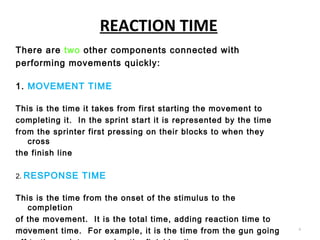
There are two other components connected with
performing movements quickly:
1. MOVEMENT TIME
This is the time it takes from first starting the movement to
completing it. In the sprint start it is represented by the time
from the sprinter first pressing on their blocks to when they
cross
the finish line
2. RESPONSE TIME
This is the time from the onset of the stimulus to the
completion
of the movement. It is the total time, adding reaction time to
movement time. For example, it is the time from the gun going
.5
01/26/16 .6
SIMPLE
REACTION TIME
CHOICE REACTION TIME
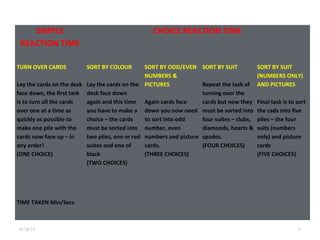
TURN OVER CARDS
Lay the cards on the desk
face down, the first task
is to turn all the cards
over one at a time as
quickly as possible to
make one pile with the
cards now face up – in
any order!
(ONE CHOICE)
SORT BY COLOUR
Lay the cards on the
desk face down
again and this time
you have to make a
choice – the cards
must be sorted into
two piles, one or red
suites and one of
black
(TWO CHOICES)
SORT BY ODD/EVEN
NUMBERS &
PICTURES
Again cards face
down you now need
to sort into odd
number, even
numbers and picture
cards.
(THREE CHOICES)
SORT BY SUIT
Repeat the task of
turning over the
cards but now they
must be sorted into
four suites – clubs,
diamonds, hearts &
spades.
(FOUR CHOICES)
SORT BY SUIT
(NUMBERS ONLY)
AND PICTURES
Final task is to sort
the cads into five
piles – the four
suits (numbers
only) and picture
cards
(FIVE CHOICES)
TIME TAKEN Min/Secs
REACTION TIME
01/26/16 .7
SIMPLE REACTION TIME
• is relevant to a single stimulus and a single possible
response
CHOICE REACTION TIME
• several stimuli are given but only one
must be selected for response
• The more choices a person has, the
more information needs processing, and
the longer it takes to process, a slower
reaction time is recorded!
• this is Hick’s Law - see graph
PSYCHOLOGICAL REFRACTORY
PERIOD
01/26/16 .8
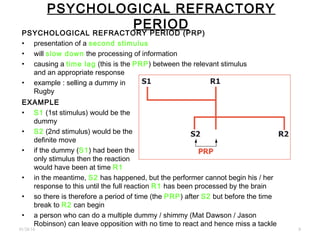
PSYCHOLOGICAL REFRACTORY PERIOD (PRP)
• presentation of a second stimulus
• will slow down the processing of information
• causing a time lag (this is the PRP) between the relevant stimulus
and an appropriate response
• example : selling a dummy in
Rugby
EXAMPLE
• S1 (1st stimulus) would be the
dummy
• S2 (2nd stimulus) would be the
definite move
• if the dummy (S1) had been the
only stimulus then the reaction
would have been at time R1
• in the meantime, S2 has happened, but the performer cannot begin his / her
response to this until the full reaction R1 has been processed by the brain
• so there is therefore a period of time (the PRP) after S2 but before the time
break to R2 can begin
• a person who can do a multiple dummy / shimmy (Mat Dawson / Jason
Robinson) can leave opposition with no time to react and hence miss a tackle
FACTORS WHICH AFFECT REACTION
TIME
There are several factors that affect reaction time:
WHAT ARE THESE?
01/26/16 .9
FACTORS AFFECTING REACTION TIME
01/26/16 .10
FACTORS AFFECTING REACTION TIME
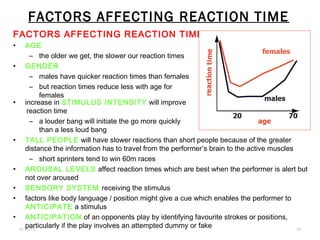
• AGE
– the older we get, the slower our reaction times
• GENDER
– males have quicker reaction times than females
– but reaction times reduce less with age for
females
• increase in STIMULUS INTENSITY will improve
reaction time
– a louder bang will initiate the go more quickly
than a less loud bang
• TALL PEOPLE will have slower reactions than short people because of the greater
distance the information has to travel from the performer’s brain to the active muscles
– short sprinters tend to win 60m races
• AROUSAL LEVELS affect reaction times which are best when the performer is alert but
not over aroused
• SENSORY SYSTEM receiving the stimulus
• factors like body language / position might give a cue which enables the performer to
ANTICIPATE a stimulus
• ANTICIPATION of an opponents play by identifying favourite strokes or positions,
particularly if the play involves an attempted dummy or fake
REACTION TIME
01/26/16 .11
How can we improve response/reaction time
Discuss with the person next to you methods of
how a coach could improve reaction time?
PRACTICE – The more often a stimulus is responded to the shorter the
reaction time becomes, if enough practice is done the response
becomes automatic
MENTAL REHEARSAL – Going over responses in your mind
CONCENTRATION – Ignoring irrelevant signals
EXPERIENCE – awareness of regular activity
ANTICIPATION – initiating movement (close to experience)
.12
THE ROLE OF ANTICIPATION
01/26/16 .13
ANTICIPATION
• the ability to predict future events from early signals or past events
• reaction time can be speeded up if the performer learns to anticipate certain
actions, good performers start running motor programmes before the
stimulus is fully recognised they anticipate the strength, speed and
direction of a stimulus. This would enable a performer to partially eliminate the
PRP (psychological refractory period)
however, opponents will also be trying to anticipate
• Opponents reaction times can be increased by increasing the number of
choices of stimulus they have increasing the number of fakes or dummies
(Dawson / Robinson)

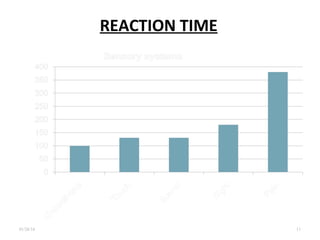
Reaction time

  • 1.
    AS Level Sportand Physical Education Reaction / Response Times 01/26/16 .1
  • 2.
    Contents 3 - REACTIONTIME MOVEMENT / RESPONSE TIME 4 - REACTION TIME SIMPLE / CHOICE REACTION TIME / HICK’S LAW 5 - PSYCHOLOGICAL REFRACTORY PERIOD 6 - FACTORS AFFECTING REACTION TIME AGE / GENDER / AROUSAL / ANTICIPATION 7 - THE ROLE OF ANTICIPATION 8 - IMPROVING RESPONSE TIMES CUES / DECISION MAKING / ATTENTIONAL FOCUS 01/26/16 .2
  • 3.
    REACTION TIME 01/26/16 .3 Reactiontime is the speed at which we are able to process information and make decisions. Being able to respond quickly is very important in many sports and often determines if we are successful. Reaction time is defined as the time between the onset of the stimulus and the start of the movement response to it. In the sprint start, reaction time is the time from the gun
  • 4.
    REACTION TIME 01/26/16 .4 Thereare two other components connected with performing movements quickly: 1. MOVEMENT TIME This is the time it takes from first starting the movement to completing it. In the sprint start it is represented by the time from the sprinter first pressing on their blocks to when they cross the finish line 2. RESPONSE TIME This is the time from the onset of the stimulus to the completion of the movement. It is the total time, adding reaction time to movement time. For example, it is the time from the gun going
  • 5.
  • 6.
    01/26/16 .6 SIMPLE REACTION TIME CHOICEREACTION TIME TURN OVER CARDS Lay the cards on the desk face down, the first task is to turn all the cards over one at a time as quickly as possible to make one pile with the cards now face up – in any order! (ONE CHOICE) SORT BY COLOUR Lay the cards on the desk face down again and this time you have to make a choice – the cards must be sorted into two piles, one or red suites and one of black (TWO CHOICES) SORT BY ODD/EVEN NUMBERS & PICTURES Again cards face down you now need to sort into odd number, even numbers and picture cards. (THREE CHOICES) SORT BY SUIT Repeat the task of turning over the cards but now they must be sorted into four suites – clubs, diamonds, hearts & spades. (FOUR CHOICES) SORT BY SUIT (NUMBERS ONLY) AND PICTURES Final task is to sort the cads into five piles – the four suits (numbers only) and picture cards (FIVE CHOICES) TIME TAKEN Min/Secs
  • 7.
    REACTION TIME 01/26/16 .7 SIMPLEREACTION TIME • is relevant to a single stimulus and a single possible response CHOICE REACTION TIME • several stimuli are given but only one must be selected for response • The more choices a person has, the more information needs processing, and the longer it takes to process, a slower reaction time is recorded! • this is Hick’s Law - see graph
  • 8.
    PSYCHOLOGICAL REFRACTORY PERIOD 01/26/16 .8 PSYCHOLOGICALREFRACTORY PERIOD (PRP) • presentation of a second stimulus • will slow down the processing of information • causing a time lag (this is the PRP) between the relevant stimulus and an appropriate response • example : selling a dummy in Rugby EXAMPLE • S1 (1st stimulus) would be the dummy • S2 (2nd stimulus) would be the definite move • if the dummy (S1) had been the only stimulus then the reaction would have been at time R1 • in the meantime, S2 has happened, but the performer cannot begin his / her response to this until the full reaction R1 has been processed by the brain • so there is therefore a period of time (the PRP) after S2 but before the time break to R2 can begin • a person who can do a multiple dummy / shimmy (Mat Dawson / Jason Robinson) can leave opposition with no time to react and hence miss a tackle
  • 9.
    FACTORS WHICH AFFECTREACTION TIME There are several factors that affect reaction time: WHAT ARE THESE? 01/26/16 .9
  • 10.
    FACTORS AFFECTING REACTIONTIME 01/26/16 .10 FACTORS AFFECTING REACTION TIME • AGE – the older we get, the slower our reaction times • GENDER – males have quicker reaction times than females – but reaction times reduce less with age for females • increase in STIMULUS INTENSITY will improve reaction time – a louder bang will initiate the go more quickly than a less loud bang • TALL PEOPLE will have slower reactions than short people because of the greater distance the information has to travel from the performer’s brain to the active muscles – short sprinters tend to win 60m races • AROUSAL LEVELS affect reaction times which are best when the performer is alert but not over aroused • SENSORY SYSTEM receiving the stimulus • factors like body language / position might give a cue which enables the performer to ANTICIPATE a stimulus • ANTICIPATION of an opponents play by identifying favourite strokes or positions, particularly if the play involves an attempted dummy or fake
  • 11.
  • 12.
    How can weimprove response/reaction time Discuss with the person next to you methods of how a coach could improve reaction time? PRACTICE – The more often a stimulus is responded to the shorter the reaction time becomes, if enough practice is done the response becomes automatic MENTAL REHEARSAL – Going over responses in your mind CONCENTRATION – Ignoring irrelevant signals EXPERIENCE – awareness of regular activity ANTICIPATION – initiating movement (close to experience) .12
  • 13.
    THE ROLE OFANTICIPATION 01/26/16 .13 ANTICIPATION • the ability to predict future events from early signals or past events • reaction time can be speeded up if the performer learns to anticipate certain actions, good performers start running motor programmes before the stimulus is fully recognised they anticipate the strength, speed and direction of a stimulus. This would enable a performer to partially eliminate the PRP (psychological refractory period) however, opponents will also be trying to anticipate • Opponents reaction times can be increased by increasing the number of choices of stimulus they have increasing the number of fakes or dummies (Dawson / Robinson)