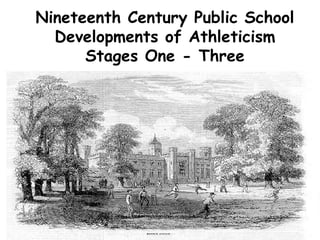
Nineteenth Century Public School
Developments of Athleticism
Stages One - Three
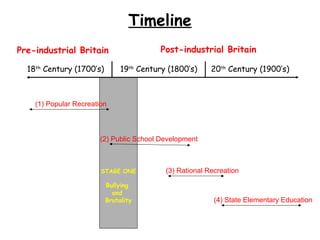
STAGE ONE
Bullying
and
Brutality
18th
Century (1700’s) 19th
Century (1800’s) 20th
Century (1900’s)
Pre-industrial Britain Post-industrial Britain
(1) Popular Recreation
(2) Public School Development
(3) Rational Recreation
(4) State Elementary Education
Timeline
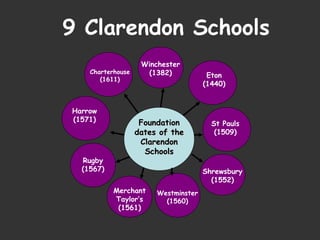
FoundationFoundation
dates of thedates of the
ClarendonClarendon
SchoolsSchools
Charterhouse
(1611)
Eton
(1440)
Merchant
Taylor’s
(1561)
Westminster
(1560)
Winchester
(1382)
Harrow
(1571)
St Pauls
(1509)
Rugby
(1567) Shrewsbury
(1552)
9 Clarendon Schools
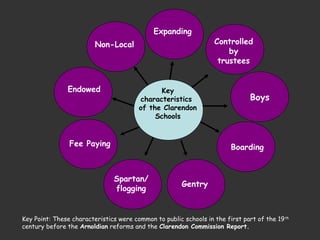
Key Point: These characteristics were common to public schools in the first part of the 19th
century before the Arnoldian reforms and the Clarendon Commission Report.
Key
characteristics
of the Clarendon
Schools
Non-Local Controlled
by
trustees
Spartan/
flogging
Gentry
Expanding
Endowed
BoardingFee Paying
Boys
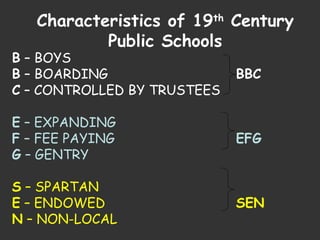
Characteristics of 19th
Century
Public Schools
B – BOYS
B – BOARDING BBC
C – CONTROLLED BY TRUSTEES
E – EXPANDING
F – FEE PAYING EFG
G – GENTRY
S – SPARTAN
E – ENDOWED SEN
N – NON-LOCAL
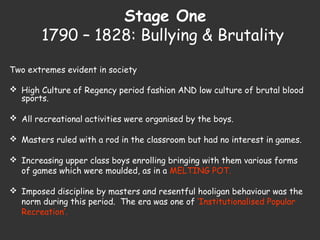
Stage One
1790 – 1828: Bullying & Brutality
Two extremes evident in society
 High Culture of Regency period fashion AND low culture of brutal blood
sports.
 All recreational activities were organised by the boys.
 Masters ruled with a rod in the classroom but had no interest in games.
 Increasing upper class boys enrolling bringing with them various forms
of games which were moulded, as in a MELTING POT.
 Imposed discipline by masters and resentful hooligan behaviour was the
norm during this period. The era was one of ‘Institutionalised Popular
Recreation’.
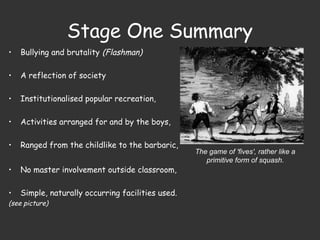
Stage One Summary
• Bullying and brutality (Flashman)
• A reflection of society
• Institutionalised popular recreation,
• Activities arranged for and by the boys,
• Ranged from the childlike to the barbaric,
• No master involvement outside classroom,
• Simple, naturally occurring facilities used.
(see picture)
The game of 'fives', rather like a
primitive form of squash.
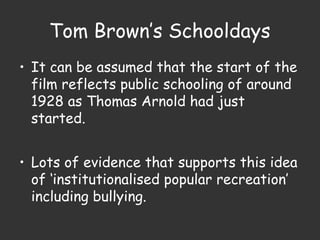
Tom Brown’s Schooldays
• It can be assumed that the start of the
film reflects public schooling of around
1928 as Thomas Arnold had just
started.
• Lots of evidence that supports this idea
of ‘institutionalised popular recreation’
including bullying.
Codified by the beginning of the 19th
century and being non violent
in nature made cricket more suitable as a gentry recreation.
Stage Two: 1828 – 1842
Dr Thomas Arnold & Social Control
• Time of GREAT change.
• Dr Thomas Arnold and other liberal headmasters
wanted to reform public schools.
• Wanted to produce Christian Gentlemen and to
preach good moral behaviour. Playing sport for the
good of God.
• Muscular Christianity – The combination of
godliness and manliness: The belief in having a
strong and fit body to match a robust and healthy
soul.
Dr Thomas Arnold
• Influential reforms.
• Arnold used games as a way of establishing social
control.
• More trusting relationship with the sixth form
raising their powers of discipline.
• Masters took on roles as mentors and guide rather
than judge and executioner.
• Games kept the boys out of trouble in the day and
sent them to bed exhausted.
Stage Two Summary
• Time of reform and social change
• Initiated by Dr Thomas Arnold and other liberal
headmasters
• A reflection of societal change
• The growth of the house system
• Regular play on an inter house basis
(Games within schools not between schools)
• Technical developments (increased organisation,
Stage Three: 1842-1912
Athleticism – The ‘Cult’
• Athleticism – Combination of moral integrity and physical effort
OR playing hard but with sportsmanship.
Symbols of athleticism in the that late 19th century English
public schools included:
• 'mellowed buildings' that were more aesthetically welcoming than
previous 'harsh' school buildings,
• Magnificent fields to play games on,
• The wearing of caps,
• The awarding of colours to worthy recipients,
Rules were readily adhered to, with fair play and sportsmanship
of key importance in developing 'rounded' gentlemen.
• Links to Muscular Christianity were developed - Win gracefully or
lose with honour and bravery.
Roles of team
games in
preparing public
schoolboys for
leadership
Teamwork/loyalty
to a team
Captains in sport
then captain in
industry
Making decisions
Leading by example
Organisational
experience through
committees
Testing/developing
temperament
Testing/developing
courage/bravery
Roles of team
games in
preparing public
schoolboys for
leadership
Roles of team
games in
preparing public
schoolboys for
leadership
Teamwork/loyalty
to a team
Captains in sport
then captain in
industry
Making decisions
Leading by example
Organisational
experience through
committees
Testing/developing
temperament
Testing/developing
courage/bravery
Roles of team
games in
preparing public
schoolboys for
leadership
Team games in
public schools
Team sports in particular were believed to reflect athleticism, since they required
participants
to show a range of physical qualities, such as endeavour (playing hard),
effort and striving to do one's best, as part of a collective effort.
A
T
H
L
E
T
I
C
I
S
M
ll-round, mind and body
emperament
ealth
eadership
ndeavour
eamwork
ntegrity
ohesion/competition
nstrument of education
portsmanship
uscular christianity
Athleticism combined
physical endeavour with
moral integrity
In the space of 60 years
what had once been an
embarrassment to
headmasters became their
pride – GAMES &
ATHLETIC PURSUITS!
Stage One vs Stage Three
Discuss the differences between the two era’s
highlighting key differences?
Stage One Stage Three
Institutionalised popular
recreation
Athleticism reached cult
proportions
No master involvement Increased master involvement
Riotous behaviour Christian gentlemen
Organised by and for the boys. Structured inter house/inter
school competitions.
Bullying and brutality Moral integrity and
sportsmanship

Stages

  • 1.
    Nineteenth Century PublicSchool Developments of Athleticism Stages One - Three
  • 2.
    STAGE ONE Bullying and Brutality 18th Century (1700’s)19th Century (1800’s) 20th Century (1900’s) Pre-industrial Britain Post-industrial Britain (1) Popular Recreation (2) Public School Development (3) Rational Recreation (4) State Elementary Education Timeline
  • 3.
    FoundationFoundation dates of thedatesof the ClarendonClarendon SchoolsSchools Charterhouse (1611) Eton (1440) Merchant Taylor’s (1561) Westminster (1560) Winchester (1382) Harrow (1571) St Pauls (1509) Rugby (1567) Shrewsbury (1552) 9 Clarendon Schools
  • 4.
    Key Point: Thesecharacteristics were common to public schools in the first part of the 19th century before the Arnoldian reforms and the Clarendon Commission Report. Key characteristics of the Clarendon Schools Non-Local Controlled by trustees Spartan/ flogging Gentry Expanding Endowed BoardingFee Paying Boys
  • 5.
    Characteristics of 19th Century PublicSchools B – BOYS B – BOARDING BBC C – CONTROLLED BY TRUSTEES E – EXPANDING F – FEE PAYING EFG G – GENTRY S – SPARTAN E – ENDOWED SEN N – NON-LOCAL
  • 6.
    Stage One 1790 –1828: Bullying & Brutality Two extremes evident in society  High Culture of Regency period fashion AND low culture of brutal blood sports.  All recreational activities were organised by the boys.  Masters ruled with a rod in the classroom but had no interest in games.  Increasing upper class boys enrolling bringing with them various forms of games which were moulded, as in a MELTING POT.  Imposed discipline by masters and resentful hooligan behaviour was the norm during this period. The era was one of ‘Institutionalised Popular Recreation’.
  • 7.
    Stage One Summary •Bullying and brutality (Flashman) • A reflection of society • Institutionalised popular recreation, • Activities arranged for and by the boys, • Ranged from the childlike to the barbaric, • No master involvement outside classroom, • Simple, naturally occurring facilities used. (see picture) The game of 'fives', rather like a primitive form of squash.
  • 8.
    Tom Brown’s Schooldays •It can be assumed that the start of the film reflects public schooling of around 1928 as Thomas Arnold had just started. • Lots of evidence that supports this idea of ‘institutionalised popular recreation’ including bullying.
  • 9.
    Codified by thebeginning of the 19th century and being non violent in nature made cricket more suitable as a gentry recreation.
  • 10.
    Stage Two: 1828– 1842 Dr Thomas Arnold & Social Control • Time of GREAT change. • Dr Thomas Arnold and other liberal headmasters wanted to reform public schools. • Wanted to produce Christian Gentlemen and to preach good moral behaviour. Playing sport for the good of God. • Muscular Christianity – The combination of godliness and manliness: The belief in having a strong and fit body to match a robust and healthy soul.
  • 11.
    Dr Thomas Arnold •Influential reforms. • Arnold used games as a way of establishing social control. • More trusting relationship with the sixth form raising their powers of discipline. • Masters took on roles as mentors and guide rather than judge and executioner. • Games kept the boys out of trouble in the day and sent them to bed exhausted.
  • 12.
    Stage Two Summary •Time of reform and social change • Initiated by Dr Thomas Arnold and other liberal headmasters • A reflection of societal change • The growth of the house system • Regular play on an inter house basis (Games within schools not between schools) • Technical developments (increased organisation,
  • 13.
    Stage Three: 1842-1912 Athleticism– The ‘Cult’ • Athleticism – Combination of moral integrity and physical effort OR playing hard but with sportsmanship. Symbols of athleticism in the that late 19th century English public schools included: • 'mellowed buildings' that were more aesthetically welcoming than previous 'harsh' school buildings, • Magnificent fields to play games on, • The wearing of caps, • The awarding of colours to worthy recipients, Rules were readily adhered to, with fair play and sportsmanship of key importance in developing 'rounded' gentlemen. • Links to Muscular Christianity were developed - Win gracefully or lose with honour and bravery.
  • 14.
    Roles of team gamesin preparing public schoolboys for leadership Teamwork/loyalty to a team Captains in sport then captain in industry Making decisions Leading by example Organisational experience through committees Testing/developing temperament Testing/developing courage/bravery Roles of team games in preparing public schoolboys for leadership Roles of team games in preparing public schoolboys for leadership Teamwork/loyalty to a team Captains in sport then captain in industry Making decisions Leading by example Organisational experience through committees Testing/developing temperament Testing/developing courage/bravery Roles of team games in preparing public schoolboys for leadership Team games in public schools Team sports in particular were believed to reflect athleticism, since they required participants to show a range of physical qualities, such as endeavour (playing hard), effort and striving to do one's best, as part of a collective effort.
  • 15.
    A T H L E T I C I S M ll-round, mind andbody emperament ealth eadership ndeavour eamwork ntegrity ohesion/competition nstrument of education portsmanship uscular christianity Athleticism combined physical endeavour with moral integrity In the space of 60 years what had once been an embarrassment to headmasters became their pride – GAMES & ATHLETIC PURSUITS!
  • 16.
    Stage One vsStage Three Discuss the differences between the two era’s highlighting key differences? Stage One Stage Three Institutionalised popular recreation Athleticism reached cult proportions No master involvement Increased master involvement Riotous behaviour Christian gentlemen Organised by and for the boys. Structured inter house/inter school competitions. Bullying and brutality Moral integrity and sportsmanship