Multidimensional ScalingAdvance StatisticsCPS510DDr.  Carlo MagnoCounseling and Educational Psychology DepartmentDe La Salle University-Manila
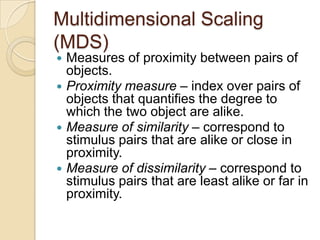
Multidimensional Scaling (MDS)Measures of proximity between pairs of objects.
Proximity measure – index over pairs of objects that quantifies the degree to which the two object are alike.
Measure of similarity – correspond to stimulus pairs that are alike or close in proximity.
Measure of dissimilarity – correspond to stimulus pairs that are least alike or far in proximity.MDSUse:
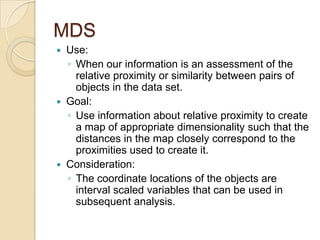
When our information is an assessment of the relative proximity or similarity between pairs of objects in the data set.
Goal:
Use information about relative proximity to create a map of appropriate dimensionality such that the distances in the map closely correspond to the proximities used to create it.
Consideration:
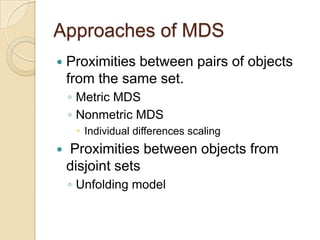
The coordinate locations of the objects are interval scaled variables that can be used in subsequent analysis.Approaches of MDSProximities between pairs of objects from the same set.Metric MDSNonmetric MDSIndividual differences scaling Proximities between objects from disjoint setsUnfolding model
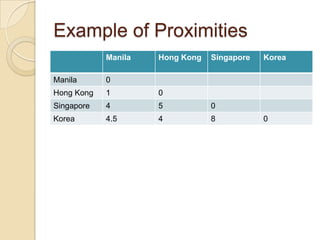
Metric MDSProximity between pairs of objects reflect the actual physical distances.Judgment of the respondents’ proximity using well calibrated instruments.Level of measurement: ratioEx.  Actual distances of one city to another.
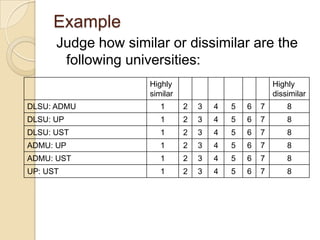
Example of Proximities
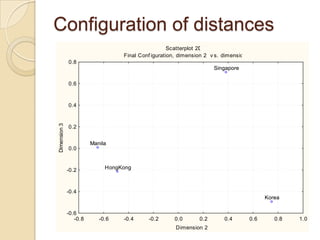
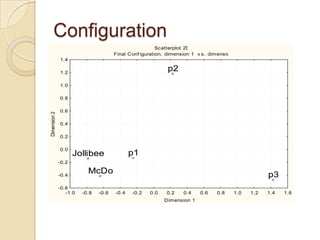
Configuration of distances
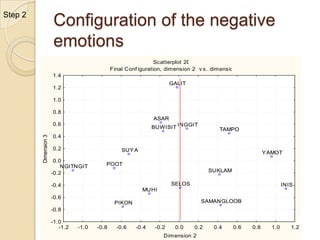
Nonmetric MDSPerceived similarity of different stimuli judged on a scale that is assumed ordinal in nature.Level of measurement: interval, ratioSteps:1.  Choose the number of dimensions2.  Plot the configurations3.  Calculate the distances4.  Achieve monotonic correspondence between actual distance and dissimilarities.5.  Reduce stress
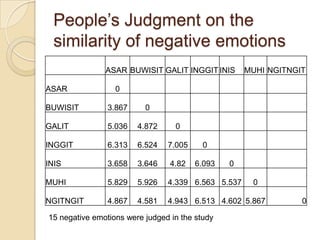
People’s Judgment on the similarity of negative emotions15 negative emotions were judged in the study
Configuration of the negative emotionsStep 2
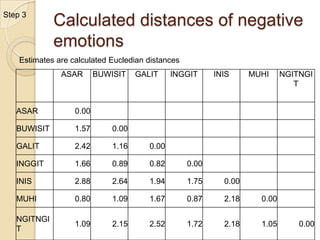
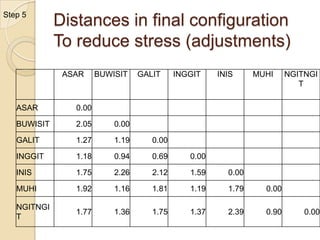
Calculated distances of negative emotionsStep 3Estimates are calculated Eucledian distances
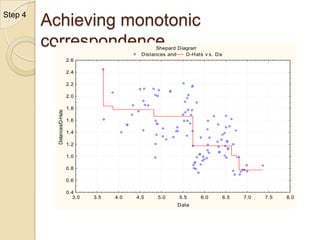
Step 4Achieving monotonic correspondence
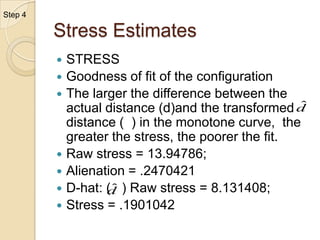
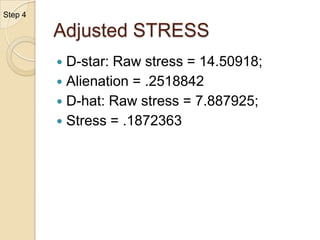
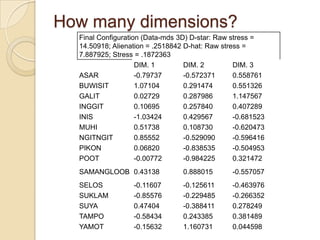
Stress EstimatesSTRESS
Goodness of fit of the configuration
The larger the difference between the actual distance (d)and the transformed distance (  ) in the monotone curve,  the greater the stress, the poorer the fit.
Raw stress = 13.94786;
Alienation = .2470421
D-hat: (   ) Raw stress = 8.131408;
Stress = .1901042Step 4

Multidimensional scaling1