Multidimensional Scaling and 
Conjoint Analysis 
By: Omer Maroof 
MBA: 3rd Sem……. 
Enroll: 110130 
1
Multidimensional Scaling 
Used to: 
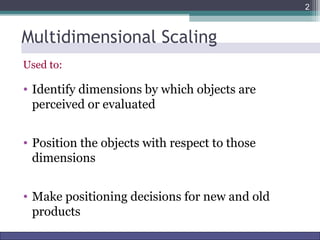
• Identify dimensions by which objects are 
perceived or evaluated 
• Position the objects with respect to those 
dimensions 
• Make positioning decisions for new and old 
products 
2 
Marketing Research http://www.drvkumar.com/mr10/ 10th Edition
3 
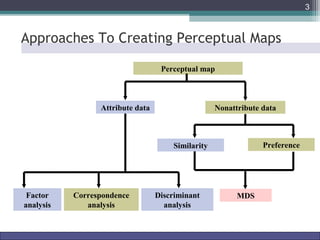
Approaches To Creating Perceptual Maps 
Perceptual map 
Attribute data Nonattribute data 
Similarity Preference 
Correspondence 
analysis 
Discriminant MDS 
analysis 
Factor 
analysis 
Marketing Research http://www.drvkumar.com/mr10/ 10th Edition
Attribute Based Approaches 
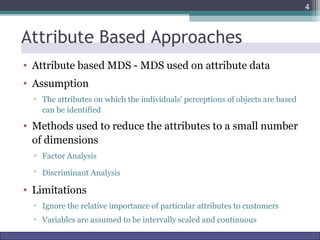
• Attribute based MDS - MDS used on attribute data 
• Assumption 
▫ The attributes on which the individuals' perceptions of objects are based 
can be identified 
• Methods used to reduce the attributes to a small number 
of dimensions 
▫ Factor Analysis 
▫ Discriminant Analysis 
• Limitations 
▫ Ignore the relative importance of particular attributes to customers 
▫ Variables are assumed to be intervally scaled and continuous 
4 
Marketing Research http://www.drvkumar.com/mr10/ 10th Edition
Comparison of Factor and 
Discriminant Analysis 
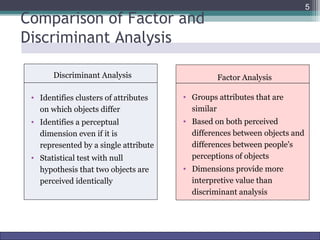
Discriminant Analysis Factor Analysis 
• Identifies clusters of attributes 
on which objects differ 
• Identifies a perceptual 
dimension even if it is 
represented by a single attribute 
• Statistical test with null 
hypothesis that two objects are 
perceived identically 
• Groups attributes that are 
similar 
• Based on both perceived 
differences between objects and 
differences between people's 
perceptions of objects 
• Dimensions provide more 
interpretive value than 
discriminant analysis 
5 
Marketing Research http://www.drvkumar.com/mr10/ 10th Edition
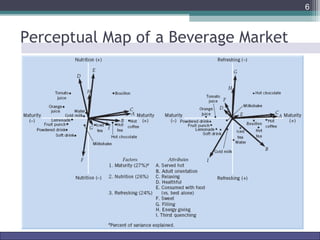
Perceptual Map of a Beverage Market 
6 
Marketing Research http://www.drvkumar.com/mr10/ 10th Edition
7 
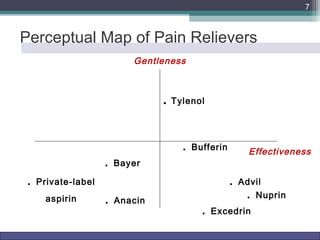
Perceptual Map of Pain Relievers 
Gentleness 
. Tylenol 
. Bufferin Effectiveness 
. Advil 
. Nuprin 
. Excedrin 
. Private-label 
aspirin 
. Bayer 
. Anacin 
Marketing Research http://www.drvkumar.com/mr10/ 10th Edition
Basic Concepts of Multidimensional Scaling (MDS) 
• MDS uses proximities (value which denotes how similar or how different two 
objects are perceived to be) among different objects as input 
• Proximities data is used to produce a geometric configuration of points 
(objects) in a two-dimensional space as output 
• The fit between the derived distances and the two proximities in each 
dimension is evaluated through a measure called stress 
• The appropriate number of dimensions required to locate objects can be 
obtained by plotting stress values against the number of dimensions 
8 
Marketing Research http://www.drvkumar.com/mr10/ 10th Edition
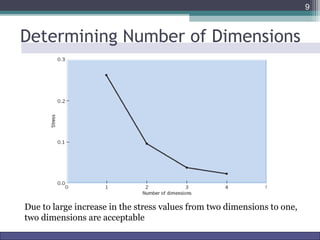
Determining Number of Dimensions 
9 
Due to large increase in the stress values from two dimensions to one, 
two dimensions are acceptable 
Marketing Research http://www.drvkumar.com/mr10/ 10th Edition
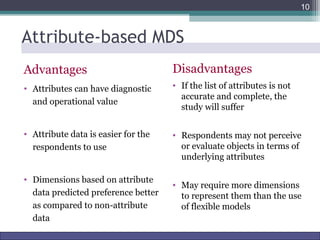
Attribute-based MDS 
Advantages 
• Attributes can have diagnostic 
and operational value 
• Attribute data is easier for the 
respondents to use 
• Dimensions based on attribute 
data predicted preference better 
as compared to non-attribute 
data 
10 
Disadvantages 
• If the list of attributes is not 
accurate and complete, the 
study will suffer 
• Respondents may not perceive 
or evaluate objects in terms of 
underlying attributes 
• May require more dimensions 
to represent them than the use 
of flexible models 
Marketing Research http://www.drvkumar.com/mr10/ 10th Edition
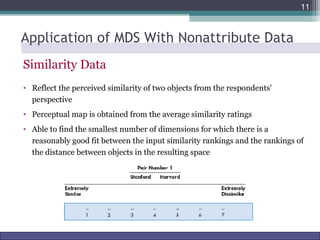
Application of MDS With Nonattribute Data 
Similarity Data 
11 
• Reflect the perceived similarity of two objects from the respondents' 
perspective 
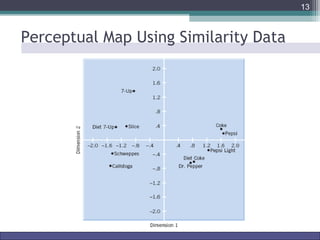
• Perceptual map is obtained from the average similarity ratings 
• Able to find the smallest number of dimensions for which there is a 
reasonably good fit between the input similarity rankings and the rankings of 
the distance between objects in the resulting space 
Marketing Research http://www.drvkumar.com/mr10/ 10th Edition
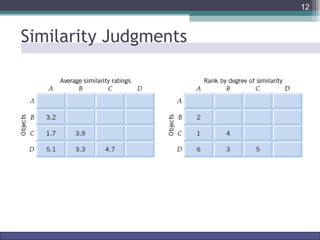
Similarity Judgments 
12 
Marketing Research http://www.drvkumar.com/mr10/ 10th Edition
Perceptual Map Using Similarity Data 
13 
Marketing Research http://www.drvkumar.com/mr10/ 10th Edition
14 
Application of MDS With Nonattribute Data (Contd.) 
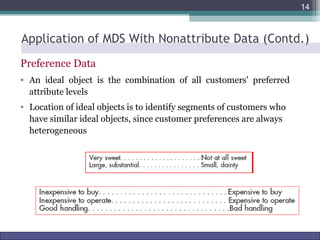
Preference Data 
• An ideal object is the combination of all customers' preferred 
attribute levels 
• Location of ideal objects is to identify segments of customers who 
have similar ideal objects, since customer preferences are always 
heterogeneous 
Marketing Research http://www.drvkumar.com/mr10/ 10th Edition
Issues in MDS 
• Perceptual mapping has not been shown to be reliable 
across different methods 
15 
• The effect of market events on perceptual maps cannot be 
ascertained 
• The interpretation of dimensions is difficult 
• When more than two or three dimensions are needed, 
usefulness is reduced 
Marketing Research http://www.drvkumar.com/mr10/ 10th Edition
Conjoint Analysis 
• Technique that allows a subset of the possible combinations of 
product features to be used to determine the relative importance of 
each feature in the purchase decision 
• Used to determine the relative importance of various attributes to 
respondents, based on their making trade-off judgments 
• Uses: 
▫ To select features on a new product/service 
▫ Predict sales 
▫ Understand relationships 
16 
Marketing Research http://www.drvkumar.com/mr10/ 10th Edition
Inputs in Conjoint Analysis 
• The dependent variable is the preference judgment that a 
respondent makes about a new concept 
• The independent variables are the attribute levels that 
need to be specified 
17 
• Respondents make judgments about the concept either by 
considering 
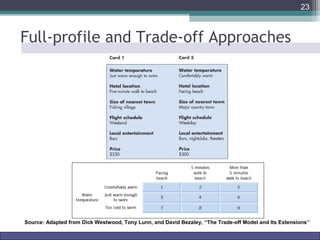
▫ Two attributes at a time - Trade-off approach 
▫ Full profile of attributes - Full profile approach 
Marketing Research http://www.drvkumar.com/mr10/ 10th Edition
Outputs in Conjoint Analysis 
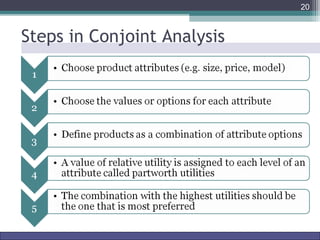
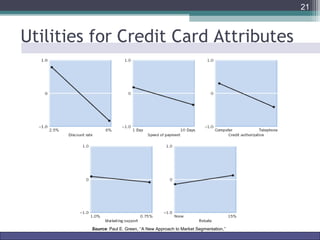
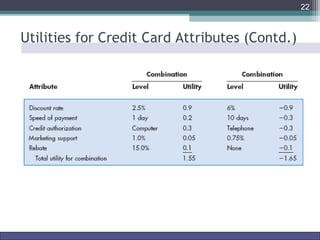
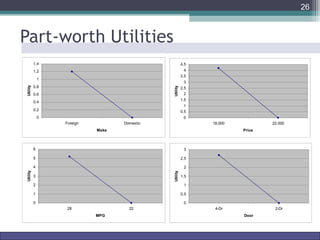
• A value of relative utility is assigned to each level of an 
attribute called partworth utilities 
• The combination with the highest utilities should be the 
one that is most preferred 
• The combination with the lowest total utility is the least 
preferred 
18 
Marketing Research http://www.drvkumar.com/mr10/ 10th Edition
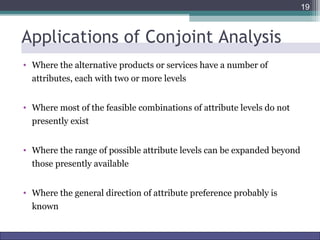
Applications of Conjoint Analysis 
• Where the alternative products or services have a number of 
attributes, each with two or more levels 
• Where most of the feasible combinations of attribute levels do not 
presently exist 
• Where the range of possible attribute levels can be expanded beyond 
those presently available 
• Where the general direction of attribute preference probably is 
known 
19 
Marketing Research http://www.drvkumar.com/mr10/ 10th Edition
Steps in Conjoint Analysis 
20 
Marketing Research http://www.drvkumar.com/mr10/ 10th Edition
Utilities for Credit Card Attributes 
21 
Source: Paul E. Green, ‘‘A New Approach to Market Segmentation,’’ 
Marketing Research http://www.drvkumar.com/mr10/ 10th Edition
Utilities for Credit Card Attributes (Contd.) 
22 
Marketing Research http://www.drvkumar.com/mr10/ 10th Edition
Full-profile and Trade-off Approaches 
23 
Source: Adapted from Dick Westwood, Tony Lunn, and David Bezaley, ‘‘The Trade-off Model and Its Extensions’’ 
Marketing Research http://www.drvkumar.com/mr10/ 10th Edition
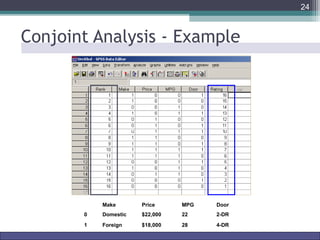
Conjoint Analysis - Example 
Make Price MPG Door 
0 Domestic $22,000 22 2-DR 
1 Foreign $18,000 28 4-DR 
24 
24 
Marketing Research http://www.drvkumar.com/mr10/ 10th Edition
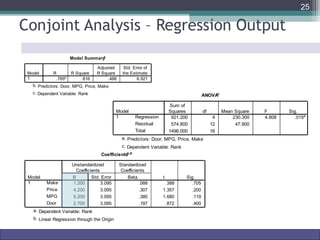
Conjoint Analysis – Regression Output 
25 
Model Summaryc 
R R Square 
Adjusted 
R Square 
Std. Error of 
the Estimate 
.785b .616 .488 6.921 
Model 
1 
b. Predictors: Door, MPG, Price, Make 
c. Dependent Variable: Rank 
Model 
1 
a. Predictors: Door, MPG, Price, Make 
c. Dependent Variable: Rank 
Coefficientsa,b 
Unstandardized 
Coefficients 
B Std. Error 
Regression 
Residual 
Total 
Standardized 
Coefficients 
Beta 
Sum of 
Squares df Mean Square F Sig. 
921.200 4 230.300 4.808 .015a 
574.800 12 47.900 
1496.000 16 
t Sig. 
1.200 3.095 .088 .388 .705 
4.200 3.095 .307 1.357 .200 
5.200 3.095 .380 1.680 .119 
2.700 3.095 .197 .872 .400 
Make 
Price 
MPG 
Door 
Model 
1 
a. Dependent Variable: Rank 
b. Linear Regression through the Origin 
ANOVAc 
Marketing Research http://www.drvkumar.com/mr10/ 10th Edition
Part-worth Utilities 
1.4 
1.2 
1 
0.8 
0.6 
0.4 
0.2 
0 
Foreign Domestic 
Make 
Utility 
4.5 
4 
3.5 
3 
2.5 
2 
1.5 
1 
0.5 
0 
18,000 22,000 
Price 
Utility 
6 
5 
4 
3 
2 
1 
0 
28 22 
MPG 
Utility 
3 
2.5 
2 
1.5 
1 
0.5 
0 
4-Dr 2-Dr 
Door 
Utility 
26 
26 
Marketing Research http://www.drvkumar.com/mr10/ 10th Edition
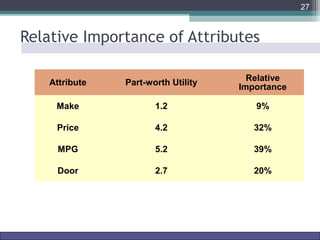
Relative Importance of Attributes 
Attribute Part-worth Utility Relative 
Importance 
Make 1.2 9% 
Price 4.2 32% 
MPG 5.2 39% 
Door 2.7 20% 
27 
27 
Marketing Research http://www.drvkumar.com/mr10/ 10th Edition
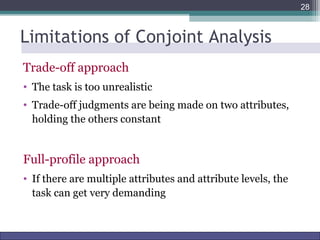
Limitations of Conjoint Analysis 
Trade-off approach 
• The task is too unrealistic 
• Trade-off judgments are being made on two attributes, 
holding the others constant 
Full-profile approach 
• If there are multiple attributes and attribute levels, the 
task can get very demanding 
28 
Marketing Research http://www.drvkumar.com/mr10/ 10th Edition

Multidimensional scaling & Conjoint Analysis

  • 1.
    Multidimensional Scaling and Conjoint Analysis By: Omer Maroof MBA: 3rd Sem……. Enroll: 110130 1
  • 2.
    Multidimensional Scaling Usedto: • Identify dimensions by which objects are perceived or evaluated • Position the objects with respect to those dimensions • Make positioning decisions for new and old products 2 Marketing Research http://www.drvkumar.com/mr10/ 10th Edition
  • 3.
    3 Approaches ToCreating Perceptual Maps Perceptual map Attribute data Nonattribute data Similarity Preference Correspondence analysis Discriminant MDS analysis Factor analysis Marketing Research http://www.drvkumar.com/mr10/ 10th Edition
  • 4.
    Attribute Based Approaches • Attribute based MDS - MDS used on attribute data • Assumption ▫ The attributes on which the individuals' perceptions of objects are based can be identified • Methods used to reduce the attributes to a small number of dimensions ▫ Factor Analysis ▫ Discriminant Analysis • Limitations ▫ Ignore the relative importance of particular attributes to customers ▫ Variables are assumed to be intervally scaled and continuous 4 Marketing Research http://www.drvkumar.com/mr10/ 10th Edition
  • 5.
    Comparison of Factorand Discriminant Analysis Discriminant Analysis Factor Analysis • Identifies clusters of attributes on which objects differ • Identifies a perceptual dimension even if it is represented by a single attribute • Statistical test with null hypothesis that two objects are perceived identically • Groups attributes that are similar • Based on both perceived differences between objects and differences between people's perceptions of objects • Dimensions provide more interpretive value than discriminant analysis 5 Marketing Research http://www.drvkumar.com/mr10/ 10th Edition
  • 6.
    Perceptual Map ofa Beverage Market 6 Marketing Research http://www.drvkumar.com/mr10/ 10th Edition
  • 7.
    7 Perceptual Mapof Pain Relievers Gentleness . Tylenol . Bufferin Effectiveness . Advil . Nuprin . Excedrin . Private-label aspirin . Bayer . Anacin Marketing Research http://www.drvkumar.com/mr10/ 10th Edition
  • 8.
    Basic Concepts ofMultidimensional Scaling (MDS) • MDS uses proximities (value which denotes how similar or how different two objects are perceived to be) among different objects as input • Proximities data is used to produce a geometric configuration of points (objects) in a two-dimensional space as output • The fit between the derived distances and the two proximities in each dimension is evaluated through a measure called stress • The appropriate number of dimensions required to locate objects can be obtained by plotting stress values against the number of dimensions 8 Marketing Research http://www.drvkumar.com/mr10/ 10th Edition
  • 9.
    Determining Number ofDimensions 9 Due to large increase in the stress values from two dimensions to one, two dimensions are acceptable Marketing Research http://www.drvkumar.com/mr10/ 10th Edition
  • 10.
    Attribute-based MDS Advantages • Attributes can have diagnostic and operational value • Attribute data is easier for the respondents to use • Dimensions based on attribute data predicted preference better as compared to non-attribute data 10 Disadvantages • If the list of attributes is not accurate and complete, the study will suffer • Respondents may not perceive or evaluate objects in terms of underlying attributes • May require more dimensions to represent them than the use of flexible models Marketing Research http://www.drvkumar.com/mr10/ 10th Edition
  • 11.
    Application of MDSWith Nonattribute Data Similarity Data 11 • Reflect the perceived similarity of two objects from the respondents' perspective • Perceptual map is obtained from the average similarity ratings • Able to find the smallest number of dimensions for which there is a reasonably good fit between the input similarity rankings and the rankings of the distance between objects in the resulting space Marketing Research http://www.drvkumar.com/mr10/ 10th Edition
  • 12.
    Similarity Judgments 12 Marketing Research http://www.drvkumar.com/mr10/ 10th Edition
  • 13.
    Perceptual Map UsingSimilarity Data 13 Marketing Research http://www.drvkumar.com/mr10/ 10th Edition
  • 14.
    14 Application ofMDS With Nonattribute Data (Contd.) Preference Data • An ideal object is the combination of all customers' preferred attribute levels • Location of ideal objects is to identify segments of customers who have similar ideal objects, since customer preferences are always heterogeneous Marketing Research http://www.drvkumar.com/mr10/ 10th Edition
  • 15.
    Issues in MDS • Perceptual mapping has not been shown to be reliable across different methods 15 • The effect of market events on perceptual maps cannot be ascertained • The interpretation of dimensions is difficult • When more than two or three dimensions are needed, usefulness is reduced Marketing Research http://www.drvkumar.com/mr10/ 10th Edition
  • 16.
    Conjoint Analysis •Technique that allows a subset of the possible combinations of product features to be used to determine the relative importance of each feature in the purchase decision • Used to determine the relative importance of various attributes to respondents, based on their making trade-off judgments • Uses: ▫ To select features on a new product/service ▫ Predict sales ▫ Understand relationships 16 Marketing Research http://www.drvkumar.com/mr10/ 10th Edition
  • 17.
    Inputs in ConjointAnalysis • The dependent variable is the preference judgment that a respondent makes about a new concept • The independent variables are the attribute levels that need to be specified 17 • Respondents make judgments about the concept either by considering ▫ Two attributes at a time - Trade-off approach ▫ Full profile of attributes - Full profile approach Marketing Research http://www.drvkumar.com/mr10/ 10th Edition
  • 18.
    Outputs in ConjointAnalysis • A value of relative utility is assigned to each level of an attribute called partworth utilities • The combination with the highest utilities should be the one that is most preferred • The combination with the lowest total utility is the least preferred 18 Marketing Research http://www.drvkumar.com/mr10/ 10th Edition
  • 19.
    Applications of ConjointAnalysis • Where the alternative products or services have a number of attributes, each with two or more levels • Where most of the feasible combinations of attribute levels do not presently exist • Where the range of possible attribute levels can be expanded beyond those presently available • Where the general direction of attribute preference probably is known 19 Marketing Research http://www.drvkumar.com/mr10/ 10th Edition
  • 20.
    Steps in ConjointAnalysis 20 Marketing Research http://www.drvkumar.com/mr10/ 10th Edition
  • 21.
    Utilities for CreditCard Attributes 21 Source: Paul E. Green, ‘‘A New Approach to Market Segmentation,’’ Marketing Research http://www.drvkumar.com/mr10/ 10th Edition
  • 22.
    Utilities for CreditCard Attributes (Contd.) 22 Marketing Research http://www.drvkumar.com/mr10/ 10th Edition
  • 23.
    Full-profile and Trade-offApproaches 23 Source: Adapted from Dick Westwood, Tony Lunn, and David Bezaley, ‘‘The Trade-off Model and Its Extensions’’ Marketing Research http://www.drvkumar.com/mr10/ 10th Edition
  • 24.
    Conjoint Analysis -Example Make Price MPG Door 0 Domestic $22,000 22 2-DR 1 Foreign $18,000 28 4-DR 24 24 Marketing Research http://www.drvkumar.com/mr10/ 10th Edition
  • 25.
    Conjoint Analysis –Regression Output 25 Model Summaryc R R Square Adjusted R Square Std. Error of the Estimate .785b .616 .488 6.921 Model 1 b. Predictors: Door, MPG, Price, Make c. Dependent Variable: Rank Model 1 a. Predictors: Door, MPG, Price, Make c. Dependent Variable: Rank Coefficientsa,b Unstandardized Coefficients B Std. Error Regression Residual Total Standardized Coefficients Beta Sum of Squares df Mean Square F Sig. 921.200 4 230.300 4.808 .015a 574.800 12 47.900 1496.000 16 t Sig. 1.200 3.095 .088 .388 .705 4.200 3.095 .307 1.357 .200 5.200 3.095 .380 1.680 .119 2.700 3.095 .197 .872 .400 Make Price MPG Door Model 1 a. Dependent Variable: Rank b. Linear Regression through the Origin ANOVAc Marketing Research http://www.drvkumar.com/mr10/ 10th Edition
  • 26.
    Part-worth Utilities 1.4 1.2 1 0.8 0.6 0.4 0.2 0 Foreign Domestic Make Utility 4.5 4 3.5 3 2.5 2 1.5 1 0.5 0 18,000 22,000 Price Utility 6 5 4 3 2 1 0 28 22 MPG Utility 3 2.5 2 1.5 1 0.5 0 4-Dr 2-Dr Door Utility 26 26 Marketing Research http://www.drvkumar.com/mr10/ 10th Edition
  • 27.
    Relative Importance ofAttributes Attribute Part-worth Utility Relative Importance Make 1.2 9% Price 4.2 32% MPG 5.2 39% Door 2.7 20% 27 27 Marketing Research http://www.drvkumar.com/mr10/ 10th Edition
  • 28.
    Limitations of ConjointAnalysis Trade-off approach • The task is too unrealistic • Trade-off judgments are being made on two attributes, holding the others constant Full-profile approach • If there are multiple attributes and attribute levels, the task can get very demanding 28 Marketing Research http://www.drvkumar.com/mr10/ 10th Edition
  • 29.