Updates	
  on	
  Asthma	
  and	
  COPD	
  
Keng	
  Sheng	
  Chew	
  
School	
  of	
  Medical	
  Sciences	
  
Universi6	
  Sains	
  Malaysia	
  
1	
  
Conflict	
  of	
  Interest	
  

•  I	
  declare	
  I	
  have	
  received	
  educa6onal	
  
grants	
  from	
  Astra-­‐Zeneca	
  (M)	
  Sdn	
  Bhd	
  

2	
  
Outlines	
  
• 
• 
• 
• 
• 
• 
• 
• 

In	
  asthma:	
  	
  
Con6nuous	
  neb?	
  
IV	
  B2-­‐agonist?	
  	
  
IV	
  steroids?	
  
An6cholinergics?	
  
Magnesium	
  sulphate?	
  
NIPPV?	
  
When	
  intubate?	
  What	
  to	
  look	
  for?	
  
3	
  
Outlines	
  
• 
• 
• 
• 
• 
• 

In	
  COPD:	
  
Recent	
  concepts	
  
B2-­‐agonists	
  vs	
  an6cholinergics?	
  
NIPPV?	
  
Issues	
  of	
  mechanical	
  ven6la6on	
  
Hypoxic	
  drive	
  –how	
  true	
  is	
  this	
  fear?	
  

4	
  
Updates	
  on	
  Asthma	
  

5	
  
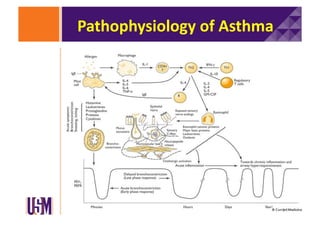
Pathophysiology	
  of	
  Asthma	
  

6	
  
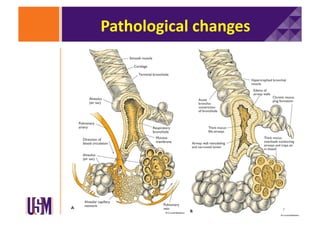
Pathological	
  changes	
  

7	
  
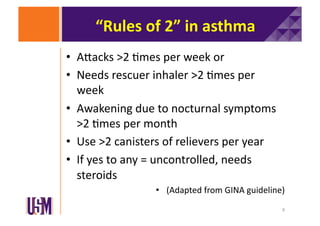
“Rules	
  of	
  2”	
  in	
  asthma	
  
•  AXacks	
  >2	
  6mes	
  per	
  week	
  or	
  
•  Needs	
  rescuer	
  inhaler	
  >2	
  6mes	
  per	
  
week	
  
•  Awakening	
  due	
  to	
  nocturnal	
  symptoms	
  
>2	
  6mes	
  per	
  month	
  
•  Use	
  >2	
  canisters	
  of	
  relievers	
  per	
  year	
  
•  If	
  yes	
  to	
  any	
  =	
  uncontrolled,	
  needs	
  
steroids	
  
•  (Adapted	
  from	
  GINA	
  guideline)	
  
8	
  
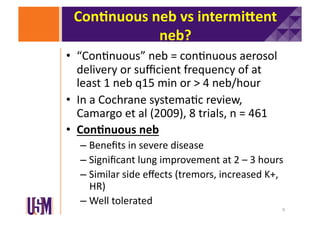
Con@nuous	
  neb	
  vs	
  intermiCent	
  
neb?	
  
•  “Con6nuous”	
  neb	
  =	
  con6nuous	
  aerosol	
  
delivery	
  or	
  sufficient	
  frequency	
  of	
  at	
  
least	
  1	
  neb	
  q15	
  min	
  or	
  >	
  4	
  neb/hour	
  
•  In	
  a	
  Cochrane	
  systema6c	
  review,	
  
Camargo	
  et	
  al	
  (2009),	
  8	
  trials,	
  n	
  =	
  461	
  
•  Con@nuous	
  neb	
  
–  Benefits	
  in	
  severe	
  disease	
  
–  Significant	
  lung	
  improvement	
  at	
  2	
  –	
  3	
  hours	
  
–  Similar	
  side	
  effects	
  (tremors,	
  increased	
  K+,	
  
HR)	
  
–  Well	
  tolerated	
  

9	
  
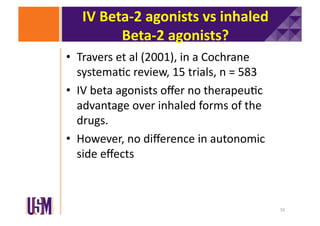
IV	
  Beta-­‐2	
  agonists	
  vs	
  inhaled	
  
Beta-­‐2	
  agonists?	
  
•  Travers	
  et	
  al	
  (2001),	
  in	
  a	
  Cochrane	
  
systema6c	
  review,	
  15	
  trials,	
  n	
  =	
  583	
  
•  IV	
  beta	
  agonists	
  offer	
  no	
  therapeu6c	
  
advantage	
  over	
  inhaled	
  forms	
  of	
  the	
  
drugs.	
  	
  
•  However,	
  no	
  difference	
  in	
  autonomic	
  
side	
  effects	
  

10	
  
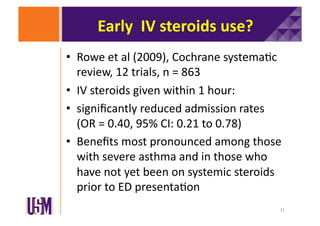
Early	
  	
  IV	
  steroids	
  use?	
  
•  Rowe	
  et	
  al	
  (2009),	
  Cochrane	
  systema6c	
  
review,	
  12	
  trials,	
  n	
  =	
  863	
  
•  IV	
  steroids	
  given	
  within	
  1	
  hour:	
  
•  significantly	
  reduced	
  admission	
  rates	
  
(OR	
  =	
  0.40,	
  95%	
  CI:	
  0.21	
  to	
  0.78)	
  
•  Benefits	
  most	
  pronounced	
  among	
  those	
  
with	
  severe	
  asthma	
  and	
  in	
  those	
  who	
  
have	
  not	
  yet	
  been	
  on	
  systemic	
  steroids	
  
prior	
  to	
  ED	
  presenta6on	
  
11	
  
An@cholinergics	
  
•  An6cholinergics	
  –	
  not	
  to	
  be	
  used	
  alone	
  
•  Teoh	
  et	
  al	
  (2012),	
  in	
  a	
  Cochrane	
  review,	
  
4	
  trials,	
  n	
  =	
  171	
  
–  An6cholinergics	
  alone	
  less	
  efficacious	
  and	
  
more	
  likely	
  to	
  fail	
  

•  An6cholinergics	
  combined	
  with	
  SABA?	
  
–  Griffiths	
  et	
  al	
  (2013),	
  in	
  a	
  systema6c	
  review,	
  
15	
  trials,	
  n	
  =	
  2497	
  (pediatrics),	
  found	
  
–  combining	
  an6cholinergic	
  and	
  SABA	
  
significantly	
  reduces	
  the	
  risk	
  for	
  hospital	
  
admission	
  
12	
  
Magnesium	
  sulphate	
  
•  Blocks	
  calcium	
  channel	
  
•  Relaxes	
  bronchial	
  smooth	
  muscle	
  
•  Inhibits	
  contrac6le	
  response	
  to	
  
endogenous	
  bronchoconstrictors	
  
•  Rowe	
  et	
  al	
  (2009):	
  
•  7	
  trials,	
  n	
  =	
  665	
  
•  Overall	
  no	
  improvement	
  in	
  lung	
  
func6on,	
  no	
  improvement	
  in	
  adm	
  rate	
  
•  BUT	
  reduce	
  admission	
  rate	
  in	
  severe	
  
asthma	
  subgroup	
  
13	
  
NIPPV	
  in	
  Asthma?	
  
•  Lim	
  et	
  al	
  (2012)	
  in	
  a	
  Cochrane	
  review,	
  5	
  
trials,	
  n	
  =	
  206,	
  preliminary	
  results	
  show	
  
NIPPV	
  has	
  benefit	
  of	
  
–  Reduced	
  hospitaliza6on	
  rate	
  
–  Reduced	
  6me	
  to	
  discharge	
  from	
  ED	
  
–  Improves	
  lung	
  func6on	
  

•  But	
  s6ll	
  lack	
  of	
  good	
  evidence,	
  remains	
  
controversial;	
  NOT	
  for	
  rou6ne	
  use	
  
•  Two	
  of	
  the	
  studies:	
  2	
  intuba6ons	
  needed	
  in	
  
45	
  par6cipants	
  on	
  NPPV	
  vs	
  no	
  intuba6ons	
  
in	
  41	
  control	
  pa6ents	
  (risk	
  ra6o	
  4.48;	
  95%	
  
CI	
  0.23	
  to	
  89.13)	
  
14	
  
Mechanical	
  ven@la@on	
  
•  4	
  indica6ons	
  for	
  intuba6on	
  (Brenner	
  et	
  al,	
  
2009	
  in	
  Proceedings	
  of	
  the	
  ATS)	
  

–  cardiac	
  arrest	
  
–  respiratory	
  arrest	
  or	
  profound	
  bradypnea	
  
–  physical	
  exhaus6on	
  
–  AMS	
  (agitated	
  pa6ent,	
  interfering	
  with	
  oxygen	
  
delivery)	


•  Hypercapnia	
  per	
  se	
  without	
  evidence	
  of	
  
physical	
  exhaus6on	
  or	
  mental	
  changes	
  IS	
  
NOT	
  an	
  indica6on	
  
•  Persistent	
  hypercapnia	
  despite	
  treatment	
  
+/-­‐	
  AMS	
  is	
  an	
  	
  indica6on	
  (PaCO2	
  increase	
  ~	
  
5mmHg/Hr	
  or	
  more	
  than	
  55	
  –	
  70	
  mmHg)	
  
15	
  
Mechanical	
  ven@la@on	
  
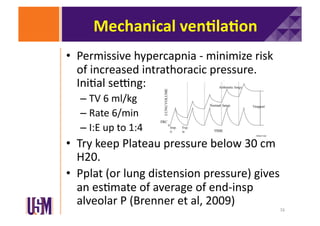
•  Permissive	
  hypercapnia	
  -­‐	
  minimize	
  risk	
  
of	
  increased	
  intrathoracic	
  pressure.	
  
Ini6al	
  sepng:	
  
–  TV	
  6	
  ml/kg	
  
–  Rate	
  6/min	
  
–  I:E	
  up	
  to	
  1:4	
  

•  Try	
  keep	
  Plateau	
  pressure	
  below	
  30	
  cm	
  
H20.	
  	
  
•  Pplat	
  (or	
  lung	
  distension	
  pressure)	
  gives	
  
an	
  es6mate	
  of	
  average	
  of	
  end-­‐insp	
  
alveolar	
  P	
  (Brenner	
  et	
  al,	
  2009)	
  

16	
  
Induc@on	
  Agents	
  
Ketamine	
  	
  
releases	
  of	
  catecholamines	
  
bronchial	
  smooth	
  muscle	
  relaxa6on	
  
Side	
  effects	
  –	
  hypersecre6on,	
  
hypertension,	
  arrhythmias,	
  and	
  
hallucina6ons	
  
•  rela6vely	
  contraindicated	
  in	
  pa6ents	
  
with	
  ischemic	
  heart	
  disease,	
  
hypertension,	
  increased	
  intracranial	
  
pressure.	
  
• 
• 
• 
• 

17	
  
Updates	
  on	
  COPD	
  

18	
  
Reversible

Irreversible
Source: Peter J. Barnes, MD
Basics	
  
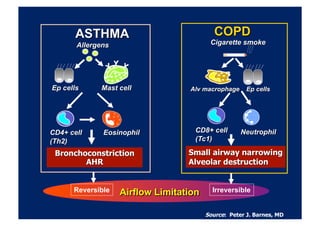
•  COPD	
  is	
  a	
  systemic	
  disease,	
  not	
  just	
  
pulmomary	
  (Agus6,	
  2005)	
  
–  systemic	
  inflamma6on,	
  systemic	
  oxida6ve	
  
stress,	
  ac6va6on	
  of	
  circula6ng	
  
inflammatory	
  cells,	
  e.g.	
  neutrophils,	
  
macrphages,	
  and	
  augmented	
  levels	
  of	
  pro-­‐
inflammatory	
  cytokines	
  

•  Extrapulmonary	
  associa6ons:	
  IHD,	
  
osteopenia,	
  cachexia,	
  malnutri6on,	
  
skeletal	
  was6ng	
  
20	
  
Bronchodilators	
  
•  Cochrane	
  systema6c	
  review	
  by	
  McCrory	
  et	
  
al	
  (2005)	
  
–  No	
  significant	
  difference	
  in	
  changes	
  in	
  FEV1	
  
between	
  b2-­‐agonists	
  and	
  the	
  an6cholinergic	
  
ipratropium	
  at	
  90	
  minutes	
  and	
  24	
  hours	
  and	
  	
  
–  no	
  advantage	
  combining	
  

•  An6cholinergics	
  –	
  slower	
  onset	
  (15	
  min,	
  
peak	
  60	
  to	
  90	
  min,	
  and	
  longer	
  6	
  to	
  8	
  hrs).	
  
•  General	
  consensus	
  (GOLD)	
  –	
  SABA	
  first,	
  
then	
  an6cholinergics	
  
21	
  
NIPPV	
  in	
  COPD	
  
•  Ram	
  FSF	
  et	
  al	
  (2004)	
  in	
  a	
  Cochrane	
  
systema6c	
  review,	
  14	
  trials	
  involving	
  n	
  =	
  
622	
  (outcomes	
  of	
  treatment	
  failure),	
  n	
  =	
  
541	
  (mortality)	
  
•  NIPPV	
  resulted	
  in	
  
•  decreased	
  mortality	
  	
  
•  decreased	
  need	
  for	
  intuba6on	
  	
  
•  reduc6on	
  in	
  treatment	
  failure	
  
22	
  
Mechanical	
  ven@la@ons	
  
•  Issues	
  with	
  mechanical	
  ven6la6on	
  in	
  
COPD	
  (BruloXe	
  et	
  al,	
  2012):	
  
•  poorer	
  prognosis	
  (mortality	
  rates	
  
between	
  20%	
  and	
  73%)	
  	
  
•  a	
  mean	
  life	
  expectancy	
  of	
  1	
  year	
  
•  Barotrauma,	
  infec6ons	
  
•  Discuss	
  with	
  family	
  regarding	
  pros	
  and	
  
cons	
  
23	
  
Hypoxic	
  Drive	
  in	
  COPD?	
  
•  How	
  real	
  is	
  this	
  fear?	
  
•  Started	
  off	
  with	
  a	
  paper	
  by	
  E.J.M	
  Campbell	
  
in	
  1960	
  	
  
•  Really	
  no	
  science	
  behind	
  it!	
  Consensus	
  
opinion	
  
•  A	
  Cochrane	
  review	
  by	
  Aus6n	
  Wood-­‐Baker	
  
(2009)	
  
–  “No	
  relevant	
  trials	
  have	
  been	
  published	
  to	
  
date,	
  so	
  there	
  is	
  no	
  evidence	
  to	
  indicate	
  
whether	
  different	
  oxygen	
  therapies	
  in	
  the	
  pre-­‐
hospital	
  se@ng	
  have	
  an	
  effect	
  on	
  outcome	
  for	
  
people	
  with	
  acute	
  exacerbaBons	
  of	
  COPD”	
  
24	
  
Hypoxic	
  Drive	
  in	
  COPD?	
  
•  Plant	
  et	
  al	
  (2000)	
  shows	
  an	
  associa6on	
  
between	
  increased	
  oxygen	
  with	
  
hypercapnea,	
  respiratory	
  acidosis,	
  and	
  
ICU	
  admission	
  but	
  this	
  does	
  not	
  occur	
  in	
  
every	
  pa6ent	
  given	
  increased	
  FiO2.	
  
•  May	
  happen	
  
•  Careful	
  observa6on	
  of	
  this	
  pa6ent	
  
•  BUT	
  remember:	
  the	
  risks	
  of	
  withholding	
  
oxygen	
  are	
  much	
  greater	
  than	
  giving	
  
them	
  too	
  much!	
  

25	
  
Summary	
  
• 
• 
• 
• 
• 
• 
• 
• 

In	
  asthma:	
  	
  
Con6nuous	
  neb?	
  
IV	
  B2-­‐agonist?	
  	
  
IV	
  steroids?	
  
An6cholinergics?	
  
Magnesium	
  sulphate?	
  
NIPPV?	
  
When	
  intubate?	
  What	
  to	
  look	
  for?	
  
26	
  
Summary	
  
• 
• 
• 
• 
• 
• 

In	
  COPD:	
  
Recent	
  concepts	
  
B2-­‐agonists	
  vs	
  an6cholinergics?	
  
NIPPV?	
  
Issues	
  of	
  mechanical	
  ven6la6on	
  
Hypoxic	
  drive	
  -­‐	
  controversials	
  

27	
  
References	
  
•  Camargo	
  Jr	
  CA,	
  Spooner	
  C,	
  Rowe	
  BH.	
  Con6nuous	
  
versus	
  intermiXent	
  beta-­‐agonists	
  for	
  acute	
  asthma.	
  
Cochrane	
  Database	
  of	
  Systema6c	
  Reviews	
  2003,	
  
Issue	
  4.	
  Art.	
  No.:	
  CD001115.	
  DOI:	
  
10.1002/14651858.CD001115	
  
•  Travers	
  A,	
  Jones	
  AP,	
  Kelly	
  K,	
  Barker	
  SJ,	
  Camargo	
  CA,	
  
Rowe	
  BH.	
  Intravenous	
  beta2-­‐agonists	
  for	
  acute	
  
asthma	
  in	
  the	
  emergency	
  department.	
  Cochrane	
  
Database	
  Syst	
  Rev.2001;(2)	
  :CD002988	
  
•  Rowe	
  BH,	
  Spooner	
  C,Ducharme	
  F,	
  Bretzlaff	
  J,	
  BotaG.	
  
Early	
  emergency	
  department	
  treatment	
  of	
  acute	
  
asthma	
  with	
  systemic	
  cor6costeroids.	
  Cochrane	
  
Database	
  of	
  Systema6c	
  Reviews	
  2001,	
  Issue	
  1.	
  Art.	
  
No.:	
  CD002178.	
  DOI:	
  10.1002/14651858.CD002178.	
  
28	
  
References	
  
•  Griffiths	
  B,	
  Ducharme	
  FM.	
  Combined	
  inhaled	
  
an6cholinergics	
  and	
  short-­‐ac6ng	
  beta2-­‐agonists	
  
for	
  ini6al	
  treatment	
  of	
  acute	
  asthma	
  in	
  children.	
  
Cochrane	
  Database	
  of	
  Systema6c	
  Reviews	
  2013,	
  
Issue	
  8.	
  Art.	
  No.:	
  CD000060.	
  DOI:	
  
10.1002/14651858.CD000060.pub2.	
  
•  Lim	
  WJ,	
  Mohammed	
  Akram	
  R,	
  Carson	
  KV,	
  
Mysore	
  S,	
  Labiszewski	
  NA,	
  Wedzicha	
  JA,	
  Rowe	
  
BH,	
  Smith	
  BJ.	
  Non-­‐invasive	
  posi6ve	
  pressure	
  
ven6la6on	
  for	
  treatment	
  of	
  respiratory	
  failure	
  
due	
  to	
  severe	
  acute	
  exacerba6ons	
  of	
  asthma.	
  
Cochrane	
  Database	
  of	
  Systema6c	
  Reviews	
  2012,	
  
Issue	
  12.	
  Art.	
  No.:	
  CD004360.	
  DOI	
  
10.1002/14651858.CD004360.pub4.	
  
29	
  
References	
  
•  Barry	
  Brenner,	
  Thomas	
  Corbridge,	
  and	
  
Antoine	
  Kazzi	
  "Intuba6on	
  and	
  Mechanical	
  
Ven6la6on	
  of	
  the	
  Asthma6c	
  Pa6ent	
  in	
  
Respiratory	
  Failure",	
  Proceedings	
  of	
  the	
  
American	
  Thoracic	
  Society,	
  Vol.	
  6,	
  No.	
  4	
  
(2009),	
  pp.	
  371-­‐379.	
  	
  
•  McCrory	
  DC,	
  Brown	
  CD.	
  An6cholinergic	
  
bronchodilators	
  versus	
  beta2-­‐
sympathomime6c	
  agents	
  for	
  acute	
  
exacerba6ons	
  of	
  chronic	
  obstruc6ve	
  
pulmonary	
  disease.	
  Cochrane	
  Database	
  of	
  
Systema6c	
  Reviews	
  2003,	
  Issue	
  1.	
  Art.	
  No.:	
  
CD003900.	
  DOI:
10.1002/14651858.CD003900.	
  

30	
  
References	
  
•  Agus6	
  AG.	
  Systemic	
  effects	
  of	
  chronic	
  
obstruc6ve	
  pulmonary	
  disease.	
  Proc	
  Am	
  Thorac	
  
Soc	
  2005;	
  2	
  (4):367-­‐70;	
  discussion	
  71-­‐2.	
  	
  
•  Ram	
  FSF,	
  Picot	
  J,	
  Lightowler	
  J,	
  Wedzicha	
  JA.	
  
Non-­‐invasive	
  posi6ve	
  pressure	
  ven6la6on	
  for	
  
treatment	
  of	
  respiratory	
  failure	
  due	
  to	
  
exacerba6ons	
  of	
  chronic	
  obstruc6ve	
  pulmonary	
  
disease.	
  Cochrane	
  Database	
  of	
  Systema6c	
  
Reviews	
  2004,	
  Issue	
  3.	
  Art.	
  No.:	
  CD004104.	
  DOI:	
  
10.1002/14651858.CD004104.pub3.	
  	
  
•  BruloXe	
  CA,	
  Lang	
  ES.	
  Acute	
  exacerba6ons	
  of	
  
chronic	
  obstruc6ve	
  pulmonary	
  disease	
  in	
  the	
  
emergency	
  department.	
  Emerg	
  Med	
  Clin	
  North	
  
Am.	
  2012;	
  May;30(2):223-­‐47,	
  vii.	
  
31	
  
References	
  
•  Teoh	
  L,	
  Cates	
  CJ,	
  et	
  al.	
  An6cholinergic	
  
therapy	
  for	
  acute	
  asthma	
  in	
  children.	
  
Cochrane	
  Database	
  Syst	
  Rev	
  2012,	
  Issue	
  
4:	
  CD003797.	
  
•  Plant	
  PK,	
  Owen	
  JL,	
  Elliot	
  MW.	
  One	
  year	
  
period	
  prevalence	
  study	
  of	
  respiratory	
  
acidosis	
  in	
  acute	
  exacerba6ons	
  of	
  COPD:	
  
implica6ons	
  for	
  the	
  provision	
  of	
  
noninvasive	
  ven6la6on	
  and	
  oxygen	
  
administra6on.	
  Thorax	
  2000;55:550–4.	
  
32	
  
33	
  

Updates on Asthma and COPD

  • 1.
    Updates  on  Asthma  and  COPD   Keng  Sheng  Chew   School  of  Medical  Sciences   Universi6  Sains  Malaysia   1  
  • 2.
    Conflict  of  Interest   •  I  declare  I  have  received  educa6onal   grants  from  Astra-­‐Zeneca  (M)  Sdn  Bhd   2  
  • 3.
    Outlines   •  •  •  •  •  •  •  •  In  asthma:     Con6nuous  neb?   IV  B2-­‐agonist?     IV  steroids?   An6cholinergics?   Magnesium  sulphate?   NIPPV?   When  intubate?  What  to  look  for?   3  
  • 4.
    Outlines   •  •  •  •  •  •  In  COPD:   Recent  concepts   B2-­‐agonists  vs  an6cholinergics?   NIPPV?   Issues  of  mechanical  ven6la6on   Hypoxic  drive  –how  true  is  this  fear?   4  
  • 5.
  • 6.
  • 7.
  • 8.
    “Rules  of  2”  in  asthma   •  AXacks  >2  6mes  per  week  or   •  Needs  rescuer  inhaler  >2  6mes  per   week   •  Awakening  due  to  nocturnal  symptoms   >2  6mes  per  month   •  Use  >2  canisters  of  relievers  per  year   •  If  yes  to  any  =  uncontrolled,  needs   steroids   •  (Adapted  from  GINA  guideline)   8  
  • 9.
    Con@nuous  neb  vs  intermiCent   neb?   •  “Con6nuous”  neb  =  con6nuous  aerosol   delivery  or  sufficient  frequency  of  at   least  1  neb  q15  min  or  >  4  neb/hour   •  In  a  Cochrane  systema6c  review,   Camargo  et  al  (2009),  8  trials,  n  =  461   •  Con@nuous  neb   –  Benefits  in  severe  disease   –  Significant  lung  improvement  at  2  –  3  hours   –  Similar  side  effects  (tremors,  increased  K+,   HR)   –  Well  tolerated   9  
  • 10.
    IV  Beta-­‐2  agonists  vs  inhaled   Beta-­‐2  agonists?   •  Travers  et  al  (2001),  in  a  Cochrane   systema6c  review,  15  trials,  n  =  583   •  IV  beta  agonists  offer  no  therapeu6c   advantage  over  inhaled  forms  of  the   drugs.     •  However,  no  difference  in  autonomic   side  effects   10  
  • 11.
    Early    IV  steroids  use?   •  Rowe  et  al  (2009),  Cochrane  systema6c   review,  12  trials,  n  =  863   •  IV  steroids  given  within  1  hour:   •  significantly  reduced  admission  rates   (OR  =  0.40,  95%  CI:  0.21  to  0.78)   •  Benefits  most  pronounced  among  those   with  severe  asthma  and  in  those  who   have  not  yet  been  on  systemic  steroids   prior  to  ED  presenta6on   11  
  • 12.
    An@cholinergics   •  An6cholinergics  –  not  to  be  used  alone   •  Teoh  et  al  (2012),  in  a  Cochrane  review,   4  trials,  n  =  171   –  An6cholinergics  alone  less  efficacious  and   more  likely  to  fail   •  An6cholinergics  combined  with  SABA?   –  Griffiths  et  al  (2013),  in  a  systema6c  review,   15  trials,  n  =  2497  (pediatrics),  found   –  combining  an6cholinergic  and  SABA   significantly  reduces  the  risk  for  hospital   admission   12  
  • 13.
    Magnesium  sulphate   • Blocks  calcium  channel   •  Relaxes  bronchial  smooth  muscle   •  Inhibits  contrac6le  response  to   endogenous  bronchoconstrictors   •  Rowe  et  al  (2009):   •  7  trials,  n  =  665   •  Overall  no  improvement  in  lung   func6on,  no  improvement  in  adm  rate   •  BUT  reduce  admission  rate  in  severe   asthma  subgroup   13  
  • 14.
    NIPPV  in  Asthma?   •  Lim  et  al  (2012)  in  a  Cochrane  review,  5   trials,  n  =  206,  preliminary  results  show   NIPPV  has  benefit  of   –  Reduced  hospitaliza6on  rate   –  Reduced  6me  to  discharge  from  ED   –  Improves  lung  func6on   •  But  s6ll  lack  of  good  evidence,  remains   controversial;  NOT  for  rou6ne  use   •  Two  of  the  studies:  2  intuba6ons  needed  in   45  par6cipants  on  NPPV  vs  no  intuba6ons   in  41  control  pa6ents  (risk  ra6o  4.48;  95%   CI  0.23  to  89.13)   14  
  • 15.
    Mechanical  ven@la@on   • 4  indica6ons  for  intuba6on  (Brenner  et  al,   2009  in  Proceedings  of  the  ATS)   –  cardiac  arrest   –  respiratory  arrest  or  profound  bradypnea   –  physical  exhaus6on   –  AMS  (agitated  pa6ent,  interfering  with  oxygen   delivery)     •  Hypercapnia  per  se  without  evidence  of   physical  exhaus6on  or  mental  changes  IS   NOT  an  indica6on   •  Persistent  hypercapnia  despite  treatment   +/-­‐  AMS  is  an    indica6on  (PaCO2  increase  ~   5mmHg/Hr  or  more  than  55  –  70  mmHg)   15  
  • 16.
    Mechanical  ven@la@on   • Permissive  hypercapnia  -­‐  minimize  risk   of  increased  intrathoracic  pressure.   Ini6al  sepng:   –  TV  6  ml/kg   –  Rate  6/min   –  I:E  up  to  1:4   •  Try  keep  Plateau  pressure  below  30  cm   H20.     •  Pplat  (or  lung  distension  pressure)  gives   an  es6mate  of  average  of  end-­‐insp   alveolar  P  (Brenner  et  al,  2009)   16  
  • 17.
    Induc@on  Agents   Ketamine     releases  of  catecholamines   bronchial  smooth  muscle  relaxa6on   Side  effects  –  hypersecre6on,   hypertension,  arrhythmias,  and   hallucina6ons   •  rela6vely  contraindicated  in  pa6ents   with  ischemic  heart  disease,   hypertension,  increased  intracranial   pressure.   •  •  •  •  17  
  • 18.
  • 19.
  • 20.
    Basics   •  COPD  is  a  systemic  disease,  not  just   pulmomary  (Agus6,  2005)   –  systemic  inflamma6on,  systemic  oxida6ve   stress,  ac6va6on  of  circula6ng   inflammatory  cells,  e.g.  neutrophils,   macrphages,  and  augmented  levels  of  pro-­‐ inflammatory  cytokines   •  Extrapulmonary  associa6ons:  IHD,   osteopenia,  cachexia,  malnutri6on,   skeletal  was6ng   20  
  • 21.
    Bronchodilators   •  Cochrane  systema6c  review  by  McCrory  et   al  (2005)   –  No  significant  difference  in  changes  in  FEV1   between  b2-­‐agonists  and  the  an6cholinergic   ipratropium  at  90  minutes  and  24  hours  and     –  no  advantage  combining   •  An6cholinergics  –  slower  onset  (15  min,   peak  60  to  90  min,  and  longer  6  to  8  hrs).   •  General  consensus  (GOLD)  –  SABA  first,   then  an6cholinergics   21  
  • 22.
    NIPPV  in  COPD   •  Ram  FSF  et  al  (2004)  in  a  Cochrane   systema6c  review,  14  trials  involving  n  =   622  (outcomes  of  treatment  failure),  n  =   541  (mortality)   •  NIPPV  resulted  in   •  decreased  mortality     •  decreased  need  for  intuba6on     •  reduc6on  in  treatment  failure   22  
  • 23.
    Mechanical  ven@la@ons   • Issues  with  mechanical  ven6la6on  in   COPD  (BruloXe  et  al,  2012):   •  poorer  prognosis  (mortality  rates   between  20%  and  73%)     •  a  mean  life  expectancy  of  1  year   •  Barotrauma,  infec6ons   •  Discuss  with  family  regarding  pros  and   cons   23  
  • 24.
    Hypoxic  Drive  in  COPD?   •  How  real  is  this  fear?   •  Started  off  with  a  paper  by  E.J.M  Campbell   in  1960     •  Really  no  science  behind  it!  Consensus   opinion   •  A  Cochrane  review  by  Aus6n  Wood-­‐Baker   (2009)   –  “No  relevant  trials  have  been  published  to   date,  so  there  is  no  evidence  to  indicate   whether  different  oxygen  therapies  in  the  pre-­‐ hospital  se@ng  have  an  effect  on  outcome  for   people  with  acute  exacerbaBons  of  COPD”   24  
  • 25.
    Hypoxic  Drive  in  COPD?   •  Plant  et  al  (2000)  shows  an  associa6on   between  increased  oxygen  with   hypercapnea,  respiratory  acidosis,  and   ICU  admission  but  this  does  not  occur  in   every  pa6ent  given  increased  FiO2.   •  May  happen   •  Careful  observa6on  of  this  pa6ent   •  BUT  remember:  the  risks  of  withholding   oxygen  are  much  greater  than  giving   them  too  much!   25  
  • 26.
    Summary   •  •  •  •  •  •  •  •  In  asthma:     Con6nuous  neb?   IV  B2-­‐agonist?     IV  steroids?   An6cholinergics?   Magnesium  sulphate?   NIPPV?   When  intubate?  What  to  look  for?   26  
  • 27.
    Summary   •  •  •  •  •  •  In  COPD:   Recent  concepts   B2-­‐agonists  vs  an6cholinergics?   NIPPV?   Issues  of  mechanical  ven6la6on   Hypoxic  drive  -­‐  controversials   27  
  • 28.
    References   •  Camargo  Jr  CA,  Spooner  C,  Rowe  BH.  Con6nuous   versus  intermiXent  beta-­‐agonists  for  acute  asthma.   Cochrane  Database  of  Systema6c  Reviews  2003,   Issue  4.  Art.  No.:  CD001115.  DOI:   10.1002/14651858.CD001115   •  Travers  A,  Jones  AP,  Kelly  K,  Barker  SJ,  Camargo  CA,   Rowe  BH.  Intravenous  beta2-­‐agonists  for  acute   asthma  in  the  emergency  department.  Cochrane   Database  Syst  Rev.2001;(2)  :CD002988   •  Rowe  BH,  Spooner  C,Ducharme  F,  Bretzlaff  J,  BotaG.   Early  emergency  department  treatment  of  acute   asthma  with  systemic  cor6costeroids.  Cochrane   Database  of  Systema6c  Reviews  2001,  Issue  1.  Art.   No.:  CD002178.  DOI:  10.1002/14651858.CD002178.   28  
  • 29.
    References   •  Griffiths  B,  Ducharme  FM.  Combined  inhaled   an6cholinergics  and  short-­‐ac6ng  beta2-­‐agonists   for  ini6al  treatment  of  acute  asthma  in  children.   Cochrane  Database  of  Systema6c  Reviews  2013,   Issue  8.  Art.  No.:  CD000060.  DOI:   10.1002/14651858.CD000060.pub2.   •  Lim  WJ,  Mohammed  Akram  R,  Carson  KV,   Mysore  S,  Labiszewski  NA,  Wedzicha  JA,  Rowe   BH,  Smith  BJ.  Non-­‐invasive  posi6ve  pressure   ven6la6on  for  treatment  of  respiratory  failure   due  to  severe  acute  exacerba6ons  of  asthma.   Cochrane  Database  of  Systema6c  Reviews  2012,   Issue  12.  Art.  No.:  CD004360.  DOI   10.1002/14651858.CD004360.pub4.   29  
  • 30.
    References   •  Barry  Brenner,  Thomas  Corbridge,  and   Antoine  Kazzi  "Intuba6on  and  Mechanical   Ven6la6on  of  the  Asthma6c  Pa6ent  in   Respiratory  Failure",  Proceedings  of  the   American  Thoracic  Society,  Vol.  6,  No.  4   (2009),  pp.  371-­‐379.     •  McCrory  DC,  Brown  CD.  An6cholinergic   bronchodilators  versus  beta2-­‐ sympathomime6c  agents  for  acute   exacerba6ons  of  chronic  obstruc6ve   pulmonary  disease.  Cochrane  Database  of   Systema6c  Reviews  2003,  Issue  1.  Art.  No.:   CD003900.  DOI: 10.1002/14651858.CD003900.   30  
  • 31.
    References   •  Agus6  AG.  Systemic  effects  of  chronic   obstruc6ve  pulmonary  disease.  Proc  Am  Thorac   Soc  2005;  2  (4):367-­‐70;  discussion  71-­‐2.     •  Ram  FSF,  Picot  J,  Lightowler  J,  Wedzicha  JA.   Non-­‐invasive  posi6ve  pressure  ven6la6on  for   treatment  of  respiratory  failure  due  to   exacerba6ons  of  chronic  obstruc6ve  pulmonary   disease.  Cochrane  Database  of  Systema6c   Reviews  2004,  Issue  3.  Art.  No.:  CD004104.  DOI:   10.1002/14651858.CD004104.pub3.     •  BruloXe  CA,  Lang  ES.  Acute  exacerba6ons  of   chronic  obstruc6ve  pulmonary  disease  in  the   emergency  department.  Emerg  Med  Clin  North   Am.  2012;  May;30(2):223-­‐47,  vii.   31  
  • 32.
    References   •  Teoh  L,  Cates  CJ,  et  al.  An6cholinergic   therapy  for  acute  asthma  in  children.   Cochrane  Database  Syst  Rev  2012,  Issue   4:  CD003797.   •  Plant  PK,  Owen  JL,  Elliot  MW.  One  year   period  prevalence  study  of  respiratory   acidosis  in  acute  exacerba6ons  of  COPD:   implica6ons  for  the  provision  of   noninvasive  ven6la6on  and  oxygen   administra6on.  Thorax  2000;55:550–4.   32  
  • 33.