Key Feature 
Questions: 
An Introduction 
Dr. Chew Keng Sheng 
Universiti Sains Malaysia
What is a Key-Features Question? (KFQ) 
• KFQ are designed to specifically assess decision-making 
skills rather than simple recall of factual 
knowledge. 
• While knowledge is obviously a very important 
requisite for effective problem solving, the 
challenge posed by key features cases is the 
application of knowledge to the resolution of a 
problem 
www.PresentationPro.com
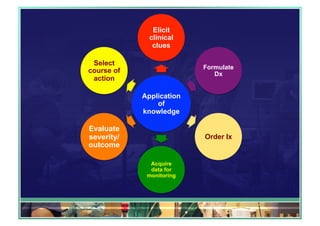
Elicit 
clinical 
clues 
Application 
of 
knowledge 
Formulate 
Dx 
Order Ix 
Acquire 
data for 
monitoring 
Select 
course of 
action 
Evaluate 
severity/ 
outcome
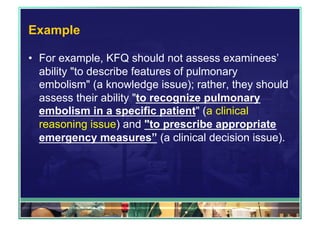
Example 
• For example, KFQ should not assess examinees’ 
ability "to describe features of pulmonary 
embolism" (a knowledge issue); rather, they should 
assess their ability "to recognize pulmonary 
embolism in a specific patient" (a clinical 
reasoning issue) and "to prescribe appropriate 
emergency measures” (a clinical decision issue).
A general rule to keep in mind when 
developing key features cases is that if 
the question asked can be answered 
without reference to the attached 
clinical scenario, then it is not a good 
question and is likely not measuring 
clinical decision making. 
www.PresentationPro.com
Definition of Key-Feature 
• The term “key feature” was introduced by Bordage 
& Page (1987) and is defined as: 
1. a critical or essential or key step(s) in the 
resolution of a problem, 
2. a step(s) in which examinees are most likely to 
make errors in the resolution of the problem, or 
3. a difficult or challenging aspect in the identification 
and management of the problem in practice.
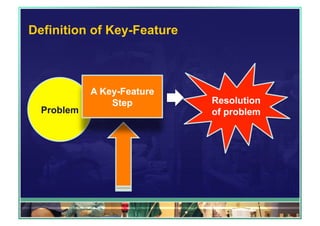
Definition of Key-Feature 
Problem 
A Key-Feature 
Step Resolution 
of problem
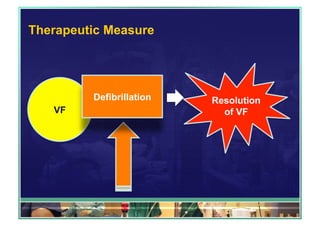
Therapeutic Measure 
VF 
Defibrillation Resolution 
of VF
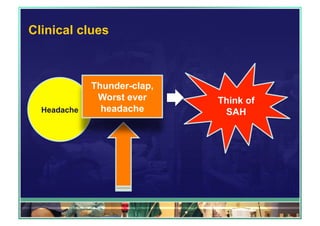
Clinical clues 
Headache 
Thunder-clap, 
Worst ever 
headache 
Think of 
SAH
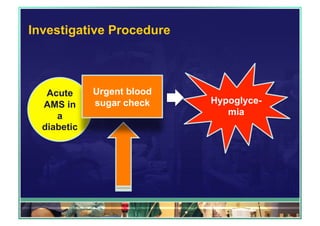
Investigative Procedure 
Acute 
AMS in 
a 
diabetic 
Urgent blood 
sugar check Hypoglyce-mia
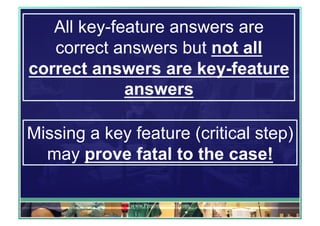
All key-feature answers are 
correct answers but not all 
correct answers are key-feature 
answers 
Missing a key feature (critical step) 
may prove fatal to the case! 
www.PresentationPro.com
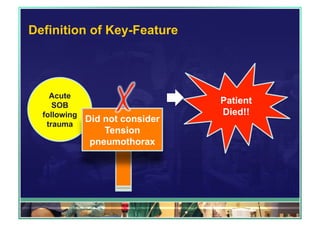
Definition of Key-Feature 
Acute 
SOB 
following 
trauma Did not consider 
Tension 
pneumothorax 
Patient 
Died!!
Ask: 
“What are the critical, essential, 
or challenging elements in the 
resolution of this problem?” 
“What are this problem’s key 
features that should be 
assessed?” 
www.PresentationPro.com
Key Features are case-specific 
• Key features are often unique to different cases or 
presentations of a clinical problem, as they may 
vary relative to the clinical presentation of the 
problem and relative to other issues such as the 
patient's age and gender. 
• It is therefore unusual to have a “generic” set of 
key features for a specific clinical problem. 
www.PresentationPro.com
Key Features are case-specific 
• For example, the critical elements in the resolution 
of a diabetic problem as a life-threatening event are 
quite different from those of a diabetic problem 
presenting as an undifferentiated complaint in an 
adolescent 
www.PresentationPro.com
How an examiner sets a KFQ 
• First, define the key features of the case 
• Each key feature has two/three basic elements: 
1. a set of conditions: “Given a pregnant woman 
experiencing third-trimester vaginal bleeding with 
no abdominal pain”; 
2. a task (i.e., a clinical action or decision): “Consider 
placenta previa as a leading diagnosis”; and 
3. some qualifiers (optional): “leading diagnosis.” 
www.PresentationPro.com
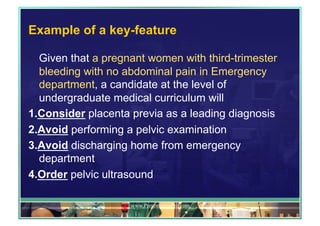
Example of a key-feature 
• Given that a pregnant women with third-trimester 
bleeding with no abdominal pain in Emergency 
department, a candidate at the level of 
undergraduate medical curriculum will 
1. Consider placenta previa as a leading diagnosis 
2. Avoid performing a pelvic examination 
3. Avoid discharging home from emergency 
department 
4. Order pelvic ultrasound 
www.PresentationPro.com
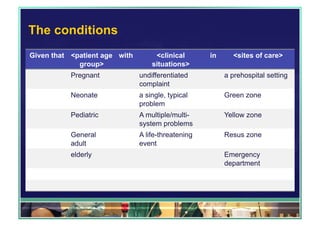
The conditions 
Given that <patient age 
group> 
with <clinical 
situations> 
in <sites of care> 
Pregnant undifferentiated 
complaint 
a prehospital setting 
Neonate a single, typical 
problem 
Green zone 
Pediatric A multiple/multi-system 
problems 
Yellow zone 
General 
adult 
A life-threatening 
event 
Resus zone 
elderly Emergency 
department
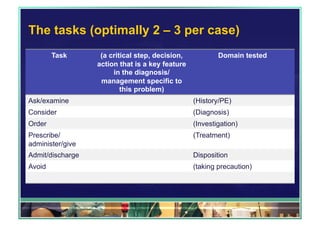
The tasks (optimally 2 – 3 per case) 
Task (a critical step, decision, 
action that is a key feature 
in the diagnosis/ 
management specific to 
this problem) 
Domain tested 
Ask/examine (History/PE) 
Consider (Diagnosis) 
Order (Investigation) 
Prescribe/ 
(Treatment) 
administer/give 
Admit/discharge Disposition 
Avoid (taking precaution)
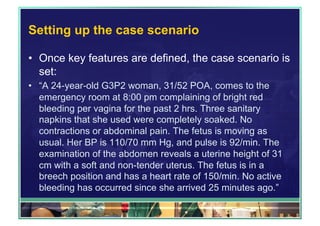
Setting up the case scenario 
• Once key features are defined, the case scenario is 
set: 
• “A 24-year-old G3P2 woman, 31/52 POA, comes to the 
emergency room at 8:00 pm complaining of bright red 
bleeding per vagina for the past 2 hrs. Three sanitary 
napkins that she used were completely soaked. No 
contractions or abdominal pain. The fetus is moving as 
usual. Her BP is 110/70 mm Hg, and pulse is 92/min. The 
examination of the abdomen reveals a uterine height of 31 
cm with a soft and non-tender uterus. The fetus is in a 
breech position and has a heart rate of 150/min. No active 
bleeding has occurred since she arrived 25 minutes ago.”
Question Formats 
• Two response formats are recommended for 
clinical decision-making cases: 
– short-answer "write-in" (WI) responses and 
– "short-menu" (SM) responses. 
• In the WI format, examinees supply their 
responses. 
• In the SM format, examinees select their responses 
from prepared lists of options accompanying the 
question.
In SM Format 
• The number of options in these lists varies 
depending on what the question is testing. 
• In general there are typically 15-20 options. 
• There should be ~ 2-3 times the total number of 
choices in the list as there are number of correct 
responses 
• List of choices may contain correct non-scored 
responses (not a key-feature), incorrect distractors, 
and dangerous options if chosen (“killer 
responses”).
In SM Format 
• "Select up to x" is a suitable instruction for 
questions in which one or more answers are sought 
and for which the number of opportunities for 
examinees to provide these answers should be 
capped. 
• The number “x” considers the number of correct 
keyed responses sought, together with other factors 
such as responses that would be reasonable but 
are not keyed (e.g., general screening questions in 
a history-taking question).
In SM Format 
• Also, the number “x“ commonly provides a buffer 
for examinees to select some incorrect responses 
(e.g., if four correct responses are sought, five or 
six responses might be permitted).
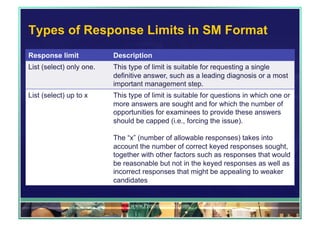
Types of Response Limits in SM Format 
Response limit Description 
List (select) only one. This type of limit is suitable for requesting a single 
definitive answer, such as a leading diagnosis or a most 
important management step. 
List (select) up to x This type of limit is suitable for questions in which one or 
more answers are sought and for which the number of 
opportunities for examinees to provide these answers 
should be capped (i.e., forcing the issue). 
The “x” (number of allowable responses) takes into 
account the number of correct keyed responses sought, 
together with other factors such as responses that would 
be reasonable but not in the keyed responses as well as 
incorrect responses that might be appealing to weaker 
candidates 
www.PresentationPro.com
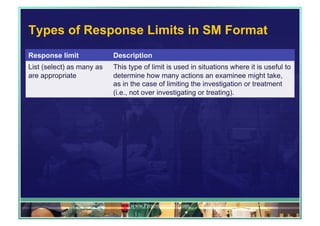
Types of Response Limits in SM Format 
Response limit Description 
List (select) as many as 
are appropriate 
This type of limit is used in situations where it is useful to 
determine how many actions an examinee might take, 
as in the case of limiting the investigation or treatment 
(i.e., not over investigating or treating). 
www.PresentationPro.com
References 
• Page G, Bordage G, Allen T. Developing Key-feature 
Problems And Examinations To Assess Clinical Decision-making 
Skills. Acad Med. 1995;70(3):194-201. 
• Medical Council Of Canada. Guidelines For The 
Development Of Key Feature Problems & Test Cases 
August 2012. Available At: 
http://mcc.ca/wp-content/uploads/cdm-guidelines.pdf 
Accessed 11 July 2014

Key Feature Questions - An Introduction

  • 1.
    Key Feature Questions: An Introduction Dr. Chew Keng Sheng Universiti Sains Malaysia
  • 2.
    What is aKey-Features Question? (KFQ) • KFQ are designed to specifically assess decision-making skills rather than simple recall of factual knowledge. • While knowledge is obviously a very important requisite for effective problem solving, the challenge posed by key features cases is the application of knowledge to the resolution of a problem www.PresentationPro.com
  • 3.
    Elicit clinical clues Application of knowledge Formulate Dx Order Ix Acquire data for monitoring Select course of action Evaluate severity/ outcome
  • 4.
    Example • Forexample, KFQ should not assess examinees’ ability "to describe features of pulmonary embolism" (a knowledge issue); rather, they should assess their ability "to recognize pulmonary embolism in a specific patient" (a clinical reasoning issue) and "to prescribe appropriate emergency measures” (a clinical decision issue).
  • 5.
    A general ruleto keep in mind when developing key features cases is that if the question asked can be answered without reference to the attached clinical scenario, then it is not a good question and is likely not measuring clinical decision making. www.PresentationPro.com
  • 6.
    Definition of Key-Feature • The term “key feature” was introduced by Bordage & Page (1987) and is defined as: 1. a critical or essential or key step(s) in the resolution of a problem, 2. a step(s) in which examinees are most likely to make errors in the resolution of the problem, or 3. a difficult or challenging aspect in the identification and management of the problem in practice.
  • 7.
    Definition of Key-Feature Problem A Key-Feature Step Resolution of problem
  • 8.
    Therapeutic Measure VF Defibrillation Resolution of VF
  • 9.
    Clinical clues Headache Thunder-clap, Worst ever headache Think of SAH
  • 10.
    Investigative Procedure Acute AMS in a diabetic Urgent blood sugar check Hypoglyce-mia
  • 11.
    All key-feature answersare correct answers but not all correct answers are key-feature answers Missing a key feature (critical step) may prove fatal to the case! www.PresentationPro.com
  • 12.
    Definition of Key-Feature Acute SOB following trauma Did not consider Tension pneumothorax Patient Died!!
  • 13.
    Ask: “What arethe critical, essential, or challenging elements in the resolution of this problem?” “What are this problem’s key features that should be assessed?” www.PresentationPro.com
  • 14.
    Key Features arecase-specific • Key features are often unique to different cases or presentations of a clinical problem, as they may vary relative to the clinical presentation of the problem and relative to other issues such as the patient's age and gender. • It is therefore unusual to have a “generic” set of key features for a specific clinical problem. www.PresentationPro.com
  • 15.
    Key Features arecase-specific • For example, the critical elements in the resolution of a diabetic problem as a life-threatening event are quite different from those of a diabetic problem presenting as an undifferentiated complaint in an adolescent www.PresentationPro.com
  • 16.
    How an examinersets a KFQ • First, define the key features of the case • Each key feature has two/three basic elements: 1. a set of conditions: “Given a pregnant woman experiencing third-trimester vaginal bleeding with no abdominal pain”; 2. a task (i.e., a clinical action or decision): “Consider placenta previa as a leading diagnosis”; and 3. some qualifiers (optional): “leading diagnosis.” www.PresentationPro.com
  • 17.
    Example of akey-feature • Given that a pregnant women with third-trimester bleeding with no abdominal pain in Emergency department, a candidate at the level of undergraduate medical curriculum will 1. Consider placenta previa as a leading diagnosis 2. Avoid performing a pelvic examination 3. Avoid discharging home from emergency department 4. Order pelvic ultrasound www.PresentationPro.com
  • 18.
    The conditions Giventhat <patient age group> with <clinical situations> in <sites of care> Pregnant undifferentiated complaint a prehospital setting Neonate a single, typical problem Green zone Pediatric A multiple/multi-system problems Yellow zone General adult A life-threatening event Resus zone elderly Emergency department
  • 19.
    The tasks (optimally2 – 3 per case) Task (a critical step, decision, action that is a key feature in the diagnosis/ management specific to this problem) Domain tested Ask/examine (History/PE) Consider (Diagnosis) Order (Investigation) Prescribe/ (Treatment) administer/give Admit/discharge Disposition Avoid (taking precaution)
  • 20.
    Setting up thecase scenario • Once key features are defined, the case scenario is set: • “A 24-year-old G3P2 woman, 31/52 POA, comes to the emergency room at 8:00 pm complaining of bright red bleeding per vagina for the past 2 hrs. Three sanitary napkins that she used were completely soaked. No contractions or abdominal pain. The fetus is moving as usual. Her BP is 110/70 mm Hg, and pulse is 92/min. The examination of the abdomen reveals a uterine height of 31 cm with a soft and non-tender uterus. The fetus is in a breech position and has a heart rate of 150/min. No active bleeding has occurred since she arrived 25 minutes ago.”
  • 21.
    Question Formats •Two response formats are recommended for clinical decision-making cases: – short-answer "write-in" (WI) responses and – "short-menu" (SM) responses. • In the WI format, examinees supply their responses. • In the SM format, examinees select their responses from prepared lists of options accompanying the question.
  • 22.
    In SM Format • The number of options in these lists varies depending on what the question is testing. • In general there are typically 15-20 options. • There should be ~ 2-3 times the total number of choices in the list as there are number of correct responses • List of choices may contain correct non-scored responses (not a key-feature), incorrect distractors, and dangerous options if chosen (“killer responses”).
  • 23.
    In SM Format • "Select up to x" is a suitable instruction for questions in which one or more answers are sought and for which the number of opportunities for examinees to provide these answers should be capped. • The number “x” considers the number of correct keyed responses sought, together with other factors such as responses that would be reasonable but are not keyed (e.g., general screening questions in a history-taking question).
  • 24.
    In SM Format • Also, the number “x“ commonly provides a buffer for examinees to select some incorrect responses (e.g., if four correct responses are sought, five or six responses might be permitted).
  • 25.
    Types of ResponseLimits in SM Format Response limit Description List (select) only one. This type of limit is suitable for requesting a single definitive answer, such as a leading diagnosis or a most important management step. List (select) up to x This type of limit is suitable for questions in which one or more answers are sought and for which the number of opportunities for examinees to provide these answers should be capped (i.e., forcing the issue). The “x” (number of allowable responses) takes into account the number of correct keyed responses sought, together with other factors such as responses that would be reasonable but not in the keyed responses as well as incorrect responses that might be appealing to weaker candidates www.PresentationPro.com
  • 26.
    Types of ResponseLimits in SM Format Response limit Description List (select) as many as are appropriate This type of limit is used in situations where it is useful to determine how many actions an examinee might take, as in the case of limiting the investigation or treatment (i.e., not over investigating or treating). www.PresentationPro.com
  • 27.
    References • PageG, Bordage G, Allen T. Developing Key-feature Problems And Examinations To Assess Clinical Decision-making Skills. Acad Med. 1995;70(3):194-201. • Medical Council Of Canada. Guidelines For The Development Of Key Feature Problems & Test Cases August 2012. Available At: http://mcc.ca/wp-content/uploads/cdm-guidelines.pdf Accessed 11 July 2014