Advanced Cardiac Life
Support Updates 2015
(The Malaysian Perspective)
K.S. Chew, MD, MMED
School of Medical Sciences, Universiti Sains Malaysia
Conflict of Interest
•  No conflict of interest to declare.
Downloads
www.PresentationPro.com
To download this slide and
much more, go to:
emergencymedic.blogspot.com
Oxygen Use
1
•  Take out your smartphone
2
•  Make sure you are connected
3
•  Go to: pollev.com/cksheng74
www.PresentationPro.com
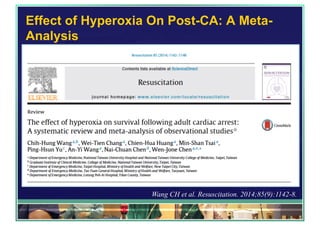
Effect of Hyperoxia On Post-CA: A Meta-
Analysis
Wang CH et al. Resuscitation. 2014;85(9):1142-8.
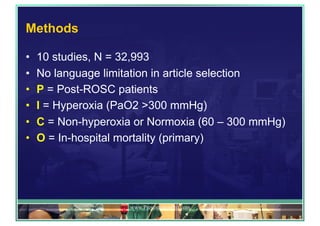
Methods
•  10 studies, N = 32,993
•  No language limitation in article selection
•  P = Post-ROSC patients
•  I = Hyperoxia (PaO2 >300 mmHg)
•  C = Non-hyperoxia or Normoxia (60 – 300 mmHg)
•  O = In-hospital mortality (primary)
www.PresentationPro.com
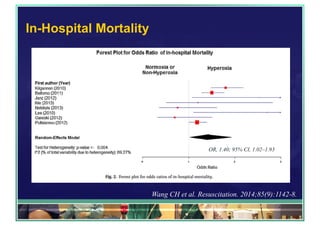
In-Hospital Mortality
Wang CH et al. Resuscitation. 2014;85(9):1142-8.
OR, 1.40; 95% CI, 1.02–1.93
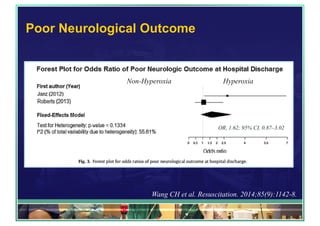
Poor Neurological Outcome
OR, 1.62; 95% CI, 0.87–3.02
HyperoxiaNon-Hyperoxia
Wang CH et al. Resuscitation. 2014;85(9):1142-8.
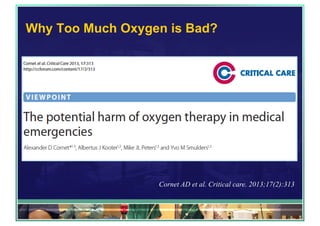
Why Too Much Oxygen is Bad?
Cornet AD et al. Critical care. 2013;17(2):313
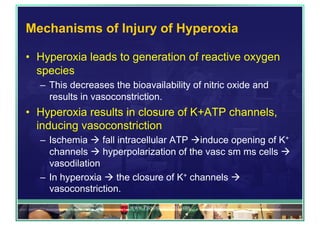
Mechanisms of Injury of Hyperoxia
•  Hyperoxia leads to generation of reactive oxygen
species
–  This decreases the bioavailability of nitric oxide and
results in vasoconstriction.
•  Hyperoxia results in closure of K+ATP channels,
inducing vasoconstriction
–  Ischemia ! fall intracellular ATP !induce opening of K+
channels ! hyperpolarization of the vasc sm ms cells !
vasodilation
–  In hyperoxia ! the closure of K+ channels !
vasoconstriction.
www.PresentationPro.com
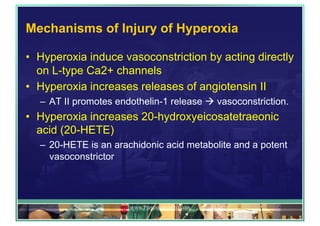
Mechanisms of Injury of Hyperoxia
•  Hyperoxia induce vasoconstriction by acting directly
on L-type Ca2+ channels
•  Hyperoxia increases releases of angiotensin II
–  AT II promotes endothelin-1 release ! vasoconstriction.
•  Hyperoxia increases 20-hydroxyeicosatetraeonic
acid (20-HETE)
–  20-HETE is an arachidonic acid metabolite and a potent
vasoconstrictor
www.PresentationPro.com
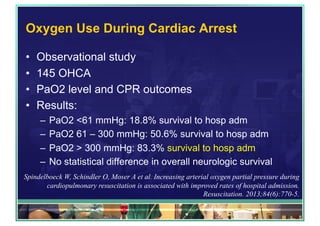
Oxygen Use During Cardiac Arrest
•  Observational study
•  145 OHCA
•  PaO2 level and CPR outcomes
•  Results:
–  PaO2 <61 mmHg: 18.8% survival to hosp adm
–  PaO2 61 – 300 mmHg: 50.6% survival to hosp adm
–  PaO2 > 300 mmHg: 83.3% survival to hosp adm
–  No statistical difference in overall neurologic survival
Spindelboeck W, Schindler O, Moser A et al. Increasing arterial oxygen partial pressure during
cardiopulmonary resuscitation is associated with improved rates of hospital admission.
Resuscitation. 2013;84(6):770-5.
Authors’ Conclusion
www.PresentationPro.com
We describe a significantly increased rate
of hospital admission associated with
increasing PaO2. We found that the
previously described potentially harmful
effects of hyperoxia after return of
spontaneous circulation were not
reproduced for PaO2 measured during
CPR.
AHA 2015 Guidelines
•  When supplementary oxygen is available, it may be
reasonable to use the maximal feasible inspired
oxygen concentration during CPR.
•  Evidence for possible detrimental effects of
hyperoxia in the immediate post-cardiac arrest
period should not be extrapolated to CPR context
www.PresentationPro.com
AHA 2015 Guidelines
Post-CPR:
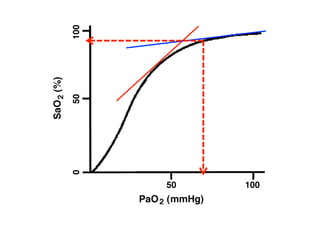
•  When resources are available to titrate FiO2, it is
reasonable to decrease FiO2 when SaO2 is 100%
provided the SaO2 is maintained at 94% or greater.
www.PresentationPro.com
Adrenaline
Theoretical Background
Adrenaline:
•  Alpha-adrenergic effect: vasoconstriction
•  Increase coronary perfusion pressure
•  Increase cerebral perfusion pressure
•  Beta-adrenergic effect: ? controversial
•  Increase myocardial work
•  Reduced subendocardial perfusion
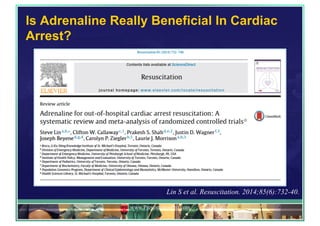
Is Adrenaline Really Beneficial In Cardiac
Arrest?
www.PresentationPro.com
Lin S et al. Resuscitation. 2014;85(6):732-40.
Meta-Analysis (Lin et al, 2014)
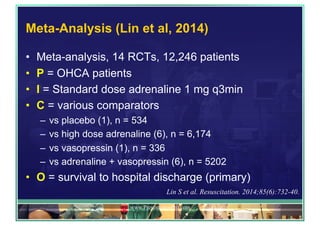
•  Meta-analysis, 14 RCTs, 12,246 patients
•  P = OHCA patients
•  I = Standard dose adrenaline 1 mg q3min
•  C = various comparators
–  vs placebo (1), n = 534
–  vs high dose adrenaline (6), n = 6,174
–  vs vasopressin (1), n = 336
–  vs adrenaline + vasopressin (6), n = 5202
•  O = survival to hospital discharge (primary)
www.PresentationPro.com
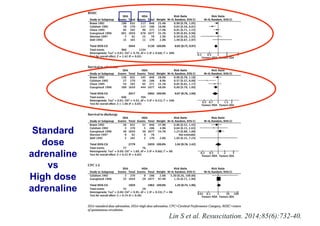
Lin S et al. Resuscitation. 2014;85(6):732-40.
Standard
dose
adrenaline
vs
High dose
adrenaline
www.PresentationPro.com
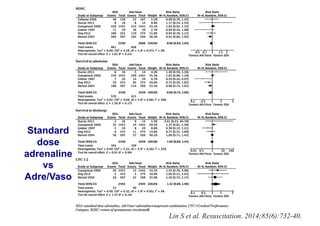
Lin S et al. Resuscitation. 2014;85(6):732-40.
Standard
dose
adrenaline
vs
Adre/Vaso
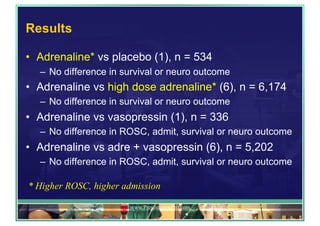
Results
•  Adrenaline* vs placebo (1), n = 534
–  No difference in survival or neuro outcome
•  Adrenaline vs high dose adrenaline* (6), n = 6,174
–  No difference in survival or neuro outcome
•  Adrenaline vs vasopressin (1), n = 336
–  No difference in ROSC, admit, survival or neuro outcome
•  Adrenaline vs adre + vasopressin (6), n = 5,202
–  No difference in ROSC, admit, survival or neuro outcome
www.PresentationPro.com
* Higher ROSC, higher admission
Authors’ Conclusion
“There was no clear advantage of SDA over placebo, HDA,
adrenaline and vasopressin combination, or vasopressin
alone, in survival to discharge or neurological outcomes
after OHCA. There were improvements in rates of survival to
admission and ROSC with HDA over SDA and with SDA over
placebo. Thus, the efficacy of vasopressor use in OHCA
remains unanswered. Future trials are needed to determine
the optimal dose of adrenaline for OHCA.”
*SDA = standard dose adrenaline;
HAD = high dose adrenaline Lin S et al. Resuscitation. 2014;85(6):732-40.
AHA 2015 Recommendations
•  Standard-dose epinephrine (1 mg every 3 to 5
minutes) may be reasonable for patients in cardiac
arrest (Class IIb, LOE B-R).
•  High-dose epinephrine is not recommended for
routine use in cardiac arrest (Class III: No Benefit,
LOE B-R).
How early should adrenaline be given?
•  IHCA
•  N = 25095, non-shockable rhythms.
•  Adjusted OR (survival to discharge):
–  OR = 1.0 for 1-3 min (reference group)
–  OR = 0.91 (95% CI 0.82 to 1.00; P=0.055) for 4-6 min
–  OR = 0.74 (95% CI 0.63 to 0.88; P<0.001) for 7-9 min
–  OR = 0.63 (95% CI 0.52 to 0.76; P<0.001) for >9 min
Donnino MW, Salciccioli JD, Howell MD, Cocchi MN, Giberson B, Berg K, et al. Time to
administration of epinephrine and outcome after in-hospital cardiac arrest with non
shockable rhythms: retrospective analysis of large in-hospital data registry. BMJ
2014;348:g3028.
OHCA setting
•  Shockable rhythm:
–  Cantrell et al (2013)
•  ROSC achiever: shorter scene arrival-to-first adrenaline than
non-ROSC (8.1 vs. 9.8 min, p < 0.01)
•  Non-shockable rhythm
–  Goto et al (2013), N = 209577
•  improved 1-month survival; adrenaline <9 min, EMS-initiated
CPR vs adrenaline >10 min
–  Nakahura et al (2012), N = 212228
•  improved survival to discharge; adrenaline<10 min, EMS-initiated
CPR vs no adrenaline
–  Koscik et al (2013), N = 686
•  improved ROSC in adrenaline <10 min, PEA
AHA 2015 Recommendations
•  For initial non-shockable rhythm: It may be
reasonable to administer adrenaline as soon as
feasible after the onset of cardiac arrest (Class IIb,
LOE C-LD).
•  For initial shockable rhyhtm: There is insufficient
evidence to make a recommendation as to the
optimal timing of adrenaline, particularly in relation
to defibrillation
www.PresentationPro.com
Anti-arrhythmic Drugs
Amiodarone vs Placebo (ARREST study)
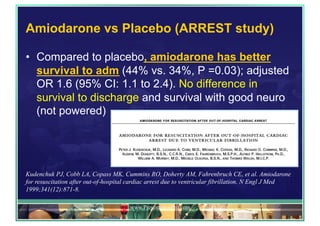
•  Compared to placebo, amiodarone has better
survival to adm (44% vs. 34%, P =0.03); adjusted
OR 1.6 (95% CI: 1.1 to 2.4). No difference in
survival to discharge and survival with good neuro
(not powered)
www.PresentationPro.com
Kudenchuk PJ, Cobb LA, Copass MK, Cummins RO, Doherty AM, Fahrenbruch CE, et al. Amiodarone
for resuscitation after out-of-hospital cardiac arrest due to ventricular fibrillation. N Engl J Med
1999;341(12):871-8.
Amiodarone vs Lidocaine (ALIVE)
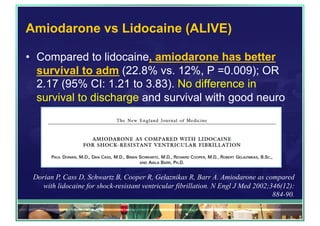
•  Compared to lidocaine, amiodarone has better
survival to adm (22.8% vs. 12%, P =0.009); OR
2.17 (95% CI: 1.21 to 3.83). No difference in
survival to discharge and survival with good neuro
Dorian P, Cass D, Schwartz B, Cooper R, Gelaznikas R, Barr A. Amiodarone as compared
with lidocaine for shock-resistant ventricular fibrillation. N Engl J Med 2002;346(12):
884-90.
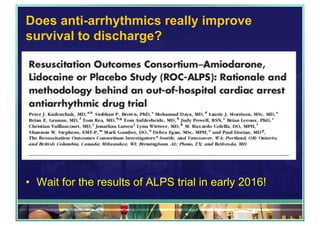
Does anti-arrhythmics really improve
survival to discharge?
•  Wait for the results of ALPS trial in early 2016!
AHA 2015 Recommendations
•  Amiodarone may be considered for VF/pVT that is
unresponsive to CPR, defibrillation, and a
vasopressor therapy (Class IIb, LOE B-R).
•  Lidocaine may be considered as an alternative to
amiodarone for VF/pVT that is unresponsive to
CPR, defibrillation, and vasopressor therapy (Class
IIb, LOE C-LD).
www.PresentationPro.com
AHA 2015 Recommendations
“…none (of the antiarrhythmics) have yet
been proven to increase long term
survival or survival with good neurologic
outcome. Thus establishing vascular
access to enable drug administration
should not compromise the quality of CPR
or timely defibrillation, which are known to
improve survival.”
AHA 2015 Recommendations on
Ultrasound Use
Ultrasound (cardiac or noncardiac )may be
considered during the management of
cardiac arrest, although its usefulness has
not been well established (Class IIb, LOE C-
EO). If a qualified sonographer is present and
use of ultrasound does not interfere with the
standard cardiac arrest treatment protocol,
then ultrasound may be considered as an
adjunct to standard patient evaluation (Class
IIb, LOE C-EO).
Therapeutic Hypothermia
Why Therapeutic Hypothermia?
1.  reduce the cerebral metabolic rate for oxygen
(CMRO2) (6% for q1°C reduction in brain
temperature >28°C)
2.  suppression of free radical production in
reperfusion injury
3.  suppression of excitatory amino acids release,
and calcium shifts, which can in turn lead to
mitochondrial damage and apoptosis
•  Adverse effects: arrhythmias, infection, and
coagulopathy. Nolan JP. et al. Circulation. 2003;108(1):118-21.
Historical Perspective
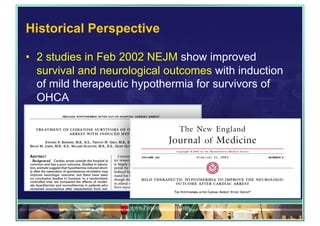
•  2 studies in Feb 2002 NEJM show improved
survival and neurological outcomes with induction
of mild therapeutic hypothermia for survivors of
OHCA
www.PresentationPro.com
Historical Perspective
•  The Hypothermia after Cardiac Arrest Study Group
study – OHCA with ROSC: 32-34ºC over 24 hours
(n=137) improved functional recovery at discharge
(55% vs 39%; NNT = 6), lower 6-mo mortality rate
vs with normothermic patients (41% vs 55%)
(NNT=7)
•  In Bernard et al, 77 OHCA with ROSC: hypothermia
(33°C for 12 hours) vs normothermia: Good neuro
at discharge in 49% of hypothermic patients vs 26%
normothermic
www.PresentationPro.com
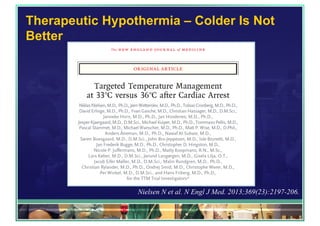
Therapeutic Hypothermia – Colder Is Not
Better
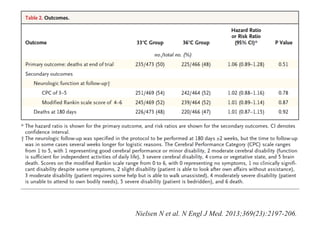
Nielsen N et al. N Engl J Med. 2013;369(23):2197-206.
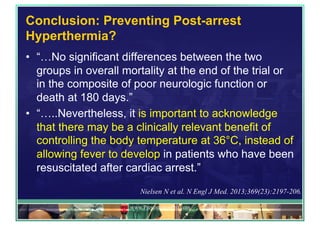
Conclusion: Preventing Post-arrest
Hyperthermia?
•  “…No significant differences between the two
groups in overall mortality at the end of the trial or
in the composite of poor neurologic function or
death at 180 days.”
•  “…..Nevertheless, it is important to acknowledge
that there may be a clinically relevant benefit of
controlling the body temperature at 36°C, instead of
allowing fever to develop in patients who have been
resuscitated after cardiac arrest.”
www.PresentationPro.com
Nielsen N et al. N Engl J Med. 2013;369(23):2197-206.
New therapy in cardiac
arrest:
Combo of adrenaline-
vasopressin-steroids?
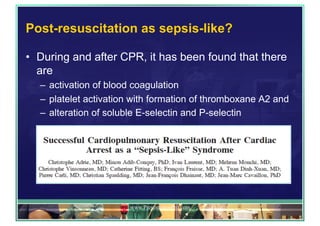
Post-resuscitation as sepsis-like?
•  During and after CPR, it has been found that there
are
–  activation of blood coagulation
–  platelet activation with formation of thromboxane A2 and
–  alteration of soluble E-selectin and P-selectin
www.PresentationPro.com
Post-resuscitation as sepsis-like?
•  Four phases post-resuscitation:
1. First 24 hrs - microcirculatory dysfunction from
multifocal hypoxia leading to rapid release of toxic
enzymes & free radicals into CSF and blood
2. 1 to 3 days - cardiac function & systemic function
improved, but increased intestinal permeability
predisposes to sepsis syndrome and MODS
3. Days later – serious infection, patient declines
rapidly
4. Death
www.PresentationPro.com
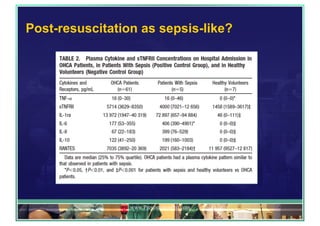
Post-resuscitation as sepsis-like?
www.PresentationPro.com
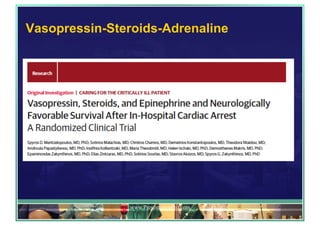
Vasopressin-Steroids-Adrenaline
www.PresentationPro.com
Vasopressin
•  Non-survivors of CPR have lower plasma
vasopressin level compared to those who survived
•  Vasopressin acts directly on V1 receptors on
vascular contractile elements
•  In cardiac arrest, vasopressin is released as
adjunct vasopressor to adrenaline
www.PresentationPro.com
Steroids
•  Cardiac arrest – lower cortisol levels during and
after CPR
•  ROSC is associated with increased plasma
cytokine elevation, endotoxemia, coagulopathy,
adrenal insufficiency resulting in post-resus shock
•  Steroids may be beneficial to improve
hemodynamics and reduce intensity of post-resus
SIRS and MODS
www.PresentationPro.com
Vasopressin-steroids-epinephrine (VSE)
Mentzelopoulus et al (2013)
•  P = In-hospital cardiac arrest
•  I = VSE
•  C = saline-placebo
•  O = ROSC for > 20 min
•  = Survival to discharge with good neuro
www.PresentationPro.com
VSE vs control
•  VSE – higher ROSC > 20 min (83.9% vs 65.9%;
OR, 2.98; 95%CI, 1.39-6.40; P = 0.005)
•  VSE – higher survival to discharge with good neuro
(CPC score of 1 or 2) (13.9% vs 5.1%; OR, 3.28;
95%CI, 1.17-9.20; P = 0.02).
•  Post-resus shock: VSE – higher survival to
discharge with good neuro (21.1% vs 8.2%; OR
3.74; 95% CI 1.20 – 11.62; p = 0.02), improved
hemodynamics; less oran dysfunction
Post-resus shock: sustained post-resus shock >4 hours or required >50% increase of
vasopressor to maintain MAP>70 mmHg post-resus
Thank You For Your Attention

ACLS 2015 Updates - The Malaysian Perspective

  • 1.
    Advanced Cardiac Life SupportUpdates 2015 (The Malaysian Perspective) K.S. Chew, MD, MMED School of Medical Sciences, Universiti Sains Malaysia
  • 2.
    Conflict of Interest • No conflict of interest to declare.
  • 3.
    Downloads www.PresentationPro.com To download thisslide and much more, go to: emergencymedic.blogspot.com
  • 4.
  • 5.
    1 •  Take outyour smartphone 2 •  Make sure you are connected 3 •  Go to: pollev.com/cksheng74 www.PresentationPro.com
  • 8.
    Effect of HyperoxiaOn Post-CA: A Meta- Analysis Wang CH et al. Resuscitation. 2014;85(9):1142-8.
  • 9.
    Methods •  10 studies,N = 32,993 •  No language limitation in article selection •  P = Post-ROSC patients •  I = Hyperoxia (PaO2 >300 mmHg) •  C = Non-hyperoxia or Normoxia (60 – 300 mmHg) •  O = In-hospital mortality (primary) www.PresentationPro.com
  • 10.
    In-Hospital Mortality Wang CHet al. Resuscitation. 2014;85(9):1142-8. OR, 1.40; 95% CI, 1.02–1.93
  • 11.
    Poor Neurological Outcome OR,1.62; 95% CI, 0.87–3.02 HyperoxiaNon-Hyperoxia Wang CH et al. Resuscitation. 2014;85(9):1142-8.
  • 12.
    Why Too MuchOxygen is Bad? Cornet AD et al. Critical care. 2013;17(2):313
  • 13.
    Mechanisms of Injuryof Hyperoxia •  Hyperoxia leads to generation of reactive oxygen species –  This decreases the bioavailability of nitric oxide and results in vasoconstriction. •  Hyperoxia results in closure of K+ATP channels, inducing vasoconstriction –  Ischemia ! fall intracellular ATP !induce opening of K+ channels ! hyperpolarization of the vasc sm ms cells ! vasodilation –  In hyperoxia ! the closure of K+ channels ! vasoconstriction. www.PresentationPro.com
  • 14.
    Mechanisms of Injuryof Hyperoxia •  Hyperoxia induce vasoconstriction by acting directly on L-type Ca2+ channels •  Hyperoxia increases releases of angiotensin II –  AT II promotes endothelin-1 release ! vasoconstriction. •  Hyperoxia increases 20-hydroxyeicosatetraeonic acid (20-HETE) –  20-HETE is an arachidonic acid metabolite and a potent vasoconstrictor www.PresentationPro.com
  • 15.
  • 16.
    Oxygen Use DuringCardiac Arrest •  Observational study •  145 OHCA •  PaO2 level and CPR outcomes •  Results: –  PaO2 <61 mmHg: 18.8% survival to hosp adm –  PaO2 61 – 300 mmHg: 50.6% survival to hosp adm –  PaO2 > 300 mmHg: 83.3% survival to hosp adm –  No statistical difference in overall neurologic survival Spindelboeck W, Schindler O, Moser A et al. Increasing arterial oxygen partial pressure during cardiopulmonary resuscitation is associated with improved rates of hospital admission. Resuscitation. 2013;84(6):770-5.
  • 17.
    Authors’ Conclusion www.PresentationPro.com We describea significantly increased rate of hospital admission associated with increasing PaO2. We found that the previously described potentially harmful effects of hyperoxia after return of spontaneous circulation were not reproduced for PaO2 measured during CPR.
  • 18.
    AHA 2015 Guidelines • When supplementary oxygen is available, it may be reasonable to use the maximal feasible inspired oxygen concentration during CPR. •  Evidence for possible detrimental effects of hyperoxia in the immediate post-cardiac arrest period should not be extrapolated to CPR context www.PresentationPro.com
  • 19.
    AHA 2015 Guidelines Post-CPR: • When resources are available to titrate FiO2, it is reasonable to decrease FiO2 when SaO2 is 100% provided the SaO2 is maintained at 94% or greater. www.PresentationPro.com
  • 20.
  • 21.
    Theoretical Background Adrenaline: •  Alpha-adrenergiceffect: vasoconstriction •  Increase coronary perfusion pressure •  Increase cerebral perfusion pressure •  Beta-adrenergic effect: ? controversial •  Increase myocardial work •  Reduced subendocardial perfusion
  • 23.
    Is Adrenaline ReallyBeneficial In Cardiac Arrest? www.PresentationPro.com Lin S et al. Resuscitation. 2014;85(6):732-40.
  • 24.
    Meta-Analysis (Lin etal, 2014) •  Meta-analysis, 14 RCTs, 12,246 patients •  P = OHCA patients •  I = Standard dose adrenaline 1 mg q3min •  C = various comparators –  vs placebo (1), n = 534 –  vs high dose adrenaline (6), n = 6,174 –  vs vasopressin (1), n = 336 –  vs adrenaline + vasopressin (6), n = 5202 •  O = survival to hospital discharge (primary) www.PresentationPro.com Lin S et al. Resuscitation. 2014;85(6):732-40.
  • 25.
    Lin S etal. Resuscitation. 2014;85(6):732-40. Standard dose adrenaline vs High dose adrenaline
  • 26.
    www.PresentationPro.com Lin S etal. Resuscitation. 2014;85(6):732-40. Standard dose adrenaline vs Adre/Vaso
  • 27.
    Results •  Adrenaline* vsplacebo (1), n = 534 –  No difference in survival or neuro outcome •  Adrenaline vs high dose adrenaline* (6), n = 6,174 –  No difference in survival or neuro outcome •  Adrenaline vs vasopressin (1), n = 336 –  No difference in ROSC, admit, survival or neuro outcome •  Adrenaline vs adre + vasopressin (6), n = 5,202 –  No difference in ROSC, admit, survival or neuro outcome www.PresentationPro.com * Higher ROSC, higher admission
  • 28.
    Authors’ Conclusion “There wasno clear advantage of SDA over placebo, HDA, adrenaline and vasopressin combination, or vasopressin alone, in survival to discharge or neurological outcomes after OHCA. There were improvements in rates of survival to admission and ROSC with HDA over SDA and with SDA over placebo. Thus, the efficacy of vasopressor use in OHCA remains unanswered. Future trials are needed to determine the optimal dose of adrenaline for OHCA.” *SDA = standard dose adrenaline; HAD = high dose adrenaline Lin S et al. Resuscitation. 2014;85(6):732-40.
  • 29.
    AHA 2015 Recommendations • Standard-dose epinephrine (1 mg every 3 to 5 minutes) may be reasonable for patients in cardiac arrest (Class IIb, LOE B-R). •  High-dose epinephrine is not recommended for routine use in cardiac arrest (Class III: No Benefit, LOE B-R).
  • 30.
    How early shouldadrenaline be given? •  IHCA •  N = 25095, non-shockable rhythms. •  Adjusted OR (survival to discharge): –  OR = 1.0 for 1-3 min (reference group) –  OR = 0.91 (95% CI 0.82 to 1.00; P=0.055) for 4-6 min –  OR = 0.74 (95% CI 0.63 to 0.88; P<0.001) for 7-9 min –  OR = 0.63 (95% CI 0.52 to 0.76; P<0.001) for >9 min Donnino MW, Salciccioli JD, Howell MD, Cocchi MN, Giberson B, Berg K, et al. Time to administration of epinephrine and outcome after in-hospital cardiac arrest with non shockable rhythms: retrospective analysis of large in-hospital data registry. BMJ 2014;348:g3028.
  • 31.
    OHCA setting •  Shockablerhythm: –  Cantrell et al (2013) •  ROSC achiever: shorter scene arrival-to-first adrenaline than non-ROSC (8.1 vs. 9.8 min, p < 0.01) •  Non-shockable rhythm –  Goto et al (2013), N = 209577 •  improved 1-month survival; adrenaline <9 min, EMS-initiated CPR vs adrenaline >10 min –  Nakahura et al (2012), N = 212228 •  improved survival to discharge; adrenaline<10 min, EMS-initiated CPR vs no adrenaline –  Koscik et al (2013), N = 686 •  improved ROSC in adrenaline <10 min, PEA
  • 32.
    AHA 2015 Recommendations • For initial non-shockable rhythm: It may be reasonable to administer adrenaline as soon as feasible after the onset of cardiac arrest (Class IIb, LOE C-LD). •  For initial shockable rhyhtm: There is insufficient evidence to make a recommendation as to the optimal timing of adrenaline, particularly in relation to defibrillation www.PresentationPro.com
  • 36.
  • 37.
    Amiodarone vs Placebo(ARREST study) •  Compared to placebo, amiodarone has better survival to adm (44% vs. 34%, P =0.03); adjusted OR 1.6 (95% CI: 1.1 to 2.4). No difference in survival to discharge and survival with good neuro (not powered) www.PresentationPro.com Kudenchuk PJ, Cobb LA, Copass MK, Cummins RO, Doherty AM, Fahrenbruch CE, et al. Amiodarone for resuscitation after out-of-hospital cardiac arrest due to ventricular fibrillation. N Engl J Med 1999;341(12):871-8.
  • 38.
    Amiodarone vs Lidocaine(ALIVE) •  Compared to lidocaine, amiodarone has better survival to adm (22.8% vs. 12%, P =0.009); OR 2.17 (95% CI: 1.21 to 3.83). No difference in survival to discharge and survival with good neuro Dorian P, Cass D, Schwartz B, Cooper R, Gelaznikas R, Barr A. Amiodarone as compared with lidocaine for shock-resistant ventricular fibrillation. N Engl J Med 2002;346(12): 884-90.
  • 39.
    Does anti-arrhythmics reallyimprove survival to discharge? •  Wait for the results of ALPS trial in early 2016!
  • 40.
    AHA 2015 Recommendations • Amiodarone may be considered for VF/pVT that is unresponsive to CPR, defibrillation, and a vasopressor therapy (Class IIb, LOE B-R). •  Lidocaine may be considered as an alternative to amiodarone for VF/pVT that is unresponsive to CPR, defibrillation, and vasopressor therapy (Class IIb, LOE C-LD). www.PresentationPro.com
  • 41.
    AHA 2015 Recommendations “…none(of the antiarrhythmics) have yet been proven to increase long term survival or survival with good neurologic outcome. Thus establishing vascular access to enable drug administration should not compromise the quality of CPR or timely defibrillation, which are known to improve survival.”
  • 42.
    AHA 2015 Recommendationson Ultrasound Use Ultrasound (cardiac or noncardiac )may be considered during the management of cardiac arrest, although its usefulness has not been well established (Class IIb, LOE C- EO). If a qualified sonographer is present and use of ultrasound does not interfere with the standard cardiac arrest treatment protocol, then ultrasound may be considered as an adjunct to standard patient evaluation (Class IIb, LOE C-EO).
  • 43.
  • 44.
    Why Therapeutic Hypothermia? 1. reduce the cerebral metabolic rate for oxygen (CMRO2) (6% for q1°C reduction in brain temperature >28°C) 2.  suppression of free radical production in reperfusion injury 3.  suppression of excitatory amino acids release, and calcium shifts, which can in turn lead to mitochondrial damage and apoptosis •  Adverse effects: arrhythmias, infection, and coagulopathy. Nolan JP. et al. Circulation. 2003;108(1):118-21.
  • 45.
    Historical Perspective •  2studies in Feb 2002 NEJM show improved survival and neurological outcomes with induction of mild therapeutic hypothermia for survivors of OHCA www.PresentationPro.com
  • 46.
    Historical Perspective •  TheHypothermia after Cardiac Arrest Study Group study – OHCA with ROSC: 32-34ºC over 24 hours (n=137) improved functional recovery at discharge (55% vs 39%; NNT = 6), lower 6-mo mortality rate vs with normothermic patients (41% vs 55%) (NNT=7) •  In Bernard et al, 77 OHCA with ROSC: hypothermia (33°C for 12 hours) vs normothermia: Good neuro at discharge in 49% of hypothermic patients vs 26% normothermic www.PresentationPro.com
  • 47.
    Therapeutic Hypothermia –Colder Is Not Better Nielsen N et al. N Engl J Med. 2013;369(23):2197-206.
  • 48.
    Nielsen N etal. N Engl J Med. 2013;369(23):2197-206.
  • 49.
    Conclusion: Preventing Post-arrest Hyperthermia? • “…No significant differences between the two groups in overall mortality at the end of the trial or in the composite of poor neurologic function or death at 180 days.” •  “…..Nevertheless, it is important to acknowledge that there may be a clinically relevant benefit of controlling the body temperature at 36°C, instead of allowing fever to develop in patients who have been resuscitated after cardiac arrest.” www.PresentationPro.com Nielsen N et al. N Engl J Med. 2013;369(23):2197-206.
  • 52.
    New therapy incardiac arrest: Combo of adrenaline- vasopressin-steroids?
  • 53.
    Post-resuscitation as sepsis-like? • During and after CPR, it has been found that there are –  activation of blood coagulation –  platelet activation with formation of thromboxane A2 and –  alteration of soluble E-selectin and P-selectin www.PresentationPro.com
  • 54.
    Post-resuscitation as sepsis-like? • Four phases post-resuscitation: 1. First 24 hrs - microcirculatory dysfunction from multifocal hypoxia leading to rapid release of toxic enzymes & free radicals into CSF and blood 2. 1 to 3 days - cardiac function & systemic function improved, but increased intestinal permeability predisposes to sepsis syndrome and MODS 3. Days later – serious infection, patient declines rapidly 4. Death www.PresentationPro.com
  • 55.
  • 56.
  • 57.
    Vasopressin •  Non-survivors ofCPR have lower plasma vasopressin level compared to those who survived •  Vasopressin acts directly on V1 receptors on vascular contractile elements •  In cardiac arrest, vasopressin is released as adjunct vasopressor to adrenaline www.PresentationPro.com
  • 58.
    Steroids •  Cardiac arrest– lower cortisol levels during and after CPR •  ROSC is associated with increased plasma cytokine elevation, endotoxemia, coagulopathy, adrenal insufficiency resulting in post-resus shock •  Steroids may be beneficial to improve hemodynamics and reduce intensity of post-resus SIRS and MODS www.PresentationPro.com
  • 59.
    Vasopressin-steroids-epinephrine (VSE) Mentzelopoulus etal (2013) •  P = In-hospital cardiac arrest •  I = VSE •  C = saline-placebo •  O = ROSC for > 20 min •  = Survival to discharge with good neuro www.PresentationPro.com
  • 60.
    VSE vs control • VSE – higher ROSC > 20 min (83.9% vs 65.9%; OR, 2.98; 95%CI, 1.39-6.40; P = 0.005) •  VSE – higher survival to discharge with good neuro (CPC score of 1 or 2) (13.9% vs 5.1%; OR, 3.28; 95%CI, 1.17-9.20; P = 0.02). •  Post-resus shock: VSE – higher survival to discharge with good neuro (21.1% vs 8.2%; OR 3.74; 95% CI 1.20 – 11.62; p = 0.02), improved hemodynamics; less oran dysfunction Post-resus shock: sustained post-resus shock >4 hours or required >50% increase of vasopressor to maintain MAP>70 mmHg post-resus
  • 61.
    Thank You ForYour Attention