CHRONIC OBSTRUCTIVE
       PULMONARY DISEASE:

The New Malaysian 2nd Edition CPG – Its Importance
   From The Perspective of Emergency Medicine


                 K S CHEW
         School of Medical Sciences
          Universiti Sains Malaysia
FREE DOWNLOAD at:
Malaysian Thoracic Society Website
http://www.mts.org.my/resources.html
DEFINITION
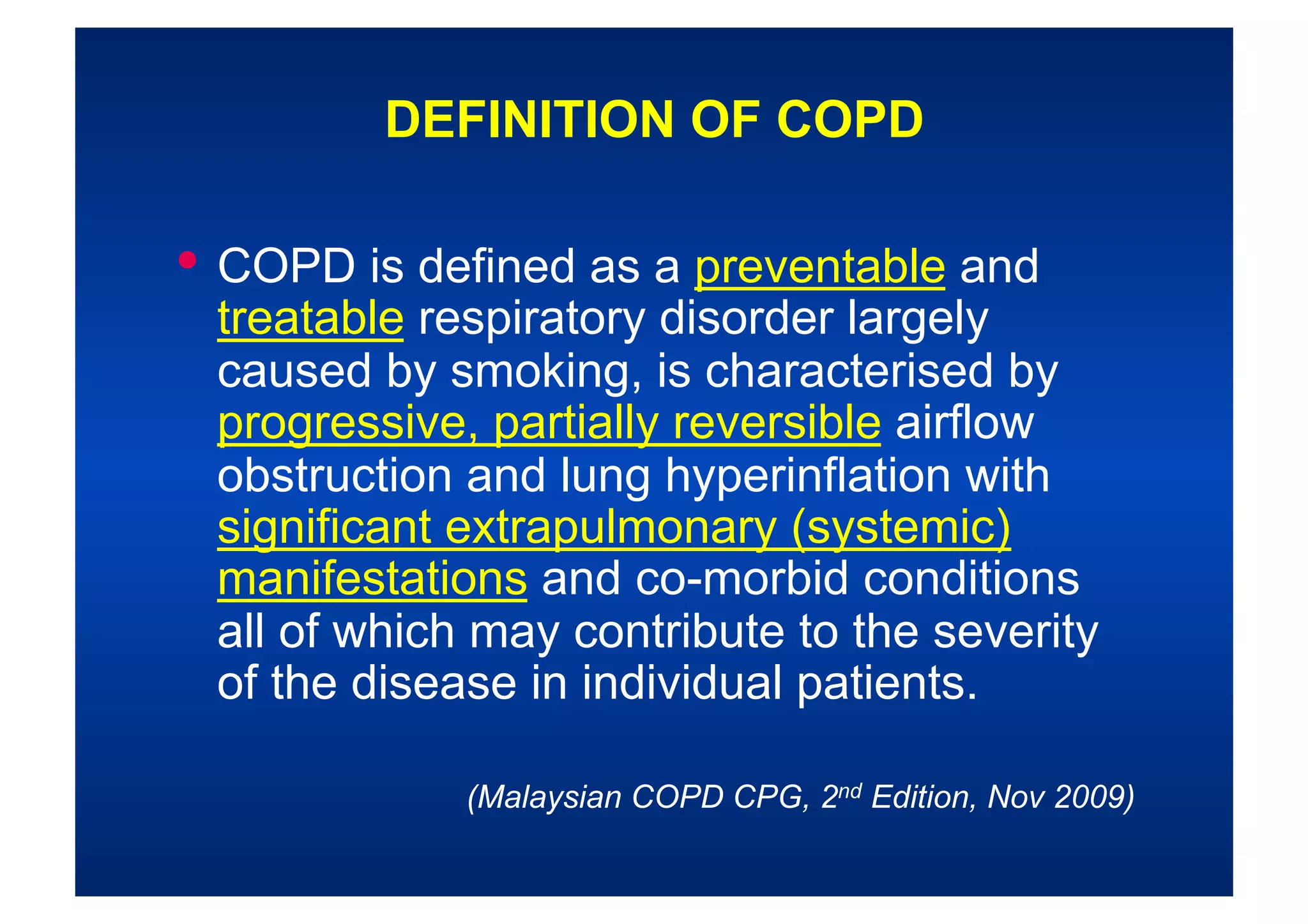
DEFINITION OF COPD

•  COPD is defined as a preventable and
 treatable respiratory disorder largely
 caused by smoking, is characterised by
 progressive, partially reversible airflow
 obstruction and lung hyperinflation with
 significant extrapulmonary (systemic)
 manifestations and co-morbid conditions
 all of which may contribute to the severity
 of the disease in individual patients.

             (Malaysian COPD CPG, 2nd Edition, Nov 2009)
SYSTEMIC EFFECTS OF COPD

     •  Several recent studies have clearly shown
         that COPD is associated not only with an
         abnormal inflammatory response of the
         lung parenchyma but also with evidence of
         systemic inflammation, including systemic
         oxidative stress, activation of circulating
         inflammatory cells and increased levels of
         pro-inflammatory cytokines


Agusti AG. Systemic effects of chronic obstructive pulmonary disease. Proc Am Thorac Soc 2005;
                                                                   2 (4):367-70; discussion 71-2.
Examples of Co-morbidities Associated
             With COPD


•  Ischaemic heart disease
•  Osteopenia, osteoporosis and bone
   fractures
•  Cachexia and malnutrition
•  Normochromic normocytic anaemia
•  Skeletal muscle wasting and peripheral
   muscle dysfunction
SYSTEMIC EFFECTS OF COPD

     •  Various studies have shown that the lung
         inflammatory response is characterised by
          •  increased numbers of neutrophils, macrophages
             and T-lymphocytes with a CD8+ predominance
          •  augmented concentrations of proinflammatory
             cytokines, such as leukotriene B4, interleukin
             (IL)-8 and tumour necrosis factor (TNF)-a
          •  evidence of oxidative stress caused by the
             inhalation of oxidants (tobacco smoke) and/or the
             activated inflammatory


Agusti AG. Systemic effects of chronic obstructive pulmonary disease. Proc Am Thorac Soc 2005;
                                                                   2 (4):367-70; discussion 71-2.
WHY SYSTEMIC EFFECTS?

     Hypothesis
     •  The tobacco smoke alone causes
        oxidative stress
     •  The pulmonary inflammatory process in
        the lung itself is the source of these
        systemic inflammation.
     •  The increased surface expression of
        several neutrophil adhesion molecules
        may be due to genetic predisposition

Agusti AG. Systemic effects of chronic obstructive pulmonary disease. Proc Am Thorac Soc 2005;
                                                                   2 (4):367-70; discussion 71-2.
DISEASE BURDEN
COPD is projected to be the third
        biggest cause of mortality by 2020
               1990                            2020
  Ischaemic heart disease     1st    Ischaemic heart disease
   Cardiovascular disease     2nd    Cardiovascular disease
Lower respiratory infection   3rd    COPD
        Diarrhoeal disease    4th    Lower respiratory infection
        Perinatal disorders   5th    Lung cancer
                      COPD    6th    Road traffic accident
              Tuberculosis    7th    Tuberculosis
                  Measles     8th    Stomach cancer
      Road traffic accident   9th    HIV
              Lung cancer     10th   Suicide


                                            Murray CJ & Lopez AD. Lancet 1997;349:1498–1504.
Percent Change in Age-Adjusted Death
          Rates, U.S., 1965-1998

       Proportion of 1965 Rate

3.0

        Coronary                 Stroke   Other CVD   COPD         All Other
2.5      Heart                                                     Causes
        Disease
2.0


1.5


1.0


0.5


 0
           –59%                  –64%       –35%      +163%           –7%
      1965 - 1998 1965 - 1998 1965 - 1998 1965 - 1998 1965 - 1998
                                                       Source: NHLBI/NIH/DHHS
Model Projections of Moderate-Severe
 COPD in Population Aged ≥ 30 Years


               (Malaysian COPD CPG, 2nd Edition, Nov 2009)
PATHOPHYSIOLOGY
INFLAMMATION IN COPD


 SMALL AIRWAY              PARENCHYMAL
   DISEASE                  DESTRUCTION
Airway Inflammation        Loss of alveolar
                             attachment
Airway Remodeling
                       Decrease of elastic recoil


            AIRFLOW LIMITATION
Pathogenesis of
  COPD

     Host factors
Amplifying mechanisms


       Source: Peter J. Barnes, MD
Inflammatory Cells Involved in COPD


                                      Source: Peter J. Barnes, MD
Oxidative Stress in COPD
                           Macrophage Neutrophil


  Anti-proteases
   SLPI α1-AT

    Proteolysis


                                  Plasma leak     Bronchoconstriction

   ↑ Mucus secretion
                                                Source: Peter J. Barnes, MD
Inflammation plays a central role in the
     pathogenesis and pathology of COPD


                                                                         Cigarette smoke
                                                                            (and other irritants)
Genetic susceptibility


                                                                                        Lung Inflammation
                                                                                          • Inflammatory  cells
                                                                                          • Inflammatory mediators
                                                                                          • Oxidative stress
                                                                                          • Proteases


                                            COPD pathology
          Obstructive                               Mucus                                      Alveolar
          bronchiolitis                          hypersecretion                            wall destruction


      Adapted from Global Initiative for Chronic Obstructive Lung Disease (GOLD) Guidelines, 2009. Available from http://www.goldcopd.com/
DIAGNOSIS AND
CLASSIFICATION OF SEVERITY
DIAGNOSIS


•  Spirometry is essential for the diagnosis of
  COPD.

•  The diagnosis should be confirmed by
  spirometry showing a post-bronchodilator
  FEV1/FVC ratio of less than 70%.


                    (Malaysian COPD CPG, 2nd Edition, Nov 2009)
DIAGNOSIS

•  A clinical diagnosis of COPD should be
   considered in any individual with
   symptoms of chronic cough, sputum
   production or dyspnoea and a history of
   exposure to risk factors for the disease,
   especially cigarette smoking.
•  But every effort should be made to refer
   the patient for spirometry to confirm the
   diagnosis.

                    (Malaysian COPD CPG, 2nd Edition, Nov 2009)
CLASSIFICATION
   OF COPD
   SEVERITY


Spirometry is essential
for the diagnosis of
COPD and is useful for
assessment of the
severity of airflow
obstruction (Grade C)


 (Malaysian COPD CPG,
  2nd Edition, Nov 2009)
The Modified Medical Research Council
      (MMRC) Dyspnoea Scale


                (Malaysian COPD CPG, 2nd Edition, Nov 2009)
Classification of
COPD Severity Based
   on Spirometric
  Impairment and
     Symptoms


  (Malaysian COPD CPG,
   2nd Edition, Nov 2009)
Reversible            Irreversible

             Source: Peter J. Barnes, MD
(Malaysian COPD CPG, 2nd Edition, Nov 2009)
RISK FACTORS
RISK FACTORS


   (Malaysian COPD CPG, 2nd Edition, Nov 2009)
RISK FACTORS


•  Cigarette smoking is the best known and
   most studied risk factor for COPD.
•  About 15% of smokers develop COPD.
•  However, tobacco smoke is the risk factor
   for as much as 90% of the cases of
   COPD.
•  Non-smokers may also develop the
   disease
                   (Malaysian COPD CPG, 2nd Edition, Nov 2009)
TOBACCO SMOKE


•  Some studies have suggested that women
   are more susceptible to the effects of
   tobacco smoke than men
•  Quantification of tobacco consumption:
   total pack-years = (number of cigarettes
   smoked per day ÷ 20) x number of years
   of smoking


                   (Malaysian COPD CPG, 2nd Edition, Nov 2009)
TOBACCO SMOKE


•  Smoking cessation is the single most
  effective - and cost effective - intervention
  to reduce the risk of developing COPD and
  stop its progression.

•  Even a brief (three-minute) period of
  counselling to urge a smoker to quit results
  in smoking cessation rates of 5-10%.

                    (Malaysian COPD CPG, 2nd Edition, Nov 2009)
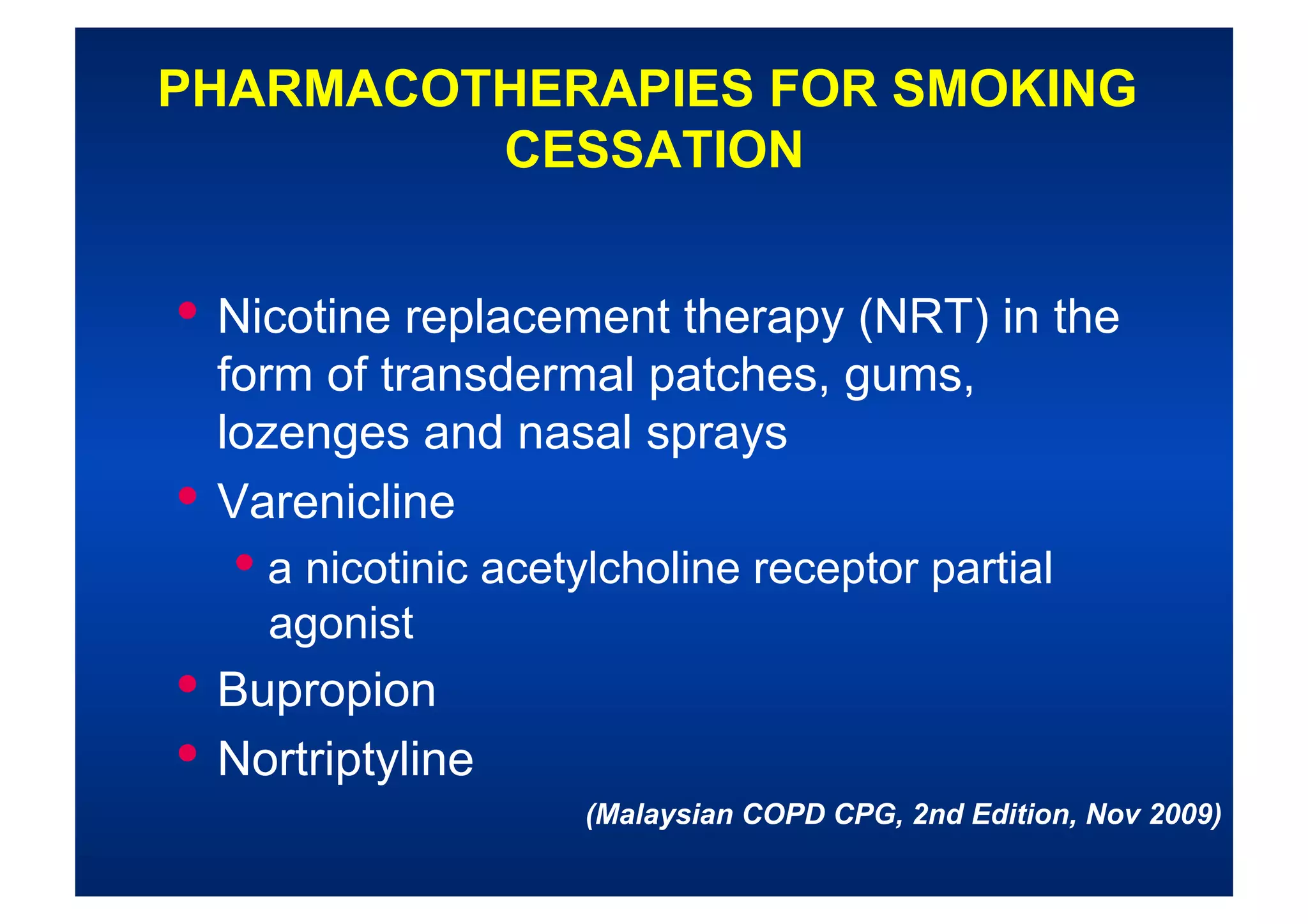
PHARMACOTHERAPIES FOR SMOKING
         CESSATION


•  Nicotine replacement therapy (NRT) in the
   form of transdermal patches, gums,
   lozenges and nasal sprays
•  Varenicline
   •  a nicotinic acetylcholine receptor partial
     agonist
•  Bupropion
•  Nortriptyline
                      (Malaysian COPD CPG, 2nd Edition, Nov 2009)
5’A’s FOR SMOKING CESSATION


           (Malaysian COPD CPG, 2nd Edition, Nov 2009)
VICIOUS CIRCLE HYPOTHESIS:
HOW INFECTION CONTRIBUTE TO THE
 PATHOGENESIS AND PROGRESSION
             OF COPD


             (Malaysian COPD CPG, 2nd Edition, Nov 2009)
MANAGEMENT OF STABLE COPD
    AND EXACERBATIONS
(Malaysian COPD CPG, 2nd
         Edition, Nov 2009)
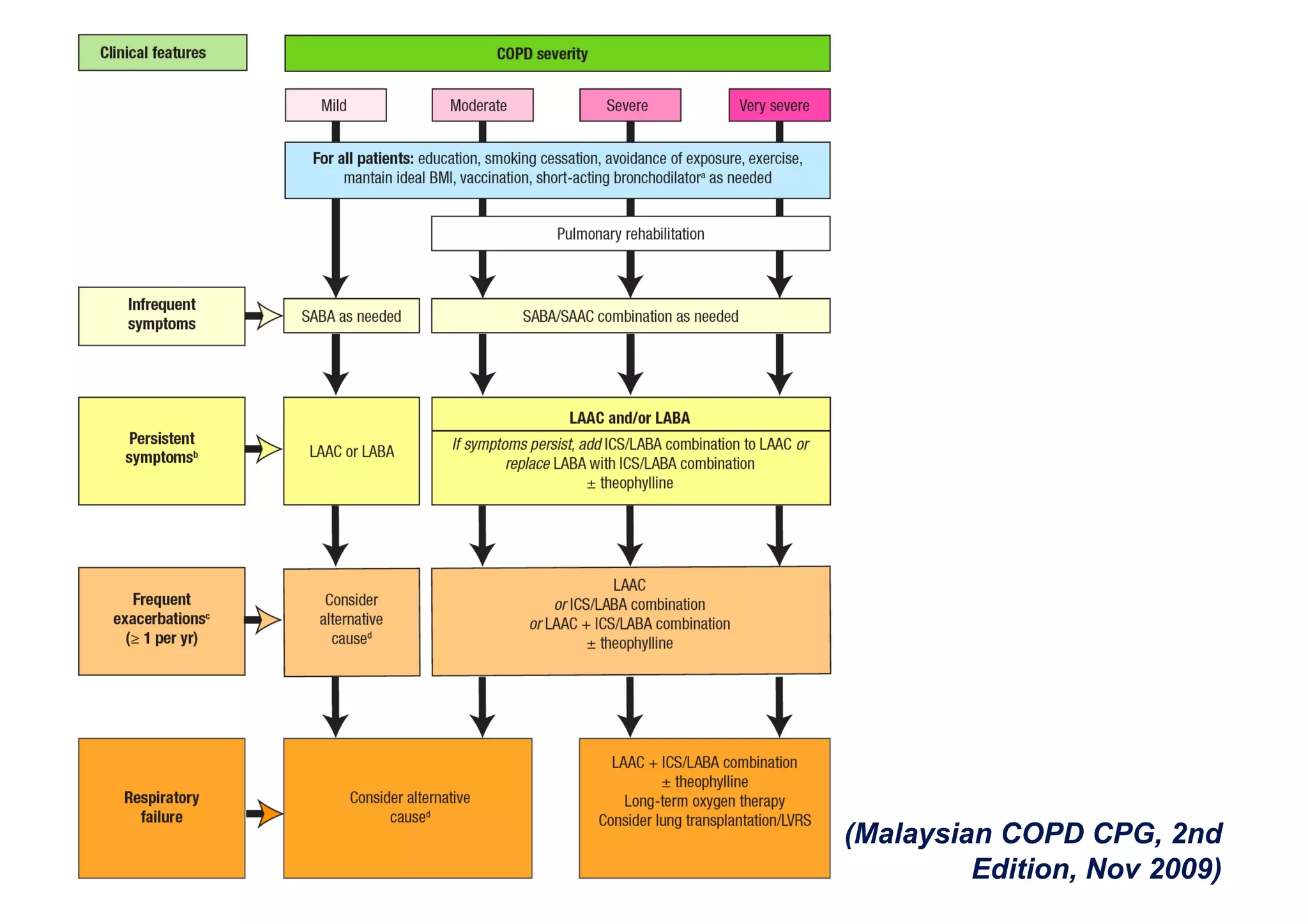
MANAGING STABLE COPD


•  COPD patients at any stage of disease
   severity should be advised to quit smoking
   if they still smoke. [Grade A]
•  In patients with mild COPD who are
   symptomatic, SABA or SAAC or a
   combination of both may be prescribed


                   (Malaysian COPD CPG, 2nd Edition, Nov 2009)
MANAGING STABLE COPD


•  In patients with moderate to very severe
   COPD with persistent symptoms, but
   without frequent COPD exacerbations,
   either a LAAC or LABA may be initiated.
•  If symptoms persist despite this treatment,
   an ICS/LABA combination should be
   added; and vice versa. [Grade A]

                   (Malaysian COPD CPG, 2nd Edition, Nov 2009)
INDICATIONS FOR HOSPITALISATION


             (Malaysian COPD CPG, 2nd Edition, Nov 2009)
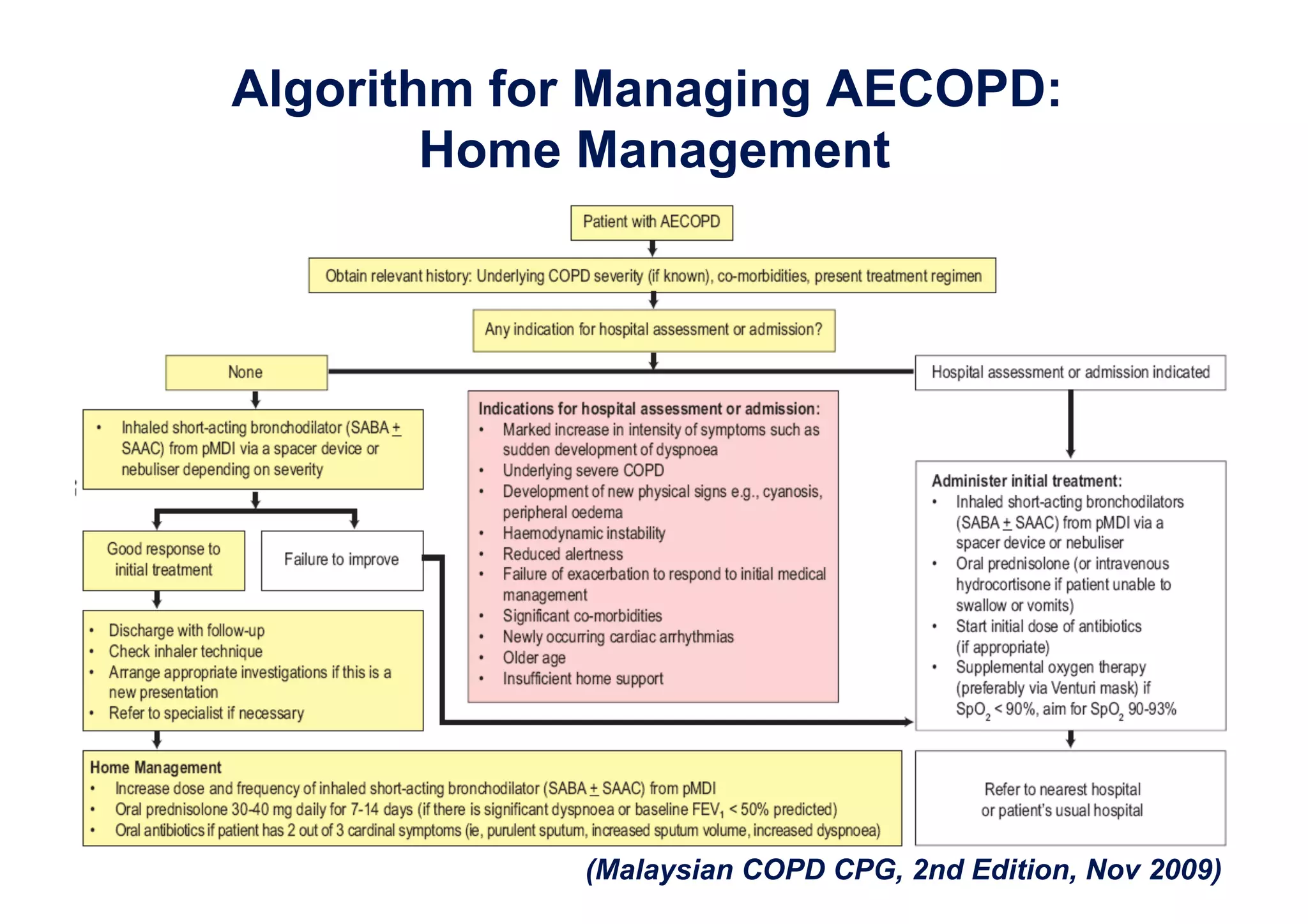
Algorithm for Managing AECOPD:
        Home Management


            (Malaysian COPD CPG, 2nd Edition, Nov 2009)
Algorithm for Managing AECOPD:
      Hospital Management


            (Malaysian COPD CPG, 2nd Edition, Nov 2009)
INDICATIONS FOR NIV


       (Malaysian COPD CPG, 2nd Edition, Nov 2009)
CONTRAINDICATIONS FOR NIV


          (Malaysian COPD CPG, 2nd Edition, Nov 2009)
INDICATIONS FOR MECHANICAL
         VENTILATION


           (Malaysian COPD CPG, 2nd Edition, Nov 2009)
ANTIBIOTICS


•  Antibiotics should be given to patients with
   AECOPD having at least 2 out of 3
   cardinal symptoms (i.e., purulent sputum,
   increased sputum volume and/or
   increased dyspnoea).
•  Antibiotics are beneficial during AECOPD
   but have no proven benefit to prevent
   exacerbations
                    (Malaysian COPD CPG, 2nd Edition, Nov 2009)
Understanding Potential Long Term
Impacts on Function with Tiotropium
          (UPLIFT) TRIAL

•  Tiotropium confers symptomatic and
 spirometric improvement in patients with
 COPD but does not influence the
 underlying gradual decline in lung function
 as measured by FEV1

     – Tashkin DP et al. A 4-year trial of tiotropium in
      chronic obstructive pulmonary disease. N Engl
      J Med 2008 Oct 9; 359:1543.
RECENT TRIALS
Towards a Revolution in COPD Health
           (TORCH) study


•  In this study of COPD patients, inhaled
  therapy with fluticasone plus salmeterol
  was associated with a 2.6 percentage-
  point reduction in mortality that just failed
  to reach statistical significance (p=0.052).

     – Calverley PMA et al. Salmeterol and fluticasone
       propionate and survival in chronic obstructive
       pulmonary disease. N Engl J Med 2007 Feb 22;
       356:775-89.
Towards a Revolution in COPD Health
           (TORCH) study

•  In several respects, salmeterol
  monotherapy appeared superior to
  fluticasone monotherapy — an interesting
  outcome given the current controversy
  about potential harms with long-acting ß-
  agonists in asthma.

     – Calverley PMA et al. Salmeterol and fluticasone
       propionate and survival in chronic obstructive
       pulmonary disease. N Engl J Med 2007 Feb 22;
       356:775-89.
Towards a Revolution in COPD Health
           (TORCH) study
•  At the current moment, the conclusion
  from TORCH study is:
  •  combination therapy offers several
     advantages (but not clear-cut mortality
     reduction)
  •  that steroid monotherapy should not be
     advocated
  •  that salmeterol monotherapy appears to be
     safe
  •  the increased incidence of pneumonia with
     fluticasone requires further investigation.
OPTIMAL TRIAL


•  Addition of fluticasone–salmeterol to
  tiotropium therapy did not statistically
  influence rates of COPD exacerbation but
  did improve lung function, quality of life,
  and hospitalization rates in patients with
  moderate to severe COPD
           •  Aaron SD et al. Tiotropium in combination with
             placebo, salmeterol, or fluticasone–salmeterol for
             treatment of chronic obstructive pulmonary
             disease. A randomized trial. Ann Intern Med
             2007 Feb 19;
Can we give COPD
patients a brighter start
to their day and reduce
    their future risk ?
The impact of COPD Exacerbations

Increased symptoms                    Reduced lung function
                                      “I get less air… I panic and
                                      think now I’m going to die” 1


Increased mortality2,3               Reduced quality of life
Lower QoL is a powerful              91% of patients reported an
indicator of hospitalisation &       impact on activities of daily living
mortality4                           50% of patients stop all activities1


                                          1 Vogelmeier   et al, ATS abstract 2004.
                                          2 Donaldson   et al, Thorax 2002.
                                          3 Fabbri et al, Thorax 1998
                                          4 Fan et al; Chest; August, 2002
Increased frequency of exacerbations
increases the risk of mortality in COPD

                       1.0                                               0 exacerbations
                                                                         1–2 exacerbations
                                                                         ≥ 3 exacerbations
                       0.8
Survival probability


                                                        P < 0.0002
                       0.6

                                                                                       P < 0.0001
                       0.4                                  P = 0.069


                       0.2


                        0
                             0   10   20    30    40   50        60
                                       Time (months)

                                                                  Soler-Cataluna JJ, et al. Thorax 2005;60:925–931.
COPD symptoms are the worst in the morning
   Patients (%)
  50
                  46%                                                                              All COPD patients (N=803)
                                                                                                   Severe COPD patients (N=289)
  45

  40
          37%
  35                                                                                    34%


 30                                                                                            28%
                                                                     27%
                                                                                  25%
 25
                                                               21%
 20
                                                                                                     17%
                                                   16%
 15
                                 11%
 10                                          9%                                                                  9%
                                                                                                                       7%
  5                        4%

  0
          Morning         Mid-day            Afternoon         Evening             Night      No particular   Difficult to say
                                                                                               time of day

Results from 803 interviews in seven EU countries and the USA
Partridge MR et al. Current Medical Research and Opinion 2009; 25(8): 2043-2048
A slow and difficult morning can impact the rest of the day


                                                                         •  Getting out of bed

                                                                         •  Washing

                                                                         •  Dressing

                                                                         •  Walking up and down stairs

                                                                         •  Making breakfast


Partridge MR et al. Current Medical Research and Opinion 2009; 25(8): 2043-2048
COPD patients want faster symptom relief


                          Faster symptom relief                           55%

      Longer intervals between flare-ups                                  40%

                                  Fewer side effects                      36%

Better ability to cope with daily chores                                  27%

                       Lower costs of treatment                           27%

                                            Better doses                  23%


                                                           0         10         20   30   40   50   60
                                                           Patients (%)


Results from 1100 interviews in five EU countries and the USA

Miravitlles M, et al. Respir Med 2007;101:453–460.
Fast relief in the morning
      is a window of
     opportunity for
 better symptom control
PHARMACOLOGY OF
   SYMBICORT
Budesonide
•  Anti-inflammatory agent
                                                +             Formoterol

                                                       •  Long-acting bronchodilator
•  Fast onset within 3-5
   hours                                               •  Onset as fast as salbutamol

•  Demonstrated dose                                    (1-3 minutes)
   response
                                                       •  Demonstrated dose
                                                          response 6 µg to 54 µg/day
•  Greater efficacy in
   combination with
   formoterol vs. higher
   doses of budesonide
   alone
                                                 ®
                     Only Symbicort Turbuhaler can be
                          prescribed in this manner
            Symbicort® Turbuhaler® Product Monograph
    Formoterol has a rapid onset with long duration of
           action
          Whereas salmeterol, though has an equivalent
           bronchodilator effect, has a slower onset of action
          This probably reflects the fact that formoterol is a
           full agonist, whereas salmeterol is a partial agonist


1. Barnes PJ. Scientific rationale for using a single inhaler for asthma control. Eur Respir J. 2007 Mar;29
                                                                                                 (3):587-95.

     2. Bousquet J, Boulet LP, Peters MJ, Magnussen H, Quiralte J, Martinez-Aguilar NE, Carlsheimer A.
  Budesonide/formoterol for maintenance and relief in uncontrolled asthma vs. high-dose salmeterol/
                                                 fluticasone. Respir Med. 2007 Dec;101(12):2437-46.

   3. Kuna P, Peters MJ, Manjra AI, Jorup C, Naya IP, Martinez-Jimenez NE, Buhl R. Effect of budesonide/
formoterol maintenance and reliever therapy on asthma exacerbations. Int J Clin Pract. 2007 May;61(5):
                                                                                                725-36.
    Formoterol is a full β2-agonist, whereas salmeterol
           is a partial β2-agonist.
          Therefore, increasing the dose of formoterol in the
           presence of ICS is associated with increased
           protection from exacerbations.
          But higher doses are not recommended with
           salmeterol because it has a plateau in its efficacy at
           around 100µg/day.
1. Barnes PJ. Scientific rationale for using a single inhaler for asthma control. Eur Respir J. 2007 Mar;29
                                                                                                 (3):587-95.

     2. Bousquet J, Boulet LP, Peters MJ, Magnussen H, Quiralte J, Martinez-Aguilar NE, Carlsheimer A.
  Budesonide/formoterol for maintenance and relief in uncontrolled asthma vs. high-dose salmeterol/
                                                 fluticasone. Respir Med. 2007 Dec;101(12):2437-46.

   3. Kuna P, Peters MJ, Manjra AI, Jorup C, Naya IP, Martinez-Jimenez NE, Buhl R. Effect of budesonide/
formoterol maintenance and reliever therapy on asthma exacerbations. Int J Clin Pract. 2007 May;61(5):
                                                                                                725-36.
ICS upregulates the β2-receptors

LABA increases the nuclear
translocation of glucocorticoid       Barnes PJ. Scientific rationale for using a single
                                   inhaler for asthma control. Eur Respir J. 2007 Mar;
receptors                                                                29(3):587-95.
    Direct bronchodilator effect

    Non-bronchodilator effects
     ◦  Reduced plasma exudation
        by relaxes the endothelial cells, thus closes the gap
     ◦  Mast cell stabilization
     ◦  Reduced neutrophils
        Thus reduce the releases of reactive oxygen species via
         the activated neutrophils


                                     Barnes PJ. Scientific rationale for using a single
                                  inhaler for asthma control. Eur Respir J. 2007 Mar;
                                                                        29(3):587-95.
Barnes PJ. Scientific rationale for using a single
inhaler for asthma control. Eur Respir J. 2007 Mar;
                                      29(3):587-95.
How to help COPD patients achieve their
        goals in everyday life ?
Therapy at each stage of COPD
        I: Mild                  II: Moderate          III: Severe                   IV: Very Severe
                                                                                  •  FEV1/FVC < 70%
                                                                                  •  FEV1 < 30%
                                                   •  FEV1/FVC <                     predicted
                              •  FEV1/FVC < 70%    70%                            •  or FEV1 < 50%
                                50% ≤ FEV1 <     30% ≤ FEV1 <                      predicted plus
•  FEV1/FVC < 70%              80%                   50% predicted                   chronic
                                predicted                                            respiratory failure
•  FEV1 ≥ 80%
predicted
Active reduction of risk factor(s); influenza vaccination
Add short-acting bronchodilator (when needed)
                              Add regular treatment with one or more long-acting
                              bronchodilators (when needed); Add rehabilitation
                                                    Add inhaled glucocorticosteroids if
                                                    repeated exacerbations
                                                                                    Add long-term
                                                                                    oxygen if chronic
                                                                                    respiratory failure
                                                                                    Consider surgical
                                                                                    treatments
                                                                    Global Initiative for Chronic Obstructive Lung Disease
FVC = forced vital capacity                              (GOLD) Guidelines, 2008. Available from http://www.goldcopd.com/
Symbicort® rapidly improves FEV1 within 5 minutes
   Symbicort® + TIO+ works faster than TIO+ alone                              Symbicort works faster than Sal/Flu#
  Morning FEV1 (I)                                                       FEV1 change from pre-dose (ml)

 1.32                                                                    120
                                          Symbicort + tiotropium
                                                                                                               Symbicort ® 320/9 µg bid
 1.28                                           P < 0.001
                                                                         100                                               P < 0.001

 1.24                     P < 0.001                                                                P < 0.001
                                                                         80
 1.20

  1.16                                                                   60

                                                                                                                 Sal/Flu 50/500 µg bid
  1.12                                                                   40

  1.08                                            tiotropium
                                                                         20
  1.04

  1.00                                                                     0
           -1 0             5           10           15                        0               5                  10           15

   Time (minutes) since drug intake                                        Minutes post-dose


+TIO = tiotropium                                                        # Sal/Flu = salmeterol/fluticasone
Adapted from Welte et al. Am J Respir Crit Care Med 2009, 180: 741-750   Partridge MR, et al. Ther Adv Respir Dis 2009
Greater control over morning activities with Symbicort®

                                                                                           Symbicort® 320/9µg bid

                                                                                           salmeterol/fluticasone 50/500µg bid
 Change in CDLM questionnaire scores from run-in

 0.30

                                                                                                           +
 0.25
                     ≠
                                                                             +
 0.20

 0.15


 0.10


 0.05

 0.00
            TOTAL                Wash                Dry        Get        Eat      Walk early      Walk late
            SCORE               yourself           yourself   dressed   breakfast

 Bid = twice daily; CDLM = Capacity of Daily Living During the Morning
 +p<0.02 vs salmeterol/fluticasone      ≠p<0.05 vs salmeterol/fluticasone


 Partridge MR et al. Ther Adv Respir Dis 2009
Greater control over morning activities with
  Symbicort® + tiotropium vs tiotropium alone
          Change in CDLM total score from run-in*

           0.35

           0.30                                                                   Symbicort + tiotropium

           0.25
                                                                                           p=0.001†
           0.20

           0.15
                            p=0.027^
           0.10                                                                       tiotropium
           0.05

                0
                        1      2       3       4      5     6  7         8   9   10   11     12
                                                           Weeks
^Treatment comparison from randomisation to first week of treatment
†Treatment comparison from randomisation to last week of treatment


Adapted from Welte et al. Am J Respir Crit Care Med 2009, 180: 741-750
Better symptom relief during the day and night
                    with Symbicort® *

           Mean difference in COPD symptom score from run-in to full treatment period

           Breathlessness            Chest tightness             Night time
                                                                                        Cough
                                                                 awakenings

                                                                                                  Better symptom relief
                                                                                                  with reduced COPD
                  -0.142*                                                               -0.161*   symptom score
                  -0.142*                  -0.142*                   -0.157*


0.1


                 P<0.001                  P<0.001                   P<0.001             P<0.001
0.2


 *   Symbicort + tiotropium vs tiotropium alone

     Adapted from Welte et al. Am J Respir Crit Care Med 2009, 180: 741-750
Less reliever use with Symbicort® *
                                 Reliever use at run-in and 12 week (last week)

          Mean number of inhalations                                             Symbicort + tiotropium
                                        P<0.001                                  tiotropium
          0.165

          0.160

          0.155

          0.150
                                                                                 P<0.001
          0.145

          0.140

          0.135

          0.130
                              Run-in              Week 12               Run-in             Week 12

                                       Daytime                           Night-time

* Symbicort + tiotropium vs tiotropium alone
Adapted from Welte et al. Am J Respir Crit Care Med 2009, 180:741-750
Greater improvement in health status
                       with Symbicort® *
                                                                                Symbicort + tiotropium
                   Adjusted mean difference in SGRQ-C score                     tiotropium

                  6
                                                   P = 0.023
                   5

                   4                                    3.8

                   3

                   2
                                            1.5

                   1

                   0
                                            SGRQ-C total
                             Comparisons are from randomisation to last visit


* Symbicort®+ tiotropium vs tiotropium alone
Adapted from Welte et al. Am J Respir Crit Care Med 2009, 180:741-750
62% lower rate of severe exacerbations
                        with Symbicort®*
 Exacerbations/patients/3 months
 0.4                                                              Ratio: 0.38 (95% CI: 0.25-0.57)
                                                                  P<0.001


0.3
                                                                                    tiotropium


 0.2


                                                                                   Symbicort + tiotropium
0.1


 0.0
                 15            30             45             60            75           90
   Days since randomisation

N=660
*Symbicort + tiotropium vs tiotropium alone
Adapted from Welte et al. Am J Respir Crit Care Med 2009, 180: 741-750
65% less Hospitalization/ER treatments
                         with Symbicort®*
         Events/1000 patients/3 months
   100

     90                                                              Ratio: 0.35 (95% CI: 0.16-0.78)
                                 80
                                                                     P=0.011
    80

    70

    60

    50

     40

     30                                                     28


     20

    10

      0                        tiotropium          Symbicort + tiotropium
                                 N=331                   N=329
*Symbicort + tiotropium vs. tiotropium alone
Adapted from Welte et al. Am J Respir Crit Care Med 2009, 180: 741-750
Budesonide and the risk of pneumonia:
     a meta-analysis of individual patient data


•  Budesonide, with or without formoterol, is not associated
  with an increased risk of pneumonia adverse events (AE) or
  serious adverse events (SAEs)

•  The two most important risk factors for pneumonia AEs or
  SAEs in patients with COPD are increasing age and
  reduced lung function


                                                 Sin DD et al. Lancet 2009; 374:712–719.
Risk of pneumonia as an AE
             No significant difference between treatment groups
       N=7042                                                                         Szafranski et al.1 1.26 (0.64–2.49)

                                                                                      Calverley et al.2 1.54 (0.67–3.53)

                                                                                      Rennard et al.3 0.88 (0.57–1.36)

                                                                                      Tashkin et al.4 1.14 (0.56–2.33)

                                                                                      Bourbeau et al.5 0.79 (0.12–5.17)

                                                                                      Pauwels et al.6 2.08 (0.85–5.10)

                                                                                      Vestbo et al.7 0.56 (0.23–1.34)


                                                                                      Overall8 1.05 (0.81–1.37)


 0.1        0.2          0.5     1      2                     5         10
                                                                                                   1. Szafranski W et al. Eur Respir J 2003; 21:74–81,
                       Hazard ratio (95% CI)                                                    2. Calverley PM et al. Eur Respir J 2003; 22:912–919,
                                                                                                          3. Rennard SI et al. Drugs 2009; 69:549–565,
        Control treatment                  Inhaled budesonide treatment                                4. Tashkin DP et al. Drugs 2008; 68:1975–2000,
                                                                          5. Bourbeau J et al. Am J Respir Crit Care Med 1994; 149(4 Suppl 2):A183,
Data were adjusted for age, sex, smoking status, body mass index and % of                  6. Pauwels RA et al. N Engl J Med 1999; 340:1948–1953,
predicted FEV1.                                                                                         7. Vestbo J et al. Lancet 1999; 353:1819–1823,
AE = adverse event; CI = confidence intervals                                                                8. Sin DD et al. Lancet 2009; 374:712–719.
Risk of pneumonia as an SAE
            No significant difference between treatment groups

       N=7042                                                                         Szafranski et al.1 0.82 (0.32–2.07)


                                                                                      Calverley et al.2 1.21 (0.45–3.36)


                                                                                      Rennard et al.3 0.72 (0.37–1.37)


                                                                                      Tashkin et al.4 1.06 (0.40–2.83)


                                                                                      Bourbeau et al.5 0.79 (0.12–5.17)


                                                                                      Pauwels et al.6 5.48 (0.66–45.7)

                                                                                      Overall7 0.92 (0.62–1.35)


           0.1                  1                           10                     100
                       Hazard ratio (95% CI)                                                      1. Szafranski W et al. Eur Respir J 2003; 21:74–81,
                                                                                               2. Calverley PM et al. Eur Respir J 2003; 22:912–919,
        Control treatment                   Inhaled budesonide treatment                                 3. Rennard SI et al. Drugs 2009; 69:549–565,
                                                                                                      4. Tashkin DP et al. Drugs 2008; 68:1975–2000,
Data were adjusted for age, sex, smoking status, body mass index and     5. Bourbeau J et al. Am J Respir Crit Care Med 1994; 149(4 Suppl 2):A183,
FEV1 (% predicted)                                                                        6. Pauwels RA et al. N Engl J Med 1999; 340:1948–1953,
CI = confidence intervals; SAE = serious adverse event                                                      7. Sin DD et al. Lancet 2009; 374:712–719.
SUMMARY


•  COPD is no longer just considered a lung
   parenchymal pathology, but one with
   significant systemic effects
•  Spirometry is required for both diagnosis
   and assessment of severity. Every effort
   should be made to refer patient for
   spirometry.
SUMMARY


•  Smoking cessation is the single most cost
  effective - intervention to reduce the risk of
  developing COPD and stop its
  progression. Even a brief 3-min of
  counselling may result in smoking
  cessation rates of 5-10%
SUMMARY


•  The combination of LABA/ICS has been
   shown to improve lung function, quality of
   life and reduce exacerbations compared
   with placebo in COPD patients with FEV1
   < 65% predicted.
•  Consider NIV in patients with persistent
   hypercapnoeic respiratory failure despite
   optimal medical therapy

The 2009 COPD Malaysian Guidelines - What's Important From Emergency Medicine Perspective?

  • 1.
    CHRONIC OBSTRUCTIVE PULMONARY DISEASE: The New Malaysian 2nd Edition CPG – Its Importance From The Perspective of Emergency Medicine K S CHEW School of Medical Sciences Universiti Sains Malaysia
  • 2.
    FREE DOWNLOAD at: MalaysianThoracic Society Website http://www.mts.org.my/resources.html
  • 3.
  • 4.
    DEFINITION OF COPD • COPD is defined as a preventable and treatable respiratory disorder largely caused by smoking, is characterised by progressive, partially reversible airflow obstruction and lung hyperinflation with significant extrapulmonary (systemic) manifestations and co-morbid conditions all of which may contribute to the severity of the disease in individual patients. (Malaysian COPD CPG, 2nd Edition, Nov 2009)
  • 5.
    SYSTEMIC EFFECTS OFCOPD •  Several recent studies have clearly shown that COPD is associated not only with an abnormal inflammatory response of the lung parenchyma but also with evidence of systemic inflammation, including systemic oxidative stress, activation of circulating inflammatory cells and increased levels of pro-inflammatory cytokines Agusti AG. Systemic effects of chronic obstructive pulmonary disease. Proc Am Thorac Soc 2005; 2 (4):367-70; discussion 71-2.
  • 6.
    Examples of Co-morbiditiesAssociated With COPD •  Ischaemic heart disease •  Osteopenia, osteoporosis and bone fractures •  Cachexia and malnutrition •  Normochromic normocytic anaemia •  Skeletal muscle wasting and peripheral muscle dysfunction
  • 7.
    SYSTEMIC EFFECTS OFCOPD •  Various studies have shown that the lung inflammatory response is characterised by •  increased numbers of neutrophils, macrophages and T-lymphocytes with a CD8+ predominance •  augmented concentrations of proinflammatory cytokines, such as leukotriene B4, interleukin (IL)-8 and tumour necrosis factor (TNF)-a •  evidence of oxidative stress caused by the inhalation of oxidants (tobacco smoke) and/or the activated inflammatory Agusti AG. Systemic effects of chronic obstructive pulmonary disease. Proc Am Thorac Soc 2005; 2 (4):367-70; discussion 71-2.
  • 8.
    WHY SYSTEMIC EFFECTS? Hypothesis •  The tobacco smoke alone causes oxidative stress •  The pulmonary inflammatory process in the lung itself is the source of these systemic inflammation. •  The increased surface expression of several neutrophil adhesion molecules may be due to genetic predisposition Agusti AG. Systemic effects of chronic obstructive pulmonary disease. Proc Am Thorac Soc 2005; 2 (4):367-70; discussion 71-2.
  • 9.
  • 10.
    COPD is projectedto be the third biggest cause of mortality by 2020 1990 2020 Ischaemic heart disease 1st Ischaemic heart disease Cardiovascular disease 2nd Cardiovascular disease Lower respiratory infection 3rd COPD Diarrhoeal disease 4th Lower respiratory infection Perinatal disorders 5th Lung cancer COPD 6th Road traffic accident Tuberculosis 7th Tuberculosis Measles 8th Stomach cancer Road traffic accident 9th HIV Lung cancer 10th Suicide Murray CJ & Lopez AD. Lancet 1997;349:1498–1504.
  • 11.
    Percent Change inAge-Adjusted Death Rates, U.S., 1965-1998 Proportion of 1965 Rate 3.0 Coronary Stroke Other CVD COPD All Other 2.5 Heart Causes Disease 2.0 1.5 1.0 0.5 0 –59% –64% –35% +163% –7% 1965 - 1998 1965 - 1998 1965 - 1998 1965 - 1998 1965 - 1998 Source: NHLBI/NIH/DHHS
  • 12.
    Model Projections ofModerate-Severe COPD in Population Aged ≥ 30 Years (Malaysian COPD CPG, 2nd Edition, Nov 2009)
  • 13.
  • 14.
    INFLAMMATION IN COPD SMALL AIRWAY PARENCHYMAL DISEASE DESTRUCTION Airway Inflammation Loss of alveolar attachment Airway Remodeling Decrease of elastic recoil AIRFLOW LIMITATION
  • 15.
    Pathogenesis of COPD Host factors Amplifying mechanisms Source: Peter J. Barnes, MD
  • 16.
    Inflammatory Cells Involvedin COPD Source: Peter J. Barnes, MD
  • 17.
    Oxidative Stress inCOPD Macrophage Neutrophil Anti-proteases SLPI α1-AT Proteolysis Plasma leak Bronchoconstriction ↑ Mucus secretion Source: Peter J. Barnes, MD
  • 18.
    Inflammation plays acentral role in the pathogenesis and pathology of COPD Cigarette smoke (and other irritants) Genetic susceptibility Lung Inflammation • Inflammatory cells • Inflammatory mediators • Oxidative stress • Proteases COPD pathology Obstructive Mucus Alveolar bronchiolitis hypersecretion wall destruction Adapted from Global Initiative for Chronic Obstructive Lung Disease (GOLD) Guidelines, 2009. Available from http://www.goldcopd.com/
  • 19.
  • 20.
    DIAGNOSIS •  Spirometry isessential for the diagnosis of COPD. •  The diagnosis should be confirmed by spirometry showing a post-bronchodilator FEV1/FVC ratio of less than 70%. (Malaysian COPD CPG, 2nd Edition, Nov 2009)
  • 21.
    DIAGNOSIS •  A clinicaldiagnosis of COPD should be considered in any individual with symptoms of chronic cough, sputum production or dyspnoea and a history of exposure to risk factors for the disease, especially cigarette smoking. •  But every effort should be made to refer the patient for spirometry to confirm the diagnosis. (Malaysian COPD CPG, 2nd Edition, Nov 2009)
  • 22.
    CLASSIFICATION OF COPD SEVERITY Spirometry is essential for the diagnosis of COPD and is useful for assessment of the severity of airflow obstruction (Grade C) (Malaysian COPD CPG, 2nd Edition, Nov 2009)
  • 23.
    The Modified MedicalResearch Council (MMRC) Dyspnoea Scale (Malaysian COPD CPG, 2nd Edition, Nov 2009)
  • 24.
    Classification of COPD SeverityBased on Spirometric Impairment and Symptoms (Malaysian COPD CPG, 2nd Edition, Nov 2009)
  • 25.
    Reversible Irreversible Source: Peter J. Barnes, MD
  • 26.
    (Malaysian COPD CPG,2nd Edition, Nov 2009)
  • 27.
  • 28.
    RISK FACTORS (Malaysian COPD CPG, 2nd Edition, Nov 2009)
  • 29.
    RISK FACTORS •  Cigarettesmoking is the best known and most studied risk factor for COPD. •  About 15% of smokers develop COPD. •  However, tobacco smoke is the risk factor for as much as 90% of the cases of COPD. •  Non-smokers may also develop the disease (Malaysian COPD CPG, 2nd Edition, Nov 2009)
  • 30.
    TOBACCO SMOKE •  Somestudies have suggested that women are more susceptible to the effects of tobacco smoke than men •  Quantification of tobacco consumption: total pack-years = (number of cigarettes smoked per day ÷ 20) x number of years of smoking (Malaysian COPD CPG, 2nd Edition, Nov 2009)
  • 31.
    TOBACCO SMOKE •  Smokingcessation is the single most effective - and cost effective - intervention to reduce the risk of developing COPD and stop its progression. •  Even a brief (three-minute) period of counselling to urge a smoker to quit results in smoking cessation rates of 5-10%. (Malaysian COPD CPG, 2nd Edition, Nov 2009)
  • 32.
    PHARMACOTHERAPIES FOR SMOKING CESSATION •  Nicotine replacement therapy (NRT) in the form of transdermal patches, gums, lozenges and nasal sprays •  Varenicline •  a nicotinic acetylcholine receptor partial agonist •  Bupropion •  Nortriptyline (Malaysian COPD CPG, 2nd Edition, Nov 2009)
  • 33.
    5’A’s FOR SMOKINGCESSATION (Malaysian COPD CPG, 2nd Edition, Nov 2009)
  • 34.
    VICIOUS CIRCLE HYPOTHESIS: HOWINFECTION CONTRIBUTE TO THE PATHOGENESIS AND PROGRESSION OF COPD (Malaysian COPD CPG, 2nd Edition, Nov 2009)
  • 35.
    MANAGEMENT OF STABLECOPD AND EXACERBATIONS
  • 36.
    (Malaysian COPD CPG,2nd Edition, Nov 2009)
  • 37.
    MANAGING STABLE COPD • COPD patients at any stage of disease severity should be advised to quit smoking if they still smoke. [Grade A] •  In patients with mild COPD who are symptomatic, SABA or SAAC or a combination of both may be prescribed (Malaysian COPD CPG, 2nd Edition, Nov 2009)
  • 38.
    MANAGING STABLE COPD • In patients with moderate to very severe COPD with persistent symptoms, but without frequent COPD exacerbations, either a LAAC or LABA may be initiated. •  If symptoms persist despite this treatment, an ICS/LABA combination should be added; and vice versa. [Grade A] (Malaysian COPD CPG, 2nd Edition, Nov 2009)
  • 39.
    INDICATIONS FOR HOSPITALISATION (Malaysian COPD CPG, 2nd Edition, Nov 2009)
  • 40.
    Algorithm for ManagingAECOPD: Home Management (Malaysian COPD CPG, 2nd Edition, Nov 2009)
  • 41.
    Algorithm for ManagingAECOPD: Hospital Management (Malaysian COPD CPG, 2nd Edition, Nov 2009)
  • 42.
    INDICATIONS FOR NIV (Malaysian COPD CPG, 2nd Edition, Nov 2009)
  • 43.
    CONTRAINDICATIONS FOR NIV (Malaysian COPD CPG, 2nd Edition, Nov 2009)
  • 44.
    INDICATIONS FOR MECHANICAL VENTILATION (Malaysian COPD CPG, 2nd Edition, Nov 2009)
  • 45.
    ANTIBIOTICS •  Antibiotics shouldbe given to patients with AECOPD having at least 2 out of 3 cardinal symptoms (i.e., purulent sputum, increased sputum volume and/or increased dyspnoea). •  Antibiotics are beneficial during AECOPD but have no proven benefit to prevent exacerbations (Malaysian COPD CPG, 2nd Edition, Nov 2009)
  • 46.
    Understanding Potential LongTerm Impacts on Function with Tiotropium (UPLIFT) TRIAL •  Tiotropium confers symptomatic and spirometric improvement in patients with COPD but does not influence the underlying gradual decline in lung function as measured by FEV1 – Tashkin DP et al. A 4-year trial of tiotropium in chronic obstructive pulmonary disease. N Engl J Med 2008 Oct 9; 359:1543.
  • 47.
  • 48.
    Towards a Revolutionin COPD Health (TORCH) study •  In this study of COPD patients, inhaled therapy with fluticasone plus salmeterol was associated with a 2.6 percentage- point reduction in mortality that just failed to reach statistical significance (p=0.052). – Calverley PMA et al. Salmeterol and fluticasone propionate and survival in chronic obstructive pulmonary disease. N Engl J Med 2007 Feb 22; 356:775-89.
  • 49.
    Towards a Revolutionin COPD Health (TORCH) study •  In several respects, salmeterol monotherapy appeared superior to fluticasone monotherapy — an interesting outcome given the current controversy about potential harms with long-acting ß- agonists in asthma. – Calverley PMA et al. Salmeterol and fluticasone propionate and survival in chronic obstructive pulmonary disease. N Engl J Med 2007 Feb 22; 356:775-89.
  • 50.
    Towards a Revolutionin COPD Health (TORCH) study •  At the current moment, the conclusion from TORCH study is: •  combination therapy offers several advantages (but not clear-cut mortality reduction) •  that steroid monotherapy should not be advocated •  that salmeterol monotherapy appears to be safe •  the increased incidence of pneumonia with fluticasone requires further investigation.
  • 51.
    OPTIMAL TRIAL •  Additionof fluticasone–salmeterol to tiotropium therapy did not statistically influence rates of COPD exacerbation but did improve lung function, quality of life, and hospitalization rates in patients with moderate to severe COPD •  Aaron SD et al. Tiotropium in combination with placebo, salmeterol, or fluticasone–salmeterol for treatment of chronic obstructive pulmonary disease. A randomized trial. Ann Intern Med 2007 Feb 19;
  • 52.
    Can we giveCOPD patients a brighter start to their day and reduce their future risk ?
  • 53.
    The impact ofCOPD Exacerbations Increased symptoms Reduced lung function “I get less air… I panic and think now I’m going to die” 1 Increased mortality2,3 Reduced quality of life Lower QoL is a powerful 91% of patients reported an indicator of hospitalisation & impact on activities of daily living mortality4 50% of patients stop all activities1 1 Vogelmeier et al, ATS abstract 2004. 2 Donaldson et al, Thorax 2002. 3 Fabbri et al, Thorax 1998 4 Fan et al; Chest; August, 2002
  • 54.
    Increased frequency ofexacerbations increases the risk of mortality in COPD 1.0 0 exacerbations 1–2 exacerbations ≥ 3 exacerbations 0.8 Survival probability P < 0.0002 0.6 P < 0.0001 0.4 P = 0.069 0.2 0 0 10 20 30 40 50 60 Time (months) Soler-Cataluna JJ, et al. Thorax 2005;60:925–931.
  • 55.
    COPD symptoms arethe worst in the morning Patients (%) 50 46% All COPD patients (N=803) Severe COPD patients (N=289) 45 40 37% 35 34% 30 28% 27% 25% 25 21% 20 17% 16% 15 11% 10 9% 9% 7% 5 4% 0 Morning Mid-day Afternoon Evening Night No particular Difficult to say time of day Results from 803 interviews in seven EU countries and the USA Partridge MR et al. Current Medical Research and Opinion 2009; 25(8): 2043-2048
  • 56.
    A slow anddifficult morning can impact the rest of the day •  Getting out of bed •  Washing •  Dressing •  Walking up and down stairs •  Making breakfast Partridge MR et al. Current Medical Research and Opinion 2009; 25(8): 2043-2048
  • 57.
    COPD patients wantfaster symptom relief Faster symptom relief 55% Longer intervals between flare-ups 40% Fewer side effects 36% Better ability to cope with daily chores 27% Lower costs of treatment 27% Better doses 23% 0 10 20 30 40 50 60 Patients (%) Results from 1100 interviews in five EU countries and the USA Miravitlles M, et al. Respir Med 2007;101:453–460.
  • 58.
    Fast relief inthe morning is a window of opportunity for better symptom control
  • 59.
  • 60.
    Budesonide •  Anti-inflammatory agent + Formoterol •  Long-acting bronchodilator •  Fast onset within 3-5 hours •  Onset as fast as salbutamol •  Demonstrated dose (1-3 minutes) response •  Demonstrated dose response 6 µg to 54 µg/day •  Greater efficacy in combination with formoterol vs. higher doses of budesonide alone ® Only Symbicort Turbuhaler can be prescribed in this manner Symbicort® Turbuhaler® Product Monograph
  • 61.
      Formoterol has a rapid onset with long duration of action   Whereas salmeterol, though has an equivalent bronchodilator effect, has a slower onset of action   This probably reflects the fact that formoterol is a full agonist, whereas salmeterol is a partial agonist 1. Barnes PJ. Scientific rationale for using a single inhaler for asthma control. Eur Respir J. 2007 Mar;29 (3):587-95. 2. Bousquet J, Boulet LP, Peters MJ, Magnussen H, Quiralte J, Martinez-Aguilar NE, Carlsheimer A. Budesonide/formoterol for maintenance and relief in uncontrolled asthma vs. high-dose salmeterol/ fluticasone. Respir Med. 2007 Dec;101(12):2437-46. 3. Kuna P, Peters MJ, Manjra AI, Jorup C, Naya IP, Martinez-Jimenez NE, Buhl R. Effect of budesonide/ formoterol maintenance and reliever therapy on asthma exacerbations. Int J Clin Pract. 2007 May;61(5): 725-36.
  • 62.
      Formoterol is a full β2-agonist, whereas salmeterol is a partial β2-agonist.   Therefore, increasing the dose of formoterol in the presence of ICS is associated with increased protection from exacerbations.   But higher doses are not recommended with salmeterol because it has a plateau in its efficacy at around 100µg/day. 1. Barnes PJ. Scientific rationale for using a single inhaler for asthma control. Eur Respir J. 2007 Mar;29 (3):587-95. 2. Bousquet J, Boulet LP, Peters MJ, Magnussen H, Quiralte J, Martinez-Aguilar NE, Carlsheimer A. Budesonide/formoterol for maintenance and relief in uncontrolled asthma vs. high-dose salmeterol/ fluticasone. Respir Med. 2007 Dec;101(12):2437-46. 3. Kuna P, Peters MJ, Manjra AI, Jorup C, Naya IP, Martinez-Jimenez NE, Buhl R. Effect of budesonide/ formoterol maintenance and reliever therapy on asthma exacerbations. Int J Clin Pract. 2007 May;61(5): 725-36.
  • 63.
    ICS upregulates theβ2-receptors LABA increases the nuclear translocation of glucocorticoid Barnes PJ. Scientific rationale for using a single inhaler for asthma control. Eur Respir J. 2007 Mar; receptors 29(3):587-95.
  • 64.
      Direct bronchodilator effect   Non-bronchodilator effects ◦  Reduced plasma exudation   by relaxes the endothelial cells, thus closes the gap ◦  Mast cell stabilization ◦  Reduced neutrophils   Thus reduce the releases of reactive oxygen species via the activated neutrophils Barnes PJ. Scientific rationale for using a single inhaler for asthma control. Eur Respir J. 2007 Mar; 29(3):587-95.
  • 65.
    Barnes PJ. Scientificrationale for using a single inhaler for asthma control. Eur Respir J. 2007 Mar; 29(3):587-95.
  • 66.
    How to helpCOPD patients achieve their goals in everyday life ?
  • 67.
    Therapy at eachstage of COPD I: Mild II: Moderate III: Severe IV: Very Severe •  FEV1/FVC < 70% •  FEV1 < 30% •  FEV1/FVC < predicted •  FEV1/FVC < 70% 70% •  or FEV1 < 50%   50% ≤ FEV1 <   30% ≤ FEV1 < predicted plus •  FEV1/FVC < 70% 80% 50% predicted chronic predicted respiratory failure •  FEV1 ≥ 80% predicted Active reduction of risk factor(s); influenza vaccination Add short-acting bronchodilator (when needed) Add regular treatment with one or more long-acting bronchodilators (when needed); Add rehabilitation Add inhaled glucocorticosteroids if repeated exacerbations Add long-term oxygen if chronic respiratory failure Consider surgical treatments Global Initiative for Chronic Obstructive Lung Disease FVC = forced vital capacity (GOLD) Guidelines, 2008. Available from http://www.goldcopd.com/
  • 68.
    Symbicort® rapidly improvesFEV1 within 5 minutes Symbicort® + TIO+ works faster than TIO+ alone Symbicort works faster than Sal/Flu# Morning FEV1 (I) FEV1 change from pre-dose (ml) 1.32 120 Symbicort + tiotropium Symbicort ® 320/9 µg bid 1.28 P < 0.001 100 P < 0.001 1.24 P < 0.001 P < 0.001 80 1.20 1.16 60 Sal/Flu 50/500 µg bid 1.12 40 1.08 tiotropium 20 1.04 1.00 0 -1 0 5 10 15 0 5 10 15 Time (minutes) since drug intake Minutes post-dose +TIO = tiotropium # Sal/Flu = salmeterol/fluticasone Adapted from Welte et al. Am J Respir Crit Care Med 2009, 180: 741-750 Partridge MR, et al. Ther Adv Respir Dis 2009
  • 69.
    Greater control overmorning activities with Symbicort® Symbicort® 320/9µg bid salmeterol/fluticasone 50/500µg bid Change in CDLM questionnaire scores from run-in 0.30 + 0.25 ≠ + 0.20 0.15 0.10 0.05 0.00 TOTAL Wash Dry Get Eat Walk early Walk late SCORE yourself yourself dressed breakfast Bid = twice daily; CDLM = Capacity of Daily Living During the Morning +p<0.02 vs salmeterol/fluticasone ≠p<0.05 vs salmeterol/fluticasone Partridge MR et al. Ther Adv Respir Dis 2009
  • 70.
    Greater control overmorning activities with Symbicort® + tiotropium vs tiotropium alone Change in CDLM total score from run-in* 0.35 0.30 Symbicort + tiotropium 0.25 p=0.001† 0.20 0.15 p=0.027^ 0.10 tiotropium 0.05 0 1 2 3 4 5 6 7 8 9 10 11 12 Weeks ^Treatment comparison from randomisation to first week of treatment †Treatment comparison from randomisation to last week of treatment Adapted from Welte et al. Am J Respir Crit Care Med 2009, 180: 741-750
  • 71.
    Better symptom reliefduring the day and night with Symbicort® * Mean difference in COPD symptom score from run-in to full treatment period Breathlessness Chest tightness Night time Cough awakenings Better symptom relief with reduced COPD -0.142* -0.161* symptom score -0.142* -0.142* -0.157* 0.1 P<0.001 P<0.001 P<0.001 P<0.001 0.2 * Symbicort + tiotropium vs tiotropium alone Adapted from Welte et al. Am J Respir Crit Care Med 2009, 180: 741-750
  • 72.
    Less reliever usewith Symbicort® * Reliever use at run-in and 12 week (last week) Mean number of inhalations Symbicort + tiotropium P<0.001 tiotropium 0.165 0.160 0.155 0.150 P<0.001 0.145 0.140 0.135 0.130 Run-in Week 12 Run-in Week 12 Daytime Night-time * Symbicort + tiotropium vs tiotropium alone Adapted from Welte et al. Am J Respir Crit Care Med 2009, 180:741-750
  • 73.
    Greater improvement inhealth status with Symbicort® * Symbicort + tiotropium Adjusted mean difference in SGRQ-C score tiotropium 6 P = 0.023 5 4 3.8 3 2 1.5 1 0 SGRQ-C total Comparisons are from randomisation to last visit * Symbicort®+ tiotropium vs tiotropium alone Adapted from Welte et al. Am J Respir Crit Care Med 2009, 180:741-750
  • 74.
    62% lower rateof severe exacerbations with Symbicort®* Exacerbations/patients/3 months 0.4 Ratio: 0.38 (95% CI: 0.25-0.57) P<0.001 0.3 tiotropium 0.2 Symbicort + tiotropium 0.1 0.0 15 30 45 60 75 90 Days since randomisation N=660 *Symbicort + tiotropium vs tiotropium alone Adapted from Welte et al. Am J Respir Crit Care Med 2009, 180: 741-750
  • 75.
    65% less Hospitalization/ERtreatments with Symbicort®* Events/1000 patients/3 months 100 90 Ratio: 0.35 (95% CI: 0.16-0.78) 80 P=0.011 80 70 60 50 40 30 28 20 10 0 tiotropium Symbicort + tiotropium N=331 N=329 *Symbicort + tiotropium vs. tiotropium alone Adapted from Welte et al. Am J Respir Crit Care Med 2009, 180: 741-750
  • 76.
    Budesonide and therisk of pneumonia: a meta-analysis of individual patient data •  Budesonide, with or without formoterol, is not associated with an increased risk of pneumonia adverse events (AE) or serious adverse events (SAEs) •  The two most important risk factors for pneumonia AEs or SAEs in patients with COPD are increasing age and reduced lung function Sin DD et al. Lancet 2009; 374:712–719.
  • 77.
    Risk of pneumoniaas an AE No significant difference between treatment groups N=7042 Szafranski et al.1 1.26 (0.64–2.49) Calverley et al.2 1.54 (0.67–3.53) Rennard et al.3 0.88 (0.57–1.36) Tashkin et al.4 1.14 (0.56–2.33) Bourbeau et al.5 0.79 (0.12–5.17) Pauwels et al.6 2.08 (0.85–5.10) Vestbo et al.7 0.56 (0.23–1.34) Overall8 1.05 (0.81–1.37) 0.1 0.2 0.5 1 2 5 10 1. Szafranski W et al. Eur Respir J 2003; 21:74–81, Hazard ratio (95% CI) 2. Calverley PM et al. Eur Respir J 2003; 22:912–919, 3. Rennard SI et al. Drugs 2009; 69:549–565, Control treatment Inhaled budesonide treatment 4. Tashkin DP et al. Drugs 2008; 68:1975–2000, 5. Bourbeau J et al. Am J Respir Crit Care Med 1994; 149(4 Suppl 2):A183, Data were adjusted for age, sex, smoking status, body mass index and % of 6. Pauwels RA et al. N Engl J Med 1999; 340:1948–1953, predicted FEV1. 7. Vestbo J et al. Lancet 1999; 353:1819–1823, AE = adverse event; CI = confidence intervals 8. Sin DD et al. Lancet 2009; 374:712–719.
  • 78.
    Risk of pneumoniaas an SAE No significant difference between treatment groups N=7042 Szafranski et al.1 0.82 (0.32–2.07) Calverley et al.2 1.21 (0.45–3.36) Rennard et al.3 0.72 (0.37–1.37) Tashkin et al.4 1.06 (0.40–2.83) Bourbeau et al.5 0.79 (0.12–5.17) Pauwels et al.6 5.48 (0.66–45.7) Overall7 0.92 (0.62–1.35) 0.1 1 10 100 Hazard ratio (95% CI) 1. Szafranski W et al. Eur Respir J 2003; 21:74–81, 2. Calverley PM et al. Eur Respir J 2003; 22:912–919, Control treatment Inhaled budesonide treatment 3. Rennard SI et al. Drugs 2009; 69:549–565, 4. Tashkin DP et al. Drugs 2008; 68:1975–2000, Data were adjusted for age, sex, smoking status, body mass index and 5. Bourbeau J et al. Am J Respir Crit Care Med 1994; 149(4 Suppl 2):A183, FEV1 (% predicted) 6. Pauwels RA et al. N Engl J Med 1999; 340:1948–1953, CI = confidence intervals; SAE = serious adverse event 7. Sin DD et al. Lancet 2009; 374:712–719.
  • 79.
    SUMMARY •  COPD isno longer just considered a lung parenchymal pathology, but one with significant systemic effects •  Spirometry is required for both diagnosis and assessment of severity. Every effort should be made to refer patient for spirometry.
  • 80.
    SUMMARY •  Smoking cessationis the single most cost effective - intervention to reduce the risk of developing COPD and stop its progression. Even a brief 3-min of counselling may result in smoking cessation rates of 5-10%
  • 81.
    SUMMARY •  The combinationof LABA/ICS has been shown to improve lung function, quality of life and reduce exacerbations compared with placebo in COPD patients with FEV1 < 65% predicted. •  Consider NIV in patients with persistent hypercapnoeic respiratory failure despite optimal medical therapy