Intensive Course For
  Emergency Medicine Phase I
(MMed Professional Exam 2010)
             KS Chew
    School of Medical Sciences
     Universiti Sains Malaysia
Cardiovascular Physiology Review:
         Cardiac Output
• Stroke volume = End diastolic volume – End
  systolic volume = 135 – 65 = 70 ml
• At rate of 70 beats/min, CO = 70 * 70 = 4900
  ml
• Ejection fraction (EF) is the ratio of stroke
  volume to end-diastolic volume (EDV),
  expressed as a percentage:
• EF = (SV/EDV) * 100
Schematic Representation Of The Frog-
 heart Preparation Used By Otto Frank
Frank-Starling Law
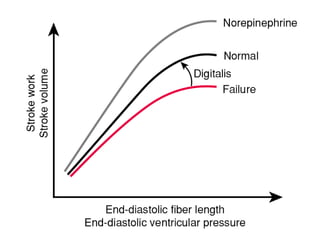
Effects On Stroke Volume Of Stimulating The
      Sympathetic Nerves To The Heart
The pressure-volume cycle of the human left ventricle. The
area bounded by the pressure-volume curve gives the stroke
work of the heart. The lower confine of the pressure-volume
loop shown by the dotted line is defined by the passive
stretch of the relaxed ventricular muscle by the returning
blood.
Increased
            Preload


Increased   Increased
Afterload   Contractility
Vascular Function and Cardiac
       Function Curve
Vascular Function and Cardiac
       Function Curve
Relationship Between End-diastolic
  Ventricular Volume and Stroke
              Volume
Pathophysiology of Acute Coronary
           Syndrome
Onset of STEMI                                  Hospital Management                     Modified from Libby. Circulation 2001;104:365,
   - Prehospital issues                            - Medications                           Hamm et al. The Lancet 2001;358:1533 and
   - Initial recognition and management            - Arrhythmias                           Davies. Heart 2000;83:361.
     in the Emergency Department (ED)              - Complications
   - Reperfusion                                   - Preparation for discharge
                                                                   Secondary Prevention/
 Management                                                       Long-Term Management
Before STEMI


                                                                             Chronology of the
                                                                             interface between the
       1           2        3         4           5               6          patient and the clinician
                                      4                                      through the progression
                                                                             of plaque formation and
                                                                             the onset of
           Presentation
                                  Ischemic Discomfort
         Working Dx             Acute Coronary Syndrome

                                                                             complications of
               ECG         No ST Elevation
                           UA      NSTEMI
                                                 ST Elevation
                                                                             STEMI.
            Cardiac
           Biomarker


           Final Dx       Unstable        NQMI         QwMI
                          Angina
                                          Myocardial Infarction
Pathophysiology of ACS
                                           Large
One example of atherothrombotic            fissure
disease progression
                                                 Occlusive thrombus
     Lipid pool                                  (Q-wave MI)

 Macrophages
                                          Small
Stress, tensile,                          fissure
       internal
                                                 Mural thrombus
 Shear forces,        Fissure                    (unstable angina/
     external                                    non-Q-wave MI)

         Atherosclerotic
                       Plaque             Thrombus
         plaque        disruption
                                        Fuster V et al NEJM 1992;326:310–318
                       Davies MJ et al Circulation 1990;82(Suppl II):II–38, II–46
Atherothrombosis: a Generalized
           and Progressive Process
                                                        Plaque       Unstable

                Fatty          Fibrous
                                              Athero- rupture/
                                              sclerotic fissure &
                                                                      angina
                                                                        MI
                                                                              }ACS
Normal          streak         plaque         plaque    thrombosis

                                                                           Ischemic
                                                                       stroke/TIA


                                                                             Critical
                                                                                  leg
    Clinically silent                                                      ischemia
                  Stable angina
                                                                     Cardiovascular
                  Intermittent claudication                                  death


                  Increasing age
ACS, acute coronary syndrome; TIA, transient ischemic attack
Platelet Inhibition With GP IIb/IIIa
                Inhibitors


Reproduced with permission from Yeghiazarians Y, Braunstein JB, Askari A, et al. Unstable angina pectoris. N Engl J Med.
2000;342:101-114. Copyright © 2000, Massachusetts Medical Society. All rights reserved.
Mechanism of Action of Aspirin in Acute
Coronary Syndrome
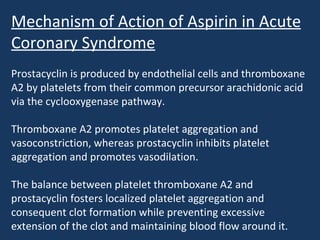
Prostacyclin is produced by endothelial cells and thromboxane
A2 by platelets from their common precursor arachidonic acid
via the cyclooxygenase pathway.

Thromboxane A2 promotes platelet aggregation and
vasoconstriction, whereas prostacyclin inhibits platelet
aggregation and promotes vasodilation.

The balance between platelet thromboxane A2 and
prostacyclin fosters localized platelet aggregation and
consequent clot formation while preventing excessive
extension of the clot and maintaining blood flow around it.
Mechanism of Action of Aspirin in Acute
Coronary Syndrome
The thromboxane A2–prostacyclin balance can be shifted
toward prostacyclin by administration of low doses of aspirin.
Aspirin produces irreversible inhibition of cyclooxygenase.

Although this reduces production of both thromboxane A2 and
prostacyclin, endothelial cells produce new cyclooxygenase in
a matter of hours whereas platelets cannot manufacture the
enzyme, and the level rises only as new platelets enter the
circulation. This is a slow process because platelets have a half-
life of about 4 days.
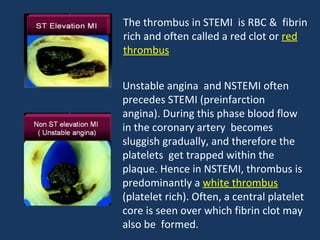
The thrombus in STEMI is RBC & fibrin
rich and often called a red clot or red
thrombus


Unstable angina and NSTEMI often
precedes STEMI (preinfarction
angina). During this phase blood flow
in the coronary artery becomes
sluggish gradually, and therefore the
platelets get trapped within the
plaque. Hence in NSTEMI, thrombus is
predominantly a white thrombus
(platelet rich). Often, a central platelet
core is seen over which fibrin clot may
also be formed.
Fibrinolytics
• Why is streptokinase not used in treating UA/
  NSTEMI?
• All available thrombolytic agents act basically
  as a fibrinolytic agents, therefore it is difficult
  to lyse the platelet rich clot.
• There is also a risk of these agents lysing the
  fibrin cap and exposing underlying platelet
  core and trigger a fresh thrombus (TIMI IIIb
  trial)
STEMI, NSTEMI and UA
• STEMI - occlusive thrombus - ST elevation (and
  Q waves) - Cardiac Enzyme elevation -
  Fibrinolytics beneficial
• NSTEMI - non-occlusive thrombus - NO ST/Q -
  Cardiac Enzyme elevation present -
  Fibrinolytics not beneficial
• UA - non-occlusive thrombus - NO ST/Q -
  Cardiac Enzyme elevation absent -
  Fibrinolytics not beneficial
Electrophysiological Changes During
          Cardiac Ischemia
• Ischemia/hypoxia causes an elevation in
  extracellular K+. This occurs because K+ leaks
  out through K+ - ATP channels and because of
  decreased activity of the Na+/K+-ATPase
  pump
Pathophysiology of Asthma and
            COPD
• A chronic inflammatory disorder of the
  airways
• Many cells and cellular elements play a role
• Characterized by airway hyperresponsiveness
  that leads to recurrent episodes of wheezing,
  breathlessness, chest tightness, and coughing
• Widespread, variable, and often reversible
  airflow limitation
ASTHMA                            COPD
       Allergens                        Cigarette smoke

                YY Y

  Ep cells    Mast cell         Alv macrophage cells
                                            Ep


  CD4+ cell   Eosinophil          CD8+ cell Neutrophil
  (Th2)                           (Tc1)
    Bronchoconstriction           Small airway narrowing
           AHR                    Alveolar destruction


                   Airflow Limitation
Reversible                                     Irreversible
                                        Source: Peter J. Barnes, MD

Intensive Course Phase 1 2010a

  • 1.
    Intensive Course For Emergency Medicine Phase I (MMed Professional Exam 2010) KS Chew School of Medical Sciences Universiti Sains Malaysia
  • 2.
  • 3.
    • Stroke volume= End diastolic volume – End systolic volume = 135 – 65 = 70 ml • At rate of 70 beats/min, CO = 70 * 70 = 4900 ml • Ejection fraction (EF) is the ratio of stroke volume to end-diastolic volume (EDV), expressed as a percentage: • EF = (SV/EDV) * 100
  • 6.
    Schematic Representation OfThe Frog- heart Preparation Used By Otto Frank
  • 7.
  • 8.
    Effects On StrokeVolume Of Stimulating The Sympathetic Nerves To The Heart
  • 9.
    The pressure-volume cycleof the human left ventricle. The area bounded by the pressure-volume curve gives the stroke work of the heart. The lower confine of the pressure-volume loop shown by the dotted line is defined by the passive stretch of the relaxed ventricular muscle by the returning blood.
  • 11.
    Increased Preload Increased Increased Afterload Contractility
  • 16.
    Vascular Function andCardiac Function Curve
  • 17.
    Vascular Function andCardiac Function Curve
  • 19.
    Relationship Between End-diastolic Ventricular Volume and Stroke Volume
  • 20.
    Pathophysiology of AcuteCoronary Syndrome
  • 21.
    Onset of STEMI Hospital Management Modified from Libby. Circulation 2001;104:365, - Prehospital issues - Medications Hamm et al. The Lancet 2001;358:1533 and - Initial recognition and management - Arrhythmias Davies. Heart 2000;83:361. in the Emergency Department (ED) - Complications - Reperfusion - Preparation for discharge Secondary Prevention/ Management Long-Term Management Before STEMI Chronology of the interface between the 1 2 3 4 5 6 patient and the clinician 4 through the progression of plaque formation and the onset of Presentation Ischemic Discomfort Working Dx Acute Coronary Syndrome complications of ECG No ST Elevation UA NSTEMI ST Elevation STEMI. Cardiac Biomarker Final Dx Unstable NQMI QwMI Angina Myocardial Infarction
  • 22.
    Pathophysiology of ACS Large One example of atherothrombotic fissure disease progression Occlusive thrombus Lipid pool (Q-wave MI) Macrophages Small Stress, tensile, fissure internal Mural thrombus Shear forces, Fissure (unstable angina/ external non-Q-wave MI) Atherosclerotic Plaque Thrombus plaque disruption Fuster V et al NEJM 1992;326:310–318 Davies MJ et al Circulation 1990;82(Suppl II):II–38, II–46
  • 23.
    Atherothrombosis: a Generalized and Progressive Process Plaque Unstable Fatty Fibrous Athero- rupture/ sclerotic fissure & angina MI }ACS Normal streak plaque plaque thrombosis Ischemic stroke/TIA Critical leg Clinically silent ischemia Stable angina Cardiovascular Intermittent claudication death Increasing age ACS, acute coronary syndrome; TIA, transient ischemic attack
  • 24.
    Platelet Inhibition WithGP IIb/IIIa Inhibitors Reproduced with permission from Yeghiazarians Y, Braunstein JB, Askari A, et al. Unstable angina pectoris. N Engl J Med. 2000;342:101-114. Copyright © 2000, Massachusetts Medical Society. All rights reserved.
  • 25.
    Mechanism of Actionof Aspirin in Acute Coronary Syndrome Prostacyclin is produced by endothelial cells and thromboxane A2 by platelets from their common precursor arachidonic acid via the cyclooxygenase pathway. Thromboxane A2 promotes platelet aggregation and vasoconstriction, whereas prostacyclin inhibits platelet aggregation and promotes vasodilation. The balance between platelet thromboxane A2 and prostacyclin fosters localized platelet aggregation and consequent clot formation while preventing excessive extension of the clot and maintaining blood flow around it.
  • 26.
    Mechanism of Actionof Aspirin in Acute Coronary Syndrome The thromboxane A2–prostacyclin balance can be shifted toward prostacyclin by administration of low doses of aspirin. Aspirin produces irreversible inhibition of cyclooxygenase. Although this reduces production of both thromboxane A2 and prostacyclin, endothelial cells produce new cyclooxygenase in a matter of hours whereas platelets cannot manufacture the enzyme, and the level rises only as new platelets enter the circulation. This is a slow process because platelets have a half- life of about 4 days.
  • 31.
    The thrombus inSTEMI is RBC & fibrin rich and often called a red clot or red thrombus Unstable angina and NSTEMI often precedes STEMI (preinfarction angina). During this phase blood flow in the coronary artery becomes sluggish gradually, and therefore the platelets get trapped within the plaque. Hence in NSTEMI, thrombus is predominantly a white thrombus (platelet rich). Often, a central platelet core is seen over which fibrin clot may also be formed.
  • 32.
    Fibrinolytics • Why isstreptokinase not used in treating UA/ NSTEMI? • All available thrombolytic agents act basically as a fibrinolytic agents, therefore it is difficult to lyse the platelet rich clot. • There is also a risk of these agents lysing the fibrin cap and exposing underlying platelet core and trigger a fresh thrombus (TIMI IIIb trial)
  • 33.
    STEMI, NSTEMI andUA • STEMI - occlusive thrombus - ST elevation (and Q waves) - Cardiac Enzyme elevation - Fibrinolytics beneficial • NSTEMI - non-occlusive thrombus - NO ST/Q - Cardiac Enzyme elevation present - Fibrinolytics not beneficial • UA - non-occlusive thrombus - NO ST/Q - Cardiac Enzyme elevation absent - Fibrinolytics not beneficial
  • 35.
    Electrophysiological Changes During Cardiac Ischemia • Ischemia/hypoxia causes an elevation in extracellular K+. This occurs because K+ leaks out through K+ - ATP channels and because of decreased activity of the Na+/K+-ATPase pump
  • 37.
  • 38.
    • A chronicinflammatory disorder of the airways • Many cells and cellular elements play a role • Characterized by airway hyperresponsiveness that leads to recurrent episodes of wheezing, breathlessness, chest tightness, and coughing • Widespread, variable, and often reversible airflow limitation
  • 42.
    ASTHMA COPD Allergens Cigarette smoke YY Y Ep cells Mast cell Alv macrophage cells Ep CD4+ cell Eosinophil CD8+ cell Neutrophil (Th2) (Tc1) Bronchoconstriction Small airway narrowing AHR Alveolar destruction Airflow Limitation Reversible Irreversible Source: Peter J. Barnes, MD