Oxidative Phosphorylation
This occurs in the inner membranes of the mitochondria
enzymes and protein carrier molecules embedded
folded into cristae to increase the surface area
NAD reduced and FAD reduced are passed to ETC
The Hydrogen atom is split into
a proton (H+) and
an electron (e-)
The proton remains in
solution
The molecule that splits
hydrogen moves the
proton into the inter-
membrane space
The proton will later be
used to reduce oxygen
The electron is
transferred to various
electron carriers along a
biological electron
transport chain
At certain points ATP is
made by phosphorylation
– during chemiosmosis
Oxygen is finally reduced
to water
Biological electron transport
This is a series of linked oxidation and
reduction, or Redox, reactions
a donor and an acceptor of electrons
The acceptor gains an electron and
becomes reduced
The donor looses an electron and
becomes oxidized
Fe2+ + Cu2+ Fe 3+ + Cu+
Energy is lost as the electron is
passed along the chain
usually as heat
At certain points there is enough
energy to make ATP
This is done by a process called
Chemiosmosis
In the first step NADreduced
donates the hydrogen to a
hydrogen carrier
The first hydrogen carrier is
now in the reduced state
The hydrogen is then passed to a
second hydrogen carrier molecule
This is now reduced
The first carrier is oxidised
It can now pick up more hydrogen
It is at this point that FAD can first
donate hydrogen
If FAD is being used the process
begins here
The hydrogen is broken into a proton and an
electron
The proton is released into the inter-
membrane space because of the structure of
the carrier molecule
This will make a proton gradient across the
inner membrane
An electron acceptor molecule
picks up the electron and
becomes reduced
The electron is passed to a second
electron carrier then to Cytochrome
oxidase – which is now reduced
The final electron acceptor is oxygen
Two electrons combine with a 2
protons to form 2 hydrogens
These are picked up by oxygen,
forming water
The final step in oxidative
phosphorylation involves cytochrome
oxidase reducing oxygen to water.
This step can be inhibited using
Potassium Cyanide or Carbon monoxide
These are known as respiratory
inhibitors
they can be used experimentally to show
the effects of blocking respiration
(energy release) on a process
The transfer of electrons makes energy available
Some is lost as heat
But at some points there is enough energy
released to produce ATP
Potentially each NADreduced can generate 3 ATP molecules
And each NADreduced can generate 2 ATP molecules
In reality 25% of the energy made is used in
transporting ATP out of the mitochondria
therefore
For each NAD reduced there are 2.5
ATP made
For each FAD reduced there are 1.5
ATP made
process NAD
reduced
made
FAD
red
made
Amount
ATP
formed in
ETC
Total
glycolysis 2 - 2 x 2.5 = 5
Link
reaction
1x2 - 2 x 2.5= 5
Krebs
Cycle
3x2
1 x 2
6 x 2.5 =
3 x 1.5 =
15
3
TOTAL 28
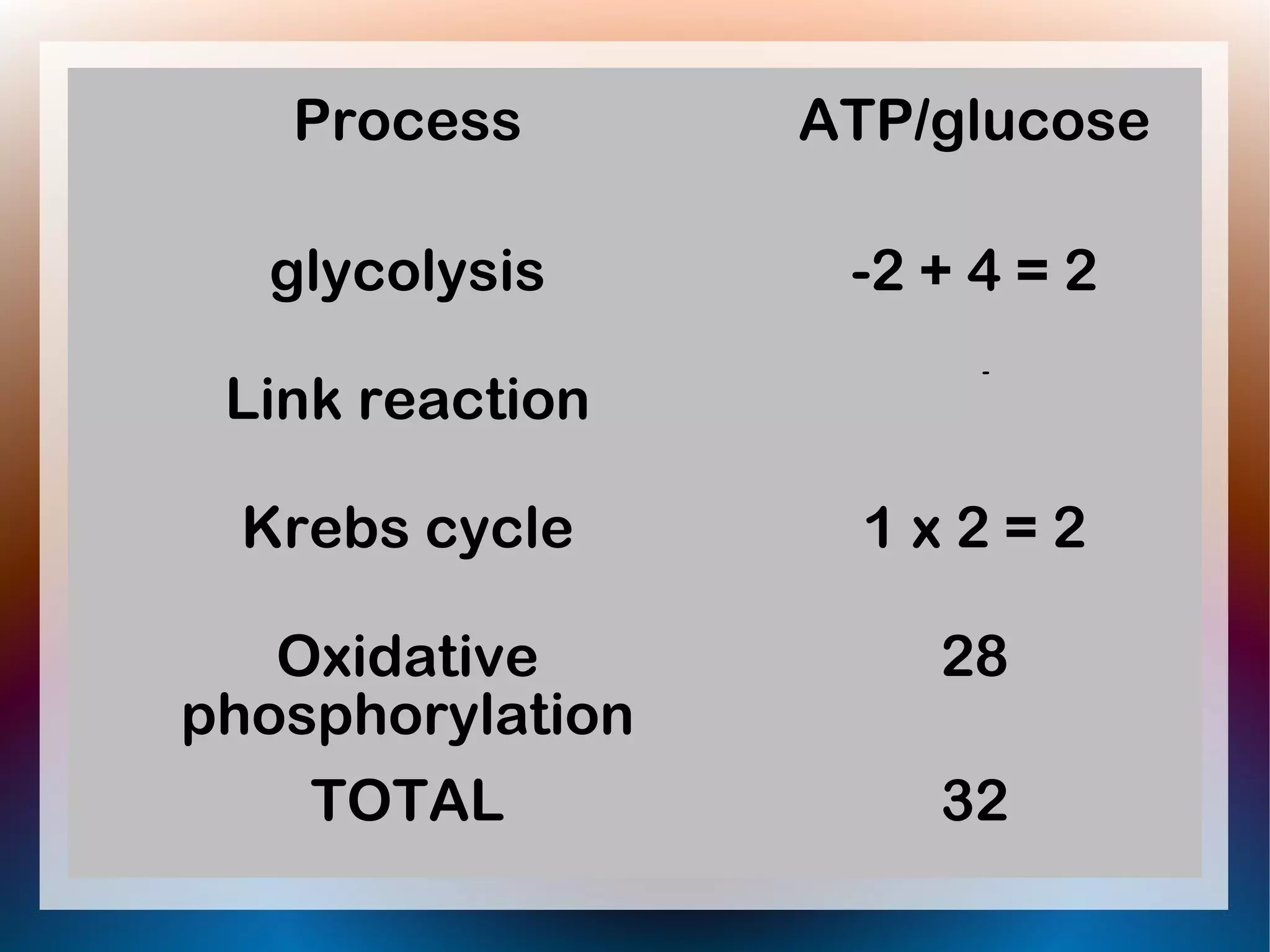
Process ATP/glucose
glycolysis -2 + 4 = 2
Link reaction
-
Krebs cycle 1 x 2 = 2
Oxidative
phosphorylation
28
TOTAL 32
Chemiosmosis
the most accepted explanation for ATP
synthesis during the electron transport
chain
Note that ATP formed in glycolysis and
the Krebs cycle uses Chemical
Potential energy from the bonds
Energy from the ETC is used
to pump hydrogen ions
from the mitochondrial
matrix
to the space between the
membranes of the envelope
This occurs because of the orientation of the proteins that
pick up and then loose the hydrogen ions
they will always transfer the ions to one side of the
membrane
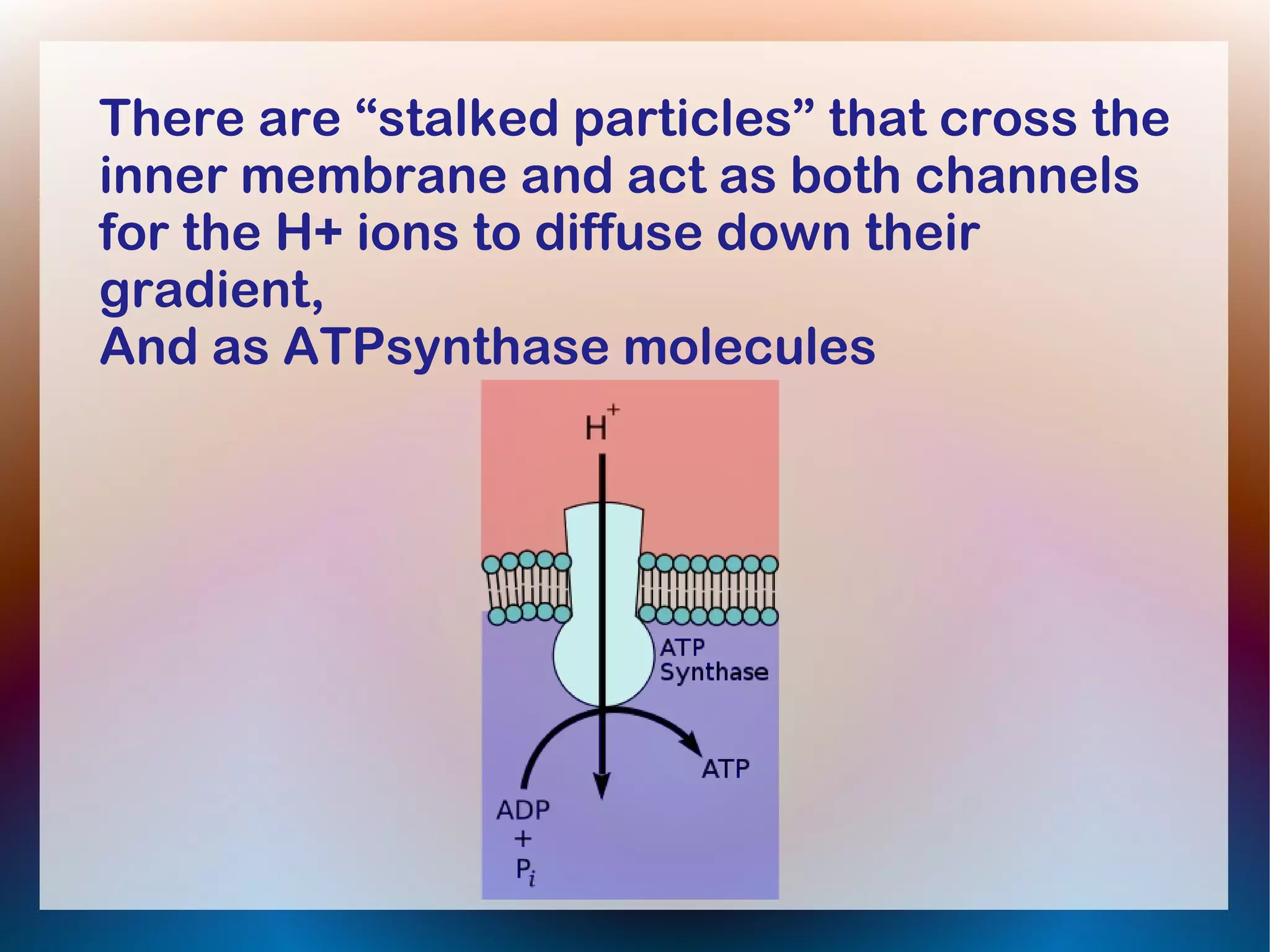
There are “stalked particles” that cross the
inner membrane and act as both channels
for the H+ ions to diffuse down their
gradient,
And as ATPsynthase molecules
For 3 H+
ions moving through the ATPsynthase one
ADP is phosphorylated to ATP
Recommended videos
ETC and ATPsynthase
Very good

4. oxidative phosphorylation

  • 1.
  • 2.
    Oxidative Phosphorylation This occursin the inner membranes of the mitochondria enzymes and protein carrier molecules embedded folded into cristae to increase the surface area
  • 3.
    NAD reduced andFAD reduced are passed to ETC The Hydrogen atom is split into a proton (H+) and an electron (e-)
  • 4.
    The proton remainsin solution The molecule that splits hydrogen moves the proton into the inter- membrane space The proton will later be used to reduce oxygen
  • 5.
    The electron is transferredto various electron carriers along a biological electron transport chain At certain points ATP is made by phosphorylation – during chemiosmosis Oxygen is finally reduced to water
  • 7.
    Biological electron transport Thisis a series of linked oxidation and reduction, or Redox, reactions a donor and an acceptor of electrons The acceptor gains an electron and becomes reduced The donor looses an electron and becomes oxidized Fe2+ + Cu2+ Fe 3+ + Cu+
  • 8.
    Energy is lostas the electron is passed along the chain usually as heat At certain points there is enough energy to make ATP This is done by a process called Chemiosmosis
  • 9.
    In the firststep NADreduced donates the hydrogen to a hydrogen carrier The first hydrogen carrier is now in the reduced state
  • 10.
    The hydrogen isthen passed to a second hydrogen carrier molecule This is now reduced The first carrier is oxidised It can now pick up more hydrogen
  • 11.
    It is atthis point that FAD can first donate hydrogen If FAD is being used the process begins here
  • 12.
    The hydrogen isbroken into a proton and an electron The proton is released into the inter- membrane space because of the structure of the carrier molecule This will make a proton gradient across the inner membrane
  • 13.
    An electron acceptormolecule picks up the electron and becomes reduced
  • 14.
    The electron ispassed to a second electron carrier then to Cytochrome oxidase – which is now reduced
  • 15.
    The final electronacceptor is oxygen Two electrons combine with a 2 protons to form 2 hydrogens These are picked up by oxygen, forming water
  • 16.
    The final stepin oxidative phosphorylation involves cytochrome oxidase reducing oxygen to water. This step can be inhibited using Potassium Cyanide or Carbon monoxide These are known as respiratory inhibitors they can be used experimentally to show the effects of blocking respiration (energy release) on a process
  • 17.
    The transfer ofelectrons makes energy available Some is lost as heat But at some points there is enough energy released to produce ATP Potentially each NADreduced can generate 3 ATP molecules And each NADreduced can generate 2 ATP molecules
  • 19.
    In reality 25%of the energy made is used in transporting ATP out of the mitochondria therefore For each NAD reduced there are 2.5 ATP made For each FAD reduced there are 1.5 ATP made
  • 20.
    process NAD reduced made FAD red made Amount ATP formed in ETC Total glycolysis2 - 2 x 2.5 = 5 Link reaction 1x2 - 2 x 2.5= 5 Krebs Cycle 3x2 1 x 2 6 x 2.5 = 3 x 1.5 = 15 3 TOTAL 28
  • 21.
    Process ATP/glucose glycolysis -2+ 4 = 2 Link reaction - Krebs cycle 1 x 2 = 2 Oxidative phosphorylation 28 TOTAL 32
  • 22.
  • 23.
    the most acceptedexplanation for ATP synthesis during the electron transport chain Note that ATP formed in glycolysis and the Krebs cycle uses Chemical Potential energy from the bonds
  • 24.
    Energy from theETC is used to pump hydrogen ions from the mitochondrial matrix to the space between the membranes of the envelope
  • 25.
    This occurs becauseof the orientation of the proteins that pick up and then loose the hydrogen ions they will always transfer the ions to one side of the membrane
  • 26.
    There are “stalkedparticles” that cross the inner membrane and act as both channels for the H+ ions to diffuse down their gradient, And as ATPsynthase molecules
  • 27.
    For 3 H+ ionsmoving through the ATPsynthase one ADP is phosphorylated to ATP
  • 28.
    Recommended videos ETC andATPsynthase Very good