Presentation
on
Testing of Hypothesis
By:
Ankit Dubey
Chintan H.Trivedi
• Basics of Hypothesis
• Procedure of Hypothesis Testing
• Testing Of Hypothesis for Comparing two
related samples
• Hypothesis testing of Proportion
• Limitations of Test of Hypothesis
HYPOTHESIS
• For a researcher hypothesis is a formal question
that he intends to resolve.
• Hypothesis may be defined as a proposition or a
set of proposition set forth as an explanation for
the occurrence of some specified group of
phenomena.
• Example: vehicle A performs better than vehicle B
NULL HYPOTHESIS AND ALTERNATIVE
HYPOTHESIS
• Null hypothesis: when population mean is
equal to hypothesis mean
• Alternative hypothesis : the hypothesis which
is accepted when null hypothesis fails
• A set of alternatives to null hypothesis is
called alternative hypothesis
• Null hypothesis always include = to sign
• Alternative hypothesis may include any of the
inequality signs
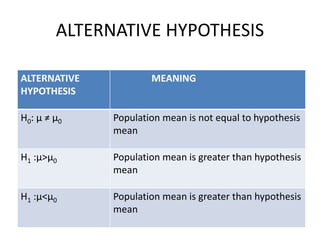
ALTERNATIVE HYPOTHESIS
ALTERNATIVE
HYPOTHESIS
MEANING
H0: μ ≠ μ0 Population mean is not equal to hypothesis
mean
H1 :μ>μ0 Population mean is greater than hypothesis
mean
H1 :μ<μ0 Population mean is greater than hypothesis
mean
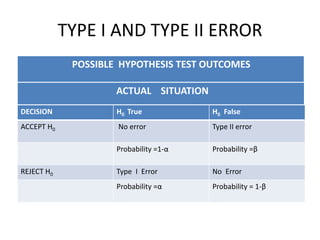
TYPE I AND TYPE II ERROR
POSSIBLE HYPOTHESIS TEST OUTCOMES
ACTUAL SITUATION
DECISION H0 True H0 False
ACCEPT H0 No error Type II error
Probability =1-α Probability =β
REJECT H0 Type I Error No Error
Probability =α Probability = 1-β
CRITICAL VALUE
It divides area under probability curve into two
regions critical and acceptance regions
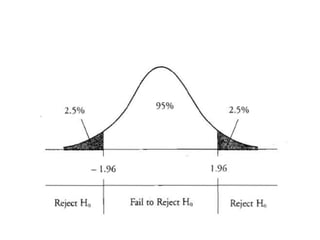
In two tailed test we wish to test H0 : μ =μ0
against H1 : μ≠ μ0 we have two critical values
which divides probability curve into two
regions
Level of significance
• Denoted by α is the probability of Type 1 error.
• It is usually 5% which should be chosen with
great care thought and reason.
• If level of significance is 5% then researcher is
willing to take as much as 5% percent risk of
rejecting null hypothesis if it is true.
• Maximum Value of probability of rejecting H0
when it is true.
• Determined usually in advance prior to testing
of hypothesis.
Two Tailed And One Tailed Test
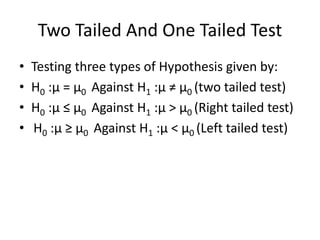
• Testing three types of Hypothesis given by:
• H0 :μ = μ0 Against H1 :μ ≠ μ0 (two tailed test)
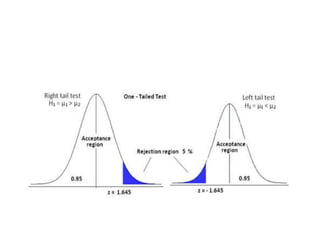
• H0 :μ ≤ μ0 Against H1 :μ > μ0 (Right tailed test)
• H0 :μ ≥ μ0 Against H1 :μ < μ0 (Left tailed test)
PROCEDURE FOR HYPOTHESIS TESTING
• It is used to test validity of hypothesis
• Setting up the hypothesis: Formal statement
of null and alternative hypothesis
• Selecting significance level:pre determined
level of significance based on sample size,
variability of measurements with in sample
• Test statistic: to obtain value of mean
,variance etc on basis of distribution selected
PROCEDURE FOR HYPOTHESIS TESTING
• Critical value: depends on type of
distribution, level of significance, type of test
• Decision: compare the value of test statistic
and critical value
• we reject null hypothesis when
• Test statistic value< lower than critical
value>upper critical value
• Value of test statistic > critical value
• Value of test statistic < critical value
HYPOTHESIS TESTING FOR
COMPARING TWO RELATED SAMPLES
• Paired t-test is a way to test for comparing two
related samples,
• For a paired t-test, observations in the two
samples collected in the form matched pairs
• “each observation in the one sample must be
paired with an observation in the other sample in
such a manner that these observations are
somehow “matched” or related, in an attempt to
eliminate extraneous factors which are not of
interest in test.”
• Such a test is generally considered appropriate in
a before-and-after-treatment study.
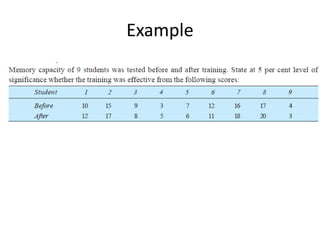
• Testing a group of certain students before and
after training in order to know whether the
training is effective, in which situation we may
use paired t-test.
• To apply this test, :
a. Work out the difference score for each
matched pair
b. Find out the average of such differences, D
c. Sample variance of the difference score.
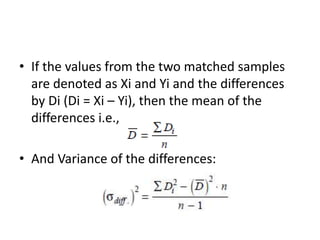
• If the values from the two matched samples
are denoted as Xi and Yi and the differences
by Di (Di = Xi – Yi), then the mean of the
differences i.e.,
• And Variance of the differences:
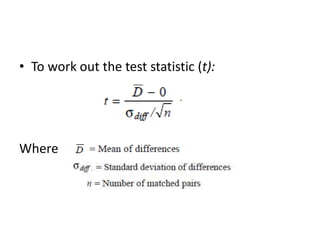
• To work out the test statistic (t):
Where
Example
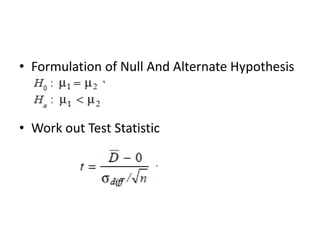
• Formulation of Null And Alternate Hypothesis
• Work out Test Statistic
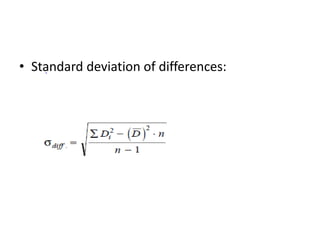
• Standard deviation of differences:
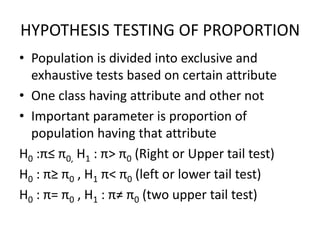
HYPOTHESIS TESTING OF PROPORTION
• Population is divided into exclusive and
exhaustive tests based on certain attribute
• One class having attribute and other not
• Important parameter is proportion of
population having that attribute
H0 :π≤ π0, H1 : π> π0 (Right or Upper tail test)
H0 : π≥ π0 , H1 π< π0 (left or lower tail test)
H0 : π= π0 , H1 : π≠ π0 (two upper tail test)
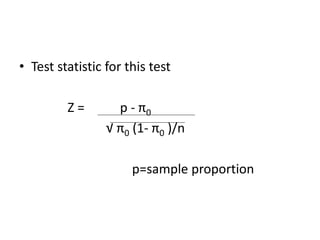
• Test statistic for this test
Z = p - π0
√ π0 (1- π0 )/n
p=sample proportion
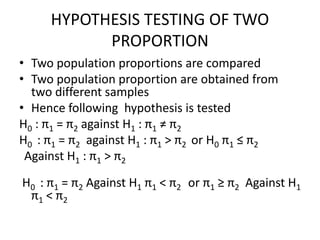
HYPOTHESIS TESTING OF TWO
PROPORTION
• Two population proportions are compared
• Two population proportion are obtained from
two different samples
• Hence following hypothesis is tested
H0 : π1 = π2 against H1 : π1 ≠ π2
H0 : π1 = π2 against H1 : π1 > π2 or H0 π1 ≤ π2
Against H1 : π1 > π2
H0 : π1 = π2 Against H1 π1 < π2 or π1 ≥ π2 Against H1
π1 < π2
EXAMPLE
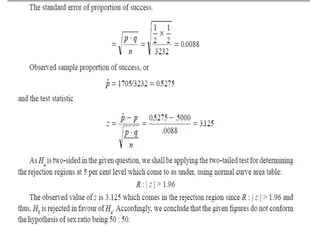
Q) A sample survey indicates that out of 3232 births,
1705 were boys and the rest were girls. Do these
figures confirm the hypothesis that the sex ratio is
50 : 50? Test at 5 per cent level of significance.
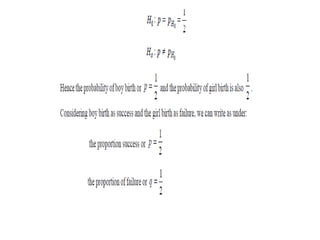
Solution: Starting from the null hypothesis that the sex
ratio is 50 : 50 we may write:
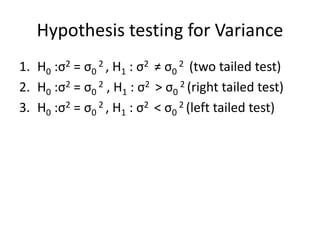
Hypothesis testing for Variance
1. H0 :σ2 = σ0
2 , H1 : σ2 ≠ σ0
2 (two tailed test)
2. H0 :σ2 = σ0
2 , H1 : σ2 > σ0
2 (right tailed test)
3. H0 :σ2 = σ0
2 , H1 : σ2 < σ0
2 (left tailed test)
Limitations of Test of Hypothesis
• Important limitations are as follows:
• Testing is not decision-making itself; the tests are only
useful aids for decision-making.
• “proper interpretation of statistical evidence is
important to intelligent decisions.”
• Test do not explain the reasons as to why does the
difference exist, viz. between the means of the two
samples.
• They simply indicate whether the difference is due to
fluctuations of sampling or because of other reasons
• The tests do not tell us the reasons causing the
difference.
• Results of significance tests are based on probabilities
and as such cannot be expressed with full certainty.
• Statistical inferences based on the significance tests
cannot be said to be entirely correct evidences
concerning the truth of the hypotheses.
• This is specially so in case of small samples where the
probability of drawing erring inferences happens to be
generally higher.
• For greater reliability, the size of samples be sufficiently
enlarged.
• All these limitations suggest that in problems
of statistical significance, the inference
techniques (or the tests) must be combined
with adequate knowledge of the subject-
matter along with the ability of good
judgement.
Thank You!

Testing of Hypothesis

  • 1.
  • 2.
    • Basics ofHypothesis • Procedure of Hypothesis Testing • Testing Of Hypothesis for Comparing two related samples • Hypothesis testing of Proportion • Limitations of Test of Hypothesis
  • 3.
    HYPOTHESIS • For aresearcher hypothesis is a formal question that he intends to resolve. • Hypothesis may be defined as a proposition or a set of proposition set forth as an explanation for the occurrence of some specified group of phenomena. • Example: vehicle A performs better than vehicle B
  • 4.
    NULL HYPOTHESIS ANDALTERNATIVE HYPOTHESIS • Null hypothesis: when population mean is equal to hypothesis mean • Alternative hypothesis : the hypothesis which is accepted when null hypothesis fails • A set of alternatives to null hypothesis is called alternative hypothesis • Null hypothesis always include = to sign • Alternative hypothesis may include any of the inequality signs
  • 5.
    ALTERNATIVE HYPOTHESIS ALTERNATIVE HYPOTHESIS MEANING H0: μ≠ μ0 Population mean is not equal to hypothesis mean H1 :μ>μ0 Population mean is greater than hypothesis mean H1 :μ<μ0 Population mean is greater than hypothesis mean
  • 6.
    TYPE I ANDTYPE II ERROR POSSIBLE HYPOTHESIS TEST OUTCOMES ACTUAL SITUATION DECISION H0 True H0 False ACCEPT H0 No error Type II error Probability =1-α Probability =β REJECT H0 Type I Error No Error Probability =α Probability = 1-β
  • 7.
    CRITICAL VALUE It dividesarea under probability curve into two regions critical and acceptance regions In two tailed test we wish to test H0 : μ =μ0 against H1 : μ≠ μ0 we have two critical values which divides probability curve into two regions
  • 8.
    Level of significance •Denoted by α is the probability of Type 1 error. • It is usually 5% which should be chosen with great care thought and reason. • If level of significance is 5% then researcher is willing to take as much as 5% percent risk of rejecting null hypothesis if it is true. • Maximum Value of probability of rejecting H0 when it is true. • Determined usually in advance prior to testing of hypothesis.
  • 9.
    Two Tailed AndOne Tailed Test • Testing three types of Hypothesis given by: • H0 :μ = μ0 Against H1 :μ ≠ μ0 (two tailed test) • H0 :μ ≤ μ0 Against H1 :μ > μ0 (Right tailed test) • H0 :μ ≥ μ0 Against H1 :μ < μ0 (Left tailed test)
  • 12.
    PROCEDURE FOR HYPOTHESISTESTING • It is used to test validity of hypothesis • Setting up the hypothesis: Formal statement of null and alternative hypothesis • Selecting significance level:pre determined level of significance based on sample size, variability of measurements with in sample • Test statistic: to obtain value of mean ,variance etc on basis of distribution selected
  • 13.
    PROCEDURE FOR HYPOTHESISTESTING • Critical value: depends on type of distribution, level of significance, type of test • Decision: compare the value of test statistic and critical value • we reject null hypothesis when • Test statistic value< lower than critical value>upper critical value • Value of test statistic > critical value • Value of test statistic < critical value
  • 14.
    HYPOTHESIS TESTING FOR COMPARINGTWO RELATED SAMPLES • Paired t-test is a way to test for comparing two related samples, • For a paired t-test, observations in the two samples collected in the form matched pairs • “each observation in the one sample must be paired with an observation in the other sample in such a manner that these observations are somehow “matched” or related, in an attempt to eliminate extraneous factors which are not of interest in test.”
  • 15.
    • Such atest is generally considered appropriate in a before-and-after-treatment study. • Testing a group of certain students before and after training in order to know whether the training is effective, in which situation we may use paired t-test. • To apply this test, : a. Work out the difference score for each matched pair b. Find out the average of such differences, D c. Sample variance of the difference score.
  • 16.
    • If thevalues from the two matched samples are denoted as Xi and Yi and the differences by Di (Di = Xi – Yi), then the mean of the differences i.e., • And Variance of the differences:
  • 17.
    • To workout the test statistic (t): Where
  • 18.
  • 19.
    • Formulation ofNull And Alternate Hypothesis • Work out Test Statistic
  • 20.
    • Standard deviationof differences:
  • 21.
    HYPOTHESIS TESTING OFPROPORTION • Population is divided into exclusive and exhaustive tests based on certain attribute • One class having attribute and other not • Important parameter is proportion of population having that attribute H0 :π≤ π0, H1 : π> π0 (Right or Upper tail test) H0 : π≥ π0 , H1 π< π0 (left or lower tail test) H0 : π= π0 , H1 : π≠ π0 (two upper tail test)
  • 22.
    • Test statisticfor this test Z = p - π0 √ π0 (1- π0 )/n p=sample proportion
  • 23.
    HYPOTHESIS TESTING OFTWO PROPORTION • Two population proportions are compared • Two population proportion are obtained from two different samples • Hence following hypothesis is tested H0 : π1 = π2 against H1 : π1 ≠ π2 H0 : π1 = π2 against H1 : π1 > π2 or H0 π1 ≤ π2 Against H1 : π1 > π2 H0 : π1 = π2 Against H1 π1 < π2 or π1 ≥ π2 Against H1 π1 < π2
  • 24.
    EXAMPLE Q) A samplesurvey indicates that out of 3232 births, 1705 were boys and the rest were girls. Do these figures confirm the hypothesis that the sex ratio is 50 : 50? Test at 5 per cent level of significance. Solution: Starting from the null hypothesis that the sex ratio is 50 : 50 we may write:
  • 27.
    Hypothesis testing forVariance 1. H0 :σ2 = σ0 2 , H1 : σ2 ≠ σ0 2 (two tailed test) 2. H0 :σ2 = σ0 2 , H1 : σ2 > σ0 2 (right tailed test) 3. H0 :σ2 = σ0 2 , H1 : σ2 < σ0 2 (left tailed test)
  • 28.
    Limitations of Testof Hypothesis • Important limitations are as follows: • Testing is not decision-making itself; the tests are only useful aids for decision-making. • “proper interpretation of statistical evidence is important to intelligent decisions.” • Test do not explain the reasons as to why does the difference exist, viz. between the means of the two samples. • They simply indicate whether the difference is due to fluctuations of sampling or because of other reasons • The tests do not tell us the reasons causing the difference.
  • 29.
    • Results ofsignificance tests are based on probabilities and as such cannot be expressed with full certainty. • Statistical inferences based on the significance tests cannot be said to be entirely correct evidences concerning the truth of the hypotheses. • This is specially so in case of small samples where the probability of drawing erring inferences happens to be generally higher. • For greater reliability, the size of samples be sufficiently enlarged.
  • 30.
    • All theselimitations suggest that in problems of statistical significance, the inference techniques (or the tests) must be combined with adequate knowledge of the subject- matter along with the ability of good judgement.
  • 31.