Wilcoxon Signed-Ranked Test 
(Paired T)
The Wilcoxon test is the non-parametric analogue to the 
pair-wise (repeated measures) t-test.
The non-parametric analogue to the pair-wise (repeated 
measures) t-test is the Wilcoxon test. 
You may remember that the pair-wise (repeated 
measures) t-test is used to determine the statistical 
significant difference between the same 
sample/observations or people on two separate 
occasions.
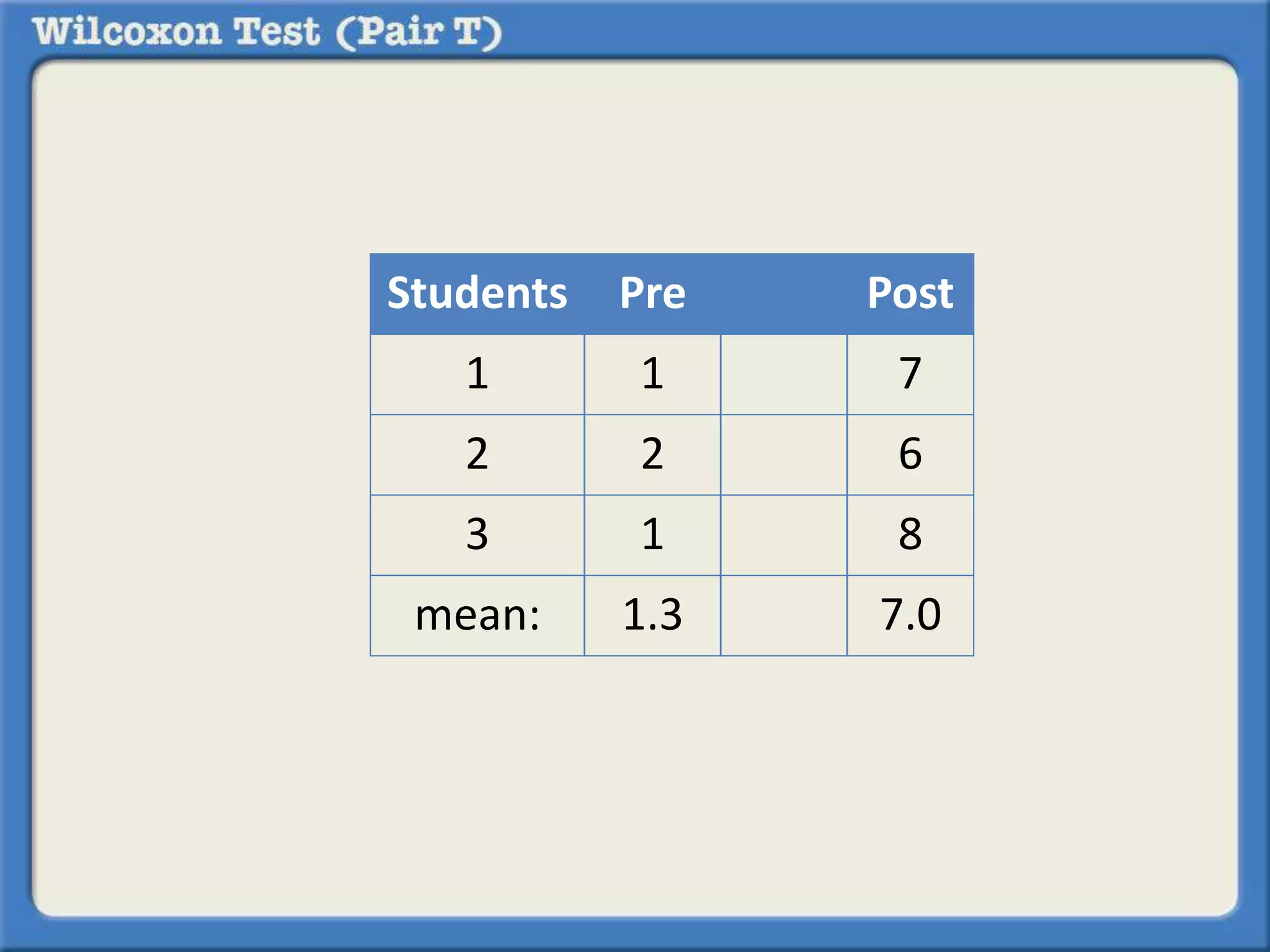
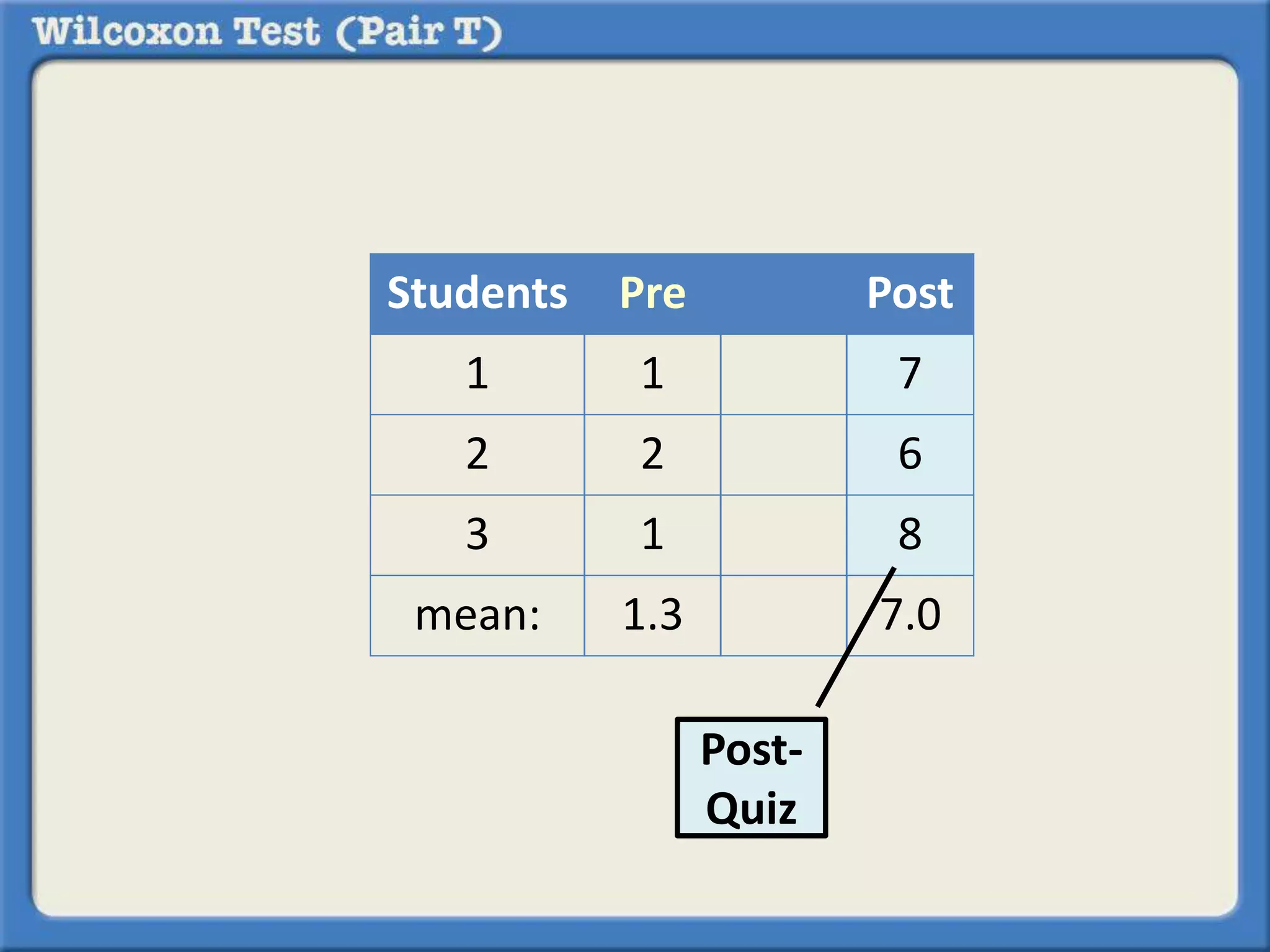
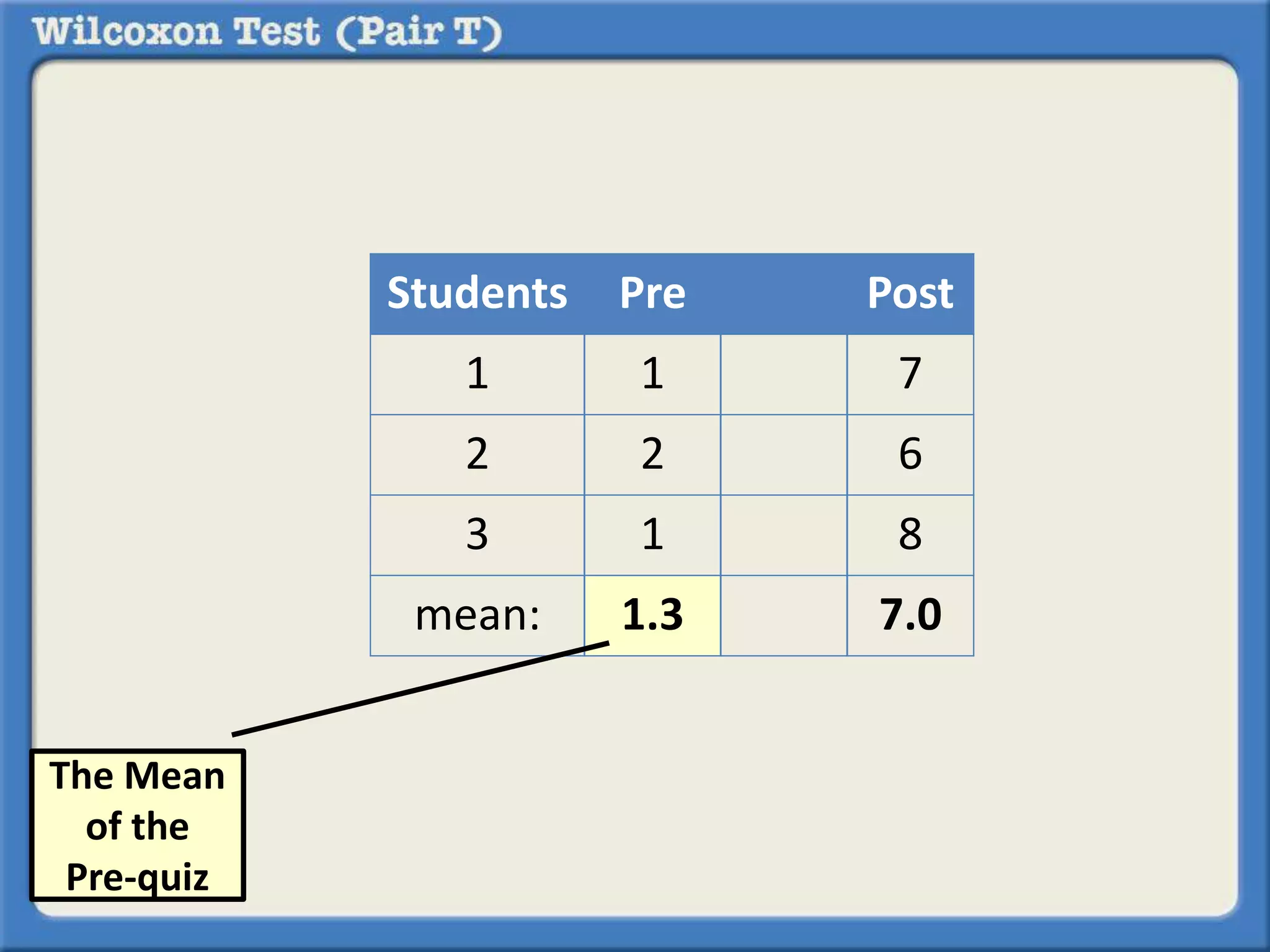
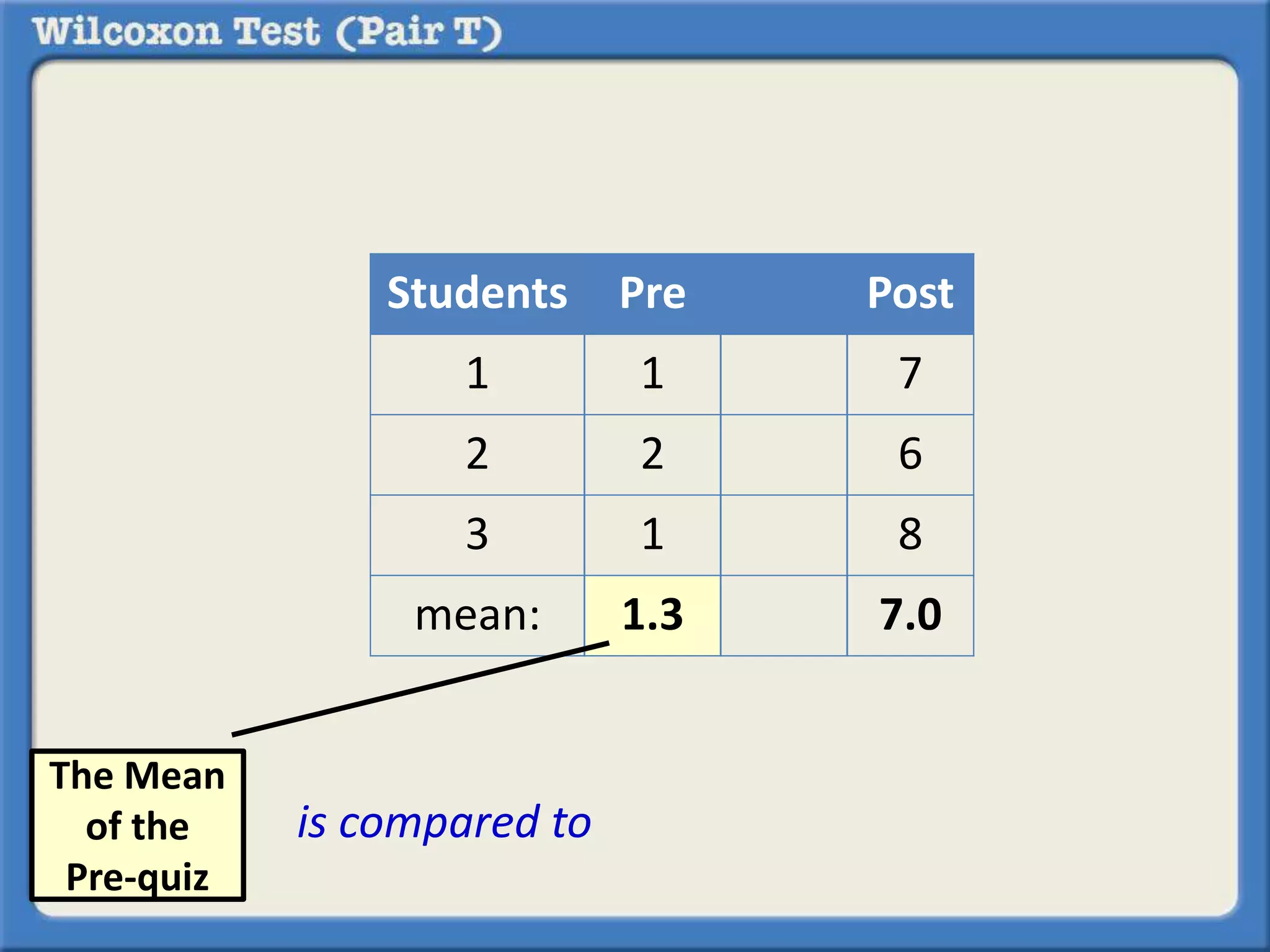
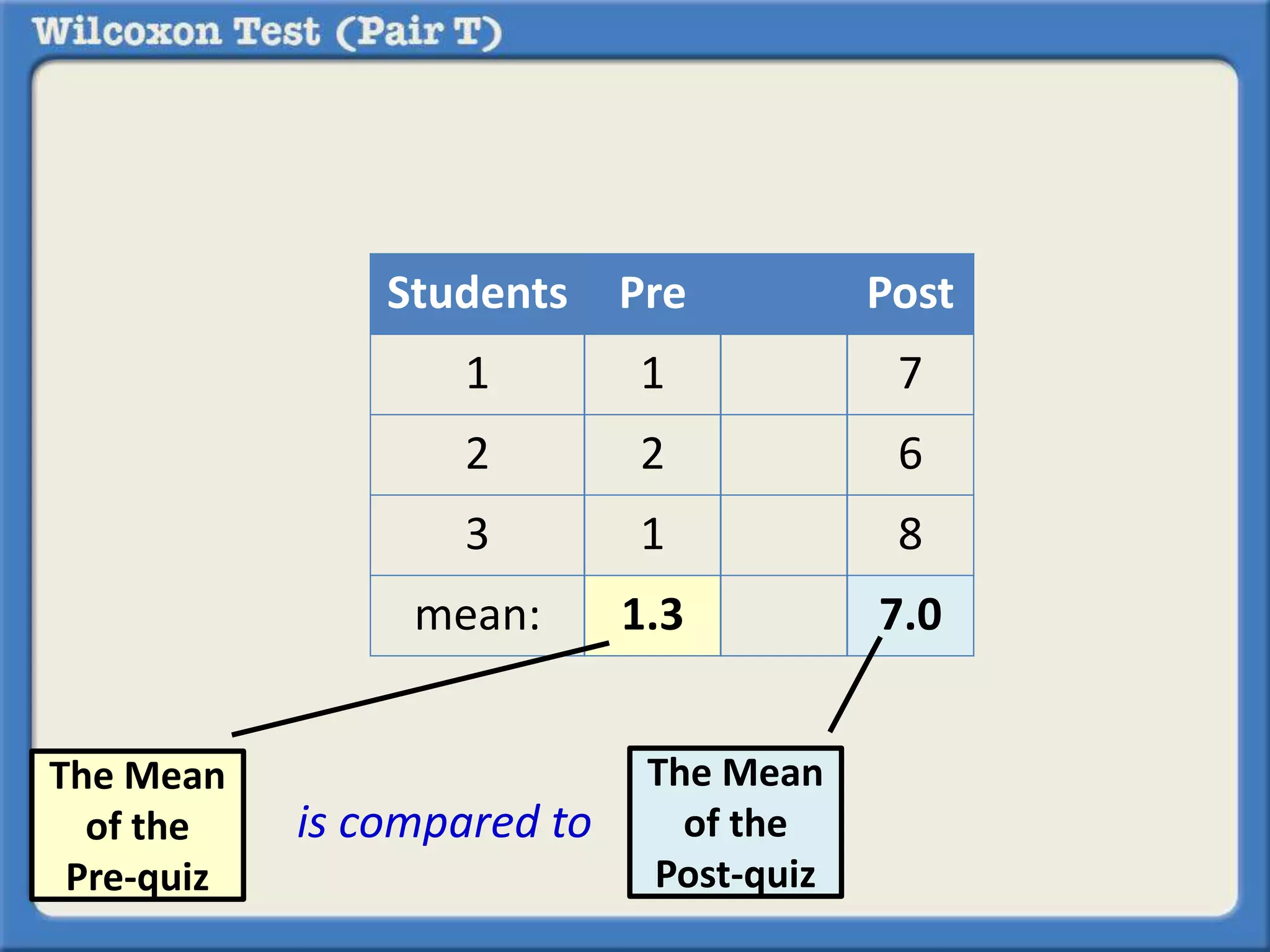
Here is a simplified data set that would use a paired 
sample t-test:
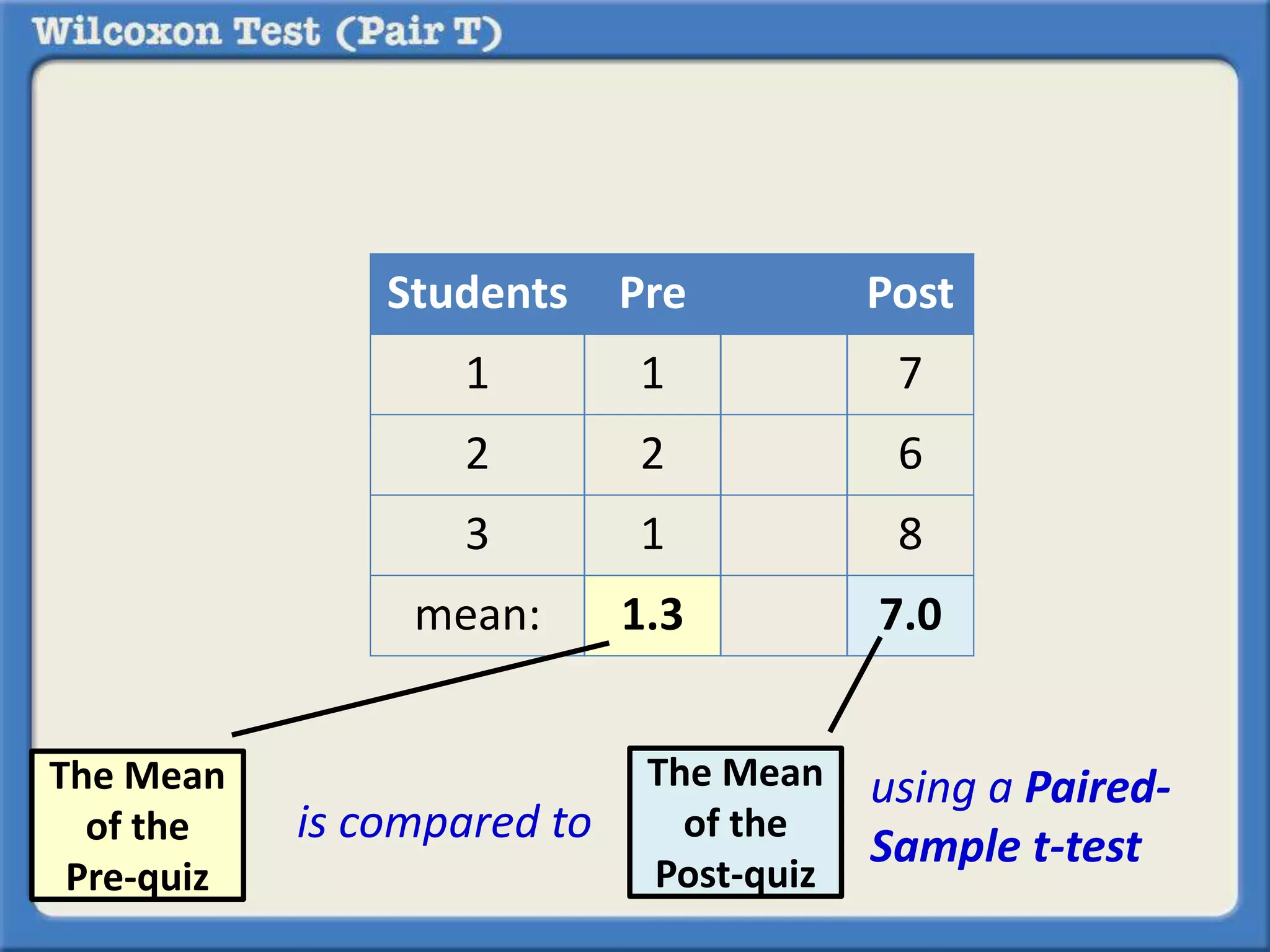
Students Pre Post 
1 1 7 
2 2 6 
3 1 8 
mean: 1.3 7.0
Students Pre Post 
1 1 7 
2 2 6 
3 1 8 
mean: 1.3 7.0 
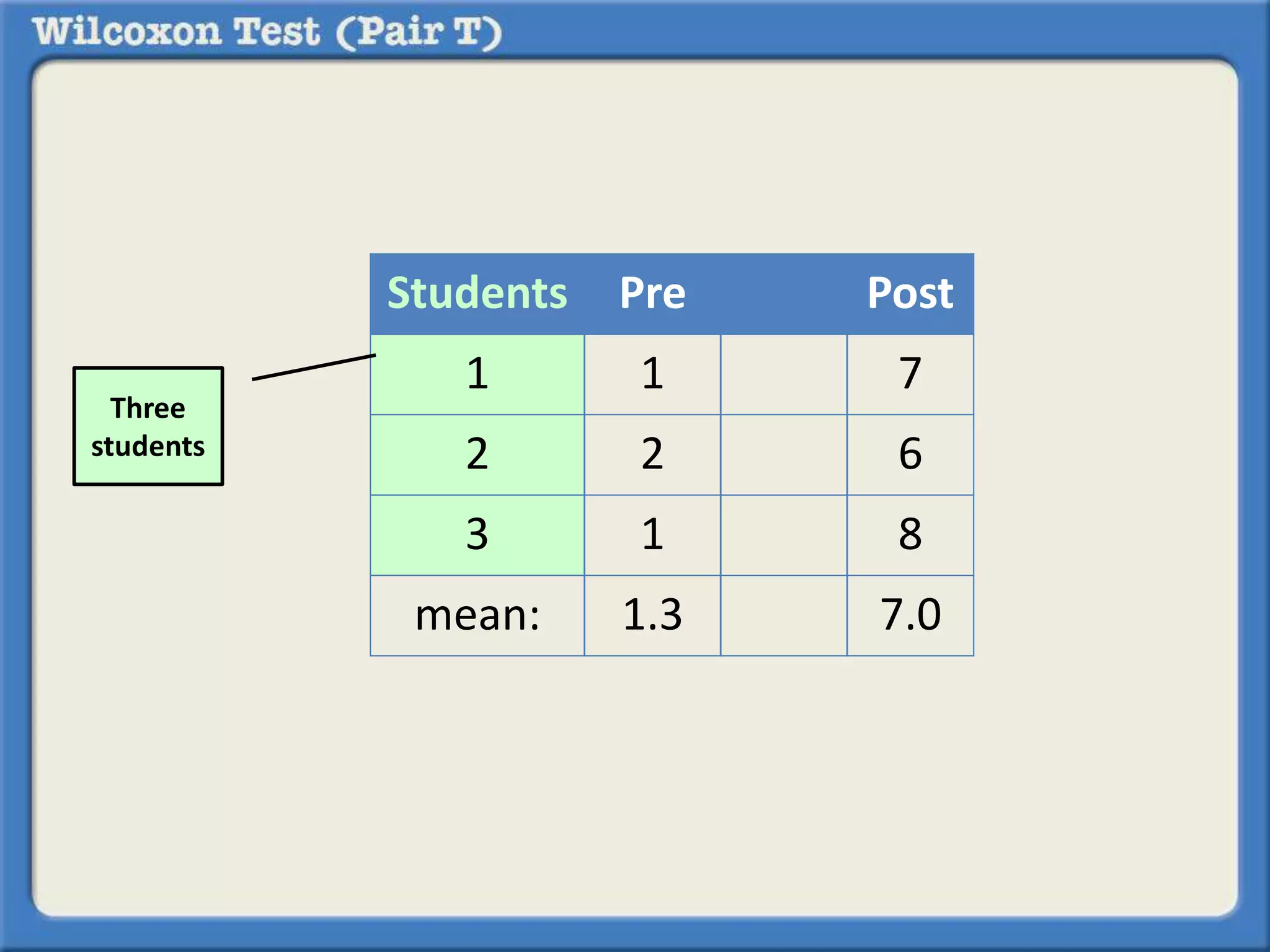
Three 
students
Students Pre Post 
1 1 7 
2 2 6 
3 1 8 
mean: 1.3 7.0 
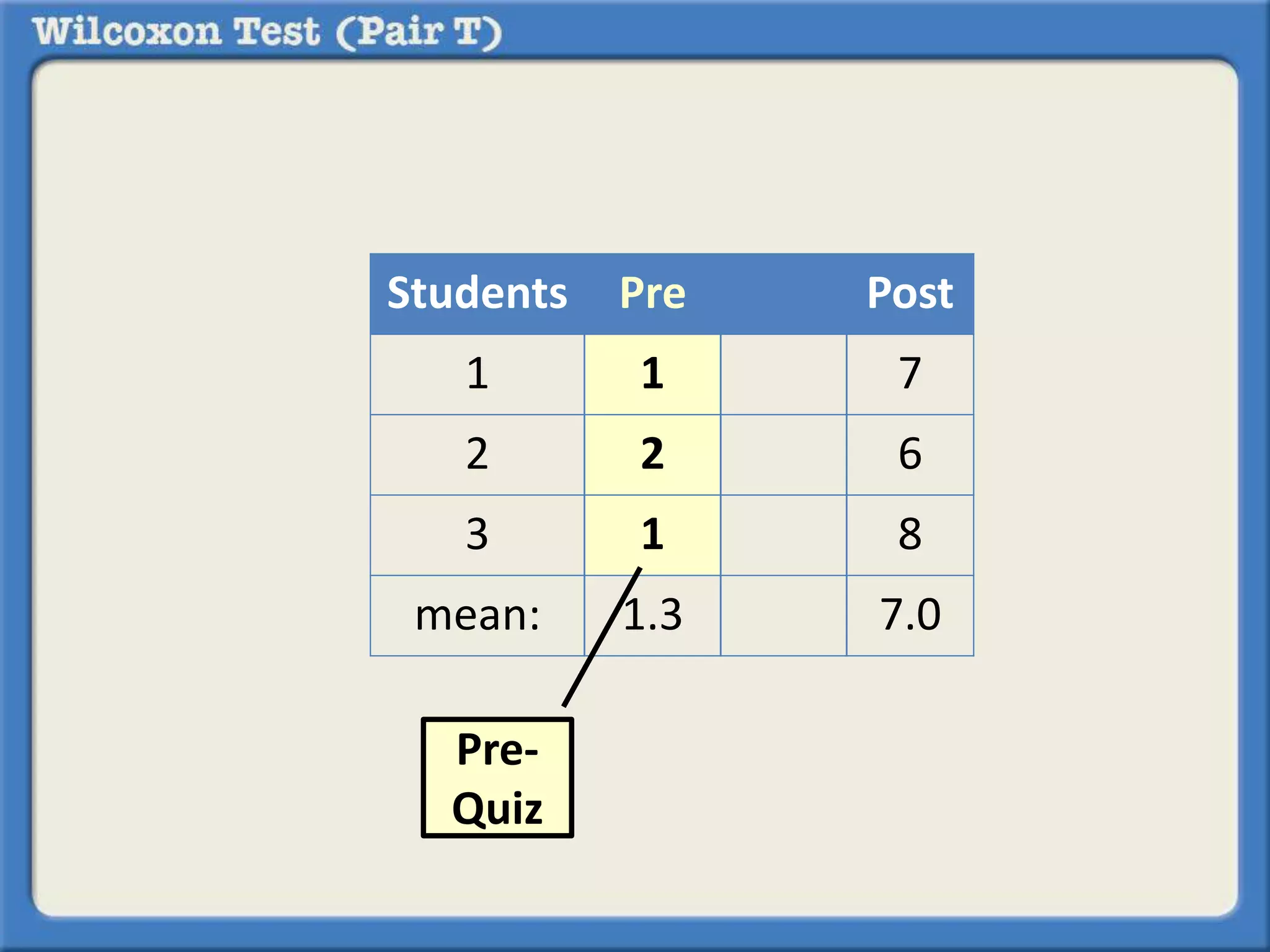
Pre- 
Quiz
Students Pre Post 
1 1 7 
2 2 6 
3 1 8 
mean: 1.3 7.0 
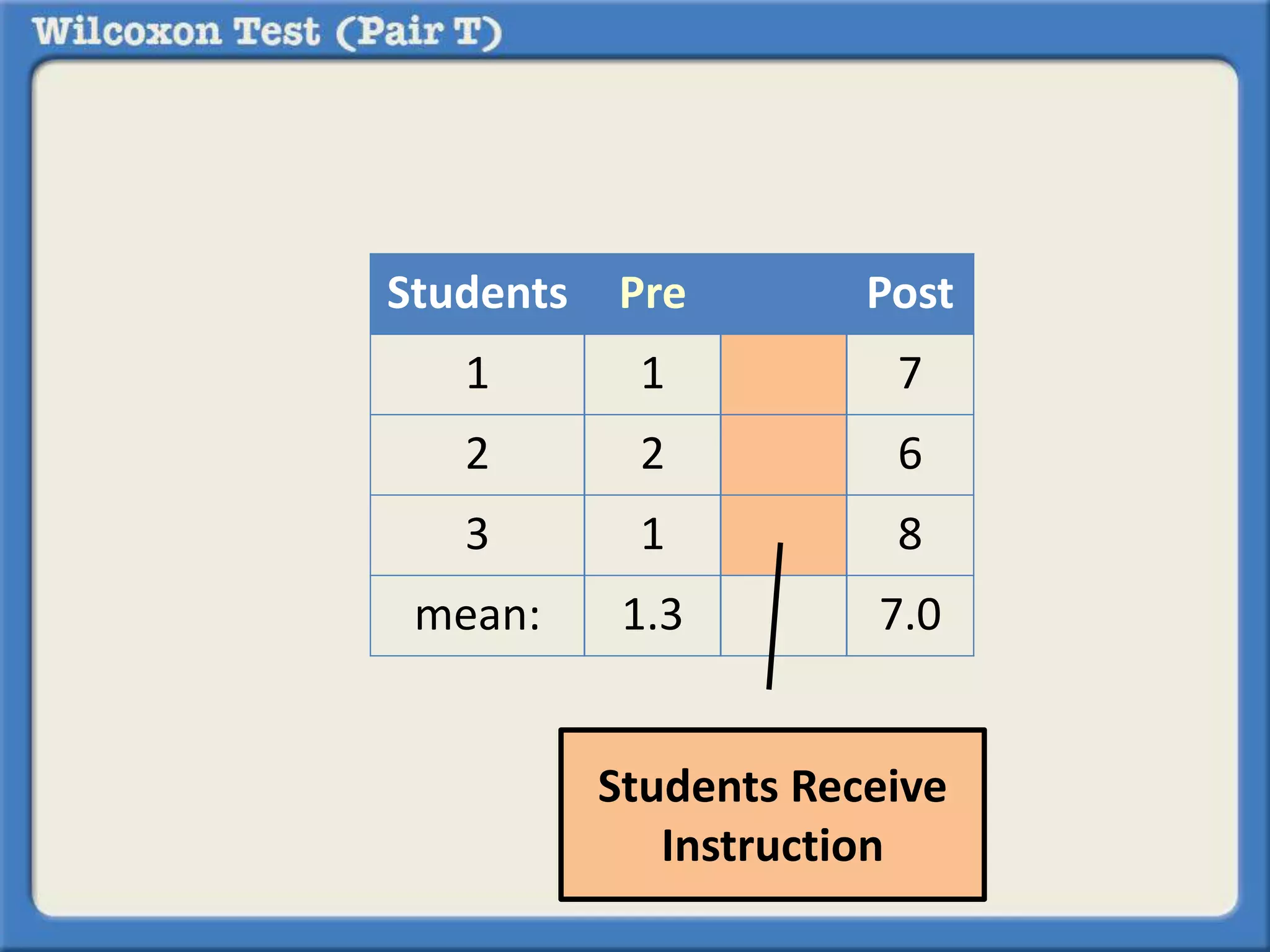
Students Receive 
Instruction
Students Pre Post 
1 1 7 
2 2 6 
3 1 8 
mean: 1.3 7.0 
Post- 
Quiz
Students Pre Post 
1 1 7 
2 2 6 
3 1 8 
mean: 1.3 7.0 
The Mean 
of the 
Pre-quiz
Students Pre Post 
1 1 7 
2 2 6 
3 1 8 
mean: 1.3 7.0 
The Mean 
of the 
Pre-quiz 
is compared to
Students Pre Post 
1 1 7 
2 2 6 
3 1 8 
mean: 1.3 7.0 
The Mean 
of the 
Pre-quiz 
is compared to 
The Mean 
of the 
Post-quiz
Students Pre Post 
1 1 7 
2 2 6 
3 1 8 
mean: 1.3 7.0 
The Mean 
of the 
Pre-quiz 
is compared to 
The Mean 
of the 
Post-quiz 
using a Paired- 
Sample t-test
It appears that the post-test scores are higher than the 
pre-test scores. But what is the likelihood of getting this 
result if we tested one thousand samples of 3.0?
It appears that the post-test scores are higher than the 
pre-test scores. But what is the likelihood of getting this 
result if we tested one thousand samples of 3.0? 
We use the paired-sample t-test to test the likelihood of 
this result occurring by chance.
It appears that the post-test scores are higher than the 
pre-test scores. But what is the likelihood of getting this 
result if we tested one thousand samples of 3.0? 
We use the paired-sample t-test to test the likelihood of 
this result occurring by chance. 
But the Paired-sample t-test can be used when certain 
assumptions are met:
It appears that the post-test scores are higher than the 
pre-test scores. But what is the likelihood of getting this 
result if we tested one thousand samples of 3.0? 
We use the paired-sample t-test to test the likelihood of 
this result occurring by chance. 
But the Paired-sample t-test can be used when certain 
assumptions are met: 
1. the data is interval/ratio
It appears that the post-test scores are higher than the 
pre-test scores. But what is the likelihood of getting this 
result if we tested one thousand samples of 3.0? 
We use the paired-sample t-test to test the likelihood of 
this result occurring by chance. 
But the Paired-sample t-test can be used when certain 
assumptions are met: 
1. the data is interval/ratio 
2. the data is normally distributed
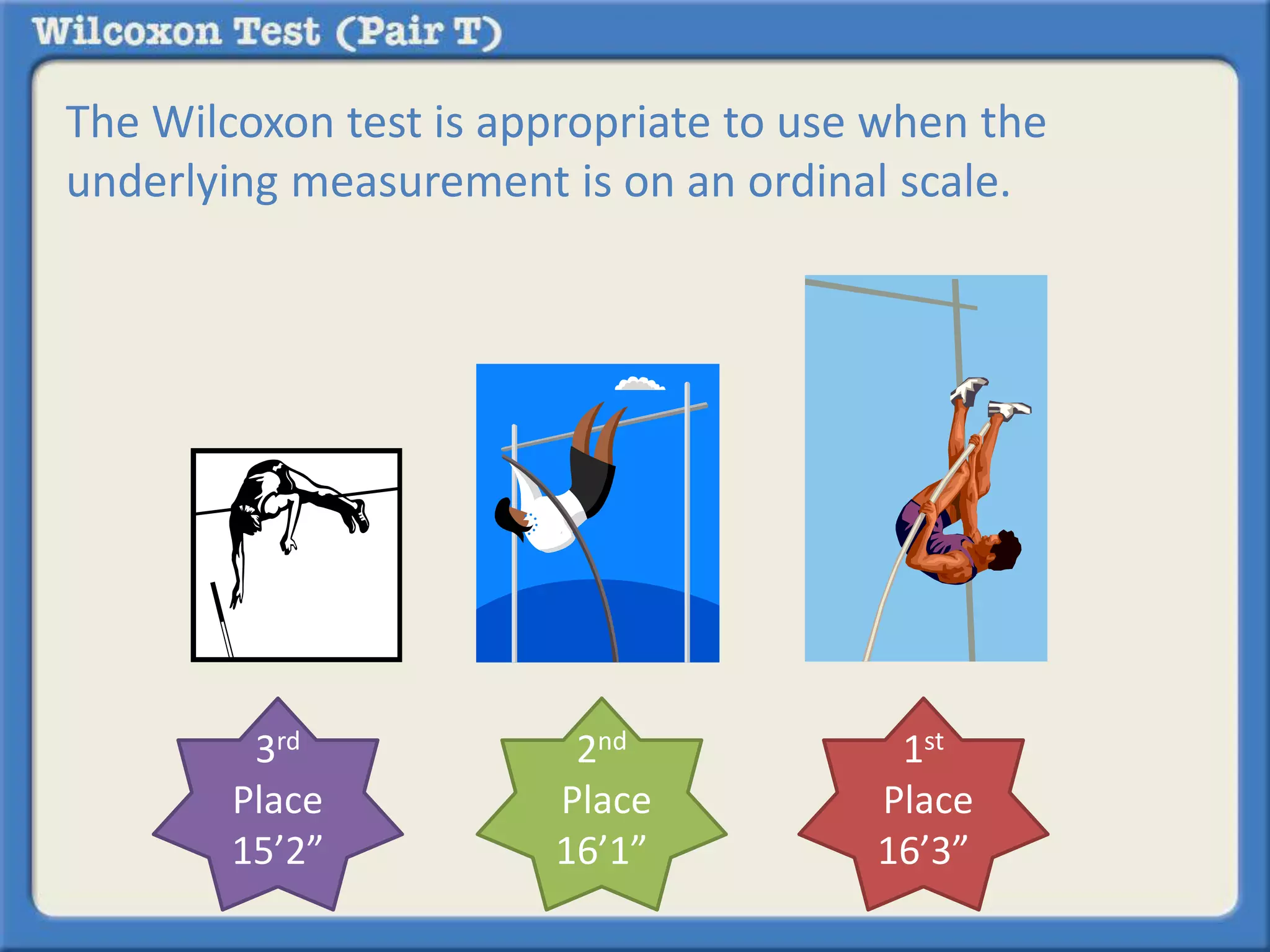
The Wilcoxon test is appropriate to use when the 
underlying measurement is on an ordinal scale.
The Wilcoxon test is appropriate to use when the 
underlying measurement is on an ordinal scale. 
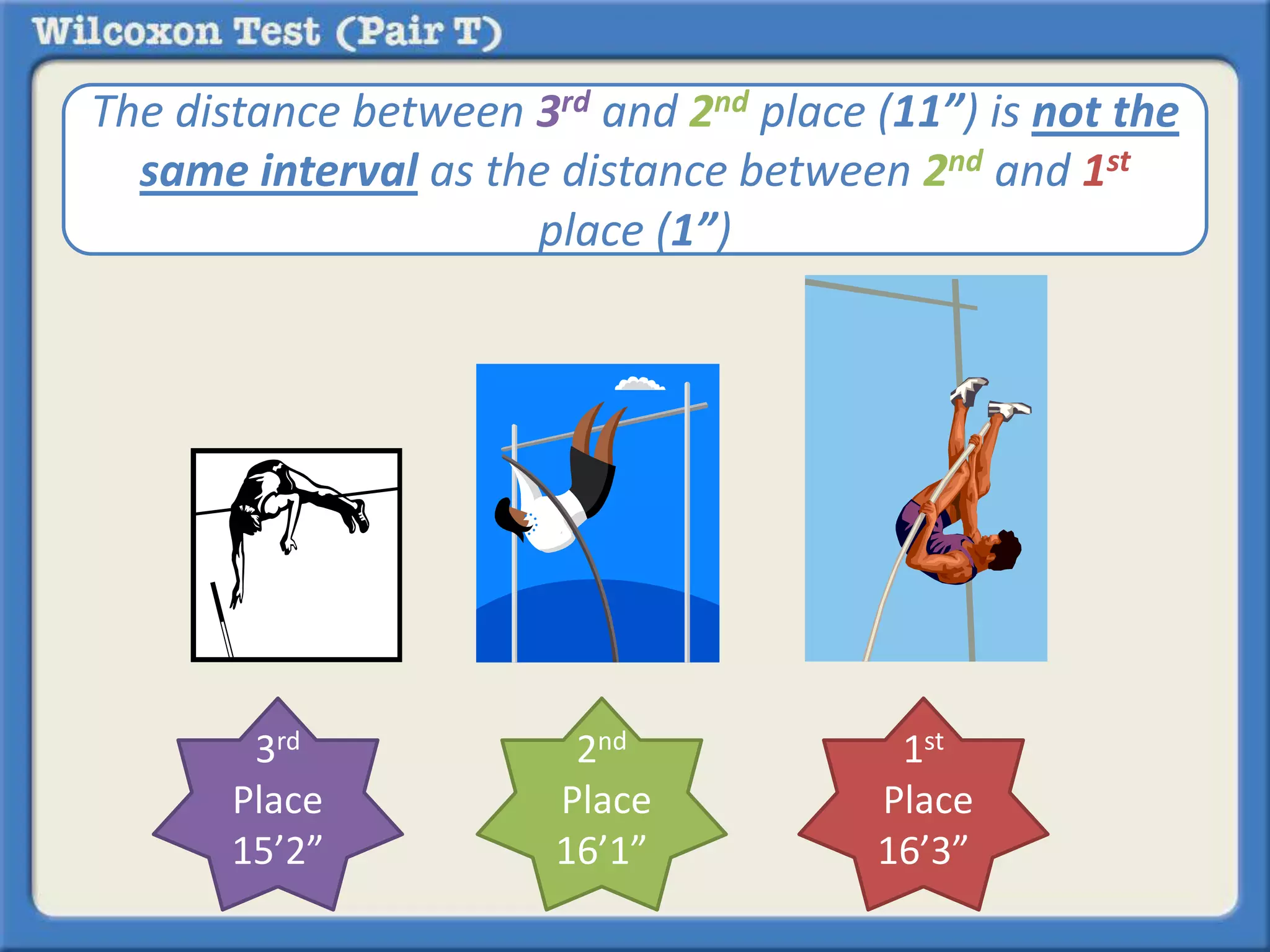
3rd 
Place 
15’2” 
2nd 
Place 
16’1” 
1st 
Place 
16’3”
The distance between 3rd and 2nd place (11”) is not the 
same interval as the distance between 2nd and 1st 
3rd 
Place 
15’2” 
2nd 
Place 
16’1” 
1st 
Place 
16’3” 
place (1”)
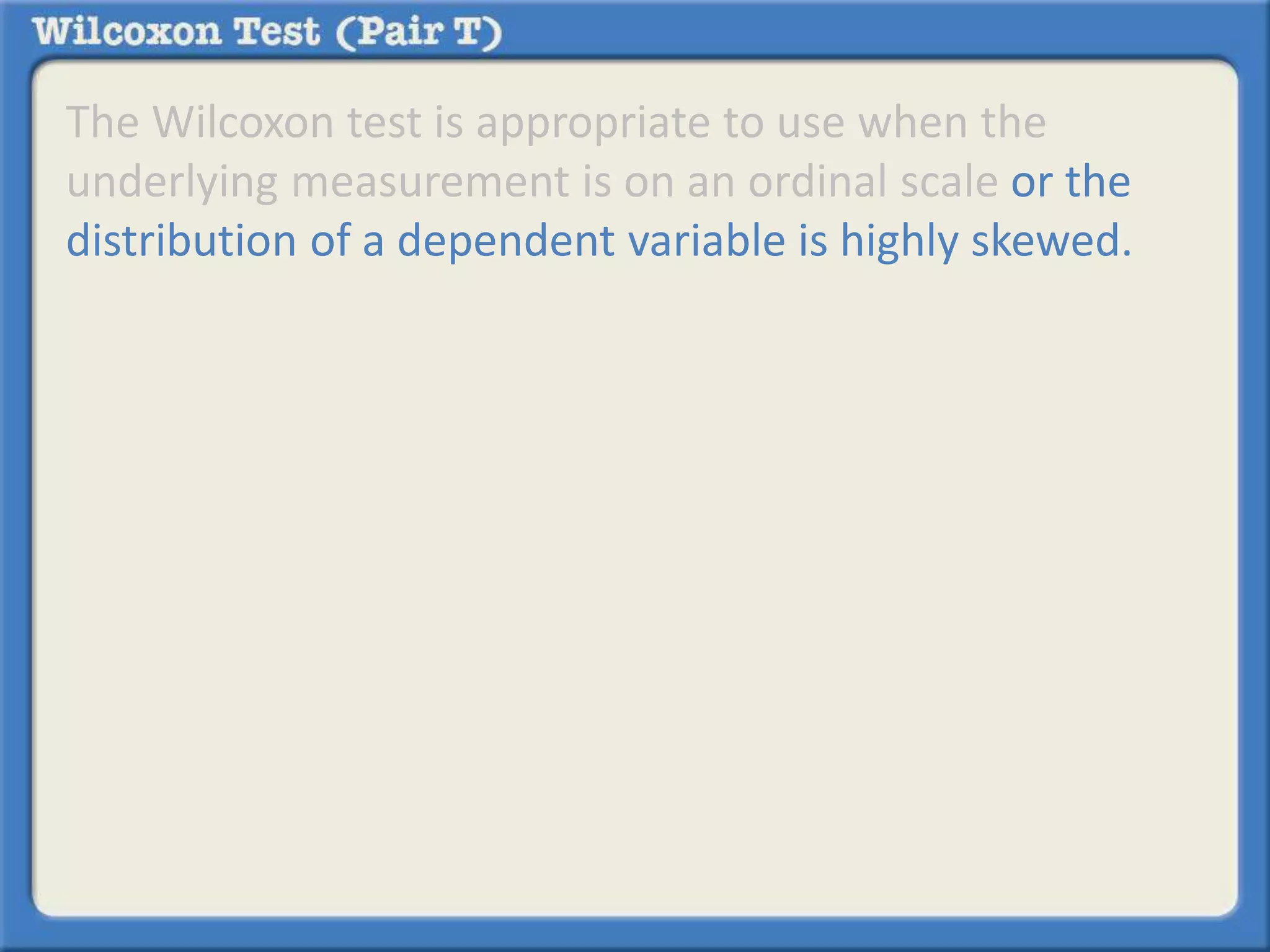
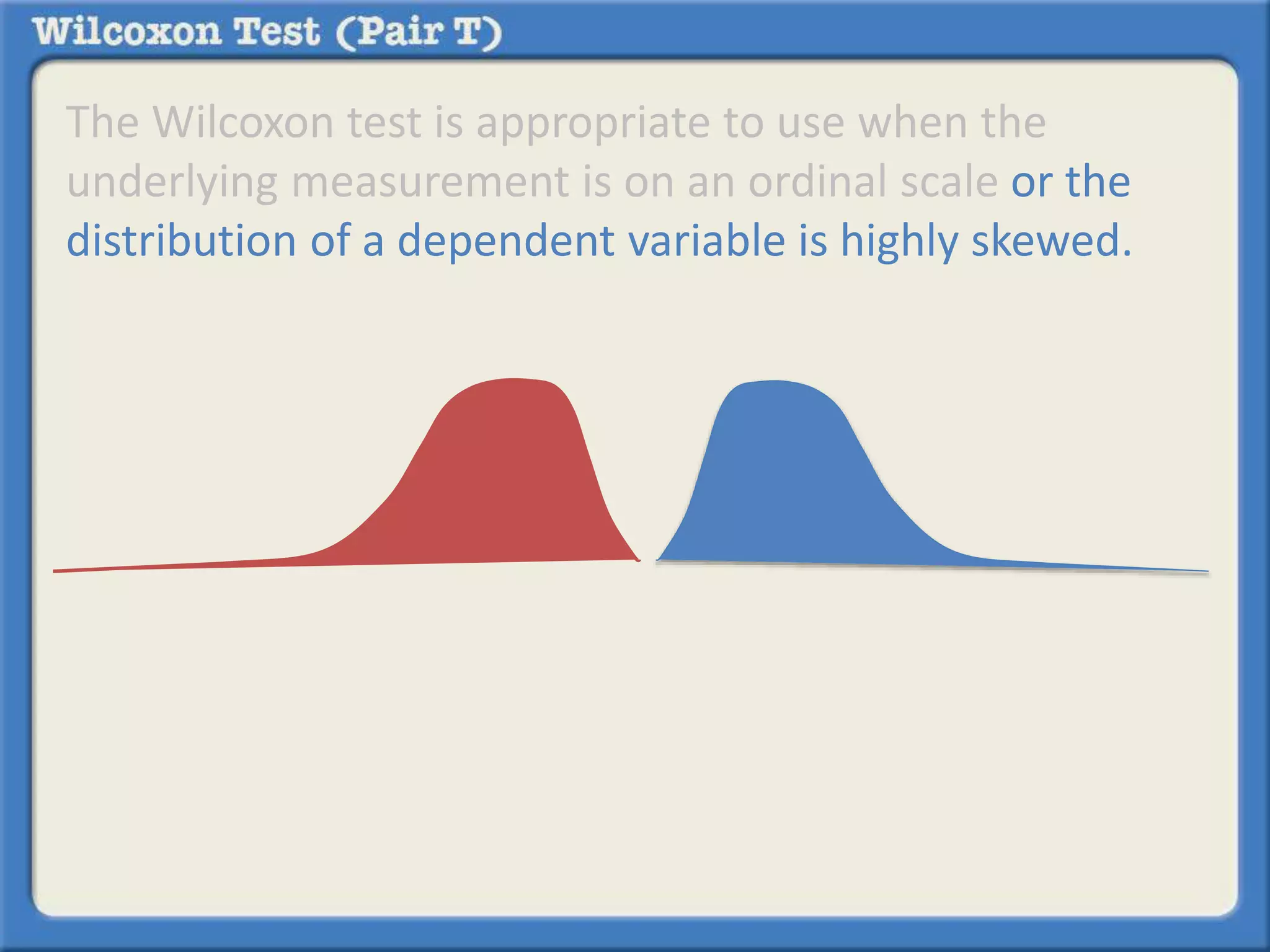
The Wilcoxon test is appropriate to use when the 
underlying measurement is on an ordinal scale or the 
distribution of a dependent variable is highly skewed.
The Wilcoxon test is appropriate to use when the 
underlying measurement is on an ordinal scale or the 
distribution of a dependent variable is highly skewed.
The Wilcoxon test is appropriate to use when the 
underlying measurement is on an ordinal scale or the 
distribution of a dependent variable is highly skewed. 
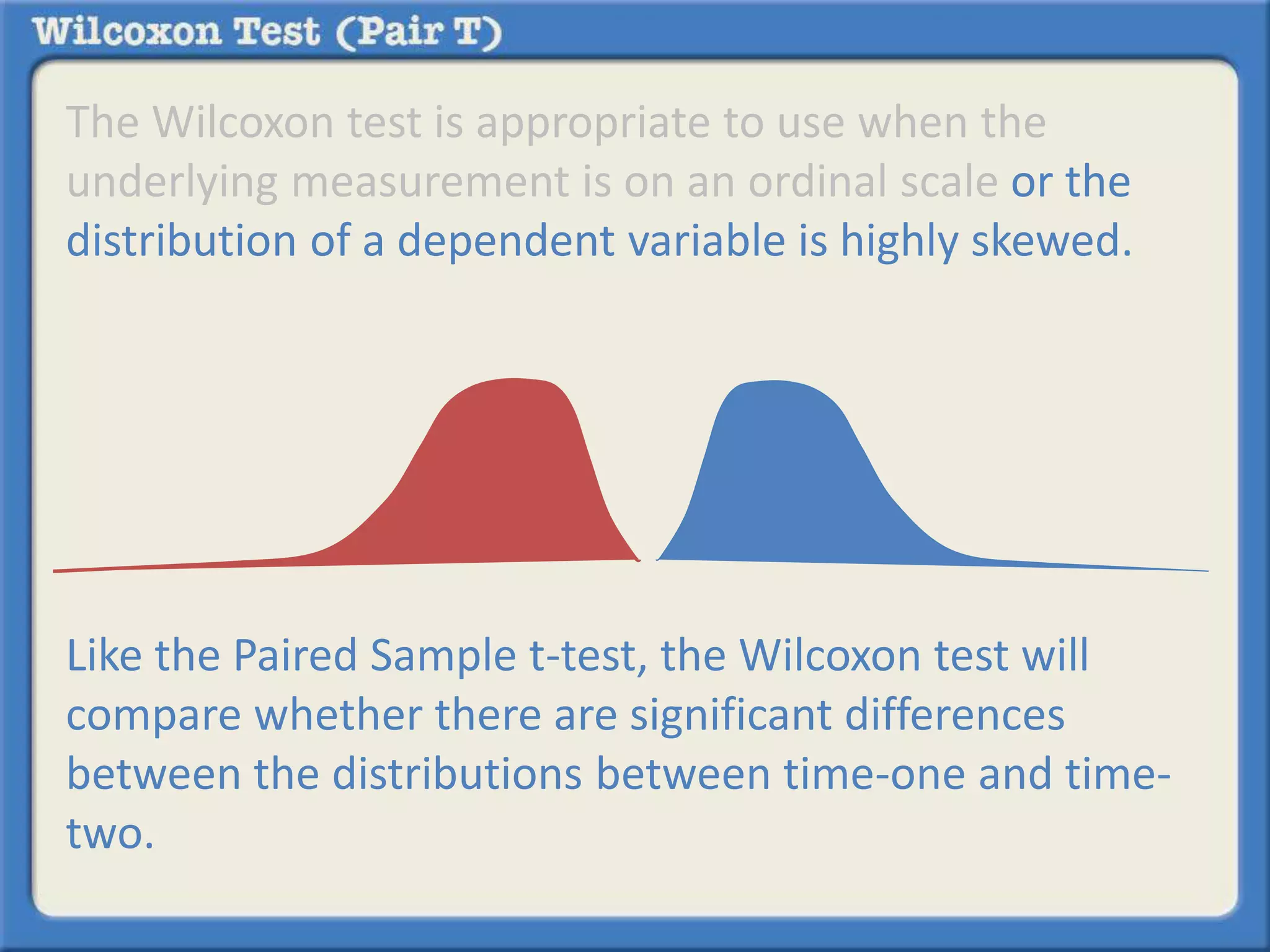
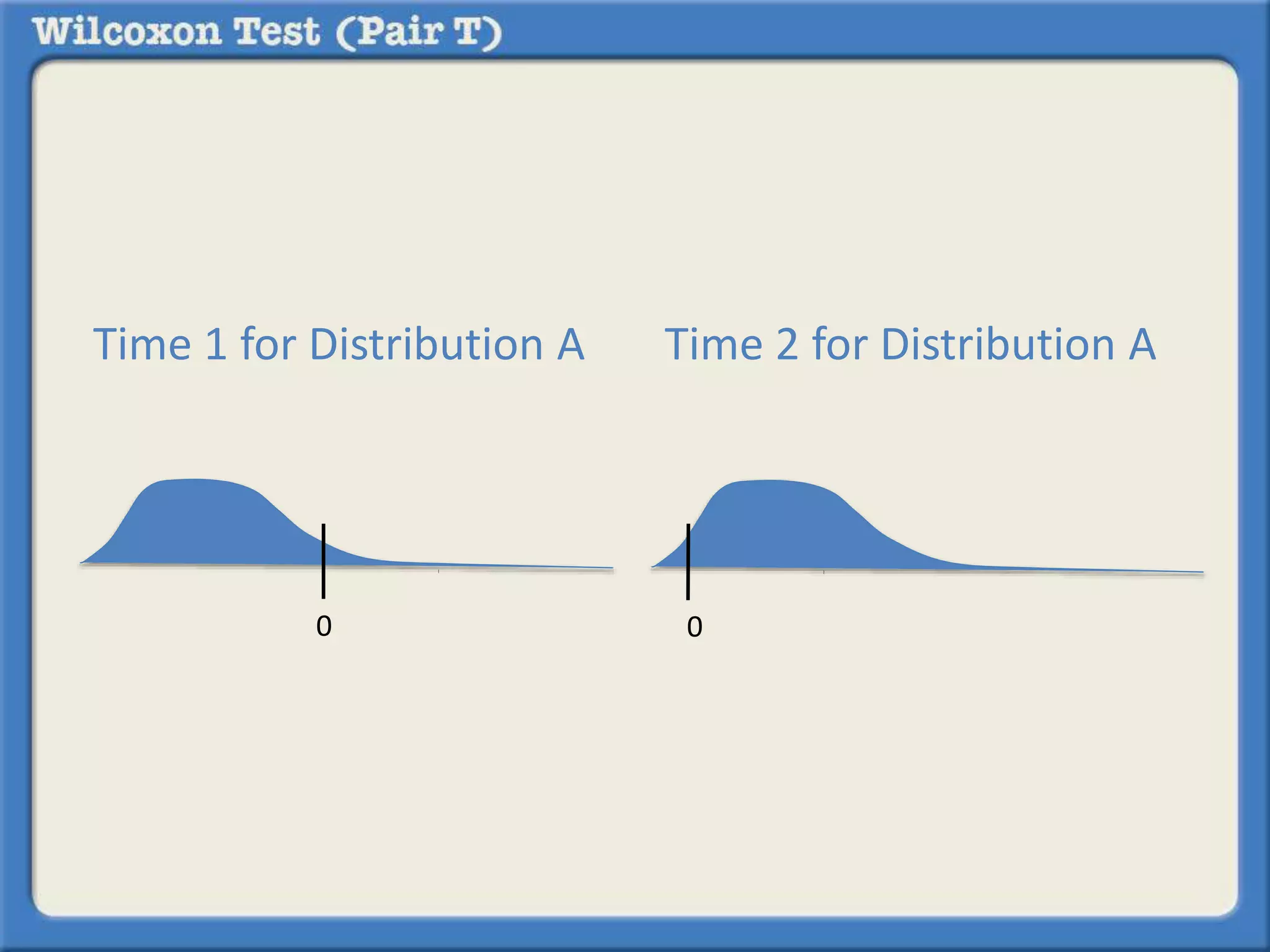
Like the Paired Sample t-test, the Wilcoxon test will 
compare whether there are significant differences 
between the distributions between time-one and time-two.
Time 1 for Distribution A Time 2 for Distribution A 
0 0
A Paired Sample t-test would be used if the distributions 
were more normal and the data were interval or ratio.
A Paired Sample t-test would be used if the distributions 
were more normal and the data were interval or ratio. 
Interval/Ratio scales 
• assume quantity of the attribute. 
• have equal intervals.
The Wilcoxon like all nonparametric tests
The Wilcoxon like all nonparametric tests 
1. is not sensitive to outliers and therefore is more 
appropriate to use when the data is skewed.
The Wilcoxon like all nonparametric tests 
1. is not sensitive to outliers and therefore is more 
appropriate to use when the data is skewed. 
2. (uses the Median instead of the Mean and is 
therefore more appropriate to use when the data is 
rank order or ordinal.

What is a Wilcoxon Sign-Ranked Test (pair t non para)?

  • 1.
  • 2.
    The Wilcoxon testis the non-parametric analogue to the pair-wise (repeated measures) t-test.
  • 3.
    The non-parametric analogueto the pair-wise (repeated measures) t-test is the Wilcoxon test. You may remember that the pair-wise (repeated measures) t-test is used to determine the statistical significant difference between the same sample/observations or people on two separate occasions.
  • 4.
    Here is asimplified data set that would use a paired sample t-test:
  • 5.
    Students Pre Post 1 1 7 2 2 6 3 1 8 mean: 1.3 7.0
  • 6.
    Students Pre Post 1 1 7 2 2 6 3 1 8 mean: 1.3 7.0 Three students
  • 7.
    Students Pre Post 1 1 7 2 2 6 3 1 8 mean: 1.3 7.0 Pre- Quiz
  • 8.
    Students Pre Post 1 1 7 2 2 6 3 1 8 mean: 1.3 7.0 Students Receive Instruction
  • 9.
    Students Pre Post 1 1 7 2 2 6 3 1 8 mean: 1.3 7.0 Post- Quiz
  • 10.
    Students Pre Post 1 1 7 2 2 6 3 1 8 mean: 1.3 7.0 The Mean of the Pre-quiz
  • 11.
    Students Pre Post 1 1 7 2 2 6 3 1 8 mean: 1.3 7.0 The Mean of the Pre-quiz is compared to
  • 12.
    Students Pre Post 1 1 7 2 2 6 3 1 8 mean: 1.3 7.0 The Mean of the Pre-quiz is compared to The Mean of the Post-quiz
  • 13.
    Students Pre Post 1 1 7 2 2 6 3 1 8 mean: 1.3 7.0 The Mean of the Pre-quiz is compared to The Mean of the Post-quiz using a Paired- Sample t-test
  • 14.
    It appears thatthe post-test scores are higher than the pre-test scores. But what is the likelihood of getting this result if we tested one thousand samples of 3.0?
  • 15.
    It appears thatthe post-test scores are higher than the pre-test scores. But what is the likelihood of getting this result if we tested one thousand samples of 3.0? We use the paired-sample t-test to test the likelihood of this result occurring by chance.
  • 16.
    It appears thatthe post-test scores are higher than the pre-test scores. But what is the likelihood of getting this result if we tested one thousand samples of 3.0? We use the paired-sample t-test to test the likelihood of this result occurring by chance. But the Paired-sample t-test can be used when certain assumptions are met:
  • 17.
    It appears thatthe post-test scores are higher than the pre-test scores. But what is the likelihood of getting this result if we tested one thousand samples of 3.0? We use the paired-sample t-test to test the likelihood of this result occurring by chance. But the Paired-sample t-test can be used when certain assumptions are met: 1. the data is interval/ratio
  • 18.
    It appears thatthe post-test scores are higher than the pre-test scores. But what is the likelihood of getting this result if we tested one thousand samples of 3.0? We use the paired-sample t-test to test the likelihood of this result occurring by chance. But the Paired-sample t-test can be used when certain assumptions are met: 1. the data is interval/ratio 2. the data is normally distributed
  • 19.
    The Wilcoxon testis appropriate to use when the underlying measurement is on an ordinal scale.
  • 20.
    The Wilcoxon testis appropriate to use when the underlying measurement is on an ordinal scale. 3rd Place 15’2” 2nd Place 16’1” 1st Place 16’3”
  • 21.
    The distance between3rd and 2nd place (11”) is not the same interval as the distance between 2nd and 1st 3rd Place 15’2” 2nd Place 16’1” 1st Place 16’3” place (1”)
  • 22.
    The Wilcoxon testis appropriate to use when the underlying measurement is on an ordinal scale or the distribution of a dependent variable is highly skewed.
  • 23.
    The Wilcoxon testis appropriate to use when the underlying measurement is on an ordinal scale or the distribution of a dependent variable is highly skewed.
  • 24.
    The Wilcoxon testis appropriate to use when the underlying measurement is on an ordinal scale or the distribution of a dependent variable is highly skewed. Like the Paired Sample t-test, the Wilcoxon test will compare whether there are significant differences between the distributions between time-one and time-two.
  • 25.
    Time 1 forDistribution A Time 2 for Distribution A 0 0
  • 26.
    A Paired Samplet-test would be used if the distributions were more normal and the data were interval or ratio.
  • 27.
    A Paired Samplet-test would be used if the distributions were more normal and the data were interval or ratio. Interval/Ratio scales • assume quantity of the attribute. • have equal intervals.
  • 28.
    The Wilcoxon likeall nonparametric tests
  • 29.
    The Wilcoxon likeall nonparametric tests 1. is not sensitive to outliers and therefore is more appropriate to use when the data is skewed.
  • 30.
    The Wilcoxon likeall nonparametric tests 1. is not sensitive to outliers and therefore is more appropriate to use when the data is skewed. 2. (uses the Median instead of the Mean and is therefore more appropriate to use when the data is rank order or ordinal.