Hypothesis
Dr. Jai Singh
Definition of hypothesis
Hypothesis
• A hypothesis is a proposed explanation for a
phenomenon.
-explain a phenomenon or predict a relationship in research.
- an assumption or concession made for the sake of argument
- an interpretation of a practical situation or condition taken
as the ground for action
- a tentative assumption made in order to draw out and test
its logical or empirical consequences
- the antecedent clause of a conditional statement
Research Hypothesis
• A research hypothesis is a specific, clear, and
testable proposition or predictive statement
about the possible outcome of a scientific
research study based on a particular property
of a population.
• Ex.- presumed differences between groups on
a particular variable or relationships between
variables.
Research hypotheses- Types
• Simple Hypothesis: This predicts the relationship between a
single independent variable (IV) and a single dependent
variable (DV).
• Students who eat breakfast will perform better on a math
exam than students who do not eat breakfast.
• Students who experience test anxiety prior to an English exam
will get higher scores than students who do not experience
test anxiety.
• Motorists who talk on the phone while driving will be more
likely to make errors on a driving course than those who do
not talk on the phone.
• Lower levels of exercise (IV) will be associated with greater
weight retention (DV).
Complex Hypothesis
This predicts the relationship between two or more
independent variables and two or more dependent
variables.
• low risk pregnant women (IV) who ● value
health highly;●believe that engaging in health
promoting behaviours will result in positive
outcomes;●perceive fewer barriers to health
promoting activities; are more likely than other
women to attend pregnancy-related education
programs (DV).
Directional Hypothesis
• Researcher is intellectually committed to a
particular outcome.
• specify the expected direction of the relationship
between variables
• The investigator bases this hypothesis on the trends
apparent from previous research on this topic.
Ex. - High school students who participate in
extracurricular activities have a lower GPA than those
who do not participate in such activities.
• - definite direction to the prediction.
Non directional Hypothesis
- there is no sufficient past research on which
to base a prediction. Do not require the
direction of the relationship.
Ex.- ‘The academic performance of high school
students is related to their participation in
extracurricular activities.’
Associative Hypothesis
• - propose relationships between variables,
when one variable changes, the other
changes. Do not indicate cause and effect.
• Such hypotheses also need the researcher
to rule out the possibility that the effect is a
result of a cause other than what the study
has examined.
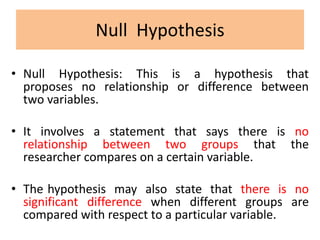
Null Hypothesis
• Null Hypothesis: This is a hypothesis that
proposes no relationship or difference between
two variables.
• It involves a statement that says there is no
relationship between two groups that the
researcher compares on a certain variable.
• The hypothesis may also state that there is no
significant difference when different groups are
compared with respect to a particular variable.
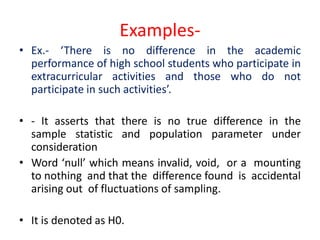
Examples-
• Ex.- ‘There is no difference in the academic
performance of high school students who participate in
extracurricular activities and those who do not
participate in such activities’.
• - It asserts that there is no true difference in the
sample statistic and population parameter under
consideration
• Word ‘null’ which means invalid, void, or a mounting
to nothing and that the difference found is accidental
arising out of fluctuations of sampling.
• It is denoted as H0.
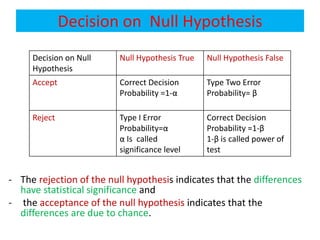
Decision on Null Hypothesis
- The rejection of the null hypothesis indicates that the differences
have statistical significance and
- the acceptance of the null hypothesis indicates that the
differences are due to chance.
Decision on Null
Hypothesis
Null Hypothesis True Null Hypothesis False
Accept Correct Decision
Probability =1-α
Type Two Error
Probability= β
Reject Type I Error
Probability=α
α Is called
significance level
Correct Decision
Probability =1-β
1-β is called power of
test
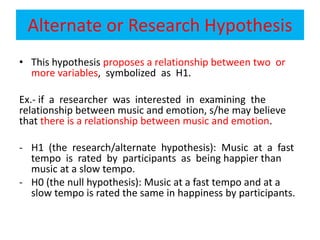
Alternate or Research Hypothesis
• This hypothesis proposes a relationship between two or
more variables, symbolized as H1.
Ex.- if a researcher was interested in examining the
relationship between music and emotion, s/he may believe
that there is a relationship between music and emotion.
- H1 (the research/alternate hypothesis): Music at a fast
tempo is rated by participants as being happier than
music at a slow tempo.
- H0 (the null hypothesis): Music at a fast tempo and at a
slow tempo is rated the same in happiness by participants.
Statistical Hypothesis
• Statistical hypothesis is an assumption
about statistical populations that one seeks
to support or refute.
• The null hypothesis and alternative hypothesis
together are called statistical hypothesis.
Level of Significance
• The level of significance is the probability of rejecting a true null
hypothesis and is denoted by α.
• The frequently used values of α are 0.05; 0.01; 0.1 etc.
When, α = 0.05 it means that level of significance is 5%.
• α = 0.01 it means 1% level of significance.
• α = 0.1 it means 10% level of significance.
• In fact α specifies the critical region.
• A competed value of the test statistic that falls in the
critical region (CR) is said to be significant. So, α is called the
level of significance.
Critical/ Rejection Region
• The critical region (CR) or rejection region (RR) is
the area under the curve beyond certain limits in
which the population value is unlikely to fall by
chance.
• If an observed value falls in this region H0 is
rejected and the observed value is said to be
significant.
• The region for which H0 is rejected is called
critical region or rejection region.
Confidence Interval
• Confidence interval is the interval marked
by limits within which the population value
lies by chance and the hypothesis is
consider to be justifiable.
• If an observed value falls in confidence
interval H0 is accepted.
Critical Values
The values of the test statistic which
separates critical region from confidence
region (acceptance region) are called critical
values.
Standard Deviation
• measure of variability or dispersion in a set of
data points.
• represents the average distance of a set of
scores from the mean or average score.
• A smaller standard deviation - a data set where scores are very close to the mean
score (a smaller range).
• a larger standard deviation - scores with more variance (a larger range).
- For example, if the average score on a test was 80 and the standard deviation was
2, the scores would be more clustered around the mean
• the standard deviation - 10. - Scores are more scattered.
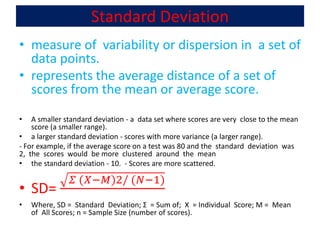
• SD=
𝛴 (𝑋−𝑀)2/ (𝑁−1)
• Where, SD = Standard Deviation; Σ = Sum of; X = Individual Score; M = Mean
of All Scores; n = Sample Size (number of scores).
Standard Error
• The standard error is an estimate of the
standard deviation of a statistic.
- used to compute confidence intervals and
margins of error.
-
Degree of Freedom
• Degree of Freedom refers to the number of
values which are free to vary after we have
given the number of restrictions imposed
upon the data.
• It is commonly abbreviated by df.
• In statistics, it is the number of values in a
study that are free to vary.
Ex.- Degrees of freedom
• Ex.- if you have to take ten different courses
to graduate, and only ten different courses
are offered, then you have nine degrees of
freedom.
• Nine semesters you will be able to choose
which class to take; the tenth semester, there
will only be one class left to take - there is no
choice, if you want to graduate.
One-tailed and Two-tailed Tests
• A test in which the critical region is located in
one tail of the distribution of test of statistic is
called one-tailed test.
• -two types of one-tailed test
(a) Right tailed test and
(b) Left tailed test.
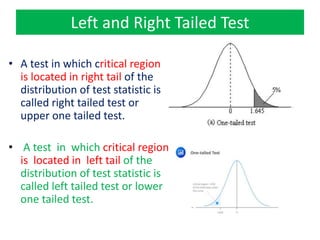
Left and Right Tailed Test
• A test in which critical region
is located in right tail of the
distribution of test statistic is
called right tailed test or
upper one tailed test.
• A test in which critical region
is located in left tail of the
distribution of test statistic is
called left tailed test or lower
one tailed test.
Critical Region in one tailed and two tailed tests
• Acceptance Region Lower one tailed test
• One tailed alternative hypothesis leads to one tailed test.
Hypotheses of one tailed tests are
(a) H0: ϴ ≤ ϴ0 H1: ϴ > ϴ0
(b) H0: ϴ ≥ ϴ0 H1: ϴ < ϴ0
• Two-tailed Test: A test in which the critical region is located in
two tails of the distribution of test of statistic is called two-tailed
test.
• Two-sided alternative hypothesis leads to two-tailed test.
(a) H0: ϴ = ϴ0 ;
(b) H1: ϴ ≠ ϴ0
Critical Values for One tailed test
• To reject H0: μ1− μ2 ≤ 0 and accept H1: μ1− μ2
> 0, using the normal distribution, a normal
deviate greater than +1.64 is required for significant
at the 0.05 level.
• Likewise to reject H0: μ1− μ2 ≥ 0 and accept H1:
μ1− μ2 < 0, the corresponding normal curve is less
than -1.64.
• The fact that for a normal distribution 5 percent of
the area of the curve falls beyond +1.64 standard
deviation units above the mean, and 5% beyond -
1.64 standard deviation units below the mean.
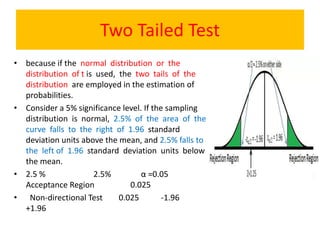
Two Tailed Test
• because if the normal distribution or the
distribution of t is used, the two tails of the
distribution are employed in the estimation of
probabilities.
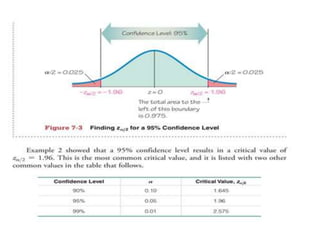
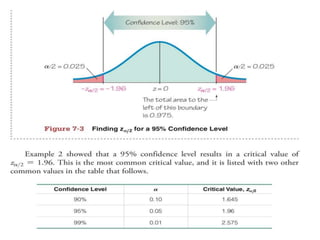
• Consider a 5% significance level. If the sampling
distribution is normal, 2.5% of the area of the
curve falls to the right of 1.96 standard
deviation units above the mean, and 2.5% falls to
the left of 1.96 standard deviation units below
the mean.
• 2.5 % 2.5% α =0.05
Acceptance Region 0.025
• Non-directional Test 0.025 -1.96
+1.96
Non-directional Test
• We may wish to test the null hypothesis H0:μ1− μ2 = 0
against the alternative H1:μ1− μ2 ≠ 0.
- This means that if H0 is rejected, the decision is that a
difference exists between the two means.
- No assertion is made about the direction of the
difference. Such a test is a non-directional test.
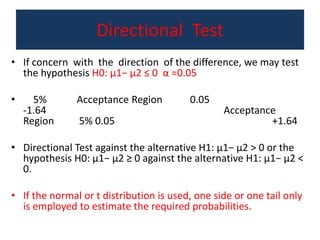
Directional Test
• If concern with the direction of the difference, we may test
the hypothesis H0: μ1− μ2 ≤ 0 α =0.05
• 5% Acceptance Region 0.05
-1.64 Acceptance
Region 5% 0.05 +1.64
• Directional Test against the alternative H1: μ1− μ2 > 0 or the
hypothesis H0: μ1− μ2 ≥ 0 against the alternative H1: μ1− μ2 <
0.
• If the normal or t distribution is used, one side or one tail only
is employed to estimate the required probabilities.
THANKS TO ALL

ONLINE Workshop Presentation - VCW

  • 1.
  • 2.
    Definition of hypothesis Hypothesis •A hypothesis is a proposed explanation for a phenomenon. -explain a phenomenon or predict a relationship in research. - an assumption or concession made for the sake of argument - an interpretation of a practical situation or condition taken as the ground for action - a tentative assumption made in order to draw out and test its logical or empirical consequences - the antecedent clause of a conditional statement
  • 3.
    Research Hypothesis • Aresearch hypothesis is a specific, clear, and testable proposition or predictive statement about the possible outcome of a scientific research study based on a particular property of a population. • Ex.- presumed differences between groups on a particular variable or relationships between variables.
  • 4.
    Research hypotheses- Types •Simple Hypothesis: This predicts the relationship between a single independent variable (IV) and a single dependent variable (DV). • Students who eat breakfast will perform better on a math exam than students who do not eat breakfast. • Students who experience test anxiety prior to an English exam will get higher scores than students who do not experience test anxiety. • Motorists who talk on the phone while driving will be more likely to make errors on a driving course than those who do not talk on the phone. • Lower levels of exercise (IV) will be associated with greater weight retention (DV).
  • 5.
    Complex Hypothesis This predictsthe relationship between two or more independent variables and two or more dependent variables. • low risk pregnant women (IV) who ● value health highly;●believe that engaging in health promoting behaviours will result in positive outcomes;●perceive fewer barriers to health promoting activities; are more likely than other women to attend pregnancy-related education programs (DV).
  • 6.
    Directional Hypothesis • Researcheris intellectually committed to a particular outcome. • specify the expected direction of the relationship between variables • The investigator bases this hypothesis on the trends apparent from previous research on this topic. Ex. - High school students who participate in extracurricular activities have a lower GPA than those who do not participate in such activities. • - definite direction to the prediction.
  • 7.
    Non directional Hypothesis -there is no sufficient past research on which to base a prediction. Do not require the direction of the relationship. Ex.- ‘The academic performance of high school students is related to their participation in extracurricular activities.’
  • 8.
    Associative Hypothesis • -propose relationships between variables, when one variable changes, the other changes. Do not indicate cause and effect. • Such hypotheses also need the researcher to rule out the possibility that the effect is a result of a cause other than what the study has examined.
  • 9.
    Null Hypothesis • NullHypothesis: This is a hypothesis that proposes no relationship or difference between two variables. • It involves a statement that says there is no relationship between two groups that the researcher compares on a certain variable. • The hypothesis may also state that there is no significant difference when different groups are compared with respect to a particular variable.
  • 10.
    Examples- • Ex.- ‘Thereis no difference in the academic performance of high school students who participate in extracurricular activities and those who do not participate in such activities’. • - It asserts that there is no true difference in the sample statistic and population parameter under consideration • Word ‘null’ which means invalid, void, or a mounting to nothing and that the difference found is accidental arising out of fluctuations of sampling. • It is denoted as H0.
  • 11.
    Decision on NullHypothesis - The rejection of the null hypothesis indicates that the differences have statistical significance and - the acceptance of the null hypothesis indicates that the differences are due to chance. Decision on Null Hypothesis Null Hypothesis True Null Hypothesis False Accept Correct Decision Probability =1-α Type Two Error Probability= β Reject Type I Error Probability=α α Is called significance level Correct Decision Probability =1-β 1-β is called power of test
  • 12.
    Alternate or ResearchHypothesis • This hypothesis proposes a relationship between two or more variables, symbolized as H1. Ex.- if a researcher was interested in examining the relationship between music and emotion, s/he may believe that there is a relationship between music and emotion. - H1 (the research/alternate hypothesis): Music at a fast tempo is rated by participants as being happier than music at a slow tempo. - H0 (the null hypothesis): Music at a fast tempo and at a slow tempo is rated the same in happiness by participants.
  • 13.
    Statistical Hypothesis • Statisticalhypothesis is an assumption about statistical populations that one seeks to support or refute. • The null hypothesis and alternative hypothesis together are called statistical hypothesis.
  • 14.
    Level of Significance •The level of significance is the probability of rejecting a true null hypothesis and is denoted by α. • The frequently used values of α are 0.05; 0.01; 0.1 etc. When, α = 0.05 it means that level of significance is 5%. • α = 0.01 it means 1% level of significance. • α = 0.1 it means 10% level of significance. • In fact α specifies the critical region. • A competed value of the test statistic that falls in the critical region (CR) is said to be significant. So, α is called the level of significance.
  • 15.
    Critical/ Rejection Region •The critical region (CR) or rejection region (RR) is the area under the curve beyond certain limits in which the population value is unlikely to fall by chance. • If an observed value falls in this region H0 is rejected and the observed value is said to be significant. • The region for which H0 is rejected is called critical region or rejection region.
  • 17.
    Confidence Interval • Confidenceinterval is the interval marked by limits within which the population value lies by chance and the hypothesis is consider to be justifiable. • If an observed value falls in confidence interval H0 is accepted.
  • 19.
    Critical Values The valuesof the test statistic which separates critical region from confidence region (acceptance region) are called critical values.
  • 20.
    Standard Deviation • measureof variability or dispersion in a set of data points. • represents the average distance of a set of scores from the mean or average score. • A smaller standard deviation - a data set where scores are very close to the mean score (a smaller range). • a larger standard deviation - scores with more variance (a larger range). - For example, if the average score on a test was 80 and the standard deviation was 2, the scores would be more clustered around the mean • the standard deviation - 10. - Scores are more scattered. • SD= 𝛴 (𝑋−𝑀)2/ (𝑁−1) • Where, SD = Standard Deviation; Σ = Sum of; X = Individual Score; M = Mean of All Scores; n = Sample Size (number of scores).
  • 21.
    Standard Error • Thestandard error is an estimate of the standard deviation of a statistic. - used to compute confidence intervals and margins of error. -
  • 22.
    Degree of Freedom •Degree of Freedom refers to the number of values which are free to vary after we have given the number of restrictions imposed upon the data. • It is commonly abbreviated by df. • In statistics, it is the number of values in a study that are free to vary.
  • 23.
    Ex.- Degrees offreedom • Ex.- if you have to take ten different courses to graduate, and only ten different courses are offered, then you have nine degrees of freedom. • Nine semesters you will be able to choose which class to take; the tenth semester, there will only be one class left to take - there is no choice, if you want to graduate.
  • 24.
    One-tailed and Two-tailedTests • A test in which the critical region is located in one tail of the distribution of test of statistic is called one-tailed test. • -two types of one-tailed test (a) Right tailed test and (b) Left tailed test.
  • 25.
    Left and RightTailed Test • A test in which critical region is located in right tail of the distribution of test statistic is called right tailed test or upper one tailed test. • A test in which critical region is located in left tail of the distribution of test statistic is called left tailed test or lower one tailed test.
  • 26.
    Critical Region inone tailed and two tailed tests • Acceptance Region Lower one tailed test • One tailed alternative hypothesis leads to one tailed test. Hypotheses of one tailed tests are (a) H0: ϴ ≤ ϴ0 H1: ϴ > ϴ0 (b) H0: ϴ ≥ ϴ0 H1: ϴ < ϴ0 • Two-tailed Test: A test in which the critical region is located in two tails of the distribution of test of statistic is called two-tailed test. • Two-sided alternative hypothesis leads to two-tailed test. (a) H0: ϴ = ϴ0 ; (b) H1: ϴ ≠ ϴ0
  • 27.
    Critical Values forOne tailed test • To reject H0: μ1− μ2 ≤ 0 and accept H1: μ1− μ2 > 0, using the normal distribution, a normal deviate greater than +1.64 is required for significant at the 0.05 level. • Likewise to reject H0: μ1− μ2 ≥ 0 and accept H1: μ1− μ2 < 0, the corresponding normal curve is less than -1.64. • The fact that for a normal distribution 5 percent of the area of the curve falls beyond +1.64 standard deviation units above the mean, and 5% beyond - 1.64 standard deviation units below the mean.
  • 28.
    Two Tailed Test •because if the normal distribution or the distribution of t is used, the two tails of the distribution are employed in the estimation of probabilities. • Consider a 5% significance level. If the sampling distribution is normal, 2.5% of the area of the curve falls to the right of 1.96 standard deviation units above the mean, and 2.5% falls to the left of 1.96 standard deviation units below the mean. • 2.5 % 2.5% α =0.05 Acceptance Region 0.025 • Non-directional Test 0.025 -1.96 +1.96
  • 29.
    Non-directional Test • Wemay wish to test the null hypothesis H0:μ1− μ2 = 0 against the alternative H1:μ1− μ2 ≠ 0. - This means that if H0 is rejected, the decision is that a difference exists between the two means. - No assertion is made about the direction of the difference. Such a test is a non-directional test.
  • 30.
    Directional Test • Ifconcern with the direction of the difference, we may test the hypothesis H0: μ1− μ2 ≤ 0 α =0.05 • 5% Acceptance Region 0.05 -1.64 Acceptance Region 5% 0.05 +1.64 • Directional Test against the alternative H1: μ1− μ2 > 0 or the hypothesis H0: μ1− μ2 ≥ 0 against the alternative H1: μ1− μ2 < 0. • If the normal or t distribution is used, one side or one tail only is employed to estimate the required probabilities.
  • 31.