Kruskal-Wallis Test
The non-parametric analogue for a one-way ANOVA 
test is the Kruskal-Wallis test.
The non-parametric analogue for a one-way ANOVA 
test is the Kruskal-Wallis test. 
Remember that a non-parametric test is used when 
the distribution is either highly skewed or we are 
comparing ordinal or rank ordered data.
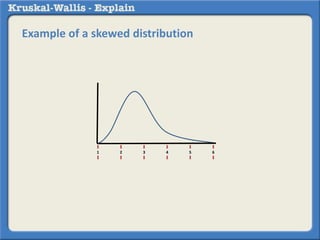
Example of a skewed distribution 
1 2 3 4 5 6
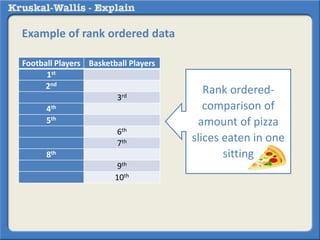
Example of rank ordered data 
Football Players Basketball Players 
1st 
2nd 
3rd 
4th 
5th 
6th 
7th 
8th 
9th 
10th 
Rank ordered-comparison 
of 
amount of pizza 
slices eaten in one 
sitting
Similar to the Mann-Whitney U test, the Kruskal-Wallis 
test evaluates the differences among groups by 
estimating differences in ranks among them.
Similar to the Mann-Whitney U test, the Kruskal-Wallis 
test evaluates the differences among groups by 
estimating differences in ranks among them. 
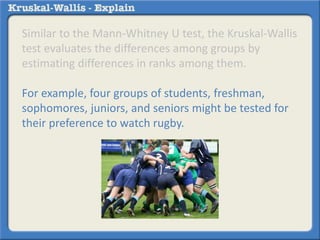
For example, four groups of students, freshman, 
sophomores, juniors, and seniors might be tested for 
their preference to watch rugby.
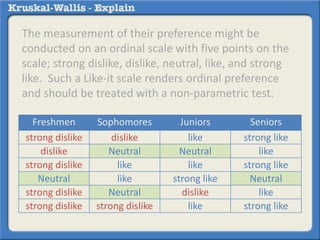
The measurement of their preference might be 
conducted on an ordinal scale with five points on the 
scale; strong dislike, dislike, neutral, like, and strong 
like. Such a Like-it scale renders ordinal preference 
and should be treated with a non-parametric test.
The measurement of their preference might be 
conducted on an ordinal scale with five points on the 
scale; strong dislike, dislike, neutral, like, and strong 
like. Such a Like-it scale renders ordinal preference 
and should be treated with a non-parametric test. 
Freshmen Sophomores Juniors Seniors 
strong dislike dislike like strong like 
dislike Neutral Neutral like 
strong dislike like like strong like 
Neutral like strong like Neutral 
strong dislike Neutral dislike like 
strong dislike strong dislike like strong like
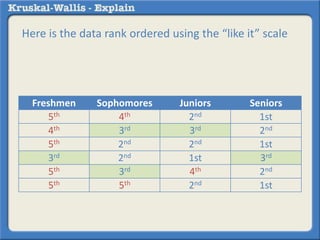
Here is the data rank ordered using the “like it” scale 
Freshmen Sophomores Juniors Seniors 
5th 4th 2nd 1st 
4th 3rd 3rd 2nd 
5th 2nd 2nd 1st 
3rd 2nd 1st 3rd 
5th 3rd 4th 2nd 
5th 5th 2nd 1st
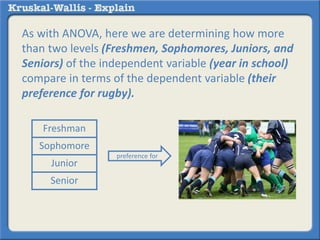
As with ANOVA, here we are determining how more 
than two levels (Freshmen, Sophomores, Juniors, and 
Seniors) of the independent variable (year in school) 
compare in terms of the dependent variable (their 
preference for rugby). 
preference for 
Freshman 
Sophomore 
Junior 
Senior
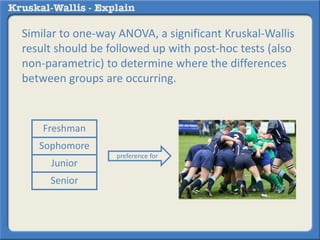
Similar to one-way ANOVA, a significant Kruskal-Wallis 
result should be followed up with post-hoc tests (also 
non-parametric) to determine where the differences 
between groups are occurring. 
preference for 
Freshman 
Sophomore 
Junior 
Senior

What is a Kruskal Wallis-Test?

  • 1.
  • 2.
    The non-parametric analoguefor a one-way ANOVA test is the Kruskal-Wallis test.
  • 3.
    The non-parametric analoguefor a one-way ANOVA test is the Kruskal-Wallis test. Remember that a non-parametric test is used when the distribution is either highly skewed or we are comparing ordinal or rank ordered data.
  • 4.
    Example of askewed distribution 1 2 3 4 5 6
  • 5.
    Example of rankordered data Football Players Basketball Players 1st 2nd 3rd 4th 5th 6th 7th 8th 9th 10th Rank ordered-comparison of amount of pizza slices eaten in one sitting
  • 6.
    Similar to theMann-Whitney U test, the Kruskal-Wallis test evaluates the differences among groups by estimating differences in ranks among them.
  • 7.
    Similar to theMann-Whitney U test, the Kruskal-Wallis test evaluates the differences among groups by estimating differences in ranks among them. For example, four groups of students, freshman, sophomores, juniors, and seniors might be tested for their preference to watch rugby.
  • 8.
    The measurement oftheir preference might be conducted on an ordinal scale with five points on the scale; strong dislike, dislike, neutral, like, and strong like. Such a Like-it scale renders ordinal preference and should be treated with a non-parametric test.
  • 9.
    The measurement oftheir preference might be conducted on an ordinal scale with five points on the scale; strong dislike, dislike, neutral, like, and strong like. Such a Like-it scale renders ordinal preference and should be treated with a non-parametric test. Freshmen Sophomores Juniors Seniors strong dislike dislike like strong like dislike Neutral Neutral like strong dislike like like strong like Neutral like strong like Neutral strong dislike Neutral dislike like strong dislike strong dislike like strong like
  • 10.
    Here is thedata rank ordered using the “like it” scale Freshmen Sophomores Juniors Seniors 5th 4th 2nd 1st 4th 3rd 3rd 2nd 5th 2nd 2nd 1st 3rd 2nd 1st 3rd 5th 3rd 4th 2nd 5th 5th 2nd 1st
  • 11.
    As with ANOVA,here we are determining how more than two levels (Freshmen, Sophomores, Juniors, and Seniors) of the independent variable (year in school) compare in terms of the dependent variable (their preference for rugby). preference for Freshman Sophomore Junior Senior
  • 12.
    Similar to one-wayANOVA, a significant Kruskal-Wallis result should be followed up with post-hoc tests (also non-parametric) to determine where the differences between groups are occurring. preference for Freshman Sophomore Junior Senior