6/11/15
Classroom observation and researchVMAN14
bit.ly/1k24xjo
L2 pragmatics
Other classes …
✤ audio diaries VMAN121
✤ YouTube You Teach
VMAN14 

Classroom research
✤ school placement: observing
classroom practice
✤ learning about classroom
research
Elaine Tarone: exploring
learner language

Lynda Yates: softening short
requests
L2 pragmatics
1. What is pragmatics and why should language
teachers be interested?
2. How can we study pragmatics? Aisha Siddiqa
3. How can you contribute to this area during your
school placement?
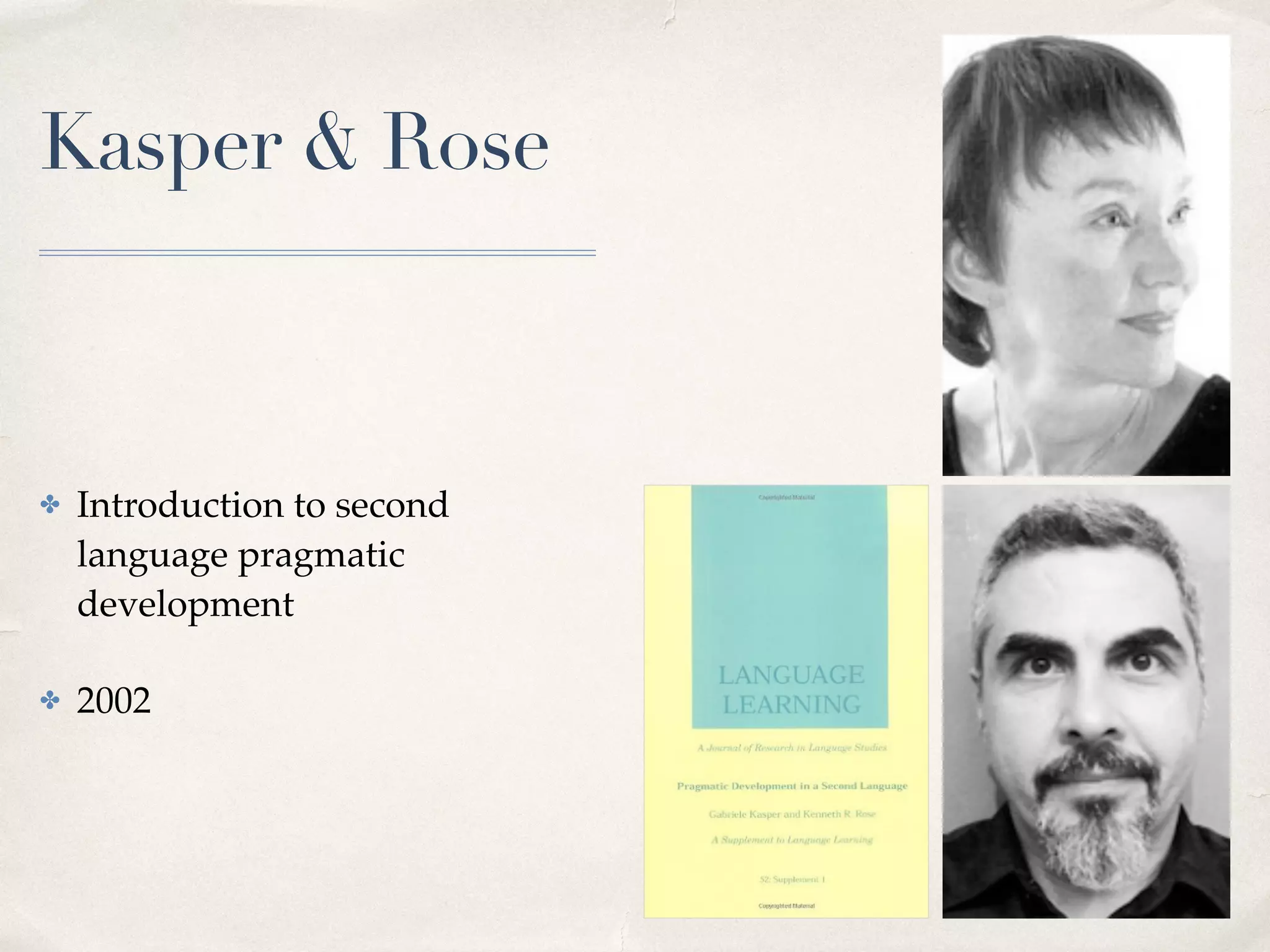
Kasper & Rose
✤ Introduction to second
language pragmatic
development
✤ 2002
What is pragmatics?
✤ “the societally necessary and consciously interactive
dimension of the study of language” (Mey, 1993).
✤ “the study of language from the point of view of users,
especially of the choices they make, the constraints they
encounter in using language in social interaction and
the effects their use of language has on other
participants in the act of communication” (Crystal, 1997)
✤ “meaning in interaction” (Thomas, 1995)
“Pragmatic meanings arise from choices between linguistic
forms, such as using one discourse marker or particle over
another, or opting for one linguistic format of a
communicative act instead of a contextually possible alterna-
tive to convey illocutionary force or politeness.”
–Kasper & Rose, 2002
“Speakers’ and writers’ choices,however, are not unconstrained
but are governed by social conventions,which can be flexed to
different, contextually varying degrees but only entirely set
aside at the peril of losing claims to face, insider status, or
sanity.”
interlanguage studies
✤ interlanguage grammar
✤ interlanguage phonology
✤ interlanguage lexicon
✤ interlanguage pragmatics
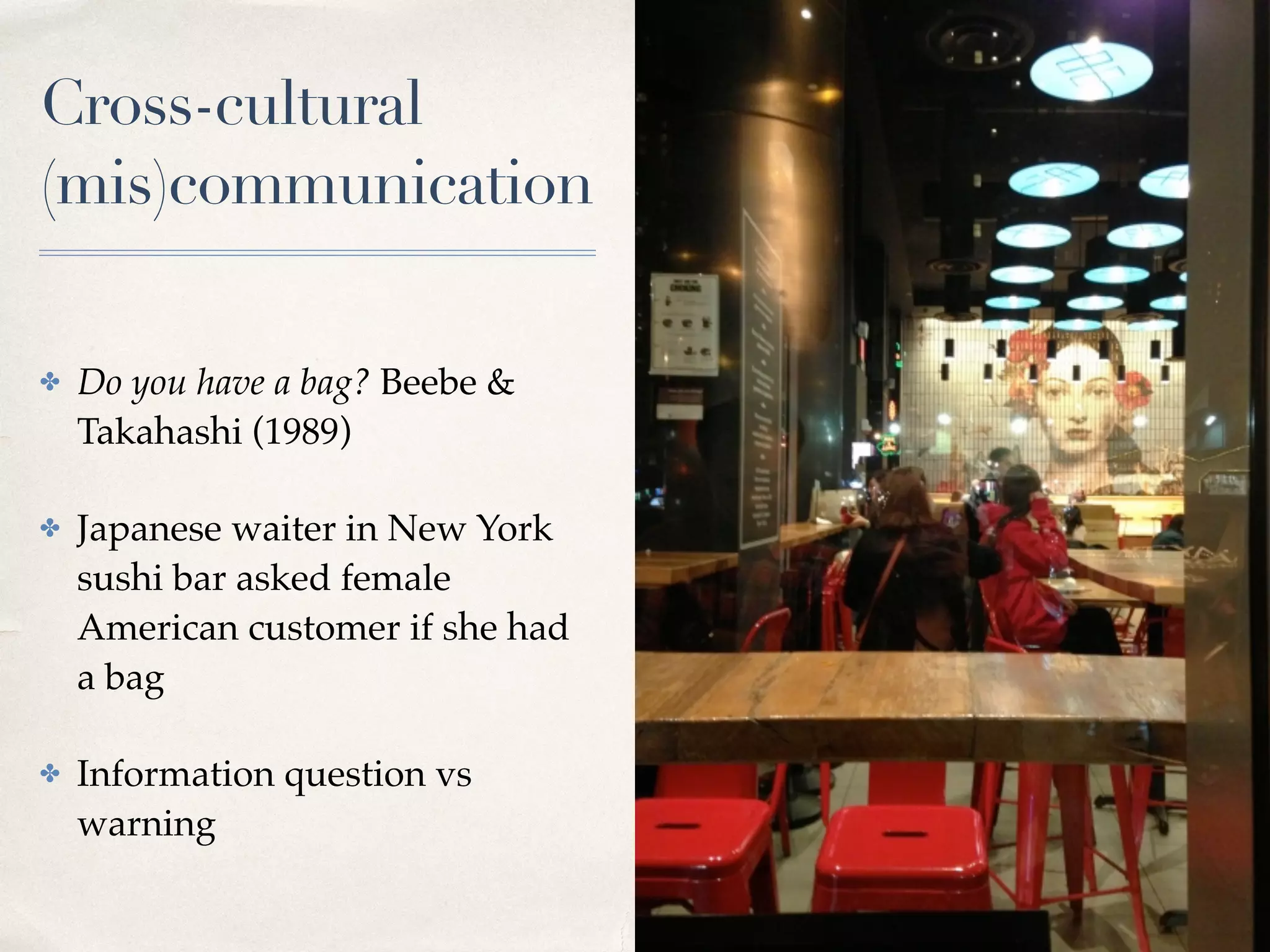
Cross-cultural
(mis)communication
✤ Do you have a bag? Beebe &
Takahashi (1989)
✤ Japanese waiter in New York
sushi bar asked female
American customer if she had
a bag
✤ Information question vs
warning
the pragmatic ability of non-native
speakers
✤ comprehension of L2 pragmatic meanings
✤ production of L2 pragmatic meanings
✤ interactions in different settings
✤ pragmatic aspects of L2 writing
use or
development?
✤ researchers working in
interlanguage pragmatics have not
emphasised the acquisitional
dimension of pragmatics (how
learners learn to use language
appropriately)
✤ researchers have treated
pragmatics as if it has no
developmental dimension
✤ pragmatics has been studied as an
issue of language use, not
development
not only [is] interlanguage
pragmatics not
fundamentally acquisitional,
but it [is] in fact
fundamentally not
acquisitional
Bardovi-Harlig, 1999
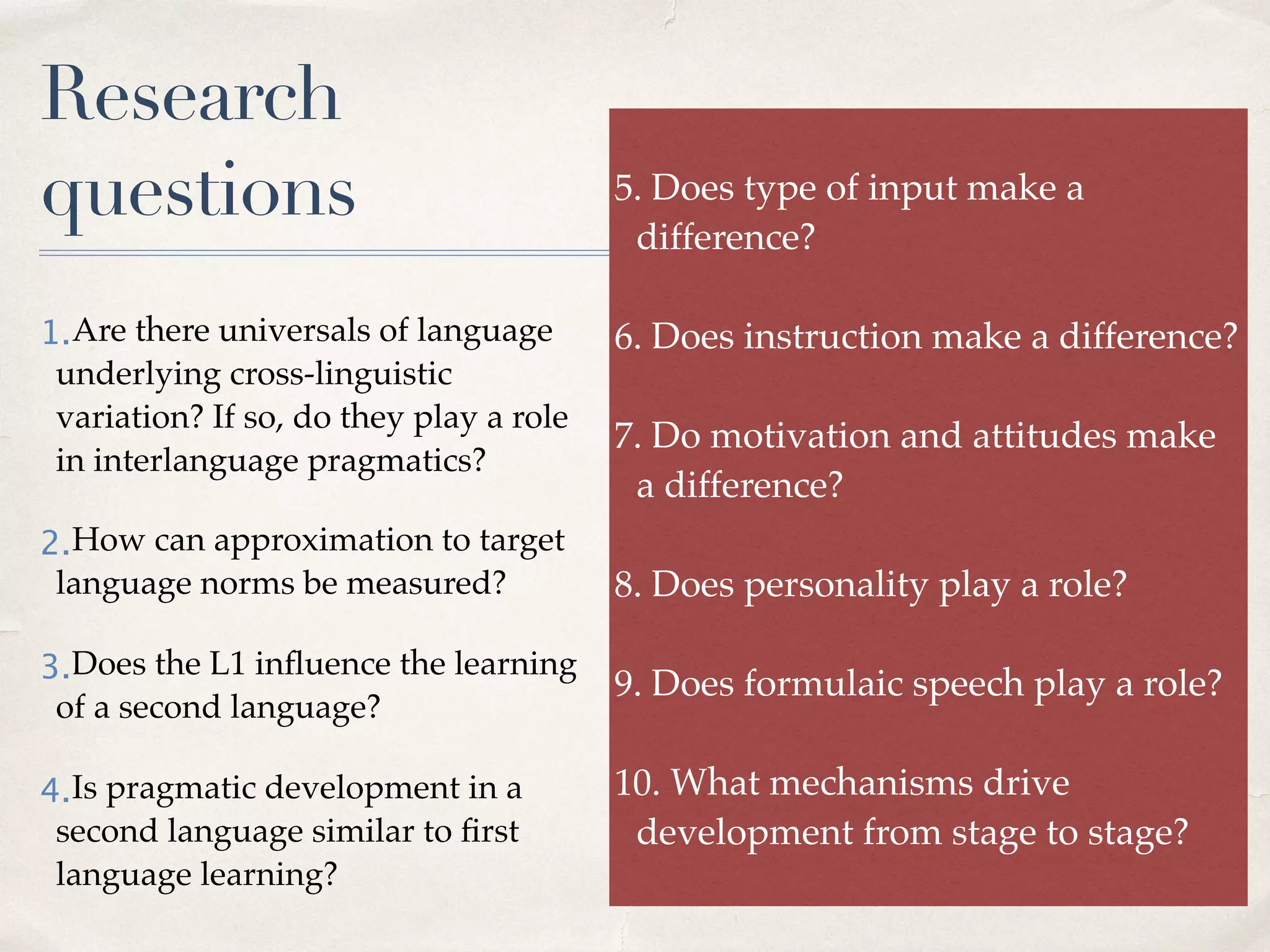
Research
questions
1.Are there universals of language
underlying cross-linguistic
variation? If so, do they play a role
in interlanguage pragmatics?
2.How can approximation to target
language norms be measured?
3.Does the L1 influence the learning
of a second language?
4.Is pragmatic development in a
second language similar to first
language learning?
5. Does type of input make a
difference?

6. Does instruction make a difference?

7. Do motivation and attitudes make
a difference?

8. Does personality play a role?

9. Does formulaic speech play a role?

10. What mechanisms drive
development from stage to stage?
L2 pragmatics
1. What is pragmatics and why should language
teachers be interested?
2. How can we study pragmatics? Aisha Siddiqa
3. How can you contribute to this area during your
school placement?
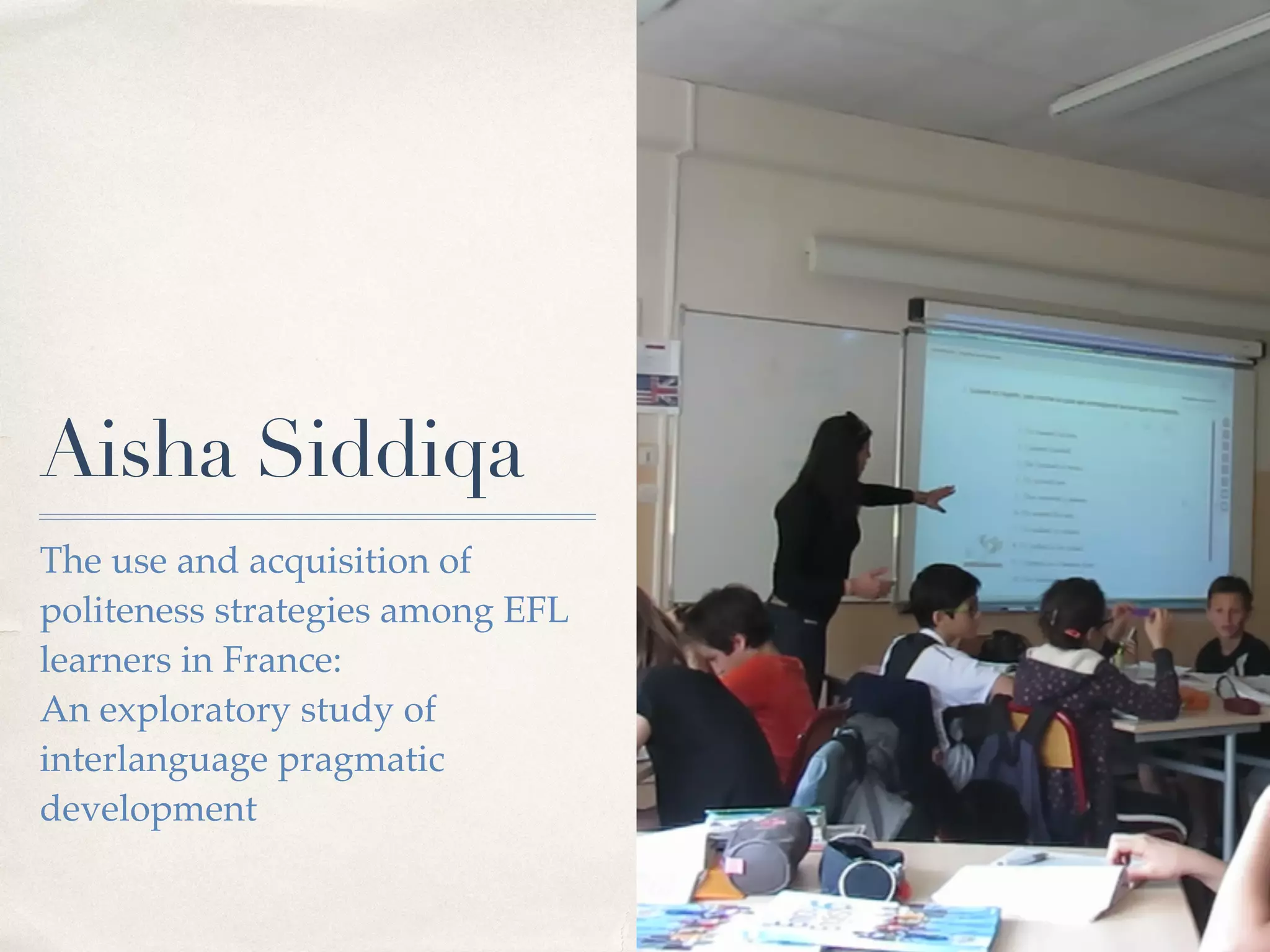
Aisha Siddiqa
The use and acquisition of
politeness strategies among EFL
learners in France: 

An exploratory study of
interlanguage pragmatic
development
L2 pragmatics
1. What is pragmatics and why should language
teachers be interested?
2. How can we study pragmatics? Aisha Siddiqa
3. How can you contribute to this area during your
school placement?
School
placements
✤ First placement (November):
observation

=> what kinds of requests can
you spot?
✤ Second placement (Spring):

intervention

=> what kind of teaching/
learning activity can you
design?
Observation of secondary school
requests
✤ analysis of written teaching material (textbook, or teacher
handouts) - look at any examples of requests, or teaching of
requests, or opportunities for requests to be made
✤ observation/recording/filming of classroom interaction,
looking for requests in EN or FR
✤ COPT in French
✤ interview students/teachers about views of objectives of
English teaching/learning
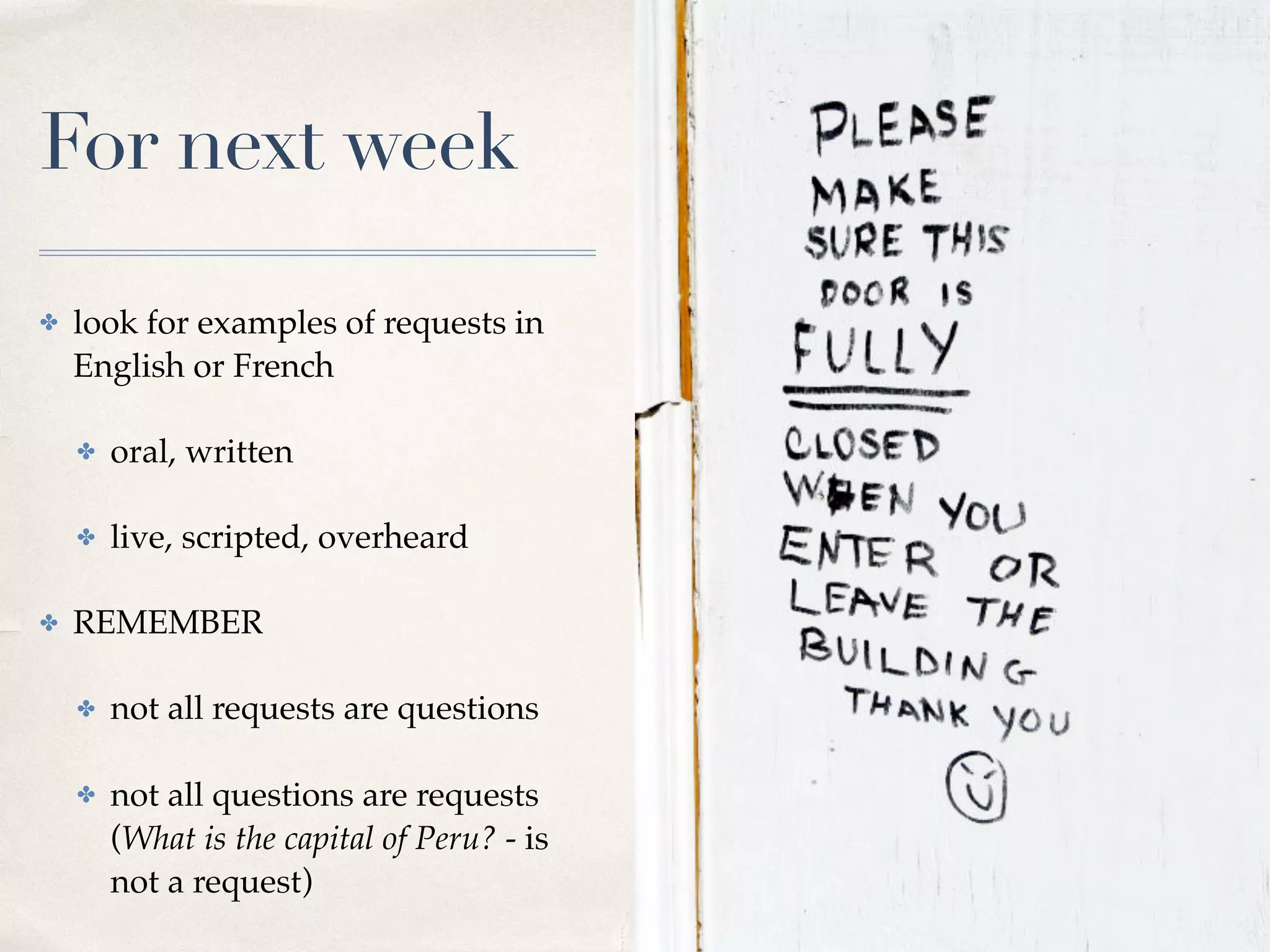
For next week
✤ look for examples of requests in
English or French
✤ oral, written
✤ live, scripted, overheard
✤ REMEMBER
✤ not all requests are questions
✤ not all questions are requests 

(What is the capital of Peru? - is
not a request)

L2 pragmatics M1 MEEF classroom research

  • 1.
    6/11/15 Classroom observation andresearchVMAN14 bit.ly/1k24xjo L2 pragmatics
  • 2.
    Other classes … ✤audio diaries VMAN121 ✤ YouTube You Teach
  • 3.
    VMAN14 
 Classroom research ✤school placement: observing classroom practice ✤ learning about classroom research Elaine Tarone: exploring learner language
 Lynda Yates: softening short requests
  • 4.
    L2 pragmatics 1. Whatis pragmatics and why should language teachers be interested? 2. How can we study pragmatics? Aisha Siddiqa 3. How can you contribute to this area during your school placement?
  • 5.
    Kasper & Rose ✤Introduction to second language pragmatic development ✤ 2002
  • 6.
    What is pragmatics? ✤“the societally necessary and consciously interactive dimension of the study of language” (Mey, 1993). ✤ “the study of language from the point of view of users, especially of the choices they make, the constraints they encounter in using language in social interaction and the effects their use of language has on other participants in the act of communication” (Crystal, 1997) ✤ “meaning in interaction” (Thomas, 1995)
  • 7.
    “Pragmatic meanings arisefrom choices between linguistic forms, such as using one discourse marker or particle over another, or opting for one linguistic format of a communicative act instead of a contextually possible alterna- tive to convey illocutionary force or politeness.” –Kasper & Rose, 2002 “Speakers’ and writers’ choices,however, are not unconstrained but are governed by social conventions,which can be flexed to different, contextually varying degrees but only entirely set aside at the peril of losing claims to face, insider status, or sanity.”
  • 8.
    interlanguage studies ✤ interlanguagegrammar ✤ interlanguage phonology ✤ interlanguage lexicon ✤ interlanguage pragmatics
  • 9.
    Cross-cultural (mis)communication ✤ Do youhave a bag? Beebe & Takahashi (1989) ✤ Japanese waiter in New York sushi bar asked female American customer if she had a bag ✤ Information question vs warning
  • 10.
    the pragmatic abilityof non-native speakers ✤ comprehension of L2 pragmatic meanings ✤ production of L2 pragmatic meanings ✤ interactions in different settings ✤ pragmatic aspects of L2 writing
  • 11.
    use or development? ✤ researchersworking in interlanguage pragmatics have not emphasised the acquisitional dimension of pragmatics (how learners learn to use language appropriately) ✤ researchers have treated pragmatics as if it has no developmental dimension ✤ pragmatics has been studied as an issue of language use, not development not only [is] interlanguage pragmatics not fundamentally acquisitional, but it [is] in fact fundamentally not acquisitional Bardovi-Harlig, 1999
  • 12.
    Research questions 1.Are there universalsof language underlying cross-linguistic variation? If so, do they play a role in interlanguage pragmatics? 2.How can approximation to target language norms be measured? 3.Does the L1 influence the learning of a second language? 4.Is pragmatic development in a second language similar to first language learning? 5. Does type of input make a difference?
 6. Does instruction make a difference?
 7. Do motivation and attitudes make a difference?
 8. Does personality play a role?
 9. Does formulaic speech play a role?
 10. What mechanisms drive development from stage to stage?
  • 13.
    L2 pragmatics 1. Whatis pragmatics and why should language teachers be interested? 2. How can we study pragmatics? Aisha Siddiqa 3. How can you contribute to this area during your school placement?
  • 14.
    Aisha Siddiqa The useand acquisition of politeness strategies among EFL learners in France: 
 An exploratory study of interlanguage pragmatic development
  • 15.
    L2 pragmatics 1. Whatis pragmatics and why should language teachers be interested? 2. How can we study pragmatics? Aisha Siddiqa 3. How can you contribute to this area during your school placement?
  • 16.
    School placements ✤ First placement(November): observation
 => what kinds of requests can you spot? ✤ Second placement (Spring):
 intervention
 => what kind of teaching/ learning activity can you design?
  • 17.
    Observation of secondaryschool requests ✤ analysis of written teaching material (textbook, or teacher handouts) - look at any examples of requests, or teaching of requests, or opportunities for requests to be made ✤ observation/recording/filming of classroom interaction, looking for requests in EN or FR ✤ COPT in French ✤ interview students/teachers about views of objectives of English teaching/learning
  • 18.
    For next week ✤look for examples of requests in English or French ✤ oral, written ✤ live, scripted, overheard ✤ REMEMBER ✤ not all requests are questions ✤ not all questions are requests 
 (What is the capital of Peru? - is not a request)